Forum for Agricultural Research in Africa


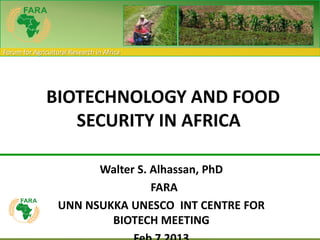
               BIOTECHNOLOGY AND FOOD
                  SECURITY IN AFRICA

                         Walter S. Alhassan, PhD
                                   FARA
                   UNN NSUKKA UNESCO INT CENTRE FOR
                           BIOTECH MEETING
ANCIENT PROVERB


     „He who has bread may have
     troubles; He who lacks it has only
     one‟


Forum for Agricultural Research in Africa
INTRODUCTION

      West Africa is a food insecure region.
     The FAO (2012) estimates that 1 in 4 of
     the world’s 840 million malnourished live
     in West Africa. Globally, more than 1
     billion people are malnourished. Rising
     population and low agricultural
     productivity worsen the food situation.


Forum for Agricultural Research in Africa
GLOBAL HUNGER INDEX


     GHI= number undernourished as per cent of
     total population + proportion chldn aged 5 and
     below underweight + mortality in chldn 5 and
     below.


Forum for Agricultural Research in Africa
INTRODUCTION
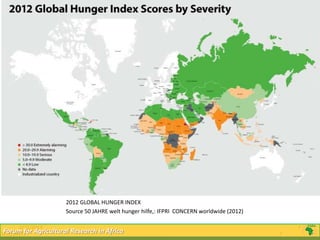
     The 2012 Global Hunger Index (GHI)
     map shows:
     • Nearly all of sub-Sahara Africa is
       in the “serious” hunger
       classification.
     • Exceptions are South Africa,
       Gabon, Mauritius and Ghana.


Forum for Agricultural Research in Africa
INTRODUCTION

     • For West Africa, Niger and Sierra Leone
       classified as “alarming”.
     • Ghana is the only country the sub-region
       classified as “Moderate” and meeting the
       MDG 1
     • Most of the increase in food crop production
       has been attributed more to areal expansion
       of farmlands than increased productivity per
       unit area.

Forum for Agricultural Research in Africa
2012 GLOBAL HUNGER INDEX
                       Source 50 JAHRE welt hunger hilfe,: IFPRI CONCERN worldwide (2012)

      2/22/2013                                                                                 7
2/22/2013for Agricultural Research in Africa
 Forum                                                                                      7
INTRODUCTION
      Solution lies in:
     • The application of known
       technologies in agriculture.
     • Coupled with the introduction of
       modern biotechnology on a need
       basis.


Forum for Agricultural Research in Africa
INTRODUCTION
     • Modern biotech covers a range of tools:
      Tissue culture
      DNA characterisation of germplasm,
      Marker assisted selection (use of DNA
       fragments as markers for the molecular
       identification of desirable genes)
          In 2012 a major breakthrough in Marker
           Assisted Breeding was reported in
           Tanzania for cassava.


Forum for Agricultural Research in Africa
INTRODUCTION
         Cassava varieties resistant to the ACMV
          and Cassava Brown Streak Disease both
          devastating of cassava in East Africa
          were developed using MAS. Was a
          collaborative research effort: ARI, Tanz,
          CIAT, NRCRI, IITA, Donald Danforth and
          GCP.
      Genetic transformation (genetic engineering
      or genetic modification). Most potent of the
      biotechnology tools. Use governed by the
      application of legislative frameworks that
      guarantee acceptable levels of safety.
Forum for Agricultural Research in Africa
GM RECENT BIOETHICS ANALYSIS
     Study (Casquier and Otiz, 2012) considered the
     social, cultural, environmental and moral
     impacts of the use of modern biotechnology in
     the transgenic improvement of crops,
     concluded that:
     • “in order to feed so many people without
       destroying the environment in this century it
       is necessary to have more production using
       agro-biotechnology,
     • In spite of all the objections it will contribute
       to the conservation of biodiversity and the
       preservation of the environment.”
Forum for Agricultural Research in Africa
WHEN CAN GM BE APPLIED?


     • Intractable pests and diseases,
     • Declining soil fertility,
     • Climate change phenomena of drought and
       flooding,
     • Nutrient deficiencies
     • Danger of agro-chemical residues in food or
       water resources.
     • Sustainable intensification of agriculture.


Forum for Agricultural Research in Africa
SOME GM APPLICATION
                  CHALLENGES IN AFRICA

     • The existence of enabling legislation
       for GM crops,
     • Infrastructural support services,
     • Agro-input supply
     • Seed legislation
     • Markets and a core of well-trained and
       motivated scientists and informed
       farmers

Forum for Agricultural Research in Africa
Burkina Faso GM Crop Status
     • Cotton is biggest export crop. Africa’s leader.
     • In 2012-2013 57.5% increase in cotton
       reported due to GM application. 400,000 tons
       in 2011 to 630,000 tons in 2012.
     • About 250,000 of the 350,000 producers are
       small scale farmers.
     • Area under Bt cottong is 250,000 ha. Bollgard
       II (Monsanto) used. Insect damage to cotton
       is 50-70%. Pyrethroids used from 1998 but
       there is built up resistance now. Increase
       number of sprays from 4-5 to 6-8.
Forum for Agricultural Research in Africa
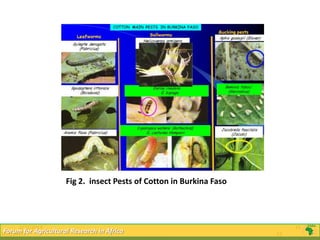
Fig 2. insect Pests of Cotton in Burkina Faso


      2/22/2013                                                             15
2/22/2013for Agricultural Research in Africa
 Forum                                                                 15
Burkina Faso GM crop Status

     • Conventional cotton : increased resistance
       from pyrethroids. More spraying (6-8).
     • Bt cotton future management : refugia zones.
           Relates to BIOTECHNOLOGY
           STEWARDSHIP.
           Currently 15m wide refugia advocated.

     • Reduces chance of insect resistance to Bt.


Forum for Agricultural Research in Africa
Burkina Faso GM crop Status
                                            Bt Cowpea

     • Burkina Faso is the third largest cowpea
       producer in Africa. Nigeria is the largest.
       producer. Produced 537,000 tons in 2008.
       Current yield is 600kg/ha.
     • Major pests : Aphis, thrips and maruca.
       Maruca pod borer is the most devastating.


Forum for Agricultural Research in Africa
Burkina Faso GM crop Status

                     Bt cowpea
     • Burkina Faso is one of 3 countries in
       Africa undertaking confined field trials
       on Bt cowpea.
     • Cowpea is genetically engineered to
       control the cowpea pod borer (Maruca).


Forum for Agricultural Research in Africa
Burkina Faso GM crop Status

                   Africa Biofortified Sorghum (ABS)

     • Nutrient enhanced sorghum (hi carotene,
       iron and lysine) on test as at 2011.
     • Gene flow studies.
     • Burkina Faso is part of the ABS consortium
       involving Kenya, South Africa, Nigeria. Most
       of the consortium work has been
       coordinated by Africa Harvest.

Forum for Agricultural Research in Africa
Nigeria GM crop Status
     • National institutions actively engaged in GM
       biotechnology research at the CFT level are
       the Institute of Agricultural Research (IAR),
       Samaru, Zaria, Nigeria and the National Root
       Crops Research Institute (NRCRI), Umudike.

     • GM crops under study at the field trial level
       are cassava, cowpea and sorghum


Forum for Agricultural Research in Africa
Nigeria GM crop Status
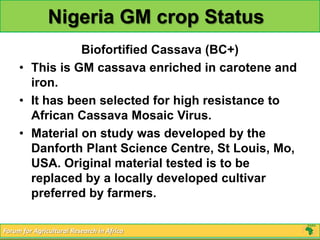
                Biofortified Cassava (BC+)
     • This is GM cassava enriched in carotene and
       iron.
     • It has been selected for high resistance to
       African Cassava Mosaic Virus.
     • Material on study was developed by the
       Danforth Plant Science Centre, St Louis, Mo,
       USA. Original material tested is to be
       replaced by a locally developed cultivar
       preferred by farmers.

Forum for Agricultural Research in Africa
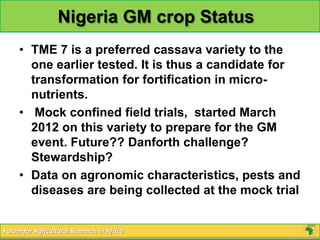
Nigeria GM crop Status
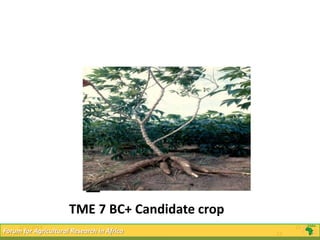
     • TME 7 is a preferred cassava variety to the
       one earlier tested. It is thus a candidate for
       transformation for fortification in micro-
       nutrients.
     • Mock confined field trials, started March
       2012 on this variety to prepare for the GM
       event. Future?? Danforth challenge?
       Stewardship?
     • Data on agronomic characteristics, pests and
       diseases are being collected at the mock trial


Forum for Agricultural Research in Africa
TME 7 BC+ Candidate crop
      2/22/2013                                         23
2/22/2013for Agricultural Research in Africa
 Forum                                             23
Cowpea Production, Nigeria


     •   World’s largest producer.
     •   2.2 m tons grain produced
     •   7 m ha cultivated
     •   Av yield is 350 kg/ha
     •   Grown extensively in the
         Savannas/Derived Savannas.

Forum for Agricultural Research in Africa
Cowpea Production, Nigeria
                          Bt Cowpea
     • Trials have been on-going under CFT for 3
       years now.
     • Promising lines have been identified and
       have been introgressed into preferred local
       lines and being evaluated. At least 2 more
       years’ study pending food safety and mulit-
       locational trials.
     • Trials are at the IAR of the Ahmadu Bello
       University Samaru, Zaria, Nigeria.

Forum for Agricultural Research in Africa
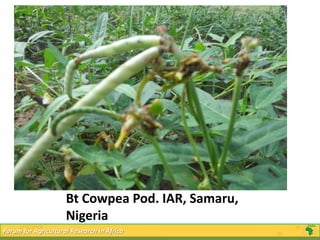
Bt Cowpea Pod. IAR, Samaru,
                       Nigeria
      2/22/2013                                           26
2/22/2013for Agricultural Research in Africa
 Forum                                               26
Ghana GM Pipeline Products
     Permits have been granted for the following
     CFTs:
      GM Insect (Maruca) Resistant Cowpea
       (CSIR-SARI)
      Nitrogen and Water Use Efficient and Salt
       Tolerant Rice (CSIR-CRI)
      GM High Protein Sweet Potato (CSIR-CRI)


Forum for Agricultural Research in Africa
Other High Potential GM Crops,
                       Ghana
     Uncertain timeframe
     • ACMV cassava. Suggest linkages: IITA, GCP..
     • Black Sigatoka banana and plantain. Suggest
       link with NARO, Uganda.
     • Lethal Yellowing Disease Resistant Coconut
       (Central and Western Regions of Ghana).
       French assistance. Molecular non-GM
       approaches.
     • Diamond Back Moth (Plutela) resistant
       cabbage. External GM solution available.

Forum for Agricultural Research in Africa
ANIMAL BIOTECHNOLOGY
     • Globally has received much less attention
       than crop biotechnology.
     • Active areas include breed characterisation
       using molecular tools. Senegal, Ghana, etc.
     • Recombinant vaccine production. CBPP
       vaccine is candidate for recombinant DNA.
       Mali interest.
     • Diagnostics
     • Vaccine and diagnostics production are
       costly. Need public-private partnership.

Forum for Agricultural Research in Africa
GM PROSPECTS: WEST AFRICA
     • For Ghana: at least 3 GM crops will be tested
       under CFTs starting 2012.
     • For Ghana, Bt cotton will be introduced
       without the need for a CFT. Multi-locational
       trials on farmer’s fields will suffice.
     • Nigeria will release Bt cowpea and nutrient
       enhanced cassava in a 3-5 year timeframe.
     • Burkina Faso, Ghana and Nigeria are working
       on the same Bt cowpea event. All countries
       might release Bt cowpea over the 3-5 year
       timeframe.
Forum for Agricultural Research in Africa
GM PROSPECTS: WEST AFRICA


     • The release of GM crops into the food chain
       by local public sector research institutes
       might create a bandwagon effect in the
       uptake of GM technologies in West Africa.
     • Biotechnology stewardship training will
       assume great significance in the handling of
       GM crops including by small holder farmers.
     • Such stewardship training has been
       introduced to Burkina Faso, Ghana and
       Nigeria, Uganda, Kenya and Malawi by the
       FARA SABIMA Project.
Forum for Agricultural Research in Africa
CHALLENGES/WAY FORWARD
     • Need to accelerate biosafety legislation.
       Legislation should not be restrictive.
     • Enabling environment for agriculture: seed
       and other input supply, infrastructure
       support services, market, etc.
     • Scientific human resource development in
       the critical areas: plant breeding, animal
       breeding, crop protection, veterinary
       medicine, fermentation, molecular biology
       and biosafety.
     • Increased efforts in animal biotechnology.
Forum for Agricultural Research in Africa
ACKNOWLEDGMENTS

     • Dr. Hamidou Traore, INERA,
       Ouagadougou, Burkina Faso
     • Dr. Chiedozie Egesi, NRCRI, Umudike,
       Nigeria.
     • Dr. Marian Dorcas Quain- CSIR-CRI,
       Kumasi, Ghana.
     • Prof. Mohammad Ishiyaku-IAR, Samaru,
       Zaria, Nigeria.

Forum for Agricultural Research in Africa


                               Thank you

                       get bi-monthly news from African
                    agriculture research for development by
                                 subscribing at :
                              www.fara-africa.org

Bio technology and food security

  • 1.
    Forum for AgriculturalResearch in Africa BIOTECHNOLOGY AND FOOD SECURITY IN AFRICA Walter S. Alhassan, PhD FARA UNN NSUKKA UNESCO INT CENTRE FOR BIOTECH MEETING
  • 2.
    ANCIENT PROVERB „He who has bread may have troubles; He who lacks it has only one‟ Forum for Agricultural Research in Africa
  • 3.
    INTRODUCTION West Africa is a food insecure region. The FAO (2012) estimates that 1 in 4 of the world’s 840 million malnourished live in West Africa. Globally, more than 1 billion people are malnourished. Rising population and low agricultural productivity worsen the food situation. Forum for Agricultural Research in Africa
  • 4.
    GLOBAL HUNGER INDEX GHI= number undernourished as per cent of total population + proportion chldn aged 5 and below underweight + mortality in chldn 5 and below. Forum for Agricultural Research in Africa
  • 5.
    INTRODUCTION The 2012 Global Hunger Index (GHI) map shows: • Nearly all of sub-Sahara Africa is in the “serious” hunger classification. • Exceptions are South Africa, Gabon, Mauritius and Ghana. Forum for Agricultural Research in Africa
  • 6.
    INTRODUCTION • For West Africa, Niger and Sierra Leone classified as “alarming”. • Ghana is the only country the sub-region classified as “Moderate” and meeting the MDG 1 • Most of the increase in food crop production has been attributed more to areal expansion of farmlands than increased productivity per unit area. Forum for Agricultural Research in Africa
  • 7.
    2012 GLOBAL HUNGERINDEX Source 50 JAHRE welt hunger hilfe,: IFPRI CONCERN worldwide (2012) 2/22/2013 7 2/22/2013for Agricultural Research in Africa Forum 7
  • 8.
    INTRODUCTION Solution lies in: • The application of known technologies in agriculture. • Coupled with the introduction of modern biotechnology on a need basis. Forum for Agricultural Research in Africa
  • 9.
    INTRODUCTION • Modern biotech covers a range of tools:  Tissue culture  DNA characterisation of germplasm,  Marker assisted selection (use of DNA fragments as markers for the molecular identification of desirable genes)  In 2012 a major breakthrough in Marker Assisted Breeding was reported in Tanzania for cassava. Forum for Agricultural Research in Africa
  • 10.
    INTRODUCTION  Cassava varieties resistant to the ACMV and Cassava Brown Streak Disease both devastating of cassava in East Africa were developed using MAS. Was a collaborative research effort: ARI, Tanz, CIAT, NRCRI, IITA, Donald Danforth and GCP.  Genetic transformation (genetic engineering or genetic modification). Most potent of the biotechnology tools. Use governed by the application of legislative frameworks that guarantee acceptable levels of safety. Forum for Agricultural Research in Africa
  • 11.
    GM RECENT BIOETHICSANALYSIS Study (Casquier and Otiz, 2012) considered the social, cultural, environmental and moral impacts of the use of modern biotechnology in the transgenic improvement of crops, concluded that: • “in order to feed so many people without destroying the environment in this century it is necessary to have more production using agro-biotechnology, • In spite of all the objections it will contribute to the conservation of biodiversity and the preservation of the environment.” Forum for Agricultural Research in Africa
  • 12.
    WHEN CAN GMBE APPLIED? • Intractable pests and diseases, • Declining soil fertility, • Climate change phenomena of drought and flooding, • Nutrient deficiencies • Danger of agro-chemical residues in food or water resources. • Sustainable intensification of agriculture. Forum for Agricultural Research in Africa
  • 13.
    SOME GM APPLICATION CHALLENGES IN AFRICA • The existence of enabling legislation for GM crops, • Infrastructural support services, • Agro-input supply • Seed legislation • Markets and a core of well-trained and motivated scientists and informed farmers Forum for Agricultural Research in Africa
  • 14.
    Burkina Faso GMCrop Status • Cotton is biggest export crop. Africa’s leader. • In 2012-2013 57.5% increase in cotton reported due to GM application. 400,000 tons in 2011 to 630,000 tons in 2012. • About 250,000 of the 350,000 producers are small scale farmers. • Area under Bt cottong is 250,000 ha. Bollgard II (Monsanto) used. Insect damage to cotton is 50-70%. Pyrethroids used from 1998 but there is built up resistance now. Increase number of sprays from 4-5 to 6-8. Forum for Agricultural Research in Africa
  • 15.
    Fig 2. insectPests of Cotton in Burkina Faso 2/22/2013 15 2/22/2013for Agricultural Research in Africa Forum 15
  • 16.
    Burkina Faso GMcrop Status • Conventional cotton : increased resistance from pyrethroids. More spraying (6-8). • Bt cotton future management : refugia zones. Relates to BIOTECHNOLOGY STEWARDSHIP. Currently 15m wide refugia advocated. • Reduces chance of insect resistance to Bt. Forum for Agricultural Research in Africa
  • 17.
    Burkina Faso GMcrop Status Bt Cowpea • Burkina Faso is the third largest cowpea producer in Africa. Nigeria is the largest. producer. Produced 537,000 tons in 2008. Current yield is 600kg/ha. • Major pests : Aphis, thrips and maruca. Maruca pod borer is the most devastating. Forum for Agricultural Research in Africa
  • 18.
    Burkina Faso GMcrop Status Bt cowpea • Burkina Faso is one of 3 countries in Africa undertaking confined field trials on Bt cowpea. • Cowpea is genetically engineered to control the cowpea pod borer (Maruca). Forum for Agricultural Research in Africa
  • 19.
    Burkina Faso GMcrop Status Africa Biofortified Sorghum (ABS) • Nutrient enhanced sorghum (hi carotene, iron and lysine) on test as at 2011. • Gene flow studies. • Burkina Faso is part of the ABS consortium involving Kenya, South Africa, Nigeria. Most of the consortium work has been coordinated by Africa Harvest. Forum for Agricultural Research in Africa
  • 20.
    Nigeria GM cropStatus • National institutions actively engaged in GM biotechnology research at the CFT level are the Institute of Agricultural Research (IAR), Samaru, Zaria, Nigeria and the National Root Crops Research Institute (NRCRI), Umudike. • GM crops under study at the field trial level are cassava, cowpea and sorghum Forum for Agricultural Research in Africa
  • 21.
    Nigeria GM cropStatus Biofortified Cassava (BC+) • This is GM cassava enriched in carotene and iron. • It has been selected for high resistance to African Cassava Mosaic Virus. • Material on study was developed by the Danforth Plant Science Centre, St Louis, Mo, USA. Original material tested is to be replaced by a locally developed cultivar preferred by farmers. Forum for Agricultural Research in Africa
  • 22.
    Nigeria GM cropStatus • TME 7 is a preferred cassava variety to the one earlier tested. It is thus a candidate for transformation for fortification in micro- nutrients. • Mock confined field trials, started March 2012 on this variety to prepare for the GM event. Future?? Danforth challenge? Stewardship? • Data on agronomic characteristics, pests and diseases are being collected at the mock trial Forum for Agricultural Research in Africa
  • 23.
    TME 7 BC+Candidate crop 2/22/2013 23 2/22/2013for Agricultural Research in Africa Forum 23
  • 24.
    Cowpea Production, Nigeria • World’s largest producer. • 2.2 m tons grain produced • 7 m ha cultivated • Av yield is 350 kg/ha • Grown extensively in the Savannas/Derived Savannas. Forum for Agricultural Research in Africa
  • 25.
    Cowpea Production, Nigeria Bt Cowpea • Trials have been on-going under CFT for 3 years now. • Promising lines have been identified and have been introgressed into preferred local lines and being evaluated. At least 2 more years’ study pending food safety and mulit- locational trials. • Trials are at the IAR of the Ahmadu Bello University Samaru, Zaria, Nigeria. Forum for Agricultural Research in Africa
  • 26.
    Bt Cowpea Pod.IAR, Samaru, Nigeria 2/22/2013 26 2/22/2013for Agricultural Research in Africa Forum 26
  • 27.
    Ghana GM PipelineProducts Permits have been granted for the following CFTs:  GM Insect (Maruca) Resistant Cowpea (CSIR-SARI)  Nitrogen and Water Use Efficient and Salt Tolerant Rice (CSIR-CRI)  GM High Protein Sweet Potato (CSIR-CRI) Forum for Agricultural Research in Africa
  • 28.
    Other High PotentialGM Crops, Ghana Uncertain timeframe • ACMV cassava. Suggest linkages: IITA, GCP.. • Black Sigatoka banana and plantain. Suggest link with NARO, Uganda. • Lethal Yellowing Disease Resistant Coconut (Central and Western Regions of Ghana). French assistance. Molecular non-GM approaches. • Diamond Back Moth (Plutela) resistant cabbage. External GM solution available. Forum for Agricultural Research in Africa
  • 29.
    ANIMAL BIOTECHNOLOGY • Globally has received much less attention than crop biotechnology. • Active areas include breed characterisation using molecular tools. Senegal, Ghana, etc. • Recombinant vaccine production. CBPP vaccine is candidate for recombinant DNA. Mali interest. • Diagnostics • Vaccine and diagnostics production are costly. Need public-private partnership. Forum for Agricultural Research in Africa
  • 30.
    GM PROSPECTS: WESTAFRICA • For Ghana: at least 3 GM crops will be tested under CFTs starting 2012. • For Ghana, Bt cotton will be introduced without the need for a CFT. Multi-locational trials on farmer’s fields will suffice. • Nigeria will release Bt cowpea and nutrient enhanced cassava in a 3-5 year timeframe. • Burkina Faso, Ghana and Nigeria are working on the same Bt cowpea event. All countries might release Bt cowpea over the 3-5 year timeframe. Forum for Agricultural Research in Africa
  • 31.
    GM PROSPECTS: WESTAFRICA • The release of GM crops into the food chain by local public sector research institutes might create a bandwagon effect in the uptake of GM technologies in West Africa. • Biotechnology stewardship training will assume great significance in the handling of GM crops including by small holder farmers. • Such stewardship training has been introduced to Burkina Faso, Ghana and Nigeria, Uganda, Kenya and Malawi by the FARA SABIMA Project. Forum for Agricultural Research in Africa
  • 32.
    CHALLENGES/WAY FORWARD • Need to accelerate biosafety legislation. Legislation should not be restrictive. • Enabling environment for agriculture: seed and other input supply, infrastructure support services, market, etc. • Scientific human resource development in the critical areas: plant breeding, animal breeding, crop protection, veterinary medicine, fermentation, molecular biology and biosafety. • Increased efforts in animal biotechnology. Forum for Agricultural Research in Africa
  • 33.
    ACKNOWLEDGMENTS • Dr. Hamidou Traore, INERA, Ouagadougou, Burkina Faso • Dr. Chiedozie Egesi, NRCRI, Umudike, Nigeria. • Dr. Marian Dorcas Quain- CSIR-CRI, Kumasi, Ghana. • Prof. Mohammad Ishiyaku-IAR, Samaru, Zaria, Nigeria. Forum for Agricultural Research in Africa
  • 34.
    Forum for AgriculturalResearch in Africa Thank you get bi-monthly news from African agriculture research for development by subscribing at : www.fara-africa.org