Group 9
Andri l M.Akbar.y.n Pandu.F
Actions to reduce global
warming
Sun
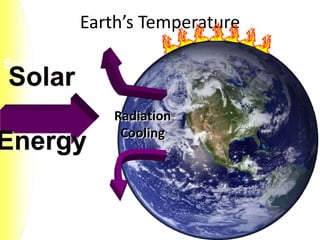
Earth’s Temperature
Solar
Energy
Radiation
Cooling
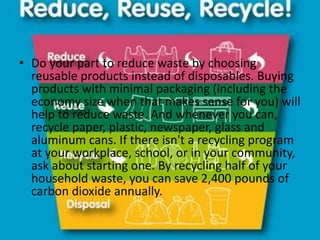
• Do your part to reduce waste by choosing
reusable products instead of disposables. Buying
products with minimal packaging (including the
economy size when that makes sense for you) will
help to reduce waste. And whenever you can,
recycle paper, plastic, newspaper, glass and
aluminum cans. If there isn't a recycling program
at your workplace, school, or in your community,
ask about starting one. By recycling half of your
household waste, you can save 2,400 pounds of
carbon dioxide annually.
Use less heat and air conditioning
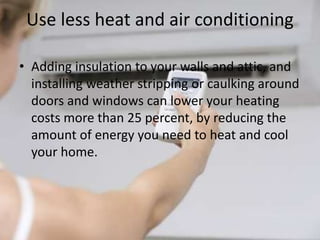
• Adding insulation to your walls and attic, and
installing weather stripping or caulking around
doors and windows can lower your heating
costs more than 25 percent, by reducing the
amount of energy you need to heat and cool
your home.
• Wherever practical, replace regular light bulbs
with compact fluorescent light (CFL) bulbs.
Replacing just one 60-watt incandescent light
bulb with a CFL will save you $30 over the life
of the bulb. CFLs also last 10 times longer than
incandescent bulbs, use two-thirds less
energy, and give off 70 percent less heat.
Drive less and drive smart
• Less driving means fewer emissions. Besides
saving gasoline, walking and biking are great
forms of exercise. Explore your community mass
transit system, and check out options for
carpooling to work or school.
• When you do drive, make sure your car is running
efficiently. For example, keeping your tires
properly inflated can improve your gas mileage by
more than 3 percent. Every gallon of gas you save
not only helps your budget, it also keeps 20
pounds of carbon dioxide out of the atmosphere.
Our take-home message…
Each of us must take steps to protect
our Earth's climate.
The end
See you later…………

global warming

  • 1.
    Group 9 Andri lM.Akbar.y.n Pandu.F
  • 2.
    Actions to reduceglobal warming
  • 3.
  • 6.
    • Do yourpart to reduce waste by choosing reusable products instead of disposables. Buying products with minimal packaging (including the economy size when that makes sense for you) will help to reduce waste. And whenever you can, recycle paper, plastic, newspaper, glass and aluminum cans. If there isn't a recycling program at your workplace, school, or in your community, ask about starting one. By recycling half of your household waste, you can save 2,400 pounds of carbon dioxide annually.
  • 7.
    Use less heatand air conditioning • Adding insulation to your walls and attic, and installing weather stripping or caulking around doors and windows can lower your heating costs more than 25 percent, by reducing the amount of energy you need to heat and cool your home.
  • 8.
    • Wherever practical,replace regular light bulbs with compact fluorescent light (CFL) bulbs. Replacing just one 60-watt incandescent light bulb with a CFL will save you $30 over the life of the bulb. CFLs also last 10 times longer than incandescent bulbs, use two-thirds less energy, and give off 70 percent less heat.
  • 9.
    Drive less anddrive smart • Less driving means fewer emissions. Besides saving gasoline, walking and biking are great forms of exercise. Explore your community mass transit system, and check out options for carpooling to work or school. • When you do drive, make sure your car is running efficiently. For example, keeping your tires properly inflated can improve your gas mileage by more than 3 percent. Every gallon of gas you save not only helps your budget, it also keeps 20 pounds of carbon dioxide out of the atmosphere.
  • 10.
    Our take-home message… Eachof us must take steps to protect our Earth's climate.
  • 11.
    The end See youlater…………