Introduction:
Why study clinker burning?
“To understand the influence of changes in kiln
operation conditions”
Normal kiln operation
Influence of chemistry, fineness, mineralogy
changes
Influence of new mix components (pozzolan,
AFR, sand, etc.)
Abnormal kiln operation
know causes of badly burnt clinker
understand why rings and deposits form
be able to suggest counter measures
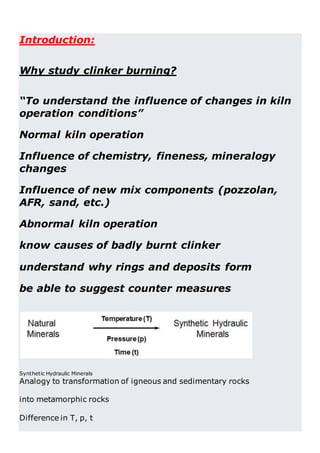
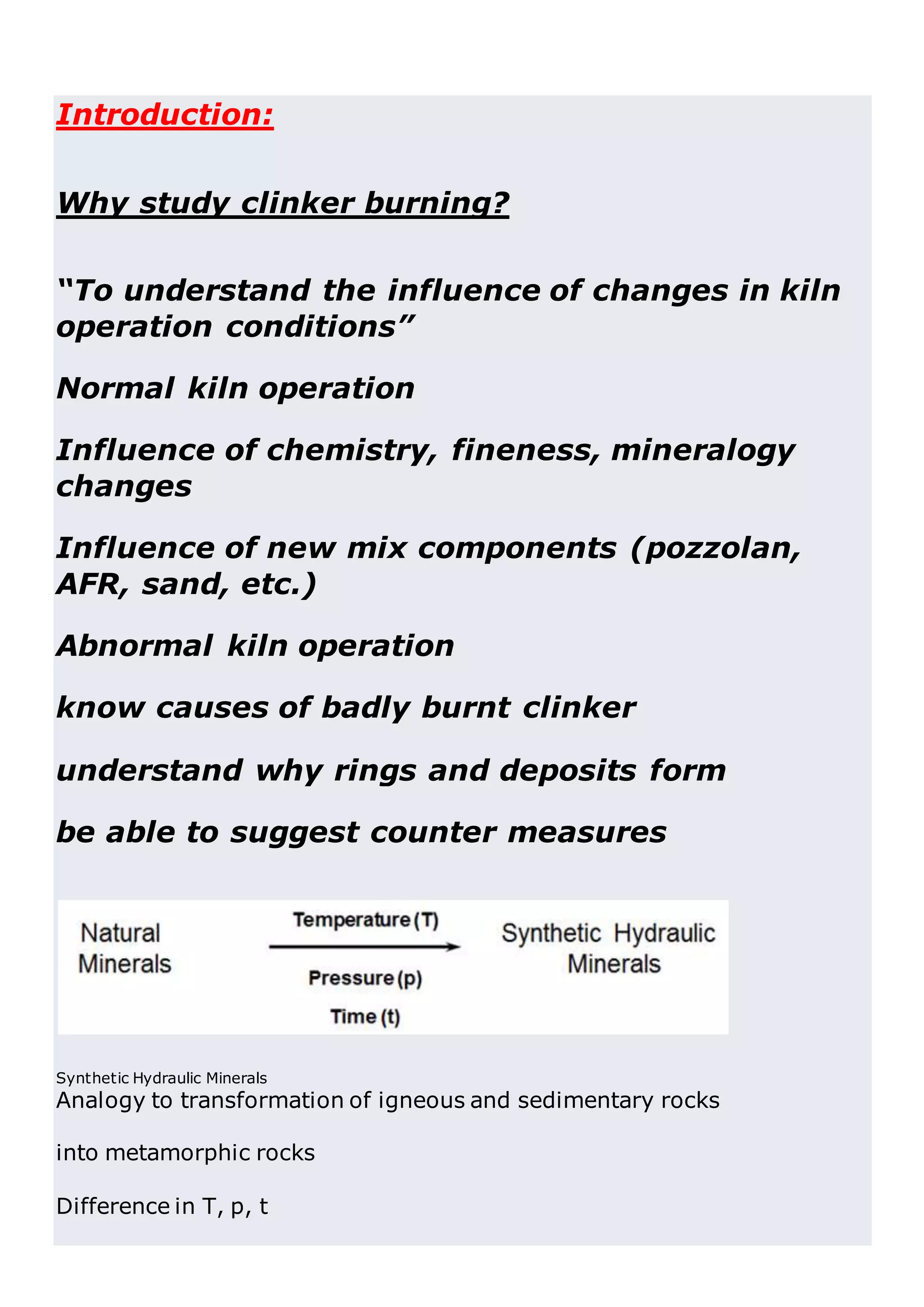
Synthetic Hydraulic Minerals
Analogy to transformation of igneous and sedimentary rocks
into metamorphic rocks
Difference in T, p, t
=============================================
=============================================
=
Two principal steps during transformation into clinker
Disintegration of original structure
Mechanical crushing and grinding
Thermal decomposition
Structural rearrangement on heating (e.g. polymorphism
Formation of new structures
Occurrence of intermediate products
Genesis and growth of final clinker minerals
Crystallization of liquid phase
=============================================
========================================
Features characterising the clinker formation process
-Complex system (series of diverse mechanisms)!
-Requires mechanical, thermal and electrical energy
-Reaction rate is slow (necessity of high temperatures, finely dispersed
material)
-Clinker minerals are not stable at normal temperature!
-Quality of product is determined by:
Clinker chemistry
Clinker microstructure
=============================================
=======================================
Control of burning process
Material technological aspects
-Raw meal burning behaviour
Burnability
Dust formation
Coating behaviour
Granulation of clinker
etc.
-Quantity and properties of liquid phase
Process technological aspects
-Temperature profile
-Kiln atmosphere
-Fuel type
-Flame characteristics
=============================================
======================================
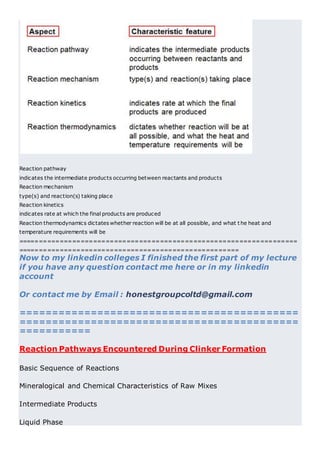
Reaction pathway
indicates the intermediate products occurring between reactants and products
Reaction mechanism
type(s) and reaction(s) taking place
Reaction kinetics
indicates rate at which the final products are produced
Reaction thermodynamics dictates whether reaction will be at all possible, and what t he heat and
temperature requirements will be
===================================================================
=====================================================
Now to my linkedin colleges I finished the first part of my lecture
if you have any question contact me here or in my linkedin
account
Or contact me by Email : honestgroupcoltd@gmail.com
===========================================
===========================================
===========
Reaction Pathways Encountered During Clinker Formation
Basic Sequence of Reactions
Mineralogical and Chemical Characteristics of Raw Mixes
Intermediate Products
Liquid Phase
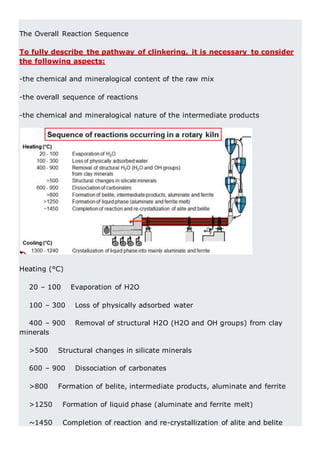
The Overall Reaction Sequence
To fully describe the pathway of clinkering, it is necessary to consider
the following aspects:
-the chemical and mineralogical content of the raw mix
-the overall sequence of reactions
-the chemical and mineralogical nature of the intermediate products
Heating (°C)
20 – 100 Evaporation of H2O
100 – 300 Loss of physically adsorbed water
400 – 900 Removal of structural H2O (H2O and OH groups) from clay
minerals
>500 Structural changes in silicate minerals
600 – 900 Dissociation of carbonates
>800 Formation of belite, intermediate products, aluminate and ferrite
>1250 Formation of liquid phase (aluminate and ferrite melt)
~1450 Completion of reaction and re-crystallization of alite and belite
Cooling (°C)
1300 – 1240Crystallization of liquid phase into mainly aluminate and ferrite
=================================================
=================================================
==========================
Mineralogical characteristics of raw mixes
Carbonates
MgCO3, ankerite CaCO3 (Mg,Fe)CO3 magnesite MgCO3, siderite FeCO3calcite
CaCO3, dolomite CaCO3
Simple Oxides
quartz SiO2, hematite Fe2O3, magnetite Fe3O4
Feldspars
potassium feldspars (Na,K)Si3O8 and
plagioclase series (Na,Ca)(Si,Al)Al2Si2O8
Sheet silicates
minerals of the mica and chlorite groups
(e.g. biotite, muscovite, chlorite),
clay minerals (e.g. kaolinite, montomorillonite, illite, palygorskite)
Hydroxides
Al-hydroxides (e.g. boehmite),
Fe-hydroxides (e.g. goethite, limonite)
Sulfides / sulfates
H2Opyrites FeS2, anhydrite CaSO4, gypsum CaSO4
Fluorides
fluorspar CaF2
=================================================
===========================================
=================================================
============================================
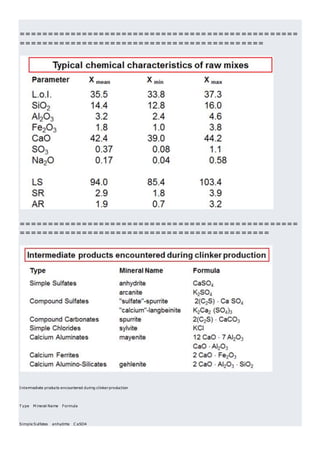
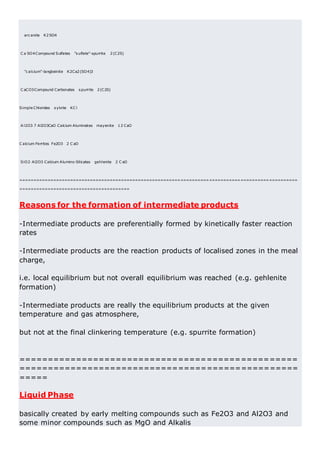
Intermediate products encountered during clinkerproduction
T ype M ineral Name Formula
Simple Sulfates anhydrite C aSO4
arcanite K2SO4
C a SO4Compound Sulfates ”sulfate”-spurrite 2(C2S)
”calcium”-langbeinite K2Ca2(SO4)3
C aCO3Compound Carbonates spurrite 2(C2S)
Simple Chlorides sylvite KC l
A l2O3 7 Al2O3CaO Calcium Aluminates mayenite 12 CaO
C alcium Ferrites Fe2O3 2 C aO
SiO2 Al2O3Calcium Alumino-Silicates gehlenite 2 C aO
==================================================================================================
=======================================
Reasons for the formation of intermediate products
-Intermediate products are preferentially formed by kinetically faster reaction
rates
-Intermediate products are the reaction products of localised zones in the meal
charge,
i.e. local equilibrium but not overall equilibrium was reached (e.g. gehlenite
formation)
-Intermediate products are really the equilibrium products at the given
temperature and gas atmosphere,
but not at the final clinkering temperature (e.g. spurrite formation)
=================================================
=================================================
=====
Liquid Phase
basically created by early melting compounds such as Fe2O3 and Al2O3 and
some minor compounds such as MgO and Alkalis
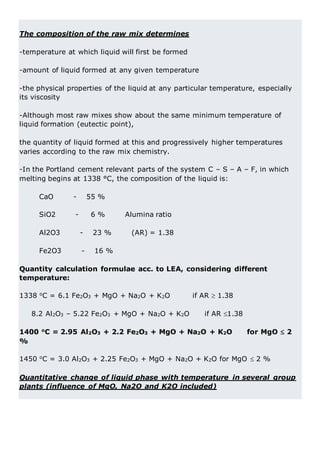
The composition of the raw mix determines
-temperature at which liquid will first be formed
-amount of liquid formed at any given temperature
-the physical properties of the liquid at any particular temperature, especially
its viscosity
-Although most raw mixes show about the same minimum temperature of
liquid formation (eutectic point),
the quantity of liquid formed at this and progressively higher temperatures
varies according to the raw mix chemistry.
-In the Portland cement relevant parts of the system C – S – A – F, in which
melting begins at 1338 °C, the composition of the liquid is:
CaO - 55 %
SiO2 - 6 % Alumina ratio
Al2O3 - 23 % (AR) = 1.38
Fe2O3 - 16 %
Quantity calculation formulae acc. to LEA, considering different
temperature:
1338 o
C = 6.1 Fe2O3 + MgO + Na2O + K2O if AR  1.38
8.2 Al2O3 – 5.22 Fe2O3 + MgO + Na2O + K2O if AR 1.38
1400 o
C = 2.95 Al2O3 + 2.2 Fe2O3 + MgO + Na2O + K2O for MgO  2
%
1450 o
C = 3.0 Al2O3 + 2.25 Fe2O3 + MgO + Na2O + K2O for MgO  2 %
Quantitative change of liquid phase with temperature in several group
plants (influence of MgO, Na2O and K2O included)
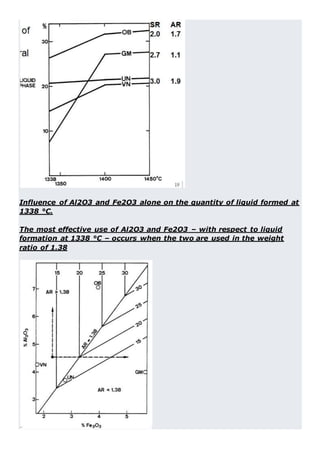
Influence of Al2O3 and Fe2O3 alone on the quantity of liquid formed at
1338 °C.
The most effective use of Al2O3 and Fe2O3 – with respect to liquid
formation at 1338 °C – occurs when the two are used in the weight
ratio of 1.38
Viscosity of liquid phase
-The viscosity of the liquid phase diminishes exponentially with increasing
temperature and at 1400 °C is reduced by addition of fluxing components in
the following order:
Na2O < CaO < MgO < Fe2O3 < MnO
-With increasing SiO2 content of the melt and to a lesser extent with increasing
Al2O3, appreciable increases in viscosity occur.
=================================================
=================================================
=========================================
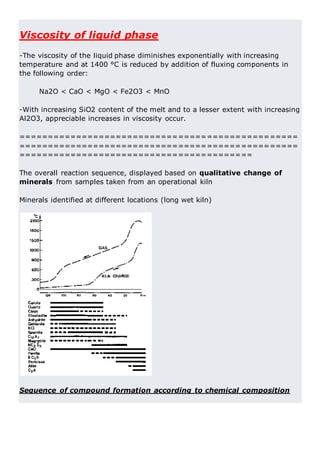
The overall reaction sequence, displayed based on qualitative change of
minerals from samples taken from an operational kiln
Minerals identified at different locations (long wet kiln)
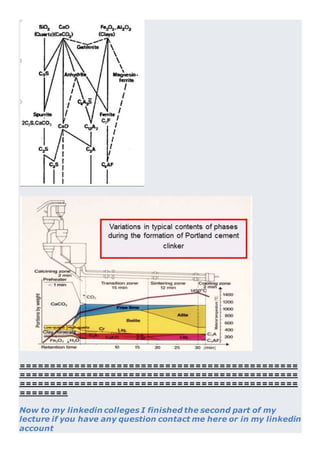
Sequence of compound formation according to chemical composition
==============================================
==============================================
==============================================
========
Now to my linkedin colleges I finished the second part of my
lecture if you have any question contact me here or in my linkedin
account
Or contact me by Email : honestgroupcoltd@gmail.com
===========================================
===========================================
===============================
Reaction Mechanisms
Definitions
State of matter
solid: definitive volume and definite shape
liquid: definitive volume, assumes shape of container
gaseous: neither definitive volume nor definite shape
Classification of reactions
1. according to their type:
low quartzstructural change high quartz
CaO + CO2decomposition CaCO3
C2Scombination 2CaO + SiO2
2. according to the state of matter:
belitesolid – solid quartz and free CaO
crystallisation of aluminate + ferritesolid – liquid liquid phase
CaO + CO2solid – gas CaCO3
liquid – liquid -
liquid – gas drying process, volatilisation of alkalis
CO2gas – gas CO + 1/2 O2
3. according to rate controlling step (kinetics of reaction)
diffusion formation of alite
belite (initial reaction)phase boundary quartz + free CaO
nucleation liquid phase crystallisation of aluminate + ferrite; alite formation
Examples
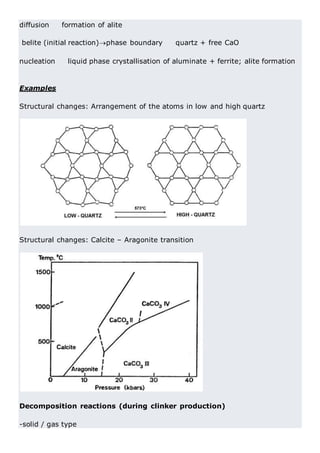
Structural changes: Arrangement of the atoms in low and high quartz
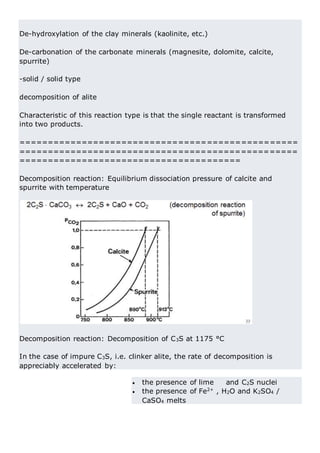
Structural changes: Calcite – Aragonite transition
Decomposition reactions (during clinker production)
-solid / gas type
De-hydroxylation of the clay minerals (kaolinite, etc.)
De-carbonation of the carbonate minerals (magnesite, dolomite, calcite,
spurrite)
-solid / solid type
decomposition of alite
Characteristic of this reaction type is that the single reactant is transformed
into two products.
=================================================
=================================================
=======================================
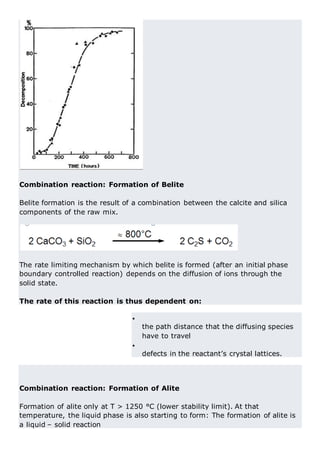
Decomposition reaction: Equilibrium dissociation pressure of calcite and
spurrite with temperature
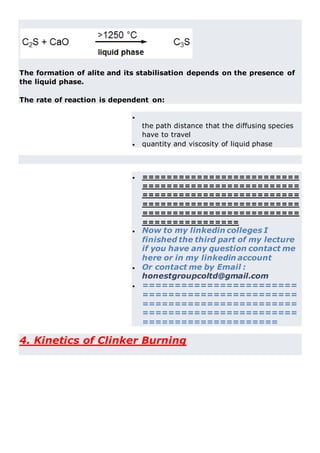
Decomposition reaction: Decomposition of C3S at 1175 °C
In the case of impure C3S, i.e. clinker alite, the rate of decomposition is
appreciably accelerated by:
 the presence of lime and C2S nuclei
 the presence of Fe2+
, H2O and K2SO4 /
CaSO4 melts
Combination reaction: Formation of Belite
Belite formation is the result of a combination between the calcite and silica
components of the raw mix.
The rate limiting mechanism by which belite is formed (after an initial phase
boundary controlled reaction) depends on the diffusion of ions through the
solid state.
The rate of this reaction is thus dependent on:

the path distance that the diffusing species
have to travel

defects in the reactant’s crystal lattices.
Combination reaction: Formation of Alite
Formation of alite only at T > 1250 °C (lower stability limit). At that
temperature, the liquid phase is also starting to form: The formation of alite is
a liquid – solid reaction
The formation of alite and its stabilisation depends on the presence of
the liquid phase.
The rate of reaction is dependent on:

the path distance that the diffusing species
have to travel
 quantity and viscosity of liquid phase
 ==========================
==========================
==========================
==========================
==========================
================
 Now to my linkedin colleges I
finished the third part of my lecture
if you have any question contact me
here or in my linkedin account
 Or contact me by Email :
honestgroupcoltd@gmail.com
 ========================
========================
========================
========================
=====================
4. Kinetics of Clinker Burning
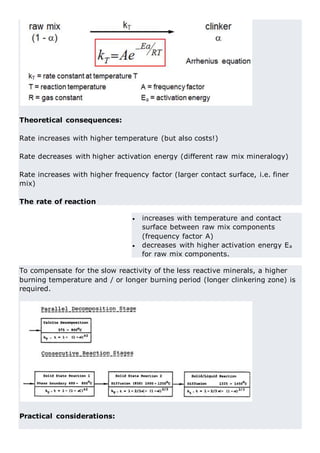
Theoretical consequences:
Rate increases with higher temperature (but also costs!)
Rate decreases with higher activation energy (different raw mix mineralogy)
Rate increases with higher frequency factor (larger contact surface, i.e. finer
mix)
The rate of reaction
 increases with temperature and contact
surface between raw mix components
(frequency factor A)
 decreases with higher activation energy Ea
for raw mix components.
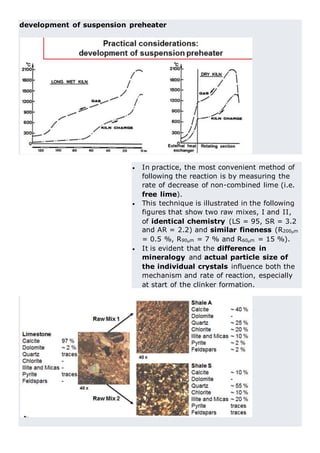
To compensate for the slow reactivity of the less reactive minerals, a higher
burning temperature and / or longer burning period (longer clinkering zone) is
required.
Practical considerations:
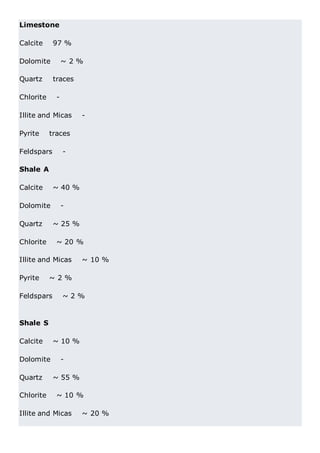
development of suspension preheater
 In practice, the most convenient method of
following the reaction is by measuring the
rate of decrease of non-combined lime (i.e.
free lime).
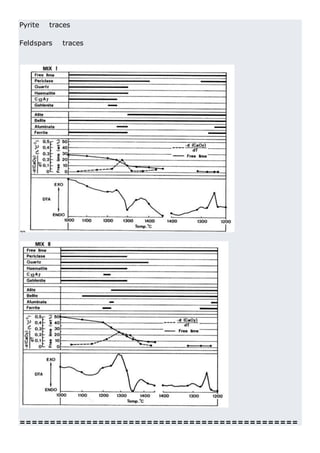
 This technique is illustrated in the following
figures that show two raw mixes, I and II,
of identical chemistry (LS = 95, SR = 3.2
and AR = 2.2) and similar fineness (R200m
= 0.5 %, R90m = 7 % and R60m = 15 %).
 It is evident that the difference in
mineralogy and actual particle size of
the individual crystals influence both the
mechanism and rate of reaction, especially
at start of the clinker formation.
Limestone
Calcite 97 %
Dolomite ~ 2 %
Quartz traces
Chlorite -
Illite and Micas -
Pyrite traces
Feldspars -
Shale A
Calcite ~ 40 %
Dolomite -
Quartz ~ 25 %
Chlorite ~ 20 %
Illite and Micas ~ 10 %
Pyrite ~ 2 %
Feldspars ~ 2 %
Shale S
Calcite ~ 10 %
Dolomite -
Quartz ~ 55 %
Chlorite ~ 10 %
Illite and Micas ~ 20 %
Pyrite traces
Feldspars traces
==============================================
==============================================
==============================================
=====
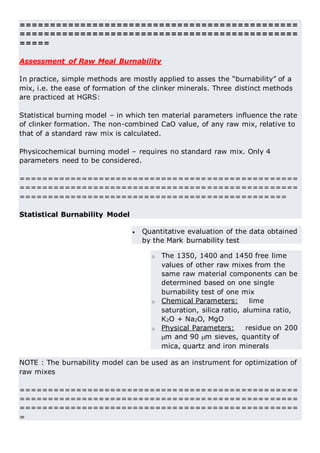
Assessment of Raw Meal Burnability
In practice, simple methods are mostly applied to asses the “burnability” of a
mix, i.e. the ease of formation of the clinker minerals. Three distinct methods
are practiced at HGRS:
Statistical burning model – in which ten material parameters influence the rate
of clinker formation. The non-combined CaO value, of any raw mix, relative to
that of a standard raw mix is calculated.
Physicochemical burning model – requires no standard raw mix. Only 4
parameters need to be considered.
=================================================
=================================================
===============================================
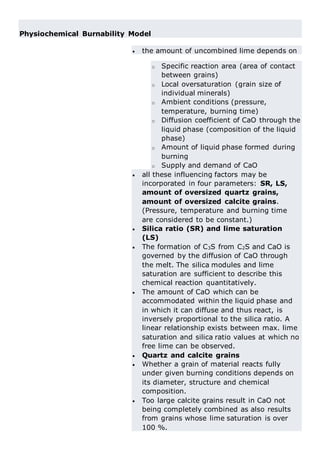
Statistical Burnability Model
 Quantitative evaluation of the data obtained
by the Mark burnability test
o The 1350, 1400 and 1450 free lime
values of other raw mixes from the
same raw material components can be
determined based on one single
burnability test of one mix
o Chemical Parameters: lime
saturation, silica ratio, alumina ratio,
K2O + Na2O, MgO
o Physical Parameters: residue on 200
m and 90 m sieves, quantity of
mica, quartz and iron minerals
NOTE : The burnability model can be used as an instrument for optimization of
raw mixes
=================================================
=================================================
=================================================
=
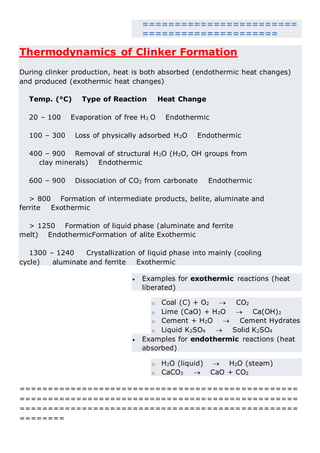
Physiochemical Burnability Model
 the amount of uncombined lime depends on
o Specific reaction area (area of contact
between grains)
o Local oversaturation (grain size of
individual minerals)
o Ambient conditions (pressure,
temperature, burning time)
o Diffusion coefficient of CaO through the
liquid phase (composition of the liquid
phase)
o Amount of liquid phase formed during
burning
o Supply and demand of CaO
 all these influencing factors may be
incorporated in four parameters: SR, LS,
amount of oversized quartz grains,
amount of oversized calcite grains.
(Pressure, temperature and burning time
are considered to be constant.)
 Silica ratio (SR) and lime saturation
(LS)
 The formation of C3S from C2S and CaO is
governed by the diffusion of CaO through
the melt. The silica modules and lime
saturation are sufficient to describe this
chemical reaction quantitatively.
 The amount of CaO which can be
accommodated within the liquid phase and
in which it can diffuse and thus react, is
inversely proportional to the silica ratio. A
linear relationship exists between max. lime
saturation and silica ratio values at which no
free lime can be observed.
 Quartz and calcite grains
 Whether a grain of material reacts fully
under given burning conditions depends on
its diameter, structure and chemical
composition.
 Too large calcite grains result in CaO not
being completely combined as also results
from grains whose lime saturation is over
100 %.
 For the “Holderbank” burnability test
conditions the following grain diameters
were found to be critical limits:
o quartz  32 m
calcite  90 m
 ==========================
==========================
==========================
==========================
==========================
================
 Now to my linkedin colleges I
finished the Fourth part of my
lecture if you have any question
contact me here or in my linkedin
account
 Or contact me by Email :
honestgroupcoltd@gmail.com
 ========================
========================
========================
========================
=====================
Thermodynamics of Clinker Formation
During clinker production, heat is both absorbed (endothermic heat changes)
and produced (exothermic heat changes)
Temp. (°C) Type of Reaction Heat Change
20 – 100 Evaporation of free H2 O Endothermic
100 – 300 Loss of physically adsorbed H2O Endothermic
400 – 900 Removal of structural H2O (H2O, OH groups from
clay minerals) Endothermic
600 – 900 Dissociation of CO2 from carbonate Endothermic
> 800 Formation of intermediate products, belite, aluminate and
ferrite Exothermic
> 1250 Formation of liquid phase (aluminate and ferrite
melt) EndothermicFormation of alite Exothermic
1300 – 1240 Crystallization of liquid phase into mainly (cooling
cycle) aluminate and ferrite Exothermic
 Examples for exothermic reactions (heat
liberated)
o Coal (C) + O2  CO2
o Lime (CaO) + H2O  Ca(OH)2
o Cement + H2O  Cement Hydrates
o Liquid K2SO4  Solid K2SO4
 Examples for endothermic reactions (heat
absorbed)
o H2O (liquid)  H2O (steam)
o CaCO3  CaO + CO2
=================================================
=================================================
=================================================
========
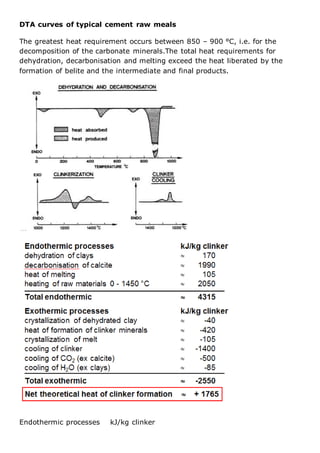
DTA curves of typical cement raw meals
The greatest heat requirement occurs between 850 – 900 °C, i.e. for the
decomposition of the carbonate minerals.The total heat requirements for
dehydration, decarbonisation and melting exceed the heat liberated by the
formation of belite and the intermediate and final products.
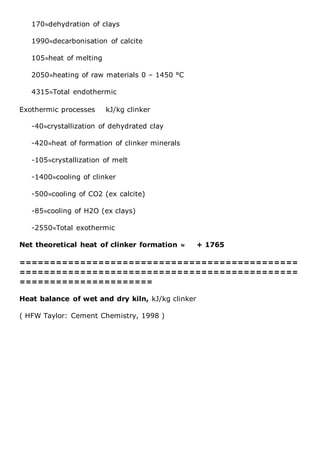
Endothermic processes kJ/kg clinker
170dehydration of clays
1990decarbonisation of calcite
105heat of melting
2050heating of raw materials 0 – 1450 °C
4315Total endothermic
Exothermic processes kJ/kg clinker
-40crystallization of dehydrated clay
-420heat of formation of clinker minerals
-105crystallization of melt
-1400cooling of clinker
-500cooling of CO2 (ex calcite)
-85cooling of H2O (ex clays)
-2550Total exothermic
Net theoretical heat of clinker formation  + 1765
==============================================
==============================================
======================
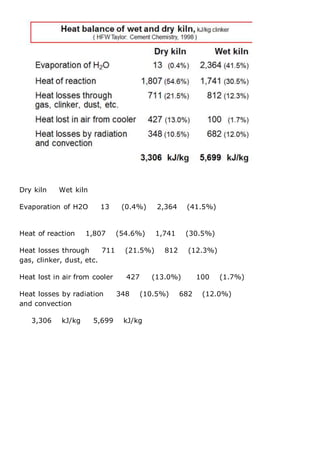
Heat balance of wet and dry kiln, kJ/kg clinker
( HFW Taylor: Cement Chemistry, 1998 )
Dry kiln Wet kiln
Evaporation of H2O 13 (0.4%) 2,364 (41.5%)
Heat of reaction 1,807 (54.6%) 1,741 (30.5%)
Heat losses through 711 (21.5%) 812 (12.3%)
gas, clinker, dust, etc.
Heat lost in air from cooler 427 (13.0%) 100 (1.7%)
Heat losses by radiation 348 (10.5%) 682 (12.0%)
and convection
3,306 kJ/kg 5,699 kJ/kg

Clinker formation-concepts

  • 1.
    Introduction: Why study clinkerburning? “To understand the influence of changes in kiln operation conditions” Normal kiln operation Influence of chemistry, fineness, mineralogy changes Influence of new mix components (pozzolan, AFR, sand, etc.) Abnormal kiln operation know causes of badly burnt clinker understand why rings and deposits form be able to suggest counter measures Synthetic Hydraulic Minerals Analogy to transformation of igneous and sedimentary rocks into metamorphic rocks Difference in T, p, t
  • 2.
    ============================================= ============================================= = Two principal stepsduring transformation into clinker Disintegration of original structure Mechanical crushing and grinding Thermal decomposition Structural rearrangement on heating (e.g. polymorphism Formation of new structures Occurrence of intermediate products Genesis and growth of final clinker minerals Crystallization of liquid phase ============================================= ======================================== Features characterising the clinker formation process -Complex system (series of diverse mechanisms)! -Requires mechanical, thermal and electrical energy -Reaction rate is slow (necessity of high temperatures, finely dispersed material) -Clinker minerals are not stable at normal temperature! -Quality of product is determined by: Clinker chemistry Clinker microstructure ============================================= =======================================
  • 3.
    Control of burningprocess Material technological aspects -Raw meal burning behaviour Burnability Dust formation Coating behaviour Granulation of clinker etc. -Quantity and properties of liquid phase Process technological aspects -Temperature profile -Kiln atmosphere -Fuel type -Flame characteristics ============================================= ======================================
  • 4.
    Reaction pathway indicates theintermediate products occurring between reactants and products Reaction mechanism type(s) and reaction(s) taking place Reaction kinetics indicates rate at which the final products are produced Reaction thermodynamics dictates whether reaction will be at all possible, and what t he heat and temperature requirements will be =================================================================== ===================================================== Now to my linkedin colleges I finished the first part of my lecture if you have any question contact me here or in my linkedin account Or contact me by Email : honestgroupcoltd@gmail.com =========================================== =========================================== =========== Reaction Pathways Encountered During Clinker Formation Basic Sequence of Reactions Mineralogical and Chemical Characteristics of Raw Mixes Intermediate Products Liquid Phase
  • 5.
    The Overall ReactionSequence To fully describe the pathway of clinkering, it is necessary to consider the following aspects: -the chemical and mineralogical content of the raw mix -the overall sequence of reactions -the chemical and mineralogical nature of the intermediate products Heating (°C) 20 – 100 Evaporation of H2O 100 – 300 Loss of physically adsorbed water 400 – 900 Removal of structural H2O (H2O and OH groups) from clay minerals >500 Structural changes in silicate minerals 600 – 900 Dissociation of carbonates >800 Formation of belite, intermediate products, aluminate and ferrite >1250 Formation of liquid phase (aluminate and ferrite melt) ~1450 Completion of reaction and re-crystallization of alite and belite
  • 6.
    Cooling (°C) 1300 –1240Crystallization of liquid phase into mainly aluminate and ferrite ================================================= ================================================= ========================== Mineralogical characteristics of raw mixes Carbonates MgCO3, ankerite CaCO3 (Mg,Fe)CO3 magnesite MgCO3, siderite FeCO3calcite CaCO3, dolomite CaCO3 Simple Oxides quartz SiO2, hematite Fe2O3, magnetite Fe3O4 Feldspars potassium feldspars (Na,K)Si3O8 and plagioclase series (Na,Ca)(Si,Al)Al2Si2O8 Sheet silicates minerals of the mica and chlorite groups (e.g. biotite, muscovite, chlorite), clay minerals (e.g. kaolinite, montomorillonite, illite, palygorskite) Hydroxides Al-hydroxides (e.g. boehmite), Fe-hydroxides (e.g. goethite, limonite) Sulfides / sulfates H2Opyrites FeS2, anhydrite CaSO4, gypsum CaSO4 Fluorides fluorspar CaF2
  • 7.
  • 8.
    arcanite K2SO4 C aSO4Compound Sulfates ”sulfate”-spurrite 2(C2S) ”calcium”-langbeinite K2Ca2(SO4)3 C aCO3Compound Carbonates spurrite 2(C2S) Simple Chlorides sylvite KC l A l2O3 7 Al2O3CaO Calcium Aluminates mayenite 12 CaO C alcium Ferrites Fe2O3 2 C aO SiO2 Al2O3Calcium Alumino-Silicates gehlenite 2 C aO ================================================================================================== ======================================= Reasons for the formation of intermediate products -Intermediate products are preferentially formed by kinetically faster reaction rates -Intermediate products are the reaction products of localised zones in the meal charge, i.e. local equilibrium but not overall equilibrium was reached (e.g. gehlenite formation) -Intermediate products are really the equilibrium products at the given temperature and gas atmosphere, but not at the final clinkering temperature (e.g. spurrite formation) ================================================= ================================================= ===== Liquid Phase basically created by early melting compounds such as Fe2O3 and Al2O3 and some minor compounds such as MgO and Alkalis
  • 9.
    The composition ofthe raw mix determines -temperature at which liquid will first be formed -amount of liquid formed at any given temperature -the physical properties of the liquid at any particular temperature, especially its viscosity -Although most raw mixes show about the same minimum temperature of liquid formation (eutectic point), the quantity of liquid formed at this and progressively higher temperatures varies according to the raw mix chemistry. -In the Portland cement relevant parts of the system C – S – A – F, in which melting begins at 1338 °C, the composition of the liquid is: CaO - 55 % SiO2 - 6 % Alumina ratio Al2O3 - 23 % (AR) = 1.38 Fe2O3 - 16 % Quantity calculation formulae acc. to LEA, considering different temperature: 1338 o C = 6.1 Fe2O3 + MgO + Na2O + K2O if AR  1.38 8.2 Al2O3 – 5.22 Fe2O3 + MgO + Na2O + K2O if AR 1.38 1400 o C = 2.95 Al2O3 + 2.2 Fe2O3 + MgO + Na2O + K2O for MgO  2 % 1450 o C = 3.0 Al2O3 + 2.25 Fe2O3 + MgO + Na2O + K2O for MgO  2 % Quantitative change of liquid phase with temperature in several group plants (influence of MgO, Na2O and K2O included)
  • 10.
    Influence of Al2O3and Fe2O3 alone on the quantity of liquid formed at 1338 °C. The most effective use of Al2O3 and Fe2O3 – with respect to liquid formation at 1338 °C – occurs when the two are used in the weight ratio of 1.38
  • 11.
    Viscosity of liquidphase -The viscosity of the liquid phase diminishes exponentially with increasing temperature and at 1400 °C is reduced by addition of fluxing components in the following order: Na2O < CaO < MgO < Fe2O3 < MnO -With increasing SiO2 content of the melt and to a lesser extent with increasing Al2O3, appreciable increases in viscosity occur. ================================================= ================================================= ========================================= The overall reaction sequence, displayed based on qualitative change of minerals from samples taken from an operational kiln Minerals identified at different locations (long wet kiln) Sequence of compound formation according to chemical composition
  • 12.
    ============================================== ============================================== ============================================== ======== Now to mylinkedin colleges I finished the second part of my lecture if you have any question contact me here or in my linkedin account
  • 13.
    Or contact meby Email : honestgroupcoltd@gmail.com =========================================== =========================================== =============================== Reaction Mechanisms Definitions State of matter solid: definitive volume and definite shape liquid: definitive volume, assumes shape of container gaseous: neither definitive volume nor definite shape Classification of reactions 1. according to their type: low quartzstructural change high quartz CaO + CO2decomposition CaCO3 C2Scombination 2CaO + SiO2 2. according to the state of matter: belitesolid – solid quartz and free CaO crystallisation of aluminate + ferritesolid – liquid liquid phase CaO + CO2solid – gas CaCO3 liquid – liquid - liquid – gas drying process, volatilisation of alkalis CO2gas – gas CO + 1/2 O2 3. according to rate controlling step (kinetics of reaction)
  • 14.
    diffusion formation ofalite belite (initial reaction)phase boundary quartz + free CaO nucleation liquid phase crystallisation of aluminate + ferrite; alite formation Examples Structural changes: Arrangement of the atoms in low and high quartz Structural changes: Calcite – Aragonite transition Decomposition reactions (during clinker production) -solid / gas type
  • 15.
    De-hydroxylation of theclay minerals (kaolinite, etc.) De-carbonation of the carbonate minerals (magnesite, dolomite, calcite, spurrite) -solid / solid type decomposition of alite Characteristic of this reaction type is that the single reactant is transformed into two products. ================================================= ================================================= ======================================= Decomposition reaction: Equilibrium dissociation pressure of calcite and spurrite with temperature Decomposition reaction: Decomposition of C3S at 1175 °C In the case of impure C3S, i.e. clinker alite, the rate of decomposition is appreciably accelerated by:  the presence of lime and C2S nuclei  the presence of Fe2+ , H2O and K2SO4 / CaSO4 melts
  • 16.
    Combination reaction: Formationof Belite Belite formation is the result of a combination between the calcite and silica components of the raw mix. The rate limiting mechanism by which belite is formed (after an initial phase boundary controlled reaction) depends on the diffusion of ions through the solid state. The rate of this reaction is thus dependent on:  the path distance that the diffusing species have to travel  defects in the reactant’s crystal lattices. Combination reaction: Formation of Alite Formation of alite only at T > 1250 °C (lower stability limit). At that temperature, the liquid phase is also starting to form: The formation of alite is a liquid – solid reaction
  • 17.
    The formation ofalite and its stabilisation depends on the presence of the liquid phase. The rate of reaction is dependent on:  the path distance that the diffusing species have to travel  quantity and viscosity of liquid phase  ========================== ========================== ========================== ========================== ========================== ================  Now to my linkedin colleges I finished the third part of my lecture if you have any question contact me here or in my linkedin account  Or contact me by Email : honestgroupcoltd@gmail.com  ======================== ======================== ======================== ======================== ===================== 4. Kinetics of Clinker Burning
  • 18.
    Theoretical consequences: Rate increaseswith higher temperature (but also costs!) Rate decreases with higher activation energy (different raw mix mineralogy) Rate increases with higher frequency factor (larger contact surface, i.e. finer mix) The rate of reaction  increases with temperature and contact surface between raw mix components (frequency factor A)  decreases with higher activation energy Ea for raw mix components. To compensate for the slow reactivity of the less reactive minerals, a higher burning temperature and / or longer burning period (longer clinkering zone) is required. Practical considerations:
  • 19.
    development of suspensionpreheater  In practice, the most convenient method of following the reaction is by measuring the rate of decrease of non-combined lime (i.e. free lime).  This technique is illustrated in the following figures that show two raw mixes, I and II, of identical chemistry (LS = 95, SR = 3.2 and AR = 2.2) and similar fineness (R200m = 0.5 %, R90m = 7 % and R60m = 15 %).  It is evident that the difference in mineralogy and actual particle size of the individual crystals influence both the mechanism and rate of reaction, especially at start of the clinker formation.
  • 20.
    Limestone Calcite 97 % Dolomite~ 2 % Quartz traces Chlorite - Illite and Micas - Pyrite traces Feldspars - Shale A Calcite ~ 40 % Dolomite - Quartz ~ 25 % Chlorite ~ 20 % Illite and Micas ~ 10 % Pyrite ~ 2 % Feldspars ~ 2 % Shale S Calcite ~ 10 % Dolomite - Quartz ~ 55 % Chlorite ~ 10 % Illite and Micas ~ 20 %
  • 21.
  • 22.
    ============================================== ============================================== ===== Assessment of RawMeal Burnability In practice, simple methods are mostly applied to asses the “burnability” of a mix, i.e. the ease of formation of the clinker minerals. Three distinct methods are practiced at HGRS: Statistical burning model – in which ten material parameters influence the rate of clinker formation. The non-combined CaO value, of any raw mix, relative to that of a standard raw mix is calculated. Physicochemical burning model – requires no standard raw mix. Only 4 parameters need to be considered. ================================================= ================================================= =============================================== Statistical Burnability Model  Quantitative evaluation of the data obtained by the Mark burnability test o The 1350, 1400 and 1450 free lime values of other raw mixes from the same raw material components can be determined based on one single burnability test of one mix o Chemical Parameters: lime saturation, silica ratio, alumina ratio, K2O + Na2O, MgO o Physical Parameters: residue on 200 m and 90 m sieves, quantity of mica, quartz and iron minerals NOTE : The burnability model can be used as an instrument for optimization of raw mixes ================================================= ================================================= ================================================= =
  • 23.
    Physiochemical Burnability Model the amount of uncombined lime depends on o Specific reaction area (area of contact between grains) o Local oversaturation (grain size of individual minerals) o Ambient conditions (pressure, temperature, burning time) o Diffusion coefficient of CaO through the liquid phase (composition of the liquid phase) o Amount of liquid phase formed during burning o Supply and demand of CaO  all these influencing factors may be incorporated in four parameters: SR, LS, amount of oversized quartz grains, amount of oversized calcite grains. (Pressure, temperature and burning time are considered to be constant.)  Silica ratio (SR) and lime saturation (LS)  The formation of C3S from C2S and CaO is governed by the diffusion of CaO through the melt. The silica modules and lime saturation are sufficient to describe this chemical reaction quantitatively.  The amount of CaO which can be accommodated within the liquid phase and in which it can diffuse and thus react, is inversely proportional to the silica ratio. A linear relationship exists between max. lime saturation and silica ratio values at which no free lime can be observed.  Quartz and calcite grains  Whether a grain of material reacts fully under given burning conditions depends on its diameter, structure and chemical composition.  Too large calcite grains result in CaO not being completely combined as also results from grains whose lime saturation is over 100 %.
  • 24.
     For the“Holderbank” burnability test conditions the following grain diameters were found to be critical limits: o quartz  32 m calcite  90 m  ========================== ========================== ========================== ========================== ========================== ================  Now to my linkedin colleges I finished the Fourth part of my lecture if you have any question contact me here or in my linkedin account  Or contact me by Email : honestgroupcoltd@gmail.com  ======================== ======================== ========================
  • 25.
    ======================== ===================== Thermodynamics of ClinkerFormation During clinker production, heat is both absorbed (endothermic heat changes) and produced (exothermic heat changes) Temp. (°C) Type of Reaction Heat Change 20 – 100 Evaporation of free H2 O Endothermic 100 – 300 Loss of physically adsorbed H2O Endothermic 400 – 900 Removal of structural H2O (H2O, OH groups from clay minerals) Endothermic 600 – 900 Dissociation of CO2 from carbonate Endothermic > 800 Formation of intermediate products, belite, aluminate and ferrite Exothermic > 1250 Formation of liquid phase (aluminate and ferrite melt) EndothermicFormation of alite Exothermic 1300 – 1240 Crystallization of liquid phase into mainly (cooling cycle) aluminate and ferrite Exothermic  Examples for exothermic reactions (heat liberated) o Coal (C) + O2  CO2 o Lime (CaO) + H2O  Ca(OH)2 o Cement + H2O  Cement Hydrates o Liquid K2SO4  Solid K2SO4  Examples for endothermic reactions (heat absorbed) o H2O (liquid)  H2O (steam) o CaCO3  CaO + CO2 ================================================= ================================================= ================================================= ========
  • 26.
    DTA curves oftypical cement raw meals The greatest heat requirement occurs between 850 – 900 °C, i.e. for the decomposition of the carbonate minerals.The total heat requirements for dehydration, decarbonisation and melting exceed the heat liberated by the formation of belite and the intermediate and final products. Endothermic processes kJ/kg clinker
  • 27.
    170dehydration of clays 1990decarbonisationof calcite 105heat of melting 2050heating of raw materials 0 – 1450 °C 4315Total endothermic Exothermic processes kJ/kg clinker -40crystallization of dehydrated clay -420heat of formation of clinker minerals -105crystallization of melt -1400cooling of clinker -500cooling of CO2 (ex calcite) -85cooling of H2O (ex clays) -2550Total exothermic Net theoretical heat of clinker formation  + 1765 ============================================== ============================================== ====================== Heat balance of wet and dry kiln, kJ/kg clinker ( HFW Taylor: Cement Chemistry, 1998 )
  • 28.
    Dry kiln Wetkiln Evaporation of H2O 13 (0.4%) 2,364 (41.5%) Heat of reaction 1,807 (54.6%) 1,741 (30.5%) Heat losses through 711 (21.5%) 812 (12.3%) gas, clinker, dust, etc. Heat lost in air from cooler 427 (13.0%) 100 (1.7%) Heat losses by radiation 348 (10.5%) 682 (12.0%) and convection 3,306 kJ/kg 5,699 kJ/kg