Chemicals from Ethylene
Petrochemical Technology
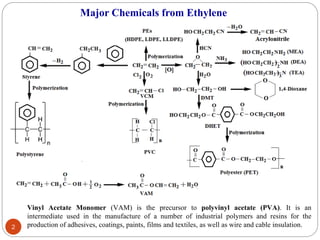
Major Chemicals from Ethylene
2
Vinyl Acetate Monomer (VAM) is the precursor to polyvinyl acetate (PVA). It is an
intermediate used in the manufacture of a number of industrial polymers and resins for the
production of adhesives, coatings, paints, films and textiles, as well as wire and cable insulation.
3
Ethylene Oxide (EO) is the second largest consumer of
Ethylene. EO finds key applications in manufacturing
Ethylene Glycol, the most common of which is
monoethylene glycol (MEG). MEG is used for making PET
resins which is used for making bottles and is also used in
several antifreeze applications. Demand for several EO
derivatives like ethyoxylates (used in shampoo, kitchen
cleaners, etc.), glycol ethers (solvents, fuels, etc.) and
ethanolamines (surfactants, personal care products, etc.)
will always remain healthy.
Ethylene Oxide
Catalyst: Ag2O/Al2O3
[Catalyst contains 10-15% of silver and promoters-compounds of
alkalis or alkali earth metals, especially Cs and Ba.]
Oxidation with air : 260-280oC; Oxidation with oxygen: 230oC
Pressure: 10-30 atm
High purity, sulphur-free ethylene is required to avoid poisoning of
the catalyst.
Ethylene concentration is about 20-30 vol% or 5 vol% when oxygen
or air, respectively, is used as oxidant. The main byproducts are CO2
and H2O, and a very small amount of acetaldehyde is formed via
isomerization of ethylene oxide.
4
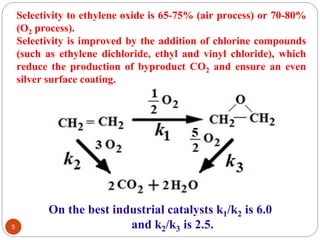
On the best industrial catalysts k1/k2 is 6.0
and k2/k3 is 2.5.
5
Selectivity to ethylene oxide is 65-75% (air process) or 70-80%
(O2 process).
Selectivity is improved by the addition of chlorine compounds
(such as ethylene dichloride, ethyl and vinyl chloride), which
reduce the production of byproduct CO2 and ensure an even
silver surface coating.
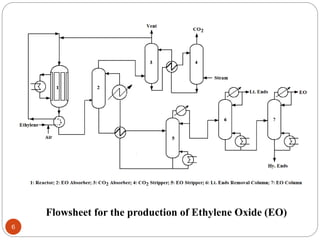
Flowsheet for the production of Ethylene Oxide (EO)
6
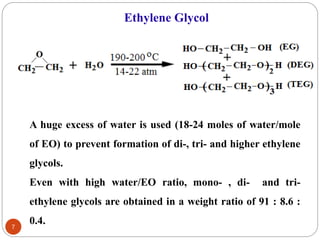
Ethylene Glycol
A huge excess of water is used (18-24 moles of water/mole
of EO) to prevent formation of di-, tri- and higher ethylene
glycols.
Even with high water/EO ratio, mono- , di- and tri-
ethylene glycols are obtained in a weight ratio of 91 : 8.6 :
0.4.
7
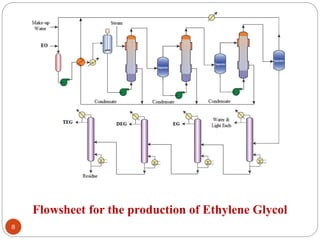
Flowsheet for the production of Ethylene Glycol
8
Monoethylene Glycol from EO
9
Ethylene oxide is reacted with CO2, forming ethylene
carbonate, which is then hydrolyzed to form MEG and
CO2. Both reactions are carried out in the liquid phase
using homogeneous catalysts.
An important feature of the process is the negligible
production of diethylene glycol (DEG) and triethylene
glycol (TEG), which occur as byproducts in other ethylene
glycol production processes.
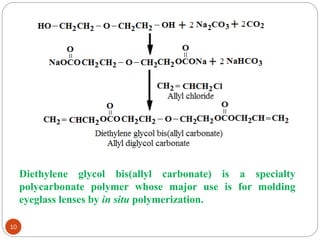
Diethylene glycol bis(allyl carbonate) is a specialty
polycarbonate polymer whose major use is for molding
eyeglass lenses by in situ polymerization.
10
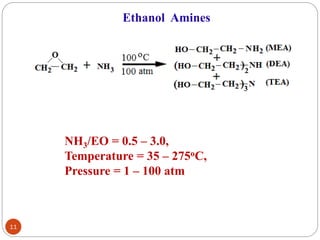
Ethanol Amines
NH3/EO = 0.5 – 3.0,
Temperature = 35 – 275oC,
Pressure = 1 – 100 atm
11
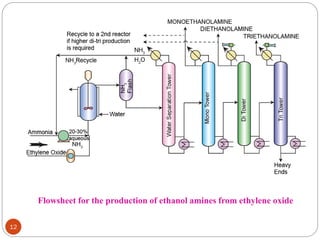
Flowsheet for the production of ethanol amines from ethylene oxide
12
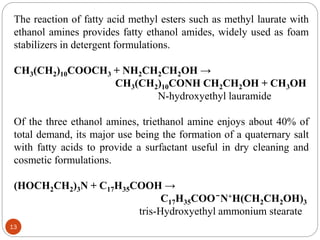
The reaction of fatty acid methyl esters such as methyl laurate with
ethanol amines provides fatty ethanol amides, widely used as foam
stabilizers in detergent formulations.
CH3(CH2)10COOCH3 + NH2CH2CH2OH →
CH3(CH2)10CONH CH2CH2OH + CH3OH
N-hydroxyethyl lauramide
Of the three ethanol amines, triethanol amine enjoys about 40% of
total demand, its major use being the formation of a quaternary salt
with fatty acids to provide a surfactant useful in dry cleaning and
cosmetic formulations.
(HOCH2CH2)3N + C17H35COOH →
C17H35COO ̄ N+H(CH2CH2OH)3
tris-Hydroxyethyl ammonium stearate
13
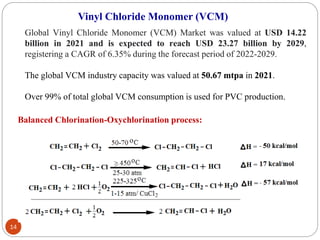
Vinyl Chloride Monomer (VCM)
Balanced Chlorination-Oxychlorination process:
14
Global Vinyl Chloride Monomer (VCM) Market was valued at USD 14.22
billion in 2021 and is expected to reach USD 23.27 billion by 2029,
registering a CAGR of 6.35% during the forecast period of 2022-2029.
The global VCM industry capacity was valued at 50.67 mtpa in 2021.
Over 99% of total global VCM consumption is used for PVC production.
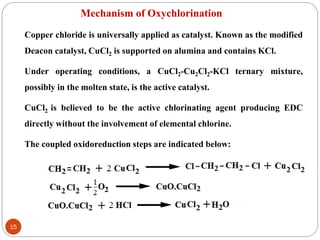
Mechanism of Oxychlorination
15
Copper chloride is universally applied as catalyst. Known as the modified
Deacon catalyst, CuCl2 is supported on alumina and contains KCl.
Under operating conditions, a CuCl2-Cu2Cl2-KCl ternary mixture,
possibly in the molten state, is the active catalyst.
CuCl2 is believed to be the active chlorinating agent producing EDC
directly without the involvement of elemental chlorine.
The coupled oxidoreduction steps are indicated below:
16
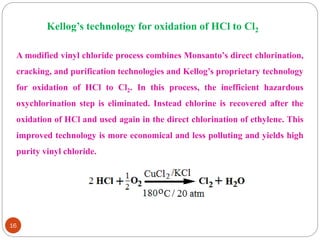
Kellog’s technology for oxidation of HCl to Cl2
A modified vinyl chloride process combines Monsanto’s direct chlorination,
cracking, and purification technologies and Kellog’s proprietary technology
for oxidation of HCl to Cl2. In this process, the inefficient hazardous
oxychlorination step is eliminated. Instead chlorine is recovered after the
oxidation of HCl and used again in the direct chlorination of ethylene. This
improved technology is more economical and less polluting and yields high
purity vinyl chloride.
17
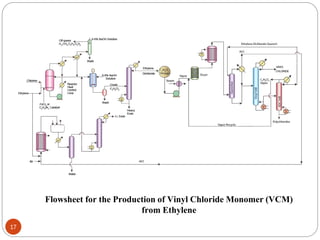
Flowsheet for the Production of Vinyl Chloride Monomer (VCM)
from Ethylene
18
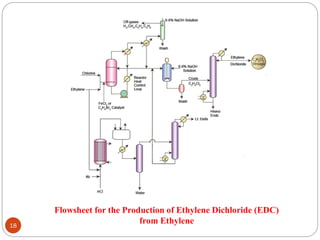
Flowsheet for the Production of Ethylene Dichloride (EDC)
from Ethylene
19
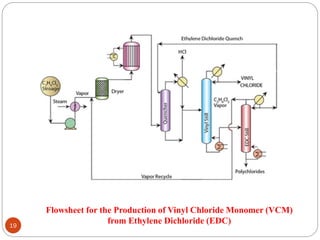
Flowsheet for the Production of Vinyl Chloride Monomer (VCM)
from Ethylene Dichloride (EDC)
20
Thank you!

Chemicals from Ethylene.pdf

  • 1.
  • 2.
    Major Chemicals fromEthylene 2 Vinyl Acetate Monomer (VAM) is the precursor to polyvinyl acetate (PVA). It is an intermediate used in the manufacture of a number of industrial polymers and resins for the production of adhesives, coatings, paints, films and textiles, as well as wire and cable insulation.
  • 3.
    3 Ethylene Oxide (EO)is the second largest consumer of Ethylene. EO finds key applications in manufacturing Ethylene Glycol, the most common of which is monoethylene glycol (MEG). MEG is used for making PET resins which is used for making bottles and is also used in several antifreeze applications. Demand for several EO derivatives like ethyoxylates (used in shampoo, kitchen cleaners, etc.), glycol ethers (solvents, fuels, etc.) and ethanolamines (surfactants, personal care products, etc.) will always remain healthy. Ethylene Oxide
  • 4.
    Catalyst: Ag2O/Al2O3 [Catalyst contains10-15% of silver and promoters-compounds of alkalis or alkali earth metals, especially Cs and Ba.] Oxidation with air : 260-280oC; Oxidation with oxygen: 230oC Pressure: 10-30 atm High purity, sulphur-free ethylene is required to avoid poisoning of the catalyst. Ethylene concentration is about 20-30 vol% or 5 vol% when oxygen or air, respectively, is used as oxidant. The main byproducts are CO2 and H2O, and a very small amount of acetaldehyde is formed via isomerization of ethylene oxide. 4
  • 5.
    On the bestindustrial catalysts k1/k2 is 6.0 and k2/k3 is 2.5. 5 Selectivity to ethylene oxide is 65-75% (air process) or 70-80% (O2 process). Selectivity is improved by the addition of chlorine compounds (such as ethylene dichloride, ethyl and vinyl chloride), which reduce the production of byproduct CO2 and ensure an even silver surface coating.
  • 6.
    Flowsheet for theproduction of Ethylene Oxide (EO) 6
  • 7.
    Ethylene Glycol A hugeexcess of water is used (18-24 moles of water/mole of EO) to prevent formation of di-, tri- and higher ethylene glycols. Even with high water/EO ratio, mono- , di- and tri- ethylene glycols are obtained in a weight ratio of 91 : 8.6 : 0.4. 7
  • 8.
    Flowsheet for theproduction of Ethylene Glycol 8
  • 9.
    Monoethylene Glycol fromEO 9 Ethylene oxide is reacted with CO2, forming ethylene carbonate, which is then hydrolyzed to form MEG and CO2. Both reactions are carried out in the liquid phase using homogeneous catalysts. An important feature of the process is the negligible production of diethylene glycol (DEG) and triethylene glycol (TEG), which occur as byproducts in other ethylene glycol production processes.
  • 10.
    Diethylene glycol bis(allylcarbonate) is a specialty polycarbonate polymer whose major use is for molding eyeglass lenses by in situ polymerization. 10
  • 11.
    Ethanol Amines NH3/EO =0.5 – 3.0, Temperature = 35 – 275oC, Pressure = 1 – 100 atm 11
  • 12.
    Flowsheet for theproduction of ethanol amines from ethylene oxide 12
  • 13.
    The reaction offatty acid methyl esters such as methyl laurate with ethanol amines provides fatty ethanol amides, widely used as foam stabilizers in detergent formulations. CH3(CH2)10COOCH3 + NH2CH2CH2OH → CH3(CH2)10CONH CH2CH2OH + CH3OH N-hydroxyethyl lauramide Of the three ethanol amines, triethanol amine enjoys about 40% of total demand, its major use being the formation of a quaternary salt with fatty acids to provide a surfactant useful in dry cleaning and cosmetic formulations. (HOCH2CH2)3N + C17H35COOH → C17H35COO ̄ N+H(CH2CH2OH)3 tris-Hydroxyethyl ammonium stearate 13
  • 14.
    Vinyl Chloride Monomer(VCM) Balanced Chlorination-Oxychlorination process: 14 Global Vinyl Chloride Monomer (VCM) Market was valued at USD 14.22 billion in 2021 and is expected to reach USD 23.27 billion by 2029, registering a CAGR of 6.35% during the forecast period of 2022-2029. The global VCM industry capacity was valued at 50.67 mtpa in 2021. Over 99% of total global VCM consumption is used for PVC production.
  • 15.
    Mechanism of Oxychlorination 15 Copperchloride is universally applied as catalyst. Known as the modified Deacon catalyst, CuCl2 is supported on alumina and contains KCl. Under operating conditions, a CuCl2-Cu2Cl2-KCl ternary mixture, possibly in the molten state, is the active catalyst. CuCl2 is believed to be the active chlorinating agent producing EDC directly without the involvement of elemental chlorine. The coupled oxidoreduction steps are indicated below:
  • 16.
    16 Kellog’s technology foroxidation of HCl to Cl2 A modified vinyl chloride process combines Monsanto’s direct chlorination, cracking, and purification technologies and Kellog’s proprietary technology for oxidation of HCl to Cl2. In this process, the inefficient hazardous oxychlorination step is eliminated. Instead chlorine is recovered after the oxidation of HCl and used again in the direct chlorination of ethylene. This improved technology is more economical and less polluting and yields high purity vinyl chloride.
  • 17.
    17 Flowsheet for theProduction of Vinyl Chloride Monomer (VCM) from Ethylene
  • 18.
    18 Flowsheet for theProduction of Ethylene Dichloride (EDC) from Ethylene
  • 19.
    19 Flowsheet for theProduction of Vinyl Chloride Monomer (VCM) from Ethylene Dichloride (EDC)
  • 20.