
ETHIOPIAN TEXTILE INDUSTRY
    PRESENT STATUS AND
FURTURE GROWTH PROSPECTS

              Prof. R. B. CHAVAN


Institute of Technology for Textile, Garment and Fashion Design
            Bahir Dar University, Bahir Dar, Ethiopia

                               2010
ETHIOPIAN TEXTILE INDUSTRY
    PRESENT STATUS AND
FURTURE GROWTH PROSPECTS


                             By
                 Prof. R B Chavan


Institute of Technology for Textile, Garment and Fashion Design
            Bahir Dar University, Bahir Dar, Ethiopia
                    E-mail: rbchavan@hotmail.com


                            2010
PREFACE


Ethiopia has a long history of traditional cottage textile sub-sector. Traditionally yarn from
cotton fiber supplied by small hold cotton farmers is home spun using age old spinning drop
wheel. The yarn is then converted into fabric using handlooms. This traditional cottage industry
continues to grow even today making an important contribution to satisfying people’s
requirement for textiles and providing large scale employment to rural and urban households.
The introduction of modern integrated textile mills in Ethiopia is a recent phenomenon initiated
by Italians during the Second World War. Dire Dawa Textile Mill, was the first integrated textile
Mill established by foreign capital in 1939. This has marked the starting point of textile sub-
sector in Ethiopia. During 196o’s, 5 large-scale integrated textile enterprises were established
mainly by private capital. The socialist regime, which reigned from 1974 to 1991, nationalized
private textile and apparel firms and at the same time established 4 more integrated textile mills
to expand the sector in order to satisfy the domestic demand for regular textiles and substituting
imported products.
The dictator economy eventually took a toll on the sector. Because of neglect, lack of
competition, and outdated technology, the sector could not meet international market standards.
As a result, the cotton farming and textile and apparel sectors were producing well below
capacity. Since the overthrow of the Marxist dictatorship in 1991 the current Federal Democratic
government has been transforming the economy from one based on a centrally planned structure
to an economy based on free market principles. In 2002, the Ethiopian government has drafted
“The Sustainable Development and Poverty Reduction Program”, in which it identified
development and poverty reduction as the primary targets of the Government and “Agricultural
Development-led Industrialization” as its principal strategy. Hence there is major focus on the
development of the cotton/ textile/garment sub-sectors in Ethiopia.
 Thus, Ethiopia has a short history of production of cotton, textiles and garments on industrial
scale. Therefore, task of writing the present book, probably the first of its kind in Ethiopia, was
both easy and difficult. It was easy because the events of developments were meager, at the same
time it was difficult due to non-availability of information in a systematic way. It must be
recorded here that following reports were found to be extremely useful and extensively used in
providing statistical data and strategic recommendations.

    1. Benchmarking of the Ethiopian Textile Industry (UNIDO draft report) prepared for the
       Textile and Apparel Industry Development Institute, Ministry of Trade and Industry,
       Ethiopia, April, 2010
    2. Market and Potential Analysis for the Textile, Garment and Home Textile Sector in
       Ethiopia (Final report 2007) prepared by Corporate solution, Bad Nauheim, Germany on
       behalf of Engineering Capacity Building Program, Germany.


                                                                                                  I 
 
3. Fruits of the loom: Export potential of Ethiopian handmade, handloom and home
       furnishing textiles: Report prepared by Eyob Demessre etal. Submitted to Integrated
       Institution Export Development Program for Ethiopia, January 2005
    4. Cotton – textile-Apparel value chain: Report for Ethiopia, Prepared by Agridev
       Consultant. Submitted to Regional Agricultural Trade expansion Support Program,
       Nairobi, Kenya, 2004
    5. Study Report on The Development Strategy of Ethiopian Cotton/Textile/Garment Sub-
       sectors (Draft) prepared by China Textile Planning Institute of Construction, Beijing,
       China, 2003

Much information was also collected through extensive internet search.
The book provides the information both of academic interest regarding the development of
cotton, textile and garment sector and some valuable statistical data as well as the information of
commercial interest for those who are interested in entering into cotton, textile and garment
business in private or partnership mode. The book contains 10 chapters covering the cotton,
textile, garment and handloom sectors. Special chapters on cotton grading, export market entry,
quality standards and care labels, marketing, business opportunities and SWOT analysis. The
book covers the up to date information till October 2010, highlighting Ethiopian Governments
ambitious plans to reach the textile/garment export earning of USD 1 billion in next five years. A
proposal has also been drafted by the Ethiopian Textile Industry Development Institute (ETIDI)
to ban the export of Ethiopian cotton in order reap the benefits of producing value added
products. It is hoped that book will provide much of the scattered information on Ethiopian
cotton, textile and garment sub-sectors in the form of a single compilation and enthuse some of
the national as well as international enterprises to enter into these sub-sectors in a big way and
contribute in boosting the industrial development and economy of Ethiopia.


Bahir Dar, Ethiopia                                         Prof. R B Chavan
 November 2010                                              E-mail: rbchavan@hotmail.com


                                                                                                 II 
 
ABOUT THE AUTHOR

Prof. R B Chavan was working as professor for 30 years at the Department of Textile
Technology, Indian Institute of Technology, Delhi, India. During this period he guided 11 Ph D
theses and published more than 150 research papers in international, national journals and
conference proceedings. He has also published 3 books on the subjects related to Chemical
processing of textiles, two books on quality assurance of Khadi a hand spun hand woven fabric
and edited a special issue of the Indian Journal Textile and Fiber research on “Environmental
issues: Technology options for textile industry”. He has also contributed a chapter on
“Environmentally friendly dyes and dyeing processes” to be published by Woodhead Publishing
Limited, Cambridge, England in book “Handbook of textile and industrial dyeing: Principles,
processes and types of dyes Vol I”. Editor: Dr Matthew Clark
He is the recipient of Perkin Centenary Award from the University of Manchester for valuable
contribution in the field of color chemistry and Colourage Gold medal for best research
publication on transfer printing of cotton and polyester/cotton blends. As a part of academic
career he visited several foreign universities like University of Manchester, England from where
he obtained his Ph D degree, university of Leeds, England, University of Natal, Brazil,
University of Dhaka, Bangladesh. He also visited other countries like Germany, France, Italy
Switzerland and USA.
After superannuation from the Indian Institute of Technology Delhi in 2006, he worked as
Consultant for 3 years at Mahatma Gandhi Institute of Rural Industrialization, Wardha,
Maharashtra, India. The assignment was a part of Rs. 120 million project sponsored by Khadi
and Village Industries Commission, Ministry of Micro, Small and Medium Enterprises, Govt. of
India. He was one of the members of core group of four experts responsible for setting up the
Institute. During the period of 3 years he provided a valuable technical interventions for the
development of Khadi (hand spun, hand woven fabric) by conducting more than 30 technology
dissemination workshops on all India basis. He also developed the technology of Solar operated
Charkha (Mini-spinning machine) and standardized the technology by conducting many field
trials. The technology has provided much needed technical intervention to reduce the drudgery of
manual operation of Charkha, improvement in quality and productivity of yarn and wage earning
capacity of spinners. Most importantly, the technology uses the renewable source of Solar energy
available abundantly both in rural and urban India and thus solves the problem of non-
availability of normal electricity in rural areas. As a result of extensive field trials the Khadi and
Village Industries Commission, India has accepted the technology for implementation in the
Khadi sector (Times of India, October 3, 2010 press release). This is one of the major
contributions of the author in the development of Khadi sector and application of science and
technology for social benefits.

                                                                                                    III 
 
Since October 2009, the author is working as Professor at the Institute of Technology for
Textile, Garment and Fashion Design (IoTex) at Bahir Dar University, Bahir Dar, Ethiopia. He is
helping in developing the post graduate and Ph D Programs at the Institute. The author is
providing technical guidance for quality testing and quality control at Bahir Dar Textile S C,
Bahir Dar, and also prepared a detailed project proposal on “Quality standardization and grading
of Ethiopian cotton”. He also initiated two M sc research projects on “Utilization of student
cafeteria food waste for biogas generation” in collaboration with the Dept. of Applied Chemistry,
Bahir Dar University and initiated a Ph D project on “Documentation and application of Natural
dye yielding plants of Ethiopia”. The present book is a result of author’s endeavor towards
maintaining academic excellence at IoTex.


                                                                                               IV 
 
CONTENTS


Preface
About the author


Chapter 1        Ethiopia: general information                                1
1.1 History
1.2 People
1.3 Capital city
1.4 Main languages
1.5 Local time
1.6 Calendar
1.7 Government and political system
1.8 Economy


Chapter 2        Cotton production: Present status and future growth plans    7
2.1 Introduction
2.2 Planting period
2.3 Cotton production
2.4 Cotton species
2.5 Cotton quality
2.6 Grading and quality checking
2.7 Scientific research and education system of cotton
2.8 Marketing chain
2.9 Cotton production statistics
2.10 Potentials for the development of cotton sub-sector
    2.11 Cotton production and marketing constrains
2.12 Recommendations for the development of cotton sub-sector
2.13 General development goals and strategy for implementation
2.14 Present status and government plans for future growth of cotton sector


                                                                                  V 
 
2.15 Current and projected yarn production capacity of Ethiopian textile industry
2.16 Yarn production and foreign exchange earning plan of textile industry,
     2009/10-2014/15
2.17 Projected production from new investment in spinning factories
2.18 Five year lint cotton demand of spinning industry
2.19 Existing capacity and future production potential of ginnery
2.20 Short and medium-term strategy to satisfy domestic and international
    demand of cotton (2010/11-2014/15)
2.21 Financial requirement for the implementation of the strategy


Chapter 3        Need for development of grading system for Ethiopian cotton        63
3.1 Introduction
3.2 International importance of cotton grading
3.3 Need for development of cotton quality standard and grading system
3.4 Brief history of iotex
3.5 Objectives
3.6 What is cotton grading?
3.7 Essential quality parameters for cotton grading
3.8 Expected outcome of the project phase I
3.9 Benefits and beneficiaries
3.10 Impact of cotton fiber properties on yarn quality and pricing
3.11Effect of fiber quality on weaving performance
3.12 Cotton grading and its need
3.13 cotton grade standards
3.14 Manual grading
3.15 Development of instrument cotton grading
3.16 Quality and pricing mechanism
3.17nternational cotton marketing
3.18 Global status of HVI instrument
3.19 Advantages of HVI classification


                                                                                         VI 
 
3.20 Implementation of instrument cotton classification systems
3.21 Sustenance of national HVI system
3.22 Technical details of cotton grading system
3.23 impact of cotton ginning on quality
3.24 Cotton grading systems of some countries


Chapter 4       Assessment of textile sub-sector                                103
4.1 Introduction
4.2 Diversification of ownership
4.3 Distribution and marketing system of textile products
4.4 Education and training system
4.5 Potentials for developing the textile sub-sector
4.6 Challenges for the development of textile sub-sector
4.7 Measures to be taken for the development of textile sub-sector
4.8 Three phase development strategy
4.9 Strategy to achieve the targets
4.10 Present status of Ethiopian textile industry
4.11 Structure of the Ethiopian Textile Industry
4.12 Factors affecting the export competiveness of Ethiopian textile industry
4.13 Other issues affecting the competitiveness of Ethiopian textile industry
4.14 Foreign Direct investment in Textile and garment industry
4.15 Incentives for foreign direct investment
4.16 Preferential Market Access and other Incentive Programs
4.17 Foreign investments
4.18 Turkey Investment
4.19 Indian Investment
4.20 U.S. Firms Partner with Ethiopia’s Almeda Textiles
4.21 The Italian Intervention on Textile and Garment Sector
4.22 Ethiopian government may ban cotton exports
4.23 Apparel export earnings likely to rise to $1 billion


                                                                                      VII 
 
Chapter 5         Assessment of garment sub-sector                        166
5.1 Introduction
5.2 Manufacturing scale and equipment level
5.3 Development opportunities for the garment sub-sector
5.4 Ethiopia’s garment export picking up speed 

5.5 Potentials for the development of garment sub-sector
5.6 Challenges for the development of the garment sub- sector
5.7 Strategy and measures for the development of the garment sub-sector
5.9 Present status of garment industry
5.10 Value chain assessment of garment sector
5.11 Trends in Garment sector and types of co-operation
5.12 Productivity and quality (Benchmarks)
5.13 Labor cost
5.14 Status of product development
5.15 Performance analysis (Case studies)
5.16 Textile and garment Exports
5.17 Institutional support
5.18 Government Support


Chapter 6       Handloom clusters and export potentials                   210
                of handloom sector
6.1 Introduction
6.2 Handloom establishments and handloom weavers in Ethiopia
6.3 Handloom clusters at Addis Ababa
6.4 Cluster institutions and their functioning
6.5 Handloom value chains
6.6 Generalized chain components for handloom marketing
6.7 Production technology
6.8 Problems during the production process
6.9 Quality management system
6.10 Handloom products

                                                                                VIII 
 
6.11 Product marketing and pricing
6.12 SWOT analysis of handloom sector
6.13 Strategic issues
6.14 Conclusions


Chapter 7         Quality standards, care labels and packaging      243
7.1 Introduction
7.2 Trade-related, health safety, social and environmental issues
7.3 Personal protective equipment
7.4 Quality control
7.5 Care labels
7.6 Care label symbols
7.7 Recommended labeling spots
7.8 Packaging
7.9 Marking


Chapter 8         Strategy for entry into export market             255
8.1 Pre-requisites for export marketing
8.2 Target groups
8.3 Target group segmentation
8.4 Purchasing behavior of target groups
8.5 Price segments
8.6 Export pricing
8.7 Cost calculations
8.8 Delivery time
8.9 Communication and product promotion
8.10 Situation in Ethiopia
8.11 Developing an export strategy
8.12 Important points to be considered by exporters
8.13 Tips for entering into export market
8.14 Basic preparations for export market entry


                                                                          IX 
 
Chapter 9       SWOT analysis and recommendations for the                      282
                development of textile, garment industry
9.1 Strengths
9.2 Weaknesses
9.3 Opportunities
9.4 Threats
9.5 Recommendations for development of textile, garment, home textile sector


Chapter 10       Business in Ethiopia: opportunities,                          295
                incentives and regulations
10.1 Investment opportunities
10.2 Economic liberalization
10.3 Why invest in Ethiopia
10.4 Investment opportunities in different areas
10.5 Regulations and incentives for starting a business in Ethiopia
10.6 Investment incentives


References                                                                     320


                                                                                     X 
 
CHAPTER 1
                          ETHIOPIA: GENERAL INFORMATION
1.1 History
The history of Ethiopia, known to many as Abyssinia, is rich, ancient, and still in part unknown.
Anthropologists believe that East Africa's Great Rift Valley is the site of the origin of
humankind. The first recorded account of the region dates back to almost 5,000 years ago during
the time of the Egyptian pharaohs, when the ancient Egyptians sent expeditions down the Red
Sea in quest of gold, ivory, incense, and slaves.
It is in the Afar region of Ethiopia where scientists discovered the remains of "Lucy" or
Dinkenesh, meaning "thou art wonderful," as she is known to the Ethiopians. "Lucy" lived more
than three million years ago, and her bones now rest in the Ethiopian National Museum at Addis
Ababa.
The country's rich history is woven with legends of King Solomon and Queen of Sheba; the Ark
of the Covenant that is said to rest in Axum. The story of King Lalibela, who is believed to
have had constructed eleven rock-hewn churches, still standing today and considered the eighth
wonder of the world.
Ethiopia is the only African country which was not colonized by European colonial forces
except, it was briefly occupied by the Italians between 1936 to1941.
In recent history, between 1889 and 1913 Emperor Menelik II reigned fending off the
encroachments of European powers. Italy posed the greatest threat, having begun to colonize part
of what would become its future colony of Eritrea in the mid 1880s. In 1896, Ethiopia defeated
Italy at The Battle of Adwa, which was considered the first victory of any African nation over a
European colonial power.
Menelik's successor, Haile Selassie I (reigned 1930-74) was left with the task of dealing Italy's
resurgent expansionism. In the early years of World War II, Ethiopia was liberated from the
Italians by the joint forces of the Resistance Movement and British army.
After being restored to power, Emperor Haile Selassie attempted to implement reforms and
modernize the state. However, increasing internal pressures, including conflict with Eritrea and
severe famine placed strains on Ethiopian society that contributed in a large part to the 1974
military rebellion that ended the Haile Selassie regime.

                                                                                               1 
 
The biggest impact of the coup was the emergence of Lieutenant Colonel Mengistu Haile
Mariam as head of state, and the reorientation of the government and national economy from
capitalism to Marxism. During the 17 years of the military control, the economy deeply
worsened, while civil unrest grew beyond the control of the military.
Growing civil unrest and a unified force of the Ethiopian people, led by the Ethiopian Peoples
Revolutionary democratic Front (EPRDF) against communist dictators finally led to the demise
of the Mengistu regime in 1991. Between 1991 and 1995 the Transitional Government of
Ethiopia, a coalition of 27 political and liberation organizations embarked on its path to
transform Ethiopia from a centralized, military-controlled country to a free and democratic
federation Government.
In 1994, a new constitution was written, setting up a legislative and a judicial system, and
guaranteeing equal rights and freedom of expression to all citizens of Ethiopia. In May 1995
people's representatives to the Parliament were elected.


1.2 People
With a population of about 85 million (2009 Estimate), Ethiopia represents a melting pot of
ancient Middle Eastern and African cultures evident in the religious, ethnic and language
composition of its Semitic, Cushitic, Omotic and Nilotic peoples. The Ethiopian population
comprises about 80 linguistic groups of which the Amhara and the Oromo constitute the
majority, with about 60 percent of the total population. Approximately 85 percent of the
population lives in the rural areas. The annual population growth rate is about 3.09 percent, and
the economically active segment, between ages 14 and 60, is about 50 percent of the total
population.


1.3 Capital city
Addis Ababa, the largest city, is the seat of the Federal Government of Ethiopia, and lies on the
central plateau at an altitude of 2,400 meters, 9 degree north of the equator. Its average
temperature is 16 degree Centigrade. Addis Ababa was founded in 1887, and has a population of
above 3 million. It is host to the African Union (AU), and the United Nations Economic
Commission for Africa (ECA). Several other international organizations have their headquarters
and branch offices in the capital, which is also the center of commerce and industry.

                                                                                               2 
 
Manufacturing plants for steel fabrication, wood, tanneries, textiles, cement, leather goods and
breweries are among the industrial activities located in and around Addis Ababa.
Ethiopia's other important cities of trade and industry are: Awassa, Dire Dawa, Gondar, Dessie,
Nazareth, Jimma, Harar, Bahir Dar, Mekele, Debere Markos and Nekemte. All these towns are
connected to Addis Ababa by asphalt and gravel roads, and most of them have good
infrastructural facilities, such as first class hotels and airports.


1.4 Main languages
Ethiopia is a country       where as many as 80 languages are spoken. Amharic is the official
language of Ethiopia. The working languages of the national/regional government may differ
according to regions. English, French, Italian and Arabic are also widely spoken.


1.5 Local time
Ethiopia is three hours ahead of Greenwich Mean Time. The 12 hour clock is used locally and
this can be confusing to visitors. The first cycle starts with "one" at 7 A.M. and goes on to "12"
at 6 P.M. The second cycle starts at 7 P.M. "one" and goes on to 6 A.M. "12".


1.6 Calendar
Ethiopia follows the Julian calendar, which consists of twelve months of thirty days each and a
thirteenth month of five days (six days in a leap year). The calendar is about eight years behind
the Western (Gregorian) calendar. The New Year is Celebrated on September 11, which is 1
Meskerem E.C. (Ethiopian Calendar).


1.7 Government and political system
Ethiopia adopted a new constitution that established the Federal Democratic Republic of
Ethiopia (FDRE) in 1995.The federal government is responsible for national defense, foreign
relations and general policy of common interest and benefits. The federal states comprise of nine
autonomous states vested with power for self-determination. The FDRE is structured along the
lines of bicameral parliament, with the council of Peoples’ Representatives being the highest
authority of the federal government, while the federal council represents the common interests of


                                                                                                3 
 
the nations, nationalities and peoples of the states. Members of both councils are elected for a
five-year term.
The federal state is headed by a constitution president and the federal government by an
executive prime minister who is accountable to the council of peoples’ Representative. Each
autonomous state is headed by a state president elected by the state council. The judiciary is
constitutionally independent.
The Federal Democratic Republic is composed of states which are delimited (formed) on the
basis of settlement patterns, language, identity and consent of the peoples concerned.


1.8 Economy
In economic fields, agriculture is the mainstay of the country's economy. Currently, it
contributes 47 percent to the GDP; 60 percent to the export and employs about 80 percent of
labor force. Industrial manufacturing and service sectors constitute about 13 percent; 40 percent
of the GDP respectively.
The country is endowed with huge natural resources. Out of the total 113 million hectors land
areas, about 56 percent is suitable for cultivation. Nearly 15-16 percent of this is currently under
cultivation. Water is the most abundant resource. A dozen of large rivers, including Blue Nile,
lakes, underground water, seasonal rainfalls and comfortable weather conditions (average 10 -
200 Celsius) provide suitable ground for the cultivation of various crops.
Livestock is another major agricultural resource the country is known for. Ethiopia ranks first in
Africa in livestock population. All these resource bases made agriculture the mainstay of the
economy.
With the launching of the new economic policy and a series reform programs in 1992, the
participation of private sectors in the economy has steadily increased, and the economy is
liberalized and gradually turned to the trend of growth from its stagnant or negative trend under
the previous regime. The new economic policy and development strategy follows Agricultural
Development-Led Industrialization in which agriculture in its current potential in terms of land
and labor is seen as an ultimate resource basis to earn material and financial capacity for the
development of the industrial sector.
Other economic factors resources are


                                                                                                  4 
 
•   Minerals
    •   Gold
    •   Marble
    •   Limestone
    •   Tantalum (small amounts)
Other resources with potential for commercial development are
• Large potash deposits,
• Natural gas,
• Iron ore
• Petroleum (possibly) and
• Geothermal energy
Land
The government owns all land and provides long-term leases to the tenants. This system keeps
on hampering growth in the industrial sector as entrepreneurs are unable to use land as collateral
for loans.
GDP composition by sector:
    •   Agriculture: 46.7%
    •   Industry: 12.9%
    •   Services: 40.4% (2006 estimate)
Population
    •   Population 85 million (2009 estimate)
    •   Population below poverty line: 38.7% (2005-2006)
Labor force
    •   Labor force: 37.9 million (2007)
    •   Agriculture and animal husbandry 85%,
    •   Government and services 10%,
    •   Industry and construction 5% (2005)
    •   Unemployment: (% of labor force) 16.7% Age group 10 years and over. Urban areas
                             (2006 estimate).


                                                                                                5 
 
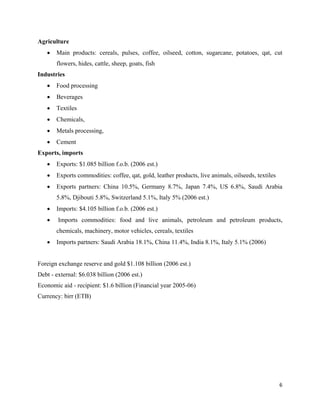
Agriculture
    •   Main products: cereals, pulses, coffee, oilseed, cotton, sugarcane, potatoes, qat, cut
        flowers, hides, cattle, sheep, goats, fish
Industries
    •   Food processing
    •   Beverages
    •   Textiles
    •   Chemicals,
    •   Metals processing,
    •   Cement
Exports, imports
    •   Exports: $1.085 billion f.o.b. (2006 est.)
    •   Exports commodities: coffee, qat, gold, leather products, live animals, oilseeds, textiles
    •   Exports partners: China 10.5%, Germany 8.7%, Japan 7.4%, US 6.8%, Saudi Arabia
        5.8%, Djibouti 5.8%, Switzerland 5.1%, Italy 5% (2006 est.)
    •   Imports: $4.105 billion f.o.b. (2006 est.)
    •   Imports commodities: food and live animals, petroleum and petroleum products,
        chemicals, machinery, motor vehicles, cereals, textiles
    •   Imports partners: Saudi Arabia 18.1%, China 11.4%, India 8.1%, Italy 5.1% (2006)


Foreign exchange reserve and gold $1.108 billion (2006 est.)
Debt - external: $6.038 billion (2006 est.)
Economic aid - recipient: $1.6 billion (Financial year 2005-06)
Currency: birr (ETB)


                                                                                                     6 
 
CHAPTER 2
       COTTON PRODUCTION: PRESENT STATUS AND FUTURE GROWTH PLANS


2.1 Introduction
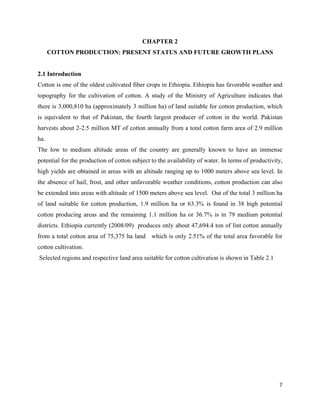
Cotton is one of the oldest cultivated fiber crops in Ethiopia. Ethiopia has favorable weather and
topography for the cultivation of cotton. A study of the Ministry of Agriculture indicates that
there is 3,000,810 ha (approximately 3 million ha) of land suitable for cotton production, which
is equivalent to that of Pakistan, the fourth largest producer of cotton in the world. Pakistan
harvests about 2-2.5 million MT of cotton annually from a total cotton farm area of 2.9 million
ha.
The low to medium altitude areas of the country are generally known to have an immense
potential for the production of cotton subject to the availability of water. In terms of productivity,
high yields are obtained in areas with an altitude ranging up to 1000 meters above sea level. In
the absence of hail, frost, and other unfavorable weather conditions, cotton production can also
be extended into areas with altitude of 1500 meters above sea level. Out of the total 3 million ha
of land suitable for cotton production, 1.9 million ha or 63.3% is found in 38 high potential
cotton producing areas and the remaining 1.1 million ha or 36.7% is in 79 medium potential
districts. Ethiopia currently (2008/09) produces only about 47,694.4 ton of lint cotton annually
from a total cotton area of 75,375 ha land which is only 2.51% of the total area favorable for
cotton cultivation.
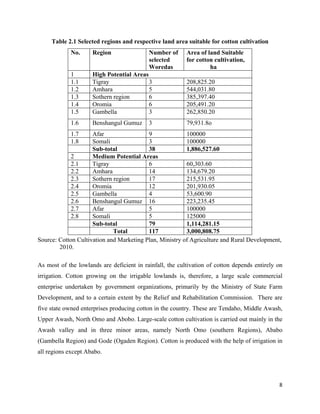
    Selected regions and respective land area suitable for cotton cultivation is shown in Table 2.1


                                                                                                      7 
 
Table 2.1 Selected regions and respective land area suitable for cotton cultivation
             No.     Region                Number of      Area of land Suitable
                                           selected       for cotton cultivation,
                                           Woredas                 ha
             1       High Potential Areas
             1.1     Tigray               3               208,825.20
             1.2     Amhara               5               544,031.80
             1.3     Sothern region       6               385,397.40
             1.4     Oromia               6               205,491.20
             1.5     Gambella             3               262,850.20
             1.6     Benshangul Gumuz      3              79,931.8o
             1.7     Afar                 9              100000
             1.8     Somali               3              100000
                     Sub-total            38             1,886,527.60
             2       Medium Potential Areas
             2.1     Tigray               6              60,303.60
             2.2     Amhara               14             134,679.20
             2.3     Sothern region       17             215,531.95
             2.4     Oromia               12             201,930.05
             2.5     Gambella             4              53,600.90
             2.6     Benshangul Gumuz 16                 223,235.45
             2.7     Afar                 5              100000
             2.8     Somali               5              125000
                     Sub-total            79             1,114,281.15
                             Total        117            3,000,808.75
Source: Cotton Cultivation and Marketing Plan, Ministry of Agriculture and Rural Development,
        2010.

As most of the lowlands are deficient in rainfall, the cultivation of cotton depends entirely on
irrigation. Cotton growing on the irrigable lowlands is, therefore, a large scale commercial
enterprise undertaken by government organizations, primarily by the Ministry of State Farm
Development, and to a certain extent by the Relief and Rehabilitation Commission. There are
five state owned enterprises producing cotton in the country. These are Tendaho, Middle Awash,
Upper Awash, North Omo and Abobo. Large-scale cotton cultivation is carried out mainly in the
Awash valley and in three minor areas, namely North Omo (southern Regions), Ababo
(Gambella Region) and Gode (Ogaden Region). Cotton is produced with the help of irrigation in
all regions except Ababo.


                                                                                              8 
 
Peasant cotton growing areas are rain fed and generally situated at altitudes ranging from about
1,000 meters to 1,700 meters above sea level. Rain-fed cotton is also grown under peasant
holdings in the Regions of Gonder (Humera), Sidamo (Bilate) and Gamo Gofa (Arba Minch)
where the annual rainfall is more than 700 mm.          Peasant production is characterized by
traditional technology with no access to improved seeds and chemicals. Almost all the cotton
produced by the peasant sector is used by the handloom industry. Spinning cotton into home-
made yarn for making traditional fabrics by handloom weavers is an important historical
tradition.


2.2 Planting period
The planting period for cotton in Ethiopia considerably varies from area to area. In the lower
Awash valley, cotton planting starts in late June and ends in mid August. In the Middle Awash
and rift valley areas, cotton planting commences sometime in early May and ends early June.
Planting is carried out during late April-early May in Upper Awash. In Humera, Metema and
Gambella areas planting is done in June-August. Harvesting also shows similar variations. In
Lower Awash cotton harvesting begins early November and ends mid January. In Middle Awash
the harvesting period is November to late December. In Humera, Metema and Gambella,
harvesting takes place starting Mid November to end January. The planting and harvesting
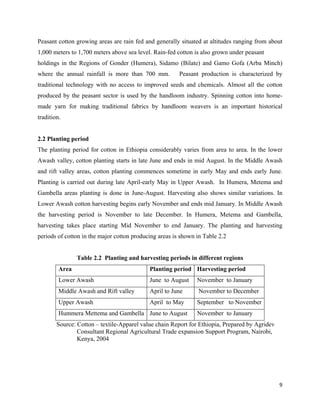
periods of cotton in the major cotton producing areas is shown in Table 2.2


                Table 2.2 Planting and harvesting periods in different regions
         Area                               Planting period Harvesting period
         Lower Awash                        June to August     November to January
         Middle Awash and Rift valley       April to June       November to December
         Upper Awash                        April to May       September to November
         Hummera Mettema and Gambella June to August           November to January
        Source: Cotton – textile-Apparel value chain Report for Ethiopia, Prepared by Agridev
                Consultant Regional Agricultural Trade expansion Support Program, Nairobi,
                Kenya, 2004


                                                                                                9 
 
2.3 Cotton production
The industrialization of the Ethiopian textile sub-sector started in 1930s, when the country’s
cotton planting remained in a stage of traditional growing pattern by household farmers. Before
1960, most cotton textile products made in Ethiopia depended on raw material imported, and
cotton import alone occupied roughly 30% of the total import value. As a result of the increased
demand on cotton from textile sub-sector, in 1960’s the Government initiated the large scale
planting of cotton     and made favorable land policies to meet the raw material needs of the
domestic textile sub-sector.
Tendaho Agricultural Development Enterprise was the first foreign-invested commercial cotton
farm. Later, local investors, including local governments, started to invest in establishing farms
specializing in cotton planting. With new cotton varieties, cotton growing area enlarged,
irrigation projects constructed,    machineries and chemical fertilizer employed in the planting,
the Ethiopian cotton sub-sector was on the road to mass production. Since 1990s, along with the
transition to the market economy, a group of private farms have come into being, thus forming
the cotton production system in which small farm households, public farms and private farms co-
exist.
The technology employed in cotton production also varies from producer to producer. The state
owned and private farms use improved agricultural practices and technologies. The small holder
farmers although participate in large numbers in cotton production, practices traditional and
backward farming.         Ethiopia grows relatively good raw cotton with fiber length of 26-28 mm.
There is potential to produce long staple length cotton in the country with improved seed and
technology utilization.


2.4 Cotton species
Cotton is not indigenous to Ethiopia. Major cotton species are Gossypium hirsutum L including
Carolina Queen, Deltapint 90, Stonenlle 1324, Cu-okri, Acalasi (S.J-2), Cucuroval 51 S, Bulk
2020 (crossbreed), Arha, Reba B-50 and Albar, (Coming from the USA, Israel, Turkey, former
Soviet Union and western African countries). All had high productivity when they were just
introduced.
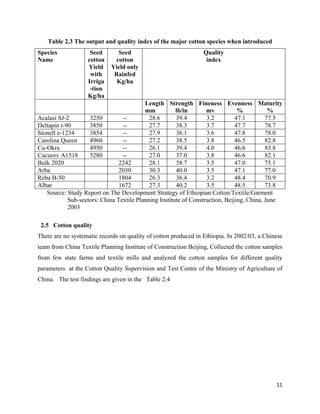
The output and quality index of the major cotton species when introduced are given in Table 2.3


                                                                                               10 
 
Table 2.3 The output and quality index of the major cotton species when introduced
Species              Seed      Seed                              Quality
Name                cotton    cotton                              index
                    Yield    Yield only
                     with     Rainfed
                    Irriga     Kg/ha
                     -tion
                    Kg/ha
                                          Length Strength Fineness Evenness Maturity
                                          mm           lb/in       mv           %           %
Acalasi SJ-2        3250         --         28.6       39.4        3.2         47.1        77.5
Deltapin t-90       3850         --         27.7       38.3        3.7         47.7        78.7
Stonell e-1234      3854         --         27.9       36.1        3.6         47.8        78.0
Carolina Queen      4960         --         27.2       38.5        3.8         46.5        82.8
Cu-Okra             4950         --         26.1       39.4        4.0         46.6        83.8
Cucurov A1518       5280         --         27.0       37.0        3.8         46.6        82.1
Bulk 2020                       2242        28.1       38.7        3.5         47.0        75.1
Arba                            2030        30.3       40.0        3.5         47.1        77.0
Reba B-50                       1804        26.3       36.4        3.2         48.4        70.9
Albar                           1672        27.3       40.2        3.5         48.5        73.8
   Source: Study Report on The Development Strategy of Ethiopian Cotton/Textile/Garment
            Sub-sectors: China Textile Planning Institute of Construction, Beijing, China, June
            2003

    2.5 Cotton quality
There are no systematic records on quality of cotton produced in Ethiopia. In 2002/03, a Chinese
team from China Textile Planning Institute of Construction Beijing, Collected the cotton samples
from few state farms and textile mills and analyzed the cotton samples for different quality
parameters at the Cotton Quality Supervision and Test Centre of the Ministry of Agriculture of
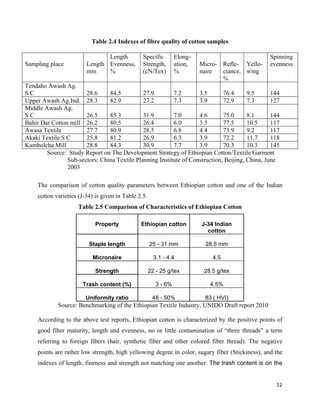
China. The test findings are given in the Table 2.4


                                                                                             11 
 
Table 2.4 Indexes of fibre quality of cotton samples

                               Length           Specific         Elong-                          Spinning
Sampling place          Length Evenness,        Strength,        ation,   Micro- Refle- Yello-   evenness
                        mm     %                (cN/Tex)         %        naire  ctance, wing
                                                                                 %
Tendaho Awash Ag.
SC                     28.6     84.5          27.9        7.2       3.5       76.4      9.5      144
Upper Awash Ag.Ind. 28.3        82.9          27.2        7.3       3.9       72.9      7.3      127
Middle Awash Ag.
SC                     26.5     85.3          31.9        7.0       4.6       75.0      8.1      144
Bahir Dar Cotton mill 26.2      80.5          26.4        6.0       3.5       77.5      10.5     117
Awasa Textile          27.7     80.9          28.5        6.8       4.4       73.9      9.2      117
Akaki Textile S C      25.8     81.2          26.9        6.3       3.9       72.2      11.7     118
Kambolcha Mill         28.8     84.3          30.9        7.7       3.9       70.3      10.3     145
        Source: Study Report on The Development Strategy of Ethiopian Cotton/Textile/Garment
                Sub-sectors: China Textile Planning Institute of Construction, Beijing, China, June
                2003

    The comparison of cotton quality parameters between Ethiopian cotton and one of the Indian
    cotton varieties (J-34) is given in Table 2.5.
                     Table 2.5 Comparison of Characteristics of Ethiopian Cotton

                            Property           Ethiopian cotton           J-34 Indian
                                                                            cotton

                         Staple length               25 - 31 mm            28.5 mm

                           Micronaire                  3.1 - 4.4              4.5

                            Strength                 22 - 25 g/tex         28.5 g/tex

                      Trash content (%)                 3 - 6%               4.5%

                        Uniformity ratio              48 - 50%             83 ( HVI)
            Source: Benchmarking of the Ethiopian Textile Industry, UNIDO Draft report 2010

    According to the above test reports, Ethiopian cotton is characterized by the positive points of
    good fiber maturity, length and evenness, no or little contamination of “three threads” a term
    referring to foreign fibers (hair, synthetic fiber and other colored fiber thread). The negative
    points are rather low strength, high yellowing degree in color, sugary fiber (Stickiness), and the
    indexes of length, fineness and strength not matching one another. The trash content is on the


                                                                                                   12 
     
higher side (6%) as compared to an equivalent variety of Indian origin cotton J-34 used in
spinning coarse yarn counts. Ethiopian cotton is suitable for spinning coarse and medium
yarn counts (Ne 20-40’s). Cotton grown in Middle Awash region is medium staple (28-30
mm) while that in Hawot region is short staple (25-27 mm).


2.6 Grading and quality checking
There is no well established system for grading and quality checking of cotton. In principle,
Ethiopia adopts American grading standards for cotton produced in the country. Cotton quality
check includes field quality grading, storing the samples of seed cotton according to their patch
field number, species, and time of harvest. 10 samples of un-ginned cotton from each batch are
taken for testing.
Fiber tests are conducted through the combination of apparatuses and visual observations and
feel. The test of length is made by hand pulling, while that of color, strength and fineness by
Spinlab and Micronnair Instruments.
Specie name, packing number, color, length, strength and grade are recorded on each bale of the
cotton.
The cotton ginning factories are not equipped with adequate quality test laboratories. Constant
humidity and temperature are not maintained, making many test errors and rare reproducibility of
test results.


2.7 Scientific research and education system of cotton
The National Agricultural Research Institution (NARI) is located in Addis Ababa, with its
agricultural technology stations in middle and lower Awash. The responsibilities of NARI and
technology stations include dissemination and training of research findings related to agriculture,
forestry, fruit and pasturage. At the same time, the stations are responsible for collection and
introduction of new plant resources, cotton seed breeding, cultivation, fertilization, irrigation,
drought fighting, preventing or solving the problems of disease, pest, or weed, and the research
work on planting systems.
The federal and regional governments have established higher institutions of agricultural
education. The three main agricultural universities are Alemaya Agricultural University, Ambo
Agricultural College and Jimma Agricultural College. Unfortunately, these agricultural


                                                                                                13 
 
institutions are not well equipped with scientific manpower and test equipment for quality and
technical inputs in cotton post-harvesting technologies.


2.8 Marketing chain
Cotton is grown as a cash crop and passes through different channels before it reaches the end
users as finished products. The marketing chain of cotton and its derivatives is shown in Figure
2.1.
                      Figure 2.1 Overview of cotton marketing chain


Source: Abdella, Merima, and Gezahegn Ayele, Agri-chain analysis of Cotton Sub-sector in
        Ethiopia. Ethiopian Development Research Institute, Ethiopia 2008.


                                                                                             14 
 
Producers
State farms, private commercial farms and small holders produce cotton. Prior to 1992, large
scale cotton farming had been the exclusive domain of state enterprises. After the reforms of
1992, private commercial farms have also been engaged in cotton production. Currently there are
six major private commercial farms engaged in cotton production; namely, Lower Awash,
Middle Awash, Birale, Humera, Metema and Wollega farms. As regards the smallholder sector,
its annual production is not much known. The traditional cottage industries including handlooms
and handicrafts were fully dependent on cotton supplied by smallholders.
There are five state-owned farms, which account for 30-31% of the total cultivated area. These
state farms are Tendaho, Middle Awash, Upper Awash, North Omo, and Abobo. The private
commercial farms accounted for the major share of 43% of the total area cultivated, while the
smallholder peasants represent 27% during 1996/97-2000/01. In terms of annual production,
private commercial farms offer the dominant share of 56% of total production, followed by the
state farm enterprises (32%) and the smallholder peasant (12%).
Cotton productivity
In spite of the low share that publicly owned farms have in total area cultivated and annual
production level, they perform relatively better in terms of productivity by using better farming
system than the privately owned and the small peasant farms. The average annual productivity
for the state owned enterprises ranges from 20 to 30 q/ha on irrigated farms and 15 to 20 q/ha
under rain fed agriculture. Privately owned farms that use irrigation systems also have a better
productivity level than the small peasants, who predominantly rely on traditional and backward
farming practices. The productivity data is given in Table 2.6


                    Table 2.6 Productivity of cotton by various producers
                            Type of producer    Productivity (q/ha)
                                                Rain fed Irrigated
                          Small holders         5-10         -
                          Private farms         15-20      20-30
                          State farms           15-20      20-30
                          Research institutes              35-45
          Source: Werer Research Center (cited in Agri-chain analysis of Cotton Sub-sector
                  in Ethiopia, 2008).


                                                                                              15 
 
The different farming techniques together with various inputs utilized and the overall
management system in the production process would imply for the disparity in the productivity
and quality of cotton produced by the various farms. The case studies undertaken for the three
categories of producers in Afar and Arbaminch reveal this fact very well.
Major problems faced by the farms
State farms
Lack of improved seeds
The two major seed types that have been used on the farm are Akala SJ2 and Delta Pine-90,
which were released from Werer Research Center. Akala SJ2 was released in 1987 with an
expected yield of 32.5 q/ha. Delta pine-90 was released during 1990 with a better-expected yield
of 38.5 quintals per ha. The farms used to buy these seeds from the research center, but now it
has been long since it starts preparing its own seeds, and even sells to other farms. The yield
capacity of these seed types is decreasing as the seeds lose their genetic potential from time to
time.
There was an attempt to introduce another seed called Gedera that was imported from Israel in
2005. Because adaptation trial was not made prior to its cultivation, the seed variety resulted in
huge loss for the farm. Lack of improved seed variety has constrained the farm’s capacity from
reaching the desired yield and quality levels. Although there are many reasons for this problem,
the fact that the farm does not get enough technical and/or advisory support from various
institutions, particularly from agricultural research centers is the major one.
Irrigation water shortage
Water shortage for irrigation arises from various reasons. Limited capacity of the cannel that was
built some 30 years ago is the major one. The cannel was originally built to irrigate limited areas
of land, but as the total area under cultivation both by the enterprise and by other farms in the
nearby area increases, the capacity of the cannel to reach the entire land has been declining from
time to time. The other reason is related with the prolonged cannel maintenance time taken by
the Awash Water Authority. Because the authority does not finish the maintenance according to
schedule, water will not be released to the farms during the appropriate irrigation time. During
times of heavy flooding from the Awash River, the cannel will also be closed completely as it
will be filled with soil sediment, creating water shortage for irrigation.


                                                                                                16 
 
To solve the water shortage problem, the authority once tried to open another way-out for the
cannel, but it did not succeed, as there were major problems in its design.
Labor shortage
Shortage of labor particularly during harvesting time is becoming a major problem to the farm.
The vast majority of pickers are brought from the Southern part of the county, and labor sourcing
was not a problem for a long time until recently. The low wage paid to pickers (25cents per kg)
compared to the surrounding private farms is one of the reason for shortage of labor which
results in labor shifting away from the state farm towards other farms who offer a relatively
better price. Apart from the disincentive created by low wage rate, alternative job opportunities
created in areas where the laborers came from is the major reason that created labor shortage not
only to the enterprise, but also to other cotton farms in the area.
Shortage of labor has a lot of implication on the farming operation. Delayed cotton picking
results in loss of cotton quality as the plant has to stay on the ground beyond the intended time
losing its moisture content and exposed to dust and other dirt materials. Delayed picking will
also expose the cotton plant to be fed by cattle, camels, and goats. Due to increased problems
faced by shortage of labor, the farms are planning to move towards mechanized harvesting
although it is costly and results in lower quality of cotton compared to hand picking.
Pest
The common pest types that affect the fiber yield and quality are the African Bollworm (ABW),
aphids, jassids and white fly. Particularly the ABW has a significant effect on yield and quality
of lint, causing an average cotton yield loss of 48% or 720 kg/ha The most widely used method
for controlling pest by the farm is the application of insecticides using aircraft spraying which
cost approximately 990 birr per ha. One problem associated with insecticide usage is the
resistance development by the insects that subsequently fails to control the pest. The other
problem arises due to the delayed availability of insecticides, as they are usually imported
through various agents of chemicals in the country. Health hazards associated with the use of
chemicals that have high level of toxicity is also a major problem. The most frequently used
chemical on the farm is thiodon, which contains a dangerous chemical called endosulfan with
high level of toxicity. Although there are no records of injuries or death caused by this chemical
in Ethiopia, there has been a record of dozens of death in cotton farms associated with the use of
this chemical, such as in India, Malaysia, and Sudan.

                                                                                               17 
 
Problems faced by Private farms
Almost all of the problems associated with the farming activities of the state farm like lack of
improved seeds, shortage of irrigation water, shortage of labor and pest are also faced by the
private commercial farm.
Major problems faced by smallholders
Apart from the common problems that arise due to the lack of improved seeds, shortage of
irrigation water, labor shortage and pest, smallholder farms also face the following problems.
Lack of finance:
    There are no credit associations to provide peasants with the necessary finance for farming
activities. This has limited the small holders’ chance of looking for alternative input price offers
in other markets, forcing them to rely on prices provides by big private commercial farms. This
has also forced the small holders to sell the raw cotton without it being processed/ginned, which
fetches much lower price.
Lack of market information
Information regarding the existing domestic and/or international market is almost non-existent
with the small holders. This has made them to become price takers, with no-negotiation power
for the selling price of cotton.
Problems related with land ownership
    In case small hold farming, most of the peasants come from other parts of the region and pay a
certain amount of their net profit to tribe members who own the land. The tribes have full power
to discontinue the farmer upon failure of paying the specified amount, or if they obtain a better
offer from another farmer who wish to expand his land. This uncertainty over land has been a
major disincentive to smallholder farmers to invest their time, power, and money fully.
In and around Arbaminch, the situation is a bit worse. In spite of the long existing tradition of
cotton farming, in this area that was once called the Cotton Belt in Ethiopia, the area is losing its
originality due to obstacles faced by the farms starting from the very small land holdings they
got. The average land holding of a household in that area is estimated to be one fourth of a
hectare which they use it for not only the production of cotton but also other cash crops like
Banana and food crops like cassava, tef, sweet potato, and others. Because cotton harvesting
requires a lot of investment and intensive care throughout its cultivation period, there is a trend
to shift from cotton to other less time and money consuming cash crops.

                                                                                                  18 
 
The small holders are aware of the fact that successful cultivation of cotton would result in
higher yield and return at the end of the day than other cash crops cultivated in that area, but
because of lack of finance and technical assistance provided to them, they prefer to cultivate
other crops with lower but less riskier returns like banana. One other factor for the small holders
to abandon cotton farming has to do with lack of market access for their produce. They lack
information regarding where to sell and at what price. Often the local collectors would go around
the house of every farmer and collect cotton at a very low price. The capacity of the local
collectors to absorb the total cotton produced in the area is also limited resulting in large amount
of cotton to be wasted without even reaching the local market. This shows that markets are
highly disintegrated leaving little room for incentive to farmers.
Smallholder farms in Humbo Wereda, which is found around Arbaminch, have started to form
trade unions that would collect the final cotton harvest and take it to the market. It is a good
move to establish such unions to alleviate the market problem of farmers. Nevertheless, apart
from that, huge technical assistance in terms of improving the productivity and yield of cotton
together with forming a strong linkage with the domestic and international market is yet to be
focused and developed.
Local Assemblers
As can be seen from the Figure 2.1, rural assemblers play an important role in collecting seed
cotton from smallholders. These assemblers are mostly independent operators at primary markets
who assemble and transport the raw cotton using pack animals and small trucks for sale to
private ginners. They handle about 20% of the cotton production by smallholders.
Ginneries
In 2003 there were 11 ginneries, 4 state owned and 7 private with an estimated annual ginning
capacity of 200,000 MT of raw cotton.


                                                                                                 19 
 
Table 2.7 Distribution, number, and operation of private and state-owned ginneries
                                              Private
     Location           No. of                             Operation
                      Ginneries
Addis Ababa           04        Offer ginnery service to private commercial farms and lint
                                cotton exporters in Awash valley and other cotton producing
                                regions
Gonder                02        Provide service to private commercial farms and cotton traders
                                operating at Metema and its surroundings.
Humera                01        Owned by a cotton producing share company.
State owned
Middle Awash          01           Provide service to state owned farms and small holders around
state enterprise                   the area
Tendaho State         01           Provide service to state owned farms
Enterprise
South Omo State       01           Provide service to state owned farms South Omo State
Enterprise
South Omo State       01           Provide service to state owned farms South Omo State
Enterprises
Abobo State           01           Provide service to state owned farms South Omo State
Enterprises

Source: Abdella, Merima, and Gezahegn Ayele. 2008. Agri-chain analysis of Cotton Sub-sector
in Ethiopia. Ethiopian Development Research Institute, Ethiopia.

All the ginneries are operating under capacity due to the low production of cotton in the country.
While all the cotton produced by state farms and private commercial farms go to the ginneries,
only 20% of the smallholder production is ginned. This is mainly because handlooms are the
main buyers of raw cotton directly from smallholder peasant farms.
Most of the lint cotton processed by public and private ginneries is sold to domestic textile mills
for further processing and production of textile fibers. Textile mills receive 80% of the cotton lint
provided by ginneries, where only 20% goes to the export market that is very low compared to
eastern and southern Africa average.
Delayed ginning operation due to prolonged time taken to source spare parts from abroad to
maintain the ginning machines is one of the problems that the factory faces. Electricity
interruption is also a major problem, which results in almost 20% of the idle time. Shortage of
qualified laborers and laboratory equipments that are essential for the grading procedure are also
creating difficulty in the ginning process.

                                                                                                  20 
 
Limited information regarding the international market is a major marketing problem.
Textile sector
Domestically produced raw and lint cotton are the major raw materials consumed by textile
factories, although other synthetic fibers and acrylic yarn are used to a limited extent. Almost
80% of lint cotton produced locally is absorbed by the textile mills for further processing to
produce fabrics both for the domestic and for the export market. The domestically produced
cotton is sufficient in fully satisfying the demands of the textile mills, making import of either
raw and/or lint cotton negligible.
The large cotton mills that consume local lint cotton as primary inputs for manufacturing textile
fibers are mostly state-owned or those leased by the private sector from the government on fixed
contractual agreements. The major textile factories are:
integrated mills (Akaki, Hawassa, Kombolcha, Bahir Dar, Dire Dawa, Almeda and Ethio-Japan
Nylon Textile factory;
Spinning mills (Adie Ababa and Edget Yarn Factory);
Spinning and weaving (Arbaminch Textile Factory);
Integrated Blanket Factory (Debre Berhan Blanket Factory).
Most of the textile factories in the country are largely underperforming unable to maximize the
benefits of procuring raw material from their close vicinity. The annual lint cotton consumption
of the existing textile mills is estimated to be 42,860 mt, which can be fully met from domestic
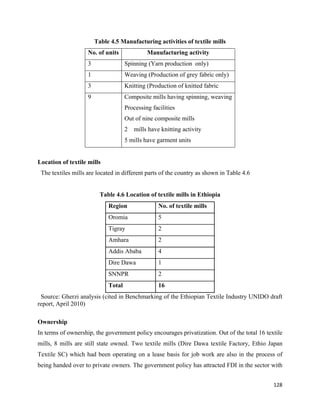
supply, but their actual consumption does not exceed 30,000 mt           Table 2.8 shows the actual
production in percent of the installed capacity of different textile mills.


        Table 2.8 Actual value of production of textile mills as % of yearly capacity
                      Industrial group           1998/1999 1999/2000 2000/2001
                 Manufacture of textiles            32.8         43.5         53.49
                 Spinning, weaving, finishing      31.23         42.93        54.31
                 Cordage, rope, twine, netting     60.22         53-41        45.66
                 Knitting                          32.29         16.37        31.48
                 Source: CSA (2003)


                                                                                                21 
 
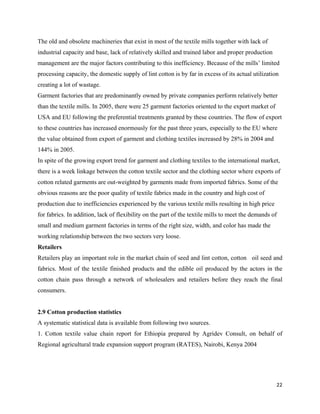
The old and obsolete machineries that exist in most of the textile mills together with lack of
industrial capacity and base, lack of relatively skilled and trained labor and proper production
management are the major factors contributing to this inefficiency. Because of the mills’ limited
processing capacity, the domestic supply of lint cotton is by far in excess of its actual utilization
creating a lot of wastage.
Garment factories that are predominantly owned by private companies perform relatively better
than the textile mills. In 2005, there were 25 garment factories oriented to the export market of
USA and EU following the preferential treatments granted by these countries. The flow of export
to these countries has increased enormously for the past three years, especially to the EU where
the value obtained from export of garment and clothing textiles increased by 28% in 2004 and
144% in 2005.
In spite of the growing export trend for garment and clothing textiles to the international market,
there is a week linkage between the cotton textile sector and the clothing sector where exports of
cotton related garments are out-weighted by garments made from imported fabrics. Some of the
obvious reasons are the poor quality of textile fabrics made in the country and high cost of
production due to inefficiencies experienced by the various textile mills resulting in high price
for fabrics. In addition, lack of flexibility on the part of the textile mills to meet the demands of
small and medium garment factories in terms of the right size, width, and color has made the
working relationship between the two sectors very loose.
Retailers
Retailers play an important role in the market chain of seed and lint cotton, cotton oil seed and
fabrics. Most of the textile finished products and the edible oil produced by the actors in the
cotton chain pass through a network of wholesalers and retailers before they reach the final
consumers.


2.9 Cotton production statistics
A systematic statistical data is available from following two sources.
1. Cotton textile value chain report for Ethiopia prepared by Agridev Consult, on behalf of
Regional agricultural trade expansion support program (RATES), Nairobi, Kenya 2004


                                                                                                    22 
 
2. Study Report on The Development Strategy of Ethiopian Cotton/Textile/Garment Sub-
       sectors, prepared by China Textile Planning Institute of Construction Beijing, China June
       2003
Though these reports are out dated, a summary is given in order to keep the record of the
information. A more recent statistical data from the Ministry of Agriculture is given at the end of
the chapter.
Statistical data from Regional agricultural trade expansion support program RATES
(1996/97 to 2000/01)
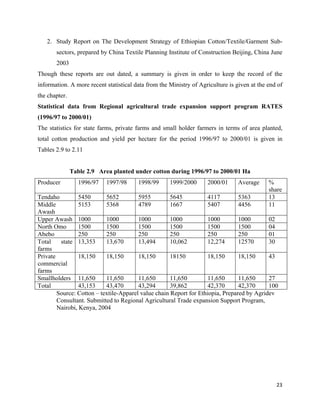
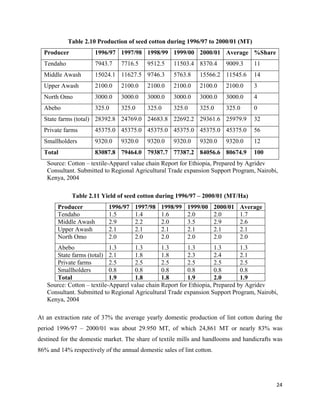
The statistics for state farms, private farms and small holder farmers in terms of area planted,
total cotton production and yield per hectare for the period 1996/97 to 2000/01 is given in
Tables 2.9 to 2.11


               Table 2.9 Area planted under cotton during 1996/97 to 2000/01 Ha
Producer          1996/97   1997/98     1998/99      1999/2000      2000/01      Average     %
                                                                                             share
Tendaho          5450      5652         5955         5645          4117         5363         13
Middle           5153      5368         4789         1667          5407         4456         11
Awash
Upper Awash 1000           1000         1000         1000           1000        1000       02
North Omo        1500      1500         1500         1500          1500         1500       04
Abebo            250       250          250          250            250         250        01
Total    state 13,353      13,670       13,494       10,062        12,274       12570      30
farms
Private          18,150    18,150       18,150       18150         18,150       18,150     43
commercial
farms
Smallholders 11,650        11,650       11,650       11,650        11,650       11,650     27
Total            43,153    43,470       43,294       39,862        42,370       42,370     100
        Source: Cotton – textile-Apparel value chain Report for Ethiopia, Prepared by Agridev
        Consultant. Submitted to Regional Agricultural Trade expansion Support Program,
        Nairobi, Kenya, 2004


                                                                                                23 
 
Table 2.10 Production of seed cotton during 1996/97 to 2000/01 (MT)
    Producer            1996/97 1997/98 1998/99 1999/00 2000/01 Average %Share
    Tendaho             7943.7   7716.5    9512.5    11503.4 8370.4         9009.3    11
    Middle Awash        15024.1 11627.5 9746.3       5763.8    15566.2 11545.6        14
    Upper Awash         2100.0   2100.0    2100.0    2100.0    2100.0       2100.0    3
    North Omo           3000.0   3000.0    3000.0    3000.0    3000.0       3000.0    4
    Abebo               325.0    325.0     325.0     325.0     325.0        325.0     0
    State farms (total) 28392.8 24769.0 24683.8 22692.2 29361.6 25979.9               32
    Private farms       45375.0 45375.0 45375.0 45375.0 45375.0 45375.0               56
    Smallholders        9320.0   9320.0    9320.0    9320.0    9320.0       9320.0    12
    Total               83087.8 79464.0 79387.7 77387.2 84056.6 80674.9               100
     Source: Cotton – textile-Apparel value chain Report for Ethiopia, Prepared by Agridev
     Consultant. Submitted to Regional Agricultural Trade expansion Support Program, Nairobi,
     Kenya, 2004

               Table 2.11 Yield of seed cotton during 1996/97 – 2000/01 (MT/Ha)
         Producer           1996/97   1997/98   1998/99    1999/00      2000/01   Average
         Tendaho            1.5       1.4       1.6        2.0          2.0       1.7
         Middle Awash       2.9       2.2       2.0        3.5          2.9       2.6
         Upper Awash        2.1       2.1       2.1        2.1          2.1       2.1
         North Omo          2.0       2.0       2.0        2.0          2.0       2.0
        Abebo                 1.3      1.3        1.3       1.3        1.3       1.3
        State farms (total) 2.1        1.8        1.8       2.3        2.4       2.1
        Private farms         2.5      2.5        2.5       2.5        2.5       2.5
        Smallholders          0.8      0.8        0.8       0.8        0.8       0.8
        Total                 1.9      1.8        1.8       1.9        2.0       1.9
     Source: Cotton – textile-Apparel value chain Report for Ethiopia, Prepared by Agridev
     Consultant. Submitted to Regional Agricultural Trade expansion Support Program, Nairobi,
     Kenya, 2004

At an extraction rate of 37% the average yearly domestic production of lint cotton during the
period 1996/97 – 2000/01 was about 29.950 MT, of which 24,861 MT or nearly 83% was
destined for the domestic market. The share of textile mills and handlooms and handicrafts was
86% and 14% respectively of the annual domestic sales of lint cotton.


                                                                                            24 
 
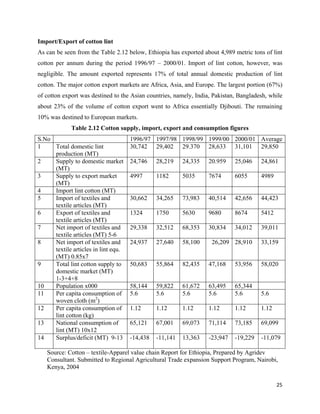
Import/Export of cotton lint
As can be seen from the Table 2.12 below, Ethiopia has exported about 4,989 metric tons of lint
cotton per annum during the period 1996/97 – 2000/01. Import of lint cotton, however, was
negligible. The amount exported represents 17% of total annual domestic production of lint
cotton. The major cotton export markets are Africa, Asia, and Europe. The largest portion (67%)
of cotton export was destined to the Asian countries, namely, India, Pakistan, Bangladesh, while
about 23% of the volume of cotton export went to Africa essentially Djibouti. The remaining
10% was destined to European markets.
             Table 2.12 Cotton supply, import, export and consumption figures
S.No                                 1996/97 1997/98 1998/99 1999/00 2000/01 Average
1    Total domestic lint             30,742 29,402 29.370 28,633 31,101 29,850
     production (MT)
2    Supply to domestic market       24,746    28,219    24,335    20.959    25,046    24,861
     (MT)
3    Supply to export market         4997      1182      5035      7674      6055      4989
     (MT)
4    Import lint cotton (MT)
5    Import of textiles and          30,662    34,265    73,983    40,514    42,656    44,423
     textile articles (MT)
6    Export of textiles and          1324      1750      5630      9680      8674      5412
     textile articles (MT)
7    Net import of textiles and      29,338    32,512    68,353    30,834    34,012    39,011
     textile articles (MT) 5-6
8    Net import of textiles and      24,937    27,640    58,100     26,209 28,910      33,159
     textile articles in lint equ.
     (MT) 0.85x7
9    Total lint cotton supply to     50,683    55,864    82,435    47,168    53,956    58,020
     domestic market (MT)
     1-3+4+8
10   Population x000                 58,144    59,822    61,672    63,495    65,344
11   Per capita consumption of       5.6       5.6       5.6       5.6       5.6       5.6
     woven cloth (m2)
12   Per capita consumption of       1.12      1.12      1.12      1.12      1.12      1.12
     lint cotton (kg)
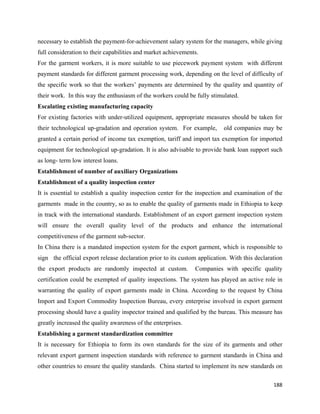
13   National consumption of         65,121    67,001    69,073    71,114    73,185    69,099
     lint (MT) 10x12
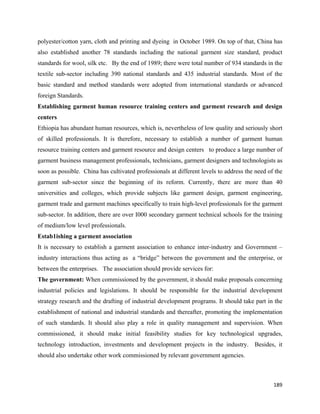
14   Surplus/deficit (MT) 9-13       -14,438   -11,141   13,363    -23,947   -19,229   -11,079

    Source: Cotton – textile-Apparel value chain Report for Ethiopia, Prepared by Agridev
    Consultant. Submitted to Regional Agricultural Trade expansion Support Program, Nairobi,
    Kenya, 2004

                                                                                              25 
 
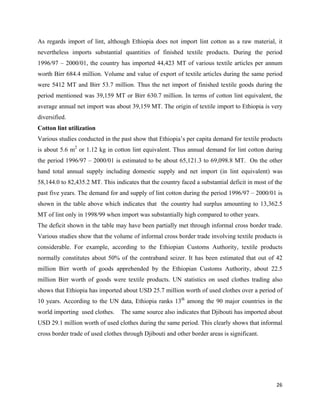
As regards import of lint, although Ethiopia does not import lint cotton as a raw material, it
nevertheless imports substantial quantities of finished textile products. During the period
1996/97 – 2000/01, the country has imported 44,423 MT of various textile articles per annum
worth Birr 684.4 million. Volume and value of export of textile articles during the same period
were 5412 MT and Birr 53.7 million. Thus the net import of finished textile goods during the
period mentioned was 39,159 MT or Birr 630.7 million. In terms of cotton lint equivalent, the
average annual net import was about 39,159 MT. The origin of textile import to Ethiopia is very
diversified.
Cotton lint utilization
Various studies conducted in the past show that Ethiopia’s per capita demand for textile products
is about 5.6 m2 or 1.12 kg in cotton lint equivalent. Thus annual demand for lint cotton during
the period 1996/97 – 2000/01 is estimated to be about 65,121.3 to 69,098.8 MT. On the other
hand total annual supply including domestic supply and net import (in lint equivalent) was
58,144.0 to 82,435.2 MT. This indicates that the country faced a substantial deficit in most of the
past five years. The demand for and supply of lint cotton during the period 1996/97 – 2000/01 is
shown in the table above which indicates that the country had surplus amounting to 13,362.5
MT of lint only in 1998/99 when import was substantially high compared to other years.
The deficit shown in the table may have been partially met through informal cross border trade.
Various studies show that the volume of informal cross border trade involving textile products is
considerable. For example, according to the Ethiopian Customs Authority, textile products
normally constitutes about 50% of the contraband seizer. It has been estimated that out of 42
million Birr worth of goods apprehended by the Ethiopian Customs Authority, about 22.5
million Birr worth of goods were textile products. UN statistics on used clothes trading also
shows that Ethiopia has imported about USD 25.7 million worth of used clothes over a period of
10 years. According to the UN data, Ethiopia ranks 13th among the 90 major countries in the
world importing used clothes.    The same source also indicates that Djibouti has imported about
USD 29.1 million worth of used clothes during the same period. This clearly shows that informal
cross border trade of used clothes through Djibouti and other border areas is significant.


                                                                                                26 
 
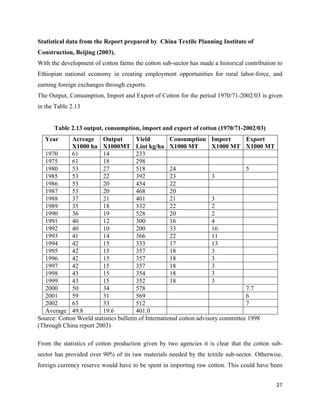
Statistical data from the Report prepared by China Textile Planning Institute of
Construction, Beijing (2003).
With the development of cotton farms the cotton sub-sector has made a historical contribution to
Ethiopian national economy in creating employment opportunities for rural labor-force, and
earning foreign exchanges through exports.
The Output, Consumption, Import and Export of Cotton for the period 1970/71-2002/03 is given
in the Table 2.13


      Table 2.13 output, consumption, import and export of cotton (1970/71-2002/03)
    Year     Acreage Output             Yield         Consumption Import           Export
             X1000 ha X1000MT Lint kg/ha X1000 MT                      X1000 MT X1000 MT
   1970      61          14             233
   1975      61          18             298
   1980      53          27             518           24                           5
   1985      53          22             392           23               3
   1986      53          20             454           22
   1987      53          20             468           20
   1988      37          21             401           21               3
   1989      35          18             332           22               2
   1990      36          19             528           20               2
   1991      40          12             300           16               4
   1992      40          10             200           33               16
   1993      41          14             366           22               11
   1994      42          15             333           17               13
   1995      42          15             357           18               3
   1996      42          15             357           18               3
   1997      42          15             357           18               3
   1998      43          15             354           18               3
   1999      43          15             352           18               3
   2000      50          34             578                                        7.7
   2001      59          31             569                                        6
   2002      63          33             512                                        7
   Average 49.8          19.6           401.0
Source: Cotton World statistics bulletin of International cotton advisory committee 1998
(Through China report 2003)

From the statistics of cotton production given by two agencies it is clear that the cotton sub-
sector has provided over 90% of its raw materials needed by the textile sub-sector. Otherwise,
foreign currency reserve would have to be spent in importing raw cotton. This could have been


                                                                                             27 
 
an unwise choice. The cotton sub-sector has been vital support for the textile sub-sector.
Therefore, it is obvious that the cotton sub-sector development will directly promote Ethiopian
industrialization.
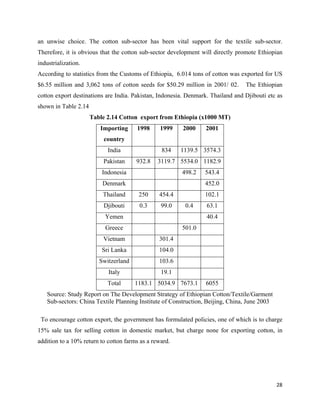
According to statistics from the Customs of Ethiopia, 6.014 tons of cotton was exported for US
$6.55 million and 3,062 tons of cotton seeds for $50.29 million in 2001/ 02.       The Ethiopian
cotton export destinations are India. Pakistan, Indonesia. Denmark. Thailand and Djibouti etc as
shown in Table 2.14
                      Table 2.14 Cotton export from Ethiopia (x1000 MT)
                          Importing      1998     1999     2000    2001
                            country
                             India                834     1139.5 3574.3
                            Pakistan    932.8    3119.7 5534.0 1182.9
                           Indonesia                      498.2    543.4
                           Denmark                                 452.0
                           Thailand      250     454.4             102.1
                            Djibouti      0.3     99.0     0.4      63.1
                            Yemen                                   40.4
                            Greece                        501.0
                            Vietnam              301.4
                           Sri Lanka             104.0
                          Switzerland            103.6
                              Italy               19.1
                             Total      1183.1 5034.9 7673.1       6055
      Source: Study Report on The Development Strategy of Ethiopian Cotton/Textile/Garment
      Sub-sectors: China Textile Planning Institute of Construction, Beijing, China, June 2003

    To encourage cotton export, the government has formulated policies, one of which is to charge
15% sale tax for selling cotton in domestic market, but charge none for exporting cotton, in
addition to a 10% return to cotton farms as a reward.


                                                                                                 28 
 
2.10 Potentials for the development of cotton sub-sector
The potentials of growing cotton are high because of following favorable factors
      1. Natural environment advantages.     
      2. Large labor force and Low production cost 
      3. The potentiality for expanding the cotton growing acreage 
      4. Increasing the yield potentiality  
      5. Domestic and international market potentials 
    Natural environment advantages
Ethiopia is bestowed with natural environment advantages such as availability of vast land at
suitable sea level heights, sufficient sunshine and temperature, soil conditions, abundant water
resources etc. for the development of cotton sub-sector.
64% of Ethiopian land is at or below 1500m, which provides a vast territory for cotton growing.
The main areas for cotton growing are in low or mid regions from 360 m to 1300 m high. The
country endowed with 13 Ethiopian months of sunshine, the annual sunshine in Ethiopia
amounts to over 3,000 hours, which can fully satisfy the need of cotton growing. The average
temperature in cotton growing area is 26-310 C. Under such conditions, theoretically, cotton can
be planted all the year around. Ethiopian cotton field soils are brown and composed of
denaturation soil and alluvial soil. The content of cohesive particles is 60% while that of sand
particle 40%. The soil is rich in organic matters. Most importantly, with its rich rainfall, nine
rivers, many lakes and as the source of the Blue Nile, Ethiopia is rich in water resource and is
recognized as the Water Tower of Africa, though the water utilization ratio is only 5%.
Large labor force and low production cost
    Out of 67 million, 57 million i.e. 85% of population live in rural area. 13 million i.e. 23%
population is between 15-49 years old. (2002). This constitutes ample labor force for agriculture.
Ethiopia has a comparative advantage over other countries in terms of production cost per
hectare. According to a survey by International Cotton Advisory Committee (1998), the
production cost of Ethiopian cotton is 66.3% of that of China, 57.3% America. 33.5% Australia.
23.2% Israel,         and 90.8% India. By contrast, because of low production efficiency, the
production cost per kilogram, has a comparative disadvantage and is higher than that of any of


                                                                                                29 
 
the above mentioned countries. Ethiopia also enjoys low cost of cotton ginning, packing and
processing.
The potentiality for expanding the cotton growing acreage
56% of Ethiopian territory is arable land, of which 15%. about 16.85 million ha up to now have
been cultivated. 3.7million ha can be irrigated, though only 197,000 ha, 5% of it has been
irrigated until now. Judged from its arable land and irrigated land, Ethiopia has a great
potentiality for expanding cotton- growing acreage.
Potentials for increasing the yield per hectare
At present the cotton species are primarily American species--- Deltapint 90 and Acalasi (SJ-2).
However, these species have been used for more than20 years, thus giving rise to the serious
problem of species ageing and degeneration. Generally, species will be limited to a 3-5 years use
in the major cotton production countries, because by species renewal, yield can be increased by
l0%-15%, in some cases, even by 30%. Also the use of fertilizers is low and cultivation methods
are not totally scientific. With the use of improved seeds such as crossbred or genetically
modified, increasing the use of fertilizers and scientific inputs for cultivation the yield per
hectare can be considerably increased with the positive effect on total production.
Vast domestic and international market
Assuming 1.5 kg per person per year consumption of cotton and 75 million population (2006)
the domestic consumption of cotton will be 103,000 ton. With the progress of cotton sub-sector
there will be emphasis on the export of cotton.       The government has identified textile and
garment sub-sector as one of the priority sectors for rapid industrial developments. All these
factors will lead to increase production of cotton. At the international level, cotton is a kind of
cash crop and it is a leading raw material for the textile and garment sub-sector, and definitely
occupies the dominant position among natural fibers. With the rise of world population and
people’s living standard, cotton will continue its dominant place in global fiber consumption. As
a small cotton-planting country, in terms of its present export scale, Ethiopia has a rather large
export market.


2.11 Cotton production and marketing constrains
According to a study conducted by the Ministry of Agriculture, cotton production and marketing
faces various constraints. The nature and type of the constraints are different. On the production

                                                                                                30 
 
side, the constraints are related to the absence or limited availability of research and extension
services and inadequate supply of inputs, while on the marketing side, the constraints are related
to lack of capacity to supply quality products, inadequacy of the existing infrastructure and lack
of finance. Some of the constraints are as follows.
Strengthening the development of human resources
Qualified and trained human resource is the most important factor in production, marketing and
general management. The development of human resources is of practical importance and
urgency for the developing countries, which possess the advantages of raw materials, labor force
and market potentialities. Labor-force with low cost and high quality is a vital element of
showing the comparative advantages of the industry, and is also to create the most competitive
environment for foreign investments.
Education and training to enhance the comprehensive qualities of the staff on the public farms
can be a concrete and effective method of reinforcing the development of human resources. The
training of personnel can be performed at two levels:
Train personnel of medium and advanced level for cotton management and administration and
technological research. Identify     training plans and regulate the management methods of
training; reform the management measures; select devoted and excellent experts in the cotton
production, management, administration, and technology for training personnel in batches in
definite time schedule. Train managers, workers and farmer at the basic level. Improve training
methods to rapidly enhance the trainees’ basic quality and skill.
Production constraints
According to the reports of RATES, Kenya and China Textile Planning Institute of Construction
China, some of the constraints in the development of cotton sub-sector and measures are
summarized below
Shortage of improved seed Varieties
The seed varieties available in the country are either inadequate or do not meet the required
international standards or both. Not much research efforts are made to develop cotton seed
varieties which can allow the production of cotton of acceptable quality and quantity. The seed
variety needed to produce the type of cotton in great demand in the international market is long
fiber seed, and it is not available in the country. More seriously, minimal research efforts are
made to the multiplication of those seed varieties which are already known and used in other

                                                                                               31 
 
countries. These constraints have seriously undermined the effort to improve cotton productivity
and quality.
Surveys demonstrate that in Ethiopia, cotton plants are primarily American species--- Deltapint
90 and Acalasi (SJ-2).     However, these species have been used for more than 20 years, thus
giving rise to the serious problem of species ageing and degeneration. Generally, species will be
limited to a 3-5 years use in the major cotton production countries, because by renewal of
species, yield can be increased by l0%-15%., in some cases, even by 30%.
    Since 1990s, the cotton species have come into a new utilization era from normal cotton to
crossbreed cotton and pest-resistant cotton. There are two ways to produce crossbreed cotton.
One is breeding among species, or subspecies. This has obvious advantages and is an effective
way to increase the yield, quality and pest- resistance.
Another approach is the development of genetically modified Pest-resistant cotton usually refers
to Bt gene-transformed cotton. Its successful breeding opens a new technological path for anti-
pest cotton species.
The world has come into the era of supplying seeds commercially instead of breeding
independently. It is advocated that seeds for production be replaced every year and that farms
and farmers not to keep their seeds. Seed breeding, crossbreeding, processing, testing, packing
are all done in industrial way. For example, China’s cotton planting acreage has been 4.5-5
million ha. planting acreage of pest-resistant cotton (Bt cotton) has reached 30%, crossbred
cotton is 15% , demonstrating a strong developing trend. Indian cotton acreage is 7-7.5 million
ha, 50% being crossbred cotton. At the same time, America has cotton acreage of 5-5.5 million
ha, 60% of which is anti-pest Bt cotton. These giant countries in cotton production often use
their breeds for 3-5 years. It is generally held that new breeds will increase yield by 10%-15%,
the highest being 30%. In this way, quality as well as its resistance to pests, will also be
improved.
Shortage of technical inputs
Needless to say, if one is to meet required quality standards, availability of adequate amounts of
technical inputs- fertilizers, pesticides, herbicides and better equipment is crucial. The reality in
Ethiopia is, however the reverse. In spite of its visibility by its absence, the attention given to
provide such inputs to the farmers has been minimal, and this has had an obvious negative
impact on improving quality and productivity. As cotton is prone to attacks by different types of

                                                                                                  32 
 
pests, absence or inadequacy of pesticides has forced textile factories to receive inferior raw
cotton damaged or infested with honey dew caused by the excretion of sucking insects like
aphides. Following measures are suggested to improve the situation.
In Ethiopia, large-scale farms are highly mechanized. The cleaning of the remaining old Plants,
tilling, raking, leveling, sowing, and preventing pests, diseases and weeds, are mostly dependable
on machineries. Large tractors, sowing machines, leveling machine, large cotton-ginning
machines, Oil extractors and diesel generators are mainly from the former Soviet Union and
Germany. All these machines, suffering from ageing to all degrees and shortage of spare parts,
need renovation. The problem of ageing and shortage of parts also restrict the cotton yield and
quality. The enterprises should reinforce their maintenance work of equipments. Make full use of
the existing machinery potentialities, put into use new parts, and bring down the malfunction
rate. Thus, they can raise the production capability and efficiency and bring into play the scale
effects of large farms.
Fiber quality test
Fiber quality test is the foundation on which cotton quality and price are assessed. Public farms,
on the basis of the existing fiber tests, should reform and introduce new state of art test
equipment, improve cotton fiber test laboratory, enhance the testing measures so that, they can
make a series of scientific test criteria and procedures for the assessment and regulation of cotton
quality.
The government cotton administration should set up agencies to supervise cotton quality. Quality
Testing Station should be established in different cotton producing regions.          It should be
compulsory that cotton producer, when applying for government’s financial aid and exports
should testify cotton in terms of quality by the testing certified agencies. The technical staff in
the testing laboratories should be qualified from the recognized institutions.
Large-scale farms should set the role model
Large-scale state farms are the leading force to increase Ethiopian gross output of cotton.
Therefore, the large scale farms should take the initiatives in utilizing new agricultural
technologies, new varieties and planting techniques. And thus act as an example for private
farms and traditional farmers to follow suit. This will drive Ethiopian cotton subsector to
advance.


                                                                                                 33 
 
Equalizing fertilization
Fertilizer, being the “food” of cotton, is an important factor of improving cotton yield, the
increase percentage being 30-50%. Now the advanced cotton-planting countries have undergone
the transition from single nutrition to multiple nutrition and the transition from nitrogen fertilizer
to the combination of nitrogen with phosphate, potash and trace elements.
Ethiopia uses a rather small amount of fertilizer. Since there have been no fertilizer factories in
the country, all fertilizers depend on imports. The amount of fertilizer is as low as 17kg/ha, in
comparison to 83kg/ha for the average global level, 97kg/ha for the North Africa, and
1,125kg/ha for China. The recommended amount for Upper Awash is N 64kg/ha and P 46kg/ha
and for Tendaho Farm Carbamide 100kg/ha. The fertilizer method is manual spraying along with
diammonium before sowing, followed by disc harrowing, and addition of Carbamide during the
periods of flower and boll.
    Control of disease and pests
Major cotton pests in Ethiopia include bollworm, pink bollworm, leafhopper, aphid. Cotton-leaf
acarid, trips and leaf miner. Chemical pesticides are Polyethrine, Thiodon, Carbamate,
Endosulfan, Pyrethroids and Deltonet. All imported from the U.S.A,              U.K,    France, and
Germany.
Diseases and pests cause 30% loss of cotton production and also affect the cotton quality.
Therefore, forecast teams of cotton diseases and pests should be established and integrated
measures should be adopted to control diseases and pests to ensure high yield and quality of
cotton.
Absence of extension services
Extension service to small-scale cotton producers is virtually non-existing. What ever is
produced at this level is entirely using traditional practices which can ensure neither adequate nor
quality production. The quality constraints on its part have diminished the potential earnings of
small scale farmers. In general absence of extension services have impeded the expansion of
modern cotton production practices in the country.
Limited Research work
Overall limited attention is given to cotton production in the country. Research on improving
productivity is minimal. There is only in one center-Melka Werer that some research is

                                                                                                   34 
 
undertaken. And even this is limited in scope, focusing only on irrigation practices in the area.
There is no research on rain fed production where the efforts of small farmers are concentrated.
In view of this new varieties and technologies should be employed to raise the cotton quality and
yield, which involve the work of tilling, sowing, planting density, plant protection, fertilization.
Irrigation, preventing pests, diseases and weeds, as well as chemical regulations.
The development of science and technology in connection with cotton should be further stressed.
That is to say, equip the research laboratories with scientific equipment; improve the functioning
of cotton research institutions, employ qualified research staff to strengthen scientific innovation
and technological development ability. The scientific research and development findings should
be transferred in the fields for productivity and yield improvements.
Scientific R & D institutions should cooperate with cotton enterprises, conduct surveys, spread
related knowledge, and promote the academic exchanges for the dissemination of cotton science
and technology. The institutions should also bring into play the advantages of the industry as a
whole and devote themselves to the comprehensive R&D activities of high standards, profound
scientific contents, and high added values.
Limited Irrigation Practices
Irrigation practices are limited to a few state and large-scale private farms operating in a few
areas. The rest is rain fed where erratic rains frequently cause crop failures or the production of
cotton of inferior quality and quantity.
Ethiopia is accessible to abundant water resources for irrigation, though its present utilization
rate only 5%.
As long as water is provided, cotton can grow all the year around. However, Ethiopian cotton
fields with irrigation constitute 22% of the whole cotton planting acreage. The limited irrigation
includes ridge and furrow irrigation and flooding, with the water from pumping or blocking. The
rest of the cotton fields depend on rainfall. Therefore, the low rate of Irrigation and heavy
dependence on rainfalls severely restricts the development of the cotton sub-sector.
With irrigation, un-ginned cotton yield is 2-3tons/ha, while if only rain-fed, un-ginned cotton
yield reduces to 0.8-l.5 tons/ha.
In its growing and breeding period, cotton needs irrigation 4-5 times, with the amount of 45,000-
60,000 m3/ha each time. Irrigation should be conducted 10-15 days before sowing, and also 3-4
times during its reproducing period. Usually there is no irrigation during the seedling period, but

                                                                                                 35 
 
it is needed in the budding, blossoming and       boll periods. Irrigation should happen every 14
days during blossom and boll periods, while 21 days in the rest periods. The last irrigation should
be conducted 15-21 days before harvest. Irrigation can be done through furrow irrigation or
sprays. Flooding should be avoided. During the process of construction for irrigation, water-
saving irrigation techniques should be used, such as development of water transportation through
pipes, seepage control, spraying irrigation and drip irrigation.
Thus irrigation works are the lifeline of agriculture and therefore top priority has to be given to
irrigation of agricultural fields.
Take advantage of international aids
Ethiopia is the country receiving the lion’s share of foreign aid in the world. Normally aids are
confined to specific purposes and not applicable for competitive trades. One of agriculture’s
characteristics is closely related to activities of public welfare, such as controlling of nature,
fighting poverty, helping people in need, which belongs to the non-competitive field. If
donations are used to conduct capital construction for irrigation works and reform cotton fields
with low or medium yields, then it is to better for the ecology. Moreover, to help victims of
natural calamities, produce and feed themselves will be more effective than to solve the actual
problems of poverty and famine. Consequently, it is advisable to appeal to the international
community: integrate food aid with developing agricultural resources, enlarge planting acreage,
reform cotton field with low or medium yield, improve cotton varieties, prevent and solve pest or
disease problems, establish scientific and technology proliferation system, and train personnel, so
as to help establish the basic conditions for cotton production.
The focus on the irrigation works of the arable land will achieve multi-purpose effects, reducing
calamities, and transforming saline-alkali land. In this regard, the Ministry of Water Resources
has set up a Water Resources Development Fund. In addition, the World Bank can help
implement a 15-year plan of irrigation works. Corresponding plans in other aspects should be
designed to support the developing strategies of the cotton sub-sector.
Market Constraints
Beyond cotton production, cotton marketing is also constrained by different factors. The most
notable among these are the followings
Inadequate knowledge about market standards


                                                                                                36 
 
The Ethiopian Standards Authority has established the quality which domestic cotton production
should fulfill to meet the required market standards. These standards are not, however widely
known to all the players on the marketing chain, and this has prevented producers and domestic
market suppliers from taking all necessary precautions to ensure that their products are up to the
standards required.
Furthermore, inspections against the standards are not made by a neutral body which can ensure
fair evaluations, but rather by the buyers themselves, and this practice has often denied farmers a
fair price for their products.
Lack of Market information
The market information system in Ethiopia is generally poor, and cotton marketing is not an
exception. Absence or inadequacy of such a system has deprived producers and suppliers access
to such vital information as     alternative market outlets, levels of demand and price, and the
standards required by the various players in the market. Production and marketing decisions have
as a result been made either arbitrarily or on incomplete information basis. Needless to say,
producers need market information to help them decide on what, how much and at what quality
to produce and traders to decide at what price to buy and sell. Absence of market information has
reduced the competitiveness and bargaining power of farmers and local suppliers, forcing them
to be price takers.
Information network is the general trend of the present world and social development. The rapid
establishment of the national market information network of cotton and solving the urgent
problem of production information shortage and blockage of technology and market information
will be an effective choice for Ethiopia. It is therefore essential to set up cotton trade union,
reinforce the trade regulation, and provide an all-round information service. A national
information system should survey the production and operation of the whole trade, in the hope of
identifying the development level, being consultative to the government’s policy making and
scientific research, as well as sharing the information with cotton enterprises.
Absence of a System for Contractual Production and Marketing Arrangement
Cotton production and marketing       is done in an arbitrary manner in that there is no practice
where by producers can be assured of a reliable market and traders a steady supply. The reason
for this is that there is no experience in pre-delivery contractual arrangements among the market
players. Such arrangements between producers and traders could have allowed the former to

                                                                                                37 
 
produce as per an agreed contract and to a required standard and the later to ensure timely
purchase and payment. It could have helped ease financial and technical constraints often faced
in the production and marketing process. The traders could for example have helped the farmers
to overcome financial and technical problems which they often face.
Inadequacy of Support through Service co-operatives
In spite of the many constraints which cotton farmers face in production and marketing, there is
no mechanism for collective efforts to address the problems. Production and marketing is done in
a fragmented and isolated manner, and through individual efforts. A reliable way out of such
constraints is to address them collectively by establishing service co-operatives. Such structures
have proved to be instrumental to other similar activities by ensuring their members access to
markets, better bargaining power in setting prices, and in the supply of agricultural inputs,
among others. At present, there are no service co-operatives operational in most of the cotton
producing areas and where they exist, their focus is on other activities, depriving cotton farmers
the opportunity to expand and get a fair price for their products.
Lack of finance
Cotton production even at a small scale requires finance to purchase technical inputs like
fertilizers, as well as necessary equipment. Cotton farmers have often faced serious financial
shortages and so have the traders engaged in the business. Individual attempts to access credit
facilities have not been successful due to lack of collateral. Beyond the production and marketing
of raw materials, textile factories and ginneries, as well as oil mills also face serious financial
constraints, which have limited their ability to purchase new or replace obsolete equipment.
In order to overcome the financial problems Government should widen the financial channels,
which can include the government’s fiscal allocation, bank loans, foreign funds, self fund-raising
by enterprises, and effective use of international aids. For these purposes, the government may
consider establishing a special development fund and entrust it to commercial banks for
operation. Besides, the government should abide by the principle of “loan according to sale; loan
according to efficiency”. Thus, support for the production can be strengthened without the
danger of bad loans.
As for the national investments, they can be spent in the capital construction of the sub-sector,
such as the construction of medium or large-sized reservoirs, dams, and roads. Bank loans can be
expended in purchasing or storing cotton. Funds raised by enterprises themselves can be used to

                                                                                                38 
 
improve production conditions, for example, to purchase or maintain farm implements and fiber
testing devices, to cultivate barren land   and to train personnel.


2.12 Recommendations for the development of cotton sub-sector.
The report prepared by Agridev consultancy on behalf of Regional Agricultural Trade Expansion
Support Program (RATES Centre), Nairobi, Kenya (2004) has recommended several measure
for the development of cotton sub-sector. These recommendations are summarized below.
Production increase through area expansion
According to a recent report of the Ministry of Agriculture, there are many cotton producing
areas in the country. These areas could be grouped into two. The first group consists of areas
identified in 38 Weredas and 8 regions, which have a high potential. They include irrigated farms
currently operated by state farms, private investors and small farmers. Those areas in Gambela
and Somali regions, where irrigation infrastructures have been laid and rain fed farms of high
potentials currently run by investors and small farmers. The second group consists of farms in 79
weredas in 8 regions. They are farms of medium potential. They are mainly rain fed farms
currently operated by private investors and small farmers, but have the potentials for irrigation
development through river diversions and construction of small dams.
The Govt. thus has to encourage local and foreign investors in order to develop and utilize the
above mentioned potential for expansion.
Productivity increase through intensification
The use of improved agricultural technologies, improved farm management practices and
research and extension services, will have far reaching impact beyond the level of production,
positively affecting the quality of the product, which will in turn improve its marketability. The
focus in this regard should therefore be on the following:
a)   Application of improved agricultural technologies
The use of improved agricultural technologies such as improved seed, artificial fertilizers,
pesticides, appropriate machineries and implements are crucial to increase production and       to
improve the quality of lint cotton. The use of improved seeds should include
     •   Developing and expanding hybrid seeds
     •   Introduction and adoption of highly productive and long fiber varieties.


                                                                                               39 
 
•   Involvement of Ethiopian seed enterprises as well as similar other agencies in the
           multiplication and dissemination of high quality seeds.
As regards to other technologies, the focus should be on the use of chemical fertilizers,
pesticides and appropriate machineries and implements required for such an activity. Service co-
operatives and other organizations responsible for the supply of inputs must play a big role. And
in this endeavor, they need to be supported and encouraged through all possible means.
b) Application of better farming methods
The focus here must be to develop improved cotton production packages and introduce them
through the extension system effectively. The packages should include improved methods of
land preparation, seeding, irrigation practices, harvesting, post harvest handling, crop protection
etc.
c) Improved Post harvest Management
The activities here include taking proper care of the crop during transportation and storage so as
to prevent losses and damages. Similar care should be made during ginning, particularly in
maintaining the desired moisture level of the crop and keeping it clean from dirt and waste
materials.
d) Promotion of Crop Rotation
Crop rotation practice must have two purposes. One is to help improve the income of the farmers
by encouraging them to grow crops, such as sesame, haricot beans and wheat alongside cotton.
The crops to be included in the rotation must, however, be short maturing and high yielding and
that its practice should be compatible with the technology and equipment in use. The other is to
improve the fertility of the soil and to help break the reproduction cycle of pests and diseases.
e) Effective Extension Service
This is an activity that has been lacking in the past and the importance of the service to increase
cotton production and productivity is enormous. The Ministry of Agriculture and its counterparts
at regional levels must provide extension service on cotton if production and productivity are to
be increased in the country.
f) Improved Research activities
Research activities have also been weak and this need to be strengthened if the potential for
cotton production in the country is to be realized. The Ethiopian Agriculture Research Authority


                                                                                                    40 
 
must work hard to expand its research activities to solve crop productivity constraints faced by
different producers in the country.


g) Dissemination of Knowledge about Standards
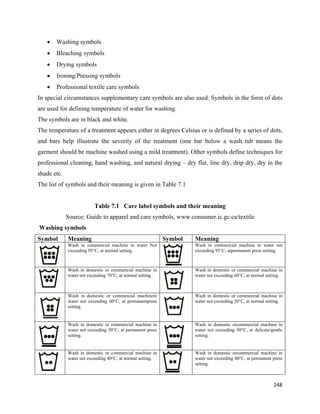
Knowledge about the quality standards required in cotton production has, as noted earlier, been
limited and the need to rectify the situation has been obvious. To this effect, the Ethiopian
Standards Authority in collaboration with other concerned agencies; must advice and support
farmers and traders whenever they need such support and disseminate all information about
standards through all possible means.
h) Promotion of Irrigation Practices

The ministry of Water Resources and other relevant agencies must work hard to expand
irrigation facilities of all types-large and small-scale particularly in the rain deficit areas.
i) Availability of Ginneries
The ginneries currently servicing the cotton producing areas are obsolete. And not fairly
distributed. It is imperative therefore that they are replaced by modern ginneries and that its
distribution is improved in such a way that all production areas get easy access.
j) Other Facilities
The need for the availability of adequately distributed oil processing mills suitable for cottonseed
and the expansion of storage facilities in all production areas cannot be refuted. Hence,
improving the availability and distribution of oil mills and the expansion of storage facilities are
imperative.
Improving the Market Efficiency
The ultimate measure of the success of the production expansion efforts is the benefit which one
derives from improved market access. Hence, serious attention must be exerted to improve the
availability of cotton markets. To this effect, expanding access to the existing markets in India,
Pakistan, Indonesia and Thailand, where Ethiopian cotton has been sold. Bridging the existing
supply gap has to be an important target.
Furthermore, new markets have been opened in Turkey, Egypt, Yemen and Oman. These
countries are nearer to Ethiopia, where the transport cost is lower and the benefit, accordingly,
higher. Hence, further strengthening marketing ties with them is crucial. Other markets must also
be explored and expanded in due course. These are Italy and Greece, which have occasionally

                                                                                                   41 
 
been importing Ethiopian cotton and China, korea republic and Japan, where a huge potential
exists. European markets, particularly Germany and Russia must be considered as options if the
capacity to deliver the type and quality they require is build. To this effect, producing long fibre
lint would have paramount importance.
In general the market expansion efforts must be guided by a cost minimizing and benefit
maximizing strategy for which establishment of contacts with buying companies and supplying
them with products which meet their standards are essential.
Strong Market information System
    The following additional measures are recommended to improve market opportunities
As noted earlier, it is of crucial importance that producers and suppliers of cotton get adequate
information about the type and quality of the product in demand in different markets. Suppliers
also need information on alternative market outlets and the levels of prices offered in these
markets. Availability of such information helps marketing decisions of where and how much to
sell and at what price. The establishment of good market information system is therefore needed
to undertake the following:
Collection and processing of information on price from all major domestic markets, and its
dissemination on regular basis to producers, traders, service co-operatives and relevant Govt.
agencies.
Collection and processing of information on the type, quantity and quality of production at the
farm and intermediary levels, and its dissemination to relevant agencies at Wereda, regional and
federal levels, as well as to traders, service co-operatives and similar establishments.
Compilation of information from external markets on levels of prices and demand and the quality
and standard they expect of the products supplied, and the dissemination of the information to
exporters, producers, service co-operatives, trade unions and other relevant bodies on regular
basis.
Training and deployment of qualified field staff and establishment of information flow networks
at desired levels.
Building the capacity of service co-operatives, trade unions and similar other bodies to compile
and disseminate to their members the market information they receive and providing them with
any other additional support required.


                                                                                                 42 
 
Promotion of contractual arrangement in production and marketing
To ensure a steady supply to buyers and a reliable market to producers, establishment of a
system for pre-delivery contractual arrangements between the following market players is
essential.
    •   Between farmers and local buyers
    •   Between farmers and service co-operatives and ginneries
    •   Between service co-operatives and exporters or textile factories
    •   Between local suppliers and exporters, as well as between local suppliers and ginneries
        and textile factories and
    •   Between state and private farms and ginneries and textile factories.
Such contracts are expected to help facilitate the establishment of purchase prices, the type,
amount and quality of the product to be produced and marketed, payment arrangements between
the parties concerned, obligations of the contracting parties and the type of support to be
provided to producers. To this effect, a guideline, which specifies the procedures, and the rules
and regulations that need to be observed must be developed.
Encouraging the Participation of Private Investors
Conducive environment has to be created for the participation of investors both in cotton
production and marketing as well as in oil processing and ginning.
Creating Better Access to Finance
The financial constraints faced by cotton producers and traders needs to be addressed through the
following alternatives
    •   Supporting saving and credit associations to broaden their areas of involvement.
    •   Establishment of Service Co-operative banks with Government’s loan-able funds to be
        maintained until they are self supporting.
    •   Establishment and expansion of inventory credit system
    •   Provision of Government financial support to production enterprises, and similar other
        support to private investors.


                                                                                              43 
 
Institutional and Other Support
a) Creating effective institutions that provide services for the promotion of regional/international
trading activities
b) Reducing transaction costs through road improvement, expansion of telecommunication
services.


2.13 General development goals and strategy for implementation
The development of textile and garment industry is dependent on the development of cotton sub-
sector. In order to give impetus to textile and garment sector it will be essential to increase the
acreage of the cotton growing area, increase the per unit yield, enhance the quality, and satisfy
the domestic needs and earn foreign exchange by exporting as well. These measures will boost
competitiveness of Ethiopian cotton sub-sector in the world.
    In the report prepared by China Textile planning institute of construction (2003) following
development goals and strategy for implementation are suggested for the period 2002-2012.
With the increase of population and rise of people’s living standard and the development of the
textile and garment sub-sectors, the demand for cotton will be increased rapidly. Taking the
population of        67million (2002) as base line     and about 3.09% growth rate, Ethiopian
population will be 73 million by 2005 and 89 million in 10 years (2012). The fiber consumption
per person of less than 1kg (2002) will rise to 1 .5 kg per person in 2012. The total consumption
of cotton fiber will be 130 thousand tons. Taking into consideration the factors of garment
imports, synthetic fibers and fiber waste, the demand will be around 100 thousand tons. Adding
up, 60 thousand tons for the garment sub-sector for export and the direct export of cotton. All
these assumptions will require the domestic cotton yield to be around 200 thousand tons.
To realize the general goal, the cotton sub-sector should first satisfy the domestic needs and
support the smooth realization of industrialization.
Compared with its neighboring cotton producing countries, Ethiopia belongs to the countries of
small cotton production, lagging behind Tanzania, Sudan and other African countries of medium
yield. Therefore, to be a medium sized country of cotton production by the year 2012, the gross
yield should not be less than 200 thousand tons.
    The China report has suggested the following goals/targets to be achieved in three phases and
the strategy to be adopted to achieve the cotton production to 200 thousand tons by 2012.

                                                                                                 44 
 
Table 2.15 Suggested Cotton sub-sector development plan
Goal/Target             2002        2003-2004           2005-2007             2008-2012
                        (Base)      (Short term         (Medium term;         (long term (10
                                    2 years)            5 years               years
Cotton growing area 63,000          80,000              100,000 to 180,000    250,000 to
(Ha)                                                                          280,000
Cotton production        32,700      40,000 to 65,000 80,000 to 120,000       200,000
(tons)                  tons
Export Quantity         7000         20,000              50,000              70,000
(ton)
Export value (USD)                   20 million          50 million          70 million
 Study Report on The Development Strategy of Ethiopian Cotton/Textile/Garment Sub-sectors:
 China Textile Planning Institute of Construction, Beijing, China, June 2003

Development goals
Short term in 2 Years (2003-2004)
On the basis of 63,000 ha of land for cotton cultivation and 32,700 tons cotton production in
2002 (Base line), l0000 ha more should be employed to plant cotton per year. As a result 40,000
- 65,000 tons of cotton will be produced from 70.000--80.000 ha and export earning of 20
million USD
Medium term 5 years (2005-2007)
On the basis of the acreage in 2002, enlarge the planting acreage by 20-30 thousand ha every
year, and reach 100-180 thousand ha so that the total yield of cotton will reach 80-120 thousand
tons, the export of raw cotton 50-70 thousand tons, and foreign exchange earning of 50 million
US dollars. Meanwhile, domestic consumption should be improved.
Long term 10 years (2008-2012)
On the basis of the previous five-year cotton acreage, increase rapidly the sowing acreage and
attempt to reach 250-280 thousand ha. Meanwhile, as a result of the increase of the per unit
yield, the total yield will be 200,000 tons and support the development of the textile sub-sector
with the market orientation turning from domestic market to international market.
Strategy for implementation
Short term 2 years (2003-2004)
    •   Identify cotton development as the focus point of national economic development and
        formulate policies and laws for cotton development. Conduct extensive study of land
        resources, and provide lands for expanding cotton-planting area.

                                                                                               45 
 
•   Guarantee capitals to increase the irrigable land. Make full use of water resources.
    •   Tap the potential of public cotton farms through reforming institutions; decentralize the
        management right up to lower levels. Simultaneously, encourage private farms and small
        farm holder farmers to grow cotton.
    •   Establish centers for developing improved cotton seed varieties for introducing new types
        and seeds. In this way, cotton quality is expected to be better. In the first place perfect
        the fiber types, with the emphasis on improving the length, strength and luster of the
        cotton, reduce the percentage of short fibers, and to increase the spinning ability of fibers
        for the needs of some high-class yarns and fabrics.
    •   In the second place, improve the working of cotton-ginning machines and purchase parts
        in an attempt to improve ginning quality; introduce instruments and equipments and
        improve testing measures for the purpose of upgrading cotton quality classification.
    •   Attract businessmen and their investments, in order to increase the number of private
        farms and enlarge their size.
    •   Train intermediate and advanced talents for management, technology, and research. Send
        key members in phases to advanced countries for further studies. Invite experts on cotton
        management and technology to Ethiopia to give lectures and advice.
Mid-term - Five-years (2005-2007)
    •   Choose proper places for the enlargement of the cotton acreage and realize the goal of
        output increase. The first way to enlarge cotton-planting acreage is to restore the original
        public growing acreage; the second is to enlarge the private acreage; the third is to
        encourage farmers to enlarge their planting.
    •   Till the land, construct irrigation works, improve fields of low yields, establish complete
        popularization system of agricultural science and technology, spread scientific planting
        management methods, introduce or invent applicable techniques of plant protection.
        fertilization and irrigation, and transform extensive management into intensive one for
        the sake of stabilizing or even increasing the yield per ha.
    •   Public cotton farms should set up an example in the field of popularizing new varieties.
        They should establish production system of scientific management and improved seed
        varieties with the help of national scientific research institutions. New varieties and
        efficient planting techniques should be popularized gradually.

                                                                                                  46 
 
Long-term 10 year (2007-2012)
    •   The long term work will focus on the gradually establishing complete market economic
        system encouraging farms and farmers to plant cotton, consistently regulating the
        national macro policies, and improving the productivity.
Attention will also be given to the cooperation of relevant industries, lowering the costs of cotton
production and improving the size and competitiveness of the cotton sub-sector.


2.14 Present status and government plans for future growth of cotton sector
The Ethiopian Government has carefully studied and made earnest efforts to implement the
recommendations given in the following two reports
    1. Cotton textile value chain report for Ethiopia prepared by Agridev Consult, on behalf of
        Regional agricultural trade expansion support program (RATES), Nairobi, Kenya 2004
    2. Study Report on The Development Strategy of Ethiopian Cotton/Textile/Garment Sub-
        sectors, prepared by China Textile Planning Institute of Construction, Beijing, China June
        2003
    3. Recently UNIDO has prepared a draft document “Benchmarking of the Ethiopian Textile
        Industry” on behalf of Ministry of Trade and Industries giving the present status of
        Ethiopian cotton and textile/garment sub-sectors (April 2010)
An attempt is made to briefly review and provide statistical data of the present status and plans
for future growth of Ethiopian cotton sub-sector.
Government support measures to cotton growers

The government support measures to encourage cotton cultivation in Ethiopia include the
following:
    •   Supply of quality seeds
    •   Supply of inputs such as fertilizer and pesticides. Cotton is highly vulnerable to disease
        and needs preventive measures.
    •   Minimum price support policy does not exist in Ethiopia as cotton marketing is in private
        hands.
    •   Encouraging production of organic cotton which fetches premium in world market.


                                                                                                 47 
 
The ministry of Agriculture and Rural Development is responsible for the development of the
cotton sector in Ethiopia.
Cotton production
As mentioned earlier, state farms, private farms and smallholding farmers produce cotton.

1. State Farms
Prior to 1992, large-scale cotton farming had been the exclusive domain of state enterprises. The
five state cotton farm enterprises (Tendaho, Middle Awash, Upper Awash, North Omo and
Abobo) used to produce more than 62,000 metric tons of seed cotton annually from some 30,000
ha in 2003. Most of the state farm cotton production, about 26,000 metric ton, was from the
Awash valley area. State farm’s share of annual cotton production was around 32% in the year
2003.
Currently (2008/09); there are three government owned farms producing cotton in the country;
Upper Awash, Abobo, and Vegetable and Fruit Development Enterprise. These state farms plant
cotton on a total area of 3522 ha, out of which 2300 ha is rain fed and 1222 ha is irrigated.
From these areas, 65504quintal of seed cotton is produced. Cotton production of state farms is
only 5% of the total cotton production and covers only 7% of the irrigated land.
2. Private farms
After the reform of 1992, private commercial farms have also been engaged in cotton production.
Private farms are mostly located in Metema, Humera, Middle Awash and southern rift valley.
They cover a land of 28,984 hectare and yield 654,610.8quintal of seed cotton, which is 67% of
the total production. Private farms cover 93% of the irrigated land.
3. Smallholder Farms
The land covered by small-hold farmers for cotton production is about 42,948 hectare and
produces 568,923quintal of seed cotton, which is 28% of the total production. It covers 81% of
rain fed cultivation of cotton.
The statistics of total area expected to be cultivated, and seed as well as lint cotton production for
the years 2008/09 and 2009/10 is given in Table 2.16


                                                                                                   48 
 
Table 2.16 Cotton Cultivation Area and Productivity in the Years 2008/09 and 2009/10
                  2008/2009 Cultivation Year                                2009/2010 Cultivation Year
                  Area    Product Productio         Producti     Irrigation Expected Productio Producti
   Type of        Cultiva ion in     n in           on in        or rain    land to   n in         on in
No Farm Land      ted in  quintal    quintal        quintal      fed        be        quintal      quintal
.                 hectare per        (seed          (lint                   cultivate (seed        (lint
                          hectare cotton)           cotton)                 d in      cotton)      cotton)
                                                                            hectare
1   Governmen 2300          17.0       39100        14467        Rain fed 2800        47600        17612
    t farms
              1222          23.5       26404        9769         Irrigation 2622         48404         17909
    Sub-total 3522          18.6*      65504        24236                   5422         96004         35521

2   Private       5134      13.2       67918.58     25130        Rain fed    8097        137194        50762
    farms

                  23770     24.67      586692.2     217076       Irrigation 56211        1402437       518902
    Sub-total     28904     18.9*      654610.8     242206                  64308        1539631       569663
3   Smallholde
    r farms**
    Tigray        11690     11.6       135721       50217        Rain fed    11690       135721        50217
    region
    Amhara        28658     13.6       390888       144629       Rain fed    33991       463637        171546
    region
    Benshangul    883       10         8830         3267         Rain fed    883         8830          3267
    region
    Gambella      1718      19.5       33484        12389        Rain fed    1718        33484         12389
    region
    Sub-total     42949     13.2*      568923       210502                   48282       641672        237419
4   Achievable              35-40
    Potential
                24992                613096      226845      Irrigation 58833            1450841       536811
                50383                250099      250099      Rain fed 59179              826466        305793
        Total 75375 17.1*            1289038 476944                     118012           2277307       842604
    * Average production of seed cotton in quintal per hectare.
    **This information does not include the southern region.
    Source: Cotton Cultivation and Marketing Strategic Plan, Ministry of Agriculture and Rural Development, 
    2009/10 


    Comparison of the status of cotton production in 2001 and 2009
    The comparison of the area cultivated and cotton production by three stake holders namely, state
    farms, private farms and small hold farmers is given in table 2.17


                                                                                                        49 
     
Table 2.17 Status of the area cultivated and cotton production (2001 and 2008
Area/Productio       State farms            Private farms          Small-hold           Total
n                                                                  farmers
                     2001         2009      2001       2009        2001    2009         2001      2009
Area cultivate       12570        5422      18150      64308       11650 48282          42370     118012
(ha)
% share              29.1         4.6       43.8       54.5        27.5     40.9
Seed cotton          25979.       9600.     45375.     153963      9320.    64167       80674..   227730.
Production           9            4         0          1           0        2           9         7
(MT)
% share              32.3         4.2       56.2       67.6        11.5     28.2

Cotton Production
Cotton production and consumption trends for the years 2003-2008 are given in Tables 2.18


               Table 2.18 Cotton production for the past six years, 2003/04-2008/09
                              No.         Year                Lint Cotton MT
                              1           2003/04             31,406
                              2           2004/05             16,579
                              3           2005/06             27,693
                              4           2006/07             34,184
                              5           2007/08             36,300
                              6           2008/09             47,694.4
                       Source: Source: Cotton Cultivation and Marketing Strategic Plan, Ministry of  
                                          Agriculture and Rural Development, 2009/10 
 

    Cotton production in Ethiopia compared to other cotton producing countries
    The cotton production and yield in Ethiopia (2009/10) compared to the major cotton producing
countries is shown in Table 2.19


                                                                                                        50 
 
Table 2.19 Cotton production in Ethiopia and major cotton producing countries
                   Country         Area under     Yield (kg/ha)   Production
                                   cultivation                    (‘000 tons)
                                   (‘000 ha)
                   Ethiopia        85             263             22*
                   China           5,591          1,216           6,800
                   India           10,152         502             5,100
                   Pakistan        3,072          687             2,112
                   Turkey          280            1,339           375
                   Bangladesh      34             294             10
                   World           30,597         725             22,177
 Source :International Cotton Advisory Committee (ICAC) (2010)
* The Ministry of Agriculture and Development estimate is 47,694 tons for 2008/09
                                                    rd
In case of Ethiopia, the yield of 263 kg is about 1/3 of the global average of 725 kg and lowest
among the reference countries where (except Bangladesh) the average yields are over 2 to 4
times higher. This is attributed to natural factors such as soil characteristics and climate but
chiefly agriculture practices such as irrigation, availability of good quality seeds and use of
fertilizers and bio technology.
Cotton consumption by textile industry
The actual lint cotton consumption of textile industries could be obtained from yearly purchase
data shown in Table 2.20
    Table 2.20 Actual cotton consumption of textile industry (spinning) for the past six years,
                                      2003/04-2008/09 (MT)
No.     Textile Industry     2003/04 2004/05 2005/06 2006/07 2007/08 2008/09
1       Combolcha            2,620.2 3,344.5 2,339.4 3,508.6 2,434.5 3,230.0
2       Awassa               2,023.3 2,049.2 2,009.7 1,797.3 1,482.5 1,080.4
3       Arba Minch           1,238.2 147.2        200.6       1,258.8 2,123.5 1,144.4
4       Bahir Dar            2,066.3 1,928.1 1,598.8 2,116.3 1,880.5 480.1
5       Edget (Average)      400.0      420.0     439.0       4,377.0 400.0         380.7
6       Dire Dawa            3,142.6 3,121.3 2,914.7 2,440.0 2,798.5 1,684.0
7       Almeda (Average)     5,040.0 5,040.0 5,040.0 5,040.0 5,040.0 2,500.0
8       Adey Abeba           687.6      106.4     975.6       927.5      488.9      478.5
9       Ayka Addis           ---        ---       ---         ---        ---        2,496.2
10      Adama Spinning       ---        ---       ---         ---        ---        2,150.6
        Total                17,218.2 16,156.7 15,517.8 21,465.5 16,648.4 15,624.9
         Source: Cotton Cultivation and Marketing Strategic Plan, Ministry of Agriculture and
                  Rural Development, 2010

                                                                                                51 
 
In 2008/09, lint cotton consumption of small scale textile enterprises was 937 ton per year. Data
on the actual lint cotton consumed by artifacts, traditional handloom weavers and cottage
industries is difficult to retrieve. However, it was estimated to be 5,000 ton in 2008/09.
Therefore, cotton consumption of traditional weavers and cottage industries is estimated to be
around 6,000 ton or more.
As can be seen from cotton production and consumption tables, all domestic demands of lint
cotton could be met from cotton supply within the country, except in 2004/05 where there was a
deficit. In 2004/05 the demand was greater than supply and the textile industries imported more
cotton. However, in all other fiscal years, the supply was almost twice that of demand of cotton
by textile industries if all cotton produced was utilized domestically.
Export Market
From 1950 – 1975, Ethiopia was importing seed cotton for the consumption of textile mills.
Later on cotton was produced in sufficient amount in the country itself and subsequently the
country was able to export lint cotton to different countries, specially starting from 1995. The
amount of cotton exported for the last ten years is indicated in the Table 2.21


        Table 2.21 Quantity of cotton exported (in ton) and income earned (in USD)
                        Year of          Quantity MT       Revenue,
                        Cultivation                        x1000USD
                        2000             5,626             7,219
                        2001             7,625             7,911
                        2002             5,827             53,347
                        2003             7,562             7,735
                        2004             8,189             10,879
                        2005             1,228             1,848
                        2006             6,177             6,807
                        2007             11,760            14,342
                        2008             14,907            19,237
                        2009             4,766             5,788
       Source: Cotton Cultivation and Marketing Strategic Plan, Ministry of Agriculture and
               Rural Development, 2010

                                                                                              52 
 
In the years 2006, 2007 and 2008, the amount of lint cotton exported from Ethiopia is about
0.09% of the world market, which is insignificant. The major countries that import lint cotton
from Ethiopia are Pakistan, India, Greece, Indonesia and Thailand. In addition, Egypt, Turkey,
Oman, Switzerland and United Arab Emirates purchase small amount of cotton from the country.
Cotton import to the country, 2005/06-2007/08
Ethiopia not only exports cotton, but also imports it whenever the need arises. Though cotton
production is more than the demand of the nation, due to various marketing imbalances, certain
amount of cotton is usually imported. The amount of cotton imported and the associated cost for
three years is given the Table 2.22.
              Table 2.22 Quantity of lint cotton imported (ton) and its value (USD)
             Year                Quantity (MT)          Price (X 000USD)
             2005/06             211.8                  4830.3
             2006/07             669.4                  17235.5
             2007/08             1,295.2                35141.4
                Source: CSA report 2008


2.15 Current and projected yarn production capacity of Ethiopian textile industry
There are 10 medium and large scale textile factories in Ethiopia (2009/10). Nine out of ten are
composite textile mills while Adama Spinning factory produces only spun yarn. The installed
production capacity of these 10 factories is 37,625 ton of yarn per year consuming 15624.9 ton
of lint cotton. In 2009/10, these ten textile factories actually consumed 33,323 ton of lint cotton
per year and produced 25,858 ton of yarn per year indicating that they were operating at 68% of
their installed production capacity. The current and projected yarn production capacity of textile
industries    for   the   next   five    years   (2010/11-2014/15)   is   given   in   Table   2.23


                                                                                                53 
 
Table 2.23 Current and Projected Yarn Production Capacity of Textile Industry
                               Production Capacity
                                   2009/10                                             Achievable Production Capacity through Support


                                                        Capacity
                                  Current Production
S.                                                                                     2010/11                   2011/12                   2012/13                   2013/14                   2014/15


                                                                      Efficiency (%)
    Name of Factory
No.


                                                                                                    Production


                                                                                                                              Production


                                                                                                                                                        Production


                                                                                                                                                                                  Production


                                                                                                                                                                                                            Production
                                                                                                                 Efficiency


                                                                                                                                           Efficiency


                                                                                                                                                                     Efficiency


                                                                                                                                                                                               Efficiency
                                                                                       Efficiency
                                                        Installed
                                  (kg/day)


                                                        (kg/day)


                                                                                                    (kg/day)


                                                                                                                              (kg/day)


                                                                                                                                                        (kg/day)


                                                                                                                                                                                  (kg/day)


                                                                                                                                                                                                            (kg/day)
                                                                                       (%)


                                                                                                                 (%)


                                                                                                                                           (%)


                                                                                                                                                                     (%)


                                                                                                                                                                                               (%)
1        Arba Minch            5,856                   10,000       58.6               78.0         7800         90.0         9000         90.0         9000         90.0         9000         90.0         9000
         Textile
2        Awassa Textile        4,000                   7,000        57.1               75.0         5250         90.0         6300         90.0         6300         90.0         6300         90.0         6300
3        Adei Ababa            4,323                   7,000        61.8               80.0         5600         90.0         6300         90.0         6300         90.0         6300         90.0         6300
         Textile
4        Bahir Dar Textile     5,241                   7,500        69.9               80.0         6000         90.0         6750         90.0         6750         90.0         6750         90.0         6750
5        Dire Dawa Textile     8,794                   12,000       73.3               80.0         9600         90.0         10800        90.0         10800        90.0         10800        90.0         1080
                                                                                                                                                                                                            0
6        Kombolcha Textile 6,200                       10,000       62.0               90.0         9000         90.0         9000         90.0         9000         90.0         9000         90.0         9000
7        Alemeda Textile   11,000                      20,000       55.0               90.0         1800         90.0         18000        90.0         18000        90.0         18000        90.0         1800
                                                                                                    0                                                                                                       0
8        Ayka Textile          17,000                  20,000       85.0               90.0         1800         90.0         18000        90.0         18000        90.0         18000        90.0         1800
                                                                                                    0                                                                                                       0
9        Adama Spinning        8,600                   10,000       86.0               90.0         9000         90.0         9000         90.0         9000   90.0               9000   90.0               9000
10       Edget Textile         2,867                   4,000        71.7               80.0         3200         90.0         3600         90.0         3600   90.0               3600   90.0               3600
         Total                 73,881                  107,500      68.0                            9145                      96750                     96,750                    96,750                    9675
                                                                                                    0                                                                                                       0
         Sum (ton/year)        25858                   37625                                        3200                      33863                     33863                     33863                     3386
                                                                                                    8                                                                                                       3
         Note: 350 working days is considered and utilization of 90% as benchmark, source NITRA, at 80% recovery from fiber to yarn is considered.
     Source: Textile and Garment Support Institute report 2009/10

                                                                                                                                                                                                            54 
      
Lint Cotton Requirement for Yarn Production
Lint cotton passes through various processing stages of spinning machines to produce yarn.
Considering the wastage of lint cotton when it is processed from the blow room to the final
twisting and winding, it is essential to estimate the amount of lint cotton to be consumed. In an
efficient factory, the lint cotton wastage is estimated to be 11%. For example, to produce a
1000kg of yarn, ginned cotton of 1,124 kg is required; that is estimated to be 3,038 kg of seed
cotton (37% of seed cotton). Usually the yield of lint cotton is 37-42% of seed cotton.


2.16 Yarn Production and Foreign Exchange Earning Plan of Textile Industry, 2010/11-
2014/15
According to export strategy plan it is expected to earn a foreign exchange of 7 million USD in
2009/10 through yarn export. To obtain this revenue, 25,858 tons of yarn per year needs to be
produced. After five years in 2014/15, a foreign exchange of 100 million USD is envisaged (i.e.
an average of 18.6 million USD foreign exchange earnings per year). The production capacity of
warp and weft threads of textile industries has to increase to 170,097 metric tons. Table 2.24


Table 2.24 Five year foreign exchange earning strategy of medium and large scale spinning
                                    industry (USD in millions)
S.                                               Fiscal Year
No   Product Type                    2009/10     2010/11    2011/12     2012/13   2013/14    2014/15
.
1    Warp and weft (for                          4.5        11          25        38         55
     weaving)                        7
2    Warp and weft (for knitting)                5.5        9           20        32         45
                Sum                  7           10         20          45        70         100
Source: Textile and Garment Support Institute 2009/10


The above production capacity can be achieved by increasing the production efficiency of
existing textile industries from 68.0% to 90% and through expansion, by considering the newly
established textile mills and planned five year investments in the sector.
The overall five year production target of warp and weft threads is 170,097 ton. From this

                                                                                                 55 
 
76,544 ton is warp and weft threads would be used for weaving sector while 93,533 ton is the
warp and weft threads for knitting sector. Table 2.25


Table 2.25 Five year yarn production plan of medium and large scale spinning industries
                               2009/10        Expected yearly production, ton
S.       Product Type          production,    2010/11     2011/12    2012/13    2013/14    2014/15
No.                            MT
1        Warp and weft (for 14222             21052       27387      42059      57474      76544
         weaving)
2        Warp and weft (for 11636             25373       33473      51406      70246      93553
         knitting)
              Sum              25858          46425       60860      93465      127720     170097
       Source: Textile and Garment Support Institute 2009/10


    There are ten textile industries manufacturing yarn undertaking either expansion or construction.
Among these, the factories under expansion are Bahir Dar textile factory, Combolcha textile
factory and Dare Dawa textile factory. In five years time, expected yarn output from these
factories is 86,476 ton. Refer Table 2.26


2.17 Projected production from new investment in spinning factories
As it can be seen from export strategy, the amount of yarn production to earn foreign exchange
of 7 million USD in 2009/10 is 25,858 ton. After five years in 2014/15, it is required to produce
170,097 ton of yarn per year to earn a foreign exchange of 100 million USD. Since it is
impossible to achieve this target only from existing spinning factories, it is required to have new
investment in the sector to produce an additional 4,470 ton in 2012/13, 31,716 ton in 2013/14
and 67,084 ton in 20014/15.


                                                                                                   56 
 
Table 2.26 Expected warp and weft yarn production from textile industry undertaking
                                      expansion and construction
SN Name of         Installed/    Expected Yearly Production, ton
   Textile         Expanded                                                     Remark
   Industry        capacity      2010/1 2011/1 2012/         2013/1 2014/
                   (ton/day)     1      2      13            4      15
1        Kombolcha 8.5           2678   2678   2678          2678   2678        Starts production in
                                                                                mid 2010/11
2        Dire Dawa   3                     472.5    945      945      945        Starts production in
                                                                                 mid 2011/12
3        Bahir Dar   2                     630      630      630      630       Starts production at the
         Textile                                                                end of 2010/11
4        Else        20          6230      6230     6230     6230     6230      Starts production in
         Textile                                                                mid 2010/11
5        Saygin      40          12600     12600    12600    12600    12600     Infrastructure      and
         Dima                                                                   machinery erection will
                                                                                end at mid 2011
6        MAA         10          3150      3150     3150     3150     3150      Starts production in
         Garment                                                                mid 2009/10
7        Metro       25                    7875     7875     7875     7875      Starts production in
         Shegger                                                                mid 2011/12
8        Spintex     112.5       3504      14018    21026    28035    35044     Starts production in
                                                                                mid            2010/11.
                                                                                Increment             of
                                                                                Production Potential of
                                                                                22.5 ton/day for eight
                                                                                consecutive years.
9        Selenteks   45                    14175    14175    14175    14175     Starts production at the
                                                                                end of 2010/11
10   Ayka          10          1575     3150       3150    3150     3150        Starts production in
     expansion                                                                  mid 2010/11
Total              276         29737 64978 72459 79468 86476
Note: 350 working days is considered and utilization of 90% as benchmark, source NITRA, at 80%
recovery from fiber to yarn.
   Source: Textile and Garment Support Institute 2009/10


     2.18 FIVE YEAR LINT COTTON DEMAND OF SPINNING INDUSTRY
     For the current production of 25,858 ton of warp and weft threads, it is required to have 32,323
     ton of lint cotton and 87,358 ton of seed cotton. For producing 170,098 tons of yarn, it is


                                                                                                  57 
      
required to have 212,623 ton of ginned cotton and 574,656 ton of seed cotton. Refer Table 2.27
for details.


     Table 2.27 Five year raw material requirement of medium and large scale spinning
                                            industry
SN    Type                     Expected Production (MT/year)
                               2009/10     2010/11 2011/12 2012/13          2013/14 2014/15
1     Warp and weft yarn       25858       46783      60860     93467       127721    170098

2     Required lint cotton     32323       58478      76076     116833      159652    212623
3     Required seed cotton     87358       158049     205609    315765      431491    574656
Source: Textile and Garment Support Institute 2009/10


Long staple cotton
The long staple cotton fiber requirement of spinning factories is expected to increase for the next
five years according to the following proportion: 10% long staple cotton fiber in 2010/11, 15%
long staple cotton fiber in 2011/12, 25% long staple cotton fiber in 2012/13, 30% long staple
cotton fiber in 2013/14 and 40% long staple cotton fiber in 2014/15. Seed cotton requirement of
long staple cotton is presented in the following Table 2.28


                Table 2.28 Projected seed cotton production for long staple fiber
Staple length                 Seed Cotton (MT/year)
                              2010/11        2011/12      2012/13       2013/14      2014/15
Medium staple                 142244         185048       284189        388342       517190
Long staple                   15805          20561        31577         43149        57466
Sum                           158,049        205,609      315,765       431,491      574,656
Source: Textile and Garment Support Institute 2009/10


2.19 Existing capacity and future production potential of ginnery
There are 11 ginneries however only 9 are operational. Although the aggregate capacity of the
ginning is estimated at about 200,000 tons, actual utilization is below 50% due to low cotton


                                                                                                58 
 
production and obsolete ginning equipment. Table 2.29 shows the capacity and location of 11
ginneries.


                  Table 2.29 Installed capacity of ginneries and their location
    #          Name         Capacity      Location     Ownership          Status
                           (tons/day)
    1         Tendanho        300           Dubti        Public          Closed
    2          Awash          200          Werer         Private         Working
    3        Arba Minch        80           Arba         Private         Working
                                           Minch
   4       Gambela            60          Gambela        Public          Closed
   5         Edget            50           Addis         Private         Working
                                           Ababa
   6        Showa             15           Addis         Private         Working
                                           Ababa
   7        Gonder            30           Gonder        Private         Working
   8        Hiwot            300           Densha        Private         Working
   9         Dese             90           Gonder        Private         Working
  10         Turea            75           Addis         Private         Working
                                           Ababa
  11        Berale           100           Addis         Private         Working
                                           Ababa
                                     1,300 tons
Source: Privatization and Public Enterprise Supervising Agency


The ginning and supply of cotton in Ethiopia is concentrated in the hands of two following two
suppliers who procure seed cotton from farmers and supply ginned cotton lint to local spinning
mills and exporters.
    •   Hiwot (Sister company of Effort group/ Almeida Textiles)
    •   Middle Awash Agriculture Development Enterprise
All the seed cotton produced by state farms and private commercial farmers and about 20% of
small-holders production is ginned. Since seed cotton production of the country is limited till
now, full capacity utilization of the ginneries is not yet achieved. To utilize the excess capacity
of ginneries currently idled, the raw cotton production of the country needs to be increased. This
can be achieved either by expanding cultivated cotton area or production intensification through
improved agricultural practices and technologies to increase the yield per hectare.


                                                                                                59 
 
2.20 Short and medium-term strategy to satisfy domestic and international demand of
   cotton (2010/11-2014/15)
   According to the existing development situation of the sector, lint cotton demand of domestic
   textile factories and international market will be expected to increase by an average of 66% per
   year. Thus, the necessity of expanding cotton cultivation area, additional seed varieties,
   increasing irrigation, and new ginneries is obvious.
   Planned Cotton Demand of Textile industry and Export Market
   Medium and long staple lint cotton demand of textile industry is expected to increase from
   58,478 ton in 2010/11 to 212,623 ton in 2014/15. This is about 90% of total lint cotton
   production of the country. Thus, the demand of export market will be 10% of total lint cotton
   production of the country. Refer Table 2.30


              Table 2.30 Export and domestic market demand of lint cotton, ton/year
Lint Cotton       2010/11     2011/12    2012/13     2013/14    2014/15    Remark               Status in
                                                                                                2008/09
Medium staple     52630       68468      105150      143687     191361     Textile industry     47000-
                  16986       19364      22075       25166      28689      Export market        50000
Sub-total         69616       87832      127225      168853     220050
Long staple       ---         ---        11683       15965      21262      Cultivated
                  5848        7608       ---         ---        ---        Imported
Sub-total         5848        7608       11683       15965      21262
Total domestic    58478       76076      116833      159652         Textile industry
                                                                212623
Grand Total       75464       95440      138908      184818         Textile industry 47000-
                                                                241312
                                                                    & export market    50000
   Source: Cotton Cultivation and Marketing Strategic Plan, Ministry of Agriculture and Rural
           Development, 2009/10

   Seed cotton production plan
   Based on the above lint cotton demand, seed cotton demand will increase from the existing 127.6
   thousand ton in 2008/09 to 188.2 thousand ton in 2010/11 and finally reach 659.2 thousand ton
   per year at the end of the next five years. Since a 0.2 ton per ha per year increment in
   productivity of cultivated land is estimated, the productivity will be 1.7 ton per ha in 2010/11 and
   2.5 ton per ha in 2014/15. Therefore, cotton cultivation area should be expanded from 75.375
   thousand ha in 2009 to 262.7 thousand ha in 2014/15. Refer to the Table 2.31.


                                                                                                    60 
    
Table 2.31 Seed cotton demand in ton per year and the land to be cultivated in hectare
    Seed Cotton and             2010/11        2011/12     2012/13    2013/14    2014/15     Status in
    Cultivation Area                                                                         2009
    Medium staple               188,151        237,384     343,851    456,359    594,730
    Long staple                                            35,403     48,379     64,430
           Total                188,151        237,384     379,254    504,738    659,161     Above 127627
    Cultivated land
    Medium staple               110,677        124,939     163,739    198,417    237,892
    Long staple                                            17,702     21,034     24,781
           Total                110,677        124,939     181,440    219,451    262,673     Above 75375
Source: Cotton Cultivation and Marketing Strategic Plan, Ministry of Agriculture and Rural
        Development, 2009/10

Based on the above data, 171.6, 193.7, 375, 453.5 and 542.9 thousand ha of land is required for
cotton cultivation from 2010/11 to 2014/15 respectively. Refer Table 2.32.


                      Table 2.32 Planned Cultivation Area, 2010/11 – 2014/15
                           2010/11        2011/12        2012/13 2013/14       2014/15     Status in
                                                                                           2001-2002
                                                                                           English cale
     Land Required         114367         129103         187488     226766     271429
     Increment %           50             50             100        100        100
     Total land required   171550         193655         374977     453533     542858      Above 75375
Source: Cotton Cultivation and Marketing Strategic Plan, Ministry of Agriculture and Rural
        Development, 2009/10

Plan for new ginneries
Since cotton cultivation area and production is expected to increase according to the strategy
outlined above, improving the existing efficiency (presently less than 50%) of ginneries to the
maximum level will not be sufficient to satisfy lint cotton demand. Therefore, if the average
ginning capacity of each ginnery is estimated to be 30,000 ton per year, the need for new ginnery
is shown in the following Table 2.33


                                                                                                          61 
 
Table 2.33 Demand for Additional Ginnery
     Description          Year                                                     Status in
                          2010/11      2011/12    2012/13      2013/14   2014/15   2009
     Expected seed cotton 291635       329214     637460       771006    922856

          Saw gin                   1             7            3         3         10
          Roller gin                              4            2         2         0
          Total                     1             11           5         5
     Source: Cotton Cultivation and Marketing     Strategic   Plan, Ministry of Agriculture and Rural
             Development, 2009/10

     2.21 Financial requirement for the implementation of the strategy
     The financial requirement to meet the above mentioned growth plan strategy is given in Table
     2.34
                                    Table 2.34 Financial requirements
Expansion of            Qty Unit      Unit     Implementation Year                     Total
cultivation area,                     price    ‘00000 Birr                             price
new factory and                       per ha   2010/11 2011/12 2012/13 2013/14 2014/15 X00000
equipment                             x000                                             Birr
                                      Birr
Additional land to be         ha      40.0     2862.0    3746.2      10999.1 14141.3 17714.3 49492.9
cultivated
Additional ginnery
    Saw gin             14    No.                             4.2     41.6      16.6      16.6       79.0
    Roller gin          8     No.                                     23.1       9.2       9.2       41.5
Oil factory             3     No.                                     44.0      44.0      44.0      132.0
Cotton testing                No.
laboratory
HVI in Addis Ababa      1     No.             20.0                                                   20.0
Four other centers      4     No.              6.0                                                    6.0
Seed cotton             33    No.     1000.0 100.0          70.0      60.0      50.0      50.0      330.0
warehouse

Total sum                                  2988.0 3820.0 11168.0 14261.0 17834.0 50071.4
     Source: Cotton Cultivation and Marketing Strategic Plan, Ministry of Agriculture and Rural
             Development, 2009/10

     The above data certainly indicates that the Government of Ethiopia is serious to push forward the
     ambitious development plans for cotton, textile and garment sub-sectors in the next five years
     and years to follow.


                                                                                                    62 
      
CHAPTER 3
    NEED FOR DEVELOPMENT OF GRADING SYSTEM FOR ETHIOPIAN COTTON


3.1 Introduction
Cotton, a cellulosic fiber about 96% pure, is one of the world’s most important textile fibers
accounting for more than half of all the fibers used in clothing and household furnishings. The
total world production of cotton being 22.04 million metric tons, the four leading producing
countries, China (mainland) (6.8 million MT), the United States (5.10 million MT), India (2.65
million MT) and Pakistan (2.13 million MT) accounted for 75% of cotton production.
In Africa, Northern, Francophone Africa (West and Central) and Southern Africa produced 1.023
million MT of cotton from 3.20 million Ha of land (ICAC, 2010). Most of the cotton produced is
being traded and exported as a commodity in an international market.
Though Ethiopia’s status as a cotton producing country is low, cotton occupies a unique position
in Ethiopia’s agrarian economy. Ethiopia has enormous potential for the production of cotton. A
study of the Ministry of Agriculture in 2008/09 indicates that there is 3,000,810 ha
(approximately 3 million Ha) of land suitable for cotton production, which is equivalent to that
of Pakistan, the fourth largest producer of cotton in the world.
The bulk of cotton produced in Ethiopia has a fiber length of 26-28 mm. From this material, 30-
40S counts of yarn can be manufactured. It is hand-picked, but not comparable to the
consistently clean hand-picked cotton found in some countries. Payment by weight and lack of
premiums for pickers result in a trashy and almost single-grade seed cotton. The moisture
content of seed cotton arriving at ginneries is reported to be much higher than the recommended
level. Such post-production mishandling of the crop dilutes efforts and investments made to
evolve varieties capable of producing quality cottons and therefore better yarns.          It is
consequently regarded as poor by international standards. The impurities impair the quality of
raw cotton which in turn affects the quality of yarn and fabric, and thus preventing manufacture
of a final product with high value added. Lack of quality control is the main deficiency of the
cotton marketing system in Ethiopia.
The quality of ginned cotton has deteriorated over the years. There is no incentive to improve
ginning procedures and produce quality cotton. The ginners are probably mixing all types of


                                                                                             63 
 
cotton to obtain the maximum benefit from a cotton pricing and marketing system based on
weight.
There is no recognized or scientifically devised standardization and grading system. As a
consequence, the country is losing a significant amount of foreign exchange because raw cotton
is being sold at a discounted price. The yarn export price remained much lower than the
prevailing prices for similar grade yarns of other countries. This adversely affects the foreign
exchange earnings, badly needed for the development programs of the nation. The problems
relating to the quality of raw cotton represent important obstacles to the development of the
textile industry in Ethiopia. For these reasons, it is absolutely essential and urgent need to
undertake a national program with substantial funding for quality standardization and grading
system of cotton. Since the country has the potential to become a key player in global cotton and
textile markets, the government has been giving priority to research and development program
focusing on quantitative and qualitative improvements in cotton quality and its scientific grading.


3.2   International importance of cotton grading
The major cotton importing countries are integrating instrument based cotton quality data in the
trade. Cotton with insufficient verification of its quality will result in price discounts for the
producers or exclusion from the market. Only a worldwide harmonized control and testing
system can favor a frictionless business for all participants in the whole commercial chain.
Developed cotton growing countries, like USA, have already built up their national cotton
quality assessment systems and instrumental classification has resulted in a competitive
advantage for USA in global marketing. Such marketing advantages are also derived by other
cotton growing countries which have adopted instrumental cotton classification or grading
systems. It is obvious that the establishment of an adequate instrumental cotton testing system
based on high volume instruments for the cotton producing countries in Africa including
Ethiopia and elsewhere would facilitate the access of their cotton to diverse global markets. The
availability of high volume cotton testing instruments solely is not satisfactory to produce
reliable test results - examples from all over the world show that, without certified testing
procedures, the results will be disregarded and therefore are worthless. The results have to be
reliable and at an internationally agreed level. Cotton producing developing countries will be
disadvantaged in their market position, if they do not manage to participate in an international

                                                                                                64 
 
quality assessment system. The introduction of internationally accepted cotton grading system
will enable the cotton developing countries including Ethiopia to meet the emerging quality
assessment demands of the global cotton market so as to strengthen or at least maintain their
competitive position in the world market by keeping up with modern market developments.
Therefore, it is essential to enable these countries to supply their cotton with objective and
reliable instrument-based quality information, according to internationally accepted test rules and
procedures.


3.3    Need for development of cotton quality standard and grading system
In view of the above problem statement and the present status of the Ethiopian cotton sector, it is
absolutely essential that the Government of Ethiopia and the International agencies like ecbp,
GTZ, etc. which are actively helping to develop Ethiopian economy, realize the importance and
need of quality standardization and grading system for Ethiopian cotton with an objective to
improve the competitiveness of Ethiopian cotton, yarn and final cotton products to ensure better
returns for cotton growers, ginners, textile mills, garment manufacturers and the national
economy.
The cotton quality standardization and grading system should include the grading of seed cotton
and classification of the resulting lint according to international standards. It is also essential that
the responsibility of such a nationally important project may be assigned to the Institute of
Technology for Textile, Garment and Fashion Design (IoTex), Bahir Dar University, Bahir Dar,
which is a nationally recognized and the only national textile institute in the country. The
institute is also receiving scientific inputs from ecbp for its overall academic developments and
bringing it to the level of International Standards by introducing postgraduate and PhD level
programs and augmenting academia, research and development facilities.


3.11    Brief history of IoTex
The present Institute of Technology for Textile, Garment and Fashion Design (IoTex) is the only
national institute in Ethiopia offering textile technology (spinning, weaving, finishing), garment
manufacturing, fashion designing and general textile education courses to satisfy the technical
manpower needs of the textile and garment industry and the TVET in the country. It was
operating in the name of Department of Textile Technology as a part of Bahir Dar Polytechnic

                                                                                                     65 
 
Institute which was established in 1963 in collaboration with Russian Government. At the
beginning of establishment, the department was offering program in Textile Technology at a
Diploma level. The Diploma level program was then upgraded to B.Sc. program in Textile
Engineering in 1997 to satisfy the demands of Textile, Garment and other related industries.
Another B.Sc. program in Textile Education (Regular and Summer) and also Garment Education
(Summer) was started in the year 2003 to fulfill the teacher training requirements of the
Technical Schools spread all over Ethiopia. In the year 2008/09 a new B.Sc. program in Garment
Engineering has been launched to produce a qualified manpower to meet the demands of the
garment sector. Under the Engineering Capacity Building Program (ecbp), currently in operation
in Ethiopia in collaboration with Germany, the Department of Textile Engineering has been
upgraded to Institute of Technology for Textile, Garment and Fashion Design (IoTex), Bahir Dar
University (2009/10).
The IoTex has introduced a postgraduate program (M.Sc in Textile Technology) from the second
semester of the academic year 2010-2011. There is also a plan to start additional undergraduate
program in Fashion Designing.
Bahir Dar University is the only educational institution offering Textile Engineering, Garment &
Textile Education degree programs in Ethiopia. The institute has deep rooted history of more
than 45 years of experience and feels proud that most of technical personnel in Textile and
Garment industries of Ethiopia are graduates from the institute. It has thus satisfied the needs of
technical manpower requirements of the textile and garment industry and making further
endeavors in this direction with plans of introducing Ph D level programs by research.
IoTex has well equipped laboratories in the areas of spinning, weaving, and finishing and
garment technology along with fashion designing. IoTex has well qualified faculty members
with a total strength of 32 including two expatriate professors. Many of the faculty members
acquired their postgraduate degrees from abroad.


3.5 Objectives
    The objectives of the development of cotton grading system in Ethiopia could be divided into
two parts viz. immediate and long term objectives.


                                                                                                66 
 
Immediate objectives:
1. To initiate cotton quality standardization and grading program based on internationally
     acceptable cotton classification and grading system
2.   To establish fiber testing and classification laboratory
3. Develop cotton quality standardization and grading system using internationally accepted
     instrumentation (HVI) and introduce cotton grading system for marketing of Ethiopian cotton
4. Initiate application of quality-control measures
5. Set quality standards for seed cotton and lint cotton to ensure their full value in local and
     international markets
6. Upgrade operating facilities at some of the principal ginneries to improve the quality of lint
     through application of standardization and quality control measures
7. Provide training for cotton pickers, graders and classers
Long term objectives:
1. Establish a permanent institute and a cotton grading program based on an internationally
     acceptable grading and classing system
2. Initiate dialogue with Ethiopian Government and International Agencies for the recognition
     of the Ethiopian Cotton Grading Institute
3. To train new generation of graders, classers, arbitrators and instructors
4. To establish regional centers for cotton quality testing and provide trained manpower
5. To prepare Replicas of seed cotton grades and standards boxes for lint cotton for
     international acceptance and international trading with value addition
6. Arbitrate grading disputes between seed cotton growers and ginners and between ginners and
     spinners.


3.6 What is cotton grading?
Cotton grading, cotton classification and cotton classing are the terms used to express the quality
of cotton in terms of its physical quality parameters. A system of marketing cotton on the basis
of its physical quality parameters is known as cotton grading or cotton classing.
The quality of cotton is determined on the basis of its physical properties. Being natural fiber the
quality of cotton in terms of its physical properties is highly variable making it difficult to
determine its commercial value or price. Cotton quality is a function of its variety, growing

                                                                                                 67 
 
conditions, harvesting and ginning. Growth conditions change every year depending on the
environment (weather and soil). In addition, agricultural, harvesting and ginning methods used
for cotton production vary widely in different countries around the world. All these factors
attribute to a wide range of cotton qualities available in the international cotton market. In cotton
spinning, raw material costs make up 50-70% of the overall yarn manufacturing costs. Therefore,
Cotton purchasing is the highest risk for a spinner, and it is often based on trust gained over
generations between cotton buyer (mill owner) and seller (merchant). Other stakeholders in the
cotton supply chain are cotton seed breeders, producers, and ginners. All have a high interest in
an objective method of assessing the quality of cotton. Cotton classification or cotton grading
provides this objective assessment of cotton quality, and it is the basis for determining the cotton
price.
Thus, the term cotton classification or cotton grading refers to the application of standardized
procedures developed by United States Department of Agriculture (USDA) for measuring those
physical attributes of raw cotton that affect the quality of the finished product and/or
manufacturing efficiency. Thus a system of marketing cotton on the basis of its physical
attributes is known as cotton grading or cotton classing. USDA classification currently consists
of determinations of fiber length, length uniformity, strength, micronaire, color, ginning
preparation, leaf and extraneous matter. Research and development for the technology to rapidly
measure other important fiber characteristics, such as maturity, stickiness and short fiber content,
continues.
While classification is not mandatory, cotton growers generally find it essential for
marketing their crop and to get better value.
Cotton classing or grading methodology is constantly updated to include state-of-the-art methods
and equipment to provide the cotton industry with the best possible quality information for
cotton marketing and processing. The system is rapidly moving from reliance on the human
senses to the utilization of high-volume, precision instruments (HVI) which perform quality
measurements in a matter of seconds.


                                                                                                  68 
 
3.7 Essential quality parameters for cotton grading
According to the Universal Cotton Standards of United States Department of Agriculture
(USDA), it is essential to test and standardize the following cotton quality parameters for cotton
grading using High Volume Instrument (HVI).
    1. Fibre length (Upper Half Mean [UHM] length in inches)
    2. Length Uniformity Index (UI %)
    3. Fibre strength (g/tex)
    4. Micronaire (HVI micronaire)
    5. Color (HVI color Rd, +b)
    6. Trash (HVI trash area %)
Instruments required
The indispensable instrument required for quality testing and grading of cotton is High Volume
Instrument (HVI) for determination of         6 quality parameters listed above.      In addition,
analytical balances for sample weighing, drying oven for moisture measurement and hygrometer
for humidity measurement will be essential. The list of essential instruments and their use is
given in Table 3.1
                             Table 3.1 List of essential instruments
    S.No.        Instrument                                  Purpose
    1.       HVI                    Testing of cotton quality grading parameters
    2.       Analytical balance     Weighing of samples up to 200 gm, accuracy 0.0001 gm
    3        Electronic balance     Weighing of samples up to 2 kg, accuracy 0.01gm
    4.       Moisture balance       Moisture measurement
    5.       Hygrometer             Humidity measurement


3.8 Expected outcome of the project phase I
The major outcome of Phase I of the project will be:
         a. The HVI evaluation of quality parameters of lint cotton.
         b. Grading of cotton according to quality parameters
         c. Preparation of standard samples of graded cotton for national and international
            acceptance


                                                                                               69 
 
Other important outcome of the project are listed below
    1. Training of cotton pickers and standardization of cotton picking, storage, packing and
       transportation of seed cotton to ginneries with minimum contamination and appropriate
       moisture content of fiber.
    2. Training of technical staff of ginnery for evaluation of fiber parameters and proper setting
       of ginning machines to get lint cotton with minimum fiber breakage, neps and
       contamination.
    3. Training of technical staff of ginnery for packing and coding of each bale of cotton as per
       International practices
    4. Training of marketing staff of ginnery for dissemination of cotton quality parameters to
       textile mills according to cotton grades and also to decide the differential price
       according to cotton grade and not a uniform price as the present practice.
    5. Training of spinning technical staff of textile mills for analysis of grading data provided
       by ginneries and setting the spinning machine parameters according to cotton grades.
       This will enable the spinning mills to use graded cotton singly or in mixture to produce
       quality yarn of required count.


3.9 Benefits and beneficiaries
Benefits
1. There will be improvement in quality of seed as well as lint cotton from ginnery.
2. A new cotton marketing system will be developed based on quality and grading of cotton
    rather than cotton weight as it is existing presently. Thus premium cost benefits can be
    received by cotton growers and ginneries.
3. The completion of the project will provide a scientifically devised cotton grading system for
    national and international marketing of cotton.
4. The textile mills will receive better quality of lint cotton improving the quality of yarn, fabric
    and the final products acceptable in the export market with premium price.
5. Textile mills will thus be benefited in terms of improved productivity, quality and
    marketability of products both in domestic and export markets.
6. Quality standardization and grading system will improve cotton handling. Ethiopia will be
    able to compete with best cotton fibers in the world.

                                                                                                  70 
 
7. Experience of other countries show that cotton quality standardization and grading system
    motivates all parties, growers, ginners, spinners and exporters, to collaborate to meet
    consumer demand and compete in the global market.
8. Scientific technical support will be available to train pickers, handlers and transporters and
    ginners for introducing quality measures at all stages of post-harvesting activities.
9. Trained manpower will be available for introducing quality measures and quality testing at
    ginneries.
10. Establishment of an independent cotton grading institute will provide a national service to
    maintain the quality of cotton on a continuous basis year after year.
11. The introduction of cotton grading system will help to expand the textile and garment sector
    and thus creating more employment opportunities to the technical and skilled manpower.


Beneficiaries
The main beneficiaries will be cotton growers, ginners, textile, garment sector and the nation as
whole.
Benefits which can be derived
The expected outputs of establishment of cotton grading system can mean different things to the
following stakeholders:
    •    Cotton cultivators
    •    Ginneries
    •    Spinning mills
    •    The institute of technology for textile, garment and fashion design (IoTex)
    •    Cotton traders (exporters)
    •    Government agencies
          
Cotton Cultivators
The present practice of seed cotton marketing is based on the variety of cotton rather than cotton
grade. The state and big private farms can decide price of their seed cotton according to demand
and supply of the market. However, the small scale farmers are at disadvantage because the price
of their cotton is decided by the merchants whose obvious intentions are to give less price to
farmers to earn large profits. Marketing of cotton according to grade will help to decide the

                                                                                                 71 
 
uniform price according to cotton grade. The benefits of this uniform pricing can be enjoyed by
state farms, private farms and small scale farmers. This will also help to eliminate the
exploitation of cotton cultivators particularly the small scale farmers by unscrupulous traders.
The benefits of high price for graded cotton will encourage the cotton cultivators for being more
quality conscious.
Ginneries
Ginneries are cotton processing industries that act as a bridge between cotton cultivators and
spinning mills. The main purpose of ginning is to separate the lint cotton from the seed. It is an
important process which can retain the quality or deteriorate the quality of cotton depending
upon the type of the machine used, its working condition and precautions taken during ginning
operation. The cotton quality parameters such as fiber strength, breaking extension (elasticity),
staple length and length distribution are affected in a ginning process. The efficiency and product
quality of a spinning process and consequently the weaving process highly depend on these
cotton parameters. The roller setting in the drafting arrangement of ring spinning frame, for
example, depends on the fiber staple length (length uniformity), spinnability and the yarn count
to be spun.
The machine settings and the ginning technology itself (saw ginning and roller ginning) also
depend on the seed cotton staple length to be processed. Therefore, the ginning factory must
optimize its operating parameters based on the raw seed cotton to be processed and must also
evaluate fiber quality parameters after ginning operation. Preparation (ginning process) is one of
the criteria to be taken into account in cotton grading. Therefore, testing of cotton quality
parameters in cotton grading system gives the ginner the information necessary to optimize
ginning operation and produce good quality lint. One of the essential requirements of the cotton
grading program is to analyze cotton quality parameters of cotton from each bale and code the
bale accordingly. This will facilitate the ginnery to segregate the bales according to cotton grade.
This will help the spinners to purchase cotton at appropriate price     and optimize the spinning
processes for that specific lot of cotton. Therefore, development of the cotton grading system in
Ethiopia will help the ginners to evaluate their performance as their faults are multiplied in the
subsequent processes in quality deterioration of yarn. This has many technical and economical
implications on the fact that Ethiopia could utilize only the insignificant portion of the AGOA


                                                                                                   72 
 
opportunity because of inability to satisfy the requirements of high quality textile products in
USA.
Ginning faults that are likely to occur are:
    •   Nep formation
    •   Excessive fiber breakage
    •   Fiber straining out of elastic region
These faults propagate into all subsequent processes and produces faults like
    •   Thin and thick places in yarn
    •   Short-fiber-fly
    •   Frequent yarn breakage in spinning and weaving,
    •   Shade variation in dyeing


Spinning Mills
Spinning mills purchase lint cotton from ginneries. Their performance highly relies on the
performance of the ginneries from whom they procure their lint cotton. Spinning (especially ring
spinning) is a very sensitive process where fiber length and length uniformity, fineness,
spinnability, strength and maturity are crucial parameters to be considered. Spinnability, for
example, is a measure of the optimum count that can be safely produced from a given lot of
cotton with specific parameters. Therefore, if a mill produces a coarser yarn than can be naturally
produced from a given cotton lot, the mill loses cost benefits purely due to under-spinning of that
cotton; obviously finer yarns are more expensive than coarser ones. Therefore, standard ways of
cotton grading systems will help the spinning mills to
    •   To procure lint cotton at appropriate price from ginnery.
    •   Optimize their processes to produce high quality yarn and subsequently high quality
        fabric, garment, and other products
    •   Avoid over-spinning and under-spinning both of which are not admissible.
    •   Spinning mills can communicate the parameters of their yarn easily and pass on the
        cotton grading data to the interested party.


                                                                                                73 
 
The Institute of Technology for Textile, Garment and Fashion Design (IoTex)
Educational institutes like IoTex are supposed to carry out the following activities as mandatory
duties:
    •      Teaching-learning process
    •      Research and development
    •      Community service
The academic institutions in Ethiopia have not yet established the culture of research and
community service to the extent that they are supposed to. Some reforms in academic
environment are now landing and taking ground to facilitate the research and development and
community service activities efficiently. The IoTex is one of the institutes of technologies
established in the country to play significant role in creating a technical man power to cater the
needs of textile and garment industry development of nation. Successful establishment of cotton
grading system of national importance will give satisfaction to the institute for their obligations
towards propagating research and development activities and community service. It will also
provide motivation for such researches/projects in the future and boost the intellectual integrity
among the staff members and in the university as a whole. There is also a possibility that IoTex
would be the founder of the Ethiopian cotton grading institute and such institute may be hosted
in the IoTex campus itself.
Cotton Traders/Exporters
Cotton traders do not add any value to a cotton fiber. They make profit through market/price
manipulations. These parties make arbitrations nationally and internationally by giving
information about the cotton they are going to sell or buy. This information is more easily
communicable if internationally accepted cotton grading system is developed in the country.
This means easy domestic and export market access and saving of time and energy for cotton
traders.
Government Agencies
The Ethiopian government has placed tremendous economic importance on the textile and
garment sector as it fits very well in the “Agriculture development led Industrialization” policy
of the government. The hard foreign currencies obtained from textile product exports and the
employment potential of the sector; make this sector vitally important to the government. But, all
these opportunities can be exploited if the available raw materials are efficiently processed and

                                                                                                74 
 
marketed. One key bottleneck in cotton processing is the inability in standardizing testing of
cotton quality parameters which have significance in cotton pricing and determining the
processing parameters. Therefore, the government can use cotton grading data to make decisions
and manipulate the cotton market through taxes, subsidies and loans to encourage or discourage
a production of specific cotton in the country. This will also help the government to make
licensing and control of cotton farms.
Background information
The background information relevant to cotton grading is briefly given under the following
heads
    1. Impact of fiber parameters on yarn and fabric quality
    2. Scientific information on Cotton grading system
    3. Cotton grading systems of few countries
    4. Status of Ethiopian cotton sector


3.10 Impact of cotton fiber properties on yarn quality and pricing
Before we discuss the meaning and importance of cotton grading, it will be essential to
understand the impact of cotton fiber properties on the yarn and fabric produced.
Cotton, being a natural fiber, varies widely in its fiber characteristics, both physical and chemical
(mainly physical), because of genetic, environmental, harvesting and ginning factors. The
physical, chemical and related characteristics of cotton lint determine its textile processing
performance (including spinning and weaving machine productivity) and yarn and fabric quality.
Ultimately these characteristics also determine conversion costs and product end-use, quality and
price.
The fiber represents 50%–70% of the yarn manufacturing costs. Ideally, therefore, the price of
cotton should be linked to fiber characteristics. The relationship between cotton fiber price and
properties is given in the Table 3.2


                                                                                                  75 
 
Table 3.2 Average price contribution of quality attributes
                         S.No. Quality Attribute Price Contribution, %
                            1     Staple length                  20
                            2     Strength                        5
                            3     Micronaire                     22
                            4     Color                          30
                            5     Trash                          23
Source Cotton trading manual, Edited by Secretariat of Cotton Advisory Committee, Woodhead
publishing Ltd, Cambridge, England, 2005.

Relevance of fiber properties to spinning technology
The relative importance of the fiber properties also depends on the spinning system, on whether
or not the cotton is combed, and on the fineness of the yarn being spun.


         Table 3.3 Order of importance of fiber properties for different spinning systems
 Order of                                    Rotor (open-
Importance               Ring                   end)                  Air-jet           Friction
                 Length and length
         1                                Strength            Fineness             Friction
                 uniformity
         2       Strength                 Fineness          Cleanliness*           Strength
                                          Length and length
         3       Fineness                                   Strength               Fineness
                                          uniformity
                                                            Length and length      Length and length
         4                                Cleanliness*
                                                            uniformity             uniformity
     5                                                      Friction               Cleanliness*
*Absence of trash, dust, etc.
Source Cotton trading manual, Edited by Secretariat of Cotton Advisory Committee, Woodhead
publishing Ltd, Cambridge, England, 2005.

Relationship between fiber properties and yarn quality
The major raw material used in spinning mills is cotton. Raw material accounts for about 80% to
90% of the yarn quality.
The optimal choice of cotton for producing yarns of desired property is rendered difficult
because of two reasons:
    i)        the raw material quality is determined by the interaction of several physical properties
              of the fibers and

                                                                                                   76 
 
ii)      The inherent variation existing in all these properties among the fibers.
Cotton grading therefore outline briefly those aspects of fiber quality which will enable the
spinner to choose the material most suited from a wide range of cottons that differ in their
physical properties.
Although all cottons can be spun into yarns, the quality requirements of these yarns vary
depending upon their specific end uses. Whereas a warp yarn is expected to be strong and
extensible, the hosiery yarn should be uniform and reasonably free from imperfections. To
facilitate the characterization of cotton, it is necessary to synthesize the important physical
characteristics into a single index.
Fiber Quality Index (FQI)
The different cotton quality characteristics are synthesized into a single index called Fiber
Quality Index (FQI) defined as follows:
                  LSm
          FQI =
                   f
          Where L = 50% span length in mm
                  S = Fibre bundle strength (g/tex)
                  m = Maturity coefficient and
                  f = Fiber fineness (micronaire value)


The achievable yarn CSP (Count Strength Product) for a given FQI of cotton under optimum
Twist Multiplier is given by the expression:
          Lea CSP = 320 ( FQI + 1) − 13C............................(1)
                        ( for carded counts )
                    = [320( FQI + 1) − 13C ] (1 + W / 100).........(2)
                        ( for combed counts )
          Where C = Count spun
                  W = % waste extracted during combing


Twist for maximum strength can be expressed by the following formula:
                    50 − L + f
          T max =
                        9


                                                                                            77 
 
Where L = 50% span length
                 F = Fiber fineness (micronaire value)


If the actual CSP product is the same or more than the predicted value, the spinning performance
can be rated as good. If the actual CSP is lower by 5%, the spinning performance is rated as
average and if it is lower by 10%, the spinning performance is poor.
Note that the FQI and the yarn CSP estimates should be verified by conducting research work for
the type of raw material (cotton) of a given country and can be taken only as a broad guide line
for the spinning mills.
The relationship between fiber properties and yarn quality is summarized in the Table 3.4


    Table 3.4 Summary of interconnection between yarn characteristics and fiber quality
     Fiber property                 Characteristics co-relation to yarn
     1. Staple Length               Spinning Potential
     2. Fiber Strength              Yarn strength, less Breakages
     3. Fineness                    Finer Spinning Potential
     4. Maturity                    Yarn Strength and evenness, better dyeing
     5. Non-Lint.content (Trash)    Reduced Waste
     6, Uniformity Ratio            Better productivity and Evenness
     7. Elongation                  Less end Breakages
     8, Friction                    Cohesiveness
     9.Stickiness                   Spinning problem by lapping & Dyeing quality
     10. Grey Value                 Yarn luster
     11. Yellowness                 Yarn Appearance
     12.Neppiness                   Yarn neppiness
     13. Moisture Content           8.5% moisture content optimum for spinning at 65% R H

Table 3.5 shows the relative contributions of HVI fiber properties to predicting the strengths of
rotor versus ring yarns. It can be that strength, elongation, and color play a more significant role
in rotor yarn strength, whereas length and length uniformity play a more significant role in ring
yarn strength.


                                                                                                    78 
 
Table 3.5 Relative contributions of HVI Fiber Properties in Predicting the Strengths of
                                   Rotor versus Ring Yarns

               HVI Property           % of property           % of property
                                      Contributing to         Contributing to
                                      Rotor yarn strength Rotor yarn strength
               Strength                        24                       20
               Length Uniformity               17                       20
               Length                          12                       22
               Micronaire                      14                       15
               Elongation                       8                       5
               Color or Reflectance             6                       3
               Unexplanined                    13                       12
Source: Menachem Lewin, Cotton fiber chemistry and technology, CRC Press, London/New
        York, 2007

3.11 Effect of fiber quality on weaving performance
Increasing quality and performance demands are being placed on the entire textile
manufacturing, from raw material to end-product. For example, some 20 years ago 15 non-
repairable faults per 100 meters of cotton fabric were permitted, today it is 5, and this may
become 3 in the future. Seconds have also come down from 3% to 0.5%, with 0.3% possible in
the future. Weaving machine stops have decreased by 50% over the same period, some 20%–
30% of such stops being due to yarn defects, it is known that thin yarn places having extension
and strength below certain minimum limits cause weaving end-breaks, such thin places and other
defects in the yarn being influenced by fiber properties and spinning mill conditions.
In view of this, it is understandable that efforts are continuously being directed towards
improving the desirable properties of cotton and eliminating or minimizing any undesirable
properties. Such efforts are aimed at breeding, farming and ginning practices as well as at textile
processing systems and conditions. Furthermore, it is hardly surprising that for over a century so
much effort has gone into developing instrument methods for accurately measuring cotton fiber
properties (preferably testing each bale of cotton), and quantitatively relating the measured
properties to processing performance and yarn and fabric properties, so as to improve and
optimize quality all-round.

                                                                                                79 
 
3.12 Cotton grading and its need
Cotton grading, cotton classification and cotton classing are the terms used to express the quality
of cotton in terms of its physical quality parameters. The term cotton classification or cotton
grading refers to the application of standardized procedures developed by USDA for measuring
those physical attributes of raw cotton that affect the quality of the finished product and/or
manufacturing efficiency. Thus a system of marketing cotton on the basis of its physical
attributes is known as cotton grading or cotton classing.
USDA classification currently consists of determinations of fiber length, length uniformity,
strength, micronaire, color, preparation, leaf and extraneous matter using HVI instrument.
Research and development for the technology to rapidly measure other important fiber
characteristics, such as maturity, stickiness and short fiber content, continues.
Need of cotton grading
    Grading of cotton by the evaluation of its quality parameters is essential for the following
reasons:
      a.      To get optimum quality at lowest price
      b.      To decide whether cotton purchased can be processed to spin Yarn of desired
              specifications
      c.      To check the quality of sample cotton with quality of delivered cotton
      d.      To decide about correct machine settings and speeds for processing the cotton
      e.      To estimate profitability of purchase decisions


Currently popular instrument called HVI (High volume instrument) gives ready information on
various quality parameters of cotton to make correct purchase decisions.
It may not be possible to get all the desired qualities in one variety or one lot of cotton. In such
case, an intelligent decision to select best combination of different varieties or lots to get desired
yarn quality is necessary to get optimum yarn quality at optimum cost. If correct evaluation is
made, profits are large. Hence, evaluation of quality is essential for optimum profit making and
also makes the customers happy with supply of correct quality of yarn.
Expert classers can manage to achieve reasonable level of correct evaluation. Now, with
availability of better instruments, it is better to check qualities to make sure that desired quality

                                                                                                   80 
 
of cotton is procured. These details should give cotton buyer reasonable guidance to make
correct evaluation of cotton quality and ensure its suitability for producing required quality of
yarn.


3.13 Cotton grade standards
A cotton grade standard is a physical cotton standard that represents a specific cotton quality.
Grade standards are necessary in any grading system (Manual as well as instrumental) for
maintaining the integrity of cotton grading/classing. They represent the various grade levels for
each quality parameter of cotton. Physical cotton standards are a prerequisite for classing cotton
either by hand (manual) or by instrument. In both cases, they serve as reference for comparison.
The most recognized and widely used grade standards are the Universal Upland Grade
Standards. These standards are maintained and distributed throughout the world by the United
States Department of Agriculture (USDA). In addition to the Universal Grade Standards, many
cotton producing countries have developed their own grade standards in order to more closely
represent their own cotton. Thus, when the buyer invests in the purchase of cotton bales, he must
know what quality of cotton he is getting; hence the cotton must be graded for its quality or its
physical attributes.


3.14 Manual grading
Traditionally cotton is graded manually and practiced in many countries. Manual grading is
carried out by expert graders also known as classers. The method is based on appearance and
feel, and is accomplished mainly through the senses of sight and touch. Manual grading includes
determinations for such factors as color grade, leaf grade, staple length, preparation and the
identification of foreign or extraneous matter. These determinations are made by trained cotton
classers based upon visual comparisons with physical and descriptive standards. The use of
standards helps to promote uniformity of classing.         Since manual classification of cotton
depends on human perceptions of sight and touch, and involves the exercise of human judgment,
the grade determinations of manual classers are somewhat subjective in nature. Any two graders,
even if expert, seldom grade cotton alike, and it is by no means certain that the same grader
could twice grade the same cotton in exactly the same way. The difficulty is often complicated
by incompetence and sometimes by dishonesty.

                                                                                                   81 
 
3.15 Development of instrument cotton grading
The increasing cotton production made it difficult to provide consistent and timely classing
results by means of manual grading. In the three decades from 1940 to 1970, various
measurement instruments for cotton fiber testing had been introduced to the industry. Most of
these instruments contributed to a more systematic measurement of quality characteristics. The
disadvantage was that each instrument measured just one cotton quality parameter at a time. The
operating time to determine individual quality parameters as well as the operator influence on the
test results was considerably high. The USDA played an important role in replacing the human
classer with instrument classing. Their objective was to determine all the quality characteristics
of a cotton bale in a short period of time. The instrument developed to meet this objective was
named as the High Volume Instrument (HVI) developed by USTER® technologies Inc. USA.
Today, the entire US cotton crop is classed every year using 295 HVI instruments located in 12
classing laboratories across the US cotton belt.       Official cotton classing results include
measurements for:
     •   Fiber Length
     •   Length Uniformity Index
     •   Fiber Strength
     •   Micronaire
     •   Color Grade


The Leaf Grade is still assigned by a human classer who also determines other extraneous
matters such as bark or grass. In 1995, USDA's calibration standards for HVI measurements
were incorporated into the Universal Standards Agreement.
Instrument used for Cotton grading
There is a consensus that instrument testing of cotton is superior to traditional manual classing.
Instrument test results provide information to spinners that allow more efficient use of cotton,
thereby enhancing demand. The benefits of instrument over manual cotton classing are indicated
through an increase in the interest of these programs by cotton growing countries outside the
United States.


                                                                                               82 
 
The US cotton classing system is a good example of such benefits. Since 1991, all bales
produced in the United States are instrument classed. In 2005, 23.7 million cotton bales were
classed on HVI instruments within 4 to 5 months of cotton season. The fiber quality data was
reported back to the cotton producer within 72 hours of receiving the bale samples at one of the
12 classing offices operated by the USDA. Accurate instrument classing is the very foundation
of this system without which these accomplishments would not be possible.
3.16 Quality and pricing mechanisms
In the United States, the cotton classification system is used to determine premiums and
discounts for the most important fiber properties measured by the HVI instrument. Price
discounts (reductions) are automatically applied when the cotton quality is below the “base”
quality, and price premiums (increases) are given when the cotton quality exceeds this “base”
quality. Thus, the USDA classification results are very important to the US cotton producer since
they determine the price of the cotton crop. Instrument classification as the objective method for
evaluating the annual cotton crop has not only been adopted by the United States but also by
many other cotton producing countries, such as Australia, Brazil, Uzbekistan and Zimbabwe,
Tanzania, , Egypt, India, Pakistan, China etc.
3.17 International cotton marketing
The steps involved in international cotton marketing presently, are schematically shown in the
figure 3.1
                      Figure 3.1 International cotton marketing system


Source Cotton trading manual, Edited by Secretariat of Cotton Advisory Committee, Woodhead
publishing Ltd, Cambridge, England, 2005.

                                                                                               83 
 
The major components of this system of process and quality controls include:
    •   Well engineered and constructed HVI
    •   Representative sampling
    •   Laboratory conditioning
    •   Sample conditioning
    •   Calibration
    •   Check-tests
    •   Cotton Standards
    •   Transportation
    •   Certification and communication


3.18 Global status of HVI instrument
There is a consensus that instrument testing of cotton is superior to traditional manual classing.
Instrument test results provide information to spinners that allow more efficient use of cotton,
thereby enhancing demand. The benefits of instrument over manual cotton classing are indicated
through an increase in the interest of these programs by cotton growing countries outside the
United States. Major counties using HVI based cotton grading system are given in the Table 3.6


              Table 3.6 Examples of cotton classing operations using HVI instruments
                   Classing Organization                  Ownership
             USA (USDA)                         Government
             China                              Government
             India (MAHARASTRA)                 Government
             Pakistan                           Government
             Uzbekistan                         Government
             Brazil (BOLSA)                     Private
             Brazil (SGS)                       Private
             Australia                          Private
             Egypt                              Government
             Tanzania                           Government
             Zimbabwe                           Private
           Source: Hossein Ghorashi,UsterR HVI Classic, 2004


                                                                                               84 
 
The global estimate for the use of HVI instrument based cotton grading in 2006 was 1950. The
number of countries, where HVI instruments were in operation, was 76. Table 3.7


                    Table 3.7 Worldwide distribution of HVI for cotton grading
                             Country              Number of HVI utilized
                Asia, excluding China             518
                China                             350
                USA                               295
                Africa                            63
                Indonesia                         32
                Thailand                          26
                Philippines                       09
                Malaysia                          04
                Vietnam                           01
                Others                            662
                              Total               1950
                          R
             Source: Uster HVI Classic, Hossein Ghorashi, 2004


3.19 Advantages of HVI classification
The advantages of HVI classification may be summarized as follow
     •   Standard cotton classification–worldwide
     •   Improved accuracy of cotton classification
     •   Provides “common language” in international cotton transactions both for the seller and
         buyer of cotton
     •   Verifies cotton quality and ensures the buyer that he received what he paid for
     •   Ensures desired yarn quality
     •   Process optimization
Since it is a fully automated operation, output is 700 –800 samples per 8-hour shift with 1
operator. HVI instrument measurement reduces operator influences to a minimum. It measures
both roller-and saw-ginned cotton according to ASTM standards.


                                                                                             85 
 
Figure 3.2 Instrument for Cotton Grading Uster RHVI 1000


    Source: UsterR HVI Application report The role of cotton classification in the textile industry
                                              2006

3.20 Implementation of instrument cotton classification systems
There are several requirements to consider when implementing an instrument-based cotton
classification system. These requirements fall into two different categories, one that the
organization responsible for the implementation should meet, and the other that the instrument
manufacturer should meet in order to make instrument classing successful and effective.
The following initiatives are recommended for the organization responsible for the
implementation of an instrument-based cotton classification system:
     •   Establish government approval in the form of legislation or industry support in funding
         and promotion of this program
     •   Arrange for funding through government, private or international sources
     •   Establish infrastructure and procedures for logistics regarding laboratory locations,
         sample handling and transport, testing and data communication
     •   Establish education programs for growers
     •   Establish education for more accurate and timely bale information
     •   Assure both segments of the integrity of the overall system’s operation and performance
         of classing instruments.

                                                                                                  86 
 
The instrument manufacturer should meet the following requirements:
    •   Experience and history in providing accurate and reliable instruments for such programs
    •   Comprehensive technical and service support
    •   Innovations to reduce operator influence on test results through automation
    •   Methods to reduce laboratory climatic requirements resulting in higher data integrity as
        well as reduction of overall operational costs
    •   Effective training for use of instrument and logistics
    •   Development of applications and data utilization across the cotton supply chain
    •   Development of international standards, statistics and certification programs


3.21 Sustenance of national HVI system
Looking at the importance of cotton grading as a tool of quality control of the raw material and
subsequent products produced, the cotton producing countries should develop a national HVI
cotton classification system with large sustained funding. Besides funding, the government
should provide an enforceable rule-of-law, which is necessary for the classification system to
reach a threshold level of trust within the global market.
China’s efforts on cotton grading
Chinese mills have utilized over 90 HVIs to ensure product quality in the country. In 2004, the
China Fiber Inspection Bureau (CFIB) started the evaluation of 22 HVI units in an effort to
convert from manual to instrument classing using a similar system used in the United States. The
successful completion of this evaluation phase led to the official initiation of a large scale
program by acquisition of 62 HVI units in 2005 and 66 units in 2006. When the project is
completed in 2010, over 350 HVIs will be in operation in over 100 classing laboratories. This
will make the Chinese classing program the largest in the world. This is a major accomplishment
not only for China, but for the international cotton market as well. As the largest producer and
user of cotton in the world, the conversion to instrument classing using the HVI will further
encourage the application of instruments. It will ensure that a common language in cotton quality
testing is spoken in the market worldwide.


3.22 Technical details of cotton grading system
Laboratory Conditions

                                                                                              87 
 
Atmospheric conditions influence the measurements of cotton fiber properties, especially
strength and fineness. A difference of 2% in moisture may result in one gram per tex difference
of strength. Therefore, the temperature of laboratories for testing on HVI should be maintained
at a standard 70° Fahrenheit (21° Celsius) ± 1° and relative humidity maintained at 65% ± 2%.
Conditioned cotton samples will have moisture content between 6.75 and 8.25% (dry weight
basis).
Brief History of development of US Cotton Standards
USA was the first country to introduce cotton standards which are now internationally accepted
by many countries. Prior to the development of official cotton standards in USA was marketed
primarily on the basis of its variety and where it was grown. The United States Cotton Futures
Act of 1914 authorized the Department of Agriculture (USDA) to establish physical standards as
a means of determining color grade, staple length, strength, and other qualities and properties.
These standards were thereafter agreed upon and accepted by the leading European cotton
associations and exchanges. They were accordingly termed and referred to as the "Universal
Standards for American Cotton." When in 1923 the US Department of Agriculture (USDA)
signed the Universal Cotton Standards Agreement with nine leading cotton associations in seven
major European countries, the US classing system entered into increasingly global use. Currently
there are twenty-four signatory cotton associations representing twenty-one countries agreed to
use only Universal Standards to arbitrate US grown American upland cotton. In addition to use
by signatory countries, Universal Standards are routinely used in over twenty-five non-signatory
countries as the standard for US and non-US grown cottons.
Whereas other countries started developing their own classification system, the USDA kept
committed to continual development and improvement efforts in the area of cotton classification
standards. Since 1991, USDA cotton classification has relied on instrumental measurements. All
instrument measurements currently utilized in USDA are performed by High Volume Instrument
(HVI) patented by Uster Technologies, a leading company in textile quality controlling. Given
the international acceptance of HVI testing, in 1996 the Universal Cotton Standards Agreement
was amended to recognize USDA-produced HVI calibration cotton standards for strength, length
and uniformity index. The new standards were named Universal HVI Calibration Cotton
Standards and continue to serve today as the most recognized standards for HVI calibration.
USDA is continuing its effort toward global HVI standardization.

                                                                                             88 
 
Cotton grading parameters
USDA classification currently consists of HVI determination of the following cotton quality
parameters.
    1. Fibre length (Upper Half Mean [UHM] length in inches)
    2. Length Uniformity Index (UI %)
    3. Fibre strength (g/tex)
    4. Micronaire (HVI micronaire)
    5. Color (HVI color Rd, +b)
    6. Trash (HVI trash area %)
A brief description of these quality parameters will be useful.
Fiber length
Fibre length is defined as the average length of the longer one-half of the fibres (upper half mean
length). Fibre length is basically an inherited/genetic character of the seed variety. However,
weather, nutrient deficiencies, as well as excessive cleaning and/or drying at the gin may also
affect the fibre length which in turn affect yarn strength and evenness, and the efficiency of the
spinning process. The length of the fibre has a great influence on quality and price.
There are the following length classes for cotton species: short staple, medium to short staple,
long staple and extra-long staple.
According USDA’s classing methodology, length measurement of American upland cotton is
performed by HVI in accordance with standard test methods. The length of staple, measured in
inches and fractions of an inch, is classed as 32nds and given different codes. e.g. code 24=
24/32 in. According to the following codes, the upland cotton length conversion chart is given in
Table 3.8


                                                                                                   89 
 
Table 3.8 Upland cotton length conversion chart (USDA)
                  Inches            32nds          Inches                   32nds
            0.79 & shorter            24      1.11 – 1.13                     36
            0.80 – 0.85               26      1.14 – 1.17                     37
            0.86 – 0.89               28      1.18 – 1.20                     38
            0.90 – 0.92               29      1.21 – 1.23                     39
            0.93 – 0.95               30      1.24 – 1.26                     40
            0.96 – 0.98               31      1.27 – 1.29                     41
            0.99 – 1.01               32      1.30 – 1.32                     42
            1.02 – 1.04               33      1.33 – 1.35                     43
            1.05 – 1.07               34      1.36 & longer              44 & longer
            1.08 – 1.10               35
Source: Cotton classification, USDA, AMS Cotton program, 2004
Length Uniformity Index
The Uniformity Index is defined as the ratio between the mean length and the upper half mean
length of the fibers. It is measured on the same beards of cotton that are used for measuring fibre
length and is reported as a percentage. The higher the percentage, the greater the uniformity is. If
all the fibers of a sample were of the same length, the mean length and the upper half mean
length would be the same, and the uniformity index would be 100. As there is a natural variation
of length, the Uniformity Index will be always less than 100, typically in the range of 77 to 85
for Upland cottons. The range of length uniformity index is shown in the Table 3.9


                           Table 3.9 HVI Length Uniformity Index
                     Degree of Uniformity       Length Uniformity Index %
                       Very high                          Above 85
                       High                                 83-85
                       Intermediate                         80-82
                       Low                                  77-79
                       Very low                            Below77
Source Cotton trading manual, Edited by Secretariat of Cotton Advisory Committee, Woodhead
publishing Ltd, Cambridge, England, 2005.


                                                                                                 90 
 
Fiber strength
Cotton fiber strength is measured in grams per tex (g/tex). A tex unit is equal to the weight in
grams per kilometer of fibers (or yarns). The strength of fibers is reported in grams (force)
required to break a bundle of cotton fibers of the size of one tex fineness.
For HVI measurements, strength measurements are made on the same fiber beard (fiber bundle)
that is used for measuring fiber length. The fiber beard is clamped between two sets of jaws 1/8
inch apart. The force required to break the fibers is determined, the amount of fibers calculated
and the resulting strength in gram per tex reported. The descriptive terms listed in Table 3.10
may be helpful in explaining the measurement results.


                                        Table 3.10 Fiber strength
               Descriptive Designation                    Strength (grams per tex)

           Weak                                                  23 & below
           Intermediate                                             24 – 25
           Average                                                  26 – 28
           Strong                                                   29 – 30
           Very Strong                                           31 & above
Source Cotton trading manual, Edited by Secretariat of Cotton Advisory Committee, Woodhead
publishing Ltd, Cambridge, England, 2005.

Micronaire (HVI micronaire)
‘Micronaire’ is an arbitrary unit and lacks a precise engineering definition. An airflow instrument
is used to measure the air permeability or resistance to airflow through a plug of constant mass of
cotton fibers compressed to a fixed volume. It is measured on an arbitrary scale developed and
maintained by USDA. Micronaire measurement gives an indication of fiber fineness and
maturity as well as additional surface properties. In principle, coarse fibers would have high air
permeability, high micronaire value, while fine fibers would result in low air permeability, low
micronaire value. The range of micronaire values for international cotton species is from about
2.5 to 8, the usual range of upland cotton being from 3.5 to 5.5. Table 3.11 gives the range of
micronaire values and cotton quality.


                                                                                                91 
 
Table 3.11 Micronaire values and cotton quality
                          Micronaire Above           Fiber Quality
                                Under 2.9          Very fine
                                  3-3.9            Fine
                                  4-4.9            Medium
                                  5-5.9            Light coarse
                                Above 6            Coarse
Source Cotton trading manual, Edited by Secretariat of Cotton Advisory Committee, Woodhead
publishing Ltd, Cambridge, England, 2005.

Micronaire values include both fineness and maturity. A low micronaire cotton can be either
immature or fine, while a high-micronaire cotton can be coarse or mature.
Color
The color of cotton fibers is primarily determined by conditions of temperature and/or humidity,
cotton lint exposure to sunlight and cotton varieties. Action by parasites or micro-organism, as
well as technical defects in harvesting and subsequent storage and transport, may all affect the
color of cotton.
The color of cotton ranges from white to yellowish and is classed into the groups "White", "Light
Spotted", "Spotted Tinged" and "Yellow Stained", in descending order of quality. There are 25
official color grades of American upland cotton.
Color of cotton is measured by the degree of reflectance (Rd) and yellowness (+b). Reflectance
indicates how bright or dull a sample is, and yellowness indicates the degree of color pigment. A
three-digit color code is used to indicate the color grade. In cotton classification, the color grade
of American upland cotton is determined using the HVI Color Chart (instrument measurement),
and referenced to color grade standards.
Trash (HVI trash area %)
Trash is the non-lint material in cotton, such as leaf and bark, stems and other parts of the plant.
Trash is generally included in cotton classing grade, like color, determined by classer’s eye and
compared to cotton standards.
Trash is measured in two ways: first, by scanning the surface of a cotton sample with a video
camera, the percentage of the surface area occupied by trash particles can be calculated; second,
the classer’s leaf grade is a visual estimate of the amount of cotton plant leaf particles in cotton.

                                                                                                  92 
 
There are seven leaf grades, designated as leaf grades 1 to 7, and all are represented by physical
standards. In addition, there is a below-grade, which is descriptive. The range of average trash
values for US Upland cottons is 0.12 to 1.21%. Refer Table 3.12


         Table 3.12 Relationship of HVI trash measurement to classer’s leaf grade
                                    (US Upland cotton)
            Trash measurement (% Area)          Classers Leaf grade
                         0.12                             1
                         0.20                             2
                         0.33                             3
                         0.50                             4
                         0.68                             5
                         0.92                             6
                         1.21                             7
Source Cotton trading manual, Edited by Secretariat of Cotton Advisory Committee, Woodhead
publishing Ltd, Cambridge, England, 2005.

Fiber quality demands for future Classing and selected measurements
Moisture content
This data product is particularly important for gin-based classing, which may increase in
importance in the future. Exact testing needs moisture control. Moisture content is the water
weight relative to the dry weight of the cotton.
Short fiber content
Short fiber content of cotton is commonly defined as fibers shorter than 0.5 inch or 12.7 mm.
Short fibers contribute to yarn irregularities, lower yarn strength and increased hairiness. To
produce fine and regular cotton yarns, combing out of short fibers (along with neps and
impurities) is necessary. Short fiber content may be measured by Advance Fiber Information
System (AFIS) instruments.
Elongation
Elongation may be measured on single fibers, as applied to man-made fibers, but many
individual fibers have to be measured. Results of single fiber elongation measurement may range
from 4 to 25% in a sample. Instruments to measure single fiber strength and elongation are
available, but these are too slow for commercial application (e.g. Textest Fafegraph). Elongation
may also be measured on bundles, e.g. by HVI instruments, but here precision is low. The HVI
mean elongation for typical cottons may range from 5 to 10%.

                                                                                               93 
 
CIE – Color
The common system for color measurement is CIELAB color measurement (CIE), which
measures L (lightness or reflectance) expressed on a ‘y’ scale, a (red–green component),
expressed on an ‘x’ scale, and b (yellow–blue component), expressed on a ‘z’ scale in three-
dimensional color. Numbers produced from these scales give the exact color value of cotton. CIE
measurement instruments have applications in cotton classing in the future.
Trash identification by size, shape, trash color and type (extraneous matter)
Optical determination of different trash particles by image analysis systems and usage of true
color measurement systems are used.
Neps, seed coat fragments
Neps are visible entanglements of fibers in the size range of about 1mm diameter, which cannot
be separated to single fibers. Neps may be formed directly by ginning or by mechanical opening
and cleaning processes.
Modern nep testing is possible by AFIS, but this is too slow for commercial HVI testing. New
systems are being developed, and the Fiber Quality Tester (FQT) by Lintronics, for example, is
able to measure neps and seed coat fragments in cotton as well as stickiness. The basic data
product is neps per gram. Seed coat fragments are parts of the seeds, destroyed in ginning or
cleaning, with adhering lint fibers, which makes it difficult to separate seed coat fragments from
lint.
Stickiness
Stickiness on cotton lint can be caused by secretions from insects (honeydew) or natural plant
sugars resulting from nectars on the cotton plant or cellulose precursors in the cotton boll. Other
reasons include occasional seed oil or other oily contaminations and in some cases fungi and
bacteria. Most stickiness problems are related to insect honeydew contamination on cotton lint.
Insect honeydew is most often caused by aphids, whiteflies and mealy bugs, all members of the
insect order Homoptera. These insects ingest plant juices, extract proteins and other nutrients
from them and then expel excess sugars in the form of honeydew. These sticky liquid droplets
fall on the lint and may cause severe stickiness problems in the yarn manufacturing process.
Insect honeydew is not evenly distributed in cotton and may consist of different sugar types. At
the field level, insect infestation may reduce yield or even destroy the complete harvest. Natural
sugars are produced by leaf and floral nectar on the cotton plant as well as sugars present on

                                                                                                94 
 
fibers from newly opened bolls. Stickiness caused by natural sugars is evenly distributed and
usually disappears on storage. Stickiness accumulating over a period of days in a mill may cause
sufficient build-up that even machine destruction is possible.
International Textile Manufacturers Federation (ITMF) recommended measurement of stickiness
is the Manual Thermo detection device, according to CEN–Standard Proposition CEN/TC 248.
Automatic systems for determination of cotton fiber stickiness are being developed and tested.
Maturity
Maturity is the degree of fiber wall development. It may be expressed as either relative wall area
or relative wall thickness. Relative wall area is the cross-sectional area of the fiber (excluding
lumen) divided by the area of a circle having the same perimeter as the fiber. Relative wall
thickness is twice the average wall thickness divided by the diameter of a circle having the same
perimeter as the fiber. Maturity ratio is defined for maturity measurement and has no units.
The IIC-Shirley Fineness/Maturity Tester (FMT) is the ITMF recommended test method,
working on the principle of a double compression airflow instrument. Standards are ISO and
ASTM D3818-1979.
Additional Cotton Fiber Quality Problems
Contamination
Cotton contamination means foreign matter other than non-lint plant parts, such as fabric, string,
organic and inorganic matter, oily substances and sticky residues on cotton, such as honeydew.
Colored contamination parts can be detected by the foreign fiber detection systems of modern
yarn clearers, if big enough. It is still nearly impossible to detect undyed or light yellow dyed
polypropylene and polyethylene films and fibrillous parts of such materials. Complete detection
is impossible, so contamination has to be prevented on the cotton fields and during harvesting.
Storage and module averaging
Storage of seed cotton can result in reduced cotton fiber quality if, for example, humidity is too
high and bacteria or other microbes develop on the cotton. USDA research in 1972 showed that
storage of seed cotton at certain conditions is possible without damage. A density of 12 pounds
per cubic foot and less than 8 to 10% moisture content allows one month of storage without
quality problems. This finding led to the development of module-building on the fields and
transportation of complete modules to the gin.


                                                                                                  95 
 
Storage of seed cotton is necessary, as not all the harvested cotton can be ginned at the same time
and later harvesting would result in reduced cotton quality. There is also an additional advantage
in the blending of seed cotton by building up modules. Module averaging allows for more even
distribution of cotton in the bales and better processing stability, but is only possible for large-
scale cotton production areas.
Open stores (go-downs) or mountain stores are the most common storage systems in developing
countries with low rainfall. Stored seed cotton is in some cases used for manual blending, for
example, the Farfalla system used for long staple cotton in Egypt and in Sudan. Warehousing is
expensive but commonly used in Europe and some Central Asian cotton-producing countries.
Trailers are still in use for transportation and short-term storage, if smaller areas have to be
harvested.


3.23 Impact of cotton ginning on quality
After cotton variety and growing conditions, ginning is the next important factor for cotton
quality to be considered. Bad ginning conditions will reduce the fiber quality, while optimum
ginning conditions will maintain it.
New measurement principles used during ginning, such as the ‘Intelli-Gin’ from Zellweger-Uster
Inc. and the ‘Gin-Wizzard’ from Schaffner Technologies can optimize quality control during
ginning and adaptation of ginning machinery conditions. Quality control at the gin, sampling of
every bale produced and online measurement of quality parameters are already the basis of HVI
classing and will underlie internet cotton trading into the future.
Ginning principles
The two ginning principles used widely in industry are saw ginning and roller ginning. Roller
ginning is applied for long and extra-long staple cottons; saw ginning is used for medium staple
and short staple cottons.
Saw ginning
A typical two-stand ginning system of 25–32 bales per hour capacity would have the following
steps for spindle-harvested cotton: Module feeding system, input control, tower drier, inclined
cleaner, stick machine, tower drier, inclined cleaner, impact cleaner, gin feeder, gin, lint cleaner,
output control, battery condenser, bale press, sampling and wrapping.


                                                                                                  96 
 
Seed cotton is fed into the gin where a roller creates a seed cotton roll in the roll box. As this roll
rotates and presses against a wall of ribs through which saws are protruding, individual fibers are
pulled from the seed. The spacing between each saw and rib is such that seed cannot pass
through. The ginned seed is discharged at the bottom of the stand and the lint transported to the
lint cleaners or to the bale press. Cotton fibers can withstand the forces applied during ginning,
but fiber shortening is inevitable. Increased cylinder speeds can damage seed cotton, and poorly
maintained gins lead to higher short fiber contents, seed coat fragments and fiber neps. Trash
may be destroyed and pepper trash may be found in over ginned cotton.
Saw-ginned cotton has a totally different appearance from roller-ginned cotton: it looks fluffy,
cleaner and has a more regular surface.
Roller ginning
Roller gins are used for ginning long staple and extra-long staple cottons, in developing countries
such as India and Pakistan and elsewhere. Old-type reciprocating knife roller gin stands (capacity
50 to 80 pounds of lint per hour and stand) are still used for medium and short staple cottons too.
Roller ginning is gentle to lint, and seed separation for long staple cottons is easier.
Modern roller ginning technology uses a rotary knife roller gin stand (capacity 600 to 700
pounds of lint per hour and stand). The rotary knife roller gin separates lint from seed by using
frictional forces between a moving roller and a fixed stationary knife surface. Maintenance of
knifes, knife-to-roller distances and speed control are essential for good ginning. Over-ginning
will produce fiber knots, which can be seen in bale cotton and are difficult to process in the mill
or lead to fiber destruction. Roller-ginned cotton is irregular in appearance, and can be
characterized as striped and knotty.
Sampling procedure
Sampling for cotton quality determination (HVI) and classing is done directly after baling or by
shippers, forwarders, trade representatives and customers at seaports or destination locations.
Commonly two samples of 200–300 grams are taken. The samples are identified by bale
numbers, weight, gin and other original information printed as a ‘green card’ or similar
identification systems, including computer readable barcodes or numbering systems.
Storage and transportation
Bales are stored in warehouses or sometimes on open spaces and transported in containers or on
open trucks to their destination. Container sea transportation has become increasingly important.

                                                                                                    97 
 
Variation from bale to bale and within bales
Cotton quality may vary from bale to bale in a lot and within the bales. Nevertheless the bale
sample is taken by the cotton trade and industry to represent statistically the quality of that
uniquely identified bale.
The premise is that statistical variation is similar within a bale and within the bales of a lot of
designated origin, gin or production area from a specific harvest time. This is particularly true for
large production areas, with large fields of cotton of the same quality harvested at the same time.
Measurement of the quality of each bale therefore will deliver a good ‘picture’ of a certain cotton
lot. If only some few bales are represented and measured, e.g. every tenth bale, the quality of the
information is poorer.
Smaller fields and greater quality differences from field to field give rise to higher variation of
quality parameters of a lot. The same would be true for re-pressed bales from different origins. In
that case, the bale sample may differ totally from the mean of the whole bale. No HVI instrument
is able to detect such differences, and only visual appraisal of the bale itself will clarify the
situation. In these cases, arbitration by sworn classers is necessary for the trade, cotton
exchanges and customers.


3.24 Cotton grading systems of some countries
There is a worldwide movement toward the increased use of instrument measurements such as
the HVI in characterizing cotton quality and in cotton classification. This is encouraged by
international bodies such as the International Cotton Advisory Committee (ICAC) and the
International Textile Manufacturers Federation (ITMF). The cotton grading systems developed
by some countries are briefly given in this Appendix.
USA
Universal Cotton Standards (USDA–Upland cotton)
The Universal Cotton Standards Agreement, the US-classing system, established by the USDA,
is used not only for US cotton in international trade, but also for cottons produced in Mexico and
Central America, Australia and West Africa. Under the auspices of the Agreement, currently
twenty-four signatory cotton associations representing twenty-one countries agreed to use only
Universal Standards to arbitrate US grown American upland cotton. In addition to use by


                                                                                                  98 
 
signatory countries, Universal Standards are routinely used in over twenty-five non-signatory
countries as the standard for US and non-US grown cottons.
The basic grades are:
            Good Middling
            Strict Middling
            Middling
            Strict Low Middling
            Low Middling
            Strict Good Ordinary
            Good Ordinary
China
In 2003, China unveiled a cotton classification reform plan aimed at transitioning from the
current manual classification system to an instrument-based classification system within 5 years.
The reform plan includes transitioning to UD bales, two-sided bale sampling, and HVI
inspection of all Chinese cotton (bale form). The China Fiber Inspection Bureau, responsible for
cotton classification, has acquired 75 HVI systems in 2004 and 2005 as part of a process to shift
from a hand-class system, based on grades and staple length to the U.S. style HVI system.
India
The Indian cotton is classed in a way resembling the Egyptian system and not based on the
American system. The system takes into account species, variety, grade, and length. Place of
cultivation and ginning method are also mentioned. East India Cotton Association prepares and
maintains grades and staple standards. There are five principal grades: extra superfine, superfine,
fine (basis), fully good, and good.
Pakistan
The official Pakistan Cotton Standards Institute (PCSI) gives six standards.
                                      Grade   Nomenclature
                                      1       Super
                                      2       One
                                      3       Two
                                      4       Three
                                      5       Four
                                      6       Five


                                                                                                99 
 
Turkey
The following cotton grades are used in Turkey.
                                       Grade       Nomenclature
                                       1           Extra
                                       2           Grade I
                                       3           Grade II
                                       4           Grade III
African countries
Egypt
In Egypt, the country with the most famous cotton worldwide, a special long staple classification
system, i.e. Egyptian Standards (long staple and extra-long staple cotton) was developed,
incorporating seven grades. Arbitration of Egyptian cotton is restricted to the Cotton Testing
General Organization (CATGO) based in Alexandria, Egypt. The following grades and standards
are used:
                               S. No   Grade           Abbreviation
                                 1     Extra               EX
                                 2     Fully Good          FG
                                 3     Good                 G
                                 4     Fully Good Fair    FGF
                                 5     Good Fair           GF
                                 6     Fully Fair          FF
                                 7     Fair                 F

Francophone Africa
For most of the former French colonies that are now independent countries in Africa, as well as
in many other African countries, cotton cultivation management, ginning, and fiber marketing
are operated by one company. Cotton classing is also operated by the company’s classing office,
and is based on types and grades. Some HVI lines are in operation but are not used for classing
as such. Classing is performed by trained classers visually and micronaire measurements are
made by instrument. Length is estimated with the pulling method and expressed in l=32 in.
Grade is visually estimated according to the color, trash, and preparation. There is a specific
grade standard system for cottons of French-speaking countries in Africa. The system is based on
six grades 0, 1, 2, 3, 4, 5, from best to worst.


                                                                                             100 
 
Sudan
In Sudan, cotton is classified twice, as seed cotton before the gin and as lint at the port of
shipment. The handpicked cotton is piled up on covers where trash and other contaminants are
removed. Grades are assigned to the piles and the graded cotton is transported to the gin. The
field classification system is felt to be key to implementing quality control measures such as
timely and early picking, which can reduce stickiness. The ginned cotton is baled and transported
to Port Sudan where the lint is reclassified and samples are taken for fiber testing.
South Africa
In South Africa prior to ginning, producers submit samples of seed cotton both handpicked and
machine picked for classification processes by using RSA Seed Cotton Standards for grade to
obtain information on the expected quality of their crop. When buying seed cotton, it also
determines the price paid to the farmer whether buying or contract ginning; accurate pre-
selection of seed cotton and homogenous blending of lots prior to ginning is viewed by ginners
as important to ensure that the lots of cotton lint are uniform in grade and quality. Ginners are
currently extensively using HVI evaluation, and the seed cotton grading function is viewed by
ginners as a control measure. The Quality Control Division of Cotton, South Africa, is mainly
responsible for the grading and classification of the South African cotton crop but this is not a
compulsory service. Ginners who participate submit samples from each bale to receive a grading
certificate that is used for the local marketing of their crop. Ginners who are responsible for their
own grading and classification are required to use the same grade and quality specifications. The
Quality Control Division uses HVI for fiber analysis. The system measures color, trash, fineness,
length, strength, elongation, and length uniformity of cotton. The determination of grade is done
visually in accordance with the South African lint standards, namely Deal, Dirk, Doly, Duns, and
Lfy, which are comparable to U.S. lint standards good middling, strict middling, middling, strict
low middling, and low middling, respectively.
Tanzania
The Tanzania Cotton Board (TCB) has established cotton quality standards. The grade of cotton
is determined in terms of color, leaf, and preparation. In reference to these factors, cotton is
classed into the groups "TANG" (the superior quality), "GANY" (the fair average quality), and
"YIKA" (the inferior quality). These grades (referred to as "Physical grade standards") are all
represented by physical samples in the custody of TCB. In addition, there are four "descriptive

                                                                                                 101 
 
grade standards" for GANY and one descriptive "under grade" ("UG"). Finally, three descriptive
color standards (named "Slight dull mixed stain" (SDM), "Dull mixed stain" (DM), and "Stain")
are introduced for lint contaminated by insects or in the field for a long time after balls opening.
Cotton grade is assessed on the basis of the above standards by classers.
3.25 Impact and future of HVI systems
HVI has totally revolutionized the way in which cotton is marketed and processed in the modern
textile industry. By purchasing cotton bales based on HVI measurements the textile industry is
now able to systematically store, retrieve, and form multi bale input lay downs designed for
uniformity of process and product quality. In addition to product uniformity, HVI data allows for
selection of appropriate raw materials at reduced costs while maximizing product quality and
profit. Despite the obvious assets of HVI, at this time, it still does not produce information of
certain fiber properties that are critical to process optimization and control. Included among these
are true short fiber content, fineness and maturity, seed coat fragments, and sugar. It is hoped that
research now carried out, especially in the United States, will lead to further enhancement of
HVI systems.
In December 2003, the International Cotton Advisory Committee (ICAC) formed an Expert
Panel on Commercial Standardization of Instrument Testing of Cotton (CSITC). The purpose of
the CSITC is to promote instrument testing of cotton on a global basis. The driving force behind
this is to enhance the competitiveness of cotton with synthetic fibers in the global market place.
At a meeting at Mumbai, India, in 2004, the panel set for itself several goals to encourage
worldwide testing of cotton with standardized instruments. These included:
1. Definition of specifications for cotton trading
2. Definition of international test rules
3. Implementation of test rules
4. Certification of testing laboratories
5. Definition and provision of calibration standards
6. Specification of commercial control limits for trading
7. Establishment of arbitration procedures
The two primary agencies proposed to help implement this program are the Bremen Fiber
Institute and the United States Department of Agriculture’s (USDA) Agriculture marketing
service (AMS) Cotton Program.

                                                                                                 102 
 
CHAPTER 4
                         ASSESSMENT OF TEXTILE SUB-SECTOR


4.1 Introduction
Ethiopia has a long history of traditional cottage textile sub-sector. Traditionally yarn from
cotton fiber supplied by small hold cotton farmers, is home spun using age old spinning drop
wheel. The yarn is then converted into fabric using handlooms. The fabric thus produced is used
for making traditional clothes like Netala, Gabi. Kamis, Kuti etc.
    This traditional cottage industry is inherited and continues to grow even today making an
important contribution to satisfying people’s requirement for textiles and providing large scale
employment to rural and urban households.
The introduction of modern integrated mills is a recent phenomenon introduced by Italians
during the Second World War (1939). Dire Dawa Textile Mill, was the first integrated textile
Mill established by foreign capital in 1939. This has marked the starting point of textile sub-
sector in Ethiopia. During 196o’s, 5 large-scale integrated textile enterprises were established
mainly by private capital, achieving a spinning capacity of 175,000 spindles.        The socialist
regime, which reigned from 1974 to 1991, nationalized private textile and apparel firms and at
the same time established 4 more integrated textile mills to expand the sector in order to satisfy
the domestic demand for regular textiles and substituting imported products. The development of
the modern textile sub-sector has made historical contribution to satisfying domestic textile need,
generating employment opportunities and promoting national economic development, in addition
to establish the basic foundation for manufacturing industry in Ethiopia.
The dictator economy eventually took a toll on the sector. Because of neglect, lack of
competition, and outdated technology, the sector could not meet international market standards.
As a result, the cotton farming and textile and apparel sectors were producing well below
capacity. Since the overthrow of the Marxist dictatorship in 1991, the current government has
been transforming the economy from one based on a centrally planned structure to an economy
based on free market principles.


                                                                                               103 
 
4.2 Diversification of ownership
Due to the economic reforms undertaken by the Ethiopian government, such as privatization and
the favorable conditions for the inflow of foreign and domestic private investment into the textile
sector, ownership of the industry has diversified. Various type of ownership, such as public
enterprises, privately owned enterprises, Shareholding Corporation, partnership enterprise and
individual enterprises, joint ventures etc have come into existence.
Broadly classifying the enterprises into public and private, there are currently 19 public and 16
private enterprises which make a total of 35 enterprises. Most public enterprises are large scale,
playing leading roles in terms of employment and productivity. Most textile enterprises are
situated in densely populated large or medium cities. Out of the total 35 textile enterprises in
Ethiopia, 18 are in Addis Ababa, the capital city. Textile enterprises located in Amhara and
Southern (S.N.N.P) regions are 6 and 5 respectively.
Thus Ethiopia's textile industry embraces both medium and large public and private enterprises.
Their main activities include spinning, weaving, chemical processing (Finishing), knitting and
garments The Ethiopian textile sector mainly produce 100% cotton textiles. The spinning,
weaving and finishing enterprises are mainly in the public sector and are of large size employing
700-800 employees per establishment. Whereas, knitting and garment units are of small size.
The Table 4.1 gives an idea of the number of manufacturing units and employment generation by
public and private enterprises.
        
           Table 4.1 Number of textile and garment establishments and employment
                                          2000/2001

                    Enterprise type        units/Employment employment
                    Public /Government 19                         13888
                    Privately owned        07                     7060
                    Partnership            01
                    Share holding          01
                    Individual             07
                    Total                  35                     20918
Source: Report on Large and Middle Scale Manufacturing and Electricity Industries Survey,
April 2002. Central Statistical Authority


                                                                                               104 
 
The statistics of yarn spindles and looms in major textile enterprises is was as follows
Cotton yarn spindles             274,754
Woolen yarn spindles             1144
Number of looms                   2962
Out of 35 textile units there are 7 knitting enterprises. Some integrated textile enterprises, such as
Addis Izmir Textile Factory, Kombolcha Textile Sh. Co., Akaki Textile Sh. Co., Awassa Textile
Sh. Co., Bahar Dar Sh Co. etc. are equipped with printing and dyeing facilities. However, there
is no upgrading of the equipment in major enterprises and parts and accessories are in short
supply.
    The production capacity of major enterprises is given in the Table 4.2


                  Table 4.2 Production and export capacity of Major enterprises
        Name of               Major outputs       Annual production        Export capacity
        enterprise                                capacity
        Almeda textile        Yarn, poplin,       36 mil m2 per annum      Terry towels:
        factory               sheeting,                                    240,000 mts Finished
                              canvas, terry                                clothes: 14.4 mil. mts
                              towels
        Almeda knitting       T-shirt, shirt,     4.8 mil. T-shirts        No data available
        and garment           trousers, single    0.72 mil. shirts
        factory               jersey, work        0.72 mil. trousers
                              clothes
        Awassa textile        gray 100%           36.1 mil. m2             poplin 720,000
        factory               cotton, drill                                cretonne
                              gray, poplin                                 960,000 dyed twill
                                                                           720,000 quilt covers -
                                                                           12 containers
        Kombolcha textile     poplin, bed        22 mil. sq. mts. of       plain fabric:
        fact                  sheet, drill gray, fabrics                   1,000,000 mts
                              twill, terry                                 poplin: 900,000 mts.
                              towel                                        drill: 700,000 mts.
                                                                           bed sheets: 800,000
                                                                           mts.
        Arbamich textile      twill, poplin,      27.6 mil. m2             No data available
        fact.                 drill, bed sheets
        Adei Ababa yarn       yarn, garment       1.2 mil kg yarn          > 0.7 mil kgs. of yarn
        s.co.                                     720,000 overcoats        400,000 pieces of
                                                                           garment
                                                                           700,000 m2 blankets
        Adei Ababa (Addis yarn, T-shirt,          T-shirts: 290,000 pcs.   No data available

                                                                                                    105 
 
Izmir)               jeans, blanket      jeans: 240,000 pcs.,
                                             yarn: 747,500 kgs.,
                                             blanket: 448,500 pcs
    Dire Dawa textile    cotton yarn,        3.1 mil. kg yarn,       No data available
    fact.                acrylic,            26 mil. m2 fabrics
                         cotton fabrics,
                         synthetic fiber

    Bahir Dar textile    gray fabrics,       > 12 mil. m2 fabrics    No data available
    fact.                gray sheets,        and 500,000 kg. yarn
                         gray sheets,
                         poplin
    Addis garment S.C    shirts              420,000 shirts          420,000 shirts
    Edget yarn&thread    yarn, sewing        N.A.                    150,000 tons (for
    fact.                thread                                      both)
    Edget garment        graduation          132,000 pieces          132,000 pcs.
    PLC                  gown, military
                         uniform, work
                         gowns and
                         uniforms, shirts,
                         trousers
    Progress garment     men and             264,000 pieces          264,000 pcs
    fact                 women garment
                         trousers, skirt,
                         shirt, overcoat,
                         jackets
    Garment express      sports wear and     1,800,000 pieces        1,800,000 pcs
    PLC                  material
    Spectrum business    shorts, shirts,     250,000 pieces          250,000 pcs.
    group                uniforms bed
                         sheets, kids
                         clothing
    G.G. fashion         ladies garment,     148,800 pieces          148,800 pcs
                         uniforms
    Gulele garment       shirts, trousers,   372,000 shirts (basic   > 160,000 shirt
    S.C                  gowns               style)                  equivalent
                         raincoats,          235,000 (equivalent
                         overcoats           of cloths)
    Sara garment         ladies skirts and   15,000 skirts and       same as the prod.
    designers and        jackets scarves     jackets                 capacity
    manufacturers                            15,000 hand woven
                                             scarves
    Nazareth garment     shirts, polo, T-    2.4 million shirts      > 550,000 shirts
    S.C.                 shirts              equivalent              equivalent
    Akaki textile S.C.   fabrics, thread,    > 8.1 mil. mts.         No data available


                                                                                         106 
 
blanket, socks   fabrics,
                                               850,000 kgs. thread,
                                               767,000 mts.
                                               blanckets and
                                               10 mil. pair of socks
    Akaki garment        shirts                > 220,000 shirts        No data available
    factory
    Ethio-Japan nylon nylon, ribbon           > 5 mil. m2 nylon        No data available
    textile S.C
    Ambassador           suits                No data available        No data available
    garment and trade
    PLC
    Debre Birhan         blankets
    blanket factory
Source: http://www.bds-ethiopia.net/textile/index.html


Among the raw materials used by textile enterprises, cotton is primarily from local suppliers.
Other materials, including chemical fiber, wool, dyestuffs and chemicals are imported.


4.3 Distribution and marketing system of textile products
Products such as yarn, fabric and blanket made by Ethiopian textile enterprises are usually
distributed by private trading companies to the local market. The specialization level of these
trading companies has been gradually improving. The export of the product is mainly handled by
the enterprises themselves.
Trading of the imported textiles hold a large market share in Ethiopian market and nearly one
thousand small-scale family-owned trading firms and a small number of larger trading
companies are engaged in the import business of textiles.


4.4 Education and training system
Textile College of Bahir Dar University which is currently known as Institute of technology for
textile, garment and fashion designing (IoTex) is the only advanced institute for textile education
in Ethiopia.    The institute mainly provides 4-year academic degree education and 3-year
vocational technical education.
The enterprises fail to provide sufficient training in technology, skill and knowledge to workers.
Moreover, rarely do enterprises collaborate or exchange with other enterprises or university.
Thus there is shortage of technically qualified production and management personnel and also
                                                                                               107 
 
the skilled workers. In the expanding scenario of textile and garment sub-sectors, there is a need
to upgrade the textile education programs and the vocational training programs for skill
development. In the absence of such efforts, the development of textile sector will be hampered
due to non-availability of technically qualified man-power.
However, through ongoing Engineering Capacity Building Program (ecbp) in collaboration with
Germany, Government has ambitious plans to expand the vocational and technical education at
University level to meet the demands of skilled labor and technical, marketing and management
manpower needs of industry.


4.5 Potentials for developing the textile sub-sector
Abundant Cotton Resources
    Domestic cotton production has already developed to a certain scale and for a long time it has
made major contribution to satisfy the requirement of fiber by the textile sub-sector. Ethiopia has
a large area of irrigated farmland which is very suitable for planting cotton. There is also great
potential for further expanding the cultivation and increase the current yield. There are two broad
categories of cotton in Ethiopia, i.e. Selam from the Gondar region in the Northwest of the
country, and Awash from the Awash region in the East. There are different grades within each
category, but in general Awash is of a better quality. Factories usually use a mix of the different
types of cotton.
Abundant cheap labor resource
With a population of more than 75 million, and with cheap cost of labor, Ethiopia can provide
sufficient labor force with cost-competitiveness for the development of labor intensive textile
sub-sector. The cost of labor in the Ethiopian textile sector is not only lower than some Asian
nations with developed textile sector, such as China, India, Pakistan but also less than some
African countries such as Tunisia, Mauritius, Kenya, etc.
    Support through policy and incentives
Ethiopian Government has identified textile as the key industry to the development of
industrialization as well as the exploitation of local resources to promote export in accordance
with the policy of Agriculture Development led Industrialization (ADLI). The long-term strategy
of the Ethiopian government is not only to develop the textile and garment industry and expand


                                                                                               108 
 
shares in domestic market, but also to develop a competitive, profitable industry in the export
market.
The Ethiopian government has been steadily pushing towards market-oriented reform by means
of developing the private sector, deregulating rigid control over the economy, liberalizing foreign
exchange, lowering tariff rate, etc. Given that export promotion is of paramount importance, the
government has issued a series of export incentives. The Ethiopian government has created an
enabling environment for the development of textile sub-sector.
The Ministry of Trade and Industry has launched textiles and garment export forum to attract
domestic textile and garment exporters into the discussion of issues and future development for
textile and garment sector in order to promote the export of textiles and garments.
Increased domestic demand
    With the increase in population at the rate of 2.7%, and as a result of the development of
economy and the progress in reduction of poverty as well as the improvement of people’s living
standards, it is believed that not only the present market demand would increase, but also a new
market demand will arise. Currently the Ethiopian per capita fiber consumption is roughly 1kg,
which is far below the world's average level of 8.7kg and Africa average level of 3.2 kg. It is
estimated that domestic fiber demand will increase at an annual rate of 5% and the large and
continuously increasing domestic market will fuel the development of the textile sector.
International textile sub-sector relocation
    Countries with developed textile sub-sector are gradually moving spinning and weaving base to
the lower-cost developing countries. For instance, Japan and Germany have already transferred
part of the textile production to India, Pakistan, Indonesia. Turkey etc. The production of grey
fabrics is done in the developing countries where fiber resources are rich, then the product is
transported back for finishing in order to cut down the spinning and weaving costs and get added
profit. Asian countries and regions which had already achieved rapid development of textile
industries, began seeking opportunities for overseas relocations in an attempt to mitigate impacts
of quotas and tariffs barriers in export market as well labor cost rise in domestic market. The
preferential terms of “AGOA”, for USA market and
“Everything but arms” policy for EU markets given to African countries have attracted the shift
of trade towards African countries including Ethiopia For this reason there are very high
chances of foreign investments in Ethiopian textile sector.

                                                                                               109 
 
4.6 Challenges for the development of textile sub-sector
In spite of several international and national growth opportunities the development textile sub-
sector is insignificant compared to some of the African countries such as Kenya, Lesotho,
Tunisia, Mauritius etc. Some of the challenges faced by the Ethiopian textile sub-sector as
enumerated in the report prepared by China Textile Planning Institute of Construction Beijing
(2003) are given in brief here.
    Slow privatization of public enterprises
The Ethiopian Government has launched the privatization of public enterprises plan since 1995-
96 and 8 textile public enterprises are on the government’s list for privatization. However,
because of undue large scale as well as large number of employees, obsolete equipment and
long-time poor performance of the privatization public enterprises has made slow progress.
Obsolete equipment
The majority of equipment in these public textile enterprises are in operation for several decades,
and in the absence of effective maintenance over a long Period of time, many equipment have
become obsolete. Shortage of spare parts and accessories is the general problem faced by these
enterprises.    Because of the poor capacity in supplying accessories by domestic suppliers, spare
parts required mostly depend on import, thus increasing the cost of maintenance and delaying
the repairs.
The age of spinning equipment and spinning speeds operating at some of the public enterprises
are given in the Table 4.3
                          Table 4.3 Equipment age and spinning speeds
                     Textile factory            Equipment            Spinning
                                                Installation year speed
                  Akaki Textile SC Co.          1959                 7000-8500
                  Adei Abeba yarn SC Co.        1961                 8000
                  Awassa Textile SC Co.         1989                 11430
                  Bahar Dar Textile SC Co. 1961
                  Kombolcha Textile SC Co. 1986
Source: Study Report on The Development Strategy of Ethiopian Cotton/Textile/Garment Sub-
sectors: China Textile Planning Institute of Construction, Beijing, China, June 2003

The limited variety of products and the low quality level


                                                                                               110 
 
In Ethiopia textile enterprises are mainly producing pure cotton products, with the low turnout of
synthetic fiber/cotton blends.   Since production is mainly for domestic market, these enterprises
had no innovation in quality control, product development and other marketing aspects over a
long period of time. The products of each enterprise are similar, and the variety is small; while
the quality is low. They have not established the product structure of multi-levels and large
variety. The product is primarily concentrated on cotton yarn, gray drills. khaki, bed sheet cloth,
and cloth for Ethiopian dresses. The deficiency caused by the singular product structure can be
seen in at least three aspects: First, it cannot compete with imported textiles. Second, the market
opportunity for export is low,     Third, it cannot satisfy the demand of garment sub-sector of
diverse fabric requirements. In addition, the product quality check system is in poor state.
Though these enterprises possess certain lab equipment, some of these equipments have been in
service for more than 20 years. Some of the most precision instruments like Uster yarn evenness
tester are out of order because of damaged parts. Furthermore, the enterprises seldom examine
product quality under standard experimental conditions.
Shrinking market share
For developing export-oriented textile sub-sector, it is necessary to understand the demand,
technology, management and development trend in international textile market, and continuously
upgrade the product quality to provide competitive product and swiftly adjust to the changes in
the market.
For a long time, the products made by Ethiopian textile enterprises have been primarily targeting
at the domestic consumer market. The enterprises are poor in market awareness, cost-awareness
and competition-awareness. As a result, product quality has not been improved over a long
period of time. In addition, product varieties have been limited. The enterprises are poor in
management and marketing, insufficient in the means and ability for quality control, high in the
product cost. The Ethiopian textile products therefore cannot compete in export market in terms
large quantity, high-quality and low-price.
Market concept in the formation
For a nation in an attempt to transform from an agricultural society into an industrial society and
from a controlled economy to a market economy, old inflexible idea, or perception are        major
barriers to the fast development of economy.


                                                                                               111 
 
Governmental administration over enterprises is unable to break away from the restriction of
planned economy mode, with the result that the enterprises are still suffering from excessive
interference and restriction. Implementation mechanism therefore fails to remain adequately
healthy, transparent, and efficient.
Without market economy or competition awareness, commitment the employees are low in
efficiency and weak in responsibility.
The market role of public enterprises is unclear
The Board of Directors of Public Enterprises Supervision Authority holds much right to make
direct decisions in management for the public enterprises. Sometimes the regulated procedure is
too rigid and complex for the enterprise executives to make timely and effective decision. The
lack of effective incentives will make it difficult to arouse enthusiasm of production personnel
and workers.
Social security system should to be established
    It is difficult for enterprises to dismiss employees, yet the low efficiency of current employees
is severely affecting the profit of the enterprises. When public enterprises are to be privatized;
investors who purchase the enterprises are required not to dismiss an employee As a result, these
public enterprises cannot be sold out. The problem could be resolved through the introduction of
social security system by the Government.
Poor raw and auxiliary material supplying capacities
The industry structure is singular with poor foundation. The domestic supplying ability for raw
and auxiliary material and spare parts for textile production is weak. It is highly dependent on
Import. Except cotton raw material, other raw and auxiliary materials, such as synthetic fibers,
dyestuff and chemicals and accessories for textile equipment, etc. all need to be imported.
Moreover; Ethiopian cotton has not been improved for a long time, so there exist the problems of
short fiber length, lower maturity, higher content of short fibers, and higher content of sugar
residues. All these factors restrict the development of intermediate and high quality textile
product.
    The very high import-dependence not only increases the production cost, but also restricts the
further development of the textile sub-sector and greatly weakens the competitiveness.


                                                                                                 112 
 
Incomplete marketing network
    The textile product trade is mostly run by small-scale trading companies owned by families, in
addition to those run directly by textile enterprises. Import-export business in textiles and raw
and auxiliary material is scattered.      Complete and highly efficient marketing network has not
yet been established. The native enterprises have fewer channels to actively get out of the
country to get the international market information to develop export opportunity.
Absence of industrial management organizations
Ethiopian textile sub-sector hasn’t formed a complete industry system. There are only individual
enterprises, but there is no comprehensive coordinating and supporting management
organizations for the textile sub-sector to develop.
    Absence of research organizations
At present, the domestic textile sub-sector does not have research organizations, and the
enterprises have not established their own Research and Development sections, either.
In Ethiopia, there is only one Textile College at Bahir Dar, whose size is rather small. The
college laboratory is fully equipped with advanced devices, but the utilization rate is not high and
some individual instruments have never been used. In terms of the course and syllabus,
systematic teaching material and detailed educational plans are required. Between university and
the enterprises there is no effective cooperation mechanism for research and development and
the cultivation of talented persons.
Backward quality inspection and standardization
Quality and Standard Authority, as the sole quality inspection and standardization Authority in
the country, is still far from establishing       complete quality inspection and standardization
system. Also, it has done little in carrying through and implementing quality standards.
Currently, textile product standard only contains part of cotton fiber, yarn standard and standard
for a few kinds of fabrics. Because of the lack of systematic quality inspection instruments and
facilities, the status of the raw material and product quality testing is poor.
Shortage of management, marketing personnel and technicians
    Management, marketing and technical personnel are critical for the development of the
enterprise. Because of the poor economic performance and low salaries, the enterprise can hardly
prevent the brain drain of the talented persons, which results in the shortage of management,
marketing and technical personnel.

                                                                                                113 
 
Poor quality of labor force
Ethiopia owns ample human resource, but the level of education remains low. In 2000, the
proportion of literate adults was 38%.
According to investigation of textile enterprises, employees with primary school and below
education occupy 57% and those with senior high school and above education only occupy 6.5%.
The proportion of employees with higher education level is obviously low. The enterprises lack
practical and systematic employee training programs and implementation methods. Even they do
provide employee training, it becomes formalistic, and cannot really improve employees’
operational skills and production efficiency.
Infrastructure to be improved
The electric power supply is erratic. Monthly planned power failure and unexpected power
interruption often take place. Sometimes in a month there are more than 100 unexpected
interruptions, which greatly affect the enterprises normal production and product quality.
Main transportation method is by means of road. There is urgent need of improvement of roads
to developing good road linkages. There is already a communication network of considerable
scale, but the distribution is not even. In some region, it is very backward, and the
communication cost is very high. Today, when we have entered the information era, the country
that has no planned communication and network system will find it difficult to take part and
succeed in the international markets.


4.7 Measures to be taken for the development of textile sub-sector
Some of the measures suggested in the report prepared by China Textile Planning Institute of
Construction, Beijing (June 2003) are summarized.
Enhance the competitiveness of public textile enterprises
The state owned enterprises still have a major share in the textile sub-sector. Though, the
Government is making sincere efforts to privatize these enterprises, there is no taker due to
several problems related to their technology status, management and labor issues. Till this
happens the Government should not allow these enterprises to slow down in their manufacturing
activities on the contrary the Government should make efforts for the development of these
enterprises to put them on sound footing for making major contributions in the domestic and


                                                                                             114 
 
international textile markets. Following measures on the part of the Government will help to
improve the situation.
    1. Reform the management system and the operational mechanism to establish the status of
         market entity and competitiveness.
    2.   It is necessary to push forward the scientific management, strategic reshaping, and work
         hard to cultivate the culture large enterprise group of international competitiveness.
    3. Make efforts for capital investments for technology improvements and reduction of
         liabilities.
    4. Introduce the social guarantee scheme to reduce the redundant workforce.
    5. Merger few State owned enterprises, optimize the enterprise property and form bigger
         enterprise to make it strong and giant enterprise as soon as possible. This will reduce the
         internal competition to capture larger domestic and international market share.
    6.   The nation should select 3-5 enterprises with better technology, equipment condition,
         large potential export ability and introduce management reforms and help turning them
         from deficit to profit. It should invest, introduce capital or raise fund by different means
         to concentrate limited capital to support and cultivate the advantageous enterprises, and
         produce the model effect.
    7. Cotton textile sub-sector is an industry with many work procedures. It is believed that
         operation is based on the principle “30% technology and 70% of management’ indicating
         that technique is the foundation for the product to enter the market, and management is
         the guarantee for the product to sustain in the market. The enterprises should emphasize
         on improvement of product quality, productivity and profitability.
    8. The education level of production personnel is low, which makes it difficult to execute
         the   enterprise’s   quality   management,    equipment     utilization   efficiency,    safety
         management, etc.
    9.   Mobilize textile workers’ enthusiasm in valuing quality, saving raw materials, improving
         technique, increasing production.
    10.Improve machine utilization efficiency through replacement of damaged spare parts and
    regular machine maintenance.
    11. It is necessary to improve cost management. Establish “cost priority” management
    mechanism, determine the competitive price of certain product according to market. Analyze

                                                                                                    115 
 
all the sections in the production of the enterprise which cause the rise of cost. Adopt
    powerful measures to lower consumption, reduce wastage, increase efficiency and minimize
    production cost.
    12. It is necessary to reform wages and introduce competition mechanism to activate
    employees positive attitude and link employees’ wages to productivity and quality.
    13. Enhance equipment maintenance; maintain a stock of spare parts to lower equipment
    failure rate, to increase the production capacity.

    14. Appropriate measures should be taken, through the absorption of foreign capital to
    replace the out dated equipments to improve the quality and productivity
    16. It is necessary to study the market trends and develop products according to market
    trends and plan the production accordingly. Develop the new variety to products to capture
    new markets. Expand market share with more intensive marketing promotion. Establish
    clearer market identification and more stable market channels.
    17. Currently equipment in Ethiopian textile sub-sector are primarily used to produce coarse
    yarn products made of pure cotton. To broaden the product range denim, twill and other
    types of products can he added to production. Moreover, the production and quality of the
    present bulk products, such as bed sheet cloth, pure cotton grey cloth can be further be
    increased.
    18. By means of increasing some key equipment, Ethiopian textile sub-sector can gradually
    develop the products of polyester/cotton blended cloth and synthetic fabrics to continuously
    expand product variety and increase the comprehensive capacity. This will also be able to
    replace some of the imported garments which are entering into Ethiopia.
    19. It is necessary to train the employees with loyalty to enterprise and dedication spirit so
    that the employees wi1l work with enthusiastic mental state and produce top grade products.
    It is necessary to enhance the employee’s full awareness of market, quality, cost, labor
    discipline, vocational commitment and dedication etc; so that the enterprises will be more
    attractive and dynamic.
To set up the industrial clusters
Industrial cluster refers to the phenomenon of geographical concentration of similar enterprises
and organizations in a particular area. The formation of industrial clusters should be one of the
most important strategies of any Government for industrial development. This becomes even

                                                                                              116 
 
very important in the developing countries like Ethiopia and in the atmosphere of globalization
of trades and avenues for global open markets.
    The industrial cluster can generally be divided into two types:
       1. The preliminary form of industrial cluster, namely the production of similar products is
            relatively concentrated in certain area with advantageous market condition.            Other
            elements like labor market, affiliated industry and specialized service industry are
            gradually formed to achieve economic benefits.
       2. The mature form of industrial cluster is the concentration of           certain sectors of the
            industry chain (e.g. weaving, knitting, garment manufacturing, spare parts, accessories
            etc.) in one locality. This kind of concentration shows large enterprises being
            concentrated in certain area in perfect organizational manner and leads to the emergence
            of more enterprises of the same kind.
    There are several advantages of the formation of industrial cluster/s. The most important are
       1. The enterprises are benefitted with lower trade cost, availability of market information
       and technology propagation. It also increases the pressure for each enterprise to improve its
       competitiveness and to develop its own special features.
       2. Market transformation continuously promotes the specialized division of labor within the
       industrial cluster, and increases the overall efficiency of the enterprises. At the same time,
       the industrial clusters also promote the development of specialized market.
       3. The industrial cluster effect also continuously pushes the government to increasingly
       adapt to the internal requirement of the industrial development in its implementation of
       policy, for example, providing land, industrial and commercial administration, social service
       and other preferential treatment. The government will also positively develop the
       advantageous factors such as geography, humanities, and commercial tradition to develop the
       economy with local feature and promote the formation of regional industry chain.
       4.   The industrial cluster is the choice because the backward domestic infrastructure
       condition greatly restricts the absorption of foreign investment and economic development.
       Yet the perfection of infrastructure in the specialized limited district is easier than to do so in
       whole nation
The construction of textile industrial zone and the industrial cluster can concentrate the limited
funds to provide better infrastructure conditions such as water, electricity, transportation,

                                                                                                      117 
 
communication network etc. and create the environment that is advantageous in the attraction of
foreign investment.
Establishing a textile industry zone/park
It is necessary to exploit the advantages of the capital city of Addis Ababa in terms of central
location, transportation, and logistics etc. and take measures on priority to plan and set up textile
industry zone in this region. This can be programmed together with the garment export
processing area in order to fully share the infrastructure and service. On the basis of continuous
assessment of experiences it can gradually extend the scale of textile industrial park and increase
the number of parks to push economic development all over the country.
Appropriate measures should be taken to create an ideal infrastructure condition for textile
industrial zone. It is necessary to formulate preferential policies, provide excellent services, and
attract domestic and international investors     to settle in the zone, so as to extend the industry
scale, increase export, make profit and lay the foundation for the further establishment of
industry concentration.
The government should positively explore to establish the linking and cooperative mechanism
among enterprises both inside and outside the industrial park to turn the park into a new growth
point for the domestic economy. The industrial zone can promote the development of the related
auxiliary industry, logistics and outside enterprises.
Promoting the development of industries relevant to textile sub-sector
The development of textile-related industry can not only reduce the dependence on import, lower
the textile sub-sector’s production cost, promote the common development with textile sub-
sector, but also can provide plenty of employment opportunities. Relatively complete industrial
structure, strong domestic supply chain of raw and auxiliary materials, all these can greatly
attract foreign investment and also benefit the sound and all-round development of textile sub-
sector.
The development of textile-related industry can start with small-investment and low technical
requirement industry, such as the establishment of textile chemical material enterprises         and
provide policy, financing and technical support for the establishment and operation of these
enterprises to increase the quantity and quality of this type of auxiliary products and reduce the
production cost, realize the substitution for imported products and increase the domestic supply
of auxiliary materials for textile sub-sector.

                                                                                                 118 
 
Establishing trade market of raw and auxiliary material as well as textiles
At present, there are a few private companies engaged in the distribution of local fabrics, yarn
and blanket, and they are gradually becoming specialized. As for the raw material and auxiliary
material and parts and spares for textile sub-sector production except cotton, almost everything
needs to be imported.         Also these enterprises directly import from foreign suppliers, the
transaction cost is high and the cycle is long. The government should consider the situation and
give directions in this regard. Gradually establish specialized market of raw and auxiliary
materials, textile product transaction market and market for loom and machine parts.
Through the establishment of specialized market, the industry can reduce transaction, shorten the
purchase time, promote the prosperity of the market, and realize the benign interaction between
the textile sub-sector park and the specialized market.
Meanwhile, it can establish logistics center where the specialized markets are concentrated. The
main function of the logistics center includes display, trade, conveyance, warehouse, loading and
unloading, packing, circulation and processing. This will create enabling environment to attract
foreign capital
Foreign capital is important for developing textile sub-sector
Textile sub-sector, as the traditional labor intensive industry, is the primary industry for most
developing countries while preparing economic development strategy, and the major choice for
foreign investors. The development of export-oriented and open textile sub-sector can benefit the
upgrading of the industrial structure and the enhancing of the competitiveness.
    Ethiopia at present is at the initial stage for the growth of industrial economy. Domestic savings
and investment capability are both low, so the shortage of funds has become the primary factor
restricting the development of textile sub-sector. Therefore the use of the foreign capital can be
the important source to make up the shortage of domestic funds. Foreign direct investment can
not only directly bring the capital urgently needed for construction and development, also along
with it, new ideas, technology, management, marketing and market network can come in. The
entry of foreign investment is beneficial to improve technology and management, increase work
efficiency and productivity as well as the quality of economic growth.


                                                                                                  119 
 
Priories in attracting foreign investment
    As a national policy for the attraction of foreign investment, the government can     establish
special measures, concentrate on a certain region to build industrial park, establish special
service facilities to attract investment from target countries.
Diaspora in the United States should also be the priority. Ethiopia’s failure to sign agreement for
the exemption of tax with the United States has become an important reason for the hindering of
investment from Diaspora.
The relevant government departments can establish a mechanism to have the dialogue and
communication with foreign investors and cooperators, be aware of their problems in the
operation, listen to their suggestions, support their reform and innovation activity, and adjust
policy measures on time so that both foreign investors and the economy of Ethiopia will prosper.
Their successful experience will definitely become the most effective and most convincing
example for other investors.
Expanding efforts for human resource development
Though Ethiopia has favorable factors like raw material, labor force, domestic and market
potentials, the urgent need is to develop human resources to take advantages of favorable factors.
Low cost, high quality labor force is an important factor to highlight the comparative advantage
of the industry, and for attracting foreign Investment. Therefore, there is a need to establish
vocational training institutes to develop skilled technical workforce.
Professionals are the key for an enterprise to acquire continuous competitive advantage, and high
quality talent resource is the real force for the development of the country. Trained talented
professionals are needed for the textile sub-sector in technology, management and marketing.
Therefore, it is essential to establish multi-level and all-direction talent education system with
scientific research institutes, higher education institutes and management institutes.
There should be planned and gradual education program for engineering technical personnel,
management personnel and marketing personnel to study and receive training in foreign
countries, to promote the leaping development of the enterprise in technical level, management
level and the ability to expand the markets.
It is necessary to attach special importance to education. Appropriate measures should be taken
to enhance policy support and capital input for higher education and vocational technical


                                                                                               120 
 
education. At the same time, it is necessary to underline efficiency in the use of funds, and
maximize the benefit of the limited funds.
Comprehensively improving labor quality
It is necessary to enhance the education and training for employees of the enterprises. Adopt the
in-service training as the focal point and completely improve the quality of employees. Stress
practical results as the primary goal and eliminate formalism in employee training. It is also
necessary to carry out various contests of skill and technical ability to improve the working
capacity of the employee.
    Measures should also be taken to increase Ethiopian people’s national pride and sense of
commitment, promote the concept of Developing economy is the mission of every Ethiopian
Establishing and improving supporting organizations
Establishing textile association
Ethiopian textile sub-sector has not formed a complete industry system, and enterprises exist as
individual enterprises, with no comprehensive administration institution to manage the industry
as a whole. In order to establish comprehensive industry development program and the
implementation scheme, a non-governmental organization like Textile Association should be in
place.
The Textile association can play the following roles: as entrusted by the government
      •   Propose industry development strategy: serve as the link           between the government
          and enterprises: offer consultative service for the progress of industry
      •   Industry development strategy study: Conduct statistical study for the production and
          operation condition of the whole industry, to understand the industry’s development
          level: follow technical development level in relation to global technology developments
          and disseminate the information to member enterprises through technical forum and other
          methods. Enhance the communication and the experience sharing among different
          enterprises: strengthen enterprises’ adaptability to the market changes, On behalf of the
          government, enhance communication with enterprises, fully publicize the significance of
          the nation’s strategy in developing textile sub-sector and the development of export
          business so that the enterprises and employees can reach consensus with the government
          on the development strategy.


                                                                                               121 
 
•   There are many public enterprises in textile sub-sector, so in the process of ownership
          transformation or privatization, inevitably a lot of conflicts between labor and
          Management will arise. The harmonious labor-management relation is the important
          factor in increasing the productivity and attracting investment. The industry sector can
          lead to establish the entrepreneurs’ association to represent the employers’ benefits,
          which will be in dialog with the labor union looking at the interests of workers. Such an
          arrangement will effectively regulate the relation between employers and workers, hence
          relieving enterprises from the complicated conflicts between labor and management, and
          greatly promoting the development of the economy. Labor union should also adjust its
          attitude, and should particularly avoid strike in pursuit of excessive salaries, etc. which
          can affect the productivity.
Establishing quality standards
    Measures should be taken to accelerate to establish raw material and product quality standards
at par with international standards. These standards should be acceptable to both the enterprise
and market and also conforms to international practice. These efforts will promote the technical
advancement of textile sub-sector. It is necessary to expand the field of textile product quality
examination and service, establish quality testing instrument laboratory, and perfect a complete
quality supervision and service system. Measures should be taken to promote              the product
quality, and make internationally competitive quality products.
Establishing textile R&D organizations
According to the plan, textile scientific research organizations can be established inside the
Textile College of Bahir Dar University. It is necessary to increase investments into research and
development, and training of personnel for the use of state of art testing equipments and
analytical techniques. This will facilitate to strengthen scientific study and technical
development capacity, and promote the core competitiveness of textile sub- sector.
It is necessary to establish the cooperation mechanism between scientific research organization,
textile education institutes and enterprises.
Improving infrastructure
It is necessary to expand investment in energy, transportation; communication network and
improve infrastructure in industrial parks and export processing areas in order to attract foreign
investment.      It is necessary to push forward the information communication sector. The

                                                                                                 122 
 
information industry is nowadays the world’s fastest industry sector in economic development,
and is also the basis for the further progress of economic globalization. The number of Internet
users reached 50 million within four years, and it represents the fourth generation of medium
which enjoyed the most rapid development (it took radio 28 years to reach this number of
audience and 13 years for TV). Measures should be taken to expand the effort to invest into
information industry infrastructure, provide speedy and cost-effective information technology
service for enterprises and customers. It is necessary to take information technology as the
breakthrough point to promote the nation’s economy to integrate into the trend of world
economy.
Emphasizing environmental protection for sustainable development
Right now Ethiopia does not have integrated planning in terms of water utilization by textile
Plants. Generally the enterprises directly use the river water, lake water or self provided well
water. In most Ethiopian textile plants there is no sewage works and the waste water from textile
Plants is discharged to the surrounding region, damaging the environment. Even for textile mills
with sewage works, the lack of professionals with ability and qualifications, or because of the
lack of funds to purchase chemical engineering product and other facilities, they can’t effectively
use and maintain the waste water treatment equipment. The nation should properly plan and
effectively manage the use of water by textile enterprises and encourage the textile enterprises to
save water, and to protect water resources. Industrialization should not be attained at the cost of
polluting environment and resources. Establish and implement wastewater discharge standard
and control measures.
In the long run it will be essential to adopt energy conservation measures, clean production
technologies, waste minimization techniques and environment prevention at source for the
prevention of environment pollution. Planning could also be done to locate dyeing and finishing
units which consume large volumes of water and are major source of water pollution, at
centralized place so the effluent treatment plants can be used as a common facility on cost
sharing basis


                                                                                               123 
 
4.8 Three phase development strategy
The China report had suggested the following short term, medium term and long term
development strategy and strategy to achieve the suggested targets assuming the year 2002 as a
baseline. The development targets are summarized in the following Table 4.4

                             Table 4.4 10 year Development targets
Period       Years        Production Export         Other                      Objectives
                          value      Value
                          ETB        USD
Short term 2003-          1 Billion  12-15                                      Revive the existing
2 years    2004                      Million                                   enterprises, make them to
                                                                               produce at full capacity,
                                                                               increase productivity, and
                                                                               profits. Improve investment
                                                                               environment to lay sound
                                                                               foundation for the
                                                                               development in the next
                                                                               stage.
Med. term    2005-        1.7 Billion 80            Number of Employees:       Push forward the foundation
5 years      2008         Birr        Million       60.000                     of the previous stage to
                                                    Spinning capacity:         continuously expand the
                                                    700,000 spindles,          scale of textile sub-sector
                                                    Weaving capacity:          production with improved
                                                    0.25 billion meter         quality of textiles. Expand
                                                    Printing and dyeing        the variety of textiles export
                                                    capacity: 0.15 billion     for large profitability.
                                                    meter
Long term    2009-        8 Billion      0.2-0.25   Number of Employees:        increase the industry’s
10 years     2012                        Billion    120,000                    productivity, increase the
                                                    Spinning capacity: 1.5-    percentage of higher and
                                                    1.8 million spindles       intermediate level product,
                                                    Weaving capacity: 1        and develop the complete
                                                    billion m                  industrial structure. Impart
                                                    Printing and dyeing        training for high-quality
                                                    capacity: 0.7 billion m    labor force and qualified
                                                                               technical, managerial and
                                                                               marketing personnel.
                                                                               market expansion to attain
                                                                               stronger competitiveness in
                                                                               international and domestic
                                                                               markets.
         Source: Study Report on The Development Strategy of Ethiopian Cotton/Textile/Garment
         Sub-sectors: China Textile Planning Institute of Construction, Beijing, China, June 2003


                                                                                                124 
 
4.9 Strategy to achieve the targets
Short term, 2 years (2003-2004)
I. Increase investment into textile sub-sector revival and enhance the current enterprise’s
profitability.
2. Improve enterprise management to improve quality and productivity.
3. Increase the exportable product varieties
4. Establish textile sub-sector association and textile and garment export promotion association
to promote the coordination within the industry, and increase the integrated competitiveness of
textile sub- sector.
5. Establish total quality management system for textiles.
6. conduct education and training for employees in form of overseas training, domestic technical
education, employees’ in-service technical training etc.
7. Plan and set up special zone for textile sub-sector to greatly enhance commercial attractions
for domestic and foreign investments.
Mid-term 5 years (2005-2008)
1. Further improvement in the investment environment conducive to the development of textile
sub-sector.
2. Introduce modern textile printing and dyeing equipment, develop relatively integrated
supporting production capacity for spinning, weaving, printing and dyeing. Measures should be
taken to develop textile finishing products, machine spare parts and other textile auxiliary
industry.
3. Expand product variety according to market trends.
4. Improve quality management system for textiles.
5. Establish international and domestic marketing channels.
6. Establish relatively complete education and training system at three levels of higher education;
secondary education and enterprise employee training. Measures should be taken to increase the
scientific research and development and technical innovation ability of the higher education
institutes.
7. Establish an industrial park in Addis Ababa, where textile and garment enterprises are
concentrated, so as to set up an industrial center.


                                                                                               125 
 
8. Due attention should be paid to environmental protection and integrated planning for textile,
printing and dyeing enterprises to discharge wastes. Policy for pollution prevention and
Environment protection should be drafted.
Long-term, 10 years (2009-2010)
    1. Establish a R&D institution and promote the development of the textile auxiliary sub-
       sectors
    2. Make preferential policies for investments in new technology and new product
       development with emphasis on development of technical capabilities to absorb and
       manage new technologies. 1/3 of technical equipment should reach the middle late 1990s
       international standards.
    3. Improve the technological level of the textile sub-sector. so as to possess certain
       capabilities in independent product designing        and development, computer aided
       designing and manufacturing etc. Efforts should be made to develop wide product range
       with particular features and international competitiveness.
    4. Establish and improve a complete supervision and monitoring system and standardization
       system for textiles quality. Appropriate arrangements should be made to encourage and
       assist enterprises in establishing international quality certification systems, for example
       1S0 9000 and ISO 14000 certification system. etc.
    5. Establish textile enterprises in large and medium-sized densely populated cities.
    6. Promote environmentally friendly production techniques in the whole industry.


The work of this stage is to completely increase the industry’s productivity, increase the
percentage of higher and intermediate level product, and develop the complete industrial
structure with strong integrated capacity of key textile sub-sectors. By the time a team of high
quality technical, managerial and marketing personnel and large number of trained/skilled labor
force will be in place. The industry will possess stronger innovative capacity and market
expansion ability to attain stronger competitiveness in international and domestic markets. The
textile sub- sector will become an industry with sustainable development ability.


                                                                                              126 
 
4.10 Present status of Ethiopian textile industry
Introduction
Textile and Clothing manufacturing is an important industry in Ethiopia. The industry employs
over 30,000 people in the formal sector with foreign exchange earnings from exports at USD
14.6 million (2008-09).
Besides, there are thousands indirectly employed in the informal, artisanal handloom weaving
sector comprising small, medium and micro enterprises engaged in production of traditional
fabrics. The livelihood of thousands of cotton growers depends on the textile industry.
Under the Industrial Development Strategy, high priority is accorded to the development of the
textile and garment industry. The salient features of the government policy for the development
of the textile and garment industry are:
           •   Export led growth
           •   Recognizing the development of industry led by the private investor
           •   Focus on and using agriculture led industry development strategy
           •   Focus on labor intensive industries
           •   Effective integration of domestic and foreign investors
           •   Effective management role by the government
The government has ambitious vision for the textile and garment industry to achieve the export
earnings from textiles and garments from a level of USD 11.5 million in 2005-06 to USD 500
million by 2010-11.
4.11 Structure of the Ethiopian Textile Industry
There are 16 textile mills in the organized or formal sector in Ethiopia which are presently
active. Majority of the textile mills were set up by the government in 1960’s, many of which
were privatized in terms of ownership and/or management. In terms of product manufacturing
activities the 16 textile mills are shown in Table 4.5


                                                                                           127 
 
Table 4.5 Manufacturing activities of textile mills
                       No. of units              Manufacturing activity
                       3                Spinning (Yarn production only)
                       1                Weaving (Production of grey fabric only)
                       3                Knitting (Production of knitted fabric
                       9                Composite mills having spinning, weaving
                                        Processing facilities
                                        Out of nine composite mills
                                        2 mills have knitting activity
                                        5 mills have garment units


Location of textile mills
    The textiles mills are located in different parts of the country as shown in Table 4.6


                             Table 4.6 Location of textile mills in Ethiopia
                                Region                No. of textile mills
                                Oromia                5
                                Tigray                2
                                Amhara                2
                                Addis Ababa           4
                                Dire Dawa             1
                                SNNPR                 2
                                Total                 16
 Source: Gherzi analysis (cited in Benchmarking of the Ethiopian Textile Industry UNIDO draft
report, April 2010)

Ownership
In terms of ownership, the government policy encourages privatization. Out of the total 16 textile
mills, 8 mills are still state owned. Two textile mills (Dire Dawa textile Factory, Ethio Japan
Textile SC) which had been operating on a lease basis for job work are also in the process of
being handed over to private owners. The government policy has attracted FDI in the sector with


                                                                                              128 
 
the setting up of 2 textile companies from Turkey and a proposed large textile project with FDI
from India.
Installed Capacity
The installed manufacturing capacity in the Ethiopian textile industry is shown in Table 4.7
The actual capacity utilization however is lower (68-70%), due to obsolete equipment which is
not in current operation coupled with erratic power supply.
                       Table 4.7 Installed textile manufacturing capacity
      Technology           Unit                                         Number
      Spinning             No. of ring spindles                  231,084 (80% in
                           No. of open end rotors                operation)
                                                                 5,768
      Weaving           No. of shuttle-less weaving machines     1,064
                        No. of shuttle looms                     500
      Knitting          No. of knitting machines (circular)      95
                        No. of knitting machines (flat)          14
      Processing        Linear meters (million) per annum        78 (Capacity
                                                                 utilization below
                                                                 50%)
Source: Benchmarking of the Ethiopian Textile Industry, UNIDO Draft report, April 2010

Production Capacity
The Table 4.8 shows the analysis of the production capacities at different stages of textile
manufacturing (spinning, weaving, knitting and processing) and capacity utilization. There are
several reasons for shortfall between installed and actual capacity utilization.
The annual production of processing woven fabrics is estimated at 34.7 million meters against an
installed processing capacity of 75.4 million meters indicating a capacity utilization of 45% only.
There are a lot of imbalances in the processing equipment in terms of in-process mismatch of
capacity such as pre-treatment and finishing or the actual width of the equipment being
incompatible with the width of fabrics demanded by buyers.
The situation in knitting processing was similar to that of woven fabric processing. The total
production was 8103 tons against a capacity of 16,134 tons. The capacity utilization in
processing of knitted fabrics was about 49%.


                                                                                               129 
 
Table 4.8 Production and actual capacity utilization by textile mills
    S.No.           Mill                                          Production
                                  Spinning             Weaving      Knitting     Processing
                                  Kg/day               m/day        tons/annum
                                                                                 Woven          Knitted
                                                                                 m/annum        tons/annum


    1       Arbaminch textiles    5856                 10,000
                                  (10,000)*            (43,383)
    2       Awassa textile                             7,500        420          6535496        350
                                  4,000                (25,768      (1050)       (16,747,500    (1750)
                                  (7,000)
    3       Adie Abeba            4,323                     0       2100                        605
                                  (7,000)              (1,130)      (5543)                      (2019)
    4       Bahir Dar Textile     5,241                15,000                    4,550,000
                                  (7,500)              (23,000)                  (13,535,496)
    5       Dire Dawa Textile     8,794                8,273                     2,895,672
                                  (12,000)             (16,932)                  (9,652,240)
    6       Kombolcha Textile     6,200                36,846                    7,134,448
                                  (10,000)             (60,273)                  (12,369866)
    7       Almeda Textile        11,000               35,289       818          9,600,000      1312
                                  (20,000)             (52,083)     (2,333)      (15,000,000)   (2625)
    8       Ayka Textile          17,000
                                  (20,000)
    9       Adama spinning        8,600
                                  (10,000)
    10      Edget Textiles        2,867
                                  (4,000)
    11      Ethio.Japan Textile                        11,504                    4,026,300
                                                       (21,236)                  (7,150,000)
    12      Crown Textile                               3543
                                                       (7800)
    13      Africa Garments                                         525                         936
                                                                    (1050)                      (2340)
    14      Maa Garments                                            1801                        1750
                                                                    (2275)                      (2450)
    15      Iliyas Textile                                          1532
                                                                    (2275)
    16      Almehdi Industry                                        415                         1750
                                                                    (1481)                      (2450)

            Total                 73,881               127,955      7610         34,741,916     8103
                                  (107,500) kg/day     (251,605)    (15976)      (75,455,101)   (16134)
                                                       m/day        Tons/annum   Linear m       Tons/annum
            Total                 25,858               192                       52,113
                                  (37625) tons/annum   (377)                     (111,683)
                                                       X1000 sqm                 X1000 Sqm
Source: Textile & Apparel Industry Development Institute/Gherzi research (Cited in
        Benchmarking of the Ethiopian Textile Industry Draft report April 2010)
*Figures in parenthesis indicate installed capacity


                                                                                                         130 
 
Product Range
The Ethiopian textile industry produces a wide range of products such as:
    •   Yarn – cotton yarn, polyester blended yarn
    •   Grey cloth
    •   Finished fabrics – bottom weights, work wear, denim, knits and industrial fabrics, printed
        sheeting
    •   Made ups – curtains, terry towels, blankets, sheeting and mosquito nets.
Cotton yarn includes both ring spun (carded and combed) and open end (OE) in the count range
6 to 20’s. The three stand alone spinning mills supply yarn for weaving and knitting as well as
handlooms. The composite mills also sell yarn to third parties. Yarn is supplied on cones to
textile and knitting mills and in hank form to handloom weavers.
Yarn and grey cloth are also exported. Finished fabrics such as dyed and printed bed sheets and
mattress ticking are supplied in widths up to 214 cm (maximum) while grey cloth is exported in
widths of 160-170 cm.
Exports
The present level of export of textile and garments from Ethiopia is actually insignificant (Table
4.9). Trends for the last five years show that exports have been increasing although still at a very
low growth rate as seen from the following export data.


2005/06        USD 11.5 Million
2007/08        USD 14.6 Million
2008/09        USD 14.4 Million
2009/10        USD 21.8 Million


There was a decline to USD 14.4 million in 2008/09 however exports recovered to a record level
of USD 21.8 million in 2009/10 (Ministry of Trade and Industry estimate)


                                                                                                131 
 
Table 4.9 Export of textiles and garments (USD million)
       S. No. Product types       Budget year (USD million)

                                  2005/06      2006/07    2007/08      2008/09   2009/10
       1        Yarn              -            -          -            3.7       9.4
       2        Fabric            4.2          4.4        4.6          3.7       4.5
       3        Apparel           6.9          8          9.7          6.6       7.3
       4        Handloom          0.1          0.2        0.4          0.4       0.6
                products
                       Total      11.1         12.6       14.6         14.4      21.8
           Annual growth          57.9         13.7       15.8         -1.6      51.5
                       Average growth       27.4
Source: Benchmarking of the Ethiopian Textile Industry UNIDO Draft report April 2010)


The trends reveal that cotton yarn exports are showing a remarkable increase which is due to the
new, state of the art spinning capacities being created in Ethiopia.
Products exported
Major textile and clothing products exported from Ethiopia include readymade garments, cotton
yarn, grey cloth and made ups. Table 4.10 illustrates various textiles and made ups exported by
the Ethiopian textile industry. Generally, the products cater to the low end of the market as
reflected in the unit value realization (UVR) and quality standards.


                     Table 4.10 Typical products exported from Ethiopia
    Cotton yarn            Ne 20/1 carded yarn             Direct export
    Grey cloth         20/20 60/60 165 cms closed Direct export
                       selvedge
    Finished fabric    14X14 108/56 190 cms           For indirect export in the form of
                                                      garments
    Made ups           Fitted bedsheet 90x190 cms Direct export
                       (dyed) with pillow case set,
                       curtains
    Source: Benchmarking of the Ethiopian Textile Industry UNIDO Draft report April 2010)


                                                                                            132 
 
The bulk of Ethiopian textiles are destined to EU, particularly Italy. Cotton Yarn is also exported
to China and Turkey. Ethiopia enjoys preferential market access to USA and EU in addition to
the regional market in COMESA.
Distribution
Ethiopian textile companies rely on traders and agents for distribution to export markets. A few
textile mills also do indirect exports by supplying intermediate products such as grey and dyed
fabrics for further processing to exporters of made ups and garments.
Unit value realization
The Table 4.11 shows the prevailing (2009/10) prices at which Ethiopian textile products are
sold in the international market.


                   Table 4.11 Prices (USD) of textiles & made ups for export
            100% cotton yarn        Ne 20/1 ring spun    2.00/kg        China
            Grey cloth              20x20 60/60 65”      0.75/m         Italy
            Made ups                Fitted bed sheet     2.57/Pc        Italy
                                    (knitted)
      Source: Benchmarking of the Ethiopian Textile Industry UNIDO Draft report April 2010)


Notably above prices are significantly lower than prices for like product in the local market. For
example, the price of 20/1 carded cotton yarn prevailing in March 2010 was Ethiopian Birr 33-
37/kg (net) ex-mill or USD 2.35/kg.
Logistics
Goods are shipped through Djoubuti port. It takes about 30 days to main European port. The cost
of transportation is as follows:
Inland haulage (Addis Ababa to Djbouti) ETB 15,000 (USD 1,100) for 40 feet container


4.12 Factors affecting the export competiveness of Ethiopian textile industry
The UNIDO draft report on Benchmarking of the Ethiopian Textile Industry, April 2010
prepared on behalf of Ministry of Trade and Industry has analyzed the various factors
responsible for and suggested some of the measures to improve the competiveness of the textile
industry. The analysis of the UNIDO draft report is summarized in this section.

                                                                                               133 
 
The productivity analysis given in Table 5.7 indicates that the overall efficiency of spinning,
weaving, knitting and processing is much lower than the installed capacity. There are several
factors responsible for this state of affairs. Some of the most important factors influencing the
productivity and export performance as discussed in UNIDO draft report are given below.
Human resource
Primary textile industry requires sophisticated management skills in terms of
    •   Organizing and manufacturing.
    •   Selection of plant & equipment,
    •   Factory layout,
    •   Sourcing of raw materials,
    •   Production planning, working
    •   Capital management and
    •   Marketing and sales
All these require a very high degree of entrepreneurial and management skills. Due to the
sophistication of equipment and quality requirements it takes nearly 3 - 5 years to bring up a
textile factory to an acceptable level of operation. It requires higher level of operator and
supervisory skills.
Highly sophisticated technology in primary textile manufacturing needs highly skilled
supervisory and technical/engineering staff as well as management The textile & apparel sector
which is highly labor intensive also faces constraints with respect to finding adequate number of
skilled workers.
Increased emphasis on exports requires a different set of workers with ability to meet
international standards of efficiency and productivity and customer service
With sector improvement being envisaged, there is a need for younger and skilled workforce to
be inducted into the industry
Skill requirements in Textile Industry
The textile industry in Ethiopia has certain strengths and weaknesses with respect to human
resources. Among its strengths are availability of experienced management and supervisory staff
who have been in the textile industry for several years. It was also observed that the companies
have well established systems and planning processes which is a result of the public sector
planning and budgeting needs at the central government level. The companies operate with

                                                                                             134 
 
budgeting and costing systems managed by skilled middle level staff. However, there is a need to
improve the ability of the existing supervisory staff to acquire skills to carry out the task
efficiently. Improvement of attitudinal skills is another area for middle managers.
Adaptability to new technology
There is a need to adapt the textile education curriculum to include latest concept, technologies
and processing techniques being used in other textile producing countries. The same applies to
acquainting the practicing technicians. For instance, most companies still seem comfortable with
rapier weaving technology even for products where air-jet weaving technology has been clearly
proven to have an edge. There is a lot of emphasis on reducing energy and material consumption
in modern textile manufacturing which requires familiarization and re-orientation of technical
staff.
Management
On the management of the textile mills, following aspects are important.
Planning
The routine planning and budgeting aspects in the mills appear to be sound and the mill
managements appear to be following the process systematically.
Delegation of authority
There seems sufficient delegation of authority to middle levels of management as reflected in
their awareness and ability to bear responsibility.
Technical skills
The technical skills at both top and middle management need to be strengthened. This aspect
should be addressed by exposing the senior managers to modern textile technology, and
management practices. The appreciation of IT at senior levels also needs to be improved to
reduce the reliance on paperwork and improve communication.
Market and customer orientation
This appears to be a weak area across mills, especially public sector mills where the senior
management as well as the middle managers seem to be disconnected from customer needs.
There is a general lack of awareness regarding market shares and understanding of competitors.
There seems to be over dependence on a few distributors or traders who are the only interface
between the customer and the textile mill. In most mills, it is common that staff designated as so


                                                                                              135 
 
called “market research” officer had never been to the market and merely handles sales
administration activities involving billing and dispatch of goods to distributors.
There is a need to strengthen the training processes in the mills by establishment of proper
training schools to impart theoretical and on job training to operators.
Sales and marketing staff require training to conduct proper market research both in local and
export markets to understand customer requirements and disseminate information to top
management and production department to meet customer needs and adapt to changing market
trends.
Greater exposure to customers and markets would be essential to develop an export orientation
among mill managements and enable them to make sound decisions while purchasing the right
equipment to satisfy customer needs.
Commercial orientation
There is also a need to sharpen the commercial orientation of senior managers since textile
industry requires day to day decisions involving costing and pricing and weighing of various
alternatives. This would be possible by disseminating costing information to various levels,
introduction of cost and profit centre concepts and value engineering.
Private sector influence
It was observed that mills which worked on lease basis or management contract showed better
performance both in terms of improvement in productivity, capacity utilization and utilization of
given resources. Although there seem concerns about managing the labor relations in such
arrangements, there is no doubt that privatization is likely to enhance accountability in the sector
and improve the long term sustainability of the enterprises. There is ample evidence of this in
China which gradually and successfully privatized large state owned textile mills.
Systems & processes
As stated above, due to the well established record management and reporting system prevalent
in the public sector units, the planning system in the mills appear to be strong. They need to be
improved with respect to customer and market orientation.
IT orientation of senior managers needs to be improved by introduction of modern systems and
tools of enterprise resource planning (ERP) and integrated Material Accounting Personnel and
Sales (MAPS) prevalent in the Indian textile industry.


                                                                                                136 
 
At the apex level it would be helpful to constantly retrain and improve the interaction between
the Textile & Apparel Industry Development Institute and the industry players through
ETGAMA.
Attitude to change
This seems to be a weak area whereby it is perceived that the middle management resist change,
particularly to adapt to new working methods and improved customer service delivery. This
would require training and retraining on changes to attitudes towards work practices.
    Wages
Average wages given to workers in the textile industry are ETB 650 or USD 50/month. The
wage level ranges from ETB 560 to 800/month. The comparison of wages in different countries
is given in Table 4.12


      Table 4.12 Average Wages given to workers in reference textile producing countries.
                           Country         Av. monthly wages
                                           (USD/month)
                           Turkey          600
                           China           175
                           India           125
                           Pakistan        80
                           Ethiopia        50
    Source: Gherzi analysis; wages pertain to unskilled/semi-skilled workers (Cited in
            Benchmarking of the Ethiopian Textile Industry UNIDO Draft report April 2010)

    The wages in Ethiopia are much lower compared to other countries, highest being in Turkey.
However it is pertinent to mention that wages are not the same thing as labor costs. Labor costs
depend to a great extent on efficiency and productivity.
Finance
Ethiopia
The Ethiopian Development Bank accords high priority to the textile industry in line with
government policy to encourage export oriented agro-allied industries. The Bank provides term
loans at a concessional rate of interest of 7.5% per annum as against a commercial lending rate of
11.5% per annum, from the private banks. The loan covers not only the capital cost but also


                                                                                              137 
 
working capital needs of the textile industry. The bank has reportedly provided funds to the tune
of ETB 3 billion (USD 250 million) to the textile industry in the last three years. (2007-2010)
This has benefited existing as well as new entrants. The Bank is contemplating extension of
concessional funds to commercial cotton farming and ginning.
As per standard terms and conditions, the promoter has to contribute minimum 30% of the
project outlay while the bank covers 70%. The repayment period of the loan is 5 to 15 years with
a moratorium period of 1 to 3 year. The Bank also provides technical assistance during the
project.
Other countries
In China, India and Pakistan, exporters get concessional pre and post shipment credit to meet
their working capital requirements. Moreover, there are special funds for long term capital needs
such as capacity expansion and purchase of new plant and equipment. India has set up a USD 6
billion facility called Textile Up gradation Fund (TUF) under which a 4 to 5 percentage point
interest subsidy is given to textile and garment mills willing to purchase new equipment


              Table 4.13 Interest rates in reference textile producing countries.
                                          Interest      Commercial
                                          rate       on bank
                                          term loan lending rate
                                          (% pa)        (% p a
                           China          5.5           5.5
                                                22             22
                             India        7.0           12.0
                                                22             27
                           Pakistan       7.5           13.0
                           Turkey         10.0          10
                           Ethiopia       7.5
                                                *
                                                        16.5*

 Source: Gherzi analysis (Cited in Benchmarking of the Ethiopian Textile Industry, UNIDO
                              Draft report April 2010)
*Interest rate for local currency loan


                                                                                             138 
 
Transport and Logistical cost
The transport and logistics cost is very high for the land locked countries in sub Saharan Africa.
Bulk of exports and imports of Ethiopia are shipped through Djibouti port. The inland haulage of
goods from Addis Ababa to Djibouti port is estimated at ETB 15,000 (USD 1,100) per 40 ft
container. The ocean freight to main European ports is about USD 2,200 and to the US East
Coast about USD 3,000 per 40 ft container.
Table 4.14 shows the cost of transportation borne by the industry:


                                 Table 4.14 Ocean Freight Costs
                    Port of shipment       Ocean freight per 40 ft
                                           container to Hamburg (USD)
                    Shanghai               2,200
                    Bombay                 2,500
                    Karachi                2,500
    Source: Gherzi analysis (Cited in Benchmarking of the Ethiopian Textile Industry, UNIDO
                             Draft report April 2010)

Power & Fuel Cost
After raw material, power constitutes the second most important cost component for the textile
industry due to high power intensity of the textile machinery, especially spinning. The power
cost in Ethiopia is internationally competitive at ETB 0.4086 per KwH (US Cents 3.1) however
the industry suffers from an acute scarcity of power.
The government has recognized power as a major factor for the economic development of the
country and is taking steps to address the demand/supply gap. Export oriented mills enjoy
priority in power supply. Unlike other countries, such as India where it’s quite common for the
textile mills to generate captive power, the Ethiopian textile mills almost entirely rely on the
public grid for their power needs. The price of fuel oil (imported) differs from mill to mill
depending on their location and ranges from ETB 6.88 to 10 per liter (average ETB 8/liter)
Table 4.15 shows the comparative tariffs on grid electricity and price of furnace oil used for
generating steam for processing (dyeing and finishing).


                                                                                              139 
 
Table 4.15 Energy costs in reference textile producing countries.
                              Country           Power tariff (USD
                                                per KwH) Grid
                              China             0.09
                              India             0.10
                              Pakistan          0.08
                              Turkey            0.10
                              Ethiopia          0.03
                  Source: Gherzi analysis (Cited in Benchmarking of the Ethiopian Textile
                                           Industry, UNIDO Draft report April 2010)

Technology Level
    The equipment used in production of textiles needs to be upgraded to keep pace with technology
and meet international quality standards at an economical cost
The equipment needs re-tooling every 10 to 15 years in textiles due to the rapid technological
advancement in highly productive, high quality and automated equipment which gives the cost
advantage. It is evident that Ethiopian textile industry suffers from a considerable disadvantage
in terms of age of equipment. The production cost on old equipment is high due to higher power
consumption; lack of automation requires more number of operators and poor quality. In case of
many state owned mills the mill management complain of non-availability of spare parts for
machines which had become outdated and in many cases even the original equipment
manufacturers (OEM) are no longer in existence
Table 4.16      shows the age structure of the textile machinery in Ethiopia in relation to major
textile producing countries


                                                                                              140 
 
Table 4.16 Age structure of installed machines in reference textile producing countries.
                         Installed     Installed short   Installed      Installed shuttle
                         short         staple spinning   shuttle less   less loom capacitiy
                         staple        capacitiy         loom           newer than 10
                         spinning      newer than 10     capacitiy      years (shipments
                         capacitiy     years                            during 1999-2008)
                         (till 2007)   (shipments
                                       during    1999-
                                       2008)
        Ethiopia         200,000       19,824            500            -
                                                                  *
        Bangladesh       6,360,367     3,521,268         14,429         18,460
        China            99,000,000    36,594,220        474,600        361,154
        Turkey           6,550,000     2,847,840         40,000         21,919
                                                                15
        India            34,871,953    15,389,578        16,642         22,968
                                                                 15
        Pakistan         10,514,000    5,552,660          27,000       11,686
    Source: ITMF, Gherzi analysis (Cited in Benchmarking of the Ethiopian Textile
                                   Industry Draft report April 2010)
    *
      Excludes about 30,000 power looms and 500,000 hand looms in the non-mill sector

The data shown in Table 4.16 reveals the low degree of modernization for the removal of
obsolescence of spinning and weaving in Ethiopia. The age of the machines is an indicator of
the generation of technology. In China, out of the total installed spinning capacity of 99 million,
about 36 million spindles are less than 10 years old or 36% of spinning capacity. In case of India
the percentage of modern spinning machines is 43%. However in contrast, out of the 200,000
spindles installed in Ethiopia as at end of 2008, only 19,824 were less than 10 years old,
indicating a high degree of obsolete spinning technology. Similar picture emerges in weaving
machines. Against this, China has 76% modern weaving machines while Pakistan has 40%.
Therefore, it’s critical that the Ethiopian textile mills should be modernized to be competitive. A
few mills have already embarked on this mission.
Enabling environment
For the textile industry to function effectively; especially to improve its export competitiveness
there is need for an enabling environment that includes government policy and its
implementation, simplification of procedures, efficient banking services and physical
infrastructure (power, water, roads, port).


                                                                                               141 
 
Bureaucratic Efficiency
The general perception is that the bureaucracy in Ethiopia lacks responsiveness to the needs of
the private sector. The Ministry of Trade & Industry in Ethiopia is actively involved in the
development of the textile industry through policy initiatives and capacity building measures
implemented through the Textile & Apparel Industry Development Institute
There is tremendous scope for customs to improve efficiency and to curtail illegal imports of
textile and clothing to address concerns of the local industry. There is also a need to streamline
procedures relating to import of inputs for re-export
Doing Business
Doing Business is a benchmarking exercise which provides a quantitative measure of regulations
for 10 regulations which include starting a business, protecting investors, hiring workers and
trade facilitation.
Table 4.17 shows absolute ranking of Ethiopia among 183 countries and benchmarks to
reference textile producing countries.


                            Table 4.17 Ease of Doing Business rank
                                Ethiopia       China       India      Pakistan     Turkey
     Employing workers          98             140         104        146          145
     Protecting investors       119            93          41         27           57
     Getting credit             127            61          30         61           71
     Trading across             159            44          94         78           67
     borders
     Overall ease of Doing 107              89          133      85            73
     Business rank
 Source: Doing Business 2010; Gherzi Analysis (Cited in Benchmarking of the Ethiopian
Textile Industry, UNIDO Draft report April 2010)

On the “Protecting Investors” parameter, Ethiopia ranked 119 among 183 countries whereas all
other benchmark countries were ranked higher. Companies grow by raising capital-either
through a bank loan or by attracting equity investors. Investors worry about getting the money
back and look for laws that protect them.


                                                                                              142 
 
Doing Business measures the procedural requirements including the number of necessary
documents and the associated time and cost (excluding tariffs) for importing and exporting. This
is known as “Trading across borders” The following picture emerges (Table 4.18)


                               Table 4.18 Trading across borders
                              UOM      Ethiopia      China      India       Pakistan       Turkey
    Documents to export       No.      8             7          8           9              7
    Time to export            Days     49            21         17          22             14
    Cost to export            USD      1,940         500        945         611            990
                              per
                              cont.
    Documents to import       No.      8             5          9           8              8
    Time to import            Days     45            24         20          18             15
    Cost to import            USD      2,993         545        960         680            1,063
                              per
                              cont.
    Overall rank among 181            159           44        94         78            67
    countries
    Source: Doing Business 2009; Gherzi analysis (Cited in Benchmarking of the Ethiopian
                                               Textile Industry, UNIDO Draft report April 2010)


As seen in the Trading across borders ranking, Ethiopia did not fare too well compared to China
which emerged the best among reference countries. The more time consuming the export or
import process, the less likely that a trader will be able to reach markets in a timely fashion. Even
China was ranked no. 44 in the survey. Quite importantly, there is high cost of transportation in
Ethiopia. This was two to four times over China (USD 500 per container) and even much higher
than in Turkey (USD 1,063 per container)
Plant utilization and efficiency
Spinning
The benchmarking related to spinning parameters are shown in Table 4.19


                                                                                                   143 
 
Table 4.19 Benchmarking of spinning: International Best Practice
    Parameter                  International         Ethiopia        Remarks
                               Best Practice         industry
    Plant utilisation – spinning 98.5%               50 - 86%
    Plant efficiency-spinning    93.5%               50 - 94%     For a mill based on
                                                                  coarse counts
    Automation in spinning     Auto-doffing     in Non- existent Only partially in new
                               ring spinning         in old mills mills with OE
    Productivity               300                   100 - 178    Based on spindle speed
    (grams/spindle shift on Ne                                    of 21,000 RPM with
    20 carded cotton yarn)                                        fully automatic ring
                                                                  frame                  and
                                                                  Indian/Pakistan cotton
    Quality – Uster%           15%                   50%          Only new mills achieve
                                                                  10%
    No. of working days        350 - 360             302          In China, India and
                                                                  Pakistan mills operate
                                                                  8,400 – 8,600 hours/year
    No. of operatives per 1000 8                     12 - 36      World best norm based
    spindles                                                      on 200 workers for a
                                                                  25,000 spindle mill
                                                                  producing coarse yarns;
                                                                  Ethiopia 12 workers
                                                                  /1,000 spindles is in case
                                                                  of best mill
    Source: Benchmarking of the Ethiopian Textile Industry, UNIDO Draft, UNIDO report April
            2010


The ring frame utilization in the Ethiopian textile industry varies from 50% to 86%. It is far
below the international best practice of 98.5% in world class mills in Asia.
The low utilization in Ethiopian spinning mills is due to obsolete machinery, lack of spare parts
and deficiencies in planning process. Most Ethiopian spinning mills operate at a very low
efficiency. Out of the 9 spinning mills, 8 mills had efficiency of 75% or below; only in one new
spinning mill, the efficiency recorded was 94%.


                                                                                             144 
 
Mill working days
The plant utilization is further reduced by number of working days due to holidays. The best
Ethiopian mill operated for 301 days a year only or about 7,200 hours compared to the
international best practice of 8,400 hours (350 days) in China, India, and Pakistan. Figure 4.1
For a developing country, the mill hours worked / year are quite low compared with the
reference countries. This results in a low level of utilization of the capital intensive spinning,
weaving and processing equipment in Ethiopia and adds to the fixed cost. The low capacity
utilization is attributed to three main factors:
The working method in the Ethiopian textile industry is on 5 - 6 days basis unlike a 7 day shift
working in the Asian countries with each worker putting in up to 60 hours a week and taking
time off by rotation and not necessarily on a fixed day such as a Sunday.
                                Figure 4.1 Mill working hours/year


Source Gherzi/ITMF (Cited in Benchmarking of the Ethiopian Textile Industry, UNIDO Draft
                    report April 2010)

Quality
The quality of yarn is measured in terms of Uster or simply U% which is a universally
acknowledged indicator of the number of imperfections in the yarn. Lower the U%, higher the
evenness in the yarn or lower the imperfections. Out of 8 spinning mills where quality data was
available, two did not even have the laboratory instruments to measure yarn quality. Two mills
reported yarn evenness in the range of 50 - 75% Uster standards while only two new spinning


                                                                                                  145 
 
mills could boast of Uster 10% standards. This means that only the new spinning mills could
meet international standards to sell in the world market and the others who were below 25%
Uster standards could only sell for low end uses in the local market and are likely to experience
very low weaving efficiency due to poor yarn quality. In a world class mill, the prevailing quality
standard is Uster 15%
Machine and labor productivity
Ethiopian spinning mills have very low machine productivity as reflected in ring spinning
productivity expressed in grams per spindle shift. This is due to poor quality of the material from
the back process (pre-spinning) and the old ring spinning machines which run at low speeds
compared to prevailing speeds of up to 17,000-21,000 on modern ring frames in world class
mills. The productivity (grams per spindle shift based on a yarn count of Ne 20) ranges from 100
to 180 grams vis-a-vis a global standard of 280 to 300 grams based on normal Asian cotton
(India/Pakistan). Even the new spinning mill in Ethiopia with state of the art equipment aims to
achieve a speed of 17,500 rpm only due to quality of cotton (high trash content and short staple
coupled with low labor skills). A 12 year old spinning mill is able to run its ring frames at 14,000
to 15,000 rpm for an average yarn count of Ne 24. On combed yarn (Ne 20), the international
productivity norm would be 340 to 350 grams per spindle shift due to cleaner cotton.
In terms of labor productivity, Ethiopian spinning mills suffer from over staffing which is mainly
due to old machinery, lack of automation and deficiencies in operator skills. Notably, it was
observed that even in the new spinning mills in Ethiopia, the labor productivity appears to be less
than the international standard by at least 50%. As against a modern mill with 25,000 spindles
based on an average count of Ne 20 which employs about 200 workers (inclusive of production
and maintenance workers), the equivalent number in the Ethiopian spinning mills is 300, adding
to its un-competitiveness. The norm in world best mills is gradually shifting towards fixing the
labor productivity standard at about 130 to 150 kg/worker/day. In other words, the daily output
in a spinning mill employing 200 workers should be 26 tons. In contrast even the best mill with
new equipment in Ethiopia aims to achieve a 10 ton/day output with 170 workers (60 kg per
worker).
Weaving
The benchmarking for weaving is shown in Table 4.20


                                                                                                146 
 
.


                 Table 4.20 Benchmarking of weaving: International Best Practice
     Parameter             International   Ethiopia     Remarks
                           Best Practice   industry
     Plant utilisation –   97-98%          22%-68%
     weaving %
     Loomshed              93-94%          58-85%       For a mill based on coarse
     efficiency %                                       counts
     Productivity          450 metres      NA           Based on airjet speed @ 900
     (Metres per loom      (Air jet)       147 metres   RPM and Rapier 650 RPM
     shift on 20x20        350 metres      (Rapier)
     60/60 165 cm cloth)   (Rapier)
     Quality – Uster%      <10 defects     15-20        On 4 Point quality inspection
                           per 100                      system
                           square metres
                           of fabric
     No. of working        350             300           In China, India and Pakistan
     days                                                mills operate 8400-8600
                                                         hours/year
     No. of looms per    Air jet          Air jet        World best norm based on 75
     operator            12               NA             (direct + indirect excluding
                         m/c’s/operator Rapier           weaving preparation) workers
                         Rapier           < 2 m/c’s      for a 120 looms mill producing
                         16 m/c’s         /operator      standard fabrics ;
                         operator                        Work load per operator
                                                         Airjet – 12 m/c’s
                                                         Rapier -16 m/c’s
    Source: Benchmarking of the Ethiopian Textile Industry, UNIDO Draft report April 2010

Plant utilization & efficiency
Similar to the trends observed in spinning mills, the utilization and efficiency of machines in
weaving is also low. The utilization factor in 10 weaving mills varies from mill to mill in the
range of 22% (very old mills), 50% (average mill) and 90% in a new weaving shed reflecting a
very low utilization in comparison to an international benchmark of 97 to 98% in a world class
weaving mill in Asia.
The loom shed efficiency level obtainable in Ethiopian weaving mills ranges from a low of 58%
to a high of 85% in a mill with state of the art rapier looms. In view of an international norm of


                                                                                              147 
 
93%, the efficiency levels in existing weaving mills in Ethiopia are 35% lower and in mills with
new equipment are about 10% lower.
In an average weaving mill in Ethiopia, producing a simple sheeting or drill fabric, the
production per weaving machine (rapier machine) per day comes to 147 meters/day in contrast to
an international standard of 350 meters/day. With the state of the art equipment in a new
weaving mill in Ethiopia, however international production norms have been achieved. However
whether this could be sustained on a consistent basis would still need to be established.
Labor productivity
The labor productivity in weaving is also low as reflected in the number of workers per loom
shed. In a relatively efficient mill, there were 348 operatives for an installed capacity of 213
rapier looms (<2 looms/operator/shift).
Technology
An important issue facing the Ethiopian weaving mills is the choice of weaving technology. It
was observed that even for standard items which require mass production; the mills have been
using rapier and projectile weaving machines as opposed to high speed air jet weaving. In the
last 50 years there have been remarkable advancements in the weaving technology with a ten
fold improvement in performance. Needless to emphasize, modern shuttle-less weaving
machines require flawless yarn quality in terms of basic yarn quality(spinning and winding) and
weaving preparation (warping and sizing) to perform under highly demanding conditions.
A brief comparison between three major weaving technologies is shown below to serve as a
guideline. (Table 4.21)


              Table 4.21 Technical attributes of 3 Shuttle-less weaving technologies
    Feature               Rapier               Projectile    Air jet
    Product range         Wide range of        Furnishing    Mass production
                          apparel,house        ,Denim,       standard fabrics for
                          hold and             Industrial    apparel and
                          industrial fabrics   fabrics       sheeting,terry towel
    Weft insertion rate   1,400 m/min          1,400 m/min   2,500 m/min
    (metres/minute)
    Maximum width of 190 - 350 cm          160 - 540 cm 190 - 430 cm
    fabrics
    Source: Benchmarking of the Ethiopian Textile Industry, UNIDO Draft report April 2010


                                                                                            148 
 
Knitting
There are 6 companies involved in knitting. Although, still small in terms of capacity (7,000
tons/year-production), compared to weaving, this is a growing sub-sector as seen in some recent
projects with state of the art knitting and processing mills. Moreover, most knitters have forward
integration in garmenting which encourages value addition.
It was observed that the operating parameters in knitting mills are at least 30% below
international standards. A major factor for low knitting machine productivity is attributed to low
yarn quality. Knitting yarns require higher yarn evenness in terms of a uniform yarn with low
imperfections. The labor productivity in knitting mills is very low compared to international best
practice due to a combination of low skills, poor yarn quality and machine condition. (Table
4.22)
                Table 4.22 Benchmarking of knitting: International Best Practice
                         Internationa
    Parameter            l Best         Ethiopia                     Remarks
                         Practice       industry
    Plant utilization –  95             30 % to 80      New plants utilize 70-80%
    knitting (%)                                        capacity
    Machine efficiency 85               40-60           For a mill based on coarse counts
    (%)
    Productivity        180             117-180       Based on single jersey fabric 30’s
    (Kg/shift)                                        yarn count 96 feeders and 24
                                                      gauge m/c
  Quality              40             50 - 55         As per 4 point system; Ethiopia,
                                                                        *
  (points/100 yard)                                   best mill standard
  No. of working       350            300             In China, India and Pakistan mills
  days                                                operate 8,400-8,600 hours/year
  No. of m/c’s per     4              1 - 1.5         In mills using good quality yarn
  operator                                            the allocation was 3 m/c’s
Source: Benchmarking of the Ethiopian Textile Industry, UNIDO Draft report April 2010
 *
   The defects are classified as per the Four-Point System. As per the acceptance criteria,40
points per 100 yards is an acceptable defect rate. Typically at least 10% of the total fabric
produced should be inspected as a representative sample


Import duty on textile and clothing exports
The import duty on various textile related items is given in Table 4.23


                                                                                                149 
 
Table 4.23 Import duty on textile & clothing imports
      Material / tariff            Import      Excise        VAT      WHT        Surcharge
                                   duty        duty [%]      [%]      [%]        [%]
                                   [%]
      Cotton lint                  10          0             15       3          10
      Man made fibers              5           0             15       3          10
      Yarn (cotton & MMF)          20          0             15       3          10
      Fabric (grey & finished)     35          10            15       3          10
      Made–ups                     35          10            15       3          10
      Apparels                     35          10            15       3          10
Source: Ethiopian customs (Cited in Benchmarking of the Ethiopian textile industry, UNIDO
draft report April 2010


The above table shows the tariffs applicable to import of various textile inputs. The government
policy provides a higher level of import duties to protect the local industry.
The import duties and other taxes on various textiles and articles thereof in Ethiopia are twice as
high compared to even other African countries. The fabrics, made-ups and garments attract
excise duty in addition in addition to basic import duties to bring parity between locally
produced and imported fabrics. No distinction is made between intermediate products such as
unfinished (grey) fabric and finished (dyed & printed) as both are subject to same tariff
percentage (35%).


4.13 Other issues affecting the competitiveness of Ethiopian textile industry
Macro level
Ownership
Textile is a highly entrepreneurial industry by nature requiring a lot of commercial management
inputs. The predominance of state owned mills is perceived as a major limitation for the future
development of the industry. Experience of major textile producing countries in Asia shows that
this industry flourished where private entrepreneurs were encouraged through consistent

                                                                                               150 
 
government policies. It’s in recognition of this situation that the government embarked on a
policy of privatization and has successfully attracted FDI, although it is still in a nascent stage.
Therefore, the government policy of privatization of ownership and attracting FDI should be
sustained in the long term.
Infrastructure
Adequate supply of power is essential to the competitiveness of the sector. The primary textile
industry consisting of spinning, weaving, knitting and processing is highly capital intensive. The
Ethiopian Electric Power Corporation (EEPCo) has embarked on new hydro power projects
which are expected to increase the current generation capacity of 870 mW from six hydro power
plants. The current demand for power is estimated at 1,200 mW. The two hydropower projects in
the pipeline are expected to augment the existing capacity by 700 mW during 2010 – 2015. The
electricity tariff of the EEPCo is internationally competitive at ETB 0.4086 per kWh (3 US
cents) and if it could be sustained with adequate power supply, it would accelerate the
development of the textile industry.
Ethiopia depends on Djibouti port for its import/exports. The port has been undergoing a
remarkable increase in containerized traffic which went up from 356,462 TEUs in 2008 to
519,950 TEUs in 2009 (48%). The new state of the art Doraleh Terminal (DCT) has a modern,
deep sea container terminal which complements the existing multipurpose Port of Djibouti
(PAID).
Banking
    According to companies engaged in exports/imports, the efficiency of the banks in dealing in
international transactions leaves much to desire.
      •   Time taken in processing payment is slow and inefficient
      •   Lack of online banking
      •   Shortage of foreign exchange
      •   Fund scarcity for working capital needs of the sector
There is a need to improve the ability of the banks to communicate faster with their international
correspondents for negotiation of letters of credit (L/C) within 48 hours.
This requires the intervention of the Ethiopian central bank to ensure adequate allocation of
foreign exchange to this priority sector and on the other ask the banks to provide a minimum
standard of service delivery to be monitored on a periodic basis

                                                                                                151 
 
Bureaucracy
Companies involved in exports and import emphasized the need for improved service delivery
from the government officials, especially customs and excise.        In several cases the export
shipment was delayed due to delay in clearing of the consignment of imported inputs. Often it
turned out to be a case of minor discrepancy in documents. It is suggested that there should be
clear, written down guidelines with respect to import/export procedures and various incentive
schemes. For established exporters with a track record, there should be even a green channel or
“fast track” system under which goods could be cleared under bond to avoid disruption in supply
chain. This is practiced in other reference countries. For example, the Advance Licensing
Scheme in India clearly defines the input/output norms applied to duty free import of inputs such
as raw materials and consumables against re-export.
The refund of import taxes after exports have been accomplished also takes excessive time,
running into months and years instead of weeks. There should be a clear scope of improvement
in this area to reduce the burden on exporters and make Ethiopian exports more competitive.
Fiscal policy
It is observed that the tariffs and taxes on textile goods in Ethiopia are on the higher side
compared to international best practice. Therefore, there is a need to rationalize the structure to
reduce the existing duties (import and excise) of 40 to 60% respectively on intermediate (yarn)
and finished goods to no more than 20 to 30% respectively.
Availability of inputs used in the textile industry
The Ethiopian textile industry faces a major disadvantage resulting from a lack of local
availability of inputs such as spare parts, dyes and chemicals and accessories used in garment
making. Companies are obliged to hold high level of inventory adding to the cost of production.
Notably, in Asian countries, textile mills maintain just in time inventories of most inputs which
could be easily sourced locally. It is suggested that textile mills and importers/traders of such
inputs may be allowed to keep inventory of fast moving items in a bonded warehouse from
where they could be cleared on demand basis upon payment of applicable duties and taxes.
Cotton production
Improving the quantity and quality of cotton in Ethiopia is critical to the future development of
the textile industry in Ethiopia. This is proved by the success achieved by the three major cotton
producing viz China, India and Pakistan.

                                                                                               152 
 
This effort should be mainly in the hands of the government to encourage cotton farming in the
country.
Improved irrigation facilities would result in improving the productivity of cotton. As per a study
carried out by ICAC, 60% of the world cotton area is irrigated and 40% is rain fed. The average
yields are in irrigated areas are usually double the average rain fed yield. Therefore access to
irrigation facilities would boost cotton production.
Besides irrigation, other factors that affect cotton yields include soil quality, seed quality,
pesticide and fertilizer use and crop management. In recent years Kenya witnessed doubling of
cotton production from 4,000 (2004/05) tons to 8,000 tons (2008/09) due to expansion in cotton
area and government support to the cotton sector through provision of free certified planting
seeds, and improving seed cotton prices.
Therefore an active government support in Ethiopia through following measures is suggested to
boost cotton production to improve the competitiveness of the cotton-textile industry:
    •   Supply of inputs standardized quality seeds for planting
    •   Supply of fertilizer at subsidized price
    •   Upgrading ginneries by encouraging textile mills to go into backward integration in
        ginning with modern equipment
    •   Encouraging organic cotton production in the country
    •   Improved irrigation facilities in the long run


Micro level
Technology up-gradation
All modernization and expansion plans should be undertaken after a detailed market survey and
evaluation of alternative technologies. It was observed that in the past, the investment plans
undertaken by the mills were based on internal situation and did not fully take into account the
customer. Also, there were process imbalances whereby the capacity in subsequent process was
enhanced, neglecting the back processes. There is a need to give priority to improvement of
cotton quality and ginning and modernization in spinning to enable the knitting and weaving
performance to be improved.


                                                                                               153 
 
Management
In case of public sector mills, there is a need to overhaul the mill management. This should be
achieved by a combination of retraining and induction of new blood. The focus should be on
following key aspects of mill management.
Commercial orientation
To sharpen management skills about supply chain management, especially planning for constant
availability of inputs used in production (raw materials, spare parts, dyes and chemicals).The
negotiating abilities of mill management need to be sharpened to evaluate various alternatives
Financial accounting
There is also a need to orient the management staff about financial accounting and costing
techniques to assist in rational decision making. This is being practiced in a few mills and needs
to be spread to others.
Market orientation needs to be considerably improved to understand customer needs,
conducting market research, strengthening the distribution channels, quality assurance and
improving customer service. While on the one hand marketing staff need to be imparted
functional skills, there is an equal need to orient the senior management and technical staff
towards customer requirements
Technical skills
Technical skills of the managers should be improved by exposing them to new technology,
international best practices in process control and machine maintenance. The maintenance
practices need to be improved to lay more emphasis on preventive maintenance of machines
rather than typical `fire-fighting’ approach
Human resource development
There should be a combined effort of the government, industry and technical education
institutions. Although ultimately, it is at the firm level that the training efforts should be most
effective, the government should seek the assistance of international development institutions
and governments of reference countries for human capacity building. In Turkey, the government
shares the employee cost where the mills relocate to less developed regions in order to encourage
them to invest in setting up in house training schools. It was observed that in Ethiopia, only a few
mills have an internal training school for training of operators and supervisors. To encourage the
mills to investment in this area, it is suggested the government should share 80% of the cost of

                                                                                                 154 
 
the training school. To overcome the resistance faced from the unions, it’s also suggested to
expose opinion leaders to international best practices by arranging mill visits in reference
countries
Information technology
Use of information technology in the mills was found to be at a minimum. In most cases
computers are used for data entry and not for effective control of resources. There is a need to
provide IT tools to managers, especially those interacting with customers
Communication
The ability to communicate effectively with the outside world would be a key to the success of
building export oriented enterprises. This should be achieved by improving the professional and
business communication skills, especially the proficiency to communicate in English language.
It is hoped that the analysis given in the UNIDO report will be useful to the Ministry of Trade
and Industry to chalk out the future path of the development and to place the cotton, textile and
garment sub-sectors on sound footing to make it competitive in the global market.


    4.14 Foreign Direct investment in Textile and garment industry
Textile and Clothing Sector, as a light manufacturing industry provides a common area for
diversification of the economy and employment generation in Ethiopia. Therefore, priority has
been accorded to the development of the long term strategy for the Ethiopian Textile and
Clothing Sector, along with other priority agro-allied and export oriented sectors such as leather,
horticulture and floriculture. The government has also developed the Textile and Apparel Sector
Master Plan and drawn up a Strategic Action Plan which specifically targets an ambitious level
of exports of USD 500 million by year 2010/11. In order to achieve this target the Ministry of
Trade and Industry is envisaging to attract Foreign Direct Investment worth USD 1.6 billion to
install around 48 spinning units, 31 for grey textile production, 22 in knitted sector, 53 in woven,
31 in garments and 6 for finished textiles making a total of 191 units.
As a result of above initiatives, the government has embarked on specific measures to develop
the textile and clothing sector. These measures include attracting FDI, modernization and
privatization of state owned enterprises and encouraging cotton cultivation. A comprehensive
capacity building program was launched with the support of NITRA (Northern India Textile


                                                                                                155 
 
Research Association), a textile research institute under the Ministry of Textiles, Government of
India.
Ethiopia has adopted an import tariff regime which provides a harmonized platform for the
development of the sector. This is an important element especially considering the contentious
nature of tariff policies on textile and clothing articles in some other regions in Sub Saharan
Africa.


4.15 Incentives for foreign direct investment
The Ethiopian Development Bank provides financial support to export led industrialization. The
objective is to boost economic diversification. The incentives offered to new projects include:
Long term funds at concessional rate of interest
The Bank provides long term funds to new textile projects at an interest rate of 7.5% per annum
as against a commercial lending rate of 11 - 12% charged by commercial banks.
The term loan is payable over a period of 5 to 15 years which includes a moratorium period of up
to 3 years.
As per terms and conditions, the promoters of the project are required to contribute a minimum
of 30% of the project outlay while the bank covers the remaining 70%.
The bank has provided about ETB 3 billion to the textile and apparel sector in the last three
years. Five major projects funded by the bank in recent years are:
    •     Ayka (Turkish FDI ; Spinning to garments)
    •     Kebir (backward integration into spinning)
    •     Else Textiles (Turkish FDI; Spinning to garments)
    •     Adama (Spinning)
    •     Dire Dawa (leasing to third party)
In addition to term loans, the bank also provides technical support for the successful execution of
the project. At the time of initial term lending, working capital requirements of the project are
also covered. Notably, the bank is also encouraging lending for development of large scale
commercial farming and ginning of cotton to help bridge the gap between demand and supply of
cotton to the textile industry.
Other incentives (fiscal and non-fiscal)


                                                                                                  156 
 
•   Duty free import of plant and machinery and spare parts can be made under different
        schemes such as duty drawback scheme, voucher scheme and bonded warehouse, subject
        to use of imported raw materials and inputs used for export production
    •   Tax holiday for a period of 2 to 7 years depending on location
    •   Capacity building support by way of meeting the cost of hiring expatatriate personnel
        and towards cost of training (local and overseas)
    •   Allotment of land at a nominal cost
    •   Other incentives are negotiable on the merits of the case


4.16 Preferential Market Access and other Incentive Programs
Following are some important but general export promotion measures and bilateral arrangements
relevant to Ethiopia. Although these are not exclusive to the textile industry as they relate to
international trade.
Africa Growth Opportunity Act (AGOA)
AGOA provides duty free preferential market access to textile and clothing, among several other
products, for export to the US. The Act is valid till 2015. In 2008 the export of textiles and
apparels from Sub-Sahara African countries (SSA) to USA was USD 1.1 billion.
The most important clause which attracts the export of apparels under AGOA is the third country
fabric provision under which Least developed countries (LDC) could use fabric from a third (non
SSA) country to be used in apparels assembled for export under AGOA. This provision which
had been extended from time to time is due to expire in September 2012. Notably majority of
garments exported to USA benefit from this provision and could be threatened by its expiration.
However, this also provides an opportunity to Ethiopia which has already developed backward
linkages between the local textile and apparel industry and therefore will be able to meet the new
rules of origin which would require regional sourcing of fabrics used in assembly of apparels
exported under AGOA. In addition to direct exports of apparels made from local yarn and
fabrics, Ethiopia could also export intermediate products such as yarn and fabrics to other sub
Saharan countries which export to the U S A.
Notably, under AGOA IV law effective since 2006 export of all textile articles (fibre, yarn,
fabrics, made ups) is also eligible for duty free market access to the U S A


                                                                                              157 
 
Everything but Arms (EBA) of the European Union
The European Union (EU) has given preferential trade policy to the Lesser Developed
Beneficiary Countries (LDBC) including Ethiopia. Accordingly, Ethiopia is a beneficiary of
Everything but Arms initiative of the EU in which all Ethiopian export products except arms can
enter the EU market free of duty and without quota restrictions.
Common Market for Eastern and Southern Africa (COMESA)
Ethiopia is a member of the Common Market for Eastern and Southern Africa (COMESA)
agreement consisting of 23 countries in Eastern and Southern Africa with a population of
approximately 353 million. Exports and imports with member countries enjoy preferential tariff
rates.
Bilateral Agreement
Ethiopia has signed bilateral trade agreements with 16 nations such as Russia, Turkey, Yemen
etc which provide legal framework for enjoying most-favored-nation treatment and removing
tariff barriers. According to Generalized System of Preference (GSP), most of the products made
in Ethiopia enjoy tariff treatment in the United States, Canada, Switzerland, Norway, Sweden,
Finland, Austria, Japan and the majority of EU member nations.


4.17 Foreign investments
The government of Ethiopia invites companies to participate in the investment of Ethiopia's
textile industry by establishing cooperation with Ethiopian public enterprises. Foreign companies
can participate in this industry in the following three forms:
         a) Joint venture
         b)    Wholesale ownership
         c)    Contract Management
The enterprises, which are in the process of privatization by the government, have their own
future prospects and plans. Some wish to expand their enterprises by installing new and modern
machinery and equipment, some would like to develop their human resources through training.
Some would like to study new market opportunities, etc. Therefore, there are various ways of
cooperation with these enterprises, which may require discussion with specific enterprises. The
Ethiopian public enterprises engaged in the textile and garment sectors who are seeking foreign
partners are listed below:

                                                                                             158 
 
1. Ethio-Japanese Synthetic Textile Share Co.
       2. Bahir Dar Textile Share Co.
       3. Kombolcha Textile Share Co.
       4. Awassa Textile Factory
       5. Arbaminch Textile Share Co.
       6. Dire Dawa Textile Factory
       7. Debre Berhan Blanket Factory
       8. Ediget Yarn and Sewing Thread Factory
       9. Adei Ababa Yarn Share Co.
       10. Akaki Garment Share Co.
       11. Addis Garment Share Co
       12. Gulele Garment Factory


The Ethiopian Government has sent high power trade delegations to various countries to attract
FDI. It is envisaged that from the target countries which include Turkey, India and China will be
attracted to put giant textile projects in Ethiopia. These efforts of the Government have borne
fruits. Some the FDI which have been materialized are summarized below: .


4.18 Turkey Investment
AYKA Textile Industry relocates to Ethiopia
One of the largest Turkish textile factories, AYKA Textile Industry and Trade Incorporated,
founded in 1988 in Istanbul, has relocating its garment factory to Ethiopia.    It is hoping that
cheap labor force as well as nominal taxes and investment incentives the federal government has
provided to the textile sector would make it internationally competitive.
The Turkish company has established, in June 2006, a local subsidiary company, AYKA Addis
Plc, with a capital of US$ 100 million and registered under three shareholders: AYKA Textile,
Yusuf Aydaniz and Gurkay Kavalikli.
The company also wants to make use of the African Growth and Opportunity Act (AGOA), a
quota and duty free privilege the United States has granted to African countries; Ethiopia has


                                                                                             159 
 
been one of the countries so far unable to take advantage from it. With its 50 million dollars
export worldwide in 2004, AYKA is the largest such an investment to have entered into Ethiopia
The company has been granted 15,000 sqm of a plot in Alem Gena, 18Km west of Addis Ababa,
from the Oromia Investment Commission. The factory was inaugurated by the Minister of Trade
and Industry, and Oromia State Chief in 2008. The Minister while speaking on the occasion said
that new textile mill demonstrates the resolve of the government in the nation’s development. He
said the government was working towards attracting more such foreign investments. According
to the directors of the company, this unit has the capacity to process 20 tons of cotton per day
and when fully operational will provide 1,000 jobs by end of 2009. The company maintained it
schedule of its operation and has fully became operation on April 29, 2010 with the inauguration
at the hands of the Ethiopian Prime Minister Meles Zenawi. The AYKA was first established in
Istanbul, Turkey in 1988, plans to add 5,000 employees to meet its target of exporting worth 70
million USD products every year. It will focus on handling all procedures from spinning to
garment production. That is an amount seven times higher than what 11 textile and 40 garment
factories of Ethiopia had managed to have made in the year 2006/07. The introduction of a
factory with the scale of AYKA will, better the possibility of competing with other textile and
garment industries elsewhere in the world.
Authorities at the Ministry of Trade and Industry are convinced that the country needs companies
such as AYKA, with an established global market presence, for it to succeed in its export plans.
AYKA is most welcomed by the garment industry, though it has difficulties in receiving locally
made fabrics of high quality. Therefore, the Ayka management will have to resort to importing
the material of their choice from aboard. Thus AYKA’s moving to Ethiopia is much appreciated
by Ethiopian Government.
AYKA Addis has plans to manufacture its products in two phases, according to the company’s
project proposal submitted to the Ministry. The first phase will involve spinning and knitting,
while the second phase will incorporate finishing and garment production.
The shifting of Ayka Textile Industry of Turkey,       has made the local Government optimistic
about the possibility of other big textile companies relocate their bases in Ethiopia.
The establishment of the biggest textile factory in Ethiopia, Ayka Textile Plc, a subsidiary of one
of the giant Turkish textile companies has also been attracting other prospective Turkish
investors in Ethiopia.

                                                                                               160 
 
The number of Turkish investors motivated to invest in Ethiopia is steadily but surely increasing
over the last few years.
Saygin Dima Textile Factory
A joint venture, between the Government of Ethiopia and investors from Turkey, has established
a new textile unit with an investment of US $78.5 million in Sebeta. It is located at a distance of
about 24 km from Addis Abba, which falls under the Oromia Special Zone. This unit will start
the manufacturing process in January, 2011.
The industrial unit was named as Saygin Dima Textile Factory, after the Turkish company –
Saygin and the region where the unit is located – Dima. It is going to start three units on a plot of
land that was approved by the Investment Board of Oromia Regional State. The approval also
extended a lease right of 80 years. This was done after the farmers of the region were paid the
compensation.
The company plans to set up facilities for spinning, weaving, and dyeing of textile products. The
Privatisation and Public Enterprises Supervising Agency (PPESA) owns 60 percent and 40
percent ownership is held by the Turkish company. It is mandatory to export at least 45-50
percent of its output in the global market.
The textile sector is expected to expand by four more textile units together with Saygin which
will be operational in the 2010/11 fiscal year. MoTI is expecting to generate $50 million from
the functioning of these units.
Nepsa Textile Plc
Nepsa Textile Plc, which is a subsidiary of one of the major textile producers in Turkey, is
opening a factory in Ethiopia with an initial investment capital of ETB 25 million.
According to the Vice Commissioner of the Oromia Investment Commission, Mr. Mohammed
Ibrahim, the regional government has already provided a 7.5 hectare plot of land to the company
in Sebeta, Oromia zone. The company is in talks with the officials from Oromia regarding
finalizing the deal and starting the construction of the factory in Sebeta, which is a town 25 Km
west of Addis Ababa, where there has been a tremendous increase in the number of real estate
development, steel manufacturing, textile and other investment ventures.
As per its production program, Nepsa Textile Plc will supply 50 percent of products to the
domestic market and will export the other half to the world market, including Turkey.
According to the industry observers, Nepsa Textile’s investments in Ethiopia will be beneficial

                                                                                                 161 
 
in terms of technology transfer and job creation as it is one of the biggest textile companies in
Turkey. Nepsa Textile Company decided to invest in Ethiopia, after a trade delegation from
Ethiopia visited Turkey, including officials from the ministry of foreign affairs.


    4.19 Indian Investment
The Export Credit Guarantee Corporation (ECGC) of India rates Ethiopia second to South Africa
as being suitable for investment. This will boost Indian investment in Ethiopia and the bilateral
trade relations between the two countries.
ECGC is essentially an Indian export promotion organization which functions under the
administrative control of the Ministry of Commerce and Industry, Department of Commerce of
India.
A visit by Indian Minister of State for Commerce and Power, resulting an agreement on five
areas of bilateral relations was evidence of the surge of Indian investment in Ethiopia.
An agreement has been reached between the two countries to collaborate in the financial sector,
hydroelectric power generation as well as leather and textile industries.
    India is also considering, opening a representative office of an Indian bank in Ethiopia for which
discussions with the Ethiopian government have started. Major Indian companies are planning
to engage with the Ethiopian Electric and Power Corporation (EEPCo) to sign a Memorandum of
Understanding (MoU) for the development of a hydroelectric power plant in the public-private
partnership mode. The same Indian infrastructure company also showed interests in the farming
and textile sectors. The other two areas of co-operation, are training and capacity building in the
areas of leather and apparel design. With $ 3.5 billion, India is the second-largest foreign
investor in Ethiopia. Of this $2 billion is in the agriculture and floriculture sectors.
Spintex India
Spintex, an Indian textile company has promised to the Ethiopian Prime Minister and the
Minister of Trade and Industry that “it will export one billion dollar worth of products a year in
seven years' time,"
"The history of the Ethiopian textile industry will completely change," Director of the Ethiopian
Textile and Leather Development Centre, told. His conviction is based on the level of foreign
direct investment in the country


                                                                                                    162 
 
Spintex was established in India in 1972 with four companies under it specializing in different
areas of the textile industry. The group has been producing different machinery for spinning;
weaving and knitting.The company will fully own the factory it will establish in Ethiopia. But it
has indicated that it would need a loan from local banks. An official at the Ministry of Trade and
Industry (MoTI) confirmed the award of loan.
The Development Bank of Ethiopia, alone, has the capability to extend loans counted in
hundreds of millions of Birr. Spintex has already received support in the form of 50,000 hectare
of land in the Awi Zone of the Amhara Regional State for cotton farming.
Spintex, has also received 50 hectare of land at the Kombolcha Industrial Zone in the Amhara
Regional State to construct what could become the largest textile factory with five times the
capacity of the current leader. It will produce 100 Ton of yarn a day, which is five times the
capacity of Ayka Addis.
Spintex has promised to the Prime Minister and the Minister of Trade and Industry that it will
export one billion USD worth of products a year in seven years time. The arrival of Spintex is
expected to be a major boon for the sector.


    4.20 U.S. Firms Partner with Ethiopia’s Almeda Textiles in Long-term Apparel Deal
Almeda Textiles, a member of the Effort Group, and two U.S. companies, Atlas Manufacturing
Group and Pinnacle Textiles, signed agreements in Addis Ababa, Ethiopia establishing long
term relationships in the apparel sector. Atlas is placing orders with Almeda worth $3million for
T-shirts and other garments for delivery throughout 2010, while Pinnacle has forecast orders of
kitchen wear valued at $7 million for the same period.
Atlas Manufacturing Group is a leading corporation in the U.S. uniform, corporate wear, and
medical garments market. Pinnacle is the U S leader in kitchen wear and hospitality garments.
Almeda textiles is one the largest vertically integrated textile and apparel firms in Ethiopia
spinning, weaving and finishing fabrics in its own textile mill and manufacturing apparel in its
own garment factory.
These partnerships will lead to initial production volumes of more than one million units of T-
shirts, kitchen wear and uniforms per year, providing jobs to over 1000 Ethiopians.        These
commercial agreements are a result of several initiatives undertaken by COMPETE’s East and
Central Africa Trade Hub (ECA Hub). COMPETE provided technical assistance to Almeda and

                                                                                              163 
 
sponsored the company to exhibit at the MAGIC Apparel Trade Show in August 2009. The
Africa Pavilion at MAGIC has become the premier platform for African Apparel exporters to
access the U.S. market. There is a sustained ECA Hub support to the Ethiopian Apparel sector
under the U.S. African Growth and Opportunity Act (AGOA) initiative.


4.21 The Italian Intervention on Textile and Garment Sector
Since the textile and garment sector suffers from inefficiency and low capacity utilization in all
levels, the focus for rehabilitating the sector is on restructuring, rehabilitation, modernization,
and finally privatization.
In line with these needs of modernization and rehabilitation, Program Aid of Italy decided to
assist the Ethiopian Ministry of Trade and Industry with the rehabilitation of seven textile and
garment public industries already included in the list of public enterprises to be privatized with a
budget of 9 million Euros.
Currently, these textile and garment factories are either on their way to be or are already
privatized. Gulele Garment was bought by a local investor while Adey Ababa and Ediget Yarn
are under negotiations to be leased by Italian and local entrepreneurs with an option to buy.
Akaki Garment has garnered the interest of a Turkish investor. The Privatizing Agency is
evaluating the purchasing offers for Addis Garment. The Kombolcha Textile and the Ethio-
Japanese Synthetic Textiles are in the pipe line to begin the privatization process.


4.22 Ethiopian government may ban cotton exports
A proposal to ban raw cotton exports had been drafted by the Ethiopian Textile Industry
Development Institute (ETIDI) and in all likelihood, the Ethiopian government is planning to
impose the ban. According to Assefa Aga, general manager of Ethiopian Cotton Producers,
Ginners, and Exporters Association (ECPGEA), the local demand for cotton this year (2010/11)
is expected to be 57,000tn while supply is expected to be 51,000tn. If there is no ban on exports,
local textile producers will be forced to import cotton from other countries for a lot of foreign
exchange. The reason for the ban, aside from the gap in supply and demand, is the gap in the
foreign exchange earned when raw cotton is exported as opposed to when value has been added
to it. According to Endalkachew Sime, secretary-general of ETGMA, a kilogram of raw cotton


                                                                                                164 
 
may be sold for a maximum of 2 dollars," whereas a kilogram of garments that requires 1.2kg for
its production can be sold for 15 dollars."
This is consistent with the draft Five-year Growth and Transformation Plan (GTP), which aims
to increase export earnings and import substitution.
The textile sector has been insisting on banning exports of raw cotton for the main reason that
domestic demand for the white gold has outstripped the supply, and if it runs short, cotton will
have to be imported by spending valuable foreign exchange.
However cotton exporters are up in arms and have raised concerns over the proposal as they have
already taken orders from international clients and if the ban was to be imposed, it would mean
reneging on commitments. Another viewpoint put across by experts is to add value to the raw
cotton in Ethiopia itself rather than exporting cotton, as it will help generate seven times more
value against that generated by raw cotton exports, which could help in bring in much needed
foreign exchange


4.23 Apparel export earnings likely to rise to $1 billion
Ethiopia has come out with a plan to hike the annual export earnings that it draws by exporting
its garments. It intends to hike its export earnings to US $1 billion, over the period of next five
years. The country, intending to attend this mark of export earnings worth $1 billion, has already
initialized its efforts on this front.
Industry sources believe that, the nation during the concerned phase would cut down on domestic
garment consumption, which almost comes to 90 percent as on date, and would add the same to
the export volume. The revenue target that the country intends to attain over the stipulated period
of time comes to almost 40 times that of the revenue of $25 million, reaped by the country in its
immediate preceding financial year (2009/2010). The country for the existing financial year, eyes
to generate revenue of $100 million from textile exports.
The sector has shown remarkable development in the last five years. The amount of foreign
currency secured from export of garments has reached 25 million US dollars in 2009/10 from
only four million USD some eight years ago. According to the experts, around 42 medium and
high-scale enterprises in Ethiopia, those functional in the textile sector either directly or
indirectly, participated in the export trade.


                                                                                               165 
 
CHAPTER 5
                        ASSESSMENT OF GARMENT SUB-SECTOR


5.1 Introduction
Ethiopia has a long history for traditional garment manufacturing either in the form of individual
tailoring or on Cottage industry scale. This style of manufacturing has satisfied the demands of
the people for centuries.
Garment manufacturing on industrial scale started in the 1950s with the establishment of the
Addis Garment factory by an Italian followed by establishment of the public Akaki garment
factory in 1963, the Guide garment factory in 1983 and the Nazreth garment factory in 1992.
These 4 state-owned garment factories have dominated Ethiopia’s garment sub-sector for a long
time.
In the 1990’s.with the development of market economy, private and foreign capitals began to
make investment in garment sub-sector, and over the period 24 private garment enterprises were
established with more than 10 workers, among which, 20 survived until this time. However,
these factories are generally of small scales, except the Express garment factory, which was
founded lately by an American Ethiopian. Ethiopia’s garment sub-sector, which started from
scratch, has finally got onto the road of industrialized development. According to the estimate of
the report prepared in 2007 by Corporate Solution, Nad Nauheim, Germany,            on behalf of
Engineering capacity building program (ecbp) there are presently 70-80 garment units.
Development of Ethiopia’s garment sub-sector has made its contribution to satisfy the demand
for apparel on the one hand and on the other hand, it has helped to earn foreign exchange for the
country through the exports. In the 1980’s, almost all Ethiopian garment factories made efforts to
export their products. The exports relied on government subsidies. As the government withdrew
the subsidies in 1991, the factories slowed down exports and turned to the domestic market to
make uniforms for schools, military, government agencies and private companies. Since 2001
due to Government incentives and the favorable conditions in the international trade
environment, export by the garment sub-sector is on the rise.


                                                                                              166 
 
5.2 Manufacturing scale and equipment level
In the year 2000-01 there were 24 large scale enterprises       with the top 4 state owned in the
dominant position. The overall manufacturing capacity was 5.2 million standard shirts per year.
The sewing equipments were mostly medium speed Lockstitch Sewing Machine and over-lock
sewing machines of the 1970’s from Korea Japan and Italy. Sewing machines for special
purposes were rarely seen. However, the factories which are recently established (2005 onwards)
are equipped with most modern machines. Key products of Ethiopia’s garment sub—sector
include shirts. Knitwear, sport wear, work wear and uniforms.
Fabrics and accessory supply
Products for the domestic market are mainly uniforms, work-wear and some casual-wear made
of medium/low count pure cotton yarn. The fabrics used are mainly domestically produced.
While in majority of cases the clothes for exports are made from imported fabrics. Even the use
of accessories such as lining cloth, buttons and zippers depend on import, due to the absence of
domestic manufacturing .
Ownership structure
The 24 garment factories in 200-01 had the following ownership structure.


          Table 5.1 Ownership structure for the garment sub-sector in the year 2000/01
                              S No.   Owenership               Number
                              1.      State owned               04
                              2.      Partnership              01
                              3.      Limited corporation      02
                              4       Co-operatives             01
                              5       Private companies         07
                              6       Individual business       09
                                                        Total 24
          Source: Study Report on The Development Strategy of Ethiopian Cotton/Textile/Garment
          Sub-sectors: China Textile Planning Institute of Construction, Beijing, China, June 2003

Regional distribution
    The regional distribution of these companies is given in the Table 5.2. Out of 24 factories, 19
are located in the capital, Addis Ababa, accounting for 80% of the total number.


                                                                                               167 
 
Table 5.2 Area distribution of garment companies
                  Area      Tigray Oromiya S N N P Addis Ababa Total
                Number         2         2            1            19          24
               Proportion     8%        8%         4%             80%        100%
    Source: Study Report on The Development Strategy of Ethiopian Cotton/Textile/Garment
    Sub-sectors: China Textile Planning Institute of Construction, Beijing, China, June 2003

After 2001, particularly 2005 onwards many more private units have come up with most modern
equipments. The present number is estimated to 70-80.
The public garment factories are mainly focusing their efforts on the manufacturing of uniforms
and work clothes, with barely any sales network or agents. Many garment factories adopt
franchises to sell their products. There’s no specific quality inspection organization. Quality
standards for export products are completely controlled by the companies themselves.
Science and educational structure and relevant organizations
There are only very few garment sub-sector oriented vocational schools in Ethiopia. The Bahir
Dar University Textile College presently known as Institute of technology for textile, garment
and fashion design (IoTex) is the only higher education institute for textiles        in Ethiopia.
Recently (2009), with technical guidance from North India Textile Research Association, India,
Ethiopian Government has established a national           scientific research institution known as
Textile and Apparel Institute (TAI) at Addis Ababa.


5.3 Development opportunities for the garment sub-sector
Africa Growth Opportunity Act (AGOA)
In May 2000, the United States issued AGOA which granted preferential trade policies to 48
African countries in the Sub-Sahara Region. Ethiopia was granted the membership of AGOA in
August 2001. It is also one of the 18 countries suitable for the special preferential clause
regarding textile and garments. Till 2015, Ethiopia’s textiles and garments can be exported to
the United States free from custom duties and quota restrictions. Even more favorable condition
is that listed Ethiopia as one of the Least Developed Countries (LDC). Ethiopia is entitled to
access the U S market with apparel processed with materials imported from any other third
country duty free and quota free.


                                                                                               168 
 
Export to EU
    European Union has granted the LDCs including Ethiopia with most favored trade policies.
Ethiopia may export all of its products, except arms to the European Union market; duty- free
and quota-free.
Bilateral Agreements
Ethiopia has signed bilateral agreements with 16 countries, including Russia, Turkey and
Yemen. According to the Generalized System of Preference (GSP), most products made in
Ethiopia are eligible for the tariff-free treatment in the United States. Canada,Switzerland,
Finland, Austria, Japan and most EU countries.
Common Market for Eastern & Southern Africa (COMESA)
Ethiopia is a member state of the Common Market for Eastern & Southern Africa, which consists
of 23 countries in eastern and southern Africa and having a total population of 300 million.
Imports and exports among member states receive tariff preferences.
Continued relocation of the international garment processing industry
    Worldwide industrial structure realignments
Some developed industrial countries, which had established good export potentials in traditional
industries like textile and garments, have given up the manufacturing activities in their home
land due to increase labor cost, high energy consumption and environment pollution problems.
These countries in order to gain higher profits have relocated these activities from their
homeland to other developing countries with under developed economies but having rich raw
material resources and cheap labor costs. The process of such Industrial structure realignment is
taking place since 1960’s.
In line with the relocation trend the garment sub- sector is in the steady process of inter-regional
relocation. In 1960’s the relocation of garment sector shifted from USA and EU to              Asian
countries and regions like Japan, Korea., Singapore and China’s Taiwan province, accelerating
the development of the garment processing industries in these areas. The garment processing
industry began its second relocation from the United States and Europe toward surrounding
countries such as Turkey and Mexico, to Asian countries like Thailand, Philippines and
Indonesia in the initial stage and to China, India, Pakistan and Vietnam in the later stage.


                                                                                                 169 
 
Impact of CBTPA and AGOA on the pattern of the garment sub- sector
In May 2000, the United States issued the Trade and Development Acts, such as Caribbean
Basin Trade Partnership Act (CBTPA) and Africa Growth Opportunity Act (AGOA). These two
important acts provided duty-free and quota-free preferential access to the Caribbean countries
and African countries south of Sahara, for their garment exports to the United States.
Since AGOA became effective in October 2000, garment sub-sector in Africa has had a
prosperous development. The duty and quota free treatment has directly lowered processing
costs in the region, Plus, with the labor costs of comparative advantage. Africa has attracted the
shift of garment industries.
Urgent task of export product restructuring
Ethiopia’s export product structure has been relying on agricultural products, primarily coffee.
Agricultural exports account for 90% of the entire exports, coffee exports consisting half of the
volume. This single product pattern has got Ethiopia in a Disadvantageous position in the export
business. The steady falling of the coffee prices since 2000 has incurred heavy losses for
Ethiopia’s foreign exchange income. Establishing a diversified export product structure has
become an imminent task for Ethiopia.
Pressure from the rapid development of other African countries
Continued relocation of the world garment sub-sector since I990s, some African countries, such
as Mauritius and Madagascar have already taken the lead to exploit the resource and policy
advantages to develop their garment industries. As a result of AGOA, a number of other African
countries, including Botswana, Kenya and Lesotho have made considerable development in the
garment industries.    The development of garment industries in other parts of Africa has posed
great pressure on Ethiopia that it cannot afford to neglect.
A brief account of the development and the status of garment industry in few African countries is
given below to keep the record of developments.
Mauritius
Mauritius is a small island in the eastern Indian Ocean with an area of 1,865 square kilometers
and a population of 12 million. However it is the largest African garment supplier to the United
States and Europe.
Garment sub-sector started in the middle 1970’s in Mauritius. EU’s duty-free and quota- free
preference for its products to access the European market has helped it to attract a large number

                                                                                              170 
 
of investors from Hong Kong, France and the Great Britain. In the 1970’s, Mauritius established
a large-scale Export Processing Zone. Most enterprises in the zone were engaged in textile and
garment exporting business. The 1980’s witnessed a rapid development of Mauritius’ garment
sub-sector, which employed 81,000 workers. In the l990’s, Mauritius’ garment sub-sector had a
stable development, with an annual export value of roughly about USS 800-900 million.
Currently; there are totally 239 garment factories with 72,000 workers.
Madagascar:
Madagascar is a small country in the Indian Ocean, with a population of 16 million. Textile and
garment exports contribute 38% to its overall export value. Textile and garment sub-sector
employs 80% of the entire labor force in its Export Processing Zone.
Madagascar Export Processing Zone was established in 1990. Currently, there are 140 garment
factories with approximately 70,000 workers in the zone. Each year it exports about 44 million
garments worth USD 48 millions, about half of which is exported to the United States.
The increase in Madagascar’s export in the 1990’s is related to the successful overseas market
expansion efforts of its neighbor, Mauritius. The rapid expansion of export resulted in higher
labor cost in Mauritius, forcing many companies to move to Madagascar, where labor cost was
cheaper.
Madagascar is one of the beneficiaries of AGOA. At the same time, it is also a member of the
LDC. Many foreign investors, in order to lower their production costs have moved into
Madagascar. One of such companies from Hong Kong has employed over 10,000 workers.
However, the riot in the presidential election has had some negative impact on Madagascar’s
textile and garment sub-sector, severely damaging its reputation as one of the garment exporting
bases. A Hong Kong company even withdrew its investment as a result of this incident.
Lesotho:
Lesotho is a small country with an area of 30,355 square kilometers and a population o 2.34
million. Lesotho is the biggest beneficiary of AGOA. In 2001 Lesotho’s textile and garment
export to the United States accounted for 36.4% of all of such exports by AGOA beneficiaries.
Lesotho exported USD 140 million worth of garment to the United States in 2000. USD 215
million in 2001 and USD 321 million in 2002; increasing by 51.3% annually. AGOA has
enabled Lesotho’s garment sub-sector a leaping growth
AGOA has stimulated foreign investors, many from Taiwan, China to come to Lesotho.

                                                                                            171 
 
With the completion of the establishment of 11 new factories and the expansion of 4 existing
ones, textile labor force in Lesotho doubled in 2001 increasing to 40000 from 20,000.
Road of developing garment export inevitable
Africa is considered by international business agencies as “the last virgin land in the world’s
emerging markets”.       With political situation in African states gradually getting stable,
international capital began to flow into Africa. Many western countries are adjusting their Africa
policies to shift their priorities from assistance to trade and investment. A number of
international financial institutions have increased loans to African countries. Among the 264
preferential development loans that the World Bank granted in 2000, 71 were to the countries
south of Sahara. In the recent years, Ethiopia has signed a number of loan or transferring
agreements with the World Bank, EU, Germany and many international organizations.
With the world garment sub-sector moving steadily to areas of low costs, Ethiopia, prominent in
its competitive cost advantage of the preferential status, is endowed with an opportunity of
developing its garment sub-sector. It is no longer a dream to create job opportunities and increase
foreign exchange incomes through the development of the garment sub-sector, provided that it
could seize the opportunity to fully exploit the advantageous environment, adjust its economic
policies and improve its investment environment, so as to attract more international and domestic
capital. In the past few years, Ethiopia has already made some achievements in exports. The
development of the garment sub-sector is an inevitable choice of the domestic demands as well
as the international situation.


5.4 Ethiopia’s garment export picking up speed
Ethiopia has had continued increase in its garment export during the past several years,
particularly with the enforcement of AGOA as seen from the Table 5.3.
                 Table 5.3 Ethiopia’s garment export value during 1998-2001
                             Year Export value Annual increase
                                     USD          %
                             1998 485462
                             1999 599783          23.5
                             2000 221893          -63
                             2001 801314          261
    Source Ethiopia Custom Office (through Study Report on The Development Strategy of
    Ethiopian Cotton/Textile/Garment Sub-sectors: China Textile Planning Institute of
    Construction, Beijing, China, June 2003)

                                                                                               172 
 
The rise in the garment export has direct connections with the establishment of a number of
export oriented garment factories.


5.5 Potentials for the development of garment sub-sector
International garment market
Because of preferential trade policies of USA (AGOA), Caribbean Basin Trade Partnership Act
(CBTPA), EU (Everything but Arms), status of least developed country (LDC), Common Market
for Eastern and Southern Africa (COMESA) and several bilateral agreements, Ethiopia has
several International opportunities for the development of textile and garment sub-sectors.
Domestic market demand increasing gradually
    With the development of Ethiopia’s economy, there will be a section of population whose
disposable income will continue to increase, creating great potential for increase in apparel
consumption. According to the general rule, with every percentage of GDP increase, there will
be a 0.8% of consumption increase and a 0.4% of apparel increase. With further expansion of the
opening up and more frequent communication with the outside world, more Ethiopians,
particularly those in rural areas, which accounts for 85% of the total population will gradually
wear the more convenient, more durable, more comfortable and more beautiful modern clothes.
It is predicted that Ethiopia’s domestic garment market will maintain an annual growth rate of
over 10%.
Larger potential for manufacturing capacities
Improving equipment utilization
Most of the garment factories in Ethiopia are not able to operate at full capacity, with actual
manufacturing capacity below 50% of their installed capacity, or half of their capacity unutilized.
Garment output could be easily doubled simply through equipment maintenance, operation
management and equipment utilization improvement.
Improving productivity
Productivity in the 4 state owned garment factories is very low, with an average output of 5 to 7
shirts per worker per shift. In some of the other developing countries the average output could
reach 20 to 25 shirts per worker under the same condition. With appropriate productivity
improving measures, the output could be at least doubled.


                                                                                               173 
 
5.6 Challenges for the development of the garment sub- sector
Market economy concept still to be formed
Ethiopia began to enter free market economy concept from the year 1992-93. However, the
establishment of market economy order is a gradual process. Under the free market economy
structure, the Government needs to transfer its role, trying to get its hands out of frequent
executive interference. On the other hand, companies need to be fully aware of their status as
market players. They should accept and participate in competitions, with the company’s profits
as their primary operational objective.
Market roles of state owned enterprises unclear
Since the beginning of the restructuring initiatives, the Ethiopian government, wishing to get its
hands out of direct interference into the operation of the public enterprises, has commissioned
the decision making rights over public enterprises’ operations to the board of directors under the
Public Enterprises Supervision Authority. Under this arrangement, the public enterprise
companies do not have the full operational decision making authority to participate into market
competitions. They do not have enough autonomy over the appointment of managers, industrial
structure realignment, layoff of employees and payment criteria. Managers of public enterprises
usually have multiple objectives, among which the maximization of profits is not necessarily the
top priority. Managers’ incomes are not directly linked with the performance of their companies.
Absence of a social security system for the workers
The labor structure in the Ethiopian public enterprises has a serious problem that many workers
are getting too old for the highly intense   garment processing industry.     In the international
garment sub-sector, the average age of workers is usually below 25. Due to the characteristics of
public enterprises and restrictions of the Labor Law, the companies cannot dismiss their workers
easily. However, the low productivity of existing workers has severely affected the profit of the
companies. The primary reason is that, without a social security system, companies have to
assume the responsibilities of the society, seriously impairing their capability of participating
market competitions.
Geographical disadvantages
Ethiopia is a land locked country without its own seaport. This directly restricts the development
of its export and trade. Currently, its imports and exports are mainly carried out through the
seaport in the neighboring Djibouti. High port taxes and complicated Custom procedures have

                                                                                              174 
 
increased the cost of trade. According to the Addis Ababa based shipping company, the custom
application fee for a 20 feet container is as high as 3250 Birr while only about 200 Birr
equivalent in China.
Ethiopia’s garment sub-sector is mainly located in Addis Ababa, 800 km from the nearest
seaport. As most of the fabrics for garment processing depend on import, the transportation fees
in the import and export process directly increases the production Cost. What’s more, the en
route time also increases the cost indirectly. For production time sensitive industries such as the
garment processing industry, this impact is especially significant. According to Ethiopian
companies, it takes 165 days for a garment export contract order to be delivered. In India and
China, it takes only 60 days to accomplish the same procedure. Therefore, geographical factors
do have direct Impact on the garment factories for their ability to accept orders.
Import restrictions
Although there’s no restriction on the quantity of import, nor does import license pose as a real
trade barrier, it doesn’t mean that the country does not have any import restrictions. Custom
clearance delay is a prominent problem in Ethiopia. Custom clearance is extremely slow. In
addition, custom evaluation is very random. Sometimes even if the exporting custom has already
confirmed the invoice value, the Ethiopian custom officials would re-evaluate the imported cargo
using their own methods at will. In addition the Ethiopian Government requests that all import be
carried out through officially registered importers or agents; who must be Ethiopian citizen.
Import delay also shows in the Pre-shipment Inspection Scheme Establishment Proclamation
(PSISEP). To ensure the imported cargo matches the foreign exchange paid, to facilitate the
passing of the PSISEP, to create a highly efficient and healthy trade environment and to prevent
the state revenue from being stolen by under proclaimed invoice values, the PSISEP requests that
all imports valued at or above US$ 2,000 (FOB) be inspected prior to shipment. These
procedures add additional trade cost indirectly.
High surcharge
Custom brokers, shipping companies, insurance companies and other channels are still at a
monopolized stage. The lack of competition has resulted in high service prices and increased
trade costs.


                                                                                                175 
 
Insufficient quality of human resources
Although Ethiopia’s labor force possessed absolute advantage in terms of numbers, it does not
mean that there’s sufficient amount of qualified labor resource. Today most of the Ethiopians
still have only very low educational level. Since 2000, the country has trained some people
through vocational education. However, as number is very limited and, on the other hand, these
students graduating from the vocational school usually do not have on job experience, there
would still be a serious shortage of skilled technical manpower.
Shortage of technicians, managers and marketing personnel
Garment factories in Ethiopia are seriously short of technicians, managers and marketing
personnel. There’s scarcely any designer, pattern maker and marketing professionals who has
received real high education. Even though Bahir Dar University Textile institute has already set
up the garment subject and received its first batch of students in 2002, it takes 4 years for these
students to graduate. On the other hand, it is by far insufficient with only one educational
institution that too with the shortage of qualified teachers and practical experience will greatly
impair the actual effect of the education.
Absence of professional managers
To expand export, the garment sub-sector has to face intensified competition from all over the
world, it is therefore essential to build up production capacities and modern marketing and
management strategies have to be adopted. It is very hard for Ethiopia’s garment sub-sector to
participate into international competitions without a team of qualified professional managers.
These professional managers generally have the following features: prominent work ethic and
professional maturity, professional advantage capable of integrating their education, training and
professional experience into their work. Without professional managers there could be no real
development of corporate governance.
Shortage of fabric and accessory manufacturing capacity
Fabrics
Most of the textile factories in Ethiopia are cotton textile factories, capable of producing limited
categories including low to medium yarn count pure cotton gray fabrics for khaki, twills, bed
sheet fabric, canvases, dyed poplin and printed sateen. These factories are incapable of supplying
fabrics for the export of the garment sub-sector. What’s more as today’s Ethiopian tend to choose


                                                                                                176 
 
the more convenient and easier-to-wear synthetic fabrics, there’s little choice for the
domestically made fabrics even in the domestic market.
Garment factories in Ethiopia depend heavily on import for most of their fabrics (70% of fabrics
for knitted garment depend on import), which mainly come from China. Korea, India and
Taiwan.
Accessories
Currently, there is no accessory and spare parts manufacturing system for the garment Sub-sector
Accessories needed in garment manufacturing such as buttons, zippers, lacework and liner cloth
have to be imported.
Packing material
There is also a serious shortage of packing material supply capacity in Ethiopia. Many packing
materials have to be imported. In addition there are only few modern packing methods and
packing equipments in the country. For example, some companies do not have their own packing
shops or packing platforms. Packing materials such as corrugated boxes are of poor quality and
inadequate for the long distance shipment.
Vulnerable infrastructure
Compared with other developing countries, Ethiopia’s industrial basis and infrastructure are
relatively underdeveloped, despite the fact that tremendous efforts have been made on the
infrastructure construction. Particularly, its power supply, telecom and transportation
infrastructure are far from being able to satisfy the demand of the development of manufacturing
industry.
    Ethiopia is a landlocked country. Currently, according to agreements with neighboring
countries, it has accesses to 9 seaports. The nearest and most frequently used is the port of
Djibouti, which is 847 km from Addis Ababa by road. Apart from this, the port of Sudan is also a
frequently used, which is 1881km from Addis Ababa by road.
With respect to its transportation, only air transportation is relatively developed in Ethiopia.
There is only one railway in the country leading to the port of Djibouti which has been in
operation for over a century. The transportation of containers mainly, depends on the road
between Addis Ababa and Djibouti. There are only 3.924 km tar road in the country. By the year
2001/02, road intensity is 29km/1000sq km in the country, while the average figure is


                                                                                            177 
 
50km/l,000 sq km in Asia. Currently, about 70% of the areas across the country do not have
modem transportation means.
Ethiopia is one of the countries with low rates of telecommunication facilities. In today’s
network era, it is very difficult to participate in the international market without advanced net
work system. Currently net works in Ethiopia are hampered with low speeds and high costs.
    Marketing networks absent
There is no distributor in Ethiopia specifically engaged in the wholesale and retail of
domestically made garments, as most of the factories only make work clothes and uniforms on
customer orders. However, some of the factories have their own agents. Others directly market
their products to the retailers.
Most of the export channels for garments made in Ethiopia were established long time back or
brought in by foreign investors. Local enterprises rarely explore any new export channel.
Although Ethiopia does host some commodity fairs or participate in some international ones, yet
companies complain that it is very difficult to secure stable supply channels with US
businessmen. Most of them would just look around in exhibitions and rarely make any deal.
Many of the garment enterprises in Ethiopia are of small scale, incapable of taking direct part in
international trade. There’s no professional trade company with a preliminary scale of handling
garment export business. At the same time, garment manufacturers in Ethiopia generally lack the
awareness of international market information as well as professionals capable of international
trade.
Unable to keep in track with the small-quantity-multi-variety trend
With the rising of life standard, garment consumption tends to be more individualized and
fashion oriented. Since the 1990’s, textile and garment markets in developed countries have had
the trend of small quantity and diversified variety, with the batch for every order getting smaller
and smaller and product life cycle getting shorter and shorter. It usually takes only half a year for
a fashion style to get into its peak and fall down dramatically, with the steadily emerging of new
products as well as new materials. Delivery period tends to be shorter and shorter. At the same
time, marketing structure for textile and garment sub-sectors has experienced significant changes
in the recent years. With the emergence of business patterns like transnational acquisition centers
and chain franchises, the distance between suppliers and customers has been shortened.


                                                                                                 178 
 
In view of the future development, major garment purchasers in the world will continue the
trends of small quantity, diversified range and short delivery periods. Currently retailers, garment
manufacturers and textile factories in the United States, EU and other developed countries have
generally established a rapid reaction system to address market demands. In addition, they are
attaching more and more importance to the development of new products and the establishment
of marketing networks.
In terms of hardware as well as software, garment enterprises in Ethiopia is striving hard to get
prepared for these rapid changes both psychologically and practically.
Aging equipment without technological support system
Today, while advanced garment processing equipment such as automatic cutting machines,
computer controlled Lockstitch sewing machines, virtual garment graphic system and stereo
iron-ordering machines are widely used in overseas garment factories. Many garment factories
are still using medium speed Lockstitch sewing machines and over-lock sewing machines
introduced from Korea, Japan, Italy and other countries in the 1970’s. However, garment
factories established after 2005 are well equipped with modern machines, but they are not used
to their full production capacity. A lot of garment factories have additional idled equipment
outside their production lines, further lowering the overall equipment utilization ratio of garment
factories in Ethiopia.
Productivity to be improved
    The average output for a worker in an Ethiopian garment factory is 5 standard shirts per
man/shift versus 20 to 25 in an average scale international garment factory. Ethiopian
productivity is very low, only about 1/4 to 1/3 of the normal level. The major reasons for this
include:
      •   Serious ageing of the employees
      •    Inadequate operational skills of the workers
      •    Absence of efficient management system.
Serious impact of imported and smuggled garments
Imported clothes have basically dominated Ethiopia’s domestic garment market. According to
Ethiopian custom office statistics, the gross garment import value was 278 million Birr in the
year 2001/02, most of these imports were low-end products made of synthetic fabrics. However,
the actual figure of Ethiopia’s garment import is far larger than that provided by the custom

                                                                                                179 
 
statistics. Large number of smuggled or second hand garments can be seen everywhere in the
market.
Lack of inter-industry institution cooperation
Ethiopia’s garment sub-sector is still far from a complete industrial system. Companies exist
only as individual entities. There’s no integrated industrial administration institution to
coordinate the overall development of the industry, nor inter-industry auxiliary institution to
support such development.
According to the quality standard authority, currently there’s no quality standard or export
quality standard for Ethiopia’s garment manufacturing. There’s no specific quality management
institution responsible for controlling the industry-wide product quality.


5.7 Strategy and measures for the development of the garment sub-sector
Promoting the development of processing trade
With the acceleration of the economic globalization and the development of international labor
division, processing trade has become an important way for countries around the world to
participate in international labor division. It is playing a more important role in fully exploiting
the comparative advantages of different countries, promoting technological advances and
industrial up-gradation and expanding exports.
Processing trade is a new form of manufacturing. It plays a significant role for developing
counties to attract international capital, promote the development of nations and regions and
achieve rapid development of industries. Processing trade is composed of production with client-
provided material and production with imported material. Considering Ethiopia’s current
situation, it is more appropriate to begin with processing with client provided material and
subsequently enter into manufacturing activities with own material and product and design
developments.
    The experience of many countries particularly China shows that processing and assembling with
imported materials plays a significant role in creating more job opportunities, increasing foreign
exchange incomes, and addressing capital shortages. It is also helpful to introduce advanced and
appropriate technology, equipment and scientific management to get more international market
information, to promote the quality and standard of exported products and to Increase fiscal
income of the country.       Through the introduction and integration of foreign capitals and

                                                                                                180 
 
technologies this kind of integrated trade can exploit the advantage of abundant resource of
cheap labors and avoid the disadvantage of fabric shortage by processing more products with
fabrics from international markets for export. In this way earning more foreign exchange and
promoting economic development.
Thus, considering its current situation of capital, technological and market access shortage, it
will be an appropriate choice for Ethiopia to promote the development of its garment sub-sector
beginning with the development of processing trade while taking advantage of its abundant labor
resources and preferential international market accessing opportunities.
Export processing zones (EPZs) emerging all over the world
EPZ is a special economic zone specifically established for the purpose of promoting the
development of processing trade. Over the past 30 years, EPZs have been emerging all over the
world. EPZs are becoming the industrial areas with the largest amount of foreign investment and
the most active foreign trade business in their respective countries and regions. These EPZs have
greatly promoted the economic development of various countries and regions.
    The establishment of EPZs in Africa started in the 1980’s. The development of these EPZ
should be attributed to the following advantages for the investors:
      1. Tariffs are exempted in addition income taxes are exempted for a considerably long time
           for example, 5 years in Libya and 10 to 20 year in Egypt. Profits earned may be
           transacted abroad freely.
      2. It is only necessary to deal with the single institute of the EPZ administration office,
           instead of with numerous government institutions, free from being hampered by
           bureaucracies in local countries. Therefore, business operation is of high efficiency.
      3. Construction sites, power supply, water supply, communications and transportation
           infrastructures are provided on preferential basis.
      4.    Political risks such as nationalization could be kept away from the EPZs.
      5. Local governments, benefiting from the management of the EPZs have had more job
           opportunities and developed local resources. They have also learned advanced production
           management techniques ensuring the political stabilities.
For a country with a long history of domestic market oriented economy like Ethiopia, it is
absolutely necessary to develop its export and establish EPZs.


                                                                                                    181 
 
EPZ enjoy special policy or a special system
The establishment of an EPZ is also the establishment of a special policy zone or special system
zone. Although Ethiopia has already established the export tax exemption system, the drawback
system and the bonded warehouse system,            these measures could only solve the problem of
taxation restriction for Ethiopia’s export to a certain level. EPZs should not only get tax
exemptions but should also permit fast custom clearance. There has to be a specific EPZ
management system in the custom office with this kind of new arrangement model. The custom
office responsible for the EPZ is linked with the custom offices in the ports through computer
networks, for electronic data transmission and custom clearance. Cargo import export of
enterprises in the EPZ can go through fast custom clearance through “one application, one
certification and one inspection” at the responsible custom office.
More supportive infrastructure
In terms of infrastructure it is much easier to accomplish supportive infrastructure within one
closed area than in the whole country. Currently, Ethiopia is seriously short of water and power
supplies, as well as communications, road traffic and other transportation infrastructures, which
cost very high. Infrastructure capability shortage has directly restricted the development of its
export. Without sufficient improvement of the infrastructures, it is difficult to expand the export.
The establishment of an EPZ and appropriate industrial distribution projection will ensure the
supply of infrastructures and attract the foreign capital flow. Therefore, it is possible not only to
provide an ideal operation environment for both domestic and overseas investors, but also to find
a way to develop the country’s industry at a lower cost.
Paving the way for industrial centralization
In many international competitive industries, it is usually the case that a lot of competitors gather
in a certain city or a certain area, For example, most of the Italian wool textile companies are
located in Biella and Prato. Herning is the base for Denmark’s windmill enterprises, while in
Basel, Switzerland three largest pharmaceutical companies are located. The centralization of
clients, competitors and suppliers can improve the effectiveness of business and promote their
specialization. Geographical centralization can bring the following advantages:
      •   increasing the industrial impact by innovations and advances,
      •   Encouraging the emergence of new comers in relevant industries and promoting the
          centralization of information and activities.

                                                                                                 182 
 
•   Geographical centralization will optimize interactions within the industries promoting the
        development of such industries.
Industrial clusters can generally be divided into two categories.
Preliminary form of the industrial cluster: Under this form, there would be a comparative
centralization of similar products in a certain advantageous area. In addition to the mainstream
market for the leading products of the cluster, there will be gradually emerging labor markets,
accessory industries and specialized service industries, jointly achieving advantages of
economies of scale.
Mature form of the industrial cluster : consisting of core industries and supporting industries.
These clusters, usually with large companies       could bring in more similar companies. Their
prominent economic advantages of large-scale manufacturing could lead to the development of
technologies and equipments, the development of labor and trade organizations leading to
lowering of trading costs and improve efficiencies. The establishment of the garment EPZ may
pave the way for the development of future cluster effects.
Thus in order to expand export, there is a need to be an appropriate environment for the
development of the export industries. The establishment of an EPZ is what Ethiopia needs.
Through this initiative, it can improve the infrastructures in the identified cluster area and
simplify the numerous and dragging bureaucratic procedures. It can also create an appropriate
business environment for both domestic and overseas companies and lay the foundations for the
future industrial developments.
Construction of the dry port
In the absence of own seaport to improve its custom clearance efficiency, Ethiopian government
is considering the construction of a dry port which could be an option as the Custom procedures
cause serious delay, significantly impacting the development of international trade. The dry port
construction has already been proposed and is in discussion with the Djibouti government. The
construction of the dry port will be beneficial to the development of the EPZ.
Establishing communication and cooperation channels with enterprises outside the zone
A centralized and exclusively managed EPZ should not sacrifice the communication between
enterprises inside and outside the zone for the improvement of its management efficiency. As a
matter of fact, EPZs in many countries are seeking and trying policies and measures for better
communication and cooperation between enterprises in and out of the zones, so as to turn the

                                                                                              183 
 
zones into not only imported material processing bases for export to foreign market, but also
growth points for their respective domestic companies. There are some arrangements that could
have encouraging effects. For example, products sold to companies in the EPZ by those outside
the zone could be regarded as export and enjoy relative preferences similar to export products.
Laying solid foundation to attract investors
Ethiopia’s capital Addis Ababa is the political, economical and cultural center of the country. It
is also the area with the most developed infrastructures. Addis Ababa has the largest airport in
Ethiopia or even in the whole Africa. In addition, it is connected with the port Of Djibouti with
good quality road and a railway, thus possessing the basic conditions for the establishment of
an EPZ.
Currently, there are 18 textile enterprises and many garment factories in Addis Ababa, which is
the highest density of textile and garment sub-sector in Ethiopia. With proper planning it is
possible to establish an industrial base at Addis Ababa and produce industrial cluster effect to
drive the development of the garment industries across the county.
An important part of this is to increase investment into the planned EPZ with improved
transportation, water, power, gas and communications facilities. On top of these, it is necessary
to issue preferential policies and provide comprehensive services to attract large and powerful
companies both in the country and abroad, so as to expand the size of the garment sub-sector,
increase export, make profits and paving the way for further accomplishment of industrial
clusters.
Strengthening policy implementation initiatives
In order to promote the development of its garment sub-sector, particularly to stimulate its
garment exports, the Ethiopian government has issued a series of preferential policies concerning
export investment, credit and finance. There’s a lot of work to do for these policies to be
properly implemented. Besides, it is necessary to make continued changes in accordance with the
actual implementation experience.
Improving government efficiency
Garment sub-sector is a highly time sensitive industry, usually with strict time limit for its
products. In addition, since fabrics as well as accessories of Ethiopia’s garment sub- sector have
to be imported. Every single deal has to undergo both procedures of import and export. Under
these circumstances the government efficiency is critical. There are two basic ways to improve

                                                                                              184 
 
the efficiency. The first is to improve the service awareness and professional abilities of
government personnel. The second is to introduce advanced executive management methods
such as the online certification and other modern ways. During the past two decades of
development, China has taken a lot of initiatives to improve government        efficiency   and its
personnel’s service awareness, including the promulgation of the Executive Litigation Law, the
establishment of the public servant complaining system and the service commitment system for
key public servicing agencies. Some areas in China have adopted the 24 hour on line custom
application system.    Administrative offices of various development zones have pledged for
offering more effective service. These policies and measures have brought more conveniences
for the investors, improved business efficiency and promoted the development of the economy.
Ethiopian Government can think of introducing such system for the rapid development of
garment sub-sector.
Expanding manufacturing scale with investments
The existing industrial basis for the garment sub-sector is very weak with limited production
capacity. Also,   considering    garment sub-sector’s unique characteristics that it requires only
small amount of investment and pays off very fast and is eligible for preferences of AGOA, EBA
and other concessions, it is suitable to make greater effort to attract investments for the garment
sub-sector to expand its scale and escalate its production capability.
Like many other African countries, Ethiopia is seriously short of capital, mainly due to heavy
foreign debt burdens, low internal saving ratios and decreased international aids. Private capitals
in Ethiopia are generally weak, incapable of making investments. Therefore, attracting foreign
direct investment (FDI) is essential. It is also important to attract Ethiopian Diaspora living in
USA, EU and other parts of world to invest in Ethiopia. Key elements that attract the FDI
include: high economic growth rate, more attractive tax preferences, better infrastructure etc.
Increasing infrastructure investment
It is impossible to develop an industry without modern infrastructure. In order to improve the
competitiveness of the garment sub-sector, it is imminent to increase infrastructure.
Due to power shortages, unexpected power interruptions have become the biggest problems for
the garment sub-sector, it is an essential requirement for the development of the garment sub-
sector to ensure the power supply capability. In view of the low power generation capacity, it is
necessary to establish an EPZ and to ensure it prioritized power supply.

                                                                                                  185 
 
It is necessary to increase telecommunications capacity. It is necessary to develop network and
mobile communications. Information development has become a trend for economic and social
development in today’s world as quick means to communicate with the outside world.
In addition, it is also essential to invest into the construction of roads and railways.
Endowing special preferential policies for the garment sub-sector
Most countries, during their economic development process, some industries of high priorities
are endowed with more preferential policies. Some countries also categorize their industries so as
to differentiate their preferential policies.
Ethiopian government has identified garment sub-sector as a priority industry. In order to
stimulate domestic and foreign investment to flow into this industry, it is necessary to make a
number of preferential industrial policies with respect to taxation preferences, foreign exchange
retaining ratio, custom clearance procedures and even subsidies to strengthen its support for the
development of the garment sub-sector.
Improving human resource quality in three tiers
In view of the poor status of human resources in Ethiopia’s garment sub-sector, it is necessary to
improve human resource quality at least in three tiers, so as to be able to acquire sufficient
qualified human resource.
The first tier is through vocational training. The second tier is through the establishment of
professional technical team. The third tier is through the establishment of professional manager
and marketing teams.
Steps are initiated to improve the first and second tiers with proper measures.
However, the third tier i.e. professional manager and marketing teams are yet to be improved.
Learning from successful experience of foreign invested and joint venture companies
The establishment of foreign invested and joint venture Companies will bring in advanced
technologies, respectful work ethics and modern perception, which will in turn become a
juncture for integrating the country with the world. It is important to summarize effectively and
disseminate the successful experience of these companies.
Arousing national pride and national responsibility
It is necessary to get the government’s economic development strategy recognized and supported
by the people, through large-scale propaganda. It is also necessary to make people to be aware of
the significance of economic development. The inevitability of Ethiopia’s choice of market

                                                                                                186 
 
economy and the strategic importance of expanding export for the economic development of the
country, it is important to intensify the national sense of pride as well as the national sense of
responsibility of the Ethiopian people promoting the idea that economic development is a
mission of every individual
The rejuvenation and development of many economies are possible only with the devotion of the
whole nation, for example, it is with the overwhelming recognition of the “Science and
technology based country” strategy across the country that Japan has achieved the post war
economic growth. Also, China’s reform and opening up has been based on the recognition and
support of its objective of “achieving the prosperity of the nation and the common richness of the
people” by the entire nation.
Improving the competitiveness of the companies
Intensifying product structural realignment in line with market demands
Judging from the demand situation in American and European markets, the trend of fashion and
raw material availability for Ethiopia’s garment factories, Ethiopia’s garment sub-sector should
take the route of focusing on cotton knitwear and leisure wears at this stage.
Textile factories in Ethiopia primarily produce medium to low yarn count textiles, suitable for
making denim and jean. Therefore, garment factories in Ethiopia may develop leisure apparel
including jean garments and denim leisure clothes.
Enhancing management and improving marketing channels
With the rapid development of      buyers’ market       with more supply than demand, Garment
sector is in more intensified competition. For garment enterprises in Ethiopia, it is inevitable to
introduce marketing ideas and establish marketing channels. More importantly, the marketing
models for its export development should keep in track with international markets and
international trends.
Reforming the salary structure
Public enterprises in Ethiopia are trapped by a lot of problems, including low salary level. As a
result, many enterprises are not able to flexibly use the payment leverage in line with the
productivity.   On the other hand, worker’s enthusiasm is dampened, seriously impacting the
improvement of the productivities. Income and welfare of manager are not directly connected
with the performance of the companies, inadequate for stimulating their enthusiasm. It is


                                                                                               187 
 
necessary to establish the payment-for-achievement salary system for the managers, while giving
full consideration to their capabilities and market achievements.
For the garment workers, it is more suitable to use piecework payment system with different
payment standards for different garment processing work, depending on the level of difficulty of
the specific work so that the workers’ payments are determined by the quality and quantity of
their work. In this way the enthusiasm of the workers could be fully stimulated.
Escalating existing manufacturing capacity
For existing factories with under-utilized equipment, appropriate measures should be taken for
their technological up-gradation and operation system. For example,        old companies may be
granted a certain period of income tax exemption, tariff and import tax exemption for imported
equipment for technological up-gradation. It is also advisable to provide bank loan support such
as long- term low interest loans.
Establishment of number of auxiliary Organizations
Establishment of a quality inspection center
It is essential to establish a quality inspection center for the inspection and examination of the
garments made in the country, so as to enable the quality of garments made in Ethiopia to keep
in track with the international standards. Establishment of an export garment inspection system
will ensure the overall quality level of the products and enhance the international
competitiveness of the garment sub-sector.
In China there is a mandated inspection system for the export garment, which is responsible to
sign the official export release declaration prior to its custom application. With this declaration
the export products are randomly inspected at custom.          Companies with specific quality
certification could be exempted of quality inspections. The system has played an active role in
warranting the quality of export garments made in China. According to the request by China
Import and Export Commodity Inspection Bureau, every enterprise involved in export garment
processing should have a quality inspector trained and qualified by the bureau. This measure has
greatly increased the quality awareness of the enterprises.
Establishing a garment standardization committee
It is necessary for Ethiopia to form its own standards for the size of its garments and other
relevant export garment inspection standards with reference to garment standards in China and
other countries to ensure the quality standards. China started to implement its new standards on

                                                                                               188 
 
polyester/cotton yarn, cloth and printing and dyeing in October 1989. On top of that, China has
also established another 78 standards including the national garment size standard, product
standards for wool, silk etc. By the end of 1989; there were total number of 934 standards in the
textile sub-sector including 390 national standards and 435 industrial standards. Most of the
basic standard and method standards were adopted from international standards or advanced
foreign Standards.
Establishing garment human resource training centers and garment research and design
centers
Ethiopia has abundant human resources, which is, nevertheless of low quality and seriously short
of skilled professionals. It is therefore, necessary to establish a number of garment human
resource training centers and garment resource and design centers to produce a large number of
garment business management professionals, technicians, garment designers and technologists as
soon as possible. China has cultivated professionals at different levels to address the need of the
garment sub-sector since the beginning of its reform. Currently, there are more than 40
universities and colleges, which provide subjects like garment design, garment engineering,
garment trade and garment machines specifically to train high-level professionals for the garment
sub-sector. In addition, there are over I000 secondary garment technical schools for the training
of medium/low level professionals.
Estab1ishing a garment association
It is necessary to establish a garment association to enhance inter-industry and Government –
industry interactions thus acting as a “bridge” between the government and the enterprise, or
between the enterprises. The association should provide services for:
The government: When commissioned by the government, it should make proposals concerning
industrial policies and legislations. It should be responsible for the industrial development
strategy research and the drafting of industrial development programs. It should take part in the
establishment of national and industrial standards and thereafter, promoting the implementation
of such standards. It should also play a role in quality management and supervision. When
commissioned, it should make initial feasibility studies for key technological upgrades,
technology introduction, investments and development projects in the industry. Besides, it
should also undertake other work commissioned by relevant government agencies.


                                                                                               189 
 
The members and the industry: It should be responsible for the establishment of industrial
regulations and a self-discipline mechanism. It should submit enterprises’ requirements to the
Government, coordinate relations between various parties and protect legitimate interests of the
enterprises. It should establish an information network and publish an industrial periodical to
provide relative industrial information. It should provide all kinds of consultancy services and
sponsor different kinds of professional trainings. It should organize specialized commodity fairs
and exhibitions-both domestic and international. It should sponsor national and international
garment design competitions. It should facilitate cooperation between domestic and overseas
parties. It should organize scientific and technological conferences, workshops, seminars etc. It
should provide other services in line with the needs of the enterprises.
Establishing labor service organizations
The garment sub-sector is highly labor-intensive, where labor-management disputes occur
frequently. In addition, there are usually many such disputes during the process of equity reform
or privatization processes of the state owned enterprises. A good relation between the labor and
the management is one of the key factors for improving productivity and attracting investment.
So it is feasible to establish an entrepreneur association for the interests of the employers, which
would make coordination with the labor union for the interests of the workers, so as to
effectively coordinate the relation between the employees           and the workers, freeing the
enterprise from disturbing labor-management disputes which hampers                  the economic
development
Establishing specialized large garment markets and logistics centers
It is necessary to establish a number of specialized large garment markets in Addis Ababa with
proper government support. For example, it is advisable to establish a garment accessory
material market to meet the requirements of garment manufacturers.            Proper arrangements
should be made to create a fairly competitive        business environment for interaction of the
industry community and the commerce community. At the same time, it is desirable to establish
a logistics center in the area where specialized markets are centralized. Major functions of the
logistics center should be among others, exhibition, trade, transportation, storage,
loading/unloading, handling, packing etc.


                                                                                                190 
 
5.8 Overall development perception and objectives
The “three step” development strategy
The report by China Textile Planning Institute of Construction, Beijing, China (2003)           has
recommended following three step/term strategy for the development of Ethiopian Garment sub-
sector in 10 years (2012). The main features of this strategy are summarized here:
With the third largest population in Africa, Ethiopia should have its proper position in garment
sub-sector. With 10 years of efforts, Ethiopia should become one of the primary garment
manufacturing countries in the sub-Sahara Region, as well as one of major garment exporting
countries in Africa.
The 10-year (2012), objective for Ethiopia’ s garment sub-sector is to achieve an annual output
of over 400 million standard shirts, with a work force of 50,000 to 70,000 people, an annual
gross product value of 4-5 billion Birr and an annual foreign exchange income of US$ 400-500
million through export.
Development objectives over 10 year period (2012)
Short term
Period 2 years (2002-2004)
Production and value 20-30 million standard shirts, 500 million ETB
Export value 20-30 million USD
Objectives
After 2 years of development and through active efforts to attract investments. Ethiopia’s
garment sub-sector is expected to have a good start. Existing enterprises will begin to operate
soundly through realignment of their production and management. It is also planned to establish
8 to 10 enterprises each with manufacturing capacity of 1-2 million standard shirts per year.
Mid term
Period 5 years (2005-2008)
Production and value 100 million standard shirts, 1 billion ETB
Export value 110 million USD
Employment 25000
Objectives
Upon the accomplishment of the short-term objectives, the industry should be capable of
providing strong support to the development of the garment sub- sector. The middle terms

                                                                                                191 
 
should be the fast expanding period for the industry when large-scale investments will occur and
manufacturing scale and capability will increase.
Long term
Period 10 years (2009-2012)
Production and value 400 million standard shirts, 5 billion ETB
Export value 400-500 million USD
Employment 50000 – 70000
Objectives
    The objective for the long-term development strategy is to upgrade the industry and increase the
    garment export as well as sales in domestic market. This will ultimately, enable Ethiopia’s
    garment sub-sector, to be competitive without preferential policies. At the same time,     textile
    and other accessory industries will also be facilitated to develop, forming a garment industrial
    cluster in Ethiopia.
Strategy to achieve the targets
Short term 2 years (2002-2004)
Products The garment market position is for the medium low-class, with primary categories
including sportswear, T-shirts, knitwear shirts, household clothes and uniforms. Among which,
T-shirts and round collar knit-wear are the priorities suitable to local conditions in Ethiopia.
    In order to achieve the set targets the following strategy may be adopted.
Establishment of a garment export processing zone (EPZ)
Planning should be made to establish an EPZ at a selected location in accordance with the
scheduled EPZ policy. The EPZ should provide well-established infrastructure and competitive
policy environment to attract domestic and foreign investor. Proper measures should be taken to
lower the risks for the investors, shorten their profitability period and assure them of realistic
profits.     Experience and lessons learned should be summarized regularly to steadily make
improvements and lay the cornerstone for further expansion of the EPZ.
Improving the efficiency of the government institutions
It is necessary to further improve and enhance the “one-stop” service by government
administrative agencies. Propagandas should be made among the public servants to emphasize
the determination of the government to develop the economy and its significance of, raising their
sense of responsibilities. On the other hand, it is necessary to introduce management methods,

                                                                                                   192 
 
such as e-governance, e-custom and other scientific techniques to improve the efficiency of the
approval procedure and custom clearance.
Improvement in under-utilized capacities in existing garment enterprises
It is necessary to re-vitalize the existing enterprises through leased and contracted operation, as
well as shareholding system restructuring and other means. Proper training should be provided
to improve the quality of the management personnel, technicians and marketing personnel.
Adequate measures should be taken to improve the manufacturing management and operational
management for raising the equipment utilization to improve productivity and quality. Also it
is expected to raise the production efficiency through improvement of workers’ skills. In
addition, it is necessary to stimulate workers’ enthusiasm through the introduction of competition
and the reform of income distribution, so as to link their incomes with the quantity and quality of
the products that they make.
Accelerating the establishment of auxiliary organizations including:
A garment quality inspection center:
A garment standardization committee:
A garment exporting promotion committee:
Mid-term development objectives and priorities, 5 years (2004-2008)
    The garment market should be positioned at medium/ low classes, with larger portion for the
medium class and diversified product structures. Major categories will still be sportswear, T-
shirts, knitwear shirts, household clothes and uniforms. However, the portion of sportswear of
relatively high value-added like jean garment, jean pants and jackets will be adequately raised.
    Priorities
With the expansion of the industry, one garment EPZ is obviously no longer able to satisfy all
the demands. It is necessary to make further investment to increase the number and improve the
quality of the EPZs, and further consolidate the functions of the administrative organizations to
provide investors and enterprises with better services.
Establishing a fabric/accessory supply system
With the industry catching certain scale, it is neither economical nor practical in terms of
processing cycle for every enterprise to make its own overseas purchases. It will be essential to
build a fabric /accessory supply system to allow the enterprises more convenient acquisition and
lower costs. Furthermore, considering Ethiopia’s air transportation pivot position in Africa, this

                                                                                               193 
 
supply system could also provide support to other African countries. Specifically, it is proposed
to establish specialized fabric and accessory (such as button, zipper and lacework) wholesale
markets and exhibition centers in areas with advanced transportation and communications, such
as Addis Ababa, so as to shorten the distance between fabric accessory suppliers and garment
manufacturers.
Shaping the overall collaboration of auxiliary organizations
By the time various auxiliary organizations will have been in place and functional. It is necessary
to establish a garment association to enhance inter-industry administration and provide garment
enterprises with substantial services, to include proper guidance, communication and
information. It is necessary to establish a number of garment research and design centers,
garment human resource training centers to further improve the garment training institutions, so
as to train a considerable number of operation management personnel, technicians, garment
designers and technologists. It is necessary for the quality standard center to begin its effort to
promote the 1S0 9000 and ISO 14000 quality systems, as well as certification for the enterprises.
Long-term development priorities, 10 year (2009-2012)
Major categories for garment processing will be diversified covering knit wear, sportswear,
men’s and women’s shirts and trousers. At the same time specific measures will be made to
design and develop and market the products with Ethiopia Label.
Priorities
Promoting the development of industrial clusters
With the expansion of industrial scale, it is necessary to take specific measures to accelerate the
process of setting up industrial clusters in different regions of Ethiopia.
    Promote quality certification
It is necessary to promote the relevant quality certification systems among garment
manufacturing enterprises to improve their competitiveness, and keep in track with the
continuously adopting international textile and garment technological standards. For example
although there are less and less trade barriers in the EU market, more and more technological
barriers, such as the ecological environment protection labels, Social accountability standards
etc. are becoming a new trade obstacles.


                                                                                               194 
 
Improving marketing network
With the approach of AGOA expiration date, preferential trade policies in favor of LDCs like
Ethiopia will possibly disappear, Ethiopia will have to compete with rivals from all over the
world. Therefore, it is extremely important to expand marketing channels and establish market
networks.


5.9 Present status of garment industry
Most of Ethiopian garment manufacturers (except few state owned units) have been set-up
recently, 2005 onwards.     For that reason the factories are technically well equipped but often
lack in     own product development, pro-active export marketing and efficient management
structure mainly due to non-availability of qualified specialists. Majority of recently established
garment production units are located in and around Addis Ababa usually having reasonable
access to road transport.
In general the self sufficiency or backward linkage in Ethiopian textile and garment sector is at
present rather low compared to other competitors on international markets.


5.10 Value chain assessment of garment sector
Complete value chain is observed in cotton knitted garment sector (Cotton cultivation, ginning,
spinning, yarn dyeing, knitting, garment manufacture and finishing). Some textile factories in
Ethiopia are vertically integrated (e.g. finishing to garment production). However, the number of
such factories and their operating capacity is low and does not provide a self sufficiency for the
demand by Ethiopian garment        industry regarding the     fabric requirements of domestic or
export markets.
Knitwear sector
The knitted garment sector is slightly in better position than the woven garment sector, because
the quality of domestically produced yarn is acceptable for some basic items like T-shirts or polo
shirts. However, the quality of yarn and finished garments are not yet consistent. Therefore in
addition to the consumption of domestically produced yarn, the knitwear garment manufacturers
are also importing necessary yarn qualities according to their requirements.
Woven garment sector


                                                                                               195 
 
The situation in woven garment sector is different and more complicated for the manufacturers.
There are only very few weaving mills in Ethiopia which are offering a rather low and partly not
sufficient quality standards for exports. Consequently the majority of fabrics which are required
for woven garment exports have to be imported. This means higher purchasing costs, more
dependence on external suppliers affecting the delivery dates and also pricing disadvantages due
to higher import duties.
For that reason capacity building within the spinning, weaving and knitting sectors would help
the Ethiopian garment industry to be competitive in international markets. Even though it is
recommendable to support spinning, weaving and knitting sector, priority should be given to
yarn and knitwear production as in this fields the value chain perspectives and market success
chances are comparably higher than woven garments. Further more in the woven sector many
international customers are still working on a sub-contracting (CM) basis with the importer
providing the fabrics.
The following figure 5.1 shows an overview of the value chain structure within the textile, home
textile and garment industry of Ethiopia.


         Figure 5.1 Structure of textile, garment, home textile industry of Ethiopia


Source: Market and Potential Analysis of the Textile, Garment and Home Textile Sector in
Ethiopia, Corporate solution 2007


                                                                                             196 
 
When looking at the value chain in the textile, garment and home textile sector in Ethiopia one
has to consider on the one hand the gross value addition for each production step and on the
other hand the necessary investment or costs and their payback (net value addition). The net
value added in spinning or weaving is rather low due to the relatively high share of raw material
costs (e.g. raw cotton for spinning) and usually very high costs for production technology /
investment. The net value addition in knitting or garment production is on the other hand
considerably high, requires low investment but is very labor intensive. For that reason the
garment industry has a much higher contribution to a value addition within the value chain than
the textile industry (spinning and weaving). Nevertheless an efficient garment production using
domestically produced yarn and fabric leads normally to a much better value addition than yarn
or fabric imports and in addition to that it prevents the garment   industry from depending too
much on other supplying markets.
The approximate gross value addition for different steps within the textile and garment
production is listed below.
      •   Spinning 15 %
      •   Weaving 15 %
      •   Knitting 20 %
      •   Dyeing / Finishing 12 %
      •   Finished Garment / Product 35 %
    Source Corporate Solution, 2007


5.11 Trends in Garment sector and types of co-operation
Garment imports by EU or US customers can be divided basically into two groups:
1. The so called "Outward Processing Traffic" (OPT) or production subcontracting (CM)
2. Imports of ready-made garments (RTS, ready to sell)
Within the past 2-3 years many EU buyers, especially large types of retailers and also large
brand name manufacturers tend strongly towards ready-made garment imports (mainly RTS
business) because of strongly rising competition and therefore cost cutting pressure. As a
consequence, the suppliers have to be able to offer a basic product development (RTS product
range) besides an efficient production, purchase of materials and financing of materials and
finished goods.

                                                                                             197 
 
The following overview shows the types of co-operation between garment suppliers and
international customers.


                Table 5.4 Types of co-operation with international customers
    S No. Type of co-operation       Task/Service provided by Export target groups
                                     manufacturer in Ethiopia
    Sub-Contracting
    1     Sub-contracting (CM        Production (Cutting, sewing,    Garment industry
          business)                  pressing, finishing and
          Fabric, trims and          packaging
          accessories provided by
          the buyer
    Advanced Sub-Contracting
    2.    Advanced sub-               Production                     Garment industry
          contracting (CMT           Purchase of trims (e.g.
          business). Fabric          buttons, zippers, interlining
          provided by the buyer      etc)

    3.      RTU (Ready to use)       Production                     Garment industry
            Business.                Purchase of trims              Sales intermediaries
            Designs provided by      Purchase of all fabrics, yarns Large retail
            buyer                    and accessories, packaging
                                     material etc.
    Ready made business
    4     Readymade business          Production                    Sales intermediaries
          (Ready to sell, RTS)        Purchase of all fabrics and   Large retail
                                      trims
                                      Development of basic
                                      product design
                                      Retail brand/private label
    5.      Collection business       Production                    Sales intermediaries
                                      Purchase of all fabrics and   Large retail
                                      trims                         Specialist retails
                                      Development of product line
                                      (multiple products)
                                      Brand name marketing
                                      Image cultivation
                                      Life style concept
    Source: Market and Potential Analysis of the Textile, Garment and Home Textile Sector in
    Ethiopia, Corporate solution 2007
The majority of garment manufacturers in Ethiopia works on a CM / CMT or RTU basis for their
customers meaning that production and sometimes procurement of fabrics, yarns or trims are


                                                                                           198 
 
provided by the Ethiopian supplier whereas all product samples / designs and occasionally even
the connection e.g. to fabric suppliers abroad is given by the customer.
The Table 5.5 shows the main types of co-operation of major garment exporting countries (as
potential competitors of Ethiopia) and indicates the development potentials for Ethiopian
garment manufacturers.


        Table 5.5 Major types of cooperation by main garment producing countries
                     Country       CM CMT RTU RTS Collection
                     Ethiopia           X       X
                     China                      X       X
                     India                      X       X
                     Pakistan                   X
                     Bangladesh                 X
                     Thialand                           X
                     Vietnam            X       X
                     Turkey                             X     X
                     Poland        X    X
                     Romania       X    X
                     Bulgaria      X    X
                     Ukrain        X
                     Moroco             X       X
                     Tunisia            X       X
    Source: Market and Potential Analysis of the Textile, Garment and Home Textile Sector in
    Ethiopia, Corporate solution 2007


As seen from the Table 5.5, China and India are already heading for RTS business whereas the
eastern European countries are mainly focused on basic subcontracting concerning garment
exports. Own collections or brand names by Eastern European suppliers (e.g. in Romania or
Bulgaria) are at present primarily sold on their domestic markets. Turkish suppliers are already
far more advanced (many companies offer own collections and have set up own brand name
concepts especially on the EU markets) mainly due to increasing costs and low reliability of
subcontracting business.
The necessity to move from CM/CMT to RTU/ RTS type of co-operation is part of the
development trends on the international garment markets which can be summarized as follows:
•   Continuous decrease of domestic garment production as well as rising readymade garment
    imports in most of the major markets in Western Europe and the USA.

                                                                                            199 
 
•   Increasing international demand for ready-made garments in terms of RTS business
In order to move from CM/CMT to RTU/RTS business strategy there will be
•   Rising demand for qualified machine operators, quality control, production, and middle
    management personnel within supplying companies.
•   Increasing importance of short and flexible lead times as well as competitive price-
    performance especially for EU market.
•   Reduction of suppliers pool by international customers (concentration on limited number of
    suppliers) but likewise constant demand for qualified and specialized new suppliers as
    substitution of unprofitable production companies / suppliers
The supplier in Ethiopia should aim to move a step forward towards RTS (product development,
product collection, production, marketing) as this offers a higher added value and more
competitiveness on the market. The risk, merits and requirements for development from CMT /
RTU business towards RTS or even an own collection are summarized in Figure 5.2


         Figure 5.2 Risk, merits and requirements to move from CM/CMT/RTU to
                                    RTS/Collection business


                                                            •    High risk
                                                        •       High profits
    Source: Market and Potential Analysis of the Textile, Garment and Home Textile Sector in
    Ethiopia, Corporate solution 2007


                                                                                          200 
 
As competition on the major international textile and garment markets (EU and USA) continues
to increase, Ethiopia as a "newcomer" has to face not only the requirements of potential
customers but performance and trends of competitors markets as well.


5.12 Productivity and quality (Benchmarks)
The major critical success factors in garment production are productivity and product quality.
The figure 5.3 shows a basic benchmark regarding international levels of productivity in major
garment producing countries. However this comparison should be considered as basic indication
because productivity always and strongly depends on the complexity of the respective product
and specific / individual requirements by the customer.


             Figure 5.3 Average level of productivity garment sector 2007 in %


1= Eastern and South China           2= Western and Northern China
    Source: Market and Potential Analysis of the Textile, Garment and Home Textile Sector in
    Ethiopia, Corporate solution 2007
Turkey as well as many eastern European countries have a relatively high productivity level due
to their already very long co-operation with Western European customers (in some cases up to
40 years) and because of intense investments into production organization, staff qualification and
efficient technology. Some South Asian countries such as Pakistan or Bangladesh are still under
                                                                                                 201 
 
development concerning adaptation and improvement of productivity and quality. The
productivity level of Chinese manufacturers varies from approx. 40 to 65 % as initially the
garment production in China started in the southern and eastern provinces including Hong Kong
and then step by step moved to the western and northern parts of the country. In general the
efficiency or productivity level of a garment company could be considered as excellent when it
reaches 70 - 80 % or higher.
A productivity increase can be achieved by increasing the working speed of machine operators
and production planning.
This system which is applied in many of the leading textile and garment producing countries is
displayed in the figure 5.4


                  Figure 5.4 International systems for productivity increase


    Source: Market and Potential Analysis of the Textile, Garment and Home Textile Sector in
    Ethiopia, Corporate solution 2007
Because of low labor cost, any improvement in productivity will provide a competitive
advantage to Ethiopian garment sector. This should be possible because many garment factories
are technically already very well equipped it would be important to improve the qualification of
the machine operators and the internal production planning (e.g. material and work flow etc.) in


                                                                                            202 
 
order to improve productivity. This means that a productivity increase would not require large
investments (compared to purchase of new machinery).
Table 5.5 shows an international benchmark for average production output per machine operator
per hour for selected products as an indication for Ethiopian manufacturers ( based upon medium
productivity of 60%).
The time data shown in the table represent an average time as one machine operator does not
complete all operations for one piece of garment.


    Table 5.5 Average production, time for selected products (Approx. in minutes per item)
     Products              Countries
                           Southeast Asia       South Asia      South Estern       Ethiopia
                           (e.g.     China,     e.g.   India,   Europe
                           Vietnam,             Pakistan,       (e.g. Romania,
                           Thailand)            Bangladesh      Bulgeria,
                                                                Turkey)
     Basic T-shirt           6                  9               8                  35
     Cotton
     Basic Polo shirt 7                         10              10                 45
     cotton
     Basic mens casual 20                       20              25                 120
     trousers, cotton
     Basic mens casual 18                       20              20                 80
     shirts, long sleeve
     Mens formal jacket      150                130             120                300
     Working        overall, 25                 25              28                 200
     cotton
     Source: Market and Potential Analysis of   the Textile, Garment and Home Textile Sector in
     Ethiopia, Corporate solution 2007


The average production time per item in Ethiopia is currently significantly higher than in
competitive supplying markets which shows, that the level of productivity is also comparably
low.
The bench mark for production output of different garments is shown in the Table 5.6
                          Table 5.6 Benchmark on production output
          Products                              Average output per hour per operator
                                                (Approx. in No. of items per hour)
          Basic T-shirt                         12-15
          Cotton

                                                                                              203 
 
Basic Polo shirt cotton               12-15
        Basic mens casual trousers, cotton    2-3
        Basic mens casual shirts, long sleeve 2-3
        Mens formal jacket                    1 item each 2-3 hours
        Working overall, cotton               2
Source: Market and Potential Analysis of the Textile, Garment and Home Textile Sector in
Ethiopia, Corporate solution 2007

Besides a low productivity Ethiopian garment manufacturers likewise show relatively large
production capacities but a capacity utilization on an average is approximately 20-30 % only.
This was a result of lack in experience of the factory owners / investors regarding setup of
garment production facilities and efficient production planning in general. The availability of
production capacities in Ethiopia might be a future advantage but currently responsible for
relatively high maintenance and depreciation costs.
Quality standard
The main product groups of the garment industry in Ethiopia are listed below
Knitwear (mostly 100% cotton
    •   T-Shirts, polo shirts, sweaters
    •   Pyjamas, underwear
Woven garments (Cotton and mixture)
    •   Casual shirts
    •   Trousers, shorts, Bermudas
    •   Working garments/corporate fashion and uniforms
    •   Outdoor jackets
    •   Sports dresses


Regarding the quality standard of the products in Ethiopia the quality of materials (yarns and
fabrics) as well as the quality of workmanship has to be taken into consideration.
The cotton yarn produced in Ethiopia meets only partly international quality standards and
customer requirements because of medium or short staple of raw cotton that is used. In addition
to that the finishing of cotton yarn is not yet up to international requirements because of lack of
know-how regarding dyeing, softening and other chemical treatments. The same situation can
also be found in local fabric production. Furthermore the current capacities of yarn and fabric

                                                                                               204 
 
production within the country at are not sufficient to satisfy the needs of the Ethiopian garment
industry.
In case of imported yarns and fabrics the material quality meets the export market requirements
because purchase is usually made in major supplying markets such as China, India or in co-
operation with buyer recommendation of yarn and fabric suppliers.
The quality of workmanship strongly depends on the technical equipment and qualification of
machine operators in the garment factories. Even if there are many garment factories (especially
larger ones) with partly excellent machinery, the lack of qualification and efficiency of operators
and line inspectors / production management lead to quality problems and in many cases to an
extremely low productivity. One of the reasons for this is the very recent setup of many
Ethiopian factories and the fact that most of the factory owners / general managers do not have
their origin in textile and garment business.


5.13 Labor cost
One of the competitive advantages of the garment industry in Ethiopia is relatively low
production costs due to a comparably low level of salaries for machine operators. This advantage
is partly compensated by low productivity and poor production planning. This is on the one hand
also related to productivity and on the other hand a result of lacking awareness among machine
operators and production management regarding product quality and quality requirements by the
customer. A basic international comparison of labor costs per hour in garment industry is shown
in the following Table 5.7


                                                                                               205 
 
Table 5.7 Garment production cost in different countries
                         Country     Approx. cost per working hour
                                    In the garment industry
                                    2006 in US $
                         Germany    21.30
                         France     16.60
                         USA        14.90
                         England    14.60
                         Japan      11.80
                         Hungary    3.20
                         Poland     2.50
                         Romania    2.00
                         Bulgaria   1.90
                         Thailand   1.00
                         Srilanka   0.80
                         India      0.60
                         Pakistan   0.40
                         Bangladesh 0.30
                         China      0.25
                         Vietnam    0.25
                         Ethiopia   0.15
Source: Market and Potential Analysis of the Textile, Garment and Home Textile Sector in
Ethiopia, Corporate solution, 2007

These figures are based upon a medium productivity level of approx. 60 % and an average
number of machine operators per production line of approx. 30.


5.14 Status of product development
Collection or product development oriented at international standards does not yet exist on the
Ethiopian market as most of the garment manufacturers were concentrating on setting-up the
technical facilities and machinery park of their factories. Some Ethiopian companies started to
create own design ideas or basic product designs for the domestic market but are not yet working
in an efficient and appropriate manner suitable for prospective export markets.


5.15 Performance analysis (Case studies)
Corporate solution on behalf of ecbp      has carried a performance analysis of   14 Ethiopian
textile, garment and home textile manufacturers.
The company analysis was focused on following main performance areas

                                                                                            206 
 
•   Main products and qualities
    •   Present type of co-operation with potential export customer
    •   Production performance
    •   Export marketing performance
    •   Management skills
    •   Financial basis of the company
Most of the analyzed companies showed potential for basic or advanced subcontracting business
for a co-operation with export customers (CM, CMT). A ready-made collection is not yet
offered by any of the analyzed companies.
Many of the Ethiopian companies analyzed have a very good or even excellent technical
equipment but are lacking proper use and handling (low productivity / lack of qualified staff).
Furthermore the basic quality of workmanship is acceptable for export markets however in case
of RTU products including yarn or fabric supply by the Ethiopian manufacturer the quality of
finishing (yarn and garment finishing) needs generally to be improved.
Most of the Ethiopian manufacturers are not yet ready for independent and proactive export
marketing as they are lacking basic know-how and experience e.g. regarding product and
company presentation, customer requirements and acquisition as well as customer service. The
financial situation in most of the analyzed companies is not a problem, even though an increase
in export earnings could generate a further boost in company development.
The current situation of the analyzed companies therefore can be summarized as follows:
    •   Very good technical equipment, very low production costs but very low productivity as
        well
    •   Inadequate staff qualification (e.g. production and marketing) and lack of intense export
        promotion / acquisition of export customers in order to generate and benefit from
        competitive advantages.


5.16 Textile and garment Exports
The textile and garment sector in Ethiopia currently plays a minor economic role for the country
with an annual production volume of about USD 12 million, which represents approx. 0.1 % of
the GDP. Also textile and garment exports of approximately USD 4 million in 2005/2006
(approx. 0,5 % of total Ethiopian exports) are currently not significant compared to China with

                                                                                             207 
 
just garment exports of USD 81billion or Turkey with USD 11 billion. According to ecbp
estimates the Ethiopian textile and garment sector consists of about 70 to 80 medium to large
sized companies with some 20000 workers employed. Since 2005 onwards the export has
steadily increased to a level of USD 14 million in 2008/2009.
A large number of these companies and production units were established recently (2005/ 2006)
by Ethiopian nationals who invested in very modern machinery and specialized technical
equipment. However many of these factories and their machine operators do have difficulties in
using modern machineries to full production capacities. This means that practically all Ethiopian
garment manufacturers are operating on a considerably low productivity level.
Even though Ethiopia has a tradition in growing cotton, Ethiopian textile and garment
manufacturers and their products are yet to penetrate in international markets, because of recent
entry in the garment export activities.
The major competitors of Ethiopia regarding garment exports especially to the EU are China,
India and Bangladesh (RTU and RTS business) or Rumania (for CM / CMT business) but also
other Asian countries do have comparably large garment exports at good annual growth rates.
The major garment items which are produced in Ethiopia are mainly related to cotton based
knitwear, leisure wear and work wear. Also synthetic fibers (yarns and fabrics) are used within
garment production e.g. acrylic, polyester, polyamide and mixtures with cotton or even wool.
However those yarns and fabrics are mainly imported due to the fact that the local spinning and
weaving mills are mainly adjusted to cotton processing. This means that most of mixed yarns and
fabrics, other fashionable materials as well as trims and accessories have to be imported resulting
additional cost and delivery time.


5.17 Institutional support
The future potential and development chances of the textile and garment sector in Ethiopia will
strongly depend on appropriate steps by local manufacturers, organizations and institutions as
well as government strategy and support developing competitive advantages for manufacturers /
suppliers in Ethiopia.
Regarding the situation of organizations and institutions in the textile, garment and home textile
sector Ethiopia is in the difficult position to have just one operational professional association
(Ethiopian Textile and Garment Manufacturers Association - ETGMA) with approx. 50

                                                                                               208 
 
members.     The second association Textile and apparel development institution is recently
established with technical assistance from North India Textile Research Association, India. Total
Textile and Garment Services (TTGS) is a private organization providing technical and
marketing services on consultancy basis.


5.18 Government Support
The government of Ethiopia is providing all possible support to the textile and garment sector
to facilitate trade and exports as well as improving export infrastructure and investment
incentives. The programs for skills development and SME capacity building are also initiated.
Considering the present situation of the garment           sector in Ethiopia the support by the
government / Ministry of trade and industry (MoTI) is most needed in the following areas:
•   Facilitation of credit access for SME
•   Launching support programs / financial aid for improving the qualification of machine
    operators and line managers / production managers as well as Quality control staff
•   Support for investments and co-operation with international partners regarding garment
    production and set up of suitable spinning and weaving mills in Ethiopia
•   Support of investment and trade promotion for the garment sector (developing the image of
    garments from Ethiopia in potential target markets).
A government has taken initiative to build a textile and apparel development institute in Addis
Ababa with the help of North India Textile Research Association, Delhi, India. The Institute of
Technology for textile, garment and fashion design, Bahir Dar University, Bahir Dar is also now
offering degree courses in textile technology (which includes spinning, weaving and finishing),
garment manufacturing and fashion designing. The institute has also commenced M Sc. (Textile
Technology) and Ph D by research programs. It is expected that these initiatives will ease out the
difficulty of trained manpower to manage the technical requirements of the textile and garment
industry in the country
But despite such incentives     the country currently doesn't produce enough fabric for domestic
and export garment demands, chemicals have to be imported. There is problem of product
diversification and that the total capacity output is low. Compared to other countries, like China,
Ethiopia is lagging behind in skills, especially in garments, and also has management problems,
so most of the investors bring their own experts to fill the gap.

                                                                                               209 
 
CHAPRTER 6
    HANDLOOM CLUSTERS AND EXPORT POTENTIALS OF HANDLOOM SECTOR


6.1 Introduction
Ethiopia with its diversified cultural background and natural resources has a rich heritage of
crafts skills. Handicraft (Micro enterprise) is therefore considered to be one of the most
important and widely spread occupations of most Ethiopians next to Agriculture. As part of the
handicrafts heritage, Ethiopia has diverse traditional handloom products. The handloom industry
that produces household and home furnishing textile products is a traditional industry that
generates employment to hundreds of thousands of households in the country. As such,
handicraft including handloom is a very important industry for income generation both in the
rural and urban areas. In fact, the handicraft sector is the largest employer and most important
source of revenue to the Ethiopian population after agriculture.
In addition to its huge employment creation, the handloom sub-sector also has strategic
importance in the economic development of the country with respect to its strong linkage to the
agricultural sector through raw material sourcing of lint cotton and the existence of growing
demand both in the domestic and international market for handloom household and furnishing
textile products.
The traditional handloom weaving industry is categorized by the Central Statistical Authorities
(CSA) of Ethiopia, as Cottage /Handicraft Manufacturing Industry. Cottage /Handicraft
Industries are defined as manufacturing establishments:
       Where goods are produced on small scale and made available for sale.
        No use of power driven machines during the manufacturing process
       Where employment is limited to the owner and the family members.
Usually the Cottage/ Handicraft establishments are located in households or small workshops.
Such establishments are mainly household type enterprises. Such activities can also be termed
as “Microenterprises”


6.2 Handloom establishments and handloom weavers in Ethiopia
As per the    Central Statistical Authority (CSA) survey on Cottage /Handicraft Manufacturing
Industries the number of Cottage/Handicraft businesses in Ethiopia in the year 2002, was

                                                                                            210 
 
estimated as 9,74,676 of which 63.27% were in rural areas and the rest (36.73%) in urban areas.
The CSA report figured out Cottage Industries in Ethiopia as follows:


                               Table 6.1 Cottage industries in Ethiopia


                                                   Establishments       Employment
             No      Industrial Groups             No.       %          No.     %
             1       Handloom weaving              221848 22.8%         296737  22.7%
             2       Wearing apparel               24137     2.5%       32401   2.5%
             3       Food and Beverages            524172 53.8%         720,895 55.2%
                     Non-metallic       mineral
             4       products                      92403      9.5%      109783       8.4%
                     Wood and saw milling,
             5       etc                           60462      6.2%      70137        5.4%
             6       Fabricated metals.            20788      2.1%      33535        2.6%
             7       Furniture                     16561      1.7%      24830        1.9%
                     Tanning and dressing of
             8       leather                       12025      1.2%      15068        1.2%
             9       Chemicals                     1117       0.1%      2125         0.2%
             10      Tobacco                       966        0.1%      1116         0.1%
             11      Publishing Printing, etc.     197        0.02%     240          0.02%
                     Total                         974676     100       1306867      100

          Source CSA, Report on Cottage /Handicraft Industries, 2003


With regard to the weaver’s demographics in Ethiopia, in the CSA report it is indicated that in
2002 there were 221,848 weaving establishments in the country. Assuming the increase in
number to be half of population growth (2.7%), the number of weavers in 2010 was expected to
be 245,000.
    Table 6.2 illustrates the development and location of establishments using the following
assumptions.
             •    The number of weaving establishment may increase by half of the population
                  growth or 1.35%
             •    Urban weavers (both male and female) are estimated to constitute 45% of total
                  weavers in the country whilst the rest, 55%, are situated in rural areas.
The female representation in the sector is 39%.


                                                                                              211 
 
Table 6.2 Number of weavers in the informal sector in Ethiopia
                             No.        of
                    Year     Weavers      Gender         Weaving
                                          Female Male    Establishments
            1     2002     296,737        115727 181010 221035
            2     2003     300,743        117290 183453 224019
            3     2004     304,803        118873 185930 227043
            4     2005     308,918        120478 188440 230108
Source: Worku Alemayehu, Unleashing the Potential of MSMEs in Ethiopia, CDP - Handloom
        Clusters, diagnostic study report 2006.

It could be possible to project the Number of weavers in Addis Ababa (Table 6.3) apart from the
general figures mentioned by the ReMSEDA and other stakeholders based on the following
assumptions.
      •   The city’s population growth is 2.9%
      •   the weaving population & establishments growth is 1.35%
      •   About 20% of weavers are found in Addis Ababa.
      •   Urban weavers constitute 45% of the total weaving population.
      •   Women weavers constitute 39% of the total weaving population
      •
          Table 6.3 Number of weavers and weaving establishments in Addis Ababa City
                  Administration
          S.No Year Addis Total    No. of Weavers Gender(Addis)         Weaving
                      Population Nation       Addis Female Male      Establishments
                        ('000)    Wide                                  in Addis
            1 2002         2642          296,737 59347 23145 36202          44207
            2 2003         2719          300,743 60149 23458 36691          44804
            3 2004         2797          304,803 60961 23775 37186          45409
            4 2005         2879          308,918 61784 24096 37688          46022
            5 2006         2962           313088 62618 24421 38197          46643
            6 2007         3048           317315 63463 24751 38712          47273
            7 2008         3136           321599 64320 25085 39235          47911
            8 2009         3227           325940 65188 25423 39765          48558
            9 2010         3321           330341 66068 25767 40302          49213
    Source: Worku Alemayehu, Unleashing the Potential of MSMEs in Ethiopia, CDP - Handloom
            clusters, diagnostic study report 2006.
                                                                                           212 
 
In general, most traditional weavers are within the in-formal sector. They are almost all self-
employed and operate from homes, have no formal training, do not pay taxes and have almost no
access to modern finance in whatever form.


7.3 Handloom clusters at Addis Ababa
A cluster is basically the concentration of economic activities within a certain sector producing
similar and closely related goods. Essentially through the collective efficiencies enjoyed by
clustered firms, clusters can enable participation in markets that may otherwise be inaccessible to
them. This is especially important in developing countries where industry is dominated by
smaller firms with limited access to capital. Through the division of production within an
industrial cluster, the capital requirement to enter the market can be significantly lowered, which
enables more producers to enter the market and achieve returns to investment
Since 1960s, the International agencies, such as UNIDO, World Bank, ILO and many other are
debating on the question of promoting the growth potential of micro enterprises in developing
countries.
Micro enterprises are recognized to have potentials to reach out small and specialized markets.
They also generate income and employment in labor intensive sectors engaging the poorest
segment of the society particularly women and unskilled labor. Yet, micro enterprises encounter
various constraints   that affect their business environment and undermine their development.
These constraints are often characterized by low productivity, poor information access, limited
technical know-how and lack of capital and market access, mostly serving local markets.
Industrial clusters in developing courtiers are particularly common in traditional and labor
intensive micro enterprises in rural and poor urban areas.
UN Institutions like UNIDO initiated a clustering of weavers often operating through established
cooperatives. The clustering way of handloom production is observed even in remote rural areas
although its organizational structure is different from those in the urban centers. The handloom
weaving cluster has economic and development importance in terms of very high employment
potential and linkages with agriculture (cotton) economy. Availability of raw materials locally,
traditional skills, increasing global market for niche hand woven home furnishings and the
advantages of export market access

                                                                                               213 
 
Clustered handloom activities are apparent in Addis Ababa as well as in parts of the countryside.
Within Addis Ababa, there are a number of neighborhoods where handloom production and sales
are geographically concentrated such as Gullele, Shiro Meda, Ayertena and Akaki. Elsewhere in
the country, regions with longstanding cultural traditions of handlooms include Amhara
(Gondor, Wollo), Oromia (Harar/Dire Dawa) and the Southern Nations Nationalities and Peoples
region (Arba Minch/Dorze). Interestingly, the neighborhood clusters in Addis Ababa correspond
ethnically to these “source regions” (for example, most of the producers and traders of traditional
clothing in Shiro Meda come from the Arba Minch and Gamo area Dorze community in the
south).
    In Addis Ababa, out of the estimated 60,000 micro enterprises in the sector, 20,000 of them are
found clustered in a district called Gullele in the northern part of the city. Shiro Meda, a sub-
district located in the northern part of Addis Ababa, at the foot of the Entoto Hills is home to
some of Ethiopia’s most respected weavers. Over the last 60 years, several weavers have
migrated from the southern part of Ethiopia to Shiro Meda in an area now known as Kebele 19,
20 and 21.
The 306 weavers at Adisu Gebeya and about 196 weavers in the Shiro Meda area have organized
themselves in 11 & 7 cooperatives/networks. The primary responsibility of the cooperatives is to
Advocate and lobby for the interests of their members. This form of network is very helpful for
interventions, like UNIDO-CDP, to make an impact for the development of the Handloom
cluster in general. Currently, even though, the cooperatives are like a living-dead type of
institutions, the members have established an organizing committee which could do the ground
work for the establishment of cooperative unions in each location.
Working premises
Unavailability of the working premise is the major problem for most of the micro enterprise
operators in Ethiopia, in general. This general problem is also prevalent in the Handloom
weaving sub-sector. The Addis Ababa Administration MSEDA is doing its very best effort in
order to alleviate this problem.
The ReMSEDA is working strongly to alleviate working premises related problems permanently
and prepared a plan         to   construct 100 multi-storied blocks (of G+4 each) capable of
accommodating around 10,000 looms, and allocate them to the weavers at a monthly rent. While
the construction of such permanent work sheds is in progress, the city administration has

                                                                                               214 
 
identified vacant sheds at two locations namely Adisu Gebeya and Shiromeda- within the sub
city of Gulele.     The weavers in the two locations have organized themselves in to 18
cooperatives. Each of these cooperative member weavers was facilitated by the city
administration to acquire the improved loom
The government is also encouraging the clustering of handloom weavers by making available
abandoned factory halls or other spacious buildings, at relatively favorable terms It is an
important phenomenon in a sector that is traditionally characterized as cottage industry, a part-
time job, with irregular production, quality problems, distribution and management problems.
Private companies like GiGi, Sara Garment and Woinu have participated in such Clustering
initiatives and have set up larger production units, with a few hundred handlooms per unit, and
workers that come to the production facility instead of working from their homes. It gives
tremendous benefits in terms of production flow, productivity, quality management, training,
motivation, storage, and distribution.
Handloom clusters in Addis Ababa are expanded beyond the domestic market to capture the
emerging export market. Some clusters formed associations and become market agents. The
market established by handloom export companies, for instance, serves to reduce the marketing
barrier. These companies specialize in a special brand of handloom products for export. The
companies have developed and established business linkages through trade missions and trade
fairs, whereby they promote innovative markets. They sub-contract local producers specializing
for export market with the specific brand design. The market destination is Europe at large and
some parts of African countries. The Ethiopian Diaspora living abroad also acts as a market
catalyst for creating market linkages.
Gender
    The statistics on handloom weavers indicates that both sexes are involved in this weaving
business, even though it is not equal in the distribution. As far as the cooperatives are concerned,
justifiable number of women is not included as members and it is found that no woman is
selected as member of the leading group of each cooperative or union. So in general it can be
said that there is some sort of gender inequality specifically the weavers in the cluster are
concerned. Almost all women are performing weaving business in their home. The fact that
women weavers work from home enables them to look after their own children. This, however,
increases their responsibilities since they also have weaving duties to perform. Working outside

                                                                                                215 
 
the home effectively separates women weavers from their children but makes it hard to employ
someone at home to look after them. Both responsibilities impose heavy burdens on women
weavers, though the option to work outside the home is more appealing.
On the other hand it is observed that quite a few women entrepreneurs are involved in the
handloom business and are becoming successful entrepreneurs. This shows that handloom
venture is a good opportunity equally for both male and female so as to integrate the issue of
gender in the cluster development strategic action plan.
Working conditions and environmental issues
Those of weavers who became members of the cooperatives got a chance to access the
temporary working premise arranged by the ReMSEDA and get improved Handloom, which
seems ergonomically good for weavers. But most of the weavers did not get this improved
Handloom. Even those who are working in the arranged premises expressed that the building is
not conducive for working because it will become easily hot in the sunny times of the day and
cold when the weather changes.
The working conditions, health and safety issues are worse for those of the weavers who are
operating in their homes.
With some of the weaving enterprises, like Muaya PLC and Menbi's Design, there are good
working conditions and healthy and safety care measures.
The Table 6.4 summarizes the comparative advantages of using separate working premises for
weaving.


                                                                                          216 
 
Table 6.4 Comparison of advantages of working at home and using separate working
                                          Premise

    S.No           Description                                 Home                       Working premises
    1              Extra Rent                                  None                       There is extra rent
    2              Transport cost                              None                       There is transport expense
    3              Household management                        Easy                       Not so easy
                   (for women weavers)
    4              Rest                                        Can be taken as            Normally rest is regulated
                                                               necessary                  and is taken with others at
                                                                                          specified time.
    5              Meals and snacks                            Can be taken fresh         Cold food taken from home
    6              Child rearing (women                        Own care, with             Possibly joint childcare unit
                   weavers)                                    interference of work       involving cost, but little
                                                                                          work interference
    7              Access to market                            Difficult and restricted   Better access to market
    8              Ventilation and lighting                    Likely to be poor          Likely to be suitable
    9              Possibility of installing                   Place unlikely to be       Easy
                   improved looms                              suitable
    10             Safety and health                           Poor                       Better. Possibility for
                                                                                          improvements
    11             Traceability for                            Bad                        Good
                   exportable products1
    12             Opportunities for                           Poor                       Better
                   trainings
    13             Learning from one                           Remote                     Likely
                   another
    14             Flexible operations time                    Possible.                  Possible if arrangements are
                                                                                          made, regulated
    15    Absence from work due        high probability                                   Minimized.
          to cultural causes, like
          prolonged cultural post
          funeral mournings, days
          dedicated to saints, etc
1
   Refers to the international practice of importing products where accepted international
standards of working conditions, working age, labor practice, etc, are fully met.
Source:Worku Alemayehu, Unleashing the Potential of MSMEs in Ethiopia, CDP - Handlooms
Cluster, Diagnostic study report, 2006

7.4 Cluster institutions and their functioning
The institutions involved in this Handloom Weaving cluster include both governmental,
Cooperative Associations (Networks) and Non-governmental Organizations and sometimes


                                                                                                                       217 
 
research institutions. The main institutions involved in assisting, (directly or indirectly), the
clusters are
    •   FeMSEDA
    •   Addis ReMSEDA
    •   Productivity Improvement Centre
    •   Sub -City MSE development Offices
    •   Cooperatives Organizing Office
    •   The City Administration
    •   Kebele Administrations
    •   Weavers' Cooperative Associations
    •   Cooperative Unions(in process to fulfill legal issues)
    •   ILO Addis Ababa Office
    •   Addis Ababa University, Institute of Ethiopian Studies
    •   Addis Credit & Saving S.C.(Micro Finance Institute)
    •   GTZ(Previously active in BDS provision Facilitation)
    •   Private BDS Providers
Governmental institutions are playing their role in the provision of training, working premises,
facilitating market linkages and improving the overall policy environments to promote weaving
business development.
Working capital
Even though Capital is the basic requirement for the cluster activity in general and Weavers in
particular, the Addis Credit & Saving Institution has only provided loans to the weavers for the
acquisition of the improved Handlooms. The weavers are still in short of working capital. This
micro finance institute lacks to develop need based financial service delivery mechanisms.
Cooperative Associations (Unions) are supposed to advocate for their members and
facilitate/provide services like bulk purchase of raw materials, receive and distribute bulk orders
among members (cooperatives), assist members in sourcing inputs and available markets for
their products, and provide other services to members as the need may be. According to the data
obtained from Addis ReMSEDA, there are 93 weavers' cooperatives in Addis Ababa City. 70 of
them are found in the Gulele Sub-City. The Table 6.5 shows the details of these cooperatives.


                                                                                                218 
 
Table 6.5 Weavers' cooperatives (Networks) in Addis Ababa city
                No. of                      Members                          Total
             Cooperatives      Female           Male         Total          Capital
                                                                             Birr
                  93             494            4744          5238         1,176,908
                Gulele           440            3170          3610         243,272
             Subcity(70)
              Gulele city        89              67            69             21
              %age(75)
Source: Worku Alemayehu, Unleashing the Potential of MSMEs in Ethiopia, CDP - Handlooms
Cluster, Diagnostic study report, 2006

Here it can be observed that not sufficient number of weavers is organized in cooperatives
(Networks) as compared to the estimation that about 60,000 weavers are found in Addis. Even
the existing weavers' cooperatives are not as such active in serving their members as they are
supposed to do so. They are a "Living-Dead" type of institutions.
The functional relationship among the governing institutions in the cluster is very loose. So
generally it can be concluded that the cluster is under performing in terms of governing structure
and system
                            Figure 6.1 Handloom weaving cluster map


Source: Worku Alemayehu, Unleashing the Potential of MSMEs in Ethiopia, CDP - Handlooms
       Cluster, Diagnostic study report, 2006


                                                                                              219 
 
6.5 Handloom value chains
    Handloom is a simple value chain activity and is pivotal in the cotton sector as it binds the rural
and urban households together and is grown from the home-based traditional handcraft industry.
Handloom weaving was established to meet household need and demand for clothing, then
gradually grew to be an additional source of income as an off-farm activity. In fact, handloom
weavers are the major demanders of raw cotton, and are engaged in weaving and preparation of
traditional fibers, especially woven dresses that are popular both at the rural and urban centers
and are also exported to Ethiopians living abroad. The main providers of raw cotton to
handlooms are smallholder farmers. Although the handloom industry depends on simple
technology and is characterized by low and fluctuating income with no access to markets,
finance, and information, it is the most important handicraft group in terms of employment,
providing the means of livelihood to the majority of weavers located in rural areas.
In the value chain context, the major products of the handloom sector can be divided in to semi-
finished fabrics and finished products. While the semi-finished fabrics are usually channeled to
the domestic garment factories for further processing, the finished products are divided into
traditional clothing categories like netela, gabi, kemis, and kuta which are sold mainly in the
domestic market and to Ethiopians living abroad, and home furnishing textiles, which are
destined to the international market. Modern handloom products are diversified and supported
with infrastructure and technology innovation.
The pathways of the value chain, is complex. Figure 6.2 shows the generalized chain
components for handloom marketing. There are set of actors in the chain: input suppliers are
shown at left, weavers and traders in the middle, and output buyers on the right. Key institutional
actors, shown the top and bottom of the diagram, facilitate the business environment, as well as
provide inputs to the system (e.g. capacity building, access to financial markets.


                                                                                                   220 
 
Figure 6.2 Actors and institutions in Ethiopia’s handloom sector


Source: Gezahegn Ayele etal, Infrastructure and cluster development a case study of handloom
        weavers in Ethiopia, 2009

6.6 Generalized chain components for handloom marketing
The marketing chain for handloom products is shown in Figure 6.3
               Figure 6.3 Generalized chain components for handloom marketing


    Source: Gezahegn Ayele etal, Infrastructure and cluster development a case study of handloom
           weavers in Ethiopia, 2009


                                                                                             221 
 
Handloom Weavers in the cluster, sale their products using (Distribution System);
    •   Open market (mostly week ends)
    •   Receiving orders from Master Weavers and sometimes from some individuals who have
        an interest to export these products. Master Weavers are weavers who have become
        relatively successful in this business and graduated themselves to the level of receiving
        and giving bulk orders of Hand woven products. Most of them have their own permanent
        relationship with selected weavers (both individuals and Cooperative members) and of
        course some of the master weavers have their own employed weavers.
    •   Taking Sub- Contracts from other well organized Enterprises and engaged in exporting
        of Handloom Weaving products, Like Menbi's Design. This sub-contracting arrangement
        is functioning in such a way that sometimes the weavers will also be given with the
        required raw materials and mostly with down payments. This shows that there is a good
        vertical linkage with the big firms in the Handloom Industry.
    •   Orders from individual users of the products. This is widely observed in the case of Gabi
        and Netela type of Traditional Cloths in the domestic market.
    •   Traditional Cloth sales shops. The shop owners are sometimes give orders to the weavers
        with specifications for a specific item they want to buy. This is true in the case of those
        traditional cloth shops located in Shiromeda cluster area. But in the case of others who
        are located out of this area, the master weavers are suppliers of the finished hand woven
        products.
"Flying Traders" These are people who are simply collecting the hand woven products under
normal market circumstances i.e when the prices are low and supply to the traditional cloths
shops or other interested parties at higher prices. Most of these buyers do not have
understandings of the weaving. They simply follow the price trends in the market. These buyers
are called flying Traders because it is difficult to tress them in the actual operation and
distribution process of the cluster products.


6.7 Production technology
The production process for the household and home furnishing textiles in Ethiopia has a low
technology input. Practically all the stages in the production process are carried out manually,
from spinning to weaving. In some cases (e.g. Woinu), some second hand machinery is used, but

                                                                                               222 
 
even then, the majority of the work is carried out manually. Main tools used are hand spinning
wheel and handloom. The manufacturing process is basically the same, whether the production
takes place in a village as part of the cottage industry by a single household or in a factory hall of
a medium-sized enterprise.
Handloom
Originally the Handloom is traditionally designed by the weavers themselves. This traditional
handloom is not convenient for weavers and it affects their quality and productivity as well as
health. There are consecutive efforts made by the ReMSEDA, FeMSEDA and other stakeholders
to improve the level of technology of traditional handloom and as a result substantial
improvements could be observed. These improvements in handloom help the weavers to
increase productivity & quality of their products. The first substantial improvement made with
the loom is the change of the wood frame to metal one. This change helps the frame to be strong
so that the weavers could be easy and quick in the weaving process. And also it helped the
weavers to be able to weave their legs being out of a pit, which they used to work with the
wooden framed traditional handloom. There is still more scope for improvements to be made.
The other major technological improvement made in such handloom is that of improving the
process of throwing shuttle for the insertion of weft yarn. Previously the weavers were throwing
the shuttle right and left using their right and left hands. But the improved one avoids throwing
of the shuttle horizontally by using their both right and left hands, which is basically saving their
effort and time, and consequently improve productivity and quality of the product. The loom is
tested in the MUYA PLC and it is possible that the loom cost can be significantly minimized by
using the wooden frame unlike the metallic frame which costs about Birr 2000 for each loom.
This improvement is done & became successful with no negative effect on the productivity of
the weavers in the aforementioned handloom weaving at MUYA PLC.
The spare parts for the handloom are supplied by private suppliers and/or some weavers as well.
Weavers explained that as such there is no a frequent need for the supply of handloom spare
parts, but the shuttle is the one which is relatively needs frequent replacement because it is
usually broken in the weaving process.
The major steps involved in the process are the following
    •   Spinning cotton fiber into yarn
    •   Winding or packaging of warp

                                                                                                  223 
 
•   Warping
    •   Knotting of warp on loom (loom preparation)
    •   Weft yarn winding on pirn
    •   Weaving
    •   Quality inspection for any defect in fabric
    •   Packing


In case of production of fabric for garment manufacturing (e.g. in the case of Woinu industry),
the fabric is packed and sent to the garment manufacturing plant, garments collected from the
manufacturing plant, inspected and re-packed before final shipment.
The detail production of the handloom Weaving is depicted in the Figure 6.4


                         Figure 6.4 Steps involved in handloom weaving

Procurement              Inserting the        Exposing the                                        
   of yarn                 yarn in a             yarn to                                   Fitting into 
                                                                       Warping              the Loom 
                         boiled water          sunlight for 
                                                 drying 

                  Delivering/             Cutting &              Weaving
                    Selling                Packing 


Source: Worku Alemayehu, Unleashing the Potential of MSMEs in Ethiopia, CDP - Handlooms
Cluster, Diagnostic study report, 2006

With regard to the production layout of the weaving process, generally it can be said that there is
no clear layout of the process as far as each individual Handloom weaver is concerned. It can
also be mentioned that the Handloom weavers are not very much aware of the necessity of
proper layout of their production process for saving their production time and increasing their
efficiency. As such relatively meaningful machinery layout can be observed with the handlooms
installed in the temporary production shade arranged by the Addis Ababa Administration
MSEDA for members of weaving cooperatives. But those Handloom Weavers who are working
in their premises are using their living room as production unit, dinning, sleeping, kids'
                                                                                               224 
 
entertainment, etc. Generally their residence is everything for them. Everything in the home can
be found around the handloom weaving.
Raw Materials
The production of handloom      textiles in Ethiopia is dominated by the use of cotton. Although in
some cases wool, silk and synthetic fiber yarns are used. Cotton is by far the most important raw
material in the handloom industry.
Essentially, the raw materials used for handloom production are
    •   100% cotton hand spun cotton yarn for weft.
    •   100% mill cotton yarn sourced from local market (dyed or bleached) for warp
    •   MAG (Sizing agent) for warp
Other fibers
    •   Jute yarn from local market
    •   Silk yarn – imported from China and India
    •   Synthetic fiber yarn imported
Sourcing of cotton fiber and yarn
Traditionally, the production of hand-woven fabrics in Ethiopia is dominated by the use of cotton
that is processed as input for yarn. Although in some cases wool, silk and synthetic fiber yarns
are used, cotton is by far the most important raw material in the industry value chain. The main
source of cotton is smallholder cotton farms that are often found dispersed throughout the
country. While all the cotton produced by state farms and private commercial farms go to the
ginneries, only 20% of the smallholder production is ginned. This is mainly because handloom
weavers are the main buyers of raw cotton directly from smallholder farmers. The cotton fiber
purchased from smallholder farmers is used for hand spinning into yarn. The hand spun yarn is
used as a weft yarn during handloom weaving. It is estimated that 200 tons of hand spun yarn is
produced in the country.
Yarn for preparation of warp
Mill made yarn is used for warp preparation. Since the handlooms      are scattered and structurally
disorganized most are operated at home. The raw material sourcing by the sector does not have a
permanently established source. However, the major source of cotton yarn for warp preparation
is the domestic textile mills. Adey Abeba Yarn Factory and Dire Dawa Textile Factory are only
two textile mills that specialize in yarn making. Although other textile mills also produce yarn, it

                                                                                                225 
 
is often for their own consumption for further processing into fabrics. The very limited
      processing units that are engaged in the production and marketing of yarn together with their
      under-capacity performance has therefore created a major concern in the overall production of
      the handloom sector. This is further aggravated by shortage of good quality dyed cotton yarn
      material in the domestic market unable to meet the demands of the handlooms with the supply
      for demanded color. However, the clustering approach, by way of networking, created better
      linkage between weavers, spinners, and small and medium handloom exporting firms and
      minimized problem of inputs access.
      The raw material purchase
      The above mentioned raw materials are available from local sources. Of course hand spun Yarns
      and Mag are manufactured locally. The weavers are buying these raw materials from retailers,
      and even re-retailers. The channel of raw material acquisition is depicted in Figure 6.5
                               Figure 6.5 Raw material acquisition channel

Manufacturer            Wholesaler               Retailer              Re‐Retailer               Weaver 
 /Importer 


      Source: Worku Alemayehu, Unleashing the Potential of MSMEs in Ethiopia, CDP - Handlooms
              Cluster, Diagnostic study report 2006.

      There is no problem with regard to the availability of the main raw materials. Specifically, the
      Re-Retailers are found around and/or near to the weavers working premises or residence, where
      they also work in their residence. Most of the big Retailers and wholesalers are located in
      Merkato area. Getaneh PLC, a private company in Addis Ababa is the major distributor of the
      locally produced raw materials, i.e., Yarns. The company is willing and of course has a plan to
      assist the weavers in terms of promoting their products for the purpose of securing wider market
      locally. The company is distributing the raw materials to the wholesalers in all parts of the
      country. Furthermore, the company is also willing to distribute the required raw materials for
      weaving to the Networks of weavers (Cooperative) directly if they could manage to make
      relatively a bulk purchase.


                                                                                                     226 
       
Costing
One can imagine that the actual cost of raw materials will be high because as it is indicated in
the Figure 6.5    above, the channel is long and at each step there are cost add ups. The
approximate cost structure analysis could be as shown Figure 6.6


                               Figure 6.6 Cost structure analysis


Source: Eyob Demessre etal., Fruits of the loom-Export potential of Ethiopian handmade,
handloom and home furnishing textiles 2005

Raw material is the biggest cost items (50%), followed by labor (40%) and packaging (5%).
Given the character of the industry, low technology input, highly manual operations, low
standard packaging, the cost structure seems realistic and quite representative.


6.8 Problems during the production process
Cotton Yarn
Most of the weavers     complain on the quality of the domestically manufactured Yarns, in the
way that sometimes the raw materials are not to the standard strength to be comfortable in the
weaving process and also sometimes there is a problem in bleaching them in maintaining their
appropriate white color.
Volume and quality of dyed yarn
One of the problems faced in the production process is the shortage of good quality dyed cotton
yarn. The dyeing of cotton yarn is a business that is controlled by state-owned companies and
cannot meet the current demand, which interrupts the production process. This situation needs to


                                                                                            227 
 
be addressed urgently, because it poses a serious threat to the operation and expansion of the
industry. Especially when targeting international markets where big volume, continuous supply
and Just-In-Time delivery are critical success factors.
Subcontracting
Another problem reported by several of the organized companies manufacturing handlooms is
timely processing and timely delivery, as well as quality management in case of subcontracting
orders to workers in different locations. This is a common issue in subcontracting, which,
however, can be effectively addressed by the concentration of workers into a central production
unit, a trend that is establishing in Addis Ababa.
Design
A large part of the household and home furnishing textiles is produced without paying attention
to fashion trends in international markets. Usually, they are produced following traditional,
customary designs, sometimes by imitating designs in the market, and sometimes according to
buyer specifications. There are only a few companies that are aware of the importance of fashion
and design and who act in a pro-active manner. As a result, a lot of the household and home
furnishing textiles produced in Ethiopia does not match international market demand.
For the household and home furnishing textiles market, design is a critical success factor,
something, that is not sufficiently recognized in Ethiopia. There is for example an absence
of design schools for training professionals in this area. And the design centre at the handicraft
training centre of FEMSEDA, that gives training in these matters to producers,
is lagging behind not just in years, but ages. It is an issue that needs serious attention.
Packaging and storage
The transport packaging materials used by the firms that are currently engaged in the exporting
of handloom products are carton boxes and polyethylene bags which are obtained from local
suppliers. These packaging materials are not up to the required standard on the ground that:
    •    They are not strong enough to protect products from damages
    •    The capacity to resist moisture is limited
The main factor responsible for the low standard of these materials is lack of technological
capacity by the few government owned production firms engaged in this production process.
This issue needs serious attention, since it affects all export related businesses.


                                                                                               228 
 
Another relevant obstacle is that there is no adequate printing press in Ethiopia that is able to
produce international standard printing and art work for the sales packaging. As a result, some
companies import sales packaging from overseas. Even then, due to limited awareness of the
crucial importance of the sales packaging is below standard. So in terms of materials used,
presentation, dimensions, graphic design, and colors, the sales packaging needs serious attention.
Concerning storage, there is no eminent problem in storage area and space. The only issue of
relevance might be the need for keeping adequate stock of raw material (like the dyed yarn
which is regularly in short supply as mentioned earlier).
6.9 Quality management system
Most of individual weavers who are working in their premises and using the temporary working
shade are unaware of systematic quality management or inspection activities. But in the case of
well organized weaving industries like Muya PLC and Menbi's Design, there is a well
established quality management system and every product at the finishing point will be checked
by a Quality Inspector and confirmation is given by the inspector.
Training
Generally training could be classified as Technical and Business management trainings in the
context of Handloom Weaving Business. So with regard to the technical training the weavers in
this cluster get the weaving skill informally from their ancestors and/ or informal employers. It
can be concluded that none of them attend formal technical skill trainings to begin the weaving
business. Of course they have attended different weaving skill up-grading trainings (design, color
matching, weaving with the improved Handloom, etc) sponsored and organized by different
stakeholders.
With regard to Business management related trainings, owners of few organized companies
have attended trainings like CEFE and even though, they have also expressed that the training
was helpful. It is observed that most of them are not exercising to manage their own weaving
business according to the inputs of the trainings.
There is as such shortage of sufficient technical training institutions in Handloom Weaving. The
only well organized institution which has the weaving training department is FeMSEDA.
Even though a separate training need assessment (TNA) is not conducted, some of the major
training needs are summarized be


                                                                                              229 
 
1.   Technical Trainings in
          o Product Design
          o Color Selection
          o Improved Handloom Operation
          o Product Development
          o Product Diversification
          o How to increase productivity
          o How to improve the quality of the product
          o Raw materials selection
    2. Business Management
          o Market Research
          o Customer Approach
          o Product Costing and Pricing
          o How to promote products
          o Financial Management
          o Record Keeping
          o Time Management
    3. Cooperatives/Networks
          a. Cooperative Management
          b. Leadership
          c. Team work and division of labour
          d. Principles, rules and regulations of group
          e. Logistics management


6.10 Handloom products
Ethiopia has diverse handicraft heritage including traditional handloom products. The Ethiopian
Government through FeMSEDA is giving emphasis on the development and promotion of
Ethiopian handloom products to generate more employment opportunities and foreign currency
earnings to the nation, thereby create wealth and reduce the impact of poverty. The growth of
this sub sector necessarily requires the creation of demand of handloom products. One of the
means to achieve this goal is through seeking the export market. The report         ”Ethiopian

                                                                                           230 
 
Handloom Product Export Market Study” prepared by FeMSEDA and Ministry of Trade and
Industries joint study team Addis Ababa, reveals that there is high potential for export of
Ethiopian Handloom products in the countries of the European Union particularly in Germany,
UK and France.
The handloom products produced in Ethiopia can be classified into two groups
        1. Traditional Fabrics & Dressings: This major category of Handloom Weaving includes
           those fabrics produced for Traditional Clothes like Gabi, Netela, Kemis, Tibeb, and
           Shema. Every weaver can produce all the products under this category except Tibeb.
           These fabrics are popular in domestic market and among the Ethiopians staying
           abroad.
        2. Home and household textiles and accessories suitable for export market.
Profiles of exportable home and household textiles which are produced in the handloom sector
are grouped as follows: -
    •   Bed furnishing;
    •   Table linen (table cloth, table cover, table center, table runner and Napkin);
    •   Kitchen linen (kitchen towel, dish towel or tea towels);
    •   Window coverings (Net or lace curtains, curtains & draperies);
    •   Wall and ceiling coverings, upholstery decorative pillowcases, throw rugs;
    •   Scarves, Shawls, Fabrics for Shirts & Boxer
    •   Home Accessories like Pillow Cover, Runners, Wall Hangings, Fashions Hand Bags etc
A brief profile of some of these exportable products is given below
Bed Spread
The Ethiopian bed spread products are the Shema Alga Libse and Shema Trase Libse. The
Shema Alga Libse is made from 100% cotton in different traditional patterns/different sizes and
it is an eye-catching bedspread mostly used in urban community. Shema Trase Libse is usually
made from plain white cotton fabrics in different traditional embroidery at the middle.
Table linen
This group comprises of tablecloths, table covers, table-centers, table-runners and napkins with
two functions of protecting the table and decoration an aesthetic appeal. Table napkins are
always sold in sets matching the tablecloth, particularly for expensive products. White or plain
colors with or without colorful printed/embroidered designs ‘Tibebe’ are most commonly

                                                                                            231 
 
demanded products. Table lines are more affected by fashion trends than bed linens. It is
therefore important for exporters to monitor changes in taste, color, material and textures
according to market trends. There are assorted table linen products known as Yeterebeza lebse
and Memegebia Check. Yeterebeza Lebse is a hand loomed fabrics from cotton and wool, with
different Ethiopian traditional patterns. The Memegebia Check are mats made of hand loomed
cotton fabrics. Both the products are manufactured in different Ethiopian traditional patterns
produced in different sizes. Materials can be flat, structured, printed, dobby, jacquard,
embroidered, damask with all kinds of adornments and decorations. Table linen is mostly made
of cotton, however; materials other than cotton have a demand for high quality textile fibers e.g.
silk or easy-to maintain such as polyester. However, the market share of pure cotton has so far
remained sufficiently stable.
Kitchen linen
There is also a demand of attractive kitchen linens, such as dish towels, terry towels, warmers,
placemats etc.
The market for dish towels is decreasing as a result of increasingly more households using
automatic dishwashers, so that hand drying is no longer necessary. In the kitchen, two types of
cotton towels made of terry or flat woven structure are used. These products are not produced
locally but it is possible for Ethiopian producers to adopt them.
Window coverings
These are divided into net or lace curtains. Curtains and draperies have various functions: to
provide privacy; eliminate (sun) light; insulation (thermal, acoustic); aesthetic effects etc. The
more open the fabric construction, like net or lace curtains, the greater the visibility of outside
view and light penetration, but there is less privacy in which case the decorative function is the
highest priority. Net curtains adorn the window frame in many houses. The major fiber used for
net curtains is polyester filament. Other fibers are polyester staple and acrylic staple.
Curtains are relatively lightweight and are in most cases hung without linings, while draperies
are heavy, often opaque, and usually have a lining. Curtains are largely sold readymade in
lengths, which fit the standard window sizes. Buying curtain fabrics to sew one’s own curtains or
letting an interior decoration firm make them up is also common, usually this applies to
expensive materials mainly for offices. Curtains and draperies are made from all types of fibers
and fabric constructions; however, most curtains are made of synthetic fabrics this is because

                                                                                               232 
 
cotton curtains require ironing after washing and they are heavy and thus inconvenient in
handling. There is also a market for expensive fibers such as silks, but it is fairly limited because
of pricing and handling restrictions. The choice of curtains depends on the fashion in wallpapers
and paints. ‘Megareja’ are Ethiopian hand loomed curtains; they are decorated by woven designs
{tibebe} and embroideries.
Wall and ceiling coverings
These are made of fabrics, which are placed on wall and ceilings, can be visually interesting as
well as functional. Such fabrics reduce and absorb noise in a room. These are mainly used in the
commercial or contract interior industry. Usage in the residential sector is very limited because
consumers prefer wallpapers, plaster work or other non-textile applications; soft floor coverings
are also used as ceiling coverings.
Upholsteries
    They are heavier fabrics (more ends and picks per cm), better dyed (color fastness) and may
have a special finish (flame- and stain-resistant). Requirements are higher in the case of usage in
the contract sector (public buildings, hotels, offices etc.). Fabrics for upholstery are stretched
tautly over furniture frames and these require more durable fabrics and are also used for
cushions. The major upholstery fabrics used are made of regenerated cellulosic fibers and cotton,
like (heavy) corduroy, velour, velvet, damask, jacquard etc.
Woven rugs:
Hand-woven durries and similar flat woven rugs have enjoyed a long period of popularity. They
are sold in cotton and wool with fringes at the ends. These flat woven rugs feature simple
designs. It is very important that colors and designs are adapted over time to meet the most
recent fashion and interior trends. Flat woven kelims have been very popular as a relatively
cheap, colorful and decorative article for floors and walls. There is strong demand for carpet and
rugs in coir, sisal, jute and other natural fibers. Natural-looking textures, colors and designs are
important. Rugs in these materials, with borders in colors to coordinate with other interior
furnishings, are extremely popular. Borders are available in a wide range of different fabrics
colors and patterns. Jute, cotton, leather, imitation leather and decorative upholstery fabrics are
all offered as borders.
Local carpet companies (importers and manufacturers) specialize in customizing rugs for
individual customers, especially at the upper end of the market. Over supply of cheap poor

                                                                                                 233 
 
quality carpets have had a negative influence on this market sector, and demand has shifted more
towards Gabbeh and other designs. Wall and ceiling coverings, upholstery and woven rugs are
not produced in Ethiopia due to lack of local demand though these can be adopted and produced
for the export market.
Traditional products
The Shema Borsa {Hand woven bag}, Yanget Libse {Scarves}, Shema Kobe {Cotton cap},
Sigaja Mentaf {Hand knotted Floor Cover/Carpet}, Sofa teras {Cushion cover}, Kumta {Boxer
shorts} are other products that are produced in the country and are exportable.
‘Shema Borsa’/Hand woven bag
Shema Borsa is a hand loomed cotton fabric. Designs vary from colorful to plain fabrics. It
can be used as lady bag or children school bag. The designs and sizes vary.
‘Yanget Libse’/Scarves
It is produced from cotton and wool using handloom. Designs vary from colorful to plain fabric.
Qualities differ according to the market; highlanders mostly use it.
‘Sofa teras’/Cushion cover
Hand loomed cushion covers decorated by traditional designs called "Tibeb" are specially made
for the royal/rich class.
Other exportable handloom products
Some of the other exportable products are listed below:
    1.    Sofa cushion covers
    2.    Place mats
    3.    Prayer rugs
    4.    Bath linen
    5.    Floor covering
    6.    Lungis
    7.    Shopping bags, hand bags, shoulder bags
    8.    Bed room slippers
    9.    Hand woven cotton baby blankets, woolen blankets, nursery blanket
    10.   Carpet tiles
    11.   Wall hangings
    12.   Durries

                                                                                              234 
 
13.   Cotton, wool and silk shawls
    14.   Hand knitted poncho
    15.   Woven wool cloak
    16.   Silk scarves
These products are not manufactured in Ethiopia, but can be easily adapted.
Based on the profiles of handloom products, as outlined in this section, it is evident that the
country has huge potentials to produce exportable handloom products. This conclusion is also
supported by the fact that some of these products have been produced traditionally and that there
are already some Ethiopian companies which have exported handloom products though at a very
low level. With the support and intervention to be provided by the Government and other
stakeholders, this very low-level market share may be expanded tremendously.
Future plan of action
It is apparent from the foregoing that the potentials to go for the export market of handlooms are
high. Certain products that are highly demanded though not produced in the country may be
easily adapted. The niche market exists for table linen, curtains and other textile materials, these
have high demand and fetch higher and relatively stable prices; this suggests that the export and
production emphasis should go to these products. It has also been revealed that Germany is the
biggest market and that it offered premium prices over other countries in the EU.
Though there are different approaches for the export to the new market, the direct export through
a foreign-based agent/distributor is the best option for Ethiopian exporters.
There are a number of Tasks that should follow:
1. The formation of the Handloom Export Task Team (HETT) by the Ministry of Trade and
Industries is crucial. The team should comprise members from MOTI, FeMSEDA, Addis Ababa
City Administration, handloom producers Associations and exporters though FeMSEDA                 The
Team should be given clear Terms of reference                with specified time frame for the
implementation of the export strategy and be equipped with adequate resources. Each agency
should immediately prepare the Action plan and be implemented.
2. It is crucial to establish the volume of the Ethiopian Exportable handlooms and organize a
meet of producers and export agents. It will be useful to prepare a database of all handloom
stakeholders.


                                                                                                  235 
 
3. Assess and determine all the supports and assistances required from the government and
investments required from the handloom enterprises and exporters. Establish the support and
interventions, which are required by producers. This will be best done if stakeholders are
involved to deliberate and decide; preferably in a way of a well organized regular forum and
meetings.
4. The time is due for initiating enquiries from the identified potential buyers and if possible
organizes meetings, visits and attend exhibitions. The MOTI and FeMSEDA should establish the
contacts and link identified agents to exporters and producers.
5. The decision on price to make Ethiopian products competitive is important.
The above efforts will definitely make Ethiopia ready to offer a rich blend of the traditional hand
made products in the global market


6.11 Product marketing and pricing
Handloom Woven products are destined for both domestic and Foreign markets. However the
major portion of the handloom products is consumed domestically. Ethiopians abroad and other
foreigners are the users of these hand woven non-garment items like tablecloths, pillow covers,
table linens etc,. The shop owners in different parts of the country are placing substantial orders
for products that can be manufactured locally by the cluster weavers. Good opportunity for bulk
orders in the domestic and export markets are coming into place for the cluster weavers.
    Based on the target market, handloom products could be classified as those produced for
domestic market and those which are targeted for international market. Handloom Weavers in
Addis Ababa cluster area are using the following major marketing and distribution channels for
their products.
Products for domestic market are Netela, Kemis, Gabi and Kuta, whereas the products for
International Markets include
Table cloths, (table cloth, table center, napkin, table runner, etc),
Decorative scarves
Bed furnishings (bed spread, quilt center, pillow case, etc),
Window coverings (curtains and draperies, etc),
    Wall and ceiling coverings (for aesthetic and functional purpose including noise absorption).


                                                                                                    236 
 
Product Pricing Strategy
Conventionally the price of a given product is determined based on the cost of production,
competitors' price, buyers' capacity to pay, producers margin and other factors. But in the case of
almost all of the individual weavers in the handloom clusters, it is almost impossible to observe
such a practice is exercised in determining the price of their products. There is absolutely no
structured pricing system for the products manufactured by individual and cooperative weavers
in the cluster.
Consequently most of the individual/cooperative weavers do not have a clear strategy applied for
pricing their products. They are price takers, which means that most of the time they simply take
the price that the master weavers, individual users, sub-contractors or any other buyers of their
products offer to them. Due to this scenario there is a wide fluctuation of prices.
In the case of relatively well organized weaving enterprises, like Menbi's design and Muya PLC,
there is clear pricing system and strategies in price setting for each handloom product.
    Sources of Finance
The Addis Credit and Saving S.C.(which is a micro Financing Institute) is the major source of
finance to buy the relatively improved Handloom for those weavers who are members of
Weavers' cooperatives. Basically because of the lack of collateral, the weavers are not able to get
loans for working capital from any financial institute. Rather they are obliged to take money
from individual lenders with high amount of interest, if they are urgently in need of it; otherwise
contribute their own limited income as working capital.
    The weavers also have an informal saving association, which is called "EQUB". In this EQUB,
all interested members contribute some defined amount of money and give the collected money
to one member at a time. This is as such a revolving type of fund that all the members will get
the saved amount at different time in turn.
6.12 SWOT analysis of handloom sector
The SWOT analysis of the handloom sector is summarized in the Table 6.6


                                                                                               237 
 
Table 6.6 SWOT analysis of handloom sector

 Description                          Current Situation                                               Future
                    Strengths                     Weaknesses                           Opportunities              Threats
Markets                                                                        •   increased demand          • Competition
                • Good emerging       • No organized marketing system              both in domestic and      • Impact of
                  markets for         • Little promotional efforts for             international markets        globalization
                  traditionally        Marketing of products                   •   There is willingness         (WTO rules)
                  designed            • No product diversification                 and commitment for
                  products.           • poor quality products                      support
                                      • Lack good market linkages              •   positive change of
                                        (vertical, sub-contracting, etc.)          attitude for local
                                      • Low recognition for local products         products in the
                                                                                   national market
Technology                            • Traditional technology                 •    Availability of more     • high cost for
                • Applies             • Doesn't allow to produce all types          improved Handloom          acquiring more
                  traditional          of hand-woven products                       technology                 improved
                  technology(pre                                                                               handloom
                  serve heritage)                                                                              technology
                • Use of local
                  materials
Inputs          • Raw material        • Shortage of working capital            • More Raw material         • Low Quality of
                  easily available    • High Cost of Raw materials               suppliers and/or            Raw materials
                • Spare parts for     • Sub-standard quality of Raw              manufacturers are
                  Handloom are          materials                                coming in to business
                  easily              • Fluctuations in Raw material price
                  available.
Innovation      • Good                • No promotion and motivating            • More      favor   and
                  Innovativeness        instruments for innovations.             incentives         for
                                                                                 appropriate     local
                                                                                 innovations
Skills          • Good                •   Poor design skill                     • More access for skill • Cost Un
                  traditionally       •   Low skill in Business management         development            affordability
                  acquired skill      •   Poor productivity                                               for the
                • Willing to          •   Lack of appropriate training                                    individual
                  upgrade             •   No formal skill training                                        weavers
Business        • Conducive           •   No coordinated effort among          • both national &            • Stringent
Environment       policy                  stakeholders in the cluster.           international                market
                  environment         •   Loose functional relationship          Conducive      policy        requirements
                • Means of            •   No enough awareness on the             environment
                  Income for the          significance of working together     • No quota in the
                  poor                •   Non-existence of appropriate           international mkt.
                • High                    commercial institutes like private
                  employment              BDS providers
                  potentials.         •   Lack Gender sensitiveness in
                                          leadership in Coops
          Source: Worku Alemayehu, Unleashing the Potential of MSMEs in Ethiopia, CDP – Handlooms
                                   Cluster, Diagnostic study report, 2006


                                                                                                                238 
           
6.13 Strategic Issues
    The strategic issues are those issues which need to be addressed in the future in order to make the
    Handloom cluster competitive both in the domestic and international business arenas. The issues
    could be identified from the result of the Strengths, weaknesses, Opportunities and Threats
    (SWOT) analysis of the cluster. The detail action plan indicating when, how, by whom these
    activities to be performed should be done as far as the implementation is concerned. The budget
    details and contributions of each stakeholder in the implementation should also be indicated and
    agreed upon.
    Based on the SWOT Analysis done for the handloom cluster, the major strategic issues with
    respective strategic approaches, actions and level of priority, are identified and presented in the
    following Table 6.7
                            Table 6.7 Strategic issues and probable solutions
S.   Strategic          Strategy to Address                   Possible Actions                   Level of
No     Issue                  the issue                                                          Priority
1  Strengthening        • Awareness            • Meetings/Discussions for awareness              First
   Networks/              creation on            Creation
   Cooperatives           benefits of          • Cooperatives/Networks Mgt Training
                          working together     • Select willing people
                        • Closely work with    • Clarifying mandates of cooperatives
                          willing people at
                          the beginning
                        • Willingness based
                          membership
2       Strengthening   • Sub-Contracting      • Facilitation of Sub-contracting                 First
        Vertical    &     arrangements           arrangements
        Horizontal      • Bulk orders          • Facilitate for Receiving bulk orders
        Linkages        • Bulk Purchase        • Facilitate for purchase of inputs in group.
3       Technical &     • Technical skills      • Provision of need based technical and          First
        Business Mgt      development and         business management trainings
        Skills            upgrading
                        • Business
                          management
                          trainings
4       Marketing       • Creation of            • Promotion of weaving products through         First
                          Market Linkages          Fairs, commercial attachés, media, etc.
                        • Aggressive             • Niche market researching
                          Promotion              • Sourcing market information
                        • Skill Training in      • Facilitate sales outlets.
                          marketing              • Facilitate establishment of organized

                                                                                                   239 
     
• Looking more for       market places
                            export
5        Technology       • Technological        • Continuously Developing prototypes and        Second
                            improvement            work on it
                          • Low cost and         • Improve the technology considering the
                            appropriateness        capacity of weavers and appropriateness.
6        Inputs           • Acquisition of       • Frequent discussion with local RM             First
                            Quality Raw            manufacturers for improvement
                            materials and        • Encourage manufacturers for import
                            other inputs           substitution.
                          • Import               • Minimize administrative costs
                            substitution         • Work to decrease the channel of
                                                   distribution
7        Gender           • Gender Sensitivity   • Awareness creation and training on            First
                            and equality           gender issues
                                                 • Encouraging w omen involved in
                                                   cooperative membership
                                                 • Help women weavers to establish
                                                   networks
                                                 • Encourage women to be leadership group
                                                   members in networks/cooperatives
8        Financial        • Financial services   • Encourage MFIs to develop specific need       First
         Services           provision for          based financial services to cluster actors,
                            cluster actors         specifically to weavers
                                                 • Continuous discussion with MFIs on the
                                                   issue of financial service problems
                                                 • Encourage Group Saving and Credit
                                                   Associations
9        Safety, Health   • Improvement of       • More awareness creation and/ or training      First
         & Working          the SH & Working       on the SH issues
         Conditions         conditions of        • Technical expertise advise/training on
                            weavers                production layout and processing
10       Working          • Availability of      • Availing working premises to all weavers      First
         Premises           enough working         on rental basis
                            premises             • Asses the capacity of weavers for working
                                                   premises
                                                 • other facilities arrangement in the
                                                   working areas
11       Strengthening    • Capacity Building    • capacity building activities based on the     First
         Support          • Task reorientation     identified gaps
         Institutions     • Coordinating         • Avoiding Institutional task duplications
                            activities           • Integrating efforts
13       Private BDS      • Developing/attract   • Conducting Awareness creation and/or          Second
         Providers          ing Private BDS        training on significance BDS
                            Providers in the     • Encourage cluster actors for BDS BY

                                                                                                   240 
      
cluster                    Using Cost sharing mechanisms at initial
                                                       stages
                                                   •   Encourage Private BDS provides in the
                                                       cluster
14       Quality          • Facilitating quality   •   Facilitate on-the site service for quality   Second
         assurance          certification              certification
                            system for             •   Developing common facility for quality
                            exportable                 checking systems
                            weaving products       •   Undertaking Quality awareness creation
                            at affordable cost         and /or training
15       Business         • Formulation of         •   Introducing incentives in the policy         Second
         Environment        Favorable policy       •   Develop flexible procedures for policy
                            and revision of            implementations
                            existing policies
16       Research &       • Innovations            • Initiating both private & Public R&D           Second
         Development                                 institutes
17       Trust b/n and    • Building Trust b/n     • Undertaking frequent discussions in the        First
         among              and among cluster        cluster
         Cluster actors     actors                 • Encouraging working together
                                                   • Developing activities that could be done
                                                     together, like group purchasing and
                                                     marketing
18       Coordination     • Coordinate all         • Exchanging information regularly               First
         of Efforts         efforts to be          • Planning together, if possible
                            exerted to develop     • Mobilizing resources
                            the cluster
19       Self-Help        Establishment of   • Conducting Awareness creation meetings               Second
         Groups             self-help           on SHG
                            Groups(SHG)      • Starting with interested people
                                             • Helping in the process of SHG
                                                Formations
                                             • Facilitating the process by drafting rules
                                                and regulations and over all governing
                                                system
20 Common           • Development of         • Conducting Awareness creation meetings               Second
    Facilities        common Facilities         on the need of Common facilities
                      in the cluster         • Prioritizing common facility needs of the
                                                cluster for decision to establish
                                             • Drafting of common facility management
                                                issue and ownership titles
                                             • Facilitating the acquisition of
                                                requirements for common facility
                                                establishment.
  Source: Worku Alemayehu, Unleashing the Potential of MSMEs in Ethiopia, CDP –
            Handlooms Cluster, Diagnostic study report, 2006

                                                                                                      241 
      
6.14 Conclusions
The household and home furnishing textiles industry is a labor intensive sector that provides
employment to hundreds of thousands of households in Ethiopia. It is a very important source of
additional income to improve the livelihood of many Ethiopians. The export revenue of the
sector is insignificant at less than 0.1% of total export earnings, while the international trade in
household and home furnishing textiles continues to expand. Given the labor intensive and low
technology nature of the industry, low investments are adequate to increase export capability.
However, the highly competitive international market will force the Ethiopian household and
home furnishing textiles sector to improve in many ways. The weaknesses of the sector
outnumber the strengths and need to be addressed for the sector to become an effective export-
driven engine for economic development of the country.
What is more worrisome is the fact that the majority of the producers are unaware of
international market trends and designs. Even knowledge about neighboring markets is non-
existent. The absence of a proper design school is also a significant drawback.
However, a new generation of entrepreneurs seems to be emerging. Entrepreneurs that have
gained knowledge and experience in overseas markets and entered in export business
understand the importance of design, quality control and packaging to survive in international
markets. It is essential to improve production capacity in bigger production units and get away
from the dependency on individual households or small co-operatives for subcontracting, thus
reducing the risk of quality deviations and non-compliance with delivery schedules. Eminent
threats to an international expansion of the industry are (apart from the low design input),
inadequate supplies of good quality dyed cotton yarn and an inferior packaging industry. These
are some of the Issues that definitely need to be addressed.


                                                                                                242 
 
CHAPTER 7
               QUALITY STANDARDS, CARE LABELS AND PACKAGING


7.1 Introduction
Most of the importers        work with certain minimum quality requirements relating to both
materials and craftsmanship. In general, a distinction can be made between:
    •   Quality parameter of fabrics, which are detectable, by an experienced person, with or
        without the aid of instruments. It is considered to be a fault if the irregularity is evident in
        the fabrics as delivered or is detrimental to the final product.
    •   Quality parameters of fabrics, which can only be determined with the aid of suitable
        equipment.
Each quality parameter described comprises:
    •   Definition of the parameter,
    •   Method of testing and
    •   Minimum quality standards and possible allowable tolerances compared with the values
        of the specifications or sample (provided by the importer or exporter) and eventual
        commercial implications.
Methods of testing quality are mainly based on ISO standards, European norms (EN), national
standards like (DIN, SIS or BS),
    •   Care labeling (ISO 3758)
    •   Dimensional stability aspects, like washing/tumbling (ISO 3759, 5077 and 6330), dry
        cleaning (ISO 3175)
    •   Mechanical and physical properties like tensile strip strength (ISO 5081), grab tensile
        strength (ISO 5082), tear strength (ISO 9290), abrasion resistance (EN 22313), crease
        recovery (ISO 9867), pilling tendency (BS 5811), spray test (EN 24920) etc.
    •   Colour fastness to several agencies like washing, light, water etc. (ISO 105).


7.2 Trade-related, health safety, social and environmental issues
Some issues are governed by legislation (product legislation), while other issues are covered
through buyers’ requirements.


                                                                                                    243 
 
Banned chemicals
In the EU, product legislation for garments, textiles and household and home furnishing textiles
is mainly concerning the use of dangerous substances such as azo dyes splitting off carcinogenic
amines. In Germany and Netherlands there is additional legislation related to the prohibition of
the use of pentachlorophenol (PCP), skin sensitizing disperse dyes, dioxins and formaldehyde.
Details about the legislation can be found in CBI’s Access Guide database on non-tariff trade
barriers. The Access Guide can be found at: www.cbi.nl/accessguide.
Standards for corporate code of conduct
Besides the legal requirements, the buyers in the EU may also have additional requirements.
These are requirements are not enforced by law, but are considered essential by the companies
as part of the purchasing criteria and/or corporate code of conduct. These requirements can range
from quality management conformance, to social accountability and occupational health and
safety compliance, and environmental management. These aspects are often covered in so-called
Suppliers Quality assessments (when scrutinizing and selecting suppliers) and laid down in the
company codes of conduct. For more information about such buyers or industry requirements,
one can refer to CBI’s access guide database at www.cbi.nl/accessguide. A good example of a
company’s code of conduct, emphasizing social and environmental accountability, can be found
on the website of IKEA (www.ikea.com).
Environment standards
To demonstrate conformance to environment, health and safety aspects, it is possible to become
certified member against specific labels. One such label is Oeko-Tex 100 issued by the Oeko Tex
Association (Association for Research and Testing in the Field of Textile Ecology, Germany).
The Oeko Tex Standard 100 is a certification which guarantees to the final consumer, a number
of environment related quality parameters for the materials and the procedures (e.g. dyeing or
textile finishing) in the production of the product including packaging. It is a major standard for
ecological and environmental friendly textiles and garments that applies primarily within the EU
countries.   Even though there are additional Oeko Tex Standards such as Oeko-Tex 200 or
Oeko-Tex 1000 the Standard Oeko-Tex 100 is still the most recognized on the market.
Organic cotton products
There are also labels in the market for products made of organic cotton. Their current market
impact is relatively small. CBI’s Access guide can offer more details on these labels.

                                                                                               244 
 
7.3 Personal Protective equipment
Another product and quality standard required in EU countries for Personal Protective
Equipment (PPE) is the so called CE mark issued by the European Committee for Norms. This
standard is also applicable for work wear and protective garments and could be requested by
European customers. The standard and the respective certification are subdivided into following
three categories:
Category I
    •   Protection against minor risks
    •   Only technical product file is required
    •   Examination/certification of materials or finished product is not necessary
Category II
    •   Protection against moderate risks
    •   Technical product file is required
    •   Examination/certification of materials or finished product by notified body is mandatory
        (notified bodies are usually research and testing institutes which are checked, certified
        and registered by the EU Commission)
    •   Certification number on product is mandatory.
Category III
    •   Protection against mortal injuried or irreversible harm
    •   Technical product file is required
    •   Examination/certification of materials or finished product by notified body is mandatory
    •   Annual quality monitoring by notified body is mandatory
    •   Certification number and monitoring number on product is mandatory.


For PPE and work wear / protective garments there are also more detailed specifications and
material codes (EN Codes) which sub-divide yarns, fabrics, trims and finished goods into a large
number of sub-categories according to specific purposes
(e.g. flame retardant or flame resistant, products for hot or cold environment, products against
mechanical risks etc.). If a garment manufacturer would like to obtain the Category II or


                                                                                              245 
 
Category III certificate or specific EN Code approval a certification of material and finished
garment by a notified body would be necessary.


7.4 Quality control
The quality control in a textile/garment producing company is either done by internal quality
inspection staff and supervisors or in co-operation with QC staff of a customer (customer’s
technicians). In some cases an external independent quality inspection is employed (e.g.
representative of SGS or Bureau Veritas laboratories).
Many international customers particularly in EU and USA require a piece by piece quality
inspection in order to minimize the risk and costs for additional QC procedures and to avoid
delay in shipment / delivery. For that reason it is highly recommendable to adapt the QC
procedures in a textile/ garment factory towards the specific requirements of the customer or
even setup a co-operation with the customers own technicians.
Documentation of QC procedures and results is of utmost importance as this represents
important management information and enables the production manager and general
management to improve and develop production and products in terms of increased
competitiveness.
Quality control personnel
Basically the QC personnel in a garment factory are organized as follows:
Preparation section
1 head QC supervisor for material entry
1 Q C assistance
Cutting section
1-2 quality inspectors in case of small or medium sized factory depending on number of cutting
tables.
Knitting section
1QC supervisor per 8-10 knitting machines
Sewing section
1 line inspector/line supervisor per production line
Ironing inspection
1-2 quality inspectors for final inspection after pressing

                                                                                          246 
 
General
1 head QC supervisor for all sections
Production manager (responsible for QC and reporting to General Manager)


7.5 Care labels
Long before polyester, acrylic and automatic washing machines came along, consumers could
easily identify a wool or cotton garment and successfully clean it without a care label. New
fibers and new technology have created a vast array of apparel and textiles - each designed to
look beautiful and to stand up to the test of time. Unfortunately, consumers had no way of
knowing just how to properly clean these items, often damaging both the apparel's beauty and
long-lived nature. 1972, the Federal Trade Commission (FTC) introduced the Care Labeling
Rule which, for the first time, required manufacturers to label their clothing with instructions for
at least one safe cleaning method for the garment. It is considered unfair and deceptive for
manufacturers or importers to sell items without care labels.
Care labels accomplished two very important goals. First, it helped consumers make buying
decisions based upon the garment care to be taken during repeated washing. Some people prefer
the convenience of dry cleaning, others the economy of machine washing. At the same time, care
labels assured that consumers knew how to safely clean their clothes so that they retained their
appearance and performance over time. Presently, Care Labeling Rule allows manufacturers to
use certain care symbols in place of written instructions to communicate a method for cleaning.
Thus Care label is a pictogram which represents a method of washing; drying, dry-cleaning and
ironing of clothing Such symbols are written on labels, known as Care Labels, attached to
clothing to indicate how a particular item should best be cleaned. The treatment indicated by the
symbols is "the maximum permitted treatment" and is not required or recommended. The
Association for Textile Care Labeling (GINETEX) states that "milder forms of treatment and
lower temperatures than those indicated on the label are always permitted." For example, if a
symbol indicates washing in hot water and tumble drying, washing in cold water and drying on a
clothes line are also acceptable.


7.6 Care label symbols
Five basic symbols as identify care treatments. These are:

                                                                                                247 
 
•   Washing symbols
      •   Bleaching symbols
      •   Drying symbols
      •   Ironing/Pressing symbols
      •   Professional textile care symbols
In special circumstances supplementary care symbols are also used. Symbols in the form of dots
are used for defining temperature of water for washing.
The symbols are in black and white.
The temperature of a treatment appears either in degrees Celsius or is defined by a series of dots,
and bars help illustrate the severity of the treatment (one bar below a wash tub means the
garment should be machine washed using a mild treatment). Other symbols define techniques for
professional cleaning, hand washing, and natural drying – dry flat, line dry, drip dry, dry in the
shade etc.
The list of symbols and their meaning is given in Table 7.1


                           Table 7.1 Care label symbols and their meaning
             Source: Guide to apparel and care symbols, www.consumer.ic.gc.ca/textile
    Washing symbols
Symbol        Meaning                                        Symbol   Meaning
              Wash in commercial machine in water Not                 Wash in commercial machine in water not
              exceeding 95°C, at normal setting.                      exceeding 95°C, atpermanent press setting.


              Wash in domestic or commercial machine in               Wash in domestic or commercial machine in
              water not exceeding 70°C, at normal setting.            water not exceeding 60°C, at normal setting.


              Wash in domestic or commercial machinein                Wash in domestic or commercial machine in
              water not exceeding 60°C, at permanentpress             water not exceeding 50°C, at normal setting.
              setting.


              Wash in domestic or commercial machine in               Wash in domestic orcommercial machine in
              water not exceeding 50°C, at permanent press            water not exceeding 50°C, at delicate/gentle
              setting.                                                setting.


              Wash in domestic or commercial machine in               Wash in domestic orcommercial machine in
              water not exceeding 40°C, at normal setting.            water not exceeding 40°C, at permanent press
                                                                      setting.


                                                                                                             248 
 
Wash in domestic or commercial machine in                  Wash in domestic or commercial machine in
          water not exceeding 40°C, at delicate/gentle               water not exceeding 30°C, at normal setting.
          setting.


          Wash in domestic or commercial machine in                  Wash in domestic or commercial machine in
          water not exceeding 30°C, at permanent press               water not exceeding 30°C, at delicate/gentle
          setting.                                                   setting.


          Wash gently by hand in water not exceeding                 Wash gently by hand in water not exceeding
          40°C.                                                      30°C.


          Wash in domestic or commercial machine at                  Do not wash.
          any temperature, at normal setting.


Bleaching symbols
Symbol    Meaning                                        Symbol     Meaning
          Use any bleach when needed.                               Do not bleach.


          Use only non-chlorine bleach when needed.


Dry cleaning symbols
Symbol     Meaning                                         Symbol     Meaning
           Tumble dry at high heat (not exceeding 75°C)               Tumble dry at medium heat (not exceeding
           at normal setting.                                         65°C) at normal setting.


           Tumble dry at medium heat (not exceeding                   Tumble dry at low heat (not exceeding
           65°C) at permanent press setting.                          55°C) at permanent press setting.


           Tumble dry at a low heat (not exceeding 55°C)              Tumble dry any heat.
           at delicate cycle


                                                                                                            249 
 
Tumble dry no heat/air dry.                                  Do not tumble dry.


           After extraction of excess water, line dry/hang              Hang up the soaking wet article to “drip”
           to dry.                                                      dry.


           After extraction of excess water, dry the article            Dry in the shade (symbol added to line dry,
           on a suitable flat surface.                                  drip dry, or dry flat).


           Do not dry.
           (To be used with “Do not wash” symbol).


Ironing/Pressing symbols
Symbol    Meaning                                              Symbol    Meaning
          Iron with or without steam by hand,                            Iron with or without steam by
          or press on commercial equipment, at a                         hand,
          high temperature (not exceeding                                or press on commercial
          200°C). Recommended                                            equipment,
           temperature for cotton and linen                              at a medium temperature
          textiles.                                                      (not exceeding 150°C).
                                                                         Recommended temperature for
                                                                         polyester, rayon, silk, triacetate
                                                                         and wool textiles.
          Iron with or without steam by hand,                            Do not steam.
          or press on commercial equipment,
          at a low temperature (not exceeding
          110°C). Recommended temperature for
          acetate, acrylic, modacrylic, nylon,
          polypropylene and spandex textiles.
          Do not iron or press.


                                                                                                              250 
 
Professional textile care symbols
Symbol     Meaning                                     Symbol   Meaning

           Dry-clean, normal cycle.                             Dry-clean, normal cycle. Petroleum
           Any solvent except                                   solvent only.
           trichloroethylene.
           Do not dry-clean.


Supplementary care symbols
Symbol        Meaning             Symbol      Meaning

              Do not wring                    Wet-clean


              Do not wet-clean


Temperature of water symbols
Symbol Meaning                   Symbol    Meaning

         95°C Near boil                    50°C Hot


         70°C Extremely hot                40°C Warm


         60°C Very hot                     30°C Cool


                                                                                                     251 
 
7.7 Recommended labeling spots
Article                          Positioning                     Alternative
Coats/jackets/ladies             Left side at bust height        Left front facing/Left side seam/
Suit/jackets                                                     Left breast pocket (inside)
Men’s jackets and suit           Left side at bust height        Left breast pocket (inside)
jacket
Waist coats/Vests                Front left side                 Top back, Middle
Dresses and blouses              Left side seam, above           Top back, Middle
                                 the hem
Jumper-blouses/Smocks            Top back, middle                Left side seam, above the hem
Jeans/Trousers                   Right back pocket or            Jeans: in the fastening
                                 Top back at waste level         Top back, Middle
Aprons                           Top back, middle                Attachment point for right
                                                                 Belt ribbon
Over coats/Professional          Top back, middle                Left side seam
wear
Skirts                           Top back, (beft)                Left side seam, above the hem
Shirts                           Top back, middle (collar)       Left side seam, above the hem
Pullovers/Sweaters,              Left side seam, above the hem   Top back, middle
Jumpers/T-shirts
Baby linen/Baby’s wear           Left side seam                  Left shoulder seam
                                                                 Baby’s vest: top, outside the seam
Children wear                    Left side seam                  Top back middle
Sportswear and Gymwear           Top back, middle                Left side seam
Ski clothes/Anoraks              Top back, middle                Reversible articles: in the left
                                                                 pocket
Dressing gowns, bath robes       Top back, middle                Left side seam
House coats and robes
Pyjamas, night dresses           Top back, middle                Left side seam, above the hem
                                                                 (except for trousers)
Seam wear                        Left side seam, top             Left side seam, above the hem
Corsets, Brassiers/Bikini tops   Back left bottom edge           Left side seam
Elasticized briefs/Panties       Top back, middle                Left side seam
Under wear/Under shirts/         Top back, middle                Left side seam
Under pants/Briefs/Strings/
Boxer shorts
Waist slips                      Left side seam                  Top back, middle
Tights/garteners                 Left side Seam                  Top back, middle
Stockings/Socks                  Printed on the package          Thermo print
Ties                             Back
Stoles and scarves               In a corner
Gloves                           In the left glove
Hats/Caps                        Inside
Article                          Positioning                     Alternative
Table cloth, Bed linen, Linen    In a corner
Towels                           Hanging loop
Ready sewn curtain               Pleating tape/Top seam
Crocheting and knitting yarns    Hang tag/package
Source: Market and Potential Analysis of the Textile, Garment and Home Textile Sector in Ethiopia,
Corporate solution 2007


                                                                                                      252 
 
7.7 Packaging
Apart from the fact that packaging is an important marketing tool, and as such should
receive proper attention, there are regulations in place in the field of packaging.
In the EU there is a Directive in relation to the minimization of packaging waste: Directive
94/62/EC. This Directive lays down maximum levels of concentration of heavy metals in
packaging and describes requirements specific to manufacturing and composition of packaging
material, in order to facilitate re-use or recycling and as such minimize negative environmental
impact. The Directive also stipulates that the amount of packaging (transport, surround, and sales
packaging) material should be minimized.
Again, more details can be found in CBI’s Access guide database at www.cbi.nl/accessguide.
Care must be given to the packaging of products if one intends to export to the EU countries. It is
obvious that the packaging must be shipment-steady. As required, products should also be
protected against the elements, changes of temperature, rough handling and theft. Besides these
basics of shipment- and handle-durability, some importers may have specific demands
concerning packaging, like information concerning the order printed on the boxes (order number,
box number, name department or contact person etc.).
For environmental reasons packaging made from materials like PVC is less popular with
consumers and in some cases is or will be forbidden by government.
    It can be noted that some items of household textiles can be sold in sets, like bath towels and
washing gloves, bed linen in sets for a single bed: 1 quilt cover or sheet and 1 pillowcase, for a
double bed: 1 quilt cover or sheet and 2 pillowcases, for a twin bed: 2 quilt covers or sheets and
2 pillowcases. Table linen are sold in sets: tablecloth with 4 or 6 napkins (4 or 6 units). In the
case of bed linen, one should always keep in mind that the consumer may want to handle/touch
the fabric or have a view of the total pattern. In the case of a large print, for instance, it may be
advisable to include a reduced photographic reproduction.
The packaging should mention as many practical indications as possible: fiber content and size
are the absolute minimum. Recommended are: number of items (in case of a set) in the
packaging, shrinkage parameters, finishing and care instructions. Standard care labeling is an
important factor.
As fabrics for curtains are normally imported in bulk, in the form of rolls, the packaging is
generally waterproof, should be able to keep out odors and mites and should be recyclable.

                                                                                                 253 
 
Ready-made curtains are generally packed in plastic bags, either individually or in sets according
to size. The articles must be labeled with information on the material, size, color and washing
instructions. Cartons with color printed cards on the exterior, a white board on the interior and
cellophane-covered window cut into the front of the box is sometimes used. The box must
include proper labeling and product description.
In all cases, suppliers are advised to contact importers on the methods of packing preferred in the
country of import.
More detailed information about general packaging techniques and the use of packaging
materials can be found on the website of ITC (www.intracen.org).


7.8 Marking
There are two kinds of requirements in the EU:
a)     Mandatory requirements like size, fiber content and care labeling/ washing instructions.
With regard to fiber content: the indication 100% or pure can be used within a margin of 2
percent of the weight of the final product. Other fibers with a weight 10% or more of the weight
of the final products can be mentioned.
b) Voluntary requirements like origin marking, brand or product name and other consumer
     information. There is an increasing awareness of the need to keep the consumer informed
     about his prospective and current purchases. Origin marking means that the name of the
     country of origin should be mentioned. It is not allowed to mention the name of another
     country other than the country of origin.


                                                                                               254 
 
CHAPTER 8
                     STRATEGY FOR ENTRY INTO EXPORT MARKET
8.1 Introduction
The main products which fall in the category of textile, home textile and garment subsectors are
given below.
     a) Textiles
     •   Yarns
     •   Fabrics
     •   Technical textiles for industrial or protective purpose (e.g. car production, construction,
         medical purpose, protective garments etc.)
     •   Trims and accessories (such as buttons, zippers, labels, interlinings etc.)
     b) Home and Household Textiles
     Home Textiles
         Carpets and floor coverings
         Curtains
         Wallpaper and wall coverings
         Furniture fabrics
         Decorative fabrics
         Sunshades and garden textiles
     Household Textiles
         Kitchen textiles e.g. kitchen towels, gloves, napkins etc.
         Table linen e.g. table cloth, table mats and sets, napkins etc.
         Bed linen e.g. bed sheets, cushion covers etc.
         Bedding e.g. cushions, blankets etc.
         Terry products e.g. towels, bathrobes etc.
         Bathroom textiles e.g. Bathroom mats, carpets, shower curtains etc.

c)       Garments
     Knitwear
     •   Flat bed knits e.g. pullovers, vests, jackets etc.
     •   Circular knits e.g. T-Shirts, sweatshirts, polo shirts, jogging suits etc.


                                                                                                255 
 
•   Underwear and lingerie e.g. underpants, socks, pantyhoses, pyjamas etc.
    •   Sportswear and functional wear e.g. active wear, swimwear, workwear and protective
        garments
    Woven Garments
    •   Outerwear for ladies, men, children e.g. trousers, shirts, jackets etc.
    •   Underwear and home wear e.g. shorts, pyjamas, night shirts etc.
    •   Work wear and protective garments
    •   Sportswear
    •   Leather garments and furs
    •   Bridal wear and evening dresses
    Accessories

Ties, scarves, gloves etc.
8.2 Pre-requisites for export marketing
In order to be successful exporter, the exporting organization should meet the following
requirements
    1. Good performance in terms of quality and quantity of production and delivery schedule.
    2. Competitive pricing
    3. Permanent availability of contact person and quick response to any query from the
        importer
    4. Flexibility for changes in quantity, and delivery schedule of the supply
    5. Competitive quality control, production and management staff
    6. Sound financial position.  
The competition in the export market is determined not only by the individual requirements of
the potential customers but also by the competitive advantages of the respective
country/production locations in terms of availability of raw materials, cheap labor, competitive
technical and managerial manpower, infrastructure, Government incentives etc.


8.3 Target groups
Once the decision to enter into export market is taken, the first essential task to identify the target
groups or customers and decision on the supply of product range, price range, means of


                                                                                                   256 
 
communication and distribution system.        For the identification of target groups/potential
customers/sales partners the following selection criteria may be considered for export marketing
    •   Type of customer/Company
    •   Contact person/Decision maker (purchase Director, Production Manage etc.)
    •   Type of co-operation (contracting (CM), advance contracting (CMT) or ready to use
        (RTU)
    •   Country and possible region within the country
    •   Selected Product groups
    •   Price segments
There are different target groups for textile, garment and home textile companies according to
the type of co-operation
Target groups for textile companies
    a. Spinning mills
    •   Yarn agencies
    •   Weaving industry
    •   Garment industry (knitwear)
    b. Weaving mills
    •   Garment industry (Woven)
    •   Home textile industry
    •   Fabric agencies
Target group for garment industry
        The target groups for garment industry are given in Table 8.1


                                                                                             257 
 
Table 8.1 Target groups for garment companies

            Distribution step/ Type of company               Preferred type of
            Target group                                     Cooperation
            Garment industry Manufacturer                    CM/CMT
                                 Converter                   RTU (Partly)
                                 Production agency
            Sales Intermediary Importer/Whole saler          RTU (Partly)
                                 Agent/Distributor           RTS
                                 Purchasing Association      Collection
                                 Sales representative
            Retail               Mail order trade            RTS (large retail only)
                                 Department Stores           Collection
                                 Chain stores
                                 Specialist retail/Boutiques
                                 Food stores/C&C
                                 Others
Source: Market and Potential Analysis of the Textile, Garment and Home Textile Sector in
Ethiopia, Corporate solution 2007

Target groups for home textiles
Practically, same as garment companies plus home textile stores and furniture chain stores or
furniture and home furnishing supermarkets.

The household and home furnishing textiles market can be divided      into the consumer market
and the professional market. The professional market includes   health sector (hospitals), public
service (government, army) and hotel sector. It is estimated that the consumer market is 3-4
times bigger than the professional market. For example in the EU, consumption of household and
home furnishing textiles in the consumer market is estimated at € 20-25 billion compared to € 6-
7 billion for the professional market.
For the home and household products from Ethiopia, the consumer market will be the main
market to focus on.


8.3 Target group segmentation
Segmentation based on demographic criteria
The size and age of the population and more significantly, the number and life stage of
households are basic determinants of the levels of expenditure and purchasing decisions in the
household and furnishing textile market.

                                                                                             258 
 
In the EU and USA markets, it is generally observed a declining birth rate and an ageing
population. The age group of the so-called 55+ has an increasing share of available disposable
income and their growing number make them an important target customer group. The number
of one-person households is also growing, especially in large cities. In UK, Italy and Spain two
person households account for the largest share.
Segmentation based on socio-economic criteria
Disposable income and the readiness of consumers to spend on the interior of their homes have
significant influence on the household and furnishing textiles market. The market for household
and home furnishing textiles is cyclical following economic ups and downs. With a recovery of
the economy, the consumption of household and home furnishing textiles increases.
Segmentation by fashion sensitivity and life style
The present consumer in international markets, especially Western Europe, wants to be seen as
an individual with his/her own life style. Household and furnishing textiles have an
individualizing function, especially in the fashion and design segment (higher price ranges).
Therefore, consumer demand has become more specific.
Just like other fashion items such as clothing, a home interior serves as the means of expression
of personality.
Consumers set priorities in their pattern of expenditure according to their life style. The
increasingly individualistic nature of society will bring about a rise in demand for goods with an
expressive value. People do not mind spending their money on such goods, while for products
with a lower priority, a low price is the main criterion.


8.4 Purchasing behavior of target groups
The purchases (import) made by the customers of each group varies.
The following overview summarizes the main aspects of each type of customer and the nature of
their business.
Manufacturer (brand name Company)
    •   Own production facilities
    •   Own product and collection development
    •   Own brand name
    •   Own distribution system, sales personnel etc.

                                                                                              259 
 
•   Average net profit of approx. 10- 15%
Converter
    •   Same as manufacturer but no own production facilities
    •   Works with external subcontractors only
    •   Also works partly for private retailers
Production agencies
    •   No own production facilities (co-operation with external subcontractors)
    •   Partly own collection development
    •   Partly own brand name but works primarily for retailers private labels or other
        manufacturers
    •   Responsible for delivery times, financing of materials / production, quality etc.
Importers / wholesalers
    •   Purchase and sales of products at own risk and for own profit
    •   Calculates a profit margin of approx. 40 - 60 % upon the manufacturers sales price
Sales agent / distributor
    •   Collection of orders for manufacturer and setup of sales contacts
    •   Calculation of a commission of approx. 5 - 10 % payable by the manufacturer and based
        upon the sales turnover
Purchasing agent
    •   Placing of orders on behalf of a retailer and setup of new suppliers contacts
    •   Mostly representing only one retail company with a large purchasing volume
    •   Calculation of a commission of approx. 10- 15 % payable by the retailer.
Purchasing association
    •   Association / alliance of retailers (e.g. small chain stores, specialist retailers) in order to
        strengthen their purchasing power (collective orders)
    •   Purchase and sales of products at own risk and for own profit
    •   Sales for associated members in permanent showrooms or special sales events
    •   Calculation with profit margin of approx. 40 - 60 % upon the manufacturers sales price


                                                                                                   260 
 
Sales representatives
    •   Salesmen working as employees for a brand name manufacturer or as free lancers
        (similar to sales agents)
    •   Works exclusively on behalf of represented brand name
    •   Calculation of commission of approx. 5 - 8 % on net turnover
Mail order
    •   Sales via catalogue or online via internet
    •   Orders flexible quantities (average approx. between 500 and 2000 pieces per style and
        color - sometimes even below 500 e.g. in case of follow-up orders for a certain product
        which sold well in the catalogue)
    •   Requires often short delivery times
    •   Sells manufacturers brands and private labels (own brands which are produced by
        external manufacturers or subcontractors on RTS or collection basis)
    •   General mail order (e.g. Otto Versand, Quelle) with wide range of products and specialist
        mail order (e.g. Elegance, 3 Suisses) specialized on garments and home textiles
    •   Profit margin 120 - 150 %
Department store
    •   Sales in own shops and with "shop-in-shop" systems (special areas for one brand name
        collection) or online via internet (virtual stores)
    •   Primarily large space with wide range of products (not only textile products)
    •   Orders usually larger quantities but requires low prices (usually "price aggressive"
        strategy)
    •   Requires exact delivery times
    •   Sells manufacturers brands and private labels
    •   Markup 100 - 150 % (in case of direct imports up to 200 %)
Chain store
    •   Sales in own shops and with "shop-in-shop" systems or online via internet (virtual stores)
    •   Primarily large space with full range of textile products
    •   Orders usually larger quantities but requires low prices
    •   Requires exact delivery schedule


                                                                                               261 
 
•   Sells manufacturers brands and private labels
    •   Some chain stores such as C&A or M&S sell own private labels only
    •   Furniture or home furnishing chains offer e.g. table linen or bathroom textile in
        combination with furniture and home equipment
    •   Profit margin 90 - 130 % (in case of direct imports up to 250 %)
Coffee chain stores
    •   Basically same concept as chain stores but smaller space (average 100 – 150 sq m) and
        limited range of products (including coffee and equipment) such as garments, home
        textiles, house ware, consumer electronics, toys
    •   Display of new merchandise in the shops every 1-2 weeks
    •   Profit margin 90 -120 %
Specialist retailers / boutiques
    •   Primarily small single shops with sales space of up to 150 sqm
    •   In some cases also regional chain stores with up to 5-10 shops
    •   Orders smaller quantities and in most cases exclusively from domestic suppliers
    •   Orders average maximum from 5-6 brand names
    •   Profit margin 100 -150 %•.
Food chains / cash & carry chains
    •   Sales of textile and garment products mainly as a special display and for a limited time
        only
    •   Primarily large space with food and non-food products
    •   Orders usually larger quantities but requires low prices
    •   Requires exact delivery times
    •   Profit Margin 80 - 150 % (in case of direct imports up to 200 %)
The Tables 8.2 and 8.3 give summary of different aspects co-operation between exporters and
import buyers.


                                                                                            262 
 
Table 8.2 Comparison of sales intermediaries
      Criteria            Importer         Sales agent       Purchasing        Purchasing
                                           Distributor           agent         association
Control of             Very low         High                Very low           Very low
manufacturer
Risk of manufacturer   Very low         high                Very low           Very low
Independent handling   yes              no                  possible           Yes
and
Own distribution
network
Basic order date for   Beginning /      Depending on        Mid of June till   Mid of June
Spring/summer season   Mid July         Customers           Mid of August      till
                                        From retail                            Mid of July
Commission/Markup      40-60%           5-10%                10-15%            40-60%
Contact via            Trade journals   Trade journals       Retailers         Direct
                       Chambers of      Associations of      Chambers of       contact
                       commerce         sales agents         commerce          Fairs
                       Fashion centers  Fairs                fairs
                       Fairs            Chambers of
                       Trade            commerce
                       associations
      Source Market and Potential Analysis of the Textile, Garment and Home Textile Sector
      in Ethiopia, Corporate solution 2007


                                                                                          263 
 
Table 8.3 Comparison of retailers
    Criteria        Special       Department     Chain stores     Mail order        Brand name
                     retail          stores                                            Stores
Product range    Narrow/deep     Wide/deep       Wide/deep       Wide/flat          Narrow/deep
                 Brands          Brands and      Brands and      No name/in         Mostly only
                 (70%)           In-house        In-house        house brands       one brand
                 No names        labels          labels
                 (30%)
Price segment    Medium-         Mass            Mass            Mass               Medium till
                 luxury          consumer till   consumer till   consumer till      luxury
                                 upper middle    upper           upper medium
                                                 medium

Order date for   Mid July till   Beginning of    Mid July till   Mid of June        August
spring/summer    mid             July till       mid             till mid of July
collection       September       Mid of          September
                                 August
    Markup        100-150%        100-150%         90-130%         120-150%           130-150%
Purchase via     Collection/     Collection/     Collection/     Manufacturer       Own
                 Presentation    Presntation     Presentation    Own import         producer
                 Order events    Importers       Order events    Purchasing
                 Trade fairs     Purchasing      Trade fairs     agents
                 Fashion         agents          Fashion
                 centers         Purchasing      centers
                 Purchasing      associations    Purchasing
                 associations                    associations
Examples for     Breuninger      Karsdadt        C&A             Neckermann         Benetton
Germany          Eickhoff        Kaufhof         H&M             Quelle             Jil Sander
                                 Woolworth       Peek &          Otto Versand       Marc O’Poto
                                                 Cloppenburg

       Source Market and Potential Analysis of the Textile, Garment and Home Textile Sector
       in Ethiopia, Corporate solution 2007
        
8.5 Price segments
On international textile and garment markets there are basically five price segments. Table 8.4
shows the price segments and products and price characteristics


                                                                                             264 
 
Table 8.4 Price segments, products and price characteristics
   Price       Product         Retailer        Brand            Fashion              Price
 segment
High        Exclusive       Executive         Donna          Fashionable          Not
price       Luxury          Stores            Karan          Colors               important
luxury      High quality    Designer          Nicole         Changes
Segment     Materials       Stores            Farhi          Every season
Market      Designer        Department        Armani         Special designs
share       Brand           stores            Joop           And exclusive
5-10%       Image                                            artwork
            Booster
Upper       Branded high    Independent       Zucchi         Many colors          Acceptance
middle      Quality         Stores            Bassetti       Available            Of price for
Price       Fashionable     Department        Van Dijck      Exclusive            Fashionable
segment     Collections     stores            Vossen          Designs but         Collections
Market      Broad range     Shop-in-shop                     Less colors          And
share       In design                                        Than in              Consumer
15-20%      Trend setters                                    Luxury               brands
                                                             segment

Middle      Good quality    Independent       Cindrella      Standard             Price
high        Trend           Stores            Iresette       Colors and           Thresholds
Price       following or    Depatment         Habitat        Each season          To be
Segment     classical       Stores                           Some                 observed
Market      assortment      Mail order                       Fashionable
share       branded         Interior                         Colors
20-25%                      Department                       Common designs
                            stores

Low price   Basic quality   Interior          Private        Standard             Price
Segment     Limited         Department        labels         collections with     important
Market      range           Stores            like IKEA,     less variables per
share       Of colors and   Variety           Marks and      season
30-40%      designs         Stores            Spencer,       Limited
            fashionable     Value retailers   Hema           number of
                                                             designs
Low         Basic or low    Variety stores    No brands      Standard products    Special
segment     Quality         discounters                      without fashion      offers,
Market      Special sales   Super markets                    requirements         Low price
share       offers          and hyper
15-20%                      markets,
                            street markets
Source: cbi, market survey household and furnishing textiles 2004


                                                                                             265 
 
8.6 Export pricing
In general, the international market for textiles, garments and household and home furnishing
textiles is a buyers market. This means that the market sets the price. Only in case of unique,
innovative products and designs, a premium price can be negotiated. Other than that, it is a
highly competitive market, with many strong competitors, which put a lot of pressure on the
price.
The textile and garment sector in Ethiopia is currently at a stage whereby it is not in a position to
negotiate premium prices. It is mainly targeted at the lower end (low to medium) of the market.
So in general, the Ethiopian companies accept low margins and have to try to make a sensible
profit by keeping the costs down. As long as the volume is considerable a low profit margins can
still be very attractive. For example when supplying a giant like IKEA, one has to accept a very
small margin, but will receive big orders.
It is impossible to come forward with standard prices. There are none. Prices in the market for
textiles, garments and household and home furnishing textiles are very much dependent on the
targeted market segment, the quality, finishing, fashion, and design innovations. In general one
can say that the prices are increasingly under pressure due to the enormous international
competition.
Market research is essential to decide on specific competitive prices in specific segments for
specific products. One can do some price research by checking the online catalogues of mail
order companies. In the European market the following are relevant companies; Neckermann
(www.neckermann.de, Wehkamp (www.wehkamp.nl), Otto (www.otto.de), La Redoute
(www.laredoute.fr).
When conducting research in a specific market it is good to keep in mind that the retail price for
household and home furnishing textile products in the European markets is usually between 3 to
5 times the FOB prices. The multiplier depends on the type of the product (high risk or low risk,
fast moving or slow moving, standardized or unique, low volume, high volume). The multiplier
includes the freight costs, the insurance costs, the wholesaler’s margin (20-30%) and the
retailer’s margin (often between 50 and 100%, but it can go up to more than 100%, again,
depending the product), as well as sales tax (Value Added Tax).


                                                                                                 266 
 
8.7 Cost calculations
    The cost calculation system in international textile and garment companies has to consider on
the one hand the internal costs within the company itself and on the other hand also prices
offered by competitors, payment conditions and discounts requested by customers, turnover and
profit targets of the own company. With regard to the internal cost structure and documentation
of costs the following system of cost calculations is used.
Production costs
          •   material and accessories
          •   costs for salaries, respective insurances, taxes
          •   costs for rent, energy, maintenance of machines and depreciation
Distribution and communication costs
      •   Advertising, promotion material, fairs etc.
      •   Costs for sales staff including salesmen, sales representatives, samples, travel costs etc.
      •   Logistics such as transport costs, handling personnel, warehousing etc.
Administration costs
      •   salaries for administration personnel
      •   Financing costs e.g. interest for bank credits, depreciation, insurances taxes etc.
      •   costs / return for equity or invested personal capital
      •   Rent, energy, office equipment
      •   Communication
      •   External services, consultancy etc.
Cost and price calculation in many international textile and garment companies is at least partly
automated as this makes calculation processes easier and more transparent for the general
management. In addition to that the company can quote in many cases sales prices directly and
quickly and is able to react on changes e.g. regarding purchasing prices for fabrics and yarns
immediately. In any case when receiving a request for quotation by a potential customer the
manufacturer should be able to quote at least after one day.
The major aim of an efficient cost calculation system within the textile and garment industry is
on the one hand to maximize profits and on the other hand to really include all existing costs
into the calculation and to cut costs that are not necessary for the company's market success.


                                                                                                    267 
 
Another important aspect especially for companies which are still in the development or setup
phase or which have started-up recently, is the break-even point and especially the quantity and
sales price at which break-even could be achieved. The respective quantity and sales price are
calculated based upon following formula:
       Break even quantity
       q = SE
            p – dc
       q = Break even quantity
       SE = Standing expenses
       p = Unit price (Price per sold item)
       dc = Direct cost per item per unit
       Break even price
       p = SE        + dc
             q
       p = Break even price per unit
       SE = Standing expenses
       q = Sold quantity
       dc = Direct cost per item/unit
A start-up in international textile industry is expected to pass break-even after 4-5 years, in
garment industry after 2-3 years.

In order to avoid losses of capital or even losses of resources in the company, successful
manufacturers include also provisions and emergency reserves into their calculation system.
Most important provisions are for unexpected disproportional increase of replacement values for
machinery, potential risks as debt losses etc. or fluctuations in interest rates and exchange rates.
Table 8.5 summarizes the basic international price indications for selected products.


                                                                                                  268 
 
Table 8.5 Average Prices for Selected Products (approx. in US $ per piece)
Product               Countries/Region
                      South East Asia South Asia e.g          South       Estern Ethiopia
                      e.g.      China, India, Pakistan        Europe
                      Vietnam          Banladesh              e.g.     Romania,
                      Thailand                                Bulgeria
                                                              Turkey
                    CM*       FOB* CM              FOB        CM        FOB      CM      FOB
Basic T-Shirts,        --     3.0-4.0  --          2.50-       --       4.0-5.0   --     2.5-3.0
Cotton                                             3.50
Basic Polo Shirt,      --     3.0-     --          2.50-       --       4.0-6.0    --     2.5-4.0
Cotton                        4.50                 3.50
Basic mens          0.80-     1.5-3.0 0.80-        1.50-      2.5-5.0   4.0-8.0   0.6-    2.0-4.0
Casual Trousers, 1.00                 1.50         2.50                           1.0
Cotton
Basic         Mens 0.60-      1.2-2.5 0.60-        1.50-      1.2-3.0   6.0-      0.8-    3.0-4.0
casual shirt        0.80              0.80         2.50                 10.0      1.2
Long sleeves
Mens         formal 4.00-     8.0-    4.50-       10-00-     12.0-    25.0-   6.0-   10.0-
Jacket              6.00      12.0    6.00        15-00      15.0     40.0    7.0    15.0
Working Overall, 0.60-        1.5-3.5 0.60-       1.50-      3.0-6.0 6.0-     0.6-   2.5-4.0
Cotton              1.00              1.20        4.50                10.0    1.0
Source: Market and Potential Analysis of the      Textile, Garment and Home Textile Sector in
Ethiopia, Corporate solution 2007
 
Some of the product prices offered by Ethiopian garment manufacturers at present are
competitive and interesting for international customers. If a respective productivity increase
could be realized within the factories, Ethiopia as a production location would even be more
attractive for potential clients.

8.8 Delivery time
    The delivery time is among the critical success factors for a supplier when working for export
customers (especially in the EU). Most customers strongly depend on a punctual delivery.
Small delays could cause huge contract penalties both for the customer and the supplier.
Delivery times consist of transportation time and handling of forwarding documents, customs
clearance etc. These handling times are in some supplying countries even more important than
the mere transport because bureaucracy and corruption sometimes make delivery unpredictable
or even impossible.


                                                                                              269 
 
Garments from Ethiopia are usually shipped via Djibouti which causes uncertainties. In addition
the procedures in Ethiopia are partly time consuming too. A normal shipment (container) by
truck / sea to the EU would need approx. 2-3 weeks delivery time provided smooth handling in
Ethiopia by an experienced export agency (otherwise delivery might take twice or even three
times as much).
In order to assess the current performance of delivery / shipment from Ethiopia e.g. to the EU,
Table 8.6 shows a comparison of delivery times for different supplying regions for sea / truck
and air transport.

      Table 8.6 Benchmark of International Delivery Times (approx. delivery times in days
                              including handling and shipment)

     Shipment      Countries/Region
     alternatives
                   South East Asia (South Asia      (South Eastern Europe Ethiopia
                   (China, Vietnam, India, Pakistan Romania, Bulgaria,
                   Thailand)        Bangladesh)     Turkey)
     Sea/Truck     40-45 days       40-60 days      5-10 days             20-30 days
     Air freight   4-6 days         5-10 days       2-5 days              4-8 days
Source: Market and Potential Analysis of the Textile, Garment and Home Textile Sector in
Ethiopia, Corporate solution 2007

8.9 Communication and product promotion
As international competition increases continuously and many suppliers in Asia and other
markets offer good quality of workmanship and materials, communication, promotion and brand
name marketing become more and more important, especially in the upper medium or luxury
segment. But also for suppliers in medium or mass consumer segment an efficient and pro-active
communication often decides about "win or lose".
    In day to day business however a customer usually decides on those suppliers who present their
products and company in a professional way and who are able to communicate their competitive
advantages best.
    Figure 8.1 shows an overview of the main communication instruments of textile and garment
companies.


                                                                                              270 
 
Figure 8.1 Communication instruments for marketing


Source: Market and Potential Analysis of the Textile, Garment and Home Textile Sector in
Ethiopia, Corporate solution 2007 
For garment companies who are offering CMT or RTU business and who intend to enter
international markets (which also applies for Ethiopian manufacturers) the following
communication instruments are primarily important in order to setup initial contacts to potential
customers and to achieve a positive image / awareness on the market.
    •   Company profile or brochure (rather short and compact information 4-6 pages, instead of
        "large catalogues" with hundreds of pages)
    •   Regular direct mailings (e.g. via e-mail) including news flash about company, products,
        fair participations etc.
    •   Direct meetings with potential customers at their office / showroom in order to present
        own products, qualities and conditions and to discuss possible cooperation
    •   Participation at international trade fairs in target markets incl. fair promotion and follow-
        up activities
In specific situations it might be also appropriate for a textile or garment company to do
advertising e.g. in specialist trade journals    In any case all kinds of advertising media (e.g.
brochures, advertisements, internet presentations etc.) should be adapted with emphasis on the
following aspects


                                                                                                 271 
 
Brand name
    •    company Brand
    •    product and collection brand
    •    brand name, logo, colors and design should basically remain unchanged with time
Slogan
    •    slogan should support image and appearance of brand name
    •    slogan could be changed with time according to marketing strategy or new product
         concepts
USP (Unique Selling Proposition = Competitive Advantage)
    •    Special and "unique" advantage of own product or company (e.g. offering a good quality
         RTS product range or experienced QC personnel with experience on target markets)
Benefit for Customer
    •    Special benefit of product for a potential customer (e.g. own company offers customer
         service that saves money for the customer or facilitates his input etc.)
Reason-Why (Decision Making)
    •    Reason for a potential customer to choose own product and not products of a competitor
         (e.g. own company's experience and reliability on target market, guarantee in time
         delivery for the customer etc.)
An appropriate brand name is at least as essential for a textile or garment company as marketing
and communication in general. A brand name is the only way for a potential customer to
recognize and remember a manufacturer / supplier and for that reason textile and garment
producers should put particular focus on developing and cultivating their brands. Each brand
should be adapted towards the following requirements or functions as otherwise the company
might lose its invested money and the brand could miss its effect.
    •    A brand should create a uniqueness of a product or collection showing a difference to
         potential competitors
    •    Brand should Indicate competence, image and power to a customer and set up a
         connection between brand name and products
    •    Brands should serve as reminder for customers (business and consumers) in order to
         remember the product


                                                                                            272 
 
•   Brand names should serve as protection of special innovative products (e.g. fabrics or
        specific accessories)
    •   Brands should be registered
A textile or garment company also has to decide whether its brand should be a name brand only,
a picture brand or a combined one. The following examples of international garment brands
show different options.
                                Figure 8.2 Product branding


Source: Market and Potential Analysis of the Textile, Garment and Home Textile Sector in
Ethiopia, Corporate solution 2007


When designing a brand name textile and garment companies should consider their corporate
identity (CI) and the respective corporate design (CD). The design of the brand and logo, colors,
types of letters etc. should always be identical wherever the brand appears (e.g. company's letter
paper, business cards, brochures etc.).


                                                                                               273 
 
8.10 Situation in Ethiopia
In addition to low productivity and product quality many Ethiopian textile / home textile and
garment companies lack in marketing know-how such as communication (e.g. missing company
profile or brochures, no corporate identity and corporate design concept etc.), distribution system
or customer service. Likewise in most cases there is no independent and pro-active customer
acquisition by the manufacturer in Ethiopia.
The current distribution structure of garment producers in Ethiopia is summarized in the
following overview. Nevertheless the distribution system in Ethiopia is not yet as developed as
in some of the competitor countries.
 
       Figure 8.3 Distribution structure for Garment and Home Textiles in Ethiopia


Source: Market and Potential Analysis of the Textile, Garment and Home Textile Sector in
Ethiopia, Corporate solution 2007


8.11 Export developing strategy
The most common ways for exporting the products are
    1. Indirect exporting
    2. Direct exporting 


                                                                                                  274 
 
Indirect exporting:
This involves the use of independent organization within the exporters domestic market. It
includes the following
1: Domestic-based export merchants, who purchase the products and sell the products abroad
2: Domestic–based export agents, who sell on behalf the exporter but do not purchase the
products. Export agents are usually paid by commission.
3: Piggy backing, {where the exporter uses overseas distribution facilities of another producer}
4: Co-operative organizations (which act on behalf of a number of producers and are partly
controlled by them).
Indirect exporting has following advantages
    •   The exporting organization is domestically based, thus communication is easier than
        using foreign intermediary.
    •   Investment and risk are lower than setting up ones own sales and marketing facility.
    •   Use can be made of the exporting organizations having knowledge of selling abroad.
Direct exporting
As exporters gain more confidence they may decide to undertake their own exporting task. This
will involve the building up overseas contacts, undertaking market research, handling
documentation and designing marketing mix strategies. Direct exporting modes include export
through, foreign-based agents or distributors (independent middle men), a domestic-based sales
force, an overseas sales/marketing office or subsidiary.
Foreign –based agents/distributors
Over 60% of US companies use them for some or all the export activity and for European firms
the figure rises to 70%. Agents may be exclusive, semi-exclusive and/or non –exclusive.
Distributors unlike agents purchase the products and are paid according to the difference
between the buying and selling prices rather than commission.
Distributors are often appointed when after sales service is required as they are more likely to
possess the necessary resources than agents. Advantages are that both are familiar with local
market, customs and conventions, have existing business contacts and employ foreign nationals.
They have an incentive to sell through either commission or profit margin but since their
remuneration is tied to sales they may be reluctant to devote much time and efforts towards


                                                                                               275 
 
developing a market for a new product. Also the market feedback may be limited as they may
see themselves as customers rather than selling agent for the exporter.
Domestic –based sales representatives:
The sales representative is an exporter employee; which gives greater control of activities
compared to independent middlemen can be expected.
This also shows a commitment to customers than the use of agents or distributors, these are
however, more appropriate for industrial market, where there are only few large customers who
require close contact with suppliers and where the size of orders justify the expense of foreign
travel.
Overseas sales/marketing office or Subsidiary
This option displays even greater customer commitment than using domestic based sales
representative, although the establishment of local office requires a greater investment. However,
the exporter may be perceived as an indigenous supplier, improving its chances of market
success. In some market where access to distribution channels is limited, selling direct through
an overseas office may be the only feasible way of breaking into a new market.
In indirect selling, an export intermediary such as an export management company (EMC) or an
export trading company (ETC) normally assumes responsibility for finding overseas buyers,
shipping products, and getting paid. In direct selling, the producer/the exporter deal directly with
a foreign buyer. The paramount consideration in determining whether to market indirectly or
directly is the level of resources a company is willing to devote to its international marketing
effort. Other factors to consider when deciding whether to market indirectly or directly include:
    •     The size of the firm.
    •     The nature of the products
    •     Previous export experience and expertise
    •     Business conditions in the selected overseas markets.


Assessing the target markets and related market variables is not enough in planning and doing
export business. This should be supplemented by understanding of the trade structure and the
supply chain, and potential importing or retail companies profile assessment.
After the assessment of internal capabilities the exporter’s next duty is to determine the most
suitable sales channel. The usual considerations when choosing a foreign representative or

                                                                                                276 
 
distributor are listed below. However, these factors may be tailored to the needs of individual
companies and product specifics. These considerations are:
    •   Size of sales force
    •   Sales records
    •   Territorial analysis
    •   Product mix
    •   Facilities and equipment
    •   Marketing policies
    •   Customer’s profile
    •   Principals represented
    •   Promotional thrust
These variables are the major considerations that should get attention while choosing sales
channels. It is also generally believed in marketing business that the selection and determination
of types and number of channels of distribution depends upon the type of the export product
whether it is consumers or business goods and also whether it is shopping or specialty goods
category. Goods like textiles, garments and home and interior furnishing textiles products are
considered as shopping goods, i.e. a tangible product for which consumers want to compare
quality, price and perhaps style in several store before making a purchase decisions. The process
of searching and comparing continues as long as the customer believes that the potential benefits
from a better purchase more than offset the addition time and effort spent in shopping. With
shopping goods, buying habits affect the distribution and promotion strategies of both
middlemen (as retail stores) and manufacturers. Shopping goods manufacturers require more
retail outlets because consumers are willing to look around for what they want.
There is no restriction as to which option/scenario exporters opt.   Exporters however, have to
assess their level of commitment, risks, and control and profit potentials and thereby choose the
option they would like to take based on their own assessments.
The choice of foreign market entry strategy is likely to have a major impact on the export
performance overseas The Ethiopian exporters may pursue either or both the indirect and direct
exporting options. Once the textile and garment sub-sectors are well organized licensing, joint
ventures and direct investments may be pursued. The direct exporting through a foreign-based
agent/distributor is the best option for Ethiopian exporters. This option has low risk of losing

                                                                                              277 
 
product information, requires relatively low resources compared to others (direct
investment/Joint venture/Own staff appointment abroad), and it does not require high controls.


8.12 Important points to be considered by exporters
For the country like Ethiopia, the companies which contemplate exporting of textile and garment
products for the first time, there are many potential pitfalls.        Exporting can be hazardous
activity, particularly for those doing it for the first time. Due attention should be given to
following points
    1. failure to obtain expert export advice and to develop an international marketing plan
       before starting exporting activity: seek qualified outside counseling
    2. Inadequate commitment by top management to solve the initial problems and provide the
       necessary financial requirements of exporting: Take a long-term view and be prepared to
       build a solid foundation, or do not get involved.
    3. Careless choice of overseas agents or distributors: carry out a personal evaluation in
       choosing overseas agents or distributors in terms of             handling the account, the
       distributors facilities and their management skills.
    4. Chasing orders around the world instead of establishing a base for profitable operations
       and orderly growth: Based on market attractiveness and company capability analysis,
       concentrate efforts in one or two geographic area at first, and then move on the next
       selected geographic area.
    5. Neglecting export markets when the home market booms: consciously ensure that export
       markets receive due attention through making a long-term commitment to export
       business.
    6. Failure to treat international distributors on equal basis to domestic counterparts: create
       partnerships with all key distributors and extend special discount offers, sales incentives
       programs, special credit terms and shared advertising campaigns.
    7. Unwillingness to modify products to meet customer preferences or regulations in export
       market: Do not rely on distributors making the necessary changes. Modification should
       be made at the factory to maintain distributor goodwill and ensure quality control.
    8. Failure to print services, sales and guarantee messages into local languages: Employ
       foreign nationals to translate messages into local languages.

                                                                                              278 
 
9. Failure to consider the use of an export management company or other marketing
          intermediary: If the exporter does not have the people or capable to employ experienced
          export staff engage a qualified intermediary.
      10. Overlooking licensing or joint venture opportunities: licensing or a joint venture
          agreement may be a simple, profitable means of avoiding import restrictions, overcoming
          inadequate resources.


    8.13 Tips for entering into export market
    Export readiness
In order to establish whether the company and the products produced are export ready, it is
essential     to carry out a SWOT analysis. This means identifying company’s strengths,
weaknesses, opportunities and threats.
The exporting Company should be certain about:
♦ The reasons why the company has decided to export
♦ The benefits to be derived from exporting
♦ Proposed initial action plan
♦ What additional finances would be required in order to enter into the costly world of
      exporting
If consideration for exporting is because the company is not doing well in the domestic market,
then perhaps reconsider entering into the export market.
Only companies that have enjoyed a successful track record locally, should export.
The Export Process includes:
♦ Market Research/Market Visit (e.g. trade fairs)
♦ Defining International competitive position
♦ Product Adaptation for international markets
♦ Set up buyer/distribution channels
♦ Marketing Planning


8.14 Basic preparations for export market entry
Having decided to enter into export market, the following basic points must be considered to be
successful in the export market

                                                                                             279 
 
•   Browse the internet.       There are many online resources that provide information and
    assistance to companies in developing countries seeking to create ties or strengthen existing
    ties with overseas markets, funding, training programs and importers. Search the internet
    sites such as Ministries of Trade, Export Departments and Chambers of Commerce of
    identified exporting countries.
•   E-mail addresses are a must for any business. It is an inexpensive way of maintaining contact
    with overseas buyers. Any E-mails queries should also be replied within a 24 hour time
    span, so please check the email on a regular basis.
•   A website is also an important tool as it serves as a virtual store for buyers to see your
    products. Also, be prepared to send free samples to potential buyers.
•   Marketing materials such as business cards, company brochures, website, brand tags and
    pamphlets with the company’s history and description of products, will also give your
    company an extra edge in the promotion of its products. All these vehicles should incorporate
    your brand logo and effectively reflect company’s brand image.
•   Always have at hand a detailed company profile which outlines the company history,
    production procedures, organizational chart, output, former and present partners etc. Buyers
    may request one in order to determine company’s viability.
•   Group buying is a smart way of cutting costs of purchase and shipment of raw materials. If
    there is no association to do so on company’s behalf, small businesses which use small
    amounts of the same raw materials can come together to buy these materials as a collective.
    This way, avoids to buy large quantities just to fulfill the minimum purchase amount required
    by sellers.
•   Sourcing raw materials in-country will make the products cheaper. Sourcing raw materials
    within neighboring African countries is also an option and can help to lower costs.
•   Registering the company on various international trade sites can help for company matching.
    This will expose the company free of charge to potential buyers overseas. This can be done
    on the following websites:
    (EU) www.cbi.nl (Provides information and training for companies in Developing countries
    that wish to seek markets in the EU)
    At present there are 4 Ethiopian businesses registered on this website;
            •     Ethiopian Spice Extraction Factory

                                                                                             280 
 
•    National Mining Corporation
           •    Oromia Coffee Farmers Cooperative Union OCFCU Ltd
           •    Sidama Coffee Farmers Cooperative Union
    (Canada) www.tfoc.ca (Provides information and assistance to developing countries selling
    in to the Canadian Market.)
    (USA) www.export.gov
•   Participating in trade fairs is a good way of getting exposure to international markets. It gives
    a good idea of what buyers want and how to promote your products. Visit the Exporters
    website regularly for a list of upcoming trade fairs.
•   Keeping abreast of color and fashion trends will help product developments and will give an
    edge in the international market. C
•   Least developed countries (LDC), including Ethiopia, can benefit from the "Everything But
    Arms" (EBA) initiative, which grants duty free and quota free access into the EU for all
    product groups, except arms and ammunition. The only condition that applies is that the
    product has to originate in Ethiopia, or has to be processed in Ethiopia to a certain extent.
    Similar export benefits are available under AGOA. For more information visit the website
    http://ec.europa.eu/taxation_customs/dds/en/tarhome.htm and www.agoa.gov
•   When looking to export; consult the Ministry of trade. The Ethiopian Government has
    waived import duties on raw materials, equipment and machinery used to produce export
    products.
•   Exporters from Ethiopia can now sell into the Canadian market without having to pay duties
    or comply with quotas for all products except dairy, poultry and egg products. Goods must
    have originated from Ethiopia and must be shipped directly to Canada. For more information
    visit the website of the Canada Customs and Revenue at www.ccra-adrc.gc.ca


                                                                                                 281 
 
CHAPTER 9
    SWOT ANALYSIS AND RECOMMENDATIONS FOR THE DEVELOPMENT OF
                             TEXTILE, GARMENT INDUSTRY


9.1 Textile Sub-sector
The SWOT analysis of Textile sub-sector is summarized below
Strengths
    •   Priority given to the sector by the government
    •   Availability of local raw materials (cotton)
    •   Availability of abundant manpower at competitive wages
    •   Competitive power cost
    •   Preferential market access to EU, USA and regional market
    •   Large local market
Weaknesses
    •   Infrastructural disadvantages especially inadequate power supply
    •   Low cotton quality
    •   Low labor productivity and lack of skilled manpower both at supervisory and
        management level
    •    Managerial skills in terms of planning and organizing
    •    Industrial relations – union attitude to change
    •   Technological obsolescence
    •    Dependence on public sector mills
    •    Additional transportation cost to port
    •    High tariffs on inputs used in the textile industry as well as finished goods which
        encourage unofficial imports for the local market
    •    Lack of local inputs such as spare parts, dyes and chemicals
    •    Shortage of foreign exchange for import of capital goods and inputs
    •    Inefficient banking system
    •    Bureaucratic inefficiency- customs


                                                                                        282 
 
Opportunities
      •   Expected improvements in infrastructure particularly power
      •   Favorable exchange rate
      •   Opening up of the industry to private sector
      •   Exploiting local and regional demand by meeting customer requirements in terms
          of quantity and quality
      •    Rising costs in China and India
    Threats
      •   Inability to attract/sustain FDI inflow
      •   Long delay in realization of infrastructural improvements, particularly power supply
      •   Shortage of local raw material-cotton
      •   Dependence on a third country port


9.1 Garment sub-sector

The SWOT analysis for textile sub-sector will also be applicable to garment sub-sector. However
the Corporate solution on behalf of Engineering Capacity Builiding Program (ecbp) carried
detailed analysis of garment and home textile sector of Ethiopia. The main findings of the
Corporate solution are summarized below along with the recommendations for the improvement
of the garment sub-sector. The opportunities and threats mentioned depend mainly on the further
development and commitment of textile, garment and home textile companies, strategies of the
government and on the development of international markets. For that reason the opportunities
and threats should be regarded only as indications.

Strengths
      •   Sufficient local cotton supply
      •   Possibilities of expansion of cotton production
      •   Local availability of yarns for knitwear sector as well as cotton fabrics in basic qualities
          (CMT and RTU / RTS business) - value chain advantage
      •   Pool of labor with low labor costs.
      •   Low production costs
      •   Emerging dynamic group of entrepreneurs with international orientation and experience.
      •   Recent investment in state of art technical equipments in garment sector. In some
          companies even machinery with special features /production procedures are available.

                                                                                                  283 
 
•   Availability of large free production spaces in many of the Ethiopian garment and home
        textile factories as well as excellent possibilities for factory expansion.
    •   Already introduced basic social standards in some textile and garment / home textile
        companies (e.g. healthcare, work safety or environment)
    •   No quota restrictions for international markets (e.g. EU, USA) facilitation of market
        access for competitive suppliers.
    •   Preferential duties (duty free) for knitwear and in specific cases for woven garments as
        well
    •   Incentive for potential buyers in terms of setting-up a business in Ethiopia
Weaknesses
    •   Inferior quality of cotton
    •   Cotton variety deviates from demand trend in international markets
    •   necessity of yarn and fabric imports (value chain disadvantage)
    •   Dependence on foreign markets and their delivery policy
    •   Unreliable supply of good quality dyed yarn, due to operation of yarn producing firms at
        a minimum capacity and their limit to the production of few varieties of yarns which
        result at times into shortage
    •   Control of dyed yarn production by state enterprise and lack of competition in
        Production.
    •   Limited innovation and design input in production
    •   Limited awareness of international market trends, designs and product development
    •   Lack of information about needs of buyers in the export market and benchmarks of
        successful products and companies in the market
    •   Limited awareness of costing and pricing strategies
    •   Absence of design school and design consultants
    •   Absence of adequate packaging and printing industry for production of suitable transport
        and sales packaging
    •   Unfavorable logistics and relatively high costs of inland transportation and sea freight
    •   Fluctuating exports, especially in bed linen, the biggest traded household and home
        furnishing textile item in the world


                                                                                                   284 
 
•   Shortage of technically qualified manpower to improve            productivity / production
        efficiency as well as quality standards, product development, pattern making, grading etc.
    •   Lack in marketing skills, customer service, customer acquisition, finance management,
        business planning, communication etc.
    •   Under utilization of existing technical equipments.
    •   Mainly concentration on CMT and RTU business of items of relatively low profit.
    •   Competitive disadvantage compared to other countries e.g. India, Pakistan, Turkey (RTS
        business) because especially large retailers prefer to purchase ready-made products
        including product development by supplier.
    •   Insufficient domestic yarn and fabric supply leading to necessity of yarn and fabric
        imports.
    •   Dependence on foreign supplying markets and their delivery policy.
    •   Availability of domestic yarn and fabric in limited range of qualities only
    •   Lack of domestic supply of trims (buttons, zippers, interlining etc.), accessories or
        packaging materials.
    •   Comparably high lead times (EU and USA) e.g. due to delivery times for imported and
        partly domestic fabrics / yarn, partly slow customs clearance and procedures at Djibouti
        port (no own sea port in Ethiopia)
    •   Generally poor independent acquisition       of new export customers / export markets
        (usually customers establish contacts to suppliers - not vice versa)
    •   Missing marketing and acquisition skills / market information
    •   Limited financial power (especially of SME) for purchase of fabrics, yarns or marketing
        / promotional activities
    •   Difficulty in availing affordable credits / loans
    •   Increasing international competition concerning CMT / RTU and RTS business mainly
        from China, South Asia and Eastern Europe
    •   Trend for RTS product development among international suppliers.
    •   Difficult image of Ethiopia as developing country on international markets and poor
        awareness of potential markets and buyers.


                                                                                              285 
 
•   In adequate promotion of marketing and communication activities by government, local
        authorities, textile, garment and home textile manufacturers and textile and garment
        associations.
Opportunities
    •   Continuous growing demand in international markets for garments, Textiles, household
        and home furnishing textiles.
    •   Good chances for acquisition of new export customers and increasing the market share of
        Ethiopia on international garment/home textile markets
    •   Substantial demand from nearby countries in Arab region, especially Saudi Arabia and
        United Arab Emirates
    •   Duty free access of Ethiopian products in EU and USA markets.
    •   Significant and growing market share of private label products in Western markets.
    •   Potential for higher value addition of the textile, garment and home textile sector inside
        the country provided appropriate steps are taken for the development of weaving and
        spinning sector and productivity increase among the garment and home textile
        manufacturers.
    •   Potentials for improvement in productivity and quality without additional investment
        into machinery
    •   Potentials for improvement of positive image of Ethiopia and its textile, garment and
        home textile sector as a production and investment location for international customers /
        investors
Threats
    •   Risk of losing competitiveness on international target markets for the garment and home
        textile industry in Ethiopia in case the manufacturing companies do not take any
        development steps in the future
    •   Manufacturers from Ethiopia could fail in terms of acquisition of export customers if they
        do not improve productivity, product quality or ability of handling advanced textile
        materials.
    •     Failure to acquire export orders due to inability of manufacturers concerning pro-active
        customer acquisition
    •   Risk of unemployment and low investment / economic growth.

                                                                                              286 
 
•   Negative impact on the textile, garment and home textile sector and possibly entire
          economy of Ethiopia in case of missing export orders due to relatively large production
          capacities in the garment / home textile companies and currently only rather low capacity
          utilization
      •   Risk of losing the opportunity for know-how transfer, staff qualification and education in
          co-operation with international customers, thereby posing threats of making large
          investments by Governmental institutions to acquire such skills through advanced
          training.
      •   Intense competition, especially in the lower-medium segments with China, India and
          Pakistan due to high price competitiveness.
      •     Strong competition from nearby countries like Egypt, Tunisia and Israel.
      •   Increasing demand for fashion sensitive products, even in the lower segments.
      •   The need for constant market monitoring and regular updating of product varieties.
      •   Constant quality, Just-in-Time delivery, and volume, as critical success factors.
      •   Slow pace of privatization negatively affecting the production and investment climate.
      •   Difficult access to the credit facilities hampering industry expansion


    9.3 Recommendations for Development of textile, garment, home textile sector
The recommendations given by Corporate Solution are summarized below. The study report on
the Development Strategy of Ethiopian Cotton/Textile/Garment Sub-sectors (draft, 2003)
prepared by China Textile Planning Institute of Construction Beijing, China has given the detail
recommendations for the development of textile and garment sectors. These recommendations
are summarized in chapter 4 and 5 of this document.
The identified strengths and weaknesses of the textile and garment sector in Ethiopia indicate
that a further development and support for the Ethiopian companies and institutions would be
necessary in order to be competitive on export markets. In this context the focus should be on
developing the garment and home textile sector and to include spinning and weaving mills into
the local supply chain. The pro-active support of direct exports of yarns and fabrics from
Ethiopia are currently not advisable because of extreme international competition on the one
hand and the existing demand by Ethiopian garment or home textile manufacturers on the other


                                                                                                   287 
 
hand. For that reason the recommendations will mainly focus on the garment sector and the three
priority home textile product groups bed, table and kitchen linen.
Corporate Solution on behalf of ecbp recommended following main fields of strategic activities
and support in order to create an appropriate basis for future development and competitiveness of
the garment and home textile fields.
    •   Improvement of staff and management qualification in the fields of production, quality
        control,
    •   Marketing and management support for textile and garment manufacturers associations in
        providing service to members in terms of
    a. International co-operation and experience sharing
    b. Acquisition of new customers in potential export markets (EU, USA and Eastern Europe)
    c. Promotion of Ethiopia as a production location for CM, CMT, RTU and RTS
    •   Support for governmental institutions regarding improvement of market infrastructure,
        investment support especially in the spinning, knitting and weaving sector.
The institutional and Govt. Support to the industry will help in
    •   Improving competitiveness of Ethiopian garment and home textile manufacturers on
        international markets.
    •   Increasing economic power of the country will help in creating jobs, export earnings and
        foreign investment.
    •   Developing Ethiopia as a production and investment location for international customers
        / buyers.


9.4 Development Strategy
One of the most important issues concerning the garment and home textile sector development
strategy will be the ability of the garment and home textile manufacturers to offer a competitive
ready-made product in terms of RTU or even RTS business as shown in the following overview.


                                                                                             288 
 
Fig 10.1 Development strategy for garment and home textile sector


Source: Market and Potential Analysis of the Textile, Garment and Home Textile Sector in
        Ethiopia, Corporate solution 2007

Especially in the first phase of the development for the garment sector it is very important to
establish CM / CMT co-operation as a "bread-and-butter" business for the garment industry. This
would create know-how and experience, for Ethiopian manufacturers and give them the chance
of adapting to international quality standards. Nevertheless a prerequisite for this will be the
improvement of productivity and quality levels among garment manufacturers in Ethiopia.
The strategy for the selected home textile subsectors would be basically similar to the garment
sector but would aim stronger at RTU and RTS business as currently home textile manufacturers
are working on RTU basis already.
Spinning and Weaving mills
Ethiopian spinning and weaving mills should focus on the production of cotton and cotton /
acrylic yarns (for knitwear industry) and on cotton and cotton / polyester fabrics plain and
printed (for garment industry).
Spinning and weaving companies should be able to supply a range of products to the Ethiopian
garment and home textile industry suitable for

                                                                                            289 
 
•   casual shirts, blouses and trousers (yarn dyed and printed)
    •   work wear (mainly yarn dyed)
    •   Casual circular and flat bed knits
    •   Table cloth, bed linen and kitchen linen (yarn dyed and printed)
In order to support the garment and home textile sector as well as yarn and fabric suppliers in the
above mentioned areas Corporate Solution recommends the following activities within the ecbp
framework:
Training Centre
To Setup a Training Center (TC) including Market information Center for textile and garment
manufacturers in collaboration with garment association and international experts with the focus
on following topics
Quality and productivity, pattern making, grading, team leading, supervision, operational
management, technical maintenance, production management, RTS product development,
marketing, customer acquisition and management, costing, financing, social standards and labor
law / employees rights.
Training of trainers (TOT): Regarding courses in the Training Center as well as in-house
coaching for garment manufacturers in their factories.
Advisory for Training Center management: Regarding organization, administration and
marketing of training activities
Strategic partnership: With export customers / investors and also leaders among garment and
home textile companies.
Vocational training/ training on the job
Coaching for a "pilot group" of selected Ethiopian garment and home textile
manufacturers      by international consultants in order to increase pilot companies performance
regarding quality, production / productivity, use of machinery, purchase of fabrics, yarns and
trims, marketing, RTS product development, management and financing - in particular
    •   Setup of a ready-to-sell "reference" collection with different suitable product lines
        containing approx. 15 - 20 styles for garment and approx. 20 - 30 styles for home textiles.
    •   Compilation of market information and setup of contacts to potential international
        companies for cotton and cotton blends, polyester and acrylic blends as well as silk
        (home textiles) and fabrics / accessories for protective garments (work wear)

                                                                                               290 
 
•   Improvement of qualification of machine operators for efficiency in production and of
        quality of workmanship
    •   Introduction of a quality control system in the garment and home textile manufacturing
        units and for the benefit of external subcontractors.
    •   Development of marketing and sales concept as well as marketing skills and company
        management
    •   Revision of company's financing abilities and possibly assistance regarding acquisition of
        additional credit lines or international grants.
    •   Support and coaching activities for the pilot group can be extended and transferred to
        additional groups of companies
Marketing assistance for pilot group
    •   Practical support for companies within the pilot group regarding marketing, export
        promotion and direct contacts to potential customers.
    •   In-house coaching for pilot companies concerning marketing and distribution strategy,
        definition of suitable target groups and target markets.
    •   Development of suitable presentation materials for customer acquisition e.g. company
        profiles, brochures, fabric swatch cards or fashion shade cards.
    •   Carrying-out buyer-seller meetings in target markets with pilot companies and potential
        customers at their office / production site.
    •   Participation in international trade fairs.
    •   Setting-up a joint promotional system / strategy for the Ethiopian garment and home
        textile industry on international markets in co-operation with Ethiopian textile and
        garment manufacturers association (ETGMA)
Assistance of strategic investments in the spinning I knitting and weaving sector
    •   Yarn and fabric production in co-operation with foreign partners and in order to build up
        weaving capacities of international quality level
    •   Intensified support for financing spinning and weaving mills in Ethiopia by Ethiopian
        government.
    •   Co-operation between international spinning and weaving mills from Southern or South
        Eastern Europe (foreign partner) and local mills in Ethiopia.


                                                                                              291 
 
•   Possibly purchase of fixed annual quantity of fabrics by foreign partner for export
        markets.
    •   Coaching for Ethiopian spinning and weaving mills regarding improvement of yarn and
        fabric qualities according to requirements in international garment / home textile markets
        (coaching by production and technical expert)
    •   Improvement of yarn and fabric finishing e.g. dyeing, printing chemical finishing and
        denim washing (coaching by textile finishing expert).
    •   Development of different yarn qualities / mixtures as well as range of plain and printed
        fabric designs for garment and home textile field according to international color trends
        for casual wear, work wear and selected home textile product groups.
    •   Support for Ethiopian textile as well as garment and home textile producers for visit
        international textile fairs in order to obtain a market overview and catch basic trends on
        material compositions, colors and prints which are suitable for RTU / RTS business in
        garment or home textile industry
    •   Establish contacts with potential suppliers for fabrics, yarns and accessories for Ethiopian
        garment and home textile manufacturers.
    •   Analysis and evaluation of possibilities regarding cotton plantation, yarn and fabric
        production according to Oeko-Tex Standards and provide support to spinning and
        weaving mills in Ethiopia concerning implementation of certificates
Network of garment associations
    •   Setup of a co-operation network between textile and garment association in Ethiopia
        (ETGMA) and leading international textile, garment and home textile associations
        preferably in potential export target markets and supplying markets for fabrics, yarns and
        trimmings.
    •   Experience sharing / know-how transfer as well as benchmarking for association in
        Ethiopia.
    •   Development of a service and management concept for ETGMA based upon international
        best practice and providing assistance for implementation.
    •   Establish contacts with potential new sales markets / customers and extending present
        market contacts as well as establish information network concerning potential suppliers
        for fabrics, yarns and trimmings

                                                                                                292 
 
Support for Textile and Garment fairs in Ethiopia
    •   Assistance to organize    textile and garment / home textile fairs in Ethiopia in order to
        facilitate promotion of textile and garment products from Ethiopia on international and
        local/regional markets and to link Ethiopian textile and garment / home textile factories.
    •   Promotion / assistance for fair organizer in Ethiopia concerning acquisition of
        international buyers for local garment and home textile manufacturers.
    •   Assistance for the fair organizer regarding promotion on major export markets in order to
        facilitate acquisition of new customers
Image building campaign for Ethiopian Textile and Garment Industry
    •   Assistance regarding "image campaign" for garment and home textile sector on major
        international target markets in order to promote the current and future performance
        potentials of garment and home textile industry in Ethiopia.
    •   Campaign to be carried-out by government / Ministry of Trade and Industries in co-
        operation with associations and possibly donors.
    •   Co-operation with strategic partners such as important buyers with intention to start a co-
        operative business in Ethiopia
Club Addis
    •   Setup of a "Club of Addis" in order to identify current and important weaknesses of
        business environment and infrastructure for garment and home textile sector in Ethiopia
        and political lobbying in collaboration with textile / garment association.
    •   Regular "informal" roundtable meetings of major textile, garment and home textile
        companies from Ethiopia and in the future possibly export customers in order to support
        co-operation, understanding, acceptance and solidarity among the Ethiopian companies
    •   Roundtable meetings of textile, garment and home textile manufacturers, MOTI and
        associations.
Social standards activities
    •   Coaching and follow-up facility for social standards activities for standardization and
        monitoring of social standards compliance.
    •   Implementation of results into training centre, training schedule as well as information on
        social standards for company staff e.g. during seminars or workshops at the training
        center.

                                                                                                293 
 
Specific recommendations for home textile sector
Mr. Eyob on behalf of Integrated institution export development program for Ethiopia gave
following recommendations for the development of home textile sector
General recommendations
    •   Improve logistics infrastructure in order to meet the Just-In-Time delivery requirements
    •   Improve access to credit and finance, by lowering the criteria for obtaining credits
    •   Accelerate the privatization process to boost private sector development and enhance the
        investment climate, which will strengthen efficiency and competitiveness
Sector specific recommendations
    •   Improve farm management and introduce Total Quality Management program to meet
        international quality standards, comply with buyers requirements and reduce costs.
    •   Diversify cotton variety to meet international preferences.
    •   Improve the production levels and quality of dyed yarn.
    •   Set-up modern design centers to meet the growing demand in international markets for
        affordable yet trend sensitive home      textiles. Italian – Ethiopian design alliances for
        added value and Unique Selling Proposition is worth considering.
    •   Develop the awareness for the need for continuous product development and assortment
        adaptation to remain competitive.
    •   Develop and improve packaging and presentation concepts and attract investment for a
        packaging industry.
    •   Benchmark the performance of major competitors and develop a sector strategy based on
        market developments and added value vis-à-vis the competition.
    •   Develop and implement a concerted promotional campaign based on the sector strategy
    •   Develop an international market information system to continuously monitor
        international market trends in order to tune the marketing strategies if and when needed


                                                                                               294 
 
CHAPTER 10
    BUSINESS IN ETHIOPIA: OPPORTUNITIES, INCENTIVES AND REGULATIONS


10.1 Investment opportunities
Ethiopia has an agricultural based economy. Agricultural production is predominantly in the
hands of small farmers working individually. The Government has made agriculture its primary
priority, and to this end developed and implemented strategy of Agricultural Development Led-
Industrialization (ADLI). which incorporates a parallel and coordinated development of
agriculture and industry.
Endowed with wide-ranging agro-ecological zones and diversified resources; Ethiopia produces
all types of cereals, fiber crops, oil seeds, coffee, tea, fruits and vegetables. Considerable
opportunities exist for new private investment in the production and processing of the
agricultural crops and resources.
A great part of the total export earning is accounted for by the agricultural sector in the form of
raw or semi-processed commodities. The export sector is based mainly on agricultural products
such as coffee, hides/skins, oil seeds and pulses.
Agriculture is supplemented by manufacturing, mining, trade, tourism, construction and services
that have a combined share of about 60 per cent of GDP. The industrial sector, which contributed
about 12 per cent of GDP, supplies important consumer goods both to the domestic and
international markets. The main manufacturing products are textiles, food stuffs, tobacco,
beverages, cement, leather and leather products, wood, metallic and non-metallic products. The
main manufacturing export products include leather and leather products and frozen meat.
Even though the mining sector currently contributes less than one per cent to GDP, there are
proven reserves of industrial minerals and precious metals such as gold, platinum, tantalum, iron
ore, marble, potash and natural gas which can economically be exploited. On the other hand,
significant contribution of service sector stems from the relatively large investment expended on
the sector, notably on health related and social services, tourism and travel-related services,
construction and related engineering services and financial services.


                                                                                               295 
 
10.2 Economic liberalization
The Market Oriented Policy since 1992 led to a number of policy measures and reforms, which
have changed the structure of the economy and encouraged immense economic development and
growth. The reforms included inter-alia: the liberalization of trade policy, privatization of public
sector enterprises, financial sector reforms, and deregulation of prices and exchange rate
controls. Since 1992, Ethiopia has cautiously devalued its currency (the Birr) and toward a
market determined exchange rate system through the use of periodic foreign exchange auction.
In line with market oriented economic policy, the investment regime has also been liberalized
through a series of Government proclamations. Soon after adopting free market economic policy,
the government enacted a liberal investment code, and Ethiopian Investment Commission, now
renamed as Agency was established to direct the implementation of the country's investment
policy. The policy is dedicated to private investment, both local and foreign; and to this end
there have been continuous amendments in the investment code since its enactment in 1992.
As a part of macro-economic reform, the Ethiopian Government launched a program for the
privatization of state owned enterprises in early 1995. Accordingly, the Ethiopian Privatization
Agency (EPA) was established in the same year. To this end, the Privatization and Public
Enterprises Supervising Agency (PPESA) has floated tenders of 308 enterprises to transfer them
to the private sector for the last ten years. Among these enterprises 214 (69.5%) of them have
been transferred to the private sector. Currently, there are over 90 state-owned enterprises to be
privatized.
There are also about 114 enterprises in search of strategic partners. . As indicated in EPA’s work
schedule, out of these enterprises, a total of 43 State owned enterprises are in the pipeline for
privatization in the near future There is a strong commitment from the Government side to fully
privatize State enterprises in the coming few years. Enterprises for privatization comprise food
processing factories, leather industries, garment factories, breweries and beverage industries,
textile factories, chemical industries, hotels, construction firms and others.
The private sector is encouraged to invest in most areas of the economy. Areas that were
exclusively restricted to the government such as defense industries, hydropower generation,
telecommunications services are now open for private as well as foreign investors. Thus the
Government has laid the ground to privatize most of the state owned enterprises to the private
sector.

                                                                                                296 
 
With the launching of the new economic policy and a series reform programs the participation
of private sectors in the economy has steadily increased since 1992, and the economy is
liberalized and gradually turned to the trend of growth from its stagnant or negative trend under
the previous regime.


10.3 Why invest in Ethiopia
Following factors encourage the domestic and foreign investors to invest in Ethiopia. Stable
Economic Environment
    •   Ethiopia has been able to achieve macro-economic stability
    •   Stable annual economic growth in double digits since 2003
    •   Stable exchange rate
    •   Government commitment to private sector
    •   Safe and secure working and living environments, identified by the U.N. and the
        International Chamber of Commerce (ICC) as key assets for investors in Ethiopia
    •   Absence of corruption - Ethiopia is described by the U.N. and ICC as exceptional in its
        almost complete absence of routine corruption.
Liberalized Economy
    •   All major economic sectors are liberalized for investment and marketing.
    •   Remittance out of Ethiopia from invested capital (dividends and interest) is permitted
    •   Remittance also permitted for principal and interest payment on external loans, payments
        associated with technology transfer, proceeds from sales or liquidation of an enterprise,
        salaries and other payments
    •   100% foreign ownership of investment is permitted.
    •   $100,000 minimum initial investment required from foreign investors to start a business
        has been reduced to $60,000. Whereas if the foreign investor is in a joint venture with a
        domestic partner this figure reduces to $25,000 (in cash or in kind) for foreign investors
        working in partnership with a domestic investor in the areas of engineering, accountancy,
        architecture, auditing services or business/management consultancy.
Security of Investment
    •   Government guarantees (Investment Code 1991) a constitutional protection from
        expropriation.

                                                                                                 297 
 
•   Ethiopia is a signatory to the main international investment related institutions, for
        example, it is a Member of the Multilateral Investment Guarantee Agency (MIGA)
    •   Ethiopia is also a signatory of the Convention on the Settlement of Investment Disputes
        between States and Nationals of Other States.
    •   Professional one-stop-shop for foreign investment through the Ethiopian Investment
        Agency (EIA)
Significant Tax Incentives
    •   Customs Import Duty - 100% exemption on all import of investment capital goods (plant
        machinery, construction materials, etc.) including spare parts plus exemption for import
        of raw materials needed for the production of export goods.
    •   Export Customs Duty - Products and services developed in Ethiopia are exempt from
        export tax
Conducive Tax Environment
    •   Corporate income tax (tax on profit) is 30%
    •   Excise tax is levied (minimum 10%) on selected local or imported products
    •   Turnover tax at 2% for priority sectors such as tractors, combine harvesting, grain mill
        etc. and 10% on other sectors.
    •   Customs duty on non-exempted imports ranges from 0 to 35%
    •   Income tax ranges from 10 to 35%
    •   Withholding tax is payable on imports at 3% of cost, insurance and freight
    •   15% VAT is payable on businesses with a turnover above $54,000
    •   Dividend tax (on income derived from dividends from a share company or withdrawals
        of profits from a private limited company) at 10%.
    •   Royalty tax (on income derived from technology and intellectual property rights) at 5%.
    •   Capital gains tax - share of companies 30%; business, factory or office buildings 15%;
        residences 0%
    •   Rental income tax (on annual rental income) between 0 and 35% depending on level of
        rental income
    •   Stamp duty - Leasing 0.5% of value; registering title to property 2% of value.


                                                                                                 298 
 
•   Tax treaties to avoid double tax payment are signed with several countries, along with
        bilateral treaties for the protection and promotion of investments
Excellent Market Potentials
    •   Strong internal market with second largest population in Sub-Saharan Africa at 79
        million.
    •   Located     at the crossroads between Africa, Middle East and Asia, within easy reach of
        the major ports.
    •   Membership of the Common Market for Eastern and Southern Africa (COMESA)
        embracing 23 countries with a population more than 300 million. Ethiopia enjoys the
        benefits of preferential tariff rates on exports to these countries.
    •   Ethiopia is an ACP member (African, Caribbean and Pacific Group) and accession to the
        WTO is under negotiation.
    •   Duty and quota free access into the U.S. (AGOA) and EU (EBA) markets. Export
        products from Ethiopia to the EU market are entitled to duty reductions or exemptions
        and are free from all quota restrictions.
    •   Under the terms of the Lome Convention. The trade preference accorded Ethiopia
        includes duty free entry of all industrial manufactured products. Under the generalized
        system of preferences (GSP), a wide range of Ethiopia's manufactured products are
        entitled       to      preferential    duty    treatment       in      the      United      States,
        Canada, Japan and most EU countries.
    •   The large and fast growing domestic market offers good prospects for investment in and
        the development of consumer goods industries such as food, beverages, tobacco, plastic
        products, soap and detergents, drugs and pharmaceuticals, paper and paper products and
        electrical and electronic products.
Strong Natural Resource Base
    •   Good rainfall, rich soils, and favorable temperature ranges. Climate is identified by the U
        N as “exceptional” offering “an excellent environment for various agricultural activities.”
    •   Unexploited mineral deposits, specifically gold, tantalum, platinum, nickel, potash and
        soda ash.
    •   Urban and rural land available on a leasehold basis. Lease rights over land can be
        transferred,        mortgaged     or   sub-leased   together        with     on-build    facilities.

                                                                                                       299 
 
Leaseholders have the right to use urban land for up to 60 years in Addis Ababa and up to
        80 years in other smaller towns, with leasehold renewal permitted (generally the range in
        the country is between 50-99 years depending on purpose and location).
Trainable labor force
    •   Ethiopia presently turns out more than 10,000 university graduates per year, including
        business management, economics, accounting, law and engineering graduates.
    •   There are 151 technical and vocational education and training schools.
    •   Private universities and colleges flourishing in Addis and regional cities.
    •   Expatriate employees permitted in senior positions, with prior consent from the Ethiopian
        Investment Commission (where employer is sole or major owner or shareholder of
        enterprise).
    •   Good standards of spoken and written English
Good Infrastructure Standards
    •   Air Transport: Three international and 18 domestic airports. international flight linked to
        over 45 cities on four continents (12 in Africa, 12 in Asia, five in Europe and two in
        North America), and domestic links to 26 destinations.
    •   The national airline Ethiopian Airlines has an outstanding safety record and modern fleet.
    •   Modern air cargo terminal and maintenance hangar in Addis soon to be completed.
    •   Road Transport: Investment in road infrastructure a high priority, with an expanding road
        network and international highways linking Ethiopia with its neighbors.
    •   Railways and Ports: 500 mile rail service linking Addis to the port of Djibouti (on the
        Red Sea coast) via the eastern cities of Dire Dawa and Nazareth. Ethiopia also has access
        to Berbera in the East and Mombassa in the south.
    •   Telecoms: Microwave links connect all regional cities and a number of smaller towns
        have automatic telephone services. International communications links are maintained
        through two satellite earth stations, providing telephone, internet, telex, fax and TV
        services. Microwave links exist with Kenya, Djibouti
        and the Sudan.
    •   Power Supply: Ethiopia has vast hydropower and promising geothermal energy
        resources, with nine hydro-electric power plants. To date, the aggregate electricity
        generated is less than 2% of the potential. Developing this area is a Government focus.

                                                                                                  300 
 
The main industrial towns are all connected to the national grid, and electricity is
        relatively cheap. The Government has liberalized the sector, allowing foreign investors to
        participate in generating electric power by setting up hydroelectric power plants, although
        national grid transmission and distribution remains with the state-owned Ethiopian
        Electric Power Corporation.


10.4 Investment opportunities in different areas
    •   Ethiopia is a country endowed with abundant and diversified natural resources and
        diverse climate. It has also several agro-ecological zones and sub-zones, each with its
        own physical and biological potential. These and other factors make the country
        conducive for undertaking investment in various areas.
        The priority areas of investment opportunity that the Government most wants to attract
        foreign direct investment (FDI) as well as domestic investment include:
        Agriculture and allied activities (floriculture, horticulture, livestock, fishery,forestry,
        etc.),
        Agro-processing,
        Textiles and garment,
        Leather and leather products,
        Tourism,
        Cement,
        Grade I construction
        Other areas of investment opportunity include
        Mining,
        Services such as health and education,
        Hydropower; etc.
In this chapter the investment opportunities available in various sectors are briefly highlighted.

Priority areas
Agriculture and allied activities
Agriculture is the leading sector in the Ethiopian economy. The country has the soil and climate
suitable for growing over 100 types of crops.
The main food crops grown are:

                                                                                                      301 
 
•    Cereals: Teff', barely, maize, wheat,
    •    Pulses: horse beans, peanuts, peas, chick-peas, rough peas, fenugreek, soybeans, and
         lentils
    •    Oil seeds: sesame, niger seed, flax, rape, linseed, groundnut, castor beans and soybeans.
The main cash and industrial crops are:
    •    Coffee, tea, cotton, oil seeds, flower, pulses, fruits and vegetables, sisal, tobacco, sugar
         cane, spices, etc.
While the total land area of the country is 111.5 million hectares, 66% (i.e. 73.6 million hectares)
is suitable for agriculture. Nevertheless, only 22% (i.e. 16.5 million hectares) of the total arable
land is so far utilized in the production of crops.

Coffee and Tea: Coffee is Ethiopia’s gift to the world. The country is Africa’s leading producer
of Coffee Arabica. While the country has a vast land suitable for coffee cultivation, currently,
only 560,000 hectares of land are estimated to have been covered by coffee trees.
Ethiopian coffee is aromatic and sweet flavored. Because of its unique quality, it is largely used
for blending with coffees produced in other countries. Ethiopian coffee, thus, offers a wide
choice to the world’s coffee roasters.
In spite of all the resources and reputation, little has been invested in coffee production and
processing operations. Investment opportunities in coffee are:
    •    Large-scale commercial coffee production
    •    Coffee roasting and packing, particularly for international markets.
Tea
The agro-climatic conditions in the country give Ethiopia a comparative advantage in the
production of tea.

Investment opportunities in tea include:
    •    Large-scale commercial production of tea
    •    Investment in modern tea blending and packing industries.
Cotton
Ethiopia is believed to be one of the origins of cotton, and cotton cultivation is deep-rooted in the
history of the country’s agriculture.


                                                                                                    302 
 
Cotton is basically a crop of warmer climates; and typical cotton soils are heavy, dark, often
cracking soils. The potential cotton growing areas of the country satisfy these temperature and
soil requirements for cotton cultivation.
Major markets for Ethiopian cotton:
    •   Africa,
    •   Asia and
    •   Europe.
Oil Seeds: Rapeseed, linseed, groundnut, sunflower, niger seed and cotton seed serve as raw
materials for the domestic edible oil industry. Some oil seeds, including peanuts and sesame, are
important export crops. Favorable agro-ecological conditions exist for introducing coconut for
the production and processing of palm oil.
Horticulture: With its variety of altitude and microclimates, the long growing season and
accessible irrigation sources, most fruits and vegetables can grow well in Ethiopia. The major
horticultural crops grown include: citrus, banana, mango, papaya, avocado, guava, grapes,
pineapple, passion fruit, apples, potatoes, cabbages cauliflower, okra, tomato, celery, cucumber,
pepper, onion, asparagus, water melon, sweet melon, carrots, green beans and cut flowers.
Major markets for some Ethiopian processed fruits and vegetables are Yemen, Saudi Arabia, and
other Middle Eastern countries.
The most important export fruits and vegetables from Ethiopia are grown mainly on State
plantations and sold primarily to Europe and the Middle East. The major exports are green beans,
tomatoes, mangoes, and papayas.
Floriculture: Ethiopia is believed to be an ideal location for the cultivation of both highland and
lowland world-class flowers. Optimum altitude for cut flower production is between 1500 and
2300 meters above sea level while the best ranges of temperature are between 10oC and 30oC.
Large areas of the country satisfy such requirements of altitude and temperature. Although
commercial floriculture is relatively a new industry in Ethiopia, owing to the country's agro-
climatic conditions for the production of a variety of cut flowers, it has become one of the very
fast growing sub-sectors in the country attracting renowned flower growing foreign companies in
the world in a very short period of time. The main destinations of Ethiopian cut flowers are the
Netherlands, France, Germany, Italy, Canada, Norway, Sweden, UK, USA, Middle East, etc.


                                                                                                 303 
 
Livestock: Ethiopia is one of the top ranking countries in Africa and among the first ten in the
world in terms of livestock resource. As data indicate, livestock resource is estimated to stand at:
    •     42 million heads of cattle
    •     25.5 million heads of sheep
    •     24.4 million heads of goats
    •     7 million equine
    •     53 million chickens; and
    •     2.3 million camels.
Ethiopia produces about 2.4 million pieces of hides, 8.3 million pieces of sheepskins and 7
million pieces of goatskins annually from its cattle resource.
Investment opportunities are potentially attractive for:
    •     modern commercial livestock breeding, production;
    •     processing of meat, milk and eggs; and
    •     animal feed processing.
    •     Ostrich, civet cat and crocodile farming are also another potential.
Fishery: Ethiopia's extensive inland rivers, lakes, reservoirs and other small water bodies
contain      substantial     proven     reserves   of    fish    and    other    aquatic   resources.
The potential annual freshwater fish production is estimated at about 45,000- 50,000 tones, of
which only 15 per cent is exploited at present.
The capture fishery potential is mainly consisted in 7400 km. of major lakes and 7000 km. of
major rivers. There are 10 major lakes 7 of which (Lakes Ziway, Langano, Abiata, Shalla,
Awassa, Abaya and Chamo) lie in the Ethiopian Rift Valley, which is part of the East African
Rift Valley Lakes System. So far, over 100 indigenous species of fish have been identified.
However, the fish diversity is not believed to have been studied exhaustively and hence more
species could be found in the future.
Compared with the Eastern Rift Valley lakes, the Ethiopian Rift Valley lakes have rich fish
diversity. Lakes Chamo and Abaya have over 20 species of fish.
Of all the aquatic systems, the Baro-Akobo system is the richest in fish diversity. It has 97
species of fish.


                                                                                                 304 
 
Forestry: Out of the total land area of Ethiopia, 51% is devoted to pasture; 14.8% to annual and
perennial crop production; 3.6% to forestry; 8.1% to bush. The remaining 3.8% is uncultivated
and 18.7% is completely unutilized so far.
Potential activities for private investors in commercial forestry include:
    •   The production and marketing of gum and incense
    •   Large-scale plantations for timber
    •   The establishment of integrated forest-based industries such as pulp and paper and
        chipboard; and
    •   The establishment of rubber plantations.
Investors are welcome to invest in integrated commercial production of structural timber, pulp
wood, match wood and even fuel wood.
Apiculture
Ethiopia's favorable agro-climatic conditions, diverse botanical base of multifarious plants
flowering over different seasons coupled with large population of honeybee colonies and other
environmental factors have created optimum conditions for honey and beeswax production.
Ethiopia is the largest honey-producing country in Africa and the fourth largest beeswax-
producing country in the world. There are around 10 million bee colonies and over 800 honey
source plants in the country. The annual honey and beeswax production is estimated at 24,700
tons and 3,200 tons, respectively.
Although no market study has been conducted, an estimate of 80% of the annual honey
production is marketed. Compared to the apiculture resource potential and the amount of honey
and beeswax production per annum, the quantity of honey and beeswax exported to the world
market is insignificant.
Agro-processing
Ethiopia has a vast landmass conducive for growing crops necessary for agro-processing. Agro-
processing investment can be undertaken in one of the following forms:
    •   Processing of fruits
    •   Processing and preserving of meat products
    •   Integrated production and processing and preserving of fish and fish products
    •   Processing and preserving of fruits and vegetables;
    •   Integrated production and processing of dairy products;

                                                                                             305 
 
•   Processing of edible oil from oil seeds;
      •   Processing of starch, corn flex and edible oil from maize;
      •   Processing of spices, etc.
Manufacturing
Manufacturing is now at an early stage of development.
Major manufacturing opportunities offering attractive potential benefits to prospective investors
include
      •   Food and Beverages: This sub-sector includes manufacture of sugar, brewery,
          winery, soft drinks, processing and bottling of mineral water, etc.
      •   The Leather Industry Ethiopia has the largest livestock population in the winery,
          soft drinks, processing and bottling of mineral water, etc.
    Footwear, garment and integrated tanning and leather goods
Ethiopian hides and skins are highly regarded for their natural qualities of clarity, flexibility,
strength, thickness and compact texture. The Ethiopian highland sheepskins have an international
reputation for their unique natural substance of finesses, thickness, flexibility, strength and
compactness of texture. They are suitable for the production of high quality dress-gloves, sports'
gloves and garment and are greatly demanded in the world market.
Likewise, Ethiopian goatskins are well recognized in the international market for making high
quality suede for fashion products.
Ethiopia offers a wide range of processed and semi-processed hides and skins to the world
market. The country's hide and skin exports include:
          •   Pickled sheepskin
          •   Crust sheepskin
          •   Wet blue goatskin and crust goatskin
          •   Crust cow hides finished garment leather
          •   Finished glove leather
          •   Lining/upper leather
          •   Sued leather
          •   Full grain leather; and
          •   Embossed leather and patent leather.


                                                                                                     306 
 
Given the abundant livestock resource, investment opportunities are available in:
          •   Tanning up to finishing
          •   Manufacture of luggage items
          •   Handbags, saddler and harness items;
Textile
The textile sub-sector has been singled out as a top priority area based on the potential it has in
terms of employment generation, prospect for export and strengthening the agro-industry linkage
and broader base development. Therefore, the availability of a large pool of inexpensive
workforce along with the highest input and the highest market demand makes the sector
attractive for investing in. Garment: While the country has a vast potential for the development
of garment industry, the sub-sector is only marginally little developed. Currently, there are very
few large-scale garment factories that produce for export market. Both the public and private
players are currently exporting some amount of finished goods to the American and European
markets.
Given the huge resource available for garment sub-sector, the country needs a number of
potential foreign and domestic investors to engage in this unexploited investment area.
Other investment opportunities
Investment opportunities include in areas:
    •     Glass and Ceramics
    •     Tableware and sanitary ware
    •     Sheet glass and manufacturing of containers
Chemicals; and Chemical Products
Manufacture of basic chemicals based on local raw materials, including:
    •     PVC granules from ethyl alcohol
    •     Formaldehyde from methanol
    •     Manufacture of caustic soda and chlorine-based chemicals
    •     Activated carbon
    •     Precipitated calcium carbonate and ballpoint ink
Paper and Paper Products
    •     Pulp from indigenous raw materials, paper and paper products.


                                                                                               307 
 
Building Materials Manufacture of:
    •   Cement, lime
    •   Gypsum, marble
    •   Granite, limestone, ceramics
    •   Roofing tiles, corrugated sheets
    •   Tubes, pipes and fittings.
Metallurgy
    •   Manufacture of basic iron and steel, operation of blast furnaces, steel converters, rolling
        and finishing mills
    •   Recycling of metal waste and scrap
    •   Manufacture of basic precious and non-ferrous metal
    •   Mechanical working, heat treatment, plating of ferrous and non-ferrous metals
    •   Structural metal products
    •   Reservoirs and steam generators.
Mining
Ethiopia offers excellent opportunities for mineral prospecting and development. There is
favorable    geological   environment      hosting    a   wide   variety   of    mineral     resources.
Ethiopia’s green stone belts offer one of the finest areas for gold mineralization any where in the
world, and more than 500 metric tons of gold deposits have already been identified by
exploration. In addition to gold, Ethiopia is blessed with a large deposit of:
    •   Precious and metallic minerals such as tantalum, iron ore, and platinum
    •   Industrial and construction minerals such as caolin, diatomite, feldspar, quartz, silica
        sand, potash, phosphate, soda ash, salt, rock salt, limestone, marble and granite.
    •   Energy minerals including coal, oil shale, natural gas and hot spring have also been
        identified in various parts of the country.
Mining sector therefore offers additional extended opportunity for investment companies to
engage not only in the production of minerals but also for establishments of various industries.
Investment on the production of construction materials, granite, sheet glass marble, cement
manufacturing, paper and pulp industries, fertilizer industries, production of various chemicals
are all rewarding business opportunities in Ethiopia


                                                                                                   308 
 
Energy
Investment opportunity is also high in the energy sector, in areas such as the generation of
electricity. There exists a huge potential for the generation of hydroelectric power, an estimated
45,000 MW of which less than 1000 MW or about 2% is put into use at present.
The distribution system is via Interconnected System (ICS) and self contained system to a certain
extent. Almost all the ICS is provided by seven hydroelectric power plants. The electric energy
is supplied by 380/220 volts and 50 Hz Ac at low level. The high voltage transmission facilities
are 230 KV, 132 KV, 66 KV and 45 KV while the medium ones are 33 KV and 15 KV.
The Federal Government has liberated the energy sector allowing foreign investors to participate
in generating electricity by erecting hydroelectric power plants. The only restriction is, however,
on the transmission and distribution of electric energy through the Integrated National Grid
System, which is reserved for the government. Thus foreign investor can generate hydropower
in bulk and enter power purchase agreement with Ethiopian Electric Power Corporation for
transmission and distribution.
With regard to fossil energy resources, there are significant opportunities for extracting oil and
natural gas in the four major sedimentary basins, namely the Ogaden, the Gambella, the Blue
Nile and the Southern Rift Valley. A number of foreign companies are currently engaged in
exploration activities.
Construction
Construction has immensely been expanding in the country following developmental activities
undergoing in all sectors of the economy. Any competent foreign construction company leveled
grade 1 can take part in various construction activities such as road construction, buildings, water
drillings, hydro-electric power generation, construction of dams, etc as contractor. Rental of
construction machinery and real estate development are other related areas for investors to take
part.
Services
Opportunities exist for private investment in the following areas of services.
Hydropower
Ethiopia has enormous potential for hydropower and geothermal energy generation. Its
hydropower potential is estimated at 30,000MW. The geothermal potential is said to be so huge
that it can even be exported to neighboring countries.

                                                                                                309 
 
The private sector can participate in electricity generation from any source. The transmission and
supply of electrical energy through Integrated National Grid System is, however, exclusively
reserved for the government. But, private investors, both foreign and domestic, are allowed off-
grid transmission and distribution of electricity. Moreover, private investors can generate
electricity in bulk and reach an agreement of power purchase with the Ethiopian Electric Power
Corporation (EEPC) for transmission and distribution.
Education
The education sub-sector has shown the highest growth rate in the services sector
Currently, there are 22 government universities and many other affiliated colleges and university
colleges in the country. Private higher institutions are also highly increasing. The latter
institutions alike the government institutions offer programs that lead to diploma and degree. The
country's public and private higher education institutions produce skilled personnel in business,
economics, management, accounting, engineering, law, medicine, technical disciplines, etc, in
fairly large number.
The participation of both foreign and domestic investors in education is highly encouraged.
Health
Ethiopia has a number of medical facilities. Major medical services are performed by foreign and
local trained personnel. Even though most medical facilities are still owned by government,
private clinics and hospitals with fair modern health care facilities are being established at a fast
rate. However, there is still high demand of medical facilities to meet the needs of the public in
the country. Therefore, the government highly encourages, offering a package of incentives to
private sector to actively participate in the sub-sector.
Other attractive opportunities in the services sector include
    •    Exporting the country’s various products (except traditional export products like raw
         coffee, oil seeds, pulses, etc.) by way of undertaking market promotion, quality
         improvement or packaging
    •    Construction, comprising first grade contracting, and rental of construction machinery as
         well as real estate development
    •    Air cargo service
    •    Participation in telecommunications network in joint venture with the government.


                                                                                                  310 
 
Tourism
Ethiopia has much to offer international tourists. It has a unique historical and cultural heritage,
magnificent scenery, a surprisingly cool climate, rich flora and fauna, important archaeological
sites and hospitable people. The northern tourist circuit known as the "Historic Route" comprises
the most important tourist sites in Ethiopia. The main attractions include:
The ancient city of Axum: It was once the centre of a powerful empire and the most important
spiritual centre of Orthodox Christianity in Ethiopia.
The medieval city of
Lalibela: It is known for its rock hewn churches;
Al Negashi mosque at Wukro: A reminder of the presence of Islam and religious tolerance in
Ethiopia;
The medieval city of Gonder: Ethiopia's 17th century capital city, with impressing castles;
Bahir Dar The island monasteries of Lake Tana
The walled city of Harar: An old historical city located in the east with its numerous mosques
and shrines of venerable age;
Anthropological findings: The 3.5 million-year-old skeleton of "Lucy" or Australopithecus at
Hadar, the 4.4 million-year-old remains of Australopithecus Ramides which is considered to be
man's anthropoid ancestor;
Hotels
Great opportunities for private investment include, among others, construction and operation of:
      •   Star-designated hotels
      •   International and specialized restaurants
      •   Lodges in tourist and holiday hubs.


10.5 Regulations and incentives for starting a business in Ethiopia
    One-stop-Shop Service
The Ethiopian Investment Agency (EIA) is the government organ responsible for promoting,
coordinating and facilitating foreign investment in the country. It is a one-stop-shop for all
investors in Ethiopia, and renders the following services:
      •   Provides the necessary information required by investors;
      •   Approves and issues investment permits to foreign investors;

                                                                                                 311 
 
•   Provides trade registration services to foreign investors;
    •   Issues operating licenses to approved foreign investments;
    •   Notarizes Memorandum of Association and Articles of Association;
    •   Grades construction contractors;
    •   Approves and registers technology transfer agreements;
    •   Registers export-oriented non-equity based foreign enterprise collaborations;
    •   Provides advisory and aftercare services to investors;
    •   Approves expatriate posts and issues work permits to foreign employees; and
    •   Facilitates the acquisition of land and utilities by foreign investors.
Starting a business in Ethiopia
The procedure for starting a business in Ethiopia by a foreigner is briefly outlined here.
The information related to the regulations relevant to guarantee to investment, taxation etc is also
highlighted. It is pointed out that the regulations and incentives is a dynamic phenomena. The
information available was in existence at the time of writing this book (November 2009) and is
likely to be modified/ changed depending on the requirements of the time. The details related to
procedure for foreign investment regulations; investment guarantee, taxation, income tax, tax
holiday etc. are available from the Ethiopian investment agency. The following information is
given only as guideline.
Foreign participation in investment can be carried out in the following forms:
    •   Through wholly foreign owned enterprises
    •   Through establishment of branches
    •   Jointly, with domestic investor(s), or with the Government.
Capital Requirements
    •   A foreign investor investing on his/her own is required to invest (except on consultancy service 
        and  publishing)  not  less  than  USD  100,000  per  project  in  cash  and/or  in  kind  as  an  initial 
        investment capital to start business.  
    • USD 60 ,000 in cash and/or in kind per project if the investment is made in partnership

        with domestic investors
    • USD 50,000 in cash and/or in kind per project in areas of engineering, architecture,

        accounting and audit services, project studies or business management, consultancy
        services or publishing.

                                                                                                              312 
 
• USD 25, 000 in cash and /or in kind for Foreign investors in partnership with domestic

        investor/s in areas of engineering, architecture, accounting, auditing, project studies,
        business management, consultancy services or publishing.
    •   No capital requirement for an investor who
    exports at least 75% of his outputs;
    reinvests his profit or dividend.
Requirements to Obtain Investment Permit and company registration
All foreign investors are required to register their enterprise in accordance with the Commercial
Code of Ethiopia. They are supposed to register the proposed company with the Ethiopian
Investment Authority. Prospective investors are required to submit an application form signed by
the investor/agent with the following documents:
    •   A copy of his power of attorney where the application is signed by the an agent;
    •   A copy of the pages of a valid passport that shows the identity of investor and two
        passport size photographs
    •   Where the investment is to be made by a newly established business organization, copies
        of Memorandum of Association and Articles of Association and copies of the pages of
        valid passports of each shareholder, if any;
Where, the investment is to be made by a branch of a foreign business organization in Ethiopia
copies of Memorandum of Association and Articles of Association or a similar document of the
parent company. After the Authority examines these documents, the founders are required to
appear in person or by proxy before the notary public at the high court and finalize the signing of
statutes of the company. Following the signing of the documents, the Authority will announce
the formation of the company through the official Gazette in less than 5 days. The Ethiopian
Investment Authority will subsequently issue a certificate of incorporation evidencing the
registration of the company.
Opening of branch office
An overseas company wishing to invest by opening a branch office is required to submit the
following documents to the Ethiopian Investment Authority:
    •   Certificate of incorporation in the country of establishment
    •   A certified and notarized copy of the statutes or memorandum of association of the
        company

                                                                                               313 
 
•   A resolution passed by the owners of the parent Company authorizing the establishment
           of a branch office in Ethiopia.
       •   The authorized capital of the branch
       •   The activity to be undertaken, and the Branch manager vested with the authority to
           become the legal representative in Ethiopia, should be indicated in the resolution
A certified and notarized three specimen signatures of the legal representative;
The Ethiopian Investment Authority shall upon receipt of the above documents, authorizes the
publication through a gazette of extracts from the statutes of the company announcing the
establishment of the branch in Ethiopia. Once the publication is made, the Authority will
subsequently issue a certificate of registration evidencing the formation of a branch of an
overseas company;
Foreign companies wishing to open liaison offices must submit their application to the Ministry
of Trade and Industry.

Reserved areas
Government Reserved Areas
       •   Transmission and supply of electrical energy through the integrated national grid system.
       •   Postal services with the exception of courier services.
       •   Air transport services using aircraft with seating capacity of more than 20 passengers.
Investment in Joint venture with the government
       •   Manufacturing of weapons and ammunitions.
       •   Telecommunication services
Areas reserved exclusively for Ethiopian nationals
       •   Broadcasting services
       •   Banking, insurance, micro-credit and saving services
       •   Travel and shipping agency services
       •   Air transport services using aircraft with a seating capacity of up to 20 passengers.
    Areas of investment reserved for domestic investors
    Following areas are exclusively reserved for domestic investors:
       •   Retail trade and brokerage
       •   Wholesale trade (excluding supply of petroleum and its by-products as well as wholesale
           by foreign investors of their products locally produced)

                                                                                                     314 
 
•   Import trade (excluding LPG, bitumen and upon the approval of the Council of Ministers;
        materials used as inputs for export products)
    •   Export trade of raw coffee, chat, oil seeds, pulses, hides and skins bought from the
        market and live sheep, goats and cattle not raised or fattened by the investor
    •   Construction companies excluding those designated as grade 1
    •   Tanning of hides and skins up to crust level
    •   Hotels other than those star-designated, motels, pensions, tea rooms, coffee shops, bars,
        night clubs and restaurants excluding international and specialized restaurants
    •   Travel agency, trade auxiliary and ticket selling services
    •   Car-hire and taxi-cabs transport services;
    •   Commercial road transport and inland water transport services
    •   Bakery products and pastries for the domestic market
    •   Grinding mills;
    •   Barber shops, beauty saloons, and provision of smith workshops and tailoring services
        except garment factories
    •   Building maintenance and repair and maintenance of vehicles
    •   Saw milling and timber making products
    •   Customs clearance services
    •   Museums, theaters and cinema hall operations
    •   Printing industries.
Areas of investment not eligible for exemption from the payment of customs duty
    •   Hotels, other than those star-designated, motels, tearooms, coffee shops, bars, night club
        and restaurants, which do not have international standards
    •   Wholesale, retail and import trade
    •   Maintenance services
    •   Commercial road transport and car- hire services
    •   Postal and courier services
    •   Real estate development
    •   Business and management consultancy services
    •   Advertisement services
    •   Cinematography and similar activities

                                                                                                315 
 
•   Radio and television broadcasting services
    •   Theatre and cinema hall operations
    •   Customs clearance services
    •   Laundry services
    •   Travel agency, trade auxiliary and ticket-selling services; and
    •   Lottery and games of a similar nature
    When it finds appropriate, the Board may issue directives providing for additional areas of
    investment, which may not be eligible for exemption from the payment of customs duty.

Investment guarantee
Ethiopia provides the following guarantees to foreign investors:
    •   Repatriation of Capital and Profits
    •   Capital repatriation and remittance of dividends and interest is guaranteed to foreign
        investors under the Investment Proclamation. Any foreign investor has the right, in
        respect of an approved investment, to make the following remittances out of Ethiopia in
        convertible currency at the prevailing exchange rate on the date of remittance:
    •   profits and dividends accruing from an investment;
    •   principal and interest payments on external loans;
    •   payments related to technology transfer or management agreements;
    •   proceeds from sale or liquidation of an enterprise;
    •   proceeds from the sale or transfer of shares or of partial ownership of an enterprise to a
        domestic investor;
    •   compensation paid to a foreign investor;
Expatriates employed in an enterprise may remit, in convertible foreign currency, salaries and
other payments accruing from their employment in accordance with the foreign exchange
regulations or directives of the country.
Guarantee against Expropriation
The constitution of the Federal Democratic Republic of Ethiopia protects private property. The
Investment Proclamation also provides investment guarantee against measures of expropriation
and nationalization that may only occur for public interest and in compliance with the
requirement of the law. Where such expropriations are made, the Government guarantees to


                                                                                              316 
 
provide adequate compensation corresponding to the prevailing market value of property and
such payment shall be effected promptly.
Other Guarantees
Ethiopia is a member of the World Bank-affiliated Multilateral Investment Guarantee Agency
(MIGA) which issues guarantees against non-commercial risks to enterprises that invest in
signatory countries. Ethiopia is currently concluding bilateral investment promotion and
protection agreements and double taxation treaties with a number of developed and developing
countries, and it is ready to conclude such treaties with any country at any time.
Ethiopia has also signed the World Bank treaty, “the International Convention on Settlement of
Investment Disputes between States and Nationals of other States (ICSID)”.
Ethiopia is also a member of World Intellectual Property Organization (WIPO)


10.6 Investment incentives
To encourage private investment and promote the inflow of foreign capital and technology into
Ethiopia, the following incentives are granted to both domestic and foreign investors engaged in
areas eligible for investment incentives:
Customs import duty
One hundred per cent exemption from the payment of import customs duties and other taxes
levied on imports is granted to an investor to import all investment capital goods, such as plant
machinery and equipment, construction materials., as well as spare parts worth up to 15% of the
value of the imported investment capital goods, provided that the goods are not produced locally
in comparable quantity, quality and price.
Investment on capital goods imported without the payment of import customs duties and other
taxes levied on imports may be transferred to another investor enjoying similar privileges.
Some investment areas such as hotels (other than star designated), whole sale, retail and import
trade, maintenance service, etc. are not eligible for exemption from customs duty.
Exemptions from customs duties or other taxes levied on imports are granted for raw materials
necessary for the production of export goods. In accordance with the Proclamation No.
249/2001, three duty incentive schemes are available for exporters.
They are Duty Draw-Back Scheme, Voucher Scheme and Bonded Manufacturing Warehouse
Scheme. Taxes and duties paid on raw materials are drawn back at the time of export of finished

                                                                                              317 
 
products. The duty draw back scheme applies to all taxes at the time of importation, and those
paid on local purchases.
    •   Exemption from the sales and excise taxes on all export commodities;
    •   Exemption from Payment of Export Customs Duties
    •   Exemption from payment of any export tax on products destined for export;
    •   Loss carry forward for half of the tax holiday period
Income tax holiday
    •   5-6 years for manufacturing or agro-processing activities which export at least 50% of
        products.
    •   5-6 years if investor supplies at least 75% of his products as an input for the production
        of export items.
    •   7-8 years if investment project is evaluated under a special circumstance by the Board of
        Investment.
    •   2-3 years if investor export less than 50% its product, but 5 - 6 years the product is
        considered by the Board of Investment (BOI) as a special one. The longer holidays are
        for investments in the underdeveloped regions.
    •   Government policy also encourages more those invest in the production of exportable by
        favoring them through incentives schemes and allocating loan funds which such investors
        can borrow up to 70% their investment capital upon request.
    •   Expansion or upgrading of the above projects:
        If the expansion or upgrading increases the existing production by 25% , in value and
        50% of the production is to be exported 2 years, 3 years
Board of investment
Moreover, the Council of Ministers may also award profit tax holiday for greater than seven
years. However, the Board may issue a directive to deny income tax exemption right granted to
investors producing only for local market, as may be necessary. The period of exemption from
profit tax begins from the date of the commencement of production or provision of services, as
the case may be.
Loss carried forward
Business enterprises that suffer losses during the tax holiday period can carry forward such
losses for half of the income tax exemption period following the expiry of the exemption period.

                                                                                              318 
 
Taxation
The principal taxes currently in place are profit tax, turn over tax (TOT), value-added tax (VAT),
excise tax, customs duty and income tax from employment. VAT has replaced sales tax. TOT
and withholding taxes have been introduced recently. Other taxes include corporate tax, dividend
income tax, royalties and stamp duties.
The Government has recently been introducing a series of measures to reform the tax system
with a view to encouraging investment and foreign trade. On the whole, the reform process is to
reduce the rates but broaden the base.
Corporate Income Tax
The corporate income tax (tax on profit) in Ethiopia is 30 per cent.
Turn Over Tax (TOT)
A 2 per cent tax is payable from supplying of goods to the local market and rendering of
construction, grain mill, tractor, combine harvesting services undertaken in the country. A 10 per
cent tax is payable on other sectors excluding the above mentioned services.
Base of computation of the Turnover Tax is the gross receipts in respect of goods supplied or
services rendered.
Excise Tax
The excise tax is charged on selected and locally produced goods or imported goods. Base of
computation is the cost of production in respect of goods produced locally, and cost, insurance
and freight value (C.I.F.) in respect of goods imported. Depending on the type of goods produced
or imported, the rate of tax ranges from 10% to 100%.
Value Added Tax
Value added tax is charged on those businesses whose total value exceeds 500,000 Birr per year.
A tax is levied and paid at the rate of 15% of the value of every taxable transaction by a
registered person, and every import goods, other than an exempt import, and an import of
services.
Customs duties
Customs duties are payable on imports by all persons and entities which have no duty-free
privileges. The main regulation on customs duty has introduced a harmonized system of
classification of goods and the rate of customs duty ranges from 0 to 35 per cent.


                                                                                              319 
 
Withholding tax
Withholding tax is payable on import of goods and is set at 3% of the same cost, insurance and
freight. In case of organizations, having legal personality, government agencies, private non-
profit institutions, and non-governmental organizations (NGOs), the amount withhold is 2% of
the gross amount of payment.


                                                                                                 320 
 
REFERENCES


    1. Benchmarking of Ethiopian Textile industry (April 2010), UNIDO Draft report
    2. Cotton this month, (April 2010), International Cotton Advisory Committee. 1-8.
    3. Ethiopian Cotton Production by Year, (April 2010), http://www.indexmundi.com
       /agriculture
    4. Turkish Company Set To Boost Ethiopia’s Textile Export, (April 30 2010)
       http://www.ethiopiandirectory.info /business-news
    5. Ethiopia: Indian Firm to Fabricate Largest Textile Plant (18 January 2010),
       http://allafrica.com /stories/201001190651.html
    6. Indian Firm to Fabricate Largest Textile Plant in Kombolcha Zone January 21, 2010
       http://www.newsdire.com/business/190-indian-firm-to-fabricate-largest-textile-plant-in-
       kombolcha-zone.html
    7. Apparel export earnings likely to rise to $1 billion (July 10, 2010),
       http://www.fibre2fashion.com/news/apparel-news/newsdetails.aspx?news_id=88829
    8. Ethiopian government may ban cotton exports (October 2010)
       http://www.fibre2fashion.com/news/apparel-newsdetails.aspx?news_id=88829
    9. Ethiopia: Govt Bans Raw Cotton Exports (2010),
       http://allafrica.com/stories/201010190079.html
    10. Cotton Cultivation and Marketing Strategic Plan, Ministry of Agriculture and Rural
       Development, 2009/2010, unpublished
    11. Nepsa   Textile   Plc   to   set   up   textile   mill   in   Ethiopia   (May   27,   2009),
       http://www.fibre2fashion.com/news/apparel-newsdetails.aspx?news_id=88829
    12. Gezahegn Ayele, Jordan Chamberlin, Lisa Moorman, Kassu Wamisho, Xiaobo Zhang,
       (February 2009), Infrastructure and cluster development, A case study of handloom
       weavers in Ethiopia paper presented at the Center for the Study of African Economies
       (CSAE) conference,
    13. Merima Ali, Jack Peerlings, (August 16-22, 2009), Value added of Cluster Membership
       for Micro Enterprises of the Handloom Sector in Ethiopia presentation at the
       International Association of Agricultural Economists Conference, Beijing, China.


                                                                                                321 
 
14. East African Textile Industry hopes for Export Growth, (August 18, 2009), Textination
       Newsline
    15. Ruan, Jianqing, and Xiaobo Zhang. (2009). Finance and Cluster-Based Industrial
       Development in China. Economic Development and Cultural Change.
    16. Ethiopia struggles to meet textile expansion plans, May 20, 2008, http://www.just-
       style.com/article.aspx?id=100835
    17. Loening, J., Rijkers, B., & Soderbom M. (2008). Non Farm Micro Enterprise
       Performance and the Investment Climate: evidence from rural Ethiopia, Policy Research
       working paper, 4577, The World Bank.
    18. Abdella, Merima, and Gezahegn Ayele. (2008), Agri-chain analysis of Cotton Sub-sector
       in Ethiopia. Ethiopian Development Research Institute, Ethiopia.
    19. Ayka Ethiopia's biggest textile factory launches integrated production (2008)
       http://www.nazret.com/blog/index.php?blog=5&cat=128&page=1&paged=2
    20. Gordon, S. and Hsieh, Y-L. (2007). Cotton: Science and technology, Woodhead
       publishing limited, Cambridge. England.
    21. Lewin, Menachem (2007). Cotton Fibre Chemistry and Technology. CRC Press,
       London/New York.
    22. ecbp/GTZ (2007), Market and Potential Analysis of the Textile, Garment and Home
       Textile Sector in Ethiopia, Corporate solution, Germany
    23. AGOA: The Case of Ethiopian Textile Sub-Sector, (Aug. 2007), Rahel Abebe, African
       Economic Conference
    24. Furter, R., Ghorashi, H., & Schleth, A. (2006) The Role of Cotton Classification in
       Textile Industry. Uster Technologies AG, 100-105.
    25. Ethiopia Building on Progress, (2006), A plan for Accelerated and Sustained
       Development to End Poverty (PASDEP) 2005/06-2009/10, Volume I, Ministry of
       Finance and Economic Development, Addis Ababa.
    26. Worku Alemayehu,(2006), Unleashing the Potential of MSMEs in Ethiopia, CDP -
       Handlooms Cluster, Diagnostic study report
    27. ICAC (2005). Cotton Trading Manual, CRC Press, Woodhead Publishing Limited,.
       Cambridge, England


                                                                                         322 
 
28. Eyob Demessre etal., (January 2005), Fruits of the loom Export potential of Ethiopian
       handmade, handloom and home furnishing textiles A report          submitted to Integrated
       Institution Export Development Programme for Ethiopia. . http://www.cbi.eu
    29. Decent work country program for Ethiopia (2005) The cotton and textile sector,
       International Labor Organization
    30. The Structure of the Ethiopian Economy (January 2005) A SAM-based Characterisation
       Paper    prepared    for the Ethiopia Country Economic Memorandum: World Bank,
       "Ethiopia-A Strategy to Balance and Stimulate Growth", A Country Economic
       Memorandum, Report No. 29383-ET, Green Cover, the World Bank.
    31. Cotton Classification (2004), United States Department of agriculture, Agriculture
       Marketing Service.
    32. Ethiopian Handloom Product Export Market Study (October 2004) prepared by
       FeMSEDA and Ministry of Trade and Industries joint study team, Addis Ababa
    33. Industrial Cluster and Poverty Reduction (2004), Towards a methodology for poverty
       and social impact assessment of cluster development initiatives UNIDO.Vienna
    34. Cotton – textile-Apparel value chain Report for Ethiopia (2004), Prepared by Agridev
       Consultant. Submitted to Regional Agricultural Trade expansion Support Program,
       Nairobi, Kenya,
    35. Hossein Ghorashi, (2004), UsterR HVI Classic,
    36. Study Report on The Development Strategy of Ethiopian Cotton/Textile/Garment Sub-
       sectors, (June 2003), China Textile Planning Institute of Construction, Beijing, China,
    37. Goreux, Louis & Macrae, John (2003). Reforming Cotton Sector in Sub-Saharan Africa.
       Africa Region Series, Working Paper Series No.47, 1-80.
    38. Marianne Nylandsted Larsen, (August, 2003), Quality Standard Setting in the Global
       Cotton Chain and Cotton Sector Reforms in Sub-Saharan Africa, Working Paper
       Subseries on Globalisation and Economic Restructuring in Africa no. xxiv.
    39. Report on Cottage/Handicraft Manufacturing Industries Survey, (2003), Central
       Statistical Authority of the Federal Republic of Ethiopia (CSAE), Addis Ababa.
    40. Report on Large and Middle Scale Manufacturing and Electrical Industries Survey, (April
       2002), Central Statistical Authority of the Federal Republic of Ethiopia (CSAE), Addis
       Ababa.

                                                                                                 323 
 
Website references
    1. Ethnic groups of Ethiopia http://realethiopia.com/ethnic-diversity/ethnic-
       diversity/index.php
    2. Emperor Haile Selassie (1930-1974)
       http://www.ethiopiantreasures.toucansurf.com/pages/selassie.htm
    3. Ethiopia: A Country Study. Thomas P. Ofcansky and LaVerle Berry .
       http://countrystudies.us/ethiopia/Fibre crops, http://ethiopiaeconomy.com/
    4. Country Information – Ethiopia, http://www.agoa.info/?view=country_info&country=et
    5. Agriculture products, http://www.africa.upenn.edu/eue_web/fao_agr.htm
    6. Afar Triangle (Ethiopia), http://archaeology.about.com/od/aterms/g/afar.htm
    7. Profile of the Textile Industry in Ethiopia,
       http://www.ethiopiaemb.org.cn/bulletin/209/003.html
    8. The Ethiopian Textile and Garment Sector ,
       http://www.bds-ethiopia.net/textile/index.html
    9. Guide to apparel and care symbols, www.consumer.ic.gc.ca/textile
    10. UNCTAD. Cotton Market. http://unctad.org/infocomm/anglais/cotton/market.htm,
    11. UNCTAD. Cotton Quality. http://unctad.org/infocomm/anglais/cotton/market.htm,
    12. World Cotton Production. http://www.cottoninc.com/MarketInformation,
    13. Fiber crops http://ethiopiaeconomy.com/
    14. A case for Ethiopian textile sector
       http://www.uneca.org/aec/documents/Rahel%20Abebe.pdf
    15. East Africa Textile Industry, http://textination.de/en/TN_Archives/engTN_
    16. Profile of the Textile Industry in Ethiopia,
       http://www.ethiopiaemb.org.cn/bulletin/209/003.html
    17. The Ethiopian Textile and Garment Sector, http://www.bds-
       ethiopia.net/textile/index.html
    18. The Textile and Garment Sector Italian development cooperation in Ethiopia,
       http://www.itacaddis.org/italy/index.cfm?fuseaction=basic_pages.basic_page&page_nam
       e=87
    19. Epcb program helps Ethiopian textile sector exploit full potential,
       http://www.fibre2fashion.com/news/country-news/Ethiopia/

                                                                                        324 
 
20. Ethiopian textile exports have grown under AGOA,
       http://www.agoa.info/?view=.&story=news&subtext=1098
    21. Turkish textile relocates in Ethiopia, http://www.ethio.com/2k7/forum_topic.ethio
    22. Japan assisting Ethiopian textile, leather industries,
       http://www.srsinfo.gov.et/index.php?option=com
    23. India market survey Ethiopian Textiles,
       http://www.indianembassy.gov.et/FINAl_800by600/mar_ser/textiles.htm
    24. PAF, Nitra to set up garment industry support institute in Ethiopia,
       http://www.expresstextile.com/20041104/newsviews01.shtml
    25. Textile And Apparel Sector In Ethiopia,
       http://www.infomat.com/research/infre0000280.html
    26. Ethiopia struggles to meet textile expansion plans, http://www.just-
       style.com/article.aspx?id=100835
    27. Investing in Ethiopian Textile industry,
       http://www.ethiopianembassy.org/pdf/Textiles%20Combo.pdf
    28. Garment Industry Sees Results
       http://www.ecbp.biz/actions/current-actions/garment-industry-sees-results.html
    29. Textile and garment manufacturing companies in Ethiopia, http://textileethiopia.com/
    30. Cluster institutions and their functioning, Addis Ababa Administration Micro & Small
       Enterprises Development Agency
    31. Access! for African business women in international trade,     www.womenexporters.com
    32. The "Flying Eight", http://www.ecbp.biz/actions/current-actions/handloom.html
    33. Ethiopian textiles, http://esedaexport.com/textiles.html
    34. Heritage organic Ethiopian cottons and traditional spinning and looming,
       http://faircompanies.com/news/view/ethiopias-solerebels-fair-trade-shoes-green-heritage/
    35. Traditional Ethiopian textiles, http://www.dhub.org/object/8506,dress
    36. Clothing in Ethiopia,
       http://www.tsc.sa.edu.au/napwebpages/FitsumswebPage/Clothes.html
    37. Traditionally inspired handmade Ethiopian products, www.sabahar.com
    38. Investing in Ethiopian Textile industry,
       http://www.ethiopianembassy.org/pdf/Textiles%20Combo.pdf

                                                                                               325 
 
39. Tips for exporters:
       http://www.womenexporters.com/countries/ethiopia/docs/TIPS%20FOR%20EXPORTE
       RS(1).doc
    40. Investment Opportunities in Ethiopia
       http://www.ethiopianmission.ch/Investmentopportunity.htm
    41. Ethiopia: Investment regulations and incentives,
       http://209.85.129.132/search?q=cache:Xt8Nxjf_TqEJ:www.tobb.org.tr/rehber/etyopya/In
       vestment%2520Guide.doc+Cotton+cultivation+in+Ethiopia&cd=13&hl=en&ct=clnk
    42. Why invest in Ethiopia, www.investethiopia.org


                                                                                       326 
 

Ethiopian textile industry final

  • 1.
    ETHIOPIAN TEXTILE INDUSTRY PRESENT STATUS AND FURTURE GROWTH PROSPECTS Prof. R. B. CHAVAN Institute of Technology for Textile, Garment and Fashion Design Bahir Dar University, Bahir Dar, Ethiopia 2010
  • 2.
    ETHIOPIAN TEXTILE INDUSTRY PRESENT STATUS AND FURTURE GROWTH PROSPECTS By Prof. R B Chavan Institute of Technology for Textile, Garment and Fashion Design Bahir Dar University, Bahir Dar, Ethiopia E-mail: rbchavan@hotmail.com 2010
  • 3.
    PREFACE Ethiopia has along history of traditional cottage textile sub-sector. Traditionally yarn from cotton fiber supplied by small hold cotton farmers is home spun using age old spinning drop wheel. The yarn is then converted into fabric using handlooms. This traditional cottage industry continues to grow even today making an important contribution to satisfying people’s requirement for textiles and providing large scale employment to rural and urban households. The introduction of modern integrated textile mills in Ethiopia is a recent phenomenon initiated by Italians during the Second World War. Dire Dawa Textile Mill, was the first integrated textile Mill established by foreign capital in 1939. This has marked the starting point of textile sub- sector in Ethiopia. During 196o’s, 5 large-scale integrated textile enterprises were established mainly by private capital. The socialist regime, which reigned from 1974 to 1991, nationalized private textile and apparel firms and at the same time established 4 more integrated textile mills to expand the sector in order to satisfy the domestic demand for regular textiles and substituting imported products. The dictator economy eventually took a toll on the sector. Because of neglect, lack of competition, and outdated technology, the sector could not meet international market standards. As a result, the cotton farming and textile and apparel sectors were producing well below capacity. Since the overthrow of the Marxist dictatorship in 1991 the current Federal Democratic government has been transforming the economy from one based on a centrally planned structure to an economy based on free market principles. In 2002, the Ethiopian government has drafted “The Sustainable Development and Poverty Reduction Program”, in which it identified development and poverty reduction as the primary targets of the Government and “Agricultural Development-led Industrialization” as its principal strategy. Hence there is major focus on the development of the cotton/ textile/garment sub-sectors in Ethiopia. Thus, Ethiopia has a short history of production of cotton, textiles and garments on industrial scale. Therefore, task of writing the present book, probably the first of its kind in Ethiopia, was both easy and difficult. It was easy because the events of developments were meager, at the same time it was difficult due to non-availability of information in a systematic way. It must be recorded here that following reports were found to be extremely useful and extensively used in providing statistical data and strategic recommendations. 1. Benchmarking of the Ethiopian Textile Industry (UNIDO draft report) prepared for the Textile and Apparel Industry Development Institute, Ministry of Trade and Industry, Ethiopia, April, 2010 2. Market and Potential Analysis for the Textile, Garment and Home Textile Sector in Ethiopia (Final report 2007) prepared by Corporate solution, Bad Nauheim, Germany on behalf of Engineering Capacity Building Program, Germany. I   
  • 4.
    3. Fruits ofthe loom: Export potential of Ethiopian handmade, handloom and home furnishing textiles: Report prepared by Eyob Demessre etal. Submitted to Integrated Institution Export Development Program for Ethiopia, January 2005 4. Cotton – textile-Apparel value chain: Report for Ethiopia, Prepared by Agridev Consultant. Submitted to Regional Agricultural Trade expansion Support Program, Nairobi, Kenya, 2004 5. Study Report on The Development Strategy of Ethiopian Cotton/Textile/Garment Sub- sectors (Draft) prepared by China Textile Planning Institute of Construction, Beijing, China, 2003 Much information was also collected through extensive internet search. The book provides the information both of academic interest regarding the development of cotton, textile and garment sector and some valuable statistical data as well as the information of commercial interest for those who are interested in entering into cotton, textile and garment business in private or partnership mode. The book contains 10 chapters covering the cotton, textile, garment and handloom sectors. Special chapters on cotton grading, export market entry, quality standards and care labels, marketing, business opportunities and SWOT analysis. The book covers the up to date information till October 2010, highlighting Ethiopian Governments ambitious plans to reach the textile/garment export earning of USD 1 billion in next five years. A proposal has also been drafted by the Ethiopian Textile Industry Development Institute (ETIDI) to ban the export of Ethiopian cotton in order reap the benefits of producing value added products. It is hoped that book will provide much of the scattered information on Ethiopian cotton, textile and garment sub-sectors in the form of a single compilation and enthuse some of the national as well as international enterprises to enter into these sub-sectors in a big way and contribute in boosting the industrial development and economy of Ethiopia. Bahir Dar, Ethiopia Prof. R B Chavan November 2010 E-mail: rbchavan@hotmail.com II   
  • 5.
    ABOUT THE AUTHOR Prof.R B Chavan was working as professor for 30 years at the Department of Textile Technology, Indian Institute of Technology, Delhi, India. During this period he guided 11 Ph D theses and published more than 150 research papers in international, national journals and conference proceedings. He has also published 3 books on the subjects related to Chemical processing of textiles, two books on quality assurance of Khadi a hand spun hand woven fabric and edited a special issue of the Indian Journal Textile and Fiber research on “Environmental issues: Technology options for textile industry”. He has also contributed a chapter on “Environmentally friendly dyes and dyeing processes” to be published by Woodhead Publishing Limited, Cambridge, England in book “Handbook of textile and industrial dyeing: Principles, processes and types of dyes Vol I”. Editor: Dr Matthew Clark He is the recipient of Perkin Centenary Award from the University of Manchester for valuable contribution in the field of color chemistry and Colourage Gold medal for best research publication on transfer printing of cotton and polyester/cotton blends. As a part of academic career he visited several foreign universities like University of Manchester, England from where he obtained his Ph D degree, university of Leeds, England, University of Natal, Brazil, University of Dhaka, Bangladesh. He also visited other countries like Germany, France, Italy Switzerland and USA. After superannuation from the Indian Institute of Technology Delhi in 2006, he worked as Consultant for 3 years at Mahatma Gandhi Institute of Rural Industrialization, Wardha, Maharashtra, India. The assignment was a part of Rs. 120 million project sponsored by Khadi and Village Industries Commission, Ministry of Micro, Small and Medium Enterprises, Govt. of India. He was one of the members of core group of four experts responsible for setting up the Institute. During the period of 3 years he provided a valuable technical interventions for the development of Khadi (hand spun, hand woven fabric) by conducting more than 30 technology dissemination workshops on all India basis. He also developed the technology of Solar operated Charkha (Mini-spinning machine) and standardized the technology by conducting many field trials. The technology has provided much needed technical intervention to reduce the drudgery of manual operation of Charkha, improvement in quality and productivity of yarn and wage earning capacity of spinners. Most importantly, the technology uses the renewable source of Solar energy available abundantly both in rural and urban India and thus solves the problem of non- availability of normal electricity in rural areas. As a result of extensive field trials the Khadi and Village Industries Commission, India has accepted the technology for implementation in the Khadi sector (Times of India, October 3, 2010 press release). This is one of the major contributions of the author in the development of Khadi sector and application of science and technology for social benefits. III   
  • 6.
    Since October 2009,the author is working as Professor at the Institute of Technology for Textile, Garment and Fashion Design (IoTex) at Bahir Dar University, Bahir Dar, Ethiopia. He is helping in developing the post graduate and Ph D Programs at the Institute. The author is providing technical guidance for quality testing and quality control at Bahir Dar Textile S C, Bahir Dar, and also prepared a detailed project proposal on “Quality standardization and grading of Ethiopian cotton”. He also initiated two M sc research projects on “Utilization of student cafeteria food waste for biogas generation” in collaboration with the Dept. of Applied Chemistry, Bahir Dar University and initiated a Ph D project on “Documentation and application of Natural dye yielding plants of Ethiopia”. The present book is a result of author’s endeavor towards maintaining academic excellence at IoTex. IV   
  • 7.
    CONTENTS Preface About the author Chapter1 Ethiopia: general information 1 1.1 History 1.2 People 1.3 Capital city 1.4 Main languages 1.5 Local time 1.6 Calendar 1.7 Government and political system 1.8 Economy Chapter 2 Cotton production: Present status and future growth plans 7 2.1 Introduction 2.2 Planting period 2.3 Cotton production 2.4 Cotton species 2.5 Cotton quality 2.6 Grading and quality checking 2.7 Scientific research and education system of cotton 2.8 Marketing chain 2.9 Cotton production statistics 2.10 Potentials for the development of cotton sub-sector 2.11 Cotton production and marketing constrains 2.12 Recommendations for the development of cotton sub-sector 2.13 General development goals and strategy for implementation 2.14 Present status and government plans for future growth of cotton sector V   
  • 8.
    2.15 Current andprojected yarn production capacity of Ethiopian textile industry 2.16 Yarn production and foreign exchange earning plan of textile industry, 2009/10-2014/15 2.17 Projected production from new investment in spinning factories 2.18 Five year lint cotton demand of spinning industry 2.19 Existing capacity and future production potential of ginnery 2.20 Short and medium-term strategy to satisfy domestic and international demand of cotton (2010/11-2014/15) 2.21 Financial requirement for the implementation of the strategy Chapter 3 Need for development of grading system for Ethiopian cotton 63 3.1 Introduction 3.2 International importance of cotton grading 3.3 Need for development of cotton quality standard and grading system 3.4 Brief history of iotex 3.5 Objectives 3.6 What is cotton grading? 3.7 Essential quality parameters for cotton grading 3.8 Expected outcome of the project phase I 3.9 Benefits and beneficiaries 3.10 Impact of cotton fiber properties on yarn quality and pricing 3.11Effect of fiber quality on weaving performance 3.12 Cotton grading and its need 3.13 cotton grade standards 3.14 Manual grading 3.15 Development of instrument cotton grading 3.16 Quality and pricing mechanism 3.17nternational cotton marketing 3.18 Global status of HVI instrument 3.19 Advantages of HVI classification VI   
  • 9.
    3.20 Implementation ofinstrument cotton classification systems 3.21 Sustenance of national HVI system 3.22 Technical details of cotton grading system 3.23 impact of cotton ginning on quality 3.24 Cotton grading systems of some countries Chapter 4 Assessment of textile sub-sector 103 4.1 Introduction 4.2 Diversification of ownership 4.3 Distribution and marketing system of textile products 4.4 Education and training system 4.5 Potentials for developing the textile sub-sector 4.6 Challenges for the development of textile sub-sector 4.7 Measures to be taken for the development of textile sub-sector 4.8 Three phase development strategy 4.9 Strategy to achieve the targets 4.10 Present status of Ethiopian textile industry 4.11 Structure of the Ethiopian Textile Industry 4.12 Factors affecting the export competiveness of Ethiopian textile industry 4.13 Other issues affecting the competitiveness of Ethiopian textile industry 4.14 Foreign Direct investment in Textile and garment industry 4.15 Incentives for foreign direct investment 4.16 Preferential Market Access and other Incentive Programs 4.17 Foreign investments 4.18 Turkey Investment 4.19 Indian Investment 4.20 U.S. Firms Partner with Ethiopia’s Almeda Textiles 4.21 The Italian Intervention on Textile and Garment Sector 4.22 Ethiopian government may ban cotton exports 4.23 Apparel export earnings likely to rise to $1 billion VII   
  • 10.
    Chapter 5 Assessment of garment sub-sector 166 5.1 Introduction 5.2 Manufacturing scale and equipment level 5.3 Development opportunities for the garment sub-sector 5.4 Ethiopia’s garment export picking up speed  5.5 Potentials for the development of garment sub-sector 5.6 Challenges for the development of the garment sub- sector 5.7 Strategy and measures for the development of the garment sub-sector 5.9 Present status of garment industry 5.10 Value chain assessment of garment sector 5.11 Trends in Garment sector and types of co-operation 5.12 Productivity and quality (Benchmarks) 5.13 Labor cost 5.14 Status of product development 5.15 Performance analysis (Case studies) 5.16 Textile and garment Exports 5.17 Institutional support 5.18 Government Support   Chapter 6 Handloom clusters and export potentials 210 of handloom sector 6.1 Introduction 6.2 Handloom establishments and handloom weavers in Ethiopia 6.3 Handloom clusters at Addis Ababa 6.4 Cluster institutions and their functioning 6.5 Handloom value chains 6.6 Generalized chain components for handloom marketing 6.7 Production technology 6.8 Problems during the production process 6.9 Quality management system 6.10 Handloom products VIII   
  • 11.
    6.11 Product marketingand pricing 6.12 SWOT analysis of handloom sector 6.13 Strategic issues 6.14 Conclusions Chapter 7 Quality standards, care labels and packaging 243 7.1 Introduction 7.2 Trade-related, health safety, social and environmental issues 7.3 Personal protective equipment 7.4 Quality control 7.5 Care labels 7.6 Care label symbols 7.7 Recommended labeling spots 7.8 Packaging 7.9 Marking Chapter 8 Strategy for entry into export market 255 8.1 Pre-requisites for export marketing 8.2 Target groups 8.3 Target group segmentation 8.4 Purchasing behavior of target groups 8.5 Price segments 8.6 Export pricing 8.7 Cost calculations 8.8 Delivery time 8.9 Communication and product promotion 8.10 Situation in Ethiopia 8.11 Developing an export strategy 8.12 Important points to be considered by exporters 8.13 Tips for entering into export market 8.14 Basic preparations for export market entry IX   
  • 12.
    Chapter 9 SWOT analysis and recommendations for the 282 development of textile, garment industry 9.1 Strengths 9.2 Weaknesses 9.3 Opportunities 9.4 Threats 9.5 Recommendations for development of textile, garment, home textile sector Chapter 10 Business in Ethiopia: opportunities, 295 incentives and regulations 10.1 Investment opportunities 10.2 Economic liberalization 10.3 Why invest in Ethiopia 10.4 Investment opportunities in different areas 10.5 Regulations and incentives for starting a business in Ethiopia 10.6 Investment incentives References 320         X   
  • 13.
    CHAPTER 1 ETHIOPIA: GENERAL INFORMATION 1.1 History The history of Ethiopia, known to many as Abyssinia, is rich, ancient, and still in part unknown. Anthropologists believe that East Africa's Great Rift Valley is the site of the origin of humankind. The first recorded account of the region dates back to almost 5,000 years ago during the time of the Egyptian pharaohs, when the ancient Egyptians sent expeditions down the Red Sea in quest of gold, ivory, incense, and slaves. It is in the Afar region of Ethiopia where scientists discovered the remains of "Lucy" or Dinkenesh, meaning "thou art wonderful," as she is known to the Ethiopians. "Lucy" lived more than three million years ago, and her bones now rest in the Ethiopian National Museum at Addis Ababa. The country's rich history is woven with legends of King Solomon and Queen of Sheba; the Ark of the Covenant that is said to rest in Axum. The story of King Lalibela, who is believed to have had constructed eleven rock-hewn churches, still standing today and considered the eighth wonder of the world. Ethiopia is the only African country which was not colonized by European colonial forces except, it was briefly occupied by the Italians between 1936 to1941. In recent history, between 1889 and 1913 Emperor Menelik II reigned fending off the encroachments of European powers. Italy posed the greatest threat, having begun to colonize part of what would become its future colony of Eritrea in the mid 1880s. In 1896, Ethiopia defeated Italy at The Battle of Adwa, which was considered the first victory of any African nation over a European colonial power. Menelik's successor, Haile Selassie I (reigned 1930-74) was left with the task of dealing Italy's resurgent expansionism. In the early years of World War II, Ethiopia was liberated from the Italians by the joint forces of the Resistance Movement and British army. After being restored to power, Emperor Haile Selassie attempted to implement reforms and modernize the state. However, increasing internal pressures, including conflict with Eritrea and severe famine placed strains on Ethiopian society that contributed in a large part to the 1974 military rebellion that ended the Haile Selassie regime. 1   
  • 14.
    The biggest impactof the coup was the emergence of Lieutenant Colonel Mengistu Haile Mariam as head of state, and the reorientation of the government and national economy from capitalism to Marxism. During the 17 years of the military control, the economy deeply worsened, while civil unrest grew beyond the control of the military. Growing civil unrest and a unified force of the Ethiopian people, led by the Ethiopian Peoples Revolutionary democratic Front (EPRDF) against communist dictators finally led to the demise of the Mengistu regime in 1991. Between 1991 and 1995 the Transitional Government of Ethiopia, a coalition of 27 political and liberation organizations embarked on its path to transform Ethiopia from a centralized, military-controlled country to a free and democratic federation Government. In 1994, a new constitution was written, setting up a legislative and a judicial system, and guaranteeing equal rights and freedom of expression to all citizens of Ethiopia. In May 1995 people's representatives to the Parliament were elected. 1.2 People With a population of about 85 million (2009 Estimate), Ethiopia represents a melting pot of ancient Middle Eastern and African cultures evident in the religious, ethnic and language composition of its Semitic, Cushitic, Omotic and Nilotic peoples. The Ethiopian population comprises about 80 linguistic groups of which the Amhara and the Oromo constitute the majority, with about 60 percent of the total population. Approximately 85 percent of the population lives in the rural areas. The annual population growth rate is about 3.09 percent, and the economically active segment, between ages 14 and 60, is about 50 percent of the total population. 1.3 Capital city Addis Ababa, the largest city, is the seat of the Federal Government of Ethiopia, and lies on the central plateau at an altitude of 2,400 meters, 9 degree north of the equator. Its average temperature is 16 degree Centigrade. Addis Ababa was founded in 1887, and has a population of above 3 million. It is host to the African Union (AU), and the United Nations Economic Commission for Africa (ECA). Several other international organizations have their headquarters and branch offices in the capital, which is also the center of commerce and industry. 2   
  • 15.
    Manufacturing plants forsteel fabrication, wood, tanneries, textiles, cement, leather goods and breweries are among the industrial activities located in and around Addis Ababa. Ethiopia's other important cities of trade and industry are: Awassa, Dire Dawa, Gondar, Dessie, Nazareth, Jimma, Harar, Bahir Dar, Mekele, Debere Markos and Nekemte. All these towns are connected to Addis Ababa by asphalt and gravel roads, and most of them have good infrastructural facilities, such as first class hotels and airports. 1.4 Main languages Ethiopia is a country where as many as 80 languages are spoken. Amharic is the official language of Ethiopia. The working languages of the national/regional government may differ according to regions. English, French, Italian and Arabic are also widely spoken. 1.5 Local time Ethiopia is three hours ahead of Greenwich Mean Time. The 12 hour clock is used locally and this can be confusing to visitors. The first cycle starts with "one" at 7 A.M. and goes on to "12" at 6 P.M. The second cycle starts at 7 P.M. "one" and goes on to 6 A.M. "12". 1.6 Calendar Ethiopia follows the Julian calendar, which consists of twelve months of thirty days each and a thirteenth month of five days (six days in a leap year). The calendar is about eight years behind the Western (Gregorian) calendar. The New Year is Celebrated on September 11, which is 1 Meskerem E.C. (Ethiopian Calendar). 1.7 Government and political system Ethiopia adopted a new constitution that established the Federal Democratic Republic of Ethiopia (FDRE) in 1995.The federal government is responsible for national defense, foreign relations and general policy of common interest and benefits. The federal states comprise of nine autonomous states vested with power for self-determination. The FDRE is structured along the lines of bicameral parliament, with the council of Peoples’ Representatives being the highest authority of the federal government, while the federal council represents the common interests of 3   
  • 16.
    the nations, nationalitiesand peoples of the states. Members of both councils are elected for a five-year term. The federal state is headed by a constitution president and the federal government by an executive prime minister who is accountable to the council of peoples’ Representative. Each autonomous state is headed by a state president elected by the state council. The judiciary is constitutionally independent. The Federal Democratic Republic is composed of states which are delimited (formed) on the basis of settlement patterns, language, identity and consent of the peoples concerned. 1.8 Economy In economic fields, agriculture is the mainstay of the country's economy. Currently, it contributes 47 percent to the GDP; 60 percent to the export and employs about 80 percent of labor force. Industrial manufacturing and service sectors constitute about 13 percent; 40 percent of the GDP respectively. The country is endowed with huge natural resources. Out of the total 113 million hectors land areas, about 56 percent is suitable for cultivation. Nearly 15-16 percent of this is currently under cultivation. Water is the most abundant resource. A dozen of large rivers, including Blue Nile, lakes, underground water, seasonal rainfalls and comfortable weather conditions (average 10 - 200 Celsius) provide suitable ground for the cultivation of various crops. Livestock is another major agricultural resource the country is known for. Ethiopia ranks first in Africa in livestock population. All these resource bases made agriculture the mainstay of the economy. With the launching of the new economic policy and a series reform programs in 1992, the participation of private sectors in the economy has steadily increased, and the economy is liberalized and gradually turned to the trend of growth from its stagnant or negative trend under the previous regime. The new economic policy and development strategy follows Agricultural Development-Led Industrialization in which agriculture in its current potential in terms of land and labor is seen as an ultimate resource basis to earn material and financial capacity for the development of the industrial sector. Other economic factors resources are 4   
  • 17.
    Minerals • Gold • Marble • Limestone • Tantalum (small amounts) Other resources with potential for commercial development are • Large potash deposits, • Natural gas, • Iron ore • Petroleum (possibly) and • Geothermal energy Land The government owns all land and provides long-term leases to the tenants. This system keeps on hampering growth in the industrial sector as entrepreneurs are unable to use land as collateral for loans. GDP composition by sector: • Agriculture: 46.7% • Industry: 12.9% • Services: 40.4% (2006 estimate) Population • Population 85 million (2009 estimate) • Population below poverty line: 38.7% (2005-2006) Labor force • Labor force: 37.9 million (2007) • Agriculture and animal husbandry 85%, • Government and services 10%, • Industry and construction 5% (2005) • Unemployment: (% of labor force) 16.7% Age group 10 years and over. Urban areas (2006 estimate). 5   
  • 18.
    Agriculture • Main products: cereals, pulses, coffee, oilseed, cotton, sugarcane, potatoes, qat, cut flowers, hides, cattle, sheep, goats, fish Industries • Food processing • Beverages • Textiles • Chemicals, • Metals processing, • Cement Exports, imports • Exports: $1.085 billion f.o.b. (2006 est.) • Exports commodities: coffee, qat, gold, leather products, live animals, oilseeds, textiles • Exports partners: China 10.5%, Germany 8.7%, Japan 7.4%, US 6.8%, Saudi Arabia 5.8%, Djibouti 5.8%, Switzerland 5.1%, Italy 5% (2006 est.) • Imports: $4.105 billion f.o.b. (2006 est.) • Imports commodities: food and live animals, petroleum and petroleum products, chemicals, machinery, motor vehicles, cereals, textiles • Imports partners: Saudi Arabia 18.1%, China 11.4%, India 8.1%, Italy 5.1% (2006) Foreign exchange reserve and gold $1.108 billion (2006 est.) Debt - external: $6.038 billion (2006 est.) Economic aid - recipient: $1.6 billion (Financial year 2005-06) Currency: birr (ETB) 6   
  • 19.
    CHAPTER 2 COTTON PRODUCTION: PRESENT STATUS AND FUTURE GROWTH PLANS 2.1 Introduction Cotton is one of the oldest cultivated fiber crops in Ethiopia. Ethiopia has favorable weather and topography for the cultivation of cotton. A study of the Ministry of Agriculture indicates that there is 3,000,810 ha (approximately 3 million ha) of land suitable for cotton production, which is equivalent to that of Pakistan, the fourth largest producer of cotton in the world. Pakistan harvests about 2-2.5 million MT of cotton annually from a total cotton farm area of 2.9 million ha. The low to medium altitude areas of the country are generally known to have an immense potential for the production of cotton subject to the availability of water. In terms of productivity, high yields are obtained in areas with an altitude ranging up to 1000 meters above sea level. In the absence of hail, frost, and other unfavorable weather conditions, cotton production can also be extended into areas with altitude of 1500 meters above sea level. Out of the total 3 million ha of land suitable for cotton production, 1.9 million ha or 63.3% is found in 38 high potential cotton producing areas and the remaining 1.1 million ha or 36.7% is in 79 medium potential districts. Ethiopia currently (2008/09) produces only about 47,694.4 ton of lint cotton annually from a total cotton area of 75,375 ha land which is only 2.51% of the total area favorable for cotton cultivation. Selected regions and respective land area suitable for cotton cultivation is shown in Table 2.1 7   
  • 20.
    Table 2.1 Selectedregions and respective land area suitable for cotton cultivation No. Region Number of Area of land Suitable selected for cotton cultivation, Woredas ha 1 High Potential Areas 1.1 Tigray 3 208,825.20 1.2 Amhara 5 544,031.80 1.3 Sothern region 6 385,397.40 1.4 Oromia 6 205,491.20 1.5 Gambella 3 262,850.20 1.6 Benshangul Gumuz 3 79,931.8o 1.7 Afar 9 100000 1.8 Somali 3 100000 Sub-total 38 1,886,527.60 2 Medium Potential Areas 2.1 Tigray 6 60,303.60 2.2 Amhara 14 134,679.20 2.3 Sothern region 17 215,531.95 2.4 Oromia 12 201,930.05 2.5 Gambella 4 53,600.90 2.6 Benshangul Gumuz 16 223,235.45 2.7 Afar 5 100000 2.8 Somali 5 125000 Sub-total 79 1,114,281.15 Total 117 3,000,808.75 Source: Cotton Cultivation and Marketing Plan, Ministry of Agriculture and Rural Development, 2010. As most of the lowlands are deficient in rainfall, the cultivation of cotton depends entirely on irrigation. Cotton growing on the irrigable lowlands is, therefore, a large scale commercial enterprise undertaken by government organizations, primarily by the Ministry of State Farm Development, and to a certain extent by the Relief and Rehabilitation Commission. There are five state owned enterprises producing cotton in the country. These are Tendaho, Middle Awash, Upper Awash, North Omo and Abobo. Large-scale cotton cultivation is carried out mainly in the Awash valley and in three minor areas, namely North Omo (southern Regions), Ababo (Gambella Region) and Gode (Ogaden Region). Cotton is produced with the help of irrigation in all regions except Ababo. 8   
  • 21.
    Peasant cotton growingareas are rain fed and generally situated at altitudes ranging from about 1,000 meters to 1,700 meters above sea level. Rain-fed cotton is also grown under peasant holdings in the Regions of Gonder (Humera), Sidamo (Bilate) and Gamo Gofa (Arba Minch) where the annual rainfall is more than 700 mm. Peasant production is characterized by traditional technology with no access to improved seeds and chemicals. Almost all the cotton produced by the peasant sector is used by the handloom industry. Spinning cotton into home- made yarn for making traditional fabrics by handloom weavers is an important historical tradition. 2.2 Planting period The planting period for cotton in Ethiopia considerably varies from area to area. In the lower Awash valley, cotton planting starts in late June and ends in mid August. In the Middle Awash and rift valley areas, cotton planting commences sometime in early May and ends early June. Planting is carried out during late April-early May in Upper Awash. In Humera, Metema and Gambella areas planting is done in June-August. Harvesting also shows similar variations. In Lower Awash cotton harvesting begins early November and ends mid January. In Middle Awash the harvesting period is November to late December. In Humera, Metema and Gambella, harvesting takes place starting Mid November to end January. The planting and harvesting periods of cotton in the major cotton producing areas is shown in Table 2.2 Table 2.2 Planting and harvesting periods in different regions Area Planting period Harvesting period Lower Awash June to August November to January Middle Awash and Rift valley April to June November to December Upper Awash April to May September to November Hummera Mettema and Gambella June to August November to January Source: Cotton – textile-Apparel value chain Report for Ethiopia, Prepared by Agridev Consultant Regional Agricultural Trade expansion Support Program, Nairobi, Kenya, 2004 9   
  • 22.
    2.3 Cotton production Theindustrialization of the Ethiopian textile sub-sector started in 1930s, when the country’s cotton planting remained in a stage of traditional growing pattern by household farmers. Before 1960, most cotton textile products made in Ethiopia depended on raw material imported, and cotton import alone occupied roughly 30% of the total import value. As a result of the increased demand on cotton from textile sub-sector, in 1960’s the Government initiated the large scale planting of cotton and made favorable land policies to meet the raw material needs of the domestic textile sub-sector. Tendaho Agricultural Development Enterprise was the first foreign-invested commercial cotton farm. Later, local investors, including local governments, started to invest in establishing farms specializing in cotton planting. With new cotton varieties, cotton growing area enlarged, irrigation projects constructed, machineries and chemical fertilizer employed in the planting, the Ethiopian cotton sub-sector was on the road to mass production. Since 1990s, along with the transition to the market economy, a group of private farms have come into being, thus forming the cotton production system in which small farm households, public farms and private farms co- exist. The technology employed in cotton production also varies from producer to producer. The state owned and private farms use improved agricultural practices and technologies. The small holder farmers although participate in large numbers in cotton production, practices traditional and backward farming. Ethiopia grows relatively good raw cotton with fiber length of 26-28 mm. There is potential to produce long staple length cotton in the country with improved seed and technology utilization. 2.4 Cotton species Cotton is not indigenous to Ethiopia. Major cotton species are Gossypium hirsutum L including Carolina Queen, Deltapint 90, Stonenlle 1324, Cu-okri, Acalasi (S.J-2), Cucuroval 51 S, Bulk 2020 (crossbreed), Arha, Reba B-50 and Albar, (Coming from the USA, Israel, Turkey, former Soviet Union and western African countries). All had high productivity when they were just introduced. The output and quality index of the major cotton species when introduced are given in Table 2.3 10   
  • 23.
    Table 2.3 Theoutput and quality index of the major cotton species when introduced Species Seed Seed Quality Name cotton cotton index Yield Yield only with Rainfed Irriga Kg/ha -tion Kg/ha Length Strength Fineness Evenness Maturity mm lb/in mv % % Acalasi SJ-2 3250 -- 28.6 39.4 3.2 47.1 77.5 Deltapin t-90 3850 -- 27.7 38.3 3.7 47.7 78.7 Stonell e-1234 3854 -- 27.9 36.1 3.6 47.8 78.0 Carolina Queen 4960 -- 27.2 38.5 3.8 46.5 82.8 Cu-Okra 4950 -- 26.1 39.4 4.0 46.6 83.8 Cucurov A1518 5280 -- 27.0 37.0 3.8 46.6 82.1 Bulk 2020 2242 28.1 38.7 3.5 47.0 75.1 Arba 2030 30.3 40.0 3.5 47.1 77.0 Reba B-50 1804 26.3 36.4 3.2 48.4 70.9 Albar 1672 27.3 40.2 3.5 48.5 73.8 Source: Study Report on The Development Strategy of Ethiopian Cotton/Textile/Garment Sub-sectors: China Textile Planning Institute of Construction, Beijing, China, June 2003 2.5 Cotton quality There are no systematic records on quality of cotton produced in Ethiopia. In 2002/03, a Chinese team from China Textile Planning Institute of Construction Beijing, Collected the cotton samples from few state farms and textile mills and analyzed the cotton samples for different quality parameters at the Cotton Quality Supervision and Test Centre of the Ministry of Agriculture of China. The test findings are given in the Table 2.4 11   
  • 24.
    Table 2.4 Indexesof fibre quality of cotton samples Length Specific Elong- Spinning Sampling place Length Evenness, Strength, ation, Micro- Refle- Yello- evenness mm % (cN/Tex) % naire ctance, wing % Tendaho Awash Ag. SC 28.6 84.5 27.9 7.2 3.5 76.4 9.5 144 Upper Awash Ag.Ind. 28.3 82.9 27.2 7.3 3.9 72.9 7.3 127 Middle Awash Ag. SC 26.5 85.3 31.9 7.0 4.6 75.0 8.1 144 Bahir Dar Cotton mill 26.2 80.5 26.4 6.0 3.5 77.5 10.5 117 Awasa Textile 27.7 80.9 28.5 6.8 4.4 73.9 9.2 117 Akaki Textile S C 25.8 81.2 26.9 6.3 3.9 72.2 11.7 118 Kambolcha Mill 28.8 84.3 30.9 7.7 3.9 70.3 10.3 145 Source: Study Report on The Development Strategy of Ethiopian Cotton/Textile/Garment Sub-sectors: China Textile Planning Institute of Construction, Beijing, China, June 2003 The comparison of cotton quality parameters between Ethiopian cotton and one of the Indian cotton varieties (J-34) is given in Table 2.5. Table 2.5 Comparison of Characteristics of Ethiopian Cotton Property Ethiopian cotton J-34 Indian cotton Staple length 25 - 31 mm 28.5 mm Micronaire 3.1 - 4.4 4.5 Strength 22 - 25 g/tex 28.5 g/tex Trash content (%) 3 - 6% 4.5% Uniformity ratio 48 - 50% 83 ( HVI) Source: Benchmarking of the Ethiopian Textile Industry, UNIDO Draft report 2010 According to the above test reports, Ethiopian cotton is characterized by the positive points of good fiber maturity, length and evenness, no or little contamination of “three threads” a term referring to foreign fibers (hair, synthetic fiber and other colored fiber thread). The negative points are rather low strength, high yellowing degree in color, sugary fiber (Stickiness), and the indexes of length, fineness and strength not matching one another. The trash content is on the 12   
  • 25.
    higher side (6%)as compared to an equivalent variety of Indian origin cotton J-34 used in spinning coarse yarn counts. Ethiopian cotton is suitable for spinning coarse and medium yarn counts (Ne 20-40’s). Cotton grown in Middle Awash region is medium staple (28-30 mm) while that in Hawot region is short staple (25-27 mm). 2.6 Grading and quality checking There is no well established system for grading and quality checking of cotton. In principle, Ethiopia adopts American grading standards for cotton produced in the country. Cotton quality check includes field quality grading, storing the samples of seed cotton according to their patch field number, species, and time of harvest. 10 samples of un-ginned cotton from each batch are taken for testing. Fiber tests are conducted through the combination of apparatuses and visual observations and feel. The test of length is made by hand pulling, while that of color, strength and fineness by Spinlab and Micronnair Instruments. Specie name, packing number, color, length, strength and grade are recorded on each bale of the cotton. The cotton ginning factories are not equipped with adequate quality test laboratories. Constant humidity and temperature are not maintained, making many test errors and rare reproducibility of test results. 2.7 Scientific research and education system of cotton The National Agricultural Research Institution (NARI) is located in Addis Ababa, with its agricultural technology stations in middle and lower Awash. The responsibilities of NARI and technology stations include dissemination and training of research findings related to agriculture, forestry, fruit and pasturage. At the same time, the stations are responsible for collection and introduction of new plant resources, cotton seed breeding, cultivation, fertilization, irrigation, drought fighting, preventing or solving the problems of disease, pest, or weed, and the research work on planting systems. The federal and regional governments have established higher institutions of agricultural education. The three main agricultural universities are Alemaya Agricultural University, Ambo Agricultural College and Jimma Agricultural College. Unfortunately, these agricultural 13   
  • 26.
    institutions are notwell equipped with scientific manpower and test equipment for quality and technical inputs in cotton post-harvesting technologies. 2.8 Marketing chain Cotton is grown as a cash crop and passes through different channels before it reaches the end users as finished products. The marketing chain of cotton and its derivatives is shown in Figure 2.1. Figure 2.1 Overview of cotton marketing chain Source: Abdella, Merima, and Gezahegn Ayele, Agri-chain analysis of Cotton Sub-sector in Ethiopia. Ethiopian Development Research Institute, Ethiopia 2008. 14   
  • 27.
    Producers State farms, privatecommercial farms and small holders produce cotton. Prior to 1992, large scale cotton farming had been the exclusive domain of state enterprises. After the reforms of 1992, private commercial farms have also been engaged in cotton production. Currently there are six major private commercial farms engaged in cotton production; namely, Lower Awash, Middle Awash, Birale, Humera, Metema and Wollega farms. As regards the smallholder sector, its annual production is not much known. The traditional cottage industries including handlooms and handicrafts were fully dependent on cotton supplied by smallholders. There are five state-owned farms, which account for 30-31% of the total cultivated area. These state farms are Tendaho, Middle Awash, Upper Awash, North Omo, and Abobo. The private commercial farms accounted for the major share of 43% of the total area cultivated, while the smallholder peasants represent 27% during 1996/97-2000/01. In terms of annual production, private commercial farms offer the dominant share of 56% of total production, followed by the state farm enterprises (32%) and the smallholder peasant (12%). Cotton productivity In spite of the low share that publicly owned farms have in total area cultivated and annual production level, they perform relatively better in terms of productivity by using better farming system than the privately owned and the small peasant farms. The average annual productivity for the state owned enterprises ranges from 20 to 30 q/ha on irrigated farms and 15 to 20 q/ha under rain fed agriculture. Privately owned farms that use irrigation systems also have a better productivity level than the small peasants, who predominantly rely on traditional and backward farming practices. The productivity data is given in Table 2.6 Table 2.6 Productivity of cotton by various producers Type of producer Productivity (q/ha) Rain fed Irrigated Small holders 5-10 - Private farms 15-20 20-30 State farms 15-20 20-30 Research institutes 35-45 Source: Werer Research Center (cited in Agri-chain analysis of Cotton Sub-sector in Ethiopia, 2008). 15   
  • 28.
    The different farmingtechniques together with various inputs utilized and the overall management system in the production process would imply for the disparity in the productivity and quality of cotton produced by the various farms. The case studies undertaken for the three categories of producers in Afar and Arbaminch reveal this fact very well. Major problems faced by the farms State farms Lack of improved seeds The two major seed types that have been used on the farm are Akala SJ2 and Delta Pine-90, which were released from Werer Research Center. Akala SJ2 was released in 1987 with an expected yield of 32.5 q/ha. Delta pine-90 was released during 1990 with a better-expected yield of 38.5 quintals per ha. The farms used to buy these seeds from the research center, but now it has been long since it starts preparing its own seeds, and even sells to other farms. The yield capacity of these seed types is decreasing as the seeds lose their genetic potential from time to time. There was an attempt to introduce another seed called Gedera that was imported from Israel in 2005. Because adaptation trial was not made prior to its cultivation, the seed variety resulted in huge loss for the farm. Lack of improved seed variety has constrained the farm’s capacity from reaching the desired yield and quality levels. Although there are many reasons for this problem, the fact that the farm does not get enough technical and/or advisory support from various institutions, particularly from agricultural research centers is the major one. Irrigation water shortage Water shortage for irrigation arises from various reasons. Limited capacity of the cannel that was built some 30 years ago is the major one. The cannel was originally built to irrigate limited areas of land, but as the total area under cultivation both by the enterprise and by other farms in the nearby area increases, the capacity of the cannel to reach the entire land has been declining from time to time. The other reason is related with the prolonged cannel maintenance time taken by the Awash Water Authority. Because the authority does not finish the maintenance according to schedule, water will not be released to the farms during the appropriate irrigation time. During times of heavy flooding from the Awash River, the cannel will also be closed completely as it will be filled with soil sediment, creating water shortage for irrigation. 16   
  • 29.
    To solve thewater shortage problem, the authority once tried to open another way-out for the cannel, but it did not succeed, as there were major problems in its design. Labor shortage Shortage of labor particularly during harvesting time is becoming a major problem to the farm. The vast majority of pickers are brought from the Southern part of the county, and labor sourcing was not a problem for a long time until recently. The low wage paid to pickers (25cents per kg) compared to the surrounding private farms is one of the reason for shortage of labor which results in labor shifting away from the state farm towards other farms who offer a relatively better price. Apart from the disincentive created by low wage rate, alternative job opportunities created in areas where the laborers came from is the major reason that created labor shortage not only to the enterprise, but also to other cotton farms in the area. Shortage of labor has a lot of implication on the farming operation. Delayed cotton picking results in loss of cotton quality as the plant has to stay on the ground beyond the intended time losing its moisture content and exposed to dust and other dirt materials. Delayed picking will also expose the cotton plant to be fed by cattle, camels, and goats. Due to increased problems faced by shortage of labor, the farms are planning to move towards mechanized harvesting although it is costly and results in lower quality of cotton compared to hand picking. Pest The common pest types that affect the fiber yield and quality are the African Bollworm (ABW), aphids, jassids and white fly. Particularly the ABW has a significant effect on yield and quality of lint, causing an average cotton yield loss of 48% or 720 kg/ha The most widely used method for controlling pest by the farm is the application of insecticides using aircraft spraying which cost approximately 990 birr per ha. One problem associated with insecticide usage is the resistance development by the insects that subsequently fails to control the pest. The other problem arises due to the delayed availability of insecticides, as they are usually imported through various agents of chemicals in the country. Health hazards associated with the use of chemicals that have high level of toxicity is also a major problem. The most frequently used chemical on the farm is thiodon, which contains a dangerous chemical called endosulfan with high level of toxicity. Although there are no records of injuries or death caused by this chemical in Ethiopia, there has been a record of dozens of death in cotton farms associated with the use of this chemical, such as in India, Malaysia, and Sudan. 17   
  • 30.
    Problems faced byPrivate farms Almost all of the problems associated with the farming activities of the state farm like lack of improved seeds, shortage of irrigation water, shortage of labor and pest are also faced by the private commercial farm. Major problems faced by smallholders Apart from the common problems that arise due to the lack of improved seeds, shortage of irrigation water, labor shortage and pest, smallholder farms also face the following problems. Lack of finance: There are no credit associations to provide peasants with the necessary finance for farming activities. This has limited the small holders’ chance of looking for alternative input price offers in other markets, forcing them to rely on prices provides by big private commercial farms. This has also forced the small holders to sell the raw cotton without it being processed/ginned, which fetches much lower price. Lack of market information Information regarding the existing domestic and/or international market is almost non-existent with the small holders. This has made them to become price takers, with no-negotiation power for the selling price of cotton. Problems related with land ownership In case small hold farming, most of the peasants come from other parts of the region and pay a certain amount of their net profit to tribe members who own the land. The tribes have full power to discontinue the farmer upon failure of paying the specified amount, or if they obtain a better offer from another farmer who wish to expand his land. This uncertainty over land has been a major disincentive to smallholder farmers to invest their time, power, and money fully. In and around Arbaminch, the situation is a bit worse. In spite of the long existing tradition of cotton farming, in this area that was once called the Cotton Belt in Ethiopia, the area is losing its originality due to obstacles faced by the farms starting from the very small land holdings they got. The average land holding of a household in that area is estimated to be one fourth of a hectare which they use it for not only the production of cotton but also other cash crops like Banana and food crops like cassava, tef, sweet potato, and others. Because cotton harvesting requires a lot of investment and intensive care throughout its cultivation period, there is a trend to shift from cotton to other less time and money consuming cash crops. 18   
  • 31.
    The small holdersare aware of the fact that successful cultivation of cotton would result in higher yield and return at the end of the day than other cash crops cultivated in that area, but because of lack of finance and technical assistance provided to them, they prefer to cultivate other crops with lower but less riskier returns like banana. One other factor for the small holders to abandon cotton farming has to do with lack of market access for their produce. They lack information regarding where to sell and at what price. Often the local collectors would go around the house of every farmer and collect cotton at a very low price. The capacity of the local collectors to absorb the total cotton produced in the area is also limited resulting in large amount of cotton to be wasted without even reaching the local market. This shows that markets are highly disintegrated leaving little room for incentive to farmers. Smallholder farms in Humbo Wereda, which is found around Arbaminch, have started to form trade unions that would collect the final cotton harvest and take it to the market. It is a good move to establish such unions to alleviate the market problem of farmers. Nevertheless, apart from that, huge technical assistance in terms of improving the productivity and yield of cotton together with forming a strong linkage with the domestic and international market is yet to be focused and developed. Local Assemblers As can be seen from the Figure 2.1, rural assemblers play an important role in collecting seed cotton from smallholders. These assemblers are mostly independent operators at primary markets who assemble and transport the raw cotton using pack animals and small trucks for sale to private ginners. They handle about 20% of the cotton production by smallholders. Ginneries In 2003 there were 11 ginneries, 4 state owned and 7 private with an estimated annual ginning capacity of 200,000 MT of raw cotton. 19   
  • 32.
    Table 2.7 Distribution,number, and operation of private and state-owned ginneries Private Location No. of Operation Ginneries Addis Ababa 04 Offer ginnery service to private commercial farms and lint cotton exporters in Awash valley and other cotton producing regions Gonder 02 Provide service to private commercial farms and cotton traders operating at Metema and its surroundings. Humera 01 Owned by a cotton producing share company. State owned Middle Awash 01 Provide service to state owned farms and small holders around state enterprise the area Tendaho State 01 Provide service to state owned farms Enterprise South Omo State 01 Provide service to state owned farms South Omo State Enterprise South Omo State 01 Provide service to state owned farms South Omo State Enterprises Abobo State 01 Provide service to state owned farms South Omo State Enterprises Source: Abdella, Merima, and Gezahegn Ayele. 2008. Agri-chain analysis of Cotton Sub-sector in Ethiopia. Ethiopian Development Research Institute, Ethiopia. All the ginneries are operating under capacity due to the low production of cotton in the country. While all the cotton produced by state farms and private commercial farms go to the ginneries, only 20% of the smallholder production is ginned. This is mainly because handlooms are the main buyers of raw cotton directly from smallholder peasant farms. Most of the lint cotton processed by public and private ginneries is sold to domestic textile mills for further processing and production of textile fibers. Textile mills receive 80% of the cotton lint provided by ginneries, where only 20% goes to the export market that is very low compared to eastern and southern Africa average. Delayed ginning operation due to prolonged time taken to source spare parts from abroad to maintain the ginning machines is one of the problems that the factory faces. Electricity interruption is also a major problem, which results in almost 20% of the idle time. Shortage of qualified laborers and laboratory equipments that are essential for the grading procedure are also creating difficulty in the ginning process. 20   
  • 33.
    Limited information regardingthe international market is a major marketing problem. Textile sector Domestically produced raw and lint cotton are the major raw materials consumed by textile factories, although other synthetic fibers and acrylic yarn are used to a limited extent. Almost 80% of lint cotton produced locally is absorbed by the textile mills for further processing to produce fabrics both for the domestic and for the export market. The domestically produced cotton is sufficient in fully satisfying the demands of the textile mills, making import of either raw and/or lint cotton negligible. The large cotton mills that consume local lint cotton as primary inputs for manufacturing textile fibers are mostly state-owned or those leased by the private sector from the government on fixed contractual agreements. The major textile factories are: integrated mills (Akaki, Hawassa, Kombolcha, Bahir Dar, Dire Dawa, Almeda and Ethio-Japan Nylon Textile factory; Spinning mills (Adie Ababa and Edget Yarn Factory); Spinning and weaving (Arbaminch Textile Factory); Integrated Blanket Factory (Debre Berhan Blanket Factory). Most of the textile factories in the country are largely underperforming unable to maximize the benefits of procuring raw material from their close vicinity. The annual lint cotton consumption of the existing textile mills is estimated to be 42,860 mt, which can be fully met from domestic supply, but their actual consumption does not exceed 30,000 mt Table 2.8 shows the actual production in percent of the installed capacity of different textile mills. Table 2.8 Actual value of production of textile mills as % of yearly capacity Industrial group 1998/1999 1999/2000 2000/2001 Manufacture of textiles 32.8 43.5 53.49 Spinning, weaving, finishing 31.23 42.93 54.31 Cordage, rope, twine, netting 60.22 53-41 45.66 Knitting 32.29 16.37 31.48 Source: CSA (2003) 21   
  • 34.
    The old andobsolete machineries that exist in most of the textile mills together with lack of industrial capacity and base, lack of relatively skilled and trained labor and proper production management are the major factors contributing to this inefficiency. Because of the mills’ limited processing capacity, the domestic supply of lint cotton is by far in excess of its actual utilization creating a lot of wastage. Garment factories that are predominantly owned by private companies perform relatively better than the textile mills. In 2005, there were 25 garment factories oriented to the export market of USA and EU following the preferential treatments granted by these countries. The flow of export to these countries has increased enormously for the past three years, especially to the EU where the value obtained from export of garment and clothing textiles increased by 28% in 2004 and 144% in 2005. In spite of the growing export trend for garment and clothing textiles to the international market, there is a week linkage between the cotton textile sector and the clothing sector where exports of cotton related garments are out-weighted by garments made from imported fabrics. Some of the obvious reasons are the poor quality of textile fabrics made in the country and high cost of production due to inefficiencies experienced by the various textile mills resulting in high price for fabrics. In addition, lack of flexibility on the part of the textile mills to meet the demands of small and medium garment factories in terms of the right size, width, and color has made the working relationship between the two sectors very loose. Retailers Retailers play an important role in the market chain of seed and lint cotton, cotton oil seed and fabrics. Most of the textile finished products and the edible oil produced by the actors in the cotton chain pass through a network of wholesalers and retailers before they reach the final consumers. 2.9 Cotton production statistics A systematic statistical data is available from following two sources. 1. Cotton textile value chain report for Ethiopia prepared by Agridev Consult, on behalf of Regional agricultural trade expansion support program (RATES), Nairobi, Kenya 2004 22   
  • 35.
    2. Study Reporton The Development Strategy of Ethiopian Cotton/Textile/Garment Sub- sectors, prepared by China Textile Planning Institute of Construction Beijing, China June 2003 Though these reports are out dated, a summary is given in order to keep the record of the information. A more recent statistical data from the Ministry of Agriculture is given at the end of the chapter. Statistical data from Regional agricultural trade expansion support program RATES (1996/97 to 2000/01) The statistics for state farms, private farms and small holder farmers in terms of area planted, total cotton production and yield per hectare for the period 1996/97 to 2000/01 is given in Tables 2.9 to 2.11 Table 2.9 Area planted under cotton during 1996/97 to 2000/01 Ha Producer 1996/97 1997/98 1998/99 1999/2000 2000/01 Average % share Tendaho 5450 5652 5955 5645 4117 5363 13 Middle 5153 5368 4789 1667 5407 4456 11 Awash Upper Awash 1000 1000 1000 1000 1000 1000 02 North Omo 1500 1500 1500 1500 1500 1500 04 Abebo 250 250 250 250 250 250 01 Total state 13,353 13,670 13,494 10,062 12,274 12570 30 farms Private 18,150 18,150 18,150 18150 18,150 18,150 43 commercial farms Smallholders 11,650 11,650 11,650 11,650 11,650 11,650 27 Total 43,153 43,470 43,294 39,862 42,370 42,370 100 Source: Cotton – textile-Apparel value chain Report for Ethiopia, Prepared by Agridev Consultant. Submitted to Regional Agricultural Trade expansion Support Program, Nairobi, Kenya, 2004 23   
  • 36.
    Table 2.10 Productionof seed cotton during 1996/97 to 2000/01 (MT) Producer 1996/97 1997/98 1998/99 1999/00 2000/01 Average %Share Tendaho 7943.7 7716.5 9512.5 11503.4 8370.4 9009.3 11 Middle Awash 15024.1 11627.5 9746.3 5763.8 15566.2 11545.6 14 Upper Awash 2100.0 2100.0 2100.0 2100.0 2100.0 2100.0 3 North Omo 3000.0 3000.0 3000.0 3000.0 3000.0 3000.0 4 Abebo 325.0 325.0 325.0 325.0 325.0 325.0 0 State farms (total) 28392.8 24769.0 24683.8 22692.2 29361.6 25979.9 32 Private farms 45375.0 45375.0 45375.0 45375.0 45375.0 45375.0 56 Smallholders 9320.0 9320.0 9320.0 9320.0 9320.0 9320.0 12 Total 83087.8 79464.0 79387.7 77387.2 84056.6 80674.9 100 Source: Cotton – textile-Apparel value chain Report for Ethiopia, Prepared by Agridev Consultant. Submitted to Regional Agricultural Trade expansion Support Program, Nairobi, Kenya, 2004 Table 2.11 Yield of seed cotton during 1996/97 – 2000/01 (MT/Ha) Producer 1996/97 1997/98 1998/99 1999/00 2000/01 Average Tendaho 1.5 1.4 1.6 2.0 2.0 1.7 Middle Awash 2.9 2.2 2.0 3.5 2.9 2.6 Upper Awash 2.1 2.1 2.1 2.1 2.1 2.1 North Omo 2.0 2.0 2.0 2.0 2.0 2.0 Abebo 1.3 1.3 1.3 1.3 1.3 1.3 State farms (total) 2.1 1.8 1.8 2.3 2.4 2.1 Private farms 2.5 2.5 2.5 2.5 2.5 2.5 Smallholders 0.8 0.8 0.8 0.8 0.8 0.8 Total 1.9 1.8 1.8 1.9 2.0 1.9 Source: Cotton – textile-Apparel value chain Report for Ethiopia, Prepared by Agridev Consultant. Submitted to Regional Agricultural Trade expansion Support Program, Nairobi, Kenya, 2004 At an extraction rate of 37% the average yearly domestic production of lint cotton during the period 1996/97 – 2000/01 was about 29.950 MT, of which 24,861 MT or nearly 83% was destined for the domestic market. The share of textile mills and handlooms and handicrafts was 86% and 14% respectively of the annual domestic sales of lint cotton. 24   
  • 37.
    Import/Export of cottonlint As can be seen from the Table 2.12 below, Ethiopia has exported about 4,989 metric tons of lint cotton per annum during the period 1996/97 – 2000/01. Import of lint cotton, however, was negligible. The amount exported represents 17% of total annual domestic production of lint cotton. The major cotton export markets are Africa, Asia, and Europe. The largest portion (67%) of cotton export was destined to the Asian countries, namely, India, Pakistan, Bangladesh, while about 23% of the volume of cotton export went to Africa essentially Djibouti. The remaining 10% was destined to European markets. Table 2.12 Cotton supply, import, export and consumption figures S.No 1996/97 1997/98 1998/99 1999/00 2000/01 Average 1 Total domestic lint 30,742 29,402 29.370 28,633 31,101 29,850 production (MT) 2 Supply to domestic market 24,746 28,219 24,335 20.959 25,046 24,861 (MT) 3 Supply to export market 4997 1182 5035 7674 6055 4989 (MT) 4 Import lint cotton (MT) 5 Import of textiles and 30,662 34,265 73,983 40,514 42,656 44,423 textile articles (MT) 6 Export of textiles and 1324 1750 5630 9680 8674 5412 textile articles (MT) 7 Net import of textiles and 29,338 32,512 68,353 30,834 34,012 39,011 textile articles (MT) 5-6 8 Net import of textiles and 24,937 27,640 58,100 26,209 28,910 33,159 textile articles in lint equ. (MT) 0.85x7 9 Total lint cotton supply to 50,683 55,864 82,435 47,168 53,956 58,020 domestic market (MT) 1-3+4+8 10 Population x000 58,144 59,822 61,672 63,495 65,344 11 Per capita consumption of 5.6 5.6 5.6 5.6 5.6 5.6 woven cloth (m2) 12 Per capita consumption of 1.12 1.12 1.12 1.12 1.12 1.12 lint cotton (kg) 13 National consumption of 65,121 67,001 69,073 71,114 73,185 69,099 lint (MT) 10x12 14 Surplus/deficit (MT) 9-13 -14,438 -11,141 13,363 -23,947 -19,229 -11,079 Source: Cotton – textile-Apparel value chain Report for Ethiopia, Prepared by Agridev Consultant. Submitted to Regional Agricultural Trade expansion Support Program, Nairobi, Kenya, 2004 25   
  • 38.
    As regards importof lint, although Ethiopia does not import lint cotton as a raw material, it nevertheless imports substantial quantities of finished textile products. During the period 1996/97 – 2000/01, the country has imported 44,423 MT of various textile articles per annum worth Birr 684.4 million. Volume and value of export of textile articles during the same period were 5412 MT and Birr 53.7 million. Thus the net import of finished textile goods during the period mentioned was 39,159 MT or Birr 630.7 million. In terms of cotton lint equivalent, the average annual net import was about 39,159 MT. The origin of textile import to Ethiopia is very diversified. Cotton lint utilization Various studies conducted in the past show that Ethiopia’s per capita demand for textile products is about 5.6 m2 or 1.12 kg in cotton lint equivalent. Thus annual demand for lint cotton during the period 1996/97 – 2000/01 is estimated to be about 65,121.3 to 69,098.8 MT. On the other hand total annual supply including domestic supply and net import (in lint equivalent) was 58,144.0 to 82,435.2 MT. This indicates that the country faced a substantial deficit in most of the past five years. The demand for and supply of lint cotton during the period 1996/97 – 2000/01 is shown in the table above which indicates that the country had surplus amounting to 13,362.5 MT of lint only in 1998/99 when import was substantially high compared to other years. The deficit shown in the table may have been partially met through informal cross border trade. Various studies show that the volume of informal cross border trade involving textile products is considerable. For example, according to the Ethiopian Customs Authority, textile products normally constitutes about 50% of the contraband seizer. It has been estimated that out of 42 million Birr worth of goods apprehended by the Ethiopian Customs Authority, about 22.5 million Birr worth of goods were textile products. UN statistics on used clothes trading also shows that Ethiopia has imported about USD 25.7 million worth of used clothes over a period of 10 years. According to the UN data, Ethiopia ranks 13th among the 90 major countries in the world importing used clothes. The same source also indicates that Djibouti has imported about USD 29.1 million worth of used clothes during the same period. This clearly shows that informal cross border trade of used clothes through Djibouti and other border areas is significant. 26   
  • 39.
    Statistical data fromthe Report prepared by China Textile Planning Institute of Construction, Beijing (2003). With the development of cotton farms the cotton sub-sector has made a historical contribution to Ethiopian national economy in creating employment opportunities for rural labor-force, and earning foreign exchanges through exports. The Output, Consumption, Import and Export of Cotton for the period 1970/71-2002/03 is given in the Table 2.13 Table 2.13 output, consumption, import and export of cotton (1970/71-2002/03) Year Acreage Output Yield Consumption Import Export X1000 ha X1000MT Lint kg/ha X1000 MT X1000 MT X1000 MT 1970 61 14 233 1975 61 18 298 1980 53 27 518 24 5 1985 53 22 392 23 3 1986 53 20 454 22 1987 53 20 468 20 1988 37 21 401 21 3 1989 35 18 332 22 2 1990 36 19 528 20 2 1991 40 12 300 16 4 1992 40 10 200 33 16 1993 41 14 366 22 11 1994 42 15 333 17 13 1995 42 15 357 18 3 1996 42 15 357 18 3 1997 42 15 357 18 3 1998 43 15 354 18 3 1999 43 15 352 18 3 2000 50 34 578 7.7 2001 59 31 569 6 2002 63 33 512 7 Average 49.8 19.6 401.0 Source: Cotton World statistics bulletin of International cotton advisory committee 1998 (Through China report 2003) From the statistics of cotton production given by two agencies it is clear that the cotton sub- sector has provided over 90% of its raw materials needed by the textile sub-sector. Otherwise, foreign currency reserve would have to be spent in importing raw cotton. This could have been 27   
  • 40.
    an unwise choice.The cotton sub-sector has been vital support for the textile sub-sector. Therefore, it is obvious that the cotton sub-sector development will directly promote Ethiopian industrialization. According to statistics from the Customs of Ethiopia, 6.014 tons of cotton was exported for US $6.55 million and 3,062 tons of cotton seeds for $50.29 million in 2001/ 02. The Ethiopian cotton export destinations are India. Pakistan, Indonesia. Denmark. Thailand and Djibouti etc as shown in Table 2.14 Table 2.14 Cotton export from Ethiopia (x1000 MT) Importing 1998 1999 2000 2001 country India 834 1139.5 3574.3 Pakistan 932.8 3119.7 5534.0 1182.9 Indonesia 498.2 543.4 Denmark 452.0 Thailand 250 454.4 102.1 Djibouti 0.3 99.0 0.4 63.1 Yemen 40.4 Greece 501.0 Vietnam 301.4 Sri Lanka 104.0 Switzerland 103.6 Italy 19.1 Total 1183.1 5034.9 7673.1 6055 Source: Study Report on The Development Strategy of Ethiopian Cotton/Textile/Garment Sub-sectors: China Textile Planning Institute of Construction, Beijing, China, June 2003 To encourage cotton export, the government has formulated policies, one of which is to charge 15% sale tax for selling cotton in domestic market, but charge none for exporting cotton, in addition to a 10% return to cotton farms as a reward. 28   
  • 41.
    2.10 Potentials forthe development of cotton sub-sector The potentials of growing cotton are high because of following favorable factors 1. Natural environment advantages.      2. Large labor force and Low production cost  3. The potentiality for expanding the cotton growing acreage  4. Increasing the yield potentiality   5. Domestic and international market potentials  Natural environment advantages Ethiopia is bestowed with natural environment advantages such as availability of vast land at suitable sea level heights, sufficient sunshine and temperature, soil conditions, abundant water resources etc. for the development of cotton sub-sector. 64% of Ethiopian land is at or below 1500m, which provides a vast territory for cotton growing. The main areas for cotton growing are in low or mid regions from 360 m to 1300 m high. The country endowed with 13 Ethiopian months of sunshine, the annual sunshine in Ethiopia amounts to over 3,000 hours, which can fully satisfy the need of cotton growing. The average temperature in cotton growing area is 26-310 C. Under such conditions, theoretically, cotton can be planted all the year around. Ethiopian cotton field soils are brown and composed of denaturation soil and alluvial soil. The content of cohesive particles is 60% while that of sand particle 40%. The soil is rich in organic matters. Most importantly, with its rich rainfall, nine rivers, many lakes and as the source of the Blue Nile, Ethiopia is rich in water resource and is recognized as the Water Tower of Africa, though the water utilization ratio is only 5%. Large labor force and low production cost Out of 67 million, 57 million i.e. 85% of population live in rural area. 13 million i.e. 23% population is between 15-49 years old. (2002). This constitutes ample labor force for agriculture. Ethiopia has a comparative advantage over other countries in terms of production cost per hectare. According to a survey by International Cotton Advisory Committee (1998), the production cost of Ethiopian cotton is 66.3% of that of China, 57.3% America. 33.5% Australia. 23.2% Israel, and 90.8% India. By contrast, because of low production efficiency, the production cost per kilogram, has a comparative disadvantage and is higher than that of any of 29   
  • 42.
    the above mentionedcountries. Ethiopia also enjoys low cost of cotton ginning, packing and processing. The potentiality for expanding the cotton growing acreage 56% of Ethiopian territory is arable land, of which 15%. about 16.85 million ha up to now have been cultivated. 3.7million ha can be irrigated, though only 197,000 ha, 5% of it has been irrigated until now. Judged from its arable land and irrigated land, Ethiopia has a great potentiality for expanding cotton- growing acreage. Potentials for increasing the yield per hectare At present the cotton species are primarily American species--- Deltapint 90 and Acalasi (SJ-2). However, these species have been used for more than20 years, thus giving rise to the serious problem of species ageing and degeneration. Generally, species will be limited to a 3-5 years use in the major cotton production countries, because by species renewal, yield can be increased by l0%-15%, in some cases, even by 30%. Also the use of fertilizers is low and cultivation methods are not totally scientific. With the use of improved seeds such as crossbred or genetically modified, increasing the use of fertilizers and scientific inputs for cultivation the yield per hectare can be considerably increased with the positive effect on total production. Vast domestic and international market Assuming 1.5 kg per person per year consumption of cotton and 75 million population (2006) the domestic consumption of cotton will be 103,000 ton. With the progress of cotton sub-sector there will be emphasis on the export of cotton. The government has identified textile and garment sub-sector as one of the priority sectors for rapid industrial developments. All these factors will lead to increase production of cotton. At the international level, cotton is a kind of cash crop and it is a leading raw material for the textile and garment sub-sector, and definitely occupies the dominant position among natural fibers. With the rise of world population and people’s living standard, cotton will continue its dominant place in global fiber consumption. As a small cotton-planting country, in terms of its present export scale, Ethiopia has a rather large export market. 2.11 Cotton production and marketing constrains According to a study conducted by the Ministry of Agriculture, cotton production and marketing faces various constraints. The nature and type of the constraints are different. On the production 30   
  • 43.
    side, the constraintsare related to the absence or limited availability of research and extension services and inadequate supply of inputs, while on the marketing side, the constraints are related to lack of capacity to supply quality products, inadequacy of the existing infrastructure and lack of finance. Some of the constraints are as follows. Strengthening the development of human resources Qualified and trained human resource is the most important factor in production, marketing and general management. The development of human resources is of practical importance and urgency for the developing countries, which possess the advantages of raw materials, labor force and market potentialities. Labor-force with low cost and high quality is a vital element of showing the comparative advantages of the industry, and is also to create the most competitive environment for foreign investments. Education and training to enhance the comprehensive qualities of the staff on the public farms can be a concrete and effective method of reinforcing the development of human resources. The training of personnel can be performed at two levels: Train personnel of medium and advanced level for cotton management and administration and technological research. Identify training plans and regulate the management methods of training; reform the management measures; select devoted and excellent experts in the cotton production, management, administration, and technology for training personnel in batches in definite time schedule. Train managers, workers and farmer at the basic level. Improve training methods to rapidly enhance the trainees’ basic quality and skill. Production constraints According to the reports of RATES, Kenya and China Textile Planning Institute of Construction China, some of the constraints in the development of cotton sub-sector and measures are summarized below Shortage of improved seed Varieties The seed varieties available in the country are either inadequate or do not meet the required international standards or both. Not much research efforts are made to develop cotton seed varieties which can allow the production of cotton of acceptable quality and quantity. The seed variety needed to produce the type of cotton in great demand in the international market is long fiber seed, and it is not available in the country. More seriously, minimal research efforts are made to the multiplication of those seed varieties which are already known and used in other 31   
  • 44.
    countries. These constraintshave seriously undermined the effort to improve cotton productivity and quality. Surveys demonstrate that in Ethiopia, cotton plants are primarily American species--- Deltapint 90 and Acalasi (SJ-2). However, these species have been used for more than 20 years, thus giving rise to the serious problem of species ageing and degeneration. Generally, species will be limited to a 3-5 years use in the major cotton production countries, because by renewal of species, yield can be increased by l0%-15%., in some cases, even by 30%. Since 1990s, the cotton species have come into a new utilization era from normal cotton to crossbreed cotton and pest-resistant cotton. There are two ways to produce crossbreed cotton. One is breeding among species, or subspecies. This has obvious advantages and is an effective way to increase the yield, quality and pest- resistance. Another approach is the development of genetically modified Pest-resistant cotton usually refers to Bt gene-transformed cotton. Its successful breeding opens a new technological path for anti- pest cotton species. The world has come into the era of supplying seeds commercially instead of breeding independently. It is advocated that seeds for production be replaced every year and that farms and farmers not to keep their seeds. Seed breeding, crossbreeding, processing, testing, packing are all done in industrial way. For example, China’s cotton planting acreage has been 4.5-5 million ha. planting acreage of pest-resistant cotton (Bt cotton) has reached 30%, crossbred cotton is 15% , demonstrating a strong developing trend. Indian cotton acreage is 7-7.5 million ha, 50% being crossbred cotton. At the same time, America has cotton acreage of 5-5.5 million ha, 60% of which is anti-pest Bt cotton. These giant countries in cotton production often use their breeds for 3-5 years. It is generally held that new breeds will increase yield by 10%-15%, the highest being 30%. In this way, quality as well as its resistance to pests, will also be improved. Shortage of technical inputs Needless to say, if one is to meet required quality standards, availability of adequate amounts of technical inputs- fertilizers, pesticides, herbicides and better equipment is crucial. The reality in Ethiopia is, however the reverse. In spite of its visibility by its absence, the attention given to provide such inputs to the farmers has been minimal, and this has had an obvious negative impact on improving quality and productivity. As cotton is prone to attacks by different types of 32   
  • 45.
    pests, absence orinadequacy of pesticides has forced textile factories to receive inferior raw cotton damaged or infested with honey dew caused by the excretion of sucking insects like aphides. Following measures are suggested to improve the situation. In Ethiopia, large-scale farms are highly mechanized. The cleaning of the remaining old Plants, tilling, raking, leveling, sowing, and preventing pests, diseases and weeds, are mostly dependable on machineries. Large tractors, sowing machines, leveling machine, large cotton-ginning machines, Oil extractors and diesel generators are mainly from the former Soviet Union and Germany. All these machines, suffering from ageing to all degrees and shortage of spare parts, need renovation. The problem of ageing and shortage of parts also restrict the cotton yield and quality. The enterprises should reinforce their maintenance work of equipments. Make full use of the existing machinery potentialities, put into use new parts, and bring down the malfunction rate. Thus, they can raise the production capability and efficiency and bring into play the scale effects of large farms. Fiber quality test Fiber quality test is the foundation on which cotton quality and price are assessed. Public farms, on the basis of the existing fiber tests, should reform and introduce new state of art test equipment, improve cotton fiber test laboratory, enhance the testing measures so that, they can make a series of scientific test criteria and procedures for the assessment and regulation of cotton quality. The government cotton administration should set up agencies to supervise cotton quality. Quality Testing Station should be established in different cotton producing regions. It should be compulsory that cotton producer, when applying for government’s financial aid and exports should testify cotton in terms of quality by the testing certified agencies. The technical staff in the testing laboratories should be qualified from the recognized institutions. Large-scale farms should set the role model Large-scale state farms are the leading force to increase Ethiopian gross output of cotton. Therefore, the large scale farms should take the initiatives in utilizing new agricultural technologies, new varieties and planting techniques. And thus act as an example for private farms and traditional farmers to follow suit. This will drive Ethiopian cotton subsector to advance. 33   
  • 46.
    Equalizing fertilization Fertilizer, beingthe “food” of cotton, is an important factor of improving cotton yield, the increase percentage being 30-50%. Now the advanced cotton-planting countries have undergone the transition from single nutrition to multiple nutrition and the transition from nitrogen fertilizer to the combination of nitrogen with phosphate, potash and trace elements. Ethiopia uses a rather small amount of fertilizer. Since there have been no fertilizer factories in the country, all fertilizers depend on imports. The amount of fertilizer is as low as 17kg/ha, in comparison to 83kg/ha for the average global level, 97kg/ha for the North Africa, and 1,125kg/ha for China. The recommended amount for Upper Awash is N 64kg/ha and P 46kg/ha and for Tendaho Farm Carbamide 100kg/ha. The fertilizer method is manual spraying along with diammonium before sowing, followed by disc harrowing, and addition of Carbamide during the periods of flower and boll. Control of disease and pests Major cotton pests in Ethiopia include bollworm, pink bollworm, leafhopper, aphid. Cotton-leaf acarid, trips and leaf miner. Chemical pesticides are Polyethrine, Thiodon, Carbamate, Endosulfan, Pyrethroids and Deltonet. All imported from the U.S.A, U.K, France, and Germany. Diseases and pests cause 30% loss of cotton production and also affect the cotton quality. Therefore, forecast teams of cotton diseases and pests should be established and integrated measures should be adopted to control diseases and pests to ensure high yield and quality of cotton. Absence of extension services Extension service to small-scale cotton producers is virtually non-existing. What ever is produced at this level is entirely using traditional practices which can ensure neither adequate nor quality production. The quality constraints on its part have diminished the potential earnings of small scale farmers. In general absence of extension services have impeded the expansion of modern cotton production practices in the country. Limited Research work Overall limited attention is given to cotton production in the country. Research on improving productivity is minimal. There is only in one center-Melka Werer that some research is 34   
  • 47.
    undertaken. And eventhis is limited in scope, focusing only on irrigation practices in the area. There is no research on rain fed production where the efforts of small farmers are concentrated. In view of this new varieties and technologies should be employed to raise the cotton quality and yield, which involve the work of tilling, sowing, planting density, plant protection, fertilization. Irrigation, preventing pests, diseases and weeds, as well as chemical regulations. The development of science and technology in connection with cotton should be further stressed. That is to say, equip the research laboratories with scientific equipment; improve the functioning of cotton research institutions, employ qualified research staff to strengthen scientific innovation and technological development ability. The scientific research and development findings should be transferred in the fields for productivity and yield improvements. Scientific R & D institutions should cooperate with cotton enterprises, conduct surveys, spread related knowledge, and promote the academic exchanges for the dissemination of cotton science and technology. The institutions should also bring into play the advantages of the industry as a whole and devote themselves to the comprehensive R&D activities of high standards, profound scientific contents, and high added values. Limited Irrigation Practices Irrigation practices are limited to a few state and large-scale private farms operating in a few areas. The rest is rain fed where erratic rains frequently cause crop failures or the production of cotton of inferior quality and quantity. Ethiopia is accessible to abundant water resources for irrigation, though its present utilization rate only 5%. As long as water is provided, cotton can grow all the year around. However, Ethiopian cotton fields with irrigation constitute 22% of the whole cotton planting acreage. The limited irrigation includes ridge and furrow irrigation and flooding, with the water from pumping or blocking. The rest of the cotton fields depend on rainfall. Therefore, the low rate of Irrigation and heavy dependence on rainfalls severely restricts the development of the cotton sub-sector. With irrigation, un-ginned cotton yield is 2-3tons/ha, while if only rain-fed, un-ginned cotton yield reduces to 0.8-l.5 tons/ha. In its growing and breeding period, cotton needs irrigation 4-5 times, with the amount of 45,000- 60,000 m3/ha each time. Irrigation should be conducted 10-15 days before sowing, and also 3-4 times during its reproducing period. Usually there is no irrigation during the seedling period, but 35   
  • 48.
    it is neededin the budding, blossoming and boll periods. Irrigation should happen every 14 days during blossom and boll periods, while 21 days in the rest periods. The last irrigation should be conducted 15-21 days before harvest. Irrigation can be done through furrow irrigation or sprays. Flooding should be avoided. During the process of construction for irrigation, water- saving irrigation techniques should be used, such as development of water transportation through pipes, seepage control, spraying irrigation and drip irrigation. Thus irrigation works are the lifeline of agriculture and therefore top priority has to be given to irrigation of agricultural fields. Take advantage of international aids Ethiopia is the country receiving the lion’s share of foreign aid in the world. Normally aids are confined to specific purposes and not applicable for competitive trades. One of agriculture’s characteristics is closely related to activities of public welfare, such as controlling of nature, fighting poverty, helping people in need, which belongs to the non-competitive field. If donations are used to conduct capital construction for irrigation works and reform cotton fields with low or medium yields, then it is to better for the ecology. Moreover, to help victims of natural calamities, produce and feed themselves will be more effective than to solve the actual problems of poverty and famine. Consequently, it is advisable to appeal to the international community: integrate food aid with developing agricultural resources, enlarge planting acreage, reform cotton field with low or medium yield, improve cotton varieties, prevent and solve pest or disease problems, establish scientific and technology proliferation system, and train personnel, so as to help establish the basic conditions for cotton production. The focus on the irrigation works of the arable land will achieve multi-purpose effects, reducing calamities, and transforming saline-alkali land. In this regard, the Ministry of Water Resources has set up a Water Resources Development Fund. In addition, the World Bank can help implement a 15-year plan of irrigation works. Corresponding plans in other aspects should be designed to support the developing strategies of the cotton sub-sector. Market Constraints Beyond cotton production, cotton marketing is also constrained by different factors. The most notable among these are the followings Inadequate knowledge about market standards 36   
  • 49.
    The Ethiopian StandardsAuthority has established the quality which domestic cotton production should fulfill to meet the required market standards. These standards are not, however widely known to all the players on the marketing chain, and this has prevented producers and domestic market suppliers from taking all necessary precautions to ensure that their products are up to the standards required. Furthermore, inspections against the standards are not made by a neutral body which can ensure fair evaluations, but rather by the buyers themselves, and this practice has often denied farmers a fair price for their products. Lack of Market information The market information system in Ethiopia is generally poor, and cotton marketing is not an exception. Absence or inadequacy of such a system has deprived producers and suppliers access to such vital information as alternative market outlets, levels of demand and price, and the standards required by the various players in the market. Production and marketing decisions have as a result been made either arbitrarily or on incomplete information basis. Needless to say, producers need market information to help them decide on what, how much and at what quality to produce and traders to decide at what price to buy and sell. Absence of market information has reduced the competitiveness and bargaining power of farmers and local suppliers, forcing them to be price takers. Information network is the general trend of the present world and social development. The rapid establishment of the national market information network of cotton and solving the urgent problem of production information shortage and blockage of technology and market information will be an effective choice for Ethiopia. It is therefore essential to set up cotton trade union, reinforce the trade regulation, and provide an all-round information service. A national information system should survey the production and operation of the whole trade, in the hope of identifying the development level, being consultative to the government’s policy making and scientific research, as well as sharing the information with cotton enterprises. Absence of a System for Contractual Production and Marketing Arrangement Cotton production and marketing is done in an arbitrary manner in that there is no practice where by producers can be assured of a reliable market and traders a steady supply. The reason for this is that there is no experience in pre-delivery contractual arrangements among the market players. Such arrangements between producers and traders could have allowed the former to 37   
  • 50.
    produce as peran agreed contract and to a required standard and the later to ensure timely purchase and payment. It could have helped ease financial and technical constraints often faced in the production and marketing process. The traders could for example have helped the farmers to overcome financial and technical problems which they often face. Inadequacy of Support through Service co-operatives In spite of the many constraints which cotton farmers face in production and marketing, there is no mechanism for collective efforts to address the problems. Production and marketing is done in a fragmented and isolated manner, and through individual efforts. A reliable way out of such constraints is to address them collectively by establishing service co-operatives. Such structures have proved to be instrumental to other similar activities by ensuring their members access to markets, better bargaining power in setting prices, and in the supply of agricultural inputs, among others. At present, there are no service co-operatives operational in most of the cotton producing areas and where they exist, their focus is on other activities, depriving cotton farmers the opportunity to expand and get a fair price for their products. Lack of finance Cotton production even at a small scale requires finance to purchase technical inputs like fertilizers, as well as necessary equipment. Cotton farmers have often faced serious financial shortages and so have the traders engaged in the business. Individual attempts to access credit facilities have not been successful due to lack of collateral. Beyond the production and marketing of raw materials, textile factories and ginneries, as well as oil mills also face serious financial constraints, which have limited their ability to purchase new or replace obsolete equipment. In order to overcome the financial problems Government should widen the financial channels, which can include the government’s fiscal allocation, bank loans, foreign funds, self fund-raising by enterprises, and effective use of international aids. For these purposes, the government may consider establishing a special development fund and entrust it to commercial banks for operation. Besides, the government should abide by the principle of “loan according to sale; loan according to efficiency”. Thus, support for the production can be strengthened without the danger of bad loans. As for the national investments, they can be spent in the capital construction of the sub-sector, such as the construction of medium or large-sized reservoirs, dams, and roads. Bank loans can be expended in purchasing or storing cotton. Funds raised by enterprises themselves can be used to 38   
  • 51.
    improve production conditions,for example, to purchase or maintain farm implements and fiber testing devices, to cultivate barren land and to train personnel. 2.12 Recommendations for the development of cotton sub-sector. The report prepared by Agridev consultancy on behalf of Regional Agricultural Trade Expansion Support Program (RATES Centre), Nairobi, Kenya (2004) has recommended several measure for the development of cotton sub-sector. These recommendations are summarized below. Production increase through area expansion According to a recent report of the Ministry of Agriculture, there are many cotton producing areas in the country. These areas could be grouped into two. The first group consists of areas identified in 38 Weredas and 8 regions, which have a high potential. They include irrigated farms currently operated by state farms, private investors and small farmers. Those areas in Gambela and Somali regions, where irrigation infrastructures have been laid and rain fed farms of high potentials currently run by investors and small farmers. The second group consists of farms in 79 weredas in 8 regions. They are farms of medium potential. They are mainly rain fed farms currently operated by private investors and small farmers, but have the potentials for irrigation development through river diversions and construction of small dams. The Govt. thus has to encourage local and foreign investors in order to develop and utilize the above mentioned potential for expansion. Productivity increase through intensification The use of improved agricultural technologies, improved farm management practices and research and extension services, will have far reaching impact beyond the level of production, positively affecting the quality of the product, which will in turn improve its marketability. The focus in this regard should therefore be on the following: a) Application of improved agricultural technologies The use of improved agricultural technologies such as improved seed, artificial fertilizers, pesticides, appropriate machineries and implements are crucial to increase production and to improve the quality of lint cotton. The use of improved seeds should include • Developing and expanding hybrid seeds • Introduction and adoption of highly productive and long fiber varieties. 39   
  • 52.
    Involvement of Ethiopian seed enterprises as well as similar other agencies in the multiplication and dissemination of high quality seeds. As regards to other technologies, the focus should be on the use of chemical fertilizers, pesticides and appropriate machineries and implements required for such an activity. Service co- operatives and other organizations responsible for the supply of inputs must play a big role. And in this endeavor, they need to be supported and encouraged through all possible means. b) Application of better farming methods The focus here must be to develop improved cotton production packages and introduce them through the extension system effectively. The packages should include improved methods of land preparation, seeding, irrigation practices, harvesting, post harvest handling, crop protection etc. c) Improved Post harvest Management The activities here include taking proper care of the crop during transportation and storage so as to prevent losses and damages. Similar care should be made during ginning, particularly in maintaining the desired moisture level of the crop and keeping it clean from dirt and waste materials. d) Promotion of Crop Rotation Crop rotation practice must have two purposes. One is to help improve the income of the farmers by encouraging them to grow crops, such as sesame, haricot beans and wheat alongside cotton. The crops to be included in the rotation must, however, be short maturing and high yielding and that its practice should be compatible with the technology and equipment in use. The other is to improve the fertility of the soil and to help break the reproduction cycle of pests and diseases. e) Effective Extension Service This is an activity that has been lacking in the past and the importance of the service to increase cotton production and productivity is enormous. The Ministry of Agriculture and its counterparts at regional levels must provide extension service on cotton if production and productivity are to be increased in the country. f) Improved Research activities Research activities have also been weak and this need to be strengthened if the potential for cotton production in the country is to be realized. The Ethiopian Agriculture Research Authority 40   
  • 53.
    must work hardto expand its research activities to solve crop productivity constraints faced by different producers in the country. g) Dissemination of Knowledge about Standards Knowledge about the quality standards required in cotton production has, as noted earlier, been limited and the need to rectify the situation has been obvious. To this effect, the Ethiopian Standards Authority in collaboration with other concerned agencies; must advice and support farmers and traders whenever they need such support and disseminate all information about standards through all possible means. h) Promotion of Irrigation Practices The ministry of Water Resources and other relevant agencies must work hard to expand irrigation facilities of all types-large and small-scale particularly in the rain deficit areas. i) Availability of Ginneries The ginneries currently servicing the cotton producing areas are obsolete. And not fairly distributed. It is imperative therefore that they are replaced by modern ginneries and that its distribution is improved in such a way that all production areas get easy access. j) Other Facilities The need for the availability of adequately distributed oil processing mills suitable for cottonseed and the expansion of storage facilities in all production areas cannot be refuted. Hence, improving the availability and distribution of oil mills and the expansion of storage facilities are imperative. Improving the Market Efficiency The ultimate measure of the success of the production expansion efforts is the benefit which one derives from improved market access. Hence, serious attention must be exerted to improve the availability of cotton markets. To this effect, expanding access to the existing markets in India, Pakistan, Indonesia and Thailand, where Ethiopian cotton has been sold. Bridging the existing supply gap has to be an important target. Furthermore, new markets have been opened in Turkey, Egypt, Yemen and Oman. These countries are nearer to Ethiopia, where the transport cost is lower and the benefit, accordingly, higher. Hence, further strengthening marketing ties with them is crucial. Other markets must also be explored and expanded in due course. These are Italy and Greece, which have occasionally 41   
  • 54.
    been importing Ethiopiancotton and China, korea republic and Japan, where a huge potential exists. European markets, particularly Germany and Russia must be considered as options if the capacity to deliver the type and quality they require is build. To this effect, producing long fibre lint would have paramount importance. In general the market expansion efforts must be guided by a cost minimizing and benefit maximizing strategy for which establishment of contacts with buying companies and supplying them with products which meet their standards are essential. Strong Market information System The following additional measures are recommended to improve market opportunities As noted earlier, it is of crucial importance that producers and suppliers of cotton get adequate information about the type and quality of the product in demand in different markets. Suppliers also need information on alternative market outlets and the levels of prices offered in these markets. Availability of such information helps marketing decisions of where and how much to sell and at what price. The establishment of good market information system is therefore needed to undertake the following: Collection and processing of information on price from all major domestic markets, and its dissemination on regular basis to producers, traders, service co-operatives and relevant Govt. agencies. Collection and processing of information on the type, quantity and quality of production at the farm and intermediary levels, and its dissemination to relevant agencies at Wereda, regional and federal levels, as well as to traders, service co-operatives and similar establishments. Compilation of information from external markets on levels of prices and demand and the quality and standard they expect of the products supplied, and the dissemination of the information to exporters, producers, service co-operatives, trade unions and other relevant bodies on regular basis. Training and deployment of qualified field staff and establishment of information flow networks at desired levels. Building the capacity of service co-operatives, trade unions and similar other bodies to compile and disseminate to their members the market information they receive and providing them with any other additional support required. 42   
  • 55.
    Promotion of contractualarrangement in production and marketing To ensure a steady supply to buyers and a reliable market to producers, establishment of a system for pre-delivery contractual arrangements between the following market players is essential. • Between farmers and local buyers • Between farmers and service co-operatives and ginneries • Between service co-operatives and exporters or textile factories • Between local suppliers and exporters, as well as between local suppliers and ginneries and textile factories and • Between state and private farms and ginneries and textile factories. Such contracts are expected to help facilitate the establishment of purchase prices, the type, amount and quality of the product to be produced and marketed, payment arrangements between the parties concerned, obligations of the contracting parties and the type of support to be provided to producers. To this effect, a guideline, which specifies the procedures, and the rules and regulations that need to be observed must be developed. Encouraging the Participation of Private Investors Conducive environment has to be created for the participation of investors both in cotton production and marketing as well as in oil processing and ginning. Creating Better Access to Finance The financial constraints faced by cotton producers and traders needs to be addressed through the following alternatives • Supporting saving and credit associations to broaden their areas of involvement. • Establishment of Service Co-operative banks with Government’s loan-able funds to be maintained until they are self supporting. • Establishment and expansion of inventory credit system • Provision of Government financial support to production enterprises, and similar other support to private investors. 43   
  • 56.
    Institutional and OtherSupport a) Creating effective institutions that provide services for the promotion of regional/international trading activities b) Reducing transaction costs through road improvement, expansion of telecommunication services. 2.13 General development goals and strategy for implementation The development of textile and garment industry is dependent on the development of cotton sub- sector. In order to give impetus to textile and garment sector it will be essential to increase the acreage of the cotton growing area, increase the per unit yield, enhance the quality, and satisfy the domestic needs and earn foreign exchange by exporting as well. These measures will boost competitiveness of Ethiopian cotton sub-sector in the world. In the report prepared by China Textile planning institute of construction (2003) following development goals and strategy for implementation are suggested for the period 2002-2012. With the increase of population and rise of people’s living standard and the development of the textile and garment sub-sectors, the demand for cotton will be increased rapidly. Taking the population of 67million (2002) as base line and about 3.09% growth rate, Ethiopian population will be 73 million by 2005 and 89 million in 10 years (2012). The fiber consumption per person of less than 1kg (2002) will rise to 1 .5 kg per person in 2012. The total consumption of cotton fiber will be 130 thousand tons. Taking into consideration the factors of garment imports, synthetic fibers and fiber waste, the demand will be around 100 thousand tons. Adding up, 60 thousand tons for the garment sub-sector for export and the direct export of cotton. All these assumptions will require the domestic cotton yield to be around 200 thousand tons. To realize the general goal, the cotton sub-sector should first satisfy the domestic needs and support the smooth realization of industrialization. Compared with its neighboring cotton producing countries, Ethiopia belongs to the countries of small cotton production, lagging behind Tanzania, Sudan and other African countries of medium yield. Therefore, to be a medium sized country of cotton production by the year 2012, the gross yield should not be less than 200 thousand tons. The China report has suggested the following goals/targets to be achieved in three phases and the strategy to be adopted to achieve the cotton production to 200 thousand tons by 2012. 44   
  • 57.
    Table 2.15 SuggestedCotton sub-sector development plan Goal/Target 2002 2003-2004 2005-2007 2008-2012 (Base) (Short term (Medium term; (long term (10 2 years) 5 years years Cotton growing area 63,000 80,000 100,000 to 180,000 250,000 to (Ha) 280,000 Cotton production 32,700 40,000 to 65,000 80,000 to 120,000 200,000 (tons) tons Export Quantity 7000 20,000 50,000 70,000 (ton) Export value (USD) 20 million 50 million 70 million Study Report on The Development Strategy of Ethiopian Cotton/Textile/Garment Sub-sectors: China Textile Planning Institute of Construction, Beijing, China, June 2003 Development goals Short term in 2 Years (2003-2004) On the basis of 63,000 ha of land for cotton cultivation and 32,700 tons cotton production in 2002 (Base line), l0000 ha more should be employed to plant cotton per year. As a result 40,000 - 65,000 tons of cotton will be produced from 70.000--80.000 ha and export earning of 20 million USD Medium term 5 years (2005-2007) On the basis of the acreage in 2002, enlarge the planting acreage by 20-30 thousand ha every year, and reach 100-180 thousand ha so that the total yield of cotton will reach 80-120 thousand tons, the export of raw cotton 50-70 thousand tons, and foreign exchange earning of 50 million US dollars. Meanwhile, domestic consumption should be improved. Long term 10 years (2008-2012) On the basis of the previous five-year cotton acreage, increase rapidly the sowing acreage and attempt to reach 250-280 thousand ha. Meanwhile, as a result of the increase of the per unit yield, the total yield will be 200,000 tons and support the development of the textile sub-sector with the market orientation turning from domestic market to international market. Strategy for implementation Short term 2 years (2003-2004) • Identify cotton development as the focus point of national economic development and formulate policies and laws for cotton development. Conduct extensive study of land resources, and provide lands for expanding cotton-planting area. 45   
  • 58.
    Guarantee capitals to increase the irrigable land. Make full use of water resources. • Tap the potential of public cotton farms through reforming institutions; decentralize the management right up to lower levels. Simultaneously, encourage private farms and small farm holder farmers to grow cotton. • Establish centers for developing improved cotton seed varieties for introducing new types and seeds. In this way, cotton quality is expected to be better. In the first place perfect the fiber types, with the emphasis on improving the length, strength and luster of the cotton, reduce the percentage of short fibers, and to increase the spinning ability of fibers for the needs of some high-class yarns and fabrics. • In the second place, improve the working of cotton-ginning machines and purchase parts in an attempt to improve ginning quality; introduce instruments and equipments and improve testing measures for the purpose of upgrading cotton quality classification. • Attract businessmen and their investments, in order to increase the number of private farms and enlarge their size. • Train intermediate and advanced talents for management, technology, and research. Send key members in phases to advanced countries for further studies. Invite experts on cotton management and technology to Ethiopia to give lectures and advice. Mid-term - Five-years (2005-2007) • Choose proper places for the enlargement of the cotton acreage and realize the goal of output increase. The first way to enlarge cotton-planting acreage is to restore the original public growing acreage; the second is to enlarge the private acreage; the third is to encourage farmers to enlarge their planting. • Till the land, construct irrigation works, improve fields of low yields, establish complete popularization system of agricultural science and technology, spread scientific planting management methods, introduce or invent applicable techniques of plant protection. fertilization and irrigation, and transform extensive management into intensive one for the sake of stabilizing or even increasing the yield per ha. • Public cotton farms should set up an example in the field of popularizing new varieties. They should establish production system of scientific management and improved seed varieties with the help of national scientific research institutions. New varieties and efficient planting techniques should be popularized gradually. 46   
  • 59.
    Long-term 10 year(2007-2012) • The long term work will focus on the gradually establishing complete market economic system encouraging farms and farmers to plant cotton, consistently regulating the national macro policies, and improving the productivity. Attention will also be given to the cooperation of relevant industries, lowering the costs of cotton production and improving the size and competitiveness of the cotton sub-sector. 2.14 Present status and government plans for future growth of cotton sector The Ethiopian Government has carefully studied and made earnest efforts to implement the recommendations given in the following two reports 1. Cotton textile value chain report for Ethiopia prepared by Agridev Consult, on behalf of Regional agricultural trade expansion support program (RATES), Nairobi, Kenya 2004 2. Study Report on The Development Strategy of Ethiopian Cotton/Textile/Garment Sub- sectors, prepared by China Textile Planning Institute of Construction, Beijing, China June 2003 3. Recently UNIDO has prepared a draft document “Benchmarking of the Ethiopian Textile Industry” on behalf of Ministry of Trade and Industries giving the present status of Ethiopian cotton and textile/garment sub-sectors (April 2010) An attempt is made to briefly review and provide statistical data of the present status and plans for future growth of Ethiopian cotton sub-sector. Government support measures to cotton growers The government support measures to encourage cotton cultivation in Ethiopia include the following: • Supply of quality seeds • Supply of inputs such as fertilizer and pesticides. Cotton is highly vulnerable to disease and needs preventive measures. • Minimum price support policy does not exist in Ethiopia as cotton marketing is in private hands. • Encouraging production of organic cotton which fetches premium in world market. 47   
  • 60.
    The ministry ofAgriculture and Rural Development is responsible for the development of the cotton sector in Ethiopia. Cotton production As mentioned earlier, state farms, private farms and smallholding farmers produce cotton. 1. State Farms Prior to 1992, large-scale cotton farming had been the exclusive domain of state enterprises. The five state cotton farm enterprises (Tendaho, Middle Awash, Upper Awash, North Omo and Abobo) used to produce more than 62,000 metric tons of seed cotton annually from some 30,000 ha in 2003. Most of the state farm cotton production, about 26,000 metric ton, was from the Awash valley area. State farm’s share of annual cotton production was around 32% in the year 2003. Currently (2008/09); there are three government owned farms producing cotton in the country; Upper Awash, Abobo, and Vegetable and Fruit Development Enterprise. These state farms plant cotton on a total area of 3522 ha, out of which 2300 ha is rain fed and 1222 ha is irrigated. From these areas, 65504quintal of seed cotton is produced. Cotton production of state farms is only 5% of the total cotton production and covers only 7% of the irrigated land. 2. Private farms After the reform of 1992, private commercial farms have also been engaged in cotton production. Private farms are mostly located in Metema, Humera, Middle Awash and southern rift valley. They cover a land of 28,984 hectare and yield 654,610.8quintal of seed cotton, which is 67% of the total production. Private farms cover 93% of the irrigated land. 3. Smallholder Farms The land covered by small-hold farmers for cotton production is about 42,948 hectare and produces 568,923quintal of seed cotton, which is 28% of the total production. It covers 81% of rain fed cultivation of cotton. The statistics of total area expected to be cultivated, and seed as well as lint cotton production for the years 2008/09 and 2009/10 is given in Table 2.16 48   
  • 61.
    Table 2.16 CottonCultivation Area and Productivity in the Years 2008/09 and 2009/10 2008/2009 Cultivation Year 2009/2010 Cultivation Year Area Product Productio Producti Irrigation Expected Productio Producti Type of Cultiva ion in n in on in or rain land to n in on in No Farm Land ted in quintal quintal quintal fed be quintal quintal . hectare per (seed (lint cultivate (seed (lint hectare cotton) cotton) d in cotton) cotton) hectare 1 Governmen 2300 17.0 39100 14467 Rain fed 2800 47600 17612 t farms 1222 23.5 26404 9769 Irrigation 2622 48404 17909 Sub-total 3522 18.6* 65504 24236 5422 96004 35521 2 Private 5134 13.2 67918.58 25130 Rain fed 8097 137194 50762 farms 23770 24.67 586692.2 217076 Irrigation 56211 1402437 518902 Sub-total 28904 18.9* 654610.8 242206 64308 1539631 569663 3 Smallholde r farms** Tigray 11690 11.6 135721 50217 Rain fed 11690 135721 50217 region Amhara 28658 13.6 390888 144629 Rain fed 33991 463637 171546 region Benshangul 883 10 8830 3267 Rain fed 883 8830 3267 region Gambella 1718 19.5 33484 12389 Rain fed 1718 33484 12389 region Sub-total 42949 13.2* 568923 210502 48282 641672 237419 4 Achievable 35-40 Potential 24992 613096 226845 Irrigation 58833 1450841 536811 50383 250099 250099 Rain fed 59179 826466 305793 Total 75375 17.1* 1289038 476944 118012 2277307 842604 * Average production of seed cotton in quintal per hectare. **This information does not include the southern region. Source: Cotton Cultivation and Marketing Strategic Plan, Ministry of Agriculture and Rural Development,  2009/10  Comparison of the status of cotton production in 2001 and 2009 The comparison of the area cultivated and cotton production by three stake holders namely, state farms, private farms and small hold farmers is given in table 2.17 49   
  • 62.
    Table 2.17 Statusof the area cultivated and cotton production (2001 and 2008 Area/Productio State farms Private farms Small-hold Total n farmers 2001 2009 2001 2009 2001 2009 2001 2009 Area cultivate 12570 5422 18150 64308 11650 48282 42370 118012 (ha) % share 29.1 4.6 43.8 54.5 27.5 40.9 Seed cotton 25979. 9600. 45375. 153963 9320. 64167 80674.. 227730. Production 9 4 0 1 0 2 9 7 (MT) % share 32.3 4.2 56.2 67.6 11.5 28.2 Cotton Production Cotton production and consumption trends for the years 2003-2008 are given in Tables 2.18 Table 2.18 Cotton production for the past six years, 2003/04-2008/09 No. Year Lint Cotton MT 1 2003/04 31,406 2 2004/05 16,579 3 2005/06 27,693 4 2006/07 34,184 5 2007/08 36,300 6 2008/09 47,694.4 Source: Source: Cotton Cultivation and Marketing Strategic Plan, Ministry of                 Agriculture and Rural Development, 2009/10    Cotton production in Ethiopia compared to other cotton producing countries The cotton production and yield in Ethiopia (2009/10) compared to the major cotton producing countries is shown in Table 2.19 50   
  • 63.
    Table 2.19 Cottonproduction in Ethiopia and major cotton producing countries Country Area under Yield (kg/ha) Production cultivation (‘000 tons) (‘000 ha) Ethiopia 85 263 22* China 5,591 1,216 6,800 India 10,152 502 5,100 Pakistan 3,072 687 2,112 Turkey 280 1,339 375 Bangladesh 34 294 10 World 30,597 725 22,177 Source :International Cotton Advisory Committee (ICAC) (2010) * The Ministry of Agriculture and Development estimate is 47,694 tons for 2008/09 rd In case of Ethiopia, the yield of 263 kg is about 1/3 of the global average of 725 kg and lowest among the reference countries where (except Bangladesh) the average yields are over 2 to 4 times higher. This is attributed to natural factors such as soil characteristics and climate but chiefly agriculture practices such as irrigation, availability of good quality seeds and use of fertilizers and bio technology. Cotton consumption by textile industry The actual lint cotton consumption of textile industries could be obtained from yearly purchase data shown in Table 2.20 Table 2.20 Actual cotton consumption of textile industry (spinning) for the past six years, 2003/04-2008/09 (MT) No. Textile Industry 2003/04 2004/05 2005/06 2006/07 2007/08 2008/09 1 Combolcha 2,620.2 3,344.5 2,339.4 3,508.6 2,434.5 3,230.0 2 Awassa 2,023.3 2,049.2 2,009.7 1,797.3 1,482.5 1,080.4 3 Arba Minch 1,238.2 147.2 200.6 1,258.8 2,123.5 1,144.4 4 Bahir Dar 2,066.3 1,928.1 1,598.8 2,116.3 1,880.5 480.1 5 Edget (Average) 400.0 420.0 439.0 4,377.0 400.0 380.7 6 Dire Dawa 3,142.6 3,121.3 2,914.7 2,440.0 2,798.5 1,684.0 7 Almeda (Average) 5,040.0 5,040.0 5,040.0 5,040.0 5,040.0 2,500.0 8 Adey Abeba 687.6 106.4 975.6 927.5 488.9 478.5 9 Ayka Addis --- --- --- --- --- 2,496.2 10 Adama Spinning --- --- --- --- --- 2,150.6 Total 17,218.2 16,156.7 15,517.8 21,465.5 16,648.4 15,624.9 Source: Cotton Cultivation and Marketing Strategic Plan, Ministry of Agriculture and Rural Development, 2010 51   
  • 64.
    In 2008/09, lintcotton consumption of small scale textile enterprises was 937 ton per year. Data on the actual lint cotton consumed by artifacts, traditional handloom weavers and cottage industries is difficult to retrieve. However, it was estimated to be 5,000 ton in 2008/09. Therefore, cotton consumption of traditional weavers and cottage industries is estimated to be around 6,000 ton or more. As can be seen from cotton production and consumption tables, all domestic demands of lint cotton could be met from cotton supply within the country, except in 2004/05 where there was a deficit. In 2004/05 the demand was greater than supply and the textile industries imported more cotton. However, in all other fiscal years, the supply was almost twice that of demand of cotton by textile industries if all cotton produced was utilized domestically. Export Market From 1950 – 1975, Ethiopia was importing seed cotton for the consumption of textile mills. Later on cotton was produced in sufficient amount in the country itself and subsequently the country was able to export lint cotton to different countries, specially starting from 1995. The amount of cotton exported for the last ten years is indicated in the Table 2.21 Table 2.21 Quantity of cotton exported (in ton) and income earned (in USD) Year of Quantity MT Revenue, Cultivation x1000USD 2000 5,626 7,219 2001 7,625 7,911 2002 5,827 53,347 2003 7,562 7,735 2004 8,189 10,879 2005 1,228 1,848 2006 6,177 6,807 2007 11,760 14,342 2008 14,907 19,237 2009 4,766 5,788 Source: Cotton Cultivation and Marketing Strategic Plan, Ministry of Agriculture and Rural Development, 2010 52   
  • 65.
    In the years2006, 2007 and 2008, the amount of lint cotton exported from Ethiopia is about 0.09% of the world market, which is insignificant. The major countries that import lint cotton from Ethiopia are Pakistan, India, Greece, Indonesia and Thailand. In addition, Egypt, Turkey, Oman, Switzerland and United Arab Emirates purchase small amount of cotton from the country. Cotton import to the country, 2005/06-2007/08 Ethiopia not only exports cotton, but also imports it whenever the need arises. Though cotton production is more than the demand of the nation, due to various marketing imbalances, certain amount of cotton is usually imported. The amount of cotton imported and the associated cost for three years is given the Table 2.22. Table 2.22 Quantity of lint cotton imported (ton) and its value (USD) Year Quantity (MT) Price (X 000USD) 2005/06 211.8 4830.3 2006/07 669.4 17235.5 2007/08 1,295.2 35141.4 Source: CSA report 2008 2.15 Current and projected yarn production capacity of Ethiopian textile industry There are 10 medium and large scale textile factories in Ethiopia (2009/10). Nine out of ten are composite textile mills while Adama Spinning factory produces only spun yarn. The installed production capacity of these 10 factories is 37,625 ton of yarn per year consuming 15624.9 ton of lint cotton. In 2009/10, these ten textile factories actually consumed 33,323 ton of lint cotton per year and produced 25,858 ton of yarn per year indicating that they were operating at 68% of their installed production capacity. The current and projected yarn production capacity of textile industries for the next five years (2010/11-2014/15) is given in Table 2.23 53   
  • 66.
    Table 2.23 Currentand Projected Yarn Production Capacity of Textile Industry Production Capacity 2009/10 Achievable Production Capacity through Support Capacity Current Production S. 2010/11 2011/12 2012/13 2013/14 2014/15 Efficiency (%) Name of Factory No. Production Production Production Production Production Efficiency Efficiency Efficiency Efficiency Efficiency Installed (kg/day) (kg/day) (kg/day) (kg/day) (kg/day) (kg/day) (kg/day) (%) (%) (%) (%) (%) 1 Arba Minch 5,856 10,000 58.6 78.0 7800 90.0 9000 90.0 9000 90.0 9000 90.0 9000 Textile 2 Awassa Textile 4,000 7,000 57.1 75.0 5250 90.0 6300 90.0 6300 90.0 6300 90.0 6300 3 Adei Ababa 4,323 7,000 61.8 80.0 5600 90.0 6300 90.0 6300 90.0 6300 90.0 6300 Textile 4 Bahir Dar Textile 5,241 7,500 69.9 80.0 6000 90.0 6750 90.0 6750 90.0 6750 90.0 6750 5 Dire Dawa Textile 8,794 12,000 73.3 80.0 9600 90.0 10800 90.0 10800 90.0 10800 90.0 1080 0 6 Kombolcha Textile 6,200 10,000 62.0 90.0 9000 90.0 9000 90.0 9000 90.0 9000 90.0 9000 7 Alemeda Textile 11,000 20,000 55.0 90.0 1800 90.0 18000 90.0 18000 90.0 18000 90.0 1800 0 0 8 Ayka Textile 17,000 20,000 85.0 90.0 1800 90.0 18000 90.0 18000 90.0 18000 90.0 1800 0 0 9 Adama Spinning 8,600 10,000 86.0 90.0 9000 90.0 9000 90.0 9000 90.0 9000 90.0 9000 10 Edget Textile 2,867 4,000 71.7 80.0 3200 90.0 3600 90.0 3600 90.0 3600 90.0 3600 Total 73,881 107,500 68.0 9145 96750 96,750 96,750 9675 0 0 Sum (ton/year) 25858 37625 3200 33863 33863 33863 3386 8 3 Note: 350 working days is considered and utilization of 90% as benchmark, source NITRA, at 80% recovery from fiber to yarn is considered. Source: Textile and Garment Support Institute report 2009/10 54   
  • 67.
    Lint Cotton Requirementfor Yarn Production Lint cotton passes through various processing stages of spinning machines to produce yarn. Considering the wastage of lint cotton when it is processed from the blow room to the final twisting and winding, it is essential to estimate the amount of lint cotton to be consumed. In an efficient factory, the lint cotton wastage is estimated to be 11%. For example, to produce a 1000kg of yarn, ginned cotton of 1,124 kg is required; that is estimated to be 3,038 kg of seed cotton (37% of seed cotton). Usually the yield of lint cotton is 37-42% of seed cotton. 2.16 Yarn Production and Foreign Exchange Earning Plan of Textile Industry, 2010/11- 2014/15 According to export strategy plan it is expected to earn a foreign exchange of 7 million USD in 2009/10 through yarn export. To obtain this revenue, 25,858 tons of yarn per year needs to be produced. After five years in 2014/15, a foreign exchange of 100 million USD is envisaged (i.e. an average of 18.6 million USD foreign exchange earnings per year). The production capacity of warp and weft threads of textile industries has to increase to 170,097 metric tons. Table 2.24 Table 2.24 Five year foreign exchange earning strategy of medium and large scale spinning industry (USD in millions) S. Fiscal Year No Product Type 2009/10 2010/11 2011/12 2012/13 2013/14 2014/15 . 1 Warp and weft (for 4.5 11 25 38 55 weaving) 7 2 Warp and weft (for knitting) 5.5 9 20 32 45 Sum 7 10 20 45 70 100 Source: Textile and Garment Support Institute 2009/10 The above production capacity can be achieved by increasing the production efficiency of existing textile industries from 68.0% to 90% and through expansion, by considering the newly established textile mills and planned five year investments in the sector. The overall five year production target of warp and weft threads is 170,097 ton. From this 55   
  • 68.
    76,544 ton iswarp and weft threads would be used for weaving sector while 93,533 ton is the warp and weft threads for knitting sector. Table 2.25 Table 2.25 Five year yarn production plan of medium and large scale spinning industries 2009/10 Expected yearly production, ton S. Product Type production, 2010/11 2011/12 2012/13 2013/14 2014/15 No. MT 1 Warp and weft (for 14222 21052 27387 42059 57474 76544 weaving) 2 Warp and weft (for 11636 25373 33473 51406 70246 93553 knitting) Sum 25858 46425 60860 93465 127720 170097 Source: Textile and Garment Support Institute 2009/10 There are ten textile industries manufacturing yarn undertaking either expansion or construction. Among these, the factories under expansion are Bahir Dar textile factory, Combolcha textile factory and Dare Dawa textile factory. In five years time, expected yarn output from these factories is 86,476 ton. Refer Table 2.26 2.17 Projected production from new investment in spinning factories As it can be seen from export strategy, the amount of yarn production to earn foreign exchange of 7 million USD in 2009/10 is 25,858 ton. After five years in 2014/15, it is required to produce 170,097 ton of yarn per year to earn a foreign exchange of 100 million USD. Since it is impossible to achieve this target only from existing spinning factories, it is required to have new investment in the sector to produce an additional 4,470 ton in 2012/13, 31,716 ton in 2013/14 and 67,084 ton in 20014/15. 56   
  • 69.
    Table 2.26 Expectedwarp and weft yarn production from textile industry undertaking expansion and construction SN Name of Installed/ Expected Yearly Production, ton Textile Expanded Remark Industry capacity 2010/1 2011/1 2012/ 2013/1 2014/ (ton/day) 1 2 13 4 15 1 Kombolcha 8.5 2678 2678 2678 2678 2678 Starts production in mid 2010/11 2 Dire Dawa 3 472.5 945 945 945 Starts production in mid 2011/12 3 Bahir Dar 2 630 630 630 630 Starts production at the Textile end of 2010/11 4 Else 20 6230 6230 6230 6230 6230 Starts production in Textile mid 2010/11 5 Saygin 40 12600 12600 12600 12600 12600 Infrastructure and Dima machinery erection will end at mid 2011 6 MAA 10 3150 3150 3150 3150 3150 Starts production in Garment mid 2009/10 7 Metro 25 7875 7875 7875 7875 Starts production in Shegger mid 2011/12 8 Spintex 112.5 3504 14018 21026 28035 35044 Starts production in mid 2010/11. Increment of Production Potential of 22.5 ton/day for eight consecutive years. 9 Selenteks 45 14175 14175 14175 14175 Starts production at the end of 2010/11 10 Ayka 10 1575 3150 3150 3150 3150 Starts production in expansion mid 2010/11 Total 276 29737 64978 72459 79468 86476 Note: 350 working days is considered and utilization of 90% as benchmark, source NITRA, at 80% recovery from fiber to yarn. Source: Textile and Garment Support Institute 2009/10 2.18 FIVE YEAR LINT COTTON DEMAND OF SPINNING INDUSTRY For the current production of 25,858 ton of warp and weft threads, it is required to have 32,323 ton of lint cotton and 87,358 ton of seed cotton. For producing 170,098 tons of yarn, it is 57   
  • 70.
    required to have212,623 ton of ginned cotton and 574,656 ton of seed cotton. Refer Table 2.27 for details. Table 2.27 Five year raw material requirement of medium and large scale spinning industry SN Type Expected Production (MT/year) 2009/10 2010/11 2011/12 2012/13 2013/14 2014/15 1 Warp and weft yarn 25858 46783 60860 93467 127721 170098 2 Required lint cotton 32323 58478 76076 116833 159652 212623 3 Required seed cotton 87358 158049 205609 315765 431491 574656 Source: Textile and Garment Support Institute 2009/10 Long staple cotton The long staple cotton fiber requirement of spinning factories is expected to increase for the next five years according to the following proportion: 10% long staple cotton fiber in 2010/11, 15% long staple cotton fiber in 2011/12, 25% long staple cotton fiber in 2012/13, 30% long staple cotton fiber in 2013/14 and 40% long staple cotton fiber in 2014/15. Seed cotton requirement of long staple cotton is presented in the following Table 2.28 Table 2.28 Projected seed cotton production for long staple fiber Staple length Seed Cotton (MT/year) 2010/11 2011/12 2012/13 2013/14 2014/15 Medium staple 142244 185048 284189 388342 517190 Long staple 15805 20561 31577 43149 57466 Sum 158,049 205,609 315,765 431,491 574,656 Source: Textile and Garment Support Institute 2009/10 2.19 Existing capacity and future production potential of ginnery There are 11 ginneries however only 9 are operational. Although the aggregate capacity of the ginning is estimated at about 200,000 tons, actual utilization is below 50% due to low cotton 58   
  • 71.
    production and obsoleteginning equipment. Table 2.29 shows the capacity and location of 11 ginneries. Table 2.29 Installed capacity of ginneries and their location # Name Capacity Location Ownership Status (tons/day) 1 Tendanho 300 Dubti Public Closed 2 Awash 200 Werer Private Working 3 Arba Minch 80 Arba Private Working Minch 4 Gambela 60 Gambela Public Closed 5 Edget 50 Addis Private Working Ababa 6 Showa 15 Addis Private Working Ababa 7 Gonder 30 Gonder Private Working 8 Hiwot 300 Densha Private Working 9 Dese 90 Gonder Private Working 10 Turea 75 Addis Private Working Ababa 11 Berale 100 Addis Private Working Ababa 1,300 tons Source: Privatization and Public Enterprise Supervising Agency The ginning and supply of cotton in Ethiopia is concentrated in the hands of two following two suppliers who procure seed cotton from farmers and supply ginned cotton lint to local spinning mills and exporters. • Hiwot (Sister company of Effort group/ Almeida Textiles) • Middle Awash Agriculture Development Enterprise All the seed cotton produced by state farms and private commercial farmers and about 20% of small-holders production is ginned. Since seed cotton production of the country is limited till now, full capacity utilization of the ginneries is not yet achieved. To utilize the excess capacity of ginneries currently idled, the raw cotton production of the country needs to be increased. This can be achieved either by expanding cultivated cotton area or production intensification through improved agricultural practices and technologies to increase the yield per hectare. 59   
  • 72.
    2.20 Short andmedium-term strategy to satisfy domestic and international demand of cotton (2010/11-2014/15) According to the existing development situation of the sector, lint cotton demand of domestic textile factories and international market will be expected to increase by an average of 66% per year. Thus, the necessity of expanding cotton cultivation area, additional seed varieties, increasing irrigation, and new ginneries is obvious. Planned Cotton Demand of Textile industry and Export Market Medium and long staple lint cotton demand of textile industry is expected to increase from 58,478 ton in 2010/11 to 212,623 ton in 2014/15. This is about 90% of total lint cotton production of the country. Thus, the demand of export market will be 10% of total lint cotton production of the country. Refer Table 2.30 Table 2.30 Export and domestic market demand of lint cotton, ton/year Lint Cotton 2010/11 2011/12 2012/13 2013/14 2014/15 Remark Status in 2008/09 Medium staple 52630 68468 105150 143687 191361 Textile industry 47000- 16986 19364 22075 25166 28689 Export market 50000 Sub-total 69616 87832 127225 168853 220050 Long staple --- --- 11683 15965 21262 Cultivated 5848 7608 --- --- --- Imported Sub-total 5848 7608 11683 15965 21262 Total domestic 58478 76076 116833 159652 Textile industry 212623 Grand Total 75464 95440 138908 184818 Textile industry 47000- 241312 & export market 50000 Source: Cotton Cultivation and Marketing Strategic Plan, Ministry of Agriculture and Rural Development, 2009/10 Seed cotton production plan Based on the above lint cotton demand, seed cotton demand will increase from the existing 127.6 thousand ton in 2008/09 to 188.2 thousand ton in 2010/11 and finally reach 659.2 thousand ton per year at the end of the next five years. Since a 0.2 ton per ha per year increment in productivity of cultivated land is estimated, the productivity will be 1.7 ton per ha in 2010/11 and 2.5 ton per ha in 2014/15. Therefore, cotton cultivation area should be expanded from 75.375 thousand ha in 2009 to 262.7 thousand ha in 2014/15. Refer to the Table 2.31. 60   
  • 73.
    Table 2.31 Seedcotton demand in ton per year and the land to be cultivated in hectare Seed Cotton and 2010/11 2011/12 2012/13 2013/14 2014/15 Status in Cultivation Area 2009 Medium staple 188,151 237,384 343,851 456,359 594,730 Long staple 35,403 48,379 64,430 Total 188,151 237,384 379,254 504,738 659,161 Above 127627 Cultivated land Medium staple 110,677 124,939 163,739 198,417 237,892 Long staple 17,702 21,034 24,781 Total 110,677 124,939 181,440 219,451 262,673 Above 75375 Source: Cotton Cultivation and Marketing Strategic Plan, Ministry of Agriculture and Rural Development, 2009/10 Based on the above data, 171.6, 193.7, 375, 453.5 and 542.9 thousand ha of land is required for cotton cultivation from 2010/11 to 2014/15 respectively. Refer Table 2.32. Table 2.32 Planned Cultivation Area, 2010/11 – 2014/15 2010/11 2011/12 2012/13 2013/14 2014/15 Status in 2001-2002 English cale Land Required 114367 129103 187488 226766 271429 Increment % 50 50 100 100 100 Total land required 171550 193655 374977 453533 542858 Above 75375 Source: Cotton Cultivation and Marketing Strategic Plan, Ministry of Agriculture and Rural Development, 2009/10 Plan for new ginneries Since cotton cultivation area and production is expected to increase according to the strategy outlined above, improving the existing efficiency (presently less than 50%) of ginneries to the maximum level will not be sufficient to satisfy lint cotton demand. Therefore, if the average ginning capacity of each ginnery is estimated to be 30,000 ton per year, the need for new ginnery is shown in the following Table 2.33 61   
  • 74.
    Table 2.33 Demandfor Additional Ginnery Description Year Status in 2010/11 2011/12 2012/13 2013/14 2014/15 2009 Expected seed cotton 291635 329214 637460 771006 922856 Saw gin 1 7 3 3 10 Roller gin 4 2 2 0 Total 1 11 5 5 Source: Cotton Cultivation and Marketing Strategic Plan, Ministry of Agriculture and Rural Development, 2009/10 2.21 Financial requirement for the implementation of the strategy The financial requirement to meet the above mentioned growth plan strategy is given in Table 2.34 Table 2.34 Financial requirements Expansion of Qty Unit Unit Implementation Year Total cultivation area, price ‘00000 Birr price new factory and per ha 2010/11 2011/12 2012/13 2013/14 2014/15 X00000 equipment x000 Birr Birr Additional land to be ha 40.0 2862.0 3746.2 10999.1 14141.3 17714.3 49492.9 cultivated Additional ginnery Saw gin 14 No. 4.2 41.6 16.6 16.6 79.0 Roller gin 8 No. 23.1 9.2 9.2 41.5 Oil factory 3 No. 44.0 44.0 44.0 132.0 Cotton testing No. laboratory HVI in Addis Ababa 1 No. 20.0 20.0 Four other centers 4 No. 6.0 6.0 Seed cotton 33 No. 1000.0 100.0 70.0 60.0 50.0 50.0 330.0 warehouse Total sum 2988.0 3820.0 11168.0 14261.0 17834.0 50071.4 Source: Cotton Cultivation and Marketing Strategic Plan, Ministry of Agriculture and Rural Development, 2009/10 The above data certainly indicates that the Government of Ethiopia is serious to push forward the ambitious development plans for cotton, textile and garment sub-sectors in the next five years and years to follow. 62   
  • 75.
    CHAPTER 3 NEED FOR DEVELOPMENT OF GRADING SYSTEM FOR ETHIOPIAN COTTON 3.1 Introduction Cotton, a cellulosic fiber about 96% pure, is one of the world’s most important textile fibers accounting for more than half of all the fibers used in clothing and household furnishings. The total world production of cotton being 22.04 million metric tons, the four leading producing countries, China (mainland) (6.8 million MT), the United States (5.10 million MT), India (2.65 million MT) and Pakistan (2.13 million MT) accounted for 75% of cotton production. In Africa, Northern, Francophone Africa (West and Central) and Southern Africa produced 1.023 million MT of cotton from 3.20 million Ha of land (ICAC, 2010). Most of the cotton produced is being traded and exported as a commodity in an international market. Though Ethiopia’s status as a cotton producing country is low, cotton occupies a unique position in Ethiopia’s agrarian economy. Ethiopia has enormous potential for the production of cotton. A study of the Ministry of Agriculture in 2008/09 indicates that there is 3,000,810 ha (approximately 3 million Ha) of land suitable for cotton production, which is equivalent to that of Pakistan, the fourth largest producer of cotton in the world. The bulk of cotton produced in Ethiopia has a fiber length of 26-28 mm. From this material, 30- 40S counts of yarn can be manufactured. It is hand-picked, but not comparable to the consistently clean hand-picked cotton found in some countries. Payment by weight and lack of premiums for pickers result in a trashy and almost single-grade seed cotton. The moisture content of seed cotton arriving at ginneries is reported to be much higher than the recommended level. Such post-production mishandling of the crop dilutes efforts and investments made to evolve varieties capable of producing quality cottons and therefore better yarns. It is consequently regarded as poor by international standards. The impurities impair the quality of raw cotton which in turn affects the quality of yarn and fabric, and thus preventing manufacture of a final product with high value added. Lack of quality control is the main deficiency of the cotton marketing system in Ethiopia. The quality of ginned cotton has deteriorated over the years. There is no incentive to improve ginning procedures and produce quality cotton. The ginners are probably mixing all types of 63   
  • 76.
    cotton to obtainthe maximum benefit from a cotton pricing and marketing system based on weight. There is no recognized or scientifically devised standardization and grading system. As a consequence, the country is losing a significant amount of foreign exchange because raw cotton is being sold at a discounted price. The yarn export price remained much lower than the prevailing prices for similar grade yarns of other countries. This adversely affects the foreign exchange earnings, badly needed for the development programs of the nation. The problems relating to the quality of raw cotton represent important obstacles to the development of the textile industry in Ethiopia. For these reasons, it is absolutely essential and urgent need to undertake a national program with substantial funding for quality standardization and grading system of cotton. Since the country has the potential to become a key player in global cotton and textile markets, the government has been giving priority to research and development program focusing on quantitative and qualitative improvements in cotton quality and its scientific grading. 3.2 International importance of cotton grading The major cotton importing countries are integrating instrument based cotton quality data in the trade. Cotton with insufficient verification of its quality will result in price discounts for the producers or exclusion from the market. Only a worldwide harmonized control and testing system can favor a frictionless business for all participants in the whole commercial chain. Developed cotton growing countries, like USA, have already built up their national cotton quality assessment systems and instrumental classification has resulted in a competitive advantage for USA in global marketing. Such marketing advantages are also derived by other cotton growing countries which have adopted instrumental cotton classification or grading systems. It is obvious that the establishment of an adequate instrumental cotton testing system based on high volume instruments for the cotton producing countries in Africa including Ethiopia and elsewhere would facilitate the access of their cotton to diverse global markets. The availability of high volume cotton testing instruments solely is not satisfactory to produce reliable test results - examples from all over the world show that, without certified testing procedures, the results will be disregarded and therefore are worthless. The results have to be reliable and at an internationally agreed level. Cotton producing developing countries will be disadvantaged in their market position, if they do not manage to participate in an international 64   
  • 77.
    quality assessment system.The introduction of internationally accepted cotton grading system will enable the cotton developing countries including Ethiopia to meet the emerging quality assessment demands of the global cotton market so as to strengthen or at least maintain their competitive position in the world market by keeping up with modern market developments. Therefore, it is essential to enable these countries to supply their cotton with objective and reliable instrument-based quality information, according to internationally accepted test rules and procedures. 3.3 Need for development of cotton quality standard and grading system In view of the above problem statement and the present status of the Ethiopian cotton sector, it is absolutely essential that the Government of Ethiopia and the International agencies like ecbp, GTZ, etc. which are actively helping to develop Ethiopian economy, realize the importance and need of quality standardization and grading system for Ethiopian cotton with an objective to improve the competitiveness of Ethiopian cotton, yarn and final cotton products to ensure better returns for cotton growers, ginners, textile mills, garment manufacturers and the national economy. The cotton quality standardization and grading system should include the grading of seed cotton and classification of the resulting lint according to international standards. It is also essential that the responsibility of such a nationally important project may be assigned to the Institute of Technology for Textile, Garment and Fashion Design (IoTex), Bahir Dar University, Bahir Dar, which is a nationally recognized and the only national textile institute in the country. The institute is also receiving scientific inputs from ecbp for its overall academic developments and bringing it to the level of International Standards by introducing postgraduate and PhD level programs and augmenting academia, research and development facilities. 3.11 Brief history of IoTex The present Institute of Technology for Textile, Garment and Fashion Design (IoTex) is the only national institute in Ethiopia offering textile technology (spinning, weaving, finishing), garment manufacturing, fashion designing and general textile education courses to satisfy the technical manpower needs of the textile and garment industry and the TVET in the country. It was operating in the name of Department of Textile Technology as a part of Bahir Dar Polytechnic 65   
  • 78.
    Institute which wasestablished in 1963 in collaboration with Russian Government. At the beginning of establishment, the department was offering program in Textile Technology at a Diploma level. The Diploma level program was then upgraded to B.Sc. program in Textile Engineering in 1997 to satisfy the demands of Textile, Garment and other related industries. Another B.Sc. program in Textile Education (Regular and Summer) and also Garment Education (Summer) was started in the year 2003 to fulfill the teacher training requirements of the Technical Schools spread all over Ethiopia. In the year 2008/09 a new B.Sc. program in Garment Engineering has been launched to produce a qualified manpower to meet the demands of the garment sector. Under the Engineering Capacity Building Program (ecbp), currently in operation in Ethiopia in collaboration with Germany, the Department of Textile Engineering has been upgraded to Institute of Technology for Textile, Garment and Fashion Design (IoTex), Bahir Dar University (2009/10). The IoTex has introduced a postgraduate program (M.Sc in Textile Technology) from the second semester of the academic year 2010-2011. There is also a plan to start additional undergraduate program in Fashion Designing. Bahir Dar University is the only educational institution offering Textile Engineering, Garment & Textile Education degree programs in Ethiopia. The institute has deep rooted history of more than 45 years of experience and feels proud that most of technical personnel in Textile and Garment industries of Ethiopia are graduates from the institute. It has thus satisfied the needs of technical manpower requirements of the textile and garment industry and making further endeavors in this direction with plans of introducing Ph D level programs by research. IoTex has well equipped laboratories in the areas of spinning, weaving, and finishing and garment technology along with fashion designing. IoTex has well qualified faculty members with a total strength of 32 including two expatriate professors. Many of the faculty members acquired their postgraduate degrees from abroad. 3.5 Objectives The objectives of the development of cotton grading system in Ethiopia could be divided into two parts viz. immediate and long term objectives. 66   
  • 79.
    Immediate objectives: 1. Toinitiate cotton quality standardization and grading program based on internationally acceptable cotton classification and grading system 2. To establish fiber testing and classification laboratory 3. Develop cotton quality standardization and grading system using internationally accepted instrumentation (HVI) and introduce cotton grading system for marketing of Ethiopian cotton 4. Initiate application of quality-control measures 5. Set quality standards for seed cotton and lint cotton to ensure their full value in local and international markets 6. Upgrade operating facilities at some of the principal ginneries to improve the quality of lint through application of standardization and quality control measures 7. Provide training for cotton pickers, graders and classers Long term objectives: 1. Establish a permanent institute and a cotton grading program based on an internationally acceptable grading and classing system 2. Initiate dialogue with Ethiopian Government and International Agencies for the recognition of the Ethiopian Cotton Grading Institute 3. To train new generation of graders, classers, arbitrators and instructors 4. To establish regional centers for cotton quality testing and provide trained manpower 5. To prepare Replicas of seed cotton grades and standards boxes for lint cotton for international acceptance and international trading with value addition 6. Arbitrate grading disputes between seed cotton growers and ginners and between ginners and spinners. 3.6 What is cotton grading? Cotton grading, cotton classification and cotton classing are the terms used to express the quality of cotton in terms of its physical quality parameters. A system of marketing cotton on the basis of its physical quality parameters is known as cotton grading or cotton classing. The quality of cotton is determined on the basis of its physical properties. Being natural fiber the quality of cotton in terms of its physical properties is highly variable making it difficult to determine its commercial value or price. Cotton quality is a function of its variety, growing 67   
  • 80.
    conditions, harvesting andginning. Growth conditions change every year depending on the environment (weather and soil). In addition, agricultural, harvesting and ginning methods used for cotton production vary widely in different countries around the world. All these factors attribute to a wide range of cotton qualities available in the international cotton market. In cotton spinning, raw material costs make up 50-70% of the overall yarn manufacturing costs. Therefore, Cotton purchasing is the highest risk for a spinner, and it is often based on trust gained over generations between cotton buyer (mill owner) and seller (merchant). Other stakeholders in the cotton supply chain are cotton seed breeders, producers, and ginners. All have a high interest in an objective method of assessing the quality of cotton. Cotton classification or cotton grading provides this objective assessment of cotton quality, and it is the basis for determining the cotton price. Thus, the term cotton classification or cotton grading refers to the application of standardized procedures developed by United States Department of Agriculture (USDA) for measuring those physical attributes of raw cotton that affect the quality of the finished product and/or manufacturing efficiency. Thus a system of marketing cotton on the basis of its physical attributes is known as cotton grading or cotton classing. USDA classification currently consists of determinations of fiber length, length uniformity, strength, micronaire, color, ginning preparation, leaf and extraneous matter. Research and development for the technology to rapidly measure other important fiber characteristics, such as maturity, stickiness and short fiber content, continues. While classification is not mandatory, cotton growers generally find it essential for marketing their crop and to get better value. Cotton classing or grading methodology is constantly updated to include state-of-the-art methods and equipment to provide the cotton industry with the best possible quality information for cotton marketing and processing. The system is rapidly moving from reliance on the human senses to the utilization of high-volume, precision instruments (HVI) which perform quality measurements in a matter of seconds. 68   
  • 81.
    3.7 Essential qualityparameters for cotton grading According to the Universal Cotton Standards of United States Department of Agriculture (USDA), it is essential to test and standardize the following cotton quality parameters for cotton grading using High Volume Instrument (HVI). 1. Fibre length (Upper Half Mean [UHM] length in inches) 2. Length Uniformity Index (UI %) 3. Fibre strength (g/tex) 4. Micronaire (HVI micronaire) 5. Color (HVI color Rd, +b) 6. Trash (HVI trash area %) Instruments required The indispensable instrument required for quality testing and grading of cotton is High Volume Instrument (HVI) for determination of 6 quality parameters listed above. In addition, analytical balances for sample weighing, drying oven for moisture measurement and hygrometer for humidity measurement will be essential. The list of essential instruments and their use is given in Table 3.1 Table 3.1 List of essential instruments S.No. Instrument Purpose 1. HVI Testing of cotton quality grading parameters 2. Analytical balance Weighing of samples up to 200 gm, accuracy 0.0001 gm 3 Electronic balance Weighing of samples up to 2 kg, accuracy 0.01gm 4. Moisture balance Moisture measurement 5. Hygrometer Humidity measurement 3.8 Expected outcome of the project phase I The major outcome of Phase I of the project will be: a. The HVI evaluation of quality parameters of lint cotton. b. Grading of cotton according to quality parameters c. Preparation of standard samples of graded cotton for national and international acceptance 69   
  • 82.
    Other important outcomeof the project are listed below 1. Training of cotton pickers and standardization of cotton picking, storage, packing and transportation of seed cotton to ginneries with minimum contamination and appropriate moisture content of fiber. 2. Training of technical staff of ginnery for evaluation of fiber parameters and proper setting of ginning machines to get lint cotton with minimum fiber breakage, neps and contamination. 3. Training of technical staff of ginnery for packing and coding of each bale of cotton as per International practices 4. Training of marketing staff of ginnery for dissemination of cotton quality parameters to textile mills according to cotton grades and also to decide the differential price according to cotton grade and not a uniform price as the present practice. 5. Training of spinning technical staff of textile mills for analysis of grading data provided by ginneries and setting the spinning machine parameters according to cotton grades. This will enable the spinning mills to use graded cotton singly or in mixture to produce quality yarn of required count. 3.9 Benefits and beneficiaries Benefits 1. There will be improvement in quality of seed as well as lint cotton from ginnery. 2. A new cotton marketing system will be developed based on quality and grading of cotton rather than cotton weight as it is existing presently. Thus premium cost benefits can be received by cotton growers and ginneries. 3. The completion of the project will provide a scientifically devised cotton grading system for national and international marketing of cotton. 4. The textile mills will receive better quality of lint cotton improving the quality of yarn, fabric and the final products acceptable in the export market with premium price. 5. Textile mills will thus be benefited in terms of improved productivity, quality and marketability of products both in domestic and export markets. 6. Quality standardization and grading system will improve cotton handling. Ethiopia will be able to compete with best cotton fibers in the world. 70   
  • 83.
    7. Experience ofother countries show that cotton quality standardization and grading system motivates all parties, growers, ginners, spinners and exporters, to collaborate to meet consumer demand and compete in the global market. 8. Scientific technical support will be available to train pickers, handlers and transporters and ginners for introducing quality measures at all stages of post-harvesting activities. 9. Trained manpower will be available for introducing quality measures and quality testing at ginneries. 10. Establishment of an independent cotton grading institute will provide a national service to maintain the quality of cotton on a continuous basis year after year. 11. The introduction of cotton grading system will help to expand the textile and garment sector and thus creating more employment opportunities to the technical and skilled manpower. Beneficiaries The main beneficiaries will be cotton growers, ginners, textile, garment sector and the nation as whole. Benefits which can be derived The expected outputs of establishment of cotton grading system can mean different things to the following stakeholders: • Cotton cultivators • Ginneries • Spinning mills • The institute of technology for textile, garment and fashion design (IoTex) • Cotton traders (exporters) • Government agencies   Cotton Cultivators The present practice of seed cotton marketing is based on the variety of cotton rather than cotton grade. The state and big private farms can decide price of their seed cotton according to demand and supply of the market. However, the small scale farmers are at disadvantage because the price of their cotton is decided by the merchants whose obvious intentions are to give less price to farmers to earn large profits. Marketing of cotton according to grade will help to decide the 71   
  • 84.
    uniform price accordingto cotton grade. The benefits of this uniform pricing can be enjoyed by state farms, private farms and small scale farmers. This will also help to eliminate the exploitation of cotton cultivators particularly the small scale farmers by unscrupulous traders. The benefits of high price for graded cotton will encourage the cotton cultivators for being more quality conscious. Ginneries Ginneries are cotton processing industries that act as a bridge between cotton cultivators and spinning mills. The main purpose of ginning is to separate the lint cotton from the seed. It is an important process which can retain the quality or deteriorate the quality of cotton depending upon the type of the machine used, its working condition and precautions taken during ginning operation. The cotton quality parameters such as fiber strength, breaking extension (elasticity), staple length and length distribution are affected in a ginning process. The efficiency and product quality of a spinning process and consequently the weaving process highly depend on these cotton parameters. The roller setting in the drafting arrangement of ring spinning frame, for example, depends on the fiber staple length (length uniformity), spinnability and the yarn count to be spun. The machine settings and the ginning technology itself (saw ginning and roller ginning) also depend on the seed cotton staple length to be processed. Therefore, the ginning factory must optimize its operating parameters based on the raw seed cotton to be processed and must also evaluate fiber quality parameters after ginning operation. Preparation (ginning process) is one of the criteria to be taken into account in cotton grading. Therefore, testing of cotton quality parameters in cotton grading system gives the ginner the information necessary to optimize ginning operation and produce good quality lint. One of the essential requirements of the cotton grading program is to analyze cotton quality parameters of cotton from each bale and code the bale accordingly. This will facilitate the ginnery to segregate the bales according to cotton grade. This will help the spinners to purchase cotton at appropriate price and optimize the spinning processes for that specific lot of cotton. Therefore, development of the cotton grading system in Ethiopia will help the ginners to evaluate their performance as their faults are multiplied in the subsequent processes in quality deterioration of yarn. This has many technical and economical implications on the fact that Ethiopia could utilize only the insignificant portion of the AGOA 72   
  • 85.
    opportunity because ofinability to satisfy the requirements of high quality textile products in USA. Ginning faults that are likely to occur are: • Nep formation • Excessive fiber breakage • Fiber straining out of elastic region These faults propagate into all subsequent processes and produces faults like • Thin and thick places in yarn • Short-fiber-fly • Frequent yarn breakage in spinning and weaving, • Shade variation in dyeing Spinning Mills Spinning mills purchase lint cotton from ginneries. Their performance highly relies on the performance of the ginneries from whom they procure their lint cotton. Spinning (especially ring spinning) is a very sensitive process where fiber length and length uniformity, fineness, spinnability, strength and maturity are crucial parameters to be considered. Spinnability, for example, is a measure of the optimum count that can be safely produced from a given lot of cotton with specific parameters. Therefore, if a mill produces a coarser yarn than can be naturally produced from a given cotton lot, the mill loses cost benefits purely due to under-spinning of that cotton; obviously finer yarns are more expensive than coarser ones. Therefore, standard ways of cotton grading systems will help the spinning mills to • To procure lint cotton at appropriate price from ginnery. • Optimize their processes to produce high quality yarn and subsequently high quality fabric, garment, and other products • Avoid over-spinning and under-spinning both of which are not admissible. • Spinning mills can communicate the parameters of their yarn easily and pass on the cotton grading data to the interested party. 73   
  • 86.
    The Institute ofTechnology for Textile, Garment and Fashion Design (IoTex) Educational institutes like IoTex are supposed to carry out the following activities as mandatory duties: • Teaching-learning process • Research and development • Community service The academic institutions in Ethiopia have not yet established the culture of research and community service to the extent that they are supposed to. Some reforms in academic environment are now landing and taking ground to facilitate the research and development and community service activities efficiently. The IoTex is one of the institutes of technologies established in the country to play significant role in creating a technical man power to cater the needs of textile and garment industry development of nation. Successful establishment of cotton grading system of national importance will give satisfaction to the institute for their obligations towards propagating research and development activities and community service. It will also provide motivation for such researches/projects in the future and boost the intellectual integrity among the staff members and in the university as a whole. There is also a possibility that IoTex would be the founder of the Ethiopian cotton grading institute and such institute may be hosted in the IoTex campus itself. Cotton Traders/Exporters Cotton traders do not add any value to a cotton fiber. They make profit through market/price manipulations. These parties make arbitrations nationally and internationally by giving information about the cotton they are going to sell or buy. This information is more easily communicable if internationally accepted cotton grading system is developed in the country. This means easy domestic and export market access and saving of time and energy for cotton traders. Government Agencies The Ethiopian government has placed tremendous economic importance on the textile and garment sector as it fits very well in the “Agriculture development led Industrialization” policy of the government. The hard foreign currencies obtained from textile product exports and the employment potential of the sector; make this sector vitally important to the government. But, all these opportunities can be exploited if the available raw materials are efficiently processed and 74   
  • 87.
    marketed. One keybottleneck in cotton processing is the inability in standardizing testing of cotton quality parameters which have significance in cotton pricing and determining the processing parameters. Therefore, the government can use cotton grading data to make decisions and manipulate the cotton market through taxes, subsidies and loans to encourage or discourage a production of specific cotton in the country. This will also help the government to make licensing and control of cotton farms. Background information The background information relevant to cotton grading is briefly given under the following heads 1. Impact of fiber parameters on yarn and fabric quality 2. Scientific information on Cotton grading system 3. Cotton grading systems of few countries 4. Status of Ethiopian cotton sector 3.10 Impact of cotton fiber properties on yarn quality and pricing Before we discuss the meaning and importance of cotton grading, it will be essential to understand the impact of cotton fiber properties on the yarn and fabric produced. Cotton, being a natural fiber, varies widely in its fiber characteristics, both physical and chemical (mainly physical), because of genetic, environmental, harvesting and ginning factors. The physical, chemical and related characteristics of cotton lint determine its textile processing performance (including spinning and weaving machine productivity) and yarn and fabric quality. Ultimately these characteristics also determine conversion costs and product end-use, quality and price. The fiber represents 50%–70% of the yarn manufacturing costs. Ideally, therefore, the price of cotton should be linked to fiber characteristics. The relationship between cotton fiber price and properties is given in the Table 3.2 75   
  • 88.
    Table 3.2 Averageprice contribution of quality attributes S.No. Quality Attribute Price Contribution, % 1 Staple length 20 2 Strength 5 3 Micronaire 22 4 Color 30 5 Trash 23 Source Cotton trading manual, Edited by Secretariat of Cotton Advisory Committee, Woodhead publishing Ltd, Cambridge, England, 2005. Relevance of fiber properties to spinning technology The relative importance of the fiber properties also depends on the spinning system, on whether or not the cotton is combed, and on the fineness of the yarn being spun. Table 3.3 Order of importance of fiber properties for different spinning systems Order of Rotor (open- Importance Ring end) Air-jet Friction Length and length 1 Strength Fineness Friction uniformity 2 Strength Fineness Cleanliness* Strength Length and length 3 Fineness Strength Fineness uniformity Length and length Length and length 4 Cleanliness* uniformity uniformity 5 Friction Cleanliness* *Absence of trash, dust, etc. Source Cotton trading manual, Edited by Secretariat of Cotton Advisory Committee, Woodhead publishing Ltd, Cambridge, England, 2005. Relationship between fiber properties and yarn quality The major raw material used in spinning mills is cotton. Raw material accounts for about 80% to 90% of the yarn quality. The optimal choice of cotton for producing yarns of desired property is rendered difficult because of two reasons: i) the raw material quality is determined by the interaction of several physical properties of the fibers and 76   
  • 89.
    ii) The inherent variation existing in all these properties among the fibers. Cotton grading therefore outline briefly those aspects of fiber quality which will enable the spinner to choose the material most suited from a wide range of cottons that differ in their physical properties. Although all cottons can be spun into yarns, the quality requirements of these yarns vary depending upon their specific end uses. Whereas a warp yarn is expected to be strong and extensible, the hosiery yarn should be uniform and reasonably free from imperfections. To facilitate the characterization of cotton, it is necessary to synthesize the important physical characteristics into a single index. Fiber Quality Index (FQI) The different cotton quality characteristics are synthesized into a single index called Fiber Quality Index (FQI) defined as follows: LSm FQI = f Where L = 50% span length in mm S = Fibre bundle strength (g/tex) m = Maturity coefficient and f = Fiber fineness (micronaire value) The achievable yarn CSP (Count Strength Product) for a given FQI of cotton under optimum Twist Multiplier is given by the expression: Lea CSP = 320 ( FQI + 1) − 13C............................(1) ( for carded counts ) = [320( FQI + 1) − 13C ] (1 + W / 100).........(2) ( for combed counts ) Where C = Count spun W = % waste extracted during combing Twist for maximum strength can be expressed by the following formula: 50 − L + f T max = 9 77   
  • 90.
    Where L =50% span length F = Fiber fineness (micronaire value) If the actual CSP product is the same or more than the predicted value, the spinning performance can be rated as good. If the actual CSP is lower by 5%, the spinning performance is rated as average and if it is lower by 10%, the spinning performance is poor. Note that the FQI and the yarn CSP estimates should be verified by conducting research work for the type of raw material (cotton) of a given country and can be taken only as a broad guide line for the spinning mills. The relationship between fiber properties and yarn quality is summarized in the Table 3.4 Table 3.4 Summary of interconnection between yarn characteristics and fiber quality Fiber property Characteristics co-relation to yarn 1. Staple Length Spinning Potential 2. Fiber Strength Yarn strength, less Breakages 3. Fineness Finer Spinning Potential 4. Maturity Yarn Strength and evenness, better dyeing 5. Non-Lint.content (Trash) Reduced Waste 6, Uniformity Ratio Better productivity and Evenness 7. Elongation Less end Breakages 8, Friction Cohesiveness 9.Stickiness Spinning problem by lapping & Dyeing quality 10. Grey Value Yarn luster 11. Yellowness Yarn Appearance 12.Neppiness Yarn neppiness 13. Moisture Content 8.5% moisture content optimum for spinning at 65% R H Table 3.5 shows the relative contributions of HVI fiber properties to predicting the strengths of rotor versus ring yarns. It can be that strength, elongation, and color play a more significant role in rotor yarn strength, whereas length and length uniformity play a more significant role in ring yarn strength. 78   
  • 91.
    Table 3.5 Relativecontributions of HVI Fiber Properties in Predicting the Strengths of Rotor versus Ring Yarns HVI Property % of property % of property Contributing to Contributing to Rotor yarn strength Rotor yarn strength Strength 24 20 Length Uniformity 17 20 Length 12 22 Micronaire 14 15 Elongation 8 5 Color or Reflectance 6 3 Unexplanined 13 12 Source: Menachem Lewin, Cotton fiber chemistry and technology, CRC Press, London/New York, 2007 3.11 Effect of fiber quality on weaving performance Increasing quality and performance demands are being placed on the entire textile manufacturing, from raw material to end-product. For example, some 20 years ago 15 non- repairable faults per 100 meters of cotton fabric were permitted, today it is 5, and this may become 3 in the future. Seconds have also come down from 3% to 0.5%, with 0.3% possible in the future. Weaving machine stops have decreased by 50% over the same period, some 20%– 30% of such stops being due to yarn defects, it is known that thin yarn places having extension and strength below certain minimum limits cause weaving end-breaks, such thin places and other defects in the yarn being influenced by fiber properties and spinning mill conditions. In view of this, it is understandable that efforts are continuously being directed towards improving the desirable properties of cotton and eliminating or minimizing any undesirable properties. Such efforts are aimed at breeding, farming and ginning practices as well as at textile processing systems and conditions. Furthermore, it is hardly surprising that for over a century so much effort has gone into developing instrument methods for accurately measuring cotton fiber properties (preferably testing each bale of cotton), and quantitatively relating the measured properties to processing performance and yarn and fabric properties, so as to improve and optimize quality all-round. 79   
  • 92.
    3.12 Cotton gradingand its need Cotton grading, cotton classification and cotton classing are the terms used to express the quality of cotton in terms of its physical quality parameters. The term cotton classification or cotton grading refers to the application of standardized procedures developed by USDA for measuring those physical attributes of raw cotton that affect the quality of the finished product and/or manufacturing efficiency. Thus a system of marketing cotton on the basis of its physical attributes is known as cotton grading or cotton classing. USDA classification currently consists of determinations of fiber length, length uniformity, strength, micronaire, color, preparation, leaf and extraneous matter using HVI instrument. Research and development for the technology to rapidly measure other important fiber characteristics, such as maturity, stickiness and short fiber content, continues. Need of cotton grading Grading of cotton by the evaluation of its quality parameters is essential for the following reasons: a. To get optimum quality at lowest price b. To decide whether cotton purchased can be processed to spin Yarn of desired specifications c. To check the quality of sample cotton with quality of delivered cotton d. To decide about correct machine settings and speeds for processing the cotton e. To estimate profitability of purchase decisions Currently popular instrument called HVI (High volume instrument) gives ready information on various quality parameters of cotton to make correct purchase decisions. It may not be possible to get all the desired qualities in one variety or one lot of cotton. In such case, an intelligent decision to select best combination of different varieties or lots to get desired yarn quality is necessary to get optimum yarn quality at optimum cost. If correct evaluation is made, profits are large. Hence, evaluation of quality is essential for optimum profit making and also makes the customers happy with supply of correct quality of yarn. Expert classers can manage to achieve reasonable level of correct evaluation. Now, with availability of better instruments, it is better to check qualities to make sure that desired quality 80   
  • 93.
    of cotton isprocured. These details should give cotton buyer reasonable guidance to make correct evaluation of cotton quality and ensure its suitability for producing required quality of yarn. 3.13 Cotton grade standards A cotton grade standard is a physical cotton standard that represents a specific cotton quality. Grade standards are necessary in any grading system (Manual as well as instrumental) for maintaining the integrity of cotton grading/classing. They represent the various grade levels for each quality parameter of cotton. Physical cotton standards are a prerequisite for classing cotton either by hand (manual) or by instrument. In both cases, they serve as reference for comparison. The most recognized and widely used grade standards are the Universal Upland Grade Standards. These standards are maintained and distributed throughout the world by the United States Department of Agriculture (USDA). In addition to the Universal Grade Standards, many cotton producing countries have developed their own grade standards in order to more closely represent their own cotton. Thus, when the buyer invests in the purchase of cotton bales, he must know what quality of cotton he is getting; hence the cotton must be graded for its quality or its physical attributes. 3.14 Manual grading Traditionally cotton is graded manually and practiced in many countries. Manual grading is carried out by expert graders also known as classers. The method is based on appearance and feel, and is accomplished mainly through the senses of sight and touch. Manual grading includes determinations for such factors as color grade, leaf grade, staple length, preparation and the identification of foreign or extraneous matter. These determinations are made by trained cotton classers based upon visual comparisons with physical and descriptive standards. The use of standards helps to promote uniformity of classing. Since manual classification of cotton depends on human perceptions of sight and touch, and involves the exercise of human judgment, the grade determinations of manual classers are somewhat subjective in nature. Any two graders, even if expert, seldom grade cotton alike, and it is by no means certain that the same grader could twice grade the same cotton in exactly the same way. The difficulty is often complicated by incompetence and sometimes by dishonesty. 81   
  • 94.
    3.15 Development ofinstrument cotton grading The increasing cotton production made it difficult to provide consistent and timely classing results by means of manual grading. In the three decades from 1940 to 1970, various measurement instruments for cotton fiber testing had been introduced to the industry. Most of these instruments contributed to a more systematic measurement of quality characteristics. The disadvantage was that each instrument measured just one cotton quality parameter at a time. The operating time to determine individual quality parameters as well as the operator influence on the test results was considerably high. The USDA played an important role in replacing the human classer with instrument classing. Their objective was to determine all the quality characteristics of a cotton bale in a short period of time. The instrument developed to meet this objective was named as the High Volume Instrument (HVI) developed by USTER® technologies Inc. USA. Today, the entire US cotton crop is classed every year using 295 HVI instruments located in 12 classing laboratories across the US cotton belt. Official cotton classing results include measurements for: • Fiber Length • Length Uniformity Index • Fiber Strength • Micronaire • Color Grade The Leaf Grade is still assigned by a human classer who also determines other extraneous matters such as bark or grass. In 1995, USDA's calibration standards for HVI measurements were incorporated into the Universal Standards Agreement. Instrument used for Cotton grading There is a consensus that instrument testing of cotton is superior to traditional manual classing. Instrument test results provide information to spinners that allow more efficient use of cotton, thereby enhancing demand. The benefits of instrument over manual cotton classing are indicated through an increase in the interest of these programs by cotton growing countries outside the United States. 82   
  • 95.
    The US cottonclassing system is a good example of such benefits. Since 1991, all bales produced in the United States are instrument classed. In 2005, 23.7 million cotton bales were classed on HVI instruments within 4 to 5 months of cotton season. The fiber quality data was reported back to the cotton producer within 72 hours of receiving the bale samples at one of the 12 classing offices operated by the USDA. Accurate instrument classing is the very foundation of this system without which these accomplishments would not be possible. 3.16 Quality and pricing mechanisms In the United States, the cotton classification system is used to determine premiums and discounts for the most important fiber properties measured by the HVI instrument. Price discounts (reductions) are automatically applied when the cotton quality is below the “base” quality, and price premiums (increases) are given when the cotton quality exceeds this “base” quality. Thus, the USDA classification results are very important to the US cotton producer since they determine the price of the cotton crop. Instrument classification as the objective method for evaluating the annual cotton crop has not only been adopted by the United States but also by many other cotton producing countries, such as Australia, Brazil, Uzbekistan and Zimbabwe, Tanzania, , Egypt, India, Pakistan, China etc. 3.17 International cotton marketing The steps involved in international cotton marketing presently, are schematically shown in the figure 3.1 Figure 3.1 International cotton marketing system Source Cotton trading manual, Edited by Secretariat of Cotton Advisory Committee, Woodhead publishing Ltd, Cambridge, England, 2005. 83   
  • 96.
    The major componentsof this system of process and quality controls include: • Well engineered and constructed HVI • Representative sampling • Laboratory conditioning • Sample conditioning • Calibration • Check-tests • Cotton Standards • Transportation • Certification and communication 3.18 Global status of HVI instrument There is a consensus that instrument testing of cotton is superior to traditional manual classing. Instrument test results provide information to spinners that allow more efficient use of cotton, thereby enhancing demand. The benefits of instrument over manual cotton classing are indicated through an increase in the interest of these programs by cotton growing countries outside the United States. Major counties using HVI based cotton grading system are given in the Table 3.6 Table 3.6 Examples of cotton classing operations using HVI instruments Classing Organization Ownership USA (USDA) Government China Government India (MAHARASTRA) Government Pakistan Government Uzbekistan Government Brazil (BOLSA) Private Brazil (SGS) Private Australia Private Egypt Government Tanzania Government Zimbabwe Private Source: Hossein Ghorashi,UsterR HVI Classic, 2004 84   
  • 97.
    The global estimatefor the use of HVI instrument based cotton grading in 2006 was 1950. The number of countries, where HVI instruments were in operation, was 76. Table 3.7 Table 3.7 Worldwide distribution of HVI for cotton grading Country Number of HVI utilized Asia, excluding China 518 China 350 USA 295 Africa 63 Indonesia 32 Thailand 26 Philippines 09 Malaysia 04 Vietnam 01 Others 662 Total 1950 R Source: Uster HVI Classic, Hossein Ghorashi, 2004 3.19 Advantages of HVI classification The advantages of HVI classification may be summarized as follow • Standard cotton classification–worldwide • Improved accuracy of cotton classification • Provides “common language” in international cotton transactions both for the seller and buyer of cotton • Verifies cotton quality and ensures the buyer that he received what he paid for • Ensures desired yarn quality • Process optimization Since it is a fully automated operation, output is 700 –800 samples per 8-hour shift with 1 operator. HVI instrument measurement reduces operator influences to a minimum. It measures both roller-and saw-ginned cotton according to ASTM standards. 85   
  • 98.
    Figure 3.2 Instrumentfor Cotton Grading Uster RHVI 1000 Source: UsterR HVI Application report The role of cotton classification in the textile industry 2006 3.20 Implementation of instrument cotton classification systems There are several requirements to consider when implementing an instrument-based cotton classification system. These requirements fall into two different categories, one that the organization responsible for the implementation should meet, and the other that the instrument manufacturer should meet in order to make instrument classing successful and effective. The following initiatives are recommended for the organization responsible for the implementation of an instrument-based cotton classification system: • Establish government approval in the form of legislation or industry support in funding and promotion of this program • Arrange for funding through government, private or international sources • Establish infrastructure and procedures for logistics regarding laboratory locations, sample handling and transport, testing and data communication • Establish education programs for growers • Establish education for more accurate and timely bale information • Assure both segments of the integrity of the overall system’s operation and performance of classing instruments. 86   
  • 99.
    The instrument manufacturershould meet the following requirements: • Experience and history in providing accurate and reliable instruments for such programs • Comprehensive technical and service support • Innovations to reduce operator influence on test results through automation • Methods to reduce laboratory climatic requirements resulting in higher data integrity as well as reduction of overall operational costs • Effective training for use of instrument and logistics • Development of applications and data utilization across the cotton supply chain • Development of international standards, statistics and certification programs 3.21 Sustenance of national HVI system Looking at the importance of cotton grading as a tool of quality control of the raw material and subsequent products produced, the cotton producing countries should develop a national HVI cotton classification system with large sustained funding. Besides funding, the government should provide an enforceable rule-of-law, which is necessary for the classification system to reach a threshold level of trust within the global market. China’s efforts on cotton grading Chinese mills have utilized over 90 HVIs to ensure product quality in the country. In 2004, the China Fiber Inspection Bureau (CFIB) started the evaluation of 22 HVI units in an effort to convert from manual to instrument classing using a similar system used in the United States. The successful completion of this evaluation phase led to the official initiation of a large scale program by acquisition of 62 HVI units in 2005 and 66 units in 2006. When the project is completed in 2010, over 350 HVIs will be in operation in over 100 classing laboratories. This will make the Chinese classing program the largest in the world. This is a major accomplishment not only for China, but for the international cotton market as well. As the largest producer and user of cotton in the world, the conversion to instrument classing using the HVI will further encourage the application of instruments. It will ensure that a common language in cotton quality testing is spoken in the market worldwide. 3.22 Technical details of cotton grading system Laboratory Conditions 87   
  • 100.
    Atmospheric conditions influencethe measurements of cotton fiber properties, especially strength and fineness. A difference of 2% in moisture may result in one gram per tex difference of strength. Therefore, the temperature of laboratories for testing on HVI should be maintained at a standard 70° Fahrenheit (21° Celsius) ± 1° and relative humidity maintained at 65% ± 2%. Conditioned cotton samples will have moisture content between 6.75 and 8.25% (dry weight basis). Brief History of development of US Cotton Standards USA was the first country to introduce cotton standards which are now internationally accepted by many countries. Prior to the development of official cotton standards in USA was marketed primarily on the basis of its variety and where it was grown. The United States Cotton Futures Act of 1914 authorized the Department of Agriculture (USDA) to establish physical standards as a means of determining color grade, staple length, strength, and other qualities and properties. These standards were thereafter agreed upon and accepted by the leading European cotton associations and exchanges. They were accordingly termed and referred to as the "Universal Standards for American Cotton." When in 1923 the US Department of Agriculture (USDA) signed the Universal Cotton Standards Agreement with nine leading cotton associations in seven major European countries, the US classing system entered into increasingly global use. Currently there are twenty-four signatory cotton associations representing twenty-one countries agreed to use only Universal Standards to arbitrate US grown American upland cotton. In addition to use by signatory countries, Universal Standards are routinely used in over twenty-five non-signatory countries as the standard for US and non-US grown cottons. Whereas other countries started developing their own classification system, the USDA kept committed to continual development and improvement efforts in the area of cotton classification standards. Since 1991, USDA cotton classification has relied on instrumental measurements. All instrument measurements currently utilized in USDA are performed by High Volume Instrument (HVI) patented by Uster Technologies, a leading company in textile quality controlling. Given the international acceptance of HVI testing, in 1996 the Universal Cotton Standards Agreement was amended to recognize USDA-produced HVI calibration cotton standards for strength, length and uniformity index. The new standards were named Universal HVI Calibration Cotton Standards and continue to serve today as the most recognized standards for HVI calibration. USDA is continuing its effort toward global HVI standardization. 88   
  • 101.
    Cotton grading parameters USDAclassification currently consists of HVI determination of the following cotton quality parameters. 1. Fibre length (Upper Half Mean [UHM] length in inches) 2. Length Uniformity Index (UI %) 3. Fibre strength (g/tex) 4. Micronaire (HVI micronaire) 5. Color (HVI color Rd, +b) 6. Trash (HVI trash area %) A brief description of these quality parameters will be useful. Fiber length Fibre length is defined as the average length of the longer one-half of the fibres (upper half mean length). Fibre length is basically an inherited/genetic character of the seed variety. However, weather, nutrient deficiencies, as well as excessive cleaning and/or drying at the gin may also affect the fibre length which in turn affect yarn strength and evenness, and the efficiency of the spinning process. The length of the fibre has a great influence on quality and price. There are the following length classes for cotton species: short staple, medium to short staple, long staple and extra-long staple. According USDA’s classing methodology, length measurement of American upland cotton is performed by HVI in accordance with standard test methods. The length of staple, measured in inches and fractions of an inch, is classed as 32nds and given different codes. e.g. code 24= 24/32 in. According to the following codes, the upland cotton length conversion chart is given in Table 3.8 89   
  • 102.
    Table 3.8 Uplandcotton length conversion chart (USDA) Inches 32nds Inches 32nds 0.79 & shorter 24 1.11 – 1.13 36 0.80 – 0.85 26 1.14 – 1.17 37 0.86 – 0.89 28 1.18 – 1.20 38 0.90 – 0.92 29 1.21 – 1.23 39 0.93 – 0.95 30 1.24 – 1.26 40 0.96 – 0.98 31 1.27 – 1.29 41 0.99 – 1.01 32 1.30 – 1.32 42 1.02 – 1.04 33 1.33 – 1.35 43 1.05 – 1.07 34 1.36 & longer 44 & longer 1.08 – 1.10 35 Source: Cotton classification, USDA, AMS Cotton program, 2004 Length Uniformity Index The Uniformity Index is defined as the ratio between the mean length and the upper half mean length of the fibers. It is measured on the same beards of cotton that are used for measuring fibre length and is reported as a percentage. The higher the percentage, the greater the uniformity is. If all the fibers of a sample were of the same length, the mean length and the upper half mean length would be the same, and the uniformity index would be 100. As there is a natural variation of length, the Uniformity Index will be always less than 100, typically in the range of 77 to 85 for Upland cottons. The range of length uniformity index is shown in the Table 3.9 Table 3.9 HVI Length Uniformity Index Degree of Uniformity Length Uniformity Index % Very high Above 85 High 83-85 Intermediate 80-82 Low 77-79 Very low Below77 Source Cotton trading manual, Edited by Secretariat of Cotton Advisory Committee, Woodhead publishing Ltd, Cambridge, England, 2005. 90   
  • 103.
    Fiber strength Cotton fiberstrength is measured in grams per tex (g/tex). A tex unit is equal to the weight in grams per kilometer of fibers (or yarns). The strength of fibers is reported in grams (force) required to break a bundle of cotton fibers of the size of one tex fineness. For HVI measurements, strength measurements are made on the same fiber beard (fiber bundle) that is used for measuring fiber length. The fiber beard is clamped between two sets of jaws 1/8 inch apart. The force required to break the fibers is determined, the amount of fibers calculated and the resulting strength in gram per tex reported. The descriptive terms listed in Table 3.10 may be helpful in explaining the measurement results. Table 3.10 Fiber strength Descriptive Designation Strength (grams per tex) Weak 23 & below Intermediate 24 – 25 Average 26 – 28 Strong 29 – 30 Very Strong 31 & above Source Cotton trading manual, Edited by Secretariat of Cotton Advisory Committee, Woodhead publishing Ltd, Cambridge, England, 2005. Micronaire (HVI micronaire) ‘Micronaire’ is an arbitrary unit and lacks a precise engineering definition. An airflow instrument is used to measure the air permeability or resistance to airflow through a plug of constant mass of cotton fibers compressed to a fixed volume. It is measured on an arbitrary scale developed and maintained by USDA. Micronaire measurement gives an indication of fiber fineness and maturity as well as additional surface properties. In principle, coarse fibers would have high air permeability, high micronaire value, while fine fibers would result in low air permeability, low micronaire value. The range of micronaire values for international cotton species is from about 2.5 to 8, the usual range of upland cotton being from 3.5 to 5.5. Table 3.11 gives the range of micronaire values and cotton quality. 91   
  • 104.
    Table 3.11 Micronairevalues and cotton quality Micronaire Above Fiber Quality Under 2.9 Very fine 3-3.9 Fine 4-4.9 Medium 5-5.9 Light coarse Above 6 Coarse Source Cotton trading manual, Edited by Secretariat of Cotton Advisory Committee, Woodhead publishing Ltd, Cambridge, England, 2005. Micronaire values include both fineness and maturity. A low micronaire cotton can be either immature or fine, while a high-micronaire cotton can be coarse or mature. Color The color of cotton fibers is primarily determined by conditions of temperature and/or humidity, cotton lint exposure to sunlight and cotton varieties. Action by parasites or micro-organism, as well as technical defects in harvesting and subsequent storage and transport, may all affect the color of cotton. The color of cotton ranges from white to yellowish and is classed into the groups "White", "Light Spotted", "Spotted Tinged" and "Yellow Stained", in descending order of quality. There are 25 official color grades of American upland cotton. Color of cotton is measured by the degree of reflectance (Rd) and yellowness (+b). Reflectance indicates how bright or dull a sample is, and yellowness indicates the degree of color pigment. A three-digit color code is used to indicate the color grade. In cotton classification, the color grade of American upland cotton is determined using the HVI Color Chart (instrument measurement), and referenced to color grade standards. Trash (HVI trash area %) Trash is the non-lint material in cotton, such as leaf and bark, stems and other parts of the plant. Trash is generally included in cotton classing grade, like color, determined by classer’s eye and compared to cotton standards. Trash is measured in two ways: first, by scanning the surface of a cotton sample with a video camera, the percentage of the surface area occupied by trash particles can be calculated; second, the classer’s leaf grade is a visual estimate of the amount of cotton plant leaf particles in cotton. 92   
  • 105.
    There are sevenleaf grades, designated as leaf grades 1 to 7, and all are represented by physical standards. In addition, there is a below-grade, which is descriptive. The range of average trash values for US Upland cottons is 0.12 to 1.21%. Refer Table 3.12 Table 3.12 Relationship of HVI trash measurement to classer’s leaf grade (US Upland cotton) Trash measurement (% Area) Classers Leaf grade 0.12 1 0.20 2 0.33 3 0.50 4 0.68 5 0.92 6 1.21 7 Source Cotton trading manual, Edited by Secretariat of Cotton Advisory Committee, Woodhead publishing Ltd, Cambridge, England, 2005. Fiber quality demands for future Classing and selected measurements Moisture content This data product is particularly important for gin-based classing, which may increase in importance in the future. Exact testing needs moisture control. Moisture content is the water weight relative to the dry weight of the cotton. Short fiber content Short fiber content of cotton is commonly defined as fibers shorter than 0.5 inch or 12.7 mm. Short fibers contribute to yarn irregularities, lower yarn strength and increased hairiness. To produce fine and regular cotton yarns, combing out of short fibers (along with neps and impurities) is necessary. Short fiber content may be measured by Advance Fiber Information System (AFIS) instruments. Elongation Elongation may be measured on single fibers, as applied to man-made fibers, but many individual fibers have to be measured. Results of single fiber elongation measurement may range from 4 to 25% in a sample. Instruments to measure single fiber strength and elongation are available, but these are too slow for commercial application (e.g. Textest Fafegraph). Elongation may also be measured on bundles, e.g. by HVI instruments, but here precision is low. The HVI mean elongation for typical cottons may range from 5 to 10%. 93   
  • 106.
    CIE – Color Thecommon system for color measurement is CIELAB color measurement (CIE), which measures L (lightness or reflectance) expressed on a ‘y’ scale, a (red–green component), expressed on an ‘x’ scale, and b (yellow–blue component), expressed on a ‘z’ scale in three- dimensional color. Numbers produced from these scales give the exact color value of cotton. CIE measurement instruments have applications in cotton classing in the future. Trash identification by size, shape, trash color and type (extraneous matter) Optical determination of different trash particles by image analysis systems and usage of true color measurement systems are used. Neps, seed coat fragments Neps are visible entanglements of fibers in the size range of about 1mm diameter, which cannot be separated to single fibers. Neps may be formed directly by ginning or by mechanical opening and cleaning processes. Modern nep testing is possible by AFIS, but this is too slow for commercial HVI testing. New systems are being developed, and the Fiber Quality Tester (FQT) by Lintronics, for example, is able to measure neps and seed coat fragments in cotton as well as stickiness. The basic data product is neps per gram. Seed coat fragments are parts of the seeds, destroyed in ginning or cleaning, with adhering lint fibers, which makes it difficult to separate seed coat fragments from lint. Stickiness Stickiness on cotton lint can be caused by secretions from insects (honeydew) or natural plant sugars resulting from nectars on the cotton plant or cellulose precursors in the cotton boll. Other reasons include occasional seed oil or other oily contaminations and in some cases fungi and bacteria. Most stickiness problems are related to insect honeydew contamination on cotton lint. Insect honeydew is most often caused by aphids, whiteflies and mealy bugs, all members of the insect order Homoptera. These insects ingest plant juices, extract proteins and other nutrients from them and then expel excess sugars in the form of honeydew. These sticky liquid droplets fall on the lint and may cause severe stickiness problems in the yarn manufacturing process. Insect honeydew is not evenly distributed in cotton and may consist of different sugar types. At the field level, insect infestation may reduce yield or even destroy the complete harvest. Natural sugars are produced by leaf and floral nectar on the cotton plant as well as sugars present on 94   
  • 107.
    fibers from newlyopened bolls. Stickiness caused by natural sugars is evenly distributed and usually disappears on storage. Stickiness accumulating over a period of days in a mill may cause sufficient build-up that even machine destruction is possible. International Textile Manufacturers Federation (ITMF) recommended measurement of stickiness is the Manual Thermo detection device, according to CEN–Standard Proposition CEN/TC 248. Automatic systems for determination of cotton fiber stickiness are being developed and tested. Maturity Maturity is the degree of fiber wall development. It may be expressed as either relative wall area or relative wall thickness. Relative wall area is the cross-sectional area of the fiber (excluding lumen) divided by the area of a circle having the same perimeter as the fiber. Relative wall thickness is twice the average wall thickness divided by the diameter of a circle having the same perimeter as the fiber. Maturity ratio is defined for maturity measurement and has no units. The IIC-Shirley Fineness/Maturity Tester (FMT) is the ITMF recommended test method, working on the principle of a double compression airflow instrument. Standards are ISO and ASTM D3818-1979. Additional Cotton Fiber Quality Problems Contamination Cotton contamination means foreign matter other than non-lint plant parts, such as fabric, string, organic and inorganic matter, oily substances and sticky residues on cotton, such as honeydew. Colored contamination parts can be detected by the foreign fiber detection systems of modern yarn clearers, if big enough. It is still nearly impossible to detect undyed or light yellow dyed polypropylene and polyethylene films and fibrillous parts of such materials. Complete detection is impossible, so contamination has to be prevented on the cotton fields and during harvesting. Storage and module averaging Storage of seed cotton can result in reduced cotton fiber quality if, for example, humidity is too high and bacteria or other microbes develop on the cotton. USDA research in 1972 showed that storage of seed cotton at certain conditions is possible without damage. A density of 12 pounds per cubic foot and less than 8 to 10% moisture content allows one month of storage without quality problems. This finding led to the development of module-building on the fields and transportation of complete modules to the gin. 95   
  • 108.
    Storage of seedcotton is necessary, as not all the harvested cotton can be ginned at the same time and later harvesting would result in reduced cotton quality. There is also an additional advantage in the blending of seed cotton by building up modules. Module averaging allows for more even distribution of cotton in the bales and better processing stability, but is only possible for large- scale cotton production areas. Open stores (go-downs) or mountain stores are the most common storage systems in developing countries with low rainfall. Stored seed cotton is in some cases used for manual blending, for example, the Farfalla system used for long staple cotton in Egypt and in Sudan. Warehousing is expensive but commonly used in Europe and some Central Asian cotton-producing countries. Trailers are still in use for transportation and short-term storage, if smaller areas have to be harvested. 3.23 Impact of cotton ginning on quality After cotton variety and growing conditions, ginning is the next important factor for cotton quality to be considered. Bad ginning conditions will reduce the fiber quality, while optimum ginning conditions will maintain it. New measurement principles used during ginning, such as the ‘Intelli-Gin’ from Zellweger-Uster Inc. and the ‘Gin-Wizzard’ from Schaffner Technologies can optimize quality control during ginning and adaptation of ginning machinery conditions. Quality control at the gin, sampling of every bale produced and online measurement of quality parameters are already the basis of HVI classing and will underlie internet cotton trading into the future. Ginning principles The two ginning principles used widely in industry are saw ginning and roller ginning. Roller ginning is applied for long and extra-long staple cottons; saw ginning is used for medium staple and short staple cottons. Saw ginning A typical two-stand ginning system of 25–32 bales per hour capacity would have the following steps for spindle-harvested cotton: Module feeding system, input control, tower drier, inclined cleaner, stick machine, tower drier, inclined cleaner, impact cleaner, gin feeder, gin, lint cleaner, output control, battery condenser, bale press, sampling and wrapping. 96   
  • 109.
    Seed cotton isfed into the gin where a roller creates a seed cotton roll in the roll box. As this roll rotates and presses against a wall of ribs through which saws are protruding, individual fibers are pulled from the seed. The spacing between each saw and rib is such that seed cannot pass through. The ginned seed is discharged at the bottom of the stand and the lint transported to the lint cleaners or to the bale press. Cotton fibers can withstand the forces applied during ginning, but fiber shortening is inevitable. Increased cylinder speeds can damage seed cotton, and poorly maintained gins lead to higher short fiber contents, seed coat fragments and fiber neps. Trash may be destroyed and pepper trash may be found in over ginned cotton. Saw-ginned cotton has a totally different appearance from roller-ginned cotton: it looks fluffy, cleaner and has a more regular surface. Roller ginning Roller gins are used for ginning long staple and extra-long staple cottons, in developing countries such as India and Pakistan and elsewhere. Old-type reciprocating knife roller gin stands (capacity 50 to 80 pounds of lint per hour and stand) are still used for medium and short staple cottons too. Roller ginning is gentle to lint, and seed separation for long staple cottons is easier. Modern roller ginning technology uses a rotary knife roller gin stand (capacity 600 to 700 pounds of lint per hour and stand). The rotary knife roller gin separates lint from seed by using frictional forces between a moving roller and a fixed stationary knife surface. Maintenance of knifes, knife-to-roller distances and speed control are essential for good ginning. Over-ginning will produce fiber knots, which can be seen in bale cotton and are difficult to process in the mill or lead to fiber destruction. Roller-ginned cotton is irregular in appearance, and can be characterized as striped and knotty. Sampling procedure Sampling for cotton quality determination (HVI) and classing is done directly after baling or by shippers, forwarders, trade representatives and customers at seaports or destination locations. Commonly two samples of 200–300 grams are taken. The samples are identified by bale numbers, weight, gin and other original information printed as a ‘green card’ or similar identification systems, including computer readable barcodes or numbering systems. Storage and transportation Bales are stored in warehouses or sometimes on open spaces and transported in containers or on open trucks to their destination. Container sea transportation has become increasingly important. 97   
  • 110.
    Variation from baleto bale and within bales Cotton quality may vary from bale to bale in a lot and within the bales. Nevertheless the bale sample is taken by the cotton trade and industry to represent statistically the quality of that uniquely identified bale. The premise is that statistical variation is similar within a bale and within the bales of a lot of designated origin, gin or production area from a specific harvest time. This is particularly true for large production areas, with large fields of cotton of the same quality harvested at the same time. Measurement of the quality of each bale therefore will deliver a good ‘picture’ of a certain cotton lot. If only some few bales are represented and measured, e.g. every tenth bale, the quality of the information is poorer. Smaller fields and greater quality differences from field to field give rise to higher variation of quality parameters of a lot. The same would be true for re-pressed bales from different origins. In that case, the bale sample may differ totally from the mean of the whole bale. No HVI instrument is able to detect such differences, and only visual appraisal of the bale itself will clarify the situation. In these cases, arbitration by sworn classers is necessary for the trade, cotton exchanges and customers. 3.24 Cotton grading systems of some countries There is a worldwide movement toward the increased use of instrument measurements such as the HVI in characterizing cotton quality and in cotton classification. This is encouraged by international bodies such as the International Cotton Advisory Committee (ICAC) and the International Textile Manufacturers Federation (ITMF). The cotton grading systems developed by some countries are briefly given in this Appendix. USA Universal Cotton Standards (USDA–Upland cotton) The Universal Cotton Standards Agreement, the US-classing system, established by the USDA, is used not only for US cotton in international trade, but also for cottons produced in Mexico and Central America, Australia and West Africa. Under the auspices of the Agreement, currently twenty-four signatory cotton associations representing twenty-one countries agreed to use only Universal Standards to arbitrate US grown American upland cotton. In addition to use by 98   
  • 111.
    signatory countries, UniversalStandards are routinely used in over twenty-five non-signatory countries as the standard for US and non-US grown cottons. The basic grades are: Good Middling Strict Middling Middling Strict Low Middling Low Middling Strict Good Ordinary Good Ordinary China In 2003, China unveiled a cotton classification reform plan aimed at transitioning from the current manual classification system to an instrument-based classification system within 5 years. The reform plan includes transitioning to UD bales, two-sided bale sampling, and HVI inspection of all Chinese cotton (bale form). The China Fiber Inspection Bureau, responsible for cotton classification, has acquired 75 HVI systems in 2004 and 2005 as part of a process to shift from a hand-class system, based on grades and staple length to the U.S. style HVI system. India The Indian cotton is classed in a way resembling the Egyptian system and not based on the American system. The system takes into account species, variety, grade, and length. Place of cultivation and ginning method are also mentioned. East India Cotton Association prepares and maintains grades and staple standards. There are five principal grades: extra superfine, superfine, fine (basis), fully good, and good. Pakistan The official Pakistan Cotton Standards Institute (PCSI) gives six standards. Grade Nomenclature 1 Super 2 One 3 Two 4 Three 5 Four 6 Five 99   
  • 112.
    Turkey The following cottongrades are used in Turkey. Grade Nomenclature 1 Extra 2 Grade I 3 Grade II 4 Grade III African countries Egypt In Egypt, the country with the most famous cotton worldwide, a special long staple classification system, i.e. Egyptian Standards (long staple and extra-long staple cotton) was developed, incorporating seven grades. Arbitration of Egyptian cotton is restricted to the Cotton Testing General Organization (CATGO) based in Alexandria, Egypt. The following grades and standards are used: S. No Grade Abbreviation 1 Extra EX 2 Fully Good FG 3 Good G 4 Fully Good Fair FGF 5 Good Fair GF 6 Fully Fair FF 7 Fair F Francophone Africa For most of the former French colonies that are now independent countries in Africa, as well as in many other African countries, cotton cultivation management, ginning, and fiber marketing are operated by one company. Cotton classing is also operated by the company’s classing office, and is based on types and grades. Some HVI lines are in operation but are not used for classing as such. Classing is performed by trained classers visually and micronaire measurements are made by instrument. Length is estimated with the pulling method and expressed in l=32 in. Grade is visually estimated according to the color, trash, and preparation. There is a specific grade standard system for cottons of French-speaking countries in Africa. The system is based on six grades 0, 1, 2, 3, 4, 5, from best to worst. 100   
  • 113.
    Sudan In Sudan, cottonis classified twice, as seed cotton before the gin and as lint at the port of shipment. The handpicked cotton is piled up on covers where trash and other contaminants are removed. Grades are assigned to the piles and the graded cotton is transported to the gin. The field classification system is felt to be key to implementing quality control measures such as timely and early picking, which can reduce stickiness. The ginned cotton is baled and transported to Port Sudan where the lint is reclassified and samples are taken for fiber testing. South Africa In South Africa prior to ginning, producers submit samples of seed cotton both handpicked and machine picked for classification processes by using RSA Seed Cotton Standards for grade to obtain information on the expected quality of their crop. When buying seed cotton, it also determines the price paid to the farmer whether buying or contract ginning; accurate pre- selection of seed cotton and homogenous blending of lots prior to ginning is viewed by ginners as important to ensure that the lots of cotton lint are uniform in grade and quality. Ginners are currently extensively using HVI evaluation, and the seed cotton grading function is viewed by ginners as a control measure. The Quality Control Division of Cotton, South Africa, is mainly responsible for the grading and classification of the South African cotton crop but this is not a compulsory service. Ginners who participate submit samples from each bale to receive a grading certificate that is used for the local marketing of their crop. Ginners who are responsible for their own grading and classification are required to use the same grade and quality specifications. The Quality Control Division uses HVI for fiber analysis. The system measures color, trash, fineness, length, strength, elongation, and length uniformity of cotton. The determination of grade is done visually in accordance with the South African lint standards, namely Deal, Dirk, Doly, Duns, and Lfy, which are comparable to U.S. lint standards good middling, strict middling, middling, strict low middling, and low middling, respectively. Tanzania The Tanzania Cotton Board (TCB) has established cotton quality standards. The grade of cotton is determined in terms of color, leaf, and preparation. In reference to these factors, cotton is classed into the groups "TANG" (the superior quality), "GANY" (the fair average quality), and "YIKA" (the inferior quality). These grades (referred to as "Physical grade standards") are all represented by physical samples in the custody of TCB. In addition, there are four "descriptive 101   
  • 114.
    grade standards" forGANY and one descriptive "under grade" ("UG"). Finally, three descriptive color standards (named "Slight dull mixed stain" (SDM), "Dull mixed stain" (DM), and "Stain") are introduced for lint contaminated by insects or in the field for a long time after balls opening. Cotton grade is assessed on the basis of the above standards by classers. 3.25 Impact and future of HVI systems HVI has totally revolutionized the way in which cotton is marketed and processed in the modern textile industry. By purchasing cotton bales based on HVI measurements the textile industry is now able to systematically store, retrieve, and form multi bale input lay downs designed for uniformity of process and product quality. In addition to product uniformity, HVI data allows for selection of appropriate raw materials at reduced costs while maximizing product quality and profit. Despite the obvious assets of HVI, at this time, it still does not produce information of certain fiber properties that are critical to process optimization and control. Included among these are true short fiber content, fineness and maturity, seed coat fragments, and sugar. It is hoped that research now carried out, especially in the United States, will lead to further enhancement of HVI systems. In December 2003, the International Cotton Advisory Committee (ICAC) formed an Expert Panel on Commercial Standardization of Instrument Testing of Cotton (CSITC). The purpose of the CSITC is to promote instrument testing of cotton on a global basis. The driving force behind this is to enhance the competitiveness of cotton with synthetic fibers in the global market place. At a meeting at Mumbai, India, in 2004, the panel set for itself several goals to encourage worldwide testing of cotton with standardized instruments. These included: 1. Definition of specifications for cotton trading 2. Definition of international test rules 3. Implementation of test rules 4. Certification of testing laboratories 5. Definition and provision of calibration standards 6. Specification of commercial control limits for trading 7. Establishment of arbitration procedures The two primary agencies proposed to help implement this program are the Bremen Fiber Institute and the United States Department of Agriculture’s (USDA) Agriculture marketing service (AMS) Cotton Program. 102   
  • 115.
    CHAPTER 4 ASSESSMENT OF TEXTILE SUB-SECTOR 4.1 Introduction Ethiopia has a long history of traditional cottage textile sub-sector. Traditionally yarn from cotton fiber supplied by small hold cotton farmers, is home spun using age old spinning drop wheel. The yarn is then converted into fabric using handlooms. The fabric thus produced is used for making traditional clothes like Netala, Gabi. Kamis, Kuti etc. This traditional cottage industry is inherited and continues to grow even today making an important contribution to satisfying people’s requirement for textiles and providing large scale employment to rural and urban households. The introduction of modern integrated mills is a recent phenomenon introduced by Italians during the Second World War (1939). Dire Dawa Textile Mill, was the first integrated textile Mill established by foreign capital in 1939. This has marked the starting point of textile sub- sector in Ethiopia. During 196o’s, 5 large-scale integrated textile enterprises were established mainly by private capital, achieving a spinning capacity of 175,000 spindles. The socialist regime, which reigned from 1974 to 1991, nationalized private textile and apparel firms and at the same time established 4 more integrated textile mills to expand the sector in order to satisfy the domestic demand for regular textiles and substituting imported products. The development of the modern textile sub-sector has made historical contribution to satisfying domestic textile need, generating employment opportunities and promoting national economic development, in addition to establish the basic foundation for manufacturing industry in Ethiopia. The dictator economy eventually took a toll on the sector. Because of neglect, lack of competition, and outdated technology, the sector could not meet international market standards. As a result, the cotton farming and textile and apparel sectors were producing well below capacity. Since the overthrow of the Marxist dictatorship in 1991, the current government has been transforming the economy from one based on a centrally planned structure to an economy based on free market principles. 103   
  • 116.
    4.2 Diversification ofownership Due to the economic reforms undertaken by the Ethiopian government, such as privatization and the favorable conditions for the inflow of foreign and domestic private investment into the textile sector, ownership of the industry has diversified. Various type of ownership, such as public enterprises, privately owned enterprises, Shareholding Corporation, partnership enterprise and individual enterprises, joint ventures etc have come into existence. Broadly classifying the enterprises into public and private, there are currently 19 public and 16 private enterprises which make a total of 35 enterprises. Most public enterprises are large scale, playing leading roles in terms of employment and productivity. Most textile enterprises are situated in densely populated large or medium cities. Out of the total 35 textile enterprises in Ethiopia, 18 are in Addis Ababa, the capital city. Textile enterprises located in Amhara and Southern (S.N.N.P) regions are 6 and 5 respectively. Thus Ethiopia's textile industry embraces both medium and large public and private enterprises. Their main activities include spinning, weaving, chemical processing (Finishing), knitting and garments The Ethiopian textile sector mainly produce 100% cotton textiles. The spinning, weaving and finishing enterprises are mainly in the public sector and are of large size employing 700-800 employees per establishment. Whereas, knitting and garment units are of small size. The Table 4.1 gives an idea of the number of manufacturing units and employment generation by public and private enterprises.   Table 4.1 Number of textile and garment establishments and employment 2000/2001 Enterprise type units/Employment employment Public /Government 19 13888 Privately owned 07 7060 Partnership 01 Share holding 01 Individual 07 Total 35 20918 Source: Report on Large and Middle Scale Manufacturing and Electricity Industries Survey, April 2002. Central Statistical Authority 104   
  • 117.
    The statistics ofyarn spindles and looms in major textile enterprises is was as follows Cotton yarn spindles 274,754 Woolen yarn spindles 1144 Number of looms 2962 Out of 35 textile units there are 7 knitting enterprises. Some integrated textile enterprises, such as Addis Izmir Textile Factory, Kombolcha Textile Sh. Co., Akaki Textile Sh. Co., Awassa Textile Sh. Co., Bahar Dar Sh Co. etc. are equipped with printing and dyeing facilities. However, there is no upgrading of the equipment in major enterprises and parts and accessories are in short supply. The production capacity of major enterprises is given in the Table 4.2 Table 4.2 Production and export capacity of Major enterprises Name of Major outputs Annual production Export capacity enterprise capacity Almeda textile Yarn, poplin, 36 mil m2 per annum Terry towels: factory sheeting, 240,000 mts Finished canvas, terry clothes: 14.4 mil. mts towels Almeda knitting T-shirt, shirt, 4.8 mil. T-shirts No data available and garment trousers, single 0.72 mil. shirts factory jersey, work 0.72 mil. trousers clothes Awassa textile gray 100% 36.1 mil. m2 poplin 720,000 factory cotton, drill cretonne gray, poplin 960,000 dyed twill 720,000 quilt covers - 12 containers Kombolcha textile poplin, bed 22 mil. sq. mts. of plain fabric: fact sheet, drill gray, fabrics 1,000,000 mts twill, terry poplin: 900,000 mts. towel drill: 700,000 mts. bed sheets: 800,000 mts. Arbamich textile twill, poplin, 27.6 mil. m2 No data available fact. drill, bed sheets Adei Ababa yarn yarn, garment 1.2 mil kg yarn > 0.7 mil kgs. of yarn s.co. 720,000 overcoats 400,000 pieces of garment 700,000 m2 blankets Adei Ababa (Addis yarn, T-shirt, T-shirts: 290,000 pcs. No data available 105   
  • 118.
    Izmir) jeans, blanket jeans: 240,000 pcs., yarn: 747,500 kgs., blanket: 448,500 pcs Dire Dawa textile cotton yarn, 3.1 mil. kg yarn, No data available fact. acrylic, 26 mil. m2 fabrics cotton fabrics, synthetic fiber Bahir Dar textile gray fabrics, > 12 mil. m2 fabrics No data available fact. gray sheets, and 500,000 kg. yarn gray sheets, poplin Addis garment S.C shirts 420,000 shirts 420,000 shirts Edget yarn&thread yarn, sewing N.A. 150,000 tons (for fact. thread both) Edget garment graduation 132,000 pieces 132,000 pcs. PLC gown, military uniform, work gowns and uniforms, shirts, trousers Progress garment men and 264,000 pieces 264,000 pcs fact women garment trousers, skirt, shirt, overcoat, jackets Garment express sports wear and 1,800,000 pieces 1,800,000 pcs PLC material Spectrum business shorts, shirts, 250,000 pieces 250,000 pcs. group uniforms bed sheets, kids clothing G.G. fashion ladies garment, 148,800 pieces 148,800 pcs uniforms Gulele garment shirts, trousers, 372,000 shirts (basic > 160,000 shirt S.C gowns style) equivalent raincoats, 235,000 (equivalent overcoats of cloths) Sara garment ladies skirts and 15,000 skirts and same as the prod. designers and jackets scarves jackets capacity manufacturers 15,000 hand woven scarves Nazareth garment shirts, polo, T- 2.4 million shirts > 550,000 shirts S.C. shirts equivalent equivalent Akaki textile S.C. fabrics, thread, > 8.1 mil. mts. No data available 106   
  • 119.
    blanket, socks fabrics, 850,000 kgs. thread, 767,000 mts. blanckets and 10 mil. pair of socks Akaki garment shirts > 220,000 shirts No data available factory Ethio-Japan nylon nylon, ribbon > 5 mil. m2 nylon No data available textile S.C Ambassador suits No data available No data available garment and trade PLC Debre Birhan blankets blanket factory Source: http://www.bds-ethiopia.net/textile/index.html Among the raw materials used by textile enterprises, cotton is primarily from local suppliers. Other materials, including chemical fiber, wool, dyestuffs and chemicals are imported. 4.3 Distribution and marketing system of textile products Products such as yarn, fabric and blanket made by Ethiopian textile enterprises are usually distributed by private trading companies to the local market. The specialization level of these trading companies has been gradually improving. The export of the product is mainly handled by the enterprises themselves. Trading of the imported textiles hold a large market share in Ethiopian market and nearly one thousand small-scale family-owned trading firms and a small number of larger trading companies are engaged in the import business of textiles. 4.4 Education and training system Textile College of Bahir Dar University which is currently known as Institute of technology for textile, garment and fashion designing (IoTex) is the only advanced institute for textile education in Ethiopia. The institute mainly provides 4-year academic degree education and 3-year vocational technical education. The enterprises fail to provide sufficient training in technology, skill and knowledge to workers. Moreover, rarely do enterprises collaborate or exchange with other enterprises or university. Thus there is shortage of technically qualified production and management personnel and also 107   
  • 120.
    the skilled workers.In the expanding scenario of textile and garment sub-sectors, there is a need to upgrade the textile education programs and the vocational training programs for skill development. In the absence of such efforts, the development of textile sector will be hampered due to non-availability of technically qualified man-power. However, through ongoing Engineering Capacity Building Program (ecbp) in collaboration with Germany, Government has ambitious plans to expand the vocational and technical education at University level to meet the demands of skilled labor and technical, marketing and management manpower needs of industry. 4.5 Potentials for developing the textile sub-sector Abundant Cotton Resources Domestic cotton production has already developed to a certain scale and for a long time it has made major contribution to satisfy the requirement of fiber by the textile sub-sector. Ethiopia has a large area of irrigated farmland which is very suitable for planting cotton. There is also great potential for further expanding the cultivation and increase the current yield. There are two broad categories of cotton in Ethiopia, i.e. Selam from the Gondar region in the Northwest of the country, and Awash from the Awash region in the East. There are different grades within each category, but in general Awash is of a better quality. Factories usually use a mix of the different types of cotton. Abundant cheap labor resource With a population of more than 75 million, and with cheap cost of labor, Ethiopia can provide sufficient labor force with cost-competitiveness for the development of labor intensive textile sub-sector. The cost of labor in the Ethiopian textile sector is not only lower than some Asian nations with developed textile sector, such as China, India, Pakistan but also less than some African countries such as Tunisia, Mauritius, Kenya, etc. Support through policy and incentives Ethiopian Government has identified textile as the key industry to the development of industrialization as well as the exploitation of local resources to promote export in accordance with the policy of Agriculture Development led Industrialization (ADLI). The long-term strategy of the Ethiopian government is not only to develop the textile and garment industry and expand 108   
  • 121.
    shares in domesticmarket, but also to develop a competitive, profitable industry in the export market. The Ethiopian government has been steadily pushing towards market-oriented reform by means of developing the private sector, deregulating rigid control over the economy, liberalizing foreign exchange, lowering tariff rate, etc. Given that export promotion is of paramount importance, the government has issued a series of export incentives. The Ethiopian government has created an enabling environment for the development of textile sub-sector. The Ministry of Trade and Industry has launched textiles and garment export forum to attract domestic textile and garment exporters into the discussion of issues and future development for textile and garment sector in order to promote the export of textiles and garments. Increased domestic demand With the increase in population at the rate of 2.7%, and as a result of the development of economy and the progress in reduction of poverty as well as the improvement of people’s living standards, it is believed that not only the present market demand would increase, but also a new market demand will arise. Currently the Ethiopian per capita fiber consumption is roughly 1kg, which is far below the world's average level of 8.7kg and Africa average level of 3.2 kg. It is estimated that domestic fiber demand will increase at an annual rate of 5% and the large and continuously increasing domestic market will fuel the development of the textile sector. International textile sub-sector relocation Countries with developed textile sub-sector are gradually moving spinning and weaving base to the lower-cost developing countries. For instance, Japan and Germany have already transferred part of the textile production to India, Pakistan, Indonesia. Turkey etc. The production of grey fabrics is done in the developing countries where fiber resources are rich, then the product is transported back for finishing in order to cut down the spinning and weaving costs and get added profit. Asian countries and regions which had already achieved rapid development of textile industries, began seeking opportunities for overseas relocations in an attempt to mitigate impacts of quotas and tariffs barriers in export market as well labor cost rise in domestic market. The preferential terms of “AGOA”, for USA market and “Everything but arms” policy for EU markets given to African countries have attracted the shift of trade towards African countries including Ethiopia For this reason there are very high chances of foreign investments in Ethiopian textile sector. 109   
  • 122.
    4.6 Challenges forthe development of textile sub-sector In spite of several international and national growth opportunities the development textile sub- sector is insignificant compared to some of the African countries such as Kenya, Lesotho, Tunisia, Mauritius etc. Some of the challenges faced by the Ethiopian textile sub-sector as enumerated in the report prepared by China Textile Planning Institute of Construction Beijing (2003) are given in brief here. Slow privatization of public enterprises The Ethiopian Government has launched the privatization of public enterprises plan since 1995- 96 and 8 textile public enterprises are on the government’s list for privatization. However, because of undue large scale as well as large number of employees, obsolete equipment and long-time poor performance of the privatization public enterprises has made slow progress. Obsolete equipment The majority of equipment in these public textile enterprises are in operation for several decades, and in the absence of effective maintenance over a long Period of time, many equipment have become obsolete. Shortage of spare parts and accessories is the general problem faced by these enterprises. Because of the poor capacity in supplying accessories by domestic suppliers, spare parts required mostly depend on import, thus increasing the cost of maintenance and delaying the repairs. The age of spinning equipment and spinning speeds operating at some of the public enterprises are given in the Table 4.3 Table 4.3 Equipment age and spinning speeds Textile factory Equipment Spinning Installation year speed Akaki Textile SC Co. 1959 7000-8500 Adei Abeba yarn SC Co. 1961 8000 Awassa Textile SC Co. 1989 11430 Bahar Dar Textile SC Co. 1961 Kombolcha Textile SC Co. 1986 Source: Study Report on The Development Strategy of Ethiopian Cotton/Textile/Garment Sub- sectors: China Textile Planning Institute of Construction, Beijing, China, June 2003 The limited variety of products and the low quality level 110   
  • 123.
    In Ethiopia textileenterprises are mainly producing pure cotton products, with the low turnout of synthetic fiber/cotton blends. Since production is mainly for domestic market, these enterprises had no innovation in quality control, product development and other marketing aspects over a long period of time. The products of each enterprise are similar, and the variety is small; while the quality is low. They have not established the product structure of multi-levels and large variety. The product is primarily concentrated on cotton yarn, gray drills. khaki, bed sheet cloth, and cloth for Ethiopian dresses. The deficiency caused by the singular product structure can be seen in at least three aspects: First, it cannot compete with imported textiles. Second, the market opportunity for export is low, Third, it cannot satisfy the demand of garment sub-sector of diverse fabric requirements. In addition, the product quality check system is in poor state. Though these enterprises possess certain lab equipment, some of these equipments have been in service for more than 20 years. Some of the most precision instruments like Uster yarn evenness tester are out of order because of damaged parts. Furthermore, the enterprises seldom examine product quality under standard experimental conditions. Shrinking market share For developing export-oriented textile sub-sector, it is necessary to understand the demand, technology, management and development trend in international textile market, and continuously upgrade the product quality to provide competitive product and swiftly adjust to the changes in the market. For a long time, the products made by Ethiopian textile enterprises have been primarily targeting at the domestic consumer market. The enterprises are poor in market awareness, cost-awareness and competition-awareness. As a result, product quality has not been improved over a long period of time. In addition, product varieties have been limited. The enterprises are poor in management and marketing, insufficient in the means and ability for quality control, high in the product cost. The Ethiopian textile products therefore cannot compete in export market in terms large quantity, high-quality and low-price. Market concept in the formation For a nation in an attempt to transform from an agricultural society into an industrial society and from a controlled economy to a market economy, old inflexible idea, or perception are major barriers to the fast development of economy. 111   
  • 124.
    Governmental administration overenterprises is unable to break away from the restriction of planned economy mode, with the result that the enterprises are still suffering from excessive interference and restriction. Implementation mechanism therefore fails to remain adequately healthy, transparent, and efficient. Without market economy or competition awareness, commitment the employees are low in efficiency and weak in responsibility. The market role of public enterprises is unclear The Board of Directors of Public Enterprises Supervision Authority holds much right to make direct decisions in management for the public enterprises. Sometimes the regulated procedure is too rigid and complex for the enterprise executives to make timely and effective decision. The lack of effective incentives will make it difficult to arouse enthusiasm of production personnel and workers. Social security system should to be established It is difficult for enterprises to dismiss employees, yet the low efficiency of current employees is severely affecting the profit of the enterprises. When public enterprises are to be privatized; investors who purchase the enterprises are required not to dismiss an employee As a result, these public enterprises cannot be sold out. The problem could be resolved through the introduction of social security system by the Government. Poor raw and auxiliary material supplying capacities The industry structure is singular with poor foundation. The domestic supplying ability for raw and auxiliary material and spare parts for textile production is weak. It is highly dependent on Import. Except cotton raw material, other raw and auxiliary materials, such as synthetic fibers, dyestuff and chemicals and accessories for textile equipment, etc. all need to be imported. Moreover; Ethiopian cotton has not been improved for a long time, so there exist the problems of short fiber length, lower maturity, higher content of short fibers, and higher content of sugar residues. All these factors restrict the development of intermediate and high quality textile product. The very high import-dependence not only increases the production cost, but also restricts the further development of the textile sub-sector and greatly weakens the competitiveness. 112   
  • 125.
    Incomplete marketing network The textile product trade is mostly run by small-scale trading companies owned by families, in addition to those run directly by textile enterprises. Import-export business in textiles and raw and auxiliary material is scattered. Complete and highly efficient marketing network has not yet been established. The native enterprises have fewer channels to actively get out of the country to get the international market information to develop export opportunity. Absence of industrial management organizations Ethiopian textile sub-sector hasn’t formed a complete industry system. There are only individual enterprises, but there is no comprehensive coordinating and supporting management organizations for the textile sub-sector to develop. Absence of research organizations At present, the domestic textile sub-sector does not have research organizations, and the enterprises have not established their own Research and Development sections, either. In Ethiopia, there is only one Textile College at Bahir Dar, whose size is rather small. The college laboratory is fully equipped with advanced devices, but the utilization rate is not high and some individual instruments have never been used. In terms of the course and syllabus, systematic teaching material and detailed educational plans are required. Between university and the enterprises there is no effective cooperation mechanism for research and development and the cultivation of talented persons. Backward quality inspection and standardization Quality and Standard Authority, as the sole quality inspection and standardization Authority in the country, is still far from establishing complete quality inspection and standardization system. Also, it has done little in carrying through and implementing quality standards. Currently, textile product standard only contains part of cotton fiber, yarn standard and standard for a few kinds of fabrics. Because of the lack of systematic quality inspection instruments and facilities, the status of the raw material and product quality testing is poor. Shortage of management, marketing personnel and technicians Management, marketing and technical personnel are critical for the development of the enterprise. Because of the poor economic performance and low salaries, the enterprise can hardly prevent the brain drain of the talented persons, which results in the shortage of management, marketing and technical personnel. 113   
  • 126.
    Poor quality oflabor force Ethiopia owns ample human resource, but the level of education remains low. In 2000, the proportion of literate adults was 38%. According to investigation of textile enterprises, employees with primary school and below education occupy 57% and those with senior high school and above education only occupy 6.5%. The proportion of employees with higher education level is obviously low. The enterprises lack practical and systematic employee training programs and implementation methods. Even they do provide employee training, it becomes formalistic, and cannot really improve employees’ operational skills and production efficiency. Infrastructure to be improved The electric power supply is erratic. Monthly planned power failure and unexpected power interruption often take place. Sometimes in a month there are more than 100 unexpected interruptions, which greatly affect the enterprises normal production and product quality. Main transportation method is by means of road. There is urgent need of improvement of roads to developing good road linkages. There is already a communication network of considerable scale, but the distribution is not even. In some region, it is very backward, and the communication cost is very high. Today, when we have entered the information era, the country that has no planned communication and network system will find it difficult to take part and succeed in the international markets. 4.7 Measures to be taken for the development of textile sub-sector Some of the measures suggested in the report prepared by China Textile Planning Institute of Construction, Beijing (June 2003) are summarized. Enhance the competitiveness of public textile enterprises The state owned enterprises still have a major share in the textile sub-sector. Though, the Government is making sincere efforts to privatize these enterprises, there is no taker due to several problems related to their technology status, management and labor issues. Till this happens the Government should not allow these enterprises to slow down in their manufacturing activities on the contrary the Government should make efforts for the development of these enterprises to put them on sound footing for making major contributions in the domestic and 114   
  • 127.
    international textile markets.Following measures on the part of the Government will help to improve the situation. 1. Reform the management system and the operational mechanism to establish the status of market entity and competitiveness. 2. It is necessary to push forward the scientific management, strategic reshaping, and work hard to cultivate the culture large enterprise group of international competitiveness. 3. Make efforts for capital investments for technology improvements and reduction of liabilities. 4. Introduce the social guarantee scheme to reduce the redundant workforce. 5. Merger few State owned enterprises, optimize the enterprise property and form bigger enterprise to make it strong and giant enterprise as soon as possible. This will reduce the internal competition to capture larger domestic and international market share. 6. The nation should select 3-5 enterprises with better technology, equipment condition, large potential export ability and introduce management reforms and help turning them from deficit to profit. It should invest, introduce capital or raise fund by different means to concentrate limited capital to support and cultivate the advantageous enterprises, and produce the model effect. 7. Cotton textile sub-sector is an industry with many work procedures. It is believed that operation is based on the principle “30% technology and 70% of management’ indicating that technique is the foundation for the product to enter the market, and management is the guarantee for the product to sustain in the market. The enterprises should emphasize on improvement of product quality, productivity and profitability. 8. The education level of production personnel is low, which makes it difficult to execute the enterprise’s quality management, equipment utilization efficiency, safety management, etc. 9. Mobilize textile workers’ enthusiasm in valuing quality, saving raw materials, improving technique, increasing production. 10.Improve machine utilization efficiency through replacement of damaged spare parts and regular machine maintenance. 11. It is necessary to improve cost management. Establish “cost priority” management mechanism, determine the competitive price of certain product according to market. Analyze 115   
  • 128.
    all the sectionsin the production of the enterprise which cause the rise of cost. Adopt powerful measures to lower consumption, reduce wastage, increase efficiency and minimize production cost. 12. It is necessary to reform wages and introduce competition mechanism to activate employees positive attitude and link employees’ wages to productivity and quality. 13. Enhance equipment maintenance; maintain a stock of spare parts to lower equipment failure rate, to increase the production capacity. 14. Appropriate measures should be taken, through the absorption of foreign capital to replace the out dated equipments to improve the quality and productivity 16. It is necessary to study the market trends and develop products according to market trends and plan the production accordingly. Develop the new variety to products to capture new markets. Expand market share with more intensive marketing promotion. Establish clearer market identification and more stable market channels. 17. Currently equipment in Ethiopian textile sub-sector are primarily used to produce coarse yarn products made of pure cotton. To broaden the product range denim, twill and other types of products can he added to production. Moreover, the production and quality of the present bulk products, such as bed sheet cloth, pure cotton grey cloth can be further be increased. 18. By means of increasing some key equipment, Ethiopian textile sub-sector can gradually develop the products of polyester/cotton blended cloth and synthetic fabrics to continuously expand product variety and increase the comprehensive capacity. This will also be able to replace some of the imported garments which are entering into Ethiopia. 19. It is necessary to train the employees with loyalty to enterprise and dedication spirit so that the employees wi1l work with enthusiastic mental state and produce top grade products. It is necessary to enhance the employee’s full awareness of market, quality, cost, labor discipline, vocational commitment and dedication etc; so that the enterprises will be more attractive and dynamic. To set up the industrial clusters Industrial cluster refers to the phenomenon of geographical concentration of similar enterprises and organizations in a particular area. The formation of industrial clusters should be one of the most important strategies of any Government for industrial development. This becomes even 116   
  • 129.
    very important inthe developing countries like Ethiopia and in the atmosphere of globalization of trades and avenues for global open markets. The industrial cluster can generally be divided into two types: 1. The preliminary form of industrial cluster, namely the production of similar products is relatively concentrated in certain area with advantageous market condition. Other elements like labor market, affiliated industry and specialized service industry are gradually formed to achieve economic benefits. 2. The mature form of industrial cluster is the concentration of certain sectors of the industry chain (e.g. weaving, knitting, garment manufacturing, spare parts, accessories etc.) in one locality. This kind of concentration shows large enterprises being concentrated in certain area in perfect organizational manner and leads to the emergence of more enterprises of the same kind. There are several advantages of the formation of industrial cluster/s. The most important are 1. The enterprises are benefitted with lower trade cost, availability of market information and technology propagation. It also increases the pressure for each enterprise to improve its competitiveness and to develop its own special features. 2. Market transformation continuously promotes the specialized division of labor within the industrial cluster, and increases the overall efficiency of the enterprises. At the same time, the industrial clusters also promote the development of specialized market. 3. The industrial cluster effect also continuously pushes the government to increasingly adapt to the internal requirement of the industrial development in its implementation of policy, for example, providing land, industrial and commercial administration, social service and other preferential treatment. The government will also positively develop the advantageous factors such as geography, humanities, and commercial tradition to develop the economy with local feature and promote the formation of regional industry chain. 4. The industrial cluster is the choice because the backward domestic infrastructure condition greatly restricts the absorption of foreign investment and economic development. Yet the perfection of infrastructure in the specialized limited district is easier than to do so in whole nation The construction of textile industrial zone and the industrial cluster can concentrate the limited funds to provide better infrastructure conditions such as water, electricity, transportation, 117   
  • 130.
    communication network etc.and create the environment that is advantageous in the attraction of foreign investment. Establishing a textile industry zone/park It is necessary to exploit the advantages of the capital city of Addis Ababa in terms of central location, transportation, and logistics etc. and take measures on priority to plan and set up textile industry zone in this region. This can be programmed together with the garment export processing area in order to fully share the infrastructure and service. On the basis of continuous assessment of experiences it can gradually extend the scale of textile industrial park and increase the number of parks to push economic development all over the country. Appropriate measures should be taken to create an ideal infrastructure condition for textile industrial zone. It is necessary to formulate preferential policies, provide excellent services, and attract domestic and international investors to settle in the zone, so as to extend the industry scale, increase export, make profit and lay the foundation for the further establishment of industry concentration. The government should positively explore to establish the linking and cooperative mechanism among enterprises both inside and outside the industrial park to turn the park into a new growth point for the domestic economy. The industrial zone can promote the development of the related auxiliary industry, logistics and outside enterprises. Promoting the development of industries relevant to textile sub-sector The development of textile-related industry can not only reduce the dependence on import, lower the textile sub-sector’s production cost, promote the common development with textile sub- sector, but also can provide plenty of employment opportunities. Relatively complete industrial structure, strong domestic supply chain of raw and auxiliary materials, all these can greatly attract foreign investment and also benefit the sound and all-round development of textile sub- sector. The development of textile-related industry can start with small-investment and low technical requirement industry, such as the establishment of textile chemical material enterprises and provide policy, financing and technical support for the establishment and operation of these enterprises to increase the quantity and quality of this type of auxiliary products and reduce the production cost, realize the substitution for imported products and increase the domestic supply of auxiliary materials for textile sub-sector. 118   
  • 131.
    Establishing trade marketof raw and auxiliary material as well as textiles At present, there are a few private companies engaged in the distribution of local fabrics, yarn and blanket, and they are gradually becoming specialized. As for the raw material and auxiliary material and parts and spares for textile sub-sector production except cotton, almost everything needs to be imported. Also these enterprises directly import from foreign suppliers, the transaction cost is high and the cycle is long. The government should consider the situation and give directions in this regard. Gradually establish specialized market of raw and auxiliary materials, textile product transaction market and market for loom and machine parts. Through the establishment of specialized market, the industry can reduce transaction, shorten the purchase time, promote the prosperity of the market, and realize the benign interaction between the textile sub-sector park and the specialized market. Meanwhile, it can establish logistics center where the specialized markets are concentrated. The main function of the logistics center includes display, trade, conveyance, warehouse, loading and unloading, packing, circulation and processing. This will create enabling environment to attract foreign capital Foreign capital is important for developing textile sub-sector Textile sub-sector, as the traditional labor intensive industry, is the primary industry for most developing countries while preparing economic development strategy, and the major choice for foreign investors. The development of export-oriented and open textile sub-sector can benefit the upgrading of the industrial structure and the enhancing of the competitiveness. Ethiopia at present is at the initial stage for the growth of industrial economy. Domestic savings and investment capability are both low, so the shortage of funds has become the primary factor restricting the development of textile sub-sector. Therefore the use of the foreign capital can be the important source to make up the shortage of domestic funds. Foreign direct investment can not only directly bring the capital urgently needed for construction and development, also along with it, new ideas, technology, management, marketing and market network can come in. The entry of foreign investment is beneficial to improve technology and management, increase work efficiency and productivity as well as the quality of economic growth. 119   
  • 132.
    Priories in attractingforeign investment As a national policy for the attraction of foreign investment, the government can establish special measures, concentrate on a certain region to build industrial park, establish special service facilities to attract investment from target countries. Diaspora in the United States should also be the priority. Ethiopia’s failure to sign agreement for the exemption of tax with the United States has become an important reason for the hindering of investment from Diaspora. The relevant government departments can establish a mechanism to have the dialogue and communication with foreign investors and cooperators, be aware of their problems in the operation, listen to their suggestions, support their reform and innovation activity, and adjust policy measures on time so that both foreign investors and the economy of Ethiopia will prosper. Their successful experience will definitely become the most effective and most convincing example for other investors. Expanding efforts for human resource development Though Ethiopia has favorable factors like raw material, labor force, domestic and market potentials, the urgent need is to develop human resources to take advantages of favorable factors. Low cost, high quality labor force is an important factor to highlight the comparative advantage of the industry, and for attracting foreign Investment. Therefore, there is a need to establish vocational training institutes to develop skilled technical workforce. Professionals are the key for an enterprise to acquire continuous competitive advantage, and high quality talent resource is the real force for the development of the country. Trained talented professionals are needed for the textile sub-sector in technology, management and marketing. Therefore, it is essential to establish multi-level and all-direction talent education system with scientific research institutes, higher education institutes and management institutes. There should be planned and gradual education program for engineering technical personnel, management personnel and marketing personnel to study and receive training in foreign countries, to promote the leaping development of the enterprise in technical level, management level and the ability to expand the markets. It is necessary to attach special importance to education. Appropriate measures should be taken to enhance policy support and capital input for higher education and vocational technical 120   
  • 133.
    education. At thesame time, it is necessary to underline efficiency in the use of funds, and maximize the benefit of the limited funds. Comprehensively improving labor quality It is necessary to enhance the education and training for employees of the enterprises. Adopt the in-service training as the focal point and completely improve the quality of employees. Stress practical results as the primary goal and eliminate formalism in employee training. It is also necessary to carry out various contests of skill and technical ability to improve the working capacity of the employee. Measures should also be taken to increase Ethiopian people’s national pride and sense of commitment, promote the concept of Developing economy is the mission of every Ethiopian Establishing and improving supporting organizations Establishing textile association Ethiopian textile sub-sector has not formed a complete industry system, and enterprises exist as individual enterprises, with no comprehensive administration institution to manage the industry as a whole. In order to establish comprehensive industry development program and the implementation scheme, a non-governmental organization like Textile Association should be in place. The Textile association can play the following roles: as entrusted by the government • Propose industry development strategy: serve as the link between the government and enterprises: offer consultative service for the progress of industry • Industry development strategy study: Conduct statistical study for the production and operation condition of the whole industry, to understand the industry’s development level: follow technical development level in relation to global technology developments and disseminate the information to member enterprises through technical forum and other methods. Enhance the communication and the experience sharing among different enterprises: strengthen enterprises’ adaptability to the market changes, On behalf of the government, enhance communication with enterprises, fully publicize the significance of the nation’s strategy in developing textile sub-sector and the development of export business so that the enterprises and employees can reach consensus with the government on the development strategy. 121   
  • 134.
    There are many public enterprises in textile sub-sector, so in the process of ownership transformation or privatization, inevitably a lot of conflicts between labor and Management will arise. The harmonious labor-management relation is the important factor in increasing the productivity and attracting investment. The industry sector can lead to establish the entrepreneurs’ association to represent the employers’ benefits, which will be in dialog with the labor union looking at the interests of workers. Such an arrangement will effectively regulate the relation between employers and workers, hence relieving enterprises from the complicated conflicts between labor and management, and greatly promoting the development of the economy. Labor union should also adjust its attitude, and should particularly avoid strike in pursuit of excessive salaries, etc. which can affect the productivity. Establishing quality standards Measures should be taken to accelerate to establish raw material and product quality standards at par with international standards. These standards should be acceptable to both the enterprise and market and also conforms to international practice. These efforts will promote the technical advancement of textile sub-sector. It is necessary to expand the field of textile product quality examination and service, establish quality testing instrument laboratory, and perfect a complete quality supervision and service system. Measures should be taken to promote the product quality, and make internationally competitive quality products. Establishing textile R&D organizations According to the plan, textile scientific research organizations can be established inside the Textile College of Bahir Dar University. It is necessary to increase investments into research and development, and training of personnel for the use of state of art testing equipments and analytical techniques. This will facilitate to strengthen scientific study and technical development capacity, and promote the core competitiveness of textile sub- sector. It is necessary to establish the cooperation mechanism between scientific research organization, textile education institutes and enterprises. Improving infrastructure It is necessary to expand investment in energy, transportation; communication network and improve infrastructure in industrial parks and export processing areas in order to attract foreign investment. It is necessary to push forward the information communication sector. The 122   
  • 135.
    information industry isnowadays the world’s fastest industry sector in economic development, and is also the basis for the further progress of economic globalization. The number of Internet users reached 50 million within four years, and it represents the fourth generation of medium which enjoyed the most rapid development (it took radio 28 years to reach this number of audience and 13 years for TV). Measures should be taken to expand the effort to invest into information industry infrastructure, provide speedy and cost-effective information technology service for enterprises and customers. It is necessary to take information technology as the breakthrough point to promote the nation’s economy to integrate into the trend of world economy. Emphasizing environmental protection for sustainable development Right now Ethiopia does not have integrated planning in terms of water utilization by textile Plants. Generally the enterprises directly use the river water, lake water or self provided well water. In most Ethiopian textile plants there is no sewage works and the waste water from textile Plants is discharged to the surrounding region, damaging the environment. Even for textile mills with sewage works, the lack of professionals with ability and qualifications, or because of the lack of funds to purchase chemical engineering product and other facilities, they can’t effectively use and maintain the waste water treatment equipment. The nation should properly plan and effectively manage the use of water by textile enterprises and encourage the textile enterprises to save water, and to protect water resources. Industrialization should not be attained at the cost of polluting environment and resources. Establish and implement wastewater discharge standard and control measures. In the long run it will be essential to adopt energy conservation measures, clean production technologies, waste minimization techniques and environment prevention at source for the prevention of environment pollution. Planning could also be done to locate dyeing and finishing units which consume large volumes of water and are major source of water pollution, at centralized place so the effluent treatment plants can be used as a common facility on cost sharing basis 123   
  • 136.
    4.8 Three phasedevelopment strategy The China report had suggested the following short term, medium term and long term development strategy and strategy to achieve the suggested targets assuming the year 2002 as a baseline. The development targets are summarized in the following Table 4.4 Table 4.4 10 year Development targets Period Years Production Export Other Objectives value Value ETB USD Short term 2003- 1 Billion 12-15 Revive the existing 2 years 2004 Million enterprises, make them to produce at full capacity, increase productivity, and profits. Improve investment environment to lay sound foundation for the development in the next stage. Med. term 2005- 1.7 Billion 80 Number of Employees: Push forward the foundation 5 years 2008 Birr Million 60.000 of the previous stage to Spinning capacity: continuously expand the 700,000 spindles, scale of textile sub-sector Weaving capacity: production with improved 0.25 billion meter quality of textiles. Expand Printing and dyeing the variety of textiles export capacity: 0.15 billion for large profitability. meter Long term 2009- 8 Billion 0.2-0.25 Number of Employees: increase the industry’s 10 years 2012 Billion 120,000 productivity, increase the Spinning capacity: 1.5- percentage of higher and 1.8 million spindles intermediate level product, Weaving capacity: 1 and develop the complete billion m industrial structure. Impart Printing and dyeing training for high-quality capacity: 0.7 billion m labor force and qualified technical, managerial and marketing personnel. market expansion to attain stronger competitiveness in international and domestic markets. Source: Study Report on The Development Strategy of Ethiopian Cotton/Textile/Garment Sub-sectors: China Textile Planning Institute of Construction, Beijing, China, June 2003 124   
  • 137.
    4.9 Strategy toachieve the targets Short term, 2 years (2003-2004) I. Increase investment into textile sub-sector revival and enhance the current enterprise’s profitability. 2. Improve enterprise management to improve quality and productivity. 3. Increase the exportable product varieties 4. Establish textile sub-sector association and textile and garment export promotion association to promote the coordination within the industry, and increase the integrated competitiveness of textile sub- sector. 5. Establish total quality management system for textiles. 6. conduct education and training for employees in form of overseas training, domestic technical education, employees’ in-service technical training etc. 7. Plan and set up special zone for textile sub-sector to greatly enhance commercial attractions for domestic and foreign investments. Mid-term 5 years (2005-2008) 1. Further improvement in the investment environment conducive to the development of textile sub-sector. 2. Introduce modern textile printing and dyeing equipment, develop relatively integrated supporting production capacity for spinning, weaving, printing and dyeing. Measures should be taken to develop textile finishing products, machine spare parts and other textile auxiliary industry. 3. Expand product variety according to market trends. 4. Improve quality management system for textiles. 5. Establish international and domestic marketing channels. 6. Establish relatively complete education and training system at three levels of higher education; secondary education and enterprise employee training. Measures should be taken to increase the scientific research and development and technical innovation ability of the higher education institutes. 7. Establish an industrial park in Addis Ababa, where textile and garment enterprises are concentrated, so as to set up an industrial center. 125   
  • 138.
    8. Due attentionshould be paid to environmental protection and integrated planning for textile, printing and dyeing enterprises to discharge wastes. Policy for pollution prevention and Environment protection should be drafted. Long-term, 10 years (2009-2010) 1. Establish a R&D institution and promote the development of the textile auxiliary sub- sectors 2. Make preferential policies for investments in new technology and new product development with emphasis on development of technical capabilities to absorb and manage new technologies. 1/3 of technical equipment should reach the middle late 1990s international standards. 3. Improve the technological level of the textile sub-sector. so as to possess certain capabilities in independent product designing and development, computer aided designing and manufacturing etc. Efforts should be made to develop wide product range with particular features and international competitiveness. 4. Establish and improve a complete supervision and monitoring system and standardization system for textiles quality. Appropriate arrangements should be made to encourage and assist enterprises in establishing international quality certification systems, for example 1S0 9000 and ISO 14000 certification system. etc. 5. Establish textile enterprises in large and medium-sized densely populated cities. 6. Promote environmentally friendly production techniques in the whole industry. The work of this stage is to completely increase the industry’s productivity, increase the percentage of higher and intermediate level product, and develop the complete industrial structure with strong integrated capacity of key textile sub-sectors. By the time a team of high quality technical, managerial and marketing personnel and large number of trained/skilled labor force will be in place. The industry will possess stronger innovative capacity and market expansion ability to attain stronger competitiveness in international and domestic markets. The textile sub- sector will become an industry with sustainable development ability. 126   
  • 139.
    4.10 Present statusof Ethiopian textile industry Introduction Textile and Clothing manufacturing is an important industry in Ethiopia. The industry employs over 30,000 people in the formal sector with foreign exchange earnings from exports at USD 14.6 million (2008-09). Besides, there are thousands indirectly employed in the informal, artisanal handloom weaving sector comprising small, medium and micro enterprises engaged in production of traditional fabrics. The livelihood of thousands of cotton growers depends on the textile industry. Under the Industrial Development Strategy, high priority is accorded to the development of the textile and garment industry. The salient features of the government policy for the development of the textile and garment industry are: • Export led growth • Recognizing the development of industry led by the private investor • Focus on and using agriculture led industry development strategy • Focus on labor intensive industries • Effective integration of domestic and foreign investors • Effective management role by the government The government has ambitious vision for the textile and garment industry to achieve the export earnings from textiles and garments from a level of USD 11.5 million in 2005-06 to USD 500 million by 2010-11. 4.11 Structure of the Ethiopian Textile Industry There are 16 textile mills in the organized or formal sector in Ethiopia which are presently active. Majority of the textile mills were set up by the government in 1960’s, many of which were privatized in terms of ownership and/or management. In terms of product manufacturing activities the 16 textile mills are shown in Table 4.5 127   
  • 140.
    Table 4.5 Manufacturingactivities of textile mills No. of units Manufacturing activity 3 Spinning (Yarn production only) 1 Weaving (Production of grey fabric only) 3 Knitting (Production of knitted fabric 9 Composite mills having spinning, weaving Processing facilities Out of nine composite mills 2 mills have knitting activity 5 mills have garment units Location of textile mills The textiles mills are located in different parts of the country as shown in Table 4.6 Table 4.6 Location of textile mills in Ethiopia Region No. of textile mills Oromia 5 Tigray 2 Amhara 2 Addis Ababa 4 Dire Dawa 1 SNNPR 2 Total 16 Source: Gherzi analysis (cited in Benchmarking of the Ethiopian Textile Industry UNIDO draft report, April 2010) Ownership In terms of ownership, the government policy encourages privatization. Out of the total 16 textile mills, 8 mills are still state owned. Two textile mills (Dire Dawa textile Factory, Ethio Japan Textile SC) which had been operating on a lease basis for job work are also in the process of being handed over to private owners. The government policy has attracted FDI in the sector with 128   
  • 141.
    the setting upof 2 textile companies from Turkey and a proposed large textile project with FDI from India. Installed Capacity The installed manufacturing capacity in the Ethiopian textile industry is shown in Table 4.7 The actual capacity utilization however is lower (68-70%), due to obsolete equipment which is not in current operation coupled with erratic power supply. Table 4.7 Installed textile manufacturing capacity Technology Unit Number Spinning No. of ring spindles 231,084 (80% in No. of open end rotors operation) 5,768 Weaving No. of shuttle-less weaving machines 1,064 No. of shuttle looms 500 Knitting No. of knitting machines (circular) 95 No. of knitting machines (flat) 14 Processing Linear meters (million) per annum 78 (Capacity utilization below 50%) Source: Benchmarking of the Ethiopian Textile Industry, UNIDO Draft report, April 2010 Production Capacity The Table 4.8 shows the analysis of the production capacities at different stages of textile manufacturing (spinning, weaving, knitting and processing) and capacity utilization. There are several reasons for shortfall between installed and actual capacity utilization. The annual production of processing woven fabrics is estimated at 34.7 million meters against an installed processing capacity of 75.4 million meters indicating a capacity utilization of 45% only. There are a lot of imbalances in the processing equipment in terms of in-process mismatch of capacity such as pre-treatment and finishing or the actual width of the equipment being incompatible with the width of fabrics demanded by buyers. The situation in knitting processing was similar to that of woven fabric processing. The total production was 8103 tons against a capacity of 16,134 tons. The capacity utilization in processing of knitted fabrics was about 49%. 129   
  • 142.
    Table 4.8 Productionand actual capacity utilization by textile mills S.No. Mill Production Spinning Weaving Knitting Processing Kg/day m/day tons/annum Woven Knitted m/annum tons/annum 1 Arbaminch textiles 5856 10,000 (10,000)* (43,383) 2 Awassa textile 7,500 420 6535496 350 4,000 (25,768 (1050) (16,747,500 (1750) (7,000) 3 Adie Abeba 4,323 0 2100 605 (7,000) (1,130) (5543) (2019) 4 Bahir Dar Textile 5,241 15,000 4,550,000 (7,500) (23,000) (13,535,496) 5 Dire Dawa Textile 8,794 8,273 2,895,672 (12,000) (16,932) (9,652,240) 6 Kombolcha Textile 6,200 36,846 7,134,448 (10,000) (60,273) (12,369866) 7 Almeda Textile 11,000 35,289 818 9,600,000 1312 (20,000) (52,083) (2,333) (15,000,000) (2625) 8 Ayka Textile 17,000 (20,000) 9 Adama spinning 8,600 (10,000) 10 Edget Textiles 2,867 (4,000) 11 Ethio.Japan Textile 11,504 4,026,300 (21,236) (7,150,000) 12 Crown Textile 3543 (7800) 13 Africa Garments 525 936 (1050) (2340) 14 Maa Garments 1801 1750 (2275) (2450) 15 Iliyas Textile 1532 (2275) 16 Almehdi Industry 415 1750 (1481) (2450) Total 73,881 127,955 7610 34,741,916 8103 (107,500) kg/day (251,605) (15976) (75,455,101) (16134) m/day Tons/annum Linear m Tons/annum Total 25,858 192 52,113 (37625) tons/annum (377) (111,683) X1000 sqm X1000 Sqm Source: Textile & Apparel Industry Development Institute/Gherzi research (Cited in Benchmarking of the Ethiopian Textile Industry Draft report April 2010) *Figures in parenthesis indicate installed capacity 130   
  • 143.
    Product Range The Ethiopiantextile industry produces a wide range of products such as: • Yarn – cotton yarn, polyester blended yarn • Grey cloth • Finished fabrics – bottom weights, work wear, denim, knits and industrial fabrics, printed sheeting • Made ups – curtains, terry towels, blankets, sheeting and mosquito nets. Cotton yarn includes both ring spun (carded and combed) and open end (OE) in the count range 6 to 20’s. The three stand alone spinning mills supply yarn for weaving and knitting as well as handlooms. The composite mills also sell yarn to third parties. Yarn is supplied on cones to textile and knitting mills and in hank form to handloom weavers. Yarn and grey cloth are also exported. Finished fabrics such as dyed and printed bed sheets and mattress ticking are supplied in widths up to 214 cm (maximum) while grey cloth is exported in widths of 160-170 cm. Exports The present level of export of textile and garments from Ethiopia is actually insignificant (Table 4.9). Trends for the last five years show that exports have been increasing although still at a very low growth rate as seen from the following export data. 2005/06 USD 11.5 Million 2007/08 USD 14.6 Million 2008/09 USD 14.4 Million 2009/10 USD 21.8 Million There was a decline to USD 14.4 million in 2008/09 however exports recovered to a record level of USD 21.8 million in 2009/10 (Ministry of Trade and Industry estimate) 131   
  • 144.
    Table 4.9 Exportof textiles and garments (USD million) S. No. Product types Budget year (USD million) 2005/06 2006/07 2007/08 2008/09 2009/10 1 Yarn - - - 3.7 9.4 2 Fabric 4.2 4.4 4.6 3.7 4.5 3 Apparel 6.9 8 9.7 6.6 7.3 4 Handloom 0.1 0.2 0.4 0.4 0.6 products Total 11.1 12.6 14.6 14.4 21.8 Annual growth 57.9 13.7 15.8 -1.6 51.5 Average growth 27.4 Source: Benchmarking of the Ethiopian Textile Industry UNIDO Draft report April 2010) The trends reveal that cotton yarn exports are showing a remarkable increase which is due to the new, state of the art spinning capacities being created in Ethiopia. Products exported Major textile and clothing products exported from Ethiopia include readymade garments, cotton yarn, grey cloth and made ups. Table 4.10 illustrates various textiles and made ups exported by the Ethiopian textile industry. Generally, the products cater to the low end of the market as reflected in the unit value realization (UVR) and quality standards. Table 4.10 Typical products exported from Ethiopia Cotton yarn Ne 20/1 carded yarn Direct export Grey cloth 20/20 60/60 165 cms closed Direct export selvedge Finished fabric 14X14 108/56 190 cms For indirect export in the form of garments Made ups Fitted bedsheet 90x190 cms Direct export (dyed) with pillow case set, curtains Source: Benchmarking of the Ethiopian Textile Industry UNIDO Draft report April 2010) 132   
  • 145.
    The bulk ofEthiopian textiles are destined to EU, particularly Italy. Cotton Yarn is also exported to China and Turkey. Ethiopia enjoys preferential market access to USA and EU in addition to the regional market in COMESA. Distribution Ethiopian textile companies rely on traders and agents for distribution to export markets. A few textile mills also do indirect exports by supplying intermediate products such as grey and dyed fabrics for further processing to exporters of made ups and garments. Unit value realization The Table 4.11 shows the prevailing (2009/10) prices at which Ethiopian textile products are sold in the international market. Table 4.11 Prices (USD) of textiles & made ups for export 100% cotton yarn Ne 20/1 ring spun 2.00/kg China Grey cloth 20x20 60/60 65” 0.75/m Italy Made ups Fitted bed sheet 2.57/Pc Italy (knitted) Source: Benchmarking of the Ethiopian Textile Industry UNIDO Draft report April 2010) Notably above prices are significantly lower than prices for like product in the local market. For example, the price of 20/1 carded cotton yarn prevailing in March 2010 was Ethiopian Birr 33- 37/kg (net) ex-mill or USD 2.35/kg. Logistics Goods are shipped through Djoubuti port. It takes about 30 days to main European port. The cost of transportation is as follows: Inland haulage (Addis Ababa to Djbouti) ETB 15,000 (USD 1,100) for 40 feet container 4.12 Factors affecting the export competiveness of Ethiopian textile industry The UNIDO draft report on Benchmarking of the Ethiopian Textile Industry, April 2010 prepared on behalf of Ministry of Trade and Industry has analyzed the various factors responsible for and suggested some of the measures to improve the competiveness of the textile industry. The analysis of the UNIDO draft report is summarized in this section. 133   
  • 146.
    The productivity analysisgiven in Table 5.7 indicates that the overall efficiency of spinning, weaving, knitting and processing is much lower than the installed capacity. There are several factors responsible for this state of affairs. Some of the most important factors influencing the productivity and export performance as discussed in UNIDO draft report are given below. Human resource Primary textile industry requires sophisticated management skills in terms of • Organizing and manufacturing. • Selection of plant & equipment, • Factory layout, • Sourcing of raw materials, • Production planning, working • Capital management and • Marketing and sales All these require a very high degree of entrepreneurial and management skills. Due to the sophistication of equipment and quality requirements it takes nearly 3 - 5 years to bring up a textile factory to an acceptable level of operation. It requires higher level of operator and supervisory skills. Highly sophisticated technology in primary textile manufacturing needs highly skilled supervisory and technical/engineering staff as well as management The textile & apparel sector which is highly labor intensive also faces constraints with respect to finding adequate number of skilled workers. Increased emphasis on exports requires a different set of workers with ability to meet international standards of efficiency and productivity and customer service With sector improvement being envisaged, there is a need for younger and skilled workforce to be inducted into the industry Skill requirements in Textile Industry The textile industry in Ethiopia has certain strengths and weaknesses with respect to human resources. Among its strengths are availability of experienced management and supervisory staff who have been in the textile industry for several years. It was also observed that the companies have well established systems and planning processes which is a result of the public sector planning and budgeting needs at the central government level. The companies operate with 134   
  • 147.
    budgeting and costingsystems managed by skilled middle level staff. However, there is a need to improve the ability of the existing supervisory staff to acquire skills to carry out the task efficiently. Improvement of attitudinal skills is another area for middle managers. Adaptability to new technology There is a need to adapt the textile education curriculum to include latest concept, technologies and processing techniques being used in other textile producing countries. The same applies to acquainting the practicing technicians. For instance, most companies still seem comfortable with rapier weaving technology even for products where air-jet weaving technology has been clearly proven to have an edge. There is a lot of emphasis on reducing energy and material consumption in modern textile manufacturing which requires familiarization and re-orientation of technical staff. Management On the management of the textile mills, following aspects are important. Planning The routine planning and budgeting aspects in the mills appear to be sound and the mill managements appear to be following the process systematically. Delegation of authority There seems sufficient delegation of authority to middle levels of management as reflected in their awareness and ability to bear responsibility. Technical skills The technical skills at both top and middle management need to be strengthened. This aspect should be addressed by exposing the senior managers to modern textile technology, and management practices. The appreciation of IT at senior levels also needs to be improved to reduce the reliance on paperwork and improve communication. Market and customer orientation This appears to be a weak area across mills, especially public sector mills where the senior management as well as the middle managers seem to be disconnected from customer needs. There is a general lack of awareness regarding market shares and understanding of competitors. There seems to be over dependence on a few distributors or traders who are the only interface between the customer and the textile mill. In most mills, it is common that staff designated as so 135   
  • 148.
    called “market research”officer had never been to the market and merely handles sales administration activities involving billing and dispatch of goods to distributors. There is a need to strengthen the training processes in the mills by establishment of proper training schools to impart theoretical and on job training to operators. Sales and marketing staff require training to conduct proper market research both in local and export markets to understand customer requirements and disseminate information to top management and production department to meet customer needs and adapt to changing market trends. Greater exposure to customers and markets would be essential to develop an export orientation among mill managements and enable them to make sound decisions while purchasing the right equipment to satisfy customer needs. Commercial orientation There is also a need to sharpen the commercial orientation of senior managers since textile industry requires day to day decisions involving costing and pricing and weighing of various alternatives. This would be possible by disseminating costing information to various levels, introduction of cost and profit centre concepts and value engineering. Private sector influence It was observed that mills which worked on lease basis or management contract showed better performance both in terms of improvement in productivity, capacity utilization and utilization of given resources. Although there seem concerns about managing the labor relations in such arrangements, there is no doubt that privatization is likely to enhance accountability in the sector and improve the long term sustainability of the enterprises. There is ample evidence of this in China which gradually and successfully privatized large state owned textile mills. Systems & processes As stated above, due to the well established record management and reporting system prevalent in the public sector units, the planning system in the mills appear to be strong. They need to be improved with respect to customer and market orientation. IT orientation of senior managers needs to be improved by introduction of modern systems and tools of enterprise resource planning (ERP) and integrated Material Accounting Personnel and Sales (MAPS) prevalent in the Indian textile industry. 136   
  • 149.
    At the apexlevel it would be helpful to constantly retrain and improve the interaction between the Textile & Apparel Industry Development Institute and the industry players through ETGAMA. Attitude to change This seems to be a weak area whereby it is perceived that the middle management resist change, particularly to adapt to new working methods and improved customer service delivery. This would require training and retraining on changes to attitudes towards work practices. Wages Average wages given to workers in the textile industry are ETB 650 or USD 50/month. The wage level ranges from ETB 560 to 800/month. The comparison of wages in different countries is given in Table 4.12 Table 4.12 Average Wages given to workers in reference textile producing countries. Country Av. monthly wages (USD/month) Turkey 600 China 175 India 125 Pakistan 80 Ethiopia 50 Source: Gherzi analysis; wages pertain to unskilled/semi-skilled workers (Cited in Benchmarking of the Ethiopian Textile Industry UNIDO Draft report April 2010) The wages in Ethiopia are much lower compared to other countries, highest being in Turkey. However it is pertinent to mention that wages are not the same thing as labor costs. Labor costs depend to a great extent on efficiency and productivity. Finance Ethiopia The Ethiopian Development Bank accords high priority to the textile industry in line with government policy to encourage export oriented agro-allied industries. The Bank provides term loans at a concessional rate of interest of 7.5% per annum as against a commercial lending rate of 11.5% per annum, from the private banks. The loan covers not only the capital cost but also 137   
  • 150.
    working capital needsof the textile industry. The bank has reportedly provided funds to the tune of ETB 3 billion (USD 250 million) to the textile industry in the last three years. (2007-2010) This has benefited existing as well as new entrants. The Bank is contemplating extension of concessional funds to commercial cotton farming and ginning. As per standard terms and conditions, the promoter has to contribute minimum 30% of the project outlay while the bank covers 70%. The repayment period of the loan is 5 to 15 years with a moratorium period of 1 to 3 year. The Bank also provides technical assistance during the project. Other countries In China, India and Pakistan, exporters get concessional pre and post shipment credit to meet their working capital requirements. Moreover, there are special funds for long term capital needs such as capacity expansion and purchase of new plant and equipment. India has set up a USD 6 billion facility called Textile Up gradation Fund (TUF) under which a 4 to 5 percentage point interest subsidy is given to textile and garment mills willing to purchase new equipment Table 4.13 Interest rates in reference textile producing countries. Interest Commercial rate on bank term loan lending rate (% pa) (% p a China 5.5 5.5 22 22 India 7.0 12.0 22 27 Pakistan 7.5 13.0 Turkey 10.0 10 Ethiopia 7.5 * 16.5* Source: Gherzi analysis (Cited in Benchmarking of the Ethiopian Textile Industry, UNIDO Draft report April 2010) *Interest rate for local currency loan 138   
  • 151.
    Transport and Logisticalcost The transport and logistics cost is very high for the land locked countries in sub Saharan Africa. Bulk of exports and imports of Ethiopia are shipped through Djibouti port. The inland haulage of goods from Addis Ababa to Djibouti port is estimated at ETB 15,000 (USD 1,100) per 40 ft container. The ocean freight to main European ports is about USD 2,200 and to the US East Coast about USD 3,000 per 40 ft container. Table 4.14 shows the cost of transportation borne by the industry: Table 4.14 Ocean Freight Costs Port of shipment Ocean freight per 40 ft container to Hamburg (USD) Shanghai 2,200 Bombay 2,500 Karachi 2,500 Source: Gherzi analysis (Cited in Benchmarking of the Ethiopian Textile Industry, UNIDO Draft report April 2010) Power & Fuel Cost After raw material, power constitutes the second most important cost component for the textile industry due to high power intensity of the textile machinery, especially spinning. The power cost in Ethiopia is internationally competitive at ETB 0.4086 per KwH (US Cents 3.1) however the industry suffers from an acute scarcity of power. The government has recognized power as a major factor for the economic development of the country and is taking steps to address the demand/supply gap. Export oriented mills enjoy priority in power supply. Unlike other countries, such as India where it’s quite common for the textile mills to generate captive power, the Ethiopian textile mills almost entirely rely on the public grid for their power needs. The price of fuel oil (imported) differs from mill to mill depending on their location and ranges from ETB 6.88 to 10 per liter (average ETB 8/liter) Table 4.15 shows the comparative tariffs on grid electricity and price of furnace oil used for generating steam for processing (dyeing and finishing). 139   
  • 152.
    Table 4.15 Energycosts in reference textile producing countries. Country Power tariff (USD per KwH) Grid China 0.09 India 0.10 Pakistan 0.08 Turkey 0.10 Ethiopia 0.03 Source: Gherzi analysis (Cited in Benchmarking of the Ethiopian Textile Industry, UNIDO Draft report April 2010) Technology Level The equipment used in production of textiles needs to be upgraded to keep pace with technology and meet international quality standards at an economical cost The equipment needs re-tooling every 10 to 15 years in textiles due to the rapid technological advancement in highly productive, high quality and automated equipment which gives the cost advantage. It is evident that Ethiopian textile industry suffers from a considerable disadvantage in terms of age of equipment. The production cost on old equipment is high due to higher power consumption; lack of automation requires more number of operators and poor quality. In case of many state owned mills the mill management complain of non-availability of spare parts for machines which had become outdated and in many cases even the original equipment manufacturers (OEM) are no longer in existence Table 4.16 shows the age structure of the textile machinery in Ethiopia in relation to major textile producing countries 140   
  • 153.
    Table 4.16 Agestructure of installed machines in reference textile producing countries. Installed Installed short Installed Installed shuttle short staple spinning shuttle less less loom capacitiy staple capacitiy loom newer than 10 spinning newer than 10 capacitiy years (shipments capacitiy years during 1999-2008) (till 2007) (shipments during 1999- 2008) Ethiopia 200,000 19,824 500 - * Bangladesh 6,360,367 3,521,268 14,429 18,460 China 99,000,000 36,594,220 474,600 361,154 Turkey 6,550,000 2,847,840 40,000 21,919 15 India 34,871,953 15,389,578 16,642 22,968 15 Pakistan 10,514,000 5,552,660 27,000 11,686 Source: ITMF, Gherzi analysis (Cited in Benchmarking of the Ethiopian Textile Industry Draft report April 2010) * Excludes about 30,000 power looms and 500,000 hand looms in the non-mill sector The data shown in Table 4.16 reveals the low degree of modernization for the removal of obsolescence of spinning and weaving in Ethiopia. The age of the machines is an indicator of the generation of technology. In China, out of the total installed spinning capacity of 99 million, about 36 million spindles are less than 10 years old or 36% of spinning capacity. In case of India the percentage of modern spinning machines is 43%. However in contrast, out of the 200,000 spindles installed in Ethiopia as at end of 2008, only 19,824 were less than 10 years old, indicating a high degree of obsolete spinning technology. Similar picture emerges in weaving machines. Against this, China has 76% modern weaving machines while Pakistan has 40%. Therefore, it’s critical that the Ethiopian textile mills should be modernized to be competitive. A few mills have already embarked on this mission. Enabling environment For the textile industry to function effectively; especially to improve its export competitiveness there is need for an enabling environment that includes government policy and its implementation, simplification of procedures, efficient banking services and physical infrastructure (power, water, roads, port). 141   
  • 154.
    Bureaucratic Efficiency The generalperception is that the bureaucracy in Ethiopia lacks responsiveness to the needs of the private sector. The Ministry of Trade & Industry in Ethiopia is actively involved in the development of the textile industry through policy initiatives and capacity building measures implemented through the Textile & Apparel Industry Development Institute There is tremendous scope for customs to improve efficiency and to curtail illegal imports of textile and clothing to address concerns of the local industry. There is also a need to streamline procedures relating to import of inputs for re-export Doing Business Doing Business is a benchmarking exercise which provides a quantitative measure of regulations for 10 regulations which include starting a business, protecting investors, hiring workers and trade facilitation. Table 4.17 shows absolute ranking of Ethiopia among 183 countries and benchmarks to reference textile producing countries. Table 4.17 Ease of Doing Business rank Ethiopia China India Pakistan Turkey Employing workers 98 140 104 146 145 Protecting investors 119 93 41 27 57 Getting credit 127 61 30 61 71 Trading across 159 44 94 78 67 borders Overall ease of Doing 107 89 133 85 73 Business rank Source: Doing Business 2010; Gherzi Analysis (Cited in Benchmarking of the Ethiopian Textile Industry, UNIDO Draft report April 2010) On the “Protecting Investors” parameter, Ethiopia ranked 119 among 183 countries whereas all other benchmark countries were ranked higher. Companies grow by raising capital-either through a bank loan or by attracting equity investors. Investors worry about getting the money back and look for laws that protect them. 142   
  • 155.
    Doing Business measuresthe procedural requirements including the number of necessary documents and the associated time and cost (excluding tariffs) for importing and exporting. This is known as “Trading across borders” The following picture emerges (Table 4.18) Table 4.18 Trading across borders UOM Ethiopia China India Pakistan Turkey Documents to export No. 8 7 8 9 7 Time to export Days 49 21 17 22 14 Cost to export USD 1,940 500 945 611 990 per cont. Documents to import No. 8 5 9 8 8 Time to import Days 45 24 20 18 15 Cost to import USD 2,993 545 960 680 1,063 per cont. Overall rank among 181 159 44 94 78 67 countries Source: Doing Business 2009; Gherzi analysis (Cited in Benchmarking of the Ethiopian Textile Industry, UNIDO Draft report April 2010) As seen in the Trading across borders ranking, Ethiopia did not fare too well compared to China which emerged the best among reference countries. The more time consuming the export or import process, the less likely that a trader will be able to reach markets in a timely fashion. Even China was ranked no. 44 in the survey. Quite importantly, there is high cost of transportation in Ethiopia. This was two to four times over China (USD 500 per container) and even much higher than in Turkey (USD 1,063 per container) Plant utilization and efficiency Spinning The benchmarking related to spinning parameters are shown in Table 4.19 143   
  • 156.
    Table 4.19 Benchmarkingof spinning: International Best Practice Parameter International Ethiopia Remarks Best Practice industry Plant utilisation – spinning 98.5% 50 - 86% Plant efficiency-spinning 93.5% 50 - 94% For a mill based on coarse counts Automation in spinning Auto-doffing in Non- existent Only partially in new ring spinning in old mills mills with OE Productivity 300 100 - 178 Based on spindle speed (grams/spindle shift on Ne of 21,000 RPM with 20 carded cotton yarn) fully automatic ring frame and Indian/Pakistan cotton Quality – Uster% 15% 50% Only new mills achieve 10% No. of working days 350 - 360 302 In China, India and Pakistan mills operate 8,400 – 8,600 hours/year No. of operatives per 1000 8 12 - 36 World best norm based spindles on 200 workers for a 25,000 spindle mill producing coarse yarns; Ethiopia 12 workers /1,000 spindles is in case of best mill Source: Benchmarking of the Ethiopian Textile Industry, UNIDO Draft, UNIDO report April 2010 The ring frame utilization in the Ethiopian textile industry varies from 50% to 86%. It is far below the international best practice of 98.5% in world class mills in Asia. The low utilization in Ethiopian spinning mills is due to obsolete machinery, lack of spare parts and deficiencies in planning process. Most Ethiopian spinning mills operate at a very low efficiency. Out of the 9 spinning mills, 8 mills had efficiency of 75% or below; only in one new spinning mill, the efficiency recorded was 94%. 144   
  • 157.
    Mill working days Theplant utilization is further reduced by number of working days due to holidays. The best Ethiopian mill operated for 301 days a year only or about 7,200 hours compared to the international best practice of 8,400 hours (350 days) in China, India, and Pakistan. Figure 4.1 For a developing country, the mill hours worked / year are quite low compared with the reference countries. This results in a low level of utilization of the capital intensive spinning, weaving and processing equipment in Ethiopia and adds to the fixed cost. The low capacity utilization is attributed to three main factors: The working method in the Ethiopian textile industry is on 5 - 6 days basis unlike a 7 day shift working in the Asian countries with each worker putting in up to 60 hours a week and taking time off by rotation and not necessarily on a fixed day such as a Sunday. Figure 4.1 Mill working hours/year Source Gherzi/ITMF (Cited in Benchmarking of the Ethiopian Textile Industry, UNIDO Draft report April 2010) Quality The quality of yarn is measured in terms of Uster or simply U% which is a universally acknowledged indicator of the number of imperfections in the yarn. Lower the U%, higher the evenness in the yarn or lower the imperfections. Out of 8 spinning mills where quality data was available, two did not even have the laboratory instruments to measure yarn quality. Two mills reported yarn evenness in the range of 50 - 75% Uster standards while only two new spinning 145   
  • 158.
    mills could boastof Uster 10% standards. This means that only the new spinning mills could meet international standards to sell in the world market and the others who were below 25% Uster standards could only sell for low end uses in the local market and are likely to experience very low weaving efficiency due to poor yarn quality. In a world class mill, the prevailing quality standard is Uster 15% Machine and labor productivity Ethiopian spinning mills have very low machine productivity as reflected in ring spinning productivity expressed in grams per spindle shift. This is due to poor quality of the material from the back process (pre-spinning) and the old ring spinning machines which run at low speeds compared to prevailing speeds of up to 17,000-21,000 on modern ring frames in world class mills. The productivity (grams per spindle shift based on a yarn count of Ne 20) ranges from 100 to 180 grams vis-a-vis a global standard of 280 to 300 grams based on normal Asian cotton (India/Pakistan). Even the new spinning mill in Ethiopia with state of the art equipment aims to achieve a speed of 17,500 rpm only due to quality of cotton (high trash content and short staple coupled with low labor skills). A 12 year old spinning mill is able to run its ring frames at 14,000 to 15,000 rpm for an average yarn count of Ne 24. On combed yarn (Ne 20), the international productivity norm would be 340 to 350 grams per spindle shift due to cleaner cotton. In terms of labor productivity, Ethiopian spinning mills suffer from over staffing which is mainly due to old machinery, lack of automation and deficiencies in operator skills. Notably, it was observed that even in the new spinning mills in Ethiopia, the labor productivity appears to be less than the international standard by at least 50%. As against a modern mill with 25,000 spindles based on an average count of Ne 20 which employs about 200 workers (inclusive of production and maintenance workers), the equivalent number in the Ethiopian spinning mills is 300, adding to its un-competitiveness. The norm in world best mills is gradually shifting towards fixing the labor productivity standard at about 130 to 150 kg/worker/day. In other words, the daily output in a spinning mill employing 200 workers should be 26 tons. In contrast even the best mill with new equipment in Ethiopia aims to achieve a 10 ton/day output with 170 workers (60 kg per worker). Weaving The benchmarking for weaving is shown in Table 4.20 146   
  • 159.
    . Table 4.20 Benchmarking of weaving: International Best Practice Parameter International Ethiopia Remarks Best Practice industry Plant utilisation – 97-98% 22%-68% weaving % Loomshed 93-94% 58-85% For a mill based on coarse efficiency % counts Productivity 450 metres NA Based on airjet speed @ 900 (Metres per loom (Air jet) 147 metres RPM and Rapier 650 RPM shift on 20x20 350 metres (Rapier) 60/60 165 cm cloth) (Rapier) Quality – Uster% <10 defects 15-20 On 4 Point quality inspection per 100 system square metres of fabric No. of working 350 300 In China, India and Pakistan days mills operate 8400-8600 hours/year No. of looms per Air jet Air jet World best norm based on 75 operator 12 NA (direct + indirect excluding m/c’s/operator Rapier weaving preparation) workers Rapier < 2 m/c’s for a 120 looms mill producing 16 m/c’s /operator standard fabrics ; operator Work load per operator Airjet – 12 m/c’s Rapier -16 m/c’s Source: Benchmarking of the Ethiopian Textile Industry, UNIDO Draft report April 2010 Plant utilization & efficiency Similar to the trends observed in spinning mills, the utilization and efficiency of machines in weaving is also low. The utilization factor in 10 weaving mills varies from mill to mill in the range of 22% (very old mills), 50% (average mill) and 90% in a new weaving shed reflecting a very low utilization in comparison to an international benchmark of 97 to 98% in a world class weaving mill in Asia. The loom shed efficiency level obtainable in Ethiopian weaving mills ranges from a low of 58% to a high of 85% in a mill with state of the art rapier looms. In view of an international norm of 147   
  • 160.
    93%, the efficiencylevels in existing weaving mills in Ethiopia are 35% lower and in mills with new equipment are about 10% lower. In an average weaving mill in Ethiopia, producing a simple sheeting or drill fabric, the production per weaving machine (rapier machine) per day comes to 147 meters/day in contrast to an international standard of 350 meters/day. With the state of the art equipment in a new weaving mill in Ethiopia, however international production norms have been achieved. However whether this could be sustained on a consistent basis would still need to be established. Labor productivity The labor productivity in weaving is also low as reflected in the number of workers per loom shed. In a relatively efficient mill, there were 348 operatives for an installed capacity of 213 rapier looms (<2 looms/operator/shift). Technology An important issue facing the Ethiopian weaving mills is the choice of weaving technology. It was observed that even for standard items which require mass production; the mills have been using rapier and projectile weaving machines as opposed to high speed air jet weaving. In the last 50 years there have been remarkable advancements in the weaving technology with a ten fold improvement in performance. Needless to emphasize, modern shuttle-less weaving machines require flawless yarn quality in terms of basic yarn quality(spinning and winding) and weaving preparation (warping and sizing) to perform under highly demanding conditions. A brief comparison between three major weaving technologies is shown below to serve as a guideline. (Table 4.21) Table 4.21 Technical attributes of 3 Shuttle-less weaving technologies Feature Rapier Projectile Air jet Product range Wide range of Furnishing Mass production apparel,house ,Denim, standard fabrics for hold and Industrial apparel and industrial fabrics fabrics sheeting,terry towel Weft insertion rate 1,400 m/min 1,400 m/min 2,500 m/min (metres/minute) Maximum width of 190 - 350 cm 160 - 540 cm 190 - 430 cm fabrics Source: Benchmarking of the Ethiopian Textile Industry, UNIDO Draft report April 2010 148   
  • 161.
    Knitting There are 6companies involved in knitting. Although, still small in terms of capacity (7,000 tons/year-production), compared to weaving, this is a growing sub-sector as seen in some recent projects with state of the art knitting and processing mills. Moreover, most knitters have forward integration in garmenting which encourages value addition. It was observed that the operating parameters in knitting mills are at least 30% below international standards. A major factor for low knitting machine productivity is attributed to low yarn quality. Knitting yarns require higher yarn evenness in terms of a uniform yarn with low imperfections. The labor productivity in knitting mills is very low compared to international best practice due to a combination of low skills, poor yarn quality and machine condition. (Table 4.22) Table 4.22 Benchmarking of knitting: International Best Practice Internationa Parameter l Best Ethiopia Remarks Practice industry Plant utilization – 95 30 % to 80 New plants utilize 70-80% knitting (%) capacity Machine efficiency 85 40-60 For a mill based on coarse counts (%) Productivity 180 117-180 Based on single jersey fabric 30’s (Kg/shift) yarn count 96 feeders and 24 gauge m/c Quality 40 50 - 55 As per 4 point system; Ethiopia, * (points/100 yard) best mill standard No. of working 350 300 In China, India and Pakistan mills days operate 8,400-8,600 hours/year No. of m/c’s per 4 1 - 1.5 In mills using good quality yarn operator the allocation was 3 m/c’s Source: Benchmarking of the Ethiopian Textile Industry, UNIDO Draft report April 2010 * The defects are classified as per the Four-Point System. As per the acceptance criteria,40 points per 100 yards is an acceptable defect rate. Typically at least 10% of the total fabric produced should be inspected as a representative sample Import duty on textile and clothing exports The import duty on various textile related items is given in Table 4.23 149   
  • 162.
    Table 4.23 Importduty on textile & clothing imports Material / tariff Import Excise VAT WHT Surcharge duty duty [%] [%] [%] [%] [%] Cotton lint 10 0 15 3 10 Man made fibers 5 0 15 3 10 Yarn (cotton & MMF) 20 0 15 3 10 Fabric (grey & finished) 35 10 15 3 10 Made–ups 35 10 15 3 10 Apparels 35 10 15 3 10 Source: Ethiopian customs (Cited in Benchmarking of the Ethiopian textile industry, UNIDO draft report April 2010 The above table shows the tariffs applicable to import of various textile inputs. The government policy provides a higher level of import duties to protect the local industry. The import duties and other taxes on various textiles and articles thereof in Ethiopia are twice as high compared to even other African countries. The fabrics, made-ups and garments attract excise duty in addition in addition to basic import duties to bring parity between locally produced and imported fabrics. No distinction is made between intermediate products such as unfinished (grey) fabric and finished (dyed & printed) as both are subject to same tariff percentage (35%). 4.13 Other issues affecting the competitiveness of Ethiopian textile industry Macro level Ownership Textile is a highly entrepreneurial industry by nature requiring a lot of commercial management inputs. The predominance of state owned mills is perceived as a major limitation for the future development of the industry. Experience of major textile producing countries in Asia shows that this industry flourished where private entrepreneurs were encouraged through consistent 150   
  • 163.
    government policies. It’sin recognition of this situation that the government embarked on a policy of privatization and has successfully attracted FDI, although it is still in a nascent stage. Therefore, the government policy of privatization of ownership and attracting FDI should be sustained in the long term. Infrastructure Adequate supply of power is essential to the competitiveness of the sector. The primary textile industry consisting of spinning, weaving, knitting and processing is highly capital intensive. The Ethiopian Electric Power Corporation (EEPCo) has embarked on new hydro power projects which are expected to increase the current generation capacity of 870 mW from six hydro power plants. The current demand for power is estimated at 1,200 mW. The two hydropower projects in the pipeline are expected to augment the existing capacity by 700 mW during 2010 – 2015. The electricity tariff of the EEPCo is internationally competitive at ETB 0.4086 per kWh (3 US cents) and if it could be sustained with adequate power supply, it would accelerate the development of the textile industry. Ethiopia depends on Djibouti port for its import/exports. The port has been undergoing a remarkable increase in containerized traffic which went up from 356,462 TEUs in 2008 to 519,950 TEUs in 2009 (48%). The new state of the art Doraleh Terminal (DCT) has a modern, deep sea container terminal which complements the existing multipurpose Port of Djibouti (PAID). Banking According to companies engaged in exports/imports, the efficiency of the banks in dealing in international transactions leaves much to desire. • Time taken in processing payment is slow and inefficient • Lack of online banking • Shortage of foreign exchange • Fund scarcity for working capital needs of the sector There is a need to improve the ability of the banks to communicate faster with their international correspondents for negotiation of letters of credit (L/C) within 48 hours. This requires the intervention of the Ethiopian central bank to ensure adequate allocation of foreign exchange to this priority sector and on the other ask the banks to provide a minimum standard of service delivery to be monitored on a periodic basis 151   
  • 164.
    Bureaucracy Companies involved inexports and import emphasized the need for improved service delivery from the government officials, especially customs and excise. In several cases the export shipment was delayed due to delay in clearing of the consignment of imported inputs. Often it turned out to be a case of minor discrepancy in documents. It is suggested that there should be clear, written down guidelines with respect to import/export procedures and various incentive schemes. For established exporters with a track record, there should be even a green channel or “fast track” system under which goods could be cleared under bond to avoid disruption in supply chain. This is practiced in other reference countries. For example, the Advance Licensing Scheme in India clearly defines the input/output norms applied to duty free import of inputs such as raw materials and consumables against re-export. The refund of import taxes after exports have been accomplished also takes excessive time, running into months and years instead of weeks. There should be a clear scope of improvement in this area to reduce the burden on exporters and make Ethiopian exports more competitive. Fiscal policy It is observed that the tariffs and taxes on textile goods in Ethiopia are on the higher side compared to international best practice. Therefore, there is a need to rationalize the structure to reduce the existing duties (import and excise) of 40 to 60% respectively on intermediate (yarn) and finished goods to no more than 20 to 30% respectively. Availability of inputs used in the textile industry The Ethiopian textile industry faces a major disadvantage resulting from a lack of local availability of inputs such as spare parts, dyes and chemicals and accessories used in garment making. Companies are obliged to hold high level of inventory adding to the cost of production. Notably, in Asian countries, textile mills maintain just in time inventories of most inputs which could be easily sourced locally. It is suggested that textile mills and importers/traders of such inputs may be allowed to keep inventory of fast moving items in a bonded warehouse from where they could be cleared on demand basis upon payment of applicable duties and taxes. Cotton production Improving the quantity and quality of cotton in Ethiopia is critical to the future development of the textile industry in Ethiopia. This is proved by the success achieved by the three major cotton producing viz China, India and Pakistan. 152   
  • 165.
    This effort shouldbe mainly in the hands of the government to encourage cotton farming in the country. Improved irrigation facilities would result in improving the productivity of cotton. As per a study carried out by ICAC, 60% of the world cotton area is irrigated and 40% is rain fed. The average yields are in irrigated areas are usually double the average rain fed yield. Therefore access to irrigation facilities would boost cotton production. Besides irrigation, other factors that affect cotton yields include soil quality, seed quality, pesticide and fertilizer use and crop management. In recent years Kenya witnessed doubling of cotton production from 4,000 (2004/05) tons to 8,000 tons (2008/09) due to expansion in cotton area and government support to the cotton sector through provision of free certified planting seeds, and improving seed cotton prices. Therefore an active government support in Ethiopia through following measures is suggested to boost cotton production to improve the competitiveness of the cotton-textile industry: • Supply of inputs standardized quality seeds for planting • Supply of fertilizer at subsidized price • Upgrading ginneries by encouraging textile mills to go into backward integration in ginning with modern equipment • Encouraging organic cotton production in the country • Improved irrigation facilities in the long run Micro level Technology up-gradation All modernization and expansion plans should be undertaken after a detailed market survey and evaluation of alternative technologies. It was observed that in the past, the investment plans undertaken by the mills were based on internal situation and did not fully take into account the customer. Also, there were process imbalances whereby the capacity in subsequent process was enhanced, neglecting the back processes. There is a need to give priority to improvement of cotton quality and ginning and modernization in spinning to enable the knitting and weaving performance to be improved. 153   
  • 166.
    Management In case ofpublic sector mills, there is a need to overhaul the mill management. This should be achieved by a combination of retraining and induction of new blood. The focus should be on following key aspects of mill management. Commercial orientation To sharpen management skills about supply chain management, especially planning for constant availability of inputs used in production (raw materials, spare parts, dyes and chemicals).The negotiating abilities of mill management need to be sharpened to evaluate various alternatives Financial accounting There is also a need to orient the management staff about financial accounting and costing techniques to assist in rational decision making. This is being practiced in a few mills and needs to be spread to others. Market orientation needs to be considerably improved to understand customer needs, conducting market research, strengthening the distribution channels, quality assurance and improving customer service. While on the one hand marketing staff need to be imparted functional skills, there is an equal need to orient the senior management and technical staff towards customer requirements Technical skills Technical skills of the managers should be improved by exposing them to new technology, international best practices in process control and machine maintenance. The maintenance practices need to be improved to lay more emphasis on preventive maintenance of machines rather than typical `fire-fighting’ approach Human resource development There should be a combined effort of the government, industry and technical education institutions. Although ultimately, it is at the firm level that the training efforts should be most effective, the government should seek the assistance of international development institutions and governments of reference countries for human capacity building. In Turkey, the government shares the employee cost where the mills relocate to less developed regions in order to encourage them to invest in setting up in house training schools. It was observed that in Ethiopia, only a few mills have an internal training school for training of operators and supervisors. To encourage the mills to investment in this area, it is suggested the government should share 80% of the cost of 154   
  • 167.
    the training school.To overcome the resistance faced from the unions, it’s also suggested to expose opinion leaders to international best practices by arranging mill visits in reference countries Information technology Use of information technology in the mills was found to be at a minimum. In most cases computers are used for data entry and not for effective control of resources. There is a need to provide IT tools to managers, especially those interacting with customers Communication The ability to communicate effectively with the outside world would be a key to the success of building export oriented enterprises. This should be achieved by improving the professional and business communication skills, especially the proficiency to communicate in English language. It is hoped that the analysis given in the UNIDO report will be useful to the Ministry of Trade and Industry to chalk out the future path of the development and to place the cotton, textile and garment sub-sectors on sound footing to make it competitive in the global market. 4.14 Foreign Direct investment in Textile and garment industry Textile and Clothing Sector, as a light manufacturing industry provides a common area for diversification of the economy and employment generation in Ethiopia. Therefore, priority has been accorded to the development of the long term strategy for the Ethiopian Textile and Clothing Sector, along with other priority agro-allied and export oriented sectors such as leather, horticulture and floriculture. The government has also developed the Textile and Apparel Sector Master Plan and drawn up a Strategic Action Plan which specifically targets an ambitious level of exports of USD 500 million by year 2010/11. In order to achieve this target the Ministry of Trade and Industry is envisaging to attract Foreign Direct Investment worth USD 1.6 billion to install around 48 spinning units, 31 for grey textile production, 22 in knitted sector, 53 in woven, 31 in garments and 6 for finished textiles making a total of 191 units. As a result of above initiatives, the government has embarked on specific measures to develop the textile and clothing sector. These measures include attracting FDI, modernization and privatization of state owned enterprises and encouraging cotton cultivation. A comprehensive capacity building program was launched with the support of NITRA (Northern India Textile 155   
  • 168.
    Research Association), atextile research institute under the Ministry of Textiles, Government of India. Ethiopia has adopted an import tariff regime which provides a harmonized platform for the development of the sector. This is an important element especially considering the contentious nature of tariff policies on textile and clothing articles in some other regions in Sub Saharan Africa. 4.15 Incentives for foreign direct investment The Ethiopian Development Bank provides financial support to export led industrialization. The objective is to boost economic diversification. The incentives offered to new projects include: Long term funds at concessional rate of interest The Bank provides long term funds to new textile projects at an interest rate of 7.5% per annum as against a commercial lending rate of 11 - 12% charged by commercial banks. The term loan is payable over a period of 5 to 15 years which includes a moratorium period of up to 3 years. As per terms and conditions, the promoters of the project are required to contribute a minimum of 30% of the project outlay while the bank covers the remaining 70%. The bank has provided about ETB 3 billion to the textile and apparel sector in the last three years. Five major projects funded by the bank in recent years are: • Ayka (Turkish FDI ; Spinning to garments) • Kebir (backward integration into spinning) • Else Textiles (Turkish FDI; Spinning to garments) • Adama (Spinning) • Dire Dawa (leasing to third party) In addition to term loans, the bank also provides technical support for the successful execution of the project. At the time of initial term lending, working capital requirements of the project are also covered. Notably, the bank is also encouraging lending for development of large scale commercial farming and ginning of cotton to help bridge the gap between demand and supply of cotton to the textile industry. Other incentives (fiscal and non-fiscal) 156   
  • 169.
    Duty free import of plant and machinery and spare parts can be made under different schemes such as duty drawback scheme, voucher scheme and bonded warehouse, subject to use of imported raw materials and inputs used for export production • Tax holiday for a period of 2 to 7 years depending on location • Capacity building support by way of meeting the cost of hiring expatatriate personnel and towards cost of training (local and overseas) • Allotment of land at a nominal cost • Other incentives are negotiable on the merits of the case 4.16 Preferential Market Access and other Incentive Programs Following are some important but general export promotion measures and bilateral arrangements relevant to Ethiopia. Although these are not exclusive to the textile industry as they relate to international trade. Africa Growth Opportunity Act (AGOA) AGOA provides duty free preferential market access to textile and clothing, among several other products, for export to the US. The Act is valid till 2015. In 2008 the export of textiles and apparels from Sub-Sahara African countries (SSA) to USA was USD 1.1 billion. The most important clause which attracts the export of apparels under AGOA is the third country fabric provision under which Least developed countries (LDC) could use fabric from a third (non SSA) country to be used in apparels assembled for export under AGOA. This provision which had been extended from time to time is due to expire in September 2012. Notably majority of garments exported to USA benefit from this provision and could be threatened by its expiration. However, this also provides an opportunity to Ethiopia which has already developed backward linkages between the local textile and apparel industry and therefore will be able to meet the new rules of origin which would require regional sourcing of fabrics used in assembly of apparels exported under AGOA. In addition to direct exports of apparels made from local yarn and fabrics, Ethiopia could also export intermediate products such as yarn and fabrics to other sub Saharan countries which export to the U S A. Notably, under AGOA IV law effective since 2006 export of all textile articles (fibre, yarn, fabrics, made ups) is also eligible for duty free market access to the U S A 157   
  • 170.
    Everything but Arms(EBA) of the European Union The European Union (EU) has given preferential trade policy to the Lesser Developed Beneficiary Countries (LDBC) including Ethiopia. Accordingly, Ethiopia is a beneficiary of Everything but Arms initiative of the EU in which all Ethiopian export products except arms can enter the EU market free of duty and without quota restrictions. Common Market for Eastern and Southern Africa (COMESA) Ethiopia is a member of the Common Market for Eastern and Southern Africa (COMESA) agreement consisting of 23 countries in Eastern and Southern Africa with a population of approximately 353 million. Exports and imports with member countries enjoy preferential tariff rates. Bilateral Agreement Ethiopia has signed bilateral trade agreements with 16 nations such as Russia, Turkey, Yemen etc which provide legal framework for enjoying most-favored-nation treatment and removing tariff barriers. According to Generalized System of Preference (GSP), most of the products made in Ethiopia enjoy tariff treatment in the United States, Canada, Switzerland, Norway, Sweden, Finland, Austria, Japan and the majority of EU member nations. 4.17 Foreign investments The government of Ethiopia invites companies to participate in the investment of Ethiopia's textile industry by establishing cooperation with Ethiopian public enterprises. Foreign companies can participate in this industry in the following three forms: a) Joint venture b) Wholesale ownership c) Contract Management The enterprises, which are in the process of privatization by the government, have their own future prospects and plans. Some wish to expand their enterprises by installing new and modern machinery and equipment, some would like to develop their human resources through training. Some would like to study new market opportunities, etc. Therefore, there are various ways of cooperation with these enterprises, which may require discussion with specific enterprises. The Ethiopian public enterprises engaged in the textile and garment sectors who are seeking foreign partners are listed below: 158   
  • 171.
    1. Ethio-Japanese SyntheticTextile Share Co. 2. Bahir Dar Textile Share Co. 3. Kombolcha Textile Share Co. 4. Awassa Textile Factory 5. Arbaminch Textile Share Co. 6. Dire Dawa Textile Factory 7. Debre Berhan Blanket Factory 8. Ediget Yarn and Sewing Thread Factory 9. Adei Ababa Yarn Share Co. 10. Akaki Garment Share Co. 11. Addis Garment Share Co 12. Gulele Garment Factory The Ethiopian Government has sent high power trade delegations to various countries to attract FDI. It is envisaged that from the target countries which include Turkey, India and China will be attracted to put giant textile projects in Ethiopia. These efforts of the Government have borne fruits. Some the FDI which have been materialized are summarized below: . 4.18 Turkey Investment AYKA Textile Industry relocates to Ethiopia One of the largest Turkish textile factories, AYKA Textile Industry and Trade Incorporated, founded in 1988 in Istanbul, has relocating its garment factory to Ethiopia. It is hoping that cheap labor force as well as nominal taxes and investment incentives the federal government has provided to the textile sector would make it internationally competitive. The Turkish company has established, in June 2006, a local subsidiary company, AYKA Addis Plc, with a capital of US$ 100 million and registered under three shareholders: AYKA Textile, Yusuf Aydaniz and Gurkay Kavalikli. The company also wants to make use of the African Growth and Opportunity Act (AGOA), a quota and duty free privilege the United States has granted to African countries; Ethiopia has 159   
  • 172.
    been one ofthe countries so far unable to take advantage from it. With its 50 million dollars export worldwide in 2004, AYKA is the largest such an investment to have entered into Ethiopia The company has been granted 15,000 sqm of a plot in Alem Gena, 18Km west of Addis Ababa, from the Oromia Investment Commission. The factory was inaugurated by the Minister of Trade and Industry, and Oromia State Chief in 2008. The Minister while speaking on the occasion said that new textile mill demonstrates the resolve of the government in the nation’s development. He said the government was working towards attracting more such foreign investments. According to the directors of the company, this unit has the capacity to process 20 tons of cotton per day and when fully operational will provide 1,000 jobs by end of 2009. The company maintained it schedule of its operation and has fully became operation on April 29, 2010 with the inauguration at the hands of the Ethiopian Prime Minister Meles Zenawi. The AYKA was first established in Istanbul, Turkey in 1988, plans to add 5,000 employees to meet its target of exporting worth 70 million USD products every year. It will focus on handling all procedures from spinning to garment production. That is an amount seven times higher than what 11 textile and 40 garment factories of Ethiopia had managed to have made in the year 2006/07. The introduction of a factory with the scale of AYKA will, better the possibility of competing with other textile and garment industries elsewhere in the world. Authorities at the Ministry of Trade and Industry are convinced that the country needs companies such as AYKA, with an established global market presence, for it to succeed in its export plans. AYKA is most welcomed by the garment industry, though it has difficulties in receiving locally made fabrics of high quality. Therefore, the Ayka management will have to resort to importing the material of their choice from aboard. Thus AYKA’s moving to Ethiopia is much appreciated by Ethiopian Government. AYKA Addis has plans to manufacture its products in two phases, according to the company’s project proposal submitted to the Ministry. The first phase will involve spinning and knitting, while the second phase will incorporate finishing and garment production. The shifting of Ayka Textile Industry of Turkey, has made the local Government optimistic about the possibility of other big textile companies relocate their bases in Ethiopia. The establishment of the biggest textile factory in Ethiopia, Ayka Textile Plc, a subsidiary of one of the giant Turkish textile companies has also been attracting other prospective Turkish investors in Ethiopia. 160   
  • 173.
    The number ofTurkish investors motivated to invest in Ethiopia is steadily but surely increasing over the last few years. Saygin Dima Textile Factory A joint venture, between the Government of Ethiopia and investors from Turkey, has established a new textile unit with an investment of US $78.5 million in Sebeta. It is located at a distance of about 24 km from Addis Abba, which falls under the Oromia Special Zone. This unit will start the manufacturing process in January, 2011. The industrial unit was named as Saygin Dima Textile Factory, after the Turkish company – Saygin and the region where the unit is located – Dima. It is going to start three units on a plot of land that was approved by the Investment Board of Oromia Regional State. The approval also extended a lease right of 80 years. This was done after the farmers of the region were paid the compensation. The company plans to set up facilities for spinning, weaving, and dyeing of textile products. The Privatisation and Public Enterprises Supervising Agency (PPESA) owns 60 percent and 40 percent ownership is held by the Turkish company. It is mandatory to export at least 45-50 percent of its output in the global market. The textile sector is expected to expand by four more textile units together with Saygin which will be operational in the 2010/11 fiscal year. MoTI is expecting to generate $50 million from the functioning of these units. Nepsa Textile Plc Nepsa Textile Plc, which is a subsidiary of one of the major textile producers in Turkey, is opening a factory in Ethiopia with an initial investment capital of ETB 25 million. According to the Vice Commissioner of the Oromia Investment Commission, Mr. Mohammed Ibrahim, the regional government has already provided a 7.5 hectare plot of land to the company in Sebeta, Oromia zone. The company is in talks with the officials from Oromia regarding finalizing the deal and starting the construction of the factory in Sebeta, which is a town 25 Km west of Addis Ababa, where there has been a tremendous increase in the number of real estate development, steel manufacturing, textile and other investment ventures. As per its production program, Nepsa Textile Plc will supply 50 percent of products to the domestic market and will export the other half to the world market, including Turkey. According to the industry observers, Nepsa Textile’s investments in Ethiopia will be beneficial 161   
  • 174.
    in terms oftechnology transfer and job creation as it is one of the biggest textile companies in Turkey. Nepsa Textile Company decided to invest in Ethiopia, after a trade delegation from Ethiopia visited Turkey, including officials from the ministry of foreign affairs. 4.19 Indian Investment The Export Credit Guarantee Corporation (ECGC) of India rates Ethiopia second to South Africa as being suitable for investment. This will boost Indian investment in Ethiopia and the bilateral trade relations between the two countries. ECGC is essentially an Indian export promotion organization which functions under the administrative control of the Ministry of Commerce and Industry, Department of Commerce of India. A visit by Indian Minister of State for Commerce and Power, resulting an agreement on five areas of bilateral relations was evidence of the surge of Indian investment in Ethiopia. An agreement has been reached between the two countries to collaborate in the financial sector, hydroelectric power generation as well as leather and textile industries. India is also considering, opening a representative office of an Indian bank in Ethiopia for which discussions with the Ethiopian government have started. Major Indian companies are planning to engage with the Ethiopian Electric and Power Corporation (EEPCo) to sign a Memorandum of Understanding (MoU) for the development of a hydroelectric power plant in the public-private partnership mode. The same Indian infrastructure company also showed interests in the farming and textile sectors. The other two areas of co-operation, are training and capacity building in the areas of leather and apparel design. With $ 3.5 billion, India is the second-largest foreign investor in Ethiopia. Of this $2 billion is in the agriculture and floriculture sectors. Spintex India Spintex, an Indian textile company has promised to the Ethiopian Prime Minister and the Minister of Trade and Industry that “it will export one billion dollar worth of products a year in seven years' time," "The history of the Ethiopian textile industry will completely change," Director of the Ethiopian Textile and Leather Development Centre, told. His conviction is based on the level of foreign direct investment in the country 162   
  • 175.
    Spintex was establishedin India in 1972 with four companies under it specializing in different areas of the textile industry. The group has been producing different machinery for spinning; weaving and knitting.The company will fully own the factory it will establish in Ethiopia. But it has indicated that it would need a loan from local banks. An official at the Ministry of Trade and Industry (MoTI) confirmed the award of loan. The Development Bank of Ethiopia, alone, has the capability to extend loans counted in hundreds of millions of Birr. Spintex has already received support in the form of 50,000 hectare of land in the Awi Zone of the Amhara Regional State for cotton farming. Spintex, has also received 50 hectare of land at the Kombolcha Industrial Zone in the Amhara Regional State to construct what could become the largest textile factory with five times the capacity of the current leader. It will produce 100 Ton of yarn a day, which is five times the capacity of Ayka Addis. Spintex has promised to the Prime Minister and the Minister of Trade and Industry that it will export one billion USD worth of products a year in seven years time. The arrival of Spintex is expected to be a major boon for the sector. 4.20 U.S. Firms Partner with Ethiopia’s Almeda Textiles in Long-term Apparel Deal Almeda Textiles, a member of the Effort Group, and two U.S. companies, Atlas Manufacturing Group and Pinnacle Textiles, signed agreements in Addis Ababa, Ethiopia establishing long term relationships in the apparel sector. Atlas is placing orders with Almeda worth $3million for T-shirts and other garments for delivery throughout 2010, while Pinnacle has forecast orders of kitchen wear valued at $7 million for the same period. Atlas Manufacturing Group is a leading corporation in the U.S. uniform, corporate wear, and medical garments market. Pinnacle is the U S leader in kitchen wear and hospitality garments. Almeda textiles is one the largest vertically integrated textile and apparel firms in Ethiopia spinning, weaving and finishing fabrics in its own textile mill and manufacturing apparel in its own garment factory. These partnerships will lead to initial production volumes of more than one million units of T- shirts, kitchen wear and uniforms per year, providing jobs to over 1000 Ethiopians. These commercial agreements are a result of several initiatives undertaken by COMPETE’s East and Central Africa Trade Hub (ECA Hub). COMPETE provided technical assistance to Almeda and 163   
  • 176.
    sponsored the companyto exhibit at the MAGIC Apparel Trade Show in August 2009. The Africa Pavilion at MAGIC has become the premier platform for African Apparel exporters to access the U.S. market. There is a sustained ECA Hub support to the Ethiopian Apparel sector under the U.S. African Growth and Opportunity Act (AGOA) initiative. 4.21 The Italian Intervention on Textile and Garment Sector Since the textile and garment sector suffers from inefficiency and low capacity utilization in all levels, the focus for rehabilitating the sector is on restructuring, rehabilitation, modernization, and finally privatization. In line with these needs of modernization and rehabilitation, Program Aid of Italy decided to assist the Ethiopian Ministry of Trade and Industry with the rehabilitation of seven textile and garment public industries already included in the list of public enterprises to be privatized with a budget of 9 million Euros. Currently, these textile and garment factories are either on their way to be or are already privatized. Gulele Garment was bought by a local investor while Adey Ababa and Ediget Yarn are under negotiations to be leased by Italian and local entrepreneurs with an option to buy. Akaki Garment has garnered the interest of a Turkish investor. The Privatizing Agency is evaluating the purchasing offers for Addis Garment. The Kombolcha Textile and the Ethio- Japanese Synthetic Textiles are in the pipe line to begin the privatization process. 4.22 Ethiopian government may ban cotton exports A proposal to ban raw cotton exports had been drafted by the Ethiopian Textile Industry Development Institute (ETIDI) and in all likelihood, the Ethiopian government is planning to impose the ban. According to Assefa Aga, general manager of Ethiopian Cotton Producers, Ginners, and Exporters Association (ECPGEA), the local demand for cotton this year (2010/11) is expected to be 57,000tn while supply is expected to be 51,000tn. If there is no ban on exports, local textile producers will be forced to import cotton from other countries for a lot of foreign exchange. The reason for the ban, aside from the gap in supply and demand, is the gap in the foreign exchange earned when raw cotton is exported as opposed to when value has been added to it. According to Endalkachew Sime, secretary-general of ETGMA, a kilogram of raw cotton 164   
  • 177.
    may be soldfor a maximum of 2 dollars," whereas a kilogram of garments that requires 1.2kg for its production can be sold for 15 dollars." This is consistent with the draft Five-year Growth and Transformation Plan (GTP), which aims to increase export earnings and import substitution. The textile sector has been insisting on banning exports of raw cotton for the main reason that domestic demand for the white gold has outstripped the supply, and if it runs short, cotton will have to be imported by spending valuable foreign exchange. However cotton exporters are up in arms and have raised concerns over the proposal as they have already taken orders from international clients and if the ban was to be imposed, it would mean reneging on commitments. Another viewpoint put across by experts is to add value to the raw cotton in Ethiopia itself rather than exporting cotton, as it will help generate seven times more value against that generated by raw cotton exports, which could help in bring in much needed foreign exchange 4.23 Apparel export earnings likely to rise to $1 billion Ethiopia has come out with a plan to hike the annual export earnings that it draws by exporting its garments. It intends to hike its export earnings to US $1 billion, over the period of next five years. The country, intending to attend this mark of export earnings worth $1 billion, has already initialized its efforts on this front. Industry sources believe that, the nation during the concerned phase would cut down on domestic garment consumption, which almost comes to 90 percent as on date, and would add the same to the export volume. The revenue target that the country intends to attain over the stipulated period of time comes to almost 40 times that of the revenue of $25 million, reaped by the country in its immediate preceding financial year (2009/2010). The country for the existing financial year, eyes to generate revenue of $100 million from textile exports. The sector has shown remarkable development in the last five years. The amount of foreign currency secured from export of garments has reached 25 million US dollars in 2009/10 from only four million USD some eight years ago. According to the experts, around 42 medium and high-scale enterprises in Ethiopia, those functional in the textile sector either directly or indirectly, participated in the export trade. 165   
  • 178.
    CHAPTER 5 ASSESSMENT OF GARMENT SUB-SECTOR 5.1 Introduction Ethiopia has a long history for traditional garment manufacturing either in the form of individual tailoring or on Cottage industry scale. This style of manufacturing has satisfied the demands of the people for centuries. Garment manufacturing on industrial scale started in the 1950s with the establishment of the Addis Garment factory by an Italian followed by establishment of the public Akaki garment factory in 1963, the Guide garment factory in 1983 and the Nazreth garment factory in 1992. These 4 state-owned garment factories have dominated Ethiopia’s garment sub-sector for a long time. In the 1990’s.with the development of market economy, private and foreign capitals began to make investment in garment sub-sector, and over the period 24 private garment enterprises were established with more than 10 workers, among which, 20 survived until this time. However, these factories are generally of small scales, except the Express garment factory, which was founded lately by an American Ethiopian. Ethiopia’s garment sub-sector, which started from scratch, has finally got onto the road of industrialized development. According to the estimate of the report prepared in 2007 by Corporate Solution, Nad Nauheim, Germany, on behalf of Engineering capacity building program (ecbp) there are presently 70-80 garment units. Development of Ethiopia’s garment sub-sector has made its contribution to satisfy the demand for apparel on the one hand and on the other hand, it has helped to earn foreign exchange for the country through the exports. In the 1980’s, almost all Ethiopian garment factories made efforts to export their products. The exports relied on government subsidies. As the government withdrew the subsidies in 1991, the factories slowed down exports and turned to the domestic market to make uniforms for schools, military, government agencies and private companies. Since 2001 due to Government incentives and the favorable conditions in the international trade environment, export by the garment sub-sector is on the rise. 166   
  • 179.
    5.2 Manufacturing scaleand equipment level In the year 2000-01 there were 24 large scale enterprises with the top 4 state owned in the dominant position. The overall manufacturing capacity was 5.2 million standard shirts per year. The sewing equipments were mostly medium speed Lockstitch Sewing Machine and over-lock sewing machines of the 1970’s from Korea Japan and Italy. Sewing machines for special purposes were rarely seen. However, the factories which are recently established (2005 onwards) are equipped with most modern machines. Key products of Ethiopia’s garment sub—sector include shirts. Knitwear, sport wear, work wear and uniforms. Fabrics and accessory supply Products for the domestic market are mainly uniforms, work-wear and some casual-wear made of medium/low count pure cotton yarn. The fabrics used are mainly domestically produced. While in majority of cases the clothes for exports are made from imported fabrics. Even the use of accessories such as lining cloth, buttons and zippers depend on import, due to the absence of domestic manufacturing . Ownership structure The 24 garment factories in 200-01 had the following ownership structure. Table 5.1 Ownership structure for the garment sub-sector in the year 2000/01 S No. Owenership Number 1. State owned 04 2. Partnership 01 3. Limited corporation 02 4 Co-operatives 01 5 Private companies 07 6 Individual business 09 Total 24 Source: Study Report on The Development Strategy of Ethiopian Cotton/Textile/Garment Sub-sectors: China Textile Planning Institute of Construction, Beijing, China, June 2003 Regional distribution The regional distribution of these companies is given in the Table 5.2. Out of 24 factories, 19 are located in the capital, Addis Ababa, accounting for 80% of the total number. 167   
  • 180.
    Table 5.2 Areadistribution of garment companies Area Tigray Oromiya S N N P Addis Ababa Total Number 2 2 1 19 24 Proportion 8% 8% 4% 80% 100% Source: Study Report on The Development Strategy of Ethiopian Cotton/Textile/Garment Sub-sectors: China Textile Planning Institute of Construction, Beijing, China, June 2003 After 2001, particularly 2005 onwards many more private units have come up with most modern equipments. The present number is estimated to 70-80. The public garment factories are mainly focusing their efforts on the manufacturing of uniforms and work clothes, with barely any sales network or agents. Many garment factories adopt franchises to sell their products. There’s no specific quality inspection organization. Quality standards for export products are completely controlled by the companies themselves. Science and educational structure and relevant organizations There are only very few garment sub-sector oriented vocational schools in Ethiopia. The Bahir Dar University Textile College presently known as Institute of technology for textile, garment and fashion design (IoTex) is the only higher education institute for textiles in Ethiopia. Recently (2009), with technical guidance from North India Textile Research Association, India, Ethiopian Government has established a national scientific research institution known as Textile and Apparel Institute (TAI) at Addis Ababa. 5.3 Development opportunities for the garment sub-sector Africa Growth Opportunity Act (AGOA) In May 2000, the United States issued AGOA which granted preferential trade policies to 48 African countries in the Sub-Sahara Region. Ethiopia was granted the membership of AGOA in August 2001. It is also one of the 18 countries suitable for the special preferential clause regarding textile and garments. Till 2015, Ethiopia’s textiles and garments can be exported to the United States free from custom duties and quota restrictions. Even more favorable condition is that listed Ethiopia as one of the Least Developed Countries (LDC). Ethiopia is entitled to access the U S market with apparel processed with materials imported from any other third country duty free and quota free. 168   
  • 181.
    Export to EU European Union has granted the LDCs including Ethiopia with most favored trade policies. Ethiopia may export all of its products, except arms to the European Union market; duty- free and quota-free. Bilateral Agreements Ethiopia has signed bilateral agreements with 16 countries, including Russia, Turkey and Yemen. According to the Generalized System of Preference (GSP), most products made in Ethiopia are eligible for the tariff-free treatment in the United States. Canada,Switzerland, Finland, Austria, Japan and most EU countries. Common Market for Eastern & Southern Africa (COMESA) Ethiopia is a member state of the Common Market for Eastern & Southern Africa, which consists of 23 countries in eastern and southern Africa and having a total population of 300 million. Imports and exports among member states receive tariff preferences. Continued relocation of the international garment processing industry Worldwide industrial structure realignments Some developed industrial countries, which had established good export potentials in traditional industries like textile and garments, have given up the manufacturing activities in their home land due to increase labor cost, high energy consumption and environment pollution problems. These countries in order to gain higher profits have relocated these activities from their homeland to other developing countries with under developed economies but having rich raw material resources and cheap labor costs. The process of such Industrial structure realignment is taking place since 1960’s. In line with the relocation trend the garment sub- sector is in the steady process of inter-regional relocation. In 1960’s the relocation of garment sector shifted from USA and EU to Asian countries and regions like Japan, Korea., Singapore and China’s Taiwan province, accelerating the development of the garment processing industries in these areas. The garment processing industry began its second relocation from the United States and Europe toward surrounding countries such as Turkey and Mexico, to Asian countries like Thailand, Philippines and Indonesia in the initial stage and to China, India, Pakistan and Vietnam in the later stage. 169   
  • 182.
    Impact of CBTPAand AGOA on the pattern of the garment sub- sector In May 2000, the United States issued the Trade and Development Acts, such as Caribbean Basin Trade Partnership Act (CBTPA) and Africa Growth Opportunity Act (AGOA). These two important acts provided duty-free and quota-free preferential access to the Caribbean countries and African countries south of Sahara, for their garment exports to the United States. Since AGOA became effective in October 2000, garment sub-sector in Africa has had a prosperous development. The duty and quota free treatment has directly lowered processing costs in the region, Plus, with the labor costs of comparative advantage. Africa has attracted the shift of garment industries. Urgent task of export product restructuring Ethiopia’s export product structure has been relying on agricultural products, primarily coffee. Agricultural exports account for 90% of the entire exports, coffee exports consisting half of the volume. This single product pattern has got Ethiopia in a Disadvantageous position in the export business. The steady falling of the coffee prices since 2000 has incurred heavy losses for Ethiopia’s foreign exchange income. Establishing a diversified export product structure has become an imminent task for Ethiopia. Pressure from the rapid development of other African countries Continued relocation of the world garment sub-sector since I990s, some African countries, such as Mauritius and Madagascar have already taken the lead to exploit the resource and policy advantages to develop their garment industries. As a result of AGOA, a number of other African countries, including Botswana, Kenya and Lesotho have made considerable development in the garment industries. The development of garment industries in other parts of Africa has posed great pressure on Ethiopia that it cannot afford to neglect. A brief account of the development and the status of garment industry in few African countries is given below to keep the record of developments. Mauritius Mauritius is a small island in the eastern Indian Ocean with an area of 1,865 square kilometers and a population of 12 million. However it is the largest African garment supplier to the United States and Europe. Garment sub-sector started in the middle 1970’s in Mauritius. EU’s duty-free and quota- free preference for its products to access the European market has helped it to attract a large number 170   
  • 183.
    of investors fromHong Kong, France and the Great Britain. In the 1970’s, Mauritius established a large-scale Export Processing Zone. Most enterprises in the zone were engaged in textile and garment exporting business. The 1980’s witnessed a rapid development of Mauritius’ garment sub-sector, which employed 81,000 workers. In the l990’s, Mauritius’ garment sub-sector had a stable development, with an annual export value of roughly about USS 800-900 million. Currently; there are totally 239 garment factories with 72,000 workers. Madagascar: Madagascar is a small country in the Indian Ocean, with a population of 16 million. Textile and garment exports contribute 38% to its overall export value. Textile and garment sub-sector employs 80% of the entire labor force in its Export Processing Zone. Madagascar Export Processing Zone was established in 1990. Currently, there are 140 garment factories with approximately 70,000 workers in the zone. Each year it exports about 44 million garments worth USD 48 millions, about half of which is exported to the United States. The increase in Madagascar’s export in the 1990’s is related to the successful overseas market expansion efforts of its neighbor, Mauritius. The rapid expansion of export resulted in higher labor cost in Mauritius, forcing many companies to move to Madagascar, where labor cost was cheaper. Madagascar is one of the beneficiaries of AGOA. At the same time, it is also a member of the LDC. Many foreign investors, in order to lower their production costs have moved into Madagascar. One of such companies from Hong Kong has employed over 10,000 workers. However, the riot in the presidential election has had some negative impact on Madagascar’s textile and garment sub-sector, severely damaging its reputation as one of the garment exporting bases. A Hong Kong company even withdrew its investment as a result of this incident. Lesotho: Lesotho is a small country with an area of 30,355 square kilometers and a population o 2.34 million. Lesotho is the biggest beneficiary of AGOA. In 2001 Lesotho’s textile and garment export to the United States accounted for 36.4% of all of such exports by AGOA beneficiaries. Lesotho exported USD 140 million worth of garment to the United States in 2000. USD 215 million in 2001 and USD 321 million in 2002; increasing by 51.3% annually. AGOA has enabled Lesotho’s garment sub-sector a leaping growth AGOA has stimulated foreign investors, many from Taiwan, China to come to Lesotho. 171   
  • 184.
    With the completionof the establishment of 11 new factories and the expansion of 4 existing ones, textile labor force in Lesotho doubled in 2001 increasing to 40000 from 20,000. Road of developing garment export inevitable Africa is considered by international business agencies as “the last virgin land in the world’s emerging markets”. With political situation in African states gradually getting stable, international capital began to flow into Africa. Many western countries are adjusting their Africa policies to shift their priorities from assistance to trade and investment. A number of international financial institutions have increased loans to African countries. Among the 264 preferential development loans that the World Bank granted in 2000, 71 were to the countries south of Sahara. In the recent years, Ethiopia has signed a number of loan or transferring agreements with the World Bank, EU, Germany and many international organizations. With the world garment sub-sector moving steadily to areas of low costs, Ethiopia, prominent in its competitive cost advantage of the preferential status, is endowed with an opportunity of developing its garment sub-sector. It is no longer a dream to create job opportunities and increase foreign exchange incomes through the development of the garment sub-sector, provided that it could seize the opportunity to fully exploit the advantageous environment, adjust its economic policies and improve its investment environment, so as to attract more international and domestic capital. In the past few years, Ethiopia has already made some achievements in exports. The development of the garment sub-sector is an inevitable choice of the domestic demands as well as the international situation. 5.4 Ethiopia’s garment export picking up speed Ethiopia has had continued increase in its garment export during the past several years, particularly with the enforcement of AGOA as seen from the Table 5.3. Table 5.3 Ethiopia’s garment export value during 1998-2001 Year Export value Annual increase USD % 1998 485462 1999 599783 23.5 2000 221893 -63 2001 801314 261 Source Ethiopia Custom Office (through Study Report on The Development Strategy of Ethiopian Cotton/Textile/Garment Sub-sectors: China Textile Planning Institute of Construction, Beijing, China, June 2003) 172   
  • 185.
    The rise inthe garment export has direct connections with the establishment of a number of export oriented garment factories. 5.5 Potentials for the development of garment sub-sector International garment market Because of preferential trade policies of USA (AGOA), Caribbean Basin Trade Partnership Act (CBTPA), EU (Everything but Arms), status of least developed country (LDC), Common Market for Eastern and Southern Africa (COMESA) and several bilateral agreements, Ethiopia has several International opportunities for the development of textile and garment sub-sectors. Domestic market demand increasing gradually With the development of Ethiopia’s economy, there will be a section of population whose disposable income will continue to increase, creating great potential for increase in apparel consumption. According to the general rule, with every percentage of GDP increase, there will be a 0.8% of consumption increase and a 0.4% of apparel increase. With further expansion of the opening up and more frequent communication with the outside world, more Ethiopians, particularly those in rural areas, which accounts for 85% of the total population will gradually wear the more convenient, more durable, more comfortable and more beautiful modern clothes. It is predicted that Ethiopia’s domestic garment market will maintain an annual growth rate of over 10%. Larger potential for manufacturing capacities Improving equipment utilization Most of the garment factories in Ethiopia are not able to operate at full capacity, with actual manufacturing capacity below 50% of their installed capacity, or half of their capacity unutilized. Garment output could be easily doubled simply through equipment maintenance, operation management and equipment utilization improvement. Improving productivity Productivity in the 4 state owned garment factories is very low, with an average output of 5 to 7 shirts per worker per shift. In some of the other developing countries the average output could reach 20 to 25 shirts per worker under the same condition. With appropriate productivity improving measures, the output could be at least doubled. 173   
  • 186.
    5.6 Challenges forthe development of the garment sub- sector Market economy concept still to be formed Ethiopia began to enter free market economy concept from the year 1992-93. However, the establishment of market economy order is a gradual process. Under the free market economy structure, the Government needs to transfer its role, trying to get its hands out of frequent executive interference. On the other hand, companies need to be fully aware of their status as market players. They should accept and participate in competitions, with the company’s profits as their primary operational objective. Market roles of state owned enterprises unclear Since the beginning of the restructuring initiatives, the Ethiopian government, wishing to get its hands out of direct interference into the operation of the public enterprises, has commissioned the decision making rights over public enterprises’ operations to the board of directors under the Public Enterprises Supervision Authority. Under this arrangement, the public enterprise companies do not have the full operational decision making authority to participate into market competitions. They do not have enough autonomy over the appointment of managers, industrial structure realignment, layoff of employees and payment criteria. Managers of public enterprises usually have multiple objectives, among which the maximization of profits is not necessarily the top priority. Managers’ incomes are not directly linked with the performance of their companies. Absence of a social security system for the workers The labor structure in the Ethiopian public enterprises has a serious problem that many workers are getting too old for the highly intense garment processing industry. In the international garment sub-sector, the average age of workers is usually below 25. Due to the characteristics of public enterprises and restrictions of the Labor Law, the companies cannot dismiss their workers easily. However, the low productivity of existing workers has severely affected the profit of the companies. The primary reason is that, without a social security system, companies have to assume the responsibilities of the society, seriously impairing their capability of participating market competitions. Geographical disadvantages Ethiopia is a land locked country without its own seaport. This directly restricts the development of its export and trade. Currently, its imports and exports are mainly carried out through the seaport in the neighboring Djibouti. High port taxes and complicated Custom procedures have 174   
  • 187.
    increased the costof trade. According to the Addis Ababa based shipping company, the custom application fee for a 20 feet container is as high as 3250 Birr while only about 200 Birr equivalent in China. Ethiopia’s garment sub-sector is mainly located in Addis Ababa, 800 km from the nearest seaport. As most of the fabrics for garment processing depend on import, the transportation fees in the import and export process directly increases the production Cost. What’s more, the en route time also increases the cost indirectly. For production time sensitive industries such as the garment processing industry, this impact is especially significant. According to Ethiopian companies, it takes 165 days for a garment export contract order to be delivered. In India and China, it takes only 60 days to accomplish the same procedure. Therefore, geographical factors do have direct Impact on the garment factories for their ability to accept orders. Import restrictions Although there’s no restriction on the quantity of import, nor does import license pose as a real trade barrier, it doesn’t mean that the country does not have any import restrictions. Custom clearance delay is a prominent problem in Ethiopia. Custom clearance is extremely slow. In addition, custom evaluation is very random. Sometimes even if the exporting custom has already confirmed the invoice value, the Ethiopian custom officials would re-evaluate the imported cargo using their own methods at will. In addition the Ethiopian Government requests that all import be carried out through officially registered importers or agents; who must be Ethiopian citizen. Import delay also shows in the Pre-shipment Inspection Scheme Establishment Proclamation (PSISEP). To ensure the imported cargo matches the foreign exchange paid, to facilitate the passing of the PSISEP, to create a highly efficient and healthy trade environment and to prevent the state revenue from being stolen by under proclaimed invoice values, the PSISEP requests that all imports valued at or above US$ 2,000 (FOB) be inspected prior to shipment. These procedures add additional trade cost indirectly. High surcharge Custom brokers, shipping companies, insurance companies and other channels are still at a monopolized stage. The lack of competition has resulted in high service prices and increased trade costs. 175   
  • 188.
    Insufficient quality ofhuman resources Although Ethiopia’s labor force possessed absolute advantage in terms of numbers, it does not mean that there’s sufficient amount of qualified labor resource. Today most of the Ethiopians still have only very low educational level. Since 2000, the country has trained some people through vocational education. However, as number is very limited and, on the other hand, these students graduating from the vocational school usually do not have on job experience, there would still be a serious shortage of skilled technical manpower. Shortage of technicians, managers and marketing personnel Garment factories in Ethiopia are seriously short of technicians, managers and marketing personnel. There’s scarcely any designer, pattern maker and marketing professionals who has received real high education. Even though Bahir Dar University Textile institute has already set up the garment subject and received its first batch of students in 2002, it takes 4 years for these students to graduate. On the other hand, it is by far insufficient with only one educational institution that too with the shortage of qualified teachers and practical experience will greatly impair the actual effect of the education. Absence of professional managers To expand export, the garment sub-sector has to face intensified competition from all over the world, it is therefore essential to build up production capacities and modern marketing and management strategies have to be adopted. It is very hard for Ethiopia’s garment sub-sector to participate into international competitions without a team of qualified professional managers. These professional managers generally have the following features: prominent work ethic and professional maturity, professional advantage capable of integrating their education, training and professional experience into their work. Without professional managers there could be no real development of corporate governance. Shortage of fabric and accessory manufacturing capacity Fabrics Most of the textile factories in Ethiopia are cotton textile factories, capable of producing limited categories including low to medium yarn count pure cotton gray fabrics for khaki, twills, bed sheet fabric, canvases, dyed poplin and printed sateen. These factories are incapable of supplying fabrics for the export of the garment sub-sector. What’s more as today’s Ethiopian tend to choose 176   
  • 189.
    the more convenientand easier-to-wear synthetic fabrics, there’s little choice for the domestically made fabrics even in the domestic market. Garment factories in Ethiopia depend heavily on import for most of their fabrics (70% of fabrics for knitted garment depend on import), which mainly come from China. Korea, India and Taiwan. Accessories Currently, there is no accessory and spare parts manufacturing system for the garment Sub-sector Accessories needed in garment manufacturing such as buttons, zippers, lacework and liner cloth have to be imported. Packing material There is also a serious shortage of packing material supply capacity in Ethiopia. Many packing materials have to be imported. In addition there are only few modern packing methods and packing equipments in the country. For example, some companies do not have their own packing shops or packing platforms. Packing materials such as corrugated boxes are of poor quality and inadequate for the long distance shipment. Vulnerable infrastructure Compared with other developing countries, Ethiopia’s industrial basis and infrastructure are relatively underdeveloped, despite the fact that tremendous efforts have been made on the infrastructure construction. Particularly, its power supply, telecom and transportation infrastructure are far from being able to satisfy the demand of the development of manufacturing industry. Ethiopia is a landlocked country. Currently, according to agreements with neighboring countries, it has accesses to 9 seaports. The nearest and most frequently used is the port of Djibouti, which is 847 km from Addis Ababa by road. Apart from this, the port of Sudan is also a frequently used, which is 1881km from Addis Ababa by road. With respect to its transportation, only air transportation is relatively developed in Ethiopia. There is only one railway in the country leading to the port of Djibouti which has been in operation for over a century. The transportation of containers mainly, depends on the road between Addis Ababa and Djibouti. There are only 3.924 km tar road in the country. By the year 2001/02, road intensity is 29km/1000sq km in the country, while the average figure is 177   
  • 190.
    50km/l,000 sq kmin Asia. Currently, about 70% of the areas across the country do not have modem transportation means. Ethiopia is one of the countries with low rates of telecommunication facilities. In today’s network era, it is very difficult to participate in the international market without advanced net work system. Currently net works in Ethiopia are hampered with low speeds and high costs. Marketing networks absent There is no distributor in Ethiopia specifically engaged in the wholesale and retail of domestically made garments, as most of the factories only make work clothes and uniforms on customer orders. However, some of the factories have their own agents. Others directly market their products to the retailers. Most of the export channels for garments made in Ethiopia were established long time back or brought in by foreign investors. Local enterprises rarely explore any new export channel. Although Ethiopia does host some commodity fairs or participate in some international ones, yet companies complain that it is very difficult to secure stable supply channels with US businessmen. Most of them would just look around in exhibitions and rarely make any deal. Many of the garment enterprises in Ethiopia are of small scale, incapable of taking direct part in international trade. There’s no professional trade company with a preliminary scale of handling garment export business. At the same time, garment manufacturers in Ethiopia generally lack the awareness of international market information as well as professionals capable of international trade. Unable to keep in track with the small-quantity-multi-variety trend With the rising of life standard, garment consumption tends to be more individualized and fashion oriented. Since the 1990’s, textile and garment markets in developed countries have had the trend of small quantity and diversified variety, with the batch for every order getting smaller and smaller and product life cycle getting shorter and shorter. It usually takes only half a year for a fashion style to get into its peak and fall down dramatically, with the steadily emerging of new products as well as new materials. Delivery period tends to be shorter and shorter. At the same time, marketing structure for textile and garment sub-sectors has experienced significant changes in the recent years. With the emergence of business patterns like transnational acquisition centers and chain franchises, the distance between suppliers and customers has been shortened. 178   
  • 191.
    In view ofthe future development, major garment purchasers in the world will continue the trends of small quantity, diversified range and short delivery periods. Currently retailers, garment manufacturers and textile factories in the United States, EU and other developed countries have generally established a rapid reaction system to address market demands. In addition, they are attaching more and more importance to the development of new products and the establishment of marketing networks. In terms of hardware as well as software, garment enterprises in Ethiopia is striving hard to get prepared for these rapid changes both psychologically and practically. Aging equipment without technological support system Today, while advanced garment processing equipment such as automatic cutting machines, computer controlled Lockstitch sewing machines, virtual garment graphic system and stereo iron-ordering machines are widely used in overseas garment factories. Many garment factories are still using medium speed Lockstitch sewing machines and over-lock sewing machines introduced from Korea, Japan, Italy and other countries in the 1970’s. However, garment factories established after 2005 are well equipped with modern machines, but they are not used to their full production capacity. A lot of garment factories have additional idled equipment outside their production lines, further lowering the overall equipment utilization ratio of garment factories in Ethiopia. Productivity to be improved The average output for a worker in an Ethiopian garment factory is 5 standard shirts per man/shift versus 20 to 25 in an average scale international garment factory. Ethiopian productivity is very low, only about 1/4 to 1/3 of the normal level. The major reasons for this include: • Serious ageing of the employees • Inadequate operational skills of the workers • Absence of efficient management system. Serious impact of imported and smuggled garments Imported clothes have basically dominated Ethiopia’s domestic garment market. According to Ethiopian custom office statistics, the gross garment import value was 278 million Birr in the year 2001/02, most of these imports were low-end products made of synthetic fabrics. However, the actual figure of Ethiopia’s garment import is far larger than that provided by the custom 179   
  • 192.
    statistics. Large numberof smuggled or second hand garments can be seen everywhere in the market. Lack of inter-industry institution cooperation Ethiopia’s garment sub-sector is still far from a complete industrial system. Companies exist only as individual entities. There’s no integrated industrial administration institution to coordinate the overall development of the industry, nor inter-industry auxiliary institution to support such development. According to the quality standard authority, currently there’s no quality standard or export quality standard for Ethiopia’s garment manufacturing. There’s no specific quality management institution responsible for controlling the industry-wide product quality. 5.7 Strategy and measures for the development of the garment sub-sector Promoting the development of processing trade With the acceleration of the economic globalization and the development of international labor division, processing trade has become an important way for countries around the world to participate in international labor division. It is playing a more important role in fully exploiting the comparative advantages of different countries, promoting technological advances and industrial up-gradation and expanding exports. Processing trade is a new form of manufacturing. It plays a significant role for developing counties to attract international capital, promote the development of nations and regions and achieve rapid development of industries. Processing trade is composed of production with client- provided material and production with imported material. Considering Ethiopia’s current situation, it is more appropriate to begin with processing with client provided material and subsequently enter into manufacturing activities with own material and product and design developments. The experience of many countries particularly China shows that processing and assembling with imported materials plays a significant role in creating more job opportunities, increasing foreign exchange incomes, and addressing capital shortages. It is also helpful to introduce advanced and appropriate technology, equipment and scientific management to get more international market information, to promote the quality and standard of exported products and to Increase fiscal income of the country. Through the introduction and integration of foreign capitals and 180   
  • 193.
    technologies this kindof integrated trade can exploit the advantage of abundant resource of cheap labors and avoid the disadvantage of fabric shortage by processing more products with fabrics from international markets for export. In this way earning more foreign exchange and promoting economic development. Thus, considering its current situation of capital, technological and market access shortage, it will be an appropriate choice for Ethiopia to promote the development of its garment sub-sector beginning with the development of processing trade while taking advantage of its abundant labor resources and preferential international market accessing opportunities. Export processing zones (EPZs) emerging all over the world EPZ is a special economic zone specifically established for the purpose of promoting the development of processing trade. Over the past 30 years, EPZs have been emerging all over the world. EPZs are becoming the industrial areas with the largest amount of foreign investment and the most active foreign trade business in their respective countries and regions. These EPZs have greatly promoted the economic development of various countries and regions. The establishment of EPZs in Africa started in the 1980’s. The development of these EPZ should be attributed to the following advantages for the investors: 1. Tariffs are exempted in addition income taxes are exempted for a considerably long time for example, 5 years in Libya and 10 to 20 year in Egypt. Profits earned may be transacted abroad freely. 2. It is only necessary to deal with the single institute of the EPZ administration office, instead of with numerous government institutions, free from being hampered by bureaucracies in local countries. Therefore, business operation is of high efficiency. 3. Construction sites, power supply, water supply, communications and transportation infrastructures are provided on preferential basis. 4. Political risks such as nationalization could be kept away from the EPZs. 5. Local governments, benefiting from the management of the EPZs have had more job opportunities and developed local resources. They have also learned advanced production management techniques ensuring the political stabilities. For a country with a long history of domestic market oriented economy like Ethiopia, it is absolutely necessary to develop its export and establish EPZs. 181   
  • 194.
    EPZ enjoy specialpolicy or a special system The establishment of an EPZ is also the establishment of a special policy zone or special system zone. Although Ethiopia has already established the export tax exemption system, the drawback system and the bonded warehouse system, these measures could only solve the problem of taxation restriction for Ethiopia’s export to a certain level. EPZs should not only get tax exemptions but should also permit fast custom clearance. There has to be a specific EPZ management system in the custom office with this kind of new arrangement model. The custom office responsible for the EPZ is linked with the custom offices in the ports through computer networks, for electronic data transmission and custom clearance. Cargo import export of enterprises in the EPZ can go through fast custom clearance through “one application, one certification and one inspection” at the responsible custom office. More supportive infrastructure In terms of infrastructure it is much easier to accomplish supportive infrastructure within one closed area than in the whole country. Currently, Ethiopia is seriously short of water and power supplies, as well as communications, road traffic and other transportation infrastructures, which cost very high. Infrastructure capability shortage has directly restricted the development of its export. Without sufficient improvement of the infrastructures, it is difficult to expand the export. The establishment of an EPZ and appropriate industrial distribution projection will ensure the supply of infrastructures and attract the foreign capital flow. Therefore, it is possible not only to provide an ideal operation environment for both domestic and overseas investors, but also to find a way to develop the country’s industry at a lower cost. Paving the way for industrial centralization In many international competitive industries, it is usually the case that a lot of competitors gather in a certain city or a certain area, For example, most of the Italian wool textile companies are located in Biella and Prato. Herning is the base for Denmark’s windmill enterprises, while in Basel, Switzerland three largest pharmaceutical companies are located. The centralization of clients, competitors and suppliers can improve the effectiveness of business and promote their specialization. Geographical centralization can bring the following advantages: • increasing the industrial impact by innovations and advances, • Encouraging the emergence of new comers in relevant industries and promoting the centralization of information and activities. 182   
  • 195.
    Geographical centralization will optimize interactions within the industries promoting the development of such industries. Industrial clusters can generally be divided into two categories. Preliminary form of the industrial cluster: Under this form, there would be a comparative centralization of similar products in a certain advantageous area. In addition to the mainstream market for the leading products of the cluster, there will be gradually emerging labor markets, accessory industries and specialized service industries, jointly achieving advantages of economies of scale. Mature form of the industrial cluster : consisting of core industries and supporting industries. These clusters, usually with large companies could bring in more similar companies. Their prominent economic advantages of large-scale manufacturing could lead to the development of technologies and equipments, the development of labor and trade organizations leading to lowering of trading costs and improve efficiencies. The establishment of the garment EPZ may pave the way for the development of future cluster effects. Thus in order to expand export, there is a need to be an appropriate environment for the development of the export industries. The establishment of an EPZ is what Ethiopia needs. Through this initiative, it can improve the infrastructures in the identified cluster area and simplify the numerous and dragging bureaucratic procedures. It can also create an appropriate business environment for both domestic and overseas companies and lay the foundations for the future industrial developments. Construction of the dry port In the absence of own seaport to improve its custom clearance efficiency, Ethiopian government is considering the construction of a dry port which could be an option as the Custom procedures cause serious delay, significantly impacting the development of international trade. The dry port construction has already been proposed and is in discussion with the Djibouti government. The construction of the dry port will be beneficial to the development of the EPZ. Establishing communication and cooperation channels with enterprises outside the zone A centralized and exclusively managed EPZ should not sacrifice the communication between enterprises inside and outside the zone for the improvement of its management efficiency. As a matter of fact, EPZs in many countries are seeking and trying policies and measures for better communication and cooperation between enterprises in and out of the zones, so as to turn the 183   
  • 196.
    zones into notonly imported material processing bases for export to foreign market, but also growth points for their respective domestic companies. There are some arrangements that could have encouraging effects. For example, products sold to companies in the EPZ by those outside the zone could be regarded as export and enjoy relative preferences similar to export products. Laying solid foundation to attract investors Ethiopia’s capital Addis Ababa is the political, economical and cultural center of the country. It is also the area with the most developed infrastructures. Addis Ababa has the largest airport in Ethiopia or even in the whole Africa. In addition, it is connected with the port Of Djibouti with good quality road and a railway, thus possessing the basic conditions for the establishment of an EPZ. Currently, there are 18 textile enterprises and many garment factories in Addis Ababa, which is the highest density of textile and garment sub-sector in Ethiopia. With proper planning it is possible to establish an industrial base at Addis Ababa and produce industrial cluster effect to drive the development of the garment industries across the county. An important part of this is to increase investment into the planned EPZ with improved transportation, water, power, gas and communications facilities. On top of these, it is necessary to issue preferential policies and provide comprehensive services to attract large and powerful companies both in the country and abroad, so as to expand the size of the garment sub-sector, increase export, make profits and paving the way for further accomplishment of industrial clusters. Strengthening policy implementation initiatives In order to promote the development of its garment sub-sector, particularly to stimulate its garment exports, the Ethiopian government has issued a series of preferential policies concerning export investment, credit and finance. There’s a lot of work to do for these policies to be properly implemented. Besides, it is necessary to make continued changes in accordance with the actual implementation experience. Improving government efficiency Garment sub-sector is a highly time sensitive industry, usually with strict time limit for its products. In addition, since fabrics as well as accessories of Ethiopia’s garment sub- sector have to be imported. Every single deal has to undergo both procedures of import and export. Under these circumstances the government efficiency is critical. There are two basic ways to improve 184   
  • 197.
    the efficiency. Thefirst is to improve the service awareness and professional abilities of government personnel. The second is to introduce advanced executive management methods such as the online certification and other modern ways. During the past two decades of development, China has taken a lot of initiatives to improve government efficiency and its personnel’s service awareness, including the promulgation of the Executive Litigation Law, the establishment of the public servant complaining system and the service commitment system for key public servicing agencies. Some areas in China have adopted the 24 hour on line custom application system. Administrative offices of various development zones have pledged for offering more effective service. These policies and measures have brought more conveniences for the investors, improved business efficiency and promoted the development of the economy. Ethiopian Government can think of introducing such system for the rapid development of garment sub-sector. Expanding manufacturing scale with investments The existing industrial basis for the garment sub-sector is very weak with limited production capacity. Also, considering garment sub-sector’s unique characteristics that it requires only small amount of investment and pays off very fast and is eligible for preferences of AGOA, EBA and other concessions, it is suitable to make greater effort to attract investments for the garment sub-sector to expand its scale and escalate its production capability. Like many other African countries, Ethiopia is seriously short of capital, mainly due to heavy foreign debt burdens, low internal saving ratios and decreased international aids. Private capitals in Ethiopia are generally weak, incapable of making investments. Therefore, attracting foreign direct investment (FDI) is essential. It is also important to attract Ethiopian Diaspora living in USA, EU and other parts of world to invest in Ethiopia. Key elements that attract the FDI include: high economic growth rate, more attractive tax preferences, better infrastructure etc. Increasing infrastructure investment It is impossible to develop an industry without modern infrastructure. In order to improve the competitiveness of the garment sub-sector, it is imminent to increase infrastructure. Due to power shortages, unexpected power interruptions have become the biggest problems for the garment sub-sector, it is an essential requirement for the development of the garment sub- sector to ensure the power supply capability. In view of the low power generation capacity, it is necessary to establish an EPZ and to ensure it prioritized power supply. 185   
  • 198.
    It is necessaryto increase telecommunications capacity. It is necessary to develop network and mobile communications. Information development has become a trend for economic and social development in today’s world as quick means to communicate with the outside world. In addition, it is also essential to invest into the construction of roads and railways. Endowing special preferential policies for the garment sub-sector Most countries, during their economic development process, some industries of high priorities are endowed with more preferential policies. Some countries also categorize their industries so as to differentiate their preferential policies. Ethiopian government has identified garment sub-sector as a priority industry. In order to stimulate domestic and foreign investment to flow into this industry, it is necessary to make a number of preferential industrial policies with respect to taxation preferences, foreign exchange retaining ratio, custom clearance procedures and even subsidies to strengthen its support for the development of the garment sub-sector. Improving human resource quality in three tiers In view of the poor status of human resources in Ethiopia’s garment sub-sector, it is necessary to improve human resource quality at least in three tiers, so as to be able to acquire sufficient qualified human resource. The first tier is through vocational training. The second tier is through the establishment of professional technical team. The third tier is through the establishment of professional manager and marketing teams. Steps are initiated to improve the first and second tiers with proper measures. However, the third tier i.e. professional manager and marketing teams are yet to be improved. Learning from successful experience of foreign invested and joint venture companies The establishment of foreign invested and joint venture Companies will bring in advanced technologies, respectful work ethics and modern perception, which will in turn become a juncture for integrating the country with the world. It is important to summarize effectively and disseminate the successful experience of these companies. Arousing national pride and national responsibility It is necessary to get the government’s economic development strategy recognized and supported by the people, through large-scale propaganda. It is also necessary to make people to be aware of the significance of economic development. The inevitability of Ethiopia’s choice of market 186   
  • 199.
    economy and thestrategic importance of expanding export for the economic development of the country, it is important to intensify the national sense of pride as well as the national sense of responsibility of the Ethiopian people promoting the idea that economic development is a mission of every individual The rejuvenation and development of many economies are possible only with the devotion of the whole nation, for example, it is with the overwhelming recognition of the “Science and technology based country” strategy across the country that Japan has achieved the post war economic growth. Also, China’s reform and opening up has been based on the recognition and support of its objective of “achieving the prosperity of the nation and the common richness of the people” by the entire nation. Improving the competitiveness of the companies Intensifying product structural realignment in line with market demands Judging from the demand situation in American and European markets, the trend of fashion and raw material availability for Ethiopia’s garment factories, Ethiopia’s garment sub-sector should take the route of focusing on cotton knitwear and leisure wears at this stage. Textile factories in Ethiopia primarily produce medium to low yarn count textiles, suitable for making denim and jean. Therefore, garment factories in Ethiopia may develop leisure apparel including jean garments and denim leisure clothes. Enhancing management and improving marketing channels With the rapid development of buyers’ market with more supply than demand, Garment sector is in more intensified competition. For garment enterprises in Ethiopia, it is inevitable to introduce marketing ideas and establish marketing channels. More importantly, the marketing models for its export development should keep in track with international markets and international trends. Reforming the salary structure Public enterprises in Ethiopia are trapped by a lot of problems, including low salary level. As a result, many enterprises are not able to flexibly use the payment leverage in line with the productivity. On the other hand, worker’s enthusiasm is dampened, seriously impacting the improvement of the productivities. Income and welfare of manager are not directly connected with the performance of the companies, inadequate for stimulating their enthusiasm. It is 187   
  • 200.
    necessary to establishthe payment-for-achievement salary system for the managers, while giving full consideration to their capabilities and market achievements. For the garment workers, it is more suitable to use piecework payment system with different payment standards for different garment processing work, depending on the level of difficulty of the specific work so that the workers’ payments are determined by the quality and quantity of their work. In this way the enthusiasm of the workers could be fully stimulated. Escalating existing manufacturing capacity For existing factories with under-utilized equipment, appropriate measures should be taken for their technological up-gradation and operation system. For example, old companies may be granted a certain period of income tax exemption, tariff and import tax exemption for imported equipment for technological up-gradation. It is also advisable to provide bank loan support such as long- term low interest loans. Establishment of number of auxiliary Organizations Establishment of a quality inspection center It is essential to establish a quality inspection center for the inspection and examination of the garments made in the country, so as to enable the quality of garments made in Ethiopia to keep in track with the international standards. Establishment of an export garment inspection system will ensure the overall quality level of the products and enhance the international competitiveness of the garment sub-sector. In China there is a mandated inspection system for the export garment, which is responsible to sign the official export release declaration prior to its custom application. With this declaration the export products are randomly inspected at custom. Companies with specific quality certification could be exempted of quality inspections. The system has played an active role in warranting the quality of export garments made in China. According to the request by China Import and Export Commodity Inspection Bureau, every enterprise involved in export garment processing should have a quality inspector trained and qualified by the bureau. This measure has greatly increased the quality awareness of the enterprises. Establishing a garment standardization committee It is necessary for Ethiopia to form its own standards for the size of its garments and other relevant export garment inspection standards with reference to garment standards in China and other countries to ensure the quality standards. China started to implement its new standards on 188   
  • 201.
    polyester/cotton yarn, clothand printing and dyeing in October 1989. On top of that, China has also established another 78 standards including the national garment size standard, product standards for wool, silk etc. By the end of 1989; there were total number of 934 standards in the textile sub-sector including 390 national standards and 435 industrial standards. Most of the basic standard and method standards were adopted from international standards or advanced foreign Standards. Establishing garment human resource training centers and garment research and design centers Ethiopia has abundant human resources, which is, nevertheless of low quality and seriously short of skilled professionals. It is therefore, necessary to establish a number of garment human resource training centers and garment resource and design centers to produce a large number of garment business management professionals, technicians, garment designers and technologists as soon as possible. China has cultivated professionals at different levels to address the need of the garment sub-sector since the beginning of its reform. Currently, there are more than 40 universities and colleges, which provide subjects like garment design, garment engineering, garment trade and garment machines specifically to train high-level professionals for the garment sub-sector. In addition, there are over I000 secondary garment technical schools for the training of medium/low level professionals. Estab1ishing a garment association It is necessary to establish a garment association to enhance inter-industry and Government – industry interactions thus acting as a “bridge” between the government and the enterprise, or between the enterprises. The association should provide services for: The government: When commissioned by the government, it should make proposals concerning industrial policies and legislations. It should be responsible for the industrial development strategy research and the drafting of industrial development programs. It should take part in the establishment of national and industrial standards and thereafter, promoting the implementation of such standards. It should also play a role in quality management and supervision. When commissioned, it should make initial feasibility studies for key technological upgrades, technology introduction, investments and development projects in the industry. Besides, it should also undertake other work commissioned by relevant government agencies. 189   
  • 202.
    The members andthe industry: It should be responsible for the establishment of industrial regulations and a self-discipline mechanism. It should submit enterprises’ requirements to the Government, coordinate relations between various parties and protect legitimate interests of the enterprises. It should establish an information network and publish an industrial periodical to provide relative industrial information. It should provide all kinds of consultancy services and sponsor different kinds of professional trainings. It should organize specialized commodity fairs and exhibitions-both domestic and international. It should sponsor national and international garment design competitions. It should facilitate cooperation between domestic and overseas parties. It should organize scientific and technological conferences, workshops, seminars etc. It should provide other services in line with the needs of the enterprises. Establishing labor service organizations The garment sub-sector is highly labor-intensive, where labor-management disputes occur frequently. In addition, there are usually many such disputes during the process of equity reform or privatization processes of the state owned enterprises. A good relation between the labor and the management is one of the key factors for improving productivity and attracting investment. So it is feasible to establish an entrepreneur association for the interests of the employers, which would make coordination with the labor union for the interests of the workers, so as to effectively coordinate the relation between the employees and the workers, freeing the enterprise from disturbing labor-management disputes which hampers the economic development Establishing specialized large garment markets and logistics centers It is necessary to establish a number of specialized large garment markets in Addis Ababa with proper government support. For example, it is advisable to establish a garment accessory material market to meet the requirements of garment manufacturers. Proper arrangements should be made to create a fairly competitive business environment for interaction of the industry community and the commerce community. At the same time, it is desirable to establish a logistics center in the area where specialized markets are centralized. Major functions of the logistics center should be among others, exhibition, trade, transportation, storage, loading/unloading, handling, packing etc. 190   
  • 203.
    5.8 Overall developmentperception and objectives The “three step” development strategy The report by China Textile Planning Institute of Construction, Beijing, China (2003) has recommended following three step/term strategy for the development of Ethiopian Garment sub- sector in 10 years (2012). The main features of this strategy are summarized here: With the third largest population in Africa, Ethiopia should have its proper position in garment sub-sector. With 10 years of efforts, Ethiopia should become one of the primary garment manufacturing countries in the sub-Sahara Region, as well as one of major garment exporting countries in Africa. The 10-year (2012), objective for Ethiopia’ s garment sub-sector is to achieve an annual output of over 400 million standard shirts, with a work force of 50,000 to 70,000 people, an annual gross product value of 4-5 billion Birr and an annual foreign exchange income of US$ 400-500 million through export. Development objectives over 10 year period (2012) Short term Period 2 years (2002-2004) Production and value 20-30 million standard shirts, 500 million ETB Export value 20-30 million USD Objectives After 2 years of development and through active efforts to attract investments. Ethiopia’s garment sub-sector is expected to have a good start. Existing enterprises will begin to operate soundly through realignment of their production and management. It is also planned to establish 8 to 10 enterprises each with manufacturing capacity of 1-2 million standard shirts per year. Mid term Period 5 years (2005-2008) Production and value 100 million standard shirts, 1 billion ETB Export value 110 million USD Employment 25000 Objectives Upon the accomplishment of the short-term objectives, the industry should be capable of providing strong support to the development of the garment sub- sector. The middle terms 191   
  • 204.
    should be thefast expanding period for the industry when large-scale investments will occur and manufacturing scale and capability will increase. Long term Period 10 years (2009-2012) Production and value 400 million standard shirts, 5 billion ETB Export value 400-500 million USD Employment 50000 – 70000 Objectives The objective for the long-term development strategy is to upgrade the industry and increase the garment export as well as sales in domestic market. This will ultimately, enable Ethiopia’s garment sub-sector, to be competitive without preferential policies. At the same time, textile and other accessory industries will also be facilitated to develop, forming a garment industrial cluster in Ethiopia. Strategy to achieve the targets Short term 2 years (2002-2004) Products The garment market position is for the medium low-class, with primary categories including sportswear, T-shirts, knitwear shirts, household clothes and uniforms. Among which, T-shirts and round collar knit-wear are the priorities suitable to local conditions in Ethiopia. In order to achieve the set targets the following strategy may be adopted. Establishment of a garment export processing zone (EPZ) Planning should be made to establish an EPZ at a selected location in accordance with the scheduled EPZ policy. The EPZ should provide well-established infrastructure and competitive policy environment to attract domestic and foreign investor. Proper measures should be taken to lower the risks for the investors, shorten their profitability period and assure them of realistic profits. Experience and lessons learned should be summarized regularly to steadily make improvements and lay the cornerstone for further expansion of the EPZ. Improving the efficiency of the government institutions It is necessary to further improve and enhance the “one-stop” service by government administrative agencies. Propagandas should be made among the public servants to emphasize the determination of the government to develop the economy and its significance of, raising their sense of responsibilities. On the other hand, it is necessary to introduce management methods, 192   
  • 205.
    such as e-governance,e-custom and other scientific techniques to improve the efficiency of the approval procedure and custom clearance. Improvement in under-utilized capacities in existing garment enterprises It is necessary to re-vitalize the existing enterprises through leased and contracted operation, as well as shareholding system restructuring and other means. Proper training should be provided to improve the quality of the management personnel, technicians and marketing personnel. Adequate measures should be taken to improve the manufacturing management and operational management for raising the equipment utilization to improve productivity and quality. Also it is expected to raise the production efficiency through improvement of workers’ skills. In addition, it is necessary to stimulate workers’ enthusiasm through the introduction of competition and the reform of income distribution, so as to link their incomes with the quantity and quality of the products that they make. Accelerating the establishment of auxiliary organizations including: A garment quality inspection center: A garment standardization committee: A garment exporting promotion committee: Mid-term development objectives and priorities, 5 years (2004-2008) The garment market should be positioned at medium/ low classes, with larger portion for the medium class and diversified product structures. Major categories will still be sportswear, T- shirts, knitwear shirts, household clothes and uniforms. However, the portion of sportswear of relatively high value-added like jean garment, jean pants and jackets will be adequately raised. Priorities With the expansion of the industry, one garment EPZ is obviously no longer able to satisfy all the demands. It is necessary to make further investment to increase the number and improve the quality of the EPZs, and further consolidate the functions of the administrative organizations to provide investors and enterprises with better services. Establishing a fabric/accessory supply system With the industry catching certain scale, it is neither economical nor practical in terms of processing cycle for every enterprise to make its own overseas purchases. It will be essential to build a fabric /accessory supply system to allow the enterprises more convenient acquisition and lower costs. Furthermore, considering Ethiopia’s air transportation pivot position in Africa, this 193   
  • 206.
    supply system couldalso provide support to other African countries. Specifically, it is proposed to establish specialized fabric and accessory (such as button, zipper and lacework) wholesale markets and exhibition centers in areas with advanced transportation and communications, such as Addis Ababa, so as to shorten the distance between fabric accessory suppliers and garment manufacturers. Shaping the overall collaboration of auxiliary organizations By the time various auxiliary organizations will have been in place and functional. It is necessary to establish a garment association to enhance inter-industry administration and provide garment enterprises with substantial services, to include proper guidance, communication and information. It is necessary to establish a number of garment research and design centers, garment human resource training centers to further improve the garment training institutions, so as to train a considerable number of operation management personnel, technicians, garment designers and technologists. It is necessary for the quality standard center to begin its effort to promote the 1S0 9000 and ISO 14000 quality systems, as well as certification for the enterprises. Long-term development priorities, 10 year (2009-2012) Major categories for garment processing will be diversified covering knit wear, sportswear, men’s and women’s shirts and trousers. At the same time specific measures will be made to design and develop and market the products with Ethiopia Label. Priorities Promoting the development of industrial clusters With the expansion of industrial scale, it is necessary to take specific measures to accelerate the process of setting up industrial clusters in different regions of Ethiopia. Promote quality certification It is necessary to promote the relevant quality certification systems among garment manufacturing enterprises to improve their competitiveness, and keep in track with the continuously adopting international textile and garment technological standards. For example although there are less and less trade barriers in the EU market, more and more technological barriers, such as the ecological environment protection labels, Social accountability standards etc. are becoming a new trade obstacles. 194   
  • 207.
    Improving marketing network Withthe approach of AGOA expiration date, preferential trade policies in favor of LDCs like Ethiopia will possibly disappear, Ethiopia will have to compete with rivals from all over the world. Therefore, it is extremely important to expand marketing channels and establish market networks. 5.9 Present status of garment industry Most of Ethiopian garment manufacturers (except few state owned units) have been set-up recently, 2005 onwards. For that reason the factories are technically well equipped but often lack in own product development, pro-active export marketing and efficient management structure mainly due to non-availability of qualified specialists. Majority of recently established garment production units are located in and around Addis Ababa usually having reasonable access to road transport. In general the self sufficiency or backward linkage in Ethiopian textile and garment sector is at present rather low compared to other competitors on international markets. 5.10 Value chain assessment of garment sector Complete value chain is observed in cotton knitted garment sector (Cotton cultivation, ginning, spinning, yarn dyeing, knitting, garment manufacture and finishing). Some textile factories in Ethiopia are vertically integrated (e.g. finishing to garment production). However, the number of such factories and their operating capacity is low and does not provide a self sufficiency for the demand by Ethiopian garment industry regarding the fabric requirements of domestic or export markets. Knitwear sector The knitted garment sector is slightly in better position than the woven garment sector, because the quality of domestically produced yarn is acceptable for some basic items like T-shirts or polo shirts. However, the quality of yarn and finished garments are not yet consistent. Therefore in addition to the consumption of domestically produced yarn, the knitwear garment manufacturers are also importing necessary yarn qualities according to their requirements. Woven garment sector 195   
  • 208.
    The situation inwoven garment sector is different and more complicated for the manufacturers. There are only very few weaving mills in Ethiopia which are offering a rather low and partly not sufficient quality standards for exports. Consequently the majority of fabrics which are required for woven garment exports have to be imported. This means higher purchasing costs, more dependence on external suppliers affecting the delivery dates and also pricing disadvantages due to higher import duties. For that reason capacity building within the spinning, weaving and knitting sectors would help the Ethiopian garment industry to be competitive in international markets. Even though it is recommendable to support spinning, weaving and knitting sector, priority should be given to yarn and knitwear production as in this fields the value chain perspectives and market success chances are comparably higher than woven garments. Further more in the woven sector many international customers are still working on a sub-contracting (CM) basis with the importer providing the fabrics. The following figure 5.1 shows an overview of the value chain structure within the textile, home textile and garment industry of Ethiopia. Figure 5.1 Structure of textile, garment, home textile industry of Ethiopia Source: Market and Potential Analysis of the Textile, Garment and Home Textile Sector in Ethiopia, Corporate solution 2007 196   
  • 209.
    When looking atthe value chain in the textile, garment and home textile sector in Ethiopia one has to consider on the one hand the gross value addition for each production step and on the other hand the necessary investment or costs and their payback (net value addition). The net value added in spinning or weaving is rather low due to the relatively high share of raw material costs (e.g. raw cotton for spinning) and usually very high costs for production technology / investment. The net value addition in knitting or garment production is on the other hand considerably high, requires low investment but is very labor intensive. For that reason the garment industry has a much higher contribution to a value addition within the value chain than the textile industry (spinning and weaving). Nevertheless an efficient garment production using domestically produced yarn and fabric leads normally to a much better value addition than yarn or fabric imports and in addition to that it prevents the garment industry from depending too much on other supplying markets. The approximate gross value addition for different steps within the textile and garment production is listed below. • Spinning 15 % • Weaving 15 % • Knitting 20 % • Dyeing / Finishing 12 % • Finished Garment / Product 35 % Source Corporate Solution, 2007 5.11 Trends in Garment sector and types of co-operation Garment imports by EU or US customers can be divided basically into two groups: 1. The so called "Outward Processing Traffic" (OPT) or production subcontracting (CM) 2. Imports of ready-made garments (RTS, ready to sell) Within the past 2-3 years many EU buyers, especially large types of retailers and also large brand name manufacturers tend strongly towards ready-made garment imports (mainly RTS business) because of strongly rising competition and therefore cost cutting pressure. As a consequence, the suppliers have to be able to offer a basic product development (RTS product range) besides an efficient production, purchase of materials and financing of materials and finished goods. 197   
  • 210.
    The following overviewshows the types of co-operation between garment suppliers and international customers. Table 5.4 Types of co-operation with international customers S No. Type of co-operation Task/Service provided by Export target groups manufacturer in Ethiopia Sub-Contracting 1 Sub-contracting (CM Production (Cutting, sewing, Garment industry business) pressing, finishing and Fabric, trims and packaging accessories provided by the buyer Advanced Sub-Contracting 2. Advanced sub- Production Garment industry contracting (CMT Purchase of trims (e.g. business). Fabric buttons, zippers, interlining provided by the buyer etc) 3. RTU (Ready to use) Production Garment industry Business. Purchase of trims Sales intermediaries Designs provided by Purchase of all fabrics, yarns Large retail buyer and accessories, packaging material etc. Ready made business 4 Readymade business Production Sales intermediaries (Ready to sell, RTS) Purchase of all fabrics and Large retail trims Development of basic product design Retail brand/private label 5. Collection business Production Sales intermediaries Purchase of all fabrics and Large retail trims Specialist retails Development of product line (multiple products) Brand name marketing Image cultivation Life style concept Source: Market and Potential Analysis of the Textile, Garment and Home Textile Sector in Ethiopia, Corporate solution 2007 The majority of garment manufacturers in Ethiopia works on a CM / CMT or RTU basis for their customers meaning that production and sometimes procurement of fabrics, yarns or trims are 198   
  • 211.
    provided by theEthiopian supplier whereas all product samples / designs and occasionally even the connection e.g. to fabric suppliers abroad is given by the customer. The Table 5.5 shows the main types of co-operation of major garment exporting countries (as potential competitors of Ethiopia) and indicates the development potentials for Ethiopian garment manufacturers. Table 5.5 Major types of cooperation by main garment producing countries Country CM CMT RTU RTS Collection Ethiopia X X China X X India X X Pakistan X Bangladesh X Thialand X Vietnam X X Turkey X X Poland X X Romania X X Bulgaria X X Ukrain X Moroco X X Tunisia X X Source: Market and Potential Analysis of the Textile, Garment and Home Textile Sector in Ethiopia, Corporate solution 2007 As seen from the Table 5.5, China and India are already heading for RTS business whereas the eastern European countries are mainly focused on basic subcontracting concerning garment exports. Own collections or brand names by Eastern European suppliers (e.g. in Romania or Bulgaria) are at present primarily sold on their domestic markets. Turkish suppliers are already far more advanced (many companies offer own collections and have set up own brand name concepts especially on the EU markets) mainly due to increasing costs and low reliability of subcontracting business. The necessity to move from CM/CMT to RTU/ RTS type of co-operation is part of the development trends on the international garment markets which can be summarized as follows: • Continuous decrease of domestic garment production as well as rising readymade garment imports in most of the major markets in Western Europe and the USA. 199   
  • 212.
    Increasing international demand for ready-made garments in terms of RTS business In order to move from CM/CMT to RTU/RTS business strategy there will be • Rising demand for qualified machine operators, quality control, production, and middle management personnel within supplying companies. • Increasing importance of short and flexible lead times as well as competitive price- performance especially for EU market. • Reduction of suppliers pool by international customers (concentration on limited number of suppliers) but likewise constant demand for qualified and specialized new suppliers as substitution of unprofitable production companies / suppliers The supplier in Ethiopia should aim to move a step forward towards RTS (product development, product collection, production, marketing) as this offers a higher added value and more competitiveness on the market. The risk, merits and requirements for development from CMT / RTU business towards RTS or even an own collection are summarized in Figure 5.2 Figure 5.2 Risk, merits and requirements to move from CM/CMT/RTU to RTS/Collection business • High risk • High profits Source: Market and Potential Analysis of the Textile, Garment and Home Textile Sector in Ethiopia, Corporate solution 2007 200   
  • 213.
    As competition onthe major international textile and garment markets (EU and USA) continues to increase, Ethiopia as a "newcomer" has to face not only the requirements of potential customers but performance and trends of competitors markets as well. 5.12 Productivity and quality (Benchmarks) The major critical success factors in garment production are productivity and product quality. The figure 5.3 shows a basic benchmark regarding international levels of productivity in major garment producing countries. However this comparison should be considered as basic indication because productivity always and strongly depends on the complexity of the respective product and specific / individual requirements by the customer. Figure 5.3 Average level of productivity garment sector 2007 in % 1= Eastern and South China 2= Western and Northern China Source: Market and Potential Analysis of the Textile, Garment and Home Textile Sector in Ethiopia, Corporate solution 2007 Turkey as well as many eastern European countries have a relatively high productivity level due to their already very long co-operation with Western European customers (in some cases up to 40 years) and because of intense investments into production organization, staff qualification and efficient technology. Some South Asian countries such as Pakistan or Bangladesh are still under 201   
  • 214.
    development concerning adaptationand improvement of productivity and quality. The productivity level of Chinese manufacturers varies from approx. 40 to 65 % as initially the garment production in China started in the southern and eastern provinces including Hong Kong and then step by step moved to the western and northern parts of the country. In general the efficiency or productivity level of a garment company could be considered as excellent when it reaches 70 - 80 % or higher. A productivity increase can be achieved by increasing the working speed of machine operators and production planning. This system which is applied in many of the leading textile and garment producing countries is displayed in the figure 5.4 Figure 5.4 International systems for productivity increase Source: Market and Potential Analysis of the Textile, Garment and Home Textile Sector in Ethiopia, Corporate solution 2007 Because of low labor cost, any improvement in productivity will provide a competitive advantage to Ethiopian garment sector. This should be possible because many garment factories are technically already very well equipped it would be important to improve the qualification of the machine operators and the internal production planning (e.g. material and work flow etc.) in 202   
  • 215.
    order to improveproductivity. This means that a productivity increase would not require large investments (compared to purchase of new machinery). Table 5.5 shows an international benchmark for average production output per machine operator per hour for selected products as an indication for Ethiopian manufacturers ( based upon medium productivity of 60%). The time data shown in the table represent an average time as one machine operator does not complete all operations for one piece of garment. Table 5.5 Average production, time for selected products (Approx. in minutes per item) Products Countries Southeast Asia South Asia South Estern Ethiopia (e.g. China, e.g. India, Europe Vietnam, Pakistan, (e.g. Romania, Thailand) Bangladesh Bulgeria, Turkey) Basic T-shirt 6 9 8 35 Cotton Basic Polo shirt 7 10 10 45 cotton Basic mens casual 20 20 25 120 trousers, cotton Basic mens casual 18 20 20 80 shirts, long sleeve Mens formal jacket 150 130 120 300 Working overall, 25 25 28 200 cotton Source: Market and Potential Analysis of the Textile, Garment and Home Textile Sector in Ethiopia, Corporate solution 2007 The average production time per item in Ethiopia is currently significantly higher than in competitive supplying markets which shows, that the level of productivity is also comparably low. The bench mark for production output of different garments is shown in the Table 5.6 Table 5.6 Benchmark on production output Products Average output per hour per operator (Approx. in No. of items per hour) Basic T-shirt 12-15 Cotton 203   
  • 216.
    Basic Polo shirtcotton 12-15 Basic mens casual trousers, cotton 2-3 Basic mens casual shirts, long sleeve 2-3 Mens formal jacket 1 item each 2-3 hours Working overall, cotton 2 Source: Market and Potential Analysis of the Textile, Garment and Home Textile Sector in Ethiopia, Corporate solution 2007 Besides a low productivity Ethiopian garment manufacturers likewise show relatively large production capacities but a capacity utilization on an average is approximately 20-30 % only. This was a result of lack in experience of the factory owners / investors regarding setup of garment production facilities and efficient production planning in general. The availability of production capacities in Ethiopia might be a future advantage but currently responsible for relatively high maintenance and depreciation costs. Quality standard The main product groups of the garment industry in Ethiopia are listed below Knitwear (mostly 100% cotton • T-Shirts, polo shirts, sweaters • Pyjamas, underwear Woven garments (Cotton and mixture) • Casual shirts • Trousers, shorts, Bermudas • Working garments/corporate fashion and uniforms • Outdoor jackets • Sports dresses Regarding the quality standard of the products in Ethiopia the quality of materials (yarns and fabrics) as well as the quality of workmanship has to be taken into consideration. The cotton yarn produced in Ethiopia meets only partly international quality standards and customer requirements because of medium or short staple of raw cotton that is used. In addition to that the finishing of cotton yarn is not yet up to international requirements because of lack of know-how regarding dyeing, softening and other chemical treatments. The same situation can also be found in local fabric production. Furthermore the current capacities of yarn and fabric 204   
  • 217.
    production within thecountry at are not sufficient to satisfy the needs of the Ethiopian garment industry. In case of imported yarns and fabrics the material quality meets the export market requirements because purchase is usually made in major supplying markets such as China, India or in co- operation with buyer recommendation of yarn and fabric suppliers. The quality of workmanship strongly depends on the technical equipment and qualification of machine operators in the garment factories. Even if there are many garment factories (especially larger ones) with partly excellent machinery, the lack of qualification and efficiency of operators and line inspectors / production management lead to quality problems and in many cases to an extremely low productivity. One of the reasons for this is the very recent setup of many Ethiopian factories and the fact that most of the factory owners / general managers do not have their origin in textile and garment business. 5.13 Labor cost One of the competitive advantages of the garment industry in Ethiopia is relatively low production costs due to a comparably low level of salaries for machine operators. This advantage is partly compensated by low productivity and poor production planning. This is on the one hand also related to productivity and on the other hand a result of lacking awareness among machine operators and production management regarding product quality and quality requirements by the customer. A basic international comparison of labor costs per hour in garment industry is shown in the following Table 5.7 205   
  • 218.
    Table 5.7 Garmentproduction cost in different countries Country Approx. cost per working hour In the garment industry 2006 in US $ Germany 21.30 France 16.60 USA 14.90 England 14.60 Japan 11.80 Hungary 3.20 Poland 2.50 Romania 2.00 Bulgaria 1.90 Thailand 1.00 Srilanka 0.80 India 0.60 Pakistan 0.40 Bangladesh 0.30 China 0.25 Vietnam 0.25 Ethiopia 0.15 Source: Market and Potential Analysis of the Textile, Garment and Home Textile Sector in Ethiopia, Corporate solution, 2007 These figures are based upon a medium productivity level of approx. 60 % and an average number of machine operators per production line of approx. 30. 5.14 Status of product development Collection or product development oriented at international standards does not yet exist on the Ethiopian market as most of the garment manufacturers were concentrating on setting-up the technical facilities and machinery park of their factories. Some Ethiopian companies started to create own design ideas or basic product designs for the domestic market but are not yet working in an efficient and appropriate manner suitable for prospective export markets. 5.15 Performance analysis (Case studies) Corporate solution on behalf of ecbp has carried a performance analysis of 14 Ethiopian textile, garment and home textile manufacturers. The company analysis was focused on following main performance areas 206   
  • 219.
    Main products and qualities • Present type of co-operation with potential export customer • Production performance • Export marketing performance • Management skills • Financial basis of the company Most of the analyzed companies showed potential for basic or advanced subcontracting business for a co-operation with export customers (CM, CMT). A ready-made collection is not yet offered by any of the analyzed companies. Many of the Ethiopian companies analyzed have a very good or even excellent technical equipment but are lacking proper use and handling (low productivity / lack of qualified staff). Furthermore the basic quality of workmanship is acceptable for export markets however in case of RTU products including yarn or fabric supply by the Ethiopian manufacturer the quality of finishing (yarn and garment finishing) needs generally to be improved. Most of the Ethiopian manufacturers are not yet ready for independent and proactive export marketing as they are lacking basic know-how and experience e.g. regarding product and company presentation, customer requirements and acquisition as well as customer service. The financial situation in most of the analyzed companies is not a problem, even though an increase in export earnings could generate a further boost in company development. The current situation of the analyzed companies therefore can be summarized as follows: • Very good technical equipment, very low production costs but very low productivity as well • Inadequate staff qualification (e.g. production and marketing) and lack of intense export promotion / acquisition of export customers in order to generate and benefit from competitive advantages. 5.16 Textile and garment Exports The textile and garment sector in Ethiopia currently plays a minor economic role for the country with an annual production volume of about USD 12 million, which represents approx. 0.1 % of the GDP. Also textile and garment exports of approximately USD 4 million in 2005/2006 (approx. 0,5 % of total Ethiopian exports) are currently not significant compared to China with 207   
  • 220.
    just garment exportsof USD 81billion or Turkey with USD 11 billion. According to ecbp estimates the Ethiopian textile and garment sector consists of about 70 to 80 medium to large sized companies with some 20000 workers employed. Since 2005 onwards the export has steadily increased to a level of USD 14 million in 2008/2009. A large number of these companies and production units were established recently (2005/ 2006) by Ethiopian nationals who invested in very modern machinery and specialized technical equipment. However many of these factories and their machine operators do have difficulties in using modern machineries to full production capacities. This means that practically all Ethiopian garment manufacturers are operating on a considerably low productivity level. Even though Ethiopia has a tradition in growing cotton, Ethiopian textile and garment manufacturers and their products are yet to penetrate in international markets, because of recent entry in the garment export activities. The major competitors of Ethiopia regarding garment exports especially to the EU are China, India and Bangladesh (RTU and RTS business) or Rumania (for CM / CMT business) but also other Asian countries do have comparably large garment exports at good annual growth rates. The major garment items which are produced in Ethiopia are mainly related to cotton based knitwear, leisure wear and work wear. Also synthetic fibers (yarns and fabrics) are used within garment production e.g. acrylic, polyester, polyamide and mixtures with cotton or even wool. However those yarns and fabrics are mainly imported due to the fact that the local spinning and weaving mills are mainly adjusted to cotton processing. This means that most of mixed yarns and fabrics, other fashionable materials as well as trims and accessories have to be imported resulting additional cost and delivery time. 5.17 Institutional support The future potential and development chances of the textile and garment sector in Ethiopia will strongly depend on appropriate steps by local manufacturers, organizations and institutions as well as government strategy and support developing competitive advantages for manufacturers / suppliers in Ethiopia. Regarding the situation of organizations and institutions in the textile, garment and home textile sector Ethiopia is in the difficult position to have just one operational professional association (Ethiopian Textile and Garment Manufacturers Association - ETGMA) with approx. 50 208   
  • 221.
    members. The second association Textile and apparel development institution is recently established with technical assistance from North India Textile Research Association, India. Total Textile and Garment Services (TTGS) is a private organization providing technical and marketing services on consultancy basis. 5.18 Government Support The government of Ethiopia is providing all possible support to the textile and garment sector to facilitate trade and exports as well as improving export infrastructure and investment incentives. The programs for skills development and SME capacity building are also initiated. Considering the present situation of the garment sector in Ethiopia the support by the government / Ministry of trade and industry (MoTI) is most needed in the following areas: • Facilitation of credit access for SME • Launching support programs / financial aid for improving the qualification of machine operators and line managers / production managers as well as Quality control staff • Support for investments and co-operation with international partners regarding garment production and set up of suitable spinning and weaving mills in Ethiopia • Support of investment and trade promotion for the garment sector (developing the image of garments from Ethiopia in potential target markets). A government has taken initiative to build a textile and apparel development institute in Addis Ababa with the help of North India Textile Research Association, Delhi, India. The Institute of Technology for textile, garment and fashion design, Bahir Dar University, Bahir Dar is also now offering degree courses in textile technology (which includes spinning, weaving and finishing), garment manufacturing and fashion designing. The institute has also commenced M Sc. (Textile Technology) and Ph D by research programs. It is expected that these initiatives will ease out the difficulty of trained manpower to manage the technical requirements of the textile and garment industry in the country But despite such incentives the country currently doesn't produce enough fabric for domestic and export garment demands, chemicals have to be imported. There is problem of product diversification and that the total capacity output is low. Compared to other countries, like China, Ethiopia is lagging behind in skills, especially in garments, and also has management problems, so most of the investors bring their own experts to fill the gap. 209   
  • 222.
    CHAPRTER 6 HANDLOOM CLUSTERS AND EXPORT POTENTIALS OF HANDLOOM SECTOR 6.1 Introduction Ethiopia with its diversified cultural background and natural resources has a rich heritage of crafts skills. Handicraft (Micro enterprise) is therefore considered to be one of the most important and widely spread occupations of most Ethiopians next to Agriculture. As part of the handicrafts heritage, Ethiopia has diverse traditional handloom products. The handloom industry that produces household and home furnishing textile products is a traditional industry that generates employment to hundreds of thousands of households in the country. As such, handicraft including handloom is a very important industry for income generation both in the rural and urban areas. In fact, the handicraft sector is the largest employer and most important source of revenue to the Ethiopian population after agriculture. In addition to its huge employment creation, the handloom sub-sector also has strategic importance in the economic development of the country with respect to its strong linkage to the agricultural sector through raw material sourcing of lint cotton and the existence of growing demand both in the domestic and international market for handloom household and furnishing textile products. The traditional handloom weaving industry is categorized by the Central Statistical Authorities (CSA) of Ethiopia, as Cottage /Handicraft Manufacturing Industry. Cottage /Handicraft Industries are defined as manufacturing establishments: Where goods are produced on small scale and made available for sale. No use of power driven machines during the manufacturing process Where employment is limited to the owner and the family members. Usually the Cottage/ Handicraft establishments are located in households or small workshops. Such establishments are mainly household type enterprises. Such activities can also be termed as “Microenterprises” 6.2 Handloom establishments and handloom weavers in Ethiopia As per the Central Statistical Authority (CSA) survey on Cottage /Handicraft Manufacturing Industries the number of Cottage/Handicraft businesses in Ethiopia in the year 2002, was 210   
  • 223.
    estimated as 9,74,676of which 63.27% were in rural areas and the rest (36.73%) in urban areas. The CSA report figured out Cottage Industries in Ethiopia as follows: Table 6.1 Cottage industries in Ethiopia Establishments Employment No Industrial Groups No. % No. % 1 Handloom weaving 221848 22.8% 296737 22.7% 2 Wearing apparel 24137 2.5% 32401 2.5% 3 Food and Beverages 524172 53.8% 720,895 55.2% Non-metallic mineral 4 products 92403 9.5% 109783 8.4% Wood and saw milling, 5 etc 60462 6.2% 70137 5.4% 6 Fabricated metals. 20788 2.1% 33535 2.6% 7 Furniture 16561 1.7% 24830 1.9% Tanning and dressing of 8 leather 12025 1.2% 15068 1.2% 9 Chemicals 1117 0.1% 2125 0.2% 10 Tobacco 966 0.1% 1116 0.1% 11 Publishing Printing, etc. 197 0.02% 240 0.02% Total 974676 100 1306867 100 Source CSA, Report on Cottage /Handicraft Industries, 2003 With regard to the weaver’s demographics in Ethiopia, in the CSA report it is indicated that in 2002 there were 221,848 weaving establishments in the country. Assuming the increase in number to be half of population growth (2.7%), the number of weavers in 2010 was expected to be 245,000. Table 6.2 illustrates the development and location of establishments using the following assumptions. • The number of weaving establishment may increase by half of the population growth or 1.35% • Urban weavers (both male and female) are estimated to constitute 45% of total weavers in the country whilst the rest, 55%, are situated in rural areas. The female representation in the sector is 39%. 211   
  • 224.
    Table 6.2 Numberof weavers in the informal sector in Ethiopia No. of Year Weavers Gender Weaving Female Male Establishments 1 2002 296,737 115727 181010 221035 2 2003 300,743 117290 183453 224019 3 2004 304,803 118873 185930 227043 4 2005 308,918 120478 188440 230108 Source: Worku Alemayehu, Unleashing the Potential of MSMEs in Ethiopia, CDP - Handloom Clusters, diagnostic study report 2006. It could be possible to project the Number of weavers in Addis Ababa (Table 6.3) apart from the general figures mentioned by the ReMSEDA and other stakeholders based on the following assumptions. • The city’s population growth is 2.9% • the weaving population & establishments growth is 1.35% • About 20% of weavers are found in Addis Ababa. • Urban weavers constitute 45% of the total weaving population. • Women weavers constitute 39% of the total weaving population • Table 6.3 Number of weavers and weaving establishments in Addis Ababa City Administration S.No Year Addis Total No. of Weavers Gender(Addis) Weaving Population Nation Addis Female Male Establishments ('000) Wide in Addis 1 2002 2642 296,737 59347 23145 36202 44207 2 2003 2719 300,743 60149 23458 36691 44804 3 2004 2797 304,803 60961 23775 37186 45409 4 2005 2879 308,918 61784 24096 37688 46022 5 2006 2962 313088 62618 24421 38197 46643 6 2007 3048 317315 63463 24751 38712 47273 7 2008 3136 321599 64320 25085 39235 47911 8 2009 3227 325940 65188 25423 39765 48558 9 2010 3321 330341 66068 25767 40302 49213 Source: Worku Alemayehu, Unleashing the Potential of MSMEs in Ethiopia, CDP - Handloom clusters, diagnostic study report 2006. 212   
  • 225.
    In general, mosttraditional weavers are within the in-formal sector. They are almost all self- employed and operate from homes, have no formal training, do not pay taxes and have almost no access to modern finance in whatever form. 7.3 Handloom clusters at Addis Ababa A cluster is basically the concentration of economic activities within a certain sector producing similar and closely related goods. Essentially through the collective efficiencies enjoyed by clustered firms, clusters can enable participation in markets that may otherwise be inaccessible to them. This is especially important in developing countries where industry is dominated by smaller firms with limited access to capital. Through the division of production within an industrial cluster, the capital requirement to enter the market can be significantly lowered, which enables more producers to enter the market and achieve returns to investment Since 1960s, the International agencies, such as UNIDO, World Bank, ILO and many other are debating on the question of promoting the growth potential of micro enterprises in developing countries. Micro enterprises are recognized to have potentials to reach out small and specialized markets. They also generate income and employment in labor intensive sectors engaging the poorest segment of the society particularly women and unskilled labor. Yet, micro enterprises encounter various constraints that affect their business environment and undermine their development. These constraints are often characterized by low productivity, poor information access, limited technical know-how and lack of capital and market access, mostly serving local markets. Industrial clusters in developing courtiers are particularly common in traditional and labor intensive micro enterprises in rural and poor urban areas. UN Institutions like UNIDO initiated a clustering of weavers often operating through established cooperatives. The clustering way of handloom production is observed even in remote rural areas although its organizational structure is different from those in the urban centers. The handloom weaving cluster has economic and development importance in terms of very high employment potential and linkages with agriculture (cotton) economy. Availability of raw materials locally, traditional skills, increasing global market for niche hand woven home furnishings and the advantages of export market access 213   
  • 226.
    Clustered handloom activitiesare apparent in Addis Ababa as well as in parts of the countryside. Within Addis Ababa, there are a number of neighborhoods where handloom production and sales are geographically concentrated such as Gullele, Shiro Meda, Ayertena and Akaki. Elsewhere in the country, regions with longstanding cultural traditions of handlooms include Amhara (Gondor, Wollo), Oromia (Harar/Dire Dawa) and the Southern Nations Nationalities and Peoples region (Arba Minch/Dorze). Interestingly, the neighborhood clusters in Addis Ababa correspond ethnically to these “source regions” (for example, most of the producers and traders of traditional clothing in Shiro Meda come from the Arba Minch and Gamo area Dorze community in the south). In Addis Ababa, out of the estimated 60,000 micro enterprises in the sector, 20,000 of them are found clustered in a district called Gullele in the northern part of the city. Shiro Meda, a sub- district located in the northern part of Addis Ababa, at the foot of the Entoto Hills is home to some of Ethiopia’s most respected weavers. Over the last 60 years, several weavers have migrated from the southern part of Ethiopia to Shiro Meda in an area now known as Kebele 19, 20 and 21. The 306 weavers at Adisu Gebeya and about 196 weavers in the Shiro Meda area have organized themselves in 11 & 7 cooperatives/networks. The primary responsibility of the cooperatives is to Advocate and lobby for the interests of their members. This form of network is very helpful for interventions, like UNIDO-CDP, to make an impact for the development of the Handloom cluster in general. Currently, even though, the cooperatives are like a living-dead type of institutions, the members have established an organizing committee which could do the ground work for the establishment of cooperative unions in each location. Working premises Unavailability of the working premise is the major problem for most of the micro enterprise operators in Ethiopia, in general. This general problem is also prevalent in the Handloom weaving sub-sector. The Addis Ababa Administration MSEDA is doing its very best effort in order to alleviate this problem. The ReMSEDA is working strongly to alleviate working premises related problems permanently and prepared a plan to construct 100 multi-storied blocks (of G+4 each) capable of accommodating around 10,000 looms, and allocate them to the weavers at a monthly rent. While the construction of such permanent work sheds is in progress, the city administration has 214   
  • 227.
    identified vacant shedsat two locations namely Adisu Gebeya and Shiromeda- within the sub city of Gulele. The weavers in the two locations have organized themselves in to 18 cooperatives. Each of these cooperative member weavers was facilitated by the city administration to acquire the improved loom The government is also encouraging the clustering of handloom weavers by making available abandoned factory halls or other spacious buildings, at relatively favorable terms It is an important phenomenon in a sector that is traditionally characterized as cottage industry, a part- time job, with irregular production, quality problems, distribution and management problems. Private companies like GiGi, Sara Garment and Woinu have participated in such Clustering initiatives and have set up larger production units, with a few hundred handlooms per unit, and workers that come to the production facility instead of working from their homes. It gives tremendous benefits in terms of production flow, productivity, quality management, training, motivation, storage, and distribution. Handloom clusters in Addis Ababa are expanded beyond the domestic market to capture the emerging export market. Some clusters formed associations and become market agents. The market established by handloom export companies, for instance, serves to reduce the marketing barrier. These companies specialize in a special brand of handloom products for export. The companies have developed and established business linkages through trade missions and trade fairs, whereby they promote innovative markets. They sub-contract local producers specializing for export market with the specific brand design. The market destination is Europe at large and some parts of African countries. The Ethiopian Diaspora living abroad also acts as a market catalyst for creating market linkages. Gender The statistics on handloom weavers indicates that both sexes are involved in this weaving business, even though it is not equal in the distribution. As far as the cooperatives are concerned, justifiable number of women is not included as members and it is found that no woman is selected as member of the leading group of each cooperative or union. So in general it can be said that there is some sort of gender inequality specifically the weavers in the cluster are concerned. Almost all women are performing weaving business in their home. The fact that women weavers work from home enables them to look after their own children. This, however, increases their responsibilities since they also have weaving duties to perform. Working outside 215   
  • 228.
    the home effectivelyseparates women weavers from their children but makes it hard to employ someone at home to look after them. Both responsibilities impose heavy burdens on women weavers, though the option to work outside the home is more appealing. On the other hand it is observed that quite a few women entrepreneurs are involved in the handloom business and are becoming successful entrepreneurs. This shows that handloom venture is a good opportunity equally for both male and female so as to integrate the issue of gender in the cluster development strategic action plan. Working conditions and environmental issues Those of weavers who became members of the cooperatives got a chance to access the temporary working premise arranged by the ReMSEDA and get improved Handloom, which seems ergonomically good for weavers. But most of the weavers did not get this improved Handloom. Even those who are working in the arranged premises expressed that the building is not conducive for working because it will become easily hot in the sunny times of the day and cold when the weather changes. The working conditions, health and safety issues are worse for those of the weavers who are operating in their homes. With some of the weaving enterprises, like Muaya PLC and Menbi's Design, there are good working conditions and healthy and safety care measures. The Table 6.4 summarizes the comparative advantages of using separate working premises for weaving. 216   
  • 229.
    Table 6.4 Comparisonof advantages of working at home and using separate working Premise S.No Description Home Working premises 1 Extra Rent None There is extra rent 2 Transport cost None There is transport expense 3 Household management Easy Not so easy (for women weavers) 4 Rest Can be taken as Normally rest is regulated necessary and is taken with others at specified time. 5 Meals and snacks Can be taken fresh Cold food taken from home 6 Child rearing (women Own care, with Possibly joint childcare unit weavers) interference of work involving cost, but little work interference 7 Access to market Difficult and restricted Better access to market 8 Ventilation and lighting Likely to be poor Likely to be suitable 9 Possibility of installing Place unlikely to be Easy improved looms suitable 10 Safety and health Poor Better. Possibility for improvements 11 Traceability for Bad Good exportable products1 12 Opportunities for Poor Better trainings 13 Learning from one Remote Likely another 14 Flexible operations time Possible. Possible if arrangements are made, regulated 15 Absence from work due high probability Minimized. to cultural causes, like prolonged cultural post funeral mournings, days dedicated to saints, etc 1 Refers to the international practice of importing products where accepted international standards of working conditions, working age, labor practice, etc, are fully met. Source:Worku Alemayehu, Unleashing the Potential of MSMEs in Ethiopia, CDP - Handlooms Cluster, Diagnostic study report, 2006 7.4 Cluster institutions and their functioning The institutions involved in this Handloom Weaving cluster include both governmental, Cooperative Associations (Networks) and Non-governmental Organizations and sometimes                                                              217   
  • 230.
    research institutions. Themain institutions involved in assisting, (directly or indirectly), the clusters are • FeMSEDA • Addis ReMSEDA • Productivity Improvement Centre • Sub -City MSE development Offices • Cooperatives Organizing Office • The City Administration • Kebele Administrations • Weavers' Cooperative Associations • Cooperative Unions(in process to fulfill legal issues) • ILO Addis Ababa Office • Addis Ababa University, Institute of Ethiopian Studies • Addis Credit & Saving S.C.(Micro Finance Institute) • GTZ(Previously active in BDS provision Facilitation) • Private BDS Providers Governmental institutions are playing their role in the provision of training, working premises, facilitating market linkages and improving the overall policy environments to promote weaving business development. Working capital Even though Capital is the basic requirement for the cluster activity in general and Weavers in particular, the Addis Credit & Saving Institution has only provided loans to the weavers for the acquisition of the improved Handlooms. The weavers are still in short of working capital. This micro finance institute lacks to develop need based financial service delivery mechanisms. Cooperative Associations (Unions) are supposed to advocate for their members and facilitate/provide services like bulk purchase of raw materials, receive and distribute bulk orders among members (cooperatives), assist members in sourcing inputs and available markets for their products, and provide other services to members as the need may be. According to the data obtained from Addis ReMSEDA, there are 93 weavers' cooperatives in Addis Ababa City. 70 of them are found in the Gulele Sub-City. The Table 6.5 shows the details of these cooperatives. 218   
  • 231.
    Table 6.5 Weavers'cooperatives (Networks) in Addis Ababa city No. of Members Total Cooperatives Female Male Total Capital Birr 93 494 4744 5238 1,176,908 Gulele 440 3170 3610 243,272 Subcity(70) Gulele city 89 67 69 21 %age(75) Source: Worku Alemayehu, Unleashing the Potential of MSMEs in Ethiopia, CDP - Handlooms Cluster, Diagnostic study report, 2006 Here it can be observed that not sufficient number of weavers is organized in cooperatives (Networks) as compared to the estimation that about 60,000 weavers are found in Addis. Even the existing weavers' cooperatives are not as such active in serving their members as they are supposed to do so. They are a "Living-Dead" type of institutions. The functional relationship among the governing institutions in the cluster is very loose. So generally it can be concluded that the cluster is under performing in terms of governing structure and system Figure 6.1 Handloom weaving cluster map Source: Worku Alemayehu, Unleashing the Potential of MSMEs in Ethiopia, CDP - Handlooms Cluster, Diagnostic study report, 2006 219   
  • 232.
    6.5 Handloom valuechains Handloom is a simple value chain activity and is pivotal in the cotton sector as it binds the rural and urban households together and is grown from the home-based traditional handcraft industry. Handloom weaving was established to meet household need and demand for clothing, then gradually grew to be an additional source of income as an off-farm activity. In fact, handloom weavers are the major demanders of raw cotton, and are engaged in weaving and preparation of traditional fibers, especially woven dresses that are popular both at the rural and urban centers and are also exported to Ethiopians living abroad. The main providers of raw cotton to handlooms are smallholder farmers. Although the handloom industry depends on simple technology and is characterized by low and fluctuating income with no access to markets, finance, and information, it is the most important handicraft group in terms of employment, providing the means of livelihood to the majority of weavers located in rural areas. In the value chain context, the major products of the handloom sector can be divided in to semi- finished fabrics and finished products. While the semi-finished fabrics are usually channeled to the domestic garment factories for further processing, the finished products are divided into traditional clothing categories like netela, gabi, kemis, and kuta which are sold mainly in the domestic market and to Ethiopians living abroad, and home furnishing textiles, which are destined to the international market. Modern handloom products are diversified and supported with infrastructure and technology innovation. The pathways of the value chain, is complex. Figure 6.2 shows the generalized chain components for handloom marketing. There are set of actors in the chain: input suppliers are shown at left, weavers and traders in the middle, and output buyers on the right. Key institutional actors, shown the top and bottom of the diagram, facilitate the business environment, as well as provide inputs to the system (e.g. capacity building, access to financial markets. 220   
  • 233.
    Figure 6.2 Actorsand institutions in Ethiopia’s handloom sector Source: Gezahegn Ayele etal, Infrastructure and cluster development a case study of handloom weavers in Ethiopia, 2009 6.6 Generalized chain components for handloom marketing The marketing chain for handloom products is shown in Figure 6.3 Figure 6.3 Generalized chain components for handloom marketing Source: Gezahegn Ayele etal, Infrastructure and cluster development a case study of handloom weavers in Ethiopia, 2009 221   
  • 234.
    Handloom Weavers inthe cluster, sale their products using (Distribution System); • Open market (mostly week ends) • Receiving orders from Master Weavers and sometimes from some individuals who have an interest to export these products. Master Weavers are weavers who have become relatively successful in this business and graduated themselves to the level of receiving and giving bulk orders of Hand woven products. Most of them have their own permanent relationship with selected weavers (both individuals and Cooperative members) and of course some of the master weavers have their own employed weavers. • Taking Sub- Contracts from other well organized Enterprises and engaged in exporting of Handloom Weaving products, Like Menbi's Design. This sub-contracting arrangement is functioning in such a way that sometimes the weavers will also be given with the required raw materials and mostly with down payments. This shows that there is a good vertical linkage with the big firms in the Handloom Industry. • Orders from individual users of the products. This is widely observed in the case of Gabi and Netela type of Traditional Cloths in the domestic market. • Traditional Cloth sales shops. The shop owners are sometimes give orders to the weavers with specifications for a specific item they want to buy. This is true in the case of those traditional cloth shops located in Shiromeda cluster area. But in the case of others who are located out of this area, the master weavers are suppliers of the finished hand woven products. "Flying Traders" These are people who are simply collecting the hand woven products under normal market circumstances i.e when the prices are low and supply to the traditional cloths shops or other interested parties at higher prices. Most of these buyers do not have understandings of the weaving. They simply follow the price trends in the market. These buyers are called flying Traders because it is difficult to tress them in the actual operation and distribution process of the cluster products. 6.7 Production technology The production process for the household and home furnishing textiles in Ethiopia has a low technology input. Practically all the stages in the production process are carried out manually, from spinning to weaving. In some cases (e.g. Woinu), some second hand machinery is used, but 222   
  • 235.
    even then, themajority of the work is carried out manually. Main tools used are hand spinning wheel and handloom. The manufacturing process is basically the same, whether the production takes place in a village as part of the cottage industry by a single household or in a factory hall of a medium-sized enterprise. Handloom Originally the Handloom is traditionally designed by the weavers themselves. This traditional handloom is not convenient for weavers and it affects their quality and productivity as well as health. There are consecutive efforts made by the ReMSEDA, FeMSEDA and other stakeholders to improve the level of technology of traditional handloom and as a result substantial improvements could be observed. These improvements in handloom help the weavers to increase productivity & quality of their products. The first substantial improvement made with the loom is the change of the wood frame to metal one. This change helps the frame to be strong so that the weavers could be easy and quick in the weaving process. And also it helped the weavers to be able to weave their legs being out of a pit, which they used to work with the wooden framed traditional handloom. There is still more scope for improvements to be made. The other major technological improvement made in such handloom is that of improving the process of throwing shuttle for the insertion of weft yarn. Previously the weavers were throwing the shuttle right and left using their right and left hands. But the improved one avoids throwing of the shuttle horizontally by using their both right and left hands, which is basically saving their effort and time, and consequently improve productivity and quality of the product. The loom is tested in the MUYA PLC and it is possible that the loom cost can be significantly minimized by using the wooden frame unlike the metallic frame which costs about Birr 2000 for each loom. This improvement is done & became successful with no negative effect on the productivity of the weavers in the aforementioned handloom weaving at MUYA PLC. The spare parts for the handloom are supplied by private suppliers and/or some weavers as well. Weavers explained that as such there is no a frequent need for the supply of handloom spare parts, but the shuttle is the one which is relatively needs frequent replacement because it is usually broken in the weaving process. The major steps involved in the process are the following • Spinning cotton fiber into yarn • Winding or packaging of warp 223   
  • 236.
    Warping • Knotting of warp on loom (loom preparation) • Weft yarn winding on pirn • Weaving • Quality inspection for any defect in fabric • Packing In case of production of fabric for garment manufacturing (e.g. in the case of Woinu industry), the fabric is packed and sent to the garment manufacturing plant, garments collected from the manufacturing plant, inspected and re-packed before final shipment. The detail production of the handloom Weaving is depicted in the Figure 6.4 Figure 6.4 Steps involved in handloom weaving Procurement  Inserting the  Exposing the      of yarn  yarn in a  yarn to  Fitting into  Warping  the Loom  boiled water  sunlight for  drying  Delivering/  Cutting &  Weaving Selling  Packing  Source: Worku Alemayehu, Unleashing the Potential of MSMEs in Ethiopia, CDP - Handlooms Cluster, Diagnostic study report, 2006 With regard to the production layout of the weaving process, generally it can be said that there is no clear layout of the process as far as each individual Handloom weaver is concerned. It can also be mentioned that the Handloom weavers are not very much aware of the necessity of proper layout of their production process for saving their production time and increasing their efficiency. As such relatively meaningful machinery layout can be observed with the handlooms installed in the temporary production shade arranged by the Addis Ababa Administration MSEDA for members of weaving cooperatives. But those Handloom Weavers who are working in their premises are using their living room as production unit, dinning, sleeping, kids' 224   
  • 237.
    entertainment, etc. Generallytheir residence is everything for them. Everything in the home can be found around the handloom weaving. Raw Materials The production of handloom textiles in Ethiopia is dominated by the use of cotton. Although in some cases wool, silk and synthetic fiber yarns are used. Cotton is by far the most important raw material in the handloom industry. Essentially, the raw materials used for handloom production are • 100% cotton hand spun cotton yarn for weft. • 100% mill cotton yarn sourced from local market (dyed or bleached) for warp • MAG (Sizing agent) for warp Other fibers • Jute yarn from local market • Silk yarn – imported from China and India • Synthetic fiber yarn imported Sourcing of cotton fiber and yarn Traditionally, the production of hand-woven fabrics in Ethiopia is dominated by the use of cotton that is processed as input for yarn. Although in some cases wool, silk and synthetic fiber yarns are used, cotton is by far the most important raw material in the industry value chain. The main source of cotton is smallholder cotton farms that are often found dispersed throughout the country. While all the cotton produced by state farms and private commercial farms go to the ginneries, only 20% of the smallholder production is ginned. This is mainly because handloom weavers are the main buyers of raw cotton directly from smallholder farmers. The cotton fiber purchased from smallholder farmers is used for hand spinning into yarn. The hand spun yarn is used as a weft yarn during handloom weaving. It is estimated that 200 tons of hand spun yarn is produced in the country. Yarn for preparation of warp Mill made yarn is used for warp preparation. Since the handlooms are scattered and structurally disorganized most are operated at home. The raw material sourcing by the sector does not have a permanently established source. However, the major source of cotton yarn for warp preparation is the domestic textile mills. Adey Abeba Yarn Factory and Dire Dawa Textile Factory are only two textile mills that specialize in yarn making. Although other textile mills also produce yarn, it 225   
  • 238.
    is often fortheir own consumption for further processing into fabrics. The very limited processing units that are engaged in the production and marketing of yarn together with their under-capacity performance has therefore created a major concern in the overall production of the handloom sector. This is further aggravated by shortage of good quality dyed cotton yarn material in the domestic market unable to meet the demands of the handlooms with the supply for demanded color. However, the clustering approach, by way of networking, created better linkage between weavers, spinners, and small and medium handloom exporting firms and minimized problem of inputs access. The raw material purchase The above mentioned raw materials are available from local sources. Of course hand spun Yarns and Mag are manufactured locally. The weavers are buying these raw materials from retailers, and even re-retailers. The channel of raw material acquisition is depicted in Figure 6.5 Figure 6.5 Raw material acquisition channel Manufacturer Wholesaler  Retailer  Re‐Retailer  Weaver  /Importer  Source: Worku Alemayehu, Unleashing the Potential of MSMEs in Ethiopia, CDP - Handlooms Cluster, Diagnostic study report 2006. There is no problem with regard to the availability of the main raw materials. Specifically, the Re-Retailers are found around and/or near to the weavers working premises or residence, where they also work in their residence. Most of the big Retailers and wholesalers are located in Merkato area. Getaneh PLC, a private company in Addis Ababa is the major distributor of the locally produced raw materials, i.e., Yarns. The company is willing and of course has a plan to assist the weavers in terms of promoting their products for the purpose of securing wider market locally. The company is distributing the raw materials to the wholesalers in all parts of the country. Furthermore, the company is also willing to distribute the required raw materials for weaving to the Networks of weavers (Cooperative) directly if they could manage to make relatively a bulk purchase. 226   
  • 239.
    Costing One can imaginethat the actual cost of raw materials will be high because as it is indicated in the Figure 6.5 above, the channel is long and at each step there are cost add ups. The approximate cost structure analysis could be as shown Figure 6.6 Figure 6.6 Cost structure analysis Source: Eyob Demessre etal., Fruits of the loom-Export potential of Ethiopian handmade, handloom and home furnishing textiles 2005 Raw material is the biggest cost items (50%), followed by labor (40%) and packaging (5%). Given the character of the industry, low technology input, highly manual operations, low standard packaging, the cost structure seems realistic and quite representative. 6.8 Problems during the production process Cotton Yarn Most of the weavers complain on the quality of the domestically manufactured Yarns, in the way that sometimes the raw materials are not to the standard strength to be comfortable in the weaving process and also sometimes there is a problem in bleaching them in maintaining their appropriate white color. Volume and quality of dyed yarn One of the problems faced in the production process is the shortage of good quality dyed cotton yarn. The dyeing of cotton yarn is a business that is controlled by state-owned companies and cannot meet the current demand, which interrupts the production process. This situation needs to 227   
  • 240.
    be addressed urgently,because it poses a serious threat to the operation and expansion of the industry. Especially when targeting international markets where big volume, continuous supply and Just-In-Time delivery are critical success factors. Subcontracting Another problem reported by several of the organized companies manufacturing handlooms is timely processing and timely delivery, as well as quality management in case of subcontracting orders to workers in different locations. This is a common issue in subcontracting, which, however, can be effectively addressed by the concentration of workers into a central production unit, a trend that is establishing in Addis Ababa. Design A large part of the household and home furnishing textiles is produced without paying attention to fashion trends in international markets. Usually, they are produced following traditional, customary designs, sometimes by imitating designs in the market, and sometimes according to buyer specifications. There are only a few companies that are aware of the importance of fashion and design and who act in a pro-active manner. As a result, a lot of the household and home furnishing textiles produced in Ethiopia does not match international market demand. For the household and home furnishing textiles market, design is a critical success factor, something, that is not sufficiently recognized in Ethiopia. There is for example an absence of design schools for training professionals in this area. And the design centre at the handicraft training centre of FEMSEDA, that gives training in these matters to producers, is lagging behind not just in years, but ages. It is an issue that needs serious attention. Packaging and storage The transport packaging materials used by the firms that are currently engaged in the exporting of handloom products are carton boxes and polyethylene bags which are obtained from local suppliers. These packaging materials are not up to the required standard on the ground that: • They are not strong enough to protect products from damages • The capacity to resist moisture is limited The main factor responsible for the low standard of these materials is lack of technological capacity by the few government owned production firms engaged in this production process. This issue needs serious attention, since it affects all export related businesses. 228   
  • 241.
    Another relevant obstacleis that there is no adequate printing press in Ethiopia that is able to produce international standard printing and art work for the sales packaging. As a result, some companies import sales packaging from overseas. Even then, due to limited awareness of the crucial importance of the sales packaging is below standard. So in terms of materials used, presentation, dimensions, graphic design, and colors, the sales packaging needs serious attention. Concerning storage, there is no eminent problem in storage area and space. The only issue of relevance might be the need for keeping adequate stock of raw material (like the dyed yarn which is regularly in short supply as mentioned earlier). 6.9 Quality management system Most of individual weavers who are working in their premises and using the temporary working shade are unaware of systematic quality management or inspection activities. But in the case of well organized weaving industries like Muya PLC and Menbi's Design, there is a well established quality management system and every product at the finishing point will be checked by a Quality Inspector and confirmation is given by the inspector. Training Generally training could be classified as Technical and Business management trainings in the context of Handloom Weaving Business. So with regard to the technical training the weavers in this cluster get the weaving skill informally from their ancestors and/ or informal employers. It can be concluded that none of them attend formal technical skill trainings to begin the weaving business. Of course they have attended different weaving skill up-grading trainings (design, color matching, weaving with the improved Handloom, etc) sponsored and organized by different stakeholders. With regard to Business management related trainings, owners of few organized companies have attended trainings like CEFE and even though, they have also expressed that the training was helpful. It is observed that most of them are not exercising to manage their own weaving business according to the inputs of the trainings. There is as such shortage of sufficient technical training institutions in Handloom Weaving. The only well organized institution which has the weaving training department is FeMSEDA. Even though a separate training need assessment (TNA) is not conducted, some of the major training needs are summarized be 229   
  • 242.
    1. Technical Trainings in o Product Design o Color Selection o Improved Handloom Operation o Product Development o Product Diversification o How to increase productivity o How to improve the quality of the product o Raw materials selection 2. Business Management o Market Research o Customer Approach o Product Costing and Pricing o How to promote products o Financial Management o Record Keeping o Time Management 3. Cooperatives/Networks a. Cooperative Management b. Leadership c. Team work and division of labour d. Principles, rules and regulations of group e. Logistics management 6.10 Handloom products Ethiopia has diverse handicraft heritage including traditional handloom products. The Ethiopian Government through FeMSEDA is giving emphasis on the development and promotion of Ethiopian handloom products to generate more employment opportunities and foreign currency earnings to the nation, thereby create wealth and reduce the impact of poverty. The growth of this sub sector necessarily requires the creation of demand of handloom products. One of the means to achieve this goal is through seeking the export market. The report ”Ethiopian 230   
  • 243.
    Handloom Product ExportMarket Study” prepared by FeMSEDA and Ministry of Trade and Industries joint study team Addis Ababa, reveals that there is high potential for export of Ethiopian Handloom products in the countries of the European Union particularly in Germany, UK and France. The handloom products produced in Ethiopia can be classified into two groups 1. Traditional Fabrics & Dressings: This major category of Handloom Weaving includes those fabrics produced for Traditional Clothes like Gabi, Netela, Kemis, Tibeb, and Shema. Every weaver can produce all the products under this category except Tibeb. These fabrics are popular in domestic market and among the Ethiopians staying abroad. 2. Home and household textiles and accessories suitable for export market. Profiles of exportable home and household textiles which are produced in the handloom sector are grouped as follows: - • Bed furnishing; • Table linen (table cloth, table cover, table center, table runner and Napkin); • Kitchen linen (kitchen towel, dish towel or tea towels); • Window coverings (Net or lace curtains, curtains & draperies); • Wall and ceiling coverings, upholstery decorative pillowcases, throw rugs; • Scarves, Shawls, Fabrics for Shirts & Boxer • Home Accessories like Pillow Cover, Runners, Wall Hangings, Fashions Hand Bags etc A brief profile of some of these exportable products is given below Bed Spread The Ethiopian bed spread products are the Shema Alga Libse and Shema Trase Libse. The Shema Alga Libse is made from 100% cotton in different traditional patterns/different sizes and it is an eye-catching bedspread mostly used in urban community. Shema Trase Libse is usually made from plain white cotton fabrics in different traditional embroidery at the middle. Table linen This group comprises of tablecloths, table covers, table-centers, table-runners and napkins with two functions of protecting the table and decoration an aesthetic appeal. Table napkins are always sold in sets matching the tablecloth, particularly for expensive products. White or plain colors with or without colorful printed/embroidered designs ‘Tibebe’ are most commonly 231   
  • 244.
    demanded products. Tablelines are more affected by fashion trends than bed linens. It is therefore important for exporters to monitor changes in taste, color, material and textures according to market trends. There are assorted table linen products known as Yeterebeza lebse and Memegebia Check. Yeterebeza Lebse is a hand loomed fabrics from cotton and wool, with different Ethiopian traditional patterns. The Memegebia Check are mats made of hand loomed cotton fabrics. Both the products are manufactured in different Ethiopian traditional patterns produced in different sizes. Materials can be flat, structured, printed, dobby, jacquard, embroidered, damask with all kinds of adornments and decorations. Table linen is mostly made of cotton, however; materials other than cotton have a demand for high quality textile fibers e.g. silk or easy-to maintain such as polyester. However, the market share of pure cotton has so far remained sufficiently stable. Kitchen linen There is also a demand of attractive kitchen linens, such as dish towels, terry towels, warmers, placemats etc. The market for dish towels is decreasing as a result of increasingly more households using automatic dishwashers, so that hand drying is no longer necessary. In the kitchen, two types of cotton towels made of terry or flat woven structure are used. These products are not produced locally but it is possible for Ethiopian producers to adopt them. Window coverings These are divided into net or lace curtains. Curtains and draperies have various functions: to provide privacy; eliminate (sun) light; insulation (thermal, acoustic); aesthetic effects etc. The more open the fabric construction, like net or lace curtains, the greater the visibility of outside view and light penetration, but there is less privacy in which case the decorative function is the highest priority. Net curtains adorn the window frame in many houses. The major fiber used for net curtains is polyester filament. Other fibers are polyester staple and acrylic staple. Curtains are relatively lightweight and are in most cases hung without linings, while draperies are heavy, often opaque, and usually have a lining. Curtains are largely sold readymade in lengths, which fit the standard window sizes. Buying curtain fabrics to sew one’s own curtains or letting an interior decoration firm make them up is also common, usually this applies to expensive materials mainly for offices. Curtains and draperies are made from all types of fibers and fabric constructions; however, most curtains are made of synthetic fabrics this is because 232   
  • 245.
    cotton curtains requireironing after washing and they are heavy and thus inconvenient in handling. There is also a market for expensive fibers such as silks, but it is fairly limited because of pricing and handling restrictions. The choice of curtains depends on the fashion in wallpapers and paints. ‘Megareja’ are Ethiopian hand loomed curtains; they are decorated by woven designs {tibebe} and embroideries. Wall and ceiling coverings These are made of fabrics, which are placed on wall and ceilings, can be visually interesting as well as functional. Such fabrics reduce and absorb noise in a room. These are mainly used in the commercial or contract interior industry. Usage in the residential sector is very limited because consumers prefer wallpapers, plaster work or other non-textile applications; soft floor coverings are also used as ceiling coverings. Upholsteries They are heavier fabrics (more ends and picks per cm), better dyed (color fastness) and may have a special finish (flame- and stain-resistant). Requirements are higher in the case of usage in the contract sector (public buildings, hotels, offices etc.). Fabrics for upholstery are stretched tautly over furniture frames and these require more durable fabrics and are also used for cushions. The major upholstery fabrics used are made of regenerated cellulosic fibers and cotton, like (heavy) corduroy, velour, velvet, damask, jacquard etc. Woven rugs: Hand-woven durries and similar flat woven rugs have enjoyed a long period of popularity. They are sold in cotton and wool with fringes at the ends. These flat woven rugs feature simple designs. It is very important that colors and designs are adapted over time to meet the most recent fashion and interior trends. Flat woven kelims have been very popular as a relatively cheap, colorful and decorative article for floors and walls. There is strong demand for carpet and rugs in coir, sisal, jute and other natural fibers. Natural-looking textures, colors and designs are important. Rugs in these materials, with borders in colors to coordinate with other interior furnishings, are extremely popular. Borders are available in a wide range of different fabrics colors and patterns. Jute, cotton, leather, imitation leather and decorative upholstery fabrics are all offered as borders. Local carpet companies (importers and manufacturers) specialize in customizing rugs for individual customers, especially at the upper end of the market. Over supply of cheap poor 233   
  • 246.
    quality carpets havehad a negative influence on this market sector, and demand has shifted more towards Gabbeh and other designs. Wall and ceiling coverings, upholstery and woven rugs are not produced in Ethiopia due to lack of local demand though these can be adopted and produced for the export market. Traditional products The Shema Borsa {Hand woven bag}, Yanget Libse {Scarves}, Shema Kobe {Cotton cap}, Sigaja Mentaf {Hand knotted Floor Cover/Carpet}, Sofa teras {Cushion cover}, Kumta {Boxer shorts} are other products that are produced in the country and are exportable. ‘Shema Borsa’/Hand woven bag Shema Borsa is a hand loomed cotton fabric. Designs vary from colorful to plain fabrics. It can be used as lady bag or children school bag. The designs and sizes vary. ‘Yanget Libse’/Scarves It is produced from cotton and wool using handloom. Designs vary from colorful to plain fabric. Qualities differ according to the market; highlanders mostly use it. ‘Sofa teras’/Cushion cover Hand loomed cushion covers decorated by traditional designs called "Tibeb" are specially made for the royal/rich class. Other exportable handloom products Some of the other exportable products are listed below: 1. Sofa cushion covers 2. Place mats 3. Prayer rugs 4. Bath linen 5. Floor covering 6. Lungis 7. Shopping bags, hand bags, shoulder bags 8. Bed room slippers 9. Hand woven cotton baby blankets, woolen blankets, nursery blanket 10. Carpet tiles 11. Wall hangings 12. Durries 234   
  • 247.
    13. Cotton, wool and silk shawls 14. Hand knitted poncho 15. Woven wool cloak 16. Silk scarves These products are not manufactured in Ethiopia, but can be easily adapted. Based on the profiles of handloom products, as outlined in this section, it is evident that the country has huge potentials to produce exportable handloom products. This conclusion is also supported by the fact that some of these products have been produced traditionally and that there are already some Ethiopian companies which have exported handloom products though at a very low level. With the support and intervention to be provided by the Government and other stakeholders, this very low-level market share may be expanded tremendously. Future plan of action It is apparent from the foregoing that the potentials to go for the export market of handlooms are high. Certain products that are highly demanded though not produced in the country may be easily adapted. The niche market exists for table linen, curtains and other textile materials, these have high demand and fetch higher and relatively stable prices; this suggests that the export and production emphasis should go to these products. It has also been revealed that Germany is the biggest market and that it offered premium prices over other countries in the EU. Though there are different approaches for the export to the new market, the direct export through a foreign-based agent/distributor is the best option for Ethiopian exporters. There are a number of Tasks that should follow: 1. The formation of the Handloom Export Task Team (HETT) by the Ministry of Trade and Industries is crucial. The team should comprise members from MOTI, FeMSEDA, Addis Ababa City Administration, handloom producers Associations and exporters though FeMSEDA The Team should be given clear Terms of reference with specified time frame for the implementation of the export strategy and be equipped with adequate resources. Each agency should immediately prepare the Action plan and be implemented. 2. It is crucial to establish the volume of the Ethiopian Exportable handlooms and organize a meet of producers and export agents. It will be useful to prepare a database of all handloom stakeholders. 235   
  • 248.
    3. Assess anddetermine all the supports and assistances required from the government and investments required from the handloom enterprises and exporters. Establish the support and interventions, which are required by producers. This will be best done if stakeholders are involved to deliberate and decide; preferably in a way of a well organized regular forum and meetings. 4. The time is due for initiating enquiries from the identified potential buyers and if possible organizes meetings, visits and attend exhibitions. The MOTI and FeMSEDA should establish the contacts and link identified agents to exporters and producers. 5. The decision on price to make Ethiopian products competitive is important. The above efforts will definitely make Ethiopia ready to offer a rich blend of the traditional hand made products in the global market 6.11 Product marketing and pricing Handloom Woven products are destined for both domestic and Foreign markets. However the major portion of the handloom products is consumed domestically. Ethiopians abroad and other foreigners are the users of these hand woven non-garment items like tablecloths, pillow covers, table linens etc,. The shop owners in different parts of the country are placing substantial orders for products that can be manufactured locally by the cluster weavers. Good opportunity for bulk orders in the domestic and export markets are coming into place for the cluster weavers. Based on the target market, handloom products could be classified as those produced for domestic market and those which are targeted for international market. Handloom Weavers in Addis Ababa cluster area are using the following major marketing and distribution channels for their products. Products for domestic market are Netela, Kemis, Gabi and Kuta, whereas the products for International Markets include Table cloths, (table cloth, table center, napkin, table runner, etc), Decorative scarves Bed furnishings (bed spread, quilt center, pillow case, etc), Window coverings (curtains and draperies, etc), Wall and ceiling coverings (for aesthetic and functional purpose including noise absorption). 236   
  • 249.
    Product Pricing Strategy Conventionallythe price of a given product is determined based on the cost of production, competitors' price, buyers' capacity to pay, producers margin and other factors. But in the case of almost all of the individual weavers in the handloom clusters, it is almost impossible to observe such a practice is exercised in determining the price of their products. There is absolutely no structured pricing system for the products manufactured by individual and cooperative weavers in the cluster. Consequently most of the individual/cooperative weavers do not have a clear strategy applied for pricing their products. They are price takers, which means that most of the time they simply take the price that the master weavers, individual users, sub-contractors or any other buyers of their products offer to them. Due to this scenario there is a wide fluctuation of prices. In the case of relatively well organized weaving enterprises, like Menbi's design and Muya PLC, there is clear pricing system and strategies in price setting for each handloom product. Sources of Finance The Addis Credit and Saving S.C.(which is a micro Financing Institute) is the major source of finance to buy the relatively improved Handloom for those weavers who are members of Weavers' cooperatives. Basically because of the lack of collateral, the weavers are not able to get loans for working capital from any financial institute. Rather they are obliged to take money from individual lenders with high amount of interest, if they are urgently in need of it; otherwise contribute their own limited income as working capital. The weavers also have an informal saving association, which is called "EQUB". In this EQUB, all interested members contribute some defined amount of money and give the collected money to one member at a time. This is as such a revolving type of fund that all the members will get the saved amount at different time in turn. 6.12 SWOT analysis of handloom sector The SWOT analysis of the handloom sector is summarized in the Table 6.6 237   
  • 250.
    Table 6.6 SWOTanalysis of handloom sector Description Current Situation Future Strengths Weaknesses Opportunities Threats Markets • increased demand • Competition • Good emerging • No organized marketing system both in domestic and • Impact of markets for • Little promotional efforts for international markets globalization traditionally Marketing of products • There is willingness (WTO rules) designed • No product diversification and commitment for products. • poor quality products support • Lack good market linkages • positive change of (vertical, sub-contracting, etc.) attitude for local • Low recognition for local products products in the national market Technology • Traditional technology • Availability of more • high cost for • Applies • Doesn't allow to produce all types improved Handloom acquiring more traditional of hand-woven products technology improved technology(pre handloom serve heritage) technology • Use of local materials Inputs • Raw material • Shortage of working capital • More Raw material • Low Quality of easily available • High Cost of Raw materials suppliers and/or Raw materials • Spare parts for • Sub-standard quality of Raw manufacturers are Handloom are materials coming in to business easily • Fluctuations in Raw material price available. Innovation • Good • No promotion and motivating • More favor and Innovativeness instruments for innovations. incentives for appropriate local innovations Skills • Good • Poor design skill • More access for skill • Cost Un traditionally • Low skill in Business management development affordability acquired skill • Poor productivity for the • Willing to • Lack of appropriate training individual upgrade • No formal skill training weavers Business • Conducive • No coordinated effort among • both national & • Stringent Environment policy stakeholders in the cluster. international market environment • Loose functional relationship Conducive policy requirements • Means of • No enough awareness on the environment Income for the significance of working together • No quota in the poor • Non-existence of appropriate international mkt. • High commercial institutes like private employment BDS providers potentials. • Lack Gender sensitiveness in leadership in Coops Source: Worku Alemayehu, Unleashing the Potential of MSMEs in Ethiopia, CDP – Handlooms Cluster, Diagnostic study report, 2006 238   
  • 251.
    6.13 Strategic Issues The strategic issues are those issues which need to be addressed in the future in order to make the Handloom cluster competitive both in the domestic and international business arenas. The issues could be identified from the result of the Strengths, weaknesses, Opportunities and Threats (SWOT) analysis of the cluster. The detail action plan indicating when, how, by whom these activities to be performed should be done as far as the implementation is concerned. The budget details and contributions of each stakeholder in the implementation should also be indicated and agreed upon. Based on the SWOT Analysis done for the handloom cluster, the major strategic issues with respective strategic approaches, actions and level of priority, are identified and presented in the following Table 6.7 Table 6.7 Strategic issues and probable solutions S. Strategic Strategy to Address Possible Actions Level of No Issue the issue Priority 1 Strengthening • Awareness • Meetings/Discussions for awareness First Networks/ creation on Creation Cooperatives benefits of • Cooperatives/Networks Mgt Training working together • Select willing people • Closely work with • Clarifying mandates of cooperatives willing people at the beginning • Willingness based membership 2 Strengthening • Sub-Contracting • Facilitation of Sub-contracting First Vertical & arrangements arrangements Horizontal • Bulk orders • Facilitate for Receiving bulk orders Linkages • Bulk Purchase • Facilitate for purchase of inputs in group. 3 Technical & • Technical skills • Provision of need based technical and First Business Mgt development and business management trainings Skills upgrading • Business management trainings 4 Marketing • Creation of • Promotion of weaving products through First Market Linkages Fairs, commercial attachés, media, etc. • Aggressive • Niche market researching Promotion • Sourcing market information • Skill Training in • Facilitate sales outlets. marketing • Facilitate establishment of organized 239   
  • 252.
    • Looking morefor market places export 5 Technology • Technological • Continuously Developing prototypes and Second improvement work on it • Low cost and • Improve the technology considering the appropriateness capacity of weavers and appropriateness. 6 Inputs • Acquisition of • Frequent discussion with local RM First Quality Raw manufacturers for improvement materials and • Encourage manufacturers for import other inputs substitution. • Import • Minimize administrative costs substitution • Work to decrease the channel of distribution 7 Gender • Gender Sensitivity • Awareness creation and training on First and equality gender issues • Encouraging w omen involved in cooperative membership • Help women weavers to establish networks • Encourage women to be leadership group members in networks/cooperatives 8 Financial • Financial services • Encourage MFIs to develop specific need First Services provision for based financial services to cluster actors, cluster actors specifically to weavers • Continuous discussion with MFIs on the issue of financial service problems • Encourage Group Saving and Credit Associations 9 Safety, Health • Improvement of • More awareness creation and/ or training First & Working the SH & Working on the SH issues Conditions conditions of • Technical expertise advise/training on weavers production layout and processing 10 Working • Availability of • Availing working premises to all weavers First Premises enough working on rental basis premises • Asses the capacity of weavers for working premises • other facilities arrangement in the working areas 11 Strengthening • Capacity Building • capacity building activities based on the First Support • Task reorientation identified gaps Institutions • Coordinating • Avoiding Institutional task duplications activities • Integrating efforts 13 Private BDS • Developing/attract • Conducting Awareness creation and/or Second Providers ing Private BDS training on significance BDS Providers in the • Encourage cluster actors for BDS BY 240   
  • 253.
    cluster Using Cost sharing mechanisms at initial stages • Encourage Private BDS provides in the cluster 14 Quality • Facilitating quality • Facilitate on-the site service for quality Second assurance certification certification system for • Developing common facility for quality exportable checking systems weaving products • Undertaking Quality awareness creation at affordable cost and /or training 15 Business • Formulation of • Introducing incentives in the policy Second Environment Favorable policy • Develop flexible procedures for policy and revision of implementations existing policies 16 Research & • Innovations • Initiating both private & Public R&D Second Development institutes 17 Trust b/n and • Building Trust b/n • Undertaking frequent discussions in the First among and among cluster cluster Cluster actors actors • Encouraging working together • Developing activities that could be done together, like group purchasing and marketing 18 Coordination • Coordinate all • Exchanging information regularly First of Efforts efforts to be • Planning together, if possible exerted to develop • Mobilizing resources the cluster 19 Self-Help Establishment of • Conducting Awareness creation meetings Second Groups self-help on SHG Groups(SHG) • Starting with interested people • Helping in the process of SHG Formations • Facilitating the process by drafting rules and regulations and over all governing system 20 Common • Development of • Conducting Awareness creation meetings Second Facilities common Facilities on the need of Common facilities in the cluster • Prioritizing common facility needs of the cluster for decision to establish • Drafting of common facility management issue and ownership titles • Facilitating the acquisition of requirements for common facility establishment. Source: Worku Alemayehu, Unleashing the Potential of MSMEs in Ethiopia, CDP – Handlooms Cluster, Diagnostic study report, 2006 241   
  • 254.
    6.14 Conclusions The householdand home furnishing textiles industry is a labor intensive sector that provides employment to hundreds of thousands of households in Ethiopia. It is a very important source of additional income to improve the livelihood of many Ethiopians. The export revenue of the sector is insignificant at less than 0.1% of total export earnings, while the international trade in household and home furnishing textiles continues to expand. Given the labor intensive and low technology nature of the industry, low investments are adequate to increase export capability. However, the highly competitive international market will force the Ethiopian household and home furnishing textiles sector to improve in many ways. The weaknesses of the sector outnumber the strengths and need to be addressed for the sector to become an effective export- driven engine for economic development of the country. What is more worrisome is the fact that the majority of the producers are unaware of international market trends and designs. Even knowledge about neighboring markets is non- existent. The absence of a proper design school is also a significant drawback. However, a new generation of entrepreneurs seems to be emerging. Entrepreneurs that have gained knowledge and experience in overseas markets and entered in export business understand the importance of design, quality control and packaging to survive in international markets. It is essential to improve production capacity in bigger production units and get away from the dependency on individual households or small co-operatives for subcontracting, thus reducing the risk of quality deviations and non-compliance with delivery schedules. Eminent threats to an international expansion of the industry are (apart from the low design input), inadequate supplies of good quality dyed cotton yarn and an inferior packaging industry. These are some of the Issues that definitely need to be addressed. 242   
  • 255.
    CHAPTER 7 QUALITY STANDARDS, CARE LABELS AND PACKAGING 7.1 Introduction Most of the importers work with certain minimum quality requirements relating to both materials and craftsmanship. In general, a distinction can be made between: • Quality parameter of fabrics, which are detectable, by an experienced person, with or without the aid of instruments. It is considered to be a fault if the irregularity is evident in the fabrics as delivered or is detrimental to the final product. • Quality parameters of fabrics, which can only be determined with the aid of suitable equipment. Each quality parameter described comprises: • Definition of the parameter, • Method of testing and • Minimum quality standards and possible allowable tolerances compared with the values of the specifications or sample (provided by the importer or exporter) and eventual commercial implications. Methods of testing quality are mainly based on ISO standards, European norms (EN), national standards like (DIN, SIS or BS), • Care labeling (ISO 3758) • Dimensional stability aspects, like washing/tumbling (ISO 3759, 5077 and 6330), dry cleaning (ISO 3175) • Mechanical and physical properties like tensile strip strength (ISO 5081), grab tensile strength (ISO 5082), tear strength (ISO 9290), abrasion resistance (EN 22313), crease recovery (ISO 9867), pilling tendency (BS 5811), spray test (EN 24920) etc. • Colour fastness to several agencies like washing, light, water etc. (ISO 105). 7.2 Trade-related, health safety, social and environmental issues Some issues are governed by legislation (product legislation), while other issues are covered through buyers’ requirements. 243   
  • 256.
    Banned chemicals In theEU, product legislation for garments, textiles and household and home furnishing textiles is mainly concerning the use of dangerous substances such as azo dyes splitting off carcinogenic amines. In Germany and Netherlands there is additional legislation related to the prohibition of the use of pentachlorophenol (PCP), skin sensitizing disperse dyes, dioxins and formaldehyde. Details about the legislation can be found in CBI’s Access Guide database on non-tariff trade barriers. The Access Guide can be found at: www.cbi.nl/accessguide. Standards for corporate code of conduct Besides the legal requirements, the buyers in the EU may also have additional requirements. These are requirements are not enforced by law, but are considered essential by the companies as part of the purchasing criteria and/or corporate code of conduct. These requirements can range from quality management conformance, to social accountability and occupational health and safety compliance, and environmental management. These aspects are often covered in so-called Suppliers Quality assessments (when scrutinizing and selecting suppliers) and laid down in the company codes of conduct. For more information about such buyers or industry requirements, one can refer to CBI’s access guide database at www.cbi.nl/accessguide. A good example of a company’s code of conduct, emphasizing social and environmental accountability, can be found on the website of IKEA (www.ikea.com). Environment standards To demonstrate conformance to environment, health and safety aspects, it is possible to become certified member against specific labels. One such label is Oeko-Tex 100 issued by the Oeko Tex Association (Association for Research and Testing in the Field of Textile Ecology, Germany). The Oeko Tex Standard 100 is a certification which guarantees to the final consumer, a number of environment related quality parameters for the materials and the procedures (e.g. dyeing or textile finishing) in the production of the product including packaging. It is a major standard for ecological and environmental friendly textiles and garments that applies primarily within the EU countries. Even though there are additional Oeko Tex Standards such as Oeko-Tex 200 or Oeko-Tex 1000 the Standard Oeko-Tex 100 is still the most recognized on the market. Organic cotton products There are also labels in the market for products made of organic cotton. Their current market impact is relatively small. CBI’s Access guide can offer more details on these labels. 244   
  • 257.
    7.3 Personal Protectiveequipment Another product and quality standard required in EU countries for Personal Protective Equipment (PPE) is the so called CE mark issued by the European Committee for Norms. This standard is also applicable for work wear and protective garments and could be requested by European customers. The standard and the respective certification are subdivided into following three categories: Category I • Protection against minor risks • Only technical product file is required • Examination/certification of materials or finished product is not necessary Category II • Protection against moderate risks • Technical product file is required • Examination/certification of materials or finished product by notified body is mandatory (notified bodies are usually research and testing institutes which are checked, certified and registered by the EU Commission) • Certification number on product is mandatory. Category III • Protection against mortal injuried or irreversible harm • Technical product file is required • Examination/certification of materials or finished product by notified body is mandatory • Annual quality monitoring by notified body is mandatory • Certification number and monitoring number on product is mandatory. For PPE and work wear / protective garments there are also more detailed specifications and material codes (EN Codes) which sub-divide yarns, fabrics, trims and finished goods into a large number of sub-categories according to specific purposes (e.g. flame retardant or flame resistant, products for hot or cold environment, products against mechanical risks etc.). If a garment manufacturer would like to obtain the Category II or 245   
  • 258.
    Category III certificateor specific EN Code approval a certification of material and finished garment by a notified body would be necessary. 7.4 Quality control The quality control in a textile/garment producing company is either done by internal quality inspection staff and supervisors or in co-operation with QC staff of a customer (customer’s technicians). In some cases an external independent quality inspection is employed (e.g. representative of SGS or Bureau Veritas laboratories). Many international customers particularly in EU and USA require a piece by piece quality inspection in order to minimize the risk and costs for additional QC procedures and to avoid delay in shipment / delivery. For that reason it is highly recommendable to adapt the QC procedures in a textile/ garment factory towards the specific requirements of the customer or even setup a co-operation with the customers own technicians. Documentation of QC procedures and results is of utmost importance as this represents important management information and enables the production manager and general management to improve and develop production and products in terms of increased competitiveness. Quality control personnel Basically the QC personnel in a garment factory are organized as follows: Preparation section 1 head QC supervisor for material entry 1 Q C assistance Cutting section 1-2 quality inspectors in case of small or medium sized factory depending on number of cutting tables. Knitting section 1QC supervisor per 8-10 knitting machines Sewing section 1 line inspector/line supervisor per production line Ironing inspection 1-2 quality inspectors for final inspection after pressing 246   
  • 259.
    General 1 head QCsupervisor for all sections Production manager (responsible for QC and reporting to General Manager) 7.5 Care labels Long before polyester, acrylic and automatic washing machines came along, consumers could easily identify a wool or cotton garment and successfully clean it without a care label. New fibers and new technology have created a vast array of apparel and textiles - each designed to look beautiful and to stand up to the test of time. Unfortunately, consumers had no way of knowing just how to properly clean these items, often damaging both the apparel's beauty and long-lived nature. 1972, the Federal Trade Commission (FTC) introduced the Care Labeling Rule which, for the first time, required manufacturers to label their clothing with instructions for at least one safe cleaning method for the garment. It is considered unfair and deceptive for manufacturers or importers to sell items without care labels. Care labels accomplished two very important goals. First, it helped consumers make buying decisions based upon the garment care to be taken during repeated washing. Some people prefer the convenience of dry cleaning, others the economy of machine washing. At the same time, care labels assured that consumers knew how to safely clean their clothes so that they retained their appearance and performance over time. Presently, Care Labeling Rule allows manufacturers to use certain care symbols in place of written instructions to communicate a method for cleaning. Thus Care label is a pictogram which represents a method of washing; drying, dry-cleaning and ironing of clothing Such symbols are written on labels, known as Care Labels, attached to clothing to indicate how a particular item should best be cleaned. The treatment indicated by the symbols is "the maximum permitted treatment" and is not required or recommended. The Association for Textile Care Labeling (GINETEX) states that "milder forms of treatment and lower temperatures than those indicated on the label are always permitted." For example, if a symbol indicates washing in hot water and tumble drying, washing in cold water and drying on a clothes line are also acceptable. 7.6 Care label symbols Five basic symbols as identify care treatments. These are: 247   
  • 260.
    Washing symbols • Bleaching symbols • Drying symbols • Ironing/Pressing symbols • Professional textile care symbols In special circumstances supplementary care symbols are also used. Symbols in the form of dots are used for defining temperature of water for washing. The symbols are in black and white. The temperature of a treatment appears either in degrees Celsius or is defined by a series of dots, and bars help illustrate the severity of the treatment (one bar below a wash tub means the garment should be machine washed using a mild treatment). Other symbols define techniques for professional cleaning, hand washing, and natural drying – dry flat, line dry, drip dry, dry in the shade etc. The list of symbols and their meaning is given in Table 7.1 Table 7.1 Care label symbols and their meaning Source: Guide to apparel and care symbols, www.consumer.ic.gc.ca/textile Washing symbols Symbol Meaning Symbol Meaning Wash in commercial machine in water Not Wash in commercial machine in water not exceeding 95°C, at normal setting. exceeding 95°C, atpermanent press setting. Wash in domestic or commercial machine in Wash in domestic or commercial machine in water not exceeding 70°C, at normal setting. water not exceeding 60°C, at normal setting. Wash in domestic or commercial machinein Wash in domestic or commercial machine in water not exceeding 60°C, at permanentpress water not exceeding 50°C, at normal setting. setting. Wash in domestic or commercial machine in Wash in domestic orcommercial machine in water not exceeding 50°C, at permanent press water not exceeding 50°C, at delicate/gentle setting. setting. Wash in domestic or commercial machine in Wash in domestic orcommercial machine in water not exceeding 40°C, at normal setting. water not exceeding 40°C, at permanent press setting. 248   
  • 261.
    Wash in domesticor commercial machine in Wash in domestic or commercial machine in water not exceeding 40°C, at delicate/gentle water not exceeding 30°C, at normal setting. setting. Wash in domestic or commercial machine in Wash in domestic or commercial machine in water not exceeding 30°C, at permanent press water not exceeding 30°C, at delicate/gentle setting. setting. Wash gently by hand in water not exceeding Wash gently by hand in water not exceeding 40°C. 30°C. Wash in domestic or commercial machine at Do not wash. any temperature, at normal setting. Bleaching symbols Symbol Meaning Symbol Meaning Use any bleach when needed. Do not bleach. Use only non-chlorine bleach when needed. Dry cleaning symbols Symbol Meaning Symbol Meaning Tumble dry at high heat (not exceeding 75°C) Tumble dry at medium heat (not exceeding at normal setting. 65°C) at normal setting. Tumble dry at medium heat (not exceeding Tumble dry at low heat (not exceeding 65°C) at permanent press setting. 55°C) at permanent press setting. Tumble dry at a low heat (not exceeding 55°C) Tumble dry any heat. at delicate cycle 249   
  • 262.
    Tumble dry noheat/air dry. Do not tumble dry. After extraction of excess water, line dry/hang Hang up the soaking wet article to “drip” to dry. dry. After extraction of excess water, dry the article Dry in the shade (symbol added to line dry, on a suitable flat surface. drip dry, or dry flat). Do not dry. (To be used with “Do not wash” symbol). Ironing/Pressing symbols Symbol Meaning Symbol Meaning Iron with or without steam by hand, Iron with or without steam by or press on commercial equipment, at a hand, high temperature (not exceeding or press on commercial 200°C). Recommended equipment, temperature for cotton and linen at a medium temperature textiles. (not exceeding 150°C). Recommended temperature for polyester, rayon, silk, triacetate and wool textiles. Iron with or without steam by hand, Do not steam. or press on commercial equipment, at a low temperature (not exceeding 110°C). Recommended temperature for acetate, acrylic, modacrylic, nylon, polypropylene and spandex textiles. Do not iron or press. 250   
  • 263.
    Professional textile caresymbols Symbol Meaning Symbol Meaning Dry-clean, normal cycle. Dry-clean, normal cycle. Petroleum Any solvent except solvent only. trichloroethylene. Do not dry-clean. Supplementary care symbols Symbol Meaning Symbol Meaning Do not wring Wet-clean Do not wet-clean Temperature of water symbols Symbol Meaning Symbol Meaning 95°C Near boil 50°C Hot 70°C Extremely hot 40°C Warm 60°C Very hot 30°C Cool 251   
  • 264.
    7.7 Recommended labelingspots Article Positioning Alternative Coats/jackets/ladies Left side at bust height Left front facing/Left side seam/ Suit/jackets Left breast pocket (inside) Men’s jackets and suit Left side at bust height Left breast pocket (inside) jacket Waist coats/Vests Front left side Top back, Middle Dresses and blouses Left side seam, above Top back, Middle the hem Jumper-blouses/Smocks Top back, middle Left side seam, above the hem Jeans/Trousers Right back pocket or Jeans: in the fastening Top back at waste level Top back, Middle Aprons Top back, middle Attachment point for right Belt ribbon Over coats/Professional Top back, middle Left side seam wear Skirts Top back, (beft) Left side seam, above the hem Shirts Top back, middle (collar) Left side seam, above the hem Pullovers/Sweaters, Left side seam, above the hem Top back, middle Jumpers/T-shirts Baby linen/Baby’s wear Left side seam Left shoulder seam Baby’s vest: top, outside the seam Children wear Left side seam Top back middle Sportswear and Gymwear Top back, middle Left side seam Ski clothes/Anoraks Top back, middle Reversible articles: in the left pocket Dressing gowns, bath robes Top back, middle Left side seam House coats and robes Pyjamas, night dresses Top back, middle Left side seam, above the hem (except for trousers) Seam wear Left side seam, top Left side seam, above the hem Corsets, Brassiers/Bikini tops Back left bottom edge Left side seam Elasticized briefs/Panties Top back, middle Left side seam Under wear/Under shirts/ Top back, middle Left side seam Under pants/Briefs/Strings/ Boxer shorts Waist slips Left side seam Top back, middle Tights/garteners Left side Seam Top back, middle Stockings/Socks Printed on the package Thermo print Ties Back Stoles and scarves In a corner Gloves In the left glove Hats/Caps Inside Article Positioning Alternative Table cloth, Bed linen, Linen In a corner Towels Hanging loop Ready sewn curtain Pleating tape/Top seam Crocheting and knitting yarns Hang tag/package Source: Market and Potential Analysis of the Textile, Garment and Home Textile Sector in Ethiopia, Corporate solution 2007 252   
  • 265.
    7.7 Packaging Apart fromthe fact that packaging is an important marketing tool, and as such should receive proper attention, there are regulations in place in the field of packaging. In the EU there is a Directive in relation to the minimization of packaging waste: Directive 94/62/EC. This Directive lays down maximum levels of concentration of heavy metals in packaging and describes requirements specific to manufacturing and composition of packaging material, in order to facilitate re-use or recycling and as such minimize negative environmental impact. The Directive also stipulates that the amount of packaging (transport, surround, and sales packaging) material should be minimized. Again, more details can be found in CBI’s Access guide database at www.cbi.nl/accessguide. Care must be given to the packaging of products if one intends to export to the EU countries. It is obvious that the packaging must be shipment-steady. As required, products should also be protected against the elements, changes of temperature, rough handling and theft. Besides these basics of shipment- and handle-durability, some importers may have specific demands concerning packaging, like information concerning the order printed on the boxes (order number, box number, name department or contact person etc.). For environmental reasons packaging made from materials like PVC is less popular with consumers and in some cases is or will be forbidden by government. It can be noted that some items of household textiles can be sold in sets, like bath towels and washing gloves, bed linen in sets for a single bed: 1 quilt cover or sheet and 1 pillowcase, for a double bed: 1 quilt cover or sheet and 2 pillowcases, for a twin bed: 2 quilt covers or sheets and 2 pillowcases. Table linen are sold in sets: tablecloth with 4 or 6 napkins (4 or 6 units). In the case of bed linen, one should always keep in mind that the consumer may want to handle/touch the fabric or have a view of the total pattern. In the case of a large print, for instance, it may be advisable to include a reduced photographic reproduction. The packaging should mention as many practical indications as possible: fiber content and size are the absolute minimum. Recommended are: number of items (in case of a set) in the packaging, shrinkage parameters, finishing and care instructions. Standard care labeling is an important factor. As fabrics for curtains are normally imported in bulk, in the form of rolls, the packaging is generally waterproof, should be able to keep out odors and mites and should be recyclable. 253   
  • 266.
    Ready-made curtains aregenerally packed in plastic bags, either individually or in sets according to size. The articles must be labeled with information on the material, size, color and washing instructions. Cartons with color printed cards on the exterior, a white board on the interior and cellophane-covered window cut into the front of the box is sometimes used. The box must include proper labeling and product description. In all cases, suppliers are advised to contact importers on the methods of packing preferred in the country of import. More detailed information about general packaging techniques and the use of packaging materials can be found on the website of ITC (www.intracen.org). 7.8 Marking There are two kinds of requirements in the EU: a) Mandatory requirements like size, fiber content and care labeling/ washing instructions. With regard to fiber content: the indication 100% or pure can be used within a margin of 2 percent of the weight of the final product. Other fibers with a weight 10% or more of the weight of the final products can be mentioned. b) Voluntary requirements like origin marking, brand or product name and other consumer information. There is an increasing awareness of the need to keep the consumer informed about his prospective and current purchases. Origin marking means that the name of the country of origin should be mentioned. It is not allowed to mention the name of another country other than the country of origin. 254   
  • 267.
    CHAPTER 8 STRATEGY FOR ENTRY INTO EXPORT MARKET 8.1 Introduction The main products which fall in the category of textile, home textile and garment subsectors are given below. a) Textiles • Yarns • Fabrics • Technical textiles for industrial or protective purpose (e.g. car production, construction, medical purpose, protective garments etc.) • Trims and accessories (such as buttons, zippers, labels, interlinings etc.) b) Home and Household Textiles Home Textiles Carpets and floor coverings Curtains Wallpaper and wall coverings Furniture fabrics Decorative fabrics Sunshades and garden textiles Household Textiles Kitchen textiles e.g. kitchen towels, gloves, napkins etc. Table linen e.g. table cloth, table mats and sets, napkins etc. Bed linen e.g. bed sheets, cushion covers etc. Bedding e.g. cushions, blankets etc. Terry products e.g. towels, bathrobes etc. Bathroom textiles e.g. Bathroom mats, carpets, shower curtains etc. c) Garments Knitwear • Flat bed knits e.g. pullovers, vests, jackets etc. • Circular knits e.g. T-Shirts, sweatshirts, polo shirts, jogging suits etc. 255   
  • 268.
    Underwear and lingerie e.g. underpants, socks, pantyhoses, pyjamas etc. • Sportswear and functional wear e.g. active wear, swimwear, workwear and protective garments Woven Garments • Outerwear for ladies, men, children e.g. trousers, shirts, jackets etc. • Underwear and home wear e.g. shorts, pyjamas, night shirts etc. • Work wear and protective garments • Sportswear • Leather garments and furs • Bridal wear and evening dresses Accessories Ties, scarves, gloves etc. 8.2 Pre-requisites for export marketing In order to be successful exporter, the exporting organization should meet the following requirements 1. Good performance in terms of quality and quantity of production and delivery schedule. 2. Competitive pricing 3. Permanent availability of contact person and quick response to any query from the importer 4. Flexibility for changes in quantity, and delivery schedule of the supply 5. Competitive quality control, production and management staff 6. Sound financial position.   The competition in the export market is determined not only by the individual requirements of the potential customers but also by the competitive advantages of the respective country/production locations in terms of availability of raw materials, cheap labor, competitive technical and managerial manpower, infrastructure, Government incentives etc. 8.3 Target groups Once the decision to enter into export market is taken, the first essential task to identify the target groups or customers and decision on the supply of product range, price range, means of 256   
  • 269.
    communication and distributionsystem. For the identification of target groups/potential customers/sales partners the following selection criteria may be considered for export marketing • Type of customer/Company • Contact person/Decision maker (purchase Director, Production Manage etc.) • Type of co-operation (contracting (CM), advance contracting (CMT) or ready to use (RTU) • Country and possible region within the country • Selected Product groups • Price segments There are different target groups for textile, garment and home textile companies according to the type of co-operation Target groups for textile companies a. Spinning mills • Yarn agencies • Weaving industry • Garment industry (knitwear) b. Weaving mills • Garment industry (Woven) • Home textile industry • Fabric agencies Target group for garment industry The target groups for garment industry are given in Table 8.1 257   
  • 270.
    Table 8.1 Targetgroups for garment companies Distribution step/ Type of company Preferred type of Target group Cooperation Garment industry Manufacturer CM/CMT Converter RTU (Partly) Production agency Sales Intermediary Importer/Whole saler RTU (Partly) Agent/Distributor RTS Purchasing Association Collection Sales representative Retail Mail order trade RTS (large retail only) Department Stores Collection Chain stores Specialist retail/Boutiques Food stores/C&C Others Source: Market and Potential Analysis of the Textile, Garment and Home Textile Sector in Ethiopia, Corporate solution 2007 Target groups for home textiles Practically, same as garment companies plus home textile stores and furniture chain stores or furniture and home furnishing supermarkets. The household and home furnishing textiles market can be divided into the consumer market and the professional market. The professional market includes health sector (hospitals), public service (government, army) and hotel sector. It is estimated that the consumer market is 3-4 times bigger than the professional market. For example in the EU, consumption of household and home furnishing textiles in the consumer market is estimated at € 20-25 billion compared to € 6- 7 billion for the professional market. For the home and household products from Ethiopia, the consumer market will be the main market to focus on. 8.3 Target group segmentation Segmentation based on demographic criteria The size and age of the population and more significantly, the number and life stage of households are basic determinants of the levels of expenditure and purchasing decisions in the household and furnishing textile market. 258   
  • 271.
    In the EUand USA markets, it is generally observed a declining birth rate and an ageing population. The age group of the so-called 55+ has an increasing share of available disposable income and their growing number make them an important target customer group. The number of one-person households is also growing, especially in large cities. In UK, Italy and Spain two person households account for the largest share. Segmentation based on socio-economic criteria Disposable income and the readiness of consumers to spend on the interior of their homes have significant influence on the household and furnishing textiles market. The market for household and home furnishing textiles is cyclical following economic ups and downs. With a recovery of the economy, the consumption of household and home furnishing textiles increases. Segmentation by fashion sensitivity and life style The present consumer in international markets, especially Western Europe, wants to be seen as an individual with his/her own life style. Household and furnishing textiles have an individualizing function, especially in the fashion and design segment (higher price ranges). Therefore, consumer demand has become more specific. Just like other fashion items such as clothing, a home interior serves as the means of expression of personality. Consumers set priorities in their pattern of expenditure according to their life style. The increasingly individualistic nature of society will bring about a rise in demand for goods with an expressive value. People do not mind spending their money on such goods, while for products with a lower priority, a low price is the main criterion. 8.4 Purchasing behavior of target groups The purchases (import) made by the customers of each group varies. The following overview summarizes the main aspects of each type of customer and the nature of their business. Manufacturer (brand name Company) • Own production facilities • Own product and collection development • Own brand name • Own distribution system, sales personnel etc. 259   
  • 272.
    Average net profit of approx. 10- 15% Converter • Same as manufacturer but no own production facilities • Works with external subcontractors only • Also works partly for private retailers Production agencies • No own production facilities (co-operation with external subcontractors) • Partly own collection development • Partly own brand name but works primarily for retailers private labels or other manufacturers • Responsible for delivery times, financing of materials / production, quality etc. Importers / wholesalers • Purchase and sales of products at own risk and for own profit • Calculates a profit margin of approx. 40 - 60 % upon the manufacturers sales price Sales agent / distributor • Collection of orders for manufacturer and setup of sales contacts • Calculation of a commission of approx. 5 - 10 % payable by the manufacturer and based upon the sales turnover Purchasing agent • Placing of orders on behalf of a retailer and setup of new suppliers contacts • Mostly representing only one retail company with a large purchasing volume • Calculation of a commission of approx. 10- 15 % payable by the retailer. Purchasing association • Association / alliance of retailers (e.g. small chain stores, specialist retailers) in order to strengthen their purchasing power (collective orders) • Purchase and sales of products at own risk and for own profit • Sales for associated members in permanent showrooms or special sales events • Calculation with profit margin of approx. 40 - 60 % upon the manufacturers sales price 260   
  • 273.
    Sales representatives • Salesmen working as employees for a brand name manufacturer or as free lancers (similar to sales agents) • Works exclusively on behalf of represented brand name • Calculation of commission of approx. 5 - 8 % on net turnover Mail order • Sales via catalogue or online via internet • Orders flexible quantities (average approx. between 500 and 2000 pieces per style and color - sometimes even below 500 e.g. in case of follow-up orders for a certain product which sold well in the catalogue) • Requires often short delivery times • Sells manufacturers brands and private labels (own brands which are produced by external manufacturers or subcontractors on RTS or collection basis) • General mail order (e.g. Otto Versand, Quelle) with wide range of products and specialist mail order (e.g. Elegance, 3 Suisses) specialized on garments and home textiles • Profit margin 120 - 150 % Department store • Sales in own shops and with "shop-in-shop" systems (special areas for one brand name collection) or online via internet (virtual stores) • Primarily large space with wide range of products (not only textile products) • Orders usually larger quantities but requires low prices (usually "price aggressive" strategy) • Requires exact delivery times • Sells manufacturers brands and private labels • Markup 100 - 150 % (in case of direct imports up to 200 %) Chain store • Sales in own shops and with "shop-in-shop" systems or online via internet (virtual stores) • Primarily large space with full range of textile products • Orders usually larger quantities but requires low prices • Requires exact delivery schedule 261   
  • 274.
    Sells manufacturers brands and private labels • Some chain stores such as C&A or M&S sell own private labels only • Furniture or home furnishing chains offer e.g. table linen or bathroom textile in combination with furniture and home equipment • Profit margin 90 - 130 % (in case of direct imports up to 250 %) Coffee chain stores • Basically same concept as chain stores but smaller space (average 100 – 150 sq m) and limited range of products (including coffee and equipment) such as garments, home textiles, house ware, consumer electronics, toys • Display of new merchandise in the shops every 1-2 weeks • Profit margin 90 -120 % Specialist retailers / boutiques • Primarily small single shops with sales space of up to 150 sqm • In some cases also regional chain stores with up to 5-10 shops • Orders smaller quantities and in most cases exclusively from domestic suppliers • Orders average maximum from 5-6 brand names • Profit margin 100 -150 %•. Food chains / cash & carry chains • Sales of textile and garment products mainly as a special display and for a limited time only • Primarily large space with food and non-food products • Orders usually larger quantities but requires low prices • Requires exact delivery times • Profit Margin 80 - 150 % (in case of direct imports up to 200 %) The Tables 8.2 and 8.3 give summary of different aspects co-operation between exporters and import buyers. 262   
  • 275.
    Table 8.2 Comparisonof sales intermediaries Criteria Importer Sales agent Purchasing Purchasing Distributor agent association Control of Very low High Very low Very low manufacturer Risk of manufacturer Very low high Very low Very low Independent handling yes no possible Yes and Own distribution network Basic order date for Beginning / Depending on Mid of June till Mid of June Spring/summer season Mid July Customers Mid of August till From retail Mid of July Commission/Markup 40-60% 5-10% 10-15% 40-60% Contact via Trade journals Trade journals Retailers Direct Chambers of Associations of Chambers of contact commerce sales agents commerce Fairs Fashion centers Fairs fairs Fairs Chambers of Trade commerce associations Source Market and Potential Analysis of the Textile, Garment and Home Textile Sector in Ethiopia, Corporate solution 2007   263   
  • 276.
    Table 8.3 Comparisonof retailers Criteria Special Department Chain stores Mail order Brand name retail stores Stores Product range Narrow/deep Wide/deep Wide/deep Wide/flat Narrow/deep Brands Brands and Brands and No name/in Mostly only (70%) In-house In-house house brands one brand No names labels labels (30%) Price segment Medium- Mass Mass Mass Medium till luxury consumer till consumer till consumer till luxury upper middle upper upper medium medium Order date for Mid July till Beginning of Mid July till Mid of June August spring/summer mid July till mid till mid of July collection September Mid of September August Markup 100-150% 100-150% 90-130% 120-150% 130-150% Purchase via Collection/ Collection/ Collection/ Manufacturer Own Presentation Presntation Presentation Own import producer Order events Importers Order events Purchasing Trade fairs Purchasing Trade fairs agents Fashion agents Fashion centers Purchasing centers Purchasing associations Purchasing associations associations Examples for Breuninger Karsdadt C&A Neckermann Benetton Germany Eickhoff Kaufhof H&M Quelle Jil Sander Woolworth Peek & Otto Versand Marc O’Poto Cloppenburg Source Market and Potential Analysis of the Textile, Garment and Home Textile Sector in Ethiopia, Corporate solution 2007   8.5 Price segments On international textile and garment markets there are basically five price segments. Table 8.4 shows the price segments and products and price characteristics 264   
  • 277.
    Table 8.4 Pricesegments, products and price characteristics Price Product Retailer Brand Fashion Price segment High Exclusive Executive Donna Fashionable Not price Luxury Stores Karan Colors important luxury High quality Designer Nicole Changes Segment Materials Stores Farhi Every season Market Designer Department Armani Special designs share Brand stores Joop And exclusive 5-10% Image artwork Booster Upper Branded high Independent Zucchi Many colors Acceptance middle Quality Stores Bassetti Available Of price for Price Fashionable Department Van Dijck Exclusive Fashionable segment Collections stores Vossen Designs but Collections Market Broad range Shop-in-shop Less colors And share In design Than in Consumer 15-20% Trend setters Luxury brands segment Middle Good quality Independent Cindrella Standard Price high Trend Stores Iresette Colors and Thresholds Price following or Depatment Habitat Each season To be Segment classical Stores Some observed Market assortment Mail order Fashionable share branded Interior Colors 20-25% Department Common designs stores Low price Basic quality Interior Private Standard Price Segment Limited Department labels collections with important Market range Stores like IKEA, less variables per share Of colors and Variety Marks and season 30-40% designs Stores Spencer, Limited fashionable Value retailers Hema number of designs Low Basic or low Variety stores No brands Standard products Special segment Quality discounters without fashion offers, Market Special sales Super markets requirements Low price share offers and hyper 15-20% markets, street markets Source: cbi, market survey household and furnishing textiles 2004 265   
  • 278.
    8.6 Export pricing Ingeneral, the international market for textiles, garments and household and home furnishing textiles is a buyers market. This means that the market sets the price. Only in case of unique, innovative products and designs, a premium price can be negotiated. Other than that, it is a highly competitive market, with many strong competitors, which put a lot of pressure on the price. The textile and garment sector in Ethiopia is currently at a stage whereby it is not in a position to negotiate premium prices. It is mainly targeted at the lower end (low to medium) of the market. So in general, the Ethiopian companies accept low margins and have to try to make a sensible profit by keeping the costs down. As long as the volume is considerable a low profit margins can still be very attractive. For example when supplying a giant like IKEA, one has to accept a very small margin, but will receive big orders. It is impossible to come forward with standard prices. There are none. Prices in the market for textiles, garments and household and home furnishing textiles are very much dependent on the targeted market segment, the quality, finishing, fashion, and design innovations. In general one can say that the prices are increasingly under pressure due to the enormous international competition. Market research is essential to decide on specific competitive prices in specific segments for specific products. One can do some price research by checking the online catalogues of mail order companies. In the European market the following are relevant companies; Neckermann (www.neckermann.de, Wehkamp (www.wehkamp.nl), Otto (www.otto.de), La Redoute (www.laredoute.fr). When conducting research in a specific market it is good to keep in mind that the retail price for household and home furnishing textile products in the European markets is usually between 3 to 5 times the FOB prices. The multiplier depends on the type of the product (high risk or low risk, fast moving or slow moving, standardized or unique, low volume, high volume). The multiplier includes the freight costs, the insurance costs, the wholesaler’s margin (20-30%) and the retailer’s margin (often between 50 and 100%, but it can go up to more than 100%, again, depending the product), as well as sales tax (Value Added Tax).     266   
  • 279.
    8.7 Cost calculations The cost calculation system in international textile and garment companies has to consider on the one hand the internal costs within the company itself and on the other hand also prices offered by competitors, payment conditions and discounts requested by customers, turnover and profit targets of the own company. With regard to the internal cost structure and documentation of costs the following system of cost calculations is used. Production costs • material and accessories • costs for salaries, respective insurances, taxes • costs for rent, energy, maintenance of machines and depreciation Distribution and communication costs • Advertising, promotion material, fairs etc. • Costs for sales staff including salesmen, sales representatives, samples, travel costs etc. • Logistics such as transport costs, handling personnel, warehousing etc. Administration costs • salaries for administration personnel • Financing costs e.g. interest for bank credits, depreciation, insurances taxes etc. • costs / return for equity or invested personal capital • Rent, energy, office equipment • Communication • External services, consultancy etc. Cost and price calculation in many international textile and garment companies is at least partly automated as this makes calculation processes easier and more transparent for the general management. In addition to that the company can quote in many cases sales prices directly and quickly and is able to react on changes e.g. regarding purchasing prices for fabrics and yarns immediately. In any case when receiving a request for quotation by a potential customer the manufacturer should be able to quote at least after one day. The major aim of an efficient cost calculation system within the textile and garment industry is on the one hand to maximize profits and on the other hand to really include all existing costs into the calculation and to cut costs that are not necessary for the company's market success. 267   
  • 280.
    Another important aspectespecially for companies which are still in the development or setup phase or which have started-up recently, is the break-even point and especially the quantity and sales price at which break-even could be achieved. The respective quantity and sales price are calculated based upon following formula: Break even quantity q = SE p – dc q = Break even quantity SE = Standing expenses p = Unit price (Price per sold item) dc = Direct cost per item per unit Break even price p = SE + dc q p = Break even price per unit SE = Standing expenses q = Sold quantity dc = Direct cost per item/unit A start-up in international textile industry is expected to pass break-even after 4-5 years, in garment industry after 2-3 years. In order to avoid losses of capital or even losses of resources in the company, successful manufacturers include also provisions and emergency reserves into their calculation system. Most important provisions are for unexpected disproportional increase of replacement values for machinery, potential risks as debt losses etc. or fluctuations in interest rates and exchange rates. Table 8.5 summarizes the basic international price indications for selected products. 268   
  • 281.
    Table 8.5 AveragePrices for Selected Products (approx. in US $ per piece) Product Countries/Region South East Asia South Asia e.g South Estern Ethiopia e.g. China, India, Pakistan Europe Vietnam Banladesh e.g. Romania, Thailand Bulgeria Turkey CM* FOB* CM FOB CM FOB CM FOB Basic T-Shirts, -- 3.0-4.0 -- 2.50- -- 4.0-5.0 -- 2.5-3.0 Cotton 3.50 Basic Polo Shirt, -- 3.0- -- 2.50- -- 4.0-6.0 -- 2.5-4.0 Cotton 4.50 3.50 Basic mens 0.80- 1.5-3.0 0.80- 1.50- 2.5-5.0 4.0-8.0 0.6- 2.0-4.0 Casual Trousers, 1.00 1.50 2.50 1.0 Cotton Basic Mens 0.60- 1.2-2.5 0.60- 1.50- 1.2-3.0 6.0- 0.8- 3.0-4.0 casual shirt 0.80 0.80 2.50 10.0 1.2 Long sleeves Mens formal 4.00- 8.0- 4.50- 10-00- 12.0- 25.0- 6.0- 10.0- Jacket 6.00 12.0 6.00 15-00 15.0 40.0 7.0 15.0 Working Overall, 0.60- 1.5-3.5 0.60- 1.50- 3.0-6.0 6.0- 0.6- 2.5-4.0 Cotton 1.00 1.20 4.50 10.0 1.0 Source: Market and Potential Analysis of the Textile, Garment and Home Textile Sector in Ethiopia, Corporate solution 2007   Some of the product prices offered by Ethiopian garment manufacturers at present are competitive and interesting for international customers. If a respective productivity increase could be realized within the factories, Ethiopia as a production location would even be more attractive for potential clients. 8.8 Delivery time The delivery time is among the critical success factors for a supplier when working for export customers (especially in the EU). Most customers strongly depend on a punctual delivery. Small delays could cause huge contract penalties both for the customer and the supplier. Delivery times consist of transportation time and handling of forwarding documents, customs clearance etc. These handling times are in some supplying countries even more important than the mere transport because bureaucracy and corruption sometimes make delivery unpredictable or even impossible. 269   
  • 282.
    Garments from Ethiopiaare usually shipped via Djibouti which causes uncertainties. In addition the procedures in Ethiopia are partly time consuming too. A normal shipment (container) by truck / sea to the EU would need approx. 2-3 weeks delivery time provided smooth handling in Ethiopia by an experienced export agency (otherwise delivery might take twice or even three times as much). In order to assess the current performance of delivery / shipment from Ethiopia e.g. to the EU, Table 8.6 shows a comparison of delivery times for different supplying regions for sea / truck and air transport. Table 8.6 Benchmark of International Delivery Times (approx. delivery times in days including handling and shipment) Shipment Countries/Region alternatives South East Asia (South Asia (South Eastern Europe Ethiopia (China, Vietnam, India, Pakistan Romania, Bulgaria, Thailand) Bangladesh) Turkey) Sea/Truck 40-45 days 40-60 days 5-10 days 20-30 days Air freight 4-6 days 5-10 days 2-5 days 4-8 days Source: Market and Potential Analysis of the Textile, Garment and Home Textile Sector in Ethiopia, Corporate solution 2007 8.9 Communication and product promotion As international competition increases continuously and many suppliers in Asia and other markets offer good quality of workmanship and materials, communication, promotion and brand name marketing become more and more important, especially in the upper medium or luxury segment. But also for suppliers in medium or mass consumer segment an efficient and pro-active communication often decides about "win or lose". In day to day business however a customer usually decides on those suppliers who present their products and company in a professional way and who are able to communicate their competitive advantages best. Figure 8.1 shows an overview of the main communication instruments of textile and garment companies. 270   
  • 283.
    Figure 8.1 Communicationinstruments for marketing Source: Market and Potential Analysis of the Textile, Garment and Home Textile Sector in Ethiopia, Corporate solution 2007  For garment companies who are offering CMT or RTU business and who intend to enter international markets (which also applies for Ethiopian manufacturers) the following communication instruments are primarily important in order to setup initial contacts to potential customers and to achieve a positive image / awareness on the market. • Company profile or brochure (rather short and compact information 4-6 pages, instead of "large catalogues" with hundreds of pages) • Regular direct mailings (e.g. via e-mail) including news flash about company, products, fair participations etc. • Direct meetings with potential customers at their office / showroom in order to present own products, qualities and conditions and to discuss possible cooperation • Participation at international trade fairs in target markets incl. fair promotion and follow- up activities In specific situations it might be also appropriate for a textile or garment company to do advertising e.g. in specialist trade journals In any case all kinds of advertising media (e.g. brochures, advertisements, internet presentations etc.) should be adapted with emphasis on the following aspects 271   
  • 284.
    Brand name • company Brand • product and collection brand • brand name, logo, colors and design should basically remain unchanged with time Slogan • slogan should support image and appearance of brand name • slogan could be changed with time according to marketing strategy or new product concepts USP (Unique Selling Proposition = Competitive Advantage) • Special and "unique" advantage of own product or company (e.g. offering a good quality RTS product range or experienced QC personnel with experience on target markets) Benefit for Customer • Special benefit of product for a potential customer (e.g. own company offers customer service that saves money for the customer or facilitates his input etc.) Reason-Why (Decision Making) • Reason for a potential customer to choose own product and not products of a competitor (e.g. own company's experience and reliability on target market, guarantee in time delivery for the customer etc.) An appropriate brand name is at least as essential for a textile or garment company as marketing and communication in general. A brand name is the only way for a potential customer to recognize and remember a manufacturer / supplier and for that reason textile and garment producers should put particular focus on developing and cultivating their brands. Each brand should be adapted towards the following requirements or functions as otherwise the company might lose its invested money and the brand could miss its effect. • A brand should create a uniqueness of a product or collection showing a difference to potential competitors • Brand should Indicate competence, image and power to a customer and set up a connection between brand name and products • Brands should serve as reminder for customers (business and consumers) in order to remember the product 272   
  • 285.
    Brand names should serve as protection of special innovative products (e.g. fabrics or specific accessories) • Brands should be registered A textile or garment company also has to decide whether its brand should be a name brand only, a picture brand or a combined one. The following examples of international garment brands show different options. Figure 8.2 Product branding   Source: Market and Potential Analysis of the Textile, Garment and Home Textile Sector in Ethiopia, Corporate solution 2007 When designing a brand name textile and garment companies should consider their corporate identity (CI) and the respective corporate design (CD). The design of the brand and logo, colors, types of letters etc. should always be identical wherever the brand appears (e.g. company's letter paper, business cards, brochures etc.). 273   
  • 286.
    8.10 Situation inEthiopia In addition to low productivity and product quality many Ethiopian textile / home textile and garment companies lack in marketing know-how such as communication (e.g. missing company profile or brochures, no corporate identity and corporate design concept etc.), distribution system or customer service. Likewise in most cases there is no independent and pro-active customer acquisition by the manufacturer in Ethiopia. The current distribution structure of garment producers in Ethiopia is summarized in the following overview. Nevertheless the distribution system in Ethiopia is not yet as developed as in some of the competitor countries.   Figure 8.3 Distribution structure for Garment and Home Textiles in Ethiopia   Source: Market and Potential Analysis of the Textile, Garment and Home Textile Sector in Ethiopia, Corporate solution 2007 8.11 Export developing strategy The most common ways for exporting the products are 1. Indirect exporting 2. Direct exporting  274   
  • 287.
    Indirect exporting: This involvesthe use of independent organization within the exporters domestic market. It includes the following 1: Domestic-based export merchants, who purchase the products and sell the products abroad 2: Domestic–based export agents, who sell on behalf the exporter but do not purchase the products. Export agents are usually paid by commission. 3: Piggy backing, {where the exporter uses overseas distribution facilities of another producer} 4: Co-operative organizations (which act on behalf of a number of producers and are partly controlled by them). Indirect exporting has following advantages • The exporting organization is domestically based, thus communication is easier than using foreign intermediary. • Investment and risk are lower than setting up ones own sales and marketing facility. • Use can be made of the exporting organizations having knowledge of selling abroad. Direct exporting As exporters gain more confidence they may decide to undertake their own exporting task. This will involve the building up overseas contacts, undertaking market research, handling documentation and designing marketing mix strategies. Direct exporting modes include export through, foreign-based agents or distributors (independent middle men), a domestic-based sales force, an overseas sales/marketing office or subsidiary. Foreign –based agents/distributors Over 60% of US companies use them for some or all the export activity and for European firms the figure rises to 70%. Agents may be exclusive, semi-exclusive and/or non –exclusive. Distributors unlike agents purchase the products and are paid according to the difference between the buying and selling prices rather than commission. Distributors are often appointed when after sales service is required as they are more likely to possess the necessary resources than agents. Advantages are that both are familiar with local market, customs and conventions, have existing business contacts and employ foreign nationals. They have an incentive to sell through either commission or profit margin but since their remuneration is tied to sales they may be reluctant to devote much time and efforts towards 275   
  • 288.
    developing a marketfor a new product. Also the market feedback may be limited as they may see themselves as customers rather than selling agent for the exporter. Domestic –based sales representatives: The sales representative is an exporter employee; which gives greater control of activities compared to independent middlemen can be expected. This also shows a commitment to customers than the use of agents or distributors, these are however, more appropriate for industrial market, where there are only few large customers who require close contact with suppliers and where the size of orders justify the expense of foreign travel. Overseas sales/marketing office or Subsidiary This option displays even greater customer commitment than using domestic based sales representative, although the establishment of local office requires a greater investment. However, the exporter may be perceived as an indigenous supplier, improving its chances of market success. In some market where access to distribution channels is limited, selling direct through an overseas office may be the only feasible way of breaking into a new market. In indirect selling, an export intermediary such as an export management company (EMC) or an export trading company (ETC) normally assumes responsibility for finding overseas buyers, shipping products, and getting paid. In direct selling, the producer/the exporter deal directly with a foreign buyer. The paramount consideration in determining whether to market indirectly or directly is the level of resources a company is willing to devote to its international marketing effort. Other factors to consider when deciding whether to market indirectly or directly include: • The size of the firm. • The nature of the products • Previous export experience and expertise • Business conditions in the selected overseas markets. Assessing the target markets and related market variables is not enough in planning and doing export business. This should be supplemented by understanding of the trade structure and the supply chain, and potential importing or retail companies profile assessment. After the assessment of internal capabilities the exporter’s next duty is to determine the most suitable sales channel. The usual considerations when choosing a foreign representative or 276   
  • 289.
    distributor are listedbelow. However, these factors may be tailored to the needs of individual companies and product specifics. These considerations are: • Size of sales force • Sales records • Territorial analysis • Product mix • Facilities and equipment • Marketing policies • Customer’s profile • Principals represented • Promotional thrust These variables are the major considerations that should get attention while choosing sales channels. It is also generally believed in marketing business that the selection and determination of types and number of channels of distribution depends upon the type of the export product whether it is consumers or business goods and also whether it is shopping or specialty goods category. Goods like textiles, garments and home and interior furnishing textiles products are considered as shopping goods, i.e. a tangible product for which consumers want to compare quality, price and perhaps style in several store before making a purchase decisions. The process of searching and comparing continues as long as the customer believes that the potential benefits from a better purchase more than offset the addition time and effort spent in shopping. With shopping goods, buying habits affect the distribution and promotion strategies of both middlemen (as retail stores) and manufacturers. Shopping goods manufacturers require more retail outlets because consumers are willing to look around for what they want. There is no restriction as to which option/scenario exporters opt. Exporters however, have to assess their level of commitment, risks, and control and profit potentials and thereby choose the option they would like to take based on their own assessments. The choice of foreign market entry strategy is likely to have a major impact on the export performance overseas The Ethiopian exporters may pursue either or both the indirect and direct exporting options. Once the textile and garment sub-sectors are well organized licensing, joint ventures and direct investments may be pursued. The direct exporting through a foreign-based agent/distributor is the best option for Ethiopian exporters. This option has low risk of losing 277   
  • 290.
    product information, requiresrelatively low resources compared to others (direct investment/Joint venture/Own staff appointment abroad), and it does not require high controls. 8.12 Important points to be considered by exporters For the country like Ethiopia, the companies which contemplate exporting of textile and garment products for the first time, there are many potential pitfalls. Exporting can be hazardous activity, particularly for those doing it for the first time. Due attention should be given to following points 1. failure to obtain expert export advice and to develop an international marketing plan before starting exporting activity: seek qualified outside counseling 2. Inadequate commitment by top management to solve the initial problems and provide the necessary financial requirements of exporting: Take a long-term view and be prepared to build a solid foundation, or do not get involved. 3. Careless choice of overseas agents or distributors: carry out a personal evaluation in choosing overseas agents or distributors in terms of handling the account, the distributors facilities and their management skills. 4. Chasing orders around the world instead of establishing a base for profitable operations and orderly growth: Based on market attractiveness and company capability analysis, concentrate efforts in one or two geographic area at first, and then move on the next selected geographic area. 5. Neglecting export markets when the home market booms: consciously ensure that export markets receive due attention through making a long-term commitment to export business. 6. Failure to treat international distributors on equal basis to domestic counterparts: create partnerships with all key distributors and extend special discount offers, sales incentives programs, special credit terms and shared advertising campaigns. 7. Unwillingness to modify products to meet customer preferences or regulations in export market: Do not rely on distributors making the necessary changes. Modification should be made at the factory to maintain distributor goodwill and ensure quality control. 8. Failure to print services, sales and guarantee messages into local languages: Employ foreign nationals to translate messages into local languages. 278   
  • 291.
    9. Failure toconsider the use of an export management company or other marketing intermediary: If the exporter does not have the people or capable to employ experienced export staff engage a qualified intermediary. 10. Overlooking licensing or joint venture opportunities: licensing or a joint venture agreement may be a simple, profitable means of avoiding import restrictions, overcoming inadequate resources. 8.13 Tips for entering into export market Export readiness In order to establish whether the company and the products produced are export ready, it is essential to carry out a SWOT analysis. This means identifying company’s strengths, weaknesses, opportunities and threats. The exporting Company should be certain about: ♦ The reasons why the company has decided to export ♦ The benefits to be derived from exporting ♦ Proposed initial action plan ♦ What additional finances would be required in order to enter into the costly world of exporting If consideration for exporting is because the company is not doing well in the domestic market, then perhaps reconsider entering into the export market. Only companies that have enjoyed a successful track record locally, should export. The Export Process includes: ♦ Market Research/Market Visit (e.g. trade fairs) ♦ Defining International competitive position ♦ Product Adaptation for international markets ♦ Set up buyer/distribution channels ♦ Marketing Planning 8.14 Basic preparations for export market entry Having decided to enter into export market, the following basic points must be considered to be successful in the export market 279   
  • 292.
    Browse the internet. There are many online resources that provide information and assistance to companies in developing countries seeking to create ties or strengthen existing ties with overseas markets, funding, training programs and importers. Search the internet sites such as Ministries of Trade, Export Departments and Chambers of Commerce of identified exporting countries. • E-mail addresses are a must for any business. It is an inexpensive way of maintaining contact with overseas buyers. Any E-mails queries should also be replied within a 24 hour time span, so please check the email on a regular basis. • A website is also an important tool as it serves as a virtual store for buyers to see your products. Also, be prepared to send free samples to potential buyers. • Marketing materials such as business cards, company brochures, website, brand tags and pamphlets with the company’s history and description of products, will also give your company an extra edge in the promotion of its products. All these vehicles should incorporate your brand logo and effectively reflect company’s brand image. • Always have at hand a detailed company profile which outlines the company history, production procedures, organizational chart, output, former and present partners etc. Buyers may request one in order to determine company’s viability. • Group buying is a smart way of cutting costs of purchase and shipment of raw materials. If there is no association to do so on company’s behalf, small businesses which use small amounts of the same raw materials can come together to buy these materials as a collective. This way, avoids to buy large quantities just to fulfill the minimum purchase amount required by sellers. • Sourcing raw materials in-country will make the products cheaper. Sourcing raw materials within neighboring African countries is also an option and can help to lower costs. • Registering the company on various international trade sites can help for company matching. This will expose the company free of charge to potential buyers overseas. This can be done on the following websites: (EU) www.cbi.nl (Provides information and training for companies in Developing countries that wish to seek markets in the EU) At present there are 4 Ethiopian businesses registered on this website; • Ethiopian Spice Extraction Factory 280   
  • 293.
    National Mining Corporation • Oromia Coffee Farmers Cooperative Union OCFCU Ltd • Sidama Coffee Farmers Cooperative Union (Canada) www.tfoc.ca (Provides information and assistance to developing countries selling in to the Canadian Market.) (USA) www.export.gov • Participating in trade fairs is a good way of getting exposure to international markets. It gives a good idea of what buyers want and how to promote your products. Visit the Exporters website regularly for a list of upcoming trade fairs. • Keeping abreast of color and fashion trends will help product developments and will give an edge in the international market. C • Least developed countries (LDC), including Ethiopia, can benefit from the "Everything But Arms" (EBA) initiative, which grants duty free and quota free access into the EU for all product groups, except arms and ammunition. The only condition that applies is that the product has to originate in Ethiopia, or has to be processed in Ethiopia to a certain extent. Similar export benefits are available under AGOA. For more information visit the website http://ec.europa.eu/taxation_customs/dds/en/tarhome.htm and www.agoa.gov • When looking to export; consult the Ministry of trade. The Ethiopian Government has waived import duties on raw materials, equipment and machinery used to produce export products. • Exporters from Ethiopia can now sell into the Canadian market without having to pay duties or comply with quotas for all products except dairy, poultry and egg products. Goods must have originated from Ethiopia and must be shipped directly to Canada. For more information visit the website of the Canada Customs and Revenue at www.ccra-adrc.gc.ca 281   
  • 294.
    CHAPTER 9 SWOT ANALYSIS AND RECOMMENDATIONS FOR THE DEVELOPMENT OF TEXTILE, GARMENT INDUSTRY 9.1 Textile Sub-sector The SWOT analysis of Textile sub-sector is summarized below Strengths • Priority given to the sector by the government • Availability of local raw materials (cotton) • Availability of abundant manpower at competitive wages • Competitive power cost • Preferential market access to EU, USA and regional market • Large local market Weaknesses • Infrastructural disadvantages especially inadequate power supply • Low cotton quality • Low labor productivity and lack of skilled manpower both at supervisory and management level • Managerial skills in terms of planning and organizing • Industrial relations – union attitude to change • Technological obsolescence • Dependence on public sector mills • Additional transportation cost to port • High tariffs on inputs used in the textile industry as well as finished goods which encourage unofficial imports for the local market • Lack of local inputs such as spare parts, dyes and chemicals • Shortage of foreign exchange for import of capital goods and inputs • Inefficient banking system • Bureaucratic inefficiency- customs 282   
  • 295.
    Opportunities • Expected improvements in infrastructure particularly power • Favorable exchange rate • Opening up of the industry to private sector • Exploiting local and regional demand by meeting customer requirements in terms of quantity and quality • Rising costs in China and India Threats • Inability to attract/sustain FDI inflow • Long delay in realization of infrastructural improvements, particularly power supply • Shortage of local raw material-cotton • Dependence on a third country port 9.1 Garment sub-sector The SWOT analysis for textile sub-sector will also be applicable to garment sub-sector. However the Corporate solution on behalf of Engineering Capacity Builiding Program (ecbp) carried detailed analysis of garment and home textile sector of Ethiopia. The main findings of the Corporate solution are summarized below along with the recommendations for the improvement of the garment sub-sector. The opportunities and threats mentioned depend mainly on the further development and commitment of textile, garment and home textile companies, strategies of the government and on the development of international markets. For that reason the opportunities and threats should be regarded only as indications. Strengths • Sufficient local cotton supply • Possibilities of expansion of cotton production • Local availability of yarns for knitwear sector as well as cotton fabrics in basic qualities (CMT and RTU / RTS business) - value chain advantage • Pool of labor with low labor costs. • Low production costs • Emerging dynamic group of entrepreneurs with international orientation and experience. • Recent investment in state of art technical equipments in garment sector. In some companies even machinery with special features /production procedures are available. 283   
  • 296.
    Availability of large free production spaces in many of the Ethiopian garment and home textile factories as well as excellent possibilities for factory expansion. • Already introduced basic social standards in some textile and garment / home textile companies (e.g. healthcare, work safety or environment) • No quota restrictions for international markets (e.g. EU, USA) facilitation of market access for competitive suppliers. • Preferential duties (duty free) for knitwear and in specific cases for woven garments as well • Incentive for potential buyers in terms of setting-up a business in Ethiopia Weaknesses • Inferior quality of cotton • Cotton variety deviates from demand trend in international markets • necessity of yarn and fabric imports (value chain disadvantage) • Dependence on foreign markets and their delivery policy • Unreliable supply of good quality dyed yarn, due to operation of yarn producing firms at a minimum capacity and their limit to the production of few varieties of yarns which result at times into shortage • Control of dyed yarn production by state enterprise and lack of competition in Production. • Limited innovation and design input in production • Limited awareness of international market trends, designs and product development • Lack of information about needs of buyers in the export market and benchmarks of successful products and companies in the market • Limited awareness of costing and pricing strategies • Absence of design school and design consultants • Absence of adequate packaging and printing industry for production of suitable transport and sales packaging • Unfavorable logistics and relatively high costs of inland transportation and sea freight • Fluctuating exports, especially in bed linen, the biggest traded household and home furnishing textile item in the world 284   
  • 297.
    Shortage of technically qualified manpower to improve productivity / production efficiency as well as quality standards, product development, pattern making, grading etc. • Lack in marketing skills, customer service, customer acquisition, finance management, business planning, communication etc. • Under utilization of existing technical equipments. • Mainly concentration on CMT and RTU business of items of relatively low profit. • Competitive disadvantage compared to other countries e.g. India, Pakistan, Turkey (RTS business) because especially large retailers prefer to purchase ready-made products including product development by supplier. • Insufficient domestic yarn and fabric supply leading to necessity of yarn and fabric imports. • Dependence on foreign supplying markets and their delivery policy. • Availability of domestic yarn and fabric in limited range of qualities only • Lack of domestic supply of trims (buttons, zippers, interlining etc.), accessories or packaging materials. • Comparably high lead times (EU and USA) e.g. due to delivery times for imported and partly domestic fabrics / yarn, partly slow customs clearance and procedures at Djibouti port (no own sea port in Ethiopia) • Generally poor independent acquisition of new export customers / export markets (usually customers establish contacts to suppliers - not vice versa) • Missing marketing and acquisition skills / market information • Limited financial power (especially of SME) for purchase of fabrics, yarns or marketing / promotional activities • Difficulty in availing affordable credits / loans • Increasing international competition concerning CMT / RTU and RTS business mainly from China, South Asia and Eastern Europe • Trend for RTS product development among international suppliers. • Difficult image of Ethiopia as developing country on international markets and poor awareness of potential markets and buyers. 285   
  • 298.
    In adequate promotion of marketing and communication activities by government, local authorities, textile, garment and home textile manufacturers and textile and garment associations. Opportunities • Continuous growing demand in international markets for garments, Textiles, household and home furnishing textiles. • Good chances for acquisition of new export customers and increasing the market share of Ethiopia on international garment/home textile markets • Substantial demand from nearby countries in Arab region, especially Saudi Arabia and United Arab Emirates • Duty free access of Ethiopian products in EU and USA markets. • Significant and growing market share of private label products in Western markets. • Potential for higher value addition of the textile, garment and home textile sector inside the country provided appropriate steps are taken for the development of weaving and spinning sector and productivity increase among the garment and home textile manufacturers. • Potentials for improvement in productivity and quality without additional investment into machinery • Potentials for improvement of positive image of Ethiopia and its textile, garment and home textile sector as a production and investment location for international customers / investors Threats • Risk of losing competitiveness on international target markets for the garment and home textile industry in Ethiopia in case the manufacturing companies do not take any development steps in the future • Manufacturers from Ethiopia could fail in terms of acquisition of export customers if they do not improve productivity, product quality or ability of handling advanced textile materials. • Failure to acquire export orders due to inability of manufacturers concerning pro-active customer acquisition • Risk of unemployment and low investment / economic growth. 286   
  • 299.
    Negative impact on the textile, garment and home textile sector and possibly entire economy of Ethiopia in case of missing export orders due to relatively large production capacities in the garment / home textile companies and currently only rather low capacity utilization • Risk of losing the opportunity for know-how transfer, staff qualification and education in co-operation with international customers, thereby posing threats of making large investments by Governmental institutions to acquire such skills through advanced training. • Intense competition, especially in the lower-medium segments with China, India and Pakistan due to high price competitiveness. • Strong competition from nearby countries like Egypt, Tunisia and Israel. • Increasing demand for fashion sensitive products, even in the lower segments. • The need for constant market monitoring and regular updating of product varieties. • Constant quality, Just-in-Time delivery, and volume, as critical success factors. • Slow pace of privatization negatively affecting the production and investment climate. • Difficult access to the credit facilities hampering industry expansion 9.3 Recommendations for Development of textile, garment, home textile sector The recommendations given by Corporate Solution are summarized below. The study report on the Development Strategy of Ethiopian Cotton/Textile/Garment Sub-sectors (draft, 2003) prepared by China Textile Planning Institute of Construction Beijing, China has given the detail recommendations for the development of textile and garment sectors. These recommendations are summarized in chapter 4 and 5 of this document. The identified strengths and weaknesses of the textile and garment sector in Ethiopia indicate that a further development and support for the Ethiopian companies and institutions would be necessary in order to be competitive on export markets. In this context the focus should be on developing the garment and home textile sector and to include spinning and weaving mills into the local supply chain. The pro-active support of direct exports of yarns and fabrics from Ethiopia are currently not advisable because of extreme international competition on the one hand and the existing demand by Ethiopian garment or home textile manufacturers on the other 287   
  • 300.
    hand. For thatreason the recommendations will mainly focus on the garment sector and the three priority home textile product groups bed, table and kitchen linen. Corporate Solution on behalf of ecbp recommended following main fields of strategic activities and support in order to create an appropriate basis for future development and competitiveness of the garment and home textile fields. • Improvement of staff and management qualification in the fields of production, quality control, • Marketing and management support for textile and garment manufacturers associations in providing service to members in terms of a. International co-operation and experience sharing b. Acquisition of new customers in potential export markets (EU, USA and Eastern Europe) c. Promotion of Ethiopia as a production location for CM, CMT, RTU and RTS • Support for governmental institutions regarding improvement of market infrastructure, investment support especially in the spinning, knitting and weaving sector. The institutional and Govt. Support to the industry will help in • Improving competitiveness of Ethiopian garment and home textile manufacturers on international markets. • Increasing economic power of the country will help in creating jobs, export earnings and foreign investment. • Developing Ethiopia as a production and investment location for international customers / buyers. 9.4 Development Strategy One of the most important issues concerning the garment and home textile sector development strategy will be the ability of the garment and home textile manufacturers to offer a competitive ready-made product in terms of RTU or even RTS business as shown in the following overview. 288   
  • 301.
    Fig 10.1 Developmentstrategy for garment and home textile sector Source: Market and Potential Analysis of the Textile, Garment and Home Textile Sector in Ethiopia, Corporate solution 2007 Especially in the first phase of the development for the garment sector it is very important to establish CM / CMT co-operation as a "bread-and-butter" business for the garment industry. This would create know-how and experience, for Ethiopian manufacturers and give them the chance of adapting to international quality standards. Nevertheless a prerequisite for this will be the improvement of productivity and quality levels among garment manufacturers in Ethiopia. The strategy for the selected home textile subsectors would be basically similar to the garment sector but would aim stronger at RTU and RTS business as currently home textile manufacturers are working on RTU basis already. Spinning and Weaving mills Ethiopian spinning and weaving mills should focus on the production of cotton and cotton / acrylic yarns (for knitwear industry) and on cotton and cotton / polyester fabrics plain and printed (for garment industry). Spinning and weaving companies should be able to supply a range of products to the Ethiopian garment and home textile industry suitable for 289   
  • 302.
    casual shirts, blouses and trousers (yarn dyed and printed) • work wear (mainly yarn dyed) • Casual circular and flat bed knits • Table cloth, bed linen and kitchen linen (yarn dyed and printed) In order to support the garment and home textile sector as well as yarn and fabric suppliers in the above mentioned areas Corporate Solution recommends the following activities within the ecbp framework: Training Centre To Setup a Training Center (TC) including Market information Center for textile and garment manufacturers in collaboration with garment association and international experts with the focus on following topics Quality and productivity, pattern making, grading, team leading, supervision, operational management, technical maintenance, production management, RTS product development, marketing, customer acquisition and management, costing, financing, social standards and labor law / employees rights. Training of trainers (TOT): Regarding courses in the Training Center as well as in-house coaching for garment manufacturers in their factories. Advisory for Training Center management: Regarding organization, administration and marketing of training activities Strategic partnership: With export customers / investors and also leaders among garment and home textile companies. Vocational training/ training on the job Coaching for a "pilot group" of selected Ethiopian garment and home textile manufacturers by international consultants in order to increase pilot companies performance regarding quality, production / productivity, use of machinery, purchase of fabrics, yarns and trims, marketing, RTS product development, management and financing - in particular • Setup of a ready-to-sell "reference" collection with different suitable product lines containing approx. 15 - 20 styles for garment and approx. 20 - 30 styles for home textiles. • Compilation of market information and setup of contacts to potential international companies for cotton and cotton blends, polyester and acrylic blends as well as silk (home textiles) and fabrics / accessories for protective garments (work wear) 290   
  • 303.
    Improvement of qualification of machine operators for efficiency in production and of quality of workmanship • Introduction of a quality control system in the garment and home textile manufacturing units and for the benefit of external subcontractors. • Development of marketing and sales concept as well as marketing skills and company management • Revision of company's financing abilities and possibly assistance regarding acquisition of additional credit lines or international grants. • Support and coaching activities for the pilot group can be extended and transferred to additional groups of companies Marketing assistance for pilot group • Practical support for companies within the pilot group regarding marketing, export promotion and direct contacts to potential customers. • In-house coaching for pilot companies concerning marketing and distribution strategy, definition of suitable target groups and target markets. • Development of suitable presentation materials for customer acquisition e.g. company profiles, brochures, fabric swatch cards or fashion shade cards. • Carrying-out buyer-seller meetings in target markets with pilot companies and potential customers at their office / production site. • Participation in international trade fairs. • Setting-up a joint promotional system / strategy for the Ethiopian garment and home textile industry on international markets in co-operation with Ethiopian textile and garment manufacturers association (ETGMA) Assistance of strategic investments in the spinning I knitting and weaving sector • Yarn and fabric production in co-operation with foreign partners and in order to build up weaving capacities of international quality level • Intensified support for financing spinning and weaving mills in Ethiopia by Ethiopian government. • Co-operation between international spinning and weaving mills from Southern or South Eastern Europe (foreign partner) and local mills in Ethiopia. 291   
  • 304.
    Possibly purchase of fixed annual quantity of fabrics by foreign partner for export markets. • Coaching for Ethiopian spinning and weaving mills regarding improvement of yarn and fabric qualities according to requirements in international garment / home textile markets (coaching by production and technical expert) • Improvement of yarn and fabric finishing e.g. dyeing, printing chemical finishing and denim washing (coaching by textile finishing expert). • Development of different yarn qualities / mixtures as well as range of plain and printed fabric designs for garment and home textile field according to international color trends for casual wear, work wear and selected home textile product groups. • Support for Ethiopian textile as well as garment and home textile producers for visit international textile fairs in order to obtain a market overview and catch basic trends on material compositions, colors and prints which are suitable for RTU / RTS business in garment or home textile industry • Establish contacts with potential suppliers for fabrics, yarns and accessories for Ethiopian garment and home textile manufacturers. • Analysis and evaluation of possibilities regarding cotton plantation, yarn and fabric production according to Oeko-Tex Standards and provide support to spinning and weaving mills in Ethiopia concerning implementation of certificates Network of garment associations • Setup of a co-operation network between textile and garment association in Ethiopia (ETGMA) and leading international textile, garment and home textile associations preferably in potential export target markets and supplying markets for fabrics, yarns and trimmings. • Experience sharing / know-how transfer as well as benchmarking for association in Ethiopia. • Development of a service and management concept for ETGMA based upon international best practice and providing assistance for implementation. • Establish contacts with potential new sales markets / customers and extending present market contacts as well as establish information network concerning potential suppliers for fabrics, yarns and trimmings 292   
  • 305.
    Support for Textileand Garment fairs in Ethiopia • Assistance to organize textile and garment / home textile fairs in Ethiopia in order to facilitate promotion of textile and garment products from Ethiopia on international and local/regional markets and to link Ethiopian textile and garment / home textile factories. • Promotion / assistance for fair organizer in Ethiopia concerning acquisition of international buyers for local garment and home textile manufacturers. • Assistance for the fair organizer regarding promotion on major export markets in order to facilitate acquisition of new customers Image building campaign for Ethiopian Textile and Garment Industry • Assistance regarding "image campaign" for garment and home textile sector on major international target markets in order to promote the current and future performance potentials of garment and home textile industry in Ethiopia. • Campaign to be carried-out by government / Ministry of Trade and Industries in co- operation with associations and possibly donors. • Co-operation with strategic partners such as important buyers with intention to start a co- operative business in Ethiopia Club Addis • Setup of a "Club of Addis" in order to identify current and important weaknesses of business environment and infrastructure for garment and home textile sector in Ethiopia and political lobbying in collaboration with textile / garment association. • Regular "informal" roundtable meetings of major textile, garment and home textile companies from Ethiopia and in the future possibly export customers in order to support co-operation, understanding, acceptance and solidarity among the Ethiopian companies • Roundtable meetings of textile, garment and home textile manufacturers, MOTI and associations. Social standards activities • Coaching and follow-up facility for social standards activities for standardization and monitoring of social standards compliance. • Implementation of results into training centre, training schedule as well as information on social standards for company staff e.g. during seminars or workshops at the training center. 293   
  • 306.
    Specific recommendations forhome textile sector Mr. Eyob on behalf of Integrated institution export development program for Ethiopia gave following recommendations for the development of home textile sector General recommendations • Improve logistics infrastructure in order to meet the Just-In-Time delivery requirements • Improve access to credit and finance, by lowering the criteria for obtaining credits • Accelerate the privatization process to boost private sector development and enhance the investment climate, which will strengthen efficiency and competitiveness Sector specific recommendations • Improve farm management and introduce Total Quality Management program to meet international quality standards, comply with buyers requirements and reduce costs. • Diversify cotton variety to meet international preferences. • Improve the production levels and quality of dyed yarn. • Set-up modern design centers to meet the growing demand in international markets for affordable yet trend sensitive home textiles. Italian – Ethiopian design alliances for added value and Unique Selling Proposition is worth considering. • Develop the awareness for the need for continuous product development and assortment adaptation to remain competitive. • Develop and improve packaging and presentation concepts and attract investment for a packaging industry. • Benchmark the performance of major competitors and develop a sector strategy based on market developments and added value vis-à-vis the competition. • Develop and implement a concerted promotional campaign based on the sector strategy • Develop an international market information system to continuously monitor international market trends in order to tune the marketing strategies if and when needed 294   
  • 307.
    CHAPTER 10 BUSINESS IN ETHIOPIA: OPPORTUNITIES, INCENTIVES AND REGULATIONS 10.1 Investment opportunities Ethiopia has an agricultural based economy. Agricultural production is predominantly in the hands of small farmers working individually. The Government has made agriculture its primary priority, and to this end developed and implemented strategy of Agricultural Development Led- Industrialization (ADLI). which incorporates a parallel and coordinated development of agriculture and industry. Endowed with wide-ranging agro-ecological zones and diversified resources; Ethiopia produces all types of cereals, fiber crops, oil seeds, coffee, tea, fruits and vegetables. Considerable opportunities exist for new private investment in the production and processing of the agricultural crops and resources. A great part of the total export earning is accounted for by the agricultural sector in the form of raw or semi-processed commodities. The export sector is based mainly on agricultural products such as coffee, hides/skins, oil seeds and pulses. Agriculture is supplemented by manufacturing, mining, trade, tourism, construction and services that have a combined share of about 60 per cent of GDP. The industrial sector, which contributed about 12 per cent of GDP, supplies important consumer goods both to the domestic and international markets. The main manufacturing products are textiles, food stuffs, tobacco, beverages, cement, leather and leather products, wood, metallic and non-metallic products. The main manufacturing export products include leather and leather products and frozen meat. Even though the mining sector currently contributes less than one per cent to GDP, there are proven reserves of industrial minerals and precious metals such as gold, platinum, tantalum, iron ore, marble, potash and natural gas which can economically be exploited. On the other hand, significant contribution of service sector stems from the relatively large investment expended on the sector, notably on health related and social services, tourism and travel-related services, construction and related engineering services and financial services. 295   
  • 308.
    10.2 Economic liberalization TheMarket Oriented Policy since 1992 led to a number of policy measures and reforms, which have changed the structure of the economy and encouraged immense economic development and growth. The reforms included inter-alia: the liberalization of trade policy, privatization of public sector enterprises, financial sector reforms, and deregulation of prices and exchange rate controls. Since 1992, Ethiopia has cautiously devalued its currency (the Birr) and toward a market determined exchange rate system through the use of periodic foreign exchange auction. In line with market oriented economic policy, the investment regime has also been liberalized through a series of Government proclamations. Soon after adopting free market economic policy, the government enacted a liberal investment code, and Ethiopian Investment Commission, now renamed as Agency was established to direct the implementation of the country's investment policy. The policy is dedicated to private investment, both local and foreign; and to this end there have been continuous amendments in the investment code since its enactment in 1992. As a part of macro-economic reform, the Ethiopian Government launched a program for the privatization of state owned enterprises in early 1995. Accordingly, the Ethiopian Privatization Agency (EPA) was established in the same year. To this end, the Privatization and Public Enterprises Supervising Agency (PPESA) has floated tenders of 308 enterprises to transfer them to the private sector for the last ten years. Among these enterprises 214 (69.5%) of them have been transferred to the private sector. Currently, there are over 90 state-owned enterprises to be privatized. There are also about 114 enterprises in search of strategic partners. . As indicated in EPA’s work schedule, out of these enterprises, a total of 43 State owned enterprises are in the pipeline for privatization in the near future There is a strong commitment from the Government side to fully privatize State enterprises in the coming few years. Enterprises for privatization comprise food processing factories, leather industries, garment factories, breweries and beverage industries, textile factories, chemical industries, hotels, construction firms and others. The private sector is encouraged to invest in most areas of the economy. Areas that were exclusively restricted to the government such as defense industries, hydropower generation, telecommunications services are now open for private as well as foreign investors. Thus the Government has laid the ground to privatize most of the state owned enterprises to the private sector. 296   
  • 309.
    With the launchingof the new economic policy and a series reform programs the participation of private sectors in the economy has steadily increased since 1992, and the economy is liberalized and gradually turned to the trend of growth from its stagnant or negative trend under the previous regime. 10.3 Why invest in Ethiopia Following factors encourage the domestic and foreign investors to invest in Ethiopia. Stable Economic Environment • Ethiopia has been able to achieve macro-economic stability • Stable annual economic growth in double digits since 2003 • Stable exchange rate • Government commitment to private sector • Safe and secure working and living environments, identified by the U.N. and the International Chamber of Commerce (ICC) as key assets for investors in Ethiopia • Absence of corruption - Ethiopia is described by the U.N. and ICC as exceptional in its almost complete absence of routine corruption. Liberalized Economy • All major economic sectors are liberalized for investment and marketing. • Remittance out of Ethiopia from invested capital (dividends and interest) is permitted • Remittance also permitted for principal and interest payment on external loans, payments associated with technology transfer, proceeds from sales or liquidation of an enterprise, salaries and other payments • 100% foreign ownership of investment is permitted. • $100,000 minimum initial investment required from foreign investors to start a business has been reduced to $60,000. Whereas if the foreign investor is in a joint venture with a domestic partner this figure reduces to $25,000 (in cash or in kind) for foreign investors working in partnership with a domestic investor in the areas of engineering, accountancy, architecture, auditing services or business/management consultancy. Security of Investment • Government guarantees (Investment Code 1991) a constitutional protection from expropriation. 297   
  • 310.
    Ethiopia is a signatory to the main international investment related institutions, for example, it is a Member of the Multilateral Investment Guarantee Agency (MIGA) • Ethiopia is also a signatory of the Convention on the Settlement of Investment Disputes between States and Nationals of Other States. • Professional one-stop-shop for foreign investment through the Ethiopian Investment Agency (EIA) Significant Tax Incentives • Customs Import Duty - 100% exemption on all import of investment capital goods (plant machinery, construction materials, etc.) including spare parts plus exemption for import of raw materials needed for the production of export goods. • Export Customs Duty - Products and services developed in Ethiopia are exempt from export tax Conducive Tax Environment • Corporate income tax (tax on profit) is 30% • Excise tax is levied (minimum 10%) on selected local or imported products • Turnover tax at 2% for priority sectors such as tractors, combine harvesting, grain mill etc. and 10% on other sectors. • Customs duty on non-exempted imports ranges from 0 to 35% • Income tax ranges from 10 to 35% • Withholding tax is payable on imports at 3% of cost, insurance and freight • 15% VAT is payable on businesses with a turnover above $54,000 • Dividend tax (on income derived from dividends from a share company or withdrawals of profits from a private limited company) at 10%. • Royalty tax (on income derived from technology and intellectual property rights) at 5%. • Capital gains tax - share of companies 30%; business, factory or office buildings 15%; residences 0% • Rental income tax (on annual rental income) between 0 and 35% depending on level of rental income • Stamp duty - Leasing 0.5% of value; registering title to property 2% of value. 298   
  • 311.
    Tax treaties to avoid double tax payment are signed with several countries, along with bilateral treaties for the protection and promotion of investments Excellent Market Potentials • Strong internal market with second largest population in Sub-Saharan Africa at 79 million. • Located at the crossroads between Africa, Middle East and Asia, within easy reach of the major ports. • Membership of the Common Market for Eastern and Southern Africa (COMESA) embracing 23 countries with a population more than 300 million. Ethiopia enjoys the benefits of preferential tariff rates on exports to these countries. • Ethiopia is an ACP member (African, Caribbean and Pacific Group) and accession to the WTO is under negotiation. • Duty and quota free access into the U.S. (AGOA) and EU (EBA) markets. Export products from Ethiopia to the EU market are entitled to duty reductions or exemptions and are free from all quota restrictions. • Under the terms of the Lome Convention. The trade preference accorded Ethiopia includes duty free entry of all industrial manufactured products. Under the generalized system of preferences (GSP), a wide range of Ethiopia's manufactured products are entitled to preferential duty treatment in the United States, Canada, Japan and most EU countries. • The large and fast growing domestic market offers good prospects for investment in and the development of consumer goods industries such as food, beverages, tobacco, plastic products, soap and detergents, drugs and pharmaceuticals, paper and paper products and electrical and electronic products. Strong Natural Resource Base • Good rainfall, rich soils, and favorable temperature ranges. Climate is identified by the U N as “exceptional” offering “an excellent environment for various agricultural activities.” • Unexploited mineral deposits, specifically gold, tantalum, platinum, nickel, potash and soda ash. • Urban and rural land available on a leasehold basis. Lease rights over land can be transferred, mortgaged or sub-leased together with on-build facilities. 299   
  • 312.
    Leaseholders have theright to use urban land for up to 60 years in Addis Ababa and up to 80 years in other smaller towns, with leasehold renewal permitted (generally the range in the country is between 50-99 years depending on purpose and location). Trainable labor force • Ethiopia presently turns out more than 10,000 university graduates per year, including business management, economics, accounting, law and engineering graduates. • There are 151 technical and vocational education and training schools. • Private universities and colleges flourishing in Addis and regional cities. • Expatriate employees permitted in senior positions, with prior consent from the Ethiopian Investment Commission (where employer is sole or major owner or shareholder of enterprise). • Good standards of spoken and written English Good Infrastructure Standards • Air Transport: Three international and 18 domestic airports. international flight linked to over 45 cities on four continents (12 in Africa, 12 in Asia, five in Europe and two in North America), and domestic links to 26 destinations. • The national airline Ethiopian Airlines has an outstanding safety record and modern fleet. • Modern air cargo terminal and maintenance hangar in Addis soon to be completed. • Road Transport: Investment in road infrastructure a high priority, with an expanding road network and international highways linking Ethiopia with its neighbors. • Railways and Ports: 500 mile rail service linking Addis to the port of Djibouti (on the Red Sea coast) via the eastern cities of Dire Dawa and Nazareth. Ethiopia also has access to Berbera in the East and Mombassa in the south. • Telecoms: Microwave links connect all regional cities and a number of smaller towns have automatic telephone services. International communications links are maintained through two satellite earth stations, providing telephone, internet, telex, fax and TV services. Microwave links exist with Kenya, Djibouti and the Sudan. • Power Supply: Ethiopia has vast hydropower and promising geothermal energy resources, with nine hydro-electric power plants. To date, the aggregate electricity generated is less than 2% of the potential. Developing this area is a Government focus. 300   
  • 313.
    The main industrialtowns are all connected to the national grid, and electricity is relatively cheap. The Government has liberalized the sector, allowing foreign investors to participate in generating electric power by setting up hydroelectric power plants, although national grid transmission and distribution remains with the state-owned Ethiopian Electric Power Corporation. 10.4 Investment opportunities in different areas • Ethiopia is a country endowed with abundant and diversified natural resources and diverse climate. It has also several agro-ecological zones and sub-zones, each with its own physical and biological potential. These and other factors make the country conducive for undertaking investment in various areas. The priority areas of investment opportunity that the Government most wants to attract foreign direct investment (FDI) as well as domestic investment include: Agriculture and allied activities (floriculture, horticulture, livestock, fishery,forestry, etc.), Agro-processing, Textiles and garment, Leather and leather products, Tourism, Cement, Grade I construction Other areas of investment opportunity include Mining, Services such as health and education, Hydropower; etc. In this chapter the investment opportunities available in various sectors are briefly highlighted. Priority areas Agriculture and allied activities Agriculture is the leading sector in the Ethiopian economy. The country has the soil and climate suitable for growing over 100 types of crops. The main food crops grown are: 301   
  • 314.
    Cereals: Teff', barely, maize, wheat, • Pulses: horse beans, peanuts, peas, chick-peas, rough peas, fenugreek, soybeans, and lentils • Oil seeds: sesame, niger seed, flax, rape, linseed, groundnut, castor beans and soybeans. The main cash and industrial crops are: • Coffee, tea, cotton, oil seeds, flower, pulses, fruits and vegetables, sisal, tobacco, sugar cane, spices, etc. While the total land area of the country is 111.5 million hectares, 66% (i.e. 73.6 million hectares) is suitable for agriculture. Nevertheless, only 22% (i.e. 16.5 million hectares) of the total arable land is so far utilized in the production of crops. Coffee and Tea: Coffee is Ethiopia’s gift to the world. The country is Africa’s leading producer of Coffee Arabica. While the country has a vast land suitable for coffee cultivation, currently, only 560,000 hectares of land are estimated to have been covered by coffee trees. Ethiopian coffee is aromatic and sweet flavored. Because of its unique quality, it is largely used for blending with coffees produced in other countries. Ethiopian coffee, thus, offers a wide choice to the world’s coffee roasters. In spite of all the resources and reputation, little has been invested in coffee production and processing operations. Investment opportunities in coffee are: • Large-scale commercial coffee production • Coffee roasting and packing, particularly for international markets. Tea The agro-climatic conditions in the country give Ethiopia a comparative advantage in the production of tea. Investment opportunities in tea include: • Large-scale commercial production of tea • Investment in modern tea blending and packing industries. Cotton Ethiopia is believed to be one of the origins of cotton, and cotton cultivation is deep-rooted in the history of the country’s agriculture. 302   
  • 315.
    Cotton is basicallya crop of warmer climates; and typical cotton soils are heavy, dark, often cracking soils. The potential cotton growing areas of the country satisfy these temperature and soil requirements for cotton cultivation. Major markets for Ethiopian cotton: • Africa, • Asia and • Europe. Oil Seeds: Rapeseed, linseed, groundnut, sunflower, niger seed and cotton seed serve as raw materials for the domestic edible oil industry. Some oil seeds, including peanuts and sesame, are important export crops. Favorable agro-ecological conditions exist for introducing coconut for the production and processing of palm oil. Horticulture: With its variety of altitude and microclimates, the long growing season and accessible irrigation sources, most fruits and vegetables can grow well in Ethiopia. The major horticultural crops grown include: citrus, banana, mango, papaya, avocado, guava, grapes, pineapple, passion fruit, apples, potatoes, cabbages cauliflower, okra, tomato, celery, cucumber, pepper, onion, asparagus, water melon, sweet melon, carrots, green beans and cut flowers. Major markets for some Ethiopian processed fruits and vegetables are Yemen, Saudi Arabia, and other Middle Eastern countries. The most important export fruits and vegetables from Ethiopia are grown mainly on State plantations and sold primarily to Europe and the Middle East. The major exports are green beans, tomatoes, mangoes, and papayas. Floriculture: Ethiopia is believed to be an ideal location for the cultivation of both highland and lowland world-class flowers. Optimum altitude for cut flower production is between 1500 and 2300 meters above sea level while the best ranges of temperature are between 10oC and 30oC. Large areas of the country satisfy such requirements of altitude and temperature. Although commercial floriculture is relatively a new industry in Ethiopia, owing to the country's agro- climatic conditions for the production of a variety of cut flowers, it has become one of the very fast growing sub-sectors in the country attracting renowned flower growing foreign companies in the world in a very short period of time. The main destinations of Ethiopian cut flowers are the Netherlands, France, Germany, Italy, Canada, Norway, Sweden, UK, USA, Middle East, etc. 303   
  • 316.
    Livestock: Ethiopia isone of the top ranking countries in Africa and among the first ten in the world in terms of livestock resource. As data indicate, livestock resource is estimated to stand at: • 42 million heads of cattle • 25.5 million heads of sheep • 24.4 million heads of goats • 7 million equine • 53 million chickens; and • 2.3 million camels. Ethiopia produces about 2.4 million pieces of hides, 8.3 million pieces of sheepskins and 7 million pieces of goatskins annually from its cattle resource. Investment opportunities are potentially attractive for: • modern commercial livestock breeding, production; • processing of meat, milk and eggs; and • animal feed processing. • Ostrich, civet cat and crocodile farming are also another potential. Fishery: Ethiopia's extensive inland rivers, lakes, reservoirs and other small water bodies contain substantial proven reserves of fish and other aquatic resources. The potential annual freshwater fish production is estimated at about 45,000- 50,000 tones, of which only 15 per cent is exploited at present. The capture fishery potential is mainly consisted in 7400 km. of major lakes and 7000 km. of major rivers. There are 10 major lakes 7 of which (Lakes Ziway, Langano, Abiata, Shalla, Awassa, Abaya and Chamo) lie in the Ethiopian Rift Valley, which is part of the East African Rift Valley Lakes System. So far, over 100 indigenous species of fish have been identified. However, the fish diversity is not believed to have been studied exhaustively and hence more species could be found in the future. Compared with the Eastern Rift Valley lakes, the Ethiopian Rift Valley lakes have rich fish diversity. Lakes Chamo and Abaya have over 20 species of fish. Of all the aquatic systems, the Baro-Akobo system is the richest in fish diversity. It has 97 species of fish. 304   
  • 317.
    Forestry: Out ofthe total land area of Ethiopia, 51% is devoted to pasture; 14.8% to annual and perennial crop production; 3.6% to forestry; 8.1% to bush. The remaining 3.8% is uncultivated and 18.7% is completely unutilized so far. Potential activities for private investors in commercial forestry include: • The production and marketing of gum and incense • Large-scale plantations for timber • The establishment of integrated forest-based industries such as pulp and paper and chipboard; and • The establishment of rubber plantations. Investors are welcome to invest in integrated commercial production of structural timber, pulp wood, match wood and even fuel wood. Apiculture Ethiopia's favorable agro-climatic conditions, diverse botanical base of multifarious plants flowering over different seasons coupled with large population of honeybee colonies and other environmental factors have created optimum conditions for honey and beeswax production. Ethiopia is the largest honey-producing country in Africa and the fourth largest beeswax- producing country in the world. There are around 10 million bee colonies and over 800 honey source plants in the country. The annual honey and beeswax production is estimated at 24,700 tons and 3,200 tons, respectively. Although no market study has been conducted, an estimate of 80% of the annual honey production is marketed. Compared to the apiculture resource potential and the amount of honey and beeswax production per annum, the quantity of honey and beeswax exported to the world market is insignificant. Agro-processing Ethiopia has a vast landmass conducive for growing crops necessary for agro-processing. Agro- processing investment can be undertaken in one of the following forms: • Processing of fruits • Processing and preserving of meat products • Integrated production and processing and preserving of fish and fish products • Processing and preserving of fruits and vegetables; • Integrated production and processing of dairy products; 305   
  • 318.
    Processing of edible oil from oil seeds; • Processing of starch, corn flex and edible oil from maize; • Processing of spices, etc. Manufacturing Manufacturing is now at an early stage of development. Major manufacturing opportunities offering attractive potential benefits to prospective investors include • Food and Beverages: This sub-sector includes manufacture of sugar, brewery, winery, soft drinks, processing and bottling of mineral water, etc. • The Leather Industry Ethiopia has the largest livestock population in the winery, soft drinks, processing and bottling of mineral water, etc. Footwear, garment and integrated tanning and leather goods Ethiopian hides and skins are highly regarded for their natural qualities of clarity, flexibility, strength, thickness and compact texture. The Ethiopian highland sheepskins have an international reputation for their unique natural substance of finesses, thickness, flexibility, strength and compactness of texture. They are suitable for the production of high quality dress-gloves, sports' gloves and garment and are greatly demanded in the world market. Likewise, Ethiopian goatskins are well recognized in the international market for making high quality suede for fashion products. Ethiopia offers a wide range of processed and semi-processed hides and skins to the world market. The country's hide and skin exports include: • Pickled sheepskin • Crust sheepskin • Wet blue goatskin and crust goatskin • Crust cow hides finished garment leather • Finished glove leather • Lining/upper leather • Sued leather • Full grain leather; and • Embossed leather and patent leather. 306   
  • 319.
    Given the abundantlivestock resource, investment opportunities are available in: • Tanning up to finishing • Manufacture of luggage items • Handbags, saddler and harness items; Textile The textile sub-sector has been singled out as a top priority area based on the potential it has in terms of employment generation, prospect for export and strengthening the agro-industry linkage and broader base development. Therefore, the availability of a large pool of inexpensive workforce along with the highest input and the highest market demand makes the sector attractive for investing in. Garment: While the country has a vast potential for the development of garment industry, the sub-sector is only marginally little developed. Currently, there are very few large-scale garment factories that produce for export market. Both the public and private players are currently exporting some amount of finished goods to the American and European markets. Given the huge resource available for garment sub-sector, the country needs a number of potential foreign and domestic investors to engage in this unexploited investment area. Other investment opportunities Investment opportunities include in areas: • Glass and Ceramics • Tableware and sanitary ware • Sheet glass and manufacturing of containers Chemicals; and Chemical Products Manufacture of basic chemicals based on local raw materials, including: • PVC granules from ethyl alcohol • Formaldehyde from methanol • Manufacture of caustic soda and chlorine-based chemicals • Activated carbon • Precipitated calcium carbonate and ballpoint ink Paper and Paper Products • Pulp from indigenous raw materials, paper and paper products. 307   
  • 320.
    Building Materials Manufactureof: • Cement, lime • Gypsum, marble • Granite, limestone, ceramics • Roofing tiles, corrugated sheets • Tubes, pipes and fittings. Metallurgy • Manufacture of basic iron and steel, operation of blast furnaces, steel converters, rolling and finishing mills • Recycling of metal waste and scrap • Manufacture of basic precious and non-ferrous metal • Mechanical working, heat treatment, plating of ferrous and non-ferrous metals • Structural metal products • Reservoirs and steam generators. Mining Ethiopia offers excellent opportunities for mineral prospecting and development. There is favorable geological environment hosting a wide variety of mineral resources. Ethiopia’s green stone belts offer one of the finest areas for gold mineralization any where in the world, and more than 500 metric tons of gold deposits have already been identified by exploration. In addition to gold, Ethiopia is blessed with a large deposit of: • Precious and metallic minerals such as tantalum, iron ore, and platinum • Industrial and construction minerals such as caolin, diatomite, feldspar, quartz, silica sand, potash, phosphate, soda ash, salt, rock salt, limestone, marble and granite. • Energy minerals including coal, oil shale, natural gas and hot spring have also been identified in various parts of the country. Mining sector therefore offers additional extended opportunity for investment companies to engage not only in the production of minerals but also for establishments of various industries. Investment on the production of construction materials, granite, sheet glass marble, cement manufacturing, paper and pulp industries, fertilizer industries, production of various chemicals are all rewarding business opportunities in Ethiopia 308   
  • 321.
    Energy Investment opportunity isalso high in the energy sector, in areas such as the generation of electricity. There exists a huge potential for the generation of hydroelectric power, an estimated 45,000 MW of which less than 1000 MW or about 2% is put into use at present. The distribution system is via Interconnected System (ICS) and self contained system to a certain extent. Almost all the ICS is provided by seven hydroelectric power plants. The electric energy is supplied by 380/220 volts and 50 Hz Ac at low level. The high voltage transmission facilities are 230 KV, 132 KV, 66 KV and 45 KV while the medium ones are 33 KV and 15 KV. The Federal Government has liberated the energy sector allowing foreign investors to participate in generating electricity by erecting hydroelectric power plants. The only restriction is, however, on the transmission and distribution of electric energy through the Integrated National Grid System, which is reserved for the government. Thus foreign investor can generate hydropower in bulk and enter power purchase agreement with Ethiopian Electric Power Corporation for transmission and distribution. With regard to fossil energy resources, there are significant opportunities for extracting oil and natural gas in the four major sedimentary basins, namely the Ogaden, the Gambella, the Blue Nile and the Southern Rift Valley. A number of foreign companies are currently engaged in exploration activities. Construction Construction has immensely been expanding in the country following developmental activities undergoing in all sectors of the economy. Any competent foreign construction company leveled grade 1 can take part in various construction activities such as road construction, buildings, water drillings, hydro-electric power generation, construction of dams, etc as contractor. Rental of construction machinery and real estate development are other related areas for investors to take part. Services Opportunities exist for private investment in the following areas of services. Hydropower Ethiopia has enormous potential for hydropower and geothermal energy generation. Its hydropower potential is estimated at 30,000MW. The geothermal potential is said to be so huge that it can even be exported to neighboring countries. 309   
  • 322.
    The private sectorcan participate in electricity generation from any source. The transmission and supply of electrical energy through Integrated National Grid System is, however, exclusively reserved for the government. But, private investors, both foreign and domestic, are allowed off- grid transmission and distribution of electricity. Moreover, private investors can generate electricity in bulk and reach an agreement of power purchase with the Ethiopian Electric Power Corporation (EEPC) for transmission and distribution. Education The education sub-sector has shown the highest growth rate in the services sector Currently, there are 22 government universities and many other affiliated colleges and university colleges in the country. Private higher institutions are also highly increasing. The latter institutions alike the government institutions offer programs that lead to diploma and degree. The country's public and private higher education institutions produce skilled personnel in business, economics, management, accounting, engineering, law, medicine, technical disciplines, etc, in fairly large number. The participation of both foreign and domestic investors in education is highly encouraged. Health Ethiopia has a number of medical facilities. Major medical services are performed by foreign and local trained personnel. Even though most medical facilities are still owned by government, private clinics and hospitals with fair modern health care facilities are being established at a fast rate. However, there is still high demand of medical facilities to meet the needs of the public in the country. Therefore, the government highly encourages, offering a package of incentives to private sector to actively participate in the sub-sector. Other attractive opportunities in the services sector include • Exporting the country’s various products (except traditional export products like raw coffee, oil seeds, pulses, etc.) by way of undertaking market promotion, quality improvement or packaging • Construction, comprising first grade contracting, and rental of construction machinery as well as real estate development • Air cargo service • Participation in telecommunications network in joint venture with the government. 310   
  • 323.
    Tourism Ethiopia has muchto offer international tourists. It has a unique historical and cultural heritage, magnificent scenery, a surprisingly cool climate, rich flora and fauna, important archaeological sites and hospitable people. The northern tourist circuit known as the "Historic Route" comprises the most important tourist sites in Ethiopia. The main attractions include: The ancient city of Axum: It was once the centre of a powerful empire and the most important spiritual centre of Orthodox Christianity in Ethiopia. The medieval city of Lalibela: It is known for its rock hewn churches; Al Negashi mosque at Wukro: A reminder of the presence of Islam and religious tolerance in Ethiopia; The medieval city of Gonder: Ethiopia's 17th century capital city, with impressing castles; Bahir Dar The island monasteries of Lake Tana The walled city of Harar: An old historical city located in the east with its numerous mosques and shrines of venerable age; Anthropological findings: The 3.5 million-year-old skeleton of "Lucy" or Australopithecus at Hadar, the 4.4 million-year-old remains of Australopithecus Ramides which is considered to be man's anthropoid ancestor; Hotels Great opportunities for private investment include, among others, construction and operation of: • Star-designated hotels • International and specialized restaurants • Lodges in tourist and holiday hubs. 10.5 Regulations and incentives for starting a business in Ethiopia One-stop-Shop Service The Ethiopian Investment Agency (EIA) is the government organ responsible for promoting, coordinating and facilitating foreign investment in the country. It is a one-stop-shop for all investors in Ethiopia, and renders the following services: • Provides the necessary information required by investors; • Approves and issues investment permits to foreign investors; 311   
  • 324.
    Provides trade registration services to foreign investors; • Issues operating licenses to approved foreign investments; • Notarizes Memorandum of Association and Articles of Association; • Grades construction contractors; • Approves and registers technology transfer agreements; • Registers export-oriented non-equity based foreign enterprise collaborations; • Provides advisory and aftercare services to investors; • Approves expatriate posts and issues work permits to foreign employees; and • Facilitates the acquisition of land and utilities by foreign investors. Starting a business in Ethiopia The procedure for starting a business in Ethiopia by a foreigner is briefly outlined here. The information related to the regulations relevant to guarantee to investment, taxation etc is also highlighted. It is pointed out that the regulations and incentives is a dynamic phenomena. The information available was in existence at the time of writing this book (November 2009) and is likely to be modified/ changed depending on the requirements of the time. The details related to procedure for foreign investment regulations; investment guarantee, taxation, income tax, tax holiday etc. are available from the Ethiopian investment agency. The following information is given only as guideline. Foreign participation in investment can be carried out in the following forms: • Through wholly foreign owned enterprises • Through establishment of branches • Jointly, with domestic investor(s), or with the Government. Capital Requirements • A foreign investor investing on his/her own is required to invest (except on consultancy service  and  publishing)  not  less  than  USD  100,000  per  project  in  cash  and/or  in  kind  as  an  initial  investment capital to start business.   • USD 60 ,000 in cash and/or in kind per project if the investment is made in partnership with domestic investors • USD 50,000 in cash and/or in kind per project in areas of engineering, architecture, accounting and audit services, project studies or business management, consultancy services or publishing. 312   
  • 325.
    • USD 25,000 in cash and /or in kind for Foreign investors in partnership with domestic investor/s in areas of engineering, architecture, accounting, auditing, project studies, business management, consultancy services or publishing. • No capital requirement for an investor who exports at least 75% of his outputs; reinvests his profit or dividend. Requirements to Obtain Investment Permit and company registration All foreign investors are required to register their enterprise in accordance with the Commercial Code of Ethiopia. They are supposed to register the proposed company with the Ethiopian Investment Authority. Prospective investors are required to submit an application form signed by the investor/agent with the following documents: • A copy of his power of attorney where the application is signed by the an agent; • A copy of the pages of a valid passport that shows the identity of investor and two passport size photographs • Where the investment is to be made by a newly established business organization, copies of Memorandum of Association and Articles of Association and copies of the pages of valid passports of each shareholder, if any; Where, the investment is to be made by a branch of a foreign business organization in Ethiopia copies of Memorandum of Association and Articles of Association or a similar document of the parent company. After the Authority examines these documents, the founders are required to appear in person or by proxy before the notary public at the high court and finalize the signing of statutes of the company. Following the signing of the documents, the Authority will announce the formation of the company through the official Gazette in less than 5 days. The Ethiopian Investment Authority will subsequently issue a certificate of incorporation evidencing the registration of the company. Opening of branch office An overseas company wishing to invest by opening a branch office is required to submit the following documents to the Ethiopian Investment Authority: • Certificate of incorporation in the country of establishment • A certified and notarized copy of the statutes or memorandum of association of the company 313   
  • 326.
    A resolution passed by the owners of the parent Company authorizing the establishment of a branch office in Ethiopia. • The authorized capital of the branch • The activity to be undertaken, and the Branch manager vested with the authority to become the legal representative in Ethiopia, should be indicated in the resolution A certified and notarized three specimen signatures of the legal representative; The Ethiopian Investment Authority shall upon receipt of the above documents, authorizes the publication through a gazette of extracts from the statutes of the company announcing the establishment of the branch in Ethiopia. Once the publication is made, the Authority will subsequently issue a certificate of registration evidencing the formation of a branch of an overseas company; Foreign companies wishing to open liaison offices must submit their application to the Ministry of Trade and Industry. Reserved areas Government Reserved Areas • Transmission and supply of electrical energy through the integrated national grid system. • Postal services with the exception of courier services. • Air transport services using aircraft with seating capacity of more than 20 passengers. Investment in Joint venture with the government • Manufacturing of weapons and ammunitions. • Telecommunication services Areas reserved exclusively for Ethiopian nationals • Broadcasting services • Banking, insurance, micro-credit and saving services • Travel and shipping agency services • Air transport services using aircraft with a seating capacity of up to 20 passengers. Areas of investment reserved for domestic investors Following areas are exclusively reserved for domestic investors: • Retail trade and brokerage • Wholesale trade (excluding supply of petroleum and its by-products as well as wholesale by foreign investors of their products locally produced) 314   
  • 327.
    Import trade (excluding LPG, bitumen and upon the approval of the Council of Ministers; materials used as inputs for export products) • Export trade of raw coffee, chat, oil seeds, pulses, hides and skins bought from the market and live sheep, goats and cattle not raised or fattened by the investor • Construction companies excluding those designated as grade 1 • Tanning of hides and skins up to crust level • Hotels other than those star-designated, motels, pensions, tea rooms, coffee shops, bars, night clubs and restaurants excluding international and specialized restaurants • Travel agency, trade auxiliary and ticket selling services • Car-hire and taxi-cabs transport services; • Commercial road transport and inland water transport services • Bakery products and pastries for the domestic market • Grinding mills; • Barber shops, beauty saloons, and provision of smith workshops and tailoring services except garment factories • Building maintenance and repair and maintenance of vehicles • Saw milling and timber making products • Customs clearance services • Museums, theaters and cinema hall operations • Printing industries. Areas of investment not eligible for exemption from the payment of customs duty • Hotels, other than those star-designated, motels, tearooms, coffee shops, bars, night club and restaurants, which do not have international standards • Wholesale, retail and import trade • Maintenance services • Commercial road transport and car- hire services • Postal and courier services • Real estate development • Business and management consultancy services • Advertisement services • Cinematography and similar activities 315   
  • 328.
    Radio and television broadcasting services • Theatre and cinema hall operations • Customs clearance services • Laundry services • Travel agency, trade auxiliary and ticket-selling services; and • Lottery and games of a similar nature When it finds appropriate, the Board may issue directives providing for additional areas of investment, which may not be eligible for exemption from the payment of customs duty. Investment guarantee Ethiopia provides the following guarantees to foreign investors: • Repatriation of Capital and Profits • Capital repatriation and remittance of dividends and interest is guaranteed to foreign investors under the Investment Proclamation. Any foreign investor has the right, in respect of an approved investment, to make the following remittances out of Ethiopia in convertible currency at the prevailing exchange rate on the date of remittance: • profits and dividends accruing from an investment; • principal and interest payments on external loans; • payments related to technology transfer or management agreements; • proceeds from sale or liquidation of an enterprise; • proceeds from the sale or transfer of shares or of partial ownership of an enterprise to a domestic investor; • compensation paid to a foreign investor; Expatriates employed in an enterprise may remit, in convertible foreign currency, salaries and other payments accruing from their employment in accordance with the foreign exchange regulations or directives of the country. Guarantee against Expropriation The constitution of the Federal Democratic Republic of Ethiopia protects private property. The Investment Proclamation also provides investment guarantee against measures of expropriation and nationalization that may only occur for public interest and in compliance with the requirement of the law. Where such expropriations are made, the Government guarantees to 316   
  • 329.
    provide adequate compensationcorresponding to the prevailing market value of property and such payment shall be effected promptly. Other Guarantees Ethiopia is a member of the World Bank-affiliated Multilateral Investment Guarantee Agency (MIGA) which issues guarantees against non-commercial risks to enterprises that invest in signatory countries. Ethiopia is currently concluding bilateral investment promotion and protection agreements and double taxation treaties with a number of developed and developing countries, and it is ready to conclude such treaties with any country at any time. Ethiopia has also signed the World Bank treaty, “the International Convention on Settlement of Investment Disputes between States and Nationals of other States (ICSID)”. Ethiopia is also a member of World Intellectual Property Organization (WIPO) 10.6 Investment incentives To encourage private investment and promote the inflow of foreign capital and technology into Ethiopia, the following incentives are granted to both domestic and foreign investors engaged in areas eligible for investment incentives: Customs import duty One hundred per cent exemption from the payment of import customs duties and other taxes levied on imports is granted to an investor to import all investment capital goods, such as plant machinery and equipment, construction materials., as well as spare parts worth up to 15% of the value of the imported investment capital goods, provided that the goods are not produced locally in comparable quantity, quality and price. Investment on capital goods imported without the payment of import customs duties and other taxes levied on imports may be transferred to another investor enjoying similar privileges. Some investment areas such as hotels (other than star designated), whole sale, retail and import trade, maintenance service, etc. are not eligible for exemption from customs duty. Exemptions from customs duties or other taxes levied on imports are granted for raw materials necessary for the production of export goods. In accordance with the Proclamation No. 249/2001, three duty incentive schemes are available for exporters. They are Duty Draw-Back Scheme, Voucher Scheme and Bonded Manufacturing Warehouse Scheme. Taxes and duties paid on raw materials are drawn back at the time of export of finished 317   
  • 330.
    products. The dutydraw back scheme applies to all taxes at the time of importation, and those paid on local purchases. • Exemption from the sales and excise taxes on all export commodities; • Exemption from Payment of Export Customs Duties • Exemption from payment of any export tax on products destined for export; • Loss carry forward for half of the tax holiday period Income tax holiday • 5-6 years for manufacturing or agro-processing activities which export at least 50% of products. • 5-6 years if investor supplies at least 75% of his products as an input for the production of export items. • 7-8 years if investment project is evaluated under a special circumstance by the Board of Investment. • 2-3 years if investor export less than 50% its product, but 5 - 6 years the product is considered by the Board of Investment (BOI) as a special one. The longer holidays are for investments in the underdeveloped regions. • Government policy also encourages more those invest in the production of exportable by favoring them through incentives schemes and allocating loan funds which such investors can borrow up to 70% their investment capital upon request. • Expansion or upgrading of the above projects: If the expansion or upgrading increases the existing production by 25% , in value and 50% of the production is to be exported 2 years, 3 years Board of investment Moreover, the Council of Ministers may also award profit tax holiday for greater than seven years. However, the Board may issue a directive to deny income tax exemption right granted to investors producing only for local market, as may be necessary. The period of exemption from profit tax begins from the date of the commencement of production or provision of services, as the case may be. Loss carried forward Business enterprises that suffer losses during the tax holiday period can carry forward such losses for half of the income tax exemption period following the expiry of the exemption period. 318   
  • 331.
    Taxation The principal taxescurrently in place are profit tax, turn over tax (TOT), value-added tax (VAT), excise tax, customs duty and income tax from employment. VAT has replaced sales tax. TOT and withholding taxes have been introduced recently. Other taxes include corporate tax, dividend income tax, royalties and stamp duties. The Government has recently been introducing a series of measures to reform the tax system with a view to encouraging investment and foreign trade. On the whole, the reform process is to reduce the rates but broaden the base. Corporate Income Tax The corporate income tax (tax on profit) in Ethiopia is 30 per cent. Turn Over Tax (TOT) A 2 per cent tax is payable from supplying of goods to the local market and rendering of construction, grain mill, tractor, combine harvesting services undertaken in the country. A 10 per cent tax is payable on other sectors excluding the above mentioned services. Base of computation of the Turnover Tax is the gross receipts in respect of goods supplied or services rendered. Excise Tax The excise tax is charged on selected and locally produced goods or imported goods. Base of computation is the cost of production in respect of goods produced locally, and cost, insurance and freight value (C.I.F.) in respect of goods imported. Depending on the type of goods produced or imported, the rate of tax ranges from 10% to 100%. Value Added Tax Value added tax is charged on those businesses whose total value exceeds 500,000 Birr per year. A tax is levied and paid at the rate of 15% of the value of every taxable transaction by a registered person, and every import goods, other than an exempt import, and an import of services. Customs duties Customs duties are payable on imports by all persons and entities which have no duty-free privileges. The main regulation on customs duty has introduced a harmonized system of classification of goods and the rate of customs duty ranges from 0 to 35 per cent. 319   
  • 332.
    Withholding tax Withholding taxis payable on import of goods and is set at 3% of the same cost, insurance and freight. In case of organizations, having legal personality, government agencies, private non- profit institutions, and non-governmental organizations (NGOs), the amount withhold is 2% of the gross amount of payment. 320   
  • 333.
    REFERENCES 1. Benchmarking of Ethiopian Textile industry (April 2010), UNIDO Draft report 2. Cotton this month, (April 2010), International Cotton Advisory Committee. 1-8. 3. Ethiopian Cotton Production by Year, (April 2010), http://www.indexmundi.com /agriculture 4. Turkish Company Set To Boost Ethiopia’s Textile Export, (April 30 2010) http://www.ethiopiandirectory.info /business-news 5. Ethiopia: Indian Firm to Fabricate Largest Textile Plant (18 January 2010), http://allafrica.com /stories/201001190651.html 6. Indian Firm to Fabricate Largest Textile Plant in Kombolcha Zone January 21, 2010 http://www.newsdire.com/business/190-indian-firm-to-fabricate-largest-textile-plant-in- kombolcha-zone.html 7. Apparel export earnings likely to rise to $1 billion (July 10, 2010), http://www.fibre2fashion.com/news/apparel-news/newsdetails.aspx?news_id=88829 8. Ethiopian government may ban cotton exports (October 2010) http://www.fibre2fashion.com/news/apparel-newsdetails.aspx?news_id=88829 9. Ethiopia: Govt Bans Raw Cotton Exports (2010), http://allafrica.com/stories/201010190079.html 10. Cotton Cultivation and Marketing Strategic Plan, Ministry of Agriculture and Rural Development, 2009/2010, unpublished 11. Nepsa Textile Plc to set up textile mill in Ethiopia (May 27, 2009), http://www.fibre2fashion.com/news/apparel-newsdetails.aspx?news_id=88829 12. Gezahegn Ayele, Jordan Chamberlin, Lisa Moorman, Kassu Wamisho, Xiaobo Zhang, (February 2009), Infrastructure and cluster development, A case study of handloom weavers in Ethiopia paper presented at the Center for the Study of African Economies (CSAE) conference, 13. Merima Ali, Jack Peerlings, (August 16-22, 2009), Value added of Cluster Membership for Micro Enterprises of the Handloom Sector in Ethiopia presentation at the International Association of Agricultural Economists Conference, Beijing, China. 321   
  • 334.
    14. East AfricanTextile Industry hopes for Export Growth, (August 18, 2009), Textination Newsline 15. Ruan, Jianqing, and Xiaobo Zhang. (2009). Finance and Cluster-Based Industrial Development in China. Economic Development and Cultural Change. 16. Ethiopia struggles to meet textile expansion plans, May 20, 2008, http://www.just- style.com/article.aspx?id=100835 17. Loening, J., Rijkers, B., & Soderbom M. (2008). Non Farm Micro Enterprise Performance and the Investment Climate: evidence from rural Ethiopia, Policy Research working paper, 4577, The World Bank. 18. Abdella, Merima, and Gezahegn Ayele. (2008), Agri-chain analysis of Cotton Sub-sector in Ethiopia. Ethiopian Development Research Institute, Ethiopia. 19. Ayka Ethiopia's biggest textile factory launches integrated production (2008) http://www.nazret.com/blog/index.php?blog=5&cat=128&page=1&paged=2 20. Gordon, S. and Hsieh, Y-L. (2007). Cotton: Science and technology, Woodhead publishing limited, Cambridge. England. 21. Lewin, Menachem (2007). Cotton Fibre Chemistry and Technology. CRC Press, London/New York. 22. ecbp/GTZ (2007), Market and Potential Analysis of the Textile, Garment and Home Textile Sector in Ethiopia, Corporate solution, Germany 23. AGOA: The Case of Ethiopian Textile Sub-Sector, (Aug. 2007), Rahel Abebe, African Economic Conference 24. Furter, R., Ghorashi, H., & Schleth, A. (2006) The Role of Cotton Classification in Textile Industry. Uster Technologies AG, 100-105. 25. Ethiopia Building on Progress, (2006), A plan for Accelerated and Sustained Development to End Poverty (PASDEP) 2005/06-2009/10, Volume I, Ministry of Finance and Economic Development, Addis Ababa. 26. Worku Alemayehu,(2006), Unleashing the Potential of MSMEs in Ethiopia, CDP - Handlooms Cluster, Diagnostic study report 27. ICAC (2005). Cotton Trading Manual, CRC Press, Woodhead Publishing Limited,. Cambridge, England 322   
  • 335.
    28. Eyob Demessreetal., (January 2005), Fruits of the loom Export potential of Ethiopian handmade, handloom and home furnishing textiles A report submitted to Integrated Institution Export Development Programme for Ethiopia. . http://www.cbi.eu 29. Decent work country program for Ethiopia (2005) The cotton and textile sector, International Labor Organization 30. The Structure of the Ethiopian Economy (January 2005) A SAM-based Characterisation Paper prepared for the Ethiopia Country Economic Memorandum: World Bank, "Ethiopia-A Strategy to Balance and Stimulate Growth", A Country Economic Memorandum, Report No. 29383-ET, Green Cover, the World Bank. 31. Cotton Classification (2004), United States Department of agriculture, Agriculture Marketing Service. 32. Ethiopian Handloom Product Export Market Study (October 2004) prepared by FeMSEDA and Ministry of Trade and Industries joint study team, Addis Ababa 33. Industrial Cluster and Poverty Reduction (2004), Towards a methodology for poverty and social impact assessment of cluster development initiatives UNIDO.Vienna 34. Cotton – textile-Apparel value chain Report for Ethiopia (2004), Prepared by Agridev Consultant. Submitted to Regional Agricultural Trade expansion Support Program, Nairobi, Kenya, 35. Hossein Ghorashi, (2004), UsterR HVI Classic, 36. Study Report on The Development Strategy of Ethiopian Cotton/Textile/Garment Sub- sectors, (June 2003), China Textile Planning Institute of Construction, Beijing, China, 37. Goreux, Louis & Macrae, John (2003). Reforming Cotton Sector in Sub-Saharan Africa. Africa Region Series, Working Paper Series No.47, 1-80. 38. Marianne Nylandsted Larsen, (August, 2003), Quality Standard Setting in the Global Cotton Chain and Cotton Sector Reforms in Sub-Saharan Africa, Working Paper Subseries on Globalisation and Economic Restructuring in Africa no. xxiv. 39. Report on Cottage/Handicraft Manufacturing Industries Survey, (2003), Central Statistical Authority of the Federal Republic of Ethiopia (CSAE), Addis Ababa. 40. Report on Large and Middle Scale Manufacturing and Electrical Industries Survey, (April 2002), Central Statistical Authority of the Federal Republic of Ethiopia (CSAE), Addis Ababa. 323   
  • 336.
    Website references 1. Ethnic groups of Ethiopia http://realethiopia.com/ethnic-diversity/ethnic- diversity/index.php 2. Emperor Haile Selassie (1930-1974) http://www.ethiopiantreasures.toucansurf.com/pages/selassie.htm 3. Ethiopia: A Country Study. Thomas P. Ofcansky and LaVerle Berry . http://countrystudies.us/ethiopia/Fibre crops, http://ethiopiaeconomy.com/ 4. Country Information – Ethiopia, http://www.agoa.info/?view=country_info&country=et 5. Agriculture products, http://www.africa.upenn.edu/eue_web/fao_agr.htm 6. Afar Triangle (Ethiopia), http://archaeology.about.com/od/aterms/g/afar.htm 7. Profile of the Textile Industry in Ethiopia, http://www.ethiopiaemb.org.cn/bulletin/209/003.html 8. The Ethiopian Textile and Garment Sector , http://www.bds-ethiopia.net/textile/index.html 9. Guide to apparel and care symbols, www.consumer.ic.gc.ca/textile 10. UNCTAD. Cotton Market. http://unctad.org/infocomm/anglais/cotton/market.htm, 11. UNCTAD. Cotton Quality. http://unctad.org/infocomm/anglais/cotton/market.htm, 12. World Cotton Production. http://www.cottoninc.com/MarketInformation, 13. Fiber crops http://ethiopiaeconomy.com/ 14. A case for Ethiopian textile sector http://www.uneca.org/aec/documents/Rahel%20Abebe.pdf 15. East Africa Textile Industry, http://textination.de/en/TN_Archives/engTN_ 16. Profile of the Textile Industry in Ethiopia, http://www.ethiopiaemb.org.cn/bulletin/209/003.html 17. The Ethiopian Textile and Garment Sector, http://www.bds- ethiopia.net/textile/index.html 18. The Textile and Garment Sector Italian development cooperation in Ethiopia, http://www.itacaddis.org/italy/index.cfm?fuseaction=basic_pages.basic_page&page_nam e=87 19. Epcb program helps Ethiopian textile sector exploit full potential, http://www.fibre2fashion.com/news/country-news/Ethiopia/ 324   
  • 337.
    20. Ethiopian textileexports have grown under AGOA, http://www.agoa.info/?view=.&story=news&subtext=1098 21. Turkish textile relocates in Ethiopia, http://www.ethio.com/2k7/forum_topic.ethio 22. Japan assisting Ethiopian textile, leather industries, http://www.srsinfo.gov.et/index.php?option=com 23. India market survey Ethiopian Textiles, http://www.indianembassy.gov.et/FINAl_800by600/mar_ser/textiles.htm 24. PAF, Nitra to set up garment industry support institute in Ethiopia, http://www.expresstextile.com/20041104/newsviews01.shtml 25. Textile And Apparel Sector In Ethiopia, http://www.infomat.com/research/infre0000280.html 26. Ethiopia struggles to meet textile expansion plans, http://www.just- style.com/article.aspx?id=100835 27. Investing in Ethiopian Textile industry, http://www.ethiopianembassy.org/pdf/Textiles%20Combo.pdf 28. Garment Industry Sees Results http://www.ecbp.biz/actions/current-actions/garment-industry-sees-results.html 29. Textile and garment manufacturing companies in Ethiopia, http://textileethiopia.com/ 30. Cluster institutions and their functioning, Addis Ababa Administration Micro & Small Enterprises Development Agency 31. Access! for African business women in international trade, www.womenexporters.com 32. The "Flying Eight", http://www.ecbp.biz/actions/current-actions/handloom.html 33. Ethiopian textiles, http://esedaexport.com/textiles.html 34. Heritage organic Ethiopian cottons and traditional spinning and looming, http://faircompanies.com/news/view/ethiopias-solerebels-fair-trade-shoes-green-heritage/ 35. Traditional Ethiopian textiles, http://www.dhub.org/object/8506,dress 36. Clothing in Ethiopia, http://www.tsc.sa.edu.au/napwebpages/FitsumswebPage/Clothes.html 37. Traditionally inspired handmade Ethiopian products, www.sabahar.com 38. Investing in Ethiopian Textile industry, http://www.ethiopianembassy.org/pdf/Textiles%20Combo.pdf 325   
  • 338.
    39. Tips forexporters: http://www.womenexporters.com/countries/ethiopia/docs/TIPS%20FOR%20EXPORTE RS(1).doc 40. Investment Opportunities in Ethiopia http://www.ethiopianmission.ch/Investmentopportunity.htm 41. Ethiopia: Investment regulations and incentives, http://209.85.129.132/search?q=cache:Xt8Nxjf_TqEJ:www.tobb.org.tr/rehber/etyopya/In vestment%2520Guide.doc+Cotton+cultivation+in+Ethiopia&cd=13&hl=en&ct=clnk 42. Why invest in Ethiopia, www.investethiopia.org 326