BGMEA University of Fashion & Technology(BUFT)
Presentation on: OEKO Textile
Course Title: Special Fabric
Course Code: TEX 2101
Md.Shafiul Arefin Pial
Email:shafiulpial@outlook.com/
shafiulpial@gmail.com
Phone:+12029459927
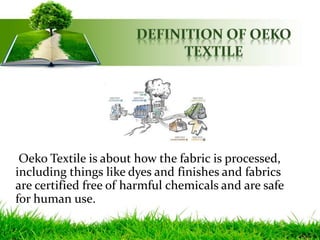
Oeko Textile is about how the fabric is processed,
including things like dyes and finishes and fabrics
are certified free of harmful chemicals and are safe
for human use.
The variations of Certifications of oeko-tex is writing below:
 STANDARD 100 by OEKO-TEX
 STeP by OEKO-TEX
 MADE IN GREEN by OEKO-TEX
 ECO PASSPORT by OEKO-TEX
 DETOX TO ZERO by OEKO-TEX
 LEATHER STANDARD by OEKO-TEX
 My STeP by OEKO-TEX
***We discuss about first four variations which are directly related with Ready
Made Garment , Fabric or clothings.
1
25
18
Oekotech
16
8
8
765
Oekotech 1%
Mobitech 25%
Indutech 18%
Geotech 1%
Sports tech 16%
Build tech 8%
Home tech 8%
Meditech7%
Agrotech 6%
Protech 5%
Packtech 5%
The STANDARD 100 by OEKO-TEX is a worldwide
consistent, independent testing and certification system
for raw, semi-finished, and finished textile products at all
processing levels, as well as accessory materials used.
Criteria
• Important legal regulations, such as banned Azo colourants,
formaldehyde, pentachlorophenol, cadmium, nickel, etc.
• Numerous harmful chemicals, even if they are not yet legally
regulated.
• Requirements from the US Consumer Product Safety
Improvement Act (CPSIA) regarding lead.
• Numerous also environmentally relevant substance class.
The following principle therefore applies:
Product class I: Textiles and textile toys for babies and small
children up to the age of three, e.g. underwear, romper suits, bed
linen, bedding, soft toys etc.
Product class II: Textiles which, when used as intended, have a
large part of their surface in direct contact with the skin, e.g.
underwear, bed linen, terry cloth items, shirts, blouses etc.
Product class III: Textiles which, when used as intended, have
no or only a little part of their surface in direct contact with the
skin, e.g. jackets, coats, facing materials etc.
Product class IV: Furnishing materials for decorative purposes
such as table linen and curtains, but also textile wall and floor
coverings etc.
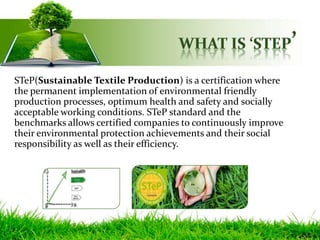
STeP(Sustainable Textile Production) is a certification where
the permanent implementation of environmental friendly
production processes, optimum health and safety and socially
acceptable working conditions. STeP standard and the
benchmarks allows certified companies to continuously improve
their environmental protection achievements and their social
responsibility as well as their efficiency.
Environmental
Performance
Social
Responsibility
Occupational
Health and
Safety
Quantity
Management
Chemical
Management
OEKO
STeP
Environmental
Management
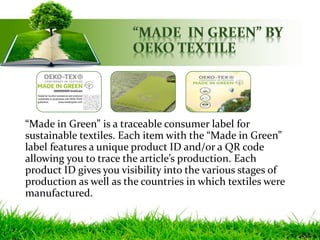
“Made in Green” is a traceable consumer label for
sustainable textiles. Each item with the “Made in Green”
label features a unique product ID and/or a QR code
allowing you to trace the article’s production. Each
product ID gives you visibility into the various stages of
production as well as the countries in which textiles were
manufactured.
ECO PASSPORT by OEKO-TEX is an certification system for
chemicals, colourants and auxiliaries used to manufacture textiles.
A three-stage verification process analyses whether the chemical
products and each individual ingredient meet specific requirements
with regard to sustainability, safety and compliance with statutory
regulations.
• Stage 1:Restricted Substance List (RSL) and Manufacturing Restricted
Substance List (MRSL) screening
• Stage 2:Analytical verification
• Stage 3 (optional):Assessment
Or On-Site Visit
Oeko textile

Oeko textile

  • 2.
    BGMEA University ofFashion & Technology(BUFT) Presentation on: OEKO Textile Course Title: Special Fabric Course Code: TEX 2101 Md.Shafiul Arefin Pial Email:shafiulpial@outlook.com/ shafiulpial@gmail.com Phone:+12029459927
  • 3.
    Oeko Textile isabout how the fabric is processed, including things like dyes and finishes and fabrics are certified free of harmful chemicals and are safe for human use.
  • 4.
    The variations ofCertifications of oeko-tex is writing below:  STANDARD 100 by OEKO-TEX  STeP by OEKO-TEX  MADE IN GREEN by OEKO-TEX  ECO PASSPORT by OEKO-TEX  DETOX TO ZERO by OEKO-TEX  LEATHER STANDARD by OEKO-TEX  My STeP by OEKO-TEX ***We discuss about first four variations which are directly related with Ready Made Garment , Fabric or clothings.
  • 5.
    1 25 18 Oekotech 16 8 8 765 Oekotech 1% Mobitech 25% Indutech18% Geotech 1% Sports tech 16% Build tech 8% Home tech 8% Meditech7% Agrotech 6% Protech 5% Packtech 5%
  • 6.
    The STANDARD 100by OEKO-TEX is a worldwide consistent, independent testing and certification system for raw, semi-finished, and finished textile products at all processing levels, as well as accessory materials used. Criteria • Important legal regulations, such as banned Azo colourants, formaldehyde, pentachlorophenol, cadmium, nickel, etc. • Numerous harmful chemicals, even if they are not yet legally regulated. • Requirements from the US Consumer Product Safety Improvement Act (CPSIA) regarding lead. • Numerous also environmentally relevant substance class.
  • 7.
    The following principletherefore applies: Product class I: Textiles and textile toys for babies and small children up to the age of three, e.g. underwear, romper suits, bed linen, bedding, soft toys etc. Product class II: Textiles which, when used as intended, have a large part of their surface in direct contact with the skin, e.g. underwear, bed linen, terry cloth items, shirts, blouses etc. Product class III: Textiles which, when used as intended, have no or only a little part of their surface in direct contact with the skin, e.g. jackets, coats, facing materials etc. Product class IV: Furnishing materials for decorative purposes such as table linen and curtains, but also textile wall and floor coverings etc.
  • 8.
    STeP(Sustainable Textile Production)is a certification where the permanent implementation of environmental friendly production processes, optimum health and safety and socially acceptable working conditions. STeP standard and the benchmarks allows certified companies to continuously improve their environmental protection achievements and their social responsibility as well as their efficiency.
  • 9.
  • 10.
    “Made in Green”is a traceable consumer label for sustainable textiles. Each item with the “Made in Green” label features a unique product ID and/or a QR code allowing you to trace the article’s production. Each product ID gives you visibility into the various stages of production as well as the countries in which textiles were manufactured.
  • 11.
    ECO PASSPORT byOEKO-TEX is an certification system for chemicals, colourants and auxiliaries used to manufacture textiles. A three-stage verification process analyses whether the chemical products and each individual ingredient meet specific requirements with regard to sustainability, safety and compliance with statutory regulations. • Stage 1:Restricted Substance List (RSL) and Manufacturing Restricted Substance List (MRSL) screening • Stage 2:Analytical verification • Stage 3 (optional):Assessment Or On-Site Visit