The Graham Scoo
Big Data and Analytics Roundtable
Booth School of Business
The University of Chicago
Arnie Aronoff
Data Analytics Ethics: Issues and Questions
Facilitator
Arnie Aronoff, Ph.D.
Instructor, MScA in Data Analytics
Instructor, School of Social Services Administration
The University of Chicago
Group Concept OD
Organizational Development and Training
(312) 259-4544
aaronoff33@gmail.com
2
Topic and Process for Today
General Topic:
• Operationalizing data analytics ethics.
• Organizational issues raised by data analytics ethics challenges.
Process:
• Not a lecture from a data analyst.
• Not a lecture from an industry expert.
• Dystopian sensibility but a believer.
• A work in progress.
• But…a chance to identify issues and questions and discuss them in
a facilitated manner.
3
Questions for Today
1. What Big data analytics ethics
issues do employees need to
understand?
2. Who needs to be educated or
trained in Big data analytics
ethics?
3. Who should be accountable for
identifying business activities that
may have ethical ramifications and
who is then accountable for taking
action?
4. How can identifying and taking
action related to analytics ethics
be operationalized? What might a
code of professionalism look like?
4
What is Data Analytics Ethics?
“…[the] ethical…issues that underpin the big data phenomenon.”
-- Council for Big Data, Ethics, and Society https://bdes.datasociety.net/
“…principles that should be recognized as governing data flows … and should
inform the establishment of … ethical big data norms.” -- Richards, N.M., and
King, J.H., “Big Data Ethics,” Wake Forest Law Review (2014) 49: 393-432
“…data ethics…studies and evaluates moral problems related to data (including
generation, recording, curation, processing dissemination, sharing and use),
algorithms (including artificial intelligence, artificial agents, machine learning, and
robots) and corresponding practices (including responsible innovation,
programming, hacking, and professional codes), in order to formulate and support
morally good solutions (e.g., right conducts or right values).” -- Floridi and Taddeo,
“What is data ethics?” Phil. Trans. R. Soc. A374: 20160360
5
Why Should Businesses Care About
Data Analytics Ethics?
“50% of all business ethics violations will occur
through improper use of big data analytics by 2018.”
-- Gartner: “Big Data Could Put Your Business at
Risk” (7/10/2015)
The use of Big Data and analytics carries
unintended ethical consequences/challenges.
6
Why Should Businesses Care About
Data Analytics Ethics?
Consequential Argument:
• Crossing the “creepy line” can lead to customer dissatisfaction,
compromise corporate reputation, and sometimes have substantial
financial consequences.
• You can only using Big Data and analytics to generate profit through
goods and services if people and other organizations allow their data to
be used (either actively or passively). If people lose trust in companies,
will they further restrict the availability of their data?
• It might be better to operationalize processes and norms ahead of
regulatory requirements.
Non-Consequential Argument:
• Every organization and company is part of an implicit social contract.
Minimizing unintended consequences of risk is a fundamentally good
business activity in and of itself.
7
Big Data and Data Analytics are Enormously Beneficial
• Compliance is Needed: Sticking to rules and regulations.
Precondition for doing business. You need to do this. Remember: The
use of Big Data may be under-regulated for now but the public can still
frown upon practices that “smell bad” (the “yuk” or “creepy” factor).
• Innovation and Profit are Drivers: Big data’s innovations and profits
must be balanced against risk. The emphasis should be on benefits;
awareness and actions are needed to mitigate bad situations.
• Competitive Differentiation Can Result: You can differentiate
yourself as a business by adopting ethical standards.
8
1. What Big data analytics ethics issues do
employees need to understand?
• Customer and group privacy
• Identity, anonymity
• Informed consent
• Ownership of data
• Bias in data, algorithmic bias, representational bias (visualization),
bias in use
• Bias in the data
• Bias in the data
• Selling, Buying, and Transfer of Data
9
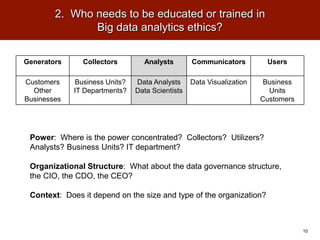
Generators Collectors Analysts Communicators Users
Customers
Other
Businesses
Business Units?
IT Departments?
Data Analysts
Data Scientists
Data Visualization Business
Units
Customers
10
2. Who needs to be educated or trained in
Big data analytics ethics?
Power: Where is the power concentrated? Collectors? Utilizers?
Analysts? Business Units? IT department?
Organizational Structure: What about the data governance structure,
the CIO, the CDO, the CEO?
Context: Does it depend on the size and type of the organization?
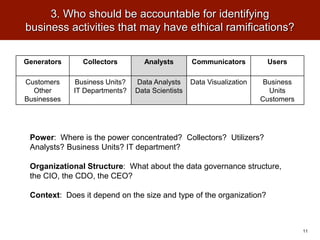
Generators Collectors Analysts Communicators Users
Customers
Other
Businesses
Business Units?
IT Departments?
Data Analysts
Data Scientists
Data Visualization Business
Units
Customers
11
3. Who should be accountable for identifying
business activities that may have ethical ramifications?
Power: Where is the power concentrated? Collectors? Utilizers?
Analysts? Business Units? IT department?
Organizational Structure: What about the data governance structure,
the CIO, the CDO, the CEO?
Context: Does it depend on the size and type of the organization?
3. Who should be accountable for taking action when
ethical issues are identified?
Internal
• The internal chain of command:
CEO, COO, CIO, CDO, Business unit heads
• The business’s data governance structure
• The corporate board
External:
• Professional associations that audit practices
• The local, state, or federal government
Does it depend on the scope and consequences of the issue?
Who can be trusted when they say they are acting? How do we know?
12
General Data Protection Regulation (GDPR)
• Creates new individual rights.
• Imposes new accountability measures on organizations
that collect or process data.
• What is the impact of GDPR on all of this?
13
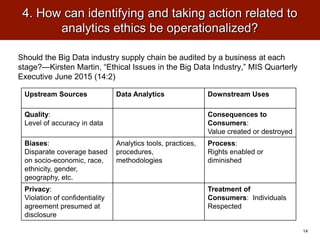
4. How can identifying and taking action related to
analytics ethics be operationalized?
Should the Big Data industry supply chain be audited by a business at each
stage?—Kirsten Martin, “Ethical Issues in the Big Data Industry,” MIS Quarterly
Executive June 2015 (14:2)
14
Upstream Sources Data Analytics Downstream Uses
Quality:
Level of accuracy in data
Consequences to
Consumers:
Value created or destroyed
Biases:
Disparate coverage based
on socio-economic, race,
ethnicity, gender,
geography, etc.
Analytics tools, practices,
procedures,
methodologies
Process:
Rights enabled or
diminished
Privacy:
Violation of confidentiality
agreement presumed at
disclosure
Treatment of
Consumers: Individuals
Respected
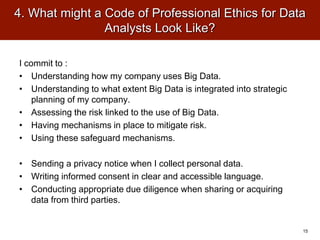
4. What might a Code of Professional Ethics for Data
Analysts Look Like?
I commit to :
• Understanding how my company uses Big Data.
• Understanding to what extent Big Data is integrated into strategic
planning of my company.
• Assessing the risk linked to the use of Big Data.
• Having mechanisms in place to mitigate risk.
• Using these safeguard mechanisms.
• Sending a privacy notice when I collect personal data.
• Writing informed consent in clear and accessible language.
• Conducting appropriate due diligence when sharing or acquiring
data from third parties.
15
4. What might a Code of Professional Ethics for Data
Analysts Look Like?
• Accenture’s Universal Principles for Data Ethics
• “What Big Data Needs: A Code of Ethical Practices,
MIT Technology Review
• Data Science Code of Professional Conduct, Data
Science Association
16
Preface to Case Study
• Ethics is not an exact science. There is an element of
subjectivity, relativity, and perspective. What’s ethical for one
person might not be for the other person.
• We need to discuss pros and cons but in resolution of the
issues these are false dichotomies. Resolution of ethical
issues occurs not through picking one side (yes or no) or
compromise (half the pie) but collaboration, synthesis,
creativity.
• In ethical debate we shouldn’t fall back on “that’s what the law
says” as the lowest common denominator. Ethics is about
determine what we think is the right or wrong thing to do.
17
Group Discussion and Report Out
• Group 1: What are the issues that employees of the company need
to understand? What should the company do?
• Group 2: Who needs to be educated about these issues? What
should the company do?
• Group 3: Who is accountable here and for what? What should the
company do?
• Group 4: In addition to transparency, what principles might this
company choose to incorporate in a code of data analytics ethics?
What might the company develop as a triage process? What
should the company do?
18
End of Deck
19

Data Analytics Ethics: Issues and Questions (Arnie Aronoff, Ph.D.)

  • 1.
    The Graham Scoo BigData and Analytics Roundtable Booth School of Business The University of Chicago Arnie Aronoff Data Analytics Ethics: Issues and Questions
  • 2.
    Facilitator Arnie Aronoff, Ph.D. Instructor,MScA in Data Analytics Instructor, School of Social Services Administration The University of Chicago Group Concept OD Organizational Development and Training (312) 259-4544 aaronoff33@gmail.com 2
  • 3.
    Topic and Processfor Today General Topic: • Operationalizing data analytics ethics. • Organizational issues raised by data analytics ethics challenges. Process: • Not a lecture from a data analyst. • Not a lecture from an industry expert. • Dystopian sensibility but a believer. • A work in progress. • But…a chance to identify issues and questions and discuss them in a facilitated manner. 3
  • 4.
    Questions for Today 1.What Big data analytics ethics issues do employees need to understand? 2. Who needs to be educated or trained in Big data analytics ethics? 3. Who should be accountable for identifying business activities that may have ethical ramifications and who is then accountable for taking action? 4. How can identifying and taking action related to analytics ethics be operationalized? What might a code of professionalism look like? 4
  • 5.
    What is DataAnalytics Ethics? “…[the] ethical…issues that underpin the big data phenomenon.” -- Council for Big Data, Ethics, and Society https://bdes.datasociety.net/ “…principles that should be recognized as governing data flows … and should inform the establishment of … ethical big data norms.” -- Richards, N.M., and King, J.H., “Big Data Ethics,” Wake Forest Law Review (2014) 49: 393-432 “…data ethics…studies and evaluates moral problems related to data (including generation, recording, curation, processing dissemination, sharing and use), algorithms (including artificial intelligence, artificial agents, machine learning, and robots) and corresponding practices (including responsible innovation, programming, hacking, and professional codes), in order to formulate and support morally good solutions (e.g., right conducts or right values).” -- Floridi and Taddeo, “What is data ethics?” Phil. Trans. R. Soc. A374: 20160360 5
  • 6.
    Why Should BusinessesCare About Data Analytics Ethics? “50% of all business ethics violations will occur through improper use of big data analytics by 2018.” -- Gartner: “Big Data Could Put Your Business at Risk” (7/10/2015) The use of Big Data and analytics carries unintended ethical consequences/challenges. 6
  • 7.
    Why Should BusinessesCare About Data Analytics Ethics? Consequential Argument: • Crossing the “creepy line” can lead to customer dissatisfaction, compromise corporate reputation, and sometimes have substantial financial consequences. • You can only using Big Data and analytics to generate profit through goods and services if people and other organizations allow their data to be used (either actively or passively). If people lose trust in companies, will they further restrict the availability of their data? • It might be better to operationalize processes and norms ahead of regulatory requirements. Non-Consequential Argument: • Every organization and company is part of an implicit social contract. Minimizing unintended consequences of risk is a fundamentally good business activity in and of itself. 7
  • 8.
    Big Data andData Analytics are Enormously Beneficial • Compliance is Needed: Sticking to rules and regulations. Precondition for doing business. You need to do this. Remember: The use of Big Data may be under-regulated for now but the public can still frown upon practices that “smell bad” (the “yuk” or “creepy” factor). • Innovation and Profit are Drivers: Big data’s innovations and profits must be balanced against risk. The emphasis should be on benefits; awareness and actions are needed to mitigate bad situations. • Competitive Differentiation Can Result: You can differentiate yourself as a business by adopting ethical standards. 8
  • 9.
    1. What Bigdata analytics ethics issues do employees need to understand? • Customer and group privacy • Identity, anonymity • Informed consent • Ownership of data • Bias in data, algorithmic bias, representational bias (visualization), bias in use • Bias in the data • Bias in the data • Selling, Buying, and Transfer of Data 9
  • 10.
    Generators Collectors AnalystsCommunicators Users Customers Other Businesses Business Units? IT Departments? Data Analysts Data Scientists Data Visualization Business Units Customers 10 2. Who needs to be educated or trained in Big data analytics ethics? Power: Where is the power concentrated? Collectors? Utilizers? Analysts? Business Units? IT department? Organizational Structure: What about the data governance structure, the CIO, the CDO, the CEO? Context: Does it depend on the size and type of the organization?
  • 11.
    Generators Collectors AnalystsCommunicators Users Customers Other Businesses Business Units? IT Departments? Data Analysts Data Scientists Data Visualization Business Units Customers 11 3. Who should be accountable for identifying business activities that may have ethical ramifications? Power: Where is the power concentrated? Collectors? Utilizers? Analysts? Business Units? IT department? Organizational Structure: What about the data governance structure, the CIO, the CDO, the CEO? Context: Does it depend on the size and type of the organization?
  • 12.
    3. Who shouldbe accountable for taking action when ethical issues are identified? Internal • The internal chain of command: CEO, COO, CIO, CDO, Business unit heads • The business’s data governance structure • The corporate board External: • Professional associations that audit practices • The local, state, or federal government Does it depend on the scope and consequences of the issue? Who can be trusted when they say they are acting? How do we know? 12
  • 13.
    General Data ProtectionRegulation (GDPR) • Creates new individual rights. • Imposes new accountability measures on organizations that collect or process data. • What is the impact of GDPR on all of this? 13
  • 14.
    4. How canidentifying and taking action related to analytics ethics be operationalized? Should the Big Data industry supply chain be audited by a business at each stage?—Kirsten Martin, “Ethical Issues in the Big Data Industry,” MIS Quarterly Executive June 2015 (14:2) 14 Upstream Sources Data Analytics Downstream Uses Quality: Level of accuracy in data Consequences to Consumers: Value created or destroyed Biases: Disparate coverage based on socio-economic, race, ethnicity, gender, geography, etc. Analytics tools, practices, procedures, methodologies Process: Rights enabled or diminished Privacy: Violation of confidentiality agreement presumed at disclosure Treatment of Consumers: Individuals Respected
  • 15.
    4. What mighta Code of Professional Ethics for Data Analysts Look Like? I commit to : • Understanding how my company uses Big Data. • Understanding to what extent Big Data is integrated into strategic planning of my company. • Assessing the risk linked to the use of Big Data. • Having mechanisms in place to mitigate risk. • Using these safeguard mechanisms. • Sending a privacy notice when I collect personal data. • Writing informed consent in clear and accessible language. • Conducting appropriate due diligence when sharing or acquiring data from third parties. 15
  • 16.
    4. What mighta Code of Professional Ethics for Data Analysts Look Like? • Accenture’s Universal Principles for Data Ethics • “What Big Data Needs: A Code of Ethical Practices, MIT Technology Review • Data Science Code of Professional Conduct, Data Science Association 16
  • 17.
    Preface to CaseStudy • Ethics is not an exact science. There is an element of subjectivity, relativity, and perspective. What’s ethical for one person might not be for the other person. • We need to discuss pros and cons but in resolution of the issues these are false dichotomies. Resolution of ethical issues occurs not through picking one side (yes or no) or compromise (half the pie) but collaboration, synthesis, creativity. • In ethical debate we shouldn’t fall back on “that’s what the law says” as the lowest common denominator. Ethics is about determine what we think is the right or wrong thing to do. 17
  • 18.
    Group Discussion andReport Out • Group 1: What are the issues that employees of the company need to understand? What should the company do? • Group 2: Who needs to be educated about these issues? What should the company do? • Group 3: Who is accountable here and for what? What should the company do? • Group 4: In addition to transparency, what principles might this company choose to incorporate in a code of data analytics ethics? What might the company develop as a triage process? What should the company do? 18
  • 19.

Editor's Notes

  • #3 Caveats: Not a data analyst. Courses: teamwork, strategy/communications, ethics Also have a consulting practice in organizational development that focuses on higher education, nonprofits, social service organizations. This is not going to be a lecture from someone with deep expertise in data analytics or internal IT corporate experience.