Unit No. V
Centrefor Distance and Online Education
Ethics and Data Science
3.
After completion ofUnit-V, you will be able to understand
the following areas:
Doing Good Data Science & Data Ownership
The Five Cs - Implementing the Five Cs
Ethics and Security Training and Developing Guiding Principles.
Building Ethics into a Data-Driven Culture, Regulation, Building Our Future,
Case Study.
Objectives
Centre for Distance and Online Education
4.
Centre for Distanceand Online Education
Doing Good Data Science & Data Ownership
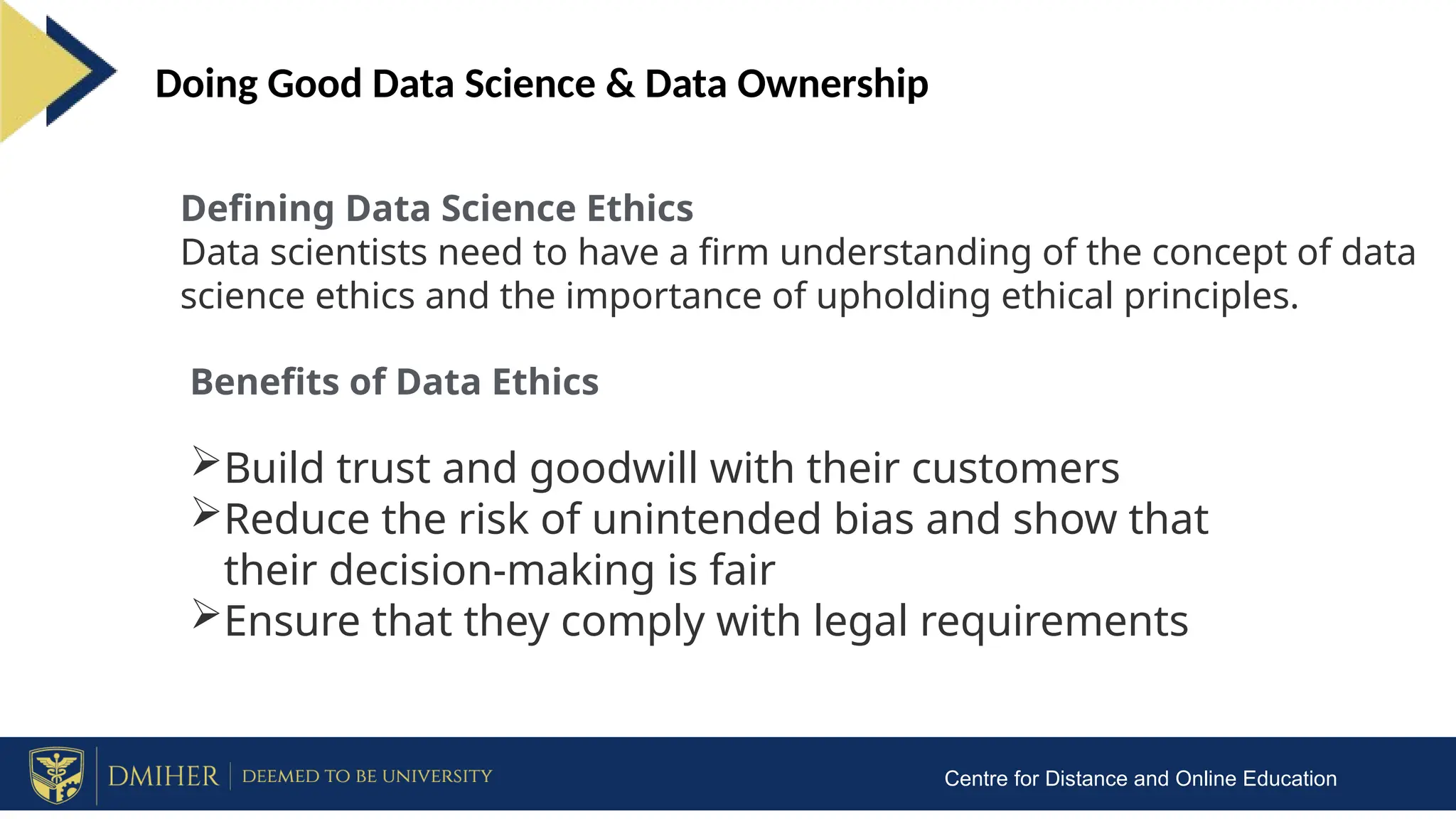
Defining Data Science Ethics
Data scientists need to have a firm understanding of the concept of data
science ethics and the importance of upholding ethical principles.
Benefits of Data Ethics
Build trust and goodwill with their customers
Reduce the risk of unintended bias and show that
their decision-making is fair
Ensure that they comply with legal requirements
5.
Centre for Distanceand Online Education
Government Norms for Collecting and Storing
Data under Legal and Regulatory Frameworks
Government around the world have established legal and regulatory
frameworks to govern the collecting and storing the data. THese norms
aims to protect individuals rights, ensure data privacy, and maintain the
integrity of information. Key aspects includes are:
Data Protection Laws: Many countries have enacted data protection
laws that regulates that
Security Standards: Governments often established standards and
regulations for the security of stored data to prevent unauthorized
access and protect against data breaches.
Data Retention Policies: Governments may set guidelines on how
long organizations can retain specific types of data and ensures that
the data is not kept indefinitely and is disposed or appropriate.
6.
Centre for Distanceand Online Education
Government Norms for Collecting and Storing
Data under Legal and Regulatory Frameworks
Compliance and Audits: Compliance checks and audits may be
require to ensure that a particular organizations adhere to data
protection laws and other regulations.
International Data Transfer Regulations: Some countries
restricts the data to transfer across the country , So for that
Cross boarder data transfer mechanisms, such as Standard
Contractual Clauses, may need to be implemented.
7.
Centre for Distanceand Online Education
Doing Good Data Science & Data Ownership
Definition: Practicing data science in a manner that benefits individuals and
communities without causing harm.
Core Values:
• Fairness: Avoid discrimination or bias in data algorithms (e.g., gender or
racial bias in hiring algorithms).
• Transparency: Clearly explain data collection, processing, and model
decision-making.
• Accountability: Take responsibility for the consequences of data-driven
decisions.
• Responsibility: Consider social impacts, ensure ethical review processes are
in place.
8.
Centre for Distanceand Online Education
Data Ownership (What is it) : The concept that individuals have the right to control
their personal data.
Key Aspects:
• Consent: Data should be collected only with informed consent.
• Access Rights: Individuals should be able to view, modify, or delete their
data.
• Legal Protections: Laws like GDPR (Europe), CCPA (California) give users legal
rights over data.
Ethical Implications:
• Misuse or selling of data without consent violates trust and privacy.
• Organizations must be transparent about data usage and ensure proper data
governance.
9.
Centre for Distanceand Online Education
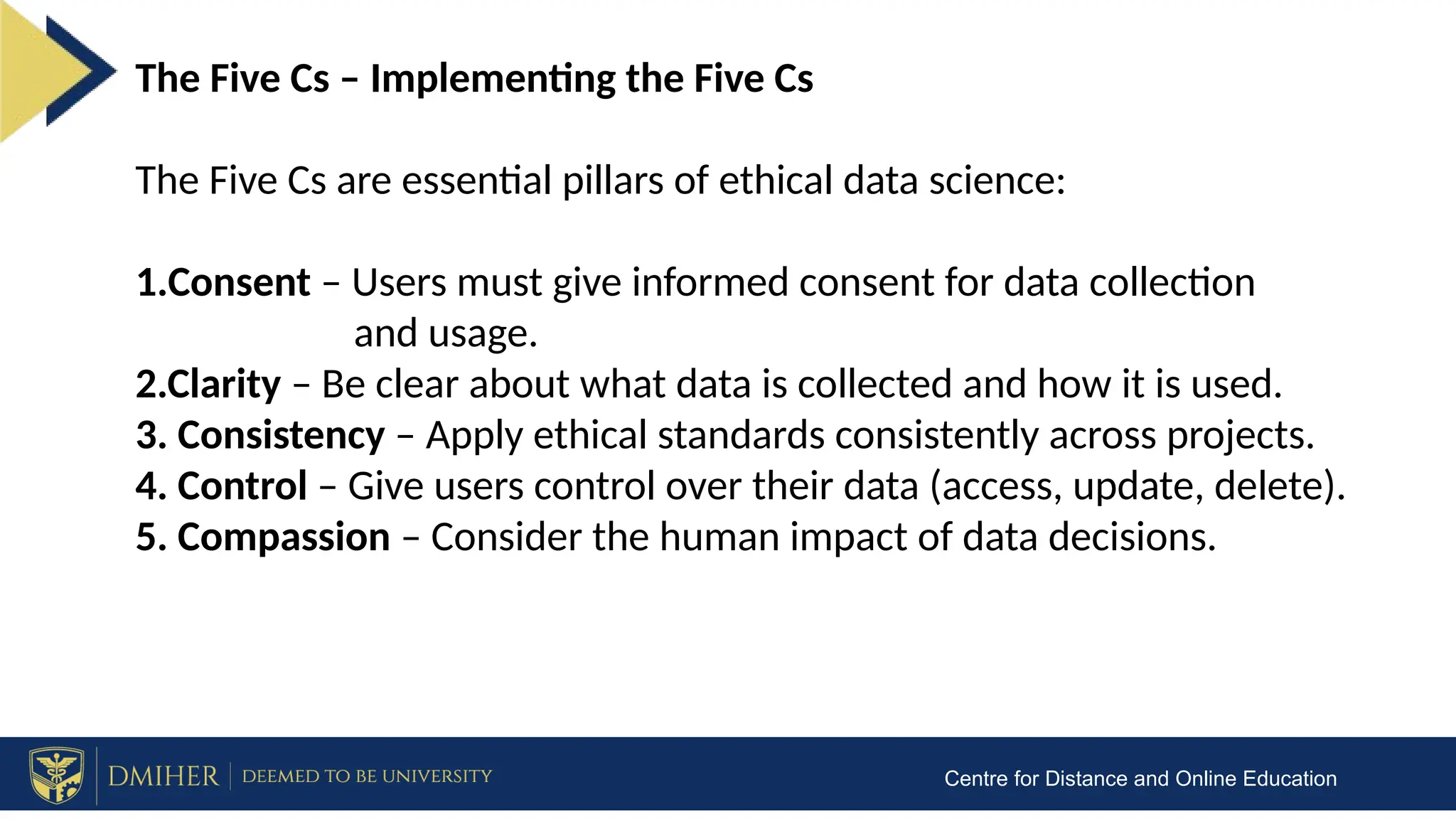
The Five Cs – Implementing the Five Cs
The Five Cs are essential pillars of ethical data science:
1.Consent – Users must give informed consent for data collection
and usage.
2.Clarity – Be clear about what data is collected and how it is used.
3. Consistency – Apply ethical standards consistently across projects.
4. Control – Give users control over their data (access, update, delete).
5. Compassion – Consider the human impact of data decisions.
10.
Centre for Distanceand Online Education
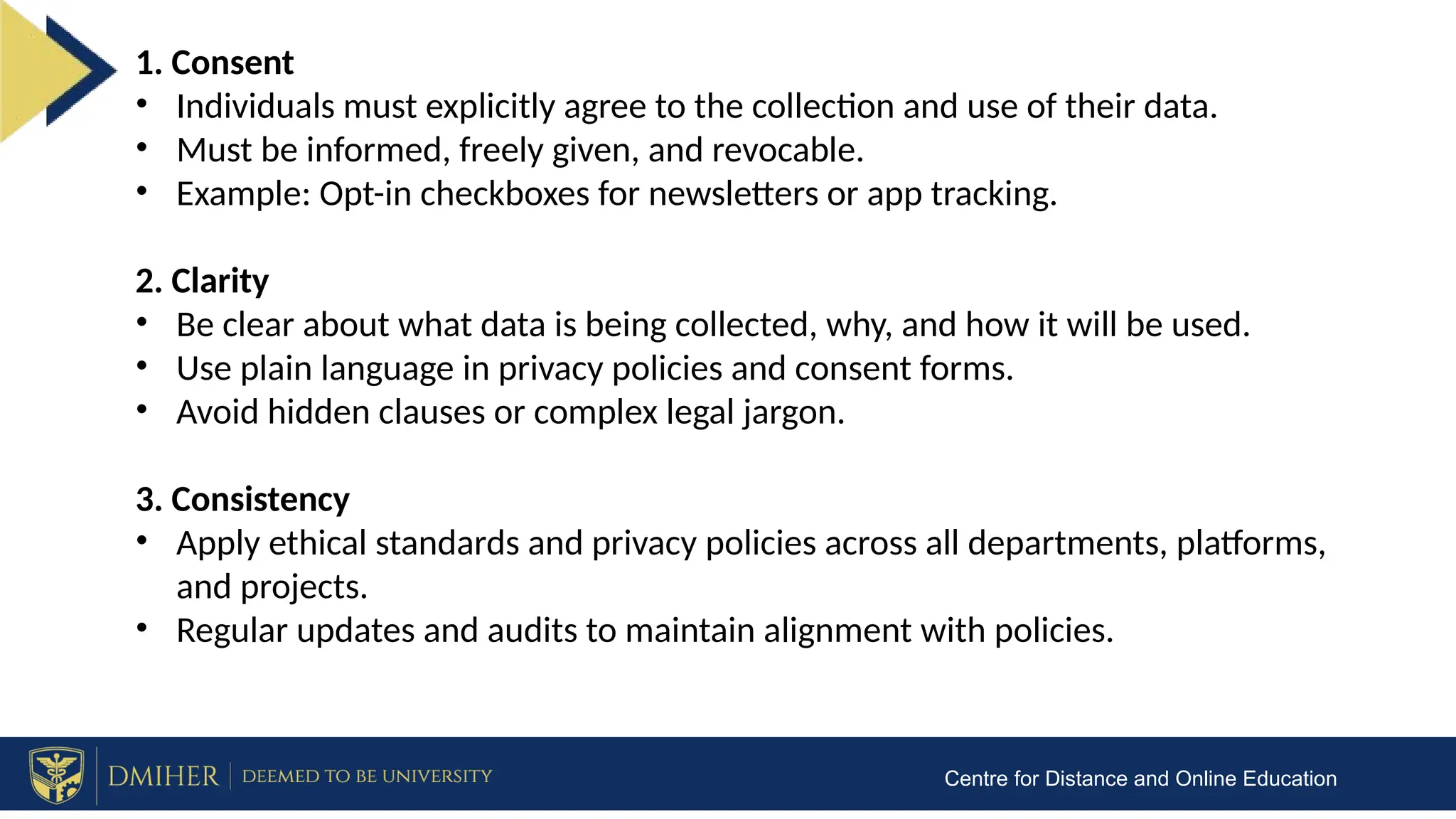
1. Consent
• Individuals must explicitly agree to the collection and use of their data.
• Must be informed, freely given, and revocable.
• Example: Opt-in checkboxes for newsletters or app tracking.
2. Clarity
• Be clear about what data is being collected, why, and how it will be used.
• Use plain language in privacy policies and consent forms.
• Avoid hidden clauses or complex legal jargon.
3. Consistency
• Apply ethical standards and privacy policies across all departments, platforms,
and projects.
• Regular updates and audits to maintain alignment with policies.
11.
Centre for Distanceand Online Education
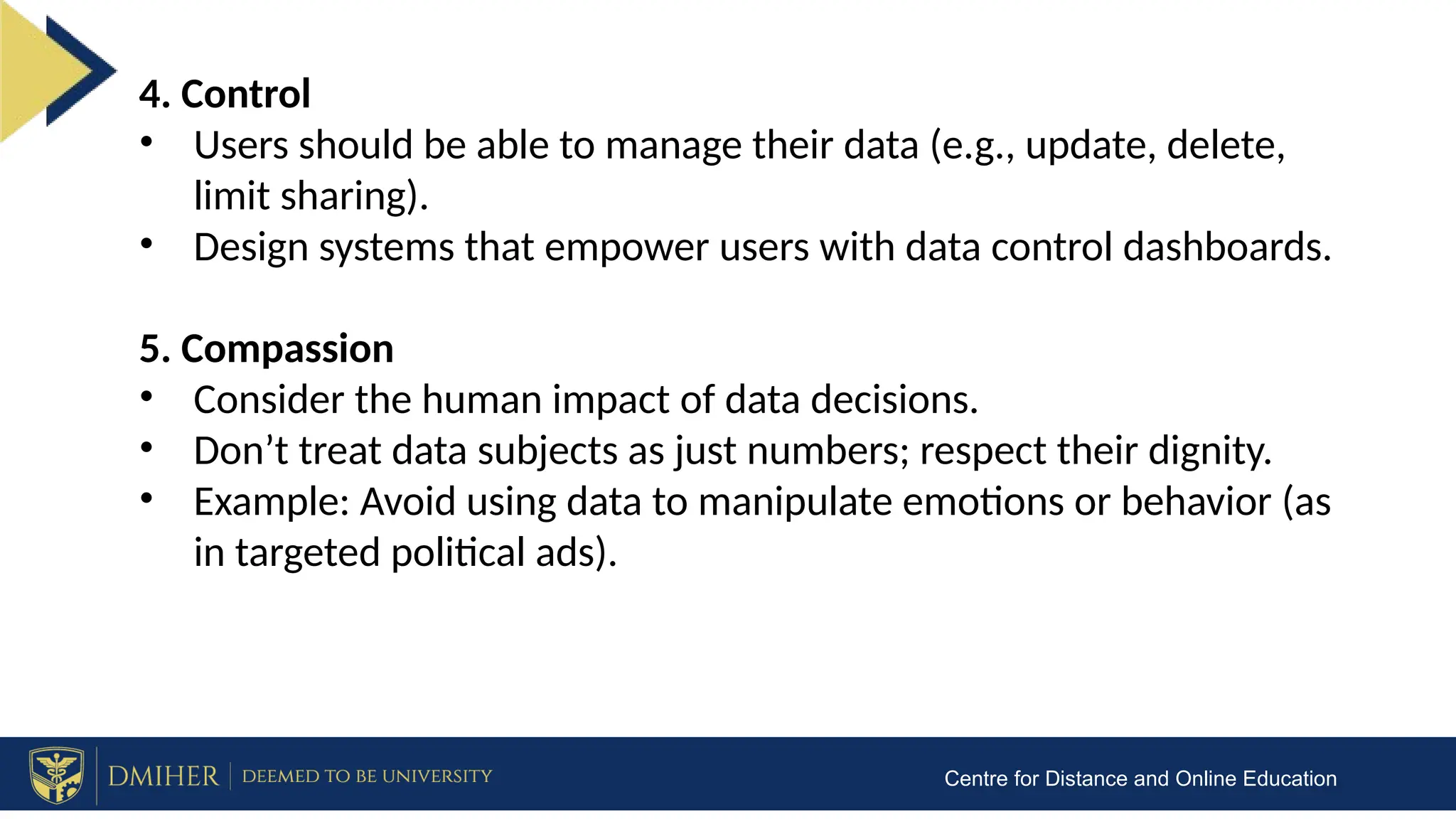
4. Control
• Users should be able to manage their data (e.g., update, delete,
limit sharing).
• Design systems that empower users with data control dashboards.
5. Compassion
• Consider the human impact of data decisions.
• Don’t treat data subjects as just numbers; respect their dignity.
• Example: Avoid using data to manipulate emotions or behavior (as
in targeted political ads).
12.
Centre for Distanceand Online Education
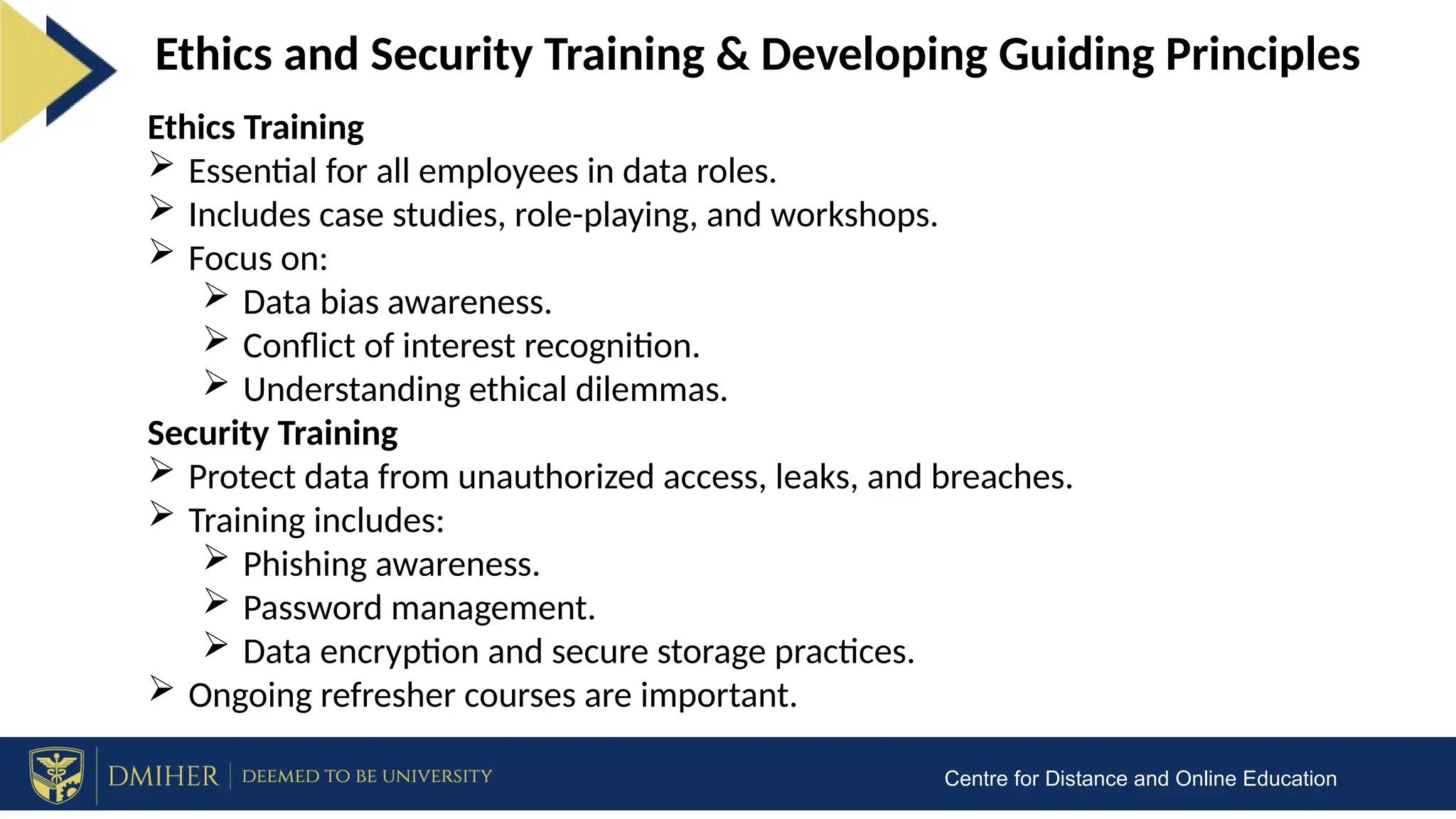
Ethics and Security Training & Developing Guiding Principles
Ethics Training
Essential for all employees in data roles.
Includes case studies, role-playing, and workshops.
Focus on:
Data bias awareness.
Conflict of interest recognition.
Understanding ethical dilemmas.
Security Training
Protect data from unauthorized access, leaks, and breaches.
Training includes:
Phishing awareness.
Password management.
Data encryption and secure storage practices.
Ongoing refresher courses are important.
13.
Centre for Distanceand Online Education
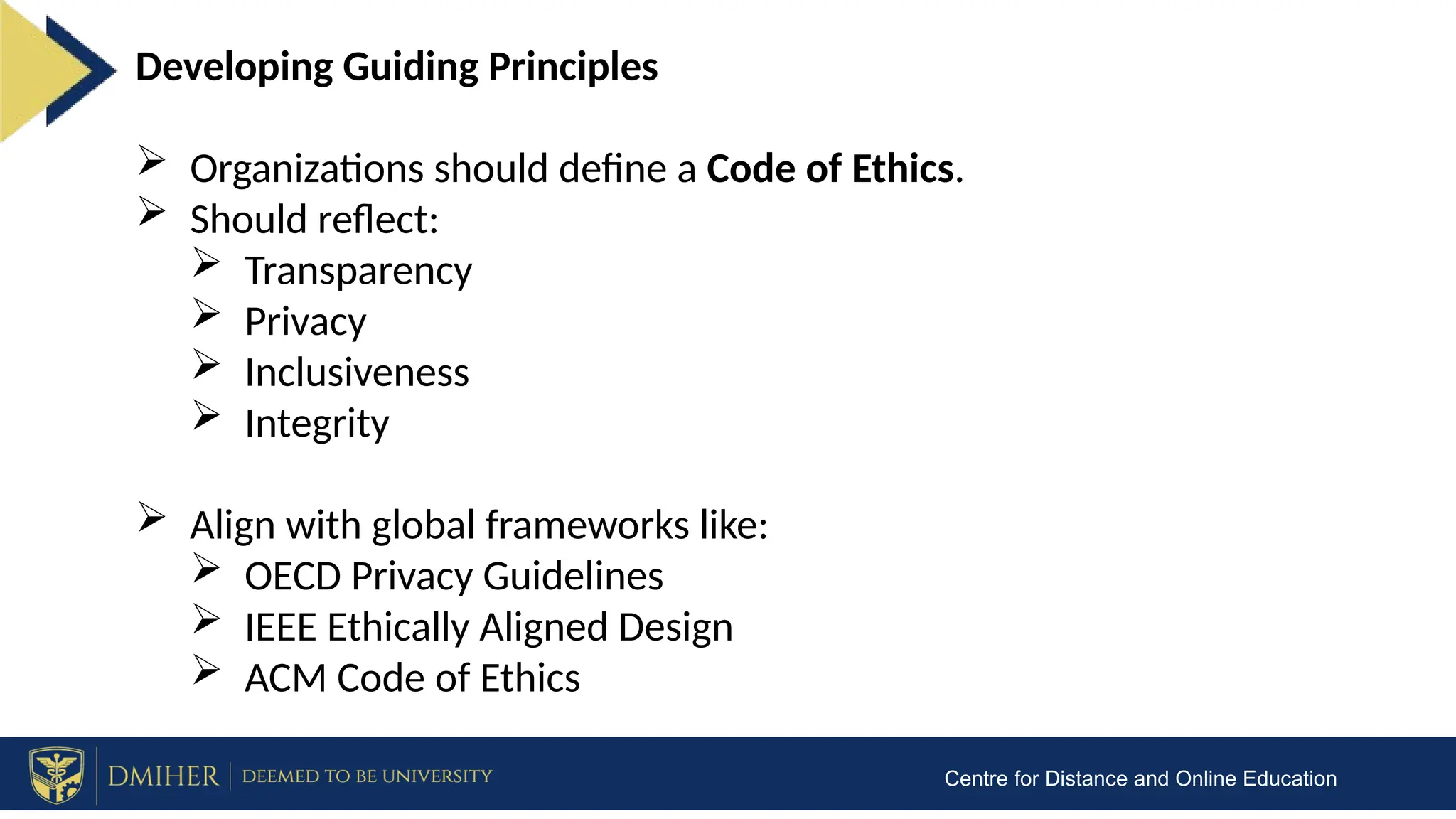
Developing Guiding Principles
Organizations should define a Code of Ethics.
Should reflect:
Transparency
Privacy
Inclusiveness
Integrity
Align with global frameworks like:
OECD Privacy Guidelines
IEEE Ethically Aligned Design
ACM Code of Ethics
14.
Centre for Distanceand Online Education
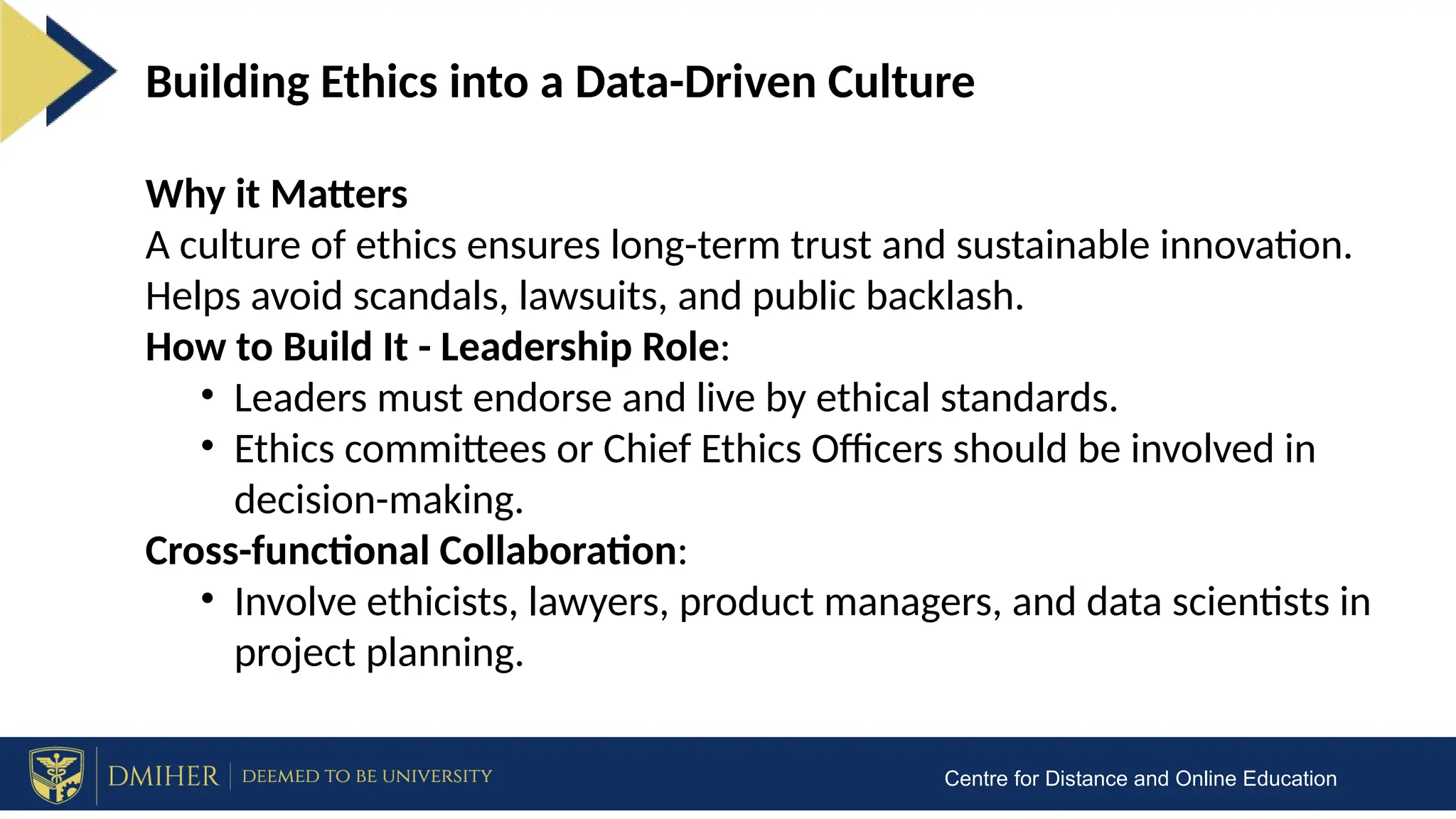
Building Ethics into a Data-Driven Culture
Why it Matters
A culture of ethics ensures long-term trust and sustainable innovation.
Helps avoid scandals, lawsuits, and public backlash.
How to Build It - Leadership Role:
• Leaders must endorse and live by ethical standards.
• Ethics committees or Chief Ethics Officers should be involved in
decision-making.
Cross-functional Collaboration:
• Involve ethicists, lawyers, product managers, and data scientists in
project planning.
15.
Centre for Distanceand Online Education
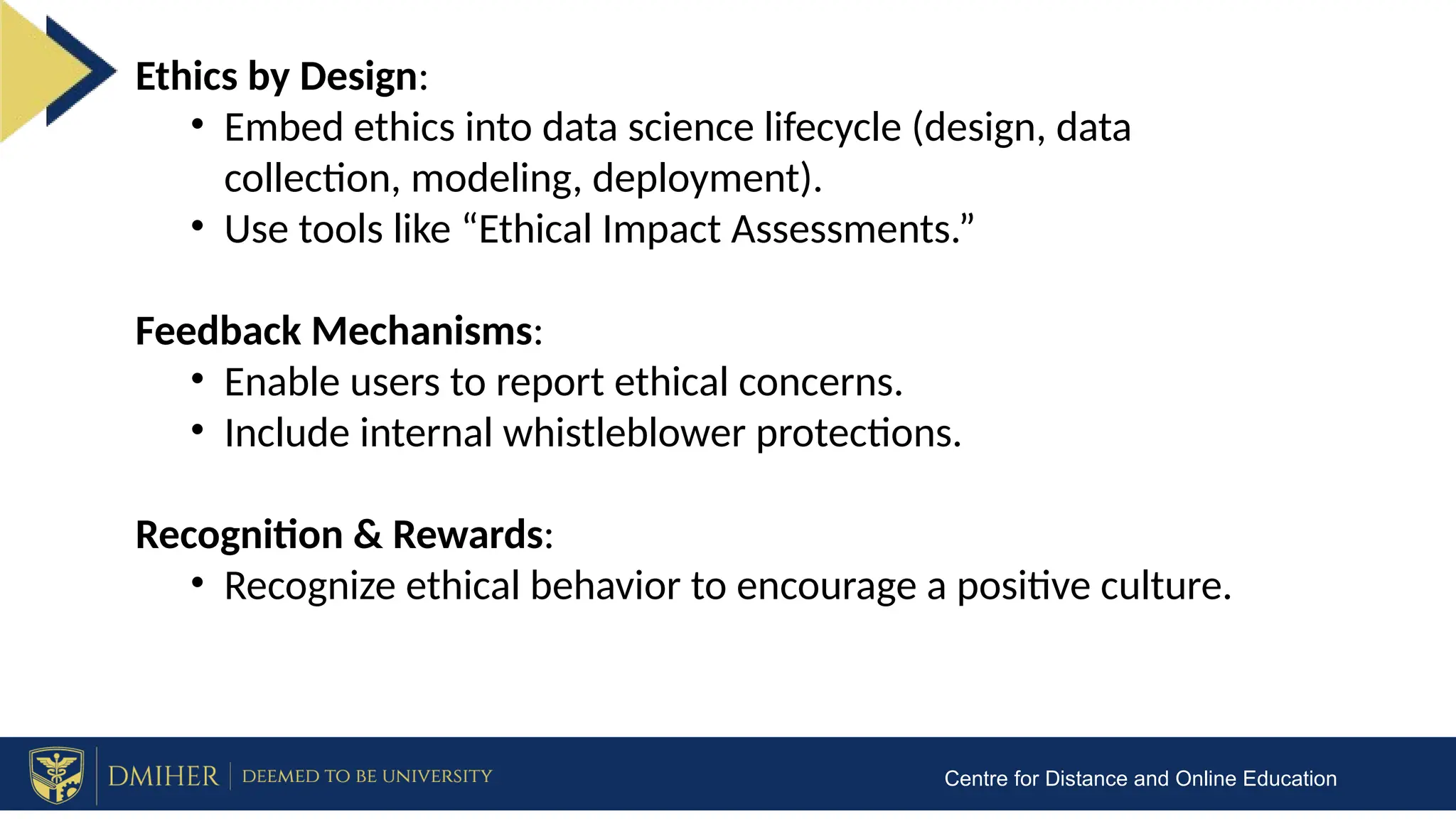
Ethics by Design:
• Embed ethics into data science lifecycle (design, data
collection, modeling, deployment).
• Use tools like “Ethical Impact Assessments.”
Feedback Mechanisms:
• Enable users to report ethical concerns.
• Include internal whistleblower protections.
Recognition & Rewards:
• Recognize ethical behavior to encourage a positive culture.
16.
Centre for Distanceand Online Education
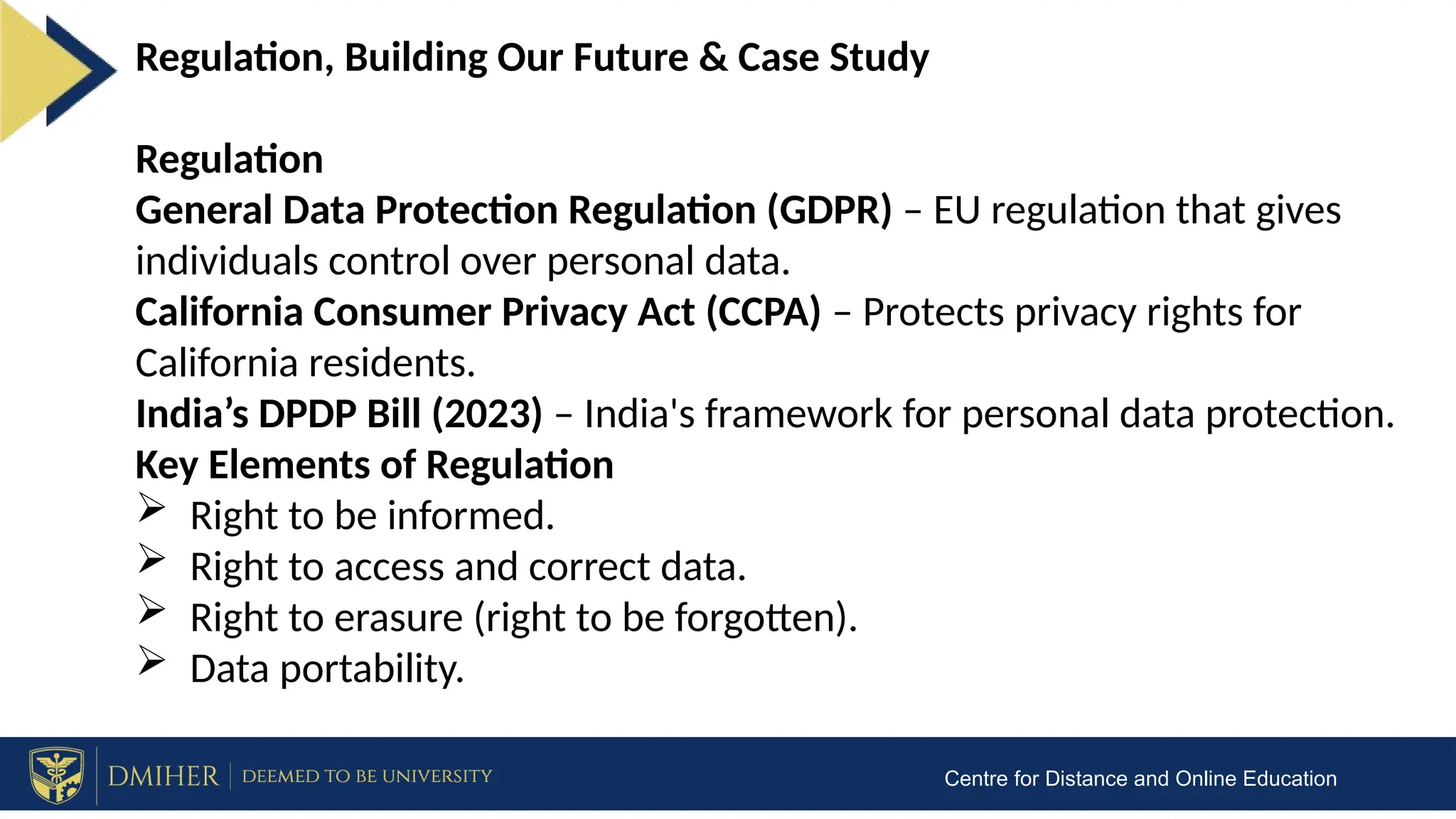
Regulation, Building Our Future & Case Study
Regulation
General Data Protection Regulation (GDPR) – EU regulation that gives
individuals control over personal data.
California Consumer Privacy Act (CCPA) – Protects privacy rights for
California residents.
India’s DPDP Bill (2023) – India's framework for personal data protection.
Key Elements of Regulation
Right to be informed.
Right to access and correct data.
Right to erasure (right to be forgotten).
Data portability.
17.
Centre for Distanceand Online Education
Building Our Future
Data ethics will shape the future of AI, IoT, healthcare, education, etc.
Focus areas:
• AI Governance: Ethical frameworks for autonomous systems.
• Sustainable Innovation: Balancing progress with rights and
dignity.
• Equity: Prevent algorithmic discrimination.
• Digital Literacy: Educate public about data rights.
18.
Centre for Distanceand Online Education
Case Study: Cambridge Analytica and Facebook
What Happened:
• Personal data of millions was harvested from Facebook without proper
consent.
• Used to influence elections via targeted political ads.
Ethical Failures:
• Lack of transparency in data use.
• Inadequate consent and privacy controls.
• No proper oversight.
Lessons Learned:
• Consent must be meaningful and informed.
• Tech companies must be transparent and accountable.
• Regulations are critical to protecting public interests.
19.
More Information
Centre forDistance and Online Education
Videos Link:
https://www.youtube.com/watch?v=6BALGpobam0
https://www.youtube.com/watch?v=WU7McTUumxU
Website Link:
https://www.geeksforgeeks.org/ethics-in-data-science-and-proper-privacy-and-usag
e-of-data/
https://online.maryville.edu/online-masters-degrees/data-science/careers/data-sci
ence-ethics-issues-and-strategies/
20.
Summary
Centre for Distanceand Online Education
• Doing Good Data Science & Data Ownership
• The Five Cs, Implementing the Five Cs
• Ethics and Security Training and Developing Guiding
Principles
• Building Ethics into a Data-Driven Culture, Regulation,
Building Our Future, Case Study.
The title ofthe college here along
with a brief description if required
Thank You!
Centre for Distance and Online Education
Editor's Notes
#1 This should be the title slide for all corporate presentations pertaining to the overall university level
#2 This is the master slide and within the blue band we can have the respective college name in case we are presenting for one of our institutions. When it is for the overall university we need not have that
#3 This is the master slide and within the blue band we can have the respective college name in case we are presenting for one of our institutions. When it is for the overall university we need not have that
#4 This is the master slide and within the blue band we can have the respective college name in case we are presenting for one of our institutions. When it is for the overall university we need not have that
#5 This is the master slide and within the blue band we can have the respective college name in case we are presenting for one of our institutions. When it is for the overall university we need not have that
#6 This is the master slide and within the blue band we can have the respective college name in case we are presenting for one of our institutions. When it is for the overall university we need not have that
#7 This is the master slide and within the blue band we can have the respective college name in case we are presenting for one of our institutions. When it is for the overall university we need not have that
#8 This is the master slide and within the blue band we can have the respective college name in case we are presenting for one of our institutions. When it is for the overall university we need not have that
#9 This is the master slide and within the blue band we can have the respective college name in case we are presenting for one of our institutions. When it is for the overall university we need not have that
#10 This is the master slide and within the blue band we can have the respective college name in case we are presenting for one of our institutions. When it is for the overall university we need not have that
#11 This is the master slide and within the blue band we can have the respective college name in case we are presenting for one of our institutions. When it is for the overall university we need not have that
#12 This is the master slide and within the blue band we can have the respective college name in case we are presenting for one of our institutions. When it is for the overall university we need not have that
#13 This is the master slide and within the blue band we can have the respective college name in case we are presenting for one of our institutions. When it is for the overall university we need not have that
#14 This is the master slide and within the blue band we can have the respective college name in case we are presenting for one of our institutions. When it is for the overall university we need not have that
#15 This is the master slide and within the blue band we can have the respective college name in case we are presenting for one of our institutions. When it is for the overall university we need not have that
#16 This is the master slide and within the blue band we can have the respective college name in case we are presenting for one of our institutions. When it is for the overall university we need not have that
#17 This is the master slide and within the blue band we can have the respective college name in case we are presenting for one of our institutions. When it is for the overall university we need not have that
#18 This is the master slide and within the blue band we can have the respective college name in case we are presenting for one of our institutions. When it is for the overall university we need not have that
#19 This is the master slide and within the blue band we can have the respective college name in case we are presenting for one of our institutions. When it is for the overall university we need not have that
#20 This is the master slide and within the blue band we can have the respective college name in case we are presenting for one of our institutions. When it is for the overall university we need not have that
#21 This is the master slide and within the blue band we can have the respective college name in case we are presenting for one of our institutions. When it is for the overall university we need not have that


![[DSC Europe 25] Vid Stimac - Policy Parsimony: Between Oversimplifying and Ov...](https://cdn.slidesharecdn.com/ss_thumbnails/eqlepagzqp2rhg3gbluh-dsc-stimac-251120-251205090438-059e7f54-thumbnail.jpg?width=640&height=640&fit=bounds)
![[DSC Europe 25] Dusan Jovicic - AI Story: From on-prem to cloud and back agai...](https://cdn.slidesharecdn.com/ss_thumbnails/8kp49m6uq22ifnbwhfnk-2-251205085715-964d11a6-thumbnail.jpg?width=640&height=640&fit=bounds)

![[DSC Europe 25] Boris Perkovic - Lost in performance.pptx](https://cdn.slidesharecdn.com/ss_thumbnails/uq5hrp7vsuahqkxzifux-1-251204082258-fd2ee09d-thumbnail.jpg?width=640&height=640&fit=bounds)


![[DSC Europe 25] Marija Vlajkovic & Andrea Radonjanin - Integration of AI tool...](https://cdn.slidesharecdn.com/ss_thumbnails/qf1jrglttoc3bm8s3aop-final-integration-of-ai-tools-251208151905-394f3a6a-thumbnail.jpg?width=640&height=640&fit=bounds)


