Accenture Labs
Building Digital Trust
The role of data ethics in the digital age
2
Data is the biggest risk that is
unaccounted for by businesses today
Copyright © 2016 Accenture All rights reserved.
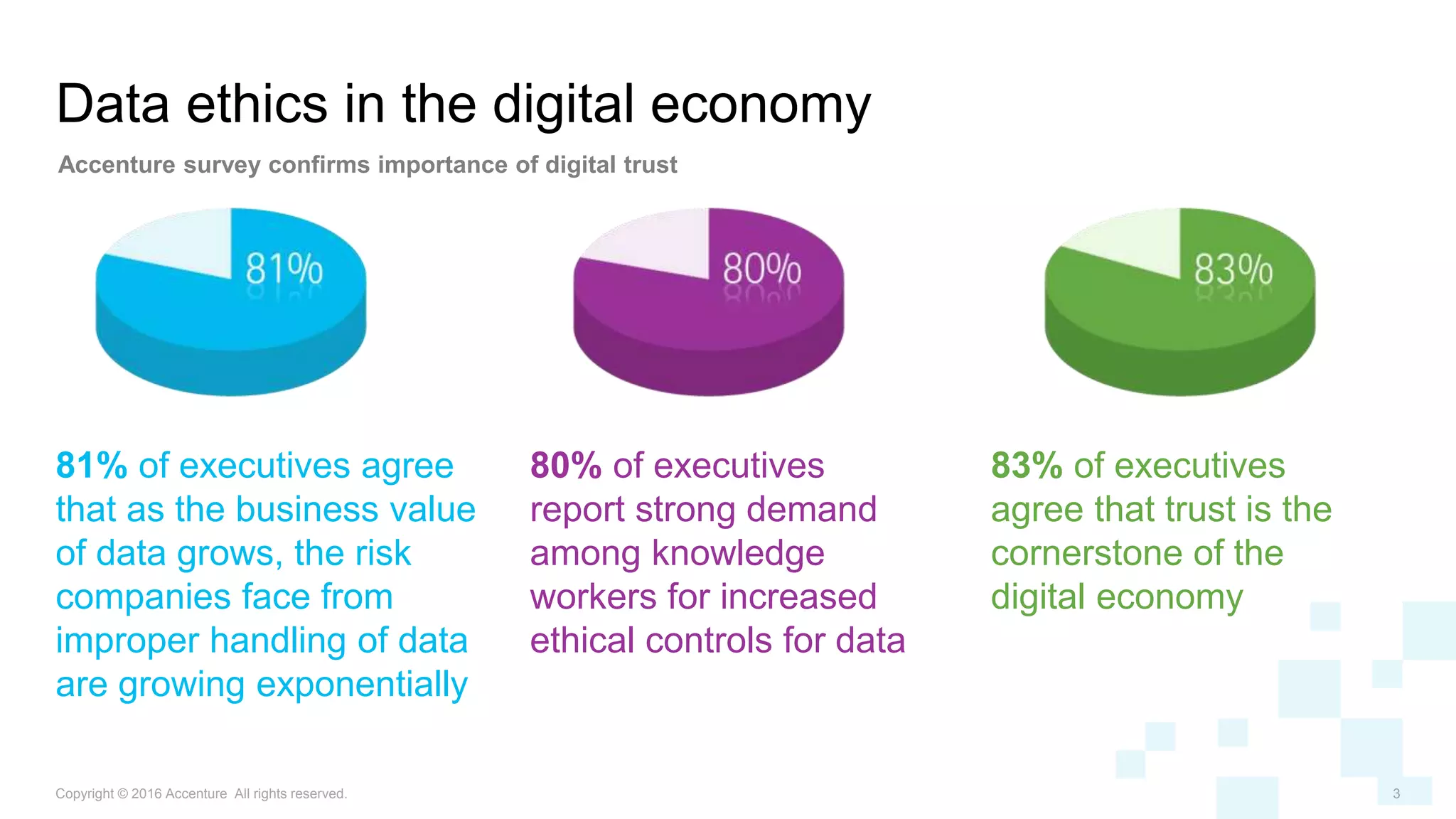
81% of executives agree
that as the business value
of data grows, the risk
companies face from
improper handling of data
are growing exponentially
Data ethics in the digital economy
Copyright © 2016 Accenture All rights reserved. 3
80% of executives
report strong demand
among knowledge
workers for increased
ethical controls for data
83% of executives
agree that trust is the
cornerstone of the
digital economy
Accenture survey confirms importance of digital trust
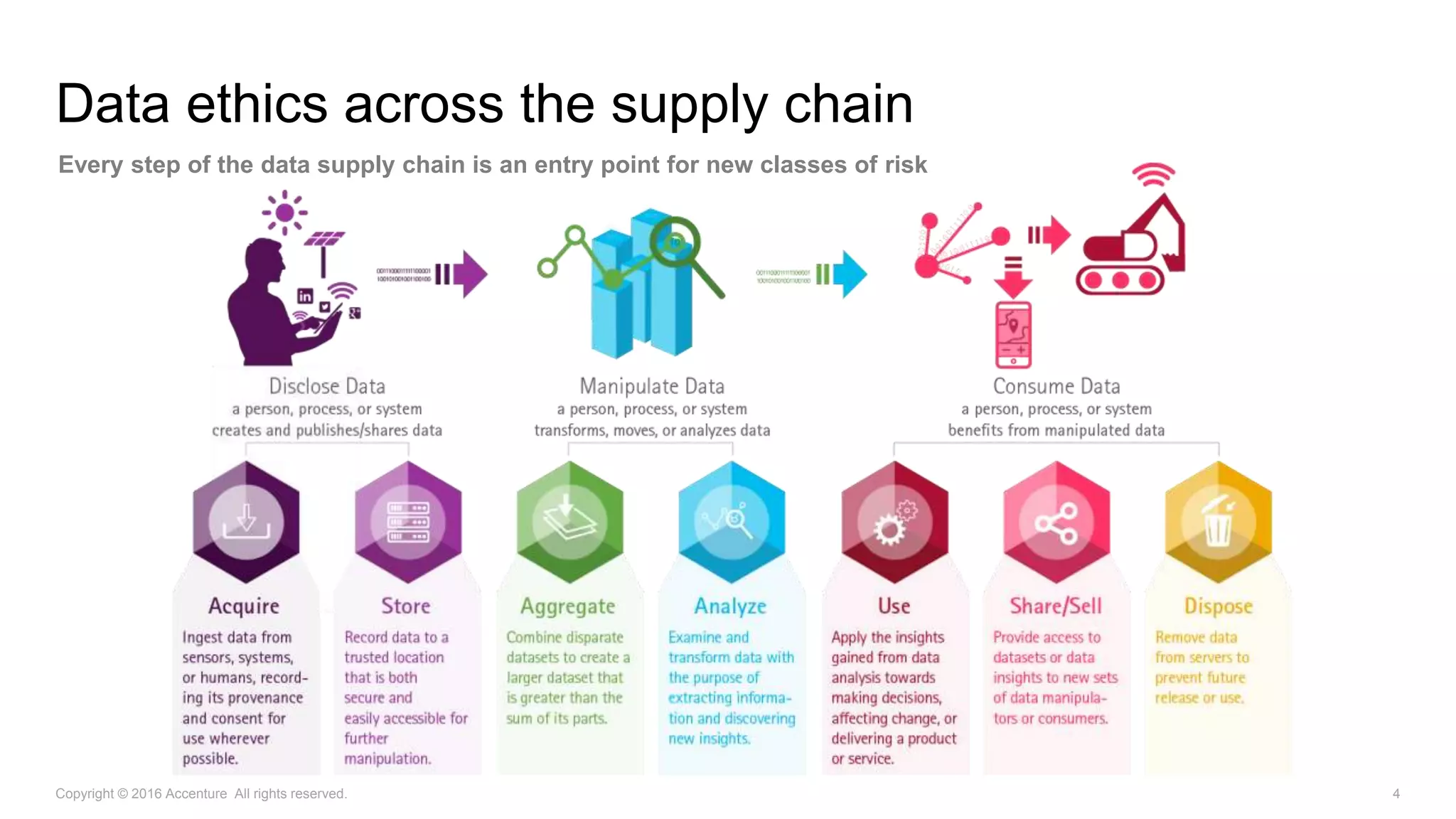
Data ethics across the supply chain
Every step of the data supply chain is an entry point for new classes of risk
Copyright © 2016 Accenture All rights reserved. 4
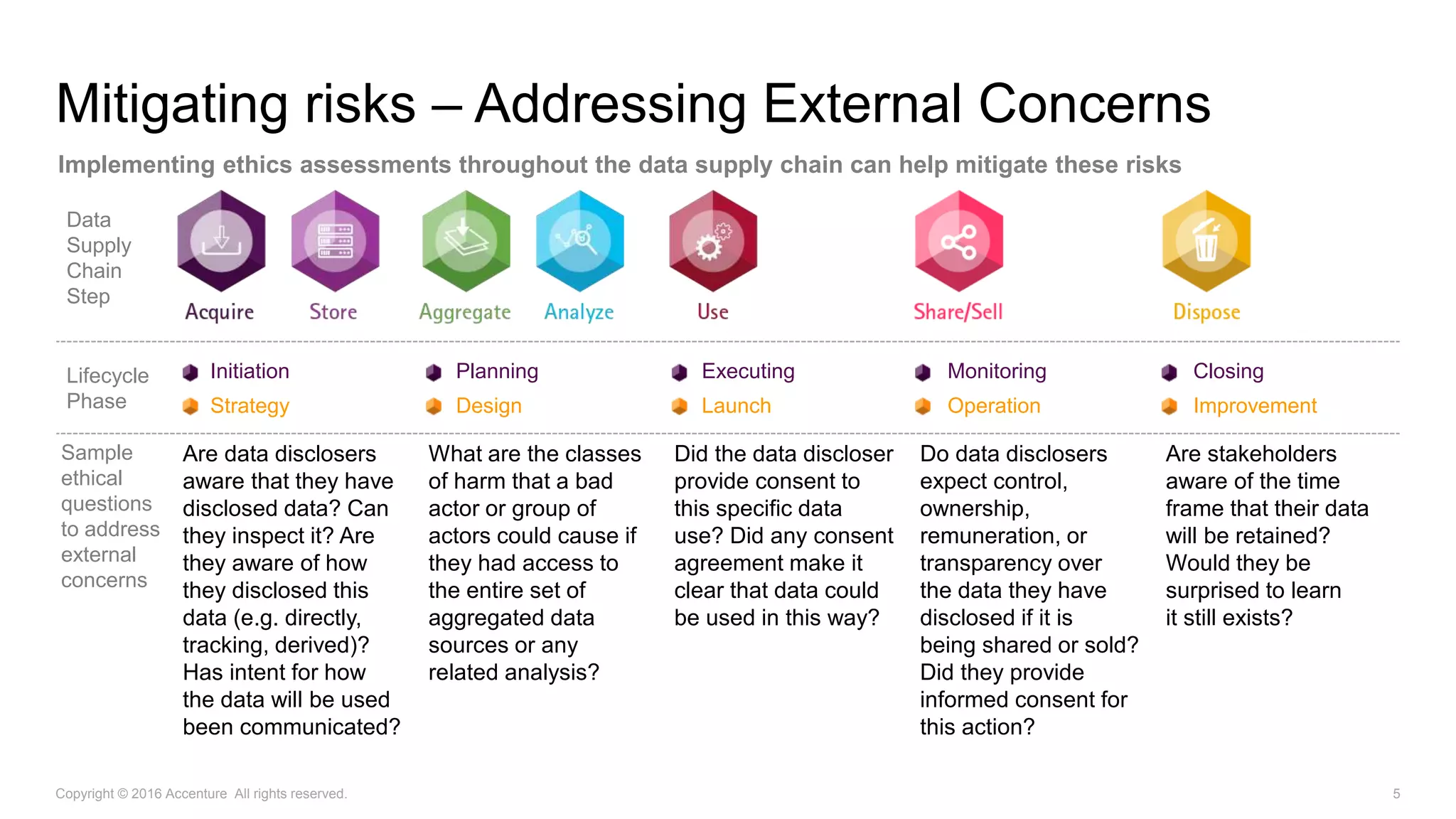
Mitigating risks – Addressing External Concerns
Data
Supply
Chain
Step
Lifecycle
Phase
Initiation
Strategy
Planning
Design
Executing
Launch
Monitoring
Operation
Closing
Improvement
Sample
ethical
questions
to address
external
concerns
Are data disclosers
aware that they have
disclosed data? Can
they inspect it? Are
they aware of how
they disclosed this
data (e.g. directly,
tracking, derived)?
Has intent for how
the data will be used
been communicated?
What are the classes
of harm that a bad
actor or group of
actors could cause if
they had access to
the entire set of
aggregated data
sources or any
related analysis?
Did the data discloser
provide consent to
this specific data
use? Did any consent
agreement make it
clear that data could
be used in this way?
Do data disclosers
expect control,
ownership,
remuneration, or
transparency over
the data they have
disclosed if it is
being shared or sold?
Did they provide
informed consent for
this action?
Are stakeholders
aware of the time
frame that their data
will be retained?
Would they be
surprised to learn
it still exists?
Copyright © 2016 Accenture All rights reserved. 5
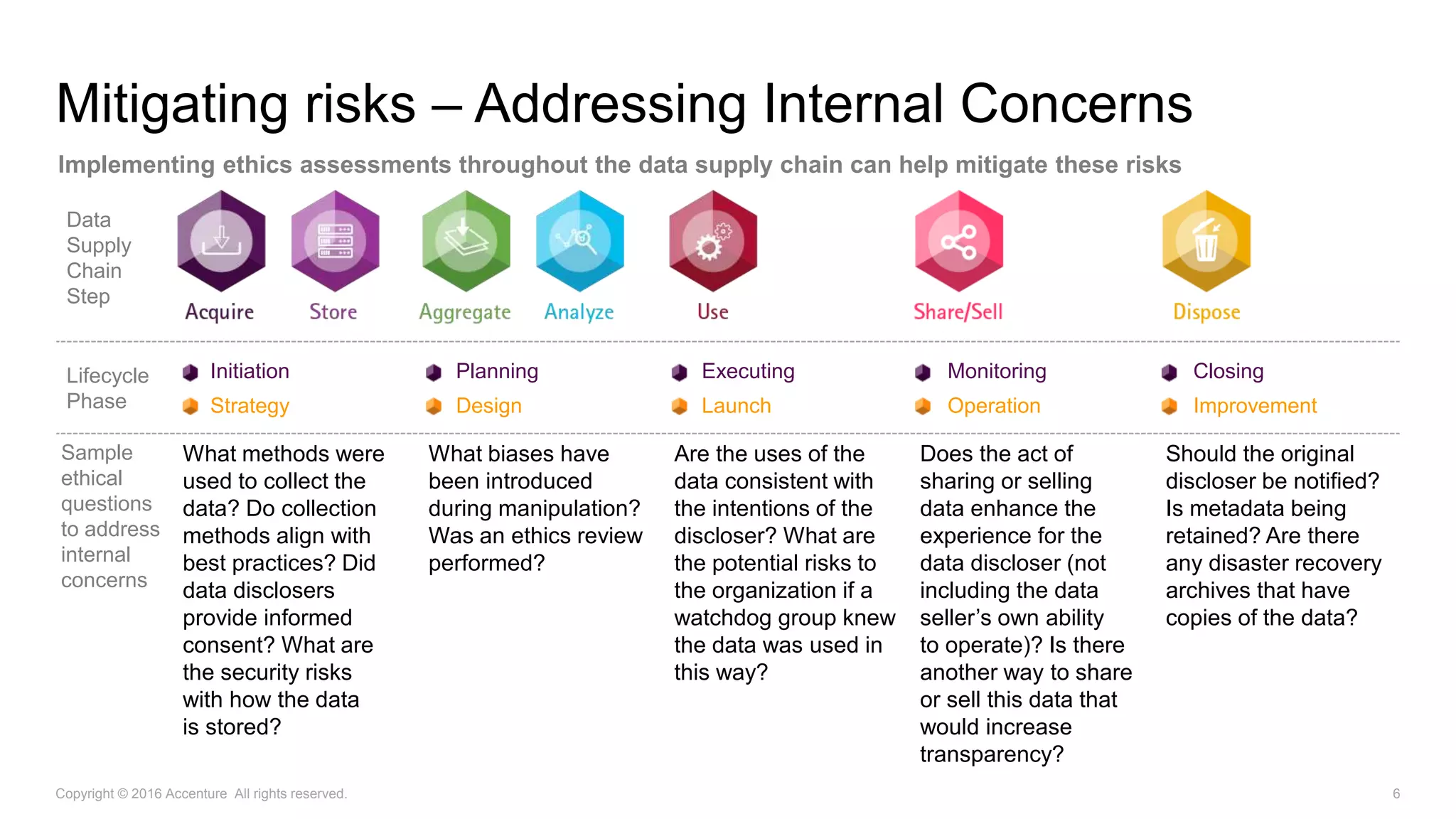
Implementing ethics assessments throughout the data supply chain can help mitigate these risks
Mitigating risks – Addressing Internal Concerns
Data
Supply
Chain
Step
Lifecycle
Phase
Initiation
Strategy
Planning
Design
Executing
Launch
Monitoring
Operation
Closing
Improvement
Sample
ethical
questions
to address
internal
concerns
What methods were
used to collect the
data? Do collection
methods align with
best practices? Did
data disclosers
provide informed
consent? What are
the security risks
with how the data
is stored?
What biases have
been introduced
during manipulation?
Was an ethics review
performed?
Are the uses of the
data consistent with
the intentions of the
discloser? What are
the potential risks to
the organization if a
watchdog group knew
the data was used in
this way?
Does the act of
sharing or selling
data enhance the
experience for the
data discloser (not
including the data
seller’s own ability
to operate)? Is there
another way to share
or sell this data that
would increase
transparency?
Should the original
discloser be notified?
Is metadata being
retained? Are there
any disaster recovery
archives that have
copies of the data?
Copyright © 2016 Accenture All rights reserved. 6
Implementing ethics assessments throughout the data supply chain can help mitigate these risks
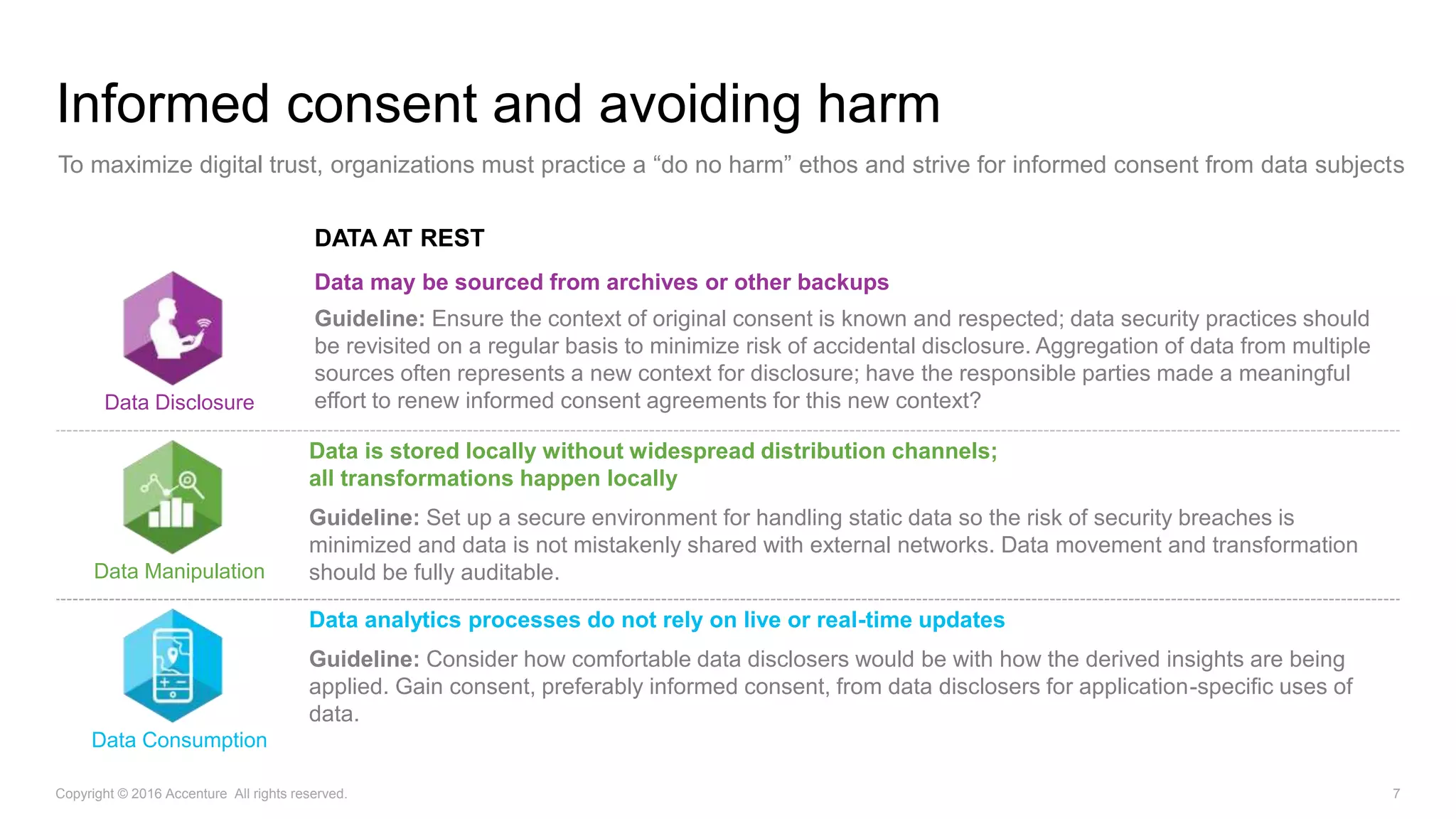
DATA AT REST
Data Disclosure
Data may be sourced from archives or other backups
Guideline: Ensure the context of original consent is known and respected; data security practices should
be revisited on a regular basis to minimize risk of accidental disclosure. Aggregation of data from multiple
sources often represents a new context for disclosure; have the responsible parties made a meaningful
effort to renew informed consent agreements for this new context?
Data Manipulation
Data is stored locally without widespread distribution channels;
all transformations happen locally
Guideline: Set up a secure environment for handling static data so the risk of security breaches is
minimized and data is not mistakenly shared with external networks. Data movement and transformation
should be fully auditable.
Data Consumption
Data analytics processes do not rely on live or real-time updates
Guideline: Consider how comfortable data disclosers would be with how the derived insights are being
applied. Gain consent, preferably informed consent, from data disclosers for application-specific uses of
data.
Informed consent and avoiding harm
To maximize digital trust, organizations must practice a “do no harm” ethos and strive for informed consent from data subjects
Copyright © 2016 Accenture All rights reserved. 7
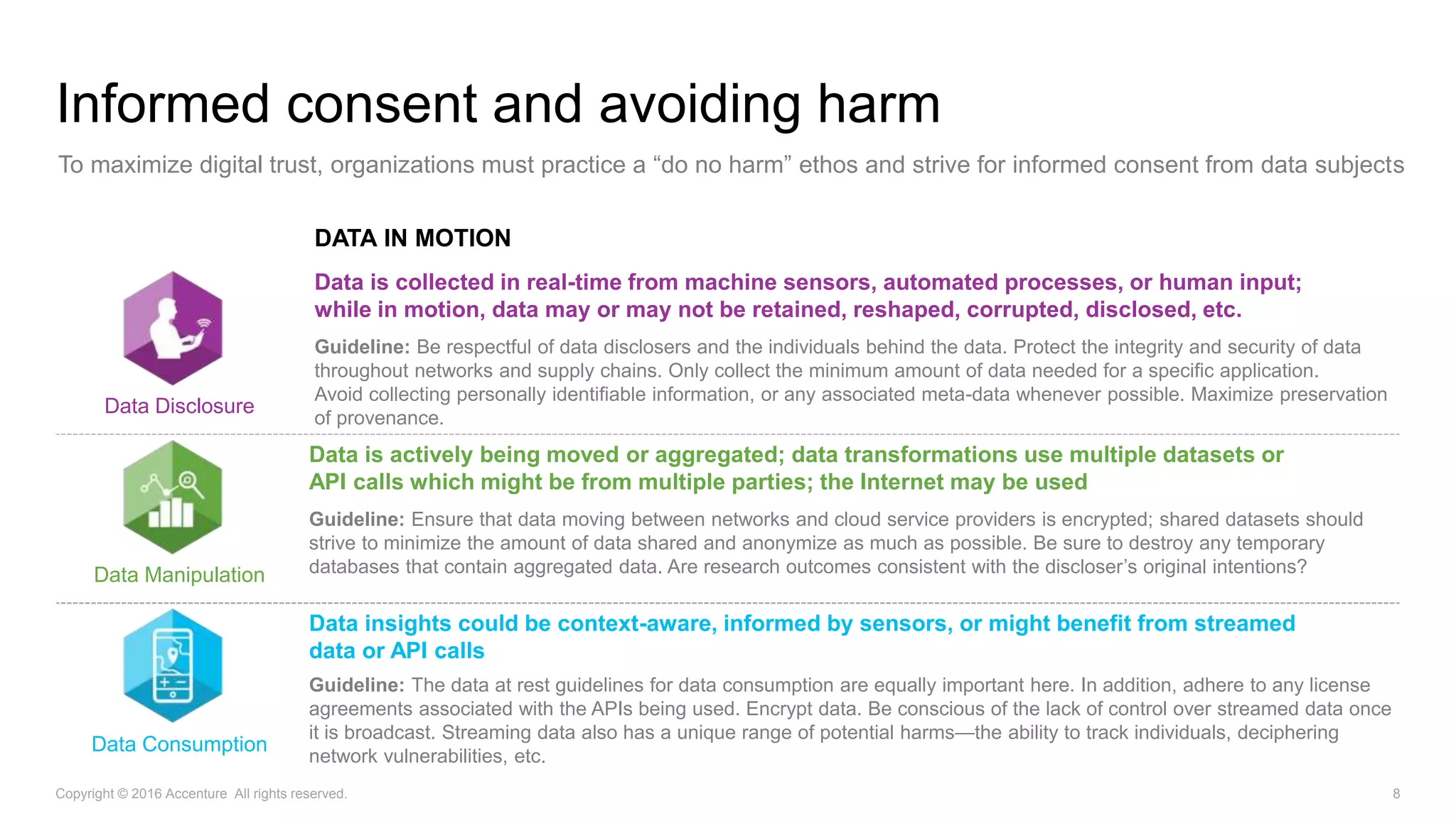
DATA IN MOTION
Data Disclosure
Data is collected in real-time from machine sensors, automated processes, or human input;
while in motion, data may or may not be retained, reshaped, corrupted, disclosed, etc.
Guideline: Be respectful of data disclosers and the individuals behind the data. Protect the integrity and security of data
throughout networks and supply chains. Only collect the minimum amount of data needed for a specific application.
Avoid collecting personally identifiable information, or any associated meta-data whenever possible. Maximize preservation
of provenance.
Data Manipulation
Data is actively being moved or aggregated; data transformations use multiple datasets or
API calls which might be from multiple parties; the Internet may be used
Guideline: Ensure that data moving between networks and cloud service providers is encrypted; shared datasets should
strive to minimize the amount of data shared and anonymize as much as possible. Be sure to destroy any temporary
databases that contain aggregated data. Are research outcomes consistent with the discloser’s original intentions?
Data Consumption
Data insights could be context-aware, informed by sensors, or might benefit from streamed
data or API calls
Guideline: The data at rest guidelines for data consumption are equally important here. In addition, adhere to any license
agreements associated with the APIs being used. Encrypt data. Be conscious of the lack of control over streamed data once
it is broadcast. Streaming data also has a unique range of potential harms—the ability to track individuals, deciphering
network vulnerabilities, etc.
Informed consent and avoiding harm
To maximize digital trust, organizations must practice a “do no harm” ethos and strive for informed consent from data subjects
Copyright © 2016 Accenture All rights reserved. 8
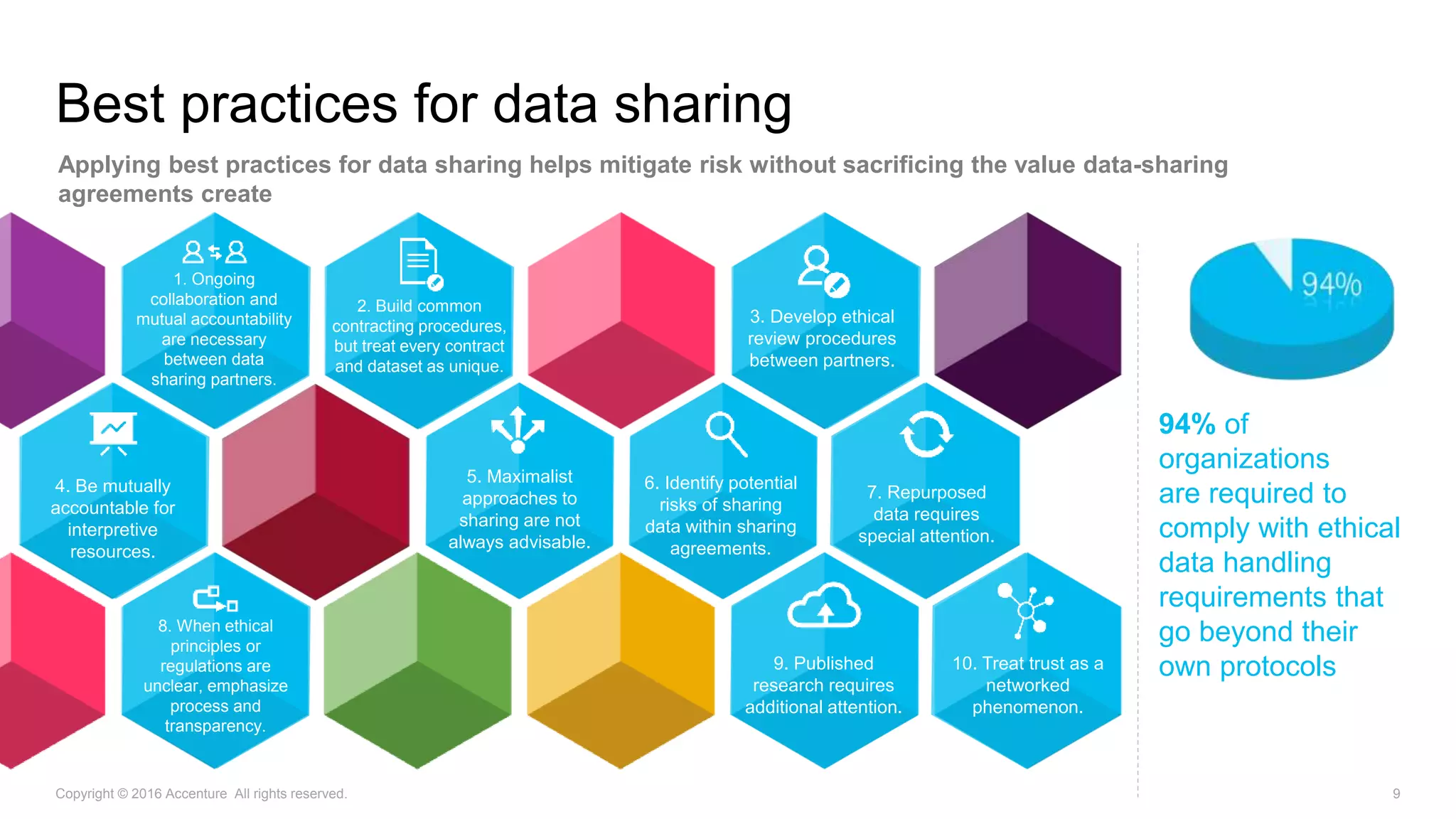
Best practices for data sharing
94% of
organizations
are required to
comply with ethical
data handling
requirements that
go beyond their
own protocols
Copyright © 2016 Accenture All rights reserved. 9
1. Ongoing
collaboration and
mutual accountability
are necessary
between data
sharing partners.
2. Build common
contracting procedures,
but treat every contract
and dataset as unique.
3. Develop ethical
review procedures
between partners.
4. Be mutually
accountable for
interpretive
resources.
5. Maximalist
approaches to
sharing are not
always advisable.
6. Identify potential
risks of sharing
data within sharing
agreements.
8. When ethical
principles or
regulations are
unclear, emphasize
process and
transparency.
9. Published
research requires
additional attention.
10. Treat trust as a
networked
phenomenon.
7. Repurposed
data requires
special attention.
Applying best practices for data sharing helps mitigate risk without sacrificing the value data-sharing
agreements create
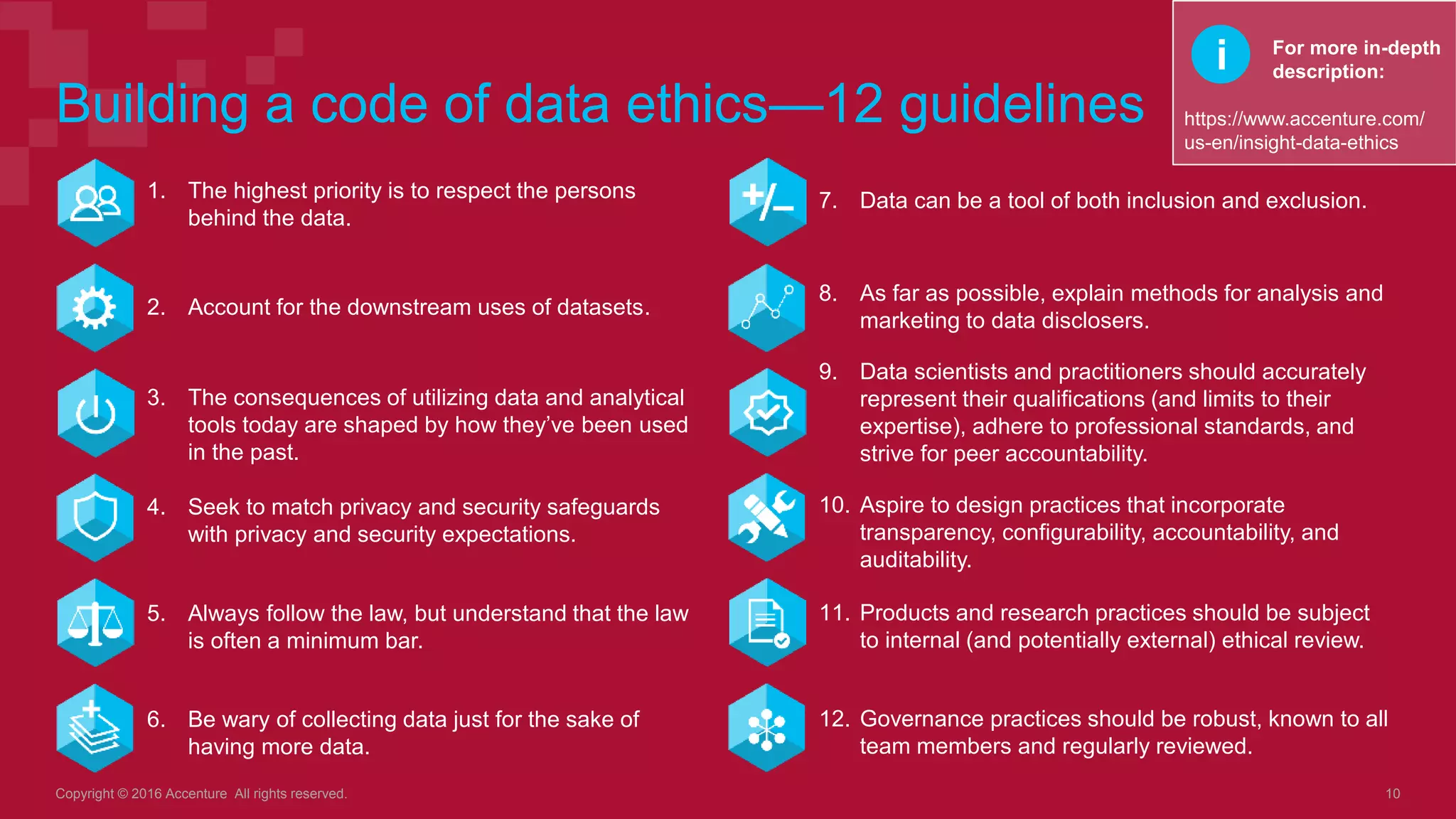
Building a code of data ethics—12 guidelines
1. The highest priority is to respect the persons
behind the data.
Copyright © 2016 Accenture All rights reserved. 10
2. Account for the downstream uses of datasets.
3. The consequences of utilizing data and analytical
tools today are shaped by how they’ve been used
in the past.
4. Seek to match privacy and security safeguards
with privacy and security expectations.
5. Always follow the law, but understand that the law
is often a minimum bar.
6. Be wary of collecting data just for the sake of
having more data.
For more in-depth
description:
https://www.accenture.com/
us-en/insight-data-ethics
7. Data can be a tool of both inclusion and exclusion.
8. As far as possible, explain methods for analysis and
marketing to data disclosers.
9. Data scientists and practitioners should accurately
represent their qualifications (and limits to their
expertise), adhere to professional standards, and
strive for peer accountability.
10. Aspire to design practices that incorporate
transparency, configurability, accountability, and
auditability.
11. Products and research practices should be subject
to internal (and potentially external) ethical review.
12. Governance practices should be robust, known to all
team members and regularly reviewed.
i
Start building trust today
The ethical treatment of data does not begin and end with a
single project in today’s digital economy – it needs to become
a core value across an organization
The embodiment of these actions into an organizational code
of data ethics is an opportunity for organizations to distinguish
themselves as industry leaders both in product/service value
and winning the trust of digital consumers
As organizations move forward in the digital economy,
embracing data ethics offers a way to engender trust and
provide vital differentiation in a crowded marketplace
Copyright © 2016 Accenture All rights reserved. 11

Building Digital Trust : The role of data ethics in the digital age

  • 1.
    Accenture Labs Building DigitalTrust The role of data ethics in the digital age
  • 2.
    2 Data is thebiggest risk that is unaccounted for by businesses today Copyright © 2016 Accenture All rights reserved.
  • 3.
    81% of executivesagree that as the business value of data grows, the risk companies face from improper handling of data are growing exponentially Data ethics in the digital economy Copyright © 2016 Accenture All rights reserved. 3 80% of executives report strong demand among knowledge workers for increased ethical controls for data 83% of executives agree that trust is the cornerstone of the digital economy Accenture survey confirms importance of digital trust
  • 4.
    Data ethics acrossthe supply chain Every step of the data supply chain is an entry point for new classes of risk Copyright © 2016 Accenture All rights reserved. 4
  • 5.
    Mitigating risks –Addressing External Concerns Data Supply Chain Step Lifecycle Phase Initiation Strategy Planning Design Executing Launch Monitoring Operation Closing Improvement Sample ethical questions to address external concerns Are data disclosers aware that they have disclosed data? Can they inspect it? Are they aware of how they disclosed this data (e.g. directly, tracking, derived)? Has intent for how the data will be used been communicated? What are the classes of harm that a bad actor or group of actors could cause if they had access to the entire set of aggregated data sources or any related analysis? Did the data discloser provide consent to this specific data use? Did any consent agreement make it clear that data could be used in this way? Do data disclosers expect control, ownership, remuneration, or transparency over the data they have disclosed if it is being shared or sold? Did they provide informed consent for this action? Are stakeholders aware of the time frame that their data will be retained? Would they be surprised to learn it still exists? Copyright © 2016 Accenture All rights reserved. 5 Implementing ethics assessments throughout the data supply chain can help mitigate these risks
  • 6.
    Mitigating risks –Addressing Internal Concerns Data Supply Chain Step Lifecycle Phase Initiation Strategy Planning Design Executing Launch Monitoring Operation Closing Improvement Sample ethical questions to address internal concerns What methods were used to collect the data? Do collection methods align with best practices? Did data disclosers provide informed consent? What are the security risks with how the data is stored? What biases have been introduced during manipulation? Was an ethics review performed? Are the uses of the data consistent with the intentions of the discloser? What are the potential risks to the organization if a watchdog group knew the data was used in this way? Does the act of sharing or selling data enhance the experience for the data discloser (not including the data seller’s own ability to operate)? Is there another way to share or sell this data that would increase transparency? Should the original discloser be notified? Is metadata being retained? Are there any disaster recovery archives that have copies of the data? Copyright © 2016 Accenture All rights reserved. 6 Implementing ethics assessments throughout the data supply chain can help mitigate these risks
  • 7.
    DATA AT REST DataDisclosure Data may be sourced from archives or other backups Guideline: Ensure the context of original consent is known and respected; data security practices should be revisited on a regular basis to minimize risk of accidental disclosure. Aggregation of data from multiple sources often represents a new context for disclosure; have the responsible parties made a meaningful effort to renew informed consent agreements for this new context? Data Manipulation Data is stored locally without widespread distribution channels; all transformations happen locally Guideline: Set up a secure environment for handling static data so the risk of security breaches is minimized and data is not mistakenly shared with external networks. Data movement and transformation should be fully auditable. Data Consumption Data analytics processes do not rely on live or real-time updates Guideline: Consider how comfortable data disclosers would be with how the derived insights are being applied. Gain consent, preferably informed consent, from data disclosers for application-specific uses of data. Informed consent and avoiding harm To maximize digital trust, organizations must practice a “do no harm” ethos and strive for informed consent from data subjects Copyright © 2016 Accenture All rights reserved. 7
  • 8.
    DATA IN MOTION DataDisclosure Data is collected in real-time from machine sensors, automated processes, or human input; while in motion, data may or may not be retained, reshaped, corrupted, disclosed, etc. Guideline: Be respectful of data disclosers and the individuals behind the data. Protect the integrity and security of data throughout networks and supply chains. Only collect the minimum amount of data needed for a specific application. Avoid collecting personally identifiable information, or any associated meta-data whenever possible. Maximize preservation of provenance. Data Manipulation Data is actively being moved or aggregated; data transformations use multiple datasets or API calls which might be from multiple parties; the Internet may be used Guideline: Ensure that data moving between networks and cloud service providers is encrypted; shared datasets should strive to minimize the amount of data shared and anonymize as much as possible. Be sure to destroy any temporary databases that contain aggregated data. Are research outcomes consistent with the discloser’s original intentions? Data Consumption Data insights could be context-aware, informed by sensors, or might benefit from streamed data or API calls Guideline: The data at rest guidelines for data consumption are equally important here. In addition, adhere to any license agreements associated with the APIs being used. Encrypt data. Be conscious of the lack of control over streamed data once it is broadcast. Streaming data also has a unique range of potential harms—the ability to track individuals, deciphering network vulnerabilities, etc. Informed consent and avoiding harm To maximize digital trust, organizations must practice a “do no harm” ethos and strive for informed consent from data subjects Copyright © 2016 Accenture All rights reserved. 8
  • 9.
    Best practices fordata sharing 94% of organizations are required to comply with ethical data handling requirements that go beyond their own protocols Copyright © 2016 Accenture All rights reserved. 9 1. Ongoing collaboration and mutual accountability are necessary between data sharing partners. 2. Build common contracting procedures, but treat every contract and dataset as unique. 3. Develop ethical review procedures between partners. 4. Be mutually accountable for interpretive resources. 5. Maximalist approaches to sharing are not always advisable. 6. Identify potential risks of sharing data within sharing agreements. 8. When ethical principles or regulations are unclear, emphasize process and transparency. 9. Published research requires additional attention. 10. Treat trust as a networked phenomenon. 7. Repurposed data requires special attention. Applying best practices for data sharing helps mitigate risk without sacrificing the value data-sharing agreements create
  • 10.
    Building a codeof data ethics—12 guidelines 1. The highest priority is to respect the persons behind the data. Copyright © 2016 Accenture All rights reserved. 10 2. Account for the downstream uses of datasets. 3. The consequences of utilizing data and analytical tools today are shaped by how they’ve been used in the past. 4. Seek to match privacy and security safeguards with privacy and security expectations. 5. Always follow the law, but understand that the law is often a minimum bar. 6. Be wary of collecting data just for the sake of having more data. For more in-depth description: https://www.accenture.com/ us-en/insight-data-ethics 7. Data can be a tool of both inclusion and exclusion. 8. As far as possible, explain methods for analysis and marketing to data disclosers. 9. Data scientists and practitioners should accurately represent their qualifications (and limits to their expertise), adhere to professional standards, and strive for peer accountability. 10. Aspire to design practices that incorporate transparency, configurability, accountability, and auditability. 11. Products and research practices should be subject to internal (and potentially external) ethical review. 12. Governance practices should be robust, known to all team members and regularly reviewed. i
  • 11.
    Start building trusttoday The ethical treatment of data does not begin and end with a single project in today’s digital economy – it needs to become a core value across an organization The embodiment of these actions into an organizational code of data ethics is an opportunity for organizations to distinguish themselves as industry leaders both in product/service value and winning the trust of digital consumers As organizations move forward in the digital economy, embracing data ethics offers a way to engender trust and provide vital differentiation in a crowded marketplace Copyright © 2016 Accenture All rights reserved. 11

Editor's Notes

  • #4 Today’s digital economies are built on creating, collecting, combining, and sharing data Existing governance frameworks and risk mitigation strategies are focused on preventing cybersecurity threats These techniques fall short considering that unethical and illegal use of data insights can amplify biases, or be used for purposes far outside the consent of original data disclosers Success in the digital economy will hinge on an organization’s ability to create and maintain ”digital-trust,” thereby reinforcing the notion that a brand is reliable, capable, safe, transparent, and truthful in its digital practices A focus on ethics puts emphasis on addressing these new risk vectors while creating confidence in a brand built on digital-trust
  • #5 Ethical treatment of materials and labor in a conventional supply chain generates respect and trust in brands from consumers Ethical treatment of digital assets in a data supply chain garners trust in similar ways Beyond consumer trust, an ethical understanding of potential risks and harms that result from misusing data helps an organization better manage their risk exposure in digital ecosystems Creating cross-organizational/industry taxonomies, or classifications, of these risks and harms opens up the discussion around these issues and allows for future planning as new risk vectors are discovered
  • #6 Project management and service design professionals can help mitigate these risks Along with understanding the risks and harms that access and use of new data bring, applying risk and harm reduction techniques allows a business to escape potentially paralyzing situations Incorporating ethical reviews throughout project and service lifecycles helps project managers stay on top of internal and external concerns around data use Approaching ethical problems proactively can help organizations accomplish that trust is baked into and reinforced with new offerings, engendering loyalty and confidence among consumers and partners
  • #7 Project management and service design professionals can help mitigate these risks Along with understanding the risks and harms that access and use of new data bring, applying risk and harm reduction techniques allows a business to escape potentially paralyzing situations Incorporating ethical reviews throughout project and service lifecycles helps project managers stay on top of internal and external concerns around data use Approaching ethical problems proactively can help organizations accomplish that trust is baked into and reinforced with new offerings, engendering loyalty and confidence among consumers and partners
  • #8 Actively managing risks helps minimize the potential for harm As data manipulation and consumption are planned, digital-trust is strengthened by ensuring data disclosers are fully aware of what their data could be used for, and how potential data use impacts them As the amount of collected data increases and its potential for use grows with an emerging platform economy, measures of informed consent that demonstrate a “do no harm” ethos promote digital-trust and reduces an organization’s risk exposure An organization will stand out and truly embody this ethos if they distinguish and clarify how consent agreements treat data at rest and data in motion, two paradigms that define modern day data use
  • #9 Actively managing risks helps minimize the potential for harm As data manipulation and consumption are planned, digital-trust is strengthened by ensuring data disclosers are fully aware of what their data could be used for, and how potential data use impacts them As the amount of collected data increases and its potential for use grows with an emerging platform economy, measures of informed consent that demonstrate a “do no harm” ethos promote digital-trust and reduces an organization’s risk exposure An organization will stand out and truly embody this ethos if they distinguish and clarify how consent agreements treat data at rest and data in motion, two paradigms that define modern day data use
  • #10 As opportunities to share data data and increase that data’s value present themselves, organizations need to be mindful of consent agreements data disclosers signed as well as the potential for ethical misuse of the data in question