Increasing Age
Diversity In The
Workplace
(Case#2, Chapter#2)
Presented By
Hassaan Ashraf (11050)
Table of Content
• Summary
• Questions
• Age Diversity
• Concerns Regarding the Aging Workforce
• Age Discrimination
• Engagement and Advancement of Older Employees
• Benefits of an Aging Workforce
• Employer Practices for the Aging Workforce
• Question#1
• Question#2
• Question#3
• Question#4
• Conclusion
Summary
• This case is about increasing age diversity in the workplace
which is the average age of the workforce has continually
increased as medical science continues to enhance longevity
and vitality fastest growing segment of the workplace is
individual over the age of 55. Recent medical research is
exploding techniques that could extend human life to 100
years or more. Unfortunately, an older worker faces a variety
of discriminatory attitude in the work place. Organizations can
take steps to limit age discrimination and ensure that
employees are treated fairly regardless of age. Many of the
techniques to limit age discrimination come down to
fundamentally sound management practices relevant for all
employees. Such as set clear expectation for performance:
deal with problems directly, communicate with workers
frequently and follow clear policies and procedure
consistently.
Questions
1. What changes in employment relationships are likely to
occur as the population ages?
2. Do you think increasing age diversity will create new
challenges for managers? What types of challenges do
you expect will be most profound?
3. How can organizations cope with differences related to
age discrimination in the workplace?
4. What types of policies might lead to charges of age
discrimination, and how can they be changed to
eliminate these problems?
Age Diversity
•Age diversity is the ability to accept all
different types of ages within a
business environment. Companies
have to adjust to an aging population
in various ways.
Concerns Regarding the Aging
Workforce
• The Demographic Landscape
U.S. Census Bureau suggest that, by 2016, one-third
of the total U.S. workforce will be age 50 or older.
The growing number of older employees results in a
shift in workforce demographics.
 A rise in the employment of older people results in a
decline of the entry-level workforce, leading to an
even larger shift in the demographics .
Concerns Regarding the Aging
Workforce
• Health Care and Increased Disability
Disability: 9.5 percent in the 18- to 24-year-old range, 21
percent in the 45- to 54-year-old range, 42 percent in the
65- to 75-year old range and 64 percent in the 75+ age
range.
Insurance: The health of the workforce not only affects
the effectiveness of the workforce but also impacts
insurance rates. With an aging workforce, healthcare and
life insurance premiums will increase due to an increased
risk of morbidity and mortality of the entire workforce.
Age Discrimination
• Positive Perceptions
experience
 knowledge
 work habits
 attitudes
 commitment to quality
even-temperedness
• Negative Perceptions
narrow-minded
 unwillingness or inability to adapt to new technology
 lack of ambition
 resistance to change
presence of physical limitations
 less willingness to relocate, travel or move to new job
locations
Engagement and Advancement
of Older Employees
• With the advances in medicine and healthcare, many older
employees find themselves very capable of continuing to
work just as effectively as their younger colleagues.
• Employers are faced with a unique challenge of retaining
and engaging older employees as well as creating career
advancement opportunities.
• 60 percent of older workers wanted to carry on working
after retirement age either in the same or different jobs
because of financial reasons.
• Society has changed its perspective of older people by its
use of new terms such as successful aging and resourceful
aging.
Benefits of an Aging Workforce
• The older employees can share many experiences both with
young and middle added employees to teach their knowledge
and expertise.
• Such diversity helps a company to service a wider range of
customers.
• By matching the employee age group to the customer’s age
group, the customer and employee relate better.
Employer Practices for the
Aging Workforce
• Work Force Assessment
Recruitment
Engagement
Retention
• Workforce Training and Engagement
• Workplace Flexibility
Question#1
What changes in employment relationships are
likely to occur as the population ages?
• Reduced hours and flexible schedules
• Phased retirement
• More training tailored towards older people
• As the workforce ages it is likely that companies will look
to other options such as outsourcing make jobs more
flexible.
Question#2
Do you think increasing age diversity will create
new challenges for managers? What types of
challenges do you expect will be most profound?
• Finding a way to balance motivation in the workplace.
This is because what motivates a younger person will not
necessarily motivate an older person.
• Managers will need to find a way to balance this when
dealing with age diversity.
• Problem of how to form a cohesive workplace by
bridging the gap between the older and younger
workers.
Question#3
How can organizations cope with differences
related to age discrimination in the workplace?
• By implementing strategies that place older people in
positions best suited to their ability without stereotyping
them.
• Organizations need to look for ways to make technology
more friendly to older people as this can enhance the
workplace experience for an older population.
• Ensure that the reward system is based on performance
and not tenure.
Question#4
What types of policies might lead to charges of
age discrimination, and how can they be changed
to eliminate these problems?
Types of policies might lead to charges of age
discrimination
• Not employing mature workers because it’s assumed
that they’ll soon retire.
• Not interviewing someone because they are too old to
‘fit in’ with other staff.
• Making choices during layoffs, or forcing someone to
retire, because of their age.
• Advertising for someone to join a “dynamic, young team”
Question#4
Policies can be changed to eliminate these problems
• Equal opportunity policy that helps staff understand their
rights and responsibilities.
• Pair workers of different ages .Workers of any age can pass on
their experience and help others develop through their
unique knowledge and skills.
• Fire an employee on the basis of his performance not on the
basis of his age.
Conclusion
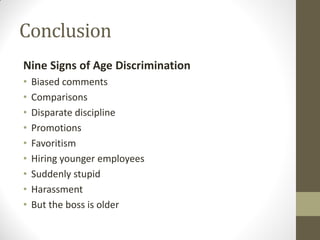
Nine Signs of Age Discrimination
• Biased comments
• Comparisons
• Disparate discipline
• Promotions
• Favoritism
• Hiring younger employees
• Suddenly stupid
• Harassment
• But the boss is older
Conclusion
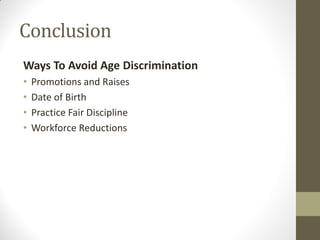
Ways To Avoid Age Discrimination
• Promotions and Raises
• Date of Birth
• Practice Fair Discipline
• Workforce Reductions
Increasing Age Diversity In The Workplace (Case#2, Chapter#2)

Increasing Age Diversity In The Workplace (Case#2, Chapter#2)

  • 2.
    Increasing Age Diversity InThe Workplace (Case#2, Chapter#2) Presented By Hassaan Ashraf (11050)
  • 3.
    Table of Content •Summary • Questions • Age Diversity • Concerns Regarding the Aging Workforce • Age Discrimination • Engagement and Advancement of Older Employees • Benefits of an Aging Workforce • Employer Practices for the Aging Workforce • Question#1 • Question#2 • Question#3 • Question#4 • Conclusion
  • 4.
    Summary • This caseis about increasing age diversity in the workplace which is the average age of the workforce has continually increased as medical science continues to enhance longevity and vitality fastest growing segment of the workplace is individual over the age of 55. Recent medical research is exploding techniques that could extend human life to 100 years or more. Unfortunately, an older worker faces a variety of discriminatory attitude in the work place. Organizations can take steps to limit age discrimination and ensure that employees are treated fairly regardless of age. Many of the techniques to limit age discrimination come down to fundamentally sound management practices relevant for all employees. Such as set clear expectation for performance: deal with problems directly, communicate with workers frequently and follow clear policies and procedure consistently.
  • 5.
    Questions 1. What changesin employment relationships are likely to occur as the population ages? 2. Do you think increasing age diversity will create new challenges for managers? What types of challenges do you expect will be most profound? 3. How can organizations cope with differences related to age discrimination in the workplace? 4. What types of policies might lead to charges of age discrimination, and how can they be changed to eliminate these problems?
  • 6.
    Age Diversity •Age diversityis the ability to accept all different types of ages within a business environment. Companies have to adjust to an aging population in various ways.
  • 7.
    Concerns Regarding theAging Workforce • The Demographic Landscape U.S. Census Bureau suggest that, by 2016, one-third of the total U.S. workforce will be age 50 or older. The growing number of older employees results in a shift in workforce demographics.  A rise in the employment of older people results in a decline of the entry-level workforce, leading to an even larger shift in the demographics .
  • 8.
    Concerns Regarding theAging Workforce • Health Care and Increased Disability Disability: 9.5 percent in the 18- to 24-year-old range, 21 percent in the 45- to 54-year-old range, 42 percent in the 65- to 75-year old range and 64 percent in the 75+ age range. Insurance: The health of the workforce not only affects the effectiveness of the workforce but also impacts insurance rates. With an aging workforce, healthcare and life insurance premiums will increase due to an increased risk of morbidity and mortality of the entire workforce.
  • 9.
    Age Discrimination • PositivePerceptions experience  knowledge  work habits  attitudes  commitment to quality even-temperedness • Negative Perceptions narrow-minded  unwillingness or inability to adapt to new technology  lack of ambition  resistance to change presence of physical limitations  less willingness to relocate, travel or move to new job locations
  • 10.
    Engagement and Advancement ofOlder Employees • With the advances in medicine and healthcare, many older employees find themselves very capable of continuing to work just as effectively as their younger colleagues. • Employers are faced with a unique challenge of retaining and engaging older employees as well as creating career advancement opportunities. • 60 percent of older workers wanted to carry on working after retirement age either in the same or different jobs because of financial reasons. • Society has changed its perspective of older people by its use of new terms such as successful aging and resourceful aging.
  • 11.
    Benefits of anAging Workforce • The older employees can share many experiences both with young and middle added employees to teach their knowledge and expertise. • Such diversity helps a company to service a wider range of customers. • By matching the employee age group to the customer’s age group, the customer and employee relate better.
  • 12.
    Employer Practices forthe Aging Workforce • Work Force Assessment Recruitment Engagement Retention • Workforce Training and Engagement • Workplace Flexibility
  • 13.
    Question#1 What changes inemployment relationships are likely to occur as the population ages? • Reduced hours and flexible schedules • Phased retirement • More training tailored towards older people • As the workforce ages it is likely that companies will look to other options such as outsourcing make jobs more flexible.
  • 14.
    Question#2 Do you thinkincreasing age diversity will create new challenges for managers? What types of challenges do you expect will be most profound? • Finding a way to balance motivation in the workplace. This is because what motivates a younger person will not necessarily motivate an older person. • Managers will need to find a way to balance this when dealing with age diversity. • Problem of how to form a cohesive workplace by bridging the gap between the older and younger workers.
  • 15.
    Question#3 How can organizationscope with differences related to age discrimination in the workplace? • By implementing strategies that place older people in positions best suited to their ability without stereotyping them. • Organizations need to look for ways to make technology more friendly to older people as this can enhance the workplace experience for an older population. • Ensure that the reward system is based on performance and not tenure.
  • 16.
    Question#4 What types ofpolicies might lead to charges of age discrimination, and how can they be changed to eliminate these problems? Types of policies might lead to charges of age discrimination • Not employing mature workers because it’s assumed that they’ll soon retire. • Not interviewing someone because they are too old to ‘fit in’ with other staff. • Making choices during layoffs, or forcing someone to retire, because of their age. • Advertising for someone to join a “dynamic, young team”
  • 17.
    Question#4 Policies can bechanged to eliminate these problems • Equal opportunity policy that helps staff understand their rights and responsibilities. • Pair workers of different ages .Workers of any age can pass on their experience and help others develop through their unique knowledge and skills. • Fire an employee on the basis of his performance not on the basis of his age.
  • 18.
    Conclusion Nine Signs ofAge Discrimination • Biased comments • Comparisons • Disparate discipline • Promotions • Favoritism • Hiring younger employees • Suddenly stupid • Harassment • But the boss is older
  • 19.
    Conclusion Ways To AvoidAge Discrimination • Promotions and Raises • Date of Birth • Practice Fair Discipline • Workforce Reductions