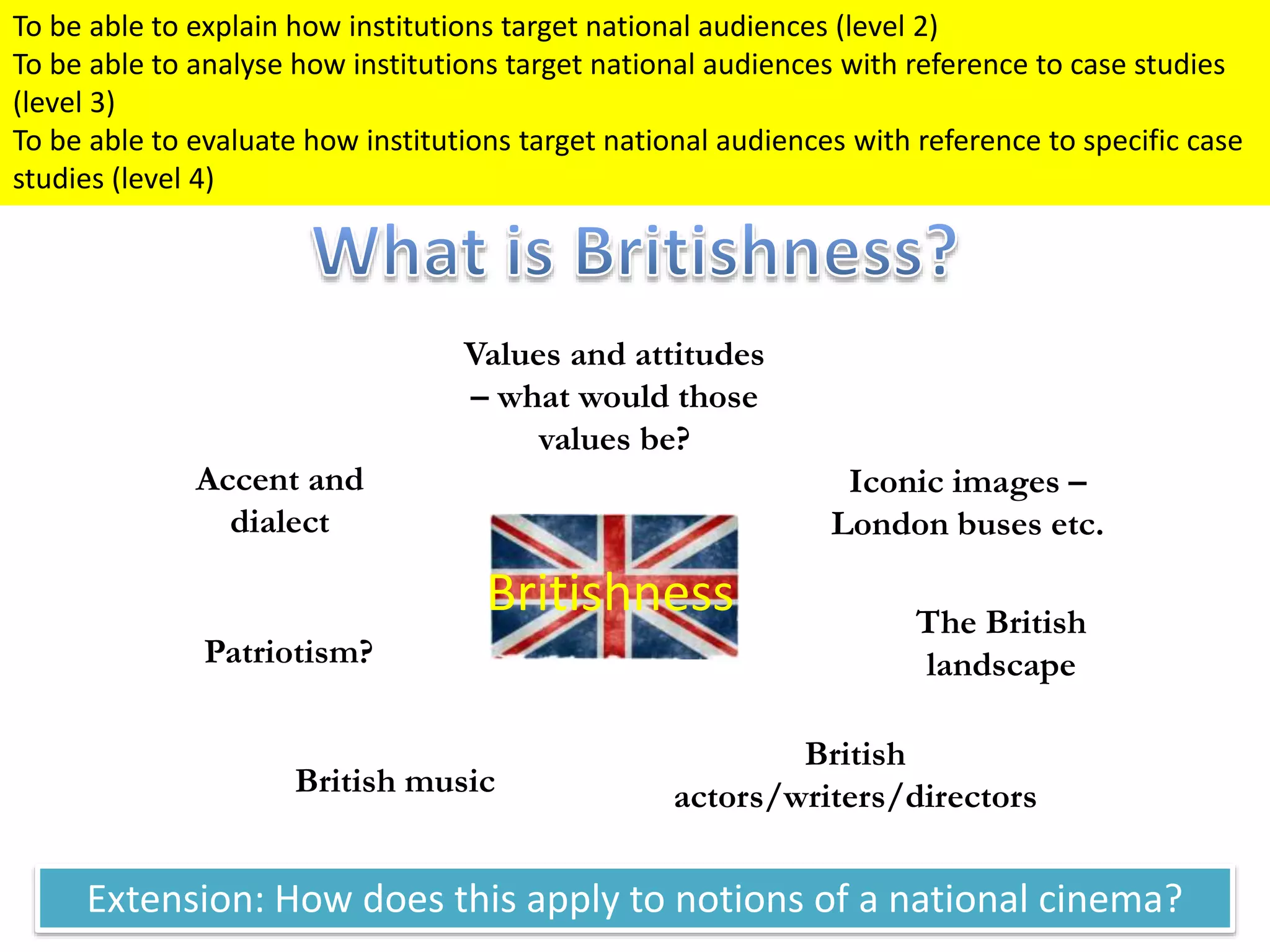
Britishness
Accent and
dialect
Values and attitudes
– what would those
values be?
Iconic images –
London buses etc.
The British
landscapePatriotism?
British music
British
actors/writers/directors
To be able to explain how institutions target national audiences (level 2)
To be able to analyse how institutions target national audiences with reference to case studies
(level 3)
To be able to evaluate how institutions target national audiences with reference to specific case
studies (level 4)
Extension: How does this apply to notions of a national cinema?
There are seven areas that you could be given a question about. They are:
1. The issues raised by media ownership in contemporary media practice.
2. The importance of cross media convergence and synergy in
production, distribution and marketing.
3. The technologies that have been introduced in recent years at the
levels of production, distribution, marketing and exchange.
4. The significance of proliferation in hardware and content for
institutions and audiences.
5. The importance of technological convergence for institutions and
audiences.
6. The issues raised in the targeting of national and local audiences
(specifically, British) by international or global institutions.
7. The ways in which the candidates’ own experiences of media
consumption illustrate wider patterns and trends of audience
behaviour.
The British Film Institute (BFI) says there are 5 categories:
A: Films made with British money, personnel and resources.
B: Films co-funded with money from Britain and from foreign investment,
but the majority of finance, cultural content and personnel are British.
C: Films with mostly foreign (but non USA) investment and a small British
input either financially or creatively.
D: Films made in the UK with (usually) British cultural content, but financed
fully or partly by American companies.
E: American films with some British involvement.
To be able to explain how institutions target national audiences (level 2)
To be able to analyse how institutions target national audiences with reference to case studies
(level 3)
To be able to evaluate how institutions target national audiences with reference to specific case
studies (level 4)
The top-grossing films of 2014 at the UK box office:
1. The Lego Movie - £34.27m
2. The Inbetweeners 2 - £33.33m
3. Dawn of the Planet of the Apes - £32.63m
4. The Hunger Games: Mockingjay Part 1 - £29.46m
5. The Hobbit: The Battle of the Five Armies - £28.71m
6. Guardians of the Galaxy - £28.51m
7. X-Men: Days of Future Past - £27.05m
8. How to Train Your Dragon 2 - £25.01m
9. The Amazing Spider-Man 2 - £24.06m
10.Paddington - £23.91m
To be able to explain how institutions target national audiences (level 2)
To be able to analyse how institutions target national audiences with reference to case studies
(level 3)
To be able to evaluate how institutions target national audiences with reference to specific case
studies (level 4)
How many of
these films are
British?
At what level are
they British?
To be able to explain how institutions target national audiences (level 2)
To be able to analyse how institutions target national audiences with reference to case studies
(level 3)
To be able to evaluate how institutions target national audiences with reference to specific case
studies (level 4)
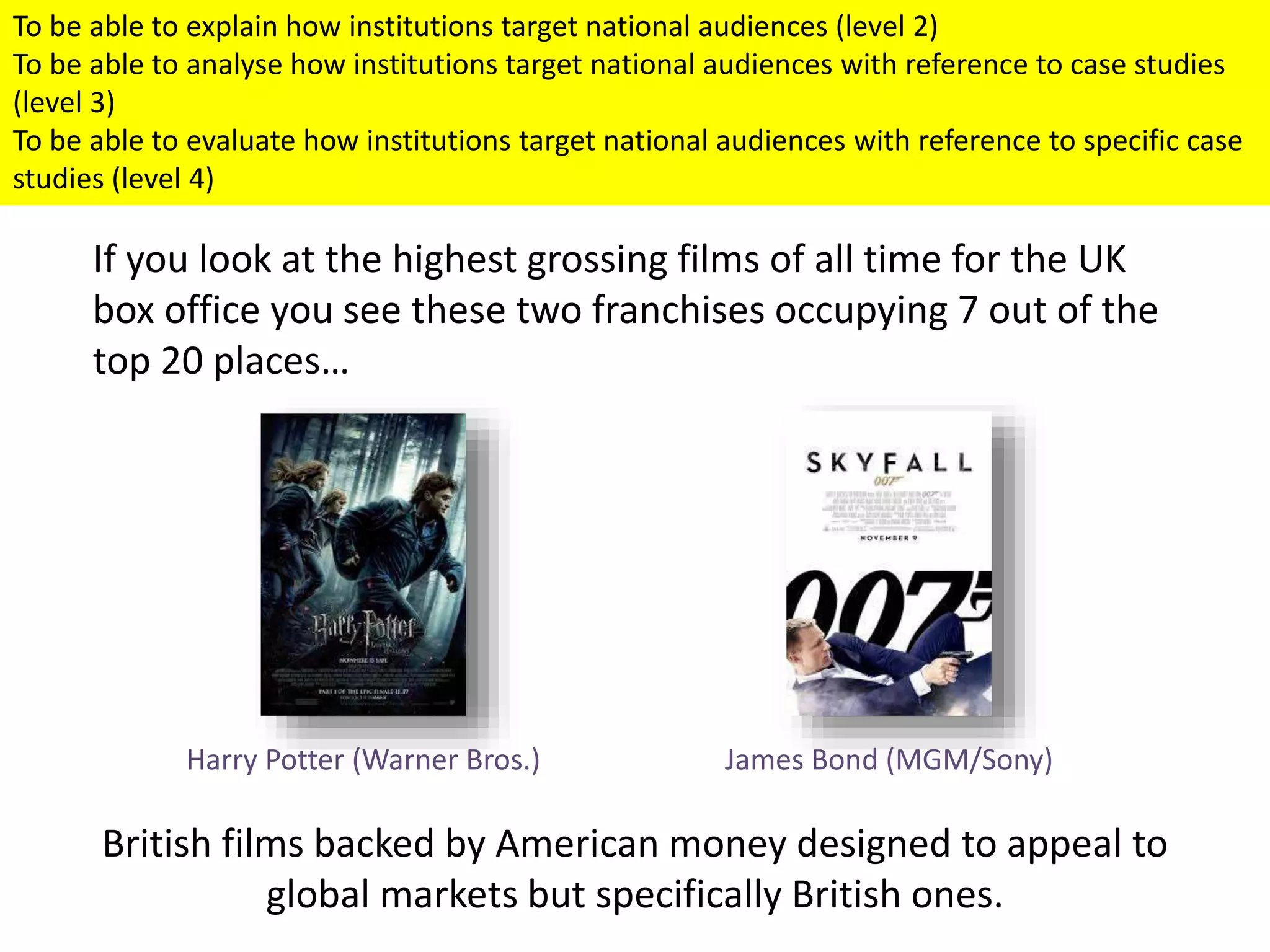
If you look at the highest grossing films of all time for the UK
box office you see these two franchises occupying 7 out of the
top 20 places…
British films backed by American money designed to appeal to
global markets but specifically British ones.
James Bond (MGM/Sony)Harry Potter (Warner Bros.)
To be able to explain how institutions target national audiences (level 2)
To be able to analyse how institutions target national audiences with reference to case studies
(level 3)
To be able to evaluate how institutions target national audiences with reference to specific case
studies (level 4)
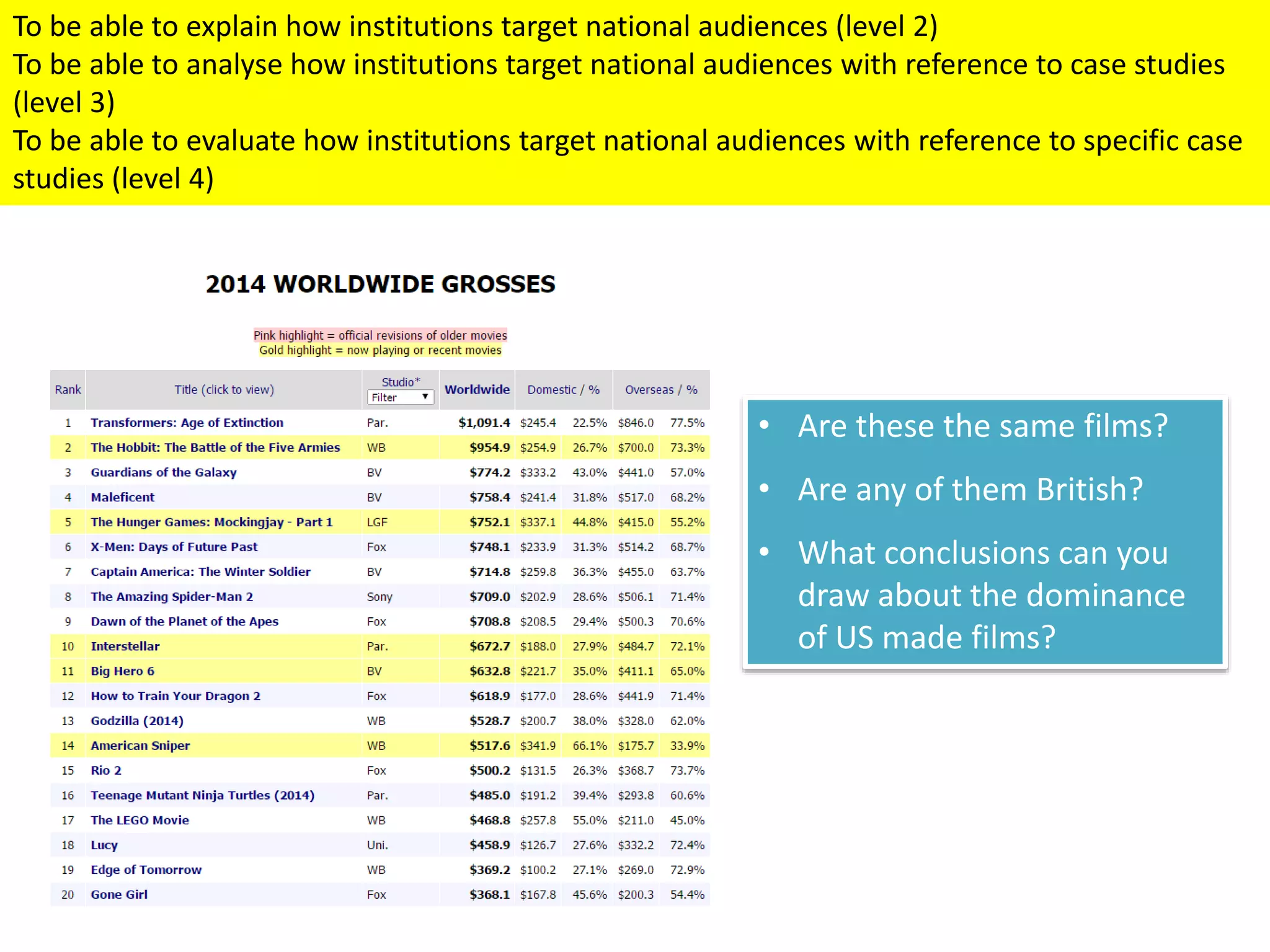
• Are these the same films?
• Are any of them British?
• What conclusions can you
draw about the dominance
of US made films?
To be able to explain how institutions target national audiences (level 2)
To be able to analyse how institutions target national audiences with reference to case studies
(level 3)
To be able to evaluate how institutions target national audiences with reference to specific case
studies (level 4)
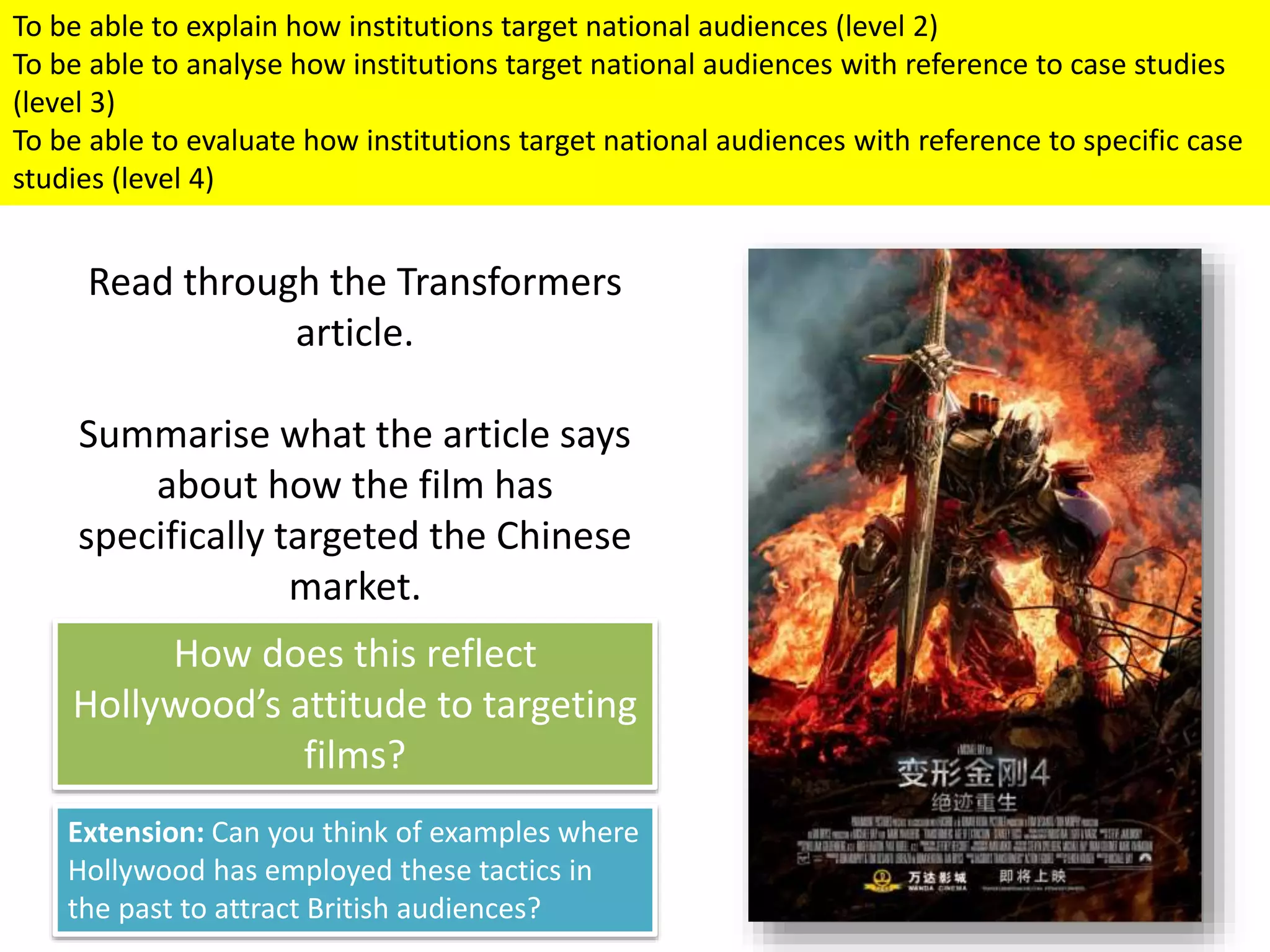
Read through the Transformers
article.
Summarise what the article says
about how the film has
specifically targeted the Chinese
market.
How does this reflect
Hollywood’s attitude to targeting
films?
Extension: Can you think of examples where
Hollywood has employed these tactics in
the past to attract British audiences?
• Film industry dominated by the big 5 film distributors
• Hollywood studios use ‘blanket marketing’ (media
saturation) strategies and ‘blanket release’ to dominate
in the cinemas, as well as cross-media convergence.
• Hollywood tends to make genre films – blockbusters
that are very commercial.
• More money available for production, marketing and
distribution in American system.
• Timing of releases of American films allows them to
dominate. (school holidays, summer holidays, Oscar
season etc.)
To be able to explain how institutions target national audiences (level 2)
To be able to analyse how institutions target national audiences with reference to case studies
(level 3)
To be able to evaluate how institutions target national audiences with reference to specific case
studies (level 4)
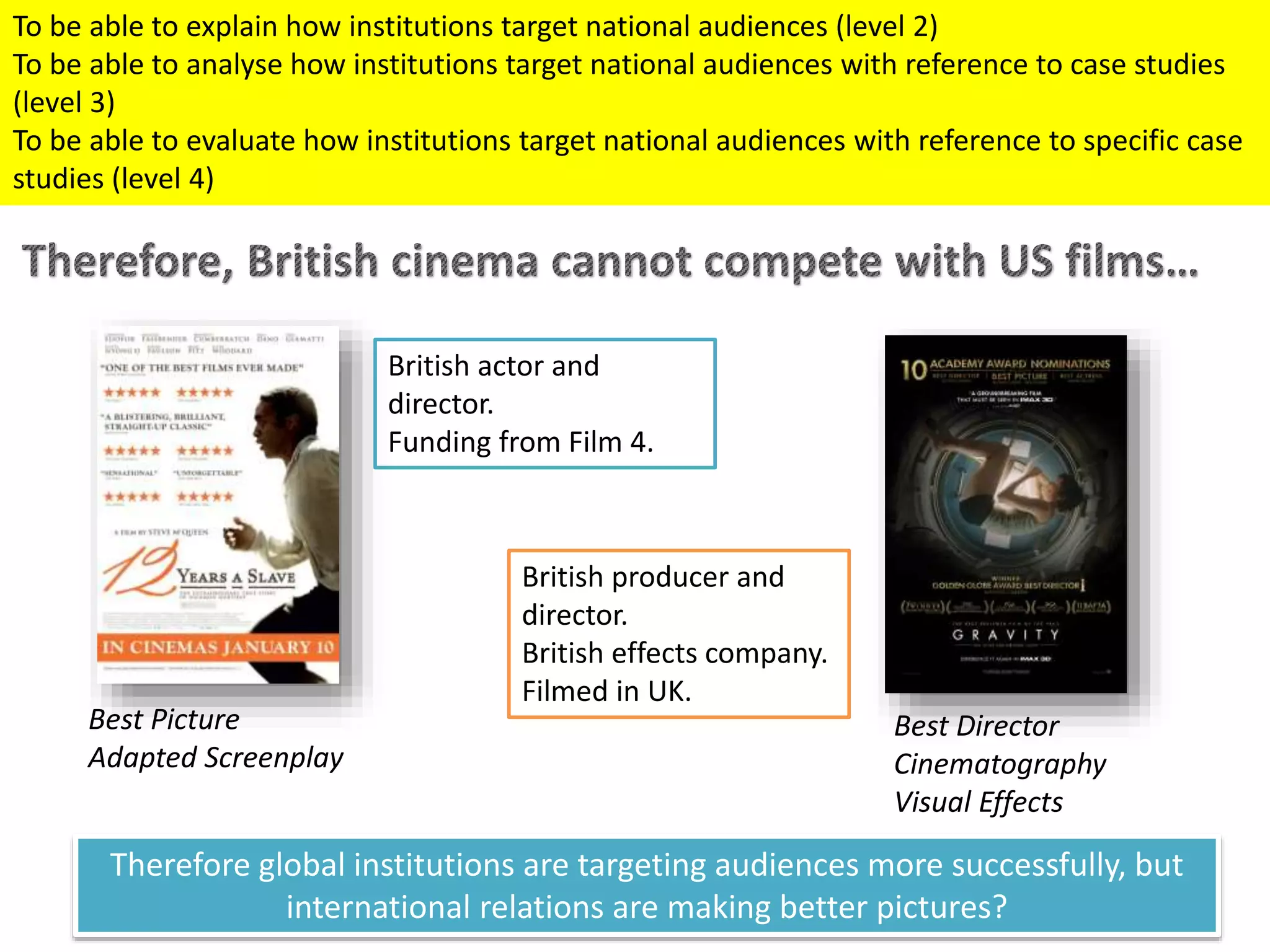
British actor and
director.
Funding from Film 4.
Best Director
Cinematography
Visual Effects
To be able to explain how institutions target national audiences (level 2)
To be able to analyse how institutions target national audiences with reference to case studies
(level 3)
To be able to evaluate how institutions target national audiences with reference to specific case
studies (level 4)
Best Picture
Adapted Screenplay
Therefore global institutions are targeting audiences more successfully, but
international relations are making better pictures?
British producer and
director.
British effects company.
Filmed in UK.
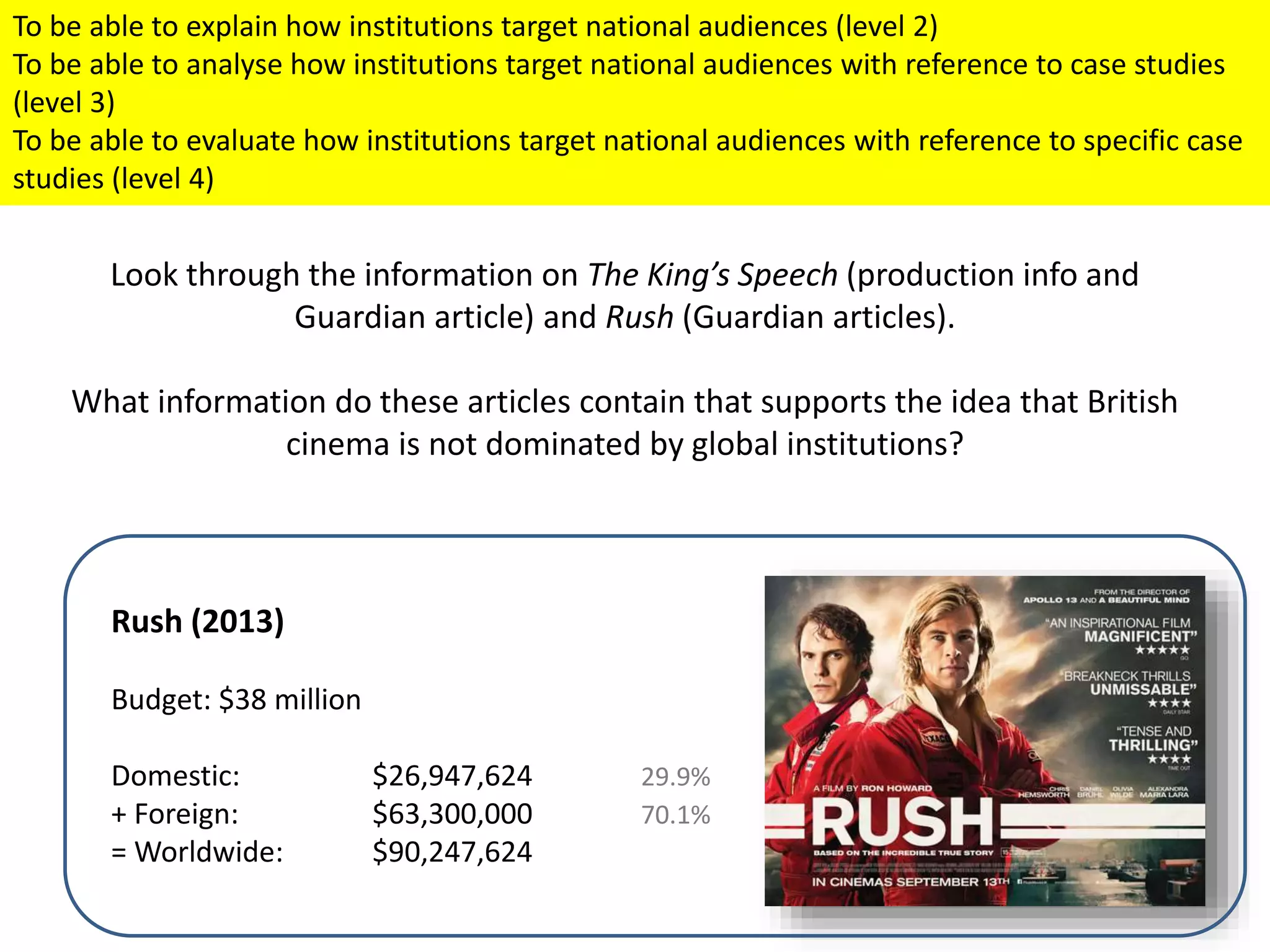
Rush (2013)
Budget: $38 million
Domestic: $26,947,624 29.9%
+ Foreign: $63,300,000 70.1%
= Worldwide: $90,247,624
To be able to explain how institutions target national audiences (level 2)
To be able to analyse how institutions target national audiences with reference to case studies
(level 3)
To be able to evaluate how institutions target national audiences with reference to specific case
studies (level 4)
Look through the information on The King’s Speech (production info and
Guardian article) and Rush (Guardian articles).
What information do these articles contain that supports the idea that British
cinema is not dominated by global institutions?
To be able to explain how institutions target national audiences (level 2)
To be able to analyse how institutions target national audiences with reference to case studies
(level 3)
To be able to evaluate how institutions target national audiences with reference to specific case
studies (level 4)
UK films made with the backing of major US
studios spent longer than other films, on
average, in UK cinemas in 2013.
UK films, including co-productions, accounted for 20% of releases and
22% of the market by value. The box office share of UK independent films was 7%.
UK films’ share of the
global box office was 11%.
BAFTA 2014 Outstanding British Film Nominations
• Gravity
• Mandela: Long Walk To Freedom
• Philomena
• Rush
• Saving Mr. Banks
• The Selfish Giant
What notions of national cinema are there left?
How does British cinema target British audiences?
How does British cinema appeal to a wider audience?
To be able to explain how institutions target national audiences (level 2)
To be able to analyse how institutions target national audiences with reference to case studies
(level 3)
To be able to evaluate how institutions target national audiences with reference to specific case
studies (level 4)
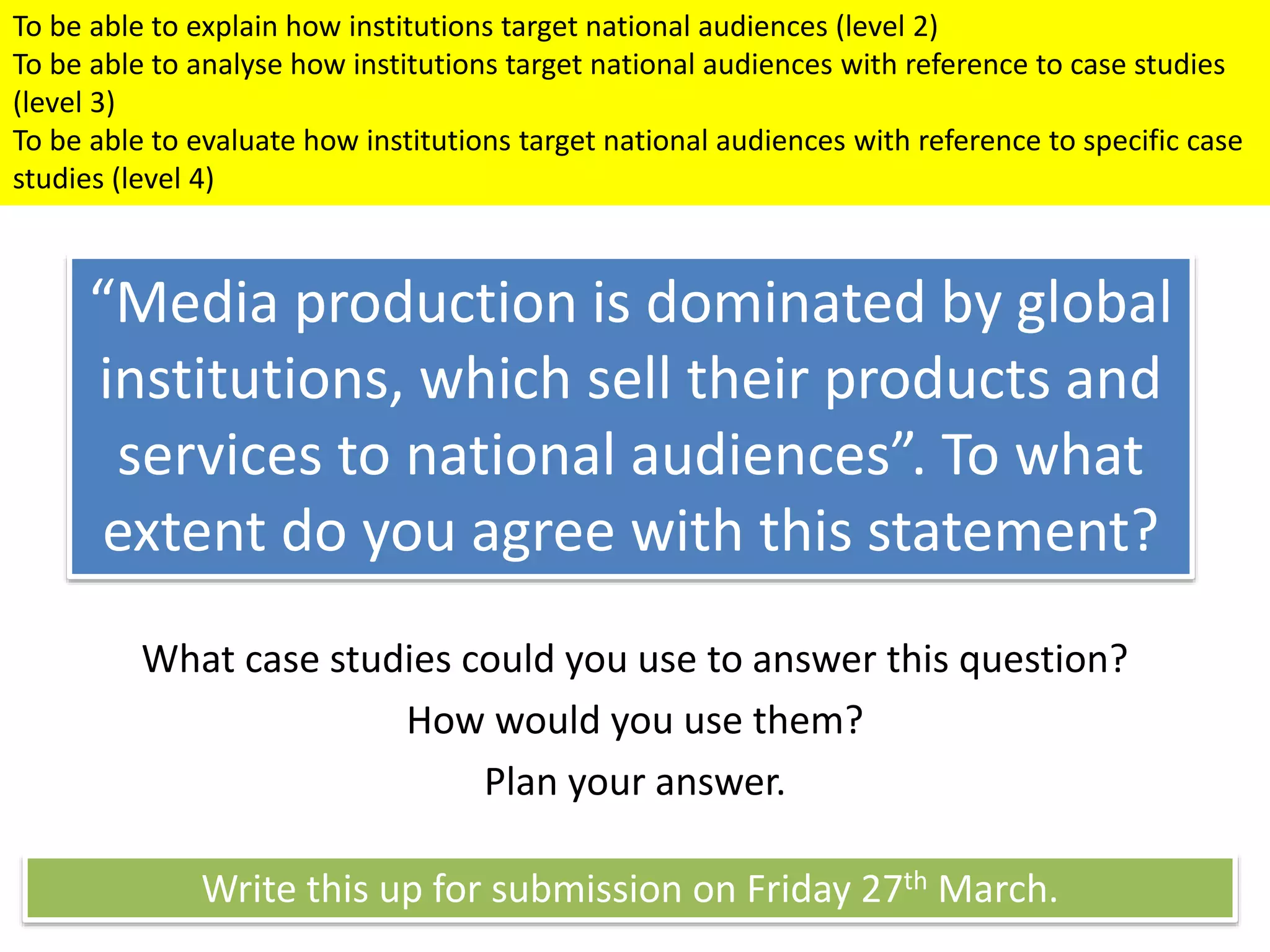
“Media production is dominated by global
institutions, which sell their products and
services to national audiences”. To what
extent do you agree with this statement?
What case studies could you use to answer this question?
How would you use them?
Plan your answer.
Write this up for submission on Friday 27th March.
To be able to explain how institutions target national audiences (level 2)
To be able to analyse how institutions target national audiences with reference to case studies
(level 3)
To be able to evaluate how institutions target national audiences with reference to specific case
studies (level 4)

Targeting of national and local audiences

  • 1.
    Britishness Accent and dialect Values andattitudes – what would those values be? Iconic images – London buses etc. The British landscapePatriotism? British music British actors/writers/directors To be able to explain how institutions target national audiences (level 2) To be able to analyse how institutions target national audiences with reference to case studies (level 3) To be able to evaluate how institutions target national audiences with reference to specific case studies (level 4) Extension: How does this apply to notions of a national cinema?
  • 2.
    There are sevenareas that you could be given a question about. They are: 1. The issues raised by media ownership in contemporary media practice. 2. The importance of cross media convergence and synergy in production, distribution and marketing. 3. The technologies that have been introduced in recent years at the levels of production, distribution, marketing and exchange. 4. The significance of proliferation in hardware and content for institutions and audiences. 5. The importance of technological convergence for institutions and audiences. 6. The issues raised in the targeting of national and local audiences (specifically, British) by international or global institutions. 7. The ways in which the candidates’ own experiences of media consumption illustrate wider patterns and trends of audience behaviour.
  • 3.
    The British FilmInstitute (BFI) says there are 5 categories: A: Films made with British money, personnel and resources. B: Films co-funded with money from Britain and from foreign investment, but the majority of finance, cultural content and personnel are British. C: Films with mostly foreign (but non USA) investment and a small British input either financially or creatively. D: Films made in the UK with (usually) British cultural content, but financed fully or partly by American companies. E: American films with some British involvement. To be able to explain how institutions target national audiences (level 2) To be able to analyse how institutions target national audiences with reference to case studies (level 3) To be able to evaluate how institutions target national audiences with reference to specific case studies (level 4)
  • 4.
    The top-grossing filmsof 2014 at the UK box office: 1. The Lego Movie - £34.27m 2. The Inbetweeners 2 - £33.33m 3. Dawn of the Planet of the Apes - £32.63m 4. The Hunger Games: Mockingjay Part 1 - £29.46m 5. The Hobbit: The Battle of the Five Armies - £28.71m 6. Guardians of the Galaxy - £28.51m 7. X-Men: Days of Future Past - £27.05m 8. How to Train Your Dragon 2 - £25.01m 9. The Amazing Spider-Man 2 - £24.06m 10.Paddington - £23.91m To be able to explain how institutions target national audiences (level 2) To be able to analyse how institutions target national audiences with reference to case studies (level 3) To be able to evaluate how institutions target national audiences with reference to specific case studies (level 4) How many of these films are British? At what level are they British?
  • 5.
    To be ableto explain how institutions target national audiences (level 2) To be able to analyse how institutions target national audiences with reference to case studies (level 3) To be able to evaluate how institutions target national audiences with reference to specific case studies (level 4) If you look at the highest grossing films of all time for the UK box office you see these two franchises occupying 7 out of the top 20 places… British films backed by American money designed to appeal to global markets but specifically British ones. James Bond (MGM/Sony)Harry Potter (Warner Bros.)
  • 6.
    To be ableto explain how institutions target national audiences (level 2) To be able to analyse how institutions target national audiences with reference to case studies (level 3) To be able to evaluate how institutions target national audiences with reference to specific case studies (level 4) • Are these the same films? • Are any of them British? • What conclusions can you draw about the dominance of US made films?
  • 7.
    To be ableto explain how institutions target national audiences (level 2) To be able to analyse how institutions target national audiences with reference to case studies (level 3) To be able to evaluate how institutions target national audiences with reference to specific case studies (level 4) Read through the Transformers article. Summarise what the article says about how the film has specifically targeted the Chinese market. How does this reflect Hollywood’s attitude to targeting films? Extension: Can you think of examples where Hollywood has employed these tactics in the past to attract British audiences?
  • 8.
    • Film industrydominated by the big 5 film distributors • Hollywood studios use ‘blanket marketing’ (media saturation) strategies and ‘blanket release’ to dominate in the cinemas, as well as cross-media convergence. • Hollywood tends to make genre films – blockbusters that are very commercial. • More money available for production, marketing and distribution in American system. • Timing of releases of American films allows them to dominate. (school holidays, summer holidays, Oscar season etc.) To be able to explain how institutions target national audiences (level 2) To be able to analyse how institutions target national audiences with reference to case studies (level 3) To be able to evaluate how institutions target national audiences with reference to specific case studies (level 4)
  • 9.
    British actor and director. Fundingfrom Film 4. Best Director Cinematography Visual Effects To be able to explain how institutions target national audiences (level 2) To be able to analyse how institutions target national audiences with reference to case studies (level 3) To be able to evaluate how institutions target national audiences with reference to specific case studies (level 4) Best Picture Adapted Screenplay Therefore global institutions are targeting audiences more successfully, but international relations are making better pictures? British producer and director. British effects company. Filmed in UK.
  • 10.
    Rush (2013) Budget: $38million Domestic: $26,947,624 29.9% + Foreign: $63,300,000 70.1% = Worldwide: $90,247,624 To be able to explain how institutions target national audiences (level 2) To be able to analyse how institutions target national audiences with reference to case studies (level 3) To be able to evaluate how institutions target national audiences with reference to specific case studies (level 4) Look through the information on The King’s Speech (production info and Guardian article) and Rush (Guardian articles). What information do these articles contain that supports the idea that British cinema is not dominated by global institutions?
  • 11.
    To be ableto explain how institutions target national audiences (level 2) To be able to analyse how institutions target national audiences with reference to case studies (level 3) To be able to evaluate how institutions target national audiences with reference to specific case studies (level 4) UK films made with the backing of major US studios spent longer than other films, on average, in UK cinemas in 2013. UK films, including co-productions, accounted for 20% of releases and 22% of the market by value. The box office share of UK independent films was 7%. UK films’ share of the global box office was 11%. BAFTA 2014 Outstanding British Film Nominations • Gravity • Mandela: Long Walk To Freedom • Philomena • Rush • Saving Mr. Banks • The Selfish Giant
  • 12.
    What notions ofnational cinema are there left? How does British cinema target British audiences? How does British cinema appeal to a wider audience? To be able to explain how institutions target national audiences (level 2) To be able to analyse how institutions target national audiences with reference to case studies (level 3) To be able to evaluate how institutions target national audiences with reference to specific case studies (level 4)
  • 13.
    “Media production isdominated by global institutions, which sell their products and services to national audiences”. To what extent do you agree with this statement? What case studies could you use to answer this question? How would you use them? Plan your answer. Write this up for submission on Friday 27th March. To be able to explain how institutions target national audiences (level 2) To be able to analyse how institutions target national audiences with reference to case studies (level 3) To be able to evaluate how institutions target national audiences with reference to specific case studies (level 4)