Who are the BBFC? 
What do they do?
Learning Objectives: 
• To know how the British ratings system works 
(Level 2) 
• To be able to apply knowledge of the British 
ratings system to your own work (Level 3) 
• To be able to evaluate ratings according to 
generic conventions and audience 
expectations (Level 4)
• To know how the British ratings system works (Level 2) 
• To be able to apply knowledge of the British ratings system to your own work (Level 3) 
• To be able to evaluate ratings according to generic conventions and audience expectations (Level 4) 
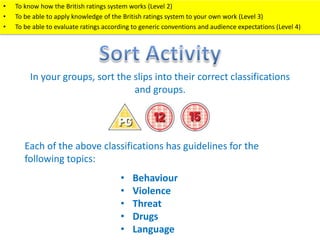
In your groups, sort the slips into their correct classifications 
and groups. 
Each of the above classifications has guidelines for the 
following topics: 
• Behaviour 
• Violence 
• Threat 
• Drugs 
• Language
• To know how the British ratings system works (Level 2) 
• To be able to apply knowledge of the British ratings system to your own work (Level 3) 
• To be able to evaluate ratings according to generic conventions and audience expectations (Level 4) 
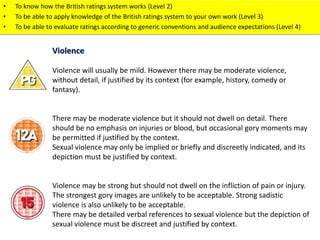
Violence 
Violence will usually be mild. However there may be moderate violence, 
without detail, if justified by its context (for example, history, comedy or 
fantasy). 
There may be moderate violence but it should not dwell on detail. There 
should be no emphasis on injuries or blood, but occasional gory moments may 
be permitted if justified by the context. 
Sexual violence may only be implied or briefly and discreetly indicated, and its 
depiction must be justified by context. 
Violence may be strong but should not dwell on the infliction of pain or injury. 
The strongest gory images are unlikely to be acceptable. Strong sadistic 
violence is also unlikely to be acceptable. 
There may be detailed verbal references to sexual violence but the depiction of 
sexual violence must be discreet and justified by context.
• To know how the British ratings system works (Level 2) 
• To be able to apply knowledge of the British ratings system to your own work (Level 3) 
• To be able to evaluate ratings according to generic conventions and audience expectations (Level 4) 
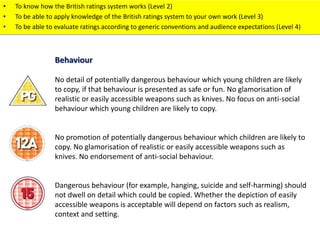
Behaviour 
No detail of potentially dangerous behaviour which young children are likely 
to copy, if that behaviour is presented as safe or fun. No glamorisation of 
realistic or easily accessible weapons such as knives. No focus on anti-social 
behaviour which young children are likely to copy. 
No promotion of potentially dangerous behaviour which children are likely to 
copy. No glamorisation of realistic or easily accessible weapons such as 
knives. No endorsement of anti-social behaviour. 
Dangerous behaviour (for example, hanging, suicide and self-harming) should 
not dwell on detail which could be copied. Whether the depiction of easily 
accessible weapons is acceptable will depend on factors such as realism, 
context and setting.
• To know how the British ratings system works (Level 2) 
• To be able to apply knowledge of the British ratings system to your own work (Level 3) 
• To be able to evaluate ratings according to generic conventions and audience expectations (Level 4) 
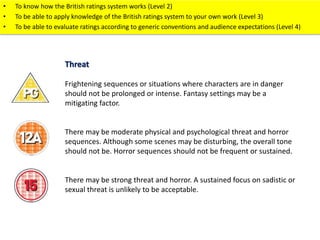
Threat 
Frightening sequences or situations where characters are in danger 
should not be prolonged or intense. Fantasy settings may be a 
mitigating factor. 
There may be moderate physical and psychological threat and horror 
sequences. Although some scenes may be disturbing, the overall tone 
should not be. Horror sequences should not be frequent or sustained. 
There may be strong threat and horror. A sustained focus on sadistic or 
sexual threat is unlikely to be acceptable.
• To know how the British ratings system works (Level 2) 
• To be able to apply knowledge of the British ratings system to your own work (Level 3) 
• To be able to evaluate ratings according to generic conventions and audience expectations (Level 4) 
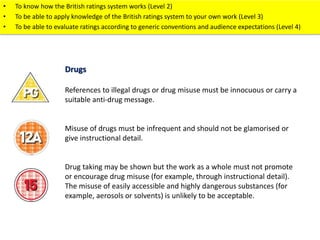
Drugs 
References to illegal drugs or drug misuse must be innocuous or carry a 
suitable anti-drug message. 
Misuse of drugs must be infrequent and should not be glamorised or 
give instructional detail. 
Drug taking may be shown but the work as a whole must not promote 
or encourage drug misuse (for example, through instructional detail). 
The misuse of easily accessible and highly dangerous substances (for 
example, aerosols or solvents) is unlikely to be acceptable.
• To know how the British ratings system works (Level 2) 
• To be able to apply knowledge of the British ratings system to your own work (Level 3) 
• To be able to evaluate ratings according to generic conventions and audience expectations (Level 4) 
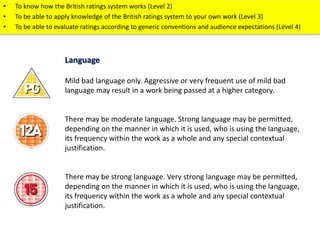
Language 
Mild bad language only. Aggressive or very frequent use of mild bad 
language may result in a work being passed at a higher category. 
There may be moderate language. Strong language may be permitted, 
depending on the manner in which it is used, who is using the language, 
its frequency within the work as a whole and any special contextual 
justification. 
There may be strong language. Very strong language may be permitted, 
depending on the manner in which it is used, who is using the language, 
its frequency within the work as a whole and any special contextual 
justification.
• To know how the British ratings system works (Level 2) 
• To be able to apply knowledge of the British ratings system to your own work (Level 3) 
• To be able to evaluate ratings according to generic conventions and audience expectations (Level 4)
• To know how the British ratings system works (Level 2) 
• To be able to apply knowledge of the British ratings system to your own work (Level 3) 
• To be able to evaluate ratings according to generic conventions and audience expectations (Level 4) 
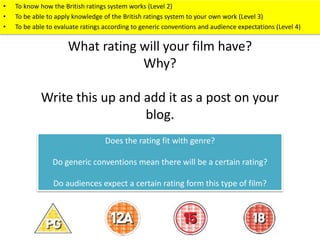
What rating will your film have? 
Why? 
Write this up and add it as a post on your 
blog. 
Does the rating fit with genre? 
Do generic conventions mean there will be a certain rating? 
Do audiences expect a certain rating form this type of film?

Ratings and Audience

  • 1.
    Who are theBBFC? What do they do?
  • 2.
    Learning Objectives: •To know how the British ratings system works (Level 2) • To be able to apply knowledge of the British ratings system to your own work (Level 3) • To be able to evaluate ratings according to generic conventions and audience expectations (Level 4)
  • 3.
    • To knowhow the British ratings system works (Level 2) • To be able to apply knowledge of the British ratings system to your own work (Level 3) • To be able to evaluate ratings according to generic conventions and audience expectations (Level 4) In your groups, sort the slips into their correct classifications and groups. Each of the above classifications has guidelines for the following topics: • Behaviour • Violence • Threat • Drugs • Language
  • 4.
    • To knowhow the British ratings system works (Level 2) • To be able to apply knowledge of the British ratings system to your own work (Level 3) • To be able to evaluate ratings according to generic conventions and audience expectations (Level 4) Violence Violence will usually be mild. However there may be moderate violence, without detail, if justified by its context (for example, history, comedy or fantasy). There may be moderate violence but it should not dwell on detail. There should be no emphasis on injuries or blood, but occasional gory moments may be permitted if justified by the context. Sexual violence may only be implied or briefly and discreetly indicated, and its depiction must be justified by context. Violence may be strong but should not dwell on the infliction of pain or injury. The strongest gory images are unlikely to be acceptable. Strong sadistic violence is also unlikely to be acceptable. There may be detailed verbal references to sexual violence but the depiction of sexual violence must be discreet and justified by context.
  • 5.
    • To knowhow the British ratings system works (Level 2) • To be able to apply knowledge of the British ratings system to your own work (Level 3) • To be able to evaluate ratings according to generic conventions and audience expectations (Level 4) Behaviour No detail of potentially dangerous behaviour which young children are likely to copy, if that behaviour is presented as safe or fun. No glamorisation of realistic or easily accessible weapons such as knives. No focus on anti-social behaviour which young children are likely to copy. No promotion of potentially dangerous behaviour which children are likely to copy. No glamorisation of realistic or easily accessible weapons such as knives. No endorsement of anti-social behaviour. Dangerous behaviour (for example, hanging, suicide and self-harming) should not dwell on detail which could be copied. Whether the depiction of easily accessible weapons is acceptable will depend on factors such as realism, context and setting.
  • 6.
    • To knowhow the British ratings system works (Level 2) • To be able to apply knowledge of the British ratings system to your own work (Level 3) • To be able to evaluate ratings according to generic conventions and audience expectations (Level 4) Threat Frightening sequences or situations where characters are in danger should not be prolonged or intense. Fantasy settings may be a mitigating factor. There may be moderate physical and psychological threat and horror sequences. Although some scenes may be disturbing, the overall tone should not be. Horror sequences should not be frequent or sustained. There may be strong threat and horror. A sustained focus on sadistic or sexual threat is unlikely to be acceptable.
  • 7.
    • To knowhow the British ratings system works (Level 2) • To be able to apply knowledge of the British ratings system to your own work (Level 3) • To be able to evaluate ratings according to generic conventions and audience expectations (Level 4) Drugs References to illegal drugs or drug misuse must be innocuous or carry a suitable anti-drug message. Misuse of drugs must be infrequent and should not be glamorised or give instructional detail. Drug taking may be shown but the work as a whole must not promote or encourage drug misuse (for example, through instructional detail). The misuse of easily accessible and highly dangerous substances (for example, aerosols or solvents) is unlikely to be acceptable.
  • 8.
    • To knowhow the British ratings system works (Level 2) • To be able to apply knowledge of the British ratings system to your own work (Level 3) • To be able to evaluate ratings according to generic conventions and audience expectations (Level 4) Language Mild bad language only. Aggressive or very frequent use of mild bad language may result in a work being passed at a higher category. There may be moderate language. Strong language may be permitted, depending on the manner in which it is used, who is using the language, its frequency within the work as a whole and any special contextual justification. There may be strong language. Very strong language may be permitted, depending on the manner in which it is used, who is using the language, its frequency within the work as a whole and any special contextual justification.
  • 9.
    • To knowhow the British ratings system works (Level 2) • To be able to apply knowledge of the British ratings system to your own work (Level 3) • To be able to evaluate ratings according to generic conventions and audience expectations (Level 4)
  • 10.
    • To knowhow the British ratings system works (Level 2) • To be able to apply knowledge of the British ratings system to your own work (Level 3) • To be able to evaluate ratings according to generic conventions and audience expectations (Level 4) What rating will your film have? Why? Write this up and add it as a post on your blog. Does the rating fit with genre? Do generic conventions mean there will be a certain rating? Do audiences expect a certain rating form this type of film?