Medical Ethical Dilemmas:  Prenatal Diagnosis and Selective Abortion   Guido de Wert Maastricht University FHML, Dept. Health, Ethics & Society
Outline   Prospective parents at high risk Reproductive options Ethics of genetic counseling Prenatal Diagnosis    selective abortion IVF/Preimplantation Genetic Diagnosis    selective transfer
Reprogenetics:  prospective parents at high risk family history, mainly * Mendelian disorders * Chromosomal disorders result of prenatal screeningtest (combitest, etc.)
Reproductive options Accept risk/’genetic lottery’ Refrain from having children ‘ Avoidance’: Oocyte donation Artificial Insemination Donor sperm Prenatal Diagnosis IVF/Preimplantation Genetic Diagnosis
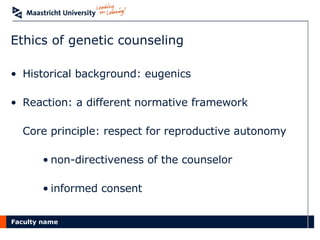
Ethics of genetic counseling Historical background: eugenics Reaction: a different normative framework Core principle: respect for reproductive autonomy non-directiveness of the counselor informed consent
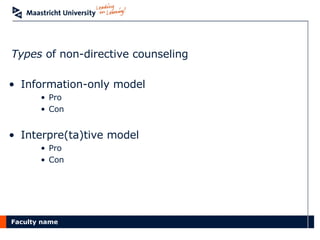
Types  of non-directive counseling   Information-only model Pro Con Interpre(ta)tive model Pro Con
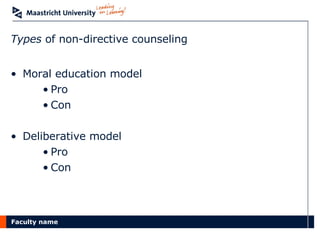
Types  of non-directive counseling Moral education model Pro Con Deliberative model Pro Con
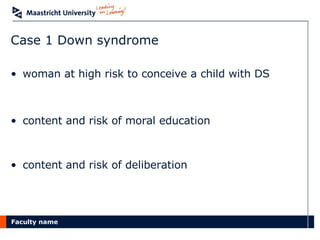
Case 1 Down syndrome woman at high risk to conceive a child with DS content and risk of moral education content and risk of deliberation
Prenatal diagnosis PD ≠ selective abortion What about  conditional  access? * Pros: - paternalism - risk of miscarriage (0.3%) - costs * Cons - reassurance - prepare for birth of affected child - provide optimal neonatal care
Ethics of (selective) abortion Beyond ‘fetalism’: simplistic one-dimensionality The moral point of view: all relevant interests  and values: status of the fetus interests of the future child interests of prospective parents interests of handicapped people
The status of the fetus: eternal dissent 1. the metaphysical concept of a person: what matters  is the ‘radical capacity’.  - fertilisation: ‘conceptionalism’ - individuation (2 weeks) - brain development (6-8 weeks) Implication: abortion is murder, unless (maybe) very early JJ Thomson is right
Thomson The argument: for the sake of debate: fetus is a person … right to life ≠ right to use the woman’s body the latter only if she accepted special responsibility if not: charity, not moral duty Comment: do we have moral duties only towards  people for whom we have voluntarily  assumed a special responsibility?
2. Beyond the metaphysical concept confuses persons - potential persons personhood presumes: presently exercisable abilities most: self-consciousness what about the moral status of  potential  persons? preferences of ‘third parties’ symbolic value the potentiality argument strong version weak version
A moral conflict interests of woman (couple) vs moral status of fetus dominant view/’overlapping consensus’ (Rawls):  relative  status abortion may be ‘the lesser of two evils’ ‘ good reasons’? rape medical indications psychosocial reasons? ‘ nurturance matters’ (Gilligan) condition of the fetus?
The ‘disability rights’ critique Claim: ‘PD/SA is at odds with the rights and interests of people with disabilities’ Arguments include: the ‘expressivist’ argument:  discrimination  denial of equal worth the ‘loss of support’ argument public support will dwindle Comments: no juxtaposition of interests
A moral justification of selective abortion ‘ gesellschaftliche Nutzwert’? social Darwinism the perfect child? prevention of (serious) suffering the child worse off? if not, still a harmful condition the family
The slippery slope structure of the slippery slope argument: - A    B - B is unacceptable, so - don’t accept A 2 variants logical: no sharp boundaries empirical: prediction - evidence?
A detailed list of indications: a useful antidote? pros avoid misuse clarity cons impossible in view of both nature’s diversity (variable expression) and progress in medicine  the moral importance of contextualization adverse societal effects: stigmatization?
The medical model Principle: ‘PD only for risk factors for the particular future child’s health’ Morally relevant variables include: severity of the disorder, taking into account preventive/therapeutic options age of onset of the disease penetrance of the mutation personal situation of the woman/couple
The right to information informed consent the result(s) of the test unexpected findings:  the right not to know medically irrelevant information:  the right to know  * the sex of the fetus
Case: I’ll continue pregnancy only if it’s a girl … couple has 2 sons & indication for karyotyping “ if it’s a boy again, I’ll opt for TOP” what to do? what’s the big fuzz? withhold PD in order to prevent misuse? refer to colleague? inform about sex only in third trimester? legal right to access file limit right to access file? are all pregnant women suspected persons …? ‘ moral education’/deliberative model of counseling?
PD for  late-onset  dirorders: HD as paradigm case Objections (Post) -  child will have many decades of good living - parents are not directly affected ‘ humanist considerations’: suffering is part of life moral ambiguity of perfect child Comments -  high risk of serious disorder - ‘genetic perfectionism’? - prospect of eventual fate imposes severe burden
Case: PD of HD – unconditional access? Couple at-risk requests PD of HD ‘just for reassurance’. Abortion is not a option for moral reasons. Comment understandable – but what about the carrier-child?  harmful knowledge right not to know counseling: ‘moral education’ or directiveness based on professional ethics? couples usually accept a restrictive policy
PGD: early PD PGD =  pars pro toto Includes IVF hormones oocyte pick up biopsy at day 3 PGD  stricto sensu selective transfer    pregnancy?
Possible advantages of PGD High risk of affected child (almost) certainty right from the start avoid psychological burdens of (repeated) selective abortion moral advantage? High risk of miscarriage pregnancy
Categorical objections to PGD? unjustified selection? unjustified biospy? the totipotency argument disproportionally burdensome?
PGD of mutations in breast cancer genes? Case A woman/couple asks for PGD, because several relatives have died from HBOC, and she carries a BRCA1 mutation. After counseling, she/the couple  is even more convinced that PGD is the better option for her/them.
Working Party PGD Relevant considerations: high risk/penetrance: breast cancer 60%-85%, ovarian cancer 20-60% (cfr family history) serious disorder preventive options (periodic exams, preventive surgery) are only partially effective and burdensome  request well-considered respect for reproductive autonomy
Dutch politics: towards a prohibition … Argument: ‘just a risk factor’ Comments  even if incomplete penetrance: still a  high risk of serious disease departure from guidance so far ‘ PD yes, PGD no’?! top-down one-dimensionality Political wisdom: May 26, 2008

Ethical Dilemmas in Abortion

  • 1.
    Medical Ethical Dilemmas: Prenatal Diagnosis and Selective Abortion Guido de Wert Maastricht University FHML, Dept. Health, Ethics & Society
  • 2.
    Outline Prospective parents at high risk Reproductive options Ethics of genetic counseling Prenatal Diagnosis  selective abortion IVF/Preimplantation Genetic Diagnosis  selective transfer
  • 3.
    Reprogenetics: prospectiveparents at high risk family history, mainly * Mendelian disorders * Chromosomal disorders result of prenatal screeningtest (combitest, etc.)
  • 4.
    Reproductive options Acceptrisk/’genetic lottery’ Refrain from having children ‘ Avoidance’: Oocyte donation Artificial Insemination Donor sperm Prenatal Diagnosis IVF/Preimplantation Genetic Diagnosis
  • 5.
    Ethics of geneticcounseling Historical background: eugenics Reaction: a different normative framework Core principle: respect for reproductive autonomy non-directiveness of the counselor informed consent
  • 6.
    Types ofnon-directive counseling Information-only model Pro Con Interpre(ta)tive model Pro Con
  • 7.
    Types ofnon-directive counseling Moral education model Pro Con Deliberative model Pro Con
  • 8.
    Case 1 Downsyndrome woman at high risk to conceive a child with DS content and risk of moral education content and risk of deliberation
  • 9.
    Prenatal diagnosis PD≠ selective abortion What about conditional access? * Pros: - paternalism - risk of miscarriage (0.3%) - costs * Cons - reassurance - prepare for birth of affected child - provide optimal neonatal care
  • 10.
    Ethics of (selective)abortion Beyond ‘fetalism’: simplistic one-dimensionality The moral point of view: all relevant interests and values: status of the fetus interests of the future child interests of prospective parents interests of handicapped people
  • 11.
    The status ofthe fetus: eternal dissent 1. the metaphysical concept of a person: what matters is the ‘radical capacity’. - fertilisation: ‘conceptionalism’ - individuation (2 weeks) - brain development (6-8 weeks) Implication: abortion is murder, unless (maybe) very early JJ Thomson is right
  • 12.
    Thomson The argument:for the sake of debate: fetus is a person … right to life ≠ right to use the woman’s body the latter only if she accepted special responsibility if not: charity, not moral duty Comment: do we have moral duties only towards people for whom we have voluntarily assumed a special responsibility?
  • 13.
    2. Beyond themetaphysical concept confuses persons - potential persons personhood presumes: presently exercisable abilities most: self-consciousness what about the moral status of potential persons? preferences of ‘third parties’ symbolic value the potentiality argument strong version weak version
  • 14.
    A moral conflictinterests of woman (couple) vs moral status of fetus dominant view/’overlapping consensus’ (Rawls): relative status abortion may be ‘the lesser of two evils’ ‘ good reasons’? rape medical indications psychosocial reasons? ‘ nurturance matters’ (Gilligan) condition of the fetus?
  • 15.
    The ‘disability rights’critique Claim: ‘PD/SA is at odds with the rights and interests of people with disabilities’ Arguments include: the ‘expressivist’ argument: discrimination denial of equal worth the ‘loss of support’ argument public support will dwindle Comments: no juxtaposition of interests
  • 16.
    A moral justificationof selective abortion ‘ gesellschaftliche Nutzwert’? social Darwinism the perfect child? prevention of (serious) suffering the child worse off? if not, still a harmful condition the family
  • 17.
    The slippery slopestructure of the slippery slope argument: - A  B - B is unacceptable, so - don’t accept A 2 variants logical: no sharp boundaries empirical: prediction - evidence?
  • 18.
    A detailed listof indications: a useful antidote? pros avoid misuse clarity cons impossible in view of both nature’s diversity (variable expression) and progress in medicine the moral importance of contextualization adverse societal effects: stigmatization?
  • 19.
    The medical modelPrinciple: ‘PD only for risk factors for the particular future child’s health’ Morally relevant variables include: severity of the disorder, taking into account preventive/therapeutic options age of onset of the disease penetrance of the mutation personal situation of the woman/couple
  • 20.
    The right toinformation informed consent the result(s) of the test unexpected findings: the right not to know medically irrelevant information: the right to know * the sex of the fetus
  • 21.
    Case: I’ll continuepregnancy only if it’s a girl … couple has 2 sons & indication for karyotyping “ if it’s a boy again, I’ll opt for TOP” what to do? what’s the big fuzz? withhold PD in order to prevent misuse? refer to colleague? inform about sex only in third trimester? legal right to access file limit right to access file? are all pregnant women suspected persons …? ‘ moral education’/deliberative model of counseling?
  • 22.
    PD for late-onset dirorders: HD as paradigm case Objections (Post) - child will have many decades of good living - parents are not directly affected ‘ humanist considerations’: suffering is part of life moral ambiguity of perfect child Comments - high risk of serious disorder - ‘genetic perfectionism’? - prospect of eventual fate imposes severe burden
  • 23.
    Case: PD ofHD – unconditional access? Couple at-risk requests PD of HD ‘just for reassurance’. Abortion is not a option for moral reasons. Comment understandable – but what about the carrier-child? harmful knowledge right not to know counseling: ‘moral education’ or directiveness based on professional ethics? couples usually accept a restrictive policy
  • 24.
    PGD: early PDPGD = pars pro toto Includes IVF hormones oocyte pick up biopsy at day 3 PGD stricto sensu selective transfer  pregnancy?
  • 25.
    Possible advantages ofPGD High risk of affected child (almost) certainty right from the start avoid psychological burdens of (repeated) selective abortion moral advantage? High risk of miscarriage pregnancy
  • 26.
    Categorical objections toPGD? unjustified selection? unjustified biospy? the totipotency argument disproportionally burdensome?
  • 27.
    PGD of mutationsin breast cancer genes? Case A woman/couple asks for PGD, because several relatives have died from HBOC, and she carries a BRCA1 mutation. After counseling, she/the couple is even more convinced that PGD is the better option for her/them.
  • 28.
    Working Party PGDRelevant considerations: high risk/penetrance: breast cancer 60%-85%, ovarian cancer 20-60% (cfr family history) serious disorder preventive options (periodic exams, preventive surgery) are only partially effective and burdensome request well-considered respect for reproductive autonomy
  • 29.
    Dutch politics: towardsa prohibition … Argument: ‘just a risk factor’ Comments even if incomplete penetrance: still a high risk of serious disease departure from guidance so far ‘ PD yes, PGD no’?! top-down one-dimensionality Political wisdom: May 26, 2008