hapter
KRISHNA MAE P. BULARON
Educational Management
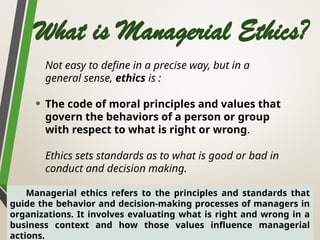
Not easy to define in a precise way, but in a
general sense, ethics is :
• The code of moral principles and values that
govern the behaviors of a person or group
with respect to what is right or wrong.
Ethics sets standards as to what is good or bad in
conduct and decision making.
What is Managerial Ethics?
Managerial ethics refers to the principles and standards that
guide the behavior and decision-making processes of managers in
organizations. It involves evaluating what is right and wrong in a
business context and how those values influence managerial
actions.
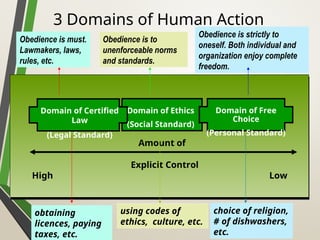
3 Domains of Human Action
Amount of
Explicit Control
High Low
Domain of Certified
Law
(Legal Standard)
Domain of Ethics
(Social Standard)
Domain of Free
Choice
(Personal Standard)
obtaining
licences, paying
taxes, etc.
choice of religion,
# of dishwashers,
etc.
Obedience is must.
Lawmakers, laws,
rules, etc.
Obedience is strictly to
oneself. Both individual and
organization enjoy complete
freedom.
Obedience is to
unenforceable norms
and standards.
using codes of
ethics, culture, etc.
Ethical Dilemma
• This is a situation that arises when all alternative
choices or behaviors have been deemed undesirable.
• Potentially negative ethical results, making it hard to
separate right from wrong.
If ethical standards are not codified,
disagreements and dilemmas about proper
behaviour will occur.
Ethical Dilemma
• The individual who must make an ethical choice in an
organization is the moral agent.
Consider the dilemmas facing a moral agent in the
situation:
A top employee at your small company tells you he
needs some time off because he has AIDS. You know the
employee needs the job as well as the health insurance
benefits. Providing health insurance benefits has already
stretched the company’s budget, and this will send
premiums through the roof. You recently read of a case in
which federal courts upheld the right of an employee to
modify health plans by putting a cap on AIDS benefits.
Should you investigate whether this is a legal possibility
for your company?
Criteria For
Ethical Decision Making
• Most ethical dilemmas involve
A conflict between needs of the part & whole
The individual versus the organization
The organization versus society as a whole
Four Considerations (Ethical
Concepts) In Ethical Decision
Making
• Utilitarian Approach
• Individualism Approach
• Moral-Rights Approach
• Justice Approach
Managers faced with these kinds of tough
ethical choices often benefit from a normative
approach (based on norms and values) to guide
their decision making.
Utilitarian Approach
“Moral behavior produces the greatest good for the
greatest number”
Under this approach, a decision maker is expected to
consider the effect of each decision alternative on all
parties and select the one that optimizes the
satisfaction for the greatest number of people.
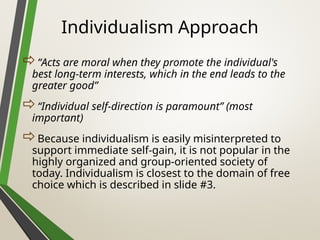
Individualism Approach
“Acts are moral when they promote the individual's
best long-term interests, which in the end leads to the
greater good”
“Individual self-direction is paramount” (most
important)
Because individualism is easily misinterpreted to
support immediate self-gain, it is not popular in the
highly organized and group-oriented society of
today. Individualism is closest to the domain of free
choice which is described in slide #3.
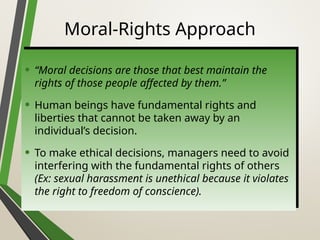
Moral-Rights Approach
• “Moral decisions are those that best maintain the
rights of those people affected by them.”
• Human beings have fundamental rights and
liberties that cannot be taken away by an
individual’s decision.
• To make ethical decisions, managers need to avoid
interfering with the fundamental rights of others
(Ex: sexual harassment is unethical because it violates
the right to freedom of conscience).
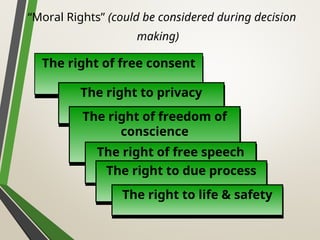
“Moral Rights” (could be considered during decision
making)
The right of free consent
The right to privacy
The right of freedom of
conscience
The right of free speech
The right to due process
The right to life & safety
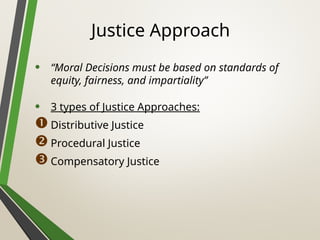
Justice Approach
• “Moral Decisions must be based on standards of
equity, fairness, and impartiality”
• 3 types of Justice Approaches:
Distributive Justice
Procedural Justice
Compensatory Justice
Distributive Justice
• Treatment of people should not be based on
arbitrary characteristics
• People should be treated differently in
proportion to the differences among them
Men & women should not receive different
salaries if they are performing the same job.
However, people who differ in a substantive
way, such as job skills or job responsibility, can
be treated differently in proportion to the
differences in skills or responsibility among
them.
Procedural Justice
• Rules should be clearly stated
• Rules should be consistently and impartially
administered
Compensatory Justice
Individuals should not be held responsible for matters
they have no control over
Individuals should be compensated for the cost of
their injuries by the party responsible
Questions such as how minority workers should be
compensated for past discrimination are not easy.
However, this approach does justify as ethical
behavior efforts to correct past wrongs, playing fair
under the rules and insisting on job-relevant
differences as the basis for different levels of pay.
Most of the laws guiding HRM are based on the
justice approach.
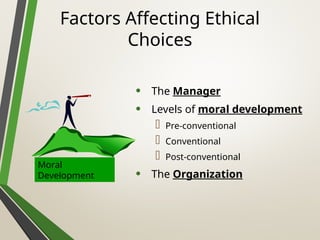
Factors Affecting Ethical
Choices
• The Manager
• Levels of moral development
 Pre-conventional
 Conventional
 Post-conventional
• The Organization
Moral
Development
The Manager
• Managers bring specific personality and behavioral
traits to the job.
• Personal needs, family influence and religious
background all shape a manager’s value system.
• Specific personality characteristics, such as ego
strength, self-confidence and a strong sense of
independence may enable managers to make
ethical decisions.
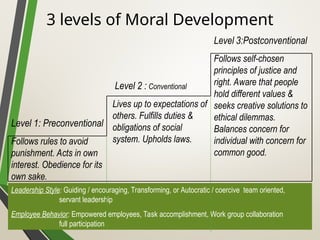
3 levels of Moral Development
Level 1: Preconventional
Follows rules to avoid
punishment. Acts in own
interest. Obedience for its
own sake.
Level 2 : Conventional
Lives up to expectations of
others. Fulfills duties &
obligations of social
system. Upholds laws.
Level 3:Postconventional
Follows self-chosen
principles of justice and
right. Aware that people
hold different values &
seeks creative solutions to
ethical dilemmas.
Balances concern for
individual with concern for
common good.
Leadership Style: Guiding / encouraging, Transforming, or Autocratic / coercive team oriented,
servant leadership
Employee Behavior: Empowered employees, Task accomplishment, Work group collaboration
full participation
The Organization
• In organization, an important influence on ethical behavior
is the norms and the values of the team, department, or
organization as a whole.
• In particular, corporate culture serves to let employees know
what beliefs and behaviors is tolerated or even encouraged.
• Culture is not the only aspect of an organization that
influences ethics, but it is a major force because it defines
company values.
• Other aspects of the organization, such as explicit rules and
policies, the reward system, the extent to which the
company cares for its people, the selection system,
emphasis on legal and professional standards, and
leadership and decision processes, can also have an impact
on ethical values and manager decision making.
Social Responsibility
• “The obligation of organization management to
make decisions and take actions that will
contribute to the welfare and interests of society
and organization”
• Separating right from wrong
• Being a good corporate citizen
Many social responsibilities issues are open to
dispute with respect to right and wrong
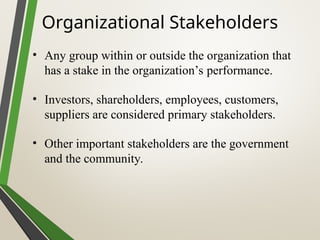
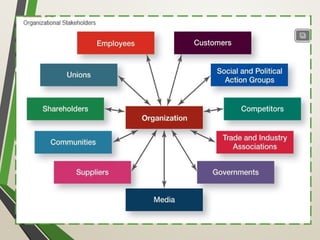
Organizational Stakeholders
• Any group within or outside the organization that
has a stake in the organization’s performance.
• Investors, shareholders, employees, customers,
suppliers are considered primary stakeholders.
• Other important stakeholders are the government
and the community.
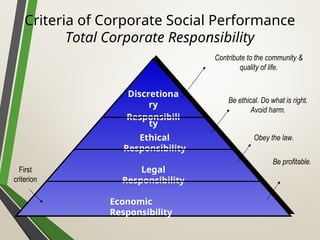
Criteria of Corporate Social Performance
Total Corporate Responsibility
Discretiona
ry
Responsibili
ty
Ethical
Responsibility
Legal
Responsibility
Economic
Responsibility
Contribute to the community &
quality of life.
Be ethical. Do what is right.
Avoid harm.
Obey the law.
Be profitable.
First
criterion
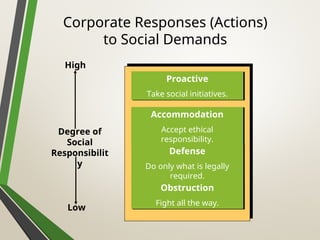
Corporate Responses (Actions)
to Social Demands
Proactive
Take social initiatives.
Accommodation
Accept ethical
responsibility.
Defense
Do only what is legally
required.
Obstruction
Fight all the way.
High
Low
Degree of
Social
Responsibilit
y
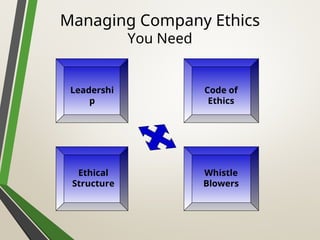
Managing Company Ethics
You Need
Leadershi
p
Ethical
Structure
Code of
Ethics
Whistle
Blowers
Bularon, Krishna Mae P. - Chapter 5- Educational Management.ppt

Bularon, Krishna Mae P. - Chapter 5- Educational Management.ppt

  • 1.
    hapter KRISHNA MAE P.BULARON Educational Management
  • 2.
    Not easy todefine in a precise way, but in a general sense, ethics is : • The code of moral principles and values that govern the behaviors of a person or group with respect to what is right or wrong. Ethics sets standards as to what is good or bad in conduct and decision making. What is Managerial Ethics? Managerial ethics refers to the principles and standards that guide the behavior and decision-making processes of managers in organizations. It involves evaluating what is right and wrong in a business context and how those values influence managerial actions.
  • 3.
    3 Domains ofHuman Action Amount of Explicit Control High Low Domain of Certified Law (Legal Standard) Domain of Ethics (Social Standard) Domain of Free Choice (Personal Standard) obtaining licences, paying taxes, etc. choice of religion, # of dishwashers, etc. Obedience is must. Lawmakers, laws, rules, etc. Obedience is strictly to oneself. Both individual and organization enjoy complete freedom. Obedience is to unenforceable norms and standards. using codes of ethics, culture, etc.
  • 4.
    Ethical Dilemma • Thisis a situation that arises when all alternative choices or behaviors have been deemed undesirable. • Potentially negative ethical results, making it hard to separate right from wrong. If ethical standards are not codified, disagreements and dilemmas about proper behaviour will occur.
  • 5.
    Ethical Dilemma • Theindividual who must make an ethical choice in an organization is the moral agent. Consider the dilemmas facing a moral agent in the situation: A top employee at your small company tells you he needs some time off because he has AIDS. You know the employee needs the job as well as the health insurance benefits. Providing health insurance benefits has already stretched the company’s budget, and this will send premiums through the roof. You recently read of a case in which federal courts upheld the right of an employee to modify health plans by putting a cap on AIDS benefits. Should you investigate whether this is a legal possibility for your company?
  • 6.
    Criteria For Ethical DecisionMaking • Most ethical dilemmas involve A conflict between needs of the part & whole The individual versus the organization The organization versus society as a whole
  • 7.
    Four Considerations (Ethical Concepts)In Ethical Decision Making • Utilitarian Approach • Individualism Approach • Moral-Rights Approach • Justice Approach Managers faced with these kinds of tough ethical choices often benefit from a normative approach (based on norms and values) to guide their decision making.
  • 8.
    Utilitarian Approach “Moral behaviorproduces the greatest good for the greatest number” Under this approach, a decision maker is expected to consider the effect of each decision alternative on all parties and select the one that optimizes the satisfaction for the greatest number of people.
  • 9.
    Individualism Approach “Acts aremoral when they promote the individual's best long-term interests, which in the end leads to the greater good” “Individual self-direction is paramount” (most important) Because individualism is easily misinterpreted to support immediate self-gain, it is not popular in the highly organized and group-oriented society of today. Individualism is closest to the domain of free choice which is described in slide #3.
  • 10.
    Moral-Rights Approach • “Moraldecisions are those that best maintain the rights of those people affected by them.” • Human beings have fundamental rights and liberties that cannot be taken away by an individual’s decision. • To make ethical decisions, managers need to avoid interfering with the fundamental rights of others (Ex: sexual harassment is unethical because it violates the right to freedom of conscience).
  • 11.
    “Moral Rights” (couldbe considered during decision making) The right of free consent The right to privacy The right of freedom of conscience The right of free speech The right to due process The right to life & safety
  • 12.
    Justice Approach • “MoralDecisions must be based on standards of equity, fairness, and impartiality” • 3 types of Justice Approaches: Distributive Justice Procedural Justice Compensatory Justice
  • 13.
    Distributive Justice • Treatmentof people should not be based on arbitrary characteristics • People should be treated differently in proportion to the differences among them Men & women should not receive different salaries if they are performing the same job. However, people who differ in a substantive way, such as job skills or job responsibility, can be treated differently in proportion to the differences in skills or responsibility among them.
  • 14.
    Procedural Justice • Rulesshould be clearly stated • Rules should be consistently and impartially administered
  • 15.
    Compensatory Justice Individuals shouldnot be held responsible for matters they have no control over Individuals should be compensated for the cost of their injuries by the party responsible Questions such as how minority workers should be compensated for past discrimination are not easy. However, this approach does justify as ethical behavior efforts to correct past wrongs, playing fair under the rules and insisting on job-relevant differences as the basis for different levels of pay. Most of the laws guiding HRM are based on the justice approach.
  • 16.
    Factors Affecting Ethical Choices •The Manager • Levels of moral development  Pre-conventional  Conventional  Post-conventional • The Organization Moral Development
  • 17.
    The Manager • Managersbring specific personality and behavioral traits to the job. • Personal needs, family influence and religious background all shape a manager’s value system. • Specific personality characteristics, such as ego strength, self-confidence and a strong sense of independence may enable managers to make ethical decisions.
  • 18.
    3 levels ofMoral Development Level 1: Preconventional Follows rules to avoid punishment. Acts in own interest. Obedience for its own sake. Level 2 : Conventional Lives up to expectations of others. Fulfills duties & obligations of social system. Upholds laws. Level 3:Postconventional Follows self-chosen principles of justice and right. Aware that people hold different values & seeks creative solutions to ethical dilemmas. Balances concern for individual with concern for common good. Leadership Style: Guiding / encouraging, Transforming, or Autocratic / coercive team oriented, servant leadership Employee Behavior: Empowered employees, Task accomplishment, Work group collaboration full participation
  • 19.
    The Organization • Inorganization, an important influence on ethical behavior is the norms and the values of the team, department, or organization as a whole. • In particular, corporate culture serves to let employees know what beliefs and behaviors is tolerated or even encouraged. • Culture is not the only aspect of an organization that influences ethics, but it is a major force because it defines company values. • Other aspects of the organization, such as explicit rules and policies, the reward system, the extent to which the company cares for its people, the selection system, emphasis on legal and professional standards, and leadership and decision processes, can also have an impact on ethical values and manager decision making.
  • 20.
    Social Responsibility • “Theobligation of organization management to make decisions and take actions that will contribute to the welfare and interests of society and organization” • Separating right from wrong • Being a good corporate citizen Many social responsibilities issues are open to dispute with respect to right and wrong
  • 21.
    Organizational Stakeholders • Anygroup within or outside the organization that has a stake in the organization’s performance. • Investors, shareholders, employees, customers, suppliers are considered primary stakeholders. • Other important stakeholders are the government and the community.
  • 23.
    Criteria of CorporateSocial Performance Total Corporate Responsibility Discretiona ry Responsibili ty Ethical Responsibility Legal Responsibility Economic Responsibility Contribute to the community & quality of life. Be ethical. Do what is right. Avoid harm. Obey the law. Be profitable. First criterion
  • 24.
    Corporate Responses (Actions) toSocial Demands Proactive Take social initiatives. Accommodation Accept ethical responsibility. Defense Do only what is legally required. Obstruction Fight all the way. High Low Degree of Social Responsibilit y
  • 26.
    Managing Company Ethics YouNeed Leadershi p Ethical Structure Code of Ethics Whistle Blowers

Editor's Notes

  • #4 An ethical dilemma (ethical paradox or moral dilemma) is a problem in the decision-making process between two possible options, neither of which is absolutely acceptable from an ethical perspective.
  • #5 "Isang pangunahing empleyado sa iyong maliit na kumpanya ang nagsabi sa iyo na kailangan niya ng pahinga dahil siya ay may AIDS. Alam mo na kailangan ng empleyado ang trabaho pati na rin ang mga benepisyo ng health insurance. Ang pagbibigay ng mga benepisyo sa health insurance ay nakaabot na sa hangganan ng badyet ng kumpanya, at ito ay magdudulot ng malaking pagtaas sa mga premium. Kamakailan lamang ay nakabasa ka ng isang kaso kung saan pinanatili ng mga pederal na hukuman ang karapatan ng isang empleyado na baguhin ang mga plano sa kalusugan sa pamamagitan ng paglalagay ng limitasyon sa mga benepisyo para sa AIDS. Dapat mo bang siyasatin kung ito ay isang legal na posibilidad para sa iyong kumpanya?"
  • #11 THE RIGHT OF FREE CONSENT : individuals are to be treated only as they knowingly and freely consent to be treated. THE RIGHT TO PRIVACY : individuals can choose to do as they please away from work and have control of information about their private life. THE RIGHT OF FREEDOM OF CONSCIENCE : individuals may refrain from carrying out any order that violates their moral or religious norms. THE RIGHT OF FREE SPEECH : individuals may criticize truthfully the ethics or legality of actions of others. THE RIGHT TO DUE PROCESS : individuals have a right to an impartial hearing and fair treatment. THE RIGHT TO LIFE AND SAFETY : individuals have a right to live without endangerment or violation of their health and safety.
  • #23 Discretionary : isteğe bağlı
  • #24 Corporate Social Responsibility (CSR) is commonly defined as a business model in which companies integrate social and environmental concerns in their business operations and interactions with their stakeholders instead of only considering economic profits.
  • #26 Code of ethics: A formal statement of the organization’s values regarding ethics and social issues. Ethical structure: The various systems, positions and programs a company can undertake to implement ethical behavior. Whistle-blowing: The disclosure by an employee of illegal, immoral or illegitimate practices by the organization.