ETHICS, STAKEHOLDERS AND CORPORATE
SOCIAL RESPONSIBILITY
Students should be able to:
 Grasp the meaning and sources of ethics and business
ethics
 Differentiate between ethical and unethical behaviour
 Explore basic ethical issues and the concept of ethical
dilemma
 Examine how ethical behaviour in organisations can be
ensured
 Grasp the stakeholder concept, the stakeholders (their
interests and power)
 Evaluate the corporate social responsibility concept
Every decision a manager takes impacts on members of
the society in which they operate.
Society expects businesses to be good corporate citizens
in all respects.
The way managers view their responsibility to society is
central to ethics, social responsibility and organisational
performance.
Ethics is difficult to define in a precise way.
Ethics is the code of moral principles and values that
govern the behaviour of a person or group with respect to
what is right or wrong (Daft & Marcic, 2001)
Set of standards of conduct and moral judgement that
helps people to determine right and wrong behaviours
(Bohlander et al., 2001)
Ethical Behaviour- behaviour that conforms to principles
of morality or rules of conduct, which are generally
accepted in society.
Unethical Behaviour- behaviour that violates generally
accepted principles of morality and values in society.
Ethical issue is a situation, problem or an opportunity in
which an individual must choose among several
alternatives on the basis of the prevailing ethical standards
or values of the firm and the society in which the firm
operates.
Some of the ethical issues faced by managers include:
Fairness and honesty
Conflict of interest
Communication and advertisement
Organisational relationship with stakeholders
Difficulty to determine exactly what is or is not ethical.
An ethical dilemma is a situation that arises when all
alternative choices or behaviours have been deemed
undesirable because of potential negative ethical
consequences, making it difficult for one to distinguish
right from wrong (Daft & Marcic, 2001).
Jim, a fifty-six year old middle manager with
children in college, discovers that the owners of
his company are cheating the government out
of several thousand dollars a year in taxes. Jim
is the only employee who would be in position
to know this. Should Jim report the owners to
Internal Revenue Service at the risk of
endangering his own livelihood, or should he
disregard the discovery in order to protect his
family’s livelihood?
Bob has done a sound job for over a year. Bob’s
boss learns that he got the job by claiming to
have a college degree, although in reality he
never graduated. Should his boss dismiss him
for submitting a fraudulent resume or overlook
the false claim since Bob has otherwise proven
to be conscientious and honourable, and since
making an issue of the degree might ruin Bob’s
career?
Ethical standard is a principle, rule or value that guides
individuals and groups in deciding what is right or wrong.
It is a guideline for business conduct.
Usually determines what ethical behaviour is.
 Apportioning harms and benefits among stakeholders is a major
consideration for making ethical decisions.
Grover Starlings (1980), has identified four standards for guiding
management in making ethical decisions:
 The utilitarian approach (altruism): an action or behaviour is ethical
only when it produces the greatest benefit for the greatest number of
stakeholders.
 The individualism approach (egoism): It defines acceptable
behaviour as one which maximises the individual decision maker’s
long term interests.
◦ The assumption underlying this approach is that if everyone does the
same thing, the well-being of society as a whole would increase.
 The procedural justice approach (obligation to formal
principles): contends that a given behaviour is moral only
when that behaviour is based on standards of equity,
fairness and impartiality.
 The moral rights approach (protection of fundamental
human rights): focuses on the rights of people.
◦ According to the approach, people have fundamental rights and
liberties that one can not overlook by his or her decision.
◦ If a decision will interfere with the fundamental human rights of
the people involved, then such a decision is unethical and must be
avoided.
Managerial ethics are the standards of behaviour that guide individual
managers in decision-making, and determining appropriate responses to
situations they encounter.
Managers make decisions based on the generally accepted norms of
stakeholders, in trying to avoid unethical behaviours.
 Gareth et al. (2000) propose questions a manager must answer:
1. Does my decision fall within the accepted values or standards that
typically apply in the organisational environment?
2. Am I willing to see the decision communicated to all stakeholders
affected by it. For example, having it reported in newspapers or on
television?
3. Would the people with whom I have significant personal relationship,
such as family members, friends, or even managers in other
organisations approve of the decision?
There are three basic areas:
i. Firm’s relationship to the employee
ii. Employee’s relationship to the firm
iii. Firm’s relationship to other economic agents in the
environment
Managers are required to approach each of these
relationships from an ethical perspective.
The relationship of the firm to the Employees
 Most frequently tested area.
 Some ethical issues:
Hiring and firing
Wages and working conditions
Privacy and respect
The relationship of the employees to the firm
Most common issues:
Conflict of interest
Honesty
Secrecy and confidentiality
The relationship of the firm and the environment
Some of these economic agents include customers, competitors, suppliers,
stockholders, unions and physical environment
Individuals’ ethics are formed through a combination of
factors.
Gareth et al. (2000) state these factors as:
1. Family influence
2. Peer influence
3. Lifetime experience
4. Basic moral values
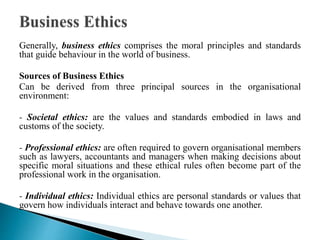
Generally, business ethics comprises the moral principles and standards
that guide behaviour in the world of business.
Sources of Business Ethics
Can be derived from three principal sources in the organisational
environment:
- Societal ethics: are the values and standards embodied in laws and
customs of the society.
- Professional ethics: are often required to govern organisational members
such as lawyers, accountants and managers when making decisions about
specific moral situations and these ethical rules often become part of the
professional work in the organisation.
- Individual ethics: Individual ethics are personal standards or values that
govern how individuals interact and behave towards one another.
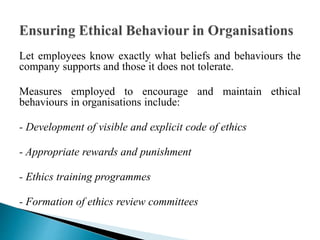
Let employees know exactly what beliefs and behaviours the
company supports and those it does not tolerate.
Measures employed to encourage and maintain ethical
behaviours in organisations include:
- Development of visible and explicit code of ethics
- Appropriate rewards and punishment
- Ethics training programmes
- Formation of ethics review committees
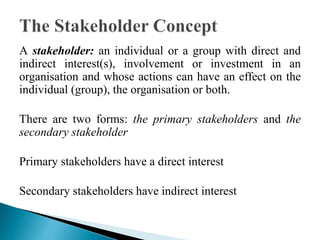
A stakeholder: an individual or a group with direct and
indirect interest(s), involvement or investment in an
organisation and whose actions can have an effect on the
individual (group), the organisation or both.
There are two forms: the primary stakeholders and the
secondary stakeholder
Primary stakeholders have a direct interest
Secondary stakeholders have indirect interest
Primary stakeholders have interest and power
They include:
 Shareholders/owners/investors
 Employees
 Customers
 Suppliers
Secondary stakeholders also have interest and power
They include:
 The community
 The government and her regulatory agencies
 The media
 Competitors
 Employee unions
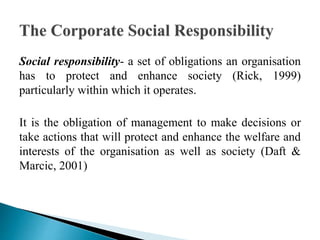
Social responsibility- a set of obligations an organisation
has to protect and enhance society (Rick, 1999)
particularly within which it operates.
It is the obligation of management to make decisions or
take actions that will protect and enhance the welfare and
interests of the organisation as well as society (Daft &
Marcic, 2001)
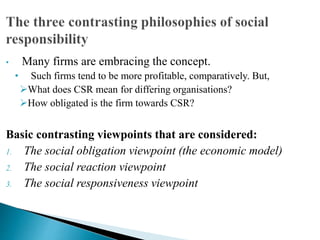
• Many firms are embracing the concept.
• Such firms tend to be more profitable, comparatively. But,
What does CSR mean for differing organisations?
How obligated is the firm towards CSR?
Basic contrasting viewpoints that are considered:
1. The social obligation viewpoint (the economic model)
2. The social reaction viewpoint
3. The social responsiveness viewpoint
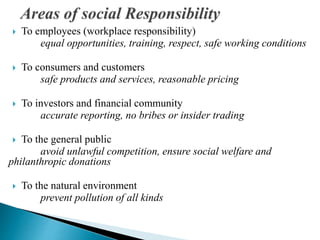
 To employees (workplace responsibility)
equal opportunities, training, respect, safe working conditions
 To consumers and customers
safe products and services, reasonable pricing
 To investors and financial community
accurate reporting, no bribes or insider trading
 To the general public
avoid unlawful competition, ensure social welfare and
philanthropic donations
 To the natural environment
prevent pollution of all kinds
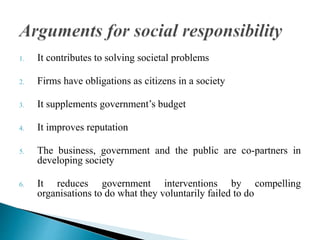
1. It contributes to solving societal problems
2. Firms have obligations as citizens in a society
3. It supplements government’s budget
4. It improves reputation
5. The business, government and the public are co-partners in
developing society
6. It reduces government interventions by compelling
organisations to do what they voluntarily failed to do
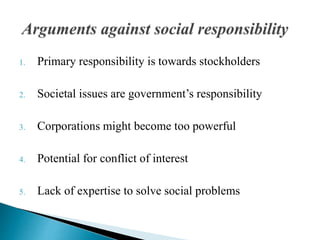
1. Primary responsibility is towards stockholders
2. Societal issues are government’s responsibility
3. Corporations might become too powerful
4. Potential for conflict of interest
5. Lack of expertise to solve social problems
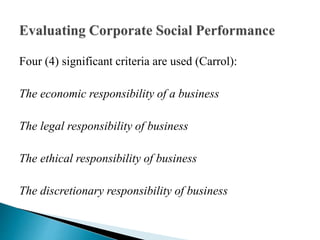
Four (4) significant criteria are used (Carrol):
The economic responsibility of a business
The legal responsibility of business
The ethical responsibility of business
The discretionary responsibility of business
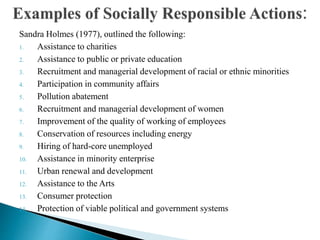
Sandra Holmes (1977), outlined the following:
1. Assistance to charities
2. Assistance to public or private education
3. Recruitment and managerial development of racial or ethnic minorities
4. Participation in community affairs
5. Pollution abatement
6. Recruitment and managerial development of women
7. Improvement of the quality of working of employees
8. Conservation of resources including energy
9. Hiring of hard-core unemployed
10. Assistance in minority enterprise
11. Urban renewal and development
12. Assistance to the Arts
13. Consumer protection
14. Protection of viable political and government systems
END

1614773486609_LECTURE FOUR.pptx

  • 1.
    ETHICS, STAKEHOLDERS ANDCORPORATE SOCIAL RESPONSIBILITY
  • 2.
    Students should beable to:  Grasp the meaning and sources of ethics and business ethics  Differentiate between ethical and unethical behaviour  Explore basic ethical issues and the concept of ethical dilemma  Examine how ethical behaviour in organisations can be ensured  Grasp the stakeholder concept, the stakeholders (their interests and power)  Evaluate the corporate social responsibility concept
  • 3.
    Every decision amanager takes impacts on members of the society in which they operate. Society expects businesses to be good corporate citizens in all respects. The way managers view their responsibility to society is central to ethics, social responsibility and organisational performance.
  • 4.
    Ethics is difficultto define in a precise way. Ethics is the code of moral principles and values that govern the behaviour of a person or group with respect to what is right or wrong (Daft & Marcic, 2001) Set of standards of conduct and moral judgement that helps people to determine right and wrong behaviours (Bohlander et al., 2001)
  • 5.
    Ethical Behaviour- behaviourthat conforms to principles of morality or rules of conduct, which are generally accepted in society. Unethical Behaviour- behaviour that violates generally accepted principles of morality and values in society.
  • 6.
    Ethical issue isa situation, problem or an opportunity in which an individual must choose among several alternatives on the basis of the prevailing ethical standards or values of the firm and the society in which the firm operates. Some of the ethical issues faced by managers include: Fairness and honesty Conflict of interest Communication and advertisement Organisational relationship with stakeholders
  • 7.
    Difficulty to determineexactly what is or is not ethical. An ethical dilemma is a situation that arises when all alternative choices or behaviours have been deemed undesirable because of potential negative ethical consequences, making it difficult for one to distinguish right from wrong (Daft & Marcic, 2001).
  • 8.
    Jim, a fifty-sixyear old middle manager with children in college, discovers that the owners of his company are cheating the government out of several thousand dollars a year in taxes. Jim is the only employee who would be in position to know this. Should Jim report the owners to Internal Revenue Service at the risk of endangering his own livelihood, or should he disregard the discovery in order to protect his family’s livelihood?
  • 9.
    Bob has donea sound job for over a year. Bob’s boss learns that he got the job by claiming to have a college degree, although in reality he never graduated. Should his boss dismiss him for submitting a fraudulent resume or overlook the false claim since Bob has otherwise proven to be conscientious and honourable, and since making an issue of the degree might ruin Bob’s career?
  • 10.
    Ethical standard isa principle, rule or value that guides individuals and groups in deciding what is right or wrong. It is a guideline for business conduct. Usually determines what ethical behaviour is.
  • 11.
     Apportioning harmsand benefits among stakeholders is a major consideration for making ethical decisions. Grover Starlings (1980), has identified four standards for guiding management in making ethical decisions:  The utilitarian approach (altruism): an action or behaviour is ethical only when it produces the greatest benefit for the greatest number of stakeholders.  The individualism approach (egoism): It defines acceptable behaviour as one which maximises the individual decision maker’s long term interests. ◦ The assumption underlying this approach is that if everyone does the same thing, the well-being of society as a whole would increase.
  • 12.
     The proceduraljustice approach (obligation to formal principles): contends that a given behaviour is moral only when that behaviour is based on standards of equity, fairness and impartiality.  The moral rights approach (protection of fundamental human rights): focuses on the rights of people. ◦ According to the approach, people have fundamental rights and liberties that one can not overlook by his or her decision. ◦ If a decision will interfere with the fundamental human rights of the people involved, then such a decision is unethical and must be avoided.
  • 13.
    Managerial ethics arethe standards of behaviour that guide individual managers in decision-making, and determining appropriate responses to situations they encounter. Managers make decisions based on the generally accepted norms of stakeholders, in trying to avoid unethical behaviours.  Gareth et al. (2000) propose questions a manager must answer: 1. Does my decision fall within the accepted values or standards that typically apply in the organisational environment? 2. Am I willing to see the decision communicated to all stakeholders affected by it. For example, having it reported in newspapers or on television? 3. Would the people with whom I have significant personal relationship, such as family members, friends, or even managers in other organisations approve of the decision?
  • 14.
    There are threebasic areas: i. Firm’s relationship to the employee ii. Employee’s relationship to the firm iii. Firm’s relationship to other economic agents in the environment Managers are required to approach each of these relationships from an ethical perspective.
  • 15.
    The relationship ofthe firm to the Employees  Most frequently tested area.  Some ethical issues: Hiring and firing Wages and working conditions Privacy and respect The relationship of the employees to the firm Most common issues: Conflict of interest Honesty Secrecy and confidentiality The relationship of the firm and the environment Some of these economic agents include customers, competitors, suppliers, stockholders, unions and physical environment
  • 16.
    Individuals’ ethics areformed through a combination of factors. Gareth et al. (2000) state these factors as: 1. Family influence 2. Peer influence 3. Lifetime experience 4. Basic moral values
  • 17.
    Generally, business ethicscomprises the moral principles and standards that guide behaviour in the world of business. Sources of Business Ethics Can be derived from three principal sources in the organisational environment: - Societal ethics: are the values and standards embodied in laws and customs of the society. - Professional ethics: are often required to govern organisational members such as lawyers, accountants and managers when making decisions about specific moral situations and these ethical rules often become part of the professional work in the organisation. - Individual ethics: Individual ethics are personal standards or values that govern how individuals interact and behave towards one another.
  • 18.
    Let employees knowexactly what beliefs and behaviours the company supports and those it does not tolerate. Measures employed to encourage and maintain ethical behaviours in organisations include: - Development of visible and explicit code of ethics - Appropriate rewards and punishment - Ethics training programmes - Formation of ethics review committees
  • 19.
    A stakeholder: anindividual or a group with direct and indirect interest(s), involvement or investment in an organisation and whose actions can have an effect on the individual (group), the organisation or both. There are two forms: the primary stakeholders and the secondary stakeholder Primary stakeholders have a direct interest Secondary stakeholders have indirect interest
  • 20.
    Primary stakeholders haveinterest and power They include:  Shareholders/owners/investors  Employees  Customers  Suppliers Secondary stakeholders also have interest and power They include:  The community  The government and her regulatory agencies  The media  Competitors  Employee unions
  • 21.
    Social responsibility- aset of obligations an organisation has to protect and enhance society (Rick, 1999) particularly within which it operates. It is the obligation of management to make decisions or take actions that will protect and enhance the welfare and interests of the organisation as well as society (Daft & Marcic, 2001)
  • 22.
    • Many firmsare embracing the concept. • Such firms tend to be more profitable, comparatively. But, What does CSR mean for differing organisations? How obligated is the firm towards CSR? Basic contrasting viewpoints that are considered: 1. The social obligation viewpoint (the economic model) 2. The social reaction viewpoint 3. The social responsiveness viewpoint
  • 23.
     To employees(workplace responsibility) equal opportunities, training, respect, safe working conditions  To consumers and customers safe products and services, reasonable pricing  To investors and financial community accurate reporting, no bribes or insider trading  To the general public avoid unlawful competition, ensure social welfare and philanthropic donations  To the natural environment prevent pollution of all kinds
  • 24.
    1. It contributesto solving societal problems 2. Firms have obligations as citizens in a society 3. It supplements government’s budget 4. It improves reputation 5. The business, government and the public are co-partners in developing society 6. It reduces government interventions by compelling organisations to do what they voluntarily failed to do
  • 25.
    1. Primary responsibilityis towards stockholders 2. Societal issues are government’s responsibility 3. Corporations might become too powerful 4. Potential for conflict of interest 5. Lack of expertise to solve social problems
  • 26.
    Four (4) significantcriteria are used (Carrol): The economic responsibility of a business The legal responsibility of business The ethical responsibility of business The discretionary responsibility of business
  • 27.
    Sandra Holmes (1977),outlined the following: 1. Assistance to charities 2. Assistance to public or private education 3. Recruitment and managerial development of racial or ethnic minorities 4. Participation in community affairs 5. Pollution abatement 6. Recruitment and managerial development of women 7. Improvement of the quality of working of employees 8. Conservation of resources including energy 9. Hiring of hard-core unemployed 10. Assistance in minority enterprise 11. Urban renewal and development 12. Assistance to the Arts 13. Consumer protection 14. Protection of viable political and government systems
  • 28.