

Galil	
  Mo(on	
  Control	
  
Ma-	
  Klint	
  
Applica(ons	
  Engineer	
  
Galil	
  Mo(on	
  Control	
  
EtherCAT  as  a  Master  Machine  Control  Tool
q  This webinar will be available afterwards at
www.designworldonline.com & email
q  Q&A at the end of the presentation
q  Hashtag for this webinar: #DWwebinar
Before We Start
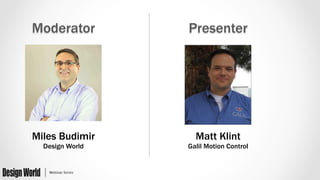
Moderator Presenter
Miles Budimir
Design World
Matt Klint
Galil Motion Control
Agenda	
  
•  Galil  Motion  Control	
•  About	
•  Introduction  to  EtherCAT	
•  Origins	
•  Communication  Format	
•  Ethernet  vs.  EtherCAT	
•  Hardware  and  Physical  Layout	
•  Galil’s  DMC-­‐‑500x0  EtherCAT  Master	
•  Features	
•  Configuration  and  Setup	
•  Setup  Example	
•  Summary	
•  Cost  and  advantages  of  an  EtherCAT  control  network	
•  Q&A
About	
  Galil	
  
Established  Reputation  and  long  History  of  Success	
•  Founded  in  1983  by  Dr.  Jacob  Tal  and  Wayne  Baron	
•  Introduced  the  1st  microprocessor  based  servo  controller	
•  Profitable  for  over  119  consecutive  quarters	
•  Over  750,000  motion  controllers  and  PLCs  delivered	
	
Excellent  Engineering  Support  and  Service	
•  Worldwide  network  of  factory  trained  reps  &  distributors	
•  Support  team  with  over  100  years  combined  motion  control  experience	
•  Online  support  tools  at  www.galil.com
Communica(on	
  Protocols	
  
•  Standardization allows cross platform integration
•  Easily attainable infrastructure lowers costs
•  Modular Design
•  Modules are easily replaceable
•  Additional modules can be added as needed
•  Wide market with dozens of vendors per type
•  Galil was the first to introduce TCP/IP communication to motion control, since then it
has become the most widely used communication protocol in the industry
EtherCAT	
  Origins	
  
Ethernet  for  Control  Automation  Technology	
•  Invented  by  Beckhoff  Automation  in  2003	
•  Ethernet based fieldbus, optimized for industrial automation control
•  Based on CANOpen, a device profile for embedded systems used in
automation
•  Standards defined and maintained by the EtherCAT Technology Group
(ECTG)
EtherCAT	
  and	
  Ethernet	
  
•  Ethernet	
•  Designed  to  move  large  amounts  of  data  through  many  different  nodes	
•  Able  to  route  data  to  and  from  billions  of  separate  addresses  allowing  communication  across  vast  
networks	
•  Large  overhead  involved  in  encapsulating,  routing  and  formaXing  data	
•  Software  handles  extraction  and  processing  of  data	
	
•  EtherCAT	
•  Uses  standard  Ethernet  hardware,  CAT5  cabling  and  Network  Interface  Cards  (NIC)	
•  Streamlines  Ethernet  communication  at  the  hardware  level	
•  Data  processing  on  slave  devices  is  handled  “on  the  fly”  via  FPGA  or  ASIC,  minimizing  latency	
•  Initial  setup  and  configuration  required
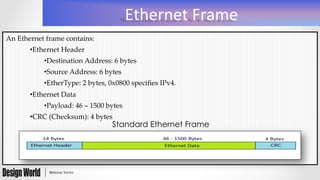
Ethernet	
  Frame	
  
An  Ethernet  frame  contains:	
• Ethernet  Header	
• Destination  Address:  6  bytes	
• Source  Address:  6  bytes	
• EtherType:  2  bytes,  0x0800  specifies  IPv4.  	
• Ethernet  Data	
• Payload:  46  –  1500  bytes	
• CRC  (Checksum):  4  bytes	
Standard Ethernet Frame
EtherCAT	
  Frame	
  
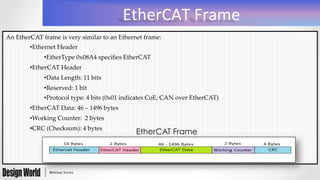
An  EtherCAT  frame  is  very  similar  to  an  Ethernet  frame:	
• Ethernet  Header	
• EtherType  0x08A4  specifies  EtherCAT	
• EtherCAT  Header	
• Data  Length:  11  bits	
• Reserved:  1  bit	
• Protocol  type:  4  bits  (0x01  indicates  CoE,  CAN  over  EtherCAT)	
• EtherCAT  Data:  46  –  1496  bytes	
• Working  Counter:    2  bytes	
• CRC  (Checksum):  4  bytes	
	
	
EtherCAT Frame
EtherCAT	
  Communica(on	
  
•  Each  drive  on  the  network  has  a  unique  address,  set  by  hardware	
•  Master/Slave  configuration  with  the  EtherCAT  Master  sending  and  requesting  data  
from  the  Slave	
•  Data  not  addressed  to  a  particular  slave  are  forwarded  along  to  the  network	
•  Minimal  processing  time  can  provide  cycle  update  rates  of  up  to  32kHz	
•  Network  physical  layout  is  limited  only  by  the  allowable  lengths  of  CAT5  Ethernet  
cable,  up  to  100  m	
•  Increased  noise  immunity  due  to  reliance  on  Ethernet  physical  components
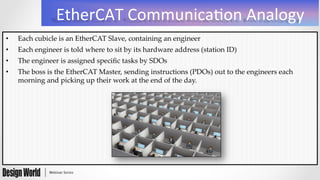
•  Each  cubicle  is  an  EtherCAT  Slave,  containing  an  engineer	
•  Each  engineer  is  told  where  to  sit  by  its  hardware  address  (station  ID)	
•  The  engineer  is  assigned  specific  tasks  by  SDOs	
•  The  boss  is  the  EtherCAT  Master,  sending  instructions  (PDOs)  out  to  the  engineers  each  
morning  and  picking  up  their  work  at  the  end  of  the  day.	
EtherCAT	
  Communica(on	
  Analogy	
  
•  Profile  Position	
Master  sends  position  commands  to  the  Slave,  slave  handles  profiling  parameters	
•    Profile  Velocity	
Master  sends  velocity  commands  to  the  Slave,  slave  handles  profiling  parameters	
•  Profile  Torque	
Master  sends  torque  commands  to  the  Slave,  slave  handles  profiling  parameters	
•  Cyclic  Position	
Position  is  continuously  updated  by  the  master,  master  handles  profiling  parameters	
•  Cyclic  Velocity	
Speed  is  continuously  updated  by  the  master,  master  handles  profiling  parameters	
•  Cyclic  Torque	
Torque  is  continuously  updated  by  the  master,  master  handles  profiling  parameters	
EtherCAT	
  Opera(on	
  Modes	
  
•  Can  be  any  software  and  or  hardware  configured  to  assemble,  send  and  
receive  EtherCAT  datagrams	
•  Requires  only  standard  Ethernet  physical  layer  components  for  
communication	
•  Facilitates  coordination  between  EtherCAT  slaves,  writing  and  
receiving  data  from  each  slave  in  an  EtherCAT  frame	
•  In  motion  control  applications,  the  relevant  data  sent  to  the  drives  are  
profiling  data	
•  The  data  requested  are  position  and  input  status	
	
EtherCAT	
  Master	
  
•  Reads  and  processes  profiling  data	
•  Writes  position,  input  and  drive  status  for  return  to  the  master	
•  Can  be  configured  for  multiple  modes  of  operation	
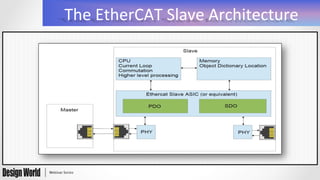
•  All  slaves  contain  specific  spaces  in  memory  where  data  can  be  wriXen	
•  These  spaces  are  called  Objects,  the  entire  memory  space  is  called  the  Object  
Dictionary	
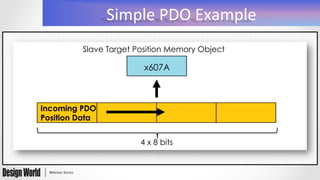
•  Each  object  has  it’s  own  address,  specified  as  an  index/sub  index	
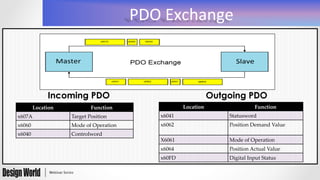
•  Example,  operation  mode  data  from  the  Master  is  wriXen  to  the  x6060  Object  in  
the  slave’s  dictionary,  position  commands  are  wriXen  to  the  x607A  Object	
EtherCAT	
  Slave	
  
SDOs	
  and	
  PDOs	
  
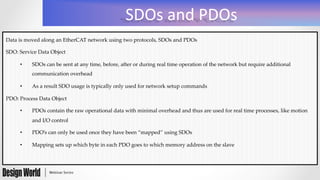
Data  is  moved  along  an  EtherCAT  network  using  two  protocols,  SDOs  and  PDOs	
SDO:  Service  Data  Object	
•  SDOs  can  be  sent  at  any  time,  before,  after  or  during  real  time  operation  of  the  network  but  require  additional  
communication  overhead	
•  As  a  result  SDO  usage  is  typically  only  used  for  network  setup  commands	
PDO:  Process  Data  Object	
•  PDOs  contain  the  raw  operational  data  with  minimal  overhead  and  thus  are  used  for  real  time  processes,  like  motion  
and  I/O  control	
•  PDO’s  can  only  be  used  once  they  have  been  “mapped”  using  SDOs	
•  Mapping  sets  up  which  byte  in  each  PDO  goes  to  which  memory  address  on  the  slave
SDO	
  vs.	
  PDO	
  Summary	
  
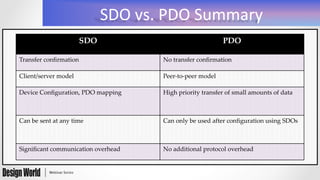
SDO	
 PDO	
Transfer  confirmation	
 No  transfer  confirmation	
Client/server  model	
 Peer-­‐‑to-­‐‑peer  model	
Device  Configuration,  PDO  mapping	
 High  priority  transfer  of  small  amounts  of  data	
Can  be  sent  at  any  time	
 Can  only  be  used  after  configuration  using  SDOs	
Significant  communication  overhead	
 No  additional  protocol  overhead
The	
  EtherCAT	
  Slave	
  State	
  Machine	
  
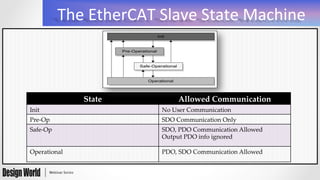
State	
 Allowed  Communication	
Init	
 No  User  Communication	
Pre-­‐‑Op	
 SDO  Communication  Only	
Safe-­‐‑Op	
 SDO,  PDO  Communication  Allowed	
Output  PDO  info  ignored	
Operational	
 PDO,  SDO  Communication  Allowed
The	
  EtherCAT	
  Slave	
  Architecture	
  
Simple	
  PDO	
  Example	
  
Incoming PDO
Position Data
Slave Target Position Memory Object
4 x 8 bits
x607A
PDO	
  Exchange	
  
Location	
 Function	
x607A	
 Target  Position	
x6060	
 Mode  of  Operation	
x6040	
 Controlword	
Location	
 Function	
x6041	
 Statusword	
x6062	
 Position  Demand  Value	
X6061	
 Mode  of  Operation	
x6064	
 Position  Actual  Value	
x60FD	
 Digital  Input  Status	
Outgoing PDOIncoming PDO
EtherCAT	
  Hardware	
  
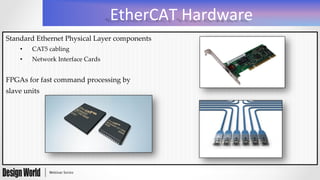
Standard  Ethernet  Physical  Layer  components	
•  CAT5  cabling	
•  Network  Interface  Cards	
	
FPGAs  for  fast  command  processing  by  	
slave  units
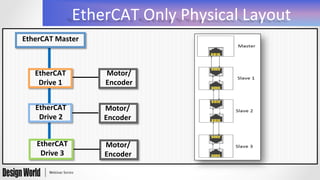
EtherCAT	
  Only	
  Physical	
  Layout	
  
EtherCAT	
  Master	
  
EtherCAT	
  
Drive	
  1	


EtherCAT	
  
Drive	
  2	


EtherCAT	
  
Drive	
  3	


Motor/	
  
Encoder	


Motor/	
  
Encoder	


Motor/	
  
Encoder	


The	
  DMC-­‐500x0	
  EtherCAT	
  Master	
  
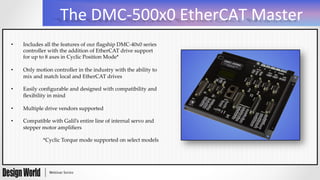
•  Includes  all  the  features  of  our  flagship  DMC-­‐‑40x0  series  
controller  with  the  addition  of  EtherCAT  drive  support  
for  up  to  8  axes  in  Cyclic  Position  Mode*  
	
•  Only  motion  controller  in  the  industry  with  the  ability  to  
mix  and  match  local  and  EtherCAT  drives  
	
•  Easily  configurable  and  designed  with  compatibility  and  
flexibility  in  mind  
	
•  Multiple  drive  vendors  supported  
	
•  Compatible  with  Galil’s  entire  line  of  internal  servo  and  
stepper  motor  amplifiers	
	
*Cyclic  Torque  mode  supported  on  select  models
The	
  DMC-­‐500x0	
  EtherCAT	
  Master	
  
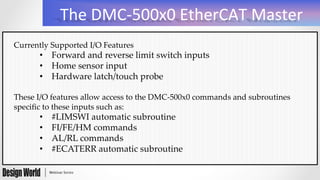
Currently  Supported  I/O  Features	
•  Forward  and  reverse  limit  switch  inputs	
•  Home  sensor  input	
•  Hardware  latch/touch  probe	
These  I/O  features  allow  access  to  the  DMC-­‐‑500x0  commands  and  subroutines  
specific  to  these  inputs  such  as:	
•  #LIMSWI  automatic  subroutine	
•  FI/FE/HM  commands	
•  AL/RL  commands	
•  #ECATERR  automatic  subroutine
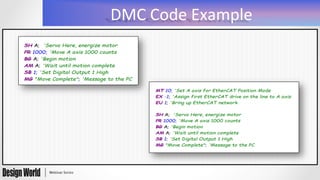
DMC	
  Code	
  Example	
  
DMC-­‐500x0	
  Hardware	
  Layout	
  
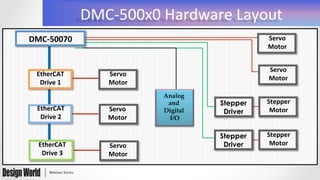
DMC-­‐50070	
  
EtherCAT	
  
Drive	
  1	


EtherCAT	
  
Drive	
  2	


EtherCAT	
  
Drive	
  3	


Servo	
  
Motor	
  
Servo	
  
Motor	
  
Servo	
  
Motor	
  
Analog  	
and  	
Digital  	
I/O	
Stepper	
  
Motor	
  
Servo	
  
Motor	
  
Servo	
  
Motor	
  
Stepper	
  
Motor	


Stepper
Driver
Stepper
Driver
Compa(ble	
  EtherCAT	
  Drives	
  
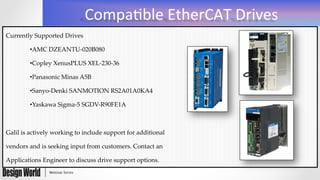
Currently  Supported  Drives	
• AMC  DZEANTU-­‐‑020B080	
• Copley  XenusPLUS  XEL-­‐‑230-­‐‑36	
• Panasonic  Minas  A5B	
• Sanyo-­‐‑Denki  SANMOTION  RS2A01A0KA4	
• Yaskawa  Sigma-­‐‑5  SGDV-­‐‑R90FE1A	
	
Galil  is  actively  working  to  include  support  for  additional  	
vendors  and  is  seeking  input  from  customers.  Contact  an  	
Applications  Engineer  to  discuss  drive  support  options.
Summary	
  
•  The  EtherCAT  protocol  is  gaining  traction  as  a  robust  and  efficient  solution  to  
demanding,  large  scale  automation  applications	
•  Built  on  the  Physical  and  Data  Link  layers  of  Ethernet  communication,  making  the  
technology  more  accessible  right  off  the  bat	
•  Higher  controller/drive  cost  is  offset  by  the  use  of  pre  existing,  easily  aXainable  
hardware	
•  Due  to  the  EtherCAT  communication  protocol,  networks  are  easily  expandable,  
modifiable  and  simple  to  maintain
Questions?
Miles Budimir
Design World
mbudimir@wtwhmedia.com
Twitter: @DW_Motion
Matt Klint
Galil Motion Control
mattk@galilmc.com
Galil Applications
Engineering Team
1 (916) 626-0101
support@galil.com
www.galil.com
Thank You
q  This webinar will be available at
designworldonline.com & email
q  Tweet with hashtag #DWwebinar
q  Connect with Design World
q  Discuss this on EngineeringExchange.com

EtherCAT as a Master Machine Control Tool

  • 1.
    Galil  Mo(on  Control   Ma-  Klint   Applica(ons  Engineer   Galil  Mo(on  Control   EtherCAT  as  a  Master  Machine  Control  Tool
  • 2.
    q  This webinarwill be available afterwards at www.designworldonline.com & email q  Q&A at the end of the presentation q  Hashtag for this webinar: #DWwebinar Before We Start
  • 3.
    Moderator Presenter Miles Budimir DesignWorld Matt Klint Galil Motion Control
  • 4.
    Agenda   •  Galil Motion  Control •  About •  Introduction  to  EtherCAT •  Origins •  Communication  Format •  Ethernet  vs.  EtherCAT •  Hardware  and  Physical  Layout •  Galil’s  DMC-­‐‑500x0  EtherCAT  Master •  Features •  Configuration  and  Setup •  Setup  Example •  Summary •  Cost  and  advantages  of  an  EtherCAT  control  network •  Q&A
  • 5.
    About  Galil   Established Reputation  and  long  History  of  Success •  Founded  in  1983  by  Dr.  Jacob  Tal  and  Wayne  Baron •  Introduced  the  1st  microprocessor  based  servo  controller •  Profitable  for  over  119  consecutive  quarters •  Over  750,000  motion  controllers  and  PLCs  delivered Excellent  Engineering  Support  and  Service •  Worldwide  network  of  factory  trained  reps  &  distributors •  Support  team  with  over  100  years  combined  motion  control  experience •  Online  support  tools  at  www.galil.com
  • 6.
    Communica(on  Protocols   • Standardization allows cross platform integration •  Easily attainable infrastructure lowers costs •  Modular Design •  Modules are easily replaceable •  Additional modules can be added as needed •  Wide market with dozens of vendors per type •  Galil was the first to introduce TCP/IP communication to motion control, since then it has become the most widely used communication protocol in the industry
  • 7.
    EtherCAT  Origins   Ethernet for  Control  Automation  Technology •  Invented  by  Beckhoff  Automation  in  2003 •  Ethernet based fieldbus, optimized for industrial automation control •  Based on CANOpen, a device profile for embedded systems used in automation •  Standards defined and maintained by the EtherCAT Technology Group (ECTG)
  • 8.
    EtherCAT  and  Ethernet   •  Ethernet •  Designed  to  move  large  amounts  of  data  through  many  different  nodes •  Able  to  route  data  to  and  from  billions  of  separate  addresses  allowing  communication  across  vast   networks •  Large  overhead  involved  in  encapsulating,  routing  and  formaXing  data •  Software  handles  extraction  and  processing  of  data •  EtherCAT •  Uses  standard  Ethernet  hardware,  CAT5  cabling  and  Network  Interface  Cards  (NIC) •  Streamlines  Ethernet  communication  at  the  hardware  level •  Data  processing  on  slave  devices  is  handled  “on  the  fly”  via  FPGA  or  ASIC,  minimizing  latency •  Initial  setup  and  configuration  required
  • 9.
    Ethernet  Frame   An Ethernet  frame  contains: • Ethernet  Header • Destination  Address:  6  bytes • Source  Address:  6  bytes • EtherType:  2  bytes,  0x0800  specifies  IPv4.   • Ethernet  Data • Payload:  46  –  1500  bytes • CRC  (Checksum):  4  bytes Standard Ethernet Frame
  • 10.
    EtherCAT  Frame   An EtherCAT  frame  is  very  similar  to  an  Ethernet  frame: • Ethernet  Header • EtherType  0x08A4  specifies  EtherCAT • EtherCAT  Header • Data  Length:  11  bits • Reserved:  1  bit • Protocol  type:  4  bits  (0x01  indicates  CoE,  CAN  over  EtherCAT) • EtherCAT  Data:  46  –  1496  bytes • Working  Counter:    2  bytes • CRC  (Checksum):  4  bytes EtherCAT Frame
  • 11.
    EtherCAT  Communica(on   • Each  drive  on  the  network  has  a  unique  address,  set  by  hardware •  Master/Slave  configuration  with  the  EtherCAT  Master  sending  and  requesting  data   from  the  Slave •  Data  not  addressed  to  a  particular  slave  are  forwarded  along  to  the  network •  Minimal  processing  time  can  provide  cycle  update  rates  of  up  to  32kHz •  Network  physical  layout  is  limited  only  by  the  allowable  lengths  of  CAT5  Ethernet   cable,  up  to  100  m •  Increased  noise  immunity  due  to  reliance  on  Ethernet  physical  components
  • 12.
    •  Each  cubicle is  an  EtherCAT  Slave,  containing  an  engineer •  Each  engineer  is  told  where  to  sit  by  its  hardware  address  (station  ID) •  The  engineer  is  assigned  specific  tasks  by  SDOs •  The  boss  is  the  EtherCAT  Master,  sending  instructions  (PDOs)  out  to  the  engineers  each   morning  and  picking  up  their  work  at  the  end  of  the  day. EtherCAT  Communica(on  Analogy  
  • 13.
    •  Profile  Position Master sends  position  commands  to  the  Slave,  slave  handles  profiling  parameters •   Profile  Velocity Master  sends  velocity  commands  to  the  Slave,  slave  handles  profiling  parameters •  Profile  Torque Master  sends  torque  commands  to  the  Slave,  slave  handles  profiling  parameters •  Cyclic  Position Position  is  continuously  updated  by  the  master,  master  handles  profiling  parameters •  Cyclic  Velocity Speed  is  continuously  updated  by  the  master,  master  handles  profiling  parameters •  Cyclic  Torque Torque  is  continuously  updated  by  the  master,  master  handles  profiling  parameters EtherCAT  Opera(on  Modes  
  • 14.
    •  Can  be any  software  and  or  hardware  configured  to  assemble,  send  and   receive  EtherCAT  datagrams •  Requires  only  standard  Ethernet  physical  layer  components  for   communication •  Facilitates  coordination  between  EtherCAT  slaves,  writing  and   receiving  data  from  each  slave  in  an  EtherCAT  frame •  In  motion  control  applications,  the  relevant  data  sent  to  the  drives  are   profiling  data •  The  data  requested  are  position  and  input  status EtherCAT  Master  
  • 15.
    •  Reads  and processes  profiling  data •  Writes  position,  input  and  drive  status  for  return  to  the  master •  Can  be  configured  for  multiple  modes  of  operation •  All  slaves  contain  specific  spaces  in  memory  where  data  can  be  wriXen •  These  spaces  are  called  Objects,  the  entire  memory  space  is  called  the  Object   Dictionary •  Each  object  has  it’s  own  address,  specified  as  an  index/sub  index •  Example,  operation  mode  data  from  the  Master  is  wriXen  to  the  x6060  Object  in   the  slave’s  dictionary,  position  commands  are  wriXen  to  the  x607A  Object EtherCAT  Slave  
  • 16.
    SDOs  and  PDOs   Data  is  moved  along  an  EtherCAT  network  using  two  protocols,  SDOs  and  PDOs SDO:  Service  Data  Object •  SDOs  can  be  sent  at  any  time,  before,  after  or  during  real  time  operation  of  the  network  but  require  additional   communication  overhead •  As  a  result  SDO  usage  is  typically  only  used  for  network  setup  commands PDO:  Process  Data  Object •  PDOs  contain  the  raw  operational  data  with  minimal  overhead  and  thus  are  used  for  real  time  processes,  like  motion   and  I/O  control •  PDO’s  can  only  be  used  once  they  have  been  “mapped”  using  SDOs •  Mapping  sets  up  which  byte  in  each  PDO  goes  to  which  memory  address  on  the  slave
  • 17.
    SDO  vs.  PDO  Summary   SDO PDO Transfer  confirmation No  transfer  confirmation Client/server  model Peer-­‐‑to-­‐‑peer  model Device  Configuration,  PDO  mapping High  priority  transfer  of  small  amounts  of  data Can  be  sent  at  any  time Can  only  be  used  after  configuration  using  SDOs Significant  communication  overhead No  additional  protocol  overhead
  • 18.
    The  EtherCAT  Slave  State  Machine   State Allowed  Communication Init No  User  Communication Pre-­‐‑Op SDO  Communication  Only Safe-­‐‑Op SDO,  PDO  Communication  Allowed Output  PDO  info  ignored Operational PDO,  SDO  Communication  Allowed
  • 19.
    The  EtherCAT  Slave  Architecture  
  • 20.
    Simple  PDO  Example   Incoming PDO Position Data Slave Target Position Memory Object 4 x 8 bits x607A
  • 21.
    PDO  Exchange   Location Function x607A Target  Position x6060 Mode  of  Operation x6040 Controlword Location Function x6041 Statusword x6062 Position  Demand  Value X6061 Mode  of  Operation x6064 Position  Actual  Value x60FD Digital  Input  Status Outgoing PDOIncoming PDO
  • 22.
    EtherCAT  Hardware   Standard Ethernet  Physical  Layer  components •  CAT5  cabling •  Network  Interface  Cards FPGAs  for  fast  command  processing  by   slave  units
  • 23.
    EtherCAT  Only  Physical  Layout   EtherCAT  Master   EtherCAT   Drive  1     EtherCAT   Drive  2     EtherCAT   Drive  3     Motor/   Encoder     Motor/   Encoder     Motor/   Encoder    
  • 24.
    The  DMC-­‐500x0  EtherCAT  Master   •  Includes  all  the  features  of  our  flagship  DMC-­‐‑40x0  series   controller  with  the  addition  of  EtherCAT  drive  support   for  up  to  8  axes  in  Cyclic  Position  Mode*   •  Only  motion  controller  in  the  industry  with  the  ability  to   mix  and  match  local  and  EtherCAT  drives   •  Easily  configurable  and  designed  with  compatibility  and   flexibility  in  mind   •  Multiple  drive  vendors  supported   •  Compatible  with  Galil’s  entire  line  of  internal  servo  and   stepper  motor  amplifiers *Cyclic  Torque  mode  supported  on  select  models
  • 25.
    The  DMC-­‐500x0  EtherCAT  Master   Currently  Supported  I/O  Features •  Forward  and  reverse  limit  switch  inputs •  Home  sensor  input •  Hardware  latch/touch  probe These  I/O  features  allow  access  to  the  DMC-­‐‑500x0  commands  and  subroutines   specific  to  these  inputs  such  as: •  #LIMSWI  automatic  subroutine •  FI/FE/HM  commands •  AL/RL  commands •  #ECATERR  automatic  subroutine
  • 26.
  • 27.
    DMC-­‐500x0  Hardware  Layout   DMC-­‐50070   EtherCAT   Drive  1     EtherCAT   Drive  2     EtherCAT   Drive  3     Servo   Motor   Servo   Motor   Servo   Motor   Analog   and   Digital   I/O Stepper   Motor   Servo   Motor   Servo   Motor   Stepper   Motor     Stepper Driver Stepper Driver
  • 28.
    Compa(ble  EtherCAT  Drives   Currently  Supported  Drives • AMC  DZEANTU-­‐‑020B080 • Copley  XenusPLUS  XEL-­‐‑230-­‐‑36 • Panasonic  Minas  A5B • Sanyo-­‐‑Denki  SANMOTION  RS2A01A0KA4 • Yaskawa  Sigma-­‐‑5  SGDV-­‐‑R90FE1A Galil  is  actively  working  to  include  support  for  additional   vendors  and  is  seeking  input  from  customers.  Contact  an   Applications  Engineer  to  discuss  drive  support  options.
  • 29.
    Summary   •  The EtherCAT  protocol  is  gaining  traction  as  a  robust  and  efficient  solution  to   demanding,  large  scale  automation  applications •  Built  on  the  Physical  and  Data  Link  layers  of  Ethernet  communication,  making  the   technology  more  accessible  right  off  the  bat •  Higher  controller/drive  cost  is  offset  by  the  use  of  pre  existing,  easily  aXainable   hardware •  Due  to  the  EtherCAT  communication  protocol,  networks  are  easily  expandable,   modifiable  and  simple  to  maintain
  • 30.
    Questions? Miles Budimir Design World mbudimir@wtwhmedia.com Twitter:@DW_Motion Matt Klint Galil Motion Control mattk@galilmc.com Galil Applications Engineering Team 1 (916) 626-0101 support@galil.com www.galil.com
  • 31.
    Thank You q  Thiswebinar will be available at designworldonline.com & email q  Tweet with hashtag #DWwebinar q  Connect with Design World q  Discuss this on EngineeringExchange.com