Applied chemistry
Branch of chemistry dealing with application of theories and principles
to practical purposes and use in our life.
Chemical industries
It is the important part of applied chemistry.
It refers to economic development of nation
and helps in making life better and prosperous
Products in chemical industries are of three typed
Basic chemicals
Functional chemicals
Fine chemicals
Basic chemical produced in large volume and purchased
on basis of purity composition and price
Eg fertlizers petrochemical s acid base and salt
Functional chemicals are used in further manufacture
Eg perfumes cosmetics medical raw materials gases
electronic parts
Fine chemicals products changed into different products
by undergoing differebt chemical changes
Unit operation refers to separation of products
obtained from different process
Involves primary treatment like physical changes
Eg crushing griniding
Unit process involves chemical treatment or
biological conversion into different synthesis of
product Eg Oxidation reduction
Importance of chemical industries
In agriculture Eg Fungicides Fertilizers pesticides
In environment Climate change conservation waste
management use of natural sources pollution control
measurments
In hygine or health Eg medicines soap sanitizers
In sunstainable energy source manage waste product
to get energy production
In food salts spicies
In painting and coating
In petrochemicals crude oil natural gas benzene etc
In pharmaceuticals drugs and medicines
In construction carpeting furniture cements
In automobile industy plastics rubber body parts
Stages in producing a new product
Researching a new product
Moving to a pilot studt
Decision to go ahead
Making and selling the product
Review
Researching a new product
Formation of new idea
Collect ideas from external sources and internal
sources from all customers compettitors mangers
salesman
Mainly focus on the current item and
shortcomings
Moving to pilot study
Idea screening
selecting the best idea
Chemical enginers knowledge needed on
designing final plant calculating feed stock
energy cost and size of additional equipment
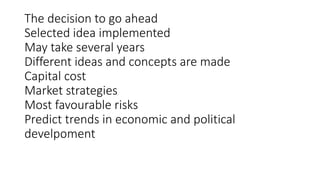
The decision to go ahead
Selected idea implemented
May take several years
Different ideas and concepts are made
Capital cost
Market strategies
Most favourable risks
Predict trends in economic and political
develpoment
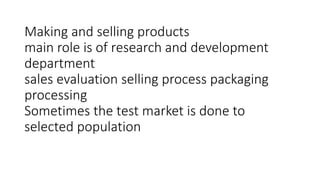
Making and selling products
main role is of research and development
department
sales evaluation selling process packaging
processing
Sometimes the test market is done to
selected population
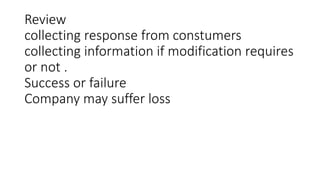
Review
collecting response from constumers
collecting information if modification requires
or not .
Success or failure
Company may suffer loss
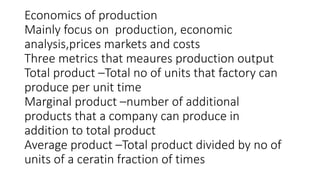
Economics of production
Mainly focus on production, economic
analysis,prices markets and costs
Three metrics that meaures production output
Total product –Total no of units that factory can
produce per unit time
Marginal product –number of additional
products that a company can produce in
addition to total product
Average product –Total product divided by no of
units of a ceratin fraction of times
Economic analysis
Market analysis and selling price-collecting
infromations about industries ,income taxes
compettion, price volume total earning from the
product
Profitability analysis- project cost return on
investment preparation of cost and profit
charts.financial status of indutry
Cost
Fixed cost
Labour , maintenance, safety,laboratory
services managnment depreciation
Variable cost
raw materials energy packaging transportation
licenses patents
Prices
raw materials, manpower energy packaging ,
taxes,supportive services for quality control
,waste management,sustainable energy form.
Cash flow
Raw materials are turned into products by cash over
some time
five stages
Research development(cash flow always neagative)
Production(cash flow should increasing but must not
be positive due to earlier cost paying back))
Growth(if product success sales will grow)
Maturity(cash flow may be negative or positive due
to market pressures)
Decline phase(if patent is about to end there is less
profit and selling declines)
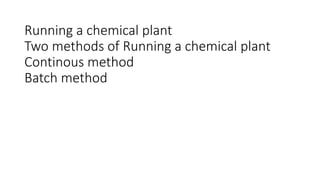
Running a chemical plant
Two methods of Running a chemical plant
Continous method
Batch method
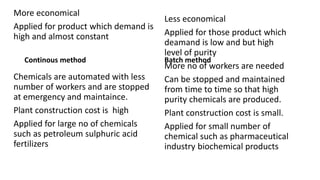
Continous method
More economical
Applied for product which demand is
high and almost constant
Chemicals are automated with less
number of workers and are stopped
at emergency and maintaince.
Plant construction cost is high
Applied for large no of chemicals
such as petroleum sulphuric acid
fertilizers
Batch method
Less economical
Applied for those product which
deamand is low and but high
level of purity
More no of workers are needed
Can be stopped and maintained
from time to time so that high
purity chemicals are produced.
Plant construction cost is small.
Applied for small number of
chemical such as pharmaceutical
industry biochemical products
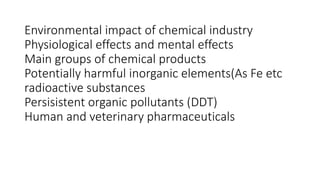
Environmental impact of chemical industry
Physiological effects and mental effects
Main groups of chemical products
Potentially harmful inorganic elements(As Fe etc
radioactive substances
Persisistent organic pollutants (DDT)
Human and veterinary pharmaceuticals

Applied chemistry.pptx

  • 1.
    Applied chemistry Branch ofchemistry dealing with application of theories and principles to practical purposes and use in our life.
  • 2.
    Chemical industries It isthe important part of applied chemistry. It refers to economic development of nation and helps in making life better and prosperous
  • 4.
    Products in chemicalindustries are of three typed Basic chemicals Functional chemicals Fine chemicals Basic chemical produced in large volume and purchased on basis of purity composition and price Eg fertlizers petrochemical s acid base and salt Functional chemicals are used in further manufacture Eg perfumes cosmetics medical raw materials gases electronic parts Fine chemicals products changed into different products by undergoing differebt chemical changes
  • 5.
    Unit operation refersto separation of products obtained from different process Involves primary treatment like physical changes Eg crushing griniding Unit process involves chemical treatment or biological conversion into different synthesis of product Eg Oxidation reduction
  • 6.
    Importance of chemicalindustries In agriculture Eg Fungicides Fertilizers pesticides In environment Climate change conservation waste management use of natural sources pollution control measurments In hygine or health Eg medicines soap sanitizers In sunstainable energy source manage waste product to get energy production In food salts spicies In painting and coating In petrochemicals crude oil natural gas benzene etc In pharmaceuticals drugs and medicines In construction carpeting furniture cements In automobile industy plastics rubber body parts
  • 7.
    Stages in producinga new product Researching a new product Moving to a pilot studt Decision to go ahead Making and selling the product Review
  • 8.
    Researching a newproduct Formation of new idea Collect ideas from external sources and internal sources from all customers compettitors mangers salesman Mainly focus on the current item and shortcomings
  • 9.
    Moving to pilotstudy Idea screening selecting the best idea Chemical enginers knowledge needed on designing final plant calculating feed stock energy cost and size of additional equipment
  • 10.
    The decision togo ahead Selected idea implemented May take several years Different ideas and concepts are made Capital cost Market strategies Most favourable risks Predict trends in economic and political develpoment
  • 11.
    Making and sellingproducts main role is of research and development department sales evaluation selling process packaging processing Sometimes the test market is done to selected population
  • 12.
    Review collecting response fromconstumers collecting information if modification requires or not . Success or failure Company may suffer loss
  • 13.
    Economics of production Mainlyfocus on production, economic analysis,prices markets and costs Three metrics that meaures production output Total product –Total no of units that factory can produce per unit time Marginal product –number of additional products that a company can produce in addition to total product Average product –Total product divided by no of units of a ceratin fraction of times
  • 14.
    Economic analysis Market analysisand selling price-collecting infromations about industries ,income taxes compettion, price volume total earning from the product Profitability analysis- project cost return on investment preparation of cost and profit charts.financial status of indutry
  • 15.
    Cost Fixed cost Labour ,maintenance, safety,laboratory services managnment depreciation Variable cost raw materials energy packaging transportation licenses patents
  • 16.
    Prices raw materials, manpowerenergy packaging , taxes,supportive services for quality control ,waste management,sustainable energy form.
  • 17.
    Cash flow Raw materialsare turned into products by cash over some time five stages Research development(cash flow always neagative) Production(cash flow should increasing but must not be positive due to earlier cost paying back)) Growth(if product success sales will grow) Maturity(cash flow may be negative or positive due to market pressures) Decline phase(if patent is about to end there is less profit and selling declines)
  • 18.
    Running a chemicalplant Two methods of Running a chemical plant Continous method Batch method
  • 19.
    Continous method More economical Appliedfor product which demand is high and almost constant Chemicals are automated with less number of workers and are stopped at emergency and maintaince. Plant construction cost is high Applied for large no of chemicals such as petroleum sulphuric acid fertilizers Batch method Less economical Applied for those product which deamand is low and but high level of purity More no of workers are needed Can be stopped and maintained from time to time so that high purity chemicals are produced. Plant construction cost is small. Applied for small number of chemical such as pharmaceutical industry biochemical products
  • 20.
    Environmental impact ofchemical industry Physiological effects and mental effects Main groups of chemical products Potentially harmful inorganic elements(As Fe etc radioactive substances Persisistent organic pollutants (DDT) Human and veterinary pharmaceuticals