SHWETHA C S &
SHREEVIDYA A S
Ist Mcom
Govt first grade college for
women, Holenarasipura
The energy demand in our country is rising due to an expanding economy, growing
population, increasing urbanization, evolving lifestyles and rising spending power. About
98% of the fuel requirement in the road transportation sector is currently met by fossil
fuels and the remaining 2% by biofuels. Today, India imports 85% of its oil requirement.
The Indian economy is expected to grow steadily despite temporary setbacks due to the
COVID pandemic. This would result in a further increase of vehicular population which in
turn will increase the demand for transportation fuels. Domestic biofuels provide a
strategic opportunity to the country, as they reduce the nation’s dependence on imported
fossil fuels. In addition, when utilized with appropriate care, biofuels can be
environmentally friendly, sustainable energy sources. They can also help generate
employment, promote Make in India, Swachh Bharat, doubling of farmers’ incomes and
promote Waste to Wealth generation.
Vehicle technology
1. E5 [blending 5% Ethanol with 95% gasoline] was notified in 2015 by MoRT&H. The rubber and plastic
components used in gasoline vehicles produced since 2008 are compatible with E10 fuel.
2. E10 [blending 10% Ethanol with 90% gasoline] was notified in 2019 by MoRT&H. The rubber and plastic
components used in gasoline vehicles are currently compatible with E10 fuel.
3. The use of E-85 fuel (85% ethanol by volume) was notified in 2016 for 4 wheeled vehicles, 3 wheelers
and 2 wheelers. E100 [pure ethanol] for use in gasoline vehicles and ED95 [95% ethanol and 5% additives
(co-solvent, corrosion inhibitors and ignition improvers)] for diesel vehicles have also been included in
the same notification. The emission standards of E 85 and E 100 fuels have also been notified.
4. The specifications of E20 as a commercial fuel have been indicated in IS: 17021: 2018 by BIS.
5. The Ministry has notified GSR 156(E) on 8th March 2021 for adoption of mass emission standards for
E20 fuel. The compatibility of a vehicle with the level of ethanol blend of E20 or E85 or E100 or ED95 is
required to be defined by the vehicle manufacturer, and the same is required to be displayed on the
vehicle by putting a clearly visible sticker.
NODAL AGENCY FOR
ETHANOL PRODUCTION
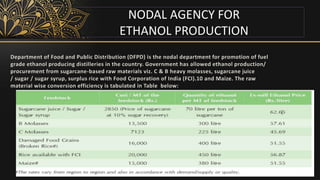
Department of Food and Public Distribution (DFPD) is the nodal department for promotion of fuel
grade ethanol producing distilleries in the country. Government has allowed ethanol production/
procurement from sugarcane-based raw materials viz. C & B heavy molasses, sugarcane juice
/ sugar / sugar syrup, surplus rice with Food Corporation of India (FCI).10 and Maize. The raw
material wise conversion efficiency is tabulated in Table below:
Supply stastics of ethanol
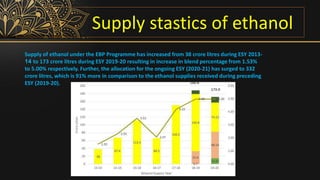
Supply of ethanol under the EBP Programme has increased from 38 crore litres during ESY 2013-
14 to 173 crore litres during ESY 2019-20 resulting in increase in blend percentage from 1.53%
to 5.00% respectively. Further, the allocation for the ongoing ESY (2020-21) has surged to 332
crore litres, which is 91% more in comparison to the ethanol supplies received during preceding
ESY (2019-20).
From the inception of the EBP Programme, various pricing models have been adopted by the government which were
based on the prevailing macro-economic situation of the sugar industry and the oil sector. The ethanol procurement
gained momentum after the introduction of Administered Pricing Mechanism for Ethanol from ESY 2014-15. Prices of
ethanol produced from sugarcane sources is approved by the Cabinet Committee on Economic Affairs (CCEA), while
that from foodgrains is decided by OMCs. Since ESY 2018- 19, Government has introduced a differential pricing policy
wherein higher rates were offered to sugar mills for production of ethanol from B-heavy molasses and sugarcane
juice.
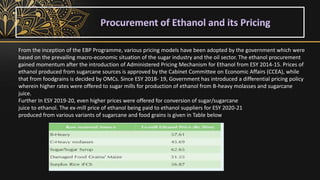
Further In ESY 2019-20, even higher prices were offered for conversion of sugar/sugarcane
juice to ethanol. The ex-mill price of ethanol being paid to ethanol suppliers for ESY 2020-21
produced from various variants of sugarcane and food grains is given in Table below
THANK YOU
This Photo by Unknown
Ethanol  production

Ethanol production

  • 1.
    SHWETHA C S& SHREEVIDYA A S Ist Mcom Govt first grade college for women, Holenarasipura
  • 5.
    The energy demandin our country is rising due to an expanding economy, growing population, increasing urbanization, evolving lifestyles and rising spending power. About 98% of the fuel requirement in the road transportation sector is currently met by fossil fuels and the remaining 2% by biofuels. Today, India imports 85% of its oil requirement. The Indian economy is expected to grow steadily despite temporary setbacks due to the COVID pandemic. This would result in a further increase of vehicular population which in turn will increase the demand for transportation fuels. Domestic biofuels provide a strategic opportunity to the country, as they reduce the nation’s dependence on imported fossil fuels. In addition, when utilized with appropriate care, biofuels can be environmentally friendly, sustainable energy sources. They can also help generate employment, promote Make in India, Swachh Bharat, doubling of farmers’ incomes and promote Waste to Wealth generation.
  • 7.
  • 8.
    1. E5 [blending5% Ethanol with 95% gasoline] was notified in 2015 by MoRT&H. The rubber and plastic components used in gasoline vehicles produced since 2008 are compatible with E10 fuel. 2. E10 [blending 10% Ethanol with 90% gasoline] was notified in 2019 by MoRT&H. The rubber and plastic components used in gasoline vehicles are currently compatible with E10 fuel. 3. The use of E-85 fuel (85% ethanol by volume) was notified in 2016 for 4 wheeled vehicles, 3 wheelers and 2 wheelers. E100 [pure ethanol] for use in gasoline vehicles and ED95 [95% ethanol and 5% additives (co-solvent, corrosion inhibitors and ignition improvers)] for diesel vehicles have also been included in the same notification. The emission standards of E 85 and E 100 fuels have also been notified. 4. The specifications of E20 as a commercial fuel have been indicated in IS: 17021: 2018 by BIS. 5. The Ministry has notified GSR 156(E) on 8th March 2021 for adoption of mass emission standards for E20 fuel. The compatibility of a vehicle with the level of ethanol blend of E20 or E85 or E100 or ED95 is required to be defined by the vehicle manufacturer, and the same is required to be displayed on the vehicle by putting a clearly visible sticker.
  • 9.
    NODAL AGENCY FOR ETHANOLPRODUCTION Department of Food and Public Distribution (DFPD) is the nodal department for promotion of fuel grade ethanol producing distilleries in the country. Government has allowed ethanol production/ procurement from sugarcane-based raw materials viz. C & B heavy molasses, sugarcane juice / sugar / sugar syrup, surplus rice with Food Corporation of India (FCI).10 and Maize. The raw material wise conversion efficiency is tabulated in Table below:
  • 10.
    Supply stastics ofethanol Supply of ethanol under the EBP Programme has increased from 38 crore litres during ESY 2013- 14 to 173 crore litres during ESY 2019-20 resulting in increase in blend percentage from 1.53% to 5.00% respectively. Further, the allocation for the ongoing ESY (2020-21) has surged to 332 crore litres, which is 91% more in comparison to the ethanol supplies received during preceding ESY (2019-20).
  • 12.
    From the inceptionof the EBP Programme, various pricing models have been adopted by the government which were based on the prevailing macro-economic situation of the sugar industry and the oil sector. The ethanol procurement gained momentum after the introduction of Administered Pricing Mechanism for Ethanol from ESY 2014-15. Prices of ethanol produced from sugarcane sources is approved by the Cabinet Committee on Economic Affairs (CCEA), while that from foodgrains is decided by OMCs. Since ESY 2018- 19, Government has introduced a differential pricing policy wherein higher rates were offered to sugar mills for production of ethanol from B-heavy molasses and sugarcane juice. Further In ESY 2019-20, even higher prices were offered for conversion of sugar/sugarcane juice to ethanol. The ex-mill price of ethanol being paid to ethanol suppliers for ESY 2020-21 produced from various variants of sugarcane and food grains is given in Table below
  • 14.