eTextBooks, the OER
        perspective.
Phil Barker              phil.barker@hw.ac.uk
JISC CETIS               @philbarker
Heriot-Watt University
Introduction

         http://www.icbl.hw.ac.uk/~philb/


                 http://jisc.cetis.ac.uk/


                        http://www.jisc.ac.uk/oer/
       UKOER
OER: Definition

Open educational resources can be defined as
‘teaching, learning, and research resources that reside
in the public domain or have been released under an
intellectual property license that permits their free use
and re-purposing by others. Open educational
resources include full courses, course materials,
modules, textbooks, streaming videos, tests, software,
and any other tools, materials, or techniques used to
support access to knowledge.’
   http://www.hewlett.org/programs/education-program/open-educational-resources
OER: Definition
“open educational resources should be freely
shared through open licences which facilitate use,
revision, translation, improvement and sharing by
anyone”
                          Capetown declaration on open education
                             http://www.capetowndeclaration.org
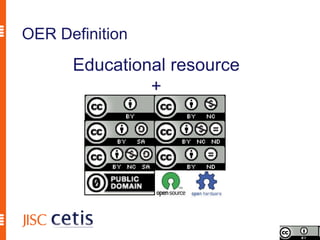
OER Definition
      Educational resource
               +
eTextBooks as Educational Resources

I hope this will be dealt with during the rest of the project

Issue include
• multimedia animations and simulations
• dynamic & adaptive content
• direct linking and embedding
• social connections
• adopt-adapt-improve (remix and republish)

           ...nothing we haven’t spent 15+yrs talking about
eTextBooks as OERs

• Need to avoid assumptions that eTextBook will be
paid-for.
• Need to be able to express CC licences.
• Need technology that permits what is allowed by the
licence (e.g. format that is portable, editable,
disaggregable)
• Desirable that technology supports what is required by
the licence (e.g. keeps attribution when copied / editted)
OER in eTextBooks


• Existing OERs tend to reflect what teachers use in
class: MS Powepoint, Word / Adobe pdf; lecture capture
and recordings; animations & interactive models

• Interest in HTML5 and EPUB

• Not so much emphasis on eLearning technical
standards
Commercial eTextBook content and
OER

PublishOER project
                 http://www.medev.ac.uk/ourwork/oer/publishoer/
What’s in it for publishers?
• Market visibility (=> acknowledgement & tracking)
• Not as OER (=> time limited licence, mixed licences)

Pearson Project Blue Sky
        http://www.pearsonlearningsolutions.com/pearson-bluesky
• OER and paid-for content in commercial “learning
solution”
Licence and attribution
             By Phil Barker <phil.barker@hw.ac.uk>, JISC
             CETIS <http://jisc.cetis.ac.uk>


This work is licensed under the Creative Commons
Attribution 3.0 Unported licence.
To view a copy of this licence, visit
http://creativecommons.org/licenses/by/3.0/ or send a
letter to Creative Commons, 171 Second Street, Suite
300, San Francisco, California 94105, USA.

eTextBooks, the OER perspective

  • 1.
    eTextBooks, the OER perspective. Phil Barker phil.barker@hw.ac.uk JISC CETIS @philbarker Heriot-Watt University
  • 2.
    Introduction http://www.icbl.hw.ac.uk/~philb/ http://jisc.cetis.ac.uk/ http://www.jisc.ac.uk/oer/ UKOER
  • 3.
    OER: Definition Open educationalresources can be defined as ‘teaching, learning, and research resources that reside in the public domain or have been released under an intellectual property license that permits their free use and re-purposing by others. Open educational resources include full courses, course materials, modules, textbooks, streaming videos, tests, software, and any other tools, materials, or techniques used to support access to knowledge.’ http://www.hewlett.org/programs/education-program/open-educational-resources
  • 4.
    OER: Definition “open educationalresources should be freely shared through open licences which facilitate use, revision, translation, improvement and sharing by anyone” Capetown declaration on open education http://www.capetowndeclaration.org
  • 5.
    OER Definition Educational resource +
  • 6.
    eTextBooks as EducationalResources I hope this will be dealt with during the rest of the project Issue include • multimedia animations and simulations • dynamic & adaptive content • direct linking and embedding • social connections • adopt-adapt-improve (remix and republish) ...nothing we haven’t spent 15+yrs talking about
  • 7.
    eTextBooks as OERs •Need to avoid assumptions that eTextBook will be paid-for. • Need to be able to express CC licences. • Need technology that permits what is allowed by the licence (e.g. format that is portable, editable, disaggregable) • Desirable that technology supports what is required by the licence (e.g. keeps attribution when copied / editted)
  • 8.
    OER in eTextBooks •Existing OERs tend to reflect what teachers use in class: MS Powepoint, Word / Adobe pdf; lecture capture and recordings; animations & interactive models • Interest in HTML5 and EPUB • Not so much emphasis on eLearning technical standards
  • 9.
    Commercial eTextBook contentand OER PublishOER project http://www.medev.ac.uk/ourwork/oer/publishoer/ What’s in it for publishers? • Market visibility (=> acknowledgement & tracking) • Not as OER (=> time limited licence, mixed licences) Pearson Project Blue Sky http://www.pearsonlearningsolutions.com/pearson-bluesky • OER and paid-for content in commercial “learning solution”
  • 10.
    Licence and attribution By Phil Barker <phil.barker@hw.ac.uk>, JISC CETIS <http://jisc.cetis.ac.uk> This work is licensed under the Creative Commons Attribution 3.0 Unported licence. To view a copy of this licence, visit http://creativecommons.org/licenses/by/3.0/ or send a letter to Creative Commons, 171 Second Street, Suite 300, San Francisco, California 94105, USA.