Sultan Qaboos University
                     Collage of Education
            Instructional and Learning Technology
        Tech4101 : Distance learning and the internet


PODCASTING-PUBLISHING OF AUDIO VIA THE
              INTERNET

                      Done by:
              Khalfan Al-Shuaili (89193)
              Ayoob Al-Shukaili (90376)
             Submitted to: Dr. Alaa Sadik
1.DEFINE THE TECHNOLOGY
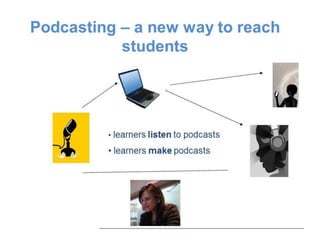
   Podcasting is the name given to the publishing
    of audio (usually mp3 files) via the Internet,
    designed to be downloaded and listened to on a
    portable mp3 player of any type, or on a
    personal computer.
   A series of sound and/or video files that are
    automatically downloaded to a computer and
    portable media device by free subscription
    whenever they are made available
2.OBJECTIVES OF USING THE TECHNOLOGY IN DE


   Supplement lecture material to greater provide
    context and depth
   Different learning preferences: auditory
   Dyslexics; people who face problem in reading
   Students who miss class can keep up with
    material
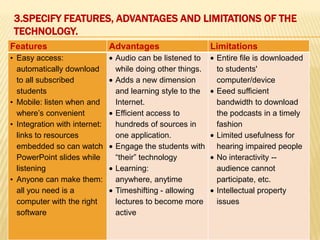
3.SPECIFY FEATURES, ADVANTAGES AND LIMITATIONS OF THE
 TECHNOLOGY.
Features                       Advantages                   Limitations
• Easy access:                  Audio can be listened to     Entire file is downloaded
  automatically download        while doing other things.    to students'
  to all subscribed             Adds a new dimension         computer/device
  students                      and learning style to the    Eeed sufficient
• Mobile: listen when and       Internet.                    bandwidth to download
  where’s convenient            Efficient access to          the podcasts in a timely
• Integration with internet:    hundreds of sources in       fashion
  links to resources            one application.             Limited usefulness for
  embedded so can watch         Engage the students with     hearing impaired people
  PowerPoint slides while       “their” technology           No interactivity --
  listening                     Learning:                    audience cannot
• Anyone can make them:         anywhere, anytime            participate, etc.
  all you need is a             Timeshifting - allowing      Intellectual property
  computer with the right       lectures to become more      issues
  software                      active
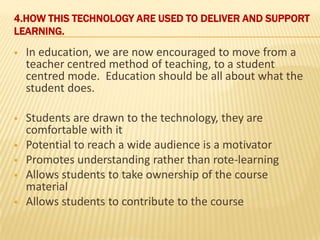
4.HOW THIS TECHNOLOGY ARE USED TO DELIVER AND SUPPORT
LEARNING.
   In education, we are now encouraged to move from a
    teacher centred method of teaching, to a student
    centred mode. Education should be all about what the
    student does.

   Students are drawn to the technology, they are
    comfortable with it
   Potential to reach a wide audience is a motivator
   Promotes understanding rather than rote-learning
   Allows students to take ownership of the course
    material
   Allows students to contribute to the course
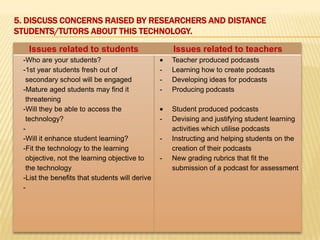
5. DISCUSS CONCERNS RAISED BY RESEARCHERS AND DISTANCE
STUDENTS/TUTORS ABOUT THIS TECHNOLOGY.

   Issues related to students                       Issues related to teachers
 -Who are your students?                            Teacher produced podcasts
 -1st year students fresh out of                -   Learning how to create podcasts
  secondary school will be engaged              -   Developing ideas for podcasts
 -Mature aged students may find it              -   Producing podcasts
  threatening
 -Will they be able to access the                   Student produced podcasts
  technology?                                   -   Devising and justifying student learning
 -                                                  activities which utilise podcasts
 -Will it enhance student learning?             -   Instructing and helping students on the
 -Fit the technology to the learning                creation of their podcasts
  objective, not the learning objective to      -   New grading rubrics that fit the
  the technology                                    submission of a podcast for assessment
 -List the benefits that students will derive
 -
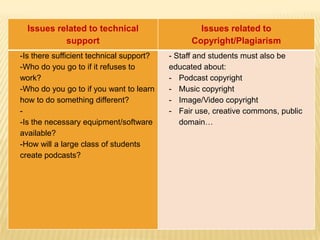
Issues related to technical                     Issues related to
           support                              Copyright/Plagiarism
-Is there sufficient technical support?   - Staff and students must also be
-Who do you go to if it refuses to        educated about:
work?                                     - Podcast copyright
-Who do you go to if you want to learn    - Music copyright
how to do something different?            - Image/Video copyright
-                                         - Fair use, creative commons, public
-Is the necessary equipment/software         domain…
available?
-How will a large class of students
create podcasts?
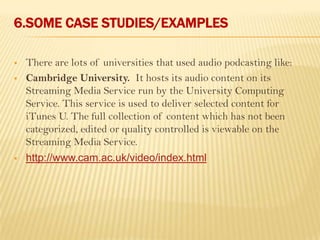
6.SOME CASE STUDIES/EXAMPLES

   There are lots of universities that used audio podcasting like:
   Cambridge University. It hosts its audio content on its
    Streaming Media Service run by the University Computing
    Service. This service is used to deliver selected content for
    iTunes U. The full collection of content which has not been
    categorized, edited or quality controlled is viewable on the
    Streaming Media Service.
   http://www.cam.ac.uk/video/index.html

Podcasting

  • 1.
    Sultan Qaboos University Collage of Education Instructional and Learning Technology Tech4101 : Distance learning and the internet PODCASTING-PUBLISHING OF AUDIO VIA THE INTERNET Done by: Khalfan Al-Shuaili (89193) Ayoob Al-Shukaili (90376) Submitted to: Dr. Alaa Sadik
  • 2.
    1.DEFINE THE TECHNOLOGY  Podcasting is the name given to the publishing of audio (usually mp3 files) via the Internet, designed to be downloaded and listened to on a portable mp3 player of any type, or on a personal computer.  A series of sound and/or video files that are automatically downloaded to a computer and portable media device by free subscription whenever they are made available
  • 4.
    2.OBJECTIVES OF USINGTHE TECHNOLOGY IN DE  Supplement lecture material to greater provide context and depth  Different learning preferences: auditory  Dyslexics; people who face problem in reading  Students who miss class can keep up with material
  • 6.
    3.SPECIFY FEATURES, ADVANTAGESAND LIMITATIONS OF THE TECHNOLOGY. Features Advantages Limitations • Easy access: Audio can be listened to Entire file is downloaded automatically download while doing other things. to students' to all subscribed Adds a new dimension computer/device students and learning style to the Eeed sufficient • Mobile: listen when and Internet. bandwidth to download where’s convenient Efficient access to the podcasts in a timely • Integration with internet: hundreds of sources in fashion links to resources one application. Limited usefulness for embedded so can watch Engage the students with hearing impaired people PowerPoint slides while “their” technology No interactivity -- listening Learning: audience cannot • Anyone can make them: anywhere, anytime participate, etc. all you need is a Timeshifting - allowing Intellectual property computer with the right lectures to become more issues software active
  • 7.
    4.HOW THIS TECHNOLOGYARE USED TO DELIVER AND SUPPORT LEARNING.  In education, we are now encouraged to move from a teacher centred method of teaching, to a student centred mode. Education should be all about what the student does.  Students are drawn to the technology, they are comfortable with it  Potential to reach a wide audience is a motivator  Promotes understanding rather than rote-learning  Allows students to take ownership of the course material  Allows students to contribute to the course
  • 8.
    5. DISCUSS CONCERNSRAISED BY RESEARCHERS AND DISTANCE STUDENTS/TUTORS ABOUT THIS TECHNOLOGY. Issues related to students Issues related to teachers -Who are your students? Teacher produced podcasts -1st year students fresh out of - Learning how to create podcasts secondary school will be engaged - Developing ideas for podcasts -Mature aged students may find it - Producing podcasts threatening -Will they be able to access the Student produced podcasts technology? - Devising and justifying student learning - activities which utilise podcasts -Will it enhance student learning? - Instructing and helping students on the -Fit the technology to the learning creation of their podcasts objective, not the learning objective to - New grading rubrics that fit the the technology submission of a podcast for assessment -List the benefits that students will derive -
  • 9.
    Issues related totechnical Issues related to support Copyright/Plagiarism -Is there sufficient technical support? - Staff and students must also be -Who do you go to if it refuses to educated about: work? - Podcast copyright -Who do you go to if you want to learn - Music copyright how to do something different? - Image/Video copyright - - Fair use, creative commons, public -Is the necessary equipment/software domain… available? -How will a large class of students create podcasts?
  • 10.
    6.SOME CASE STUDIES/EXAMPLES  There are lots of universities that used audio podcasting like:  Cambridge University. It hosts its audio content on its Streaming Media Service run by the University Computing Service. This service is used to deliver selected content for iTunes U. The full collection of content which has not been categorized, edited or quality controlled is viewable on the Streaming Media Service.  http://www.cam.ac.uk/video/index.html