Access, Standards, and Interoperability Digital Repositories for Learning 2009 Vancouver BC Ahrash N Bissell
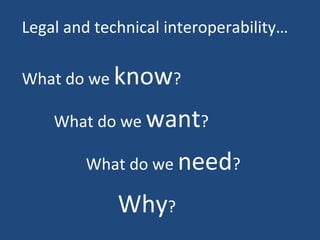
Legal and technical interoperability… What do we  know ? What do we  want ? What do we  need ? Why ?
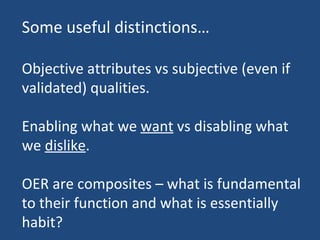
Some useful distinctions… Objective attributes vs subjective (even if validated) qualities. Enabling what we  want  vs disabling what we  dislike . OER are composites – what is fundamental to their function and what is essentially habit?
Text What are Open Edu c ational Resour c es?  Michael Reschke  cba Open Educational Resources (OER) are materials, tools, and media used for teaching and learning that are free from copyright restrictions or publicly licensed for anyone to use, adapt, and redistribute.
Open Educational Resources (OER) are materials, tools, and media used for teaching and learning that are free from copyright restrictions or publicly licensed for anyone to use, adapt, and redistribute.
Open Educational Resources (OER) are  materials, tools, and media used for teaching and learning  that are free from copyright restrictions or publicly licensed for anyone to use, adapt, and redistribute.
Open Educational Resources (OER) are materials, tools, and media used for teaching and learning that are  free from copyright restrictions or publicly licensed  for anyone to use, adapt, and redistribute.
Open Educational Resources (OER) are materials, tools, and media used for teaching and learning that are free from copyright restrictions or publicly licensed for  anyone  to use, adapt, and redistribute.
Open Educational Resources (OER) are materials, tools, and media used for teaching and learning that are free from copyright restrictions or publicly licensed for anyone to  use , adapt, and redistribute.
Open Educational Resources (OER) are materials, tools, and media used for teaching and learning that are free from copyright restrictions or publicly licensed for anyone to use,  adapt , and redistribute.
Open Educational Resources (OER) are materials, tools, and media used for teaching and learning that are free from copyright restrictions or publicly licensed for anyone to use, adapt, and  redistribute .
Some things to think about… Closing the loop – how do we incorporate data from usage into the improvement cycle? Student privacy issues Tying things together K12 vs higher ed What, if any, are the meaningful distinctions? Training and digital literacy What pedagogies depend on (or benefit from) openness? What recognition processes can support their use?
Digital vs analog objects. Lingo challenges – free, online, digital, e-learning, distance learning, etc. How tightly tied are OER to new technologies? How tightly tied should they be? What are our expectations, especially re: re-use and adaptation? Others? Some things to think about…
learn.creativecommons.org Send comments to: ahrash@creativecommons.org

Digital Repositories for Learning Overview Presentation for OpenEd 2009

  • 1.
    Access, Standards, andInteroperability Digital Repositories for Learning 2009 Vancouver BC Ahrash N Bissell
  • 2.
    Legal and technicalinteroperability… What do we know ? What do we want ? What do we need ? Why ?
  • 3.
    Some useful distinctions…Objective attributes vs subjective (even if validated) qualities. Enabling what we want vs disabling what we dislike . OER are composites – what is fundamental to their function and what is essentially habit?
  • 4.
    Text What areOpen Edu c ational Resour c es? Michael Reschke cba Open Educational Resources (OER) are materials, tools, and media used for teaching and learning that are free from copyright restrictions or publicly licensed for anyone to use, adapt, and redistribute.
  • 5.
    Open Educational Resources(OER) are materials, tools, and media used for teaching and learning that are free from copyright restrictions or publicly licensed for anyone to use, adapt, and redistribute.
  • 6.
    Open Educational Resources(OER) are materials, tools, and media used for teaching and learning that are free from copyright restrictions or publicly licensed for anyone to use, adapt, and redistribute.
  • 7.
    Open Educational Resources(OER) are materials, tools, and media used for teaching and learning that are free from copyright restrictions or publicly licensed for anyone to use, adapt, and redistribute.
  • 8.
    Open Educational Resources(OER) are materials, tools, and media used for teaching and learning that are free from copyright restrictions or publicly licensed for anyone to use, adapt, and redistribute.
  • 9.
    Open Educational Resources(OER) are materials, tools, and media used for teaching and learning that are free from copyright restrictions or publicly licensed for anyone to use , adapt, and redistribute.
  • 10.
    Open Educational Resources(OER) are materials, tools, and media used for teaching and learning that are free from copyright restrictions or publicly licensed for anyone to use, adapt , and redistribute.
  • 11.
    Open Educational Resources(OER) are materials, tools, and media used for teaching and learning that are free from copyright restrictions or publicly licensed for anyone to use, adapt, and redistribute .
  • 12.
    Some things tothink about… Closing the loop – how do we incorporate data from usage into the improvement cycle? Student privacy issues Tying things together K12 vs higher ed What, if any, are the meaningful distinctions? Training and digital literacy What pedagogies depend on (or benefit from) openness? What recognition processes can support their use?
  • 13.
    Digital vs analogobjects. Lingo challenges – free, online, digital, e-learning, distance learning, etc. How tightly tied are OER to new technologies? How tightly tied should they be? What are our expectations, especially re: re-use and adaptation? Others? Some things to think about…
  • 14.
    learn.creativecommons.org Send commentsto: ahrash@creativecommons.org