The Other Side of the Interface . or The sound of one hand clapping Phil Barker, philb@icbl.hw.ac.uk
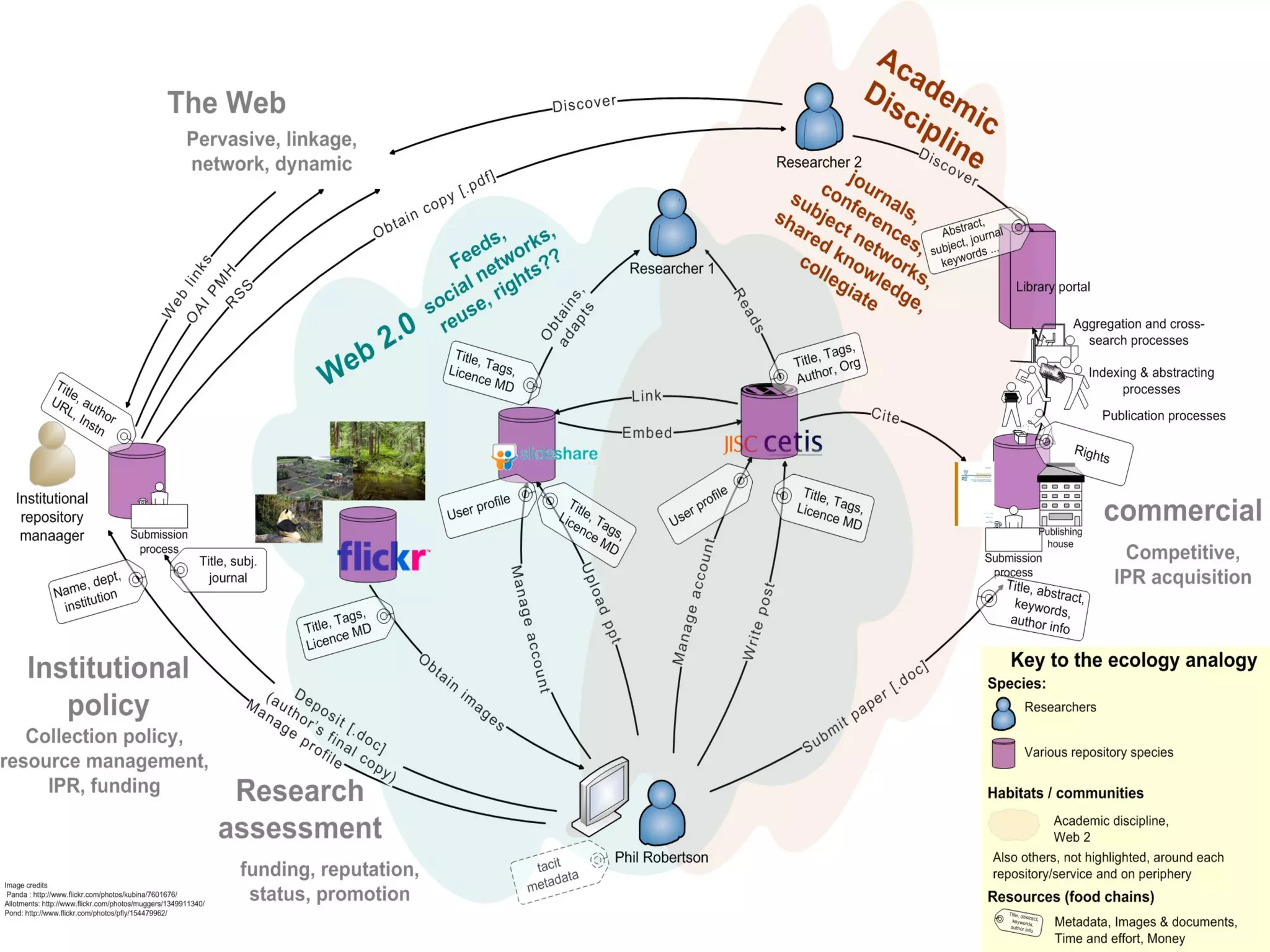
Journal ToCs Place in the Repository Ecosystem Ecology is the study of systems that are complex, dynamic, and full of interacting entities and processes.  …  ecology, and examples of the ecosystems it studies, may offer a useful analogy to inform the task of understanding and articulating the interactions between users, repositories, and services and the information environments in which they take place. http://ie-repository.jisc.ac.uk/272/
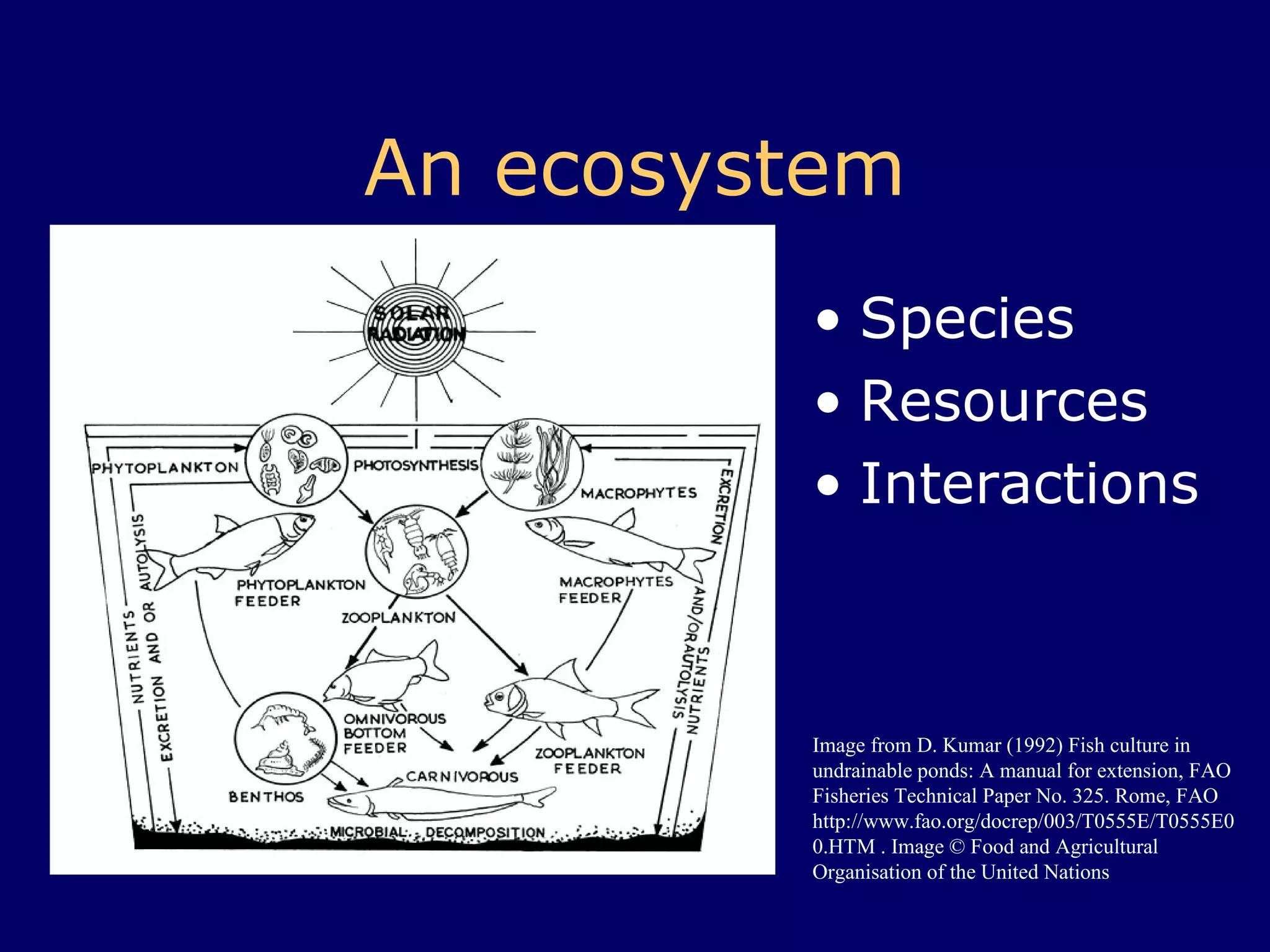
An ecosystem Species Resources Interactions Image from D. Kumar (1992) Fish culture in undrainable ponds: A manual for extension, FAO Fisheries Technical Paper No. 325. Rome, FAO http://www.fao.org/docrep/003/T0555E/T0555E00.HTM . Image © Food and Agricultural  Organisation of the United Nations
A Repository Ecosystem? Species:  Repositories Library services Web services Repository managers Researchers Journal publishers
A Repository Ecosystem? Resources Information resources Journal papers, data, metadata Money Time / attention
A Repository Ecosystem? Interactions Human-Human Human-Machine Machine-Machine:  APIs, RSS Feeds, HTTP
Repository Ecology We can study many aspects of the repository ecosystem One example is  “Metadata in an ecosystem of presentation dissemination”  Robertson, Barker & Mahey,  Proc. Int’l Conf. on Dublin Core and Metadata Applications 2008 http://blogs.cetis.ac.uk/johnr/2008/09/25/metadata-in-an-ecosystem-of-presentation-dissemination/ http:// dcpapers. dublincore .org/ojs/pubs/article/viewFile/938/934
 
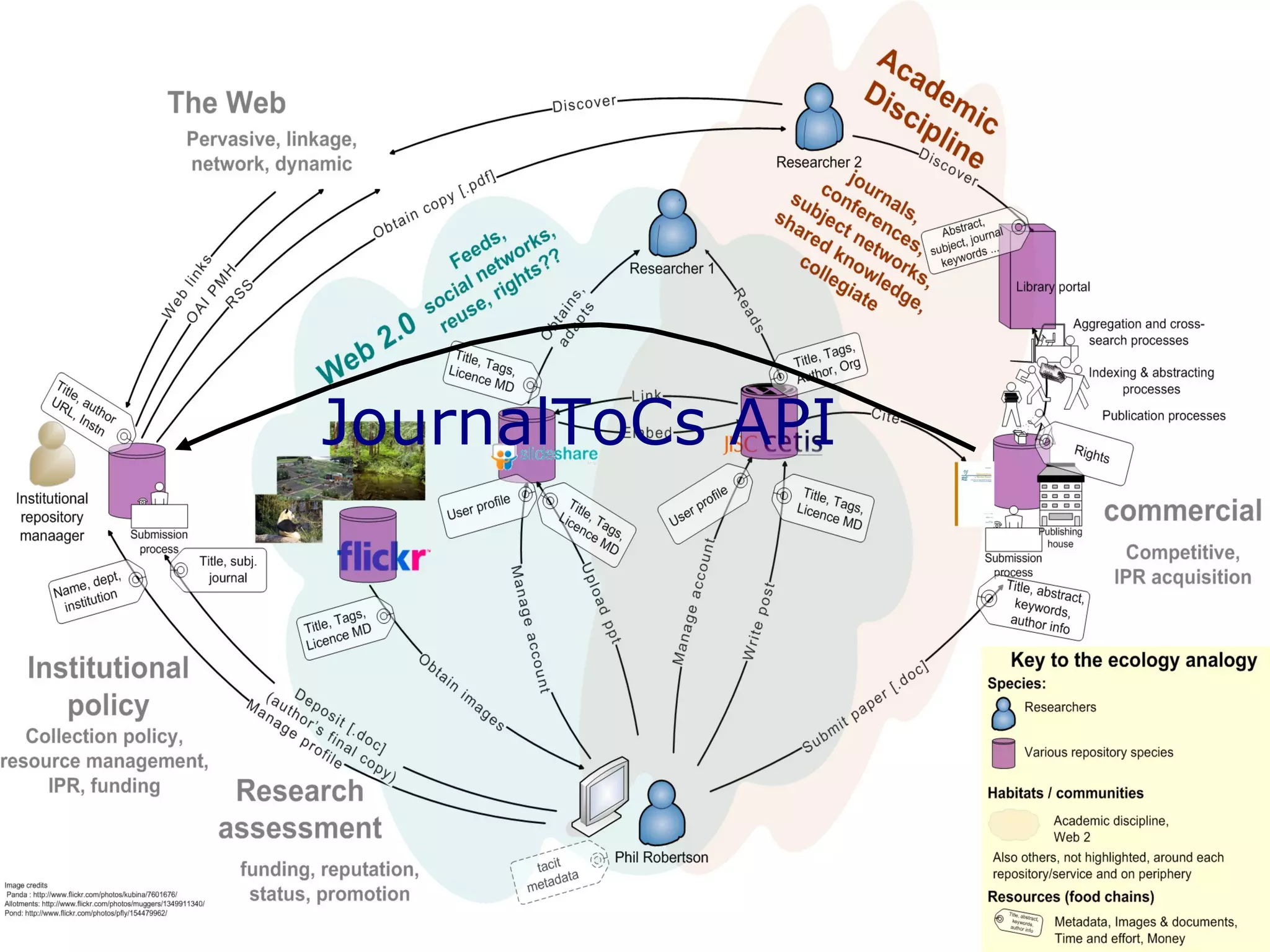
JournalToCs API
What is an API An application programming interface (API) is an interface to a software program that allows other software to interact with it. An API is an abstraction, a set of specifications; to implement one you need code in the server and the client.
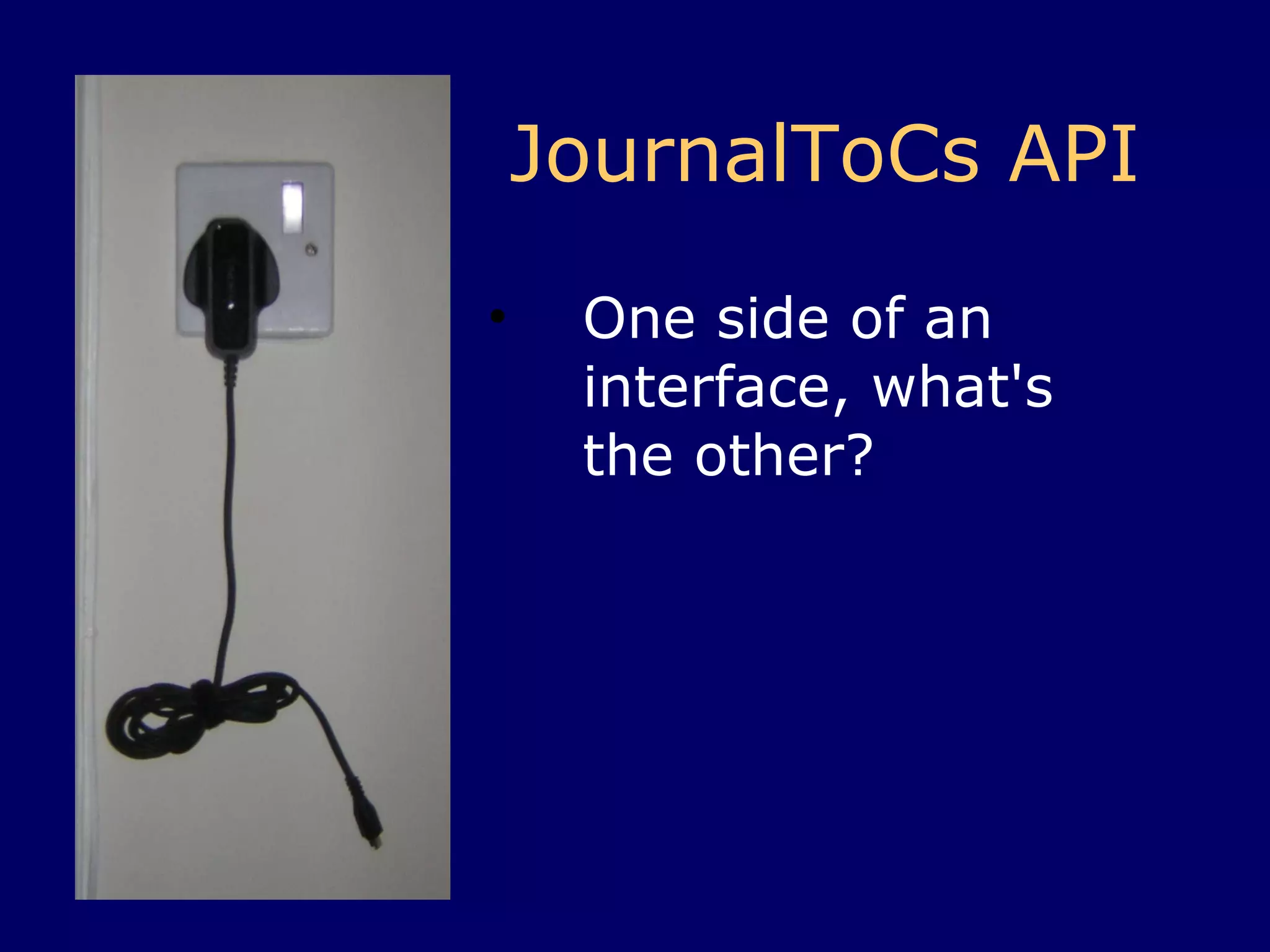
JournalToCs API One side of an interface, what's the other?
Possible complements An RSS feed reader used by the repository manager Pretty much what we have now No integration with workflow
Possible Complements 3 Response to query from the repository. Would need work on the client side Need to ask for data specifcally Pull data into where it is used
Possible complements (3) Embed RSS alerts into repository Would need work on client side Need to set up alert request (then let it run) Pull data to where it is used
Possible complements (3) Push alerts to the repository (XMPP, cf Jabber, Google Wave) Would require work on server and client. We push data to you when it is there rather than your system asking if there is anything. Puts the data where it is used.
Possible complements All except the most basic option require Further work => Further funding Clarification of your requirements Liaison with developers of target system (IR, VRE)
Summary The JournalToCs API serves and important role in the repository ecology, but implementing at JournalToCs is only half the story.

The Other Side of the Journal ToCs Interface

  • 1.
    The Other Sideof the Interface . or The sound of one hand clapping Phil Barker, philb@icbl.hw.ac.uk
  • 2.
    Journal ToCs Placein the Repository Ecosystem Ecology is the study of systems that are complex, dynamic, and full of interacting entities and processes. … ecology, and examples of the ecosystems it studies, may offer a useful analogy to inform the task of understanding and articulating the interactions between users, repositories, and services and the information environments in which they take place. http://ie-repository.jisc.ac.uk/272/
  • 3.
    An ecosystem SpeciesResources Interactions Image from D. Kumar (1992) Fish culture in undrainable ponds: A manual for extension, FAO Fisheries Technical Paper No. 325. Rome, FAO http://www.fao.org/docrep/003/T0555E/T0555E00.HTM . Image © Food and Agricultural Organisation of the United Nations
  • 4.
    A Repository Ecosystem?Species: Repositories Library services Web services Repository managers Researchers Journal publishers
  • 5.
    A Repository Ecosystem?Resources Information resources Journal papers, data, metadata Money Time / attention
  • 6.
    A Repository Ecosystem?Interactions Human-Human Human-Machine Machine-Machine: APIs, RSS Feeds, HTTP
  • 7.
    Repository Ecology Wecan study many aspects of the repository ecosystem One example is “Metadata in an ecosystem of presentation dissemination” Robertson, Barker & Mahey, Proc. Int’l Conf. on Dublin Core and Metadata Applications 2008 http://blogs.cetis.ac.uk/johnr/2008/09/25/metadata-in-an-ecosystem-of-presentation-dissemination/ http:// dcpapers. dublincore .org/ojs/pubs/article/viewFile/938/934
  • 8.
  • 9.
  • 10.
    What is anAPI An application programming interface (API) is an interface to a software program that allows other software to interact with it. An API is an abstraction, a set of specifications; to implement one you need code in the server and the client.
  • 11.
    JournalToCs API Oneside of an interface, what's the other?
  • 12.
    Possible complements AnRSS feed reader used by the repository manager Pretty much what we have now No integration with workflow
  • 13.
    Possible Complements 3Response to query from the repository. Would need work on the client side Need to ask for data specifcally Pull data into where it is used
  • 14.
    Possible complements (3)Embed RSS alerts into repository Would need work on client side Need to set up alert request (then let it run) Pull data to where it is used
  • 15.
    Possible complements (3)Push alerts to the repository (XMPP, cf Jabber, Google Wave) Would require work on server and client. We push data to you when it is there rather than your system asking if there is anything. Puts the data where it is used.
  • 16.
    Possible complements Allexcept the most basic option require Further work => Further funding Clarification of your requirements Liaison with developers of target system (IR, VRE)
  • 17.
    Summary The JournalToCsAPI serves and important role in the repository ecology, but implementing at JournalToCs is only half the story.