LRMI: using schema.org
to describe educational
resources
Phil Barker & Lorna Campbell
Motivation
Promote the sharing of educational resources by
helping people find content that meets their
specific needs.
Where do you think people go most often to find
open educational resources?
Motivation
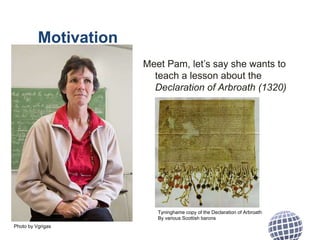
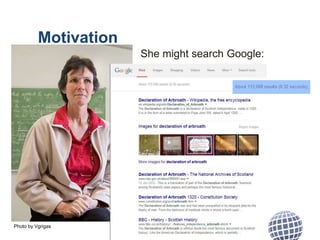
Meet Pam, let’s say she wants to
teach a lesson about the
Declaration of Arbroath (1320)
Photo by Vgrigas
Tyninghame copy of the Declaration of Arbroath
By various Scottish barons
Motivation
She might search Google:
Photo by Vgrigas
Motivation
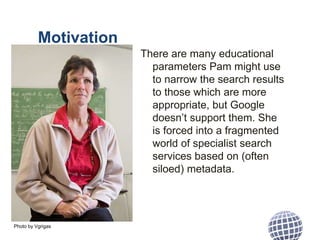
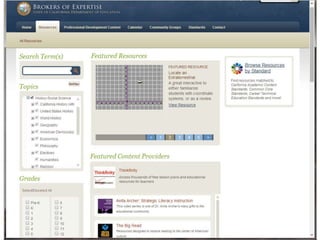
There are many educational
parameters Pam might use
to narrow the search results
to those which are more
appropriate, but Google
doesn’t support them. She
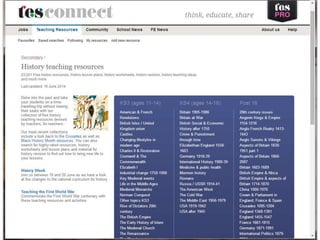
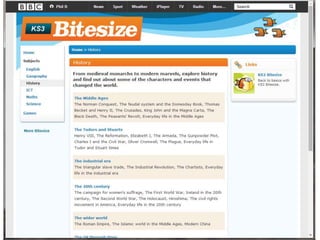
is forced into a fragmented
world of specialist search
services based on (often
siloed) metadata.
Photo by Vgrigas
Metadata and resource description
Metadata is structured information that describes,
explains or otherwise makes it easier to retrieve,
use, or manage an information resource
NISO, 2004, “Understanding metadata”
http://www.niso.org/publications/press/UnderstandingMetadata.pdf
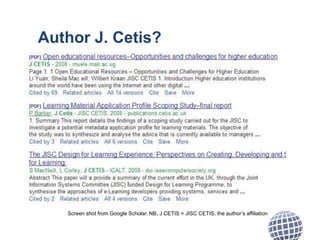
Author J. Cetis?
Screen shot from Google Scholar. NB, J CETIS = JISC CETIS, the author’s affiliation
Schema.org
a joint effort, in the spirit of sitemaps.org, to improve
the web by creating a structured data markup
schema supported by major search engines.
Schema.org FAQ, http://schema.org/docs/faq.html
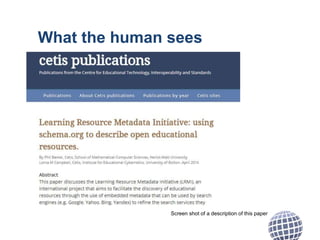
Screen shot of a description of this paper
What the human sees
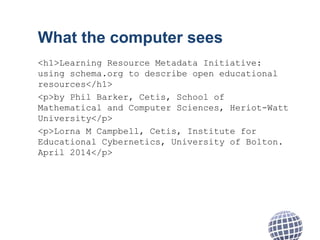
What the computer sees
<h1>Learning Resource Metadata Initiative:
using schema.org to describe open educational
resources</h1>
<p>by Phil Barker, Cetis, School of
Mathematical and Computer Sciences, Heriot-Watt
University</p>
<p>Lorna M Campbell, Cetis, Institute for
Educational Cybernetics, University of Bolton.
April 2014</p>
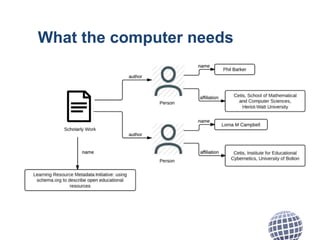
What the computer needs
What schema.org provides
An agreed hierarchy of resource types.
An agreed vocabulary for naming the characteristics
of resources and the relationships between them.
Which can be added to HTML (as microdata, RDFa
or JSON-LD) to help computers understand what
the strings or text mean.
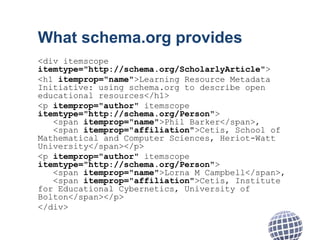
What schema.org provides
<div itemscope
itemtype="http://schema.org/ScholarlyArticle">
<h1 itemprop="name">Learning Resource Metadata
Initiative: using schema.org to describe open
educational resources</h1>
<p itemprop="author" itemscope
itemtype="http://schema.org/Person">
<span itemprop="name">Phil Barker</span>,
<span itemprop="affiliation">Cetis, School of
Mathematical and Computer Sciences, Heriot-Watt
University</span></p>
<p itemprop="author" itemscope
itemtype="http://schema.org/Person">
<span itemprop="name">Lorna M Campbell</span>,
<span itemprop="affiliation">Cetis, Institute
for Educational Cybernetics, University of
Bolton</span></p>
</div>
What’s different?
• Trust, reliability, visibility.
In general, Google won't display any content in
rich snippets that is not visible to [a] human
user.
https://support.google.com/webmasters/answer/1093493#hidden
Trust, reliability, visibility
• invisible markup invites spammers that try to
manipulate the search engine,
• a link to human-readable content allows [the
combination of] structured data and the textual
content for information extraction heuristics,
• the data quality is likely higher for visible content
(since humans will complain otherwise).
But this
violates principle of seperation of concerns – you
have to align data structure with HTML tree
structure
Martin Hepp, “JSON-LD: Finally, Google Honors Invisible Data for SEO”
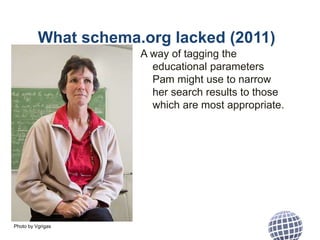
What schema.org lacked (2011)
A way of tagging the
educational parameters
Pam might use to narrow
her search results to those
which are most appropriate.
Photo by Vgrigas
LRMI: Learning resource metadata
initiative
Funded by the Bill and Melinda Gates Foundation
since June 2011 (three phases)
Co-led by Creative Commons and AEP (preK-12
learning group division of the Association of
American Publishers)
Working group including educators, publishers,
metadata specialists
Aim:
make it easier to publish, discover, and deliver quality
educational resources on the web
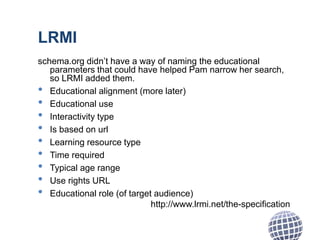
LRMI
schema.org didn’t have a way of naming the educational
parameters that could have helped Pam narrow her search,
so LRMI added them.
• Educational alignment (more later)
• Educational use
• Interactivity type
• Is based on url
• Learning resource type
• Time required
• Typical age range
• Use rights URL
• Educational role (of target audience)
http://www.lrmi.net/the-specification
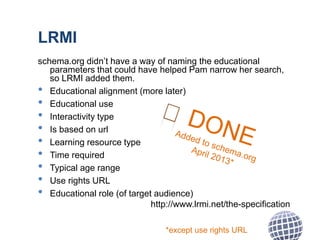
LRMI
schema.org didn’t have a way of naming the educational
parameters that could have helped Pam narrow her search,
so LRMI added them.
• Educational alignment (more later)
• Educational use
• Interactivity type
• Is based on url
• Learning resource type
• Time required
• Typical age range
• Use rights URL
• Educational role (of target audience)
http://www.lrmi.net/the-specification
*except use rights URL
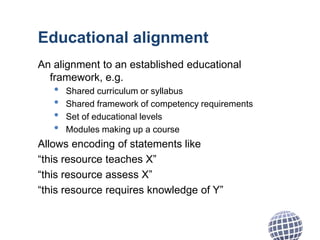
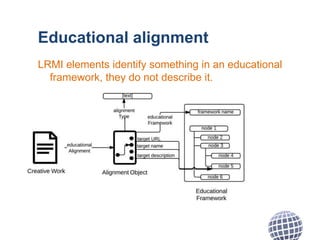
Educational alignment
An alignment to an established educational
framework, e.g.
• Shared curriculum or syllabus
• Shared framework of competency requirements
• Set of educational levels
• Modules making up a course
Allows encoding of statements like
“this resource teaches X”
“this resource assess X”
“this resource requires knowledge of Y”
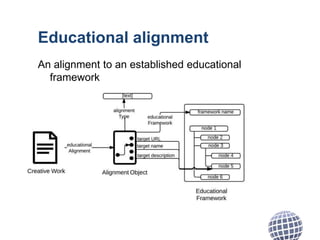
Educational alignment
An alignment to an established educational
framework
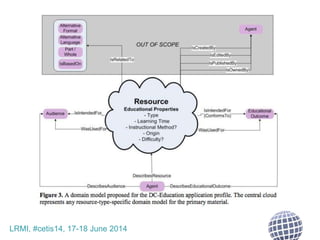
LRMI, #cetis14, 17-18 June 2014
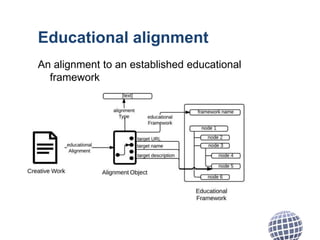
Educational alignment
An alignment to an established educational
framework
Educational alignment
LRMI elements identify something in an educational
framework, they do not describe it.
Further reading
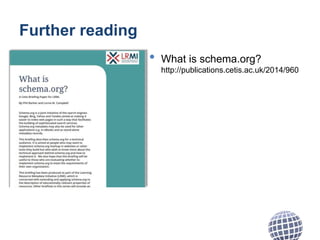
• What is schema.org?
http://publications.cetis.ac.uk/2014/960
Further reading
• What is schema.org?
http://publications.cetis.ac.uk/2014/960
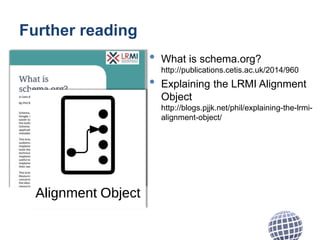
• Explaining the LRMI Alignment
Object
http://blogs.pjjk.net/phil/explaining-the-lrmi-
alignment-object/
Further reading
• What is schema.org?
http://publications.cetis.ac.uk/2014/960
• Explaining the LRMI Alignment
Object
http://blogs.pjjk.net/phil/explaining-the-lrmi-
alignment-object/
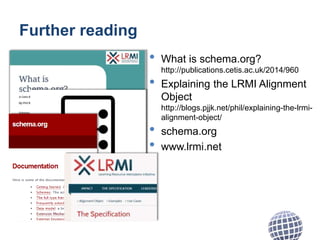
• schema.org
• www.lrmi.net
Attributions
• Photo of Pam Robertson, teacher, by Vgrigas (Own work) [CC-BY-SA-3.0
(http://creativecommons.org/licenses/by-sa/3.0)], via Wikimedia Commons
Pam really is a teacher but I have no idea whether she would want to teach anything related to the
declaration of Arbroath
• Reproduction of Tyninghame (1320 A.D) copy of the Declaration of Arbroath, 1320, via
Wikimedia Commons
• Google, yandex, bing, Yahoo! And W3C logos are trademarks.
• Screenshots may contain reserved copyright, their fair use may depend on jurisdiction.
• Other images created by the authors and licensed as CC-BY
Licence
This presentation “Learning Resource Metadata Initiative: using schema.org to describe open
educational resources”
by Phil Barker <phil.barker@hw.ac.uk>
and Lorna M Campbell <lorna.m.campbell@icloud.com>
of Cetis http://www.cetis.ac.uk is licensed under the
Creative Commons Attribution 4.0 International Licence
http://creativecommons.org/licenses/by/4.0/
Cetis
Cetis is the Centre for Educational Technology,
Interoperability and Standards. Our staff are globally
recognised as leading experts on education technology
innovation, interoperability and technology standards. For
over a decade Cetis has provided strategic, technical and
pedagogical advice on educational technology and
standards to funding bodies, standards agencies,
government, institutions and commercial partners.

LRMI: using schema.org to describe educational resources

  • 1.
    LRMI: using schema.org todescribe educational resources Phil Barker & Lorna Campbell
  • 2.
    Motivation Promote the sharingof educational resources by helping people find content that meets their specific needs. Where do you think people go most often to find open educational resources?
  • 3.
    Motivation Meet Pam, let’ssay she wants to teach a lesson about the Declaration of Arbroath (1320) Photo by Vgrigas Tyninghame copy of the Declaration of Arbroath By various Scottish barons
  • 4.
    Motivation She might searchGoogle: Photo by Vgrigas
  • 5.
    Motivation There are manyeducational parameters Pam might use to narrow the search results to those which are more appropriate, but Google doesn’t support them. She is forced into a fragmented world of specialist search services based on (often siloed) metadata. Photo by Vgrigas
  • 9.
    Metadata and resourcedescription Metadata is structured information that describes, explains or otherwise makes it easier to retrieve, use, or manage an information resource NISO, 2004, “Understanding metadata” http://www.niso.org/publications/press/UnderstandingMetadata.pdf
  • 10.
    Author J. Cetis? Screenshot from Google Scholar. NB, J CETIS = JISC CETIS, the author’s affiliation
  • 11.
    Schema.org a joint effort,in the spirit of sitemaps.org, to improve the web by creating a structured data markup schema supported by major search engines. Schema.org FAQ, http://schema.org/docs/faq.html
  • 12.
    Screen shot ofa description of this paper What the human sees
  • 13.
    What the computersees <h1>Learning Resource Metadata Initiative: using schema.org to describe open educational resources</h1> <p>by Phil Barker, Cetis, School of Mathematical and Computer Sciences, Heriot-Watt University</p> <p>Lorna M Campbell, Cetis, Institute for Educational Cybernetics, University of Bolton. April 2014</p>
  • 14.
  • 15.
    What schema.org provides Anagreed hierarchy of resource types. An agreed vocabulary for naming the characteristics of resources and the relationships between them. Which can be added to HTML (as microdata, RDFa or JSON-LD) to help computers understand what the strings or text mean.
  • 16.
    What schema.org provides <divitemscope itemtype="http://schema.org/ScholarlyArticle"> <h1 itemprop="name">Learning Resource Metadata Initiative: using schema.org to describe open educational resources</h1> <p itemprop="author" itemscope itemtype="http://schema.org/Person"> <span itemprop="name">Phil Barker</span>, <span itemprop="affiliation">Cetis, School of Mathematical and Computer Sciences, Heriot-Watt University</span></p> <p itemprop="author" itemscope itemtype="http://schema.org/Person"> <span itemprop="name">Lorna M Campbell</span>, <span itemprop="affiliation">Cetis, Institute for Educational Cybernetics, University of Bolton</span></p> </div>
  • 17.
    What’s different? • Trust,reliability, visibility. In general, Google won't display any content in rich snippets that is not visible to [a] human user. https://support.google.com/webmasters/answer/1093493#hidden
  • 18.
    Trust, reliability, visibility •invisible markup invites spammers that try to manipulate the search engine, • a link to human-readable content allows [the combination of] structured data and the textual content for information extraction heuristics, • the data quality is likely higher for visible content (since humans will complain otherwise). But this violates principle of seperation of concerns – you have to align data structure with HTML tree structure Martin Hepp, “JSON-LD: Finally, Google Honors Invisible Data for SEO”
  • 19.
    What schema.org lacked(2011) A way of tagging the educational parameters Pam might use to narrow her search results to those which are most appropriate. Photo by Vgrigas
  • 20.
    LRMI: Learning resourcemetadata initiative Funded by the Bill and Melinda Gates Foundation since June 2011 (three phases) Co-led by Creative Commons and AEP (preK-12 learning group division of the Association of American Publishers) Working group including educators, publishers, metadata specialists Aim: make it easier to publish, discover, and deliver quality educational resources on the web
  • 21.
    LRMI schema.org didn’t havea way of naming the educational parameters that could have helped Pam narrow her search, so LRMI added them. • Educational alignment (more later) • Educational use • Interactivity type • Is based on url • Learning resource type • Time required • Typical age range • Use rights URL • Educational role (of target audience) http://www.lrmi.net/the-specification
  • 22.
    LRMI schema.org didn’t havea way of naming the educational parameters that could have helped Pam narrow her search, so LRMI added them. • Educational alignment (more later) • Educational use • Interactivity type • Is based on url • Learning resource type • Time required • Typical age range • Use rights URL • Educational role (of target audience) http://www.lrmi.net/the-specification *except use rights URL
  • 23.
    Educational alignment An alignmentto an established educational framework, e.g. • Shared curriculum or syllabus • Shared framework of competency requirements • Set of educational levels • Modules making up a course Allows encoding of statements like “this resource teaches X” “this resource assess X” “this resource requires knowledge of Y”
  • 24.
    Educational alignment An alignmentto an established educational framework
  • 25.
  • 26.
    Educational alignment An alignmentto an established educational framework
  • 27.
    Educational alignment LRMI elementsidentify something in an educational framework, they do not describe it.
  • 28.
    Further reading • Whatis schema.org? http://publications.cetis.ac.uk/2014/960
  • 29.
    Further reading • Whatis schema.org? http://publications.cetis.ac.uk/2014/960 • Explaining the LRMI Alignment Object http://blogs.pjjk.net/phil/explaining-the-lrmi- alignment-object/
  • 30.
    Further reading • Whatis schema.org? http://publications.cetis.ac.uk/2014/960 • Explaining the LRMI Alignment Object http://blogs.pjjk.net/phil/explaining-the-lrmi- alignment-object/ • schema.org • www.lrmi.net
  • 31.
    Attributions • Photo ofPam Robertson, teacher, by Vgrigas (Own work) [CC-BY-SA-3.0 (http://creativecommons.org/licenses/by-sa/3.0)], via Wikimedia Commons Pam really is a teacher but I have no idea whether she would want to teach anything related to the declaration of Arbroath • Reproduction of Tyninghame (1320 A.D) copy of the Declaration of Arbroath, 1320, via Wikimedia Commons • Google, yandex, bing, Yahoo! And W3C logos are trademarks. • Screenshots may contain reserved copyright, their fair use may depend on jurisdiction. • Other images created by the authors and licensed as CC-BY
  • 32.
    Licence This presentation “LearningResource Metadata Initiative: using schema.org to describe open educational resources” by Phil Barker <phil.barker@hw.ac.uk> and Lorna M Campbell <lorna.m.campbell@icloud.com> of Cetis http://www.cetis.ac.uk is licensed under the Creative Commons Attribution 4.0 International Licence http://creativecommons.org/licenses/by/4.0/
  • 33.
    Cetis Cetis is theCentre for Educational Technology, Interoperability and Standards. Our staff are globally recognised as leading experts on education technology innovation, interoperability and technology standards. For over a decade Cetis has provided strategic, technical and pedagogical advice on educational technology and standards to funding bodies, standards agencies, government, institutions and commercial partners.

Editor's Notes

  • #2 title slide add title into box shown: add presenters
  • #3 body copy no bullets
  • #4 body copy no bullets
  • #5 body copy no bullets
  • #6 body copy no bullets
  • #10 body copy no bullets
  • #11 body copy no bullets
  • #12 body copy no bullets
  • #13 body copy no bullets
  • #14 body copy no bullets
  • #15 body copy no bullets
  • #16 body copy no bullets
  • #17 body copy no bullets
  • #18 body copy no bullets
  • #19 body copy no bullets
  • #20 body copy no bullets
  • #21 body copy no bullets
  • #22 body copy no bullets
  • #23 body copy no bullets
  • #24 body copy no bullets
  • #25 body copy no bullets
  • #27 body copy no bullets
  • #28 body copy no bullets
  • #32 body copy no bullets
  • #33 body copy no bullets