Contents
DEFINATION OF OER
CONCEPT OF CREATIVE
COMMON
TYPES OF OER
ADVANTAGES & LIMITATION
WEBSITES WITH OER RESOURCES
Prepared By
Arup Kr Saha
Assistant Professor in Geography
Chandrapur College
Purba Bardhaman, West Bengal, India
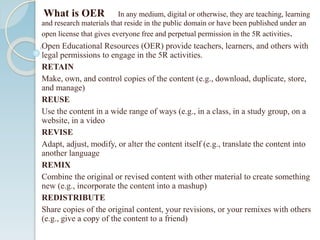
What is OER In any medium, digital or otherwise, they are teaching, learning
and research materials that reside in the public domain or have been published under an
open license that gives everyone free and perpetual permission in the 5R activities.
Open Educational Resources (OER) provide teachers, learners, and others with
legal permissions to engage in the 5R activities.
RETAIN
Make, own, and control copies of the content (e.g., download, duplicate, store,
and manage)
REUSE
Use the content in a wide range of ways (e.g., in a class, in a study group, on a
website, in a video
REVISE
Adapt, adjust, modify, or alter the content itself (e.g., translate the content into
another language
REMIX
Combine the original or revised content with other material to create something
new (e.g., incorporate the content into a mashup)
REDISTRIBUTE
Share copies of the original content, your revisions, or your remixes with others
(e.g., give a copy of the content to a friend)
Concept of creative common
One of the main features of open educational resources is that they are either in the
public domain or released under an open license, which means a Creative
Commons license in general.
Not all Creative Commons licenses are equal, however and only resources licensed
for adaptation and reuse can really be regarded as OER. Resources licensed
under the "No Derivatives" license can not be regarded strictly as OER, and
there is some debate on the status of “Non Commerical” licenced resources.
Creative Commons (CC) is a global organization that offers open-copyright
licenses, so you can give your consent as an author to share and reuse your
creative work under the conditions you choose.
Depending on the license you choose for your work, the copyright licenses offered
through Creative Commons grant specific permits. Included in the licenses are:
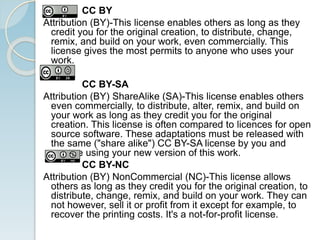
CC BY
Attribution (BY)-This license enables others as long as they
credit you for the original creation, to distribute, change,
remix, and build on your work, even commercially. This
license gives the most permits to anyone who uses your
work.
CC BY-SA
Attribution (BY) ShareAlike (SA)-This license enables others
even commercially, to distribute, alter, remix, and build on
your work as long as they credit you for the original
creation. This license is often compared to licences for open
source software. These adaptations must be released with
the same ("share alike") CC BY-SA license by you and
anyone using your new version of this work.
CC BY-NC
Attribution (BY) NonCommercial (NC)-This license allows
others as long as they credit you for the original creation, to
distribute, change, remix, and build on your work. They can
not however, sell it or profit from it except for example, to
recover the printing costs. It's a not-for-profit license.
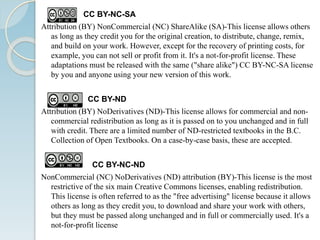
CC BY-NC-SA
Attribution (BY) NonCommercial (NC) ShareAlike (SA)-This license allows others
as long as they credit you for the original creation, to distribute, change, remix,
and build on your work. However, except for the recovery of printing costs, for
example, you can not sell or profit from it. It's a not-for-profit license. These
adaptations must be released with the same ("share alike") CC BY-NC-SA license
by you and anyone using your new version of this work.
CC BY-ND
Attribution (BY) NoDerivatives (ND)-This license allows for commercial and non-
commercial redistribution as long as it is passed on to you unchanged and in full
with credit. There are a limited number of ND-restricted textbooks in the B.C.
Collection of Open Textbooks. On a case-by-case basis, these are accepted.
CC BY-NC-ND
NonCommercial (NC) NoDerivatives (ND) attribution (BY)-This license is the most
restrictive of the six main Creative Commons licenses, enabling redistribution.
This license is often referred to as the "free advertising" license because it allows
others as long as they credit you, to download and share your work with others,
but they must be passed along unchanged and in full or commercially used. It's a
not-for-profit license
The term OER has been used to refer to materials
for learning, such as:
 Learning objects (quizzes, crossword puzzles,
flashcards, animations, interactive maps, timelines,
etc.)
 Audio lectures
 Audio-video lectures
 Images
 Sounds and music
 Entire course content
 Collections of journal articles and institutional
repositories
 Textbooks
 Online courses
 Presentation slides
 Syllabi
 Course outlines
ADVANTAGES OF OER
1. Enhancing access to education
2. Provide students with the opportunity to evaluate and plan their choices in education
Showcase the intellectual results of an institution, publicize its profile and attract students.
3. Convert students exploring alternatives into fee-paying registrations
4. Promote learning by providing educational resources for both students and self-directed
learners for just-in-time, direct, informal use.
5. Add value to producing knowledge
6.Reduce preparation time for faculty
7.Generate savings on costs- (this case has been particularly substantiated for open textbooks)
Increase quality
8.Innovation generation through collaboration
9.Increases the quality of educational resources standards by assembling more contributors
10.Optimizes the use of educational materials and increases availability
LIMITATION
Quality Assurance Services
Quality does matter whether the material is free or expensive. But not equally
preserved in all platform quality.
OER's sustainability
Many OER initiatives that have started in recent years have relied on one-time
start-up funding. Although some projects have strong institutional backing,
initial funding is likely to cease after a few years and resource maintenance will
be difficult and costly.
Lack of understanding from the public about OER
OER is a very recent development in education, at just over ten years of age. It
requires a huge change of paradigm and change of attitude and this is a much
greater challenge than the introduction of a new tool or knowledge.
WEBSITES WITH OER RESOURCES
OpenStax is a non-profit digital ecosystem that delivers free
educational content to millions of users per month to improve
learning outcomes. www.openstax.org
A California State University MERLOT collection of over
35,000 open course materials is Free Online Course Materials.
MIT OpenCourseWare (OCW) is a virtually all MIT course
content web-based publication. OCW is open to the world and
accessible and is a permanent activity of MIT.
WikiEducator is a community project that is working towards a
free version of the education curriculum by 2015 in collaboration
with the Free Culture Movement. WikiEducator is developing
free content for use in schools, polytechnics, universities,
vocational education institutions and informal education settings,
driven by the learning for development agenda.
The World Digital Library (WDL) makes significant primary
materials from countries and cultures around the world available
on the Internet, free of charge and in multilingual format.
 •Free open educational resources for Afghanistan-
www.darakhtdanesh.org/en
 Eastern Mediterranan University-
www.emu.edu.tr/en/academics/opencourseware
 UGA- www.ctl.uga.edu/pages/resources
 TESS India- www.tess-india.edu.in/
 NIOS- http://oer.nios.ac.in/wiki/index.php/Main_Page
 OER Lebanon – www.oerleb.org/home
 OER Asia(WOU) http://oerasia.org/
 OER, USM- http://ocw.usm.my/
 OER, Nepal- http://pustalaya.org/en/about/
 Seoul National University, Korea- www.nie.edu.sg/news-
detail
 Korea Open Courseware(KOCW)-
www.kocw.net/home/index
 Palestine OER Strategy Forum-
http://openmedproject.eu/results/national-oer-strategy-
forums/palestine/
 Philippines- http://en.unesco.org/news/manila-workshop-
explore-open-education-resources
 Sri Lanka- www.ou.ac.lk/home/index.php/open.educational-
resourses
 Thailand Cyber university project- www.thaicyberu.go.th/en
 Coursera- www.coursera.org/courses
 Kalindi College-
www.kalindicollege.in/kc/previousuploadstudymaterial
 Athabasca University Press- www.aupress.ca/
 Open Text Book Hong Kong- www.opentextbook.org.hk
 Open Resources Photo
 Free stock Photo- www.pexels.com
 Freely usable images- www.unspalsh.com
 Free Photo- www.flickr.com
 Free photo- www.pixabay.com
Free Icon
 Free Icons- www.flaticon.com
 Animation
 Mix & Match illustrations of people with a
design library- www.humaaans.com
Free sound
 Soundcloud- www.soundcloud.com
 Bensound- www.bensound.com
 Jamendo – www.jamendo.com
Free Vidio
 YouTube: steps—Go search—entry item— use
filter option— click on creative common—all
result are OER
 TeacherTube
Thank you

Open educational resources (OER)

  • 2.
    Contents DEFINATION OF OER CONCEPTOF CREATIVE COMMON TYPES OF OER ADVANTAGES & LIMITATION WEBSITES WITH OER RESOURCES Prepared By Arup Kr Saha Assistant Professor in Geography Chandrapur College Purba Bardhaman, West Bengal, India
  • 3.
    What is OERIn any medium, digital or otherwise, they are teaching, learning and research materials that reside in the public domain or have been published under an open license that gives everyone free and perpetual permission in the 5R activities. Open Educational Resources (OER) provide teachers, learners, and others with legal permissions to engage in the 5R activities. RETAIN Make, own, and control copies of the content (e.g., download, duplicate, store, and manage) REUSE Use the content in a wide range of ways (e.g., in a class, in a study group, on a website, in a video REVISE Adapt, adjust, modify, or alter the content itself (e.g., translate the content into another language REMIX Combine the original or revised content with other material to create something new (e.g., incorporate the content into a mashup) REDISTRIBUTE Share copies of the original content, your revisions, or your remixes with others (e.g., give a copy of the content to a friend)
  • 4.
    Concept of creativecommon One of the main features of open educational resources is that they are either in the public domain or released under an open license, which means a Creative Commons license in general. Not all Creative Commons licenses are equal, however and only resources licensed for adaptation and reuse can really be regarded as OER. Resources licensed under the "No Derivatives" license can not be regarded strictly as OER, and there is some debate on the status of “Non Commerical” licenced resources. Creative Commons (CC) is a global organization that offers open-copyright licenses, so you can give your consent as an author to share and reuse your creative work under the conditions you choose. Depending on the license you choose for your work, the copyright licenses offered through Creative Commons grant specific permits. Included in the licenses are:
  • 5.
    CC BY Attribution (BY)-Thislicense enables others as long as they credit you for the original creation, to distribute, change, remix, and build on your work, even commercially. This license gives the most permits to anyone who uses your work. CC BY-SA Attribution (BY) ShareAlike (SA)-This license enables others even commercially, to distribute, alter, remix, and build on your work as long as they credit you for the original creation. This license is often compared to licences for open source software. These adaptations must be released with the same ("share alike") CC BY-SA license by you and anyone using your new version of this work. CC BY-NC Attribution (BY) NonCommercial (NC)-This license allows others as long as they credit you for the original creation, to distribute, change, remix, and build on your work. They can not however, sell it or profit from it except for example, to recover the printing costs. It's a not-for-profit license.
  • 6.
    CC BY-NC-SA Attribution (BY)NonCommercial (NC) ShareAlike (SA)-This license allows others as long as they credit you for the original creation, to distribute, change, remix, and build on your work. However, except for the recovery of printing costs, for example, you can not sell or profit from it. It's a not-for-profit license. These adaptations must be released with the same ("share alike") CC BY-NC-SA license by you and anyone using your new version of this work. CC BY-ND Attribution (BY) NoDerivatives (ND)-This license allows for commercial and non- commercial redistribution as long as it is passed on to you unchanged and in full with credit. There are a limited number of ND-restricted textbooks in the B.C. Collection of Open Textbooks. On a case-by-case basis, these are accepted. CC BY-NC-ND NonCommercial (NC) NoDerivatives (ND) attribution (BY)-This license is the most restrictive of the six main Creative Commons licenses, enabling redistribution. This license is often referred to as the "free advertising" license because it allows others as long as they credit you, to download and share your work with others, but they must be passed along unchanged and in full or commercially used. It's a not-for-profit license
  • 7.
    The term OERhas been used to refer to materials for learning, such as:  Learning objects (quizzes, crossword puzzles, flashcards, animations, interactive maps, timelines, etc.)  Audio lectures  Audio-video lectures  Images  Sounds and music  Entire course content  Collections of journal articles and institutional repositories  Textbooks  Online courses  Presentation slides  Syllabi  Course outlines
  • 8.
    ADVANTAGES OF OER 1.Enhancing access to education 2. Provide students with the opportunity to evaluate and plan their choices in education Showcase the intellectual results of an institution, publicize its profile and attract students. 3. Convert students exploring alternatives into fee-paying registrations 4. Promote learning by providing educational resources for both students and self-directed learners for just-in-time, direct, informal use. 5. Add value to producing knowledge 6.Reduce preparation time for faculty 7.Generate savings on costs- (this case has been particularly substantiated for open textbooks) Increase quality 8.Innovation generation through collaboration 9.Increases the quality of educational resources standards by assembling more contributors 10.Optimizes the use of educational materials and increases availability
  • 9.
    LIMITATION Quality Assurance Services Qualitydoes matter whether the material is free or expensive. But not equally preserved in all platform quality. OER's sustainability Many OER initiatives that have started in recent years have relied on one-time start-up funding. Although some projects have strong institutional backing, initial funding is likely to cease after a few years and resource maintenance will be difficult and costly. Lack of understanding from the public about OER OER is a very recent development in education, at just over ten years of age. It requires a huge change of paradigm and change of attitude and this is a much greater challenge than the introduction of a new tool or knowledge.
  • 10.
    WEBSITES WITH OERRESOURCES OpenStax is a non-profit digital ecosystem that delivers free educational content to millions of users per month to improve learning outcomes. www.openstax.org A California State University MERLOT collection of over 35,000 open course materials is Free Online Course Materials. MIT OpenCourseWare (OCW) is a virtually all MIT course content web-based publication. OCW is open to the world and accessible and is a permanent activity of MIT. WikiEducator is a community project that is working towards a free version of the education curriculum by 2015 in collaboration with the Free Culture Movement. WikiEducator is developing free content for use in schools, polytechnics, universities, vocational education institutions and informal education settings, driven by the learning for development agenda. The World Digital Library (WDL) makes significant primary materials from countries and cultures around the world available on the Internet, free of charge and in multilingual format.
  • 11.
     •Free openeducational resources for Afghanistan- www.darakhtdanesh.org/en  Eastern Mediterranan University- www.emu.edu.tr/en/academics/opencourseware  UGA- www.ctl.uga.edu/pages/resources  TESS India- www.tess-india.edu.in/  NIOS- http://oer.nios.ac.in/wiki/index.php/Main_Page  OER Lebanon – www.oerleb.org/home  OER Asia(WOU) http://oerasia.org/  OER, USM- http://ocw.usm.my/  OER, Nepal- http://pustalaya.org/en/about/  Seoul National University, Korea- www.nie.edu.sg/news- detail  Korea Open Courseware(KOCW)- www.kocw.net/home/index  Palestine OER Strategy Forum- http://openmedproject.eu/results/national-oer-strategy- forums/palestine/
  • 12.
     Philippines- http://en.unesco.org/news/manila-workshop- explore-open-education-resources Sri Lanka- www.ou.ac.lk/home/index.php/open.educational- resourses  Thailand Cyber university project- www.thaicyberu.go.th/en  Coursera- www.coursera.org/courses  Kalindi College- www.kalindicollege.in/kc/previousuploadstudymaterial  Athabasca University Press- www.aupress.ca/  Open Text Book Hong Kong- www.opentextbook.org.hk  Open Resources Photo  Free stock Photo- www.pexels.com  Freely usable images- www.unspalsh.com  Free Photo- www.flickr.com  Free photo- www.pixabay.com
  • 13.
    Free Icon  FreeIcons- www.flaticon.com  Animation  Mix & Match illustrations of people with a design library- www.humaaans.com Free sound  Soundcloud- www.soundcloud.com  Bensound- www.bensound.com  Jamendo – www.jamendo.com Free Vidio  YouTube: steps—Go search—entry item— use filter option— click on creative common—all result are OER  TeacherTube
  • 14.