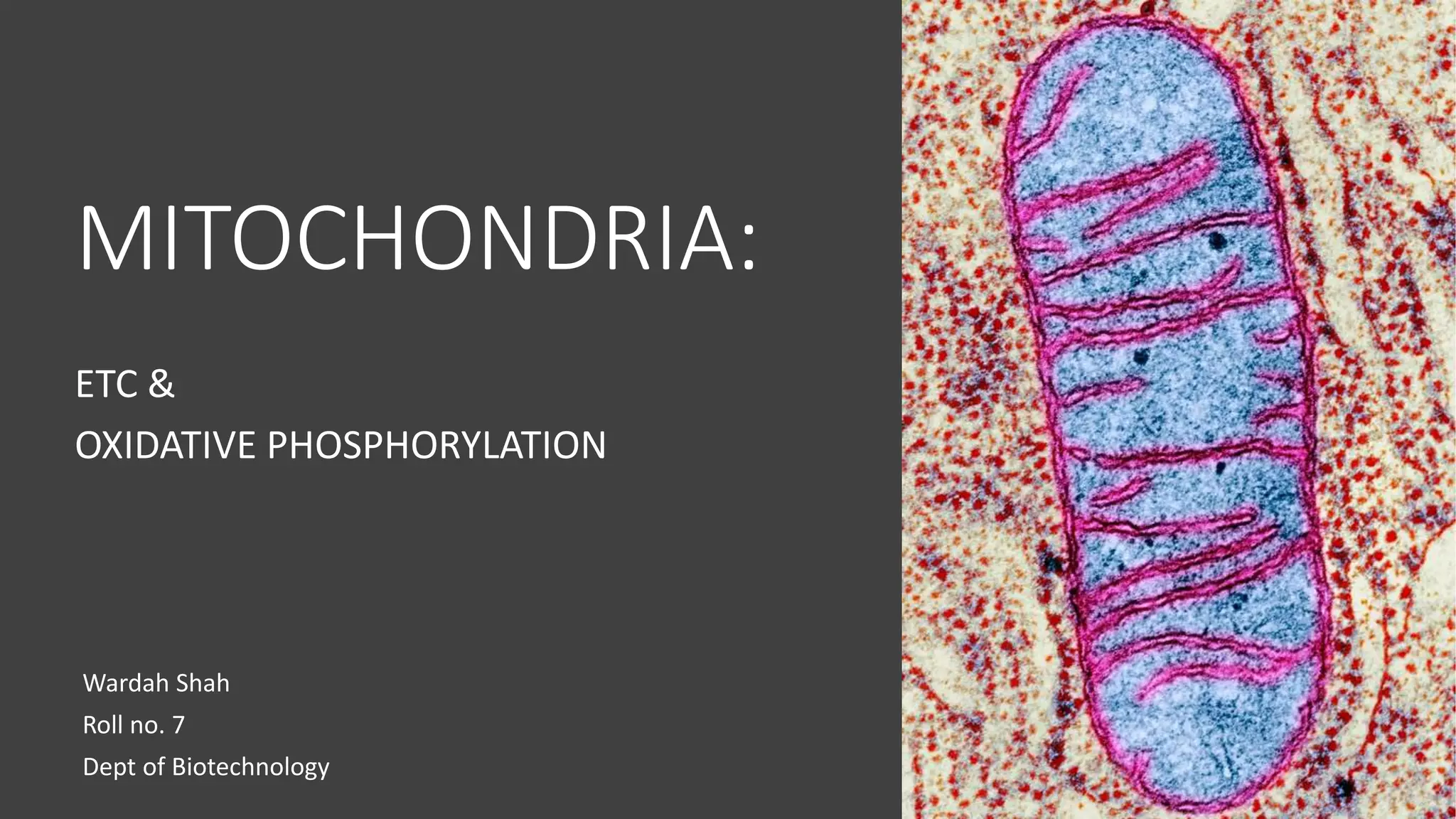
MITOCHONDRIA:
ETC &
OXIDATIVE PHOSPHORYLATION
Wardah Shah
Roll no. 7
Dept of Biotechnology
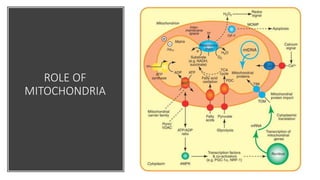
ROLE OF
MITOCHONDRIA
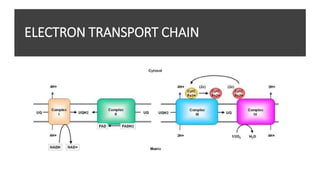
ELECTRON TRANSPORT CHAIN
ELECTRON CARRIERS
Flavoproteins
Cytochromes
Three copper atoms
Ubiquinone
Iron-sulfur proteins
WHERE
DOES NADH
AND FADH2
COME
FROM?
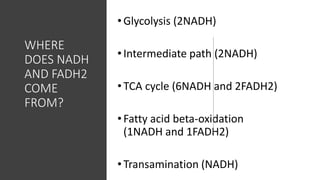
•Glycolysis (2NADH)
•Intermediate path (2NADH)
•TCA cycle (6NADH and 2FADH2)
•Fatty acid beta-oxidation
(1NADH and 1FADH2)
•Transamination (NADH)
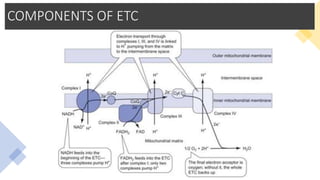
COMPONENTS OF ETC
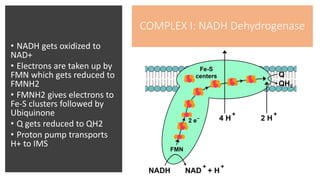
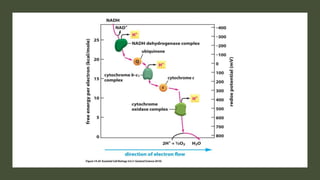
COMPLEX I: NADH Dehydrogenase
• NADH gets oxidized to
NAD+
• Electrons are taken up by
FMN which gets reduced to
FMNH2
• FMNH2 gives electrons to
Fe-S clusters followed by
Ubiquinone
• Q gets reduced to QH2
• Proton pump transports
H+ to IMS
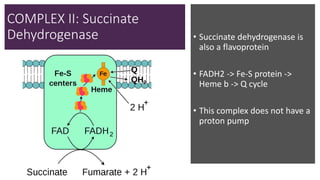
COMPLEX II: Succinate
Dehydrogenase • Succinate dehydrogenase is
also a flavoprotein
• FADH2 -> Fe-S protein ->
Heme b -> Q cycle
• This complex does not have a
proton pump
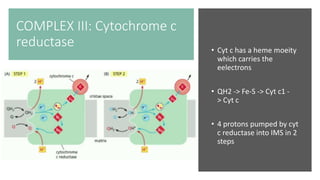
COMPLEX III: Cytochrome c
reductase • Cyt c has a heme moeity
which carries the
eelectrons
• QH2 -> Fe-S -> Cyt c1 -
> Cyt c
• 4 protons pumped by cyt
c reductase into IMS in 2
steps
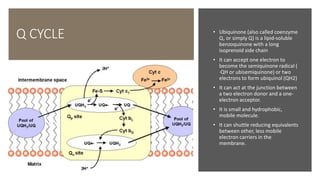
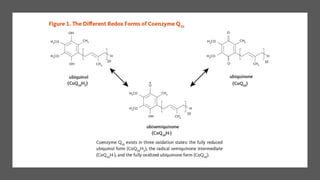
Q CYCLE • Ubiquinone (also called coenzyme
Q, or simply Q) is a lipid-soluble
benzoquinone with a long
isoprenoid side chain
• It can accept one electron to
become the semiquinone radical (
∙QH or ubisemiquinone) or two
electrons to form ubiquinol (QH2)
• It can act at the junction between
a two electron donor and a one-
electron acceptor.
• It is small and hydrophobic,
mobile molecule.
• It can shuttle reducing equivalents
between other, less mobile
electron carriers in the
membrane.
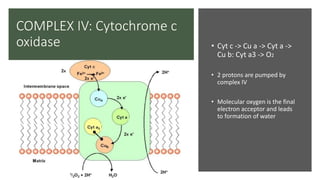
COMPLEX IV: Cytochrome c
oxidase • Cyt c -> Cu a -> Cyt a ->
Cu b: Cyt a3 -> O2
• 2 protons are pumped by
complex IV
• Molecular oxygen is the final
electron acceptor and leads
to formation of water
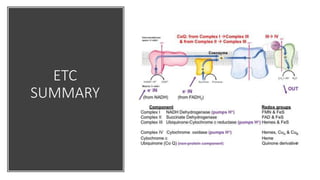
ETC
SUMMARY
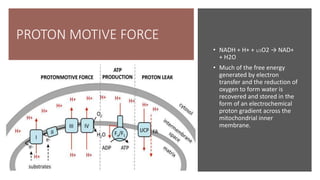
PROTON MOTIVE FORCE
• NADH + H+ + 1/2O2 → NAD+
+ H2O
• Much of the free energy
generated by electron
transfer and the reduction of
oxygen to form water is
recovered and stored in the
form of an electrochemical
proton gradient across the
mitochondrial inner
membrane.
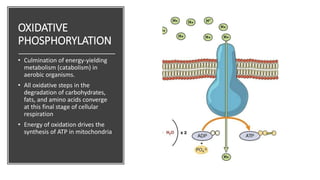
OXIDATIVE
PHOSPHORYLATION
• Culmination of energy-yielding
metabolism (catabolism) in
aerobic organisms.
• All oxidative steps in the
degradation of carbohydrates,
fats, and amino acids converge
at this final stage of cellular
respiration
• Energy of oxidation drives the
synthesis of ATP in mitochondria
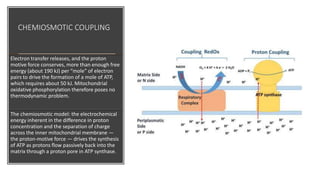
CHEMIOSMOTIC COUPLING
Electron transfer releases, and the proton
motive force conserves, more than enough free
energy (about 190 kJ) per “mole” of electron
pairs to drive the formation of a mole of ATP,
which requires about 50 kJ. Mitochondrial
oxidative phosphorylation therefore poses no
thermodynamic problem.
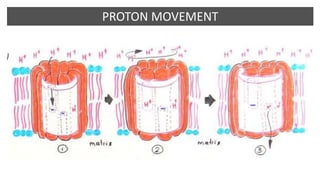
The chemiosmotic model: the electrochemical
energy inherent in the difference in proton
concentration and the separation of charge
across the inner mitochondrial membrane —
the proton-motive force — drives the synthesis
of ATP as protons flow passively back into the
matrix through a proton pore in ATP synthase.
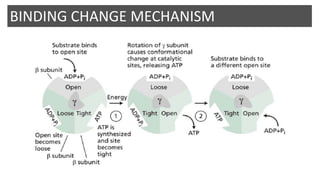
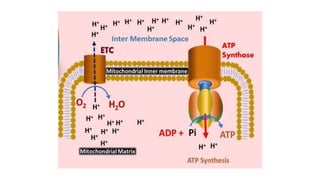
COMPLEX V: ATP SYNTHASE
• Mitochondrial ATP synthase is an F-
type ATPase
• This large enzyme complex
catalyzes the formation of ATP from
ADP and Pi, accompanied by the
flow of protons from the P to the N
side of the membrane
• ATP synthase, also called Complex
V, has two distinct components:
• F1, a peripheral membrane protein,
and
• Fo (o denoting oligomycin-
sensitive), which is integral to the
membrane.
BINDING CHANGE MECHANISM
PROTON MOVEMENT
THANK YOU

ETC and Oxidative Phosphorylation

  • 1.
    MITOCHONDRIA: ETC & OXIDATIVE PHOSPHORYLATION WardahShah Roll no. 7 Dept of Biotechnology
  • 2.
  • 3.
  • 4.
    ELECTRON CARRIERS Flavoproteins Cytochromes Three copperatoms Ubiquinone Iron-sulfur proteins
  • 5.
    WHERE DOES NADH AND FADH2 COME FROM? •Glycolysis(2NADH) •Intermediate path (2NADH) •TCA cycle (6NADH and 2FADH2) •Fatty acid beta-oxidation (1NADH and 1FADH2) •Transamination (NADH)
  • 6.
  • 7.
    COMPLEX I: NADHDehydrogenase • NADH gets oxidized to NAD+ • Electrons are taken up by FMN which gets reduced to FMNH2 • FMNH2 gives electrons to Fe-S clusters followed by Ubiquinone • Q gets reduced to QH2 • Proton pump transports H+ to IMS
  • 8.
    COMPLEX II: Succinate Dehydrogenase• Succinate dehydrogenase is also a flavoprotein • FADH2 -> Fe-S protein -> Heme b -> Q cycle • This complex does not have a proton pump
  • 9.
    COMPLEX III: Cytochromec reductase • Cyt c has a heme moeity which carries the eelectrons • QH2 -> Fe-S -> Cyt c1 - > Cyt c • 4 protons pumped by cyt c reductase into IMS in 2 steps
  • 10.
    Q CYCLE •Ubiquinone (also called coenzyme Q, or simply Q) is a lipid-soluble benzoquinone with a long isoprenoid side chain • It can accept one electron to become the semiquinone radical ( ∙QH or ubisemiquinone) or two electrons to form ubiquinol (QH2) • It can act at the junction between a two electron donor and a one- electron acceptor. • It is small and hydrophobic, mobile molecule. • It can shuttle reducing equivalents between other, less mobile electron carriers in the membrane.
  • 12.
    COMPLEX IV: Cytochromec oxidase • Cyt c -> Cu a -> Cyt a -> Cu b: Cyt a3 -> O2 • 2 protons are pumped by complex IV • Molecular oxygen is the final electron acceptor and leads to formation of water
  • 14.
  • 15.
    PROTON MOTIVE FORCE •NADH + H+ + 1/2O2 → NAD+ + H2O • Much of the free energy generated by electron transfer and the reduction of oxygen to form water is recovered and stored in the form of an electrochemical proton gradient across the mitochondrial inner membrane.
  • 16.
    OXIDATIVE PHOSPHORYLATION • Culmination ofenergy-yielding metabolism (catabolism) in aerobic organisms. • All oxidative steps in the degradation of carbohydrates, fats, and amino acids converge at this final stage of cellular respiration • Energy of oxidation drives the synthesis of ATP in mitochondria
  • 17.
    CHEMIOSMOTIC COUPLING Electron transferreleases, and the proton motive force conserves, more than enough free energy (about 190 kJ) per “mole” of electron pairs to drive the formation of a mole of ATP, which requires about 50 kJ. Mitochondrial oxidative phosphorylation therefore poses no thermodynamic problem. The chemiosmotic model: the electrochemical energy inherent in the difference in proton concentration and the separation of charge across the inner mitochondrial membrane — the proton-motive force — drives the synthesis of ATP as protons flow passively back into the matrix through a proton pore in ATP synthase.
  • 18.
    COMPLEX V: ATPSYNTHASE • Mitochondrial ATP synthase is an F- type ATPase • This large enzyme complex catalyzes the formation of ATP from ADP and Pi, accompanied by the flow of protons from the P to the N side of the membrane • ATP synthase, also called Complex V, has two distinct components: • F1, a peripheral membrane protein, and • Fo (o denoting oligomycin- sensitive), which is integral to the membrane.
  • 19.
  • 20.
  • 22.