Marko Grobelnik
marko.grobelnik@ijs.si
Jozef Stefan Institute
Ljubljana, Slovenia
Stavanger, May 8th 2012
 Introduction
◦ What is Big data?
◦ Why Big-Data?
◦ When Big-Data is really a problem?
 Techniques
 Tools
 Applications
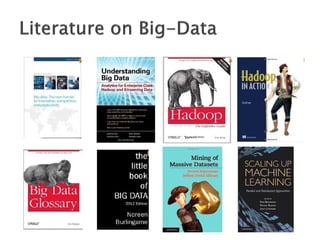
 Literature
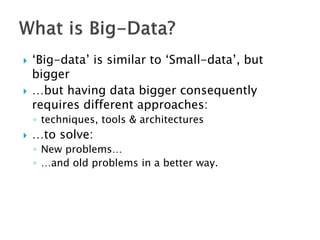
 ‘Big-data’ is similar to ‘Small-data’, but
bigger
 …but having data bigger consequently
requires different approaches:
◦ techniques, tools & architectures
 …to solve:
◦ New problems…
◦ …and old problems in a better way.
From “Understanding Big Data” by IBM
Big-Data
 Key enablers for the growth of “Big Data” are:
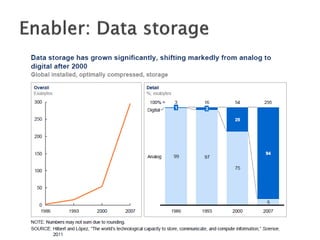
◦ Increase of storage capacities
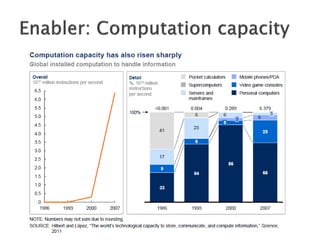
◦ Increase of processing power
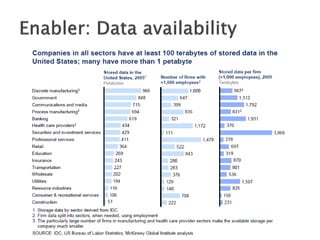
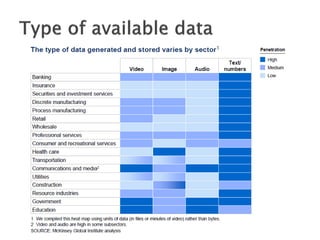
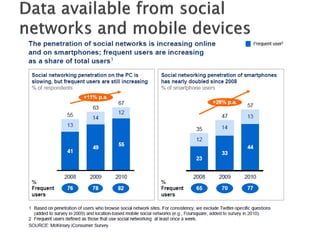
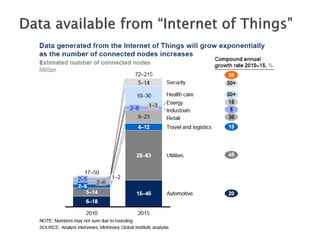
◦ Availability of data
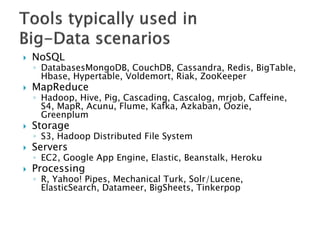
 NoSQL
◦ DatabasesMongoDB, CouchDB, Cassandra, Redis, BigTable,
Hbase, Hypertable, Voldemort, Riak, ZooKeeper
 MapReduce
◦ Hadoop, Hive, Pig, Cascading, Cascalog, mrjob, Caffeine,
S4, MapR, Acunu, Flume, Kafka, Azkaban, Oozie,
Greenplum
 Storage
◦ S3, Hadoop Distributed File System
 Servers
◦ EC2, Google App Engine, Elastic, Beanstalk, Heroku
 Processing
◦ R, Yahoo! Pipes, Mechanical Turk, Solr/Lucene,
ElasticSearch, Datameer, BigSheets, Tinkerpop
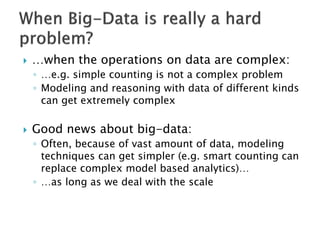
 …when the operations on data are complex:
◦ …e.g. simple counting is not a complex problem
◦ Modeling and reasoning with data of different kinds
can get extremely complex
 Good news about big-data:
◦ Often, because of vast amount of data, modeling
techniques can get simpler (e.g. smart counting can
replace complex model based analytics)…
◦ …as long as we deal with the scale
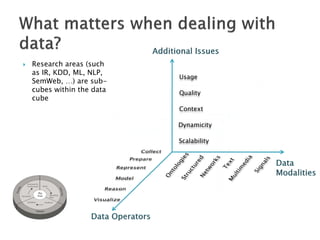
 Research areas (such
as IR, KDD, ML, NLP,
SemWeb, …) are sub-
cubes within the data
cube
Scalability
Dynamicity
Context
Quality
Usage
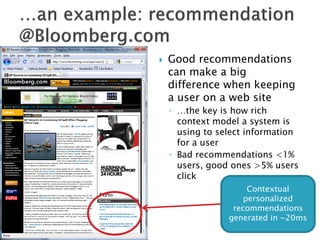
 Good recommendations
can make a big
difference when keeping
a user on a web site
◦ …the key is how rich
context model a system is
using to select information
for a user
◦ Bad recommendations <1%
users, good ones >5% users
click
Contextual
personalized
recommendations
generated in ~20ms
 Domain
 Sub-domain
 Page URL
 URL sub-directories
 Page Meta Tags
 Page Title
 Page Content
 Named Entities
 Has Query
 Referrer Query
 Referring Domain
 Referring URL
 Outgoing URL
 GeoIP Country
 GeoIP State
 GeoIP City
 Absolute Date
 Day of the Week
 Day period
 Hour of the day
 User Agent
 Zip Code
 State
 Income
 Age
 Gender
 Country
 Job Title
 Job Industry
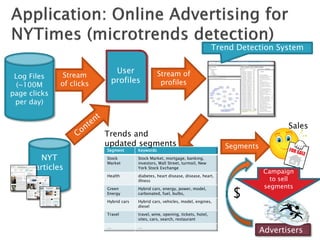
Log Files
(~100M
page clicks
per day)
User
profiles
NYT
articles
Stream of
profiles
Advertisers
Segment Keywords
Stock
Market
Stock Market, mortgage, banking,
investors, Wall Street, turmoil, New
York Stock Exchange
Health diabetes, heart disease, disease, heart,
illness
Green
Energy
Hybrid cars, energy, power, model,
carbonated, fuel, bulbs,
Hybrid cars Hybrid cars, vehicles, model, engines,
diesel
Travel travel, wine, opening, tickets, hotel,
sites, cars, search, restaurant
… …
Segments
Trend Detection System
Stream
of clicks
Trends and
updated segments
Campaign
to sell
segments
$
Sales
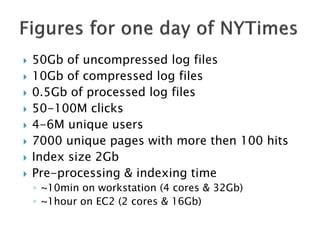
 50Gb of uncompressed log files
 10Gb of compressed log files
 0.5Gb of processed log files
 50-100M clicks
 4-6M unique users
 7000 unique pages with more then 100 hits
 Index size 2Gb
 Pre-processing & indexing time
◦ ~10min on workstation (4 cores & 32Gb)
◦ ~1hour on EC2 (2 cores & 16Gb)
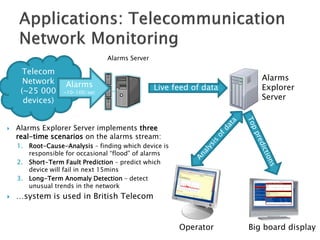
 Alarms Explorer Server implements three
real-time scenarios on the alarms stream:
1. Root-Cause-Analysis – finding which device is
responsible for occasional “flood” of alarms
2. Short-Term Fault Prediction – predict which
device will fail in next 15mins
3. Long-Term Anomaly Detection – detect
unusual trends in the network
 …system is used in British Telecom
Alarms Server
Alarms
Explorer
Server
Live feed of data
Operator Big board display
Telecom
Network
(~25 000
devices)
Alarms
~10-100/sec
 Presented in “Planetary-Scale Views on a
Large Instant-Messaging Network” by Jure
Leskovec and Eric Horvitz WWW2008
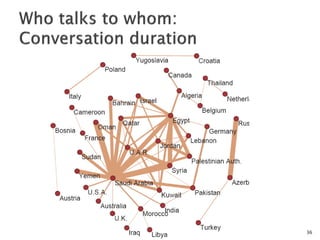
 Observe social and communication
phenomena at a planetary scale
 Largest social network analyzed to date
Research questions:
 How does communication change with user
demographics (age, sex, language, country)?
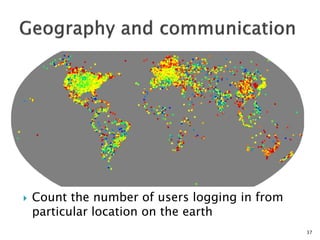
 How does geography affect communication?
 What is the structure of the communication
network?
33
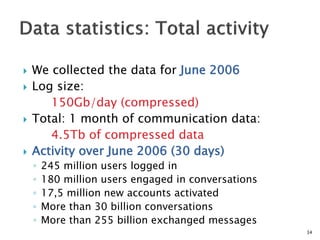
 We collected the data for June 2006
 Log size:
150Gb/day (compressed)
 Total: 1 month of communication data:
4.5Tb of compressed data
 Activity over June 2006 (30 days)
◦ 245 million users logged in
◦ 180 million users engaged in conversations
◦ 17,5 million new accounts activated
◦ More than 30 billion conversations
◦ More than 255 billion exchanged messages
34
35
36
 Count the number of users logging in from
particular location on the earth
37
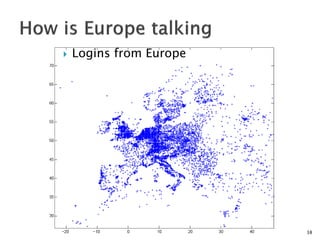
 Logins from Europe
38
 6 degrees of separation [Milgram ’60s]
 Average distance between two random users is 6.6
 90% of nodes can be reached in < 8 hops
Hops Nodes
1 10
2 78
3 396
4 8648
5 3299252
6 28395849
7 79059497
8 52995778
9 10321008
10 1955007
11 518410
12 149945
13 44616
14 13740
15 4476
16 1542
17 536
18 167
19 71
20 29
21 16
22 10
23 3
24 2
25 3
Big data tutorial_part4

Big data tutorial_part4

  • 1.
    Marko Grobelnik marko.grobelnik@ijs.si Jozef StefanInstitute Ljubljana, Slovenia Stavanger, May 8th 2012
  • 2.
     Introduction ◦ Whatis Big data? ◦ Why Big-Data? ◦ When Big-Data is really a problem?  Techniques  Tools  Applications  Literature
  • 5.
     ‘Big-data’ issimilar to ‘Small-data’, but bigger  …but having data bigger consequently requires different approaches: ◦ techniques, tools & architectures  …to solve: ◦ New problems… ◦ …and old problems in a better way.
  • 6.
  • 8.
  • 9.
     Key enablersfor the growth of “Big Data” are: ◦ Increase of storage capacities ◦ Increase of processing power ◦ Availability of data
  • 20.
     NoSQL ◦ DatabasesMongoDB,CouchDB, Cassandra, Redis, BigTable, Hbase, Hypertable, Voldemort, Riak, ZooKeeper  MapReduce ◦ Hadoop, Hive, Pig, Cascading, Cascalog, mrjob, Caffeine, S4, MapR, Acunu, Flume, Kafka, Azkaban, Oozie, Greenplum  Storage ◦ S3, Hadoop Distributed File System  Servers ◦ EC2, Google App Engine, Elastic, Beanstalk, Heroku  Processing ◦ R, Yahoo! Pipes, Mechanical Turk, Solr/Lucene, ElasticSearch, Datameer, BigSheets, Tinkerpop
  • 22.
     …when theoperations on data are complex: ◦ …e.g. simple counting is not a complex problem ◦ Modeling and reasoning with data of different kinds can get extremely complex  Good news about big-data: ◦ Often, because of vast amount of data, modeling techniques can get simpler (e.g. smart counting can replace complex model based analytics)… ◦ …as long as we deal with the scale
  • 23.
     Research areas(such as IR, KDD, ML, NLP, SemWeb, …) are sub- cubes within the data cube Scalability Dynamicity Context Quality Usage
  • 26.
     Good recommendations canmake a big difference when keeping a user on a web site ◦ …the key is how rich context model a system is using to select information for a user ◦ Bad recommendations <1% users, good ones >5% users click Contextual personalized recommendations generated in ~20ms
  • 27.
     Domain  Sub-domain Page URL  URL sub-directories  Page Meta Tags  Page Title  Page Content  Named Entities  Has Query  Referrer Query  Referring Domain  Referring URL  Outgoing URL  GeoIP Country  GeoIP State  GeoIP City  Absolute Date  Day of the Week  Day period  Hour of the day  User Agent  Zip Code  State  Income  Age  Gender  Country  Job Title  Job Industry
  • 28.
    Log Files (~100M page clicks perday) User profiles NYT articles Stream of profiles Advertisers Segment Keywords Stock Market Stock Market, mortgage, banking, investors, Wall Street, turmoil, New York Stock Exchange Health diabetes, heart disease, disease, heart, illness Green Energy Hybrid cars, energy, power, model, carbonated, fuel, bulbs, Hybrid cars Hybrid cars, vehicles, model, engines, diesel Travel travel, wine, opening, tickets, hotel, sites, cars, search, restaurant … … Segments Trend Detection System Stream of clicks Trends and updated segments Campaign to sell segments $ Sales
  • 29.
     50Gb ofuncompressed log files  10Gb of compressed log files  0.5Gb of processed log files  50-100M clicks  4-6M unique users  7000 unique pages with more then 100 hits  Index size 2Gb  Pre-processing & indexing time ◦ ~10min on workstation (4 cores & 32Gb) ◦ ~1hour on EC2 (2 cores & 16Gb)
  • 31.
     Alarms ExplorerServer implements three real-time scenarios on the alarms stream: 1. Root-Cause-Analysis – finding which device is responsible for occasional “flood” of alarms 2. Short-Term Fault Prediction – predict which device will fail in next 15mins 3. Long-Term Anomaly Detection – detect unusual trends in the network  …system is used in British Telecom Alarms Server Alarms Explorer Server Live feed of data Operator Big board display Telecom Network (~25 000 devices) Alarms ~10-100/sec
  • 32.
     Presented in“Planetary-Scale Views on a Large Instant-Messaging Network” by Jure Leskovec and Eric Horvitz WWW2008
  • 33.
     Observe socialand communication phenomena at a planetary scale  Largest social network analyzed to date Research questions:  How does communication change with user demographics (age, sex, language, country)?  How does geography affect communication?  What is the structure of the communication network? 33
  • 34.
     We collectedthe data for June 2006  Log size: 150Gb/day (compressed)  Total: 1 month of communication data: 4.5Tb of compressed data  Activity over June 2006 (30 days) ◦ 245 million users logged in ◦ 180 million users engaged in conversations ◦ 17,5 million new accounts activated ◦ More than 30 billion conversations ◦ More than 255 billion exchanged messages 34
  • 35.
  • 36.
  • 37.
     Count thenumber of users logging in from particular location on the earth 37
  • 38.
     Logins fromEurope 38
  • 39.
     6 degreesof separation [Milgram ’60s]  Average distance between two random users is 6.6  90% of nodes can be reached in < 8 hops Hops Nodes 1 10 2 78 3 396 4 8648 5 3299252 6 28395849 7 79059497 8 52995778 9 10321008 10 1955007 11 518410 12 149945 13 44616 14 13740 15 4476 16 1542 17 536 18 167 19 71 20 29 21 16 22 10 23 3 24 2 25 3