Presented to
Parvathi madam
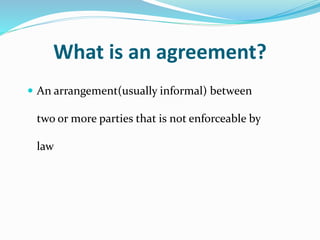
What is an agreement?
 An arrangement(usually informal) between
two or more parties that is not enforceable by
law
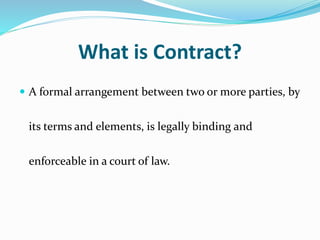
What is Contract?
 A formal arrangement between two or more parties, by
its terms and elements, is legally binding and
enforceable in a court of law.
Indian Contract Act 1872
 Came into force on 1st Semptember,1872.
 It extends to whole of India except Jammu and Kashmir.
 The Indian Contract Act has defined contract in Sec 2(h) as
“an agreement enforceable by law”.
 It’s a combination of two elements - agreement and
obligation
Essential Elements of A Contract
 Agreements
 Legal Purpose
 Lawful Consideration
 Capacity to Contract
 Consent to contract
 Legal objective
 Certainty
 Possibility of performance
 Legal formalities
 Not expressly declared as
void
Agreement
 Every promise and set of promises that forms the
consideration for each other is an agreement.
 Agreement subject to ratification by others who are not
parties to it is not a conclusive contract.
 All contracts are agreements but every agreement is not a
contract.
Example
 A and B entered into an agreement that A offered to
sell his land for a consideration of $1,00,000 and B
accepted the offer by paying the consideration to A.
hence the contract is valid.
Legal purpose
 The agreement must create a legal purpose, besides
offer and acceptance.
 Both the parties must have an intension to go to the
court of law, if the other party does not meet his
promise.
Example
 There was an agreement between R & co and C & co by means of which
the former was appointed as the agent of the latter.
 One clause in the agreement was: “This agreement is not entered into
as a formal or legal agreement and shall not be subject to legal
jurisdiction in the law courts.”
 Held, there was no binding contract as there was no intension to create
legal relationship.
Lawful Consideration
 Agreement must be supported by consideration.
 Consideration means something in return i.e both the
parties must get something in return for the promise.
 If the promise is not supported by consideration, it will be
a bare promise, and hence not enforceable by law.
 Consideration must be lawful, real ad not illusory.
Example
 Amar sells his house to Akbar for $50,000.Akbar’s
promise to pay the sum is consideration for Amar’s
promise to sell his house and vice versa.
Capacity to contract
 Sec 11 of Indian Contract Act specifies that every
person is competent to contract provided:
 He is a major.
He is of sound mind.
He is not disqualified by law to enter into a contract.
Example
 Prathap, a minor borrowed a sum of $10,000 from
Sachin, a major. Held, Sachin could not recover the
sum lent since it was not a valid contract as Prathap
was not competent to contract.
Consent to contract
 Consent of the parties should be free.
 If the consent is not free, then no valid contract comes into
existence.
 Consent is not free when it is obtained by coercion, undue
influence and fraud, misrepresentation of facts and mutual
mistake of facts.
Example
 Suresh threatens to kill Virat, if he does not sell his bat to
him. Vibrate agrees t sell his bat to Suresh. In this case
Virat’s consent was obtained by coercion (physical force)
and therefore, it cannot be regarded as free. Hence the
contract is voidable.
Legal Objective
 The object of an agreement must be lawful.
 It must not be fraudulent, unlawful, immoral or
opposed to public policy.
 If an agreement suffers any legal flaw, it shall not be
enforceable by law.
Example
 Amar offer to pay $1,000 to Akbar if Akbar kidnaps
Anthony. The agreement is unlawful as the objective is
unlawful.
Certainty
 The meaning of an agreement must be certain or
should be capable of being made certain.
 If the terms of the agreement are vague, confusing or
uncertain, it shall lead to no binding obligation for the
parties.
Example
 Amar agrees to sell 5 tons of coconut oil to Akbar at
whatever price Akbar may pay. The agreement is void
due to uncertainty of price.
Possibility of performance
 The agreement must be capable of being performed. If
the parties have agreed on a contract that contains any
promise, not possible to be performed in real life, then
the agreement will not be considered as valid.
Example
 A promises to put life in B’s dead wife if B pays him a
sum of $ 1,00,000. Such agreements are not
enforceable in the court of law as the performance of
such act is impossible in nature.
Legal Formalities
 A contract may be made by word spoken or written,
but if there is a statutory requirement that the contract
should be in writing, registered or attested, and then
such agreement must be so, otherwise it shall not be
enforceable.
Example
 An oral agreement for sale of immovable property is
unenforceable because the law requires such
agreements to be in writing and registered
Not expressly declared void
 There are agreements which have expressly been declared void as these
agreements are not in public interest such as agreement in restraint of
trade, marriage, legal proceedings etc..
 Such agreement, if entered into, shall not be enforceable by the court
even if the agreement possesses all other essential elements of valid
contract.
Example
 Amar promises to pay $ 50,000 to Akbar if Akbar does
not marry at all. This agreement is void as marriage is
right of every individual. Restrain of marriage is
expressly declared void by law.
Essential elements of contract

Essential elements of contract

  • 1.
  • 2.
    What is anagreement?  An arrangement(usually informal) between two or more parties that is not enforceable by law
  • 3.
    What is Contract? A formal arrangement between two or more parties, by its terms and elements, is legally binding and enforceable in a court of law.
  • 4.
    Indian Contract Act1872  Came into force on 1st Semptember,1872.  It extends to whole of India except Jammu and Kashmir.  The Indian Contract Act has defined contract in Sec 2(h) as “an agreement enforceable by law”.  It’s a combination of two elements - agreement and obligation
  • 6.
    Essential Elements ofA Contract  Agreements  Legal Purpose  Lawful Consideration  Capacity to Contract  Consent to contract  Legal objective  Certainty  Possibility of performance  Legal formalities  Not expressly declared as void
  • 7.
    Agreement  Every promiseand set of promises that forms the consideration for each other is an agreement.  Agreement subject to ratification by others who are not parties to it is not a conclusive contract.  All contracts are agreements but every agreement is not a contract.
  • 8.
    Example  A andB entered into an agreement that A offered to sell his land for a consideration of $1,00,000 and B accepted the offer by paying the consideration to A. hence the contract is valid.
  • 9.
    Legal purpose  Theagreement must create a legal purpose, besides offer and acceptance.  Both the parties must have an intension to go to the court of law, if the other party does not meet his promise.
  • 10.
    Example  There wasan agreement between R & co and C & co by means of which the former was appointed as the agent of the latter.  One clause in the agreement was: “This agreement is not entered into as a formal or legal agreement and shall not be subject to legal jurisdiction in the law courts.”  Held, there was no binding contract as there was no intension to create legal relationship.
  • 11.
    Lawful Consideration  Agreementmust be supported by consideration.  Consideration means something in return i.e both the parties must get something in return for the promise.  If the promise is not supported by consideration, it will be a bare promise, and hence not enforceable by law.  Consideration must be lawful, real ad not illusory.
  • 12.
    Example  Amar sellshis house to Akbar for $50,000.Akbar’s promise to pay the sum is consideration for Amar’s promise to sell his house and vice versa.
  • 13.
    Capacity to contract Sec 11 of Indian Contract Act specifies that every person is competent to contract provided:  He is a major. He is of sound mind. He is not disqualified by law to enter into a contract.
  • 14.
    Example  Prathap, aminor borrowed a sum of $10,000 from Sachin, a major. Held, Sachin could not recover the sum lent since it was not a valid contract as Prathap was not competent to contract.
  • 15.
    Consent to contract Consent of the parties should be free.  If the consent is not free, then no valid contract comes into existence.  Consent is not free when it is obtained by coercion, undue influence and fraud, misrepresentation of facts and mutual mistake of facts.
  • 16.
    Example  Suresh threatensto kill Virat, if he does not sell his bat to him. Vibrate agrees t sell his bat to Suresh. In this case Virat’s consent was obtained by coercion (physical force) and therefore, it cannot be regarded as free. Hence the contract is voidable.
  • 17.
    Legal Objective  Theobject of an agreement must be lawful.  It must not be fraudulent, unlawful, immoral or opposed to public policy.  If an agreement suffers any legal flaw, it shall not be enforceable by law.
  • 18.
    Example  Amar offerto pay $1,000 to Akbar if Akbar kidnaps Anthony. The agreement is unlawful as the objective is unlawful.
  • 19.
    Certainty  The meaningof an agreement must be certain or should be capable of being made certain.  If the terms of the agreement are vague, confusing or uncertain, it shall lead to no binding obligation for the parties.
  • 20.
    Example  Amar agreesto sell 5 tons of coconut oil to Akbar at whatever price Akbar may pay. The agreement is void due to uncertainty of price.
  • 21.
    Possibility of performance The agreement must be capable of being performed. If the parties have agreed on a contract that contains any promise, not possible to be performed in real life, then the agreement will not be considered as valid.
  • 22.
    Example  A promisesto put life in B’s dead wife if B pays him a sum of $ 1,00,000. Such agreements are not enforceable in the court of law as the performance of such act is impossible in nature.
  • 23.
    Legal Formalities  Acontract may be made by word spoken or written, but if there is a statutory requirement that the contract should be in writing, registered or attested, and then such agreement must be so, otherwise it shall not be enforceable.
  • 24.
    Example  An oralagreement for sale of immovable property is unenforceable because the law requires such agreements to be in writing and registered
  • 25.
    Not expressly declaredvoid  There are agreements which have expressly been declared void as these agreements are not in public interest such as agreement in restraint of trade, marriage, legal proceedings etc..  Such agreement, if entered into, shall not be enforceable by the court even if the agreement possesses all other essential elements of valid contract.
  • 26.
    Example  Amar promisesto pay $ 50,000 to Akbar if Akbar does not marry at all. This agreement is void as marriage is right of every individual. Restrain of marriage is expressly declared void by law.