//Oct 7, 2016 1
Stephen Brooks
Senior Engineer
Safety, Technical & Engineering: Buildings & Civils
https://uk.linkedin.com/in/stephenrbrooks
Evaluating & managing earthwork
assets with GIS*
(*without getting my shoes muddy)
/
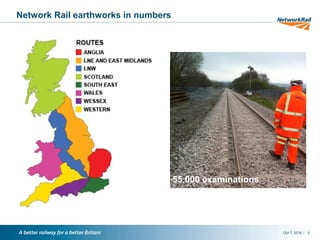
16,000 Route Km190,000 earthworks55,000 examinations
Oct 7, 2016 2
Network Rail earthworks in numbers
/Oct 7, 2016 3
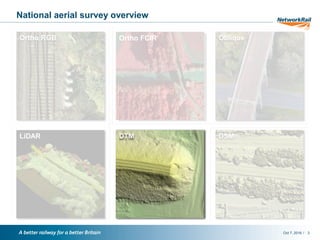
National aerial survey overview
Ortho FCIROrtho FCIR
/Oct 7, 2016 4
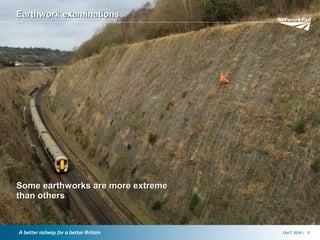
Earthwork examinationsEarthwork examinations
Earthwork inspections costEarthwork inspections cost
between £50 - £120 per fivebetween £50 - £120 per five
chain lengthchain length
There are 190,000 earthworkThere are 190,000 earthwork
assets across the UKassets across the UK
/Oct 7, 2016 5
Earthwork examinationsEarthwork examinations
Some earthworks are more extremeSome earthworks are more extreme
than othersthan others
/Oct 7, 2016 6
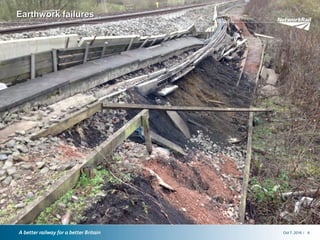
Earthwork failuresEarthwork failures
/Oct 7, 2016 7
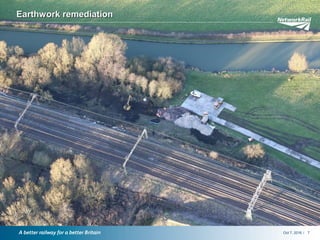
Earthwork remediationEarthwork remediation
/Oct 7, 2016 8
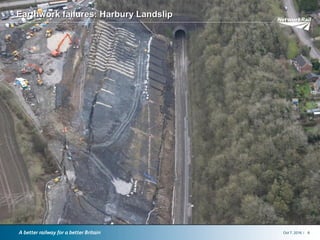
Earthwork failures: Harbury LandslipEarthwork failures: Harbury Landslip
/Oct 7, 2016 9
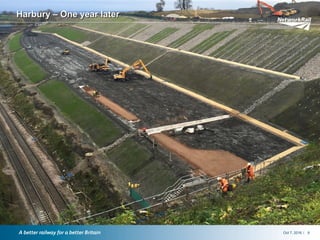
Harbury – One year laterHarbury – One year later
/Oct 7, 2016 10
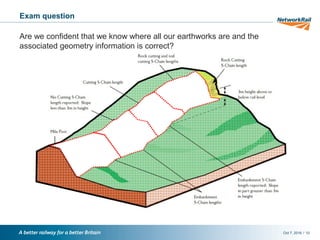
Exam question
Are we confident that we know where all our earthworks are and the
associated geometry information is correct?
/Oct 7, 2016 11
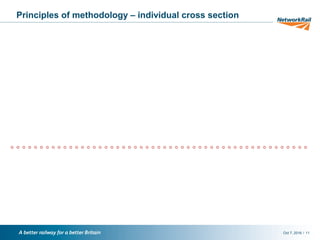
Principles of methodology – individual cross section
/Oct 7, 2016 12
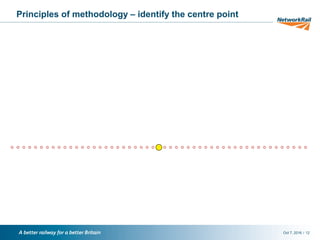
Principles of methodology – identify the centre point
/Oct 7, 2016 13
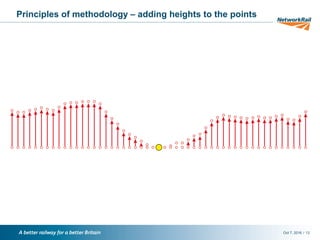
Principles of methodology – adding heights to the points
/Oct 7, 2016 14
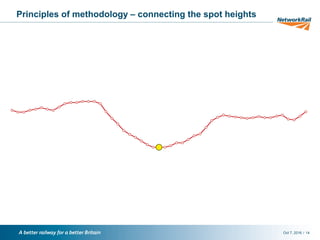
Principles of methodology – connecting the spot heights
/Oct 7, 2016 15
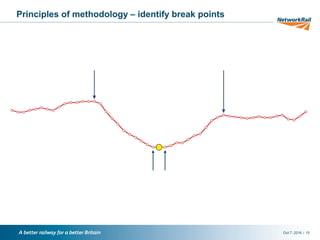
Principles of methodology – identify break points
/Oct 7, 2016 16
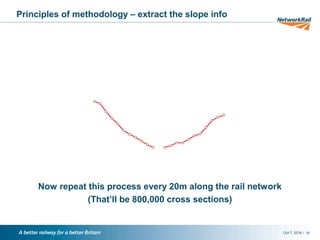
Principles of methodology – extract the slope info
Now repeat this process every 20m along the rail network
(That’ll be 800,000 cross sections)
/Oct 7, 2016 17
Applying the methodology – Never Inspected
In September 2015 we had 36,000 sites that were never inspected.
By April 2016 we had less than 6,000
80% of the 30,000 records were removed without the need to set foot on
track.
This involved analysing 150,000 cross sections and over 15m spot heights
Manual inspections of these sites would have cost in the region of £1.2m
/Oct 7, 2016 18
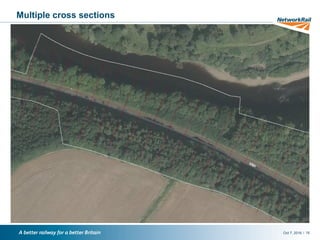
Multiple cross sections
/Oct 7, 2016 19
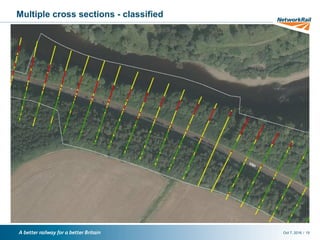
Multiple cross sections - classified
/Oct 7, 2016 20
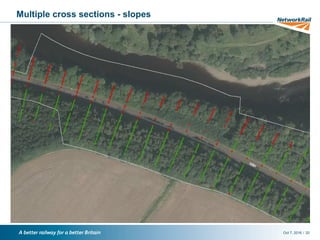
Multiple cross sections - slopes
/Oct 7, 2016 21
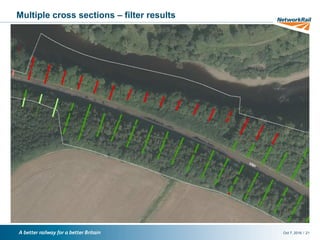
Multiple cross sections – filter results
/Oct 7, 2016 22
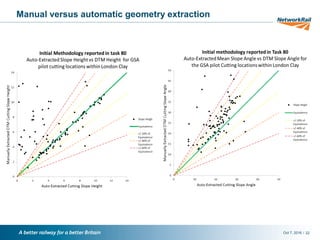
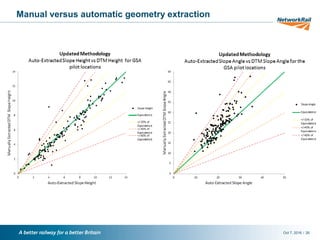
Manual versus automatic geometry extraction
/Oct 7, 2016 23
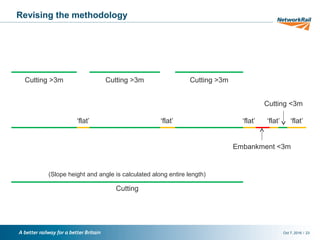
Revising the methodology
Cutting
(Slope height and angle is calculated along entire length)
Cutting >3m Cutting >3m Cutting >3m
Embankment <3m
‘flat’
Cutting <3m
‘flat’ ‘flat’ ‘flat’ ‘flat’
/Oct 7, 2016 24
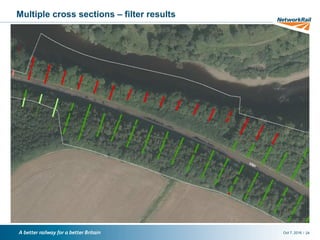
Multiple cross sections – filter results
/Oct 7, 2016 25
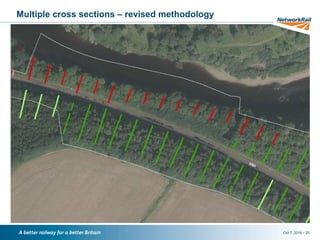
Multiple cross sections – revised methodology
/Oct 7, 2016 26
Manual versus automatic geometry extraction
/Oct 7, 2016 27
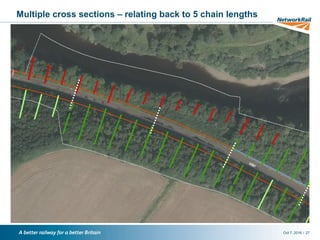
Multiple cross sections – relating back to 5 chain lengths
/Oct 7, 2016 28
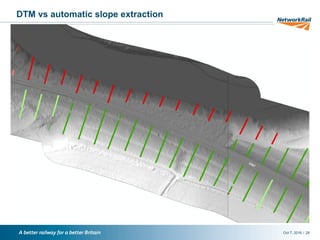
DTM vs automatic slope extraction
/Oct 7, 2016 29
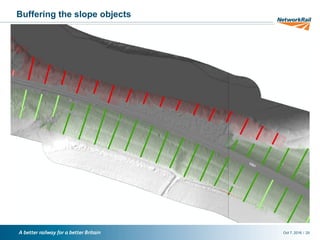
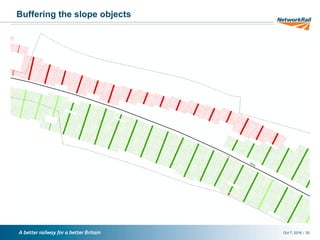
Buffering the slope objects
/Oct 7, 2016 30
Buffering the slope objects
/Oct 7, 2016 31
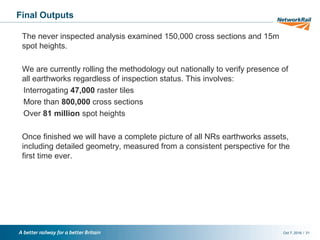
Final Outputs
The never inspected analysis examined 150,000 cross sections and 15m
spot heights.
We are currently rolling the methodology out nationally to verify presence of
all earthworks regardless of inspection status. This involves:
•Interrogating 47,000 raster tiles
•More than 800,000 cross sections
•Over 81 million spot heights
Once finished we will have a complete picture of all NRs earthworks assets,
including detailed geometry, measured from a consistent perspective for the
first time ever.
/Oct 7, 2016 32
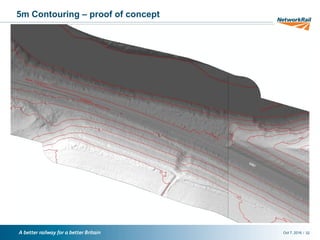
5m Contouring – proof of concept
/Oct 7, 2016 33
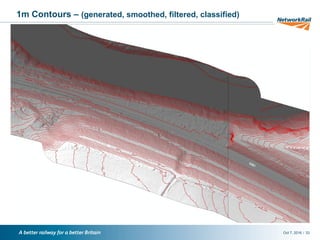
1m Contours – (generated, smoothed, filtered, classified)
/Oct 7, 2016 34
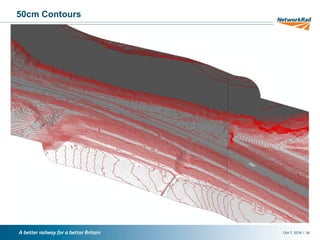
50cm Contours
/Oct 7, 2016 35
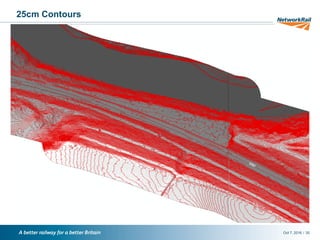
25cm Contours
/Oct 7, 2016 36
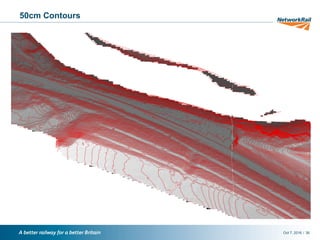
50cm Contours
/Oct 7, 2016 38
Conclusions
No one GIS system meets all requirements of such complex analysis
•Collaborative use ArcGIS, ArcPro, ArcPy & FME
Always develop a robust but flexible methodology
Complex analysis requires comprehensive data management
//Oct 7, 2016 39
Stephen Brooks
Senior Engineer
Safety, Technical & Engineering: Buildings & Civils
https://uk.linkedin.com/in/stephenrbrooks
Thank you

Esri Scotland Conf 2016 Network Rail

  • 1.
    //Oct 7, 20161 Stephen Brooks Senior Engineer Safety, Technical & Engineering: Buildings & Civils https://uk.linkedin.com/in/stephenrbrooks Evaluating & managing earthwork assets with GIS* (*without getting my shoes muddy)
  • 2.
    / 16,000 Route Km190,000earthworks55,000 examinations Oct 7, 2016 2 Network Rail earthworks in numbers
  • 3.
    /Oct 7, 20163 National aerial survey overview Ortho FCIROrtho FCIR
  • 4.
    /Oct 7, 20164 Earthwork examinationsEarthwork examinations Earthwork inspections costEarthwork inspections cost between £50 - £120 per fivebetween £50 - £120 per five chain lengthchain length There are 190,000 earthworkThere are 190,000 earthwork assets across the UKassets across the UK
  • 5.
    /Oct 7, 20165 Earthwork examinationsEarthwork examinations Some earthworks are more extremeSome earthworks are more extreme than othersthan others
  • 6.
    /Oct 7, 20166 Earthwork failuresEarthwork failures
  • 7.
    /Oct 7, 20167 Earthwork remediationEarthwork remediation
  • 8.
    /Oct 7, 20168 Earthwork failures: Harbury LandslipEarthwork failures: Harbury Landslip
  • 9.
    /Oct 7, 20169 Harbury – One year laterHarbury – One year later
  • 10.
    /Oct 7, 201610 Exam question Are we confident that we know where all our earthworks are and the associated geometry information is correct?
  • 11.
    /Oct 7, 201611 Principles of methodology – individual cross section
  • 12.
    /Oct 7, 201612 Principles of methodology – identify the centre point
  • 13.
    /Oct 7, 201613 Principles of methodology – adding heights to the points
  • 14.
    /Oct 7, 201614 Principles of methodology – connecting the spot heights
  • 15.
    /Oct 7, 201615 Principles of methodology – identify break points
  • 16.
    /Oct 7, 201616 Principles of methodology – extract the slope info Now repeat this process every 20m along the rail network (That’ll be 800,000 cross sections)
  • 17.
    /Oct 7, 201617 Applying the methodology – Never Inspected In September 2015 we had 36,000 sites that were never inspected. By April 2016 we had less than 6,000 80% of the 30,000 records were removed without the need to set foot on track. This involved analysing 150,000 cross sections and over 15m spot heights Manual inspections of these sites would have cost in the region of £1.2m
  • 18.
    /Oct 7, 201618 Multiple cross sections
  • 19.
    /Oct 7, 201619 Multiple cross sections - classified
  • 20.
    /Oct 7, 201620 Multiple cross sections - slopes
  • 21.
    /Oct 7, 201621 Multiple cross sections – filter results
  • 22.
    /Oct 7, 201622 Manual versus automatic geometry extraction
  • 23.
    /Oct 7, 201623 Revising the methodology Cutting (Slope height and angle is calculated along entire length) Cutting >3m Cutting >3m Cutting >3m Embankment <3m ‘flat’ Cutting <3m ‘flat’ ‘flat’ ‘flat’ ‘flat’
  • 24.
    /Oct 7, 201624 Multiple cross sections – filter results
  • 25.
    /Oct 7, 201625 Multiple cross sections – revised methodology
  • 26.
    /Oct 7, 201626 Manual versus automatic geometry extraction
  • 27.
    /Oct 7, 201627 Multiple cross sections – relating back to 5 chain lengths
  • 28.
    /Oct 7, 201628 DTM vs automatic slope extraction
  • 29.
    /Oct 7, 201629 Buffering the slope objects
  • 30.
    /Oct 7, 201630 Buffering the slope objects
  • 31.
    /Oct 7, 201631 Final Outputs The never inspected analysis examined 150,000 cross sections and 15m spot heights. We are currently rolling the methodology out nationally to verify presence of all earthworks regardless of inspection status. This involves: •Interrogating 47,000 raster tiles •More than 800,000 cross sections •Over 81 million spot heights Once finished we will have a complete picture of all NRs earthworks assets, including detailed geometry, measured from a consistent perspective for the first time ever.
  • 32.
    /Oct 7, 201632 5m Contouring – proof of concept
  • 33.
    /Oct 7, 201633 1m Contours – (generated, smoothed, filtered, classified)
  • 34.
    /Oct 7, 201634 50cm Contours
  • 35.
    /Oct 7, 201635 25cm Contours
  • 36.
    /Oct 7, 201636 50cm Contours
  • 37.
    /Oct 7, 201638 Conclusions No one GIS system meets all requirements of such complex analysis •Collaborative use ArcGIS, ArcPro, ArcPy & FME Always develop a robust but flexible methodology Complex analysis requires comprehensive data management
  • 38.
    //Oct 7, 201639 Stephen Brooks Senior Engineer Safety, Technical & Engineering: Buildings & Civils https://uk.linkedin.com/in/stephenrbrooks Thank you

Editor's Notes

  • #4 Data available for projects
  • #39 Always develop a robust but flexible methodology that: is produced in conjunction with subject matter experts has flexible parameters is scalable balances automation with manual input produces output using language that SMEs understand you can track progress is well documented Complex analysis requires comprehensive data management that is: systematic &amp; logical accessible to others well documented