Whitstable Town Hall Meeting -

Cromwell Road Embankment Works

Thursday 3rd May 2012 – St Marys Hall, Whitstable – 18:30


 Rev Paul Wilson and John Burrows
Before We Start…….

• Fire Evacuation Procedure
• Fire Exits
• Mobile Phones
• Any Members of the Press ?
• Filming
Agenda

• Residents Concerns – Julie Wassmer
• Geotechnics Report – Simon Abbott
• Track Geometry – Jordan Faulkner
• Environmental Issues – Glen Brown
• Work Scope and Method – Martin Pope
• Notification Policy & Lessons Learnt – Glen Brown
• Summary
• Questions Session
Resident’s Concerns and
Objections
Clay Embankments and the
Problems Associated with
Vegetation

Simon Abbott (BEng), CGeol, FGS, – Senior Asset Engineer (Geotechnics)
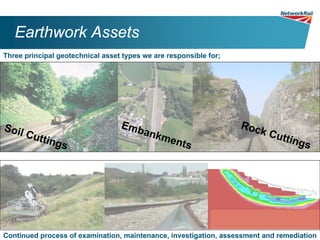
Earthwork Assets
Three principal geotechnical asset types we are responsible for;


Soil                              Emb                              R oc
       Cutt                              ank                            k Cu
            ings                             men                               tting
                                                ts                                   s


Continued process of examination, maintenance, investigation, assessment and remediation
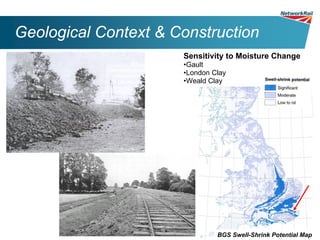
Geological Context & Construction
                      Sensitivity to Moisture Change
                      •Gault
                      •London Clay
                      •Weald Clay


                               BGS Swell-Shrink Potential Map
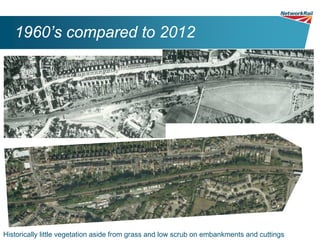
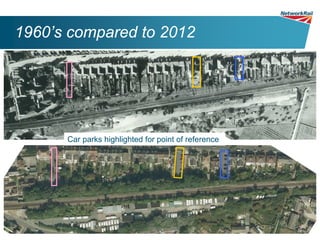
1960’s compared to 2012


Historically little vegetation aside from grass and low scrub on embankments and cuttings
1960’s compared to 2012


      Car parks highlighted for point of reference
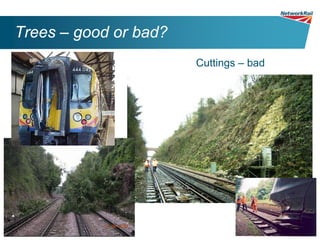
Trees – good or bad?
                       Cuttings – bad
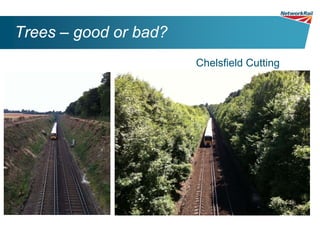
Trees – good or bad?
                       Chelsfield Cutting
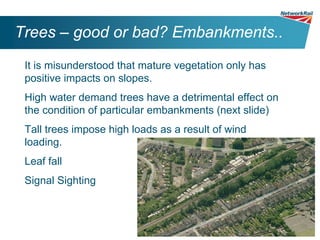
Trees – good or bad? Embankments..
 It is misunderstood that mature vegetation only has
 positive impacts on slopes.
 High water demand trees have a detrimental effect on
 the condition of particular embankments (next slide)
 Tall trees impose high loads as a result of wind
 loading.
 Leaf fall
 Signal Sighting
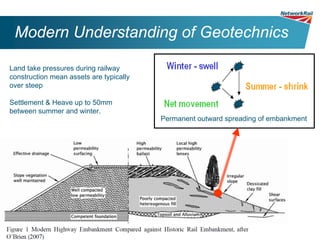
Modern Understanding of Geotechnics

Land take pressures during railway
construction mean assets are typically
over steep

Settlement & Heave up to 50mm
between summer and winter.
                                         Permanent outward spreading of embankment
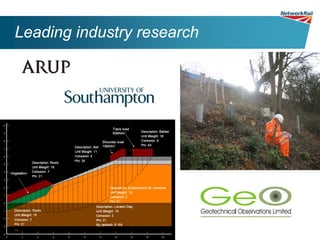
Leading industry research
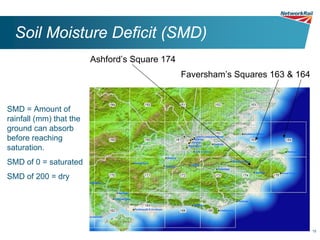
Soil Moisture Deficit (SMD)
                         Ashford’s Square 174
                                                Faversham’s Squares 163 & 164


SMD = Amount of
rainfall (mm) that the
ground can absorb
before reaching
saturation.
SMD of 0 = saturated
SMD of 200 = dry


                                                                                15
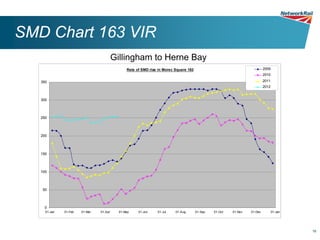
SMD Chart 163 VIR
                                         Gillingham to Herne Bay
                                               Rate of SMD rise in Morec Square 163                                       2009
                                                                                                                          2010

   350                                                                                                                    2011
                                                                                                                          2012


   300


   250


   200


   150


   100


   50


    0
     01-Jan   01-Feb   01-Mar   01-Apr     01-May    01-Jun    01-Jul    01-Aug       01-Sep   01-Oct   01-Nov   01-Dec          01-Jan


                                                                                                                                          16
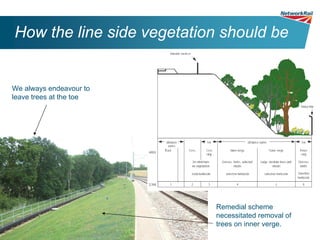
How the line side vegetation should be


We always endeavour to
leave trees at the toe


                           Remedial scheme
                           necessitated removal of
                           trees on inner verge.
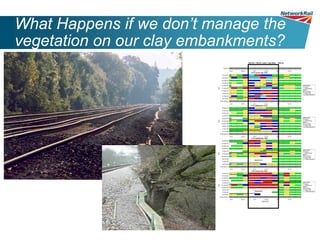
What Happens if we don’t manage the
vegetation on our clay embankments?
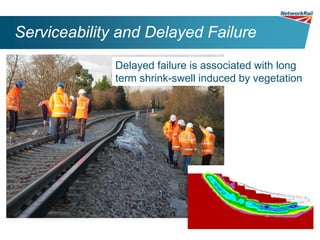
Serviceability and Delayed Failure
              Delayed failure is associated with long
              term shrink-swell induced by vegetation
References:

• Briggs, K (2010). Charing Embankment: Climate Change
  Impacts on Embankment Hydrology. Cooling Prize 2010 Winning
  Submission.
• Loveridge, F.A et al (2010). The impact of climate and climate
  change on UK Infrastructure slopes.
• Smethurst, J.A etc al (2005). Seasonal changes in pore water
  pressure in a grass covered cut slope in London Clay.
• O’Brien, A.S.O et al (2004). Old Railway Embankment Clay Fill –
  Laboratory Experiments, Numerical Modelling and Field
  Behaviour.
• CIRIA Special Publication C592 (2003). Infrastructure
  Embankments – condition appraisal and remedial techniques.
Track Geometry


Jordan Faulkner – Track Maintenance Engineer (Faversham)
Network Rail Standards – Track Maintenance

Working to Network Rail standards
that are applied nationally for
inspection and maintenance of track.
The standard specifies:

• Minimum frequencies for
inspections.
• Processes for carrying out
inspections.
• Details those track geometry faults
which require action.
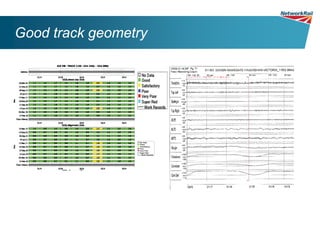
Good track geometry
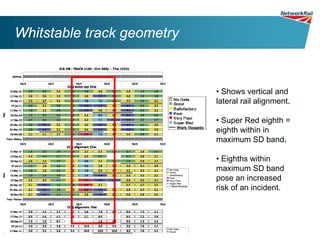
Whitstable track geometry


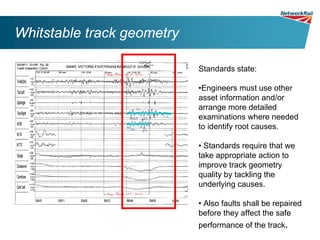
                            • Shows vertical and
                            lateral rail alignment.

                            • Super Red eighth =
                            eighth within in
                            maximum SD band.
                            • Eighths within
                            maximum SD band
                            pose an increased
                            risk of an incident.
Whitstable track geometry

                            Standards state:

                            •Engineers must use other
                            asset information and/or
                            arrange more detailed
                            examinations where needed
                            to identify root causes.

                            • Standards require that we
                            take appropriate action to
                            improve track geometry
                            quality by tackling the
                            underlying causes.

                            • Also faults shall be repaired
                            before they affect the safe
                            performance of the track.
Track Geometry

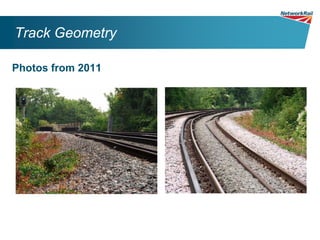
Photos from 2011
Clay Bank Vegetation Management
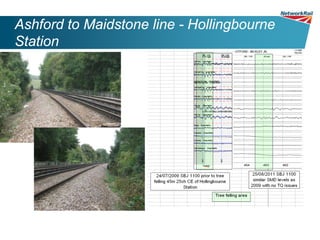
Ashford to Maidstone line - Hollingbourne
Station
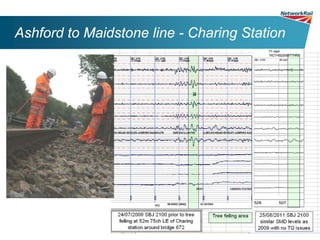
Ashford to Maidstone line - Charing Station
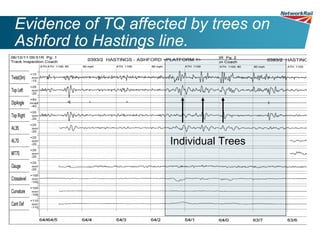
Evidence of TQ affected by trees on
Ashford to Hastings line.


                     Individual Trees
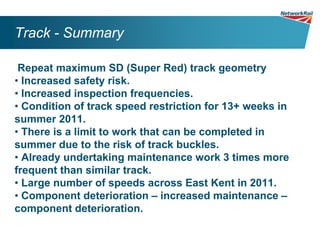
Track - Summary

 Repeat maximum SD (Super Red) track geometry
• Increased safety risk.
• Increased inspection frequencies.
• Condition of track speed restriction for 13+ weeks in
summer 2011.
• There is a limit to work that can be completed in
summer due to the risk of track buckles.
• Already undertaking maintenance work 3 times more
frequent than similar track.
• Large number of speeds across East Kent in 2011.
• Component deterioration – increased maintenance –
component deterioration.
Environmental Concerns and Summary of
 Vegetation Management


Angela Cruickshanks – Infrastructure Maintenance Environmental Specialist
(BSc/MSc Environmental Consultancy, AIEMA)

Martin Pope – Infrastructure Maintenance Programme Manager

  Date 00.00.00                                                             32
Environmental Concerns

• Pre-work survey completed by Network Rail to identify if any
  protected areas in the vicinity or any protected trees are present
• Daily site inspection recorded by the contractor to identify any
  nesting birds in the area of work
• Risk of nesting birds identified by Network Rail in the work
  package plan and provided to the contractor
• Consultation with Natural England to advise on the scope of the
  works
• Site walkouts completed to identify nests by the Network Rail
  Environment Specialist, Lineside Engineer and Programme
  Manager

      Presentation title to go here                                    33
Environmental Legislation/Mitigation

• Under the Wildlife and Countryside Act 1981, all wild birds, their
  eggs and nests are protected
• It is an offence to intentionally take, damage or destroy the nest
  of any bird while in use or being built.
• There is no reference in the Wildlife and Countryside Act 1981 to
  specific dates when vegetation work cannot be carried out as
  birds potentially nest all year round and is dependant on climate
• Contractor advised to create an exclusion zone of 2m
  surrounding any potential nests identified as per the company
  corporate guidance
Proposed Plan

• Phase 1 - Remove all younger Sycamore re-growth close to the
  lineside first and any dense shrubbery which restricts access to
  larger trees
• Phase 2 – Re-Survey the large Sycamore trees for nest which
  may be covered by the ivy. NB The ivy indicates poor health of
  the trees and some trees identified as decaying
• Any larger trees where birds are not nesting shall be removed in
  accordance with the specifications discussed.
• A proposal to use other Network Rail land to create a dense
  woodland to compensate for the woodland habitat removed at
  Whitstable in a habitat trading scheme
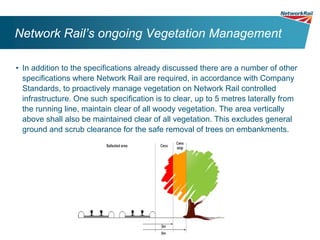
Network Rail’s ongoing Vegetation Management

• In addition to the specifications already discussed there are a number of other
  specifications where Network Rail are required, in accordance with Company
  Standards, to proactively manage vegetation on Network Rail controlled
  infrastructure. One such specification is to clear, up to 5 metres laterally from
  the running line, maintain clear of all woody vegetation. The area vertically
  above shall also be maintained clear of all vegetation. This excludes general
  ground and scrub clearance for the safe removal of trees on embankments.
The Network Rail

Pre Notification Policy


Glen Brown – Maintenance Protection Co-ordinator
Pre Notification of Works Policy

• Maintenance is the general day-to-day upkeep of the railway which keeps the
  trains running, for instance looking after tracks, signals, power supply and
  vegetation. Engineering is the larger scale infrastructure work, for example
  track replacement and upgrade works.

• When we are planning engineering works near residential areas, we aim to
  send letters to local people 10 days before the work begins. The letters explain
  what we plan to do and when we expect the works to start and finish.

• For maintenance work (such as emergency repairs or general up-keep), it is not
  possible for us to tell the people who live nearby. This is because maintenance
  work takes place every day and night of the year on the railway all over the
  country which makes it impractical to give advance notice to all the people
  affected by every job.
Pre Notification of Works Policy

• The vegetation works carried out in the Whitstable area are classified
  as maintenance works. Due to the timescales involved, letter drops
  were done in good will at Cromwell Road several days before work was
  due to start on this side of the railway.

• If we can, we will work on the plants and trees near the railway during
  the day between Monday and Friday, but sometimes we have to work
  at nights or weekends so that we can keep our staff safe and the trains
  running.

• If we are working in an area for a prolonged period, we try to let our
  neighbours know through letter drops. We will also contact the
  appropriate local authority informally and if necessary submit a formal
  activity and noise application to obtain consent.
Lessons Learnt –

Cromwell Road Tree Clearance


Glen Brown – Maintenance Protection Co-ordinator
What we could have done much better…

• Network Rail standard letter templates were not used as the contractor was
asked to manage this process without full guide lines on our process being
provided.

• Our contractors have been fully re-briefed on the NR pre-
notification policy and the new updated templates to use.


• Letters should have been more descriptive of the works being carried out so
as to avoid confusion that all trees were being removed from the embankment.

• The words “Vegetation Clearance” are open to interpretation and very rarely mean
all vegetation. These have been changed to be more descriptive on our new
template.
and how we are making it better?

• Letters should have been distributed to affected residents 10 days in advance
of the works through our postal service – Via post.

• All larger scale vegetation works are to be notified to the MPC so that letters
can be sent out 14 days in advance as we do with all engineering projects or
road closures etc.


• Managing the publics expectations when stopping works was not handled
well.
• Information given to the public was reactive and did not explain that the site
must by law be left safe and that this may require a bit more time of noise to
achieve.
Questions & Answers
• THANK YOU FOR ATTENDING AND GOODNIGHT.

Network Rail presentation whitstable may2012 (1)

  • 1.
    Whitstable Town HallMeeting - Cromwell Road Embankment Works Thursday 3rd May 2012 – St Marys Hall, Whitstable – 18:30 Rev Paul Wilson and John Burrows
  • 2.
    Before We Start……. •Fire Evacuation Procedure • Fire Exits • Mobile Phones • Any Members of the Press ? • Filming
  • 3.
    Agenda • Residents Concerns– Julie Wassmer • Geotechnics Report – Simon Abbott • Track Geometry – Jordan Faulkner • Environmental Issues – Glen Brown • Work Scope and Method – Martin Pope • Notification Policy & Lessons Learnt – Glen Brown • Summary • Questions Session
  • 4.
  • 5.
    Clay Embankments andthe Problems Associated with Vegetation Simon Abbott (BEng), CGeol, FGS, – Senior Asset Engineer (Geotechnics)
  • 6.
    Earthwork Assets Three principalgeotechnical asset types we are responsible for; Soil Emb R oc Cutt ank k Cu ings men tting ts s Continued process of examination, maintenance, investigation, assessment and remediation
  • 7.
    Geological Context &Construction Sensitivity to Moisture Change •Gault •London Clay •Weald Clay BGS Swell-Shrink Potential Map
  • 8.
    1960’s compared to2012 Historically little vegetation aside from grass and low scrub on embankments and cuttings
  • 9.
    1960’s compared to2012 Car parks highlighted for point of reference
  • 10.
    Trees – goodor bad? Cuttings – bad
  • 11.
    Trees – goodor bad? Chelsfield Cutting
  • 12.
    Trees – goodor bad? Embankments.. It is misunderstood that mature vegetation only has positive impacts on slopes. High water demand trees have a detrimental effect on the condition of particular embankments (next slide) Tall trees impose high loads as a result of wind loading. Leaf fall Signal Sighting
  • 13.
    Modern Understanding ofGeotechnics Land take pressures during railway construction mean assets are typically over steep Settlement & Heave up to 50mm between summer and winter. Permanent outward spreading of embankment
  • 14.
  • 15.
    Soil Moisture Deficit(SMD) Ashford’s Square 174 Faversham’s Squares 163 & 164 SMD = Amount of rainfall (mm) that the ground can absorb before reaching saturation. SMD of 0 = saturated SMD of 200 = dry 15
  • 16.
    SMD Chart 163VIR Gillingham to Herne Bay Rate of SMD rise in Morec Square 163 2009 2010 350 2011 2012 300 250 200 150 100 50 0 01-Jan 01-Feb 01-Mar 01-Apr 01-May 01-Jun 01-Jul 01-Aug 01-Sep 01-Oct 01-Nov 01-Dec 01-Jan 16
  • 17.
    How the lineside vegetation should be We always endeavour to leave trees at the toe Remedial scheme necessitated removal of trees on inner verge.
  • 18.
    What Happens ifwe don’t manage the vegetation on our clay embankments?
  • 19.
    Serviceability and DelayedFailure Delayed failure is associated with long term shrink-swell induced by vegetation
  • 20.
    References: • Briggs, K(2010). Charing Embankment: Climate Change Impacts on Embankment Hydrology. Cooling Prize 2010 Winning Submission. • Loveridge, F.A et al (2010). The impact of climate and climate change on UK Infrastructure slopes. • Smethurst, J.A etc al (2005). Seasonal changes in pore water pressure in a grass covered cut slope in London Clay. • O’Brien, A.S.O et al (2004). Old Railway Embankment Clay Fill – Laboratory Experiments, Numerical Modelling and Field Behaviour. • CIRIA Special Publication C592 (2003). Infrastructure Embankments – condition appraisal and remedial techniques.
  • 21.
    Track Geometry Jordan Faulkner– Track Maintenance Engineer (Faversham)
  • 22.
    Network Rail Standards– Track Maintenance Working to Network Rail standards that are applied nationally for inspection and maintenance of track. The standard specifies: • Minimum frequencies for inspections. • Processes for carrying out inspections. • Details those track geometry faults which require action.
  • 23.
  • 24.
    Whitstable track geometry • Shows vertical and lateral rail alignment. • Super Red eighth = eighth within in maximum SD band. • Eighths within maximum SD band pose an increased risk of an incident.
  • 25.
    Whitstable track geometry Standards state: •Engineers must use other asset information and/or arrange more detailed examinations where needed to identify root causes. • Standards require that we take appropriate action to improve track geometry quality by tackling the underlying causes. • Also faults shall be repaired before they affect the safe performance of the track.
  • 26.
  • 27.
  • 28.
    Ashford to Maidstoneline - Hollingbourne Station
  • 29.
    Ashford to Maidstoneline - Charing Station
  • 30.
    Evidence of TQaffected by trees on Ashford to Hastings line. Individual Trees
  • 31.
    Track - Summary Repeat maximum SD (Super Red) track geometry • Increased safety risk. • Increased inspection frequencies. • Condition of track speed restriction for 13+ weeks in summer 2011. • There is a limit to work that can be completed in summer due to the risk of track buckles. • Already undertaking maintenance work 3 times more frequent than similar track. • Large number of speeds across East Kent in 2011. • Component deterioration – increased maintenance – component deterioration.
  • 32.
    Environmental Concerns andSummary of Vegetation Management Angela Cruickshanks – Infrastructure Maintenance Environmental Specialist (BSc/MSc Environmental Consultancy, AIEMA) Martin Pope – Infrastructure Maintenance Programme Manager Date 00.00.00 32
  • 33.
    Environmental Concerns • Pre-worksurvey completed by Network Rail to identify if any protected areas in the vicinity or any protected trees are present • Daily site inspection recorded by the contractor to identify any nesting birds in the area of work • Risk of nesting birds identified by Network Rail in the work package plan and provided to the contractor • Consultation with Natural England to advise on the scope of the works • Site walkouts completed to identify nests by the Network Rail Environment Specialist, Lineside Engineer and Programme Manager Presentation title to go here 33
  • 34.
    Environmental Legislation/Mitigation • Underthe Wildlife and Countryside Act 1981, all wild birds, their eggs and nests are protected • It is an offence to intentionally take, damage or destroy the nest of any bird while in use or being built. • There is no reference in the Wildlife and Countryside Act 1981 to specific dates when vegetation work cannot be carried out as birds potentially nest all year round and is dependant on climate • Contractor advised to create an exclusion zone of 2m surrounding any potential nests identified as per the company corporate guidance
  • 35.
    Proposed Plan • Phase1 - Remove all younger Sycamore re-growth close to the lineside first and any dense shrubbery which restricts access to larger trees • Phase 2 – Re-Survey the large Sycamore trees for nest which may be covered by the ivy. NB The ivy indicates poor health of the trees and some trees identified as decaying • Any larger trees where birds are not nesting shall be removed in accordance with the specifications discussed. • A proposal to use other Network Rail land to create a dense woodland to compensate for the woodland habitat removed at Whitstable in a habitat trading scheme
  • 36.
    Network Rail’s ongoingVegetation Management • In addition to the specifications already discussed there are a number of other specifications where Network Rail are required, in accordance with Company Standards, to proactively manage vegetation on Network Rail controlled infrastructure. One such specification is to clear, up to 5 metres laterally from the running line, maintain clear of all woody vegetation. The area vertically above shall also be maintained clear of all vegetation. This excludes general ground and scrub clearance for the safe removal of trees on embankments.
  • 37.
    The Network Rail PreNotification Policy Glen Brown – Maintenance Protection Co-ordinator
  • 38.
    Pre Notification ofWorks Policy • Maintenance is the general day-to-day upkeep of the railway which keeps the trains running, for instance looking after tracks, signals, power supply and vegetation. Engineering is the larger scale infrastructure work, for example track replacement and upgrade works. • When we are planning engineering works near residential areas, we aim to send letters to local people 10 days before the work begins. The letters explain what we plan to do and when we expect the works to start and finish. • For maintenance work (such as emergency repairs or general up-keep), it is not possible for us to tell the people who live nearby. This is because maintenance work takes place every day and night of the year on the railway all over the country which makes it impractical to give advance notice to all the people affected by every job.
  • 39.
    Pre Notification ofWorks Policy • The vegetation works carried out in the Whitstable area are classified as maintenance works. Due to the timescales involved, letter drops were done in good will at Cromwell Road several days before work was due to start on this side of the railway. • If we can, we will work on the plants and trees near the railway during the day between Monday and Friday, but sometimes we have to work at nights or weekends so that we can keep our staff safe and the trains running. • If we are working in an area for a prolonged period, we try to let our neighbours know through letter drops. We will also contact the appropriate local authority informally and if necessary submit a formal activity and noise application to obtain consent.
  • 40.
    Lessons Learnt – CromwellRoad Tree Clearance Glen Brown – Maintenance Protection Co-ordinator
  • 41.
    What we couldhave done much better… • Network Rail standard letter templates were not used as the contractor was asked to manage this process without full guide lines on our process being provided. • Our contractors have been fully re-briefed on the NR pre- notification policy and the new updated templates to use. • Letters should have been more descriptive of the works being carried out so as to avoid confusion that all trees were being removed from the embankment. • The words “Vegetation Clearance” are open to interpretation and very rarely mean all vegetation. These have been changed to be more descriptive on our new template.
  • 42.
    and how weare making it better? • Letters should have been distributed to affected residents 10 days in advance of the works through our postal service – Via post. • All larger scale vegetation works are to be notified to the MPC so that letters can be sent out 14 days in advance as we do with all engineering projects or road closures etc. • Managing the publics expectations when stopping works was not handled well. • Information given to the public was reactive and did not explain that the site must by law be left safe and that this may require a bit more time of noise to achieve.
  • 43.
  • 44.
    • THANK YOUFOR ATTENDING AND GOODNIGHT.