© Ordnance Survey
SOLVING SUSTAINABILITY CHALLENGES WITH
GEOSPATIAL INFORMATION
Helping our customers see a sustainable place
OS: What we do
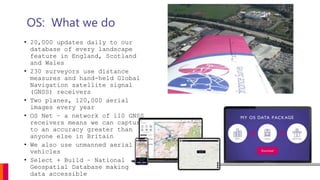
• 20,000 updates daily to our
database of every landscape
feature in England, Scotland
and Wales
• 230 surveyors use distance
measures and hand-held Global
Navigation satellite signal
(GNSS) receivers
• Two planes, 120,000 aerial
images every year
• OS Net – a network of 110 GNSS
receivers means we can capture
to an accuracy greater than
anyone else in Britain
• We also use unmanned aerial
vehicles
• Select + Build – National
Geospatial Database making
data accessible
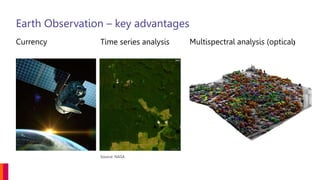
Earth Observation – key advantages
Currency
Source: NASA
Time series analysis Multispectral analysis (optical)
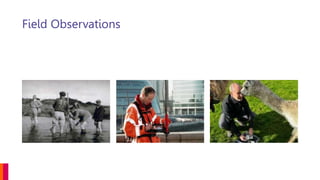
Field Observations
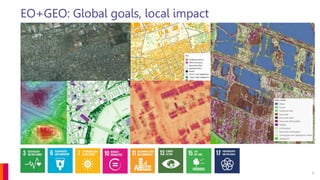
EO+GEO: Global goals, local impact
5
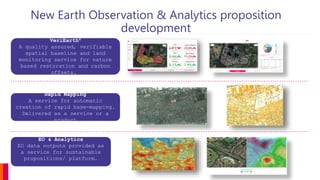
New Earth Observation & Analytics proposition
development
Rapid Mapping
A service for automatic
creation of rapid base-mapping.
Delivered as a service or a
product
VeriEarth®
A quality assured, verifiable
spatial baseline and land
monitoring service for nature
based restoration and carbon
offsets.
EO & Analytics
EO data outputs provided as
a service for sustainable
propositions/ platform.
© Ordnance Survey |
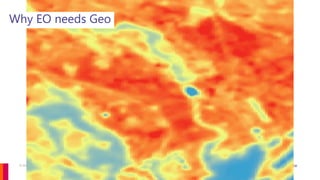
Why EO needs Geo
© Ordnance Survey |
© Ordnance Survey |
© Ordnance Survey |
© Ordnance Survey |
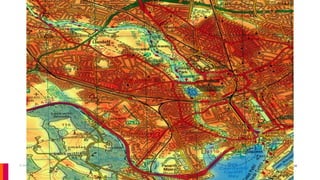
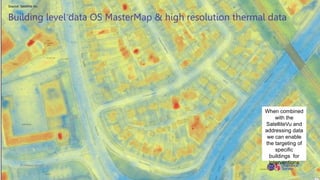
Building level data OS MasterMap & high resolution thermal data
When combined
with the
SatelliteVu and
addressing data
we can enable
the targeting of
specific
buildings for
interventions
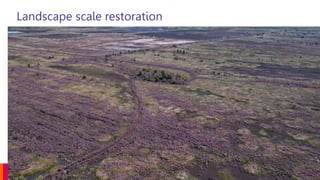
Landscape scale restoration
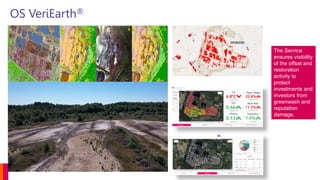
OS VeriEarth®
The Service
ensures visibility
of the offset and
restoration
activity to
protect
investments and
investors from
greenwash and
reputation
damage.
© Ordnance Survey |
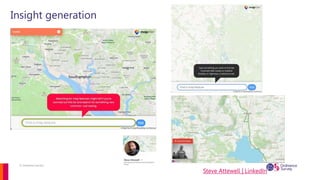
Insight generation
Steve Attewell | LinkedIn
© Ordnance Survey
Collaboration
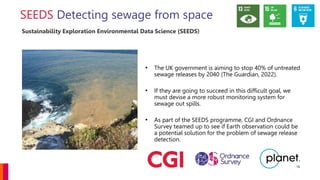
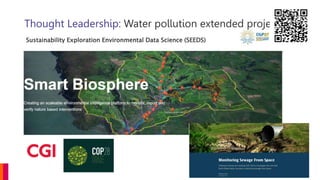
Detecting sewage from space
• The UK government is aiming to stop 40% of untreated
sewage releases by 2040 (The Guardian, 2022).
• If they are going to succeed in this difficult goal, we
must devise a more robust monitoring system for
sewage out spills.
• As part of the SEEDS programme, CGI and Ordnance
Survey teamed up to see if Earth observation could be
a potential solution for the problem of sewage release
detection.
16
Sustainability Exploration Environmental Data Science (SEEDS)
Thought Leadership: Water pollution extended project
Sustainability Exploration Environmental Data Science (SEEDS)
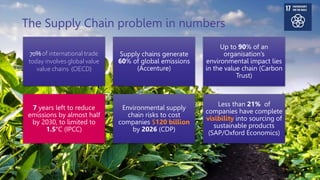
The Supply Chain problem in numbers
Official-Commercial-Sensitive
70% of international trade
today involves global value
value chains (OECD)
Supply chains generate
60% of global emissions
(Accenture)
Up to 90% of an
organisation’s
environmental impact lies
in the value chain (Carbon
Trust)
7 years left to reduce
emissions by almost half
by 2030, to limited to
1.5°C (IPCC)
Environmental supply
chain risks to cost
companies $120 billion
by 2026 (CDP)
Less than 21% of
companies have complete
visibility into sourcing of
sustainable products
(SAP/Oxford Economics)
The supply chain challenge
But companies simply don’t know where things are.
Can EO+GEO help?
Current methods for visibility of the supply chain are no longer
enough to meet regulatory requirements and customer expectations.
Or to reduce corporate exposure risk.
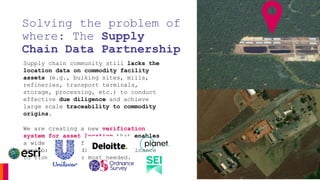
Solving the problem of
where: The Supply
Chain Data Partnership
Supply chain community still lacks the
location data on commodity facility
assets (e.g., bulking sites, mills,
refineries, transport terminals,
storage, processing, etc.) to conduct
effective due diligence and achieve
large scale traceability to commodity
origins.
We are creating a new verification
system for asset location that enables
a wide variety of transparent
monitoring, due diligence and finance
to flow where its most needed.
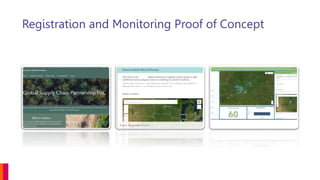
Registration and Monitoring Proof of Concept
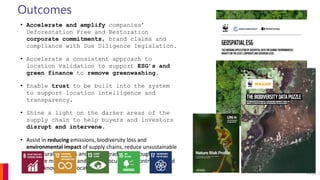
Outcomes
• Accelerate and amplify companies’
Deforestation Free and Restoration
corporate commitments, brand claims and
compliance with Due Diligence legislation.
• Accelerate a consistent approach to
location validation to support ESG’s and
green finance to remove greenwashing.
• Enable trust to be built into the system
to support location intelligence and
transparency.
• Shine a light on the darker areas of the
supply chain to help buyers and investors
disrupt and intervene.
• Assist in reducing emissions, biodiversity loss and
environmental impact of supply chains, reduce unsustainable
agricultural practices and land degradation through more
effective monitoring and smart procurement contracts based
on the known asset location.
Page 2
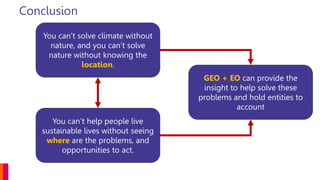
Conclusion
You can’t solve climate without
nature, and you can’t solve
nature without knowing the
location.
You can’t help people live
sustainable lives without seeing
where are the problems, and
opportunities to act.
GEO + EO can provide the
insight to help solve these
problems and hold entities to
account
"In short, our world needs climate
action on all fronts — everything,
everywhere, all at once.”
UN Secretary General Antonio
Guterres March 23
Thank you
Donna.Lyndsay@os.uk
ordnancesurvey.co.uk

Solving sustainability challenges with geospatial information

  • 1.
    © Ordnance Survey SOLVINGSUSTAINABILITY CHALLENGES WITH GEOSPATIAL INFORMATION Helping our customers see a sustainable place
  • 2.
    OS: What wedo • 20,000 updates daily to our database of every landscape feature in England, Scotland and Wales • 230 surveyors use distance measures and hand-held Global Navigation satellite signal (GNSS) receivers • Two planes, 120,000 aerial images every year • OS Net – a network of 110 GNSS receivers means we can capture to an accuracy greater than anyone else in Britain • We also use unmanned aerial vehicles • Select + Build – National Geospatial Database making data accessible
  • 3.
    Earth Observation –key advantages Currency Source: NASA Time series analysis Multispectral analysis (optical)
  • 4.
  • 5.
    EO+GEO: Global goals,local impact 5
  • 6.
    New Earth Observation& Analytics proposition development Rapid Mapping A service for automatic creation of rapid base-mapping. Delivered as a service or a product VeriEarth® A quality assured, verifiable spatial baseline and land monitoring service for nature based restoration and carbon offsets. EO & Analytics EO data outputs provided as a service for sustainable propositions/ platform.
  • 7.
    © Ordnance Survey| Why EO needs Geo
  • 8.
  • 9.
  • 10.
  • 11.
    © Ordnance Survey| Building level data OS MasterMap & high resolution thermal data When combined with the SatelliteVu and addressing data we can enable the targeting of specific buildings for interventions
  • 12.
  • 13.
    OS VeriEarth® The Service ensuresvisibility of the offset and restoration activity to protect investments and investors from greenwash and reputation damage.
  • 14.
    © Ordnance Survey| Insight generation Steve Attewell | LinkedIn
  • 15.
  • 16.
    Detecting sewage fromspace • The UK government is aiming to stop 40% of untreated sewage releases by 2040 (The Guardian, 2022). • If they are going to succeed in this difficult goal, we must devise a more robust monitoring system for sewage out spills. • As part of the SEEDS programme, CGI and Ordnance Survey teamed up to see if Earth observation could be a potential solution for the problem of sewage release detection. 16 Sustainability Exploration Environmental Data Science (SEEDS)
  • 17.
    Thought Leadership: Waterpollution extended project Sustainability Exploration Environmental Data Science (SEEDS)
  • 18.
    The Supply Chainproblem in numbers Official-Commercial-Sensitive 70% of international trade today involves global value value chains (OECD) Supply chains generate 60% of global emissions (Accenture) Up to 90% of an organisation’s environmental impact lies in the value chain (Carbon Trust) 7 years left to reduce emissions by almost half by 2030, to limited to 1.5°C (IPCC) Environmental supply chain risks to cost companies $120 billion by 2026 (CDP) Less than 21% of companies have complete visibility into sourcing of sustainable products (SAP/Oxford Economics)
  • 19.
    The supply chainchallenge But companies simply don’t know where things are. Can EO+GEO help? Current methods for visibility of the supply chain are no longer enough to meet regulatory requirements and customer expectations. Or to reduce corporate exposure risk.
  • 20.
    Solving the problemof where: The Supply Chain Data Partnership Supply chain community still lacks the location data on commodity facility assets (e.g., bulking sites, mills, refineries, transport terminals, storage, processing, etc.) to conduct effective due diligence and achieve large scale traceability to commodity origins. We are creating a new verification system for asset location that enables a wide variety of transparent monitoring, due diligence and finance to flow where its most needed.
  • 21.
  • 22.
    Outcomes • Accelerate andamplify companies’ Deforestation Free and Restoration corporate commitments, brand claims and compliance with Due Diligence legislation. • Accelerate a consistent approach to location validation to support ESG’s and green finance to remove greenwashing. • Enable trust to be built into the system to support location intelligence and transparency. • Shine a light on the darker areas of the supply chain to help buyers and investors disrupt and intervene. • Assist in reducing emissions, biodiversity loss and environmental impact of supply chains, reduce unsustainable agricultural practices and land degradation through more effective monitoring and smart procurement contracts based on the known asset location. Page 2
  • 23.
    Conclusion You can’t solveclimate without nature, and you can’t solve nature without knowing the location. You can’t help people live sustainable lives without seeing where are the problems, and opportunities to act. GEO + EO can provide the insight to help solve these problems and hold entities to account
  • 24.
    "In short, ourworld needs climate action on all fronts — everything, everywhere, all at once.” UN Secretary General Antonio Guterres March 23
  • 25.

Editor's Notes

  • #4 Sentinel-2 data can image the same place in GB every 5 days. Planet report they have the capability to image the same place in GB 12 times a day. Data typically available within 24 hours of capture. Regular and repeatable imagery collection provides the opportunity to look at change over time. Particularly useful for monitoring operations and modelling. Additional spectral information (beyond Red, Green, Blue and Near Infrared) provides additional capability to more accurately identify features, develop novel algorithms and provide additional monitoring capability.
  • #6 Innovating with our customers – means how we can help them meet their needs with new location insights, data fusion, change detection and new data sources Examples on the slide are Auto Feature Extraction used in relation to air quality data, green roofs and vegetation, and new high resolution thermal data from Space. Lusaka is showing location and the extent of informal urban settlement there RPA, DEFRA, The bottom example if from a workshop we undertook with the Greater London Authority to enable them to understand how linking of datasets can provide greater insights into the impact of planning and policy on the city Next steps is to undertake change detection analytic with the GLA. IPCC specifies that urban areas can have a significant role to play in reducing Carbon emissions “Urban areas can create opportunities to increase resource efficiency and significantly reduce GHG emissions through the systemic transition of infrastructure and urban form through low-emission development pathways towards net-zero emissions. Ambitious mitigation efforts for established, rapidly growing and emerging cities will encompass 1) reducing or changing energy and material consumption, 2) electrification, and 3) enhancing carbon uptake and storage in the urban environment. Cities can achieve net-zero emissions, but only if emissions are reduced within and outside of their administrative boundaries through supply chains, which will have beneficial cascading effects across other sectors”
  • #21 Applying systems thinking to geospatial data – by verifying and pin pointing assets we enable EO and other monitoring capabilities to work. Think back to the patient in intensive care – its like knowing where to stick the patch for the most effective monitoring of their health to get the metrics necessary to improve their condition.