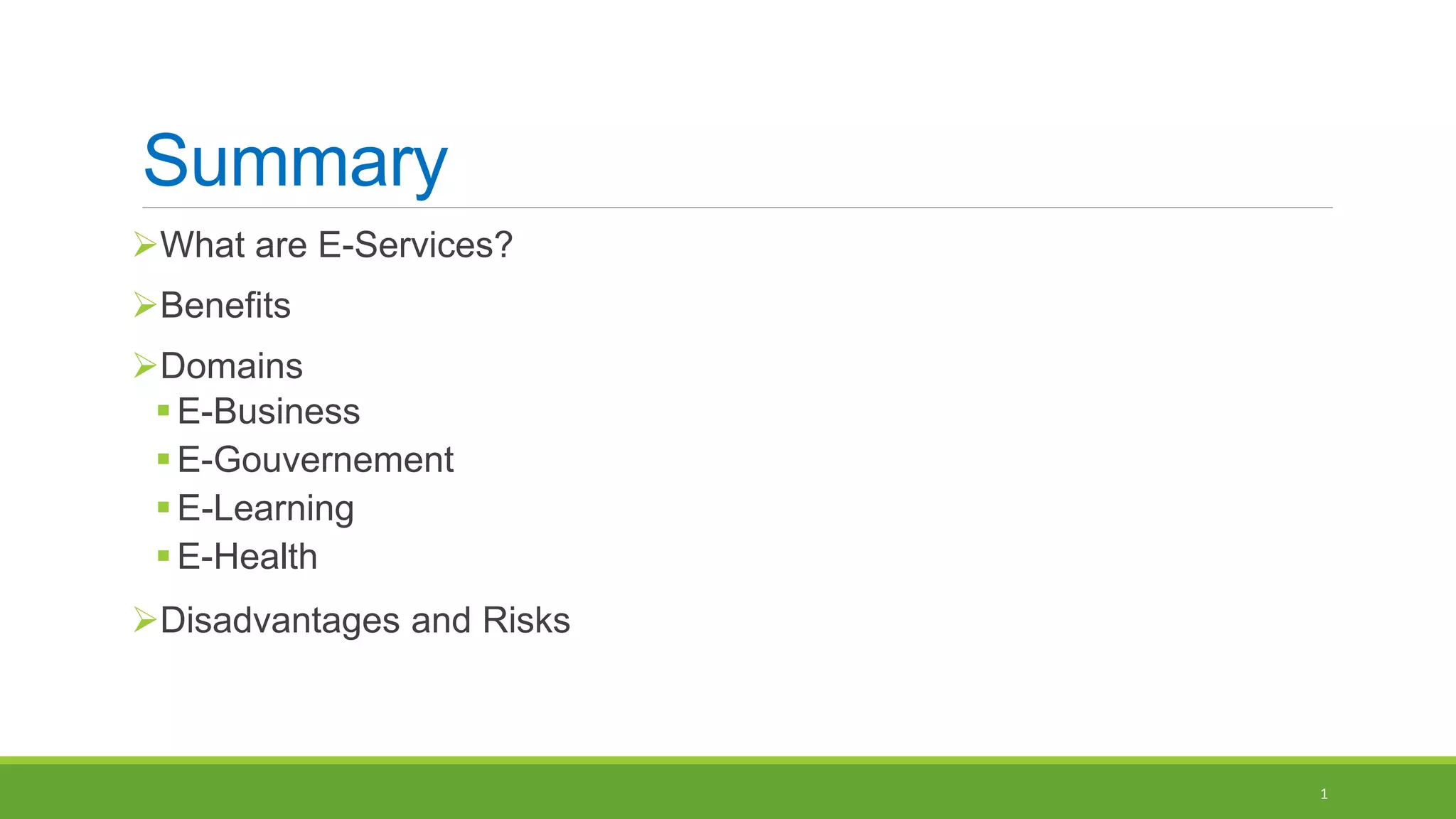
This document defines and discusses e-services. It begins by defining e-services as services that are produced, provided, and consumed through information and communication technologies like the internet. It then discusses the benefits of e-services, including accessing larger customer bases and lowering costs. The main domains of e-services identified are e-business, e-government, e-learning, and e-health. Examples of each domain are provided. The document concludes by noting some disadvantages of e-services, such as the risks of data hacking and costs of ensuring high system performance and reliability.
What are E-Services?
E-Service: Electronic Service
E-services are defined as services that are produced, provided, and/or consumed
through the use of ICT-networks such as for example Internet-based systems and mobile
solutions [ADASCUPOLA01]
E-services Software paradigm enabling peer-to-peer computation in distributed
environments based on the concept of “service” as an autonomous piece of code
published in the network. [HRPIT01]
Services provided to customers through digital. [HREGEE01]
2
4.
E-Service : Characteristics
E-Servicesare:
Open: Independent, as much as possible, of specific platforms and computer
paradigms.
Developed not only for intra-organization applications, but also for independent
organizations applications, to be assembled and reused in a distributed internet-
based cooperative enviornment.
Easily composable: assembling and integrating the e-service in a inter-oraganization
application does not require the development of complex adapters.
E-service base parts:
Service providor
Service consumer
Networks
3
5.
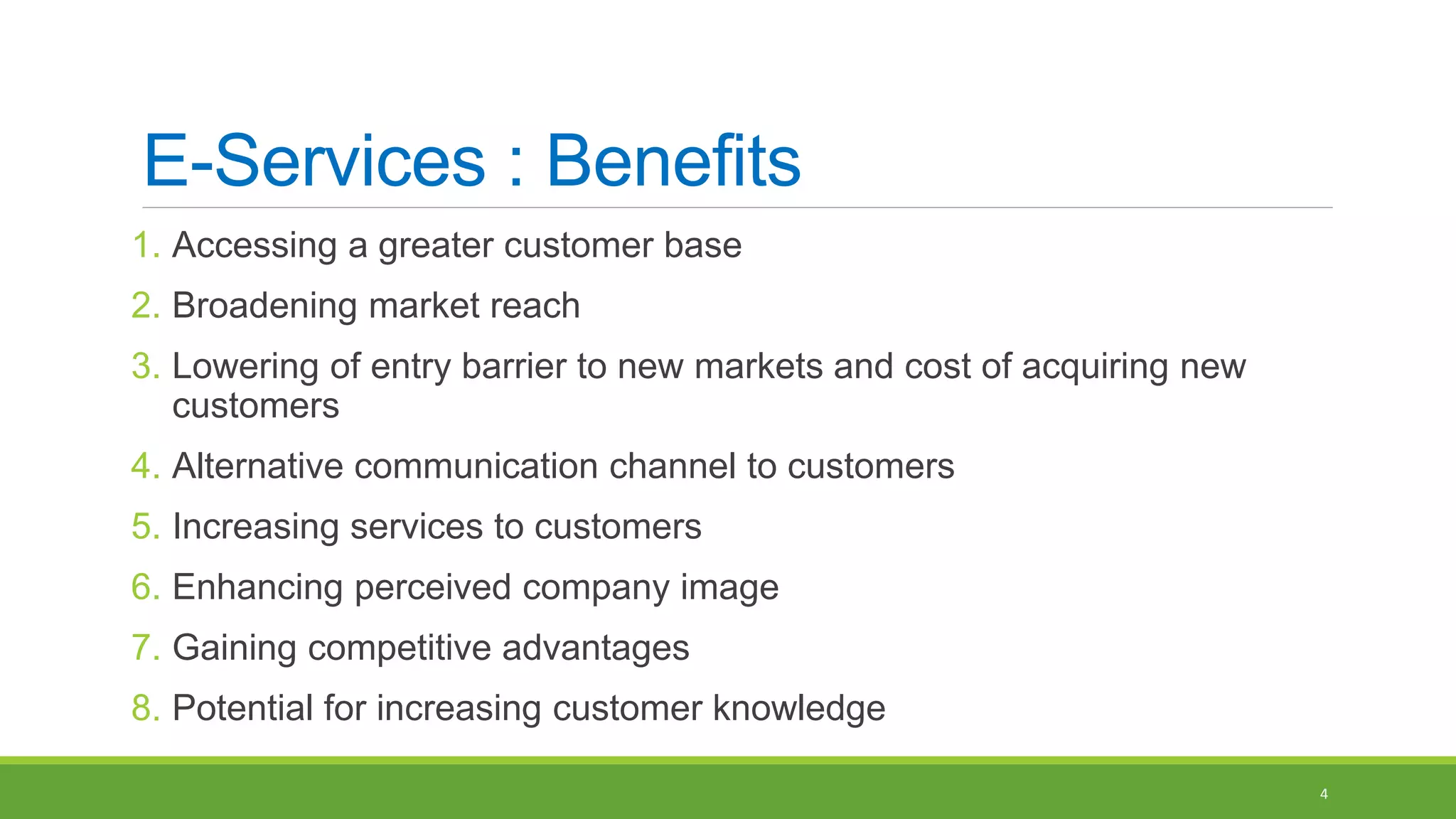
E-Services : Benefits
1.Accessing a greater customer base
2. Broadening market reach
3. Lowering of entry barrier to new markets and cost of acquiring new
customers
4. Alternative communication channel to customers
5. Increasing services to customers
6. Enhancing perceived company image
7. Gaining competitive advantages
8. Potential for increasing customer knowledge
4
E-Services : Domains
E-Business
E-business(Electronic business) is the conduct of business processes on
the Internet. These electronic business processes include buying and
selling products, supplies and services; servicing customers; processing
payments; managing production control; collaborating with business
partners; sharing information; running automated employee services;
recruiting; and more.
6
8.
E-Services : Domains
E-Business
Categories:
◦B2B (Business to Business) selling products or services between
businesses through the internet via an online sales portal.
◦ B2C (Business to Consumer) is business or transactions conducted
directly between a company and consumers who are the end-users of
its products or services.
◦ C2C (Consumer to Consumer) is a business model that facilitates an
environment, usually online, where customers can trade with each
other. Two implementations of C2C markets are auctions and
classifieds. C2C marketing has soared in popularity with the arrival of
the internet, as companies such as eBay and Craigslist have fostered
greater interaction between customers.
◦ B2E (Business to Employee) uses an intrabusiness network which
allows companies to provide products and/or services to their 7
9.
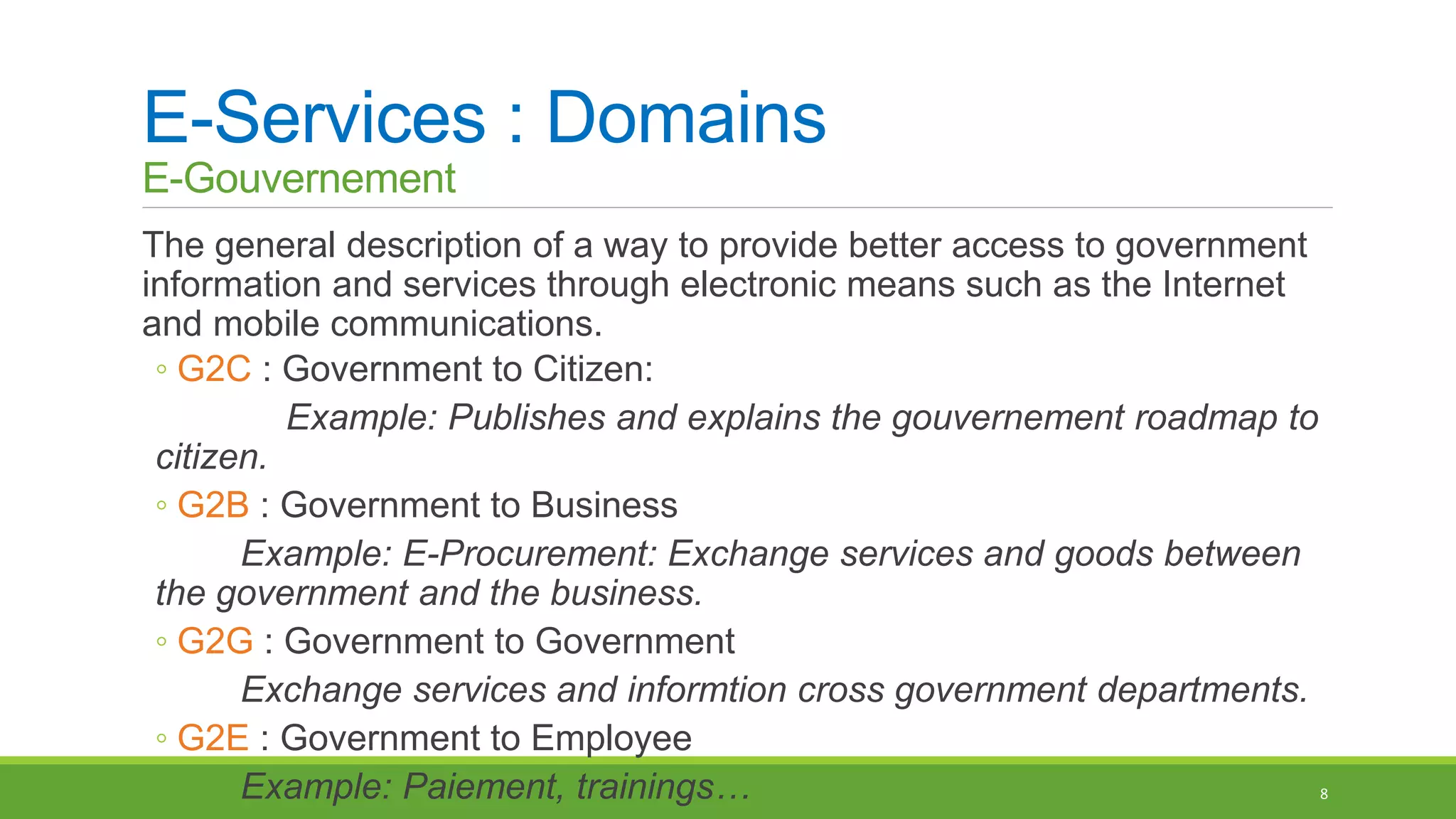
E-Services : Domains
E-Gouvernement
Thegeneral description of a way to provide better access to government
information and services through electronic means such as the Internet
and mobile communications.
◦ G2C : Government to Citizen:
Example: Publishes and explains the gouvernement roadmap to
citizen.
◦ G2B : Government to Business
Example: E-Procurement: Exchange services and goods between
the government and the business.
◦ G2G : Government to Government
Exchange services and informtion cross government departments.
◦ G2E : Government to Employee
Example: Paiement, trainings… 8
10.
E-Services : Domains
E-Learning
E-learningis a learning environment which uses information and
communication technologies (ICT's) as a platform for teaching, training
and learning activities.
9
11.
E-Services : Domains
E-Health
E-Healthis the use of information and communication technologies (ICT)
for health.
Examples include treating patients, conducting research, educating the
health workforce, tracking diseases and monitoring public health.
10
12.
E-Services : Disadvantages
◦Massive amounts of data, i.e. millions of transactions per second can
be difficult to handle. High performance processing capacity is
needed which is expensive to purchase and maintain. If a server hang
out for even a few seconds occurs, transactions get interrupted and
business is lost (customers might not try again).
◦ The above counts for temporary or permanent hardware failure as well.
◦ When sensitive customer information and other user data is kept on
a database, there always exists a risk that credit card details, email
addresses, passwords and like can be hacked.
◦ An electric supply failure and might cause catastrophically problems.
Thus, an investing in a dual system with backup by generators is
needed. This means higher costs for the platform.
11
13.
References
[ADASCUPOLA01] Ada Scupola(Roskilde University, Denmark),
Encyclopedia of Information Science and Technology, Second Edition,
Second Edition
[HRPIT01] Handbook of Research on Public Information Technology, Alex
Dunayev (AXI Web Solutions, New Zealand) and John Paynter (AXI Web
Solutions, New Zealand)
Erlane K. Ghani (Universiti Teknologi MARA, Malaysia), Jamaliah Said
(Universiti Teknologi MARA, Malaysia) and Noraini Mohd Nasir (Universiti
Teknologi MARA, Malaysia)
[HREGEE01] Handbook of Research on E-Government in Emerging
Economies: Adoption, E-Participation, and Legal Frameworks 12

![What are E-Services?
E-Service : Electronic Service
E-services are defined as services that are produced, provided, and/or consumed
through the use of ICT-networks such as for example Internet-based systems and mobile
solutions [ADASCUPOLA01]
E-services Software paradigm enabling peer-to-peer computation in distributed
environments based on the concept of “service” as an autonomous piece of code
published in the network. [HRPIT01]
Services provided to customers through digital. [HREGEE01]
2](https://image.slidesharecdn.com/aeteserviceisi2016chp1-161012194034/75/E-Services-Chapter-1-Introduction-3-2048.jpg)





![References
[ADASCUPOLA01] Ada Scupola (Roskilde University, Denmark),
Encyclopedia of Information Science and Technology, Second Edition,
Second Edition
[HRPIT01] Handbook of Research on Public Information Technology, Alex
Dunayev (AXI Web Solutions, New Zealand) and John Paynter (AXI Web
Solutions, New Zealand)
Erlane K. Ghani (Universiti Teknologi MARA, Malaysia), Jamaliah Said
(Universiti Teknologi MARA, Malaysia) and Noraini Mohd Nasir (Universiti
Teknologi MARA, Malaysia)
[HREGEE01] Handbook of Research on E-Government in Emerging
Economies: Adoption, E-Participation, and Legal Frameworks 12](https://image.slidesharecdn.com/aeteserviceisi2016chp1-161012194034/75/E-Services-Chapter-1-Introduction-13-2048.jpg)


![[2019] week06 electronic and mobile commerce](https://cdn.slidesharecdn.com/ss_thumbnails/2019week06-electronicandmobilecommerce-191004011018-thumbnail.jpg?width=640&height=640&fit=bounds)


