Mr. Abdessattar Ettaieb
ARS1/2 - 2016-2017
E-Services
Entreprise Service Bus
Content
ESB: Why do we need them?
ESB: Role in the SOA?
Use case of ESB
1
ESB:Why do we need them?
2
Information Systems Context:
•IS (Information Systems) are heterogeneous from a technological point of view.
•Each domain builds it’s own IS .
Need for Integration:
•How to trigger a process within a system from another system?
•How to insure the consistency and the propagation of data between many sub-
systems?
Two types of solutions:
•Extract-Transform-LoadTools
•Middleware solutions
3
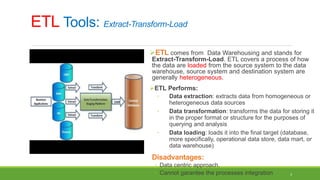
ETL Tools: Extract-Transform-Load
ETL comes from Data Warehousing and stands for
Extract-Transform-Load. ETL covers a process of how
the data are loaded from the source system to the data
warehouse, source system and destination system are
generally heterogeneous.
ETL Performs:
◦ Data extraction: extracts data from homogeneous or
heterogeneous data sources
◦ Data transformation: transforms the data for storing it
in the proper format or structure for the purposes of
querying and analysis
◦ Data loading: loads it into the final target (database,
more specifically, operational data store, data mart, or
data warehouse)
Disadvantages:
◦ Data centric approach.
◦ Cannot garantee the processes integration
4
Network-Centric Middlewares (1/2)
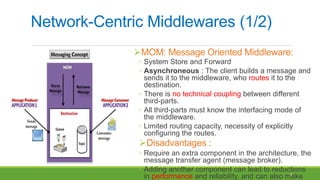
MOM: Message Oriented Middleware:
◦ System Store and Forward
◦ Asynchroneous : The client builds a message and
sends it to the middleware, who routes it to the
destination.
◦ There is no technical coupling between different
third-parts.
◦ All third-parts must know the interfacing mode of
the middleware.
◦ Limited routing capacity, necessity of explicitly
configuring the routes.
Disadvantages :
◦ Require an extra component in the architecture, the
message transfer agent (message broker).
◦ Adding another component can lead to reductions
in performance and reliability, and can also make
5
Network-Centric Middlewares (2/2)
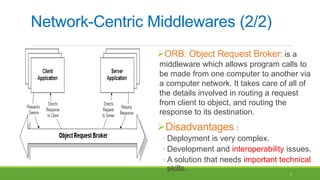
ORB: Object Request Broker: is a
middleware which allows program calls to
be made from one computer to another via
a computer network. It takes care of all of
the details involved in routing a request
from client to object, and routing the
response to its destination.
Disadvantages :
◦ Deployment is very complex.
◦ Development and interoperability issues.
◦ A solution that needs important technical
skills.
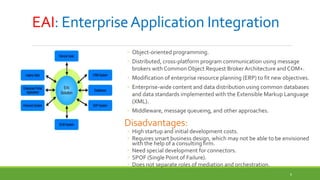
EAI: EnterpriseApplication Integration
6
◦ Object-oriented programming.
◦ Distributed, cross-platform program communication using message
brokers with Common Object Request Broker Architecture and COM+.
◦ Modification of enterprise resource planning (ERP) to fit new objectives.
◦ Enterprise-wide content and data distribution using common databases
and data standards implemented with the Extensible Markup Language
(XML).
◦ Middleware, message queueing, and other approaches.
Disadvantages:
◦ High startup and initial development costs.
◦ Requires smart business design, which may not be able to be envisioned
with the help of a consulting firm.
◦ Need special development for connectors.
◦ SPOF (Single Point of Failure).
◦ Does not separate roles of mediation and orchestration.
7
ESB: Entreprise Service Bus
EAI were transformed to two types of products:
◦ ESB to accompish the interconnections and mediation.
◦ BPM (Business Process Management) for orchestration
Data are not processed/treated on the on the ESB itself, they are sent to
the applications to through connectors.
ESB are designed basing on SOA principals: they are loosely coupled
and can be deployed seperatly.
ESB are designed basing on standards.
8
ESB: Definition
ESB stands for Enterprise Service Bus and it’s fundamentally an architecture.
It is a set of rules and principles for integrating numerous applications together over a
bus-like infrastructure.
The "bus" concept decouples applications from each other.
The data that travels on the bus is a canonical format and is almost always XML.
There is an "adapter" between the application and the bus that marshals data
between the two parties.
The adapter is responsible for talking to the backend application and transforming
data from the application format to the bus format.The adapter can also perform a
host of other activities such as message routing transaction management, security,
monitoring, error handling, etc.
ESBs are generally stateless; the state is embedded in the messages passing through
the bus.

E-Services course Chapter 3 ISI by Ettaieb Abdessattar

  • 1.
    Mr. Abdessattar Ettaieb ARS1/2- 2016-2017 E-Services Entreprise Service Bus
  • 2.
    Content ESB: Why dowe need them? ESB: Role in the SOA? Use case of ESB 1
  • 3.
    ESB:Why do weneed them? 2 Information Systems Context: •IS (Information Systems) are heterogeneous from a technological point of view. •Each domain builds it’s own IS . Need for Integration: •How to trigger a process within a system from another system? •How to insure the consistency and the propagation of data between many sub- systems? Two types of solutions: •Extract-Transform-LoadTools •Middleware solutions
  • 4.
    3 ETL Tools: Extract-Transform-Load ETLcomes from Data Warehousing and stands for Extract-Transform-Load. ETL covers a process of how the data are loaded from the source system to the data warehouse, source system and destination system are generally heterogeneous. ETL Performs: ◦ Data extraction: extracts data from homogeneous or heterogeneous data sources ◦ Data transformation: transforms the data for storing it in the proper format or structure for the purposes of querying and analysis ◦ Data loading: loads it into the final target (database, more specifically, operational data store, data mart, or data warehouse) Disadvantages: ◦ Data centric approach. ◦ Cannot garantee the processes integration
  • 5.
    4 Network-Centric Middlewares (1/2) MOM:Message Oriented Middleware: ◦ System Store and Forward ◦ Asynchroneous : The client builds a message and sends it to the middleware, who routes it to the destination. ◦ There is no technical coupling between different third-parts. ◦ All third-parts must know the interfacing mode of the middleware. ◦ Limited routing capacity, necessity of explicitly configuring the routes. Disadvantages : ◦ Require an extra component in the architecture, the message transfer agent (message broker). ◦ Adding another component can lead to reductions in performance and reliability, and can also make
  • 6.
    5 Network-Centric Middlewares (2/2) ORB:Object Request Broker: is a middleware which allows program calls to be made from one computer to another via a computer network. It takes care of all of the details involved in routing a request from client to object, and routing the response to its destination. Disadvantages : ◦ Deployment is very complex. ◦ Development and interoperability issues. ◦ A solution that needs important technical skills.
  • 7.
    EAI: EnterpriseApplication Integration 6 ◦Object-oriented programming. ◦ Distributed, cross-platform program communication using message brokers with Common Object Request Broker Architecture and COM+. ◦ Modification of enterprise resource planning (ERP) to fit new objectives. ◦ Enterprise-wide content and data distribution using common databases and data standards implemented with the Extensible Markup Language (XML). ◦ Middleware, message queueing, and other approaches. Disadvantages: ◦ High startup and initial development costs. ◦ Requires smart business design, which may not be able to be envisioned with the help of a consulting firm. ◦ Need special development for connectors. ◦ SPOF (Single Point of Failure). ◦ Does not separate roles of mediation and orchestration.
  • 8.
    7 ESB: Entreprise ServiceBus EAI were transformed to two types of products: ◦ ESB to accompish the interconnections and mediation. ◦ BPM (Business Process Management) for orchestration Data are not processed/treated on the on the ESB itself, they are sent to the applications to through connectors. ESB are designed basing on SOA principals: they are loosely coupled and can be deployed seperatly. ESB are designed basing on standards.
  • 9.
    8 ESB: Definition ESB standsfor Enterprise Service Bus and it’s fundamentally an architecture. It is a set of rules and principles for integrating numerous applications together over a bus-like infrastructure. The "bus" concept decouples applications from each other. The data that travels on the bus is a canonical format and is almost always XML. There is an "adapter" between the application and the bus that marshals data between the two parties. The adapter is responsible for talking to the backend application and transforming data from the application format to the bus format.The adapter can also perform a host of other activities such as message routing transaction management, security, monitoring, error handling, etc. ESBs are generally stateless; the state is embedded in the messages passing through the bus.