Salal Abdul
Rehman(30)
ِ‫ن‬ ٰ‫م‬ْ‫ح‬َّ‫الر‬ ِ‫هللا‬ ِ‫م‬ْ‫س‬ِ‫ب‬
ِ‫م‬ْ‫ي‬ ِ‫ح‬َّ‫الر‬
Errors and
Mistakes
URCE-5103
Contents
 Errors and Mistakes
 Difference b/w errors and mistakes
 Syntax
 Chain and choice error
 Grammatical errors
 Lexical errors
 Causes of errors
 Learning strategies
 Competence & Performance
 Errors of omission
What is a Mistake?
A mistake can refer to an act or judgment that is
misguided or wrong.
For example, you use the word mistake to refer to a
decision which brought unsuccessful results.
Her decision to sell the house was a big mistake.
I realized that meeting him was a mistake.
Mistake can also be
used to refer
something (a word,
figure, fact, etc.) that
is not correct.
You make too much
spelling mistakes.
There is a mistake in
this page.
What is an Error?
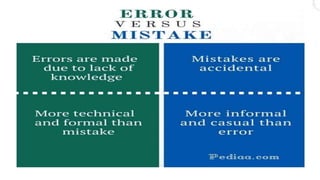
Error also has the same meaning as mistake.
However, the word error is considered to be
more formal than mistake. It is commonly
used in technical and academic writing.
In linguistics, making errors in language
indicate a person’s lack of knowledge.
Therefore, the person who is making the
error doesn’t know that he is doing
something wrong.
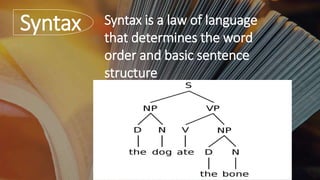
Syntax Syntax is a law of language
that determines the word
order and basic sentence
structure
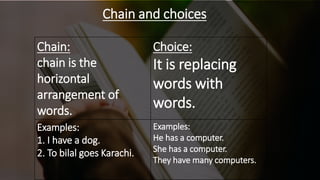
Chain and choices
Chain:
chain is the
horizontal
arrangement of
words.
Choice:
It is replacing
words with
words.
Examples:
1. I have a dog.
2. To bilal goes Karachi.
Examples:
He has a computer.
She has a computer.
They have many computers.
Grammatical Errors :
Grammatical error is a term used in
prescriptive grammar to describe an
instance of faulty, unconventional, or
controversial usage, such as a misplaced
modifier .
Types of error:
Followings are grammatical errors:
Agreement errors (subject-verb agreement
and noun-pronoun agreement)
Tense errors (past/present, aspect, etc.)
Conjunction errors
Article errors
Prepositional errors
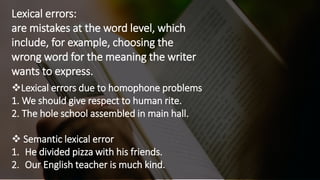
Lexical errors:
are mistakes at the word level, which
include, for example, choosing the
wrong word for the meaning the writer
wants to express.
Lexical errors due to homophone problems
1. We should give respect to human rite.
2. The hole school assembled in main hall.
 Semantic lexical error
1. He divided pizza with his friends.
2. Our English teacher is much kind.
Causes of errors
There are many reasons for errors:
 Mother- tongue interference
Overgeneralization
Literal translation
Incomplete application of rules
Transfer error
Learning strategies
21
Errors of omission
1. Choose
authentic
learning
material
2. Use
multiple
learning
methods
3. Adapt
it to your
field
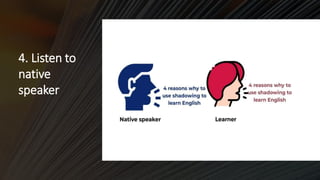
4. Listen to
native
speaker
5. Listen as often as possible
6. More you speak faster you
learn
7. Set Realistic goals
26
26

Errors and mistakes

  • 1.
    Salal Abdul Rehman(30) ِ‫ن‬ ٰ‫م‬ْ‫ح‬َّ‫الر‬ِ‫هللا‬ ِ‫م‬ْ‫س‬ِ‫ب‬ ِ‫م‬ْ‫ي‬ ِ‫ح‬َّ‫الر‬
  • 2.
  • 3.
    Contents  Errors andMistakes  Difference b/w errors and mistakes  Syntax  Chain and choice error  Grammatical errors  Lexical errors  Causes of errors  Learning strategies  Competence & Performance  Errors of omission
  • 4.
    What is aMistake? A mistake can refer to an act or judgment that is misguided or wrong. For example, you use the word mistake to refer to a decision which brought unsuccessful results. Her decision to sell the house was a big mistake. I realized that meeting him was a mistake.
  • 5.
    Mistake can alsobe used to refer something (a word, figure, fact, etc.) that is not correct. You make too much spelling mistakes. There is a mistake in this page.
  • 6.
    What is anError? Error also has the same meaning as mistake. However, the word error is considered to be more formal than mistake. It is commonly used in technical and academic writing. In linguistics, making errors in language indicate a person’s lack of knowledge. Therefore, the person who is making the error doesn’t know that he is doing something wrong.
  • 9.
    Syntax Syntax isa law of language that determines the word order and basic sentence structure
  • 10.
    Chain and choices Chain: chainis the horizontal arrangement of words. Choice: It is replacing words with words. Examples: 1. I have a dog. 2. To bilal goes Karachi. Examples: He has a computer. She has a computer. They have many computers.
  • 11.
    Grammatical Errors : Grammaticalerror is a term used in prescriptive grammar to describe an instance of faulty, unconventional, or controversial usage, such as a misplaced modifier . Types of error:
  • 12.
    Followings are grammaticalerrors: Agreement errors (subject-verb agreement and noun-pronoun agreement) Tense errors (past/present, aspect, etc.) Conjunction errors Article errors Prepositional errors
  • 13.
    Lexical errors: are mistakesat the word level, which include, for example, choosing the wrong word for the meaning the writer wants to express. Lexical errors due to homophone problems 1. We should give respect to human rite. 2. The hole school assembled in main hall.  Semantic lexical error 1. He divided pizza with his friends. 2. Our English teacher is much kind.
  • 14.
    Causes of errors Thereare many reasons for errors:  Mother- tongue interference Overgeneralization Literal translation Incomplete application of rules Transfer error
  • 16.
  • 21.
    21 Errors of omission 1.Choose authentic learning material
  • 22.
  • 23.
  • 24.
    5. Listen asoften as possible 6. More you speak faster you learn
  • 25.
  • 26.