Invasion Biology, Urbanization,
Climate Change
The Threat of Global Worming and
other non-native woes
Urbanization factoids
• At present, about 3–5% of global land area has been
converted to urban and developed land use (1)
• Urban areas in the United States increased by about
130% between 1960 and 2000 (1)
• Global urban areas could increase by about 1 million
square kilometers over the next 25 years (1)
• Within Massachusetts, 38% of the state is considered
urban according to US census classifications (2)
• Globally, the urban population in 2014 accounted for
54% of the total global population, up from 34% in 1960,
and continues to grow (3).
(1) Zhang et al. 2014. Multi-factor controls on terrestrial carbon dynamics in urbanized areas. Biogeosciences, 11, 7107–7124, 2014
(2) Rao et al. 2014. Atmospheric nitrogen inputs and losses along an urbanization gradient from Boston to Harvard Forest, MA.
BIOGEOCHEMISTRY 121: 229-245
(3) World Health Organization -- http://www.who.int/gho/urban_health/situation_trends/urban_population_growth_text/en/
Carbon change over urban gradient
• Hyvonen et al. 2008. “N deposition can increase forest soil C sequestration
from 0.51 to 0.69 MgC/ha/yr”
• Jastrow et al. 2005 “reported that elevated CO2 concentration would
increase soil C sequestration by 0.19 MgC /ha/yr”
• Pouyat et al. 2002. “soil C content significantly increased in urban sites
compared with that in rural sites in New York red oak (Quercus rubra L.)
forests”
• Koerner and Klpatek. 2010. Soil C content significantly increased in urban
sites compared with that in rural sites in desert soils, Phoenix, AZ;
• Chen et al. 2013 Pine forests, urban to rural in S. China: found lower soil
carbon in urban vs rural sites. Why? Decrease in fine roots in urban areas.
And perhaps urban heat island effect speeding up decomposition.
ABIOTIC CHANGE? Role for invasives, locally?
“Ecosystems in urban areas usually contain a higher proportion of
exotic and naturalized plant and animal species than ecosystems in
rural areas....the effects of the presence of non-native species are
variable and complex. Changes in tree species composition can
change water and nutrient fluxed in the ecosystem through
differences in uptake and more subtly, through change in litter
quality and organic matter dynamics. Changes in soil fauna, such
as earthworms, many of which are non-native, can have important
effects on nutrient cycling and organic matter dynamics in forests
in urban areas and can buffer the effects of pollutants on soil
processes.”
Groffman, P., Pouyat, R., McDonnell, M. J., Pickett, S., and
Zipperer, W. C.: Carbon pools and trace gas fluxes in urban
forest soils, in: Advances in soil science: soil management and
greenhouse effect, edited by: Lai, R., Kimble, J., Levine, E., and
Stewart, B. A., CRC press, Boca Raton, 147, 1995.
Tamura M, Tharayil N. 2014. Plant litter
chemistry and microbial priming regulate
the accrual, composition and stability of
soil carbon in invaded ecosystems. New
Phytologist 203: 110–124.
Reviewed in thoughtful essay by Mathew E. Dornbush. 2014.
The myriad surprises of unwanted guests: invasive plants and
dynamic soil carbon pools. New Phytologist 203: 1–3
Tamura and Tharayil consider soil effects of two infamous
species : Kudzu and Japanese Knotweed
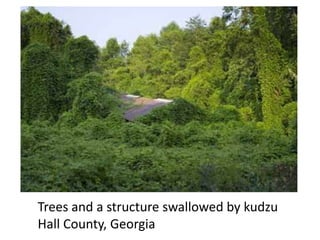
Trees and a structure swallowed by kudzu
Hall County, Georgia
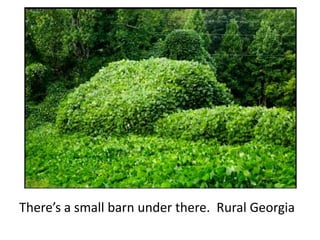
There’s a small barn under there. Rural Georgia
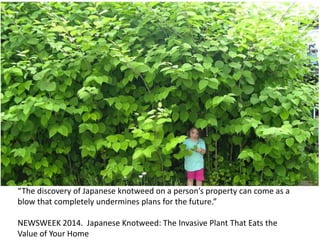
“The discovery of Japanese knotweed on a person’s property can come as a
blow that completely undermines plans for the future.”
NEWSWEEK 2014. Japanese Knotweed: The Invasive Plant That Eats the
Value of Your Home
Potential invader effects on carbon
• Increased fresh plant residues may increase
soil organic matter (SOM).
– Large amounts of low quality (low nutrient) litter
inhibits decomposer activity
– humifaction may increase. Increased supply of
litter may favor microbial activity that generates
hard-to-degrade (recalcitrant) forms of SOM
Potential invader effects on carbon
• Increased fresh plant residues may decrease
soil organic matter (SOM).
– “soil priming” may occur, whereby limits on
decomposer activity due to either lack of energy
(sugars) or nutrients (nitrogen) are lifted
– If invader provides high quality litter (as in case of
a nitrogen-fixing legume) may see enhanced
decomposer attack on existing SOM
Tamura M, Tharayil N. 2014. Plant litter chemistry and
microbial priming regulate the accrual, composition and
stability of soil carbon in invaded ecosystems. New Phytologist
203: 110–124.
RESULTS
JAPANESE KNOTWEED: “Compared with an adjacent
noninvaded old-field, P. cuspidatum-invaded soils exhibited a
26% increase in C, partially through selective preservation of
plant polymers.”
KUDZU: “Despite receiving a 22% higher litter input, P. lobata-
invaded Pinus stands exhibited a 28% decrease in soil C and a
twofold decrease in plant biomarkers, indicating microbial
priming of native soil C.”
Norway Maple, Ailanthus effects
Invasive trees Norway Maple (Acer platanoides)
and Tree of Heaven (Ailanthus altissima)
increase net nitrogen mineralization, net
nitrification, and soil nitrogen availability
compared to native tree species, including the
congener Sugar Maple (Acer saccharum)
(Gomez-Aparicio et al. 2008 Ecological Monographs).
Questions - How do non-legumes increase nitrogen activity?
Might these N effects “prime” soils, decreasing SOM?
Hypotheses
Compared to native species, successful invaders
may have thinner chlorophyll-enriched leaves
that are also lower in structural carbon
(characteristics that promote rapid growth).
Such characteristics would allow more rapid leaf
decomposition, “creating litter that contains a
higher concentration of nitrogen (higher litter
quality)”. (Rout and Callaway 2009)
Paradox of invasives
• But many invasives do not have these soil effects in
their native land.
• Could leaf traits have evolved in the new land?
Why might leaves become thinner in new
environment, with reduced allocation to cell walls?
Absence of specialized herbivores, reduced defense.
Reallocate nitrogen, carbon, to photosynthesis + seed
production.
A potential mechanism by which some invaders may
evolve leaves with traits that enhance nitrogen cycling
in the soil of invaded ecosystems.
Earthworms!
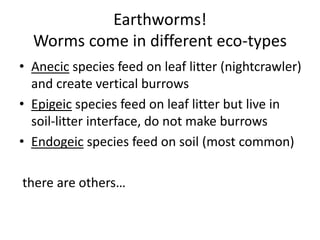
Worms come in different eco-types
• Anecic species feed on leaf litter (nightcrawler)
and create vertical burrows
• Epigeic species feed on leaf litter but live in
soil-litter interface, do not make burrows
• Endogeic species feed on soil (most common)
there are others…
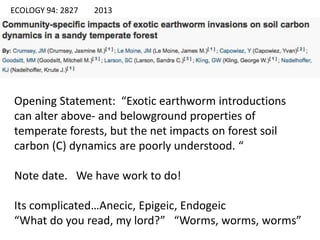
ECOLOGY 94: 2827 2013
Opening Statement: “Exotic earthworm introductions
can alter above- and belowground properties of
temperate forests, but the net impacts on forest soil
carbon (C) dynamics are poorly understood. “
Note date. We have work to do!
Its complicated…Anecic, Epigeic, Endogeic
“What do you read, my lord?” “Worms, worms, worms”
ECOLOGY 94: 2827 2013
Mesocosm trials with three worm species
--- Lumbricus terrestris [anecic]
--- Aporrectodea trapezoides [endogeic]
--- Eisenia fetida [epigeic]
ECOLOGY 94: 2827 2013
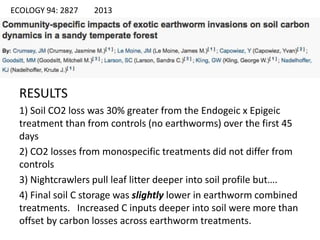
RESULTS
1) Soil CO2 loss was 30% greater from the Endogeic x Epigeic
treatment than from controls (no earthworms) over the first 45
days
2) CO2 losses from monospecific treatments did not differ from
controls
3) Nightcrawlers pull leaf litter deeper into soil profile but….
4) Final soil C storage was slightly lower in earthworm combined
treatments. Increased C inputs deeper into soil were more than
offset by carbon losses across earthworm treatments.
Effects of exotic earthworms…
Depend on:
• Soil type
• Forest type
• Earthworm species
• Stage of worm invasion
Biogeosciences, 11, 7107–7124, 2014
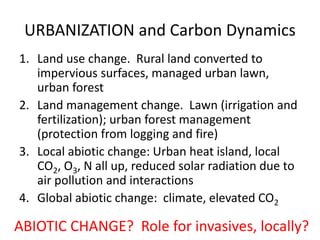
URBANIZATION and Carbon Dynamics
1. Land use change. Rural land converted to
impervious surfaces, managed urban lawn,
urban forest
2. Land management change. Lawn (irrigation and
fertilization); urban forest management
(protection from logging and fire)
3. Local abiotic change: Urban heat island, local
CO2, O3, N all up, reduced solar radiation due to
air pollution and interactions
4. Global abiotic change: climate, elevated CO2
ABIOTIC CHANGE? Role for invasives, locally?
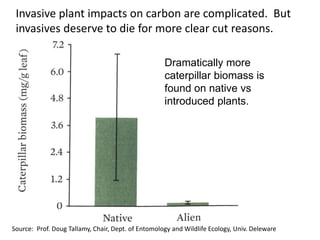
Source: Prof. Doug Tallamy, Chair, Dept. of Entomology and Wildlife Ecology, Univ. Deleware
Dramatically more
caterpillar biomass is
found on native vs
introduced plants.
Invasive plant impacts on carbon are complicated. But
invasives deserve to die for more clear cut reasons.
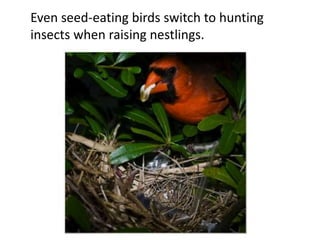
Even seed-eating birds switch to hunting
insects when raising nestlings.
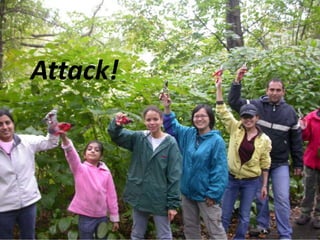
Attack!

Eric Olson - Biodiversity in the City

  • 1.
    Invasion Biology, Urbanization, ClimateChange The Threat of Global Worming and other non-native woes
  • 2.
    Urbanization factoids • Atpresent, about 3–5% of global land area has been converted to urban and developed land use (1) • Urban areas in the United States increased by about 130% between 1960 and 2000 (1) • Global urban areas could increase by about 1 million square kilometers over the next 25 years (1) • Within Massachusetts, 38% of the state is considered urban according to US census classifications (2) • Globally, the urban population in 2014 accounted for 54% of the total global population, up from 34% in 1960, and continues to grow (3). (1) Zhang et al. 2014. Multi-factor controls on terrestrial carbon dynamics in urbanized areas. Biogeosciences, 11, 7107–7124, 2014 (2) Rao et al. 2014. Atmospheric nitrogen inputs and losses along an urbanization gradient from Boston to Harvard Forest, MA. BIOGEOCHEMISTRY 121: 229-245 (3) World Health Organization -- http://www.who.int/gho/urban_health/situation_trends/urban_population_growth_text/en/
  • 4.
    Carbon change overurban gradient • Hyvonen et al. 2008. “N deposition can increase forest soil C sequestration from 0.51 to 0.69 MgC/ha/yr” • Jastrow et al. 2005 “reported that elevated CO2 concentration would increase soil C sequestration by 0.19 MgC /ha/yr” • Pouyat et al. 2002. “soil C content significantly increased in urban sites compared with that in rural sites in New York red oak (Quercus rubra L.) forests” • Koerner and Klpatek. 2010. Soil C content significantly increased in urban sites compared with that in rural sites in desert soils, Phoenix, AZ; • Chen et al. 2013 Pine forests, urban to rural in S. China: found lower soil carbon in urban vs rural sites. Why? Decrease in fine roots in urban areas. And perhaps urban heat island effect speeding up decomposition. ABIOTIC CHANGE? Role for invasives, locally?
  • 5.
    “Ecosystems in urbanareas usually contain a higher proportion of exotic and naturalized plant and animal species than ecosystems in rural areas....the effects of the presence of non-native species are variable and complex. Changes in tree species composition can change water and nutrient fluxed in the ecosystem through differences in uptake and more subtly, through change in litter quality and organic matter dynamics. Changes in soil fauna, such as earthworms, many of which are non-native, can have important effects on nutrient cycling and organic matter dynamics in forests in urban areas and can buffer the effects of pollutants on soil processes.” Groffman, P., Pouyat, R., McDonnell, M. J., Pickett, S., and Zipperer, W. C.: Carbon pools and trace gas fluxes in urban forest soils, in: Advances in soil science: soil management and greenhouse effect, edited by: Lai, R., Kimble, J., Levine, E., and Stewart, B. A., CRC press, Boca Raton, 147, 1995.
  • 6.
    Tamura M, TharayilN. 2014. Plant litter chemistry and microbial priming regulate the accrual, composition and stability of soil carbon in invaded ecosystems. New Phytologist 203: 110–124. Reviewed in thoughtful essay by Mathew E. Dornbush. 2014. The myriad surprises of unwanted guests: invasive plants and dynamic soil carbon pools. New Phytologist 203: 1–3 Tamura and Tharayil consider soil effects of two infamous species : Kudzu and Japanese Knotweed
  • 7.
    Trees and astructure swallowed by kudzu Hall County, Georgia
  • 8.
    There’s a smallbarn under there. Rural Georgia
  • 9.
    “The discovery ofJapanese knotweed on a person’s property can come as a blow that completely undermines plans for the future.” NEWSWEEK 2014. Japanese Knotweed: The Invasive Plant That Eats the Value of Your Home
  • 11.
    Potential invader effectson carbon • Increased fresh plant residues may increase soil organic matter (SOM). – Large amounts of low quality (low nutrient) litter inhibits decomposer activity – humifaction may increase. Increased supply of litter may favor microbial activity that generates hard-to-degrade (recalcitrant) forms of SOM
  • 12.
    Potential invader effectson carbon • Increased fresh plant residues may decrease soil organic matter (SOM). – “soil priming” may occur, whereby limits on decomposer activity due to either lack of energy (sugars) or nutrients (nitrogen) are lifted – If invader provides high quality litter (as in case of a nitrogen-fixing legume) may see enhanced decomposer attack on existing SOM
  • 13.
    Tamura M, TharayilN. 2014. Plant litter chemistry and microbial priming regulate the accrual, composition and stability of soil carbon in invaded ecosystems. New Phytologist 203: 110–124. RESULTS JAPANESE KNOTWEED: “Compared with an adjacent noninvaded old-field, P. cuspidatum-invaded soils exhibited a 26% increase in C, partially through selective preservation of plant polymers.” KUDZU: “Despite receiving a 22% higher litter input, P. lobata- invaded Pinus stands exhibited a 28% decrease in soil C and a twofold decrease in plant biomarkers, indicating microbial priming of native soil C.”
  • 14.
    Norway Maple, Ailanthuseffects Invasive trees Norway Maple (Acer platanoides) and Tree of Heaven (Ailanthus altissima) increase net nitrogen mineralization, net nitrification, and soil nitrogen availability compared to native tree species, including the congener Sugar Maple (Acer saccharum) (Gomez-Aparicio et al. 2008 Ecological Monographs). Questions - How do non-legumes increase nitrogen activity? Might these N effects “prime” soils, decreasing SOM?
  • 15.
    Hypotheses Compared to nativespecies, successful invaders may have thinner chlorophyll-enriched leaves that are also lower in structural carbon (characteristics that promote rapid growth). Such characteristics would allow more rapid leaf decomposition, “creating litter that contains a higher concentration of nitrogen (higher litter quality)”. (Rout and Callaway 2009)
  • 16.
    Paradox of invasives •But many invasives do not have these soil effects in their native land. • Could leaf traits have evolved in the new land? Why might leaves become thinner in new environment, with reduced allocation to cell walls? Absence of specialized herbivores, reduced defense. Reallocate nitrogen, carbon, to photosynthesis + seed production. A potential mechanism by which some invaders may evolve leaves with traits that enhance nitrogen cycling in the soil of invaded ecosystems.
  • 17.
    Earthworms! Worms come indifferent eco-types • Anecic species feed on leaf litter (nightcrawler) and create vertical burrows • Epigeic species feed on leaf litter but live in soil-litter interface, do not make burrows • Endogeic species feed on soil (most common) there are others…
  • 18.
    ECOLOGY 94: 28272013 Opening Statement: “Exotic earthworm introductions can alter above- and belowground properties of temperate forests, but the net impacts on forest soil carbon (C) dynamics are poorly understood. “ Note date. We have work to do! Its complicated…Anecic, Epigeic, Endogeic “What do you read, my lord?” “Worms, worms, worms”
  • 19.
    ECOLOGY 94: 28272013 Mesocosm trials with three worm species --- Lumbricus terrestris [anecic] --- Aporrectodea trapezoides [endogeic] --- Eisenia fetida [epigeic]
  • 20.
    ECOLOGY 94: 28272013 RESULTS 1) Soil CO2 loss was 30% greater from the Endogeic x Epigeic treatment than from controls (no earthworms) over the first 45 days 2) CO2 losses from monospecific treatments did not differ from controls 3) Nightcrawlers pull leaf litter deeper into soil profile but…. 4) Final soil C storage was slightly lower in earthworm combined treatments. Increased C inputs deeper into soil were more than offset by carbon losses across earthworm treatments.
  • 21.
    Effects of exoticearthworms… Depend on: • Soil type • Forest type • Earthworm species • Stage of worm invasion
  • 22.
  • 23.
    URBANIZATION and CarbonDynamics 1. Land use change. Rural land converted to impervious surfaces, managed urban lawn, urban forest 2. Land management change. Lawn (irrigation and fertilization); urban forest management (protection from logging and fire) 3. Local abiotic change: Urban heat island, local CO2, O3, N all up, reduced solar radiation due to air pollution and interactions 4. Global abiotic change: climate, elevated CO2 ABIOTIC CHANGE? Role for invasives, locally?
  • 24.
    Source: Prof. DougTallamy, Chair, Dept. of Entomology and Wildlife Ecology, Univ. Deleware Dramatically more caterpillar biomass is found on native vs introduced plants. Invasive plant impacts on carbon are complicated. But invasives deserve to die for more clear cut reasons.
  • 25.
    Even seed-eating birdsswitch to hunting insects when raising nestlings.
  • 26.