Ergonomics
• The wordErgonomics is derived from the
Greek words:
– Ergon = Work
– Nomos = Law
• Other terms:
– Human Factors
– Human Factors Engineering
– Human Engineering
3.
Ergonomics
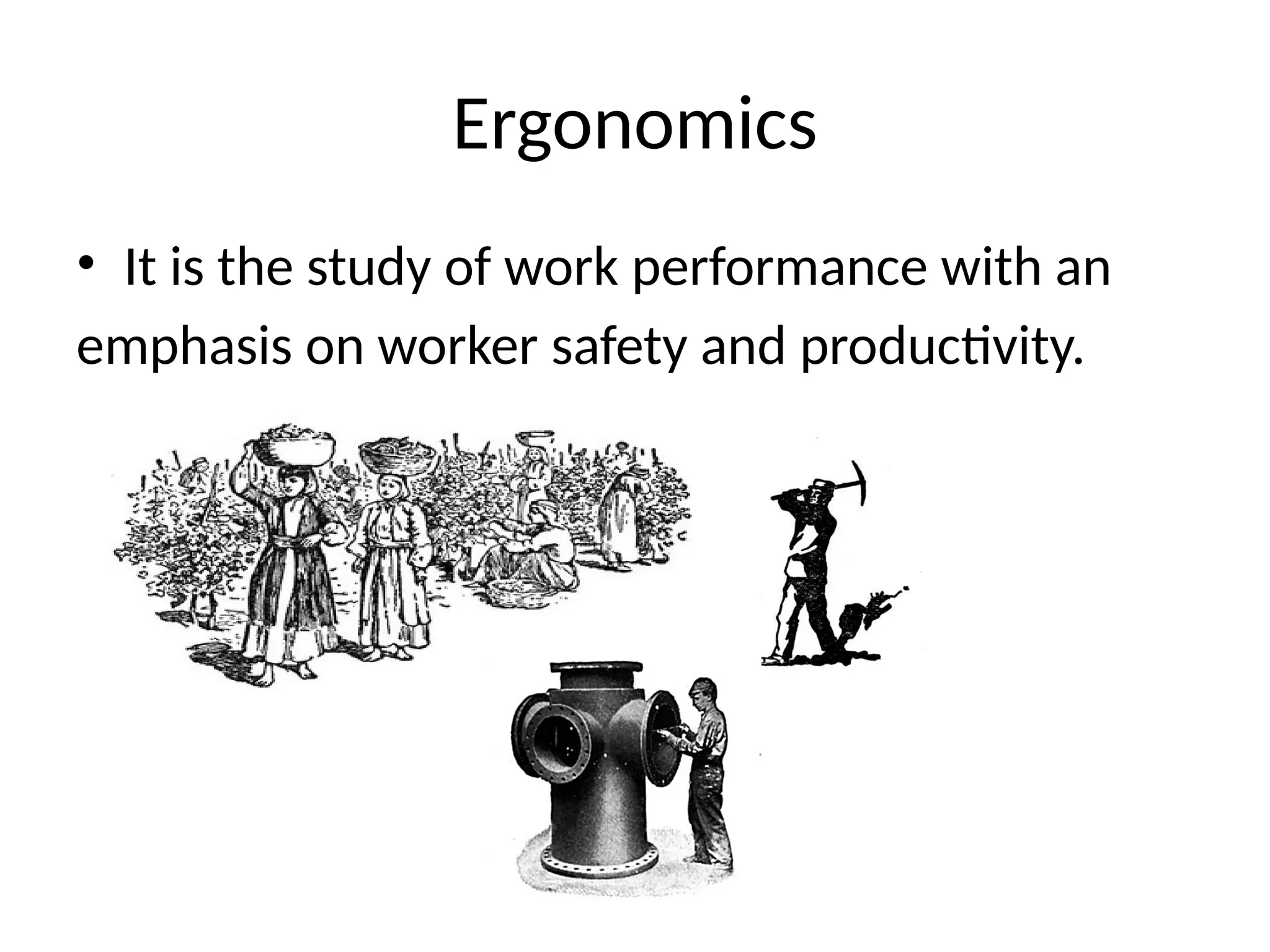
• It isthe study of work performance with an
emphasis on worker safety and productivity.
4.
Ergonomics
• It isthe scientific study of human capabilities
and limitations in relation to work demands.
• It aims to design appliances, technical
systems and tasks in such a way as to improve
human safety, health, comfort and
performance.
5.
Definition of Ergonomicsby IEA
International Ergonomics Association
“Ergonomics (or human factors) is the scientific
discipline concerned with understanding of the
interactions among humans and other elements
of a system, and the profession that applies theory
principles, data and methods to design, in order
to optimize human well-being and over all system
performance”
6.
Ergonomics
• Some dailyactivities in the workplace if carried out
improperly can lead to a slow development of injuries,
• because we tend to make adjustments to ourselves
instead of our work environment.
7.
Ergonomics
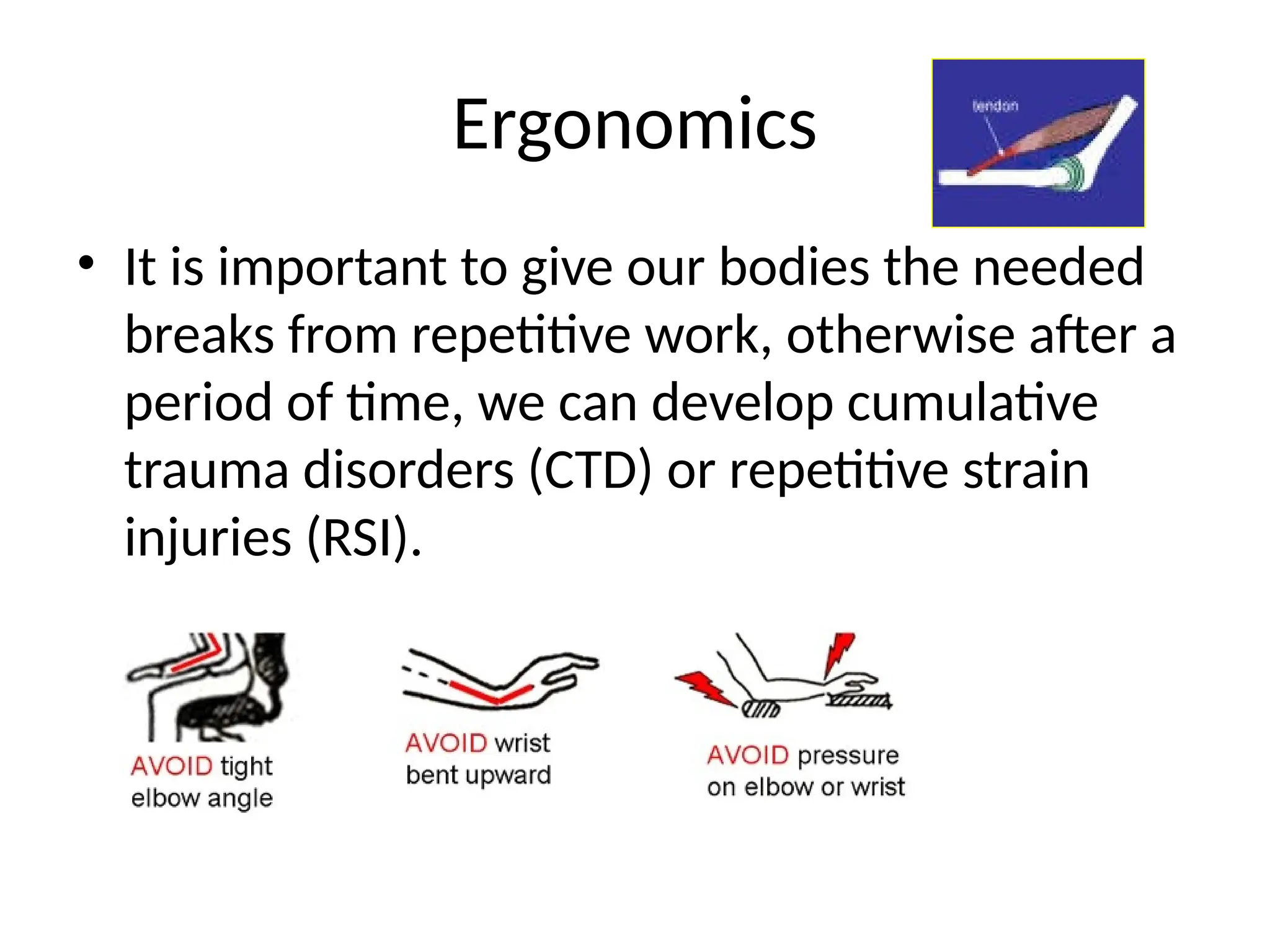
• It isimportant to give our bodies the needed
breaks from repetitive work, otherwise after a
period of time, we can develop cumulative
trauma disorders (CTD) or repetitive strain
injuries (RSI).
8.
Ergonomics
• Many factorsplay a role in Ergonomics:
– Body posture and movement
• sitting, standing, lifting, pulling and pushing
– Environmental factors
• noise, vibration, illumination, climate, chemical substances
– Information and operation
• information gained visually or through other senses,
controls, relation between displays and control
– Work organization
• appropriate tasks, interesting jobs
9.
Ergonomics
• Ergonomics drawsknowledge from various fields
in the human sciences and technology, such as
– Anthropometrics,
– Biomechanics,
– Physiology,
– Psychology,
– Toxicology,
– Mechanical engineering,
– Industrial design,
– Information technology and management.
10.
Ergonomics
• The ERGONOMIST
–Highlights the areas where ergonomic knowledge
is essential,
– Provides ergonomic guidelines
– Advises
• Designers,
• Purchasers,
• Management and
• Employees
11.
Ergonomics
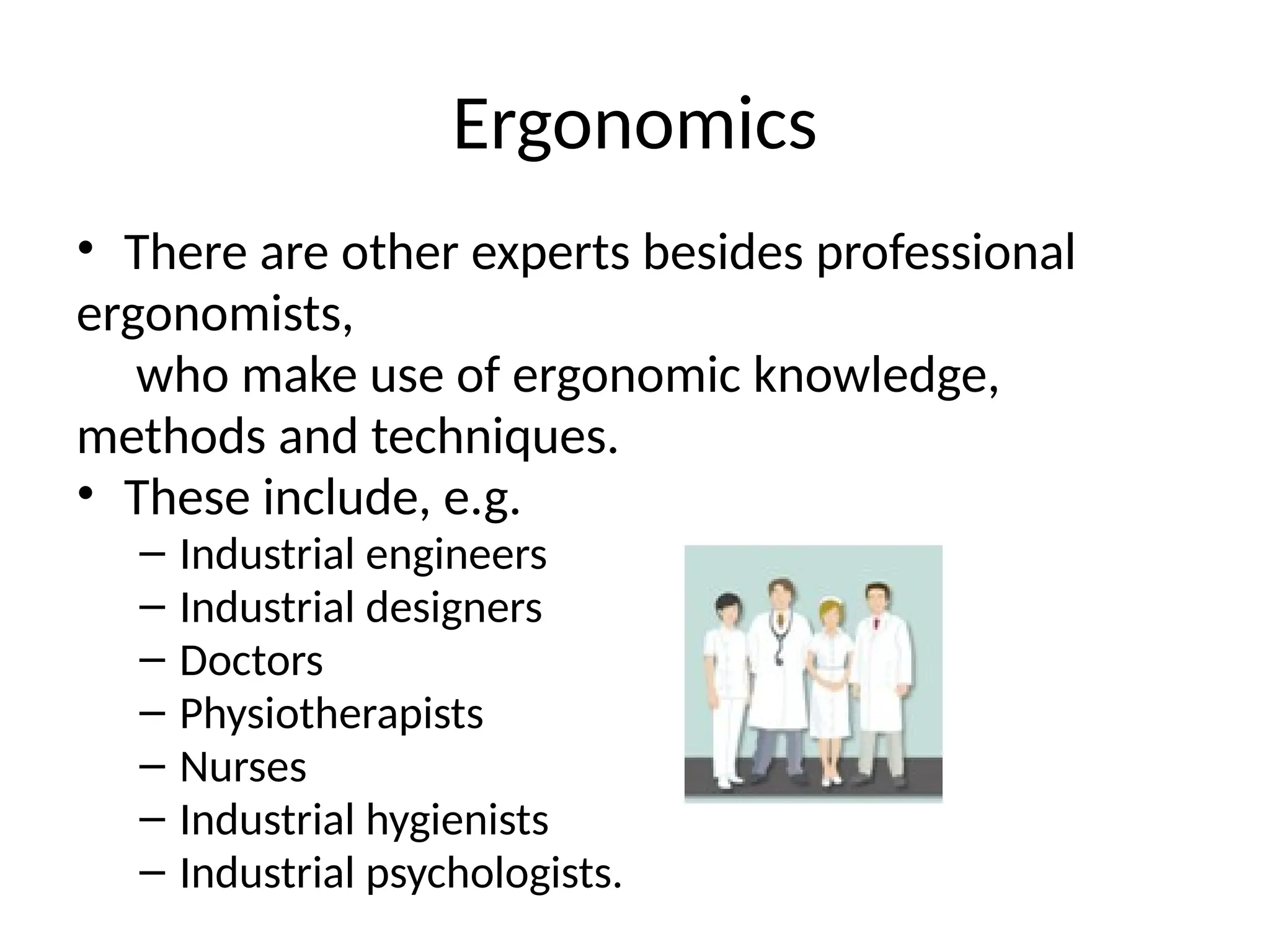
• There areother experts besides professional
ergonomists,
who make use of ergonomic knowledge,
methods and techniques.
• These include, e.g.
– Industrial engineers
– Industrial designers
– Doctors
– Physiotherapists
– Nurses
– Industrial hygienists
– Industrial psychologists.
12.
Ergonomics
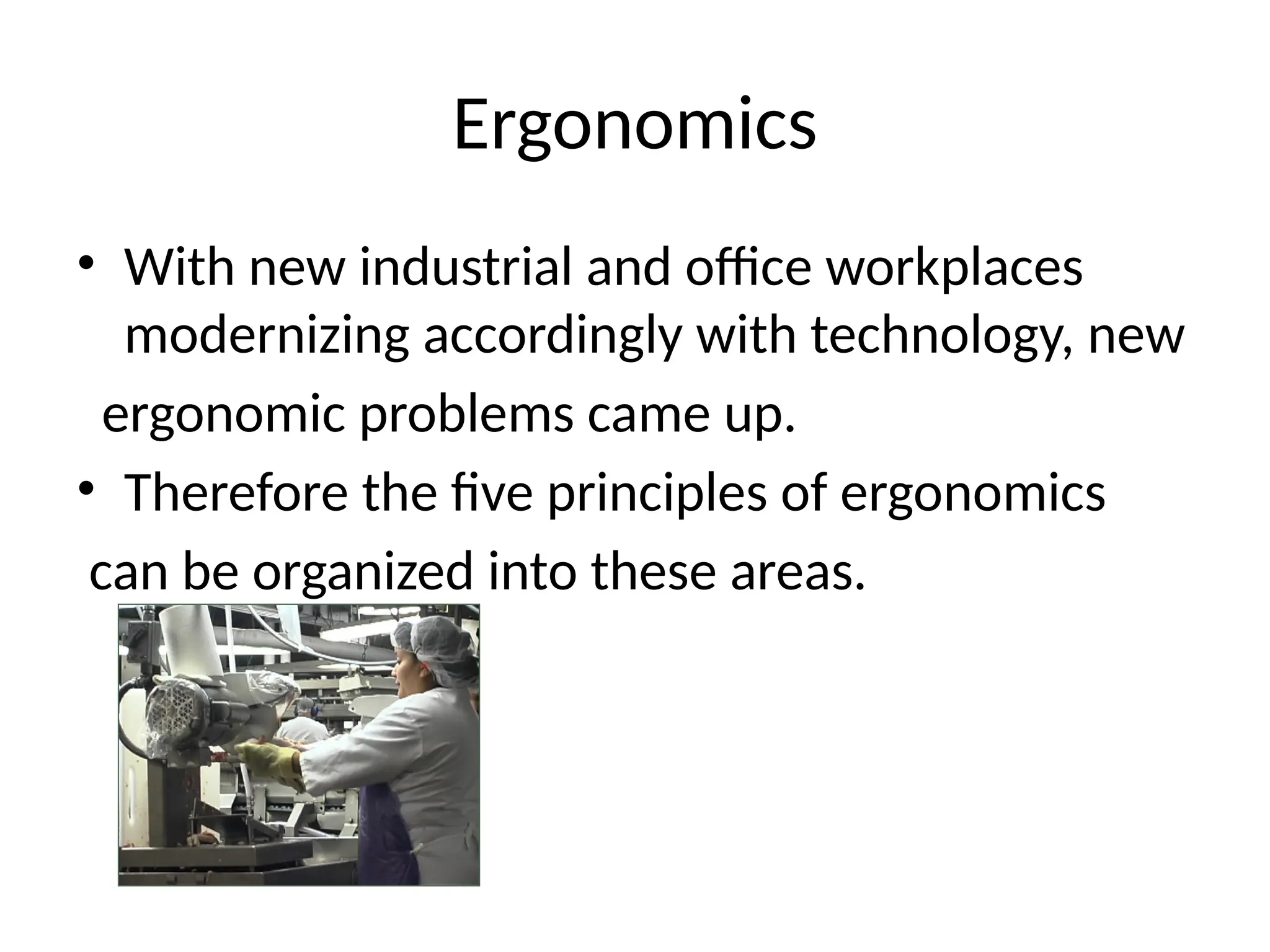
• With newindustrial and office workplaces
modernizing accordingly with technology, new
ergonomic problems came up.
• Therefore the five principles of ergonomics
can be organized into these areas.
13.
Principles of Ergonomics
MainPrinciples of Ergonomics:
1.Safety
2.Comfort
3.Ease of use
4.Productivity and performance
5.Aesthetics
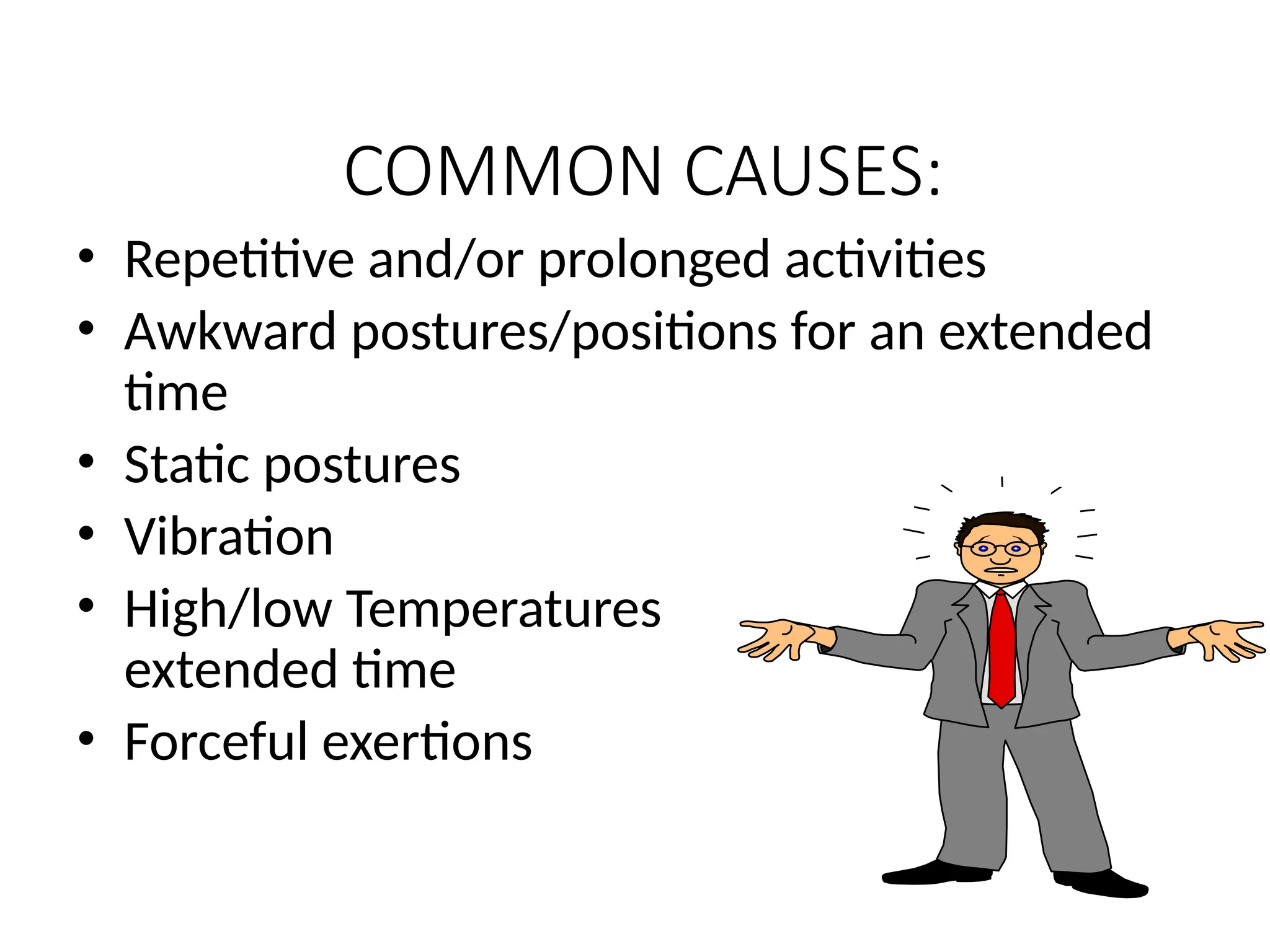
COMMON CAUSES:
• Repetitiveand/or prolonged activities
• Awkward postures/positions for an extended
time
• Static postures
• Vibration
• High/low Temperatures for an
extended time
• Forceful exertions
SIGNS OF MSD
•Decreased range of motion
• Loss of function
• Deformity
• Cramping
• Loss of color
• Decreased grip strength
• Loss of balance
• Swelling
• Redness
18.
SYMPTOMS OF MSD
•Muscle fatigue or pain
• Aching
• Burning
• Numbness
• Stiffness
• Tingling
19.
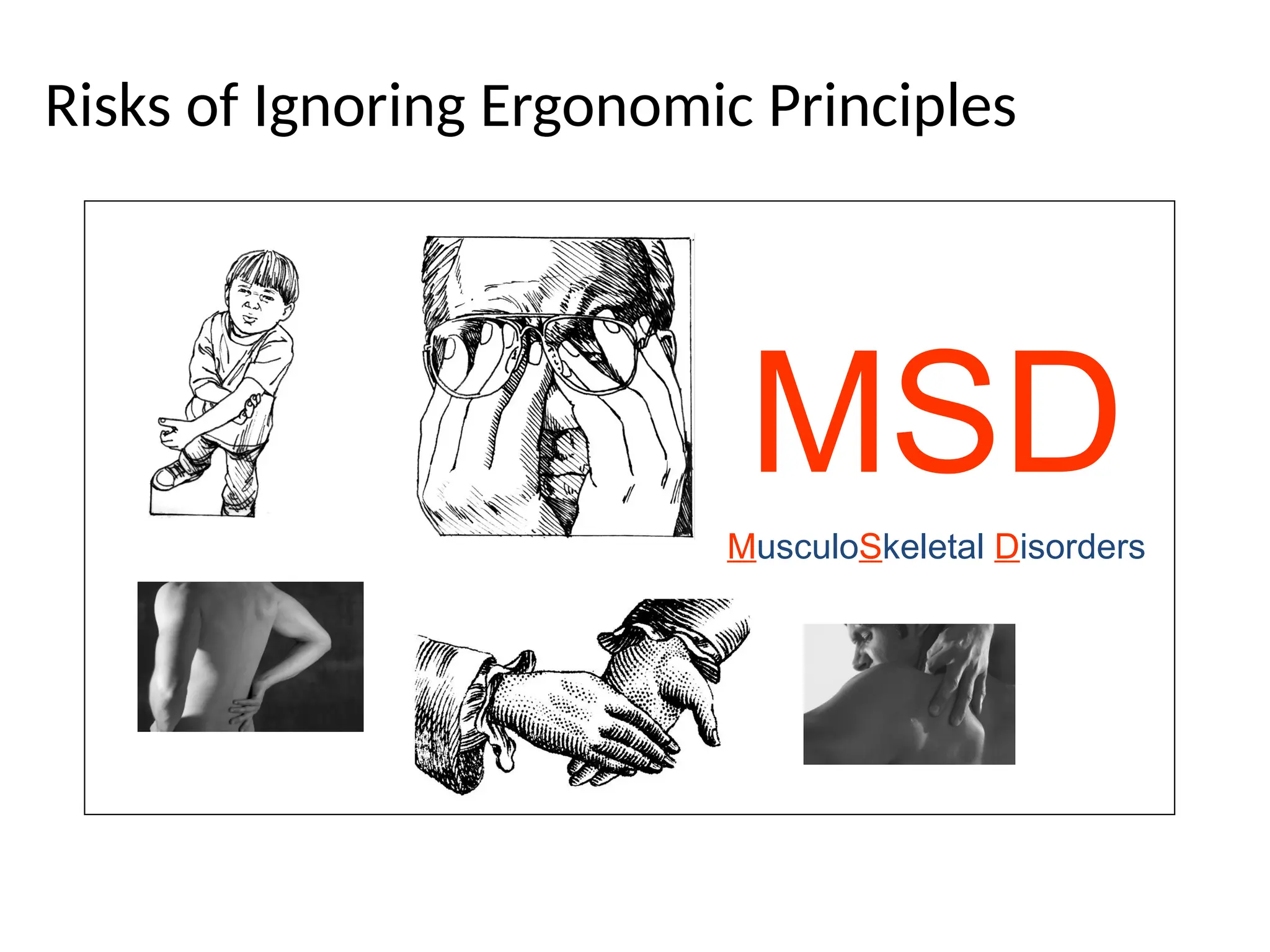
EXAMPLES OF MSD
•TENDONITIS- An inflammation of the tendon.
Typically occurs in the shoulder, wrist, hands, or
elbow.
• CARPAL TUNNEL SYNDROME- Irritation of the median
nerve, which runs through a bony channel in the
wrist called the carpal tunnel. Usually results from
excessive flexing or twisting of the wrist.
MSD CONT.
• TRIGGERFINGER SYNDROME- Tendons in the fingers
become inflamed, causing pain, swelling, and a loss
of dexterity.
• EYE STRAIN - The eyes become strained as a result of
poor lighting, glare or viewing from awkward
positions.
22.
MSD CONT.
• HAND/ARMVIBRATION SYNDROME- Tingling,
numbness, blanching, loss of dexterity in the
hand/arm
• MUSCLE STRAIN – Pain in muscles
23.
Ergonomics
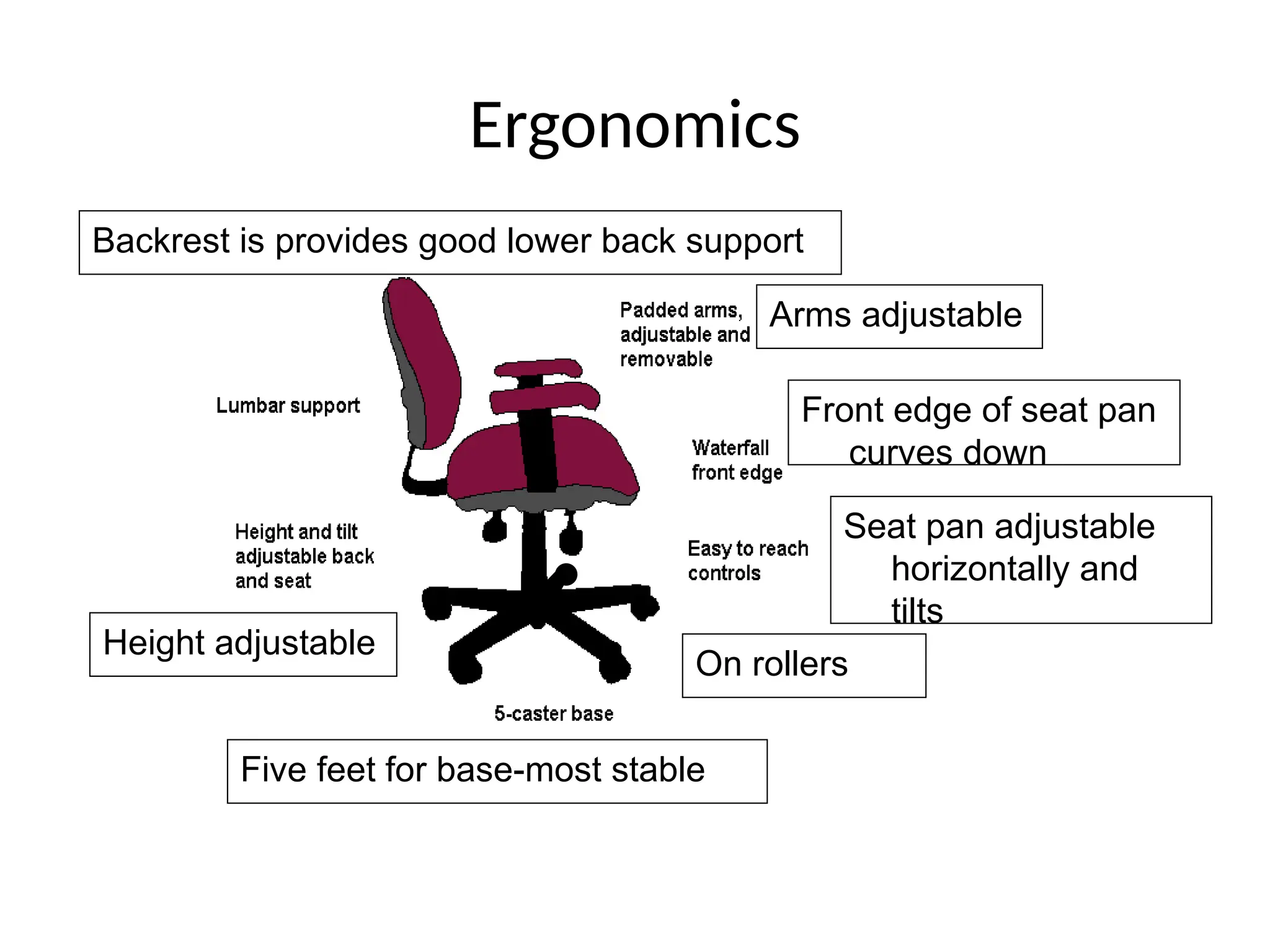
Front edge ofseat pan
curves down
Five feet for base-most stable
Height adjustable
On rollers
Seat pan adjustable
horizontally and
tilts
Backrest is provides good lower back support
Arms adjustable
Physical Ergonomics
• Itis concerned with human anatomical,
anthropometric, physiological and
biomechanical characteristics as they relate to
physical activity.
• It is the human body’s responses to physical
and physiological work loads.
26.
Physical Ergonomics
• Itis the study of the way the body
interacts with the worker's tools, such as
chairs, computers etc.
• It includes the working postures,
materials handling, repetitive
movements, work-related
musculoskeletal disorders, workplace
layout, safety and health.
27.
Physical Ergonomics
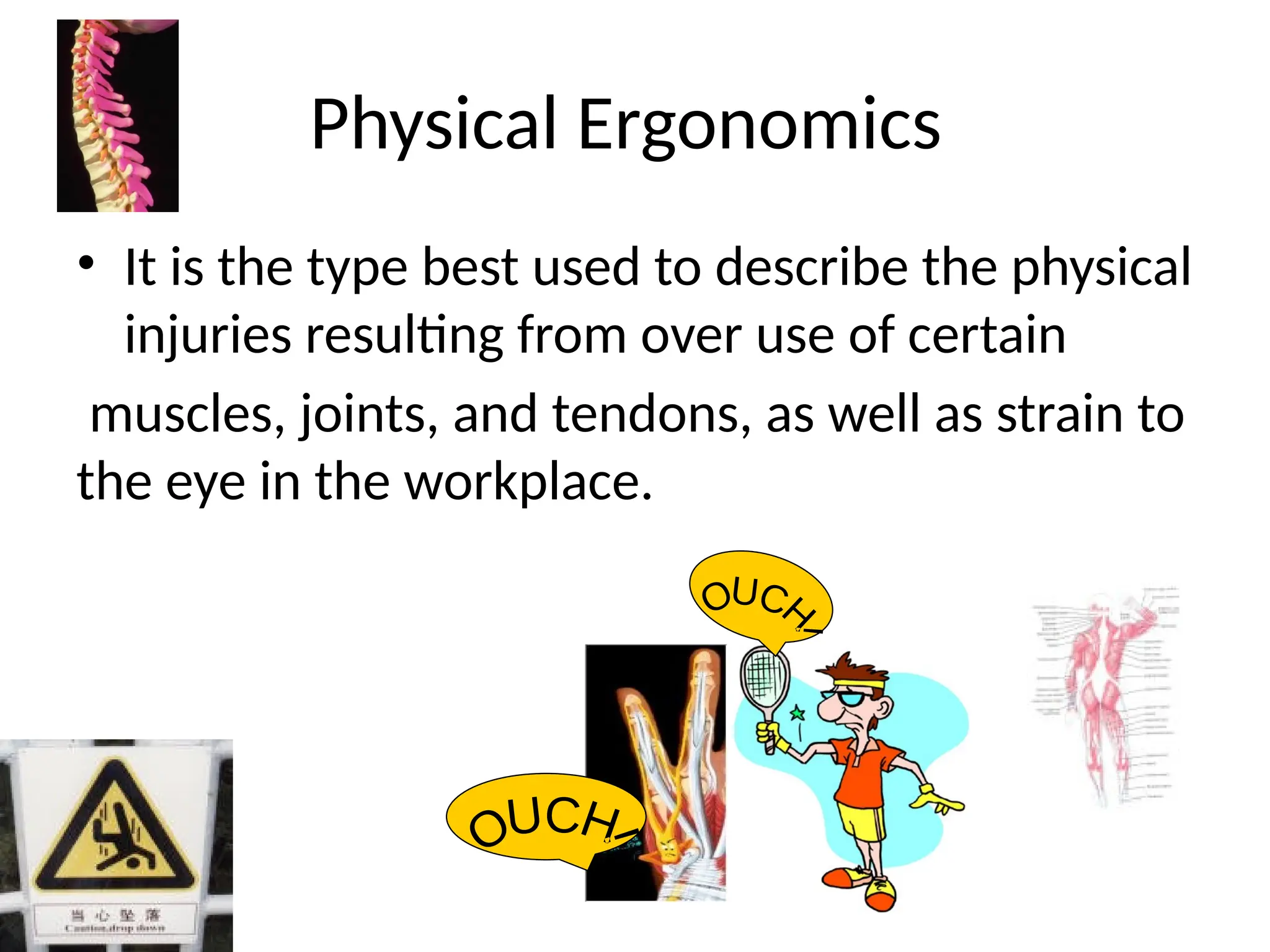
• Itis the type best used to describe the physical
injuries resulting from over use of certain
muscles, joints, and tendons, as well as strain to
the eye in the workplace.
28.
Physical Ergonomics
• Repetitivestrain injuries from repetition,
vibration, force, and posture fall into this
category.
– E.g. Computer
• Physical strain of keyboarding, mousing, and viewing
the computer screen.
• Ergonomics of your workstation should be
compatible with your body to avoid injury.
29.
Cognitive Ergonomics
• Itis concerned with mental processes (such as
perception, memory, reasoning, and motor
response), as they affect interactions among
humans and other elements of a system.
• It deals with the mental processes and
capacities of humans when at work.
30.
Cognitive Ergonomics
• Itincludes mental workload, decision-making,
skilled performance, human-computer
interaction, human reliability, work stress and
training as these may relate to human-system
design.
• Mental strain from workload, decision making,
human error, and training fall into this category.
31.
Organizational Ergonomics
• Organizationalergonomics deals with the
organizational structures, policies and processes
in the work environment, such as shift work,
scheduling, job satisfaction, motivation,
supervision, teamwork, telecommuting, and
ethics.
Importance of Ergonomics
1.Important for our own overall health
2. It avoids to accelerate all our problems with
our body
3. It helps to alleviate physical and mental stress
4. It fits the jobs to worker
5. It makes the job easier
34.
Importance of Ergonomics
6.It improves the performance of employee
7. It helps to provide safety
8. It decreases the
– Expense on your employees medical
– Absenteeism
9. It increases the
– Productivity
– Product quality
#5 Ergonomics developed into a recognized field during World War II, when for the first
time, technology and the human sciences were systematically applied in a coordinated
manner. Physiologists, psychologists, anthropologists, medical doctors, work
scientists and engineers together addressed the problems arising from the operation
of complex military equipment. The results of this interdisciplinary approach
appeared so promising that the cooperation was pursued after the war, in industry.
Interest in the approach grew rapidly, especially in Europe and the U.S., leading
to the foundation in England of the first ever national ergonomics society in 1949,
which is when the term ergonomics was adopted. This was followed in 1961 by the
creation of the International Ergonomics Association (IEA), which represents ergonomics
societies that are active in more than 40 countries or regions, with a total
membership of some 19,000 people.
#8 These factors determine to a large extent safety, health, comfort and efficient performance at work and in everyday life.
#15 Common causes of MSD, CTD, or RSI are the following:
Not all the listed risk factors will be present in every MSD producing task, nor is the existence of one of these factors necessarily sufficient to cause a MSD.
Repetitive/prolonged activities -constant lifting, continuous pressing/pulling of a lever with same extremity, even prolonged sitting especially with poor posture.
Awkward positions including reaching above the shoulders or behind the back, twisting the wrists & other joints, twisting at the waist.
Vibration from power tools(jackhammer)-excessive vibration causes pain to muscles, joints, causes trauma to the hands, arms, feet & legs.
Temperatures -Excessive heat and humidity effects the body’s blood circulation and causes cramps and general discomfort. Cold exposures effects the body’s blood circulation and causes hypothermia, loss of flexibility, distraction and poor dexterity. A general comfortable temperature range is 68-74 degrees F +/-10 degrees depending on work load with humidity between 20-60 percent.
Forceful exertions – the greater the amount of force that is applied, the greater the degree of risk for a MSD to occur. Examples of Work Related MSD injuries that are associated with “High Force” are at the shoulder/neck, the low back, and fore arm/wrist/hand.
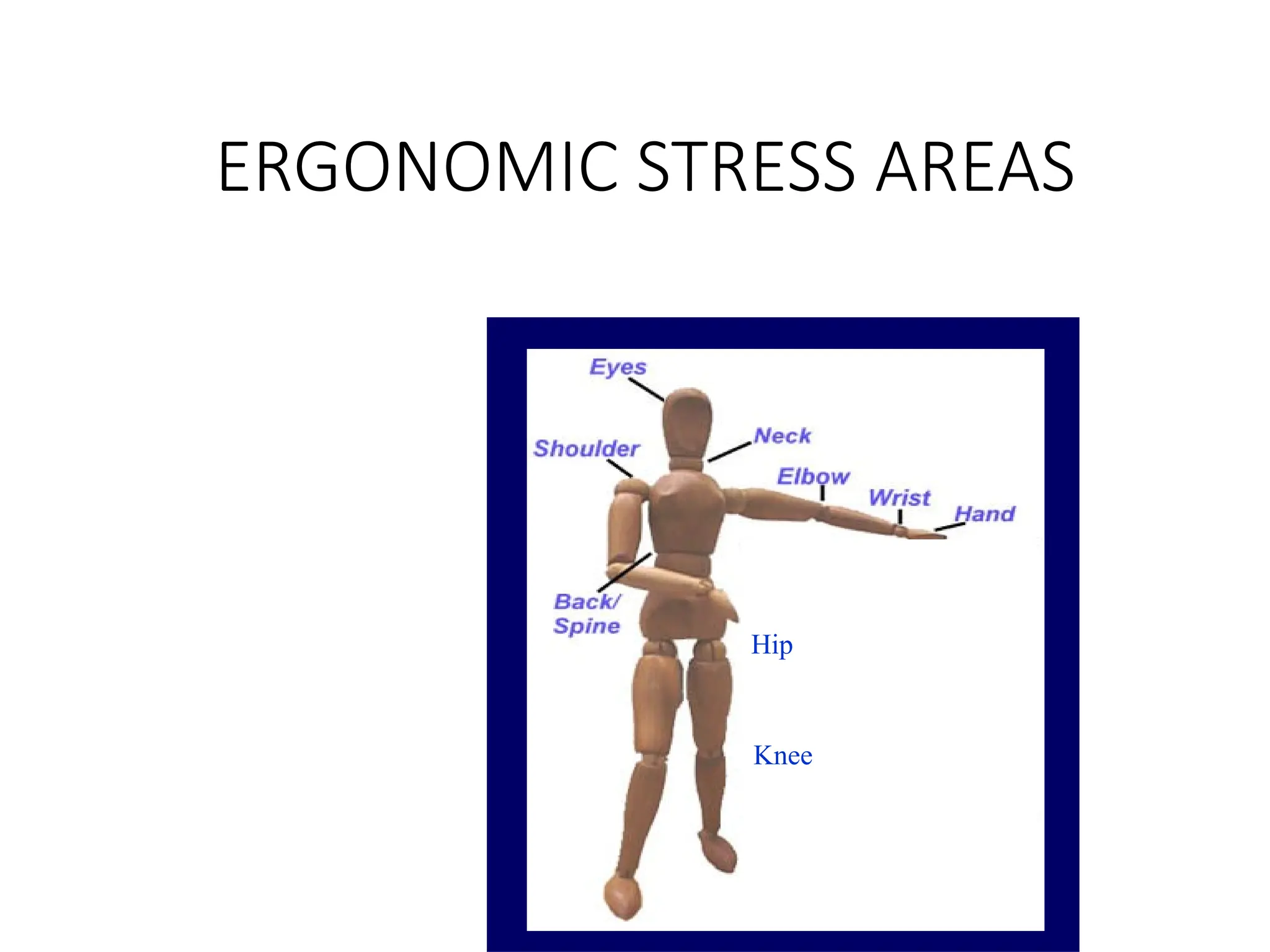
#16 These are the body parts most affected. We will discuss problems associated with each body part, and solutions for the problems.
The muscles, nerves, tendons, ligaments, cartilage, joints, including spinal discs are affected in these body parts.
#18 Symptoms can vary in their severity depending on the amount of exposure the employee has had. Often the symptoms appear gradually as muscle fatigue or pain at work that disappears during rest. Usually the symptoms become more severe as exposure continues. An example is tingling continues when the employee is at rest, numbness or pain make it difficult to perform the job, and finally the pain is so severe the employee is unable to perform physical work activities.
#19 Tendonitis- common examples are tennis elbow-usually indicated by pain or ache on along the outside of the elbow and golfer’s elbow-usually indicated by pain or ache along the inside of the elbow. Can affect the wrist which is the irritation of one of the tendons where is crosses the wrist. Tennis elbow case was a bank teller that developed the disease from the repetitious work. Other names associated with injuries of the wrist are DeQuervain’s Disease, and extensor tendonitis. Another is Rotator Cuff Tendonitis-is the set of muscles and tendons that secure the arm to the shoulder joint and permit rotation of the arm.
Carpal Tunnel Syndrome is the pinching of the median nerve at the wrist. Have the symptoms/signs of numbness, tingling, pain and weakness in the thumb, index, middle and ring fingers. The pain etc may wake you up at night or worsen when do forceful or repetitive work.
#20 Just shows the area where the median nerve runs through the wrist.
#21 Trigger Finger is a disorder of the hand that causes a painful catching of the fingers or thumb. It is an inflammation and narrowing of the outer covering or sheath that surrounds the tendons that bend the fingers. The the enlarged tendons try to move through the constricted opening it may produce a catching or snapping sensation. Usually straightening the finger is the biggest problem. There are even occasions were the finger must pulled straight or is even totally locked and cannot be pulled straight. Physicians feel that repeated strain of the area might cause the problem. Also tasks that require repeated grasping or the prolonged use of tools (scissors, screwdrivers) that press on the tendon sheath at the base of the finger or thumb may also irritate the tendons and tendon sheath.
Eye Strain- can have visual discomfort, headaches, blurred vision, burning and/or dry eyes, slow refocusing, sensitivity to light, double vision, and after-images. Poor lighting in the work area, glare from windows, lights or other sources, viewing from awkward positions, extended viewing with no breaks. Computer Vision Syndrome is the name of the condition the American Optometric Association defines as the “complex of eye and vision problems related to near work, which are experienced during or related to computer use.”
#22 1. Blanching is the turning white of the fingers or parts of hand and arm. Condition is associated with exposure to vibration. Primarily a problem with chain sawyers, and workers using pneumatic tools for grinding, polishing, sanding, and riveting. The prolonged use of vibration hand tools can cause stress at the joints and muscles leading to the reduction of blood flow. The risk increases with forceful gripping of the hand-tools and with continuous exposure to vibration both nerves and blood vessels are affected. Pneumatic tools are generally worse than electrically powered tools. Heard of a case where a construction worker developed MSD in 5 days from the continuous use of a jackhammer.
2. Muscle strains can occur in different parts of the body. The neck, shoulder, back, arm, leg, etc.
These are just some of the MSD. There are others out there.
















![Understanding Parkinson’s Disease: Causes, Symptoms, and Treatment [2025]](https://cdn.slidesharecdn.com/ss_thumbnails/understandingparkinson-251208102525-80ba3223-thumbnail.jpg?width=640&height=640&fit=bounds)


