ERD
Practice
Exercises
Database Design
Exercise 1
Problem
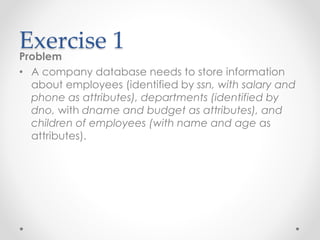
• A company database needs to store information
about employees (identified by ssn, with salary and
phone as attributes), departments (identified by
dno, with dname and budget as attributes), and
children of employees (with name and age as
attributes).
Exercise 1
Problem
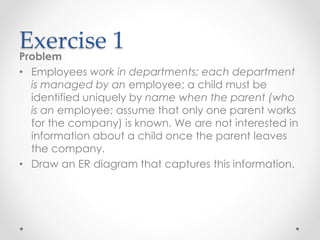
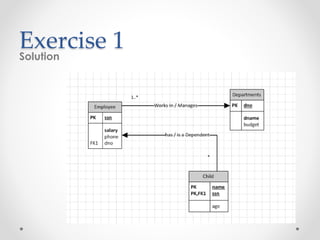
• Employees work in departments; each department
is managed by an employee; a child must be
identified uniquely by name when the parent (who
is an employee; assume that only one parent works
for the company) is known. We are not interested in
information about a child once the parent leaves
the company.
• Draw an ER diagram that captures this information.
Exercise 1
Solution
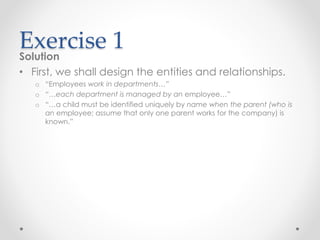
• First, we shall design the entities and relationships.
o “Employees work in departments…”
o “…each department is managed by an employee…”
o “…a child must be identified uniquely by name when the parent (who is
an employee; assume that only one parent works for the company) is
known.”
Exercise 1
Solution
Exercise 1
Solution
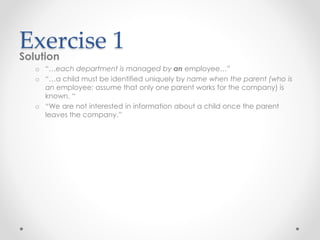
o “…each department is managed by an employee…”
o “…a child must be identified uniquely by name when the parent (who is
an employee; assume that only one parent works for the company) is
known. “
o “We are not interested in information about a child once the parent
leaves the company.”
Exercise 2
Problem
• Although you always wanted to be an artist, you
ended up being an expert on databases because
you love to cook data and you somehow confused
database with data baste. Your old love is still there,
however, so you set up a database company,
ArtBase, that builds a product for art galleries. The
core of this product is a database with a schema
that captures all the information that galleries need
to maintain.
Exercise 2
Problem
• Galleries keep information about artists, their names
(which are unique), birthplaces, age,and style of
art. For each piece of artwork, the artist, the year it
was made, its unique title, its type of art (e.g.,
painting, lithograph, sculpture, photograph), and its
price must be stored. Pieces of artwork are also
classified into groups of various kinds, for example,
portraits, still lifes, works by Picasso, or works of the
19th century; a given piece may belong to more
than one group.
Exercise 2
Problem
• Each group is identified by a name (like those just
given) that describes the group. Finally, galleries
keep information about customers. For each
customer, galleries keep that person’s unique
name, address, total amount of dollars spent in the
gallery (very important!), and the artists and groups
of art that the customer tends to like.
• Draw the ER diagram for the database.
Exercise 2
Solution
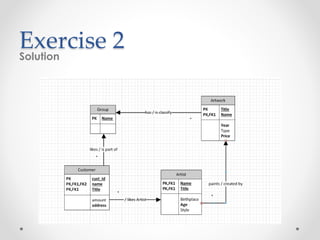
• Like before, we begin with the entities and
relationships.
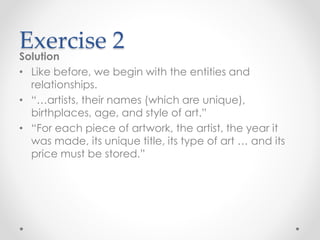
• “…artists, their names (which are unique),
birthplaces, age, and style of art.”
• “For each piece of artwork, the artist, the year it
was made, its unique title, its type of art … and its
price must be stored.”
Exercise 2
Solution
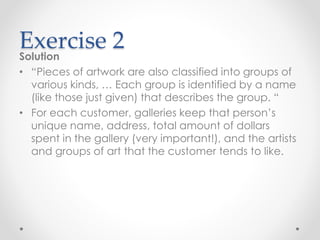
• “Pieces of artwork are also classified into groups of
various kinds, … Each group is identified by a name
(like those just given) that describes the group. “
• For each customer, galleries keep that person’s
unique name, address, total amount of dollars
spent in the gallery (very important!), and the artists
and groups of art that the customer tends to like.
Exercise 2
Solution
Exercise 2
Solution
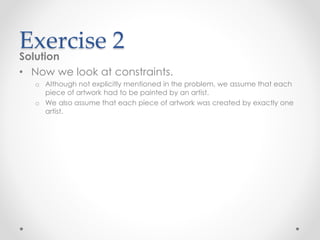
• Now we look at constraints.
o Although not explicitly mentioned in the problem, we assume that each
piece of artwork had to be painted by an artist.
o We also assume that each piece of artwork was created by exactly one
artist.
Exercise 2
Solution
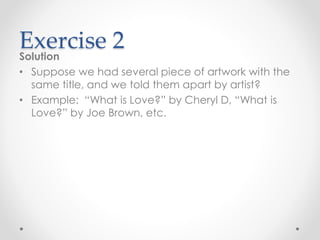
• Suppose we had several piece of artwork with the
same title, and we told them apart by artist?
• Example: “What is Love?” by Cheryl D, “What is
Love?” by Joe Brown, etc.

Erd practice exercises

  • 1.
  • 2.
    Exercise 1 Problem • Acompany database needs to store information about employees (identified by ssn, with salary and phone as attributes), departments (identified by dno, with dname and budget as attributes), and children of employees (with name and age as attributes).
  • 3.
    Exercise 1 Problem • Employeeswork in departments; each department is managed by an employee; a child must be identified uniquely by name when the parent (who is an employee; assume that only one parent works for the company) is known. We are not interested in information about a child once the parent leaves the company. • Draw an ER diagram that captures this information.
  • 4.
    Exercise 1 Solution • First,we shall design the entities and relationships. o “Employees work in departments…” o “…each department is managed by an employee…” o “…a child must be identified uniquely by name when the parent (who is an employee; assume that only one parent works for the company) is known.”
  • 5.
  • 6.
    Exercise 1 Solution o “…eachdepartment is managed by an employee…” o “…a child must be identified uniquely by name when the parent (who is an employee; assume that only one parent works for the company) is known. “ o “We are not interested in information about a child once the parent leaves the company.”
  • 7.
    Exercise 2 Problem • Althoughyou always wanted to be an artist, you ended up being an expert on databases because you love to cook data and you somehow confused database with data baste. Your old love is still there, however, so you set up a database company, ArtBase, that builds a product for art galleries. The core of this product is a database with a schema that captures all the information that galleries need to maintain.
  • 8.
    Exercise 2 Problem • Gallerieskeep information about artists, their names (which are unique), birthplaces, age,and style of art. For each piece of artwork, the artist, the year it was made, its unique title, its type of art (e.g., painting, lithograph, sculpture, photograph), and its price must be stored. Pieces of artwork are also classified into groups of various kinds, for example, portraits, still lifes, works by Picasso, or works of the 19th century; a given piece may belong to more than one group.
  • 9.
    Exercise 2 Problem • Eachgroup is identified by a name (like those just given) that describes the group. Finally, galleries keep information about customers. For each customer, galleries keep that person’s unique name, address, total amount of dollars spent in the gallery (very important!), and the artists and groups of art that the customer tends to like. • Draw the ER diagram for the database.
  • 10.
    Exercise 2 Solution • Likebefore, we begin with the entities and relationships. • “…artists, their names (which are unique), birthplaces, age, and style of art.” • “For each piece of artwork, the artist, the year it was made, its unique title, its type of art … and its price must be stored.”
  • 11.
    Exercise 2 Solution • “Piecesof artwork are also classified into groups of various kinds, … Each group is identified by a name (like those just given) that describes the group. “ • For each customer, galleries keep that person’s unique name, address, total amount of dollars spent in the gallery (very important!), and the artists and groups of art that the customer tends to like.
  • 12.
  • 13.
    Exercise 2 Solution • Nowwe look at constraints. o Although not explicitly mentioned in the problem, we assume that each piece of artwork had to be painted by an artist. o We also assume that each piece of artwork was created by exactly one artist.
  • 14.
    Exercise 2 Solution • Supposewe had several piece of artwork with the same title, and we told them apart by artist? • Example: “What is Love?” by Cheryl D, “What is Love?” by Joe Brown, etc.