11 
Instructional Design 
Epistemological Development 
English Study Program 
April 2013
22 
Ways of knowing 
• So, we have a set of research questions… 
how do we know the answers to the 
questions? 
• Epistemology: the division of philosophy 
that investigates the nature and origin of 
knowledge. 
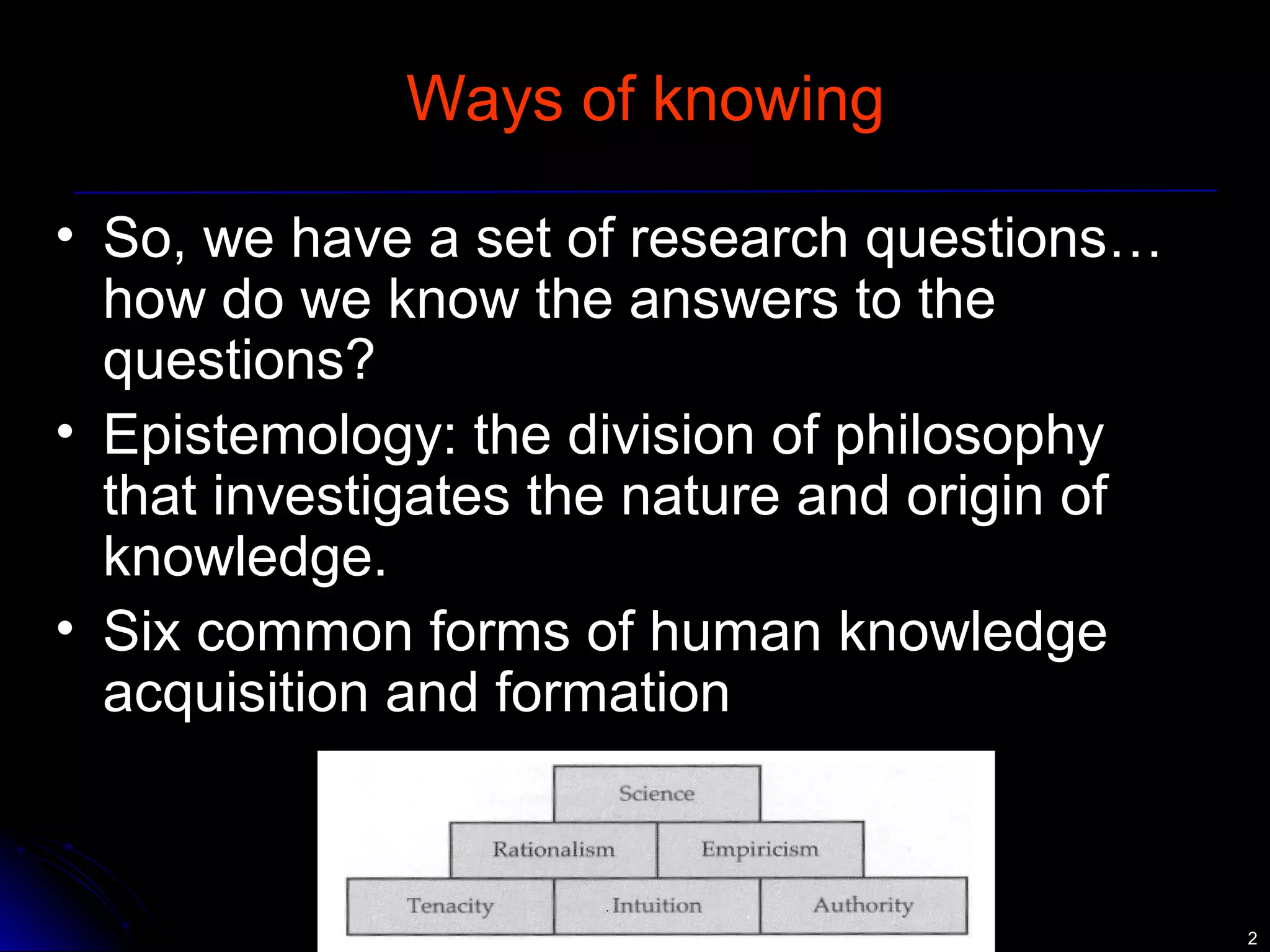
• Six common forms of human knowledge 
acquisition and formation
33 
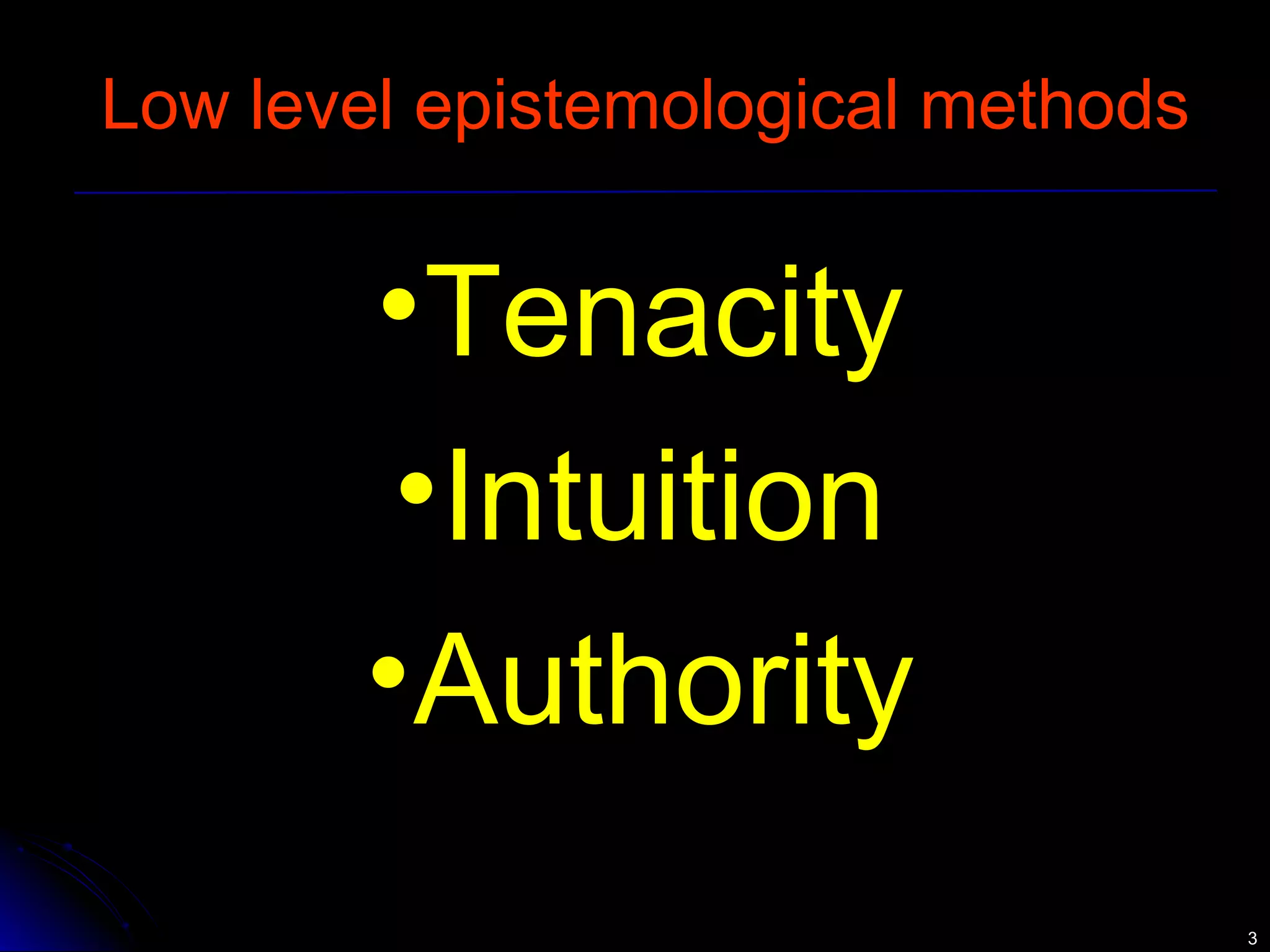
Low level epistemological methods 
•Tenacity 
•Intuition 
•Authority
44 
Ways of knowing: Tenacity 
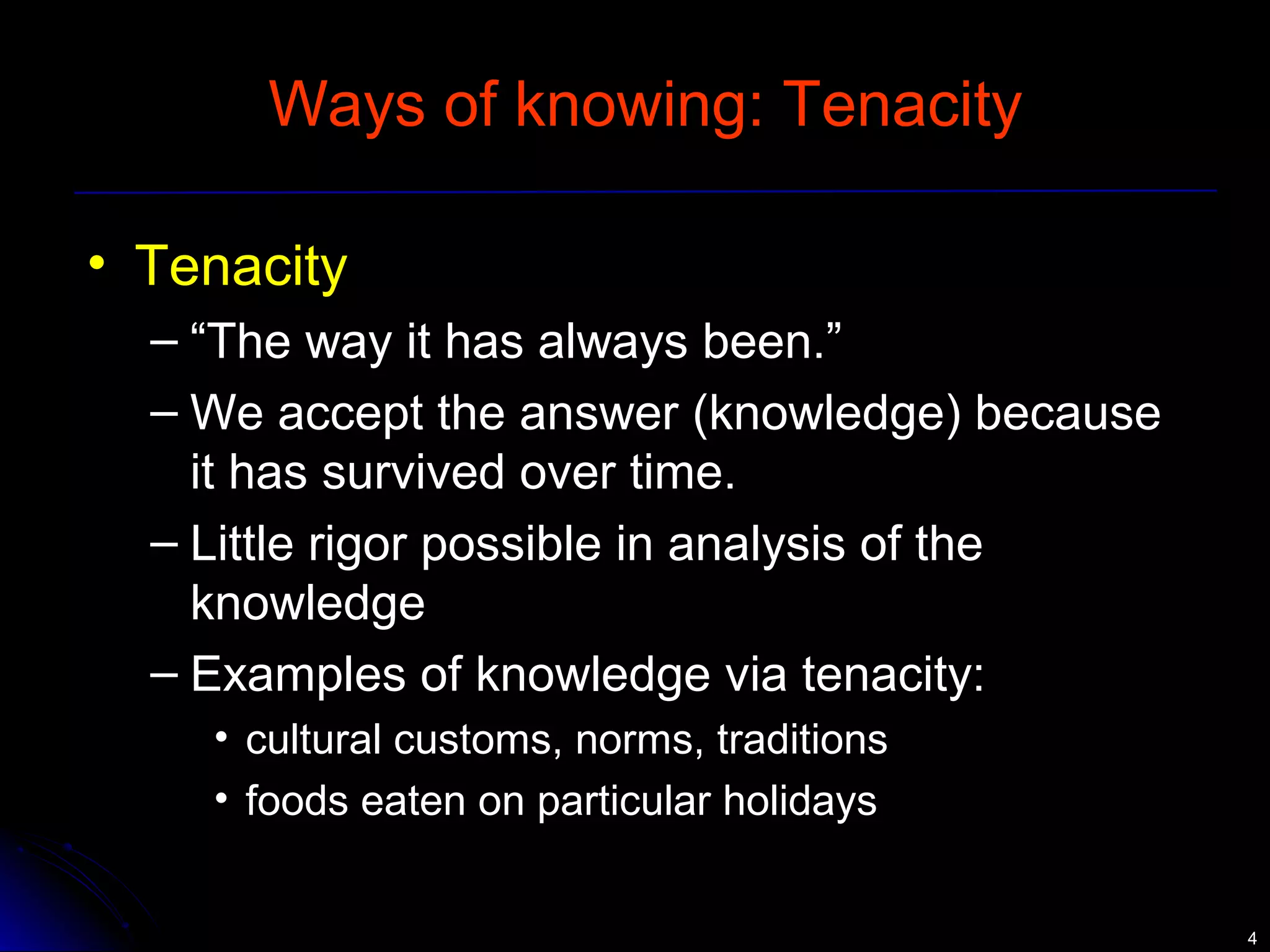
• Tenacity 
– “The way it has always been.” 
– We accept the answer (knowledge) because 
it has survived over time. 
– Little rigor possible in analysis of the 
knowledge 
– Examples of knowledge via tenacity: 
• cultural customs, norms, traditions 
• foods eaten on particular holidays
55 
Way of knowing: Intuition 
• Intuition 
– “It feels right.” 
– Extra-sensory source, gut feelings, so on 
– Again, less rigor in the analysis of the 
knowledge, because it is not readily 
analyzable
66 
Ways of knowing: Authority 
• Authority 
– answers, knowledge gained from a trusted 
source 
– burden of analysis is mostly on the credibility 
of the source
77 
Ways of knowing: Science 
• Science: the development of knowledge through 
a combination of rationalism and empiricism. 
– Mind (logic) + Senses (observation) 
– Rational empirical method: another name for science 
• Rationalism 
– Development of knowledge through the application of 
the rules of logic 
• Empiricism 
– Development and confirmation of knowledge through 
the observation of events using human senses
88 
Ways of knowing: Science (cont.) 
• Rationalism: knowing through logic 
• deductive logic: 
– apply general principles to a case to draw conclusions 
– syllogism 
• inductive logic: 
– from specific case, generalize to principles 
– Basis for hypothesis testing 
• analogical logic: 
– from a specific case, apply to another case 
– Based on similarities between the cases 
• casual logic : 
– cause and effect link between events 
• Three requirements for establishing a causal link (see later)
99 
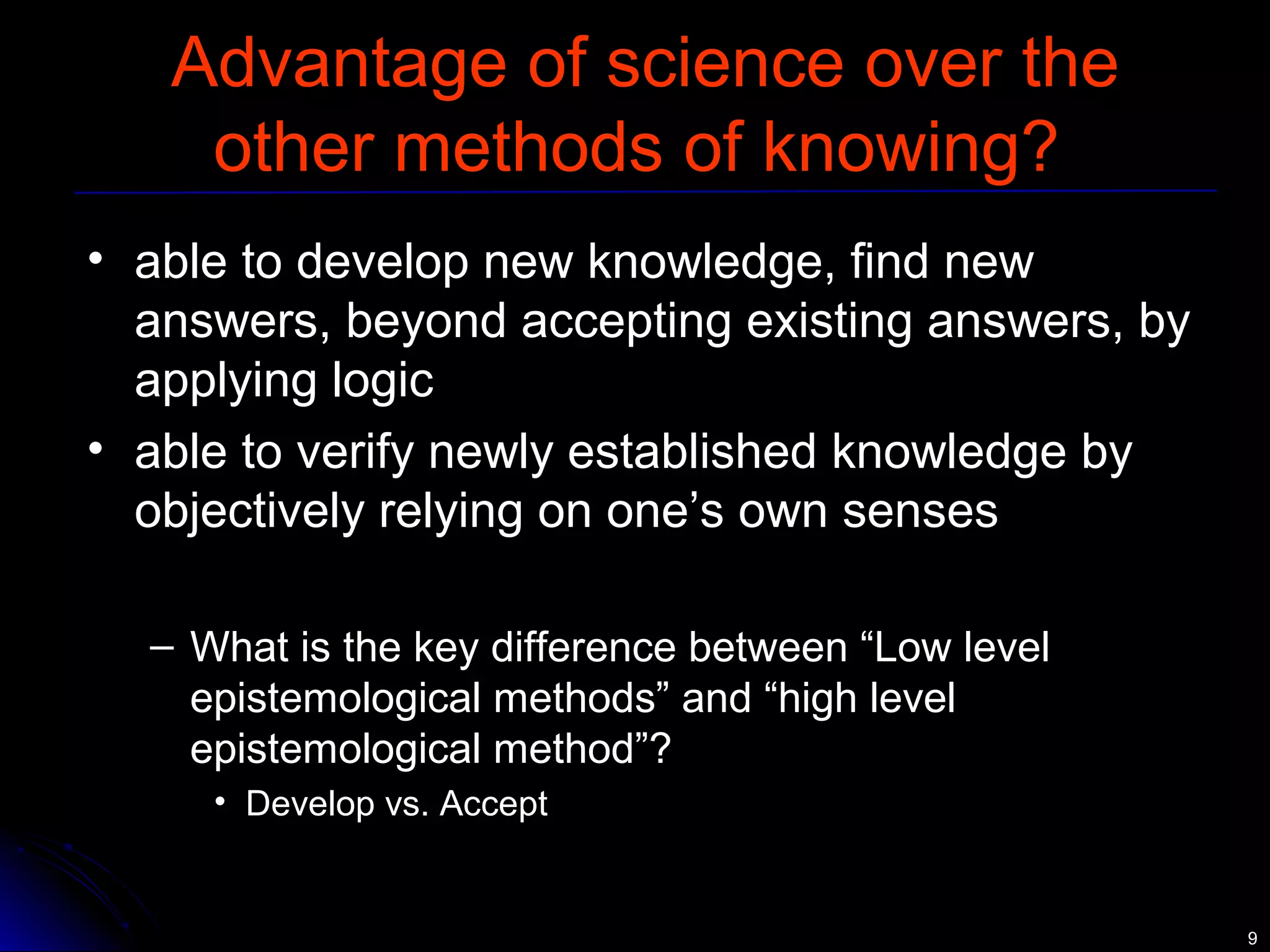
Advantage of science over the 
other methods of knowing? 
• able to develop new knowledge, find new 
answers, beyond accepting existing answers, by 
applying logic 
• able to verify newly established knowledge by 
objectively relying on one’s own senses 
– What is the key difference between “Low level 
epistemological methods” and “high level 
epistemological method”? 
• Develop vs. Accept
1100 
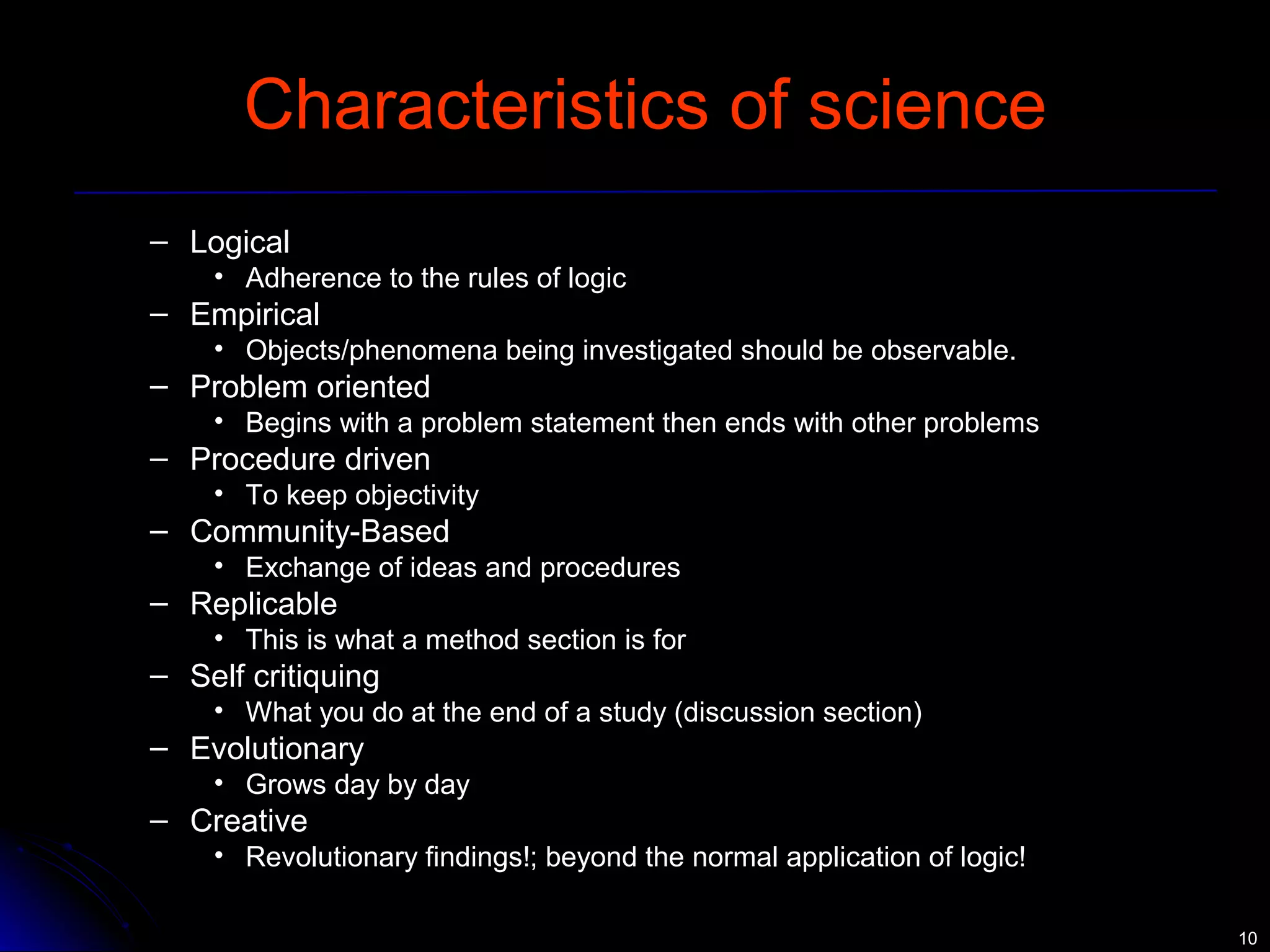
Characteristics of science 
– Logical 
• Adherence to the rules of logic 
– Empirical 
• Objects/phenomena being investigated should be observable. 
– Problem oriented 
• Begins with a problem statement then ends with other problems 
– Procedure driven 
• To keep objectivity 
– Community-Based 
• Exchange of ideas and procedures 
– Replicable 
• This is what a method section is for 
– Self critiquing 
• What you do at the end of a study (discussion section) 
– Evolutionary 
• Grows day by day 
– Creative 
• Revolutionary findings!; beyond the normal application of logic!
1111 
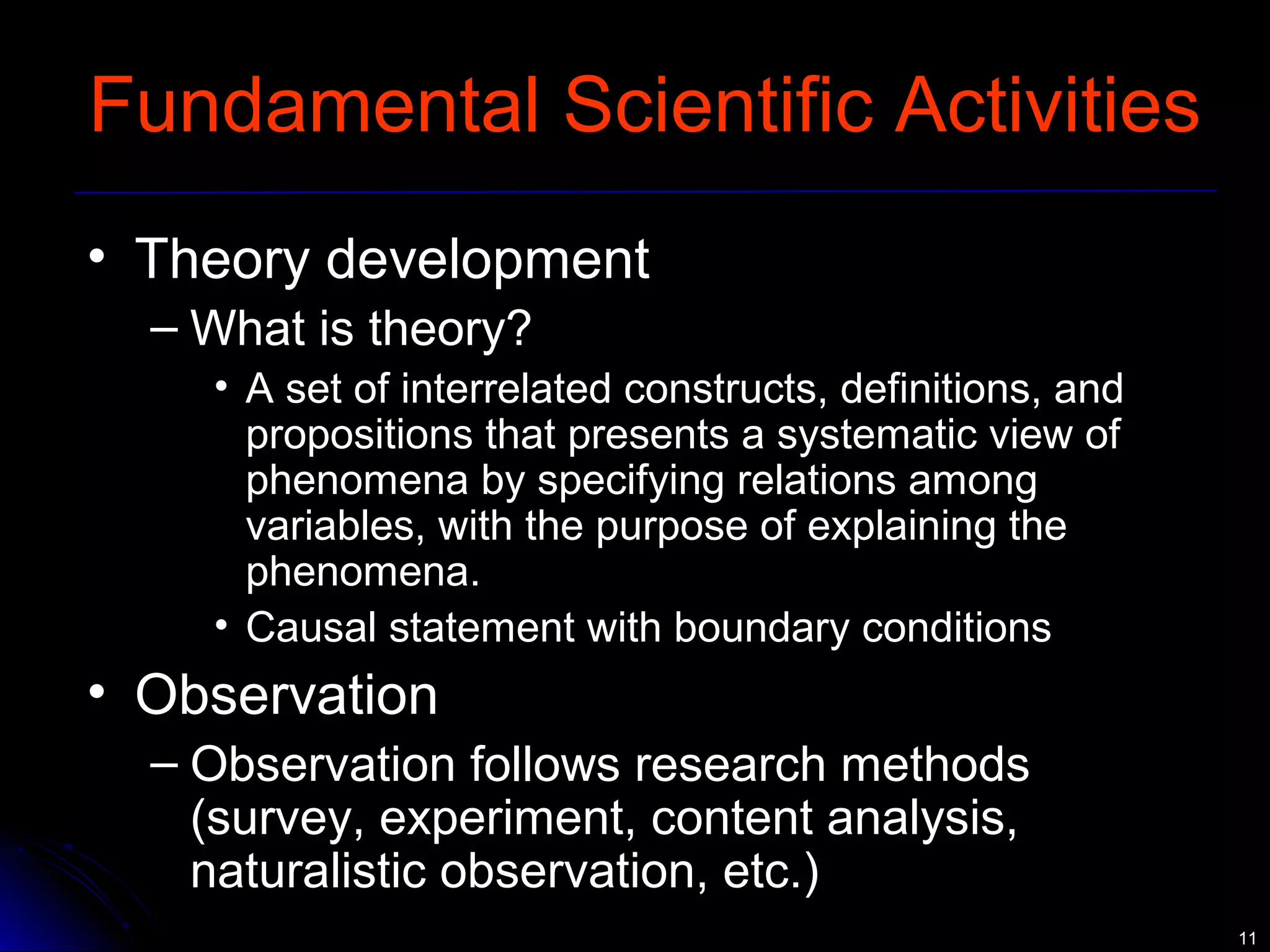
Fundamental Scientific Activities 
• Theory development 
– What is theory? 
• A set of interrelated constructs, definitions, and 
propositions that presents a systematic view of 
phenomena by specifying relations among 
variables, with the purpose of explaining the 
phenomena. 
• Causal statement with boundary conditions 
• Observation 
– Observation follows research methods 
(survey, experiment, content analysis, 
naturalistic observation, etc.)
1122 
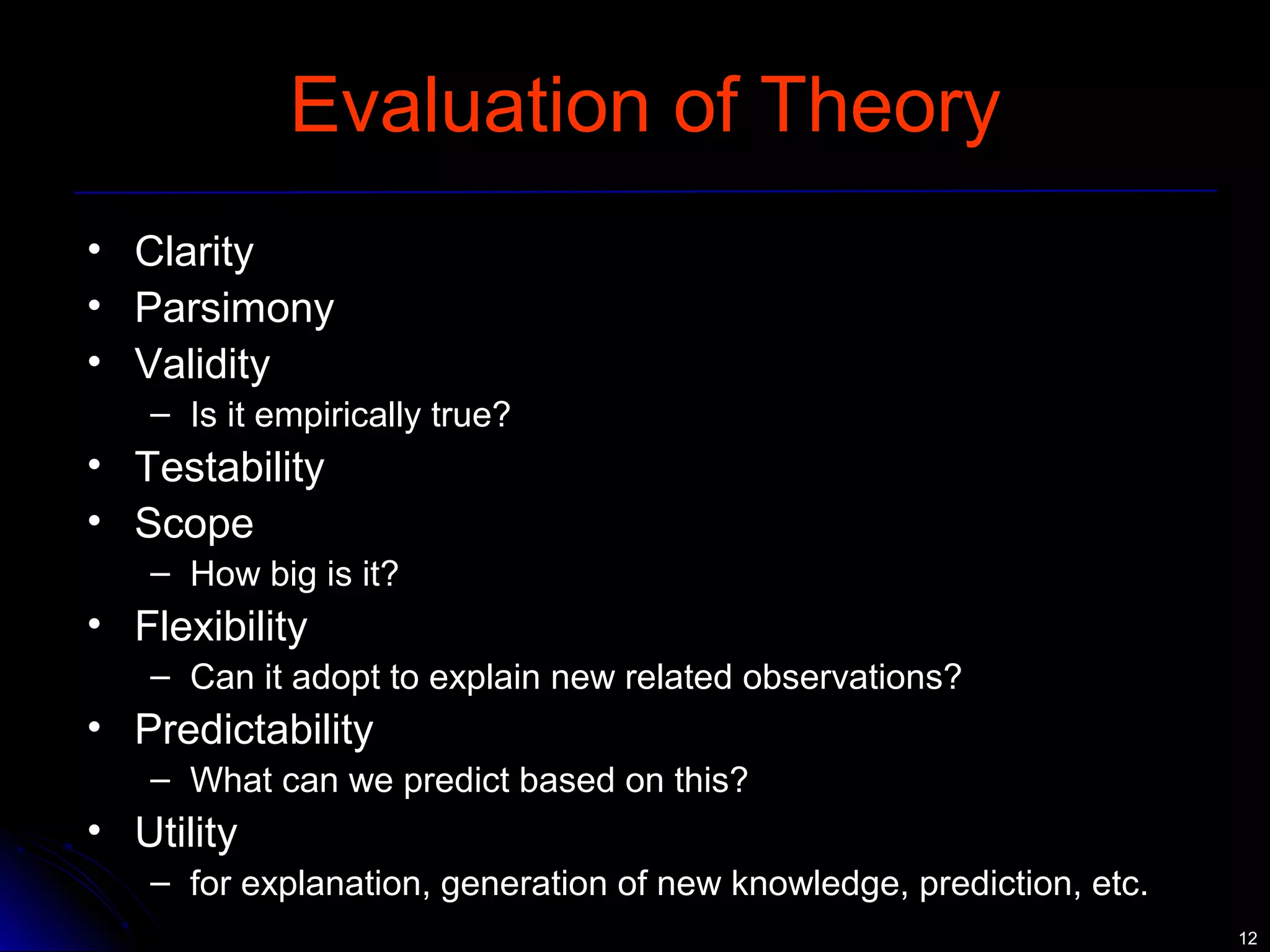
Evaluation of Theory 
• Clarity 
• Parsimony 
• Validity 
– Is it empirically true? 
• Testability 
• Scope 
– How big is it? 
• Flexibility 
– Can it adopt to explain new related observations? 
• Predictability 
– What can we predict based on this? 
• Utility 
– for explanation, generation of new knowledge, prediction, etc.
1133 
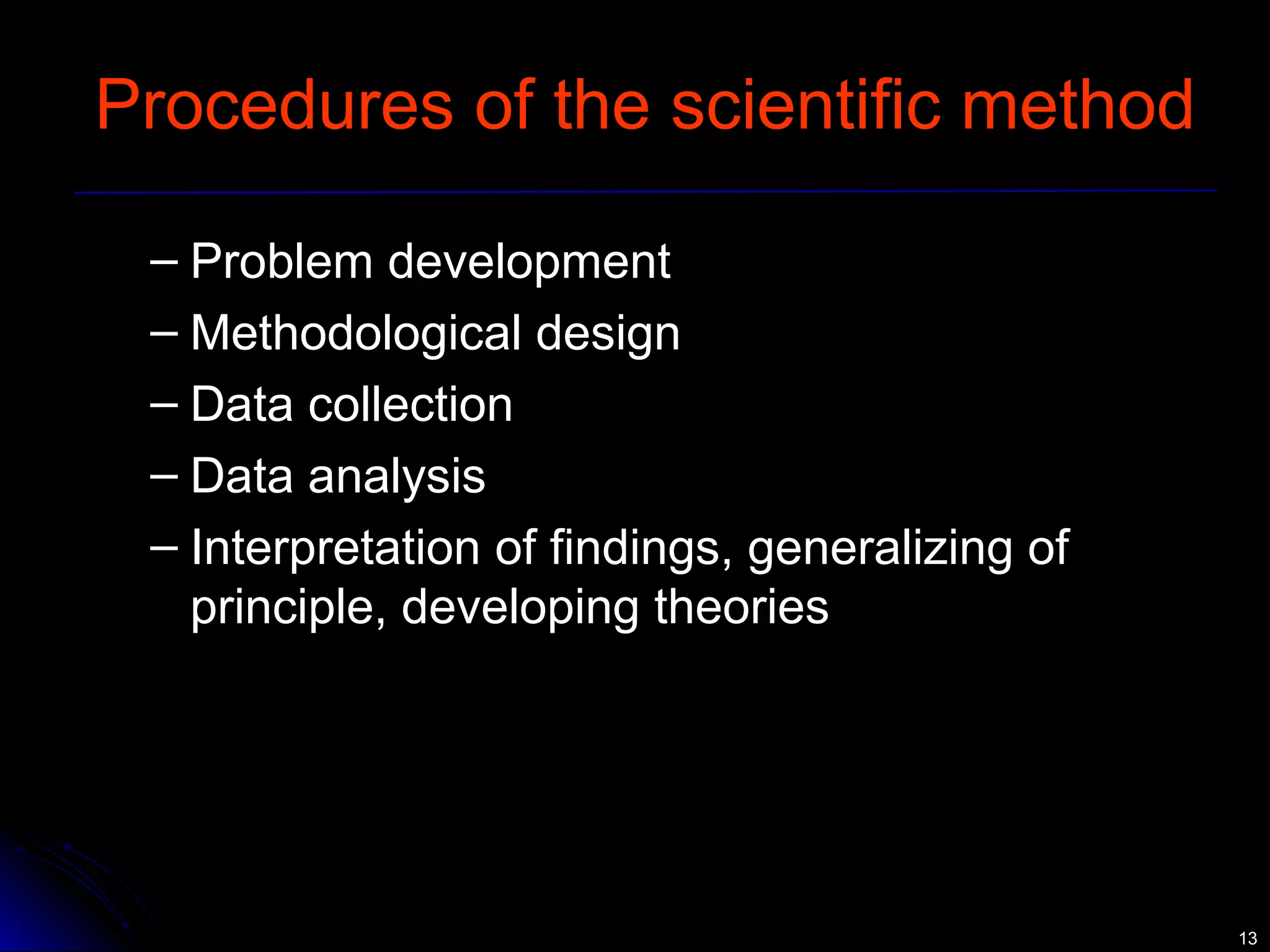
Procedures of the scientific method 
– Problem development 
– Methodological design 
– Data collection 
– Data analysis 
– Interpretation of findings, generalizing of 
principle, developing theories
1144 
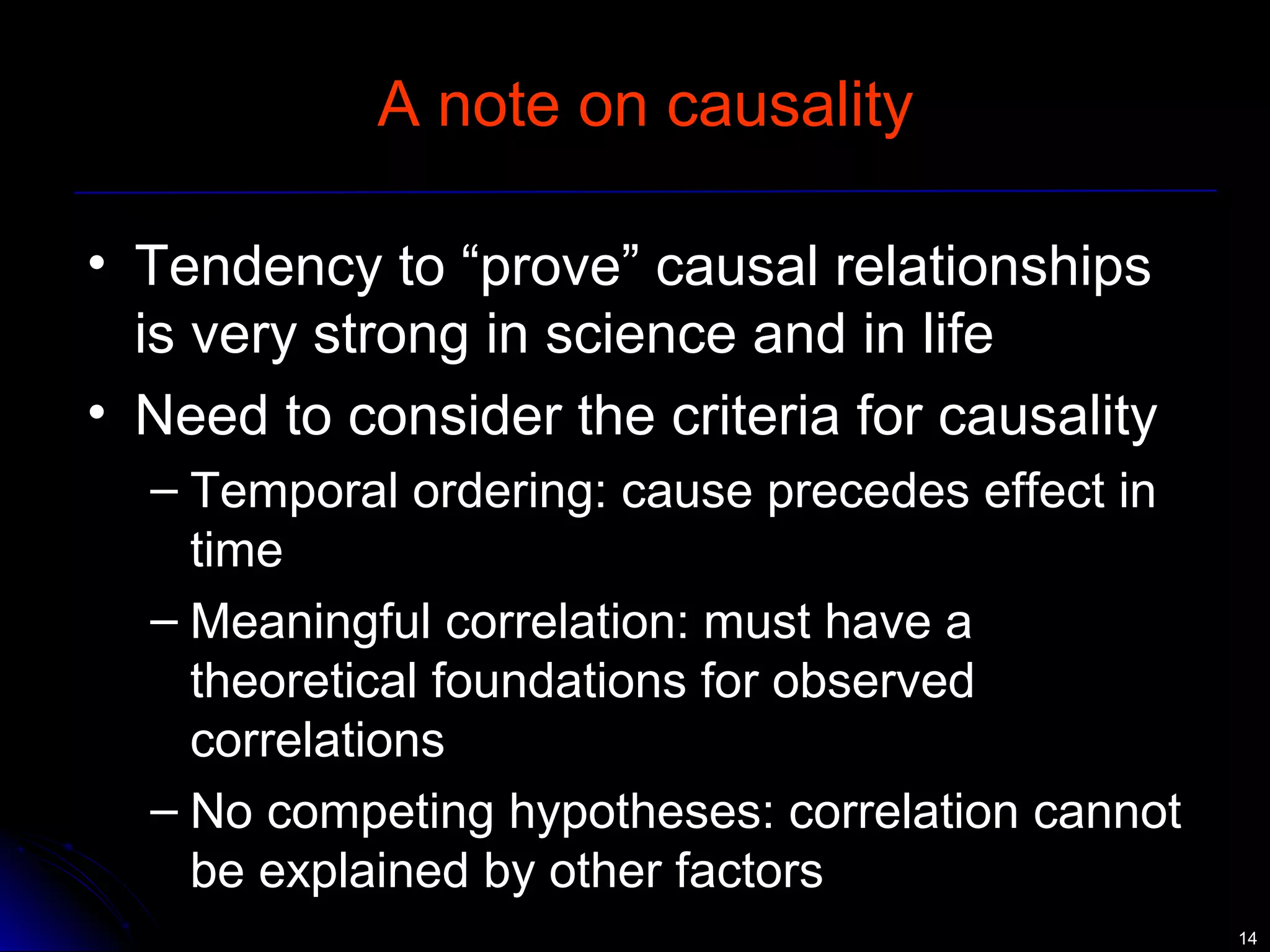
A note on causality 
• Tendency to “prove” causal relationships 
is very strong in science and in life 
• Need to consider the criteria for causality 
– Temporal ordering: cause precedes effect in 
time 
– Meaningful correlation: must have a 
theoretical foundations for observed 
correlations 
– No competing hypotheses: correlation cannot 
be explained by other factors
1155 
A note on causality (cont.) 
• Exercises in alternative hypotheses
1166 
End of Slides 
ANY QUESTION?

Epistemological development

  • 1.
    11 Instructional Design Epistemological Development English Study Program April 2013
  • 2.
    22 Ways ofknowing • So, we have a set of research questions… how do we know the answers to the questions? • Epistemology: the division of philosophy that investigates the nature and origin of knowledge. • Six common forms of human knowledge acquisition and formation
  • 3.
    33 Low levelepistemological methods •Tenacity •Intuition •Authority
  • 4.
    44 Ways ofknowing: Tenacity • Tenacity – “The way it has always been.” – We accept the answer (knowledge) because it has survived over time. – Little rigor possible in analysis of the knowledge – Examples of knowledge via tenacity: • cultural customs, norms, traditions • foods eaten on particular holidays
  • 5.
    55 Way ofknowing: Intuition • Intuition – “It feels right.” – Extra-sensory source, gut feelings, so on – Again, less rigor in the analysis of the knowledge, because it is not readily analyzable
  • 6.
    66 Ways ofknowing: Authority • Authority – answers, knowledge gained from a trusted source – burden of analysis is mostly on the credibility of the source
  • 7.
    77 Ways ofknowing: Science • Science: the development of knowledge through a combination of rationalism and empiricism. – Mind (logic) + Senses (observation) – Rational empirical method: another name for science • Rationalism – Development of knowledge through the application of the rules of logic • Empiricism – Development and confirmation of knowledge through the observation of events using human senses
  • 8.
    88 Ways ofknowing: Science (cont.) • Rationalism: knowing through logic • deductive logic: – apply general principles to a case to draw conclusions – syllogism • inductive logic: – from specific case, generalize to principles – Basis for hypothesis testing • analogical logic: – from a specific case, apply to another case – Based on similarities between the cases • casual logic : – cause and effect link between events • Three requirements for establishing a causal link (see later)
  • 9.
    99 Advantage ofscience over the other methods of knowing? • able to develop new knowledge, find new answers, beyond accepting existing answers, by applying logic • able to verify newly established knowledge by objectively relying on one’s own senses – What is the key difference between “Low level epistemological methods” and “high level epistemological method”? • Develop vs. Accept
  • 10.
    1100 Characteristics ofscience – Logical • Adherence to the rules of logic – Empirical • Objects/phenomena being investigated should be observable. – Problem oriented • Begins with a problem statement then ends with other problems – Procedure driven • To keep objectivity – Community-Based • Exchange of ideas and procedures – Replicable • This is what a method section is for – Self critiquing • What you do at the end of a study (discussion section) – Evolutionary • Grows day by day – Creative • Revolutionary findings!; beyond the normal application of logic!
  • 11.
    1111 Fundamental ScientificActivities • Theory development – What is theory? • A set of interrelated constructs, definitions, and propositions that presents a systematic view of phenomena by specifying relations among variables, with the purpose of explaining the phenomena. • Causal statement with boundary conditions • Observation – Observation follows research methods (survey, experiment, content analysis, naturalistic observation, etc.)
  • 12.
    1122 Evaluation ofTheory • Clarity • Parsimony • Validity – Is it empirically true? • Testability • Scope – How big is it? • Flexibility – Can it adopt to explain new related observations? • Predictability – What can we predict based on this? • Utility – for explanation, generation of new knowledge, prediction, etc.
  • 13.
    1133 Procedures ofthe scientific method – Problem development – Methodological design – Data collection – Data analysis – Interpretation of findings, generalizing of principle, developing theories
  • 14.
    1144 A noteon causality • Tendency to “prove” causal relationships is very strong in science and in life • Need to consider the criteria for causality – Temporal ordering: cause precedes effect in time – Meaningful correlation: must have a theoretical foundations for observed correlations – No competing hypotheses: correlation cannot be explained by other factors
  • 15.
    1155 A noteon causality (cont.) • Exercises in alternative hypotheses
  • 16.
    1166 End ofSlides ANY QUESTION?