World
view
General Worldview for Science
Edition of, M. Vasquez, Biology
What is a Worldview?
A world view or worldview is the
fundamental cognitive orientation of an
individual or society encompassing the
whole of the individual's or society's
knowledge and point of view. A world
view can include natural philosophy;
fundamental, existential, and normative
postulates; or themes, values, emotions,
and ethics
What is a Worldview?
A Worldview is a collection of beliefs (ideas, images,
attitudes, values) that a group of people hold about
things –universe, humankind, God, future. A worldview
may be adopted, developed, formed, as a result of an
unconscious assimilation or conditioning process. It is
the general perspective from which one sees and
interprets the world.
Quoted from “Philosophy” by Peter Angels
The Harper Collins Dictionary
What is a Worldview?
•“The central set of concepts and presuppositions that
provide people with their basic assumptions about
reality.”
- Darrell Whiteman
• A Worldview is a set of presuppositions (or
assumptions) which we hold consciously or
unconsciously, consistently or inconsistently about the
basic make-up of our world
- Dr. James Sire
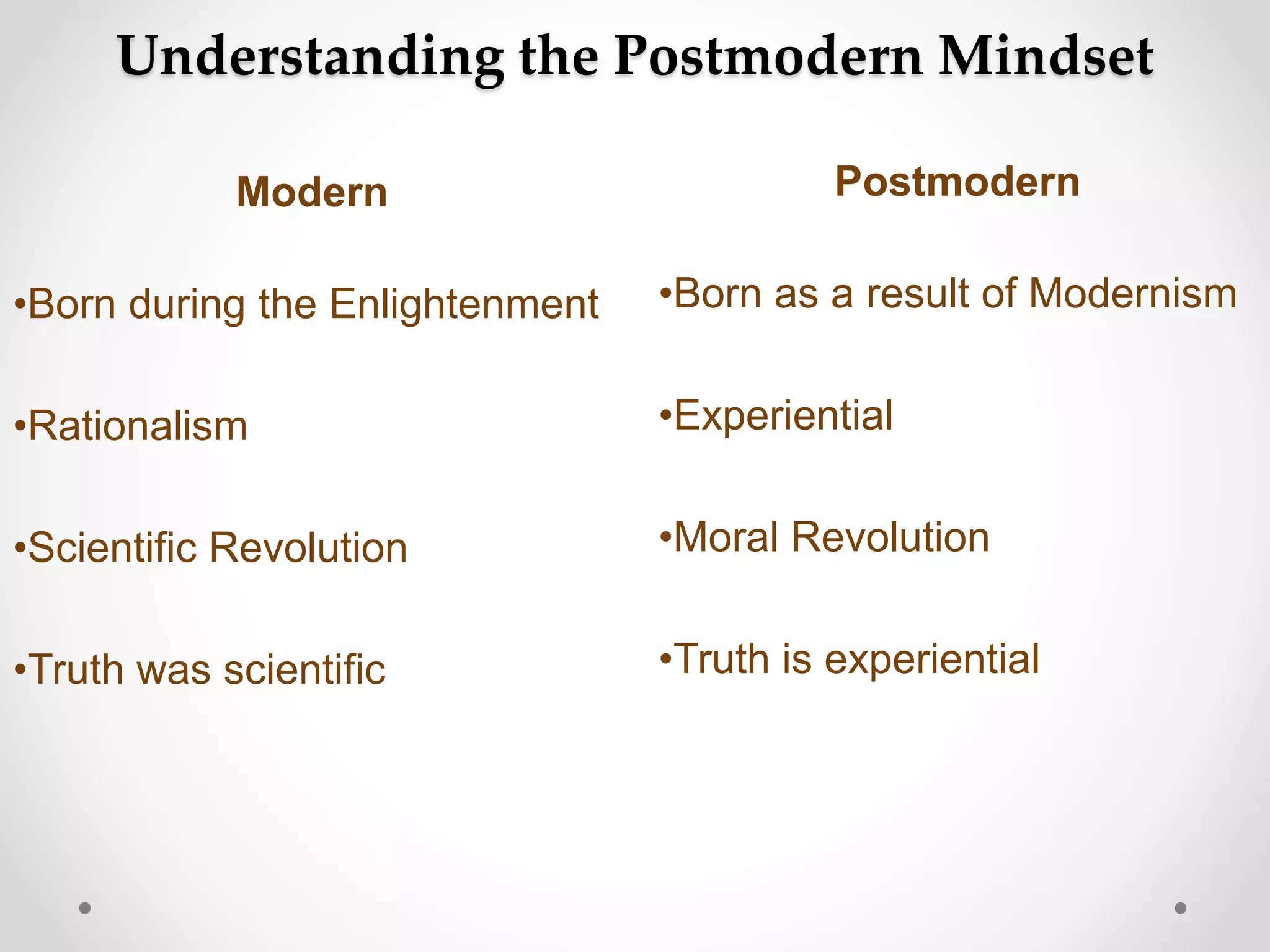
Understanding the Postmodern Mindset
Modern
•Born during the Enlightenment
•Rationalism
•Scientific Revolution
•Truth was scientific
Postmodern
•Born as a result of Modernism
•Experiential
•Moral Revolution
•Truth is experiential
What is Science?
A better answer – science is a disciplined attempt to find out:
• what exists
E.g. people, fleas, clouds, rivers, atoms, sub-atomic particles, molecules, poverty,
wars, minds, emotions, computational processes in computers, genes, species,
niches, ecosystems...
• how things work
E.g. how molecules of atoms and of hydrogen can be transformed into molecules of
water, how centripetal force produces circular or elliptical motion, how an egg
develops into a chicken, how humans generate grammatical sentences
(sometimes).
• why they work as they do
This usually requires appeal to do a deeper theory. Usually mathematics is required to
derive precise consequences from a deep theory.
• what doesn’t exist but could exist
Many animals that might have evolved did not. Many molecules might be produced
that have not been. Could peace exist on earth?
• how such things would work if they existed
What kind of design would allow a computer to learn to talk and understand
English fluently?
What is Science,
.... a disciplined attempt to find out:
• what sorts of things cannot exist
A mouse proving theorems about algebra? Dreams?
Telepathy?
• under what conditions they cannot exist
Some are probabilistic,
e.g. throwing two dice will produce two sixes only about 2.7778% of
the time. What
about: “a chess machine will not move its king into check”?
• why they cannot exist
The only way to explain why something is impossible (why a law holds)
is with
reference to a deeper, more general theory. Einstein’s theory of general
relativity
provided an explanation for Newton’s law of gravitation.
History of Science
• study of the historical development of science and scientific
knowledge, including both the natural sciences and social
sciences
Philosophy of Science
• concerned with all the assumptions, foundations, methods,
implications of science, and with the use and merit of
science.
The proper role of both sub disciplines toward those who
carry out scientific inquiry however can be stated as being
one of an historically informed guidance councilor, or
navigator which can help scientific practitioners avoid the
pitfalls and unproductive byways of the past.
• designed for students to explore
the world of scientific thought and
practice, and to deepen their
knowledge of the historical and
conceptual evolution of science
Not everyone agrees how to do science. One key issue
concerns the pursuit of objectivity.
The Scientific Method
– Open to the data
– Provisional knowledge and refutation
– Evidence is basis for knowledge
– Evidence is based on observation
– Replication is important
– Assumes an objective reality
– Precise and generalizable findings
Scientific Observation
– Systematic
– Comprehensive
– Objective
– Operationally specified
Logical Systems
• Deductive Method
1. Theory
2. Hypothesis
3. Defines variables
4. Observe/measure
• Inductive Method
1. Observe
2. Recognize a Pattern
3. Develop a logical explanation for the Pattern
Science does not assume
final answers are possible
Good scientists accept:
• that no answer is ever final,
• that it is always possible that contrary evidence can turn up,
• that it is always possible that better theories will be suggested,
In this, science differs from many other types of activity, including most
religious thinking,
e.g. those which involve a commitment to faith.
This does not mean that science is a free-for-all, that “anything goes”.
If most people accept theory A as the best available in some branch of
science, that does
not mean that no scientist can propose theory B which is inconsistent
with A.
It does mean that the reasons why B is better have to be articulated,
and those reasons
can then be investigated.
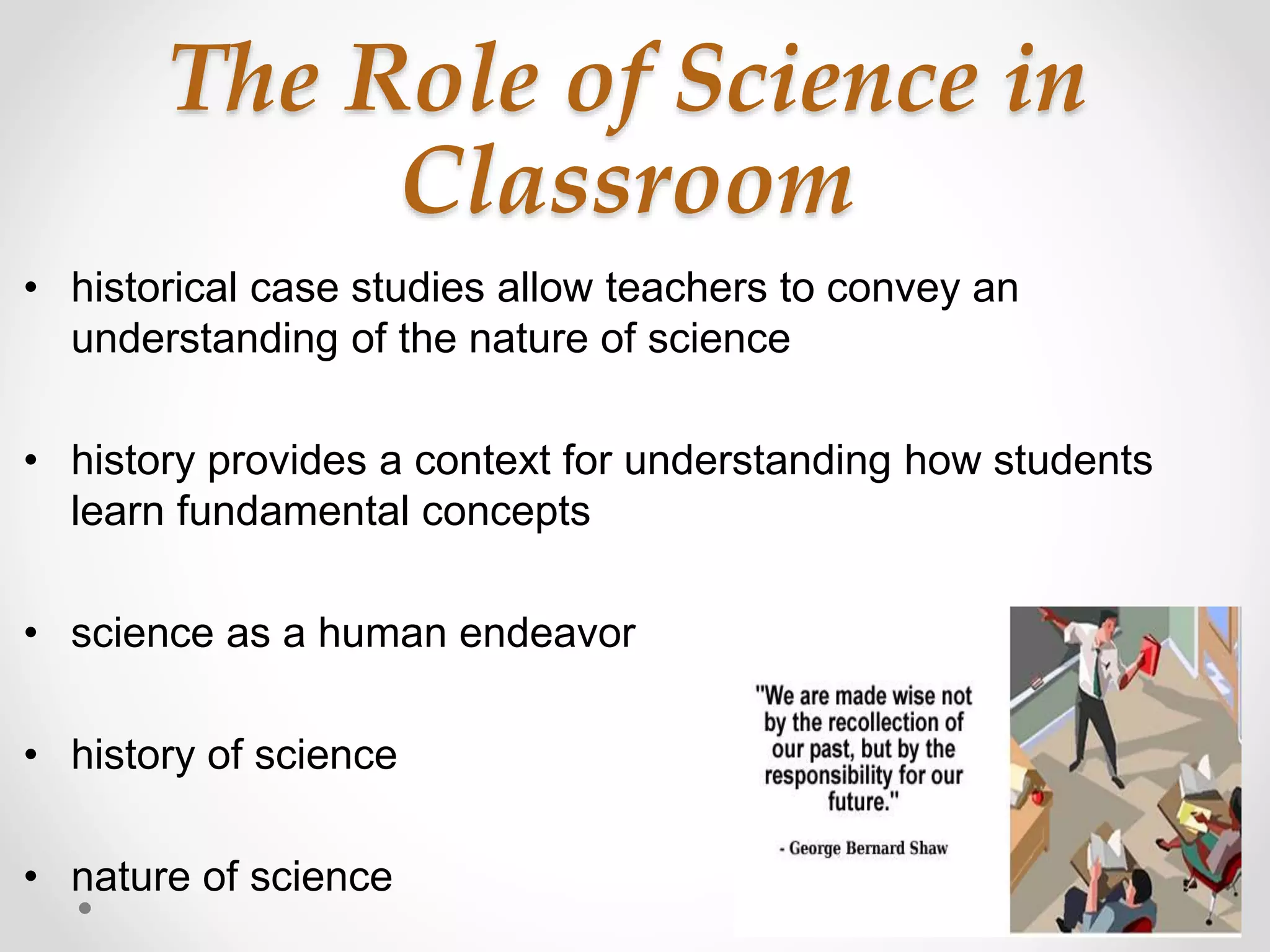
The Role of Science in
Classroom
• historical case studies allow teachers to convey an
understanding of the nature of science
• history provides a context for understanding how students
learn fundamental concepts
• science as a human endeavor
• history of science
• nature of science
Characteristic of a Good Worldview
• Must be internally consistent (Doesn’t contradict itself)
• Is able to comprehend the data of reality (It explains the real
world [reasonibly well] without becoming inconsistent.)
• Should explain what it claims to be.
• Should be subjectively satisfying.
Thank You

Worldview for science

  • 1.
    World view General Worldview forScience Edition of, M. Vasquez, Biology
  • 2.
    What is aWorldview? A world view or worldview is the fundamental cognitive orientation of an individual or society encompassing the whole of the individual's or society's knowledge and point of view. A world view can include natural philosophy; fundamental, existential, and normative postulates; or themes, values, emotions, and ethics
  • 3.
    What is aWorldview? A Worldview is a collection of beliefs (ideas, images, attitudes, values) that a group of people hold about things –universe, humankind, God, future. A worldview may be adopted, developed, formed, as a result of an unconscious assimilation or conditioning process. It is the general perspective from which one sees and interprets the world. Quoted from “Philosophy” by Peter Angels The Harper Collins Dictionary
  • 4.
    What is aWorldview? •“The central set of concepts and presuppositions that provide people with their basic assumptions about reality.” - Darrell Whiteman • A Worldview is a set of presuppositions (or assumptions) which we hold consciously or unconsciously, consistently or inconsistently about the basic make-up of our world - Dr. James Sire
  • 5.
    Understanding the PostmodernMindset Modern •Born during the Enlightenment •Rationalism •Scientific Revolution •Truth was scientific Postmodern •Born as a result of Modernism •Experiential •Moral Revolution •Truth is experiential
  • 6.
    What is Science? Abetter answer – science is a disciplined attempt to find out: • what exists E.g. people, fleas, clouds, rivers, atoms, sub-atomic particles, molecules, poverty, wars, minds, emotions, computational processes in computers, genes, species, niches, ecosystems... • how things work E.g. how molecules of atoms and of hydrogen can be transformed into molecules of water, how centripetal force produces circular or elliptical motion, how an egg develops into a chicken, how humans generate grammatical sentences (sometimes). • why they work as they do This usually requires appeal to do a deeper theory. Usually mathematics is required to derive precise consequences from a deep theory. • what doesn’t exist but could exist Many animals that might have evolved did not. Many molecules might be produced that have not been. Could peace exist on earth? • how such things would work if they existed What kind of design would allow a computer to learn to talk and understand English fluently?
  • 7.
    What is Science, ....a disciplined attempt to find out: • what sorts of things cannot exist A mouse proving theorems about algebra? Dreams? Telepathy? • under what conditions they cannot exist Some are probabilistic, e.g. throwing two dice will produce two sixes only about 2.7778% of the time. What about: “a chess machine will not move its king into check”? • why they cannot exist The only way to explain why something is impossible (why a law holds) is with reference to a deeper, more general theory. Einstein’s theory of general relativity provided an explanation for Newton’s law of gravitation.
  • 8.
    History of Science •study of the historical development of science and scientific knowledge, including both the natural sciences and social sciences Philosophy of Science • concerned with all the assumptions, foundations, methods, implications of science, and with the use and merit of science. The proper role of both sub disciplines toward those who carry out scientific inquiry however can be stated as being one of an historically informed guidance councilor, or navigator which can help scientific practitioners avoid the pitfalls and unproductive byways of the past.
  • 9.
    • designed forstudents to explore the world of scientific thought and practice, and to deepen their knowledge of the historical and conceptual evolution of science
  • 10.
    Not everyone agreeshow to do science. One key issue concerns the pursuit of objectivity. The Scientific Method – Open to the data – Provisional knowledge and refutation – Evidence is basis for knowledge – Evidence is based on observation – Replication is important – Assumes an objective reality – Precise and generalizable findings Scientific Observation – Systematic – Comprehensive – Objective – Operationally specified
  • 11.
    Logical Systems • DeductiveMethod 1. Theory 2. Hypothesis 3. Defines variables 4. Observe/measure • Inductive Method 1. Observe 2. Recognize a Pattern 3. Develop a logical explanation for the Pattern
  • 12.
    Science does notassume final answers are possible Good scientists accept: • that no answer is ever final, • that it is always possible that contrary evidence can turn up, • that it is always possible that better theories will be suggested, In this, science differs from many other types of activity, including most religious thinking, e.g. those which involve a commitment to faith. This does not mean that science is a free-for-all, that “anything goes”. If most people accept theory A as the best available in some branch of science, that does not mean that no scientist can propose theory B which is inconsistent with A. It does mean that the reasons why B is better have to be articulated, and those reasons can then be investigated.
  • 13.
    The Role ofScience in Classroom • historical case studies allow teachers to convey an understanding of the nature of science • history provides a context for understanding how students learn fundamental concepts • science as a human endeavor • history of science • nature of science
  • 14.
    Characteristic of aGood Worldview • Must be internally consistent (Doesn’t contradict itself) • Is able to comprehend the data of reality (It explains the real world [reasonibly well] without becoming inconsistent.) • Should explain what it claims to be. • Should be subjectively satisfying.
  • 15.

Editor's Notes

  • #8 But these answers are too general. There’s much more to be said in detail about the nature of science. Two objects exert a force of attraction on one another known as "gravity." Even as the center of the Earth is pulling you toward it (keeping you firmly lodged on the ground), your center of mass is pulling back at the Earth, albeit with much less force. Sir Isaac Newton quantified the gravity between two objects when he formulated his three laws of motion. Yet Newton's laws assume that gravity is an innate force of an object that can act over a distance. Albert Einstein, in his theory of special relativity, determined that the laws of physics are the same for all non-accelerating observers, and he showed that the speed of light within a vacuum is the same no matter the speed at which an observer travels. As a result, he found that space and time were interwoven into a single continuum known as space-time. Events that occur at the same time for one observer could occur at different times for another.
  • #9 How do you now correlate history and philosophy to science?* This discipline sometimes overlaps metaphysics, ontology and epistemology, viz., when it explores whether scientific results comprise a study of truth. In addition to these central problems of science as a whole, many philosophers of science consider problems that apply to particular sciences (e.g. philosophy of biology or philosophy of physics). Some philosophers of science also use contemporary results in science to reach conclusions about philosophy. How will you now relate history and philosophy of science? The proper relationship between HS and PS can not be limited to any single internal/external, or descriptive/ prescriptive role on each other because they have and will continue to rely upon each other for their very existence. The proper role of both subdisciplines toward those who carry out scientific inquiry however can be stated as being one of an historically informed guidance councilor, or navigator which can help scientific practitioners avoid the pitfalls and unproductive byways of the past. This statement holds for those who study the history of psychology as much as it holds for those who study the history of physical, chemical, and biological science.
  • #11 How do we perform scientific method? How do you describe a scientific observation? Why do you think scientific method is important?
  • #13 How do you describe a good scientists? 2. spurious- false or fake
  • #14 Why do you think it is important to integrate history and philosophy of science in classroom? History is not a stranger to the science classroom. Teachers often include stories about famous discoveries and scientists--adding a human dimension (and sometimes a bit of humor) to the scientific concepts. What student does not hear of Charles Darwin and the theory of evolution, Dmitri Medeleev and the periodic table, Marie Curie and radioactivity? * But history can be valuable for other reasons, as well. First, historical case studies allow teachers to convey an understanding of the nature of science--how scientists pose questions, design experiments, interpret results, generate alternative hypotheses and decide between them. They also provide an excellent opportunity for talking about the cultural, economic and ethical contexts of science--and how scientific discoveries, in turn, fit in society and relate to other fields of study. History also shows how scientific knowledge changes, leading students to appreciate both the achievements and limits of science. * Even more important, perhaps, history provides a context for understanding how students learn fundamental concepts. Students, like their historical counterparts, are learning concepts for the first time--without prior knowledge about the significance of those concepts. History shows what originally motivated various investigations, often in ways that students today can appreciate. History can also reveal common preconceptions of various topics, conceptions that must be transformed if teaching is to be effective. Historical debates often show how to address such misconceptions. History is thus an important tool for a constructivist classroom, where students "construct" their own knowledge by confronting and developing new explanations for discrepant events drawn from history. The important role of history and nature of science among objectives in science education has been recognized in several emerging national standards for science education. The National Research Council's National Science Education Content Standards , for example, specify standards for learning: science as a human endeavor history of science nature of science