






Epistemological Foundations
of
Design Based Research (DBR)
Rebecca J. Hogue
Twitter: @rjhogue
Email: rjhogue@pobox.com
Rebecca J. Hogue
• PhD Candidate, University of Ottawa
• Faculty of Education
• Thesis project in the Department of Family Medicine:
“Teaching Family Medicine Preceptor to use Tablet
Computers: A Design-Based Research Study”
• Specialize in mobile learning, eLearning, and creating
educational programs to support technology adoption
Rebecca.Hogue@uottawa.ca
http://rjhogue.ca
@rjhogue
Acknowledgements
This study is supported by the
Social Sciences and Humanities Research Council
Rebecca J. Hogue, PhD Candidate, @rjhogue
"one must learn by doing the thing,
for though you think you know it,
you have no certainty until you try”
~Sophocles
Introduction
1. What is Design-Based Research (DBR)
2. What are the historical roots of DBR?
3. What are the philosophical underpinnings of DBR?
4. What are the goals of DBR?
5. What constitutes new knowledge in DBR?
6. What is the methodology of DBR?
7. What are the necessary stages of inquiry in DBR?
Rebecca J. Hogue, PhD Candidate, @rjhogue
What is Design-Based Research
• Form of research that involves creating
educational interventions (e.g.
workshops, lessons) or artifacts (e.g.
computer programs, textbooks) and
evaluating them in a real-world context
• Theory informs practice
• Theory emerges from practice
Rebecca J. Hogue, PhD Candidate, @rjhogue
Historical Foundations
• DBR evolved out of the need to make educational
research more useful to practitioners
• During the paradigm wars of the early 90s
– Brown (1992)
– Collins (1992)
• Also known as: development research, formative
research, design studies, design experiments, formative
evaluation, and engineering research
• Design-Based Research Collective (2003)
• May use both qualitative and quantitative data collection
and analysis methods
Rebecca J. Hogue, PhD Candidate
Philosophical Underpinnings
Pragmatism
• New knowledge
measured in by the
consequences of the
research
• Value in research is to
improve practice
Design Sciences
• No perfect solution,
rather some solutions
are better than others
• Creating better
models is achieved
through successive
approximation
(iterative cycles)
Rebecca J. Hogue, PhD Candidate
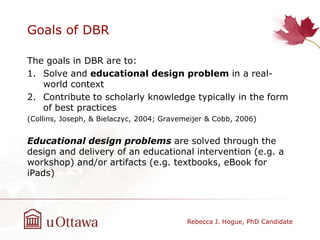
Goals of DBR
The goals in DBR are to:
1. Solve and educational design problem in a real-
world context
2. Contribute to scholarly knowledge typically in the form
of best practices
(Collins, Joseph, & Bielaczyc, 2004; Gravemeijer & Cobb, 2006)
Educational design problems are solved through the
design and delivery of an educational intervention (e.g. a
workshop) and/or artifacts (e.g. textbooks, eBook for
iPads)
Rebecca J. Hogue, PhD Candidate
What New Knowledge
The pragmatic perspective stresses the
consequences of the research:
• Improved educational theory (e.g. best
practices)
• Educations resources (e.g.
textbooks, PowerPoint slides, website)
• Professional development of the participants
Rebecca J. Hogue, PhD Candidate, @rjhogue
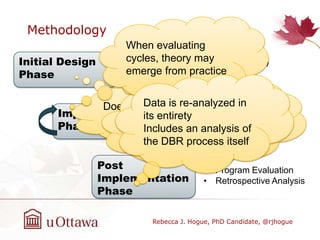
Methodology
Rebecca J. Hogue, PhD Candidate, @rjhogue
Initial Design
Phase
• Problem Analysis (Reeves, 2006)
• Initial Solution Design
Post
Implementation
Phase
• Program Evaluation
• Retrospective Analysis
Implementation
Phase
• Iterative cycles of
Design-Deliver-Evaluate
Does the problem have a
generalizable scope?
Initial design is based on
both practitioner
collaboration and
grounded in theory
When evaluating
cycles, theory may
emerge from practice
Data is re-analyzed in
its entirety
Includes an analysis of
the DBR process itself
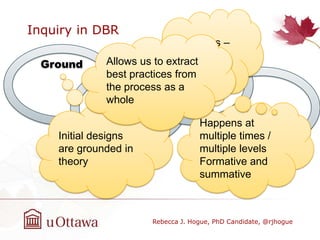
Inquiry in DBR
Rebecca J. Hogue, PhD Candidate, @rjhogue
Ground
Enact
Evaluate
Reflect
Initial designs
are grounded in
theory
Sophocles –
Can’t know
until we do
Happens at
multiple times /
multiple levels
Formative and
summative
Allows us to extract
best practices from
the process as a
whole
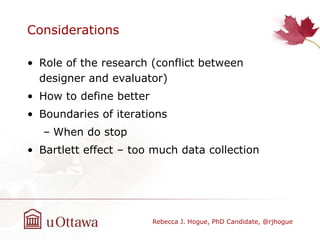
Considerations
• Role of the research (conflict between
designer and evaluator)
• How to define better
• Boundaries of iterations
– When do stop
• Bartlett effect – too much data collection
Rebecca J. Hogue, PhD Candidate, @rjhogue
Validity in DBR
• How well the enactment represents the
intended design
• How sustainable the design is after the
researcher leaves
Rebecca J. Hogue, PhD Candidate, @rjhogue
Summary
DBR is a pragmatic approach to research that involves
solving an educational design problem in a real world
context.
It uses iterative cycles of design-enact-evaluate to
improve upon educational interventions
Theory is used to inform practice, and theory emerges
from practice
Rebecca J. Hogue, PhD Candidate, @rjhogue
Thank-You
Questions?
Rebecca J. Hogue
Twitter: @rjhogue
Email: rjhogue@pobox.com

Epistemological Foundations of Design-Based Research

  • 1.
    Epistemological Foundations of Design BasedResearch (DBR) Rebecca J. Hogue Twitter: @rjhogue Email: rjhogue@pobox.com
  • 2.
    Rebecca J. Hogue •PhD Candidate, University of Ottawa • Faculty of Education • Thesis project in the Department of Family Medicine: “Teaching Family Medicine Preceptor to use Tablet Computers: A Design-Based Research Study” • Specialize in mobile learning, eLearning, and creating educational programs to support technology adoption Rebecca.Hogue@uottawa.ca http://rjhogue.ca @rjhogue
  • 3.
    Acknowledgements This study issupported by the Social Sciences and Humanities Research Council Rebecca J. Hogue, PhD Candidate, @rjhogue
  • 4.
    Rebecca J. Hogue,PhD Candidate, @rjhogue "one must learn by doing the thing, for though you think you know it, you have no certainty until you try” ~Sophocles
  • 5.
    Introduction 1. What isDesign-Based Research (DBR) 2. What are the historical roots of DBR? 3. What are the philosophical underpinnings of DBR? 4. What are the goals of DBR? 5. What constitutes new knowledge in DBR? 6. What is the methodology of DBR? 7. What are the necessary stages of inquiry in DBR? Rebecca J. Hogue, PhD Candidate, @rjhogue
  • 6.
    What is Design-BasedResearch • Form of research that involves creating educational interventions (e.g. workshops, lessons) or artifacts (e.g. computer programs, textbooks) and evaluating them in a real-world context • Theory informs practice • Theory emerges from practice Rebecca J. Hogue, PhD Candidate, @rjhogue
  • 7.
    Historical Foundations • DBRevolved out of the need to make educational research more useful to practitioners • During the paradigm wars of the early 90s – Brown (1992) – Collins (1992) • Also known as: development research, formative research, design studies, design experiments, formative evaluation, and engineering research • Design-Based Research Collective (2003) • May use both qualitative and quantitative data collection and analysis methods Rebecca J. Hogue, PhD Candidate
  • 8.
    Philosophical Underpinnings Pragmatism • Newknowledge measured in by the consequences of the research • Value in research is to improve practice Design Sciences • No perfect solution, rather some solutions are better than others • Creating better models is achieved through successive approximation (iterative cycles) Rebecca J. Hogue, PhD Candidate
  • 9.
    Goals of DBR Thegoals in DBR are to: 1. Solve and educational design problem in a real- world context 2. Contribute to scholarly knowledge typically in the form of best practices (Collins, Joseph, & Bielaczyc, 2004; Gravemeijer & Cobb, 2006) Educational design problems are solved through the design and delivery of an educational intervention (e.g. a workshop) and/or artifacts (e.g. textbooks, eBook for iPads) Rebecca J. Hogue, PhD Candidate
  • 10.
    What New Knowledge Thepragmatic perspective stresses the consequences of the research: • Improved educational theory (e.g. best practices) • Educations resources (e.g. textbooks, PowerPoint slides, website) • Professional development of the participants Rebecca J. Hogue, PhD Candidate, @rjhogue
  • 11.
    Methodology Rebecca J. Hogue,PhD Candidate, @rjhogue Initial Design Phase • Problem Analysis (Reeves, 2006) • Initial Solution Design Post Implementation Phase • Program Evaluation • Retrospective Analysis Implementation Phase • Iterative cycles of Design-Deliver-Evaluate Does the problem have a generalizable scope? Initial design is based on both practitioner collaboration and grounded in theory When evaluating cycles, theory may emerge from practice Data is re-analyzed in its entirety Includes an analysis of the DBR process itself
  • 12.
    Inquiry in DBR RebeccaJ. Hogue, PhD Candidate, @rjhogue Ground Enact Evaluate Reflect Initial designs are grounded in theory Sophocles – Can’t know until we do Happens at multiple times / multiple levels Formative and summative Allows us to extract best practices from the process as a whole
  • 13.
    Considerations • Role ofthe research (conflict between designer and evaluator) • How to define better • Boundaries of iterations – When do stop • Bartlett effect – too much data collection Rebecca J. Hogue, PhD Candidate, @rjhogue
  • 14.
    Validity in DBR •How well the enactment represents the intended design • How sustainable the design is after the researcher leaves Rebecca J. Hogue, PhD Candidate, @rjhogue
  • 15.
    Summary DBR is apragmatic approach to research that involves solving an educational design problem in a real world context. It uses iterative cycles of design-enact-evaluate to improve upon educational interventions Theory is used to inform practice, and theory emerges from practice Rebecca J. Hogue, PhD Candidate, @rjhogue
  • 16.
    Thank-You Questions? Rebecca J. Hogue Twitter:@rjhogue Email: rjhogue@pobox.com