LOGIC 
Quick Outline 
Domenic Marbaniang 
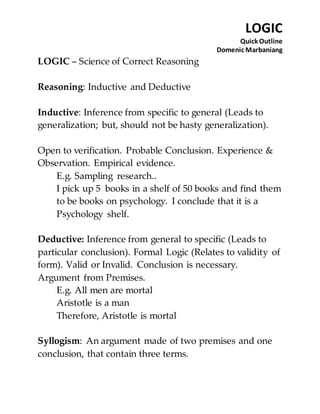
LOGIC – Science of Correct Reasoning 
Reasoning: Inductive and Deductive 
Inductive: Inference from specific to general (Leads to 
generalization; but, should not be hasty generalization). 
Open to verification. Probable Conclusion. Experience & 
Observation. Empirical evidence. 
E.g. Sampling research.. 
I pick up 5 books in a shelf of 50 books and find them 
to be books on psychology. I conclude that it is a 
Psychology shelf. 
Deductive: Inference from general to specific (Leads to 
particular conclusion). Formal Logic (Relates to validity of 
form). Valid or Invalid. Conclusion is necessary. 
Argument from Premises. 
E.g. All men are mortal 
Aristotle is a man 
Therefore, Aristotle is mortal 
Syllogism: An argument made of two premises and one 
conclusion, that contain three terms.
LOGIC 
Quick Outline 
Domenic Marbaniang 
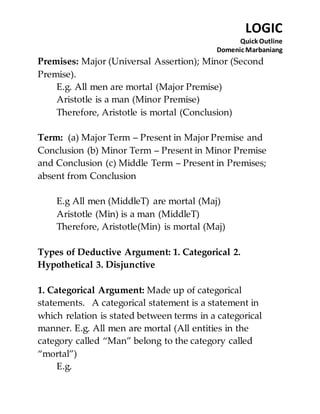
Premises: Major (Universal Assertion); Minor (Second 
Premise). 
E.g. All men are mortal (Major Premise) 
Aristotle is a man (Minor Premise) 
Therefore, Aristotle is mortal (Conclusion) 
Term: (a) Major Term – Present in Major Premise and 
Conclusion (b) Minor Term – Present in Minor Premise 
and Conclusion (c) Middle Term – Present in Premises; 
absent from Conclusion 
E.g All men (MiddleT) are mortal (Maj) 
Aristotle (Min) is a man (MiddleT) 
Therefore, Aristotle(Min) is mortal (Maj) 
Types of Deductive Argument: 1. Categorical 2. 
Hypothetical 3. Disjunctive 
1. Categorical Argument: Made up of categorical 
statements. A categorical statement is a statement in 
which relation is stated between terms in a categorical 
manner. E.g. All men are mortal (All entities in the 
category called “Man” belong to the category called 
“mortal”) 
E.g.
LOGIC 
Quick Outline 
Domenic Marbaniang 
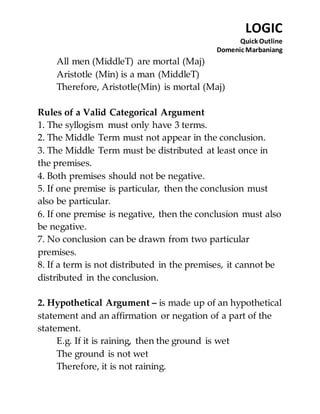
All men (MiddleT) are mortal (Maj) 
Aristotle (Min) is a man (MiddleT) 
Therefore, Aristotle(Min) is mortal (Maj) 
Rules of a Valid Categorical Argument 
1. The syllogism must only have 3 terms. 
2. The Middle Term must not appear in the conclusion. 
3. The Middle Term must be distributed at least once in 
the premises. 
4. Both premises should not be negative. 
5. If one premise is particular, then the conclusion must 
also be particular. 
6. If one premise is negative, then the conclusion must also 
be negative. 
7. No conclusion can be drawn from two particular 
premises. 
8. If a term is not distributed in the premises, it cannot be 
distributed in the conclusion. 
2. Hypothetical Argument – is made up of an hypothetical 
statement and an affirmation or negation of a part of the 
statement. 
E.g. If it is raining, then the ground is wet 
The ground is not wet 
Therefore, it is not raining.
LOGIC 
Quick Outline 
Domenic Marbaniang 
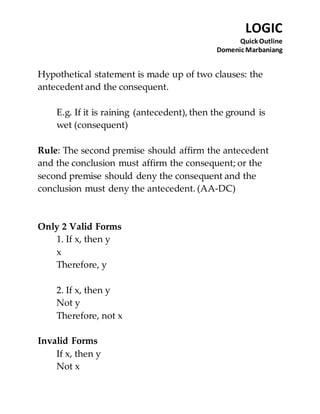
Hypothetical statement is made up of two clauses: the 
antecedent and the consequent. 
E.g. If it is raining (antecedent), then the ground is 
wet (consequent) 
Rule: The second premise should affirm the antecedent 
and the conclusion must affirm the consequent; or the 
second premise should deny the consequent and the 
conclusion must deny the antecedent. (AA-DC) 
Only 2 Valid Forms 
1. If x, then y 
x 
Therefore, y 
2. If x, then y 
Not y 
Therefore, not x 
Invalid Forms 
If x, then y 
Not x
LOGIC 
Quick Outline 
Domenic Marbaniang 
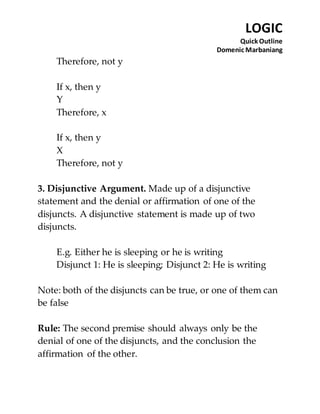
Therefore, not y 
If x, then y 
Y 
Therefore, x 
If x, then y 
X 
Therefore, not y 
3. Disjunctive Argument. Made up of a disjunctive 
statement and the denial or affirmation of one of the 
disjuncts. A disjunctive statement is made up of two 
disjuncts. 
E.g. Either he is sleeping or he is writing 
Disjunct 1: He is sleeping; Disjunct 2: He is writing 
Note: both of the disjuncts can be true, or one of them can 
be false 
Rule: The second premise should always only be the 
denial of one of the disjuncts, and the conclusion the 
affirmation of the other.
LOGIC 
Quick Outline 
Domenic Marbaniang 
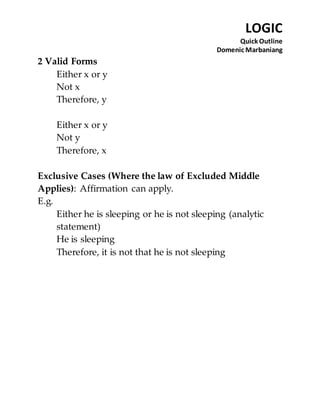
2 Valid Forms 
Either x or y 
Not x 
Therefore, y 
Either x or y 
Not y 
Therefore, x 
Exclusive Cases (Where the law of Excluded Middle 
Applies): Affirmation can apply. 
E.g. 
Either he is sleeping or he is not sleeping (analytic 
statement) 
He is sleeping 
Therefore, it is not that he is not sleeping

Formal Logic: Quick Outline

  • 1.
    LOGIC Quick Outline Domenic Marbaniang LOGIC – Science of Correct Reasoning Reasoning: Inductive and Deductive Inductive: Inference from specific to general (Leads to generalization; but, should not be hasty generalization). Open to verification. Probable Conclusion. Experience & Observation. Empirical evidence. E.g. Sampling research.. I pick up 5 books in a shelf of 50 books and find them to be books on psychology. I conclude that it is a Psychology shelf. Deductive: Inference from general to specific (Leads to particular conclusion). Formal Logic (Relates to validity of form). Valid or Invalid. Conclusion is necessary. Argument from Premises. E.g. All men are mortal Aristotle is a man Therefore, Aristotle is mortal Syllogism: An argument made of two premises and one conclusion, that contain three terms.
  • 2.
    LOGIC Quick Outline Domenic Marbaniang Premises: Major (Universal Assertion); Minor (Second Premise). E.g. All men are mortal (Major Premise) Aristotle is a man (Minor Premise) Therefore, Aristotle is mortal (Conclusion) Term: (a) Major Term – Present in Major Premise and Conclusion (b) Minor Term – Present in Minor Premise and Conclusion (c) Middle Term – Present in Premises; absent from Conclusion E.g All men (MiddleT) are mortal (Maj) Aristotle (Min) is a man (MiddleT) Therefore, Aristotle(Min) is mortal (Maj) Types of Deductive Argument: 1. Categorical 2. Hypothetical 3. Disjunctive 1. Categorical Argument: Made up of categorical statements. A categorical statement is a statement in which relation is stated between terms in a categorical manner. E.g. All men are mortal (All entities in the category called “Man” belong to the category called “mortal”) E.g.
  • 3.
    LOGIC Quick Outline Domenic Marbaniang All men (MiddleT) are mortal (Maj) Aristotle (Min) is a man (MiddleT) Therefore, Aristotle(Min) is mortal (Maj) Rules of a Valid Categorical Argument 1. The syllogism must only have 3 terms. 2. The Middle Term must not appear in the conclusion. 3. The Middle Term must be distributed at least once in the premises. 4. Both premises should not be negative. 5. If one premise is particular, then the conclusion must also be particular. 6. If one premise is negative, then the conclusion must also be negative. 7. No conclusion can be drawn from two particular premises. 8. If a term is not distributed in the premises, it cannot be distributed in the conclusion. 2. Hypothetical Argument – is made up of an hypothetical statement and an affirmation or negation of a part of the statement. E.g. If it is raining, then the ground is wet The ground is not wet Therefore, it is not raining.
  • 4.
    LOGIC Quick Outline Domenic Marbaniang Hypothetical statement is made up of two clauses: the antecedent and the consequent. E.g. If it is raining (antecedent), then the ground is wet (consequent) Rule: The second premise should affirm the antecedent and the conclusion must affirm the consequent; or the second premise should deny the consequent and the conclusion must deny the antecedent. (AA-DC) Only 2 Valid Forms 1. If x, then y x Therefore, y 2. If x, then y Not y Therefore, not x Invalid Forms If x, then y Not x
  • 5.
    LOGIC Quick Outline Domenic Marbaniang Therefore, not y If x, then y Y Therefore, x If x, then y X Therefore, not y 3. Disjunctive Argument. Made up of a disjunctive statement and the denial or affirmation of one of the disjuncts. A disjunctive statement is made up of two disjuncts. E.g. Either he is sleeping or he is writing Disjunct 1: He is sleeping; Disjunct 2: He is writing Note: both of the disjuncts can be true, or one of them can be false Rule: The second premise should always only be the denial of one of the disjuncts, and the conclusion the affirmation of the other.
  • 6.
    LOGIC Quick Outline Domenic Marbaniang 2 Valid Forms Either x or y Not x Therefore, y Either x or y Not y Therefore, x Exclusive Cases (Where the law of Excluded Middle Applies): Affirmation can apply. E.g. Either he is sleeping or he is not sleeping (analytic statement) He is sleeping Therefore, it is not that he is not sleeping