Tariku Shimels (BPharm,BA, MSc)
Research advisor & coordinator
St. Paul’s Hospital Millennium Medical College
Mobile: 0912471223
Email; tarphar2008@gmail.com 1
Medical Surgical
RESEARCH METHODOLOGY
4/19/2024
Chapters of the course
• Chapter 1: Introduction to research
– Definitions and characteristics of research
– Types of research
– Main components of any research work
• Chapter 2: Topic Selection
– Problem identification
– Criteria for prioritizing problems for research
– How to write a research topic?
2
4/19/2024
Chapters cont…
• Chapter 3: Statement of the problem and Justification
– Analyzing the problem
– Formulating the problem statement
– Justification
Chapter 4: Literature review and Referencing
– Uses of literature review
– Source of information
– Organization of information
– Conceptual framework
– Referencing
• Chapter 5: Objectives
– Definitions
– Formulation of the research objectives
3
4/19/2024
Chapters cont…
• Chapter 6: Research methods
– Types of study designs
– Study area and period
– Source and Study population
– Inclusion and Exclusion Criteria
– Sample size and sampling procedures
– Variables
– Operational definitions
– data collection and data quality control
– data processing and analysis
– Ethical considerations
– Dissemination of Results
4
4/19/2024
Chapters cont…
• Chapter 7: Work Plan Budget
– Work Plan
– Budget
• Chapter 8: Results and Discussion
– Result
– Discussion
• Chapter 9:Conclusion and Recommendation
– Conclusion
– Recommendation
5
4/19/2024
Contents cont…
Adjunct topics:
Research Ethics
Systematic review and Meta-analysis
Communication of research findings
6
4/19/2024
Evaluation of the course
• Progressive assignments (10%)
• Proposal development & presentation (40%)
• Final exam (40%)
• Attendance and participation (5-10%)
Total 100-105%
7
4/19/2024
Chapter 1: Introduction to research
Objectives:-
– Sources of knowledge
– Define research
– Identify type of research
– Identify Qualities of Good Research
– Identify main components of any research work
8
4/19/2024
Sources of Knowledge
Brainstorming:
Why is the grass green and the sky
blue?”
Are eye witnesses to a crime as reliable
as some people think?
Are the stars in the night sky actually
twinkling?
Does the sun really move across the
sky?
9
4/19/2024
Sources of knowledge
1) Everyday experience as source of Knowledge
• As we live in this world, we interact and
confront with new ideas
– We get access to this new information through
our senses --- the most immediate way of knowing
something
– Also called ‘sensory knowledge’
– We, then, process, put schematic presentation of
interactions to make sense/generate meaning out
of them
10
4/19/2024
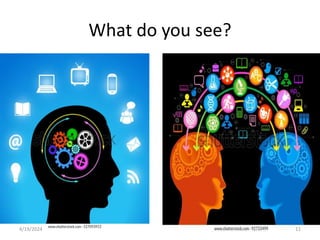
What do you see?
11
4/19/2024
What do you see?
12
4/19/2024
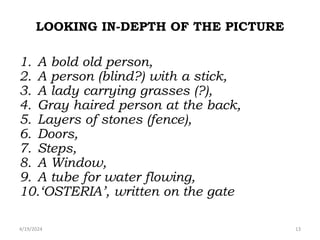
LOOKING IN-DEPTH OF THE PICTURE
1. A bold old person,
2. A person (blind?) with a stick,
3. A lady carrying grasses (?),
4. Gray haired person at the back,
5. Layers of stones (fence),
6. Doors,
7. Steps,
8. A Window,
9. A tube for water flowing,
10.‘OSTERIA’, written on the gate
13
4/19/2024
Source of knowledge cont…
• We may also use the opinion of others as
sources of knowledge
• We might have experienced a stimulus with
our senses but we want to check on the
accuracy and authenticity of these sensations.
• So, we often ask:
– Does this food taste delicious to you?
– Did you hear someone cry for help?
14
4/19/2024
Source cont…
• Being open minded is not about accepting new
ideas that fit neatly into our existing
knowledge
• It is the willingness and readiness to question
our most ardent beliefs in the face of new
evidence
15
4/19/2024
Source cont..
• Do you rely only on your senses and trust the data
you collected, because it has been said, “seeing is
believing”?
• How reliable are your senses?
• Do you think that a majority opinion defines what
is true?
1. The method of tenacity
2. The method of ‘authority’
3. The ‘ a priori’ method
4. Common sense
16
4/19/2024
1.1) The method of tenacity
• The term tenacity refers to the acceptance of a
belief based on the idea that “we have always
known it to be this way”
• Represents the automatic acceptance of the
prevailing traditional beliefs and customs in
which we have been socialized
• We accept those beliefs and customs as true
without exploring them and then behave with
it
17
4/19/2024
This method has the following problems:
a) The information may gain wide acceptance
through its familiarity alone
b) Tenacity offers no means for correcting erroneous
ideas
Exercise:
Is darker colored injera more nutritious?
18
4/19/2024
1.2) The method of ‘authority’
• If we enter into a new culture, we may experience
so many things for which we are not familiar
• If we are naïve to most of the practices what we
do, is we ask someone in that culture who is
supposed to have the knowledge – an authority
figure
• We are likely to ask others whom we think have a
wealth of experience and knowledge about the
cultural practices of the community
• We may, then, accept a new idea or information
stated by this authority figure
19
4/19/2024
Authority…
• In many cases, referring to an authority, especially in
areas about which we know nothing, is useful and
beneficial
• We often rely on the judgment and expertise when we
consult, for example, electrician, civil engineer or
chemist
• Authority can be incorrect and at times can lead people
in the wrong directions
• It is important to examine the basis of the authority’s
claims
• We have to raise questions like, are these claims based
on opinion, tradition, or direct experience? How valid
are the sources of this information?
20
4/19/2024
Authority…
Exercises:
• Is everything published in a newspaper or
book always true and accurate?
• Is there a problem if we unquestioningly
accept the knowledge and expertise of others?
21
4/19/2024
1.3 a Priori method
• Based on our general knowledge, opinion, or
belief about the world through the
aforementioned methods or personal
observation of things around us
• And we draw new and specific conclusion
from this general knowledge
• a priori propositions “agree with reason” and
not necessarily with experience
• Also known as deductive reasoning
22
4/19/2024
a priori ….
• Reason and logic are the basic tools of an a prior
method and often take the form of a logical syllogism
such as All men are tall; Mr Y is a man; therefore, Mr
Y is tall.
• Hence, logical conclusions may not necessarily lead to
correct conclusions
• We all use reason everyday as we try to solve problems
and understand relationships
As useful as it is to be reasonable, however, reason alone
will not always produce the appropriate knowledge
Exercise:
Ethiopia has the best long distance runners in the world.
Mr X is an Ethiopian, therefore …
• Does this conclusion always hold true?
23
4/19/2024
1.4 Common Sense
• This method offers an improvement over
acceptance based on tenacity, authority, or
reason because it appeals to direct experience
• Common sense is based on our own past
experiences and our perceptions of the world
• It originates from our day-to-day practical
experiences and in turn guides our daily
interaction with our surrounding
24
4/19/2024
Common sense..
• The concepts that we have about the world may be
seriously misleading
• Although common sense may help us deal with
the routine aspects of daily life, it may also form a
wall and prevent us from understanding new ideas
Exercise:
Where would it be more appropriate to apply
common sense:
A) knowing what will happen to the price of teff
when the rainy season fails,
B) knowing how bacteria will respond to a new type
of drug
25
4/19/2024
2) The scientific method
• Science is a body of systematized knowledge
• Ideas are evaluated and corrected through
dispassionately observing by means of our
bodily senses or measuring devices
• A systematic and controlled extension of
common sense - and using reason
• The blends of direct sensory experience (or
measurement) and reason gives science a self-
corrective nature
26
4/19/2024
Science ….
• One of the characteristics of science is a
reliance on information that is verifiable
through experience
• That is, it must be possible for different people
in different places and at different times using
the same method to obtain comparable
results
27
4/19/2024
Science …
• Science and common sense differ in terms of:
– the use of conceptual schemes and theoretical
structures
– the notion of control
– the explanations of different observed
phenomena
The difference between common sense and science
revolves around the concepts ‘systematic ‘and
‘controlled’
28
4/19/2024
Science ….
• The scientific methods employs defined steps:
– defining the problem
– making tentative explanations
– gathering information
– testing the hypothesis
– making conclusions as to whether the hypothesis
can be accepted or rejected
29
4/19/2024
A dive into research
methodology
30
4/19/2024
Définition
THE WORD RESEARCH
 Composed of two syllables, Re and Search
 The dictionary defines the former as a prefix meaning again, a new, or
over again and the latter as a verb meaning to examine closely and
carefully, to test and try, or to probe.
 Together forming a careful, systematic, patient study and investigation
in some field of knowledge, undertaken to establish facts or principles.
( Grinnel 1993: 4 )
‘’Research is an attempt to search for truth’’
31
4/19/2024
2) Terminologies ….
• Methodology – refers to the sets of methods,
techniques, and procedures that are employed
in implementing your research plan (design)
• A part of philosophy that deals in related
methods
• Research methods or techniques refer to all the
methods the researchers use in performing research
operations
32
4/19/2024
Research method/ology
• A science of studying how research is carried
scientifically
• A way to systematically solve the research
problem by logically adopting various steps
33
4/19/2024
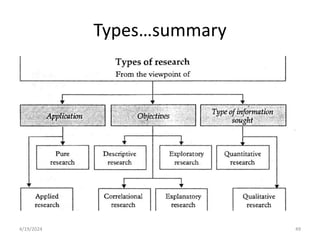
3) Types of research
• Research can be classified from three
perspectives:
• I. Application
• II. Objectives
• III. Inquiry mode
34
4/19/2024
I. Application
• If you examine a research from the perspective
of its application, there are two broad
categories:
A). Pure research
B). Applied research
35
4/19/2024
A) Pure research
According to Bailey ( 1978:17):
 Pure research involves developing and
testing theories and hypotheses that are
intellectually challenging to the researcher
May or may not have practical application at
the present time or in the future
Thus such work often involves the testing of
hypotheses containing very abstract and
specialised concepts
Also called Basic research
36
4/19/2024
B) Applied
• Most of the research undertaken in the
social sciences is applied,
• The findings are designed either for use
in understanding a phenomena/issue or
to bring a change in a program/situation
of interest
37
4/19/2024
II. Objectives
A research study can be carried out with four
objectives:
1. Descriptive
2. Correlational
3. Explanatory
4. Exploratory
38
4/19/2024
Types of research
1) Descriptive:
• The purpose here is to describe what is prevalent
with respect to the issue/ problem under study
• The main characteristic of descriptive research is that
the researcher has no control over the variables;
• S/he can only report what has happened or what is
happening
• The term Ex post facto ( after the fact ) research
for descriptive research is used mainly in social
science and business research
39
4/19/2024
Descriptive…
Some examples:
 Pattern of an épidémic in a specific
community
 Strategies put in place by a company to
increase workers’ productivity
Effects of living in a house with domestic
violence
Treatments and outcome of patients undergone
elective surgery
40
4/19/2024
Types …( cont.)
2. Correlational
• Aims at discovering or establishing the
existence of a relationship/ association/
interdependence between two or more aspects
of a situation
• For instance, the effect of the home
environment on education
41
4/19/2024
Correlational…
Some examples :
Relationship between stressful living and
incidence of heart attacks
Impact of technology on delivery of health
education to remote communities
Factors associated with adherence to
antituberculosis medications
42
4/19/2024
Types of research
3. Explanatory:
• Attempts to clarify why and how there is a
relationship between two aspects of a situation
or phenomenon
• This type of research will try to explain, for
example, how the home environment affects
children level of academic achievement
43
4/19/2024
Explanatory…
Some examples:
 How does domestic violence impact
adolescents learners ?
Why do some schools adopt a program while
others do not?
How does technology facilitate learning?
44
4/19/2024
Types of research
4. Exploratory:
• This is when a study is undertaken with the
objective either to explore an area where little
is known or to investigate the possibilities of
undertaking a particular research study.
• When a study is carried out to determine its
feasibility it is also called a feasibility study or
a pilot study
45
4/19/2024
III. Inquiry mode
From the point of view of inquiry , there are two
types of research:
1. The structured approach
2. The unstructured approach
46
4/19/2024
1. The structured approach
• This is usually classified as quantitative
research
• quantitative studies often use standardized measures,
numerical values, have larger sample sizes, and
analyze data using statistical programs
• A study is classified as quantitative if the researcher
seeks to quantify the variation in a phenomenon and
if information is gathered using quantitative variables
47
4/19/2024
2. The unstructured approach
• The unstructured approach to inquiry is usually
classified as qualitative
• A study is classified as qualitative if the purpose is
primarily to describe a situation, phenomenon,
problem or event; the information is gathered through
the use of variables or measured on qualitative
measurement scales, and if analysis is done to
establish the variation in the situation or problem
without quantifying it
• Qualitative studies tend to be more “in-depth”,
focusing on a smaller population but probing deeper
into a given problem
48
4/19/2024
Types…summary
49
4/19/2024
Qualities of a good research
• Research must address an important and
relevant issue.
-it is undertaken to increase knowledge and have
some beneficial implications
-it will also have relevance to the time, place, and
population of the study
50
4/19/2024
Qualities …(cont)
• Research is a process of collecting, analyzing and
interpreting information to answer questions.
• But to qualify as research, the process must have certain
characteristics: it must, as far as possible, be:
Logical
Rigorous
Systematic
Valid and verifiable
Empirical
Critical
51
4/19/2024
Qualities ….( cont.)
• Good research is logical: this implies that
research is guided by the rules of logical
reasoning, and the logical process of
induction and deduction is essential in
carrying out research.
52
4/19/2024
Qualities ……( cont.)
• Rigorous-you must be scrupulous (careful) in
ensuring that the procedures followed to find
answers to questions are relevant, appropriate
and justified
• Again, the degree of rigor (strict) varies
markedly between the physical and social
sciences and within the social sciences
53
4/19/2024
Qualities … ( cont.)
• Good research is systematic: this implies
that the procedure adopted to undertake an
investigation follow a certain logical
sequence.
• The different steps cannot be taken in a
haphazard way
• Some procedures must follow others
• The systematic characteristic of research
rejects the use of guessing and intuition in
arriving at conclusions
54
4/19/2024
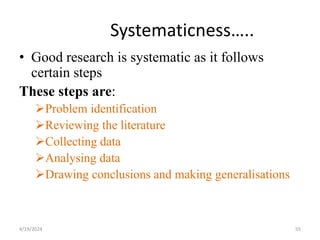
Systematicness…..
• Good research is systematic as it follows
certain steps
These steps are:
Problem identification
Reviewing the literature
Collecting data
Analysing data
Drawing conclusions and making generalisations
55
4/19/2024
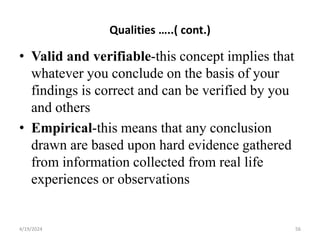
Qualities …..( cont.)
• Valid and verifiable-this concept implies that
whatever you conclude on the basis of your
findings is correct and can be verified by you
and others
• Empirical-this means that any conclusion
drawn are based upon hard evidence gathered
from information collected from real life
experiences or observations
56
4/19/2024
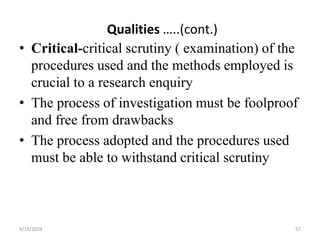
Qualities …..(cont.)
• Critical-critical scrutiny ( examination) of the
procedures used and the methods employed is
crucial to a research enquiry
• The process of investigation must be foolproof
and free from drawbacks
• The process adopted and the procedures used
must be able to withstand critical scrutiny
57
4/19/2024
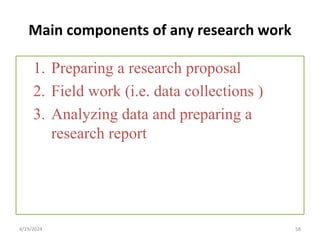
Main components of any research work
1. Preparing a research proposal
2. Field work (i.e. data collections )
3. Analyzing data and preparing a
research report
58
4/19/2024
Planning research
(Developing proposal)
• The development of a health project goes through a number of
stages.
• Formulation of the research proposal is the major task in the
process of developing a research project.
A written proposal is important:
• To clearly define the problem under study
• To avoid reinventing the wheel
• To clearly depict the methodology to be used
• To be cost and time conscious
• To be clear about what to expect in the end
59
4/19/2024
Components of research proposal
1. Research topic
2. Summary(1 page)
3. Statement of the Problem(1
page)
4. Literature review(2-4 page)
5. Justification of the study(1/2
page)
6. Objectives(1/2 page)
7. Methodology (3 page)
8. Ethical Considerations(1/2
page)
9. Work plan(1 page)
10. Dissemination and Utilization
of Results(1/2 page)
11. Cost of the Project(Max 2
page)
12. References(Use Vancouver
Style)
13. Annex
14. Assurance of Investigator
60
4/19/2024
Chapter 2: Problem identification and
topic selection
Objective :- at the end of the lesson you are
able to:
– Identify research problems
– List criteria for prioritizing research problems
– write a research topic?
61
4/19/2024
Problem identification
• Research is done with a certain purpose
• The purpose of research may be; to solve a
problem, to improve a program or to get new
knowledge
• The first task of a researcher is identifying a
research problems
62
4/19/2024
What is a problem?
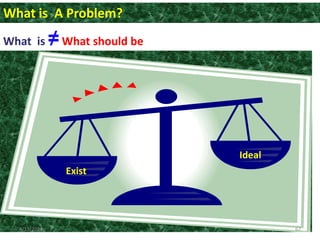
. . . any situation where a gap exists between
the actual and the desired state.
A problem does not necessarily mean that
something is seriously wrong.
It could simply indicate an interest in improving an
existing situation.
Thus, problem definitions can include both existing
problems in the current situation as well as the
quest for idealistic states in the future.
Research Problem
63
4/19/2024
Where can we get a research problems?
• Sometimes students faced difficulties to get research problems
though they are standing on a lot of problems
• it is not due to the absence of research problems; rather due to the
difficulty of identifying research problems
• We can get research problems in different ways from deferent
source:-
1. From carful environmental observation and from our day to day
activities
2. From reading
3. From discussion
4. From the social, political and economical changes
5. From personal interest
6. From scarcity of information
64
4/19/2024
Individual work
Identify three research problems
65
4/19/2024
Whether a problem requires research depends
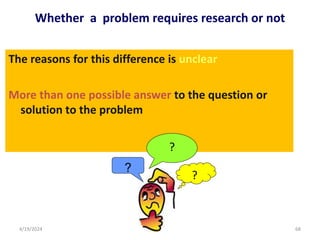
on three conditions:
I) There should be a perceived difference or
discrepancy between what it is and what it
should be;
II) The reason(s) for this difference should be
unclear (so that it makes sense to develop a
research question); and
III) There should be more than one possible and
plausible answer to the question (or solution to
the problem).
66
4/19/2024
What is A Problem?
What is ≠What should be
Exist
Ideal
67
4/19/2024
The reasons for this difference is unclear
More than one possible answer to the question or
solution to the problem
Whether a problem requires research or not
?
?
?
68
4/19/2024
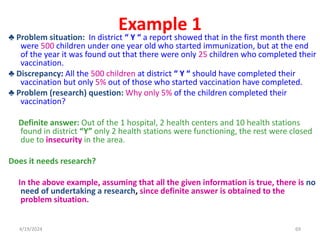
Example 1
♣ Problem situation: In district “ Y “ a report showed that in the first month there
were 500 children under one year old who started immunization, but at the end
of the year it was found out that there were only 25 children who completed their
vaccination.
♣ Discrepancy: All the 500 children at district “ Y “ should have completed their
vaccination but only 5% out of those who started vaccination have completed.
♣ Problem (research) question: Why only 5% of the children completed their
vaccination?
Definite answer: Out of the 1 hospital, 2 health centers and 10 health stations
found in district “Y” only 2 health stations were functioning, the rest were closed
due to insecurity in the area.
Does it needs research?
In the above example, assuming that all the given information is true, there is no
need of undertaking a research, since definite answer is obtained to the
problem situation.
69
4/19/2024
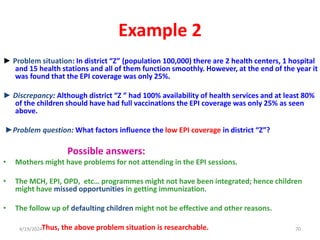
Example 2
► Problem situation: In district “Z” (population 100,000) there are 2 health centers, 1 hospital
and 15 health stations and all of them function smoothly. However, at the end of the year it
was found that the EPI coverage was only 25%.
► Discrepancy: Although district “Z ” had 100% availability of health services and at least 80%
of the children should have had full vaccinations the EPI coverage was only 25% as seen
above.
►Problem question: What factors influence the low EPI coverage in district “Z”?
Possible answers:
• Mothers might have problems for not attending in the EPI sessions.
• The MCH, EPI, OPD, etc… programmes might not have been integrated; hence children
might have missed opportunities in getting immunization.
• The follow up of defaulting children might not be effective and other reasons.
Thus, the above problem situation is researchable. 70
4/19/2024
Individual class work
• Check:
• Whether a problem you identified requires
research or not?
• Select the most researchable problem
71
4/19/2024
Criteria for prioritizing problems for research
• Each problem that is proposed for research has to
be judged according to certain guidelines or
criteria. There may be several ideas to choose
from.
♣ Before deciding on a research topic, each
proposed topic must be compared with all other
options.
• 7 Criteria for selection of a research problem
72
4/19/2024
1. Relevance: The topic you choose should be a
priority problem:
► How large or widespread is the problem?
►Who is affected?
►How severe is the problem?
2. Avoidance of duplication: Find out whether
the suggested topic has been investigated
before
– either within the proposed study area or in
– another area with similar conditions
73
4/19/2024
3. Feasibility: Consider the complexity of the problem
and the resources you will require to carry out the
study.
• Think about the resources required to conduct the study
• manpower, time, equipment and money that are locally
available
• possibility of obtaining technical and financial assistance
from external sources
4. Political acceptability: It is advisable to research a
topic that has the interest and support of the
authorities. This will facilitate the smooth conduct of
the research and increases the chance that the results
of the study will be implemented.
74
4/19/2024
5. Applicability of possible results and
recommendations:
► Is it likely that the recommendations from the study will be
applied?
► This will depend not only on the blessing of the authorities but
also on the availability of resources for implementing the
recommendations.
6. Urgency of data needed
► How urgently are the results needed for making a decision?
► consider which research should be done first and which can be
done late?
7. Ethical acceptability
We should always consider the possibility that we
may inflict harm on others while carrying out
research. Therefore, it will be useful to review the
proposed study.
75
4/19/2024
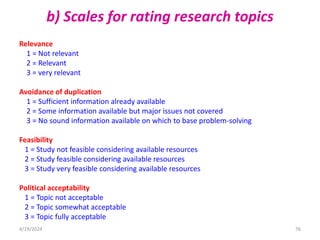
b) Scales for rating research topics
Relevance
1 = Not relevant
2 = Relevant
3 = very relevant
Avoidance of duplication
1 = Sufficient information already available
2 = Some information available but major issues not covered
3 = No sound information available on which to base problem-solving
Feasibility
1 = Study not feasible considering available resources
2 = Study feasible considering available resources
3 = Study very feasible considering available resources
Political acceptability
1 = Topic not acceptable
2 = Topic somewhat acceptable
3 = Topic fully acceptable
76
4/19/2024
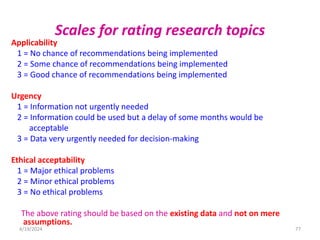
Scales for rating research topics
Applicability
1 = No chance of recommendations being implemented
2 = Some chance of recommendations being implemented
3 = Good chance of recommendations being implemented
Urgency
1 = Information not urgently needed
2 = Information could be used but a delay of some months would be
acceptable
3 = Data very urgently needed for decision-making
Ethical acceptability
1 = Major ethical problems
2 = Minor ethical problems
3 = No ethical problems
The above rating should be based on the existing data and not on mere
assumptions.
77
4/19/2024
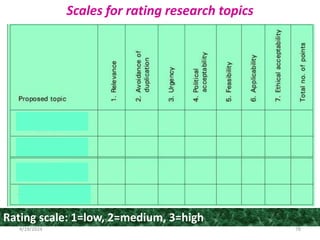
Rating scale: 1=low, 2=medium, 3=high
Scales for rating research topics
78
4/19/2024
Topic/title writing
• The research topic or title should be specific and clear.
• The topic should indicate the WHAT, WHO, WHERE and
WHEN clearly.
• The title clearly identifies the study and may contain a
brief description of the study design and objectives.
Title- Should be in line with your general objective
– Should tell readers what your study is about and where it
will be done
79
4/19/2024
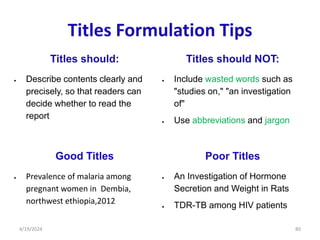
Titles Formulation Tips
Titles should: Titles should NOT:
 Describe contents clearly and
precisely, so that readers can
decide whether to read the
report
 Include wasted words such as
"studies on," "an investigation
of"
 Use abbreviations and jargon
Good Titles Poor Titles
 Prevalence of malaria among
pregnant women in Dembia,
northwest ethiopia,2012
 An Investigation of Hormone
Secretion and Weight in Rats
 TDR-TB among HIV patients
80
4/19/2024
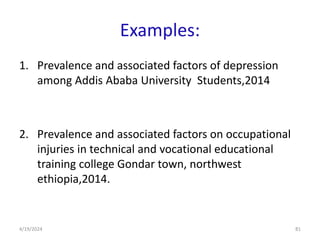
Examples:
1. Prevalence and associated factors of depression
among Addis Ababa University Students,2014
2. Prevalence and associated factors on occupational
injuries in technical and vocational educational
training college Gondar town, northwest
ethiopia,2014.
81
4/19/2024
82
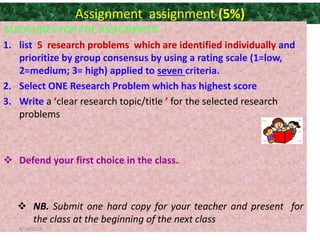
Assignment assignment (5%)
GUIDELINES FOR THE ASSIGNEMTN
1. list 5 research problems which are identified individually and
prioritize by group consensus by using a rating scale (1=low,
2=medium; 3= high) applied to seven criteria.
2. Select ONE Research Problem which has highest score
3. Write a ‘clear research topic/title ’ for the selected research
problems
 Defend your first choice in the class.
 NB. Submit one hard copy for your teacher and present for
the class at the beginning of the next class
4/19/2024
Chapter 3: Statement of the problem and
Justification
Objective: at the end of this chapter you are
able to:
– Analyze the problem
– Formulate the problem statement
– Write Justification
83
4/19/2024
Statement of the problem
Includes:
• Magnitude, frequency and distribution: Affected
geographical areas & population groups affected by the
problem
• Causes of the problem: What is the current knowledge of
the problem and its causes? Is there consensus?
controversy? conclusive evidence?
• Possible solutions: In what ways have solutions to the
problem been attempted? What has been proposed?
What are the results?
• Unanswered questions: What remains to be answered?
What areas have not been possible to understand,
determine, verify, or test?
• If necessary a short list of definitions of crucial concepts
84
4/19/2024
Justification
• It is also called significant of the study,
purpose of the study and rational of the study
• Why your research is needed?
• E.g
– Others not large enough
– Different populations
– Different intervention
– No study done before
85
4/19/2024
• A statement indicating the size of the problem
(and effect on the health service) and why the
study is appropriate
• Explain what the potential benefits are – to
patients and the health service
• Explain what your study will add to the body
of evidence already available.
86
4/19/2024
Chapter 4: Literature review and Referencing
Objective:
– What is Literature review
– Why it is necessary
– Resources(Source of information)
– How to write a literature review
– Conceptual framework
– Referencing
87
4/19/2024
What is literature review
• Literature: Printed information about something
• Review : Consider carefully
- Starting point to refine statement of the problem
- Part of the introduction of a research
• Review of the literature
- classification and evaluation of what have been written, and
organized according to guiding concept
88
4/19/2024
1) This section must be based on peer reviewed journal or other
published materials that are accessible in public domain (use non-
published materials in the Statement of the problem/introduction
if necessary but not in the literature review section).
2) Group findings from several studies (literature) according to
common theme rather than discussing individual paper: themes
could be qualitative versus quantitative approaches, magnitude of
the problem, risk factors, effectiveness of interventions etc.
3) Provide strong "umbrella" sentences at the beginnings of
paragraphs, "signposts" throughout, and brief "so what" summary
sentences at intermediate points in the review.
89
4/19/2024
Why/use of LR
• Prevent duplicating
• It increase your knowledge and helps to refining statement of the problem
• Become more familiar with the various types of methods
• It provides a framework for establishing the importance of the study
• It serves as a benchmark for comparing the results with other findings
 Describe the characteristics of previous study (where, when, who conduct,
findings, conclusion…)
 Comment on strengths and limitation of studies and findings
 Identify the GAP in knowledge
90
4/19/2024
Resources
Libraries
– Published information (books, journals..)
Internet/ web sites
– PUBMED / MEDLINE: - http://www.ncbi.nlm.nih.gov/PubMed/
– WHO website: - http://www. who.int
– Free Medical Journals :-
http://www.freemedicaljournals.com
– HINARI:- http://www. Healthinternetwork.net
– Medscape:- http://www. medscape.com
91
4/19/2024
How to write a review of literature?
• Take research problem
• Find a focus
• Organize
• Decide the order of issue to discuss
• Write coherent discussion in your own words
• Be critical to avoid possible bias
• Well quoted
• Write study design & area and sample size(sometime)
92
4/19/2024
Conceptual framework
• It is a set of broad ideas and principles used to
structure a subsequent presentation.
• Every research activity is conceptualized and will
be carried out within some contextual
framework.
• Conceptual frame- works represent ways of
thinking about a problem or a study, or ways of
representing how complex things work.
93
4/19/2024
Conceptual framework….
• Broadly speaking, conceptual frameworks
come from
– Theories with well-organized principles and
propositions that have been confirmed by
observations or experiments;
– Models derived from theories, observations or
sets of concepts, or
– Evidence-based best practices derived from
outcome and effectiveness studies.
94
4/19/2024
Referencing
• Referencing is a standardised method of
acknowledging sources of information and
ideas that you have used in your assignment
in a way that uniquely identifies their source.
• Avoid Plagiarism:- The use of another person’s
work without acknowledgement
• A reference list is a list of sources that you
have quoted from or cited in your text
95
4/19/2024
Referencing systems
• A number of referencing systems are in
common use today including:
– Vancouver (number) .
– Harvard - (author, date).
– APA (American Psychological Association)
– MLA (Modern Linguistics Association)
96
4/19/2024
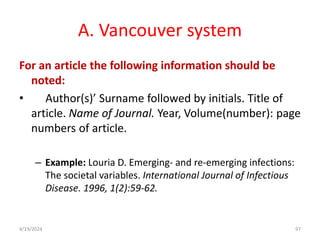
A. Vancouver system
For an article the following information should be
noted:
• Author(s)’ Surname followed by initials. Title of
article. Name of Journal. Year, Volume(number): page
numbers of article.
– Example: Louria D. Emerging- and re-emerging infections:
The societal variables. International Journal of Infectious
Disease. 1996, 1(2):59-62.
97
4/19/2024
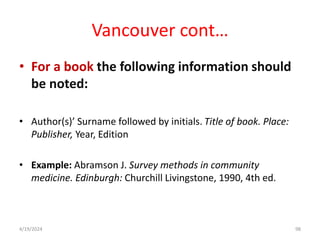
Vancouver cont…
• For a book the following information should
be noted:
• Author(s)’ Surname followed by initials. Title of book. Place:
Publisher, Year, Edition
• Example: Abramson J. Survey methods in community
medicine. Edinburgh: Churchill Livingstone, 1990, 4th ed.
98
4/19/2024
Vancouver cont..
• For a chapter in a book, the reference can
include:
• Author(s) of chapter (Surname(s) followed by initials). Chapter title. In:
Editor(s) of book, (Surname(s) followed by initials) (eds). Title of book.
Place: Publisher, Year: Page numbers of chapter.
• Example: Todd J and Barongo L. Epidemiological methods. In: Ng’weshemi
J, Boerma T, Bennett J and Schapink D (eds). HIV prevention and AIDS care
in Africa; A district level approach. Amsterdam: KIT Press, 1997: 51-68.
99
4/19/2024
Vancouver cont..
• When you use the Vancouver system, you will
use consecutive numbers in the text to
indicate your references
• At the end you will then list your references in
that order, using the format described above
100
4/19/2024
B. The Harvard System
• Using the Harvard system, reference to
sources is made at an appropriate place in the
text by stating:
– surname(of author(s);
– year of publication;
– page number(s), (optional)
101
4/19/2024
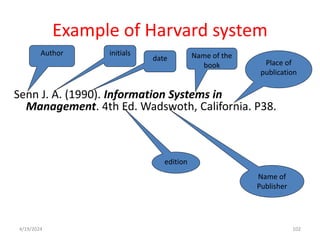
Example of Harvard system
Senn J. A. (1990). Information Systems in
Management. 4th Ed. Wadswoth, California. P38.
102
Author initials
date Name of the
book
edition
Place of
publication
Name of
Publisher
4/19/2024
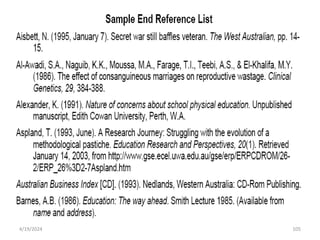
From journal
• Vogal L. C., Swinkels W. et al.(1976). Operational
Study of the Outpatient Department at the
Government Hospital ,Kimbu Kenya , East African
medical Journal, 53(3).
• Surname , initials ,Date of publication, title of
article, name of journal , volume and issue
number , page.
103
4/19/2024
From WWW
• Backer, L.A. (2002). Strategies for better
patient flow and cycle time. Downloaded from
Family practice management at
http://www.aafp.org/fpm/20020600/contents
.html(accessed on 14/3/2006)
Surname,Initials.Date.Title of article.name of
journal. Available at www. .accessed on.
104
4/19/2024
105
4/19/2024
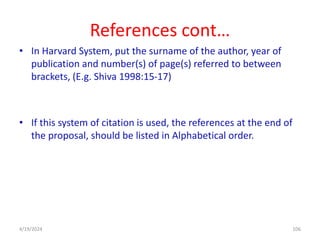
References cont…
• In Harvard System, put the surname of the author, year of
publication and number(s) of page(s) referred to between
brackets, (E.g. Shiva 1998:15-17)
• If this system of citation is used, the references at the end of
the proposal, should be listed in Alphabetical order.
106
4/19/2024
Assignment three
• Write literatures for your research proposal
using Vancouver style of referencing
107
4/19/2024
Chapter 5 :Research Objectives
• What is research objectives?
It summarizes what is to be achieved by the
research / study
108
4/19/2024
109
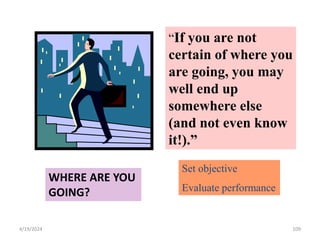
WHERE ARE YOU
GOING?
“If you are not
certain of where you
are going, you may
well end up
somewhere else
(and not even know
it!).”
Set objective
Evaluate performance
4/19/2024
Importance of developing objectives
• Focus the study
• Avoid the collection of unnecessary data
• facilitate the development of research
methodology and help to orient the
– collection,
– analysis,
– interpretation and
– utilization of data
• Helps for evaluating the research project
110
4/19/2024
111
Type of Objective
• General Objective
–What is expected to be achieved by the
study in general terms
– should be clearly related to the
statement of the problem.
• Specific Objectives
– Breaking down the general objective
into smaller, logically connected parts
4/19/2024
112
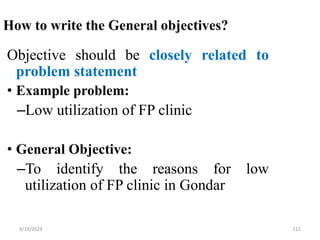
Objective should be closely related to
problem statement
• Example problem:
–Low utilization of FP clinic
• General Objective:
–To identify the reasons for low
utilization of FP clinic in Gondar
4/19/2024
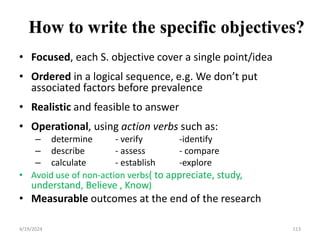
How to write the specific objectives?
• Focused, each S. objective cover a single point/idea
• Ordered in a logical sequence, e.g. We don’t put
associated factors before prevalence
• Realistic and feasible to answer
• Operational, using action verbs such as:
– determine - verify -identify
– describe - assess - compare
– calculate - establish -explore
• Avoid use of non-action verbs( to appreciate, study,
understand, Believe , Know)
• Measurable outcomes at the end of the research
113
4/19/2024
114
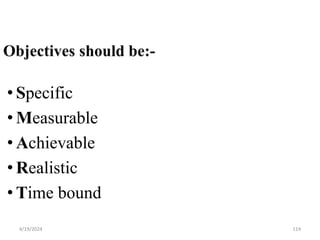
• Specific
• Measurable
• Achievable
• Realistic
• Time bound
4/19/2024
Example 1
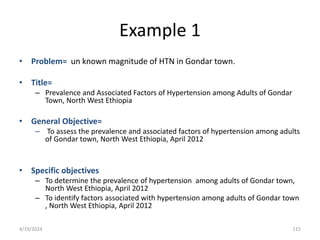
• Problem= un known magnitude of HTN in Gondar town.
• Title=
– Prevalence and Associated Factors of Hypertension among Adults of Gondar
Town, North West Ethiopia
• General Objective=
– To assess the prevalence and associated factors of hypertension among adults
of Gondar town, North West Ethiopia, April 2012
• Specific objectives
– To determine the prevalence of hypertension among adults of Gondar town,
North West Ethiopia, April 2012
– To identify factors associated with hypertension among adults of Gondar town
, North West Ethiopia, April 2012
115
4/19/2024
Example-2
• Title= Incidence and Predictors of Tuberculosis among people living with
HIV attending adult HIV care clinic at University of Gondar Referral
Hospital, Northwest Ethiopia,2012
• General Objective:
– To assess incidence and Predictors of Tuberculosis among adults living with
HIV attending HIV care clinic at University of Gondar Referral Hospital,2012
• Specific Objective=
– To determine incidence rate of Tuberculosis among adults living with HIV
attending HIV care clinic at University of Gondar Referral Hospital, 2012
– To identify the predictors of Tuberculosis among adults living with HIV
attending HIV care clinic at University of Gondar Referral Hospital,2012
116
4/19/2024
Example-3
• Title= Prevalence of Malnutrition and Associated Factors in Children
attending HIV/AIDS care in the Pediatric ART Clinics of Felege Hiwot
Hospit, North-West Ethiopia,2013
• General Objective:
– To determine the prevalence of malnutrition and factors associated
with it in children living with HIV/AIDS who are on HIV care at pediatric
ART clinics of FHRH.
• Specific Objectives
– To determine the prevalence of malnutrition in children with HIV/AIDS
following HIV/AIDS care at pediatric ART clinics of FHRH,2013
– To identify factors associated with malnutrition in children with
HIV/AIDS following HIV/AIDS care at pediatric ART Clinics of FHRH,2013
117
4/19/2024
Example 4
• General Objective: knowledge, attitude and practices
of healthcare workers about multidrug-resistant
tuberculosis at Amhara region hospital
• Specific Objectives
– To determine the knowledge of healthcare workers about
multidrug-resistant tuberculosis at Amhara region hospital
– To determine the attitude of healthcare workers about
multidrug-resistant tuberculosis at Amhara region hospital
– To determine the practices of healthcare workers about
multidrug-resistant tuberculosis at Amhara region hospital
118
4/19/2024
Assignment four
• Write general and specific objectives for your
research proposal?
119
4/19/2024
Chapter 6: Research Methods
Indicates the methodological steps you will take to answer
every question or to test every hypothesis or problem stated in
your study
– Types of study designs
– Study area and period
– Source and Study
population
– Inclusion and Exclusion
Criteria
– Sample size and
sampling procedures
– Variables
– Operational definitions
– data collection and data
quality control
– data processing and
analysis
– Ethical considerations
– Dissemination of Results
120
4/19/2024
Study design
• A study design is a specific plan or protocol for
conducting the study, which allows the
investigator to translate the conceptual
hypothesis into an operational one.
• It is a logical model that guides the
investigator in the various stages of the
research.
121
4/19/2024
Types of study designs
• Several classifications of study types are
possible, depending on what research
strategies are used
122
4/19/2024
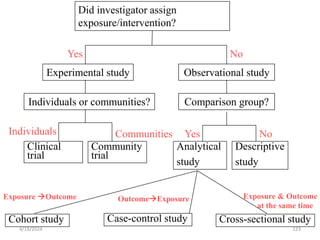
Did investigator assign
exposure/intervention?
Experimental study Observational study
Yes No
Individuals or communities?
Individuals Communities
Clinical
trial
Community
trial
Comparison group?
Yes No
Analytical
study
Descriptive
study
Cohort study Case-control study Cross-sectional study
Exposure Outcome OutcomeExposure Exposure & Outcome
at the same time
123
4/19/2024
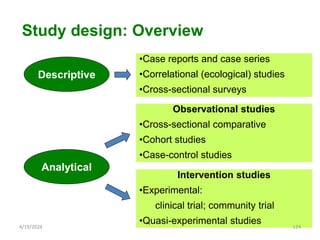
Study design: Overview
Descriptive
Analytical
•Case reports and case series
•Correlational (ecological) studies
•Cross-sectional surveys
Observational studies
•Cross-sectional comparative
•Cohort studies
•Case-control studies
Intervention studies
•Experimental:
clinical trial; community trial
•Quasi-experimental studies 124
4/19/2024
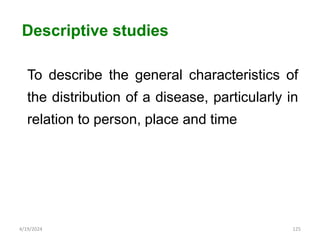
To describe the general characteristics of
the distribution of a disease, particularly in
relation to person, place and time
125
Descriptive studies
4/19/2024
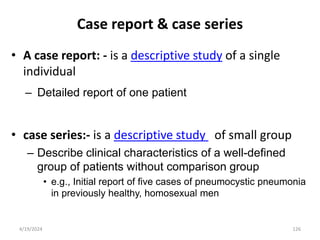
Case report & case series
• A case report: - is a descriptive study of a single
individual
– Detailed report of one patient
• case series:- is a descriptive study of small group
– Describe clinical characteristics of a well-defined
group of patients without comparison group
• e.g., Initial report of five cases of pneumocystic pneumonia
in previously healthy, homosexual men
126
4/19/2024
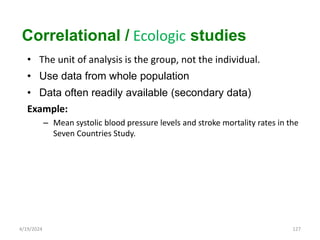
• The unit of analysis is the group, not the individual.
• Use data from whole population
• Data often readily available (secondary data)
Example:
– Mean systolic blood pressure levels and stroke mortality rates in the
Seven Countries Study.
127
Correlational / Ecologic studies
4/19/2024
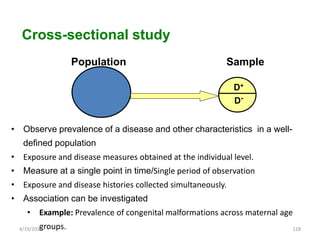
Cross-sectional study
D+
D-
Population Sample
• Observe prevalence of a disease and other characteristics in a well-
defined population
• Exposure and disease measures obtained at the individual level.
• Measure at a single point in time/Single period of observation
• Exposure and disease histories collected simultaneously.
• Association can be investigated
• Example: Prevalence of congenital malformations across maternal age
groups. 128
4/19/2024
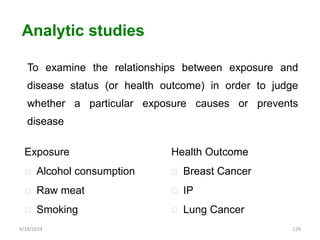
To examine the relationships between exposure and
disease status (or health outcome) in order to judge
whether a particular exposure causes or prevents
disease
129
Analytic studies
Exposure
 Alcohol consumption
 Raw meat
 Smoking
Health Outcome
 Breast Cancer
 IP
 Lung Cancer
4/19/2024
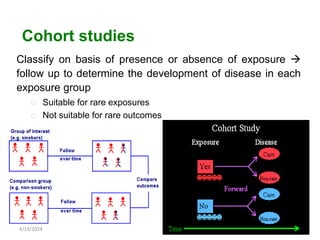
Classify on basis of presence or absence of exposure 
follow up to determine the development of disease in each
exposure group
 Suitable for rare exposures
 Not suitable for rare outcomes
130
Cohort studies
4/19/2024
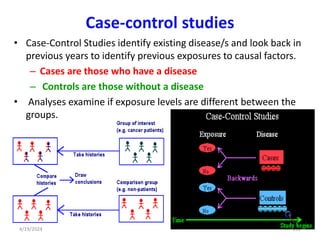
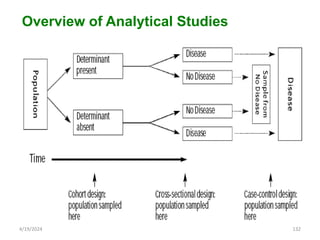
Case-control studies
• Case-Control Studies identify existing disease/s and look back in
previous years to identify previous exposures to causal factors.
– Cases are those who have a disease
– Controls are those without a disease
• Analyses examine if exposure levels are different between the
groups.
131
4/19/2024
Overview of Analytical Studies
132
4/19/2024
• Similar to cohort study, except that exposure is
allocated by the investigator
• Subjects followed up to determine if (when) they
develop the outcome
• Allocation is best done using a randomization
procedure
133
Intervention studies
4/19/2024
• Clinical trials:- Trials on individual patients
• Community trial:- Trials on communities rather
than patients
Examples:
- Iron-fortified salt and anemia in the community
- Impregnated bed net and malaria morbidity
134
Types of experiments
4/19/2024
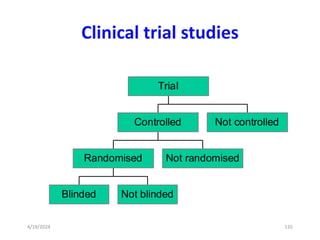
Clinical trial studies
Blinded Not blinded
Randomised Not randomised
Controlled Not controlled
Trial
135
4/19/2024
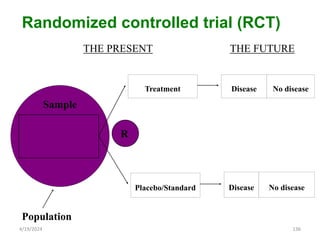
Randomized controlled trial (RCT)
Disease No disease
No disease
Disease
THE FUTURE
THE PRESENT
Population
Sample
Treatment
Placebo/Standard
R
136
4/19/2024
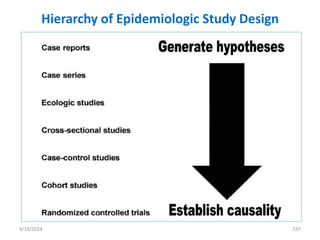
Hierarchy of Epidemiologic Study Design
137
4/19/2024
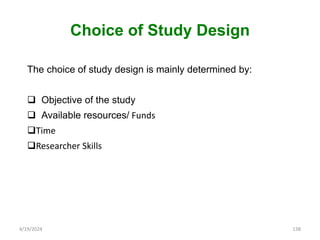
Choice of Study Design
The choice of study design is mainly determined by:
 Objective of the study
 Available resources/ Funds
Time
Researcher Skills
138
4/19/2024
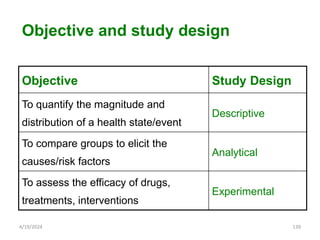
Objective Study Design
To quantify the magnitude and
distribution of a health state/event
Descriptive
To compare groups to elicit the
causes/risk factors
Analytical
To assess the efficacy of drugs,
treatments, interventions
Experimental
139
Objective and study design
4/19/2024
Assignment Five
• Choose a study design for your
research topic?
–Example:-A community based cross
sectional study design will be used
140
4/19/2024
141
4/19/2024
Study area/setting
• Where will the research take place?
• The setting where the study will be conducted
• Mentioned:
– The location of the area/setting
– Size of the population
– Availability of Health service
– Other issue related with your research
142
4/19/2024
Study area
Topic :-Incidence and Predictors of Tuberculosis among people living with
HIV attending adult HIV care clinic at University of Gondar Referral
Hospital, Northwest Ethiopia
• The stud will be conducted at University of Gondar Referral Hospital HIV
care clinic. It is located in North Gondar administrative zone, Amhara
National Regional state, which is far from about 750 km Northwest of
Addis Ababa (the capital city of Ethiopia). According to the 2007
population and housing census report , the total population size of Gondar
town was estimated to be 206,987 (36). Currently Gondar town has one
Referral Hospital and five government Health Centers. University of
Gondar Referral Hospital is a teaching Hospital which serves more than
five million people of the North Gondar zone and peoples of the
neighboring zones. The HIV care services of the Hospitals was initiated in
2005 and have three clinics: Adult ART clinic, Pediatric ART clinic, and VCT
clinic. The clinic has two medical doctors providing ART services, 1 MPH in
reproductive Health, 2 Health officers , 2 BSc and 4 Diploma nurses, 2
data clerks, 2 data base manager,1 porter, 2 janitors 3 case manager and 8
adherence supporters (people living with HIV). There were about 6444
and 3888 who ever stared and currently on ART respectively.
143
4/19/2024
Study period
• The period where the data will be collected.
– Example: the study will be conducted from
January to March, 2013.
144
4/19/2024
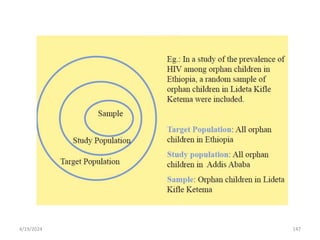
Source and Study population
• Target/source/theoretical population
– Source population refers to the entire group of
individuals or objects to which researchers are
interested in generalizing the conclusions.
– A collection of items that have something in
common for which we wish to draw conclusions at
a particular time.
– The target population usually has varying
characteristics and it is also known as the
theoretical or target population.
145
4/19/2024
Study population
– But, because of practicalities, entire target
population often cannot be studied.
– The specific population from which data are
collected
146
4/19/2024
147
4/19/2024
Example
• The source population for this study will be all
Adults living with HIV who ever registered for
chronic HIV care and support program.
• The study population for this study will be
those Adults living with HIV who ever enrolled
to University of Gondar Referral Hospital.
148
4/19/2024
Inclusion and Exclusion Criteria
• Inclusion Criteria: the set of criteria which is
important to include the study participant in
to the research
• Exclusion criteria: which help us to exclude
those individuals which will not be part of our
study.
– They should be part of the inclusion criteria
149
4/19/2024
Sample
• In research terms a sample is a group of people, objects, or
items that are taken from a larger population for measurement.
• A subset of a study population, about which information is actually obtained.
• The sample should be representative of the population to
ensure that we can generalize the findings from the research
sample to the population as a whole.
150
4/19/2024
Basic Terms
– A population: is a group of individuals persons, objects, or items
from which samples are taken for measurement
– Census: Obtained by collecting information about each member of a
population
– Sample: Obtained by collecting information only about some
members of a "population“
– Sampling Frame; is the list of people from which the sample is
taken.
– Probability samples: each population element has a known (non-
zero) chance of being chosen for the sample.
– Non-probability samples: we do not know the probability that each
population element will be chosen, and/or we cannot be sure that
each population element has a non-zero chance of being chosen
151
4/19/2024
Advantage of sampling
152
Samples offer many benefits:
• Save costs: Less expensive to study the sample than the
population.
• Save time: Less time needed to study the sample than the
population .
• Accuracy: Since sampling is done with care and studies are
conducted by skilled and qualified interviewers, the results are
expected to be accurate.
• Destructive nature of elements: For some elements, sampling
is the way to test, since tests destroy the element itself.
4/19/2024
Limitations of Sampling
• There is always error
• Sampling error is any type of bias that is attributable
to mistakes in either drawing a sample or determining
the sample size
• Non-sampling error is any error which will be
committed during data collection, coding, entry,
and so on
153
4/19/2024
Sample Size Determination
• How many completed questionnaires do we
need to have a representative sample?
• Generally the larger the better, but that takes
more time and money.
• Answer depends on:
– How different or dispersed the population is.
– Desired level of confidence.
– Desired degree of accuracy.
– Desired margin of error
154
4/19/2024
Sample Size …
• Sample size may be determined by using:
– Subjective methods (less sophisticated methods)
• The rule of thumb approach: eg. 5% of population
• Conventional approach: eg. Average of sample sizes of
similar other studies;
• Cost basis approach: The number that can be studied
with the available funds;
• Depending on the number of independent variables
– Statistical formulae (more sophisticated methods)
• Confidence interval approach.
155
4/19/2024
Sample size determination using statistical formulae:
The confidence interval approach
• To determine sample sizes using statistical formulae,
researchers use the confidence interval approach based on
the following factors:
– Desired level of data precision or accuracy;
– Amount of variability in the population (homogeneity);
– Level of confidence required in the estimates of population
values.
• Availability of resources such as money, manpower and
time may prompt the researcher to modify the computed
sample size.
156
4/19/2024
Statistical Formula
• Sample size formula, in general, depends on
the number of study population:
 Single population
Two population
157
4/19/2024
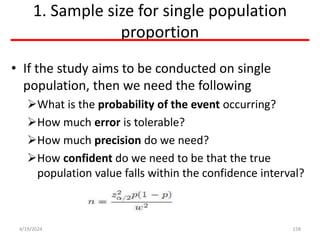
1. Sample size for single population
proportion
• If the study aims to be conducted on single
population, then we need the following
What is the probability of the event occurring?
How much error is tolerable?
How much precision do we need?
How confident do we need to be that the true
population value falls within the confidence interval?
158
4/19/2024
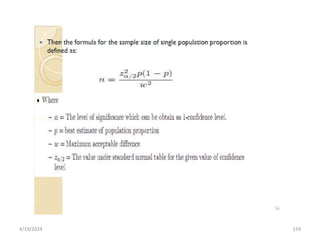
159
4/19/2024
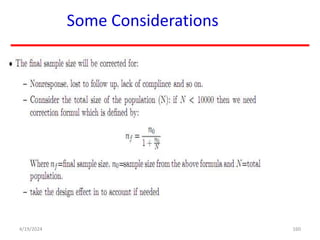
Some Considerations
160
4/19/2024
Design effects
• The loss of effectiveness by the use of cluster sampling instead of
simple random sampling is design effect.
• Working definition of design effect is that factor by how much
sample variance for the sample plan exceeds simple random
sample of same size.
• How much worse your sample is from a simple random sample
• For cluster sampling, design effect is 2
• For multistage sampling design effect is equal to the number of
stages
161
4/19/2024
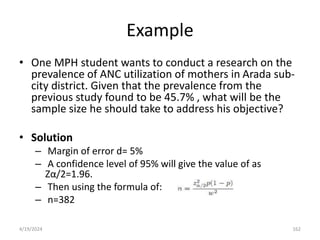
Example
• One MPH student wants to conduct a research on the
prevalence of ANC utilization of mothers in Arada sub-
city district. Given that the prevalence from the
previous study found to be 45.7% , what will be the
sample size he should take to address his objective?
• Solution
– Margin of error d= 5%
– A confidence level of 95% will give the value of as
Zα/2=1.96.
– Then using the formula of:
– n=382
162
4/19/2024
Sampling Technique
Sampling is the process of selecting a small number of
elements from a larger defined target group of
elements such that the information gathered from
the small group will allow judgment to be made
about the larger groups
163
4/19/2024
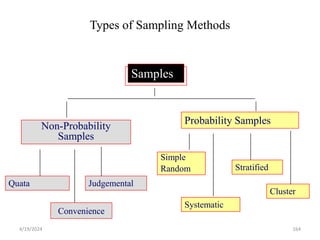
Convenience
Types of Sampling Methods
Samples
Non-Probability
Samples
Quata Judgemental
Probability Samples
Simple
Random
Systematic
Stratified
Cluster
164
4/19/2024
Probability Sampling Method
• Probability sampling strategies typically use a random or
chance process.
• The "equal chance" and "independent" components of
random sampling are what makes us confident that the
sample has a reasonable chance of representing the
population.
• What does it mean to be independent? The researchers select
each person for the study separately.
165
4/19/2024
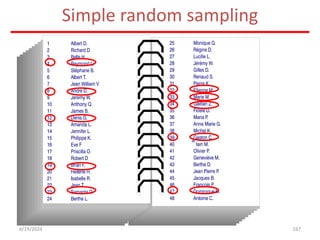
1. Simple Random Sampling
• Simple random sampling is the most straightforward of the random
sampling strategies.
• All possible samples of n subjects are equally likely to occur
• How do we actually take a random sample?
• Depending on the complexity of the population, we can use different tools
to select n samples from the frame.
 These are lottery method,
 table of random number
 computer generated random number.
• Lottery method is appropriate if the total population is not too large,
otherwise if the population is too large then it will be very difficult to use
lottery method.
• Thus, table of random number or computer generated random number is
the feasible method to be used.
166
4/19/2024
Simple random sampling
167
4/19/2024
Assumption of the population
 Homogeneity with respect to the
variable of interest
Availability of frame
168
4/19/2024
169
4/19/2024
2. Systematic Random Sampling
170
Systematic random sampling is a
method of
probability sampling
in which the defined
target population is ordered
and the sample is selected
according to position using a skip interval
4/19/2024
Steps in Drawing a Systematic Random Sample
1: Obtain a list of units that contains an acceptable frame of
the target population
2: Determine the number of units in the list and the desired
sample size
3: Compute the skip interval
• The population is listed in a particular order, then every
kth unit is selected
– Start at a random point between 1 and k
– Here k is chosen so that N ≈ kn
4: Determine a random start point
5: Beginning at the start point, select the units by choosing
each unit that corresponds to the skip interval
171
4/19/2024
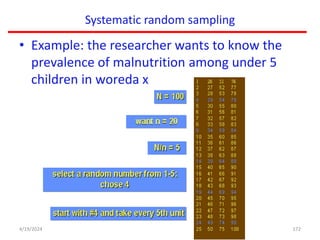
Systematic random sampling
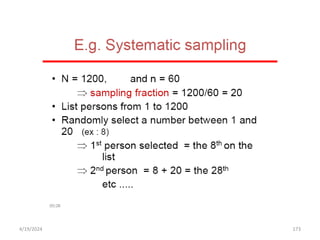
• Example: the researcher wants to know the
prevalence of malnutrition among under 5
children in woreda x
172
4/19/2024
173
4/19/2024
174
4/19/2024
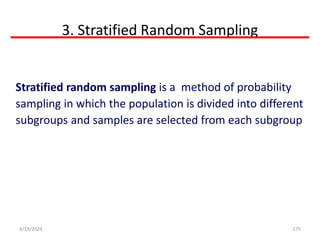
3. Stratified Random Sampling
175
Stratified random sampling is a method of probability
sampling in which the population is divided into different
subgroups and samples are selected from each subgroup
4/19/2024
Stratified sampling
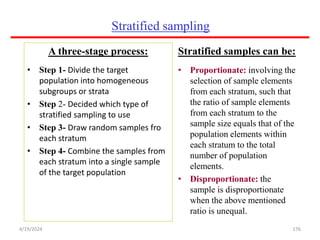
A three-stage process:
• Step 1- Divide the target
population into homogeneous
subgroups or strata
• Step 2- Decided which type of
stratified sampling to use
• Step 3- Draw random samples fro
each stratum
• Step 4- Combine the samples from
each stratum into a single sample
of the target population
Stratified samples can be:
• Proportionate: involving the
selection of sample elements
from each stratum, such that
the ratio of sample elements
from each stratum to the
sample size equals that of the
population elements within
each stratum to the total
number of population
elements.
• Disproportionate: the
sample is disproportionate
when the above mentioned
ratio is unequal.
176
4/19/2024
Cluster sampling
• If the study covers wide geographical area,
using the other methods will be too costly.
• The idea is, divided the total population in
to different clusters and then the unit of
selection will be cluster.
• Therefore, total population in the selected
cluster will be taken as the sample.
177
4/19/2024
Cluster sampling
• Steps in cluster sampling are:
– Define the population
– Determine the desired sample size
– Identify and define a logical cluster (can be kebele, Got,
residence, and so on)
– Make a list of all clusters in the population
– Estimate the average number of population number per
cluster(P/c)
– Determine the number of clusters needed by dividing
the sample size by the estimated size of the cluster (N/c)
– Randomly select the required number of clusters (using
table of random number as the total number of clusters
is manageable)
– Include in the sample all population in the selected
cluster.
178
4/19/2024
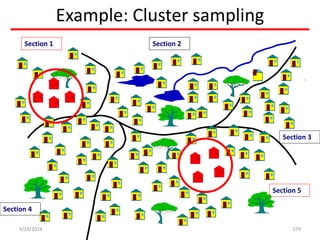
Example: Cluster sampling
179
Section 4
Section 5
Section 3
Section 2
Section 1
4/19/2024
180
4/19/2024
Cluster sampling
• Advantages
– Simple as complete list of sampling units within
population not required
– Less travel/resources required
• Disadvantages
– Potential problem is that cluster members are more
likely to be alike, than those in another cluster
(homogenous)….
– This “dependence” needs to be taken into account in
the sample size….and the analysis (“design effect”)
181
4/19/2024
Multi-stage Sample Designs
• Many surveys use complex sample designs that
combine several of the above elements in a multi-
stage sampling framework
• Sometimes the population is too large and scattered
for it to be practical to make a list of the entire
population from which to draw a SRS.
• Suppose that each unit in the population can be
divided into a number of smaller units, or subunits
182
4/19/2024
Multistage …
• The prime stimulus for multi-stage sampling is
administrative convenience
• As with cluster sampling, we select c of C clusters,
but now instead of sampling all units in each
cluster, we take a random sample. Most large
surveys carried out this way
183
4/19/2024
Selecting a sampling method
• Population to be studied
– Size/geographical distribution
– Heterogeneity with respect to variable
• Availability of list of sampling units
• Level of precision required
• Resources available
184
4/19/2024
Non-probability sampling
– Every element in the universe [sampling frame] does not
have equal probability of being chosen in the sample.
– Operationally convenient and simple in theory.
– Results may not be generalized.
– When using non-probability sampling, sample size is
unrelated to accuracy, so cost benefit consideration must
be used.
185
4/19/2024
Non-probability samples…
• Convenience sampling
– Drawn at the convenience of the researcher. Common in exploratory
research. Does not lead to any conclusion.
• Judgmental sampling
– Sampling based on some judgment, gut-feelings or experience of the
researcher. If inference drawing is not necessary, these samples are quite
useful.
• Quota sampling
– It is the non-probability equivalent of stratified
sampling.
– This differs from stratified sampling, where the
stratums are filled by random sampling.
• .
186
4/19/2024
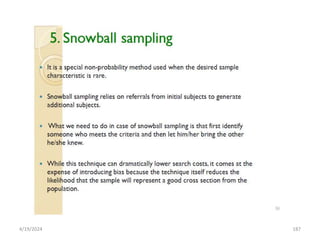
187
4/19/2024
Conclusions
• Probability samples are the best
• Ensure
– Representativeness
– Precision
• …..within available constraints
188
4/19/2024
189
What is a variable?
 A characteristic or property of a person, object or
phenomenon, which can take on different values,
may be in the form of numbers (age) or groups (sex)
e.g- person’s age (years)
weight (Kg, lbs)
number of children (1,2,3, etc)
condition of a patient (mild, moderate, severe)
4/19/2024
190
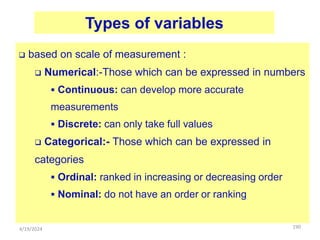
Types of variables
 based on scale of measurement :
 Numerical:-Those which can be expressed in numbers
 Continuous: can develop more accurate
measurements
 Discrete: can only take full values
 Categorical:- Those which can be expressed in
categories
 Ordinal: ranked in increasing or decreasing order
 Nominal: do not have an order or ranking
4/19/2024
191
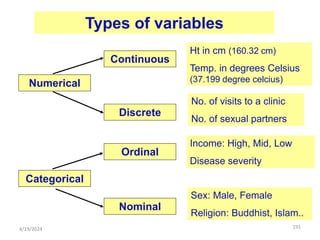
Types of variables
Numerical
Categorical
Continuous
Discrete
Ht in cm (160.32 cm)
Temp. in degrees Celsius
(37.199 degree celcius)
No. of visits to a clinic
No. of sexual partners
Ordinal
Nominal
Income: High, Mid, Low
Disease severity
Sex: Male, Female
Religion: Buddhist, Islam..
4/19/2024
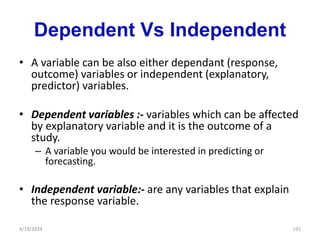
Dependent Vs Independent
• A variable can be also either dependant (response,
outcome) variables or independent (explanatory,
predictor) variables.
• Dependent variables :- variables which can be affected
by explanatory variable and it is the outcome of a
study.
– A variable you would be interested in predicting or
forecasting.
• Independent variable:- are any variables that explain
the response variable.
192
4/19/2024
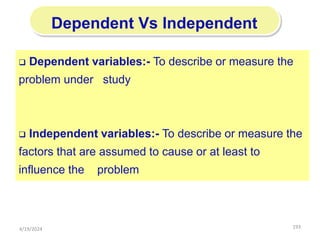
193
Dependent Vs Independent
 Dependent variables:- To describe or measure the
problem under study
 Independent variables:- To describe or measure the
factors that are assumed to cause or at least to
influence the problem
4/19/2024
194
Dependent Vs Independent
 Determined by the statement of the problem and
objectives of the study
 Relationship between smoking and lung cancer
 Independent variable: smoking
 Dependent variable: Lung cancer
 Study on reasons for smoking
 Independent variable: peer pressure, to release
stress, etc
 Dependent variable: smoking
4/19/2024
Example
• In a study to determine whether surgery or
chemotherapy results in higher survival rates
for a certain type of cancer, whether or not
the patient survived is one variable, and
whether they received surgery or
chemotherapy is the other.
• Which is the explanatory variable and which is
the response variable?
195
4/19/2024
196
Operationalizing variables
 Some variables are measureable as such, but some need
indicators
Conceptual definition
Characteristic we would like to measure
e.g- knowledge level
 Operational definition
Characteristic we would actually measure
In a set of 10 questions:
 0-3 correct answers  poor
 4-6 correct answers  reasonable
 7-10 correct answers  good
4/19/2024
197
Data Collection Methods
 Sources of data
 Types of data collection methods
 Factors considered in choice of method
 Data collection tool
4/19/2024
198
New data which are originally collected for
a specific purpose
Examples: Survey
Primary data
4/19/2024
199
An existing data to investigate research
questions other than those for which the data
were originally gathered (routinely available
information).
Secondary data
Examples: Hospital statistics
4/19/2024
200
Types of data collection methods
 Quantitative data collection methods (in numbers)
Using available information (secondary data)
 Interviewing
 Administering questionnaire
Qualitative data collection methods (in words)
 Focus group discussion (FGD)
 In-depth interview (IDI)
 Observation
4/19/2024
201
Using available information
 Census data
 Unpublished reports
 Hospital records
 Information routinely collected by others
4/19/2024
Using available information cont…
• Advantage of available data – collection is inexpensive
• Disadvantage of existing data:
– It is some times difficult to gain access to records or
reports
– Data may not always be complete and precise enough, or
too disorganized
202
4/19/2024
203
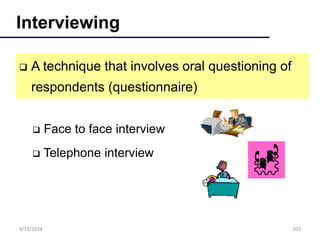
Interviewing
 A technique that involves oral questioning of
respondents (questionnaire)
 Face to face interview
 Telephone interview
4/19/2024
204
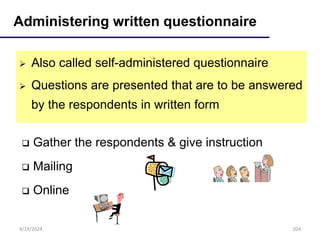
Administering written questionnaire
 Also called self-administered questionnaire
 Questions are presented that are to be answered
by the respondents in written form
 Gather the respondents & give instruction
 Mailing
 Online
4/19/2024
Administering written questionnaires
cont…
Advantages:
• less expensive
• permits anonymity & may result in more
honest responses
• does not require research assistants
• eliminates bias due to phrasing questions
differently with different respondents
205
4/19/2024
Administering written questionnaires
cont…
Disadvantages:
• Cannot be used with illiterates
• there is often a low rate of response
• questions may be misunderstood
206
4/19/2024
207
 Closed questions
 Open-ended questions
 Semi-opened questions
Types of questions
4/19/2024
208
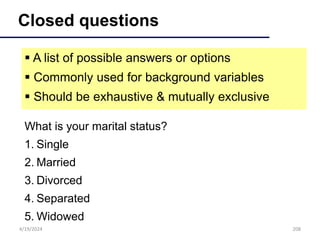
Closed questions
 A list of possible answers or options
 Commonly used for background variables
 Should be exhaustive & mutually exclusive
What is your marital status?
1. Single
2. Married
3. Divorced
4. Separated
5. Widowed
4/19/2024
209
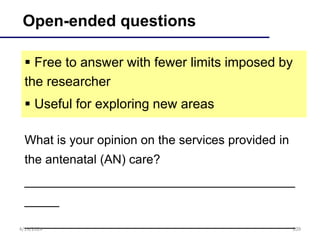
Open-ended questions
 Free to answer with fewer limits imposed by
the researcher
 Useful for exploring new areas
What is your opinion on the services provided in
the antenatal (AN) care?
_______________________________________
_____
_______________________________________
4/19/2024
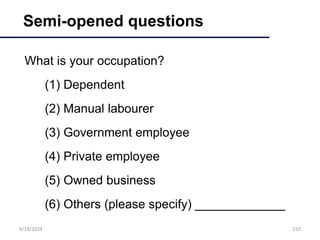
210
Semi-opened questions
What is your occupation?
(1) Dependent
(2) Manual labourer
(3) Government employee
(4) Private employee
(5) Owned business
(6) Others (please specify) _____________
4/19/2024
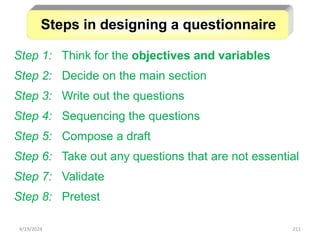
211
Step 1: Think for the objectives and variables
Step 2: Decide on the main section
Step 3: Write out the questions
Step 4: Sequencing the questions
Step 5: Compose a draft
Step 6: Take out any questions that are not essential
Step 7: Validate
Step 8: Pretest
Steps in designing a questionnaire
4/19/2024
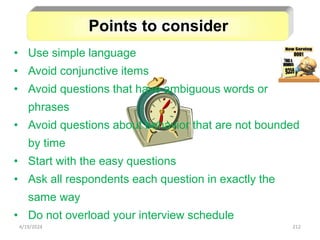
212
• Use simple language
• Avoid conjunctive items
• Avoid questions that have ambiguous words or
phrases
• Avoid questions about behavior that are not bounded
by time
• Start with the easy questions
• Ask all respondents each question in exactly the
same way
• Do not overload your interview schedule
Points to consider
4/19/2024
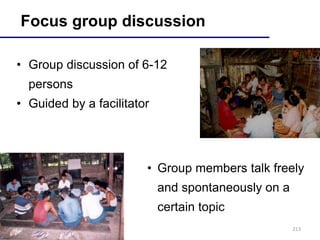
213
Focus group discussion
• Group discussion of 6-12
persons
• Guided by a facilitator
• Group members talk freely
and spontaneously on a
certain topic
4/19/2024
214
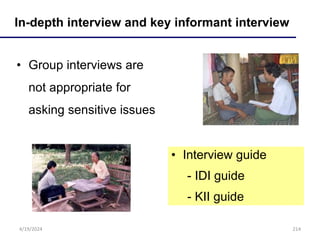
In-depth interview and key informant interview
• Group interviews are
not appropriate for
asking sensitive issues
• Interview guide
- IDI guide
- KII guide
4/19/2024
215
Observation
 Participant observation
The observer takes part in the situation he or she
observes
 Non-participant observation
The observer watches the situation, openly or
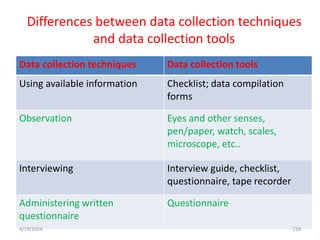
concealed, but does not participate
A technique which involves systematically selecting,
watching and recording behavior and characteristics of
living beings, objects or phenomena
4/19/2024
216
 Review your study objective
 What type of information do you require
 Independent and dependent variables
 Characteristics of the study population
(age, literacy)
 Accessibility to sample (time, infrastructure)
 Which type of data collection technique will be used
to gather the information you need
Factors to be considered in choice of method
4/19/2024
217
View different methods of data collection
Prevalence of hypertension may be obtained by
 Measuring blood pressure
(clinical measurement)
 Asking a person if he/she has hypertension
(interview)
 Record study
(document review)
4/19/2024
Differences between data collection techniques
and data collection tools
Data collection techniques Data collection tools
Using available information Checklist; data compilation
forms
Observation Eyes and other senses,
pen/paper, watch, scales,
microscope, etc..
Interviewing Interview guide, checklist,
questionnaire, tape recorder
Administering written
questionnaire
Questionnaire
218
4/19/2024
Conclusion on Data collection
• Data collection techniques and tools
– Data collection method
– Data collection tool
– Who will collect the data?
– Who will supervise the data collection?
– How long will take the data collection? etc
219
4/19/2024
Data Quality Control Issues
Describe/provide:
– Operational definitions of crucial concepts
– training of data collectors/supervisor
– Field testing the research methods and tools
– Supervision data collection process
220
4/19/2024
Pretesting and Pilot study
– Pretest – usually refers to a small-scale trial of
particular research components
– Pilot study – is the process of carrying out a
preliminary study, going through the entire
research procedure with a small sample
221
4/19/2024
Data processing
Refers to:
– data checks and correction, and
– data entry into a computer
• No matter how carefully the data have been
entered some errors are inevitable.
• The aim of this process is to produce a
relatively ‘clean’ data set ready for analysis
222
4/19/2024
Data analysis
• Data analysis: coding, entering, cleaning, storing,
recoding, choice of statistical methods
• A plan for data analysis should include the following
information:
– Identification of the analysis tasks to be completed
– Identification of the statistical software to be used for the
analysis
– A schedule or work plan for the analysis of the data
– A plan for quality control of the data analysis, including
regular checks which involve review and assessment of the
quality of a sample of the analysis already performed
223
4/19/2024
Ethical Considerations
• Professional obligation to safeguard the safety
of study participants
• Refer to national and international guidelines
• Describe potential ethical concerns and
mechanisms to minimize harm and maximize
benefits
– Every research can potentially cause ethical
concerns!!
224
4/19/2024
• Description of ethical issues related to the
study. For example consider:
– Approvals from relevant groups (e.g. UoG)
– Informed consent (subject information and
informed consent form appended)
– Benefit of the research
– Confidentiality
225
4/19/2024
Dissemination and Utilization of Results
• Briefly describe the dissemination plan
– Feedback to the community
– Feedback to local authorities
– Identify relevant agencies that need to be
informed
– Scientific publication
– Presentation in meetings/conferences
• Briefly describe how the study results can be
best translated into application
226
4/19/2024
Chapter 7: Work Plan Budget
At the end of this chapter you will be able to write
– A Work Plan and
– A Budget break down for your research work
227
4/19/2024
Work plan
• Work plan summarizes (in a table, chart,
graph) the various components of a research
project and how they fit together.
• Includes:
– Tasks to be performed
– When the task will be performed
– Who will perform the task (identify human
resource needed for each task)
– Number of staff needed to perform the task
228
4/19/2024
Work plan cont..
A work plan can serve as:
• a tool in planning the details of the project activities and later
the project funds.
• a visual outline or illustration of the sequence of the project
operations.
• a management tool for the principal investigator and/or
members of his/her team, showing what tasks and activities
are planned, their timing, and when various members will be
involved in the tasks;
• a tool for monitoring and evaluation, when the current status
of the project is compared to what was foreseen in the work
plan. 229
4/19/2024
Work plan….
• Ways of presenting a work plan
– Work schedule
– GANNT chart
– PERT chart.
230
4/19/2024
Work plan cont..
The Work Schedule
• Is a table
• Summarizes:
– tasks to be performed
– duration of each activity, and
– staff responsible.
• The work schedule does not show how various tasks are related, nor give a
visual picture of the time schedule.
231
4/19/2024
Work plan cont..
The GANTT Chart
• Is a planning tool which depicts graphically the order in which
various tasks must be completed and their duration of activity.
A typical Gantt chart includes the following information:
• The tasks to be performed
• Who is responsible for each task; and
• The time each task is expected to take.
• The length of each task is shown by a bar that extends over
the number of days, weeks or months the task is expected to
take.
• The Gantt chart doesn’t show how various tasks are related.
232
4/19/2024
233
4/19/2024
Work plan cont..
The PERT Chart
• PERT - Program Evaluation Review Technique
• PERT chart involves identifying the various “steps” necessary
for implementing a project and then planning the optimal
feasible schedules for completing a study.
• PERT chart shows the steps or events in the project that must
be completed as well as illustrating graphically how the steps
are interrelated.
• It has the added advantage of helping the investigator
determine the best timing for particular tasks and how to
complete the project in the least possible time.
• It doesn’t indicate who will complete the work
• It is somewhat more complicated to use than the other techniques.
234
4/19/2024
235
4/19/2024
Budget
• How should a budget be prepared?
– It is necessary to use the work plan as a starting point.
– Specify, for each activity in the work plan, what
resources are required.
– Determine for each resource needed the unit cost and
the total cost.
– The budget for the fieldwork component of the work
plan will include funds for personnel, transport and
supplies.
– Include a 5%-10% contingency fund
236
4/19/2024
Annex
• Include in the appendices of your proposal
any additional information you think might be
helpful to a proposal reviewer.
• For example, include:
– Biographical data on the principal investigator
– The study questionnaire if you have it.
– The consent form.
– A copy of the approval from the Institutional
Review Board.
237
4/19/2024
Your Proposal
• Simple and clear
• Good statement of the problem: why do
you want to study?
• Pertinent literature review
• Few objectives
• Clear and detailed methodological
description
• Good work plan
• Reasonable budget
238
4/19/2024
239
4/19/2024
Chapter 8: Results and Discussion
• At the end of this chapter you will be able to
write a research results and discussion
240
4/19/2024
Results
• Purpose → to describe the results of data analysis
that are relevant to the study
• This component is the core section of the scientific
report and which is presented by tables, figures, chartes,
etc.
• The results should be presented in an orderly
sequence using an outline
• The sequence of the results should follow the
sequence of the objectives and Methods section
241
4/19/2024
Results cont...
• Use past tense
• Do not interpret results
• Avoid extra words
• Determine whether the data are best presented
in the form of
– text,
– figures, or
– tables.
242
4/19/2024
Text
 Describe what you found, not what you did
 Present results in a logical sequence
 Consider sub-sections
 Do not repeat all of the data from the tables and figures
in the text;
 Make sure all numbers in text are consistent with
tables/figures
243
4/19/2024
Use of tables & figures
• Tables are referred to as “tables”, and all other
items (graphs, photographs, drawings, diagrams,
maps, etc.) are referred to as “figures”
• Tables & figures need numbers & clear title
244
4/19/2024
Discussion
Purpose → to interpret your results & justify your
interpretation
• The discussion is considered the heart of the
paper and usually requires several writing
attempts.
245
4/19/2024
Discussion cont...
• Discussion should be kept as short as possible
while clearly and fully stating, supporting,
explaining, and defending your answers and
discussing other important and directly relevant
issues.
246
4/19/2024
Discussion cont...
• Do not present any new data that were not shown in the
result section
• Organize the Discussion from the specific to the general:
your findings to the literature, to theory, to practice.
• Address all the results relating to the questions,
regardless of whether or not the findings were
statistically significant
• Discuss any unexpected findings.
• Write the limitation and strength of your study
247
4/19/2024
Chapter 9:Conclusion and Recommendation
• A conclusion is where you summarize the
paper’s findings and generalize their importance,
248
4/19/2024
Conclusion cont…
• Conclusions should be short, as they have been
elaborately discussed in the discussion section
• Strive for accuracy and originality in your
conclusion.
• By the time you reach the end of your
conclusion, there should be no question in the
reader's mind as to the validity of your claims.
249
4/19/2024
Recommendations
• Recommendations are usually placed in roughly
the same sequence as the conclusion
• Recommendations may at the same time be
summarized according to the groups towards
which they are directed
Example
– Policy makers
– Managers at district or lower level
– Staff who could implement the activities
– The community at large
– Researchers
250
4/19/2024
Thank you !!!
251
4/19/2024

Research Methodology for graduate students

  • 1.
    Tariku Shimels (BPharm,BA,MSc) Research advisor & coordinator St. Paul’s Hospital Millennium Medical College Mobile: 0912471223 Email; tarphar2008@gmail.com 1 Medical Surgical RESEARCH METHODOLOGY 4/19/2024
  • 2.
    Chapters of thecourse • Chapter 1: Introduction to research – Definitions and characteristics of research – Types of research – Main components of any research work • Chapter 2: Topic Selection – Problem identification – Criteria for prioritizing problems for research – How to write a research topic? 2 4/19/2024
  • 3.
    Chapters cont… • Chapter3: Statement of the problem and Justification – Analyzing the problem – Formulating the problem statement – Justification Chapter 4: Literature review and Referencing – Uses of literature review – Source of information – Organization of information – Conceptual framework – Referencing • Chapter 5: Objectives – Definitions – Formulation of the research objectives 3 4/19/2024
  • 4.
    Chapters cont… • Chapter6: Research methods – Types of study designs – Study area and period – Source and Study population – Inclusion and Exclusion Criteria – Sample size and sampling procedures – Variables – Operational definitions – data collection and data quality control – data processing and analysis – Ethical considerations – Dissemination of Results 4 4/19/2024
  • 5.
    Chapters cont… • Chapter7: Work Plan Budget – Work Plan – Budget • Chapter 8: Results and Discussion – Result – Discussion • Chapter 9:Conclusion and Recommendation – Conclusion – Recommendation 5 4/19/2024
  • 6.
    Contents cont… Adjunct topics: ResearchEthics Systematic review and Meta-analysis Communication of research findings 6 4/19/2024
  • 7.
    Evaluation of thecourse • Progressive assignments (10%) • Proposal development & presentation (40%) • Final exam (40%) • Attendance and participation (5-10%) Total 100-105% 7 4/19/2024
  • 8.
    Chapter 1: Introductionto research Objectives:- – Sources of knowledge – Define research – Identify type of research – Identify Qualities of Good Research – Identify main components of any research work 8 4/19/2024
  • 9.
    Sources of Knowledge Brainstorming: Whyis the grass green and the sky blue?” Are eye witnesses to a crime as reliable as some people think? Are the stars in the night sky actually twinkling? Does the sun really move across the sky? 9 4/19/2024
  • 10.
    Sources of knowledge 1)Everyday experience as source of Knowledge • As we live in this world, we interact and confront with new ideas – We get access to this new information through our senses --- the most immediate way of knowing something – Also called ‘sensory knowledge’ – We, then, process, put schematic presentation of interactions to make sense/generate meaning out of them 10 4/19/2024
  • 11.
    What do yousee? 11 4/19/2024
  • 12.
    What do yousee? 12 4/19/2024
  • 13.
    LOOKING IN-DEPTH OFTHE PICTURE 1. A bold old person, 2. A person (blind?) with a stick, 3. A lady carrying grasses (?), 4. Gray haired person at the back, 5. Layers of stones (fence), 6. Doors, 7. Steps, 8. A Window, 9. A tube for water flowing, 10.‘OSTERIA’, written on the gate 13 4/19/2024
  • 14.
    Source of knowledgecont… • We may also use the opinion of others as sources of knowledge • We might have experienced a stimulus with our senses but we want to check on the accuracy and authenticity of these sensations. • So, we often ask: – Does this food taste delicious to you? – Did you hear someone cry for help? 14 4/19/2024
  • 15.
    Source cont… • Beingopen minded is not about accepting new ideas that fit neatly into our existing knowledge • It is the willingness and readiness to question our most ardent beliefs in the face of new evidence 15 4/19/2024
  • 16.
    Source cont.. • Doyou rely only on your senses and trust the data you collected, because it has been said, “seeing is believing”? • How reliable are your senses? • Do you think that a majority opinion defines what is true? 1. The method of tenacity 2. The method of ‘authority’ 3. The ‘ a priori’ method 4. Common sense 16 4/19/2024
  • 17.
    1.1) The methodof tenacity • The term tenacity refers to the acceptance of a belief based on the idea that “we have always known it to be this way” • Represents the automatic acceptance of the prevailing traditional beliefs and customs in which we have been socialized • We accept those beliefs and customs as true without exploring them and then behave with it 17 4/19/2024
  • 18.
    This method hasthe following problems: a) The information may gain wide acceptance through its familiarity alone b) Tenacity offers no means for correcting erroneous ideas Exercise: Is darker colored injera more nutritious? 18 4/19/2024
  • 19.
    1.2) The methodof ‘authority’ • If we enter into a new culture, we may experience so many things for which we are not familiar • If we are naïve to most of the practices what we do, is we ask someone in that culture who is supposed to have the knowledge – an authority figure • We are likely to ask others whom we think have a wealth of experience and knowledge about the cultural practices of the community • We may, then, accept a new idea or information stated by this authority figure 19 4/19/2024
  • 20.
    Authority… • In manycases, referring to an authority, especially in areas about which we know nothing, is useful and beneficial • We often rely on the judgment and expertise when we consult, for example, electrician, civil engineer or chemist • Authority can be incorrect and at times can lead people in the wrong directions • It is important to examine the basis of the authority’s claims • We have to raise questions like, are these claims based on opinion, tradition, or direct experience? How valid are the sources of this information? 20 4/19/2024
  • 21.
    Authority… Exercises: • Is everythingpublished in a newspaper or book always true and accurate? • Is there a problem if we unquestioningly accept the knowledge and expertise of others? 21 4/19/2024
  • 22.
    1.3 a Priorimethod • Based on our general knowledge, opinion, or belief about the world through the aforementioned methods or personal observation of things around us • And we draw new and specific conclusion from this general knowledge • a priori propositions “agree with reason” and not necessarily with experience • Also known as deductive reasoning 22 4/19/2024
  • 23.
    a priori …. •Reason and logic are the basic tools of an a prior method and often take the form of a logical syllogism such as All men are tall; Mr Y is a man; therefore, Mr Y is tall. • Hence, logical conclusions may not necessarily lead to correct conclusions • We all use reason everyday as we try to solve problems and understand relationships As useful as it is to be reasonable, however, reason alone will not always produce the appropriate knowledge Exercise: Ethiopia has the best long distance runners in the world. Mr X is an Ethiopian, therefore … • Does this conclusion always hold true? 23 4/19/2024
  • 24.
    1.4 Common Sense •This method offers an improvement over acceptance based on tenacity, authority, or reason because it appeals to direct experience • Common sense is based on our own past experiences and our perceptions of the world • It originates from our day-to-day practical experiences and in turn guides our daily interaction with our surrounding 24 4/19/2024
  • 25.
    Common sense.. • Theconcepts that we have about the world may be seriously misleading • Although common sense may help us deal with the routine aspects of daily life, it may also form a wall and prevent us from understanding new ideas Exercise: Where would it be more appropriate to apply common sense: A) knowing what will happen to the price of teff when the rainy season fails, B) knowing how bacteria will respond to a new type of drug 25 4/19/2024
  • 26.
    2) The scientificmethod • Science is a body of systematized knowledge • Ideas are evaluated and corrected through dispassionately observing by means of our bodily senses or measuring devices • A systematic and controlled extension of common sense - and using reason • The blends of direct sensory experience (or measurement) and reason gives science a self- corrective nature 26 4/19/2024
  • 27.
    Science …. • Oneof the characteristics of science is a reliance on information that is verifiable through experience • That is, it must be possible for different people in different places and at different times using the same method to obtain comparable results 27 4/19/2024
  • 28.
    Science … • Scienceand common sense differ in terms of: – the use of conceptual schemes and theoretical structures – the notion of control – the explanations of different observed phenomena The difference between common sense and science revolves around the concepts ‘systematic ‘and ‘controlled’ 28 4/19/2024
  • 29.
    Science …. • Thescientific methods employs defined steps: – defining the problem – making tentative explanations – gathering information – testing the hypothesis – making conclusions as to whether the hypothesis can be accepted or rejected 29 4/19/2024
  • 30.
    A dive intoresearch methodology 30 4/19/2024
  • 31.
    Définition THE WORD RESEARCH Composed of two syllables, Re and Search  The dictionary defines the former as a prefix meaning again, a new, or over again and the latter as a verb meaning to examine closely and carefully, to test and try, or to probe.  Together forming a careful, systematic, patient study and investigation in some field of knowledge, undertaken to establish facts or principles. ( Grinnel 1993: 4 ) ‘’Research is an attempt to search for truth’’ 31 4/19/2024
  • 32.
    2) Terminologies …. •Methodology – refers to the sets of methods, techniques, and procedures that are employed in implementing your research plan (design) • A part of philosophy that deals in related methods • Research methods or techniques refer to all the methods the researchers use in performing research operations 32 4/19/2024
  • 33.
    Research method/ology • Ascience of studying how research is carried scientifically • A way to systematically solve the research problem by logically adopting various steps 33 4/19/2024
  • 34.
    3) Types ofresearch • Research can be classified from three perspectives: • I. Application • II. Objectives • III. Inquiry mode 34 4/19/2024
  • 35.
    I. Application • Ifyou examine a research from the perspective of its application, there are two broad categories: A). Pure research B). Applied research 35 4/19/2024
  • 36.
    A) Pure research Accordingto Bailey ( 1978:17):  Pure research involves developing and testing theories and hypotheses that are intellectually challenging to the researcher May or may not have practical application at the present time or in the future Thus such work often involves the testing of hypotheses containing very abstract and specialised concepts Also called Basic research 36 4/19/2024
  • 37.
    B) Applied • Mostof the research undertaken in the social sciences is applied, • The findings are designed either for use in understanding a phenomena/issue or to bring a change in a program/situation of interest 37 4/19/2024
  • 38.
    II. Objectives A researchstudy can be carried out with four objectives: 1. Descriptive 2. Correlational 3. Explanatory 4. Exploratory 38 4/19/2024
  • 39.
    Types of research 1)Descriptive: • The purpose here is to describe what is prevalent with respect to the issue/ problem under study • The main characteristic of descriptive research is that the researcher has no control over the variables; • S/he can only report what has happened or what is happening • The term Ex post facto ( after the fact ) research for descriptive research is used mainly in social science and business research 39 4/19/2024
  • 40.
    Descriptive… Some examples:  Patternof an épidémic in a specific community  Strategies put in place by a company to increase workers’ productivity Effects of living in a house with domestic violence Treatments and outcome of patients undergone elective surgery 40 4/19/2024
  • 41.
    Types …( cont.) 2.Correlational • Aims at discovering or establishing the existence of a relationship/ association/ interdependence between two or more aspects of a situation • For instance, the effect of the home environment on education 41 4/19/2024
  • 42.
    Correlational… Some examples : Relationshipbetween stressful living and incidence of heart attacks Impact of technology on delivery of health education to remote communities Factors associated with adherence to antituberculosis medications 42 4/19/2024
  • 43.
    Types of research 3.Explanatory: • Attempts to clarify why and how there is a relationship between two aspects of a situation or phenomenon • This type of research will try to explain, for example, how the home environment affects children level of academic achievement 43 4/19/2024
  • 44.
    Explanatory… Some examples:  Howdoes domestic violence impact adolescents learners ? Why do some schools adopt a program while others do not? How does technology facilitate learning? 44 4/19/2024
  • 45.
    Types of research 4.Exploratory: • This is when a study is undertaken with the objective either to explore an area where little is known or to investigate the possibilities of undertaking a particular research study. • When a study is carried out to determine its feasibility it is also called a feasibility study or a pilot study 45 4/19/2024
  • 46.
    III. Inquiry mode Fromthe point of view of inquiry , there are two types of research: 1. The structured approach 2. The unstructured approach 46 4/19/2024
  • 47.
    1. The structuredapproach • This is usually classified as quantitative research • quantitative studies often use standardized measures, numerical values, have larger sample sizes, and analyze data using statistical programs • A study is classified as quantitative if the researcher seeks to quantify the variation in a phenomenon and if information is gathered using quantitative variables 47 4/19/2024
  • 48.
    2. The unstructuredapproach • The unstructured approach to inquiry is usually classified as qualitative • A study is classified as qualitative if the purpose is primarily to describe a situation, phenomenon, problem or event; the information is gathered through the use of variables or measured on qualitative measurement scales, and if analysis is done to establish the variation in the situation or problem without quantifying it • Qualitative studies tend to be more “in-depth”, focusing on a smaller population but probing deeper into a given problem 48 4/19/2024
  • 49.
  • 50.
    Qualities of agood research • Research must address an important and relevant issue. -it is undertaken to increase knowledge and have some beneficial implications -it will also have relevance to the time, place, and population of the study 50 4/19/2024
  • 51.
    Qualities …(cont) • Researchis a process of collecting, analyzing and interpreting information to answer questions. • But to qualify as research, the process must have certain characteristics: it must, as far as possible, be: Logical Rigorous Systematic Valid and verifiable Empirical Critical 51 4/19/2024
  • 52.
    Qualities ….( cont.) •Good research is logical: this implies that research is guided by the rules of logical reasoning, and the logical process of induction and deduction is essential in carrying out research. 52 4/19/2024
  • 53.
    Qualities ……( cont.) •Rigorous-you must be scrupulous (careful) in ensuring that the procedures followed to find answers to questions are relevant, appropriate and justified • Again, the degree of rigor (strict) varies markedly between the physical and social sciences and within the social sciences 53 4/19/2024
  • 54.
    Qualities … (cont.) • Good research is systematic: this implies that the procedure adopted to undertake an investigation follow a certain logical sequence. • The different steps cannot be taken in a haphazard way • Some procedures must follow others • The systematic characteristic of research rejects the use of guessing and intuition in arriving at conclusions 54 4/19/2024
  • 55.
    Systematicness….. • Good researchis systematic as it follows certain steps These steps are: Problem identification Reviewing the literature Collecting data Analysing data Drawing conclusions and making generalisations 55 4/19/2024
  • 56.
    Qualities …..( cont.) •Valid and verifiable-this concept implies that whatever you conclude on the basis of your findings is correct and can be verified by you and others • Empirical-this means that any conclusion drawn are based upon hard evidence gathered from information collected from real life experiences or observations 56 4/19/2024
  • 57.
    Qualities …..(cont.) • Critical-criticalscrutiny ( examination) of the procedures used and the methods employed is crucial to a research enquiry • The process of investigation must be foolproof and free from drawbacks • The process adopted and the procedures used must be able to withstand critical scrutiny 57 4/19/2024
  • 58.
    Main components ofany research work 1. Preparing a research proposal 2. Field work (i.e. data collections ) 3. Analyzing data and preparing a research report 58 4/19/2024
  • 59.
    Planning research (Developing proposal) •The development of a health project goes through a number of stages. • Formulation of the research proposal is the major task in the process of developing a research project. A written proposal is important: • To clearly define the problem under study • To avoid reinventing the wheel • To clearly depict the methodology to be used • To be cost and time conscious • To be clear about what to expect in the end 59 4/19/2024
  • 60.
    Components of researchproposal 1. Research topic 2. Summary(1 page) 3. Statement of the Problem(1 page) 4. Literature review(2-4 page) 5. Justification of the study(1/2 page) 6. Objectives(1/2 page) 7. Methodology (3 page) 8. Ethical Considerations(1/2 page) 9. Work plan(1 page) 10. Dissemination and Utilization of Results(1/2 page) 11. Cost of the Project(Max 2 page) 12. References(Use Vancouver Style) 13. Annex 14. Assurance of Investigator 60 4/19/2024
  • 61.
    Chapter 2: Problemidentification and topic selection Objective :- at the end of the lesson you are able to: – Identify research problems – List criteria for prioritizing research problems – write a research topic? 61 4/19/2024
  • 62.
    Problem identification • Researchis done with a certain purpose • The purpose of research may be; to solve a problem, to improve a program or to get new knowledge • The first task of a researcher is identifying a research problems 62 4/19/2024
  • 63.
    What is aproblem? . . . any situation where a gap exists between the actual and the desired state. A problem does not necessarily mean that something is seriously wrong. It could simply indicate an interest in improving an existing situation. Thus, problem definitions can include both existing problems in the current situation as well as the quest for idealistic states in the future. Research Problem 63 4/19/2024
  • 64.
    Where can weget a research problems? • Sometimes students faced difficulties to get research problems though they are standing on a lot of problems • it is not due to the absence of research problems; rather due to the difficulty of identifying research problems • We can get research problems in different ways from deferent source:- 1. From carful environmental observation and from our day to day activities 2. From reading 3. From discussion 4. From the social, political and economical changes 5. From personal interest 6. From scarcity of information 64 4/19/2024
  • 65.
    Individual work Identify threeresearch problems 65 4/19/2024
  • 66.
    Whether a problemrequires research depends on three conditions: I) There should be a perceived difference or discrepancy between what it is and what it should be; II) The reason(s) for this difference should be unclear (so that it makes sense to develop a research question); and III) There should be more than one possible and plausible answer to the question (or solution to the problem). 66 4/19/2024
  • 67.
    What is AProblem? What is ≠What should be Exist Ideal 67 4/19/2024
  • 68.
    The reasons forthis difference is unclear More than one possible answer to the question or solution to the problem Whether a problem requires research or not ? ? ? 68 4/19/2024
  • 69.
    Example 1 ♣ Problemsituation: In district “ Y “ a report showed that in the first month there were 500 children under one year old who started immunization, but at the end of the year it was found out that there were only 25 children who completed their vaccination. ♣ Discrepancy: All the 500 children at district “ Y “ should have completed their vaccination but only 5% out of those who started vaccination have completed. ♣ Problem (research) question: Why only 5% of the children completed their vaccination? Definite answer: Out of the 1 hospital, 2 health centers and 10 health stations found in district “Y” only 2 health stations were functioning, the rest were closed due to insecurity in the area. Does it needs research? In the above example, assuming that all the given information is true, there is no need of undertaking a research, since definite answer is obtained to the problem situation. 69 4/19/2024
  • 70.
    Example 2 ► Problemsituation: In district “Z” (population 100,000) there are 2 health centers, 1 hospital and 15 health stations and all of them function smoothly. However, at the end of the year it was found that the EPI coverage was only 25%. ► Discrepancy: Although district “Z ” had 100% availability of health services and at least 80% of the children should have had full vaccinations the EPI coverage was only 25% as seen above. ►Problem question: What factors influence the low EPI coverage in district “Z”? Possible answers: • Mothers might have problems for not attending in the EPI sessions. • The MCH, EPI, OPD, etc… programmes might not have been integrated; hence children might have missed opportunities in getting immunization. • The follow up of defaulting children might not be effective and other reasons. Thus, the above problem situation is researchable. 70 4/19/2024
  • 71.
    Individual class work •Check: • Whether a problem you identified requires research or not? • Select the most researchable problem 71 4/19/2024
  • 72.
    Criteria for prioritizingproblems for research • Each problem that is proposed for research has to be judged according to certain guidelines or criteria. There may be several ideas to choose from. ♣ Before deciding on a research topic, each proposed topic must be compared with all other options. • 7 Criteria for selection of a research problem 72 4/19/2024
  • 73.
    1. Relevance: Thetopic you choose should be a priority problem: ► How large or widespread is the problem? ►Who is affected? ►How severe is the problem? 2. Avoidance of duplication: Find out whether the suggested topic has been investigated before – either within the proposed study area or in – another area with similar conditions 73 4/19/2024
  • 74.
    3. Feasibility: Considerthe complexity of the problem and the resources you will require to carry out the study. • Think about the resources required to conduct the study • manpower, time, equipment and money that are locally available • possibility of obtaining technical and financial assistance from external sources 4. Political acceptability: It is advisable to research a topic that has the interest and support of the authorities. This will facilitate the smooth conduct of the research and increases the chance that the results of the study will be implemented. 74 4/19/2024
  • 75.
    5. Applicability ofpossible results and recommendations: ► Is it likely that the recommendations from the study will be applied? ► This will depend not only on the blessing of the authorities but also on the availability of resources for implementing the recommendations. 6. Urgency of data needed ► How urgently are the results needed for making a decision? ► consider which research should be done first and which can be done late? 7. Ethical acceptability We should always consider the possibility that we may inflict harm on others while carrying out research. Therefore, it will be useful to review the proposed study. 75 4/19/2024
  • 76.
    b) Scales forrating research topics Relevance 1 = Not relevant 2 = Relevant 3 = very relevant Avoidance of duplication 1 = Sufficient information already available 2 = Some information available but major issues not covered 3 = No sound information available on which to base problem-solving Feasibility 1 = Study not feasible considering available resources 2 = Study feasible considering available resources 3 = Study very feasible considering available resources Political acceptability 1 = Topic not acceptable 2 = Topic somewhat acceptable 3 = Topic fully acceptable 76 4/19/2024
  • 77.
    Scales for ratingresearch topics Applicability 1 = No chance of recommendations being implemented 2 = Some chance of recommendations being implemented 3 = Good chance of recommendations being implemented Urgency 1 = Information not urgently needed 2 = Information could be used but a delay of some months would be acceptable 3 = Data very urgently needed for decision-making Ethical acceptability 1 = Major ethical problems 2 = Minor ethical problems 3 = No ethical problems The above rating should be based on the existing data and not on mere assumptions. 77 4/19/2024
  • 78.
    Rating scale: 1=low,2=medium, 3=high Scales for rating research topics 78 4/19/2024
  • 79.
    Topic/title writing • Theresearch topic or title should be specific and clear. • The topic should indicate the WHAT, WHO, WHERE and WHEN clearly. • The title clearly identifies the study and may contain a brief description of the study design and objectives. Title- Should be in line with your general objective – Should tell readers what your study is about and where it will be done 79 4/19/2024
  • 80.
    Titles Formulation Tips Titlesshould: Titles should NOT:  Describe contents clearly and precisely, so that readers can decide whether to read the report  Include wasted words such as "studies on," "an investigation of"  Use abbreviations and jargon Good Titles Poor Titles  Prevalence of malaria among pregnant women in Dembia, northwest ethiopia,2012  An Investigation of Hormone Secretion and Weight in Rats  TDR-TB among HIV patients 80 4/19/2024
  • 81.
    Examples: 1. Prevalence andassociated factors of depression among Addis Ababa University Students,2014 2. Prevalence and associated factors on occupational injuries in technical and vocational educational training college Gondar town, northwest ethiopia,2014. 81 4/19/2024
  • 82.
    82 Assignment assignment (5%) GUIDELINESFOR THE ASSIGNEMTN 1. list 5 research problems which are identified individually and prioritize by group consensus by using a rating scale (1=low, 2=medium; 3= high) applied to seven criteria. 2. Select ONE Research Problem which has highest score 3. Write a ‘clear research topic/title ’ for the selected research problems  Defend your first choice in the class.  NB. Submit one hard copy for your teacher and present for the class at the beginning of the next class 4/19/2024
  • 83.
    Chapter 3: Statementof the problem and Justification Objective: at the end of this chapter you are able to: – Analyze the problem – Formulate the problem statement – Write Justification 83 4/19/2024
  • 84.
    Statement of theproblem Includes: • Magnitude, frequency and distribution: Affected geographical areas & population groups affected by the problem • Causes of the problem: What is the current knowledge of the problem and its causes? Is there consensus? controversy? conclusive evidence? • Possible solutions: In what ways have solutions to the problem been attempted? What has been proposed? What are the results? • Unanswered questions: What remains to be answered? What areas have not been possible to understand, determine, verify, or test? • If necessary a short list of definitions of crucial concepts 84 4/19/2024
  • 85.
    Justification • It isalso called significant of the study, purpose of the study and rational of the study • Why your research is needed? • E.g – Others not large enough – Different populations – Different intervention – No study done before 85 4/19/2024
  • 86.
    • A statementindicating the size of the problem (and effect on the health service) and why the study is appropriate • Explain what the potential benefits are – to patients and the health service • Explain what your study will add to the body of evidence already available. 86 4/19/2024
  • 87.
    Chapter 4: Literaturereview and Referencing Objective: – What is Literature review – Why it is necessary – Resources(Source of information) – How to write a literature review – Conceptual framework – Referencing 87 4/19/2024
  • 88.
    What is literaturereview • Literature: Printed information about something • Review : Consider carefully - Starting point to refine statement of the problem - Part of the introduction of a research • Review of the literature - classification and evaluation of what have been written, and organized according to guiding concept 88 4/19/2024
  • 89.
    1) This sectionmust be based on peer reviewed journal or other published materials that are accessible in public domain (use non- published materials in the Statement of the problem/introduction if necessary but not in the literature review section). 2) Group findings from several studies (literature) according to common theme rather than discussing individual paper: themes could be qualitative versus quantitative approaches, magnitude of the problem, risk factors, effectiveness of interventions etc. 3) Provide strong "umbrella" sentences at the beginnings of paragraphs, "signposts" throughout, and brief "so what" summary sentences at intermediate points in the review. 89 4/19/2024
  • 90.
    Why/use of LR •Prevent duplicating • It increase your knowledge and helps to refining statement of the problem • Become more familiar with the various types of methods • It provides a framework for establishing the importance of the study • It serves as a benchmark for comparing the results with other findings  Describe the characteristics of previous study (where, when, who conduct, findings, conclusion…)  Comment on strengths and limitation of studies and findings  Identify the GAP in knowledge 90 4/19/2024
  • 91.
    Resources Libraries – Published information(books, journals..) Internet/ web sites – PUBMED / MEDLINE: - http://www.ncbi.nlm.nih.gov/PubMed/ – WHO website: - http://www. who.int – Free Medical Journals :- http://www.freemedicaljournals.com – HINARI:- http://www. Healthinternetwork.net – Medscape:- http://www. medscape.com 91 4/19/2024
  • 92.
    How to writea review of literature? • Take research problem • Find a focus • Organize • Decide the order of issue to discuss • Write coherent discussion in your own words • Be critical to avoid possible bias • Well quoted • Write study design & area and sample size(sometime) 92 4/19/2024
  • 93.
    Conceptual framework • Itis a set of broad ideas and principles used to structure a subsequent presentation. • Every research activity is conceptualized and will be carried out within some contextual framework. • Conceptual frame- works represent ways of thinking about a problem or a study, or ways of representing how complex things work. 93 4/19/2024
  • 94.
    Conceptual framework…. • Broadlyspeaking, conceptual frameworks come from – Theories with well-organized principles and propositions that have been confirmed by observations or experiments; – Models derived from theories, observations or sets of concepts, or – Evidence-based best practices derived from outcome and effectiveness studies. 94 4/19/2024
  • 95.
    Referencing • Referencing isa standardised method of acknowledging sources of information and ideas that you have used in your assignment in a way that uniquely identifies their source. • Avoid Plagiarism:- The use of another person’s work without acknowledgement • A reference list is a list of sources that you have quoted from or cited in your text 95 4/19/2024
  • 96.
    Referencing systems • Anumber of referencing systems are in common use today including: – Vancouver (number) . – Harvard - (author, date). – APA (American Psychological Association) – MLA (Modern Linguistics Association) 96 4/19/2024
  • 97.
    A. Vancouver system Foran article the following information should be noted: • Author(s)’ Surname followed by initials. Title of article. Name of Journal. Year, Volume(number): page numbers of article. – Example: Louria D. Emerging- and re-emerging infections: The societal variables. International Journal of Infectious Disease. 1996, 1(2):59-62. 97 4/19/2024
  • 98.
    Vancouver cont… • Fora book the following information should be noted: • Author(s)’ Surname followed by initials. Title of book. Place: Publisher, Year, Edition • Example: Abramson J. Survey methods in community medicine. Edinburgh: Churchill Livingstone, 1990, 4th ed. 98 4/19/2024
  • 99.
    Vancouver cont.. • Fora chapter in a book, the reference can include: • Author(s) of chapter (Surname(s) followed by initials). Chapter title. In: Editor(s) of book, (Surname(s) followed by initials) (eds). Title of book. Place: Publisher, Year: Page numbers of chapter. • Example: Todd J and Barongo L. Epidemiological methods. In: Ng’weshemi J, Boerma T, Bennett J and Schapink D (eds). HIV prevention and AIDS care in Africa; A district level approach. Amsterdam: KIT Press, 1997: 51-68. 99 4/19/2024
  • 100.
    Vancouver cont.. • Whenyou use the Vancouver system, you will use consecutive numbers in the text to indicate your references • At the end you will then list your references in that order, using the format described above 100 4/19/2024
  • 101.
    B. The HarvardSystem • Using the Harvard system, reference to sources is made at an appropriate place in the text by stating: – surname(of author(s); – year of publication; – page number(s), (optional) 101 4/19/2024
  • 102.
    Example of Harvardsystem Senn J. A. (1990). Information Systems in Management. 4th Ed. Wadswoth, California. P38. 102 Author initials date Name of the book edition Place of publication Name of Publisher 4/19/2024
  • 103.
    From journal • VogalL. C., Swinkels W. et al.(1976). Operational Study of the Outpatient Department at the Government Hospital ,Kimbu Kenya , East African medical Journal, 53(3). • Surname , initials ,Date of publication, title of article, name of journal , volume and issue number , page. 103 4/19/2024
  • 104.
    From WWW • Backer,L.A. (2002). Strategies for better patient flow and cycle time. Downloaded from Family practice management at http://www.aafp.org/fpm/20020600/contents .html(accessed on 14/3/2006) Surname,Initials.Date.Title of article.name of journal. Available at www. .accessed on. 104 4/19/2024
  • 105.
  • 106.
    References cont… • InHarvard System, put the surname of the author, year of publication and number(s) of page(s) referred to between brackets, (E.g. Shiva 1998:15-17) • If this system of citation is used, the references at the end of the proposal, should be listed in Alphabetical order. 106 4/19/2024
  • 107.
    Assignment three • Writeliteratures for your research proposal using Vancouver style of referencing 107 4/19/2024
  • 108.
    Chapter 5 :ResearchObjectives • What is research objectives? It summarizes what is to be achieved by the research / study 108 4/19/2024
  • 109.
    109 WHERE ARE YOU GOING? “Ifyou are not certain of where you are going, you may well end up somewhere else (and not even know it!).” Set objective Evaluate performance 4/19/2024
  • 110.
    Importance of developingobjectives • Focus the study • Avoid the collection of unnecessary data • facilitate the development of research methodology and help to orient the – collection, – analysis, – interpretation and – utilization of data • Helps for evaluating the research project 110 4/19/2024
  • 111.
    111 Type of Objective •General Objective –What is expected to be achieved by the study in general terms – should be clearly related to the statement of the problem. • Specific Objectives – Breaking down the general objective into smaller, logically connected parts 4/19/2024
  • 112.
    112 Objective should beclosely related to problem statement • Example problem: –Low utilization of FP clinic • General Objective: –To identify the reasons for low utilization of FP clinic in Gondar 4/19/2024
  • 113.
    How to writethe specific objectives? • Focused, each S. objective cover a single point/idea • Ordered in a logical sequence, e.g. We don’t put associated factors before prevalence • Realistic and feasible to answer • Operational, using action verbs such as: – determine - verify -identify – describe - assess - compare – calculate - establish -explore • Avoid use of non-action verbs( to appreciate, study, understand, Believe , Know) • Measurable outcomes at the end of the research 113 4/19/2024
  • 114.
    114 • Specific • Measurable •Achievable • Realistic • Time bound 4/19/2024
  • 115.
    Example 1 • Problem=un known magnitude of HTN in Gondar town. • Title= – Prevalence and Associated Factors of Hypertension among Adults of Gondar Town, North West Ethiopia • General Objective= – To assess the prevalence and associated factors of hypertension among adults of Gondar town, North West Ethiopia, April 2012 • Specific objectives – To determine the prevalence of hypertension among adults of Gondar town, North West Ethiopia, April 2012 – To identify factors associated with hypertension among adults of Gondar town , North West Ethiopia, April 2012 115 4/19/2024
  • 116.
    Example-2 • Title= Incidenceand Predictors of Tuberculosis among people living with HIV attending adult HIV care clinic at University of Gondar Referral Hospital, Northwest Ethiopia,2012 • General Objective: – To assess incidence and Predictors of Tuberculosis among adults living with HIV attending HIV care clinic at University of Gondar Referral Hospital,2012 • Specific Objective= – To determine incidence rate of Tuberculosis among adults living with HIV attending HIV care clinic at University of Gondar Referral Hospital, 2012 – To identify the predictors of Tuberculosis among adults living with HIV attending HIV care clinic at University of Gondar Referral Hospital,2012 116 4/19/2024
  • 117.
    Example-3 • Title= Prevalenceof Malnutrition and Associated Factors in Children attending HIV/AIDS care in the Pediatric ART Clinics of Felege Hiwot Hospit, North-West Ethiopia,2013 • General Objective: – To determine the prevalence of malnutrition and factors associated with it in children living with HIV/AIDS who are on HIV care at pediatric ART clinics of FHRH. • Specific Objectives – To determine the prevalence of malnutrition in children with HIV/AIDS following HIV/AIDS care at pediatric ART clinics of FHRH,2013 – To identify factors associated with malnutrition in children with HIV/AIDS following HIV/AIDS care at pediatric ART Clinics of FHRH,2013 117 4/19/2024
  • 118.
    Example 4 • GeneralObjective: knowledge, attitude and practices of healthcare workers about multidrug-resistant tuberculosis at Amhara region hospital • Specific Objectives – To determine the knowledge of healthcare workers about multidrug-resistant tuberculosis at Amhara region hospital – To determine the attitude of healthcare workers about multidrug-resistant tuberculosis at Amhara region hospital – To determine the practices of healthcare workers about multidrug-resistant tuberculosis at Amhara region hospital 118 4/19/2024
  • 119.
    Assignment four • Writegeneral and specific objectives for your research proposal? 119 4/19/2024
  • 120.
    Chapter 6: ResearchMethods Indicates the methodological steps you will take to answer every question or to test every hypothesis or problem stated in your study – Types of study designs – Study area and period – Source and Study population – Inclusion and Exclusion Criteria – Sample size and sampling procedures – Variables – Operational definitions – data collection and data quality control – data processing and analysis – Ethical considerations – Dissemination of Results 120 4/19/2024
  • 121.
    Study design • Astudy design is a specific plan or protocol for conducting the study, which allows the investigator to translate the conceptual hypothesis into an operational one. • It is a logical model that guides the investigator in the various stages of the research. 121 4/19/2024
  • 122.
    Types of studydesigns • Several classifications of study types are possible, depending on what research strategies are used 122 4/19/2024
  • 123.
    Did investigator assign exposure/intervention? Experimentalstudy Observational study Yes No Individuals or communities? Individuals Communities Clinical trial Community trial Comparison group? Yes No Analytical study Descriptive study Cohort study Case-control study Cross-sectional study Exposure Outcome OutcomeExposure Exposure & Outcome at the same time 123 4/19/2024
  • 124.
    Study design: Overview Descriptive Analytical •Casereports and case series •Correlational (ecological) studies •Cross-sectional surveys Observational studies •Cross-sectional comparative •Cohort studies •Case-control studies Intervention studies •Experimental: clinical trial; community trial •Quasi-experimental studies 124 4/19/2024
  • 125.
    To describe thegeneral characteristics of the distribution of a disease, particularly in relation to person, place and time 125 Descriptive studies 4/19/2024
  • 126.
    Case report &case series • A case report: - is a descriptive study of a single individual – Detailed report of one patient • case series:- is a descriptive study of small group – Describe clinical characteristics of a well-defined group of patients without comparison group • e.g., Initial report of five cases of pneumocystic pneumonia in previously healthy, homosexual men 126 4/19/2024
  • 127.
    • The unitof analysis is the group, not the individual. • Use data from whole population • Data often readily available (secondary data) Example: – Mean systolic blood pressure levels and stroke mortality rates in the Seven Countries Study. 127 Correlational / Ecologic studies 4/19/2024
  • 128.
    Cross-sectional study D+ D- Population Sample •Observe prevalence of a disease and other characteristics in a well- defined population • Exposure and disease measures obtained at the individual level. • Measure at a single point in time/Single period of observation • Exposure and disease histories collected simultaneously. • Association can be investigated • Example: Prevalence of congenital malformations across maternal age groups. 128 4/19/2024
  • 129.
    To examine therelationships between exposure and disease status (or health outcome) in order to judge whether a particular exposure causes or prevents disease 129 Analytic studies Exposure  Alcohol consumption  Raw meat  Smoking Health Outcome  Breast Cancer  IP  Lung Cancer 4/19/2024
  • 130.
    Classify on basisof presence or absence of exposure  follow up to determine the development of disease in each exposure group  Suitable for rare exposures  Not suitable for rare outcomes 130 Cohort studies 4/19/2024
  • 131.
    Case-control studies • Case-ControlStudies identify existing disease/s and look back in previous years to identify previous exposures to causal factors. – Cases are those who have a disease – Controls are those without a disease • Analyses examine if exposure levels are different between the groups. 131 4/19/2024
  • 132.
    Overview of AnalyticalStudies 132 4/19/2024
  • 133.
    • Similar tocohort study, except that exposure is allocated by the investigator • Subjects followed up to determine if (when) they develop the outcome • Allocation is best done using a randomization procedure 133 Intervention studies 4/19/2024
  • 134.
    • Clinical trials:-Trials on individual patients • Community trial:- Trials on communities rather than patients Examples: - Iron-fortified salt and anemia in the community - Impregnated bed net and malaria morbidity 134 Types of experiments 4/19/2024
  • 135.
    Clinical trial studies BlindedNot blinded Randomised Not randomised Controlled Not controlled Trial 135 4/19/2024
  • 136.
    Randomized controlled trial(RCT) Disease No disease No disease Disease THE FUTURE THE PRESENT Population Sample Treatment Placebo/Standard R 136 4/19/2024
  • 137.
    Hierarchy of EpidemiologicStudy Design 137 4/19/2024
  • 138.
    Choice of StudyDesign The choice of study design is mainly determined by:  Objective of the study  Available resources/ Funds Time Researcher Skills 138 4/19/2024
  • 139.
    Objective Study Design Toquantify the magnitude and distribution of a health state/event Descriptive To compare groups to elicit the causes/risk factors Analytical To assess the efficacy of drugs, treatments, interventions Experimental 139 Objective and study design 4/19/2024
  • 140.
    Assignment Five • Choosea study design for your research topic? –Example:-A community based cross sectional study design will be used 140 4/19/2024
  • 141.
  • 142.
    Study area/setting • Wherewill the research take place? • The setting where the study will be conducted • Mentioned: – The location of the area/setting – Size of the population – Availability of Health service – Other issue related with your research 142 4/19/2024
  • 143.
    Study area Topic :-Incidenceand Predictors of Tuberculosis among people living with HIV attending adult HIV care clinic at University of Gondar Referral Hospital, Northwest Ethiopia • The stud will be conducted at University of Gondar Referral Hospital HIV care clinic. It is located in North Gondar administrative zone, Amhara National Regional state, which is far from about 750 km Northwest of Addis Ababa (the capital city of Ethiopia). According to the 2007 population and housing census report , the total population size of Gondar town was estimated to be 206,987 (36). Currently Gondar town has one Referral Hospital and five government Health Centers. University of Gondar Referral Hospital is a teaching Hospital which serves more than five million people of the North Gondar zone and peoples of the neighboring zones. The HIV care services of the Hospitals was initiated in 2005 and have three clinics: Adult ART clinic, Pediatric ART clinic, and VCT clinic. The clinic has two medical doctors providing ART services, 1 MPH in reproductive Health, 2 Health officers , 2 BSc and 4 Diploma nurses, 2 data clerks, 2 data base manager,1 porter, 2 janitors 3 case manager and 8 adherence supporters (people living with HIV). There were about 6444 and 3888 who ever stared and currently on ART respectively. 143 4/19/2024
  • 144.
    Study period • Theperiod where the data will be collected. – Example: the study will be conducted from January to March, 2013. 144 4/19/2024
  • 145.
    Source and Studypopulation • Target/source/theoretical population – Source population refers to the entire group of individuals or objects to which researchers are interested in generalizing the conclusions. – A collection of items that have something in common for which we wish to draw conclusions at a particular time. – The target population usually has varying characteristics and it is also known as the theoretical or target population. 145 4/19/2024
  • 146.
    Study population – But,because of practicalities, entire target population often cannot be studied. – The specific population from which data are collected 146 4/19/2024
  • 147.
  • 148.
    Example • The sourcepopulation for this study will be all Adults living with HIV who ever registered for chronic HIV care and support program. • The study population for this study will be those Adults living with HIV who ever enrolled to University of Gondar Referral Hospital. 148 4/19/2024
  • 149.
    Inclusion and ExclusionCriteria • Inclusion Criteria: the set of criteria which is important to include the study participant in to the research • Exclusion criteria: which help us to exclude those individuals which will not be part of our study. – They should be part of the inclusion criteria 149 4/19/2024
  • 150.
    Sample • In researchterms a sample is a group of people, objects, or items that are taken from a larger population for measurement. • A subset of a study population, about which information is actually obtained. • The sample should be representative of the population to ensure that we can generalize the findings from the research sample to the population as a whole. 150 4/19/2024
  • 151.
    Basic Terms – Apopulation: is a group of individuals persons, objects, or items from which samples are taken for measurement – Census: Obtained by collecting information about each member of a population – Sample: Obtained by collecting information only about some members of a "population“ – Sampling Frame; is the list of people from which the sample is taken. – Probability samples: each population element has a known (non- zero) chance of being chosen for the sample. – Non-probability samples: we do not know the probability that each population element will be chosen, and/or we cannot be sure that each population element has a non-zero chance of being chosen 151 4/19/2024
  • 152.
    Advantage of sampling 152 Samplesoffer many benefits: • Save costs: Less expensive to study the sample than the population. • Save time: Less time needed to study the sample than the population . • Accuracy: Since sampling is done with care and studies are conducted by skilled and qualified interviewers, the results are expected to be accurate. • Destructive nature of elements: For some elements, sampling is the way to test, since tests destroy the element itself. 4/19/2024
  • 153.
    Limitations of Sampling •There is always error • Sampling error is any type of bias that is attributable to mistakes in either drawing a sample or determining the sample size • Non-sampling error is any error which will be committed during data collection, coding, entry, and so on 153 4/19/2024
  • 154.
    Sample Size Determination •How many completed questionnaires do we need to have a representative sample? • Generally the larger the better, but that takes more time and money. • Answer depends on: – How different or dispersed the population is. – Desired level of confidence. – Desired degree of accuracy. – Desired margin of error 154 4/19/2024
  • 155.
    Sample Size … •Sample size may be determined by using: – Subjective methods (less sophisticated methods) • The rule of thumb approach: eg. 5% of population • Conventional approach: eg. Average of sample sizes of similar other studies; • Cost basis approach: The number that can be studied with the available funds; • Depending on the number of independent variables – Statistical formulae (more sophisticated methods) • Confidence interval approach. 155 4/19/2024
  • 156.
    Sample size determinationusing statistical formulae: The confidence interval approach • To determine sample sizes using statistical formulae, researchers use the confidence interval approach based on the following factors: – Desired level of data precision or accuracy; – Amount of variability in the population (homogeneity); – Level of confidence required in the estimates of population values. • Availability of resources such as money, manpower and time may prompt the researcher to modify the computed sample size. 156 4/19/2024
  • 157.
    Statistical Formula • Samplesize formula, in general, depends on the number of study population:  Single population Two population 157 4/19/2024
  • 158.
    1. Sample sizefor single population proportion • If the study aims to be conducted on single population, then we need the following What is the probability of the event occurring? How much error is tolerable? How much precision do we need? How confident do we need to be that the true population value falls within the confidence interval? 158 4/19/2024
  • 159.
  • 160.
  • 161.
    Design effects • Theloss of effectiveness by the use of cluster sampling instead of simple random sampling is design effect. • Working definition of design effect is that factor by how much sample variance for the sample plan exceeds simple random sample of same size. • How much worse your sample is from a simple random sample • For cluster sampling, design effect is 2 • For multistage sampling design effect is equal to the number of stages 161 4/19/2024
  • 162.
    Example • One MPHstudent wants to conduct a research on the prevalence of ANC utilization of mothers in Arada sub- city district. Given that the prevalence from the previous study found to be 45.7% , what will be the sample size he should take to address his objective? • Solution – Margin of error d= 5% – A confidence level of 95% will give the value of as Zα/2=1.96. – Then using the formula of: – n=382 162 4/19/2024
  • 163.
    Sampling Technique Sampling isthe process of selecting a small number of elements from a larger defined target group of elements such that the information gathered from the small group will allow judgment to be made about the larger groups 163 4/19/2024
  • 164.
    Convenience Types of SamplingMethods Samples Non-Probability Samples Quata Judgemental Probability Samples Simple Random Systematic Stratified Cluster 164 4/19/2024
  • 165.
    Probability Sampling Method •Probability sampling strategies typically use a random or chance process. • The "equal chance" and "independent" components of random sampling are what makes us confident that the sample has a reasonable chance of representing the population. • What does it mean to be independent? The researchers select each person for the study separately. 165 4/19/2024
  • 166.
    1. Simple RandomSampling • Simple random sampling is the most straightforward of the random sampling strategies. • All possible samples of n subjects are equally likely to occur • How do we actually take a random sample? • Depending on the complexity of the population, we can use different tools to select n samples from the frame.  These are lottery method,  table of random number  computer generated random number. • Lottery method is appropriate if the total population is not too large, otherwise if the population is too large then it will be very difficult to use lottery method. • Thus, table of random number or computer generated random number is the feasible method to be used. 166 4/19/2024
  • 167.
  • 168.
    Assumption of thepopulation  Homogeneity with respect to the variable of interest Availability of frame 168 4/19/2024
  • 169.
  • 170.
    2. Systematic RandomSampling 170 Systematic random sampling is a method of probability sampling in which the defined target population is ordered and the sample is selected according to position using a skip interval 4/19/2024
  • 171.
    Steps in Drawinga Systematic Random Sample 1: Obtain a list of units that contains an acceptable frame of the target population 2: Determine the number of units in the list and the desired sample size 3: Compute the skip interval • The population is listed in a particular order, then every kth unit is selected – Start at a random point between 1 and k – Here k is chosen so that N ≈ kn 4: Determine a random start point 5: Beginning at the start point, select the units by choosing each unit that corresponds to the skip interval 171 4/19/2024
  • 172.
    Systematic random sampling •Example: the researcher wants to know the prevalence of malnutrition among under 5 children in woreda x 172 4/19/2024
  • 173.
  • 174.
  • 175.
    3. Stratified RandomSampling 175 Stratified random sampling is a method of probability sampling in which the population is divided into different subgroups and samples are selected from each subgroup 4/19/2024
  • 176.
    Stratified sampling A three-stageprocess: • Step 1- Divide the target population into homogeneous subgroups or strata • Step 2- Decided which type of stratified sampling to use • Step 3- Draw random samples fro each stratum • Step 4- Combine the samples from each stratum into a single sample of the target population Stratified samples can be: • Proportionate: involving the selection of sample elements from each stratum, such that the ratio of sample elements from each stratum to the sample size equals that of the population elements within each stratum to the total number of population elements. • Disproportionate: the sample is disproportionate when the above mentioned ratio is unequal. 176 4/19/2024
  • 177.
    Cluster sampling • Ifthe study covers wide geographical area, using the other methods will be too costly. • The idea is, divided the total population in to different clusters and then the unit of selection will be cluster. • Therefore, total population in the selected cluster will be taken as the sample. 177 4/19/2024
  • 178.
    Cluster sampling • Stepsin cluster sampling are: – Define the population – Determine the desired sample size – Identify and define a logical cluster (can be kebele, Got, residence, and so on) – Make a list of all clusters in the population – Estimate the average number of population number per cluster(P/c) – Determine the number of clusters needed by dividing the sample size by the estimated size of the cluster (N/c) – Randomly select the required number of clusters (using table of random number as the total number of clusters is manageable) – Include in the sample all population in the selected cluster. 178 4/19/2024
  • 179.
    Example: Cluster sampling 179 Section4 Section 5 Section 3 Section 2 Section 1 4/19/2024
  • 180.
  • 181.
    Cluster sampling • Advantages –Simple as complete list of sampling units within population not required – Less travel/resources required • Disadvantages – Potential problem is that cluster members are more likely to be alike, than those in another cluster (homogenous)…. – This “dependence” needs to be taken into account in the sample size….and the analysis (“design effect”) 181 4/19/2024
  • 182.
    Multi-stage Sample Designs •Many surveys use complex sample designs that combine several of the above elements in a multi- stage sampling framework • Sometimes the population is too large and scattered for it to be practical to make a list of the entire population from which to draw a SRS. • Suppose that each unit in the population can be divided into a number of smaller units, or subunits 182 4/19/2024
  • 183.
    Multistage … • Theprime stimulus for multi-stage sampling is administrative convenience • As with cluster sampling, we select c of C clusters, but now instead of sampling all units in each cluster, we take a random sample. Most large surveys carried out this way 183 4/19/2024
  • 184.
    Selecting a samplingmethod • Population to be studied – Size/geographical distribution – Heterogeneity with respect to variable • Availability of list of sampling units • Level of precision required • Resources available 184 4/19/2024
  • 185.
    Non-probability sampling – Everyelement in the universe [sampling frame] does not have equal probability of being chosen in the sample. – Operationally convenient and simple in theory. – Results may not be generalized. – When using non-probability sampling, sample size is unrelated to accuracy, so cost benefit consideration must be used. 185 4/19/2024
  • 186.
    Non-probability samples… • Conveniencesampling – Drawn at the convenience of the researcher. Common in exploratory research. Does not lead to any conclusion. • Judgmental sampling – Sampling based on some judgment, gut-feelings or experience of the researcher. If inference drawing is not necessary, these samples are quite useful. • Quota sampling – It is the non-probability equivalent of stratified sampling. – This differs from stratified sampling, where the stratums are filled by random sampling. • . 186 4/19/2024
  • 187.
  • 188.
    Conclusions • Probability samplesare the best • Ensure – Representativeness – Precision • …..within available constraints 188 4/19/2024
  • 189.
    189 What is avariable?  A characteristic or property of a person, object or phenomenon, which can take on different values, may be in the form of numbers (age) or groups (sex) e.g- person’s age (years) weight (Kg, lbs) number of children (1,2,3, etc) condition of a patient (mild, moderate, severe) 4/19/2024
  • 190.
    190 Types of variables based on scale of measurement :  Numerical:-Those which can be expressed in numbers  Continuous: can develop more accurate measurements  Discrete: can only take full values  Categorical:- Those which can be expressed in categories  Ordinal: ranked in increasing or decreasing order  Nominal: do not have an order or ranking 4/19/2024
  • 191.
    191 Types of variables Numerical Categorical Continuous Discrete Htin cm (160.32 cm) Temp. in degrees Celsius (37.199 degree celcius) No. of visits to a clinic No. of sexual partners Ordinal Nominal Income: High, Mid, Low Disease severity Sex: Male, Female Religion: Buddhist, Islam.. 4/19/2024
  • 192.
    Dependent Vs Independent •A variable can be also either dependant (response, outcome) variables or independent (explanatory, predictor) variables. • Dependent variables :- variables which can be affected by explanatory variable and it is the outcome of a study. – A variable you would be interested in predicting or forecasting. • Independent variable:- are any variables that explain the response variable. 192 4/19/2024
  • 193.
    193 Dependent Vs Independent Dependent variables:- To describe or measure the problem under study  Independent variables:- To describe or measure the factors that are assumed to cause or at least to influence the problem 4/19/2024
  • 194.
    194 Dependent Vs Independent Determined by the statement of the problem and objectives of the study  Relationship between smoking and lung cancer  Independent variable: smoking  Dependent variable: Lung cancer  Study on reasons for smoking  Independent variable: peer pressure, to release stress, etc  Dependent variable: smoking 4/19/2024
  • 195.
    Example • In astudy to determine whether surgery or chemotherapy results in higher survival rates for a certain type of cancer, whether or not the patient survived is one variable, and whether they received surgery or chemotherapy is the other. • Which is the explanatory variable and which is the response variable? 195 4/19/2024
  • 196.
    196 Operationalizing variables  Somevariables are measureable as such, but some need indicators Conceptual definition Characteristic we would like to measure e.g- knowledge level  Operational definition Characteristic we would actually measure In a set of 10 questions:  0-3 correct answers  poor  4-6 correct answers  reasonable  7-10 correct answers  good 4/19/2024
  • 197.
    197 Data Collection Methods Sources of data  Types of data collection methods  Factors considered in choice of method  Data collection tool 4/19/2024
  • 198.
    198 New data whichare originally collected for a specific purpose Examples: Survey Primary data 4/19/2024
  • 199.
    199 An existing datato investigate research questions other than those for which the data were originally gathered (routinely available information). Secondary data Examples: Hospital statistics 4/19/2024
  • 200.
    200 Types of datacollection methods  Quantitative data collection methods (in numbers) Using available information (secondary data)  Interviewing  Administering questionnaire Qualitative data collection methods (in words)  Focus group discussion (FGD)  In-depth interview (IDI)  Observation 4/19/2024
  • 201.
    201 Using available information Census data  Unpublished reports  Hospital records  Information routinely collected by others 4/19/2024
  • 202.
    Using available informationcont… • Advantage of available data – collection is inexpensive • Disadvantage of existing data: – It is some times difficult to gain access to records or reports – Data may not always be complete and precise enough, or too disorganized 202 4/19/2024
  • 203.
    203 Interviewing  A techniquethat involves oral questioning of respondents (questionnaire)  Face to face interview  Telephone interview 4/19/2024
  • 204.
    204 Administering written questionnaire Also called self-administered questionnaire  Questions are presented that are to be answered by the respondents in written form  Gather the respondents & give instruction  Mailing  Online 4/19/2024
  • 205.
    Administering written questionnaires cont… Advantages: •less expensive • permits anonymity & may result in more honest responses • does not require research assistants • eliminates bias due to phrasing questions differently with different respondents 205 4/19/2024
  • 206.
    Administering written questionnaires cont… Disadvantages: •Cannot be used with illiterates • there is often a low rate of response • questions may be misunderstood 206 4/19/2024
  • 207.
    207  Closed questions Open-ended questions  Semi-opened questions Types of questions 4/19/2024
  • 208.
    208 Closed questions  Alist of possible answers or options  Commonly used for background variables  Should be exhaustive & mutually exclusive What is your marital status? 1. Single 2. Married 3. Divorced 4. Separated 5. Widowed 4/19/2024
  • 209.
    209 Open-ended questions  Freeto answer with fewer limits imposed by the researcher  Useful for exploring new areas What is your opinion on the services provided in the antenatal (AN) care? _______________________________________ _____ _______________________________________ 4/19/2024
  • 210.
    210 Semi-opened questions What isyour occupation? (1) Dependent (2) Manual labourer (3) Government employee (4) Private employee (5) Owned business (6) Others (please specify) _____________ 4/19/2024
  • 211.
    211 Step 1: Thinkfor the objectives and variables Step 2: Decide on the main section Step 3: Write out the questions Step 4: Sequencing the questions Step 5: Compose a draft Step 6: Take out any questions that are not essential Step 7: Validate Step 8: Pretest Steps in designing a questionnaire 4/19/2024
  • 212.
    212 • Use simplelanguage • Avoid conjunctive items • Avoid questions that have ambiguous words or phrases • Avoid questions about behavior that are not bounded by time • Start with the easy questions • Ask all respondents each question in exactly the same way • Do not overload your interview schedule Points to consider 4/19/2024
  • 213.
    213 Focus group discussion •Group discussion of 6-12 persons • Guided by a facilitator • Group members talk freely and spontaneously on a certain topic 4/19/2024
  • 214.
    214 In-depth interview andkey informant interview • Group interviews are not appropriate for asking sensitive issues • Interview guide - IDI guide - KII guide 4/19/2024
  • 215.
    215 Observation  Participant observation Theobserver takes part in the situation he or she observes  Non-participant observation The observer watches the situation, openly or concealed, but does not participate A technique which involves systematically selecting, watching and recording behavior and characteristics of living beings, objects or phenomena 4/19/2024
  • 216.
    216  Review yourstudy objective  What type of information do you require  Independent and dependent variables  Characteristics of the study population (age, literacy)  Accessibility to sample (time, infrastructure)  Which type of data collection technique will be used to gather the information you need Factors to be considered in choice of method 4/19/2024
  • 217.
    217 View different methodsof data collection Prevalence of hypertension may be obtained by  Measuring blood pressure (clinical measurement)  Asking a person if he/she has hypertension (interview)  Record study (document review) 4/19/2024
  • 218.
    Differences between datacollection techniques and data collection tools Data collection techniques Data collection tools Using available information Checklist; data compilation forms Observation Eyes and other senses, pen/paper, watch, scales, microscope, etc.. Interviewing Interview guide, checklist, questionnaire, tape recorder Administering written questionnaire Questionnaire 218 4/19/2024
  • 219.
    Conclusion on Datacollection • Data collection techniques and tools – Data collection method – Data collection tool – Who will collect the data? – Who will supervise the data collection? – How long will take the data collection? etc 219 4/19/2024
  • 220.
    Data Quality ControlIssues Describe/provide: – Operational definitions of crucial concepts – training of data collectors/supervisor – Field testing the research methods and tools – Supervision data collection process 220 4/19/2024
  • 221.
    Pretesting and Pilotstudy – Pretest – usually refers to a small-scale trial of particular research components – Pilot study – is the process of carrying out a preliminary study, going through the entire research procedure with a small sample 221 4/19/2024
  • 222.
    Data processing Refers to: –data checks and correction, and – data entry into a computer • No matter how carefully the data have been entered some errors are inevitable. • The aim of this process is to produce a relatively ‘clean’ data set ready for analysis 222 4/19/2024
  • 223.
    Data analysis • Dataanalysis: coding, entering, cleaning, storing, recoding, choice of statistical methods • A plan for data analysis should include the following information: – Identification of the analysis tasks to be completed – Identification of the statistical software to be used for the analysis – A schedule or work plan for the analysis of the data – A plan for quality control of the data analysis, including regular checks which involve review and assessment of the quality of a sample of the analysis already performed 223 4/19/2024
  • 224.
    Ethical Considerations • Professionalobligation to safeguard the safety of study participants • Refer to national and international guidelines • Describe potential ethical concerns and mechanisms to minimize harm and maximize benefits – Every research can potentially cause ethical concerns!! 224 4/19/2024
  • 225.
    • Description ofethical issues related to the study. For example consider: – Approvals from relevant groups (e.g. UoG) – Informed consent (subject information and informed consent form appended) – Benefit of the research – Confidentiality 225 4/19/2024
  • 226.
    Dissemination and Utilizationof Results • Briefly describe the dissemination plan – Feedback to the community – Feedback to local authorities – Identify relevant agencies that need to be informed – Scientific publication – Presentation in meetings/conferences • Briefly describe how the study results can be best translated into application 226 4/19/2024
  • 227.
    Chapter 7: WorkPlan Budget At the end of this chapter you will be able to write – A Work Plan and – A Budget break down for your research work 227 4/19/2024
  • 228.
    Work plan • Workplan summarizes (in a table, chart, graph) the various components of a research project and how they fit together. • Includes: – Tasks to be performed – When the task will be performed – Who will perform the task (identify human resource needed for each task) – Number of staff needed to perform the task 228 4/19/2024
  • 229.
    Work plan cont.. Awork plan can serve as: • a tool in planning the details of the project activities and later the project funds. • a visual outline or illustration of the sequence of the project operations. • a management tool for the principal investigator and/or members of his/her team, showing what tasks and activities are planned, their timing, and when various members will be involved in the tasks; • a tool for monitoring and evaluation, when the current status of the project is compared to what was foreseen in the work plan. 229 4/19/2024
  • 230.
    Work plan…. • Waysof presenting a work plan – Work schedule – GANNT chart – PERT chart. 230 4/19/2024
  • 231.
    Work plan cont.. TheWork Schedule • Is a table • Summarizes: – tasks to be performed – duration of each activity, and – staff responsible. • The work schedule does not show how various tasks are related, nor give a visual picture of the time schedule. 231 4/19/2024
  • 232.
    Work plan cont.. TheGANTT Chart • Is a planning tool which depicts graphically the order in which various tasks must be completed and their duration of activity. A typical Gantt chart includes the following information: • The tasks to be performed • Who is responsible for each task; and • The time each task is expected to take. • The length of each task is shown by a bar that extends over the number of days, weeks or months the task is expected to take. • The Gantt chart doesn’t show how various tasks are related. 232 4/19/2024
  • 233.
  • 234.
    Work plan cont.. ThePERT Chart • PERT - Program Evaluation Review Technique • PERT chart involves identifying the various “steps” necessary for implementing a project and then planning the optimal feasible schedules for completing a study. • PERT chart shows the steps or events in the project that must be completed as well as illustrating graphically how the steps are interrelated. • It has the added advantage of helping the investigator determine the best timing for particular tasks and how to complete the project in the least possible time. • It doesn’t indicate who will complete the work • It is somewhat more complicated to use than the other techniques. 234 4/19/2024
  • 235.
  • 236.
    Budget • How shoulda budget be prepared? – It is necessary to use the work plan as a starting point. – Specify, for each activity in the work plan, what resources are required. – Determine for each resource needed the unit cost and the total cost. – The budget for the fieldwork component of the work plan will include funds for personnel, transport and supplies. – Include a 5%-10% contingency fund 236 4/19/2024
  • 237.
    Annex • Include inthe appendices of your proposal any additional information you think might be helpful to a proposal reviewer. • For example, include: – Biographical data on the principal investigator – The study questionnaire if you have it. – The consent form. – A copy of the approval from the Institutional Review Board. 237 4/19/2024
  • 238.
    Your Proposal • Simpleand clear • Good statement of the problem: why do you want to study? • Pertinent literature review • Few objectives • Clear and detailed methodological description • Good work plan • Reasonable budget 238 4/19/2024
  • 239.
  • 240.
    Chapter 8: Resultsand Discussion • At the end of this chapter you will be able to write a research results and discussion 240 4/19/2024
  • 241.
    Results • Purpose →to describe the results of data analysis that are relevant to the study • This component is the core section of the scientific report and which is presented by tables, figures, chartes, etc. • The results should be presented in an orderly sequence using an outline • The sequence of the results should follow the sequence of the objectives and Methods section 241 4/19/2024
  • 242.
    Results cont... • Usepast tense • Do not interpret results • Avoid extra words • Determine whether the data are best presented in the form of – text, – figures, or – tables. 242 4/19/2024
  • 243.
    Text  Describe whatyou found, not what you did  Present results in a logical sequence  Consider sub-sections  Do not repeat all of the data from the tables and figures in the text;  Make sure all numbers in text are consistent with tables/figures 243 4/19/2024
  • 244.
    Use of tables& figures • Tables are referred to as “tables”, and all other items (graphs, photographs, drawings, diagrams, maps, etc.) are referred to as “figures” • Tables & figures need numbers & clear title 244 4/19/2024
  • 245.
    Discussion Purpose → tointerpret your results & justify your interpretation • The discussion is considered the heart of the paper and usually requires several writing attempts. 245 4/19/2024
  • 246.
    Discussion cont... • Discussionshould be kept as short as possible while clearly and fully stating, supporting, explaining, and defending your answers and discussing other important and directly relevant issues. 246 4/19/2024
  • 247.
    Discussion cont... • Donot present any new data that were not shown in the result section • Organize the Discussion from the specific to the general: your findings to the literature, to theory, to practice. • Address all the results relating to the questions, regardless of whether or not the findings were statistically significant • Discuss any unexpected findings. • Write the limitation and strength of your study 247 4/19/2024
  • 248.
    Chapter 9:Conclusion andRecommendation • A conclusion is where you summarize the paper’s findings and generalize their importance, 248 4/19/2024
  • 249.
    Conclusion cont… • Conclusionsshould be short, as they have been elaborately discussed in the discussion section • Strive for accuracy and originality in your conclusion. • By the time you reach the end of your conclusion, there should be no question in the reader's mind as to the validity of your claims. 249 4/19/2024
  • 250.
    Recommendations • Recommendations areusually placed in roughly the same sequence as the conclusion • Recommendations may at the same time be summarized according to the groups towards which they are directed Example – Policy makers – Managers at district or lower level – Staff who could implement the activities – The community at large – Researchers 250 4/19/2024
  • 251.