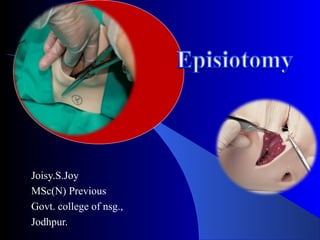
Joisy.S.Joy
MSc(N) Previous
Govt. college of nsg.,
Jodhpur.
DefinitionDefinition
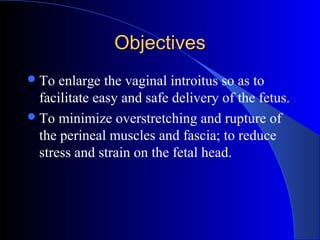
An episiotomy is the surgical incision on the
perineum and the posterior vaginal wall made
to enlarge the vaginal opening for delivery of
the fetal presenting part during the second
stage of labor.
ObjectivesObjectives
To enlarge the vaginal introitus so as to
facilitate easy and safe delivery of the fetus.
To minimize overstretching and rupture of
the perineal muscles and fascia; to reduce
stress and strain on the fetal head.
IndicationsIndications
Inelastic perineum causing delay in descent
of the presenting part.
Anticipating perineal tear in cases such as
big baby, face to pubis delivery, breech
delivery and shoulder dystocia.
Operative delivery such as forceps delivery,
ventouse delivery.
Previous perineal surgery such as pelvic
floor repair, perineal reconstructive surgery.
Timing of the episiotomyTiming of the episiotomy
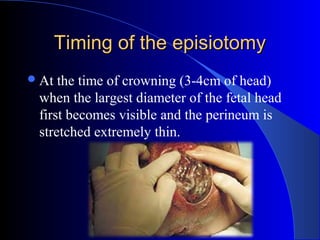
At the time of crowning (3-4cm of head)
when the largest diameter of the fetal head
first becomes visible and the perineum is
stretched extremely thin.
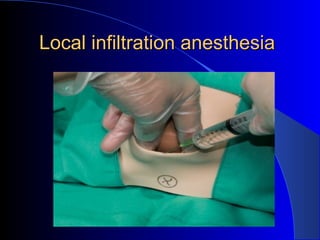
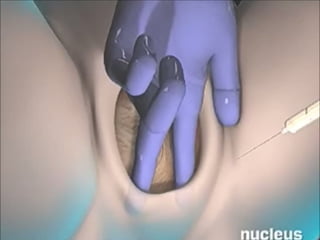
Local infiltration anesthesiaLocal infiltration anesthesia
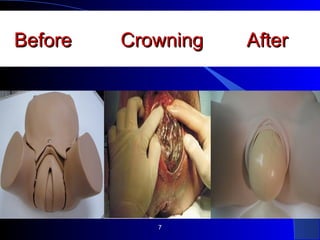
Before Crowning AfterBefore Crowning After
7
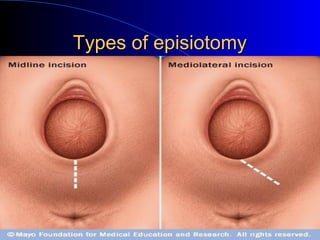
Types of episiotomyTypes of episiotomy
1. Medio-lateral
2. Median
3. Lateral
4. ‘J’ shaped
Types of episiotomyTypes of episiotomy
Steps of medio-lateralSteps of medio-lateral
episiotomyepisiotomy
The perineum is thoroughly swabbed with
antiseptic (povidone-iodine) lotion and
drapped properly.
Local anesthesia with 10ml of 1% solution
of lignocaine is injected at the incision site.
Two fingers are placed in the vagina
between the presenting part and the
posterior vaginal wall.
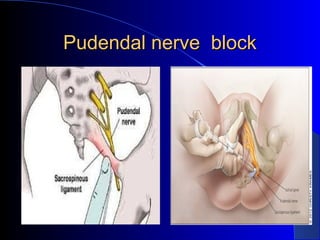
Pudendal nerve blockPudendal nerve block
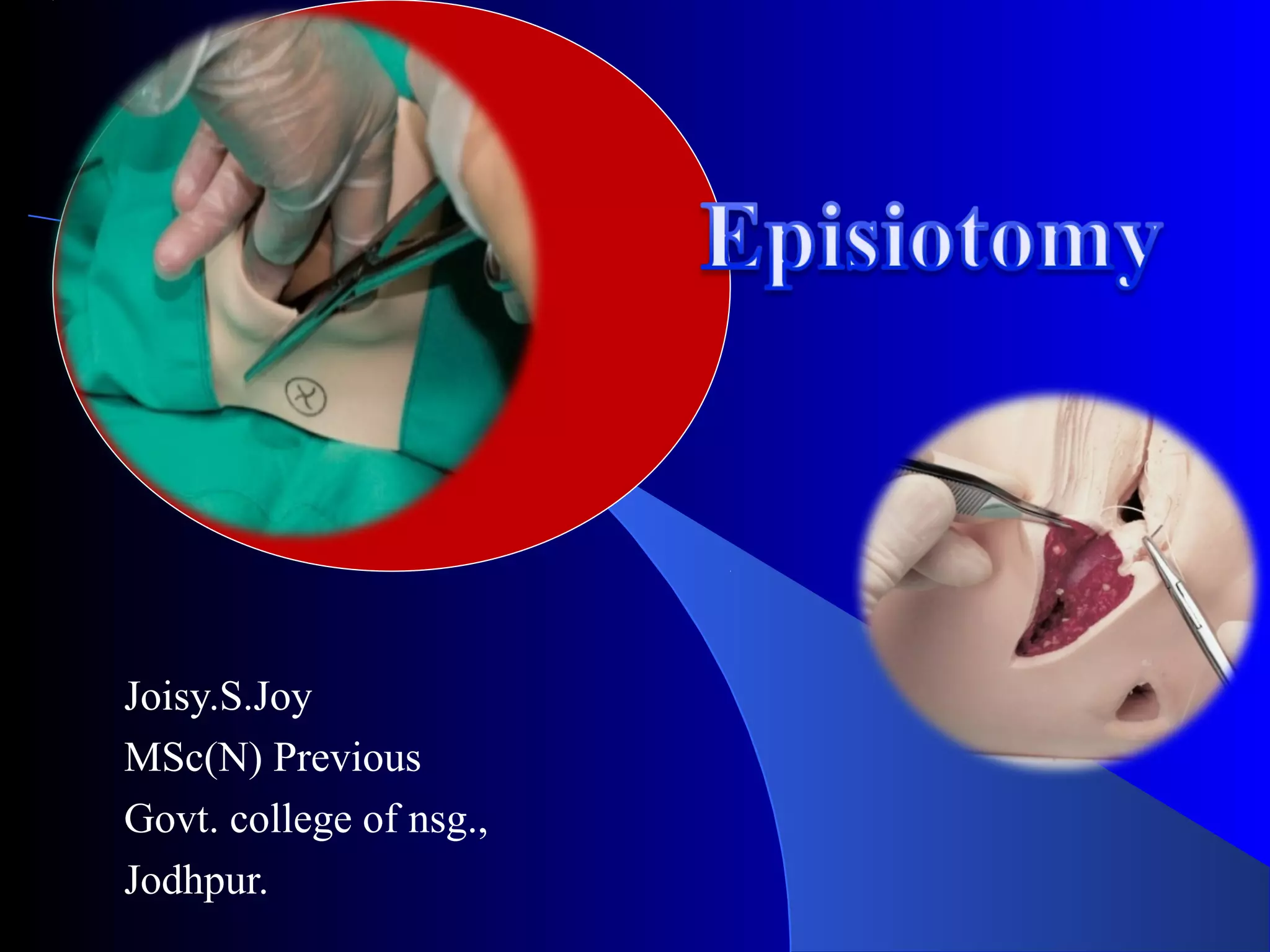
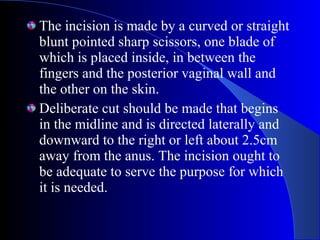
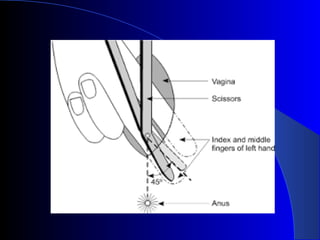
The incision is made by a curved or straight
blunt pointed sharp scissors, one blade of
which is placed inside, in between the
fingers and the posterior vaginal wall and
the other on the skin.
Deliberate cut should be made that begins
in the midline and is directed laterally and
downward to the right or left about 2.5cm
away from the anus. The incision ought to
be adequate to serve the purpose for which
it is needed.
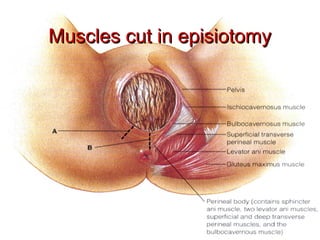
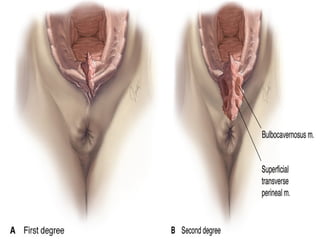
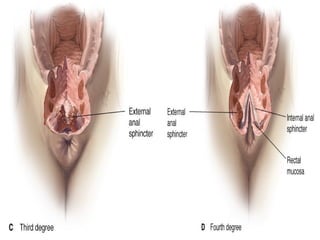
Muscles cut in episiotomyMuscles cut in episiotomy
Delivery of the head should follow
immediately and its advance must be
controlled in order to avoid extension of the
episiotomy.
N.B: If there is delay before the head
emerges, pressure should be applied to the
episiotomy site between contractions in
order to minimize bleeding.
Repair of episiotomyRepair of episiotomy
The trolley with appropriate instruments,
antiseptic solution and suture materials (No.
‘0’ chromic catgut) should be ready.
The mother is placed in lithotomy position.
The perineum is cleaned with antiseptic
solution and draped properly. Repair should
be under strict aseptic precautions.
If the repair field is obscured by oozing of
blood from above, a vaginal pack may be
inserted and is placed high up.
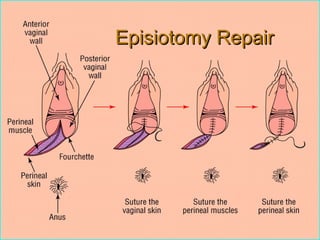
The apex of the vaginal incision is
identified and the posterior vaginal wall is
repaired from the apex downwards using
continuous suturing.
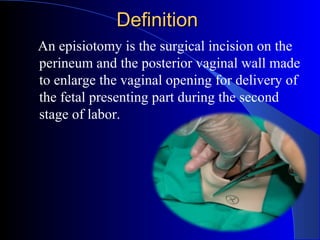
The deeper interrupted sutures are then
inserted to repair the perineal muscles.
Skin closure is done next with interrupted
transcutaneous suturing.
Episiotomy RepairEpisiotomy Repair
The sutured areas should be inspected in
order to confirm haemostasis before
removing the vaginal pack.
A vaginal examination is made to ensure
that the introitus has not been narrowed.
The area is cleaned and a sterile vaginal pad
positioned over the vulva and perineum.
The mother’s legs are then gently and
simultaneously removed from lithotomy
support and she is made comfortable.
When the wound is sutured by catgut or
dexon which will be absorbed, the sutures
need not be removed. Earlier non-
absorbable suture material (silk or nylon)
were used, in such case the stitches were to
be removed on the 6th
day.
ComplicationsComplications
Extension to involve the rectum
Vulval haematoma
Infection
Wound dehiscence
Vesicovaginal fistula
Dyspareunia
Post-operative carePost-operative care
 Care of the vulva after delivery includes
applying ice packs or magnesium sulphate
compress to the perineum for the first 24
hours to help decrease oedema and pain.
Analgesic drugs may be given when
required.
 The wound is to be kept clean and dry. The
dressing is done by swabbing with cotton
swabs soaked in antiseptic solution
followed by application of antiseptic
powder or ointment (Neosporin).
 From the 1st
postpartum day, assess the
episiotomy and perineum every shift. The
REEDA (redness, edema, ecchymosis,
discharge and approximation) scoring scale
can be used when assessing the episiotomy.
 After the first 24 hours of delivery, a sitz
bath with warm water may be used to
reduce the local discomfort.
 Daily washing with warm water and mild
soap to be encouraged.
 The mother is allowed to move out of the bed after
24 hours. Prior to that, she is allowed to roll over
on to her side or even to sit but only with thighs
apposed.
 Mother should be taught to wipe the perineum
from front to back to avoid contamination from
the anal region.
 Explain/encourage practices such as changing the
perineal pad after each voiding and bowel
movement or at least four times a day, removing
the pad from front to back and hand washing to
decrease the risk of infection and promote wound
healing of episiotomy or repaired lacerations.
Epi ppt

Epi ppt

  • 1.
  • 2.
    DefinitionDefinition An episiotomy isthe surgical incision on the perineum and the posterior vaginal wall made to enlarge the vaginal opening for delivery of the fetal presenting part during the second stage of labor.
  • 3.
    ObjectivesObjectives To enlarge thevaginal introitus so as to facilitate easy and safe delivery of the fetus. To minimize overstretching and rupture of the perineal muscles and fascia; to reduce stress and strain on the fetal head.
  • 4.
    IndicationsIndications Inelastic perineum causingdelay in descent of the presenting part. Anticipating perineal tear in cases such as big baby, face to pubis delivery, breech delivery and shoulder dystocia. Operative delivery such as forceps delivery, ventouse delivery. Previous perineal surgery such as pelvic floor repair, perineal reconstructive surgery.
  • 5.
    Timing of theepisiotomyTiming of the episiotomy At the time of crowning (3-4cm of head) when the largest diameter of the fetal head first becomes visible and the perineum is stretched extremely thin.
  • 6.
    Local infiltration anesthesiaLocalinfiltration anesthesia
  • 7.
  • 8.
    Types of episiotomyTypesof episiotomy 1. Medio-lateral 2. Median 3. Lateral 4. ‘J’ shaped
  • 9.
  • 11.
    Steps of medio-lateralStepsof medio-lateral episiotomyepisiotomy The perineum is thoroughly swabbed with antiseptic (povidone-iodine) lotion and drapped properly. Local anesthesia with 10ml of 1% solution of lignocaine is injected at the incision site. Two fingers are placed in the vagina between the presenting part and the posterior vaginal wall.
  • 12.
  • 13.
    The incision ismade by a curved or straight blunt pointed sharp scissors, one blade of which is placed inside, in between the fingers and the posterior vaginal wall and the other on the skin. Deliberate cut should be made that begins in the midline and is directed laterally and downward to the right or left about 2.5cm away from the anus. The incision ought to be adequate to serve the purpose for which it is needed.
  • 15.
    Muscles cut inepisiotomyMuscles cut in episiotomy
  • 16.
    Delivery of thehead should follow immediately and its advance must be controlled in order to avoid extension of the episiotomy. N.B: If there is delay before the head emerges, pressure should be applied to the episiotomy site between contractions in order to minimize bleeding.
  • 17.
    Repair of episiotomyRepairof episiotomy The trolley with appropriate instruments, antiseptic solution and suture materials (No. ‘0’ chromic catgut) should be ready. The mother is placed in lithotomy position. The perineum is cleaned with antiseptic solution and draped properly. Repair should be under strict aseptic precautions.
  • 18.
    If the repairfield is obscured by oozing of blood from above, a vaginal pack may be inserted and is placed high up. The apex of the vaginal incision is identified and the posterior vaginal wall is repaired from the apex downwards using continuous suturing. The deeper interrupted sutures are then inserted to repair the perineal muscles. Skin closure is done next with interrupted transcutaneous suturing.
  • 19.
  • 20.
    The sutured areasshould be inspected in order to confirm haemostasis before removing the vaginal pack. A vaginal examination is made to ensure that the introitus has not been narrowed. The area is cleaned and a sterile vaginal pad positioned over the vulva and perineum. The mother’s legs are then gently and simultaneously removed from lithotomy support and she is made comfortable.
  • 21.
    When the woundis sutured by catgut or dexon which will be absorbed, the sutures need not be removed. Earlier non- absorbable suture material (silk or nylon) were used, in such case the stitches were to be removed on the 6th day.
  • 22.
    ComplicationsComplications Extension to involvethe rectum Vulval haematoma Infection Wound dehiscence Vesicovaginal fistula Dyspareunia
  • 26.
    Post-operative carePost-operative care Care of the vulva after delivery includes applying ice packs or magnesium sulphate compress to the perineum for the first 24 hours to help decrease oedema and pain. Analgesic drugs may be given when required.  The wound is to be kept clean and dry. The dressing is done by swabbing with cotton swabs soaked in antiseptic solution followed by application of antiseptic powder or ointment (Neosporin).
  • 28.
     From the1st postpartum day, assess the episiotomy and perineum every shift. The REEDA (redness, edema, ecchymosis, discharge and approximation) scoring scale can be used when assessing the episiotomy.  After the first 24 hours of delivery, a sitz bath with warm water may be used to reduce the local discomfort.  Daily washing with warm water and mild soap to be encouraged.
  • 29.
     The motheris allowed to move out of the bed after 24 hours. Prior to that, she is allowed to roll over on to her side or even to sit but only with thighs apposed.  Mother should be taught to wipe the perineum from front to back to avoid contamination from the anal region.  Explain/encourage practices such as changing the perineal pad after each voiding and bowel movement or at least four times a day, removing the pad from front to back and hand washing to decrease the risk of infection and promote wound healing of episiotomy or repaired lacerations.

Editor's Notes

  • #20 Whether its midline or lateral repair is the same