Epilepsy
1
Seizures
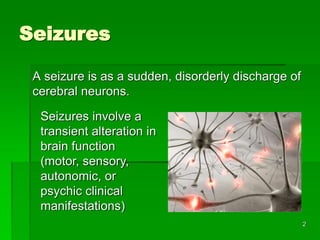
A seizure is as a sudden, disorderly discharge of
cerebral neurons.
Seizures involve a
transient alteration in
brain function
(motor, sensory,
autonomic, or
psychic clinical
manifestations)
2
Definition
 A chronic neurologic disorder manifesting by
repeated epileptic seizures (attacks or fits) which
result from uncontrolled discharges of neurons
within the central nervous system
 The clinical manifestations range from a major motor
convulsion to a brief period of lack of awareness.
The uncontrollable nature of the attacks is
characteristic of epilepsy.
3
Epidemiology and
course
 5% of the population suffer a single sz at some
time
 0.5-1% of the population have recurrent sz =
EPILEPSY
 70% = well controlled with drugs (prolonged
remissions)
 30% epilepsy at least partially resistant to drug
treatments
4
Types of Seizures
 Seizures can be classified as either partial or
generalized
 The type of seizure as well as the signs and
symptoms that accompany the seizure depend on the
part of the brain in which the seizures occur
5
Types of Seizures - Partial
 Partial Seizures are seizures that begin locally (in
one part of the brain)
i. Simple Partial seizure (consciousness not
impaired)
ii. Complex partial seizure (consciousness
impaired)
iii. Secondary generalized seizure (begins as
partial and transitions into a generalized
seizure)
6
Types of Seizures - Generalized
 Generalized seizures are bilaterally symmetric; there is
no local onset and although they involve the entire
brain, physical control is rarely lost.
 Types of GS include:
i. Absence seizures (petit mal)- staring, slight body
movement and short periods of unawareness
ii. Myoclonic seizures- sudden jerks of arms and
legs
iii. Atonic seizures (drop attacks)- suddenly
collapse or fall down
iv. Tonic-clonic seizures (grand mal)- most severe
type of seizure; characterized by loss of
consciousness, body stiffening, shaking and
sometimes tongue biting 7
Partial and Generalized
Partial Seizure with Secondary
Generalization
Primary
Generalized
Seizure
Partial Seizure
8
Etiology - Epilepsy
 Metabolic defects
 Congenital malformation
 Genetic predisposition
 Perinatal injury
 Postnatal trauma
 Myoclonic syndromes
 Infection
 Brain tumor
 Vascular disease
 Fever
 Drug and/or alcohol abuse
9
Pathogenesis
A seizure occurs when a burst of
electrical impulses in the brain
escape their normal limits (past
threshold).
They spread to neighboring areas
and create an uncontrolled storm of
cortical nerve cell electrical activity.
The electrical impulses can be
transmitted to the muscles, causing
twitches or convulsions.
10
Pathogenesis
 The 19th century neurologist Hughlings Jackson
suggested “a sudden excessive disorderly
discharge of cerebral neurons“ as the causation
of epileptic seizures.
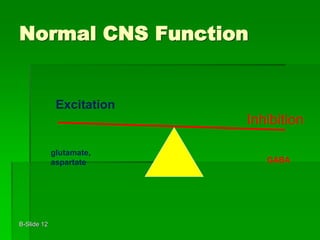
 Recent studies in animal models suggest a central
role for the excitatory neurotransmiter glutamate
and inhibitory gamma amino butyric acid (GABA)
(decreased)
11
B-Slide 12
Normal CNS Function
Excitation
Inhibition
glutamate,
aspartate GABA
B-Slide 13
Hyperexcitability reflects both
increased excitation and
decreased inhibition
Excitation
Inhibition
GABA
glutamate,
aspartate
Diagnosis
 EEGs can be used to confirm diagnosis and determine
type of seizure
 An MRI may be ordered if the initial medications pt. is on
fail to control seizures or a CT scan if pt. is an older
adult
 Plasma levels of electrolytes, glucose and calcium
levels, renal function tests, liver function tests and even
drug screening may be performed
Diagnostic tests include:
14
Diagnosis
 If the pt. has already been diagnosed with epilepsy:
anti-epileptic drug (AED) levels may be tested to ensure
that the dosage levels are accurate
 An ECG can exclude cardiac cause of symptoms or
seizure CSF may be tested for infection
15
Treatment
Current treatment methods can control seizures for
approximately 66% of people with epilepsy.
Treatments include:
Anti-epileptic drugs are the most common form of
treatment
Brain surgery is performed if seizures originate in a
small, defined area in the temporal or frontal lobes, but is
not common otherwise due to added risk of damaging
vital brain functions
16
Diagnosis & Treatment cont.
 Vagus nerve stimulation- a vagus nerve stimulator
is implanted into the chest beneath the collarbone,
wraps around the vagus nerve and stimulates the
brain to inhibit seizures
 Children (and some adults) who don’t respond to
medicinal treatment have been prescribed a high-
fat, high-protein and low carbohydrate diet to
produce ketones, which allow the body to use fat
instead of glucose for energy. The exact
mechanism for why this works is unknown.
17
Epilepsy - Treatment
 The majority of pts respond to drug therapy
(anticonvulsants). In intractable cases surgery may be
necessary. The treatment target is seizure-freedom
and improvement in quality of life!
 The commonest drugs used in clinical practice are:
Carbamazepine, Sodium valproate, Lamotrigine (first line drugs)
Levetiracetam, Topiramate, Pregabaline (second line drugs)
Zonisamide, Eslicarbazepine, Retigabine (new AEDs)
 Basic rules for drug treatment: Drug treatment should
be simple, preferably using one anticonvulsant
(monotherapy). “Start low, increase slow“.
Add-on therapy is necessary in some patients…
18
Witness Response
When you see someone having a seizure you should:
 Loosen their clothing
 Move surrounded objects that the seizing individual
could hurt him/herself on
 Stay until seizure ends to make sure the person is okay
and can get up
19

7523850.ppt

  • 1.
  • 2.
    Seizures A seizure isas a sudden, disorderly discharge of cerebral neurons. Seizures involve a transient alteration in brain function (motor, sensory, autonomic, or psychic clinical manifestations) 2
  • 3.
    Definition  A chronicneurologic disorder manifesting by repeated epileptic seizures (attacks or fits) which result from uncontrolled discharges of neurons within the central nervous system  The clinical manifestations range from a major motor convulsion to a brief period of lack of awareness. The uncontrollable nature of the attacks is characteristic of epilepsy. 3
  • 4.
    Epidemiology and course  5%of the population suffer a single sz at some time  0.5-1% of the population have recurrent sz = EPILEPSY  70% = well controlled with drugs (prolonged remissions)  30% epilepsy at least partially resistant to drug treatments 4
  • 5.
    Types of Seizures Seizures can be classified as either partial or generalized  The type of seizure as well as the signs and symptoms that accompany the seizure depend on the part of the brain in which the seizures occur 5
  • 6.
    Types of Seizures- Partial  Partial Seizures are seizures that begin locally (in one part of the brain) i. Simple Partial seizure (consciousness not impaired) ii. Complex partial seizure (consciousness impaired) iii. Secondary generalized seizure (begins as partial and transitions into a generalized seizure) 6
  • 7.
    Types of Seizures- Generalized  Generalized seizures are bilaterally symmetric; there is no local onset and although they involve the entire brain, physical control is rarely lost.  Types of GS include: i. Absence seizures (petit mal)- staring, slight body movement and short periods of unawareness ii. Myoclonic seizures- sudden jerks of arms and legs iii. Atonic seizures (drop attacks)- suddenly collapse or fall down iv. Tonic-clonic seizures (grand mal)- most severe type of seizure; characterized by loss of consciousness, body stiffening, shaking and sometimes tongue biting 7
  • 8.
    Partial and Generalized PartialSeizure with Secondary Generalization Primary Generalized Seizure Partial Seizure 8
  • 9.
    Etiology - Epilepsy Metabolic defects  Congenital malformation  Genetic predisposition  Perinatal injury  Postnatal trauma  Myoclonic syndromes  Infection  Brain tumor  Vascular disease  Fever  Drug and/or alcohol abuse 9
  • 10.
    Pathogenesis A seizure occurswhen a burst of electrical impulses in the brain escape their normal limits (past threshold). They spread to neighboring areas and create an uncontrolled storm of cortical nerve cell electrical activity. The electrical impulses can be transmitted to the muscles, causing twitches or convulsions. 10
  • 11.
    Pathogenesis  The 19thcentury neurologist Hughlings Jackson suggested “a sudden excessive disorderly discharge of cerebral neurons“ as the causation of epileptic seizures.  Recent studies in animal models suggest a central role for the excitatory neurotransmiter glutamate and inhibitory gamma amino butyric acid (GABA) (decreased) 11
  • 12.
    B-Slide 12 Normal CNSFunction Excitation Inhibition glutamate, aspartate GABA
  • 13.
    B-Slide 13 Hyperexcitability reflectsboth increased excitation and decreased inhibition Excitation Inhibition GABA glutamate, aspartate
  • 14.
    Diagnosis  EEGs canbe used to confirm diagnosis and determine type of seizure  An MRI may be ordered if the initial medications pt. is on fail to control seizures or a CT scan if pt. is an older adult  Plasma levels of electrolytes, glucose and calcium levels, renal function tests, liver function tests and even drug screening may be performed Diagnostic tests include: 14
  • 15.
    Diagnosis  If thept. has already been diagnosed with epilepsy: anti-epileptic drug (AED) levels may be tested to ensure that the dosage levels are accurate  An ECG can exclude cardiac cause of symptoms or seizure CSF may be tested for infection 15
  • 16.
    Treatment Current treatment methodscan control seizures for approximately 66% of people with epilepsy. Treatments include: Anti-epileptic drugs are the most common form of treatment Brain surgery is performed if seizures originate in a small, defined area in the temporal or frontal lobes, but is not common otherwise due to added risk of damaging vital brain functions 16
  • 17.
    Diagnosis & Treatmentcont.  Vagus nerve stimulation- a vagus nerve stimulator is implanted into the chest beneath the collarbone, wraps around the vagus nerve and stimulates the brain to inhibit seizures  Children (and some adults) who don’t respond to medicinal treatment have been prescribed a high- fat, high-protein and low carbohydrate diet to produce ketones, which allow the body to use fat instead of glucose for energy. The exact mechanism for why this works is unknown. 17
  • 18.
    Epilepsy - Treatment The majority of pts respond to drug therapy (anticonvulsants). In intractable cases surgery may be necessary. The treatment target is seizure-freedom and improvement in quality of life!  The commonest drugs used in clinical practice are: Carbamazepine, Sodium valproate, Lamotrigine (first line drugs) Levetiracetam, Topiramate, Pregabaline (second line drugs) Zonisamide, Eslicarbazepine, Retigabine (new AEDs)  Basic rules for drug treatment: Drug treatment should be simple, preferably using one anticonvulsant (monotherapy). “Start low, increase slow“. Add-on therapy is necessary in some patients… 18
  • 19.
    Witness Response When yousee someone having a seizure you should:  Loosen their clothing  Move surrounded objects that the seizing individual could hurt him/herself on  Stay until seizure ends to make sure the person is okay and can get up 19