STAFF INSPECTION UNIT , BAJAJ
COMMITTEE, & HIGH POWER
COMMITTEE
Presented by-
Sudipta Paul
MSC.NURSING 3rd sem.
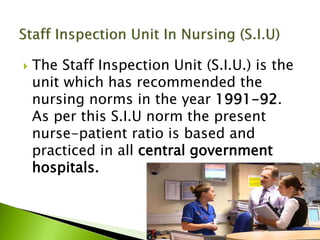
 The Staff Inspection Unit (S.I.U.) is the
unit which has recommended the
nursing norms in the year 1991-92.
As per this S.I.U norm the present
nurse-patient ratio is based and
practiced in all central government
hospitals.
 1. The norms for providing staff
nurses & nursing sisters in
Government hospital is given in
annexure to this report. The norm has
been put forward taking into
consideration the workload projected
in the wards and the other areas of
the hospital.
 2. The posts of nursing sisters and
staff nurses have been clubbed
together for calculating the staff
entitlement for performing nursing
care work which the staff nurse will
continue to perform even after she is
promoted to the existing scale of
nursing sister.
 3. Out of the entitlement worked out
on the basis of the norms, 30% Posts
may be sanctioned as nursing sister.
This would further improve the
existing ratio of 1 nursing sister to 3.6
Staff nurses fixed by the government
in settlement with the Delhi nurse
union in May 1990.
 4. The assistant nursing
superintendent are recommended in
the ratio of 1 ANS to every 4.5 nursing
sisters. The ANS will perform the duty
presently performed by nursing sisters
and perform duty in shift also.
 5. The posts of Deputy Nursing
Superintendent may continue at the level of
1 DNS per every 7.5 ANS.
 6. There will be a post of Nursing
Superintendent for every hospital having
250 or beds.
 7. There will be a post of 1 Chief Nursing
Officer for every hospital having 500 or
more beds.
 8. It is recommended that 45% posts
added for the area of 365 days
working including 10% leave reserve.
 As per recommendations of Staff Inspection Unit
(S.I.U), Department of Expenditure, 1992, Staffing
norms for the nurses working in central
government hospitals;
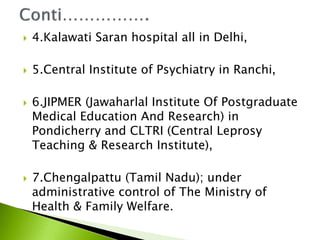
Seven hospitals are:
 1.Safdarjung hospital,
 2.Dr. Ram Manohar Lohia hospital,
 3. Smt. Sucheta Kriplani hospital,
 4.Kalawati Saran hospital all in Delhi,
 5.Central Institute of Psychiatry in Ranchi,
 6.JIPMER (Jawaharlal Institute Of Postgraduate
Medical Education And Research) in
Pondicherry and CLTRI (Central Leprosy
Teaching & Research Institute),
 7.Chengalpattu (Tamil Nadu); under
administrative control of The Ministry of
Health & Family Welfare.
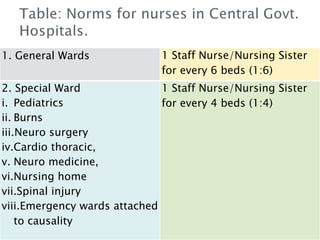
1. General Wards 1 Staff Nurse/Nursing Sister
for every 6 beds (1:6)
2. Special Ward
i. Pediatrics
ii. Burns
iii.Neuro surgery
iv.Cardio thoracic,
v. Neuro medicine,
vi.Nursing home
vii.Spinal injury
viii.Emergency wards attached
to causality
1 Staff Nurse/Nursing Sister
for every 4 beds (1:4)
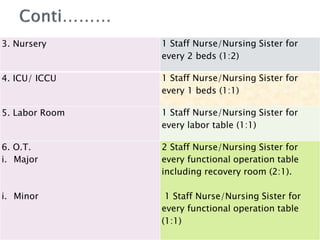
3. Nursery 1 Staff Nurse/Nursing Sister for
every 2 beds (1:2)
4. ICU/ ICCU 1 Staff Nurse/Nursing Sister for
every 1 beds (1:1)
5. Labor Room 1 Staff Nurse/Nursing Sister for
every labor table (1:1)
6. O.T.
i. Major
i. Minor
2 Staff Nurse/Nursing Sister for
every functional operation table
including recovery room (2:1).
1 Staff Nurse/Nursing Sister for
every functional operation table
(1:1)
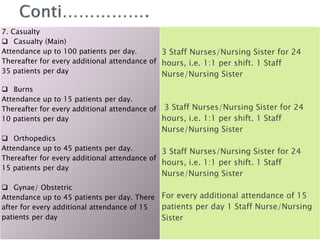
7. Casualty
 Casualty (Main)
Attendance up to 100 patients per day.
Thereafter for every additional attendance of
35 patients per day
 Burns
Attendance up to 15 patients per day.
Thereafter for every additional attendance of
10 patients per day
 Orthopedics
Attendance up to 45 patients per day.
Thereafter for every additional attendance of
15 patients per day
 Gynae/ Obstetric
Attendance up to 45 patients per day. There
after for every additional attendance of 15
patients per day
3 Staff Nurses/Nursing Sister for 24
hours, i.e. 1:1 per shift. 1 Staff
Nurse/Nursing Sister
3 Staff Nurses/Nursing Sister for 24
hours, i.e. 1:1 per shift. 1 Staff
Nurse/Nursing Sister
3 Staff Nurses/Nursing Sister for 24
hours, i.e. 1:1 per shift. 1 Staff
Nurse/Nursing Sister
For every additional attendance of 15
patients per day 1 Staff Nurse/Nursing
Sister
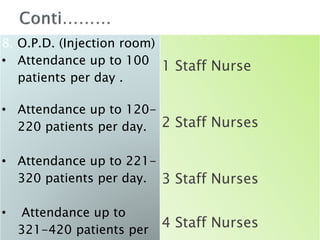
8. O.P.D. (Injection room)
• Attendance up to 100
patients per day .
• Attendance up to 120-
220 patients per day.
• Attendance up to 221-
320 patients per day.
• Attendance up to
321-420 patients per
1 Staff Nurse
2 Staff Nurses
3 Staff Nurses
4 Staff Nurses
 The Ministry of Health and Family Welfare,
Government of India, following the
adoption of the National Policy of
Education, 1986, which for the first time
took cognisance of the essential linkages
between health & education, set up a
committee on Health Manpower,
Planning, production & Management in
1986 under the Chairmanship of Prof.
J.S. Bajaj, Professor of Medicine, AIIMS,
New Delhi with major emphasis on the
creation of additional facilities for
Vocational Training.
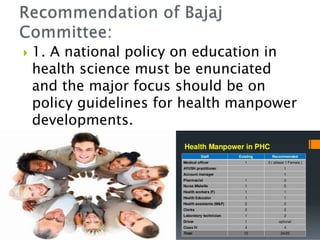
 1. A national policy on education in
health science must be enunciated
and the major focus should be on
policy guidelines for health manpower
developments.
 2. A realistic health manpower survey
should be carried out.
 3. The effective vocalization of health and
health related courses should be started
and technology should be improved.
 4. Establishment of an education
commission for health sciences
(ECHS) on the lines of UGC
(university Grants Commission of
India).
 5. Establishment of health science
universities in varies states and
union territories.
 6. Establishment of health
manpower cells at center and in the
states.
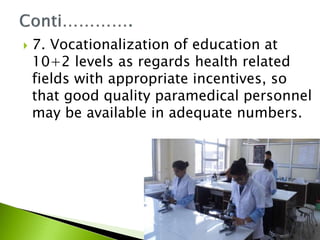
 7. Vocationalization of education at
10+2 levels as regards health related
fields with appropriate incentives, so
that good quality paramedical personnel
may be available in adequate numbers.
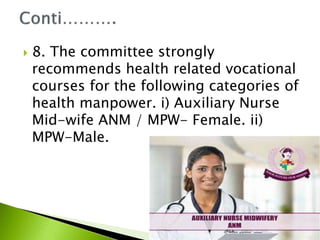
 8. The committee strongly
recommends health related vocational
courses for the following categories of
health manpower. i) Auxiliary Nurse
Mid-wife ANM / MPW- Female. ii)
MPW-Male.
 9. To prepare curriculum for school
teachers.
 10. To utilize the services of Indian
System of Medicine.
 11. Continuing education Programmed
for the health personnel.
 12. The essential educational
infrastructure to facilitate the
production of appropriate
categories of health manpower.
 13. Such modifications in the
education of health system which
would facilitate the establishment of
essential interlinkages between
health manpower, production,
deployment & utilisation.
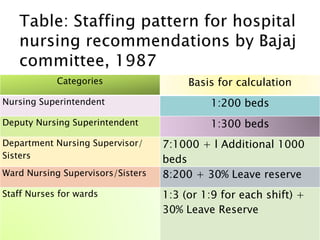
Categories Basis for calculation
Nursing Superintendent 1:200 beds
Deputy Nursing Superintendent 1:300 beds
Department Nursing Supervisor/
Sisters
7:1000 + l Additional 1000
beds
Ward Nursing Supervisors/Sisters 8:200 + 30% Leave reserve
Staff Nurses for wards 1:3 (or 1:9 for each shift) +
30% Leave Reserve
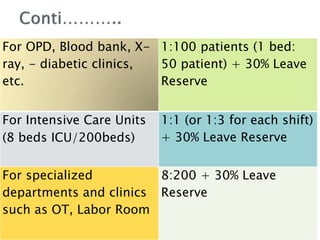
For OPD, Blood bank, X-
ray, - diabetic clinics,
etc.
1:100 patients (1 bed:
50 patient) + 30% Leave
Reserve
For Intensive Care Units
(8 beds ICU/200beds)
1:1 (or 1:3 for each shift)
+ 30% Leave Reserve
For specialized
departments and clinics
such as OT, Labor Room
8:200 + 30% Leave
Reserve
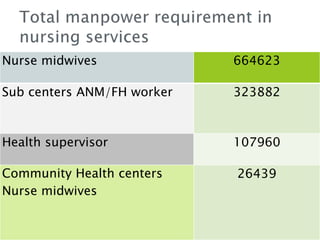
Nurse midwives 664623
Sub centers ANM/FH worker 323882
Health supervisor 107960
Community Health centers
Nurse midwives
26439
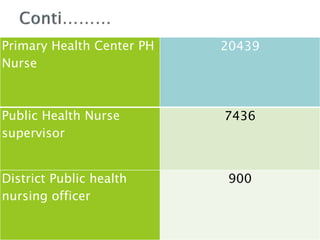
Primary Health Center PH
Nurse
20439
Public Health Nurse
supervisor
7436
District Public health
nursing officer
900
A high power committee was appointed by
the government of India, Ministry of health
& family welfare in July 1987 to review the
roles, functions, status, preparation of the
nursing personnel, nursing services & other
issues related to the development of the
profession & to make suitable
recommendations to the government. The
committee report was released at the end of
March, 1990.
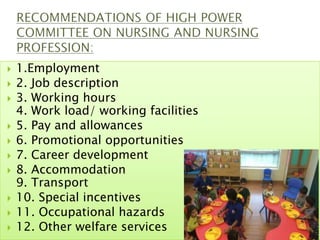
 1.Employment
 2. Job description
 3. Working hours
4. Work load/ working facilities
 5. Pay and allowances
 6. Promotional opportunities
 7. Career development
 8. Accommodation
9. Transport
 10. Special incentives
 11. Occupational hazards
 12. Other welfare services
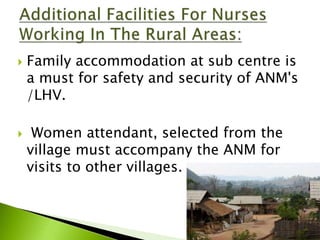
 Family accommodation at sub centre is
a must for safety and security of ANM's
/LHV.
 Women attendant, selected from the
village must accompany the ANM for
visits to other villages.
 The district public health nurse is
provided with a vehicle for field
supervision.
Fixed travel allowance with provision
of enhancement from time to time.
Rural allowance as granted to other
employees is paid to nursing
personnel.
1. The committee recommends that:
There should be 2 levels of nursing
personnel –
A. Professional nurse (degree level) and
B. Auxiliary nurse (vocational nurse).

 Definite policies of deputing 5-10% of
staff for higher studies are made by
each state.
 Provision for training reserve is made
in each institution.
 Deputation for higher study is made
compulsory after 5 yrs.
 Each nursing personnel must attend 1
or 2 refresher course every year.
 Necessary budgetary provision be
made, A National Institute for Nursing
Education Research and Training
needs to be established like NCERT,
for development of educational
technology, preparation of textbooks,
media, / manuals for nursing.

1. Nursing Supdt. -1: 200 beds
(hospitals with 200 or more beds).

2. Dy. Nsg. Supdt. - 1: 300 beds
(wherever beds are over 200)

3. Asst. Nsg . Supdt - 1: 100
 4. Ward sister/ward supervisor - 1:25
beds 30% leave reserve
 5. Staff nurse for wards -1:3 ( or 1:9
for each shift ) 30% leave reserve
 6. For nurses OPD and emergency etc
- 1: 100 patients ( 1 bed : 5 out
patients) 30% leave reserve
 7. For ICU -1:1(or 1:3 for each shift)
30% leave reserve
 For specialised depts. such as
operation theatre, labour room etc- 1:
25. 30% leave reserve.
1 ANM for 2500 population ( 2 per
sub centre)
1 ANM for 1500 population for hilly
areas.
1 health supervisor for 7500
population( for supervision of 3
ANM's).
1 public health nurse for 1 PHC
(30000 population to supervise 4
Health Supervisors )
 1 Public Health Nursing Officer for
100000 population ( community
health centre)
 1 Nurse Teacher to 10 students for
post graduate programmes.
Staff Inspection Unit.

Staff Inspection Unit.

  • 1.
    STAFF INSPECTION UNIT, BAJAJ COMMITTEE, & HIGH POWER COMMITTEE Presented by- Sudipta Paul MSC.NURSING 3rd sem.
  • 3.
     The StaffInspection Unit (S.I.U.) is the unit which has recommended the nursing norms in the year 1991-92. As per this S.I.U norm the present nurse-patient ratio is based and practiced in all central government hospitals.
  • 4.
     1. Thenorms for providing staff nurses & nursing sisters in Government hospital is given in annexure to this report. The norm has been put forward taking into consideration the workload projected in the wards and the other areas of the hospital.
  • 5.
     2. Theposts of nursing sisters and staff nurses have been clubbed together for calculating the staff entitlement for performing nursing care work which the staff nurse will continue to perform even after she is promoted to the existing scale of nursing sister.
  • 6.
     3. Outof the entitlement worked out on the basis of the norms, 30% Posts may be sanctioned as nursing sister. This would further improve the existing ratio of 1 nursing sister to 3.6 Staff nurses fixed by the government in settlement with the Delhi nurse union in May 1990.
  • 7.
     4. Theassistant nursing superintendent are recommended in the ratio of 1 ANS to every 4.5 nursing sisters. The ANS will perform the duty presently performed by nursing sisters and perform duty in shift also.
  • 8.
     5. Theposts of Deputy Nursing Superintendent may continue at the level of 1 DNS per every 7.5 ANS.  6. There will be a post of Nursing Superintendent for every hospital having 250 or beds.  7. There will be a post of 1 Chief Nursing Officer for every hospital having 500 or more beds.
  • 9.
     8. Itis recommended that 45% posts added for the area of 365 days working including 10% leave reserve.
  • 10.
     As perrecommendations of Staff Inspection Unit (S.I.U), Department of Expenditure, 1992, Staffing norms for the nurses working in central government hospitals; Seven hospitals are:  1.Safdarjung hospital,  2.Dr. Ram Manohar Lohia hospital,  3. Smt. Sucheta Kriplani hospital,
  • 11.
     4.Kalawati Saranhospital all in Delhi,  5.Central Institute of Psychiatry in Ranchi,  6.JIPMER (Jawaharlal Institute Of Postgraduate Medical Education And Research) in Pondicherry and CLTRI (Central Leprosy Teaching & Research Institute),  7.Chengalpattu (Tamil Nadu); under administrative control of The Ministry of Health & Family Welfare.
  • 12.
    1. General Wards1 Staff Nurse/Nursing Sister for every 6 beds (1:6) 2. Special Ward i. Pediatrics ii. Burns iii.Neuro surgery iv.Cardio thoracic, v. Neuro medicine, vi.Nursing home vii.Spinal injury viii.Emergency wards attached to causality 1 Staff Nurse/Nursing Sister for every 4 beds (1:4)
  • 13.
    3. Nursery 1Staff Nurse/Nursing Sister for every 2 beds (1:2) 4. ICU/ ICCU 1 Staff Nurse/Nursing Sister for every 1 beds (1:1) 5. Labor Room 1 Staff Nurse/Nursing Sister for every labor table (1:1) 6. O.T. i. Major i. Minor 2 Staff Nurse/Nursing Sister for every functional operation table including recovery room (2:1). 1 Staff Nurse/Nursing Sister for every functional operation table (1:1)
  • 14.
    7. Casualty  Casualty(Main) Attendance up to 100 patients per day. Thereafter for every additional attendance of 35 patients per day  Burns Attendance up to 15 patients per day. Thereafter for every additional attendance of 10 patients per day  Orthopedics Attendance up to 45 patients per day. Thereafter for every additional attendance of 15 patients per day  Gynae/ Obstetric Attendance up to 45 patients per day. There after for every additional attendance of 15 patients per day 3 Staff Nurses/Nursing Sister for 24 hours, i.e. 1:1 per shift. 1 Staff Nurse/Nursing Sister 3 Staff Nurses/Nursing Sister for 24 hours, i.e. 1:1 per shift. 1 Staff Nurse/Nursing Sister 3 Staff Nurses/Nursing Sister for 24 hours, i.e. 1:1 per shift. 1 Staff Nurse/Nursing Sister For every additional attendance of 15 patients per day 1 Staff Nurse/Nursing Sister
  • 15.
    8. O.P.D. (Injectionroom) • Attendance up to 100 patients per day . • Attendance up to 120- 220 patients per day. • Attendance up to 221- 320 patients per day. • Attendance up to 321-420 patients per 1 Staff Nurse 2 Staff Nurses 3 Staff Nurses 4 Staff Nurses
  • 17.
     The Ministryof Health and Family Welfare, Government of India, following the adoption of the National Policy of Education, 1986, which for the first time took cognisance of the essential linkages between health & education, set up a committee on Health Manpower, Planning, production & Management in 1986 under the Chairmanship of Prof. J.S. Bajaj, Professor of Medicine, AIIMS, New Delhi with major emphasis on the creation of additional facilities for Vocational Training.
  • 18.
     1. Anational policy on education in health science must be enunciated and the major focus should be on policy guidelines for health manpower developments.
  • 19.
     2. Arealistic health manpower survey should be carried out.  3. The effective vocalization of health and health related courses should be started and technology should be improved.
  • 20.
     4. Establishmentof an education commission for health sciences (ECHS) on the lines of UGC (university Grants Commission of India).
  • 21.
     5. Establishmentof health science universities in varies states and union territories.  6. Establishment of health manpower cells at center and in the states.
  • 22.
     7. Vocationalizationof education at 10+2 levels as regards health related fields with appropriate incentives, so that good quality paramedical personnel may be available in adequate numbers.
  • 23.
     8. Thecommittee strongly recommends health related vocational courses for the following categories of health manpower. i) Auxiliary Nurse Mid-wife ANM / MPW- Female. ii) MPW-Male.
  • 24.
     9. Toprepare curriculum for school teachers.  10. To utilize the services of Indian System of Medicine.  11. Continuing education Programmed for the health personnel.
  • 25.
     12. Theessential educational infrastructure to facilitate the production of appropriate categories of health manpower.
  • 26.
     13. Suchmodifications in the education of health system which would facilitate the establishment of essential interlinkages between health manpower, production, deployment & utilisation.
  • 27.
    Categories Basis forcalculation Nursing Superintendent 1:200 beds Deputy Nursing Superintendent 1:300 beds Department Nursing Supervisor/ Sisters 7:1000 + l Additional 1000 beds Ward Nursing Supervisors/Sisters 8:200 + 30% Leave reserve Staff Nurses for wards 1:3 (or 1:9 for each shift) + 30% Leave Reserve
  • 28.
    For OPD, Bloodbank, X- ray, - diabetic clinics, etc. 1:100 patients (1 bed: 50 patient) + 30% Leave Reserve For Intensive Care Units (8 beds ICU/200beds) 1:1 (or 1:3 for each shift) + 30% Leave Reserve For specialized departments and clinics such as OT, Labor Room 8:200 + 30% Leave Reserve
  • 29.
    Nurse midwives 664623 Subcenters ANM/FH worker 323882 Health supervisor 107960 Community Health centers Nurse midwives 26439
  • 30.
    Primary Health CenterPH Nurse 20439 Public Health Nurse supervisor 7436 District Public health nursing officer 900
  • 32.
    A high powercommittee was appointed by the government of India, Ministry of health & family welfare in July 1987 to review the roles, functions, status, preparation of the nursing personnel, nursing services & other issues related to the development of the profession & to make suitable recommendations to the government. The committee report was released at the end of March, 1990.
  • 33.
     1.Employment  2.Job description  3. Working hours 4. Work load/ working facilities  5. Pay and allowances  6. Promotional opportunities  7. Career development  8. Accommodation 9. Transport  10. Special incentives  11. Occupational hazards  12. Other welfare services
  • 34.
     Family accommodationat sub centre is a must for safety and security of ANM's /LHV.  Women attendant, selected from the village must accompany the ANM for visits to other villages.
  • 35.
     The districtpublic health nurse is provided with a vehicle for field supervision. Fixed travel allowance with provision of enhancement from time to time. Rural allowance as granted to other employees is paid to nursing personnel.
  • 36.
    1. The committeerecommends that: There should be 2 levels of nursing personnel – A. Professional nurse (degree level) and B. Auxiliary nurse (vocational nurse). 
  • 37.
     Definite policiesof deputing 5-10% of staff for higher studies are made by each state.  Provision for training reserve is made in each institution.  Deputation for higher study is made compulsory after 5 yrs.
  • 38.
     Each nursingpersonnel must attend 1 or 2 refresher course every year.  Necessary budgetary provision be made, A National Institute for Nursing Education Research and Training needs to be established like NCERT, for development of educational technology, preparation of textbooks, media, / manuals for nursing.
  • 40.
     1. Nursing Supdt.-1: 200 beds (hospitals with 200 or more beds).  2. Dy. Nsg. Supdt. - 1: 300 beds (wherever beds are over 200)  3. Asst. Nsg . Supdt - 1: 100
  • 41.
     4. Wardsister/ward supervisor - 1:25 beds 30% leave reserve  5. Staff nurse for wards -1:3 ( or 1:9 for each shift ) 30% leave reserve  6. For nurses OPD and emergency etc - 1: 100 patients ( 1 bed : 5 out patients) 30% leave reserve
  • 42.
     7. ForICU -1:1(or 1:3 for each shift) 30% leave reserve  For specialised depts. such as operation theatre, labour room etc- 1: 25. 30% leave reserve.
  • 43.
    1 ANM for2500 population ( 2 per sub centre) 1 ANM for 1500 population for hilly areas. 1 health supervisor for 7500 population( for supervision of 3 ANM's). 1 public health nurse for 1 PHC (30000 population to supervise 4 Health Supervisors )
  • 44.
     1 PublicHealth Nursing Officer for 100000 population ( community health centre)  1 Nurse Teacher to 10 students for post graduate programmes.