P O W E R S TAT I O N P R A C T I C E
( E E 3 0 7 )
SUB-STATION DESIGN AND
AUTOMATION (UNIT 3)
INTRODUCTION
• The assembly of apparatus used to change some characteristic
(e.g. voltage, a.c. to d.c., frequency, p.f. etc.) of electric supply
is called a sub-station.
• Sub-stations are important part of power system. The
continuity of supply depends to a considerable extent upon the
successful operation of sub-stations. It is, therefore, essential
to exercise utmost care while designing and building a sub-
station.
INTRODUCTION
• The following are the important points which must be kept in view
while laying out a sub-station :
• (i) It should be located at a proper site. As far as possible, it should
be located at the centre of gravity of load.
• (ii) It should provide safe and reliable arrangement. For safety,
consideration must be given to the maintenance of regulation
clearances, facilities for carrying out repairs and maintenance,
abnormal occurrences such as possibility of explosion or fire etc.
For reliability, consideration must be given for good design and
construction, the provision of suitable protective gear etc.
• (iii) It should be easily operated and maintained.
• (iv) It should involve minimum capital cost
CLASSIFICATION OF SUB-STATIONS
• According to service requirement.:
• Transformer sub-stations
• Switching sub-stations.
• Power factor correction sub-stations.
• Frequency changer sub-stations
• Converting sub-stations
• Industrial sub-stations
CLASSIFICATION OF SUB-STATIONS
• According to constructional features.:
• Indoor sub-station
• Outdoor sub-station
• Underground sub-station
• Pole-mounted sub-station
COMPARISON BETWEEN OUTDOOR AND
INDOOR SUB-STATIONS
TRANSFORMER SUB-STATIONS
• (i) Step-up sub-station
• (ii) Primary grid sub-station
• (iii) Secondary sub-station
• (iv) Distribution sub-station
TRANSFORMER SUB-STATIONS
POLE-MOUNTED SUB-STATION
UNDERGROUND SUB-STATION
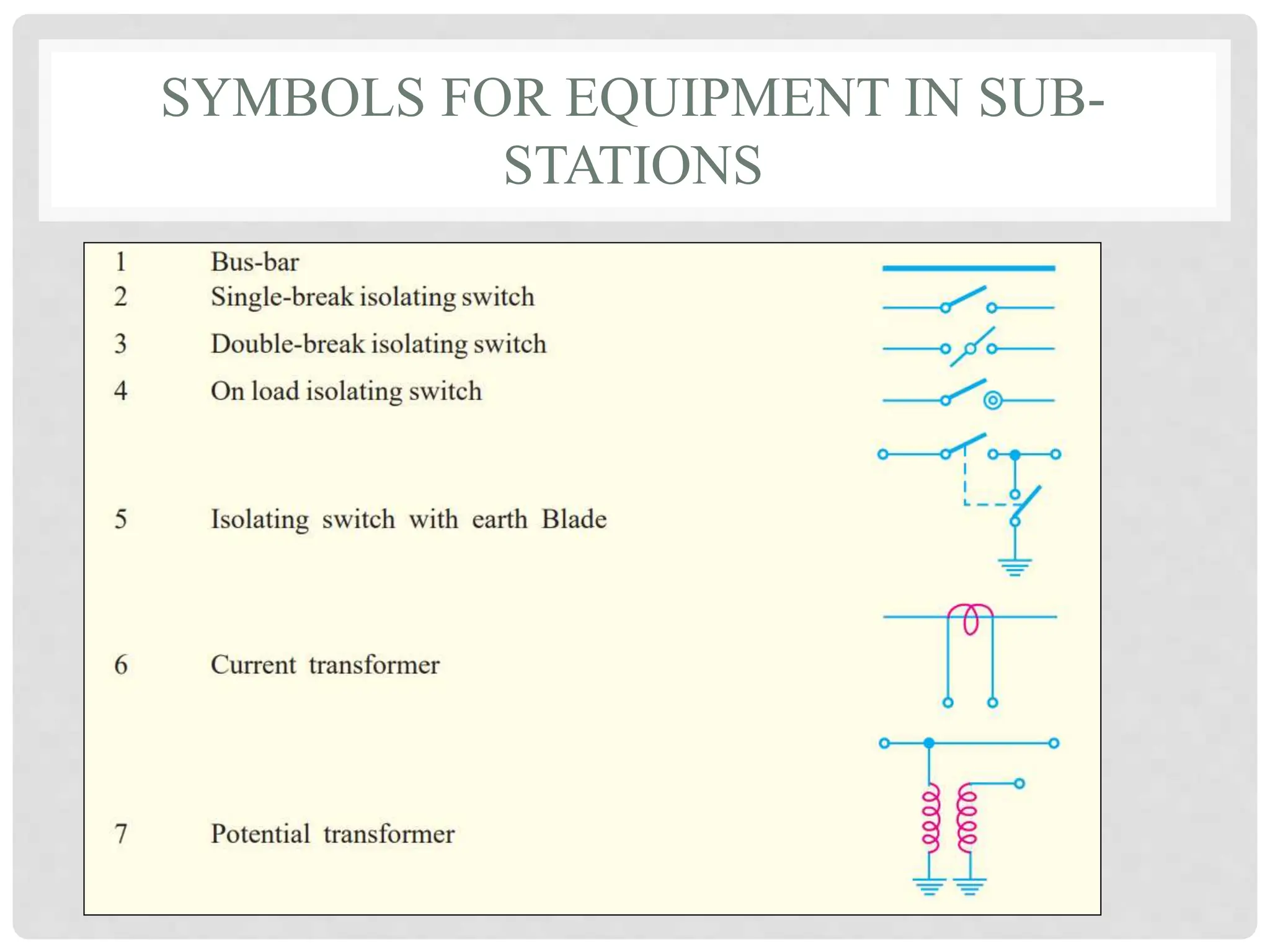
SYMBOLS FOR EQUIPMENT IN SUB-
STATIONS
SYMBOLS FOR EQUIPMENT IN SUB-
STATIONS
EQUIPMENT IN A TRANSFORMER SUB-
STATION
• Bus-bars
• Insulators
• Isolating switches
• Circuit breaker
• Power Transformers
• Instrument transformers
• Metering and Indicating Instruments
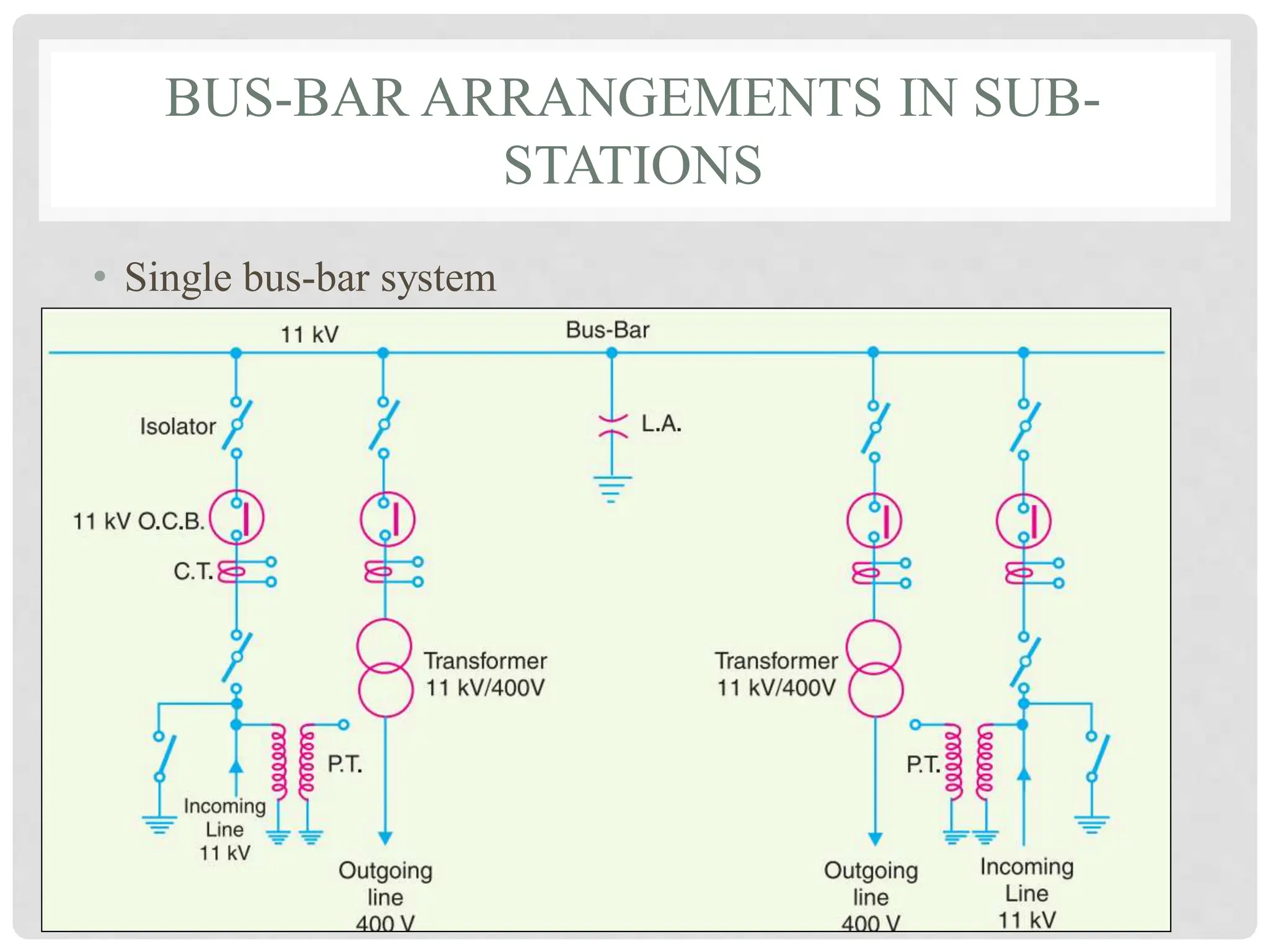
BUS-BAR ARRANGEMENTS IN SUB-
STATIONS
• Single bus-bar system
BUS-BAR ARRANGEMENTS IN SUB-
STATIONS
• Single bus-bar system with sectionalisation
BUS-BAR ARRANGEMENTS IN SUB-
STATIONS
• Duplicate bus-bar system.

Substation design and automation a detailed analysis

  • 1.
    P O WE R S TAT I O N P R A C T I C E ( E E 3 0 7 ) SUB-STATION DESIGN AND AUTOMATION (UNIT 3)
  • 2.
    INTRODUCTION • The assemblyof apparatus used to change some characteristic (e.g. voltage, a.c. to d.c., frequency, p.f. etc.) of electric supply is called a sub-station. • Sub-stations are important part of power system. The continuity of supply depends to a considerable extent upon the successful operation of sub-stations. It is, therefore, essential to exercise utmost care while designing and building a sub- station.
  • 3.
    INTRODUCTION • The followingare the important points which must be kept in view while laying out a sub-station : • (i) It should be located at a proper site. As far as possible, it should be located at the centre of gravity of load. • (ii) It should provide safe and reliable arrangement. For safety, consideration must be given to the maintenance of regulation clearances, facilities for carrying out repairs and maintenance, abnormal occurrences such as possibility of explosion or fire etc. For reliability, consideration must be given for good design and construction, the provision of suitable protective gear etc. • (iii) It should be easily operated and maintained. • (iv) It should involve minimum capital cost
  • 4.
    CLASSIFICATION OF SUB-STATIONS •According to service requirement.: • Transformer sub-stations • Switching sub-stations. • Power factor correction sub-stations. • Frequency changer sub-stations • Converting sub-stations • Industrial sub-stations
  • 5.
    CLASSIFICATION OF SUB-STATIONS •According to constructional features.: • Indoor sub-station • Outdoor sub-station • Underground sub-station • Pole-mounted sub-station
  • 6.
    COMPARISON BETWEEN OUTDOORAND INDOOR SUB-STATIONS
  • 7.
    TRANSFORMER SUB-STATIONS • (i)Step-up sub-station • (ii) Primary grid sub-station • (iii) Secondary sub-station • (iv) Distribution sub-station
  • 8.
  • 9.
  • 10.
  • 11.
    SYMBOLS FOR EQUIPMENTIN SUB- STATIONS
  • 12.
    SYMBOLS FOR EQUIPMENTIN SUB- STATIONS
  • 13.
    EQUIPMENT IN ATRANSFORMER SUB- STATION • Bus-bars • Insulators • Isolating switches • Circuit breaker • Power Transformers • Instrument transformers • Metering and Indicating Instruments
  • 14.
    BUS-BAR ARRANGEMENTS INSUB- STATIONS • Single bus-bar system
  • 15.
    BUS-BAR ARRANGEMENTS INSUB- STATIONS • Single bus-bar system with sectionalisation
  • 16.
    BUS-BAR ARRANGEMENTS INSUB- STATIONS • Duplicate bus-bar system.