Beyond Google...
Making the most of library
       resources
Learning Outcomes
1) Identify keywords to construct a basic search strategy

2) Awareness of reference sources to develop knowledge and
   vocabulary

3) Where to look for information and understand how different sources
   of information vary in their quality and purpose

4) Identify criteria for evaluating information

5) Understand what peer review is and how it relates to information
   quality

6) Construct a reference for a journal article
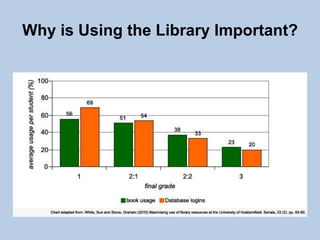
Why is Using the Library Important?
1) Analysing the Assignment Question

• Identify the keywords from your
  assignment question

• Expand your vocabulary and think of
  alternative key words and variations in
  spellings

• Link up your search terms to find the right
  information
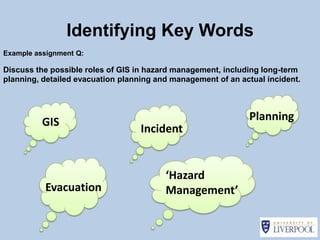
Identifying Key Words
Example assignment Q:

Discuss the possible roles of GIS in hazard management, including long-term
planning, detailed evacuation planning and management of an actual incident.


          GIS                                                 Planning
                                   Incident


                                         ‘Hazard
          Evacuation                     Management’
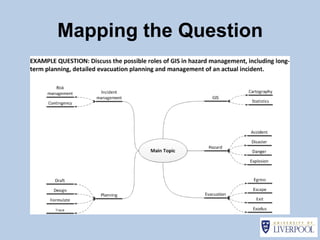
Mapping the Question
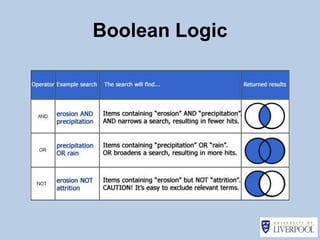
Boolean Logic
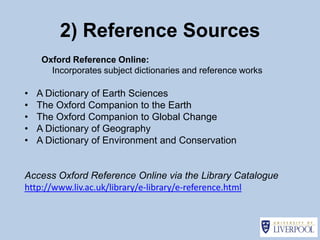
2) Reference Sources
     Oxford Reference Online:
       Incorporates subject dictionaries and reference works

•   A Dictionary of Earth Sciences
•   The Oxford Companion to the Earth
•   The Oxford Companion to Global Change
•   A Dictionary of Geography
•   A Dictionary of Environment and Conservation


Access Oxford Reference Online via the Library Catalogue
http://www.liv.ac.uk/library/e-library/e-reference.html
3) Where should you look for
information for your assignments?

Library catalogue should be your first
port of call when looking for resources:
  •   Books; print and electronic
  •   Journals; print and electronic
  •   Online databases
  •   Websites, blogs etc…
       
       
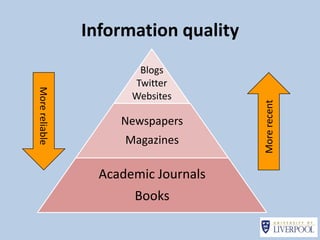
Information quality
                        Blogs
                       Twitter
More reliable


                       Websites


                                      More recent
                     Newspapers
                      Magazines

                  Academic Journals
                       Books
4) Evaluating your results
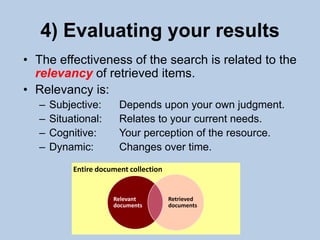
• The effectiveness of the search is related to the
  relevancy of retrieved items.
• Relevancy is:
  –   Subjective:       Depends upon your own judgment.
  –   Situational:      Relates to your current needs.
  –   Cognitive:        Your perception of the resource.
  –   Dynamic:          Changes over time.
           Entire document collection


                      Relevant          Retrieved
                      documents         documents


                                   11
Evaluating information
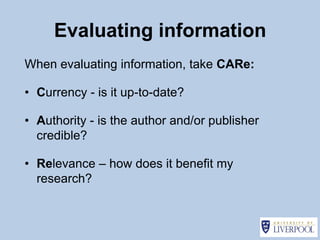
When evaluating information, take CARe:

• Currency - is it up-to-date?

• Authority - is the author and/or publisher
  credible?

• Relevance – how does it benefit my
  research?
Evaluating websites
• Anyone can publish material on the internet so there is no
  guarantee of its reliability

• Things to look for:
   •   Who produced the site? Are they credible?
   •   When was the site last updated?
   •   Does the look and feel of the site inspire confidence?
   •   Look at the web address – .com, .co.uk, .ac.uk, .org, etc.
   •   Is the site trying to sell something – a product or a point of
       view (bias)?

• Look at www.dhmo.org and consider the questions above
Recommended Websites
• Office for National Statistics
http://www.ons.gov.uk/ons/index.html

• Resource for Urban Design Information
http://www.rudi.net/

• Design Council
http://www.designcouncil.org.uk/

• Earth Trends
http://earthtrends.wri.org/
5) So, what are Journals?
Scholarly journal articles:
• are regular publications that contain articles on current
   research
• are written for and by academics
• report the latest research on a topic
• are peer reviewed or refereed (reviewed by academics before
   being accepted for publication)
• include a bibliography of references
• are often published by a professional or scholarly organization

Example:
d’Albergo (2010) ‘Urban Issues in Nation-State Agendas: A
Comparison in Western Europe’ Urban Research & Practice. 3 (2)
pp.138-158.
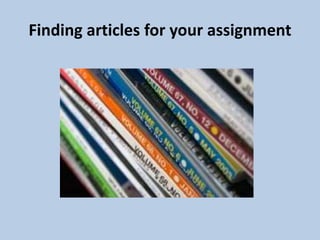
Finding articles for your assignment
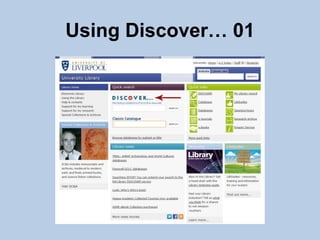
Using Discover… 01
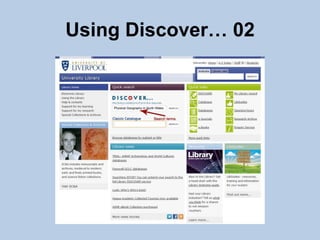
Using Discover… 02
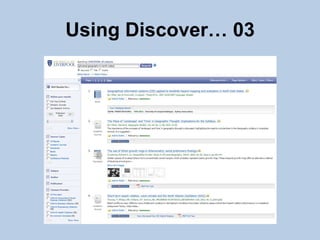
Using Discover… 03
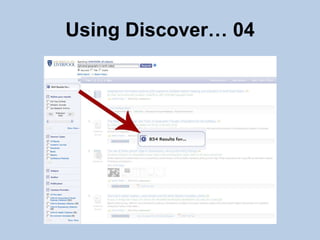
Using Discover… 04
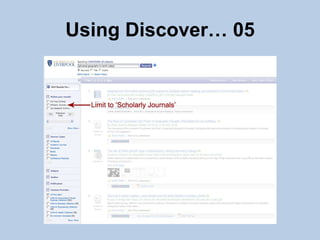
Using Discover… 05
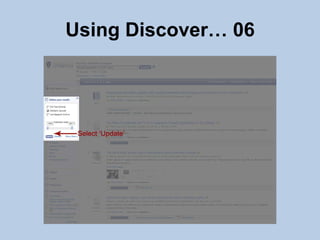
Using Discover… 06
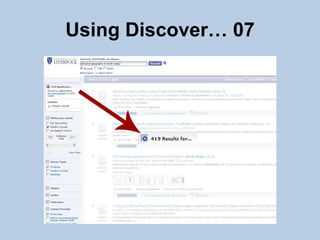
Using Discover… 07
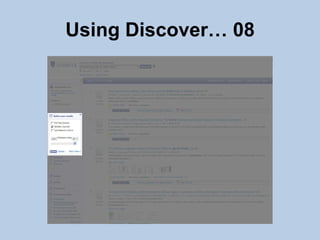
Using Discover… 08
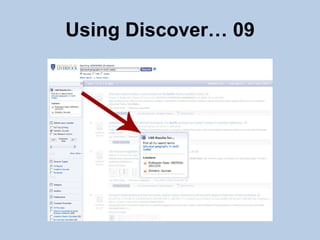
Using Discover… 09
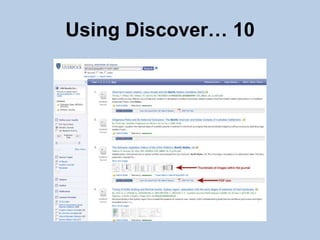
Using Discover… 10
6) Don’t forget to reference!
•   You must acknowledge in your assignment when you
    have used ideas or words that are not your own

•    The term for not identifying where your information has
    come from is Plagiarism

•   Your tutor will confirm which referencing style to adopt
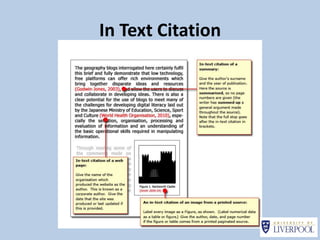
In Text Citation
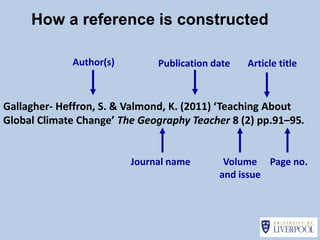
How a reference is constructed

             Author(s)        Publication date   Article title


Gallagher- Heffron, S. & Valmond, K. (2011) ‘Teaching About
Global Climate Change’ The Geography Teacher 8 (2) pp.91–95.


                         Journal name       Volume Page no.
                                           and issue
Thank You

Envs100

  • 1.
    Beyond Google... Making themost of library resources
  • 2.
    Learning Outcomes 1) Identifykeywords to construct a basic search strategy 2) Awareness of reference sources to develop knowledge and vocabulary 3) Where to look for information and understand how different sources of information vary in their quality and purpose 4) Identify criteria for evaluating information 5) Understand what peer review is and how it relates to information quality 6) Construct a reference for a journal article
  • 3.
    Why is Usingthe Library Important?
  • 4.
    1) Analysing theAssignment Question • Identify the keywords from your assignment question • Expand your vocabulary and think of alternative key words and variations in spellings • Link up your search terms to find the right information
  • 5.
    Identifying Key Words Exampleassignment Q: Discuss the possible roles of GIS in hazard management, including long-term planning, detailed evacuation planning and management of an actual incident. GIS Planning Incident ‘Hazard Evacuation Management’
  • 6.
  • 7.
  • 8.
    2) Reference Sources Oxford Reference Online: Incorporates subject dictionaries and reference works • A Dictionary of Earth Sciences • The Oxford Companion to the Earth • The Oxford Companion to Global Change • A Dictionary of Geography • A Dictionary of Environment and Conservation Access Oxford Reference Online via the Library Catalogue http://www.liv.ac.uk/library/e-library/e-reference.html
  • 9.
    3) Where shouldyou look for information for your assignments? Library catalogue should be your first port of call when looking for resources: • Books; print and electronic • Journals; print and electronic • Online databases • Websites, blogs etc…  
  • 10.
    Information quality Blogs Twitter More reliable Websites More recent Newspapers Magazines Academic Journals Books
  • 11.
    4) Evaluating yourresults • The effectiveness of the search is related to the relevancy of retrieved items. • Relevancy is: – Subjective: Depends upon your own judgment. – Situational: Relates to your current needs. – Cognitive: Your perception of the resource. – Dynamic: Changes over time. Entire document collection Relevant Retrieved documents documents 11
  • 12.
    Evaluating information When evaluatinginformation, take CARe: • Currency - is it up-to-date? • Authority - is the author and/or publisher credible? • Relevance – how does it benefit my research?
  • 13.
    Evaluating websites • Anyonecan publish material on the internet so there is no guarantee of its reliability • Things to look for: • Who produced the site? Are they credible? • When was the site last updated? • Does the look and feel of the site inspire confidence? • Look at the web address – .com, .co.uk, .ac.uk, .org, etc. • Is the site trying to sell something – a product or a point of view (bias)? • Look at www.dhmo.org and consider the questions above
  • 14.
    Recommended Websites • Officefor National Statistics http://www.ons.gov.uk/ons/index.html • Resource for Urban Design Information http://www.rudi.net/ • Design Council http://www.designcouncil.org.uk/ • Earth Trends http://earthtrends.wri.org/
  • 15.
    5) So, whatare Journals? Scholarly journal articles: • are regular publications that contain articles on current research • are written for and by academics • report the latest research on a topic • are peer reviewed or refereed (reviewed by academics before being accepted for publication) • include a bibliography of references • are often published by a professional or scholarly organization Example: d’Albergo (2010) ‘Urban Issues in Nation-State Agendas: A Comparison in Western Europe’ Urban Research & Practice. 3 (2) pp.138-158.
  • 16.
    Finding articles foryour assignment
  • 17.
  • 18.
  • 19.
  • 20.
  • 21.
  • 22.
  • 23.
  • 24.
  • 25.
  • 26.
  • 27.
    6) Don’t forgetto reference! • You must acknowledge in your assignment when you have used ideas or words that are not your own • The term for not identifying where your information has come from is Plagiarism • Your tutor will confirm which referencing style to adopt
  • 28.
  • 29.
    How a referenceis constructed Author(s) Publication date Article title Gallagher- Heffron, S. & Valmond, K. (2011) ‘Teaching About Global Climate Change’ The Geography Teacher 8 (2) pp.91–95. Journal name Volume Page no. and issue
  • 30.

Editor's Notes

  • #27 Ok so now you’ve found some articles that you will use in your assignment…