Material Balance Model
Sr.Sindhu P.J( Sr.Sharin CTC)
Assistant Professor
Department of Economics
St.Xavier’s College for Women, Aluva
Material Balance Model
Allen Kneese and R.V Ayres
The relationship between the
environment and the economy
The model visualizes the total
economic process as a physically
balanced flow between inputs and
outputs.
According to Ayres and Kneese, “If waste
assimilative capacity of the environment
is scarce, the decentralized voluntary
exchange process cannot be free of
uncompensated technological external
diseconomies unless all inputs are fully
converted into outputs, with no
unwanted material residuals along the
way and all final outputs are utterly
destroyed in the process of consumption.”
 Nature provides raw materials to the economy
for its production and consumption activities.
 Residuals (wastages) from both the production
and consumption processes usually remain and
they usually render disservices like killing fish,
reducing public health, soiling and
deteriorating buildings due to industrial
pollution.
 A major part of residual generated are
absorbed and recycled by the nature.
 The remaining wastages cause social cost and
aforesaid disservices.
 Further, all emission of residuals do not cause
pollution damage because of assimilative
capacity of the environment.
• Further, energy taken out of the
environment must be given into the nature
in some or other form.
• Even though waste energy cannot be
recycled but waste materials can be used for
various purposes. It means that economic
activity always affects environment in a
direct or indirect manner.
• Thus all inputs (fuels, raw materials, water
and so forth) used in the economy’s
production processes will ultimately result in
an equivalent residual or waste.
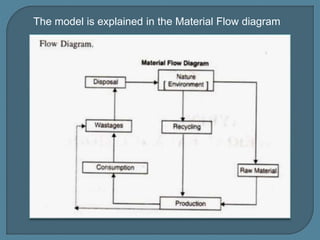
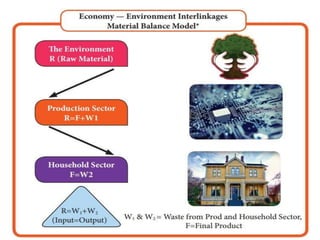
The model is explained in the Material Flow diagram
The material flow diagram implies that mass
inputs must equal mass outputs for every
process. At the same time, all resources
extracted from the environment must
eventually become unwanted wastes and
pollutants.
Materials recycled are useful but recycling is
energy intensive and imperfect, so it cannot
fully compensate. Hence, the materials
balance model provides a useful framework
for analyzing alternative methods of resource
and residuals management of resources and
the residuals.
The Material Balance Model depicts the major
functions performed by the environment.
• Environment supplies renewable and non-
renewable resources
• Environment assimilates residuals either by
absorbing them or dispersing them
• Environment provides life support services by
maintaining ecological balance and genetic
diversity.
• Environment provides natural services such as
aesthetic enjoyment and recreation.
All these functions have positive
economic value. If the environment
fails to perform any of these functions,
the real ‘environmental crisis’ takes
place. Thus the economy and
environment are closely related.
Material Balance Model

Material Balance Model

  • 1.
    Material Balance Model Sr.SindhuP.J( Sr.Sharin CTC) Assistant Professor Department of Economics St.Xavier’s College for Women, Aluva
  • 2.
    Material Balance Model AllenKneese and R.V Ayres The relationship between the environment and the economy The model visualizes the total economic process as a physically balanced flow between inputs and outputs.
  • 3.
    According to Ayresand Kneese, “If waste assimilative capacity of the environment is scarce, the decentralized voluntary exchange process cannot be free of uncompensated technological external diseconomies unless all inputs are fully converted into outputs, with no unwanted material residuals along the way and all final outputs are utterly destroyed in the process of consumption.”
  • 4.
     Nature providesraw materials to the economy for its production and consumption activities.  Residuals (wastages) from both the production and consumption processes usually remain and they usually render disservices like killing fish, reducing public health, soiling and deteriorating buildings due to industrial pollution.  A major part of residual generated are absorbed and recycled by the nature.  The remaining wastages cause social cost and aforesaid disservices.  Further, all emission of residuals do not cause pollution damage because of assimilative capacity of the environment.
  • 5.
    • Further, energytaken out of the environment must be given into the nature in some or other form. • Even though waste energy cannot be recycled but waste materials can be used for various purposes. It means that economic activity always affects environment in a direct or indirect manner. • Thus all inputs (fuels, raw materials, water and so forth) used in the economy’s production processes will ultimately result in an equivalent residual or waste.
  • 6.
    The model isexplained in the Material Flow diagram
  • 7.
    The material flowdiagram implies that mass inputs must equal mass outputs for every process. At the same time, all resources extracted from the environment must eventually become unwanted wastes and pollutants. Materials recycled are useful but recycling is energy intensive and imperfect, so it cannot fully compensate. Hence, the materials balance model provides a useful framework for analyzing alternative methods of resource and residuals management of resources and the residuals.
  • 8.
    The Material BalanceModel depicts the major functions performed by the environment. • Environment supplies renewable and non- renewable resources • Environment assimilates residuals either by absorbing them or dispersing them • Environment provides life support services by maintaining ecological balance and genetic diversity. • Environment provides natural services such as aesthetic enjoyment and recreation.
  • 9.
    All these functionshave positive economic value. If the environment fails to perform any of these functions, the real ‘environmental crisis’ takes place. Thus the economy and environment are closely related.