HOTELLING’S THEORY OF OPTIMUM EXTRACTION OF
NON-RENEWABLE RESOURCES

Prof. Prabha Panth
Osmania University
 Production by a firm is different from mineral
extraction.
 In a mine, as more extraction takes place, the stock
of the reserves starts decreasing.
 This reduces the resource availability for future
extraction.
 So there is an opportunity cost of extraction.
 Therefore the mine owner has to decide what
should be the optimum level of depletion so as to
earn profits now as well as in the future.
 Conservation of the mineral depends on the
expected future price, and the rate of discount.
Prabha Panth

2








Micro level: a mine-owner has to decide how
much of the mineral to extract in each time
period.
With each year’s extraction, the reserves of
the mine will be reduced, and eventually the
mineral will be exhausted.
Too much of extraction in the present time
period reduces the amount of the mineral for
future extraction,
But conserving the mineral for future
extraction will reduce the profits of the
present.
Prabha Panth
1
Hotelling’s Theory of Optimum depletion of
exhaustible resources (1931)
Hotelling tries to discover the conditions under
which exhaustive resources can be extracted
optimally over time, under perfect competition.

Assumptions:
 Micro analysis of an exhaustible resource (e.g. coal).
 Perfect competition in the product market, the price (p) of
coal is constant.
 Price is known to the mine owner.
 Constant returns to scale. Extraction costs do not rise but
remain constant, even as the mineral gets exhausted.
Prabha Panth
 No change in technology or improvements in
mining.
 So MC remains constant. AC = MC
 Perfect foresight regarding future costs, demand
and prices, no uncertainty.
 Downward sloping demand curve for the mineral.
 Mine owner is aware of the stock reserves of the
non-renewable resource.
 Constant extraction costs, as mineral gets
depleted, extraction costs do not rise.
Prabha Panth
User Cost or Hotelling Rent :
 User Cost: the opportunity cost of postponing
extraction of a non-renewable resource.
 If extracted now, present profits are earned, but
mineral is depleted.
 But if extraction is postponed, then profits can be
earned in the future.
 User Cost is the present value of the marginal profit
from selling the resource in the future.
 The amount he expected in future for conserving
the resource, rather than extracting it now.
Prabha Panth
Augmented User Cost (AMC) :
 AMC of the mine owner
 The opportunity cost of not depleting the
resource is added to the marginal cost.
 The miner’s decision to extract the resource
depends on his AMC, and not MC.
AMC = MC + UC
Miner has to decide how much to extract in
the present period, and how much to
conserve for the future.
Prabha Panth
Conditions for Optimal depletion of the exhaustible
resource:
 In PC, equilibrium is when P = MC
 In the case of NRR,
P = AMC = MC + UC
 Also, postponing extraction for the future involves
time preference.
 Therefore future price should exceed present price
of extraction, to compensate for loss of present
earnings due to conservation.

Prabha Panth
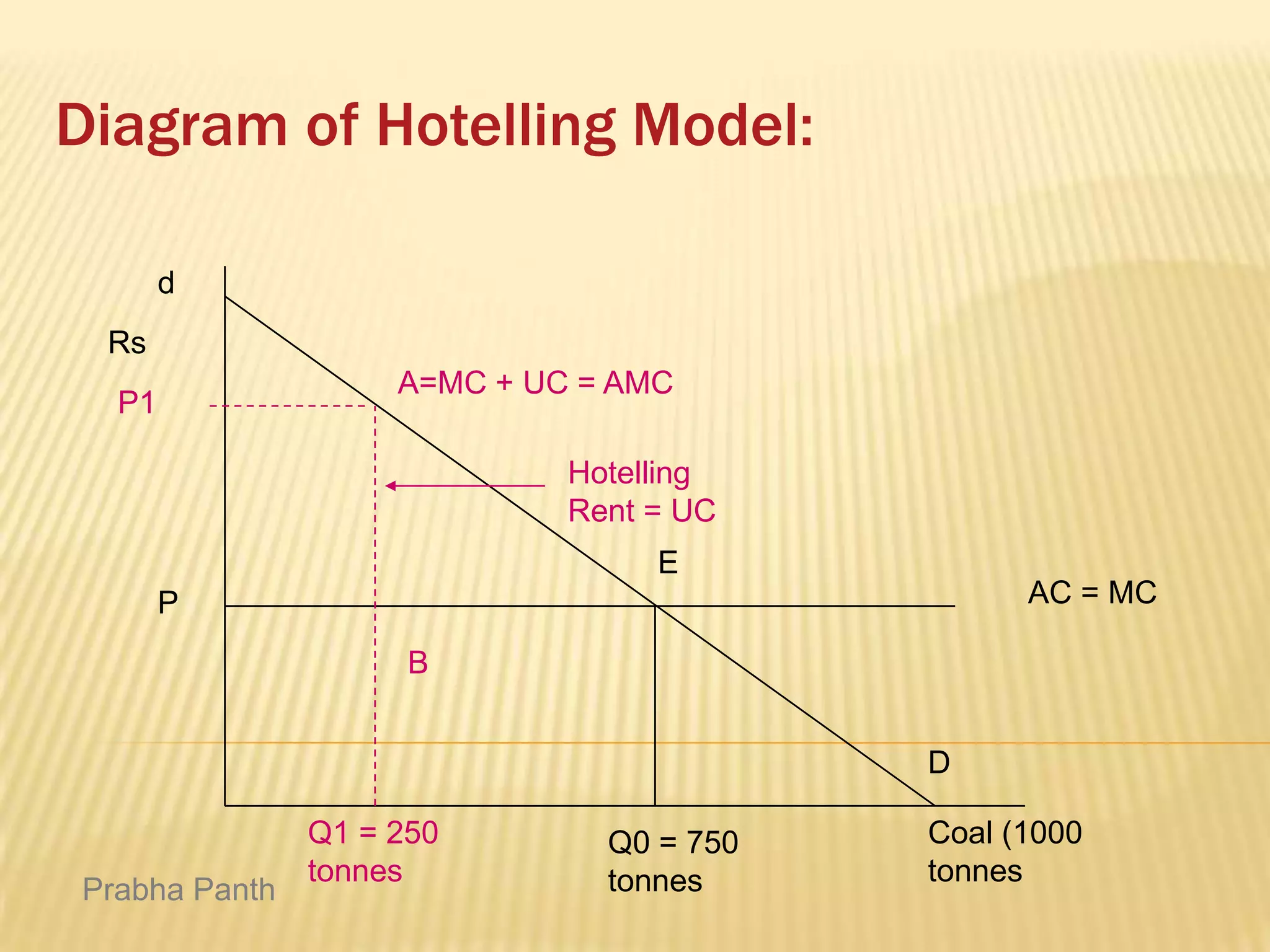
Diagram of Hotelling Model:
d
Rs

A=MC + UC = AMC

P1

Hotelling
Rent = UC
E
AC = MC

P
B
D

Prabha Panth

Q1 = 250
tonnes

Q0 = 750
tonnes

Coal (1000
tonnes
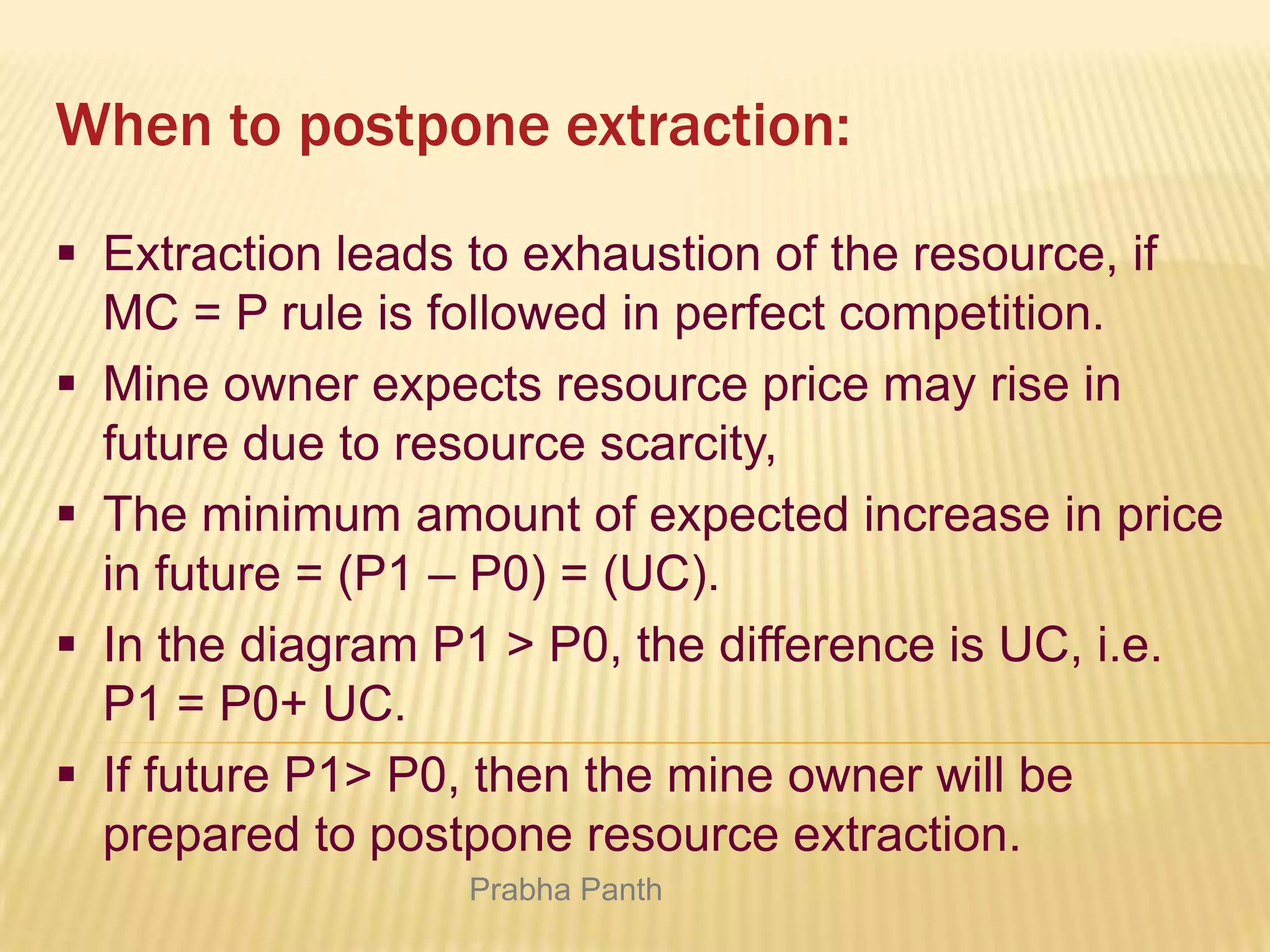
When to postpone extraction:
 Extraction leads to exhaustion of the resource, if
MC = P rule is followed in perfect competition.
 Mine owner expects resource price may rise in
future due to resource scarcity,
 The minimum amount of expected increase in price
in future = (P1 – P0) = (UC).
 In the diagram P1 > P0, the difference is UC, i.e.
P1 = P0+ UC.
 If future P1> P0, then the mine owner will be
prepared to postpone resource extraction.
Prabha Panth
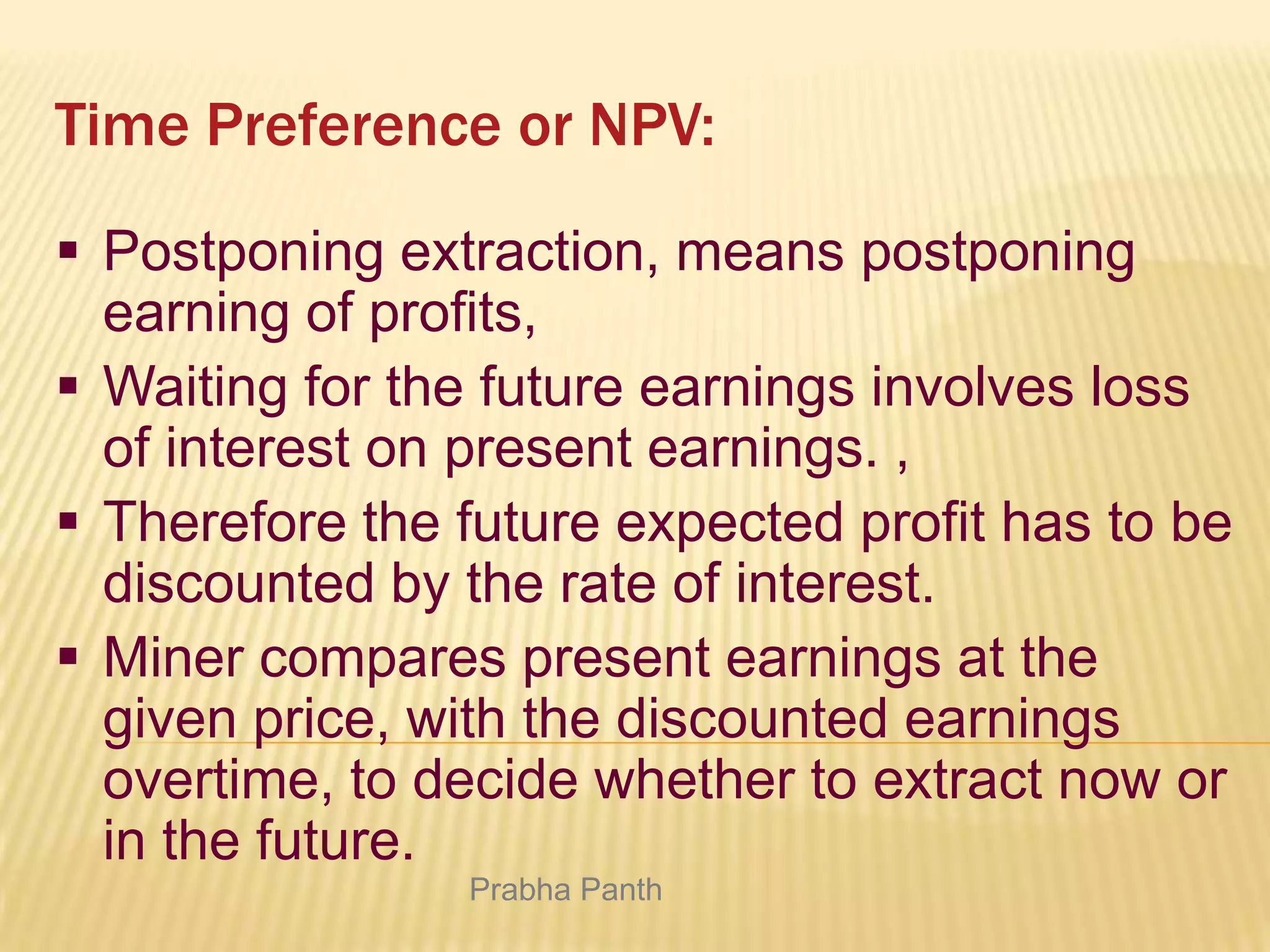
Time Preference or NPV:
 Postponing extraction, means postponing
earning of profits,
 Waiting for the future earnings involves loss
of interest on present earnings. ,
 Therefore the future expected profit has to be
discounted by the rate of interest.
 Miner compares present earnings at the
given price, with the discounted earnings
overtime, to decide whether to extract now or
in the future.
Prabha Panth
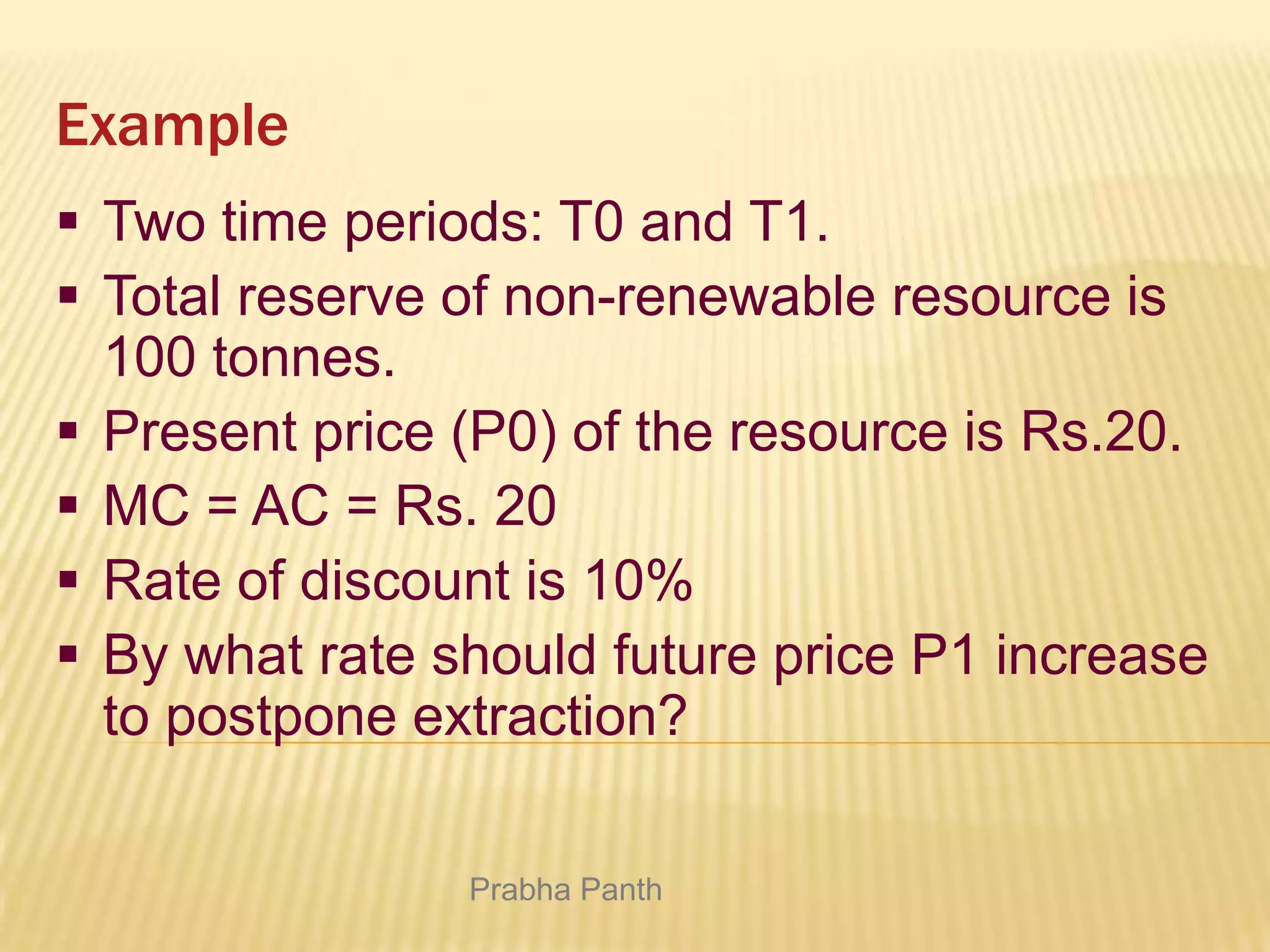
Example
 Two time periods: T0 and T1.
 Total reserve of non-renewable resource is
100 tonnes.
 Present price (P0) of the resource is Rs.20.
 MC = AC = Rs. 20
 Rate of discount is 10%
 By what rate should future price P1 increase
to postpone extraction?
Prabha Panth
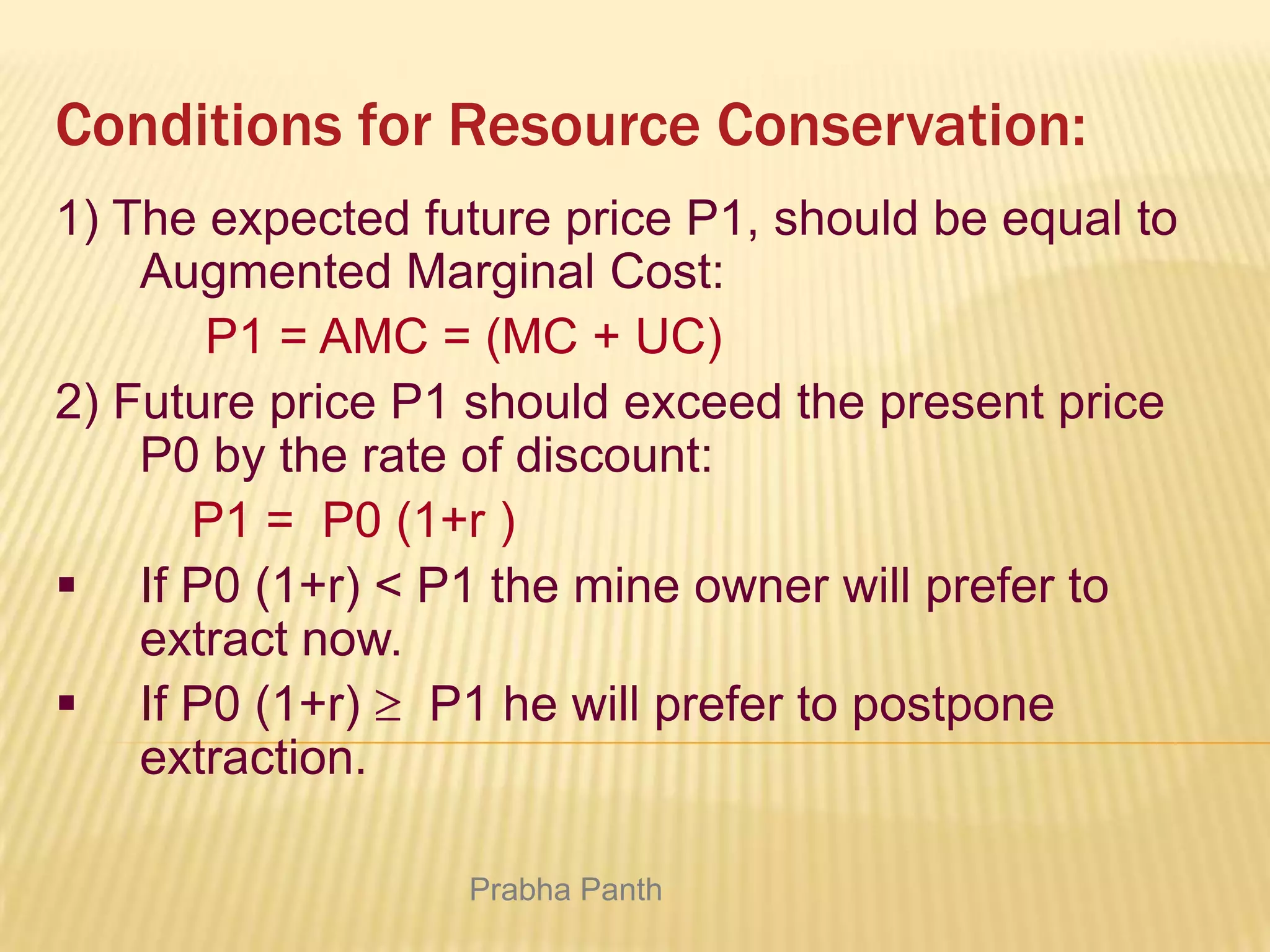
Conditions for Resource Conservation:
1) The expected future price P1, should be equal to
Augmented Marginal Cost:
P1 = AMC = (MC + UC)
2) Future price P1 should exceed the present price
P0 by the rate of discount:
P1 = P0 (1+r )
 If P0 (1+r) < P1 the mine owner will prefer to
extract now.
 If P0 (1+r) P1 he will prefer to postpone
extraction.
Prabha Panth
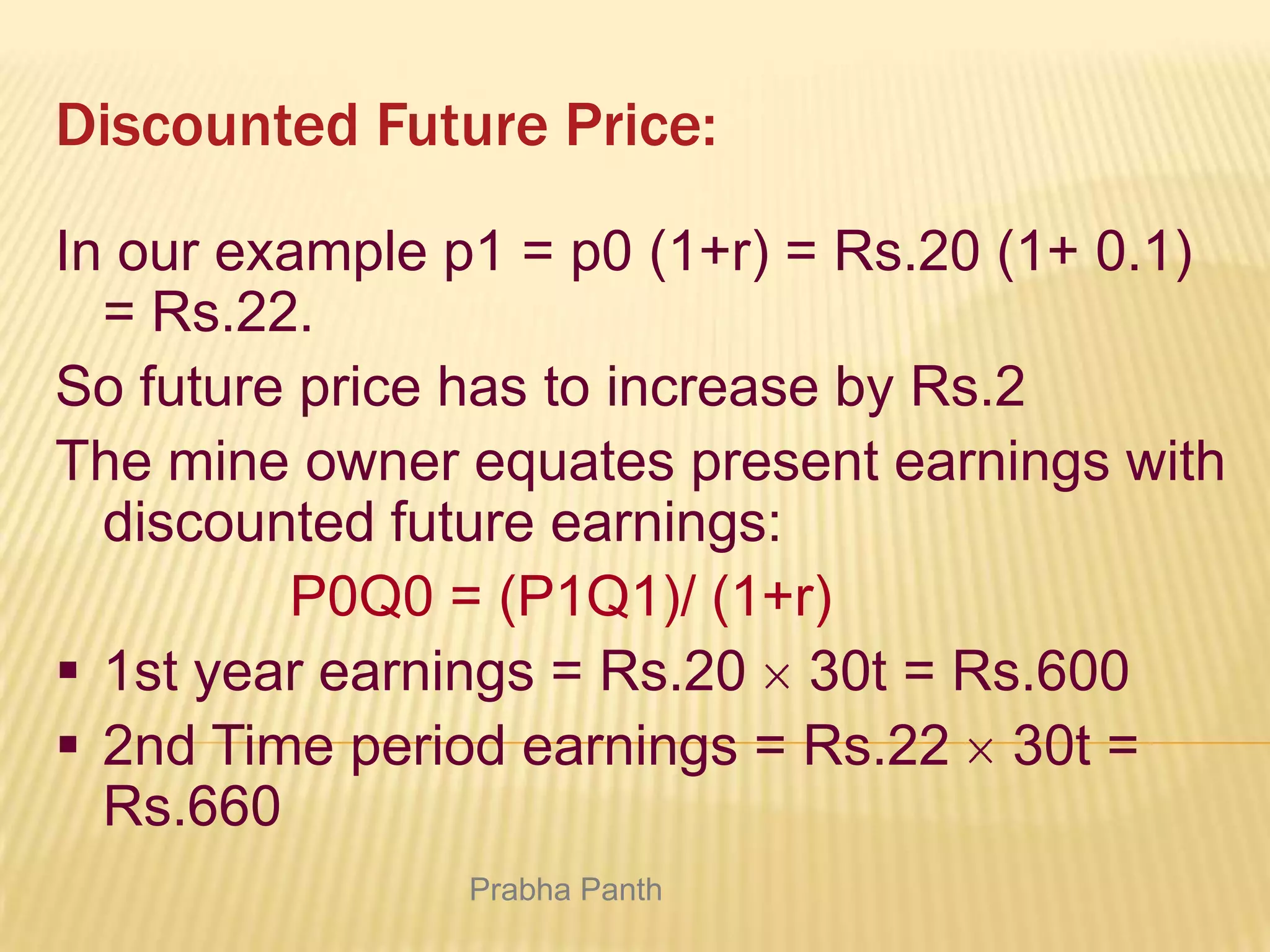
Discounted Future Price:
In our example p1 = p0 (1+r) = Rs.20 (1+ 0.1)
= Rs.22.
So future price has to increase by Rs.2
The mine owner equates present earnings with
discounted future earnings:
P0Q0 = (P1Q1)/ (1+r)
 1st year earnings = Rs.20 30t = Rs.600
 2nd Time period earnings = Rs.22 30t =
Rs.660
Prabha Panth
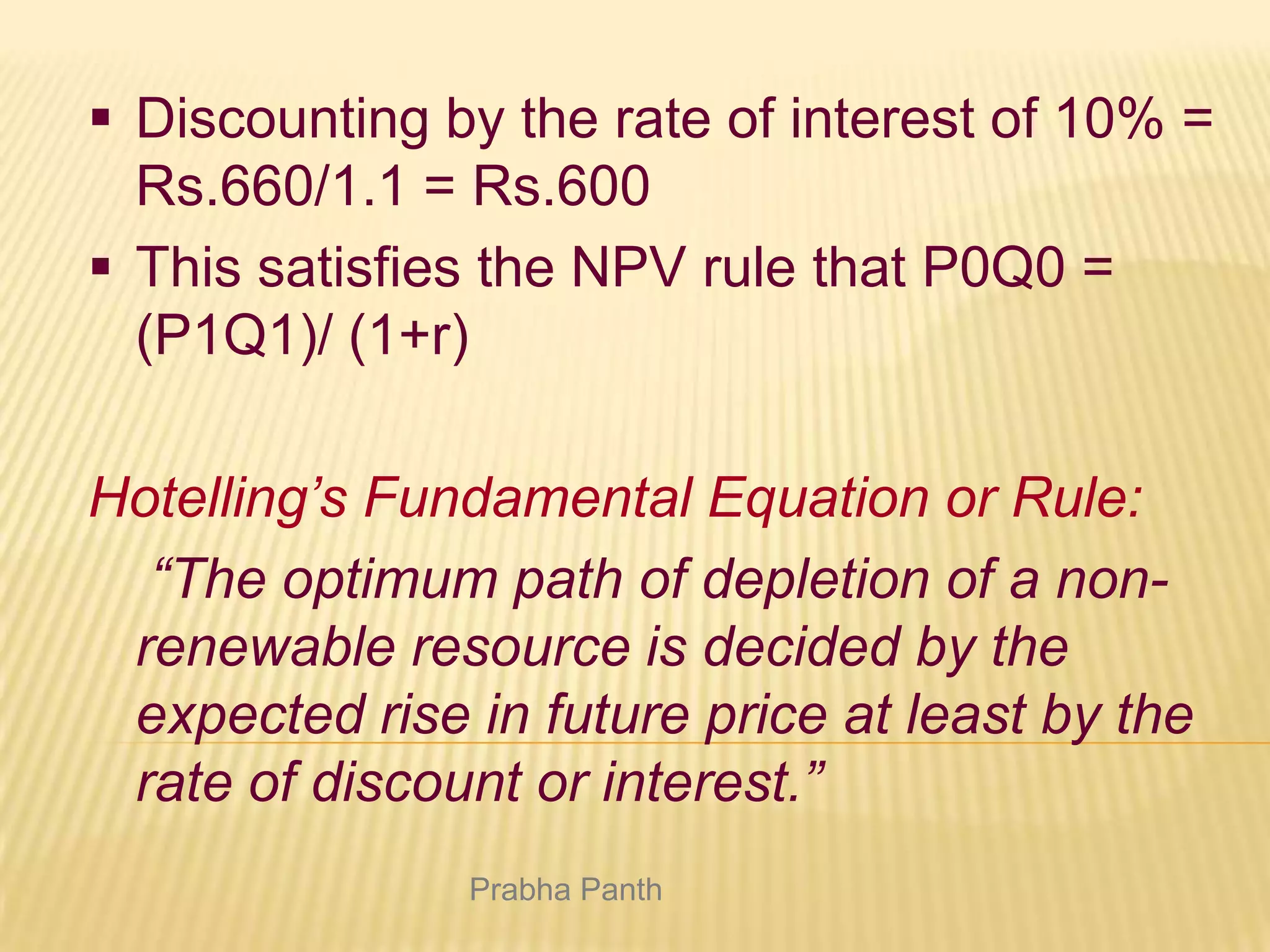
 Discounting by the rate of interest of 10% =
Rs.660/1.1 = Rs.600
 This satisfies the NPV rule that P0Q0 =
(P1Q1)/ (1+r)
Hotelling’s Fundamental Equation or Rule:
“The optimum path of depletion of a nonrenewable resource is decided by the
expected rise in future price at least by the
rate of discount or interest.”
Prabha Panth
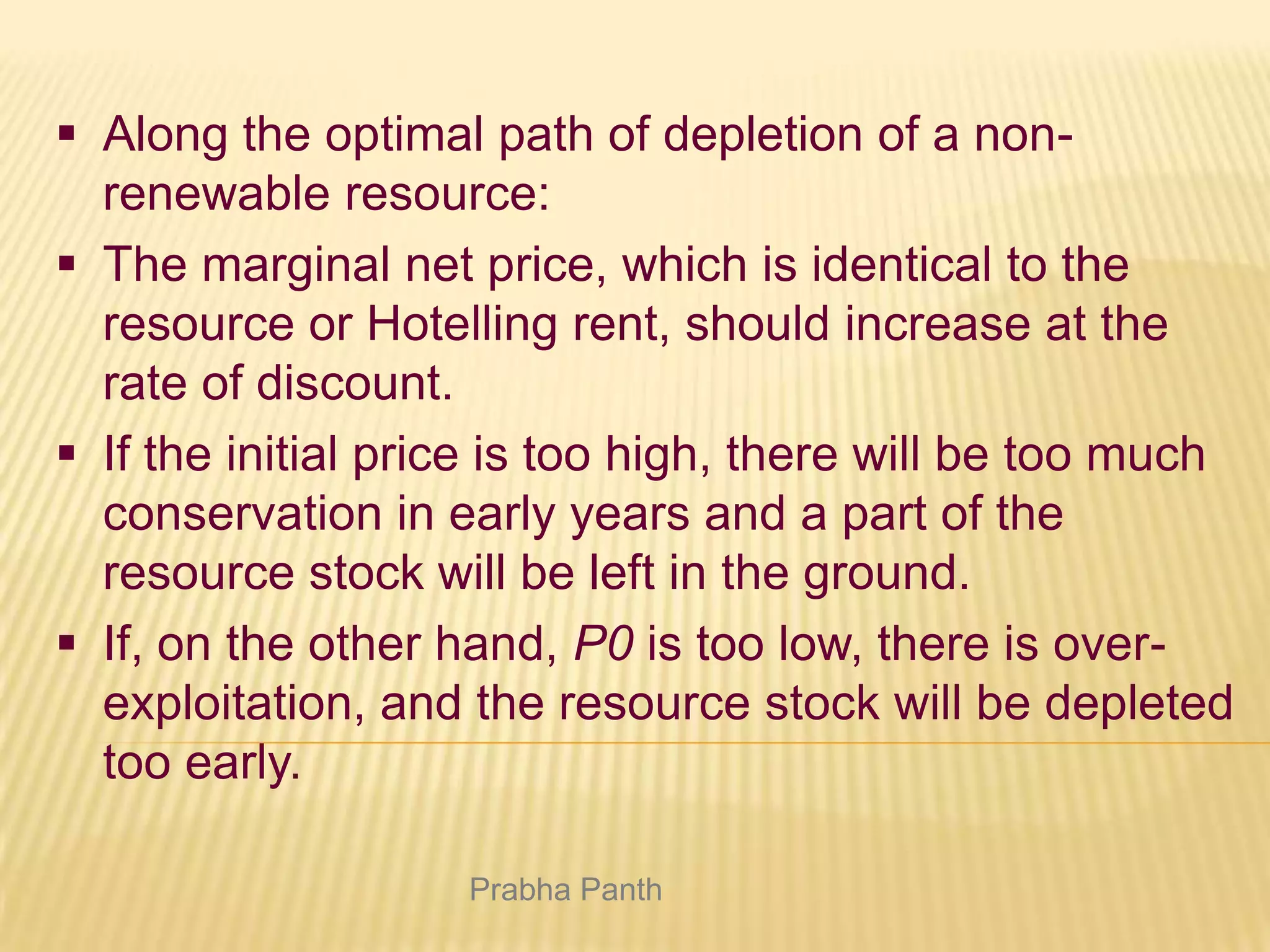
 Along the optimal path of depletion of a nonrenewable resource:
 The marginal net price, which is identical to the
resource or Hotelling rent, should increase at the
rate of discount.
 If the initial price is too high, there will be too much
conservation in early years and a part of the
resource stock will be left in the ground.
 If, on the other hand, P0 is too low, there is overexploitation, and the resource stock will be depleted
too early.
Prabha Panth
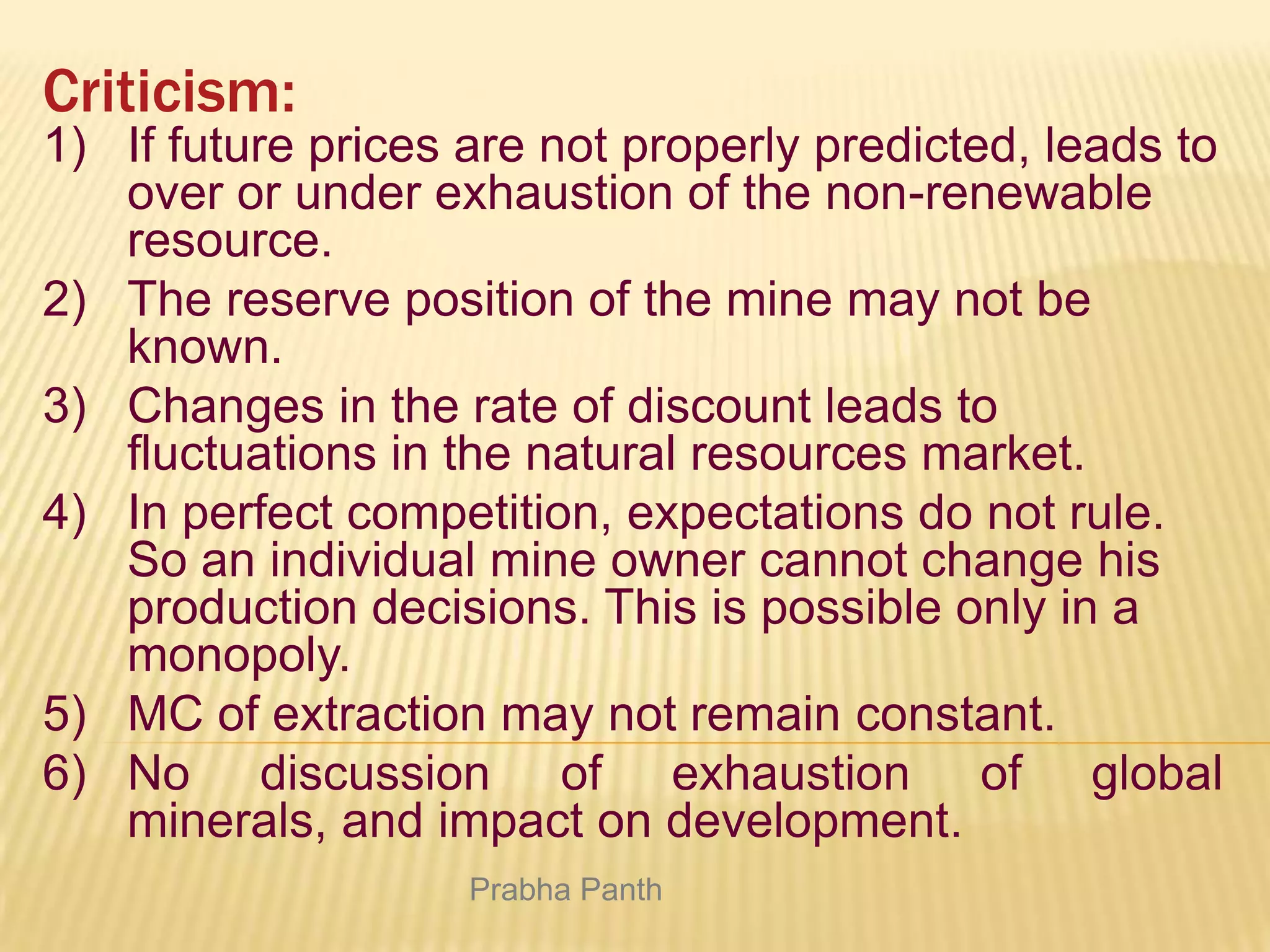
Criticism:
1) If future prices are not properly predicted, leads to
over or under exhaustion of the non-renewable
resource.
2) The reserve position of the mine may not be
known.
3) Changes in the rate of discount leads to
fluctuations in the natural resources market.
4) In perfect competition, expectations do not rule.
So an individual mine owner cannot change his
production decisions. This is possible only in a
monopoly.
5) MC of extraction may not remain constant.
6) No discussion of exhaustion of global
minerals, and impact on development.
Prabha Panth

010 hotelling optimum exhaustion of a non renewable resource

  • 1.
    HOTELLING’S THEORY OFOPTIMUM EXTRACTION OF NON-RENEWABLE RESOURCES Prof. Prabha Panth Osmania University
  • 2.
     Production bya firm is different from mineral extraction.  In a mine, as more extraction takes place, the stock of the reserves starts decreasing.  This reduces the resource availability for future extraction.  So there is an opportunity cost of extraction.  Therefore the mine owner has to decide what should be the optimum level of depletion so as to earn profits now as well as in the future.  Conservation of the mineral depends on the expected future price, and the rate of discount. Prabha Panth 2
  • 3.
        Micro level: amine-owner has to decide how much of the mineral to extract in each time period. With each year’s extraction, the reserves of the mine will be reduced, and eventually the mineral will be exhausted. Too much of extraction in the present time period reduces the amount of the mineral for future extraction, But conserving the mineral for future extraction will reduce the profits of the present. Prabha Panth 1
  • 4.
    Hotelling’s Theory ofOptimum depletion of exhaustible resources (1931) Hotelling tries to discover the conditions under which exhaustive resources can be extracted optimally over time, under perfect competition. Assumptions:  Micro analysis of an exhaustible resource (e.g. coal).  Perfect competition in the product market, the price (p) of coal is constant.  Price is known to the mine owner.  Constant returns to scale. Extraction costs do not rise but remain constant, even as the mineral gets exhausted. Prabha Panth
  • 5.
     No changein technology or improvements in mining.  So MC remains constant. AC = MC  Perfect foresight regarding future costs, demand and prices, no uncertainty.  Downward sloping demand curve for the mineral.  Mine owner is aware of the stock reserves of the non-renewable resource.  Constant extraction costs, as mineral gets depleted, extraction costs do not rise. Prabha Panth
  • 6.
    User Cost orHotelling Rent :  User Cost: the opportunity cost of postponing extraction of a non-renewable resource.  If extracted now, present profits are earned, but mineral is depleted.  But if extraction is postponed, then profits can be earned in the future.  User Cost is the present value of the marginal profit from selling the resource in the future.  The amount he expected in future for conserving the resource, rather than extracting it now. Prabha Panth
  • 7.
    Augmented User Cost(AMC) :  AMC of the mine owner  The opportunity cost of not depleting the resource is added to the marginal cost.  The miner’s decision to extract the resource depends on his AMC, and not MC. AMC = MC + UC Miner has to decide how much to extract in the present period, and how much to conserve for the future. Prabha Panth
  • 8.
    Conditions for Optimaldepletion of the exhaustible resource:  In PC, equilibrium is when P = MC  In the case of NRR, P = AMC = MC + UC  Also, postponing extraction for the future involves time preference.  Therefore future price should exceed present price of extraction, to compensate for loss of present earnings due to conservation. Prabha Panth
  • 9.
    Diagram of HotellingModel: d Rs A=MC + UC = AMC P1 Hotelling Rent = UC E AC = MC P B D Prabha Panth Q1 = 250 tonnes Q0 = 750 tonnes Coal (1000 tonnes
  • 10.
    When to postponeextraction:  Extraction leads to exhaustion of the resource, if MC = P rule is followed in perfect competition.  Mine owner expects resource price may rise in future due to resource scarcity,  The minimum amount of expected increase in price in future = (P1 – P0) = (UC).  In the diagram P1 > P0, the difference is UC, i.e. P1 = P0+ UC.  If future P1> P0, then the mine owner will be prepared to postpone resource extraction. Prabha Panth
  • 11.
    Time Preference orNPV:  Postponing extraction, means postponing earning of profits,  Waiting for the future earnings involves loss of interest on present earnings. ,  Therefore the future expected profit has to be discounted by the rate of interest.  Miner compares present earnings at the given price, with the discounted earnings overtime, to decide whether to extract now or in the future. Prabha Panth
  • 12.
    Example  Two timeperiods: T0 and T1.  Total reserve of non-renewable resource is 100 tonnes.  Present price (P0) of the resource is Rs.20.  MC = AC = Rs. 20  Rate of discount is 10%  By what rate should future price P1 increase to postpone extraction? Prabha Panth
  • 13.
    Conditions for ResourceConservation: 1) The expected future price P1, should be equal to Augmented Marginal Cost: P1 = AMC = (MC + UC) 2) Future price P1 should exceed the present price P0 by the rate of discount: P1 = P0 (1+r )  If P0 (1+r) < P1 the mine owner will prefer to extract now.  If P0 (1+r) P1 he will prefer to postpone extraction. Prabha Panth
  • 14.
    Discounted Future Price: Inour example p1 = p0 (1+r) = Rs.20 (1+ 0.1) = Rs.22. So future price has to increase by Rs.2 The mine owner equates present earnings with discounted future earnings: P0Q0 = (P1Q1)/ (1+r)  1st year earnings = Rs.20 30t = Rs.600  2nd Time period earnings = Rs.22 30t = Rs.660 Prabha Panth
  • 15.
     Discounting bythe rate of interest of 10% = Rs.660/1.1 = Rs.600  This satisfies the NPV rule that P0Q0 = (P1Q1)/ (1+r) Hotelling’s Fundamental Equation or Rule: “The optimum path of depletion of a nonrenewable resource is decided by the expected rise in future price at least by the rate of discount or interest.” Prabha Panth
  • 16.
     Along theoptimal path of depletion of a nonrenewable resource:  The marginal net price, which is identical to the resource or Hotelling rent, should increase at the rate of discount.  If the initial price is too high, there will be too much conservation in early years and a part of the resource stock will be left in the ground.  If, on the other hand, P0 is too low, there is overexploitation, and the resource stock will be depleted too early. Prabha Panth
  • 17.
    Criticism: 1) If futureprices are not properly predicted, leads to over or under exhaustion of the non-renewable resource. 2) The reserve position of the mine may not be known. 3) Changes in the rate of discount leads to fluctuations in the natural resources market. 4) In perfect competition, expectations do not rule. So an individual mine owner cannot change his production decisions. This is possible only in a monopoly. 5) MC of extraction may not remain constant. 6) No discussion of exhaustion of global minerals, and impact on development. Prabha Panth