1
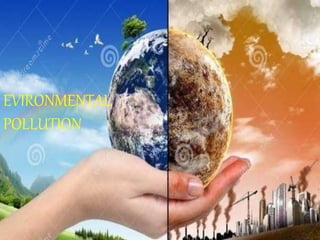
ENVIRONMENTAL POLLUTIONEVIRONMENTAL
POLLUTION
22
INTRODUCTION
• Pollution can be defined as deliberate or accidental
contamination of environment by man’s activities.
• Pollution is the introduction by man of waste matter or
surplus energy into the environment which directly or
indirectly causes damage to man and his environment.
33
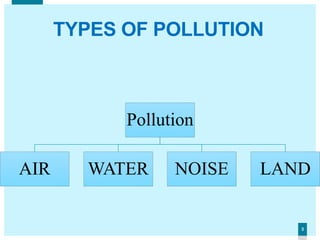
TYPES OF POLLUTION
Pollution
AIR WATER NOISE LAND
44
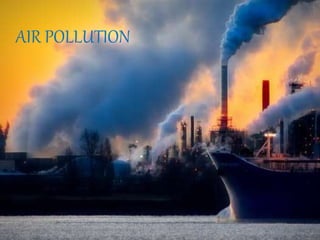
AIR POLLUTION
55
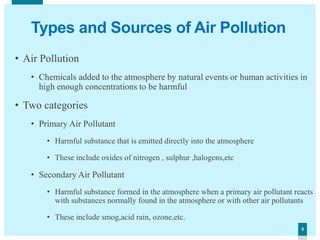
Types and Sources of Air Pollution
• Air Pollution
• Chemicals added to the atmosphere by natural events or human activities in
high enough concentrations to be harmful
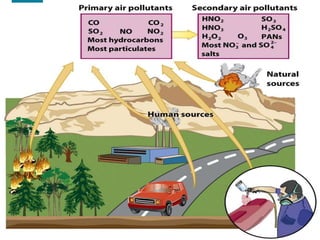
• Two categories
• Primary Air Pollutant
• Harmful substance that is emitted directly into the atmosphere
• These include oxides of nitrogen , sulphur ,halogens,etc
• Secondary Air Pollutant
• Harmful substance formed in the atmosphere when a primary air pollutant reacts
with substances normally found in the atmosphere or with other air pollutants
• These include smog,acid rain, ozone,etc.
66
77
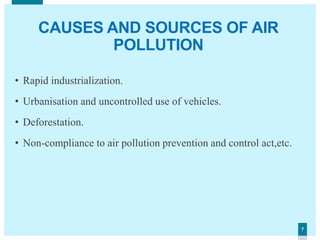
CAUSES AND SOURCES OF AIR
POLLUTION
• Rapid industrialization.
• Urbanisation and uncontrolled use of vehicles.
• Deforestation.
• Non-compliance to air pollution prevention and control act,etc.
88
99
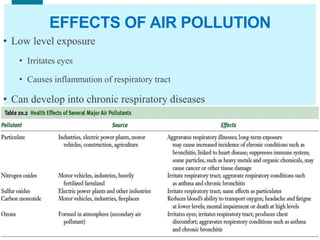
EFFECTS OF AIR POLLUTION
• Low level exposure
• Irritates eyes
• Causes inflammation of respiratory tract
• Can develop into chronic respiratory diseases
1010
• ACID RAIN-It describes any form of precipitation with high level
of nitric and sulphuric acid.it can also occur in form of snow,fog
and tiny bits of dry material.
• GREENHOUSE EFFECT-The trapping of sun’s warmth in a
planet’s lower atmosphere,due to the greater transparency of the
atmosphere to visible radiation from the sun than to infrared
radiation emitted from the planet’s surface.
• OZONE DEPLETION-A steady lowering of about four percent in
the total amount of ozone in earth’s atmosphere and a much larger
springtime decrease in stratospheric ozone around earth’s polar
regions.
1111
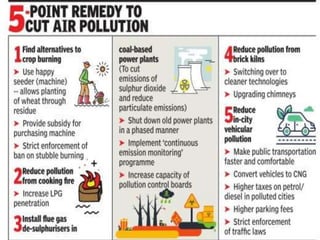
REMEDIAL MEASURES
• By adopting advanced manufacturing processes or designs that are
more environment friendly for various industrial processes.
• Use of cleaner fuels.
• Escape of air pollutants can be reduced to a considerable extent by
providing various equipments that trap the pollutants during exit into
the atmosphere.
• Strict enforcement of law and punishment to the defaulters.
• And many more ways….
1212
131313
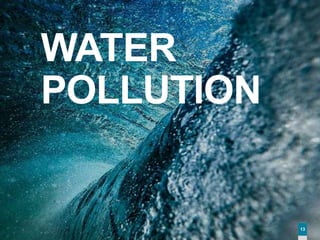
WATER
POLLUTION
13
141414
INTRODUCTION TO WATER
POLLUTION• Waterisabasicandscarcecommodity.Itisoneofthethebasicelementsof“PANCHA
MAHATATVAS”(fivebasicelements)thatmakeslifecycleonthisearthtoexist.
• Anyhumanactivitiesrequireswaterinortheotherform.Waterisrequiredfordomesticuse,industrial
use,agriculturaluseandforcommercialuse.
• Wateristheonlysubstancethatexiststhenatureinallthreephasesviz.solids,liquids,andgaseous.
• Waterpollutionisoneofhemostimportantproblemsfacedbydevelopedaswellasdeveloping
countries.
• Theearth’ssurfacehaslimitedresourcesoffreshwaterandtheerraticsupplyandpollutionfurtherputs
limitationonavailabilityofeaterforvariousactivities.
• VariousagenciessuchasWORLDHEALTHOEGANIZATION(WHO)andNATIONAL
WATERCOMMISSION(NWC)
15
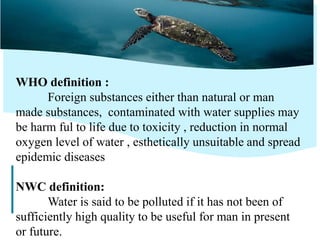
WHO definition :
Foreign substances either than natural or man
made substances, contaminated with water supplies may
be harm ful to life due to toxicity , reduction in normal
oxygen level of water , esthetically unsuitable and spread
epidemic diseases
NWC definition:
Water is said to be polluted if it has not been of
sufficiently high quality to be useful for man in present
or future.
16
• Natural causes: During precipitation , decayed vegetation ,
animal debris, soil matrix get carried away into the water
bodies. These impurities being organic in nature, impart
colour and odour . Also, the biological properties are
changed.
• Man made causes: rapid industrialization , uncontrolled use
of fertilizers, pesticides are the main man made sources of
water pollution. unplanned and haphazard growth of cities ,
reluctance on the part of governing bodies and unawareness
of general public add to the severity of the problem
CAUSES OF WATER POLLUTION
1717
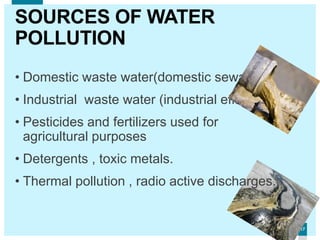
SOURCES OF WATER
POLLUTION
• Domestic waste water(domestic sewage)
• Industrial waste water (industrial effluents)
• Pesticides and fertilizers used for
agricultural purposes
• Detergents , toxic metals.
• Thermal pollution , radio active discharges.
18
EFFECTS OF WATER POLLUTION
• Spread of water borne diseases such as cholera , gastro , jaundice ,
typhoid.
• Depletion of oxygen level in receiving water bodies such as rivers or
lakes which in turn affect the aquatic life and ecosystem.
• Photosynthesis process gets hampered.
• Acidic and alkaline effluents cause corrosion.
• Industrial wastes when enter into the natural water bodies impart
objectionable colour , odour and make the water turbid and
unaesthetic. They also kill the organisms living on the water body.
• When very hot effluents are discharged in a water body, it leads to
depletion of oxygen level as well as endangered aquatic life.
191919
REMEDIAL MEASURES TO
ABATE WATER POLLUTION
• Ban on intermixing of solid waste or untreated
domestic waste or industrial waste in water bodies.
• Proper treatment of domestic and industrial waste to
such an extent as to reuse and recycle them for one or
the other use, such as irrigation, industrial processes ,
etc.
• Discouraging uncontrolled use of pesticides and
fertilizers.
• Ban on activities such as bathing, clothes , washing
animals , etc. in water bodies that are potential to water
resources.
• Regular cleaning of water bodies for aquatic weeds,
plants.
• Public awareness and legislative control as per water
(prevention and control of pollution)act 1974.
19
20
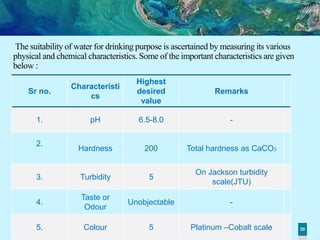
The suitability of water for drinking purpose is ascertained by measuring its various
physical and chemical characteristics. Some of the important characteristics are given
below :
Sr no.
Characteristi
cs
Highest
desired
value
Remarks
1. pH 6.5-8.0 -
2.
Hardness 200 Total hardness as CaCO3
3. Turbidity 5
On Jackson turbidity
scale(JTU)
4.
Taste or
Odour
Unobjectable -
5. Colour 5 Platinum –Cobalt scale
21
22
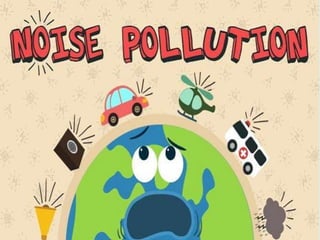
Noise can be defined as unwanted sound
pollutant that produces undesirable effects in an
individual by interfering with one’s social
activities like work, rest, recreation, sleep etc.
Hence noise pollution is regarded as a pollutant
that causes environmental degradation.
Noise can be measured in terms of following
factors:
23
SOUND PRESSURE
It is defined as the force exerted by sound over a unit
area and is expressed in N/m2.
Sound pressure can be converted into decibels(dB) by
equation
SPL(in dB)=20log10(P/P0)
Where, SPL=Sound Pressure Level in dB
P=Sound Pressure in N/m2
P0=Reference pressure
(2*10-5 N/m2)
24
SOUND INTENSITY
The rate of oscillation is called frequency and is measured in
cycles/second or Hertz(Hz).The human ear can detect sound
with frequency of 2 to 20000Hz.
25
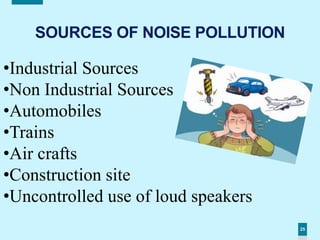
SOURCES OF NOISE POLLUTION
•Industrial Sources
•Non Industrial Sources
•Automobiles
•Trains
•Air crafts
•Construction site
•Uncontrolled use of loud speakers
26
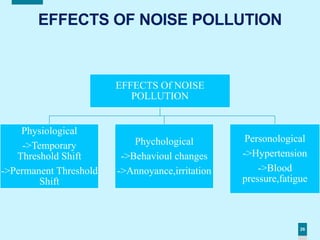
EFFECTS OF NOISE POLLUTION
EFFECTS Of NOISE
POLLUTION
Physiological
->Temporary
Threshold Shift
->Permanent Threshold
Shift
Phychological
->Behavioul changes
->Annoyance,irritation
Personological
->Hypertension
->Blood
pressure,fatigue
27
CONTROL OF NOISE POLLUTION
1)Control at receivers end:-For people working in noisy areas
ear protection aids like ear plugs, muffs, noise helmets, head
phones etc should be provided it reduces occupational
exposure.
2) Controlling at source:- This is only possible if working
method is improved.Design new machines to replace noisy
ones.Proper lubrication and better, maintenance of
machines.Installing noisy machines with sound absorbing
materials.Using Silencer to control noise from automobiles
etc.
28
3)Control during Transmission:
Constructing barriers around the equipment to
obstruct sound emissions, using absorption techniques
such as planting of trees.
29
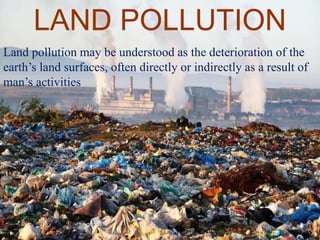
LAND POLLUTION
Land pollution may be understood as the deterioration of the
earth’s land surfaces, often directly or indirectly as a result of
man’s activities
30
SOURCES OF LAND POLLUTION
Dumping of Industrial and Domestic Wastes
Uncontrolled Irrigation
Excess use of Fertilizers and Pesticides
Wastes from Construction Industry
31
EFFECTS OF LAND POLLUTION
•The wastes buried in land may leach out and contaminate
ground water. If this water is used by human, it will lead to
spread of various diseases.
•The site used for dumping leads to fly nuisance.
•Due to excess fertilizers and pesticides land becomes
infertile.
32
REMEDIAL MESURES TO ABATE KAND
POLLUTION
•Educating farmers and agriculturist to follow proper irrigation practices.
•Controlled use pesticides and fertilizers. Organic farming is gaing a lot
of popularity these days.
•Construction of engineered landfills for dumping municipal solid
wastes.
•Use of modern techniques such as inceneration for hospital waste.
•Deep burial in case of radioactive waste.
33
MADE BY:-
1) SAKSHI MOGARKAR
2) VRUSHALI P GAJARE
3) SAKSHI PATEL

Environmental Pollution

  • 1.
  • 2.
    22 INTRODUCTION • Pollution canbe defined as deliberate or accidental contamination of environment by man’s activities. • Pollution is the introduction by man of waste matter or surplus energy into the environment which directly or indirectly causes damage to man and his environment.
  • 3.
  • 4.
  • 5.
    55 Types and Sourcesof Air Pollution • Air Pollution • Chemicals added to the atmosphere by natural events or human activities in high enough concentrations to be harmful • Two categories • Primary Air Pollutant • Harmful substance that is emitted directly into the atmosphere • These include oxides of nitrogen , sulphur ,halogens,etc • Secondary Air Pollutant • Harmful substance formed in the atmosphere when a primary air pollutant reacts with substances normally found in the atmosphere or with other air pollutants • These include smog,acid rain, ozone,etc.
  • 6.
  • 7.
    77 CAUSES AND SOURCESOF AIR POLLUTION • Rapid industrialization. • Urbanisation and uncontrolled use of vehicles. • Deforestation. • Non-compliance to air pollution prevention and control act,etc.
  • 8.
  • 9.
    99 EFFECTS OF AIRPOLLUTION • Low level exposure • Irritates eyes • Causes inflammation of respiratory tract • Can develop into chronic respiratory diseases
  • 10.
    1010 • ACID RAIN-Itdescribes any form of precipitation with high level of nitric and sulphuric acid.it can also occur in form of snow,fog and tiny bits of dry material. • GREENHOUSE EFFECT-The trapping of sun’s warmth in a planet’s lower atmosphere,due to the greater transparency of the atmosphere to visible radiation from the sun than to infrared radiation emitted from the planet’s surface. • OZONE DEPLETION-A steady lowering of about four percent in the total amount of ozone in earth’s atmosphere and a much larger springtime decrease in stratospheric ozone around earth’s polar regions.
  • 11.
    1111 REMEDIAL MEASURES • Byadopting advanced manufacturing processes or designs that are more environment friendly for various industrial processes. • Use of cleaner fuels. • Escape of air pollutants can be reduced to a considerable extent by providing various equipments that trap the pollutants during exit into the atmosphere. • Strict enforcement of law and punishment to the defaulters. • And many more ways….
  • 12.
  • 13.
  • 14.
    141414 INTRODUCTION TO WATER POLLUTION•Waterisabasicandscarcecommodity.Itisoneofthethebasicelementsof“PANCHA MAHATATVAS”(fivebasicelements)thatmakeslifecycleonthisearthtoexist. • Anyhumanactivitiesrequireswaterinortheotherform.Waterisrequiredfordomesticuse,industrial use,agriculturaluseandforcommercialuse. • Wateristheonlysubstancethatexiststhenatureinallthreephasesviz.solids,liquids,andgaseous. • Waterpollutionisoneofhemostimportantproblemsfacedbydevelopedaswellasdeveloping countries. • Theearth’ssurfacehaslimitedresourcesoffreshwaterandtheerraticsupplyandpollutionfurtherputs limitationonavailabilityofeaterforvariousactivities. • VariousagenciessuchasWORLDHEALTHOEGANIZATION(WHO)andNATIONAL WATERCOMMISSION(NWC)
  • 15.
    15 WHO definition : Foreignsubstances either than natural or man made substances, contaminated with water supplies may be harm ful to life due to toxicity , reduction in normal oxygen level of water , esthetically unsuitable and spread epidemic diseases NWC definition: Water is said to be polluted if it has not been of sufficiently high quality to be useful for man in present or future.
  • 16.
    16 • Natural causes:During precipitation , decayed vegetation , animal debris, soil matrix get carried away into the water bodies. These impurities being organic in nature, impart colour and odour . Also, the biological properties are changed. • Man made causes: rapid industrialization , uncontrolled use of fertilizers, pesticides are the main man made sources of water pollution. unplanned and haphazard growth of cities , reluctance on the part of governing bodies and unawareness of general public add to the severity of the problem CAUSES OF WATER POLLUTION
  • 17.
    1717 SOURCES OF WATER POLLUTION •Domestic waste water(domestic sewage) • Industrial waste water (industrial effluents) • Pesticides and fertilizers used for agricultural purposes • Detergents , toxic metals. • Thermal pollution , radio active discharges.
  • 18.
    18 EFFECTS OF WATERPOLLUTION • Spread of water borne diseases such as cholera , gastro , jaundice , typhoid. • Depletion of oxygen level in receiving water bodies such as rivers or lakes which in turn affect the aquatic life and ecosystem. • Photosynthesis process gets hampered. • Acidic and alkaline effluents cause corrosion. • Industrial wastes when enter into the natural water bodies impart objectionable colour , odour and make the water turbid and unaesthetic. They also kill the organisms living on the water body. • When very hot effluents are discharged in a water body, it leads to depletion of oxygen level as well as endangered aquatic life.
  • 19.
    191919 REMEDIAL MEASURES TO ABATEWATER POLLUTION • Ban on intermixing of solid waste or untreated domestic waste or industrial waste in water bodies. • Proper treatment of domestic and industrial waste to such an extent as to reuse and recycle them for one or the other use, such as irrigation, industrial processes , etc. • Discouraging uncontrolled use of pesticides and fertilizers. • Ban on activities such as bathing, clothes , washing animals , etc. in water bodies that are potential to water resources. • Regular cleaning of water bodies for aquatic weeds, plants. • Public awareness and legislative control as per water (prevention and control of pollution)act 1974. 19
  • 20.
    20 The suitability ofwater for drinking purpose is ascertained by measuring its various physical and chemical characteristics. Some of the important characteristics are given below : Sr no. Characteristi cs Highest desired value Remarks 1. pH 6.5-8.0 - 2. Hardness 200 Total hardness as CaCO3 3. Turbidity 5 On Jackson turbidity scale(JTU) 4. Taste or Odour Unobjectable - 5. Colour 5 Platinum –Cobalt scale
  • 21.
  • 22.
    22 Noise can bedefined as unwanted sound pollutant that produces undesirable effects in an individual by interfering with one’s social activities like work, rest, recreation, sleep etc. Hence noise pollution is regarded as a pollutant that causes environmental degradation. Noise can be measured in terms of following factors:
  • 23.
    23 SOUND PRESSURE It isdefined as the force exerted by sound over a unit area and is expressed in N/m2. Sound pressure can be converted into decibels(dB) by equation SPL(in dB)=20log10(P/P0) Where, SPL=Sound Pressure Level in dB P=Sound Pressure in N/m2 P0=Reference pressure (2*10-5 N/m2)
  • 24.
    24 SOUND INTENSITY The rateof oscillation is called frequency and is measured in cycles/second or Hertz(Hz).The human ear can detect sound with frequency of 2 to 20000Hz.
  • 25.
    25 SOURCES OF NOISEPOLLUTION •Industrial Sources •Non Industrial Sources •Automobiles •Trains •Air crafts •Construction site •Uncontrolled use of loud speakers
  • 26.
    26 EFFECTS OF NOISEPOLLUTION EFFECTS Of NOISE POLLUTION Physiological ->Temporary Threshold Shift ->Permanent Threshold Shift Phychological ->Behavioul changes ->Annoyance,irritation Personological ->Hypertension ->Blood pressure,fatigue
  • 27.
    27 CONTROL OF NOISEPOLLUTION 1)Control at receivers end:-For people working in noisy areas ear protection aids like ear plugs, muffs, noise helmets, head phones etc should be provided it reduces occupational exposure. 2) Controlling at source:- This is only possible if working method is improved.Design new machines to replace noisy ones.Proper lubrication and better, maintenance of machines.Installing noisy machines with sound absorbing materials.Using Silencer to control noise from automobiles etc.
  • 28.
    28 3)Control during Transmission: Constructingbarriers around the equipment to obstruct sound emissions, using absorption techniques such as planting of trees.
  • 29.
    29 LAND POLLUTION Land pollutionmay be understood as the deterioration of the earth’s land surfaces, often directly or indirectly as a result of man’s activities
  • 30.
    30 SOURCES OF LANDPOLLUTION Dumping of Industrial and Domestic Wastes Uncontrolled Irrigation Excess use of Fertilizers and Pesticides Wastes from Construction Industry
  • 31.
    31 EFFECTS OF LANDPOLLUTION •The wastes buried in land may leach out and contaminate ground water. If this water is used by human, it will lead to spread of various diseases. •The site used for dumping leads to fly nuisance. •Due to excess fertilizers and pesticides land becomes infertile.
  • 32.
    32 REMEDIAL MESURES TOABATE KAND POLLUTION •Educating farmers and agriculturist to follow proper irrigation practices. •Controlled use pesticides and fertilizers. Organic farming is gaing a lot of popularity these days. •Construction of engineered landfills for dumping municipal solid wastes. •Use of modern techniques such as inceneration for hospital waste. •Deep burial in case of radioactive waste.
  • 33.
    33 MADE BY:- 1) SAKSHIMOGARKAR 2) VRUSHALI P GAJARE 3) SAKSHI PATEL