
Environmental Growth By
Using Clean Coal Technology
In India
Presented by:-
Ms Akanchha
G.Dhanasekar
K.Aditya Dora
Contents
• Introduction
• Status Of Coal Resources In India
• Clean Coal Technologies (CCT)
• Pulverized Coal-Fired Boiler (PC)
• Fluidized Bed Combustion (FBC)
• Circulating Fluidized Bed Combustion (CFBC)
• Gasification
• IGCC (Integrated Gasification Combined Cycle)
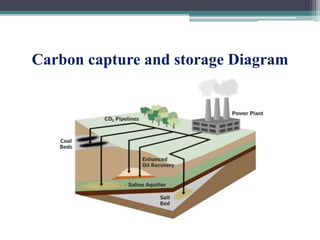
• Carbon Capture & Storage (CCS)
• Underground coal gasification (UCG)
• Combined Cycles
• Techno-economics Of Clean Technologies
• Recommendations
• Conclusion
Introduction
• The utility electricity sector in India has a National
Grid with an installed capacity of 319.60 GW (as of 31 March
2017.) Renewable power plants constituted 30.3% of total
installed capacity. India is the world's third largest
producer and four In order to address the lack of adequate
electricity availability to all the people in the country by March
2019, the Government of India launched a scheme called "Power
for All". This scheme will ensure continuous and uninterrupted
electricity supply to all households, th largest consumer of
electricity. Draft National Electricity Plan, 2016 prepared by GoI
states that India does not need additional non-renewable power
plants till 2027 with the commissioning of 50,025 MW coal
based power plants under construction and additional 100,000
MW renewable power capacity.
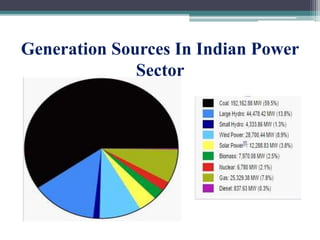
Generation Sources In Indian Power
Sector
Status Of Coal Resources In India
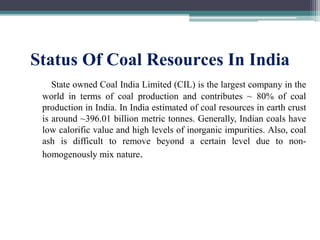
State owned Coal India Limited (CIL) is the largest company in the
world in terms of coal production and contributes ~ 80% of coal
production in India. In India estimated of coal resources in earth crust
is around ~396.01 billion metric tonnes. Generally, Indian coals have
low calorific value and high levels of inorganic impurities. Also, coal
ash is difficult to remove beyond a certain level due to non-
homogenously mix nature.
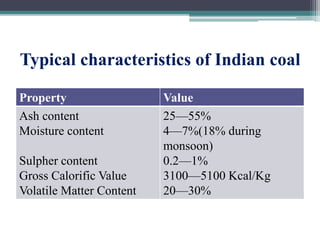
Typical characteristics of Indian coal
Property Value
Ash content
Moisture content
Sulpher content
Gross Calorific Value
Volatile Matter Content
25—55%
4—7%(18% during
monsoon)
0.2—1%
3100—5100 Kcal/Kg
20—30%
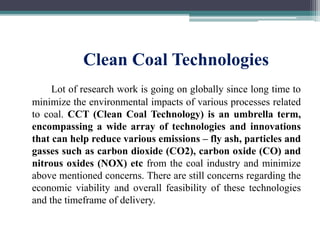
Clean Coal Technologies
Lot of research work is going on globally since long time to
minimize the environmental impacts of various processes related
to coal. CCT (Clean Coal Technology) is an umbrella term,
encompassing a wide array of technologies and innovations
that can help reduce various emissions – fly ash, particles and
gasses such as carbon dioxide (CO2), carbon oxide (CO) and
nitrous oxides (NOX) etc from the coal industry and minimize
above mentioned concerns. There are still concerns regarding the
economic viability and overall feasibility of these technologies
and the timeframe of delivery.
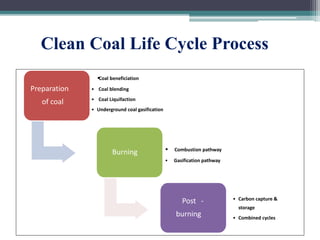
Clean Coal Life Cycle Process
Preparation
of coal
•Coal beneficiation
• Coal blending
• Coal Liquifaction
• Underground coal gasification
Burning • Combustion pathway
• Gasification pathway
Post -
burning
• Carbon capture &
storage
• Combined cycles
Pulverized Coal Fired Boiler
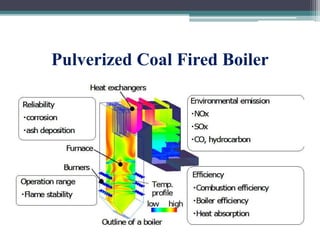
• PC combustion is being used in over 90% of coal-fired plants
worldwide and also in India. There are three main types namely sub-
critical, super-critical and ultra-supercritical with increasing thermo-
dynamic efficiency. A supercritical steam cycle typically has pressure >
226 bars and temperature > 537°C. Ultra-super critical cycle typically
operates at 357 bars/625°C. There are further performance
improvements still expected in PC combustion technology with
expected efficiency up to 55 % by 2020.
Pulverized Coal Fired Boiler
Fluidized Bed Combustion
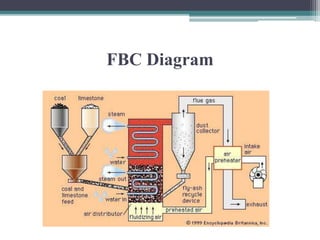
• Fluidized bed combustion (FBC) is a well-established method of
burning low-grade coals, biomass, and other waste fuels. It produces
less NOx and SOx than a conventional PC combustion and is also more
efficient. There are two types of FBC boilers currently available
namely: Circulating Fluidized Bed Combustion (CFBC) and
Pressurized Fluidized Bed Combustion (PFBC). It has proved to be a
promising technology for low grade fuels and research is going on
towards increasing the plant sizes which will definitely improve its
commercial viability.
FBC Diagram
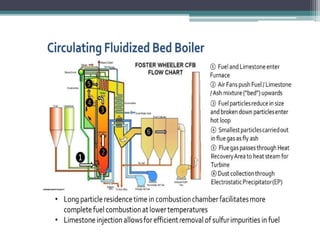
Circulating Fluidized Bed Combustion
• India’s first CFBC boiler of 175 t/h capacity was installed and
commissioned at Sinarmas Pulp and Paper (India) Ltd., Pune by BHEL.
It has proved to be a promising technology for low grade fuels and
research is going on towards increasing the plant sizes which will
definitely improve its commercial viability.
• More efficient boiler.
• It can burn any kind of low grade fuel.
• It is a developing technology for Future.
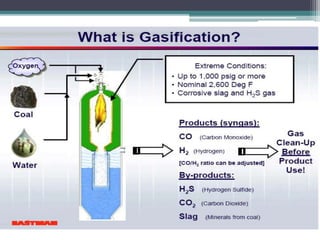
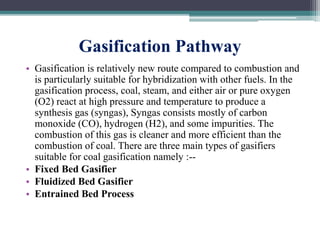
Gasification Pathway
• Gasification is relatively new route compared to combustion and
is particularly suitable for hybridization with other fuels. In the
gasification process, coal, steam, and either air or pure oxygen
(O2) react at high pressure and temperature to produce a
synthesis gas (syngas), Syngas consists mostly of carbon
monoxide (CO), hydrogen (H2), and some impurities. The
combustion of this gas is cleaner and more efficient than the
combustion of coal. There are three main types of gasifiers
suitable for coal gasification namely :--
• Fixed Bed Gasifier
• Fluidized Bed Gasifier
• Entrained Bed Process
IGCC (Integrated Gasification
Combined Cycle)
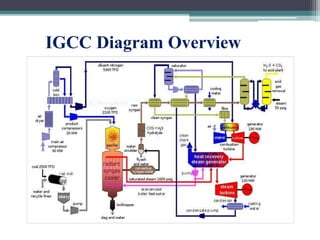
• The integrated gasification combined cycle (IGCC) plant consists of a
gasifier incorporated into a combined cycle system comprising of both
a gas turbine and a steam turbine, . Thus, IGCC is a hybrid system
including coal fired steam power generation and gas turbine based
power generation. Typically, the gas turbine produces 65% of the
power and the steam turbine produces the remaining 35% power. In
comparison to combustion-based technologies, IGCC offers numerous
advantages such as:
• Increased Efficiency From The Combined Cycle
• Improved Environmental Performance
• Lower Cost Of Cleanup Technologies
• Greater Ease Of Carbon Capture
• Lower Incremental Cost Of Capture At Present
IGCC Diagram Overview
Combustion Efficiency and
Pollutants Emission
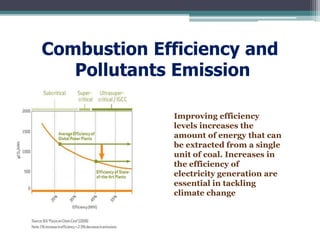
Improving efficiency
levels increases the
amount of energy that can
be extracted from a single
unit of coal. Increases in
the efficiency of
electricity generation are
essential in tackling
climate change
Carbon Capture & Storage (CCS)
• CCS is being developed for use in either combustion or gasification
pathways. For the combustion pathway, post-combustion capture seems
most appropriate. The CO2 would be removed by scrubbing with
solvents such as an amine solution. For the gasification pathway, the
CO2 would be more effectively removed using pre-combustion
capture. In effect, syngas can be de-carbonized through a water-gas
shift conversion, leaving H2 as the fuel for downstream applications
and captured CO2 for either storage or other purposes. Therefore, a
major technical challenge for coal-fired generators is the CO2 capture
side of CCS so that future plants can be built to be CO2 capture-ready
for when CCS becomes available. Currently, India has annual CO2
emissions of around 1343 Mt with approximately half being emitted
from large point sources suitable for CO2 capture.
Carbon capture and storage Diagram
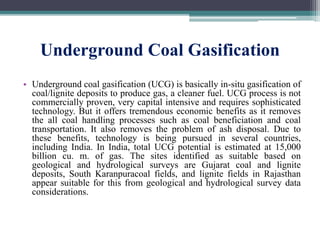
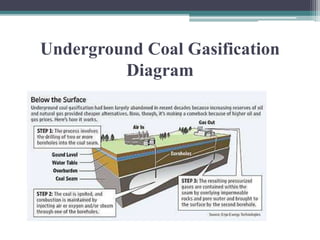
Underground Coal Gasification
• Underground coal gasification (UCG) is basically in-situ gasification of
coal/lignite deposits to produce gas, a cleaner fuel. UCG process is not
commercially proven, very capital intensive and requires sophisticated
technology. But it offers tremendous economic benefits as it removes
the all coal handling processes such as coal beneficiation and coal
transportation. It also removes the problem of ash disposal. Due to
these benefits, technology is being pursued in several countries,
including India. In India, total UCG potential is estimated at 15,000
billion cu. m. of gas. The sites identified as suitable based on
geological and hydrological surveys are Gujarat coal and lignite
deposits, South Karanpuracoal fields, and lignite fields in Rajasthan
appear suitable for this from geological and hydrological survey data
considerations.
Underground Coal Gasification
Diagram
Combined Cycles
Co-generation in the power sector has been identified as another
way of reducing emissions and achieving better energy output. In
cogeneration systems, combined cycles are typically used to produce
electricity as well as thermal energy of required quality. Along with
above mentioned IGCC system other advanced combined cycles, that
can be utilized for co-generation are as listed below:
• Integrated Gasification Humid Air Turbine (IGHAT)
• Pressurized Pulverized Coal-fired Combined Cycle (PPCC)
Techno-economics Of Clean Coal
Technologies
• Clean Coal Life Cycle Process
• Pulverized Coal Technology (PC)
• Circulating Fluidized Bed Combustion (CFBC)
• Integrated Gasification Combined Cycle (IGCC)
• Underground Coal Gasification Process (UCGP)
• Carbon Capture And Storage (CCS)
Recommendations
• It may be seen that clean coal technologies are still evolving and there
multiple choices for technologies in various stages of coal life cycle.
Considering this, keeping long term options open by not making rigid
technology choices will be logical for a developing country like India.
In short and medium term, the sector can be pushed forward by
implementing policies and regulations to meet following objectives.
a) Improvement in the efficiency of the power plants (generating
stock, T&D network, and end-use sectors)
b) Implementation of supercritical and ultra-supercritical
technology based generation plants
c) Feasibility and suitability assessment for emerging technologies
d) Enforcement and tightening of environmental pollution controls
utilizing better pollution control technologies and increased public
awareness
Conclusion
At global level, the future of clean coal technologies is bright and
they will definitely play a key role in global efforts of reduction in
environmental impact of power generation. The clean coal technologies
offer both: more efficient power generation and cleaner power
generation i.e. reduction in GHG emissions per unit of power produced.
The recent developments in clean coal technologies have been very
encouraging and have increased possibility of reaching ‚near-zero–
emission power generation.
Any Queries……………?

Environmental growth by using clean coal technology in new

  • 1.
    Environmental Growth By UsingClean Coal Technology In India Presented by:- Ms Akanchha G.Dhanasekar K.Aditya Dora
  • 2.
    Contents • Introduction • StatusOf Coal Resources In India • Clean Coal Technologies (CCT) • Pulverized Coal-Fired Boiler (PC) • Fluidized Bed Combustion (FBC) • Circulating Fluidized Bed Combustion (CFBC) • Gasification • IGCC (Integrated Gasification Combined Cycle) • Carbon Capture & Storage (CCS) • Underground coal gasification (UCG) • Combined Cycles • Techno-economics Of Clean Technologies • Recommendations • Conclusion
  • 3.
    Introduction • The utilityelectricity sector in India has a National Grid with an installed capacity of 319.60 GW (as of 31 March 2017.) Renewable power plants constituted 30.3% of total installed capacity. India is the world's third largest producer and four In order to address the lack of adequate electricity availability to all the people in the country by March 2019, the Government of India launched a scheme called "Power for All". This scheme will ensure continuous and uninterrupted electricity supply to all households, th largest consumer of electricity. Draft National Electricity Plan, 2016 prepared by GoI states that India does not need additional non-renewable power plants till 2027 with the commissioning of 50,025 MW coal based power plants under construction and additional 100,000 MW renewable power capacity.
  • 4.
    Generation Sources InIndian Power Sector
  • 5.
    Status Of CoalResources In India State owned Coal India Limited (CIL) is the largest company in the world in terms of coal production and contributes ~ 80% of coal production in India. In India estimated of coal resources in earth crust is around ~396.01 billion metric tonnes. Generally, Indian coals have low calorific value and high levels of inorganic impurities. Also, coal ash is difficult to remove beyond a certain level due to non- homogenously mix nature.
  • 6.
    Typical characteristics ofIndian coal Property Value Ash content Moisture content Sulpher content Gross Calorific Value Volatile Matter Content 25—55% 4—7%(18% during monsoon) 0.2—1% 3100—5100 Kcal/Kg 20—30%
  • 7.
    Clean Coal Technologies Lotof research work is going on globally since long time to minimize the environmental impacts of various processes related to coal. CCT (Clean Coal Technology) is an umbrella term, encompassing a wide array of technologies and innovations that can help reduce various emissions – fly ash, particles and gasses such as carbon dioxide (CO2), carbon oxide (CO) and nitrous oxides (NOX) etc from the coal industry and minimize above mentioned concerns. There are still concerns regarding the economic viability and overall feasibility of these technologies and the timeframe of delivery.
  • 8.
    Clean Coal LifeCycle Process Preparation of coal •Coal beneficiation • Coal blending • Coal Liquifaction • Underground coal gasification Burning • Combustion pathway • Gasification pathway Post - burning • Carbon capture & storage • Combined cycles
  • 9.
    Pulverized Coal FiredBoiler • PC combustion is being used in over 90% of coal-fired plants worldwide and also in India. There are three main types namely sub- critical, super-critical and ultra-supercritical with increasing thermo- dynamic efficiency. A supercritical steam cycle typically has pressure > 226 bars and temperature > 537°C. Ultra-super critical cycle typically operates at 357 bars/625°C. There are further performance improvements still expected in PC combustion technology with expected efficiency up to 55 % by 2020.
  • 10.
  • 11.
    Fluidized Bed Combustion •Fluidized bed combustion (FBC) is a well-established method of burning low-grade coals, biomass, and other waste fuels. It produces less NOx and SOx than a conventional PC combustion and is also more efficient. There are two types of FBC boilers currently available namely: Circulating Fluidized Bed Combustion (CFBC) and Pressurized Fluidized Bed Combustion (PFBC). It has proved to be a promising technology for low grade fuels and research is going on towards increasing the plant sizes which will definitely improve its commercial viability.
  • 12.
  • 13.
    Circulating Fluidized BedCombustion • India’s first CFBC boiler of 175 t/h capacity was installed and commissioned at Sinarmas Pulp and Paper (India) Ltd., Pune by BHEL. It has proved to be a promising technology for low grade fuels and research is going on towards increasing the plant sizes which will definitely improve its commercial viability. • More efficient boiler. • It can burn any kind of low grade fuel. • It is a developing technology for Future.
  • 16.
    Gasification Pathway • Gasificationis relatively new route compared to combustion and is particularly suitable for hybridization with other fuels. In the gasification process, coal, steam, and either air or pure oxygen (O2) react at high pressure and temperature to produce a synthesis gas (syngas), Syngas consists mostly of carbon monoxide (CO), hydrogen (H2), and some impurities. The combustion of this gas is cleaner and more efficient than the combustion of coal. There are three main types of gasifiers suitable for coal gasification namely :-- • Fixed Bed Gasifier • Fluidized Bed Gasifier • Entrained Bed Process
  • 17.
    IGCC (Integrated Gasification CombinedCycle) • The integrated gasification combined cycle (IGCC) plant consists of a gasifier incorporated into a combined cycle system comprising of both a gas turbine and a steam turbine, . Thus, IGCC is a hybrid system including coal fired steam power generation and gas turbine based power generation. Typically, the gas turbine produces 65% of the power and the steam turbine produces the remaining 35% power. In comparison to combustion-based technologies, IGCC offers numerous advantages such as: • Increased Efficiency From The Combined Cycle • Improved Environmental Performance • Lower Cost Of Cleanup Technologies • Greater Ease Of Carbon Capture • Lower Incremental Cost Of Capture At Present
  • 18.
  • 19.
    Combustion Efficiency and PollutantsEmission Improving efficiency levels increases the amount of energy that can be extracted from a single unit of coal. Increases in the efficiency of electricity generation are essential in tackling climate change
  • 20.
    Carbon Capture &Storage (CCS) • CCS is being developed for use in either combustion or gasification pathways. For the combustion pathway, post-combustion capture seems most appropriate. The CO2 would be removed by scrubbing with solvents such as an amine solution. For the gasification pathway, the CO2 would be more effectively removed using pre-combustion capture. In effect, syngas can be de-carbonized through a water-gas shift conversion, leaving H2 as the fuel for downstream applications and captured CO2 for either storage or other purposes. Therefore, a major technical challenge for coal-fired generators is the CO2 capture side of CCS so that future plants can be built to be CO2 capture-ready for when CCS becomes available. Currently, India has annual CO2 emissions of around 1343 Mt with approximately half being emitted from large point sources suitable for CO2 capture.
  • 21.
    Carbon capture andstorage Diagram
  • 22.
    Underground Coal Gasification •Underground coal gasification (UCG) is basically in-situ gasification of coal/lignite deposits to produce gas, a cleaner fuel. UCG process is not commercially proven, very capital intensive and requires sophisticated technology. But it offers tremendous economic benefits as it removes the all coal handling processes such as coal beneficiation and coal transportation. It also removes the problem of ash disposal. Due to these benefits, technology is being pursued in several countries, including India. In India, total UCG potential is estimated at 15,000 billion cu. m. of gas. The sites identified as suitable based on geological and hydrological surveys are Gujarat coal and lignite deposits, South Karanpuracoal fields, and lignite fields in Rajasthan appear suitable for this from geological and hydrological survey data considerations.
  • 23.
  • 24.
    Combined Cycles Co-generation inthe power sector has been identified as another way of reducing emissions and achieving better energy output. In cogeneration systems, combined cycles are typically used to produce electricity as well as thermal energy of required quality. Along with above mentioned IGCC system other advanced combined cycles, that can be utilized for co-generation are as listed below: • Integrated Gasification Humid Air Turbine (IGHAT) • Pressurized Pulverized Coal-fired Combined Cycle (PPCC)
  • 25.
    Techno-economics Of CleanCoal Technologies • Clean Coal Life Cycle Process • Pulverized Coal Technology (PC) • Circulating Fluidized Bed Combustion (CFBC) • Integrated Gasification Combined Cycle (IGCC) • Underground Coal Gasification Process (UCGP) • Carbon Capture And Storage (CCS)
  • 26.
    Recommendations • It maybe seen that clean coal technologies are still evolving and there multiple choices for technologies in various stages of coal life cycle. Considering this, keeping long term options open by not making rigid technology choices will be logical for a developing country like India. In short and medium term, the sector can be pushed forward by implementing policies and regulations to meet following objectives. a) Improvement in the efficiency of the power plants (generating stock, T&D network, and end-use sectors) b) Implementation of supercritical and ultra-supercritical technology based generation plants c) Feasibility and suitability assessment for emerging technologies d) Enforcement and tightening of environmental pollution controls utilizing better pollution control technologies and increased public awareness
  • 27.
    Conclusion At global level,the future of clean coal technologies is bright and they will definitely play a key role in global efforts of reduction in environmental impact of power generation. The clean coal technologies offer both: more efficient power generation and cleaner power generation i.e. reduction in GHG emissions per unit of power produced. The recent developments in clean coal technologies have been very encouraging and have increased possibility of reaching ‚near-zero– emission power generation.
  • 28.